

Crypto World
Sam Altman ChatGPT AI Predicts SpaceX Stock Price By End of 2026

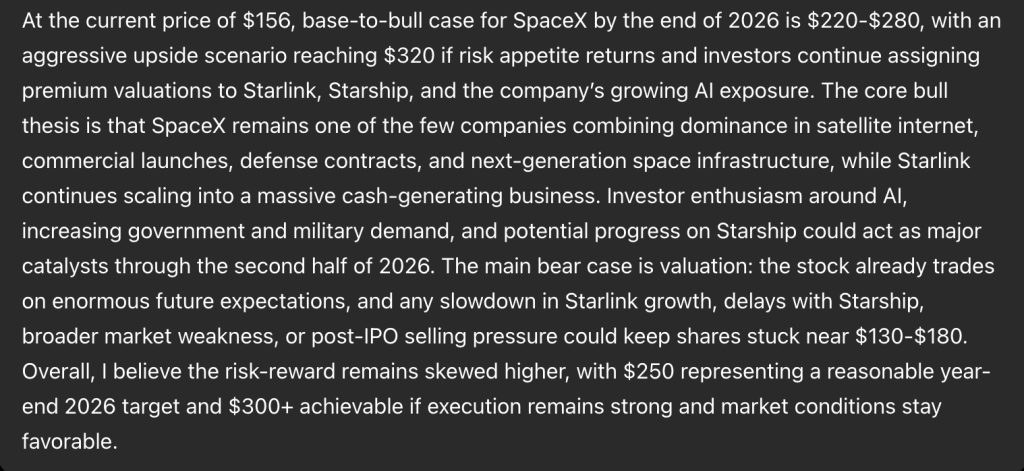
ChatGPT AI just made a prediction on SpaceX stock price that treats the recent pullback as an opportunity rather than a warning. The model sees $220 to $280 by the end of 2026, with an aggressive case stretching to $320.
The bull case treats SpaceX as a rare combination of businesses trading under one ticker. At $156 today, the model frames this as a base-to-bull setup rather than a stretch target.
SpaceX sits at the intersection of satellite internet dominance, commercial launch supremacy, major defense contracts, and next-generation space infrastructure, while Starlink continues to scale into an increasingly massive, cash-generating business on its own. Investor enthusiasm around artificial intelligence adds another layer, especially given the company’s growing exposure through its merged AI operations.
Rising government and military demand could act as a steady tailwind through the back half of 2026, and any real progress on Starship would give bulls a fresh headline to rally around.
If risk appetite returns broadly and investors keep assigning premium valuations to this combination of businesses, the model sees $250 as a reasonable year-end target, with $300 or higher achievable if execution stays strong and conditions stay favorable.
The bear case comes down to one word: valuation. The stock already prices in enormous future expectations, leaving little room for disappointment.
Any slowdown in Starlink subscriber growth, delays with Starship, broader market weakness, or simple post IPO selling pressure as lockups expire could keep shares stuck in the $130 to $180 range for a while instead of breaking higher.
SpaceX Price Prediction: SPCX Stock Tests Gravity After Its Record-Setting Launch
The intraday chart shows SpaceX trading at $156.06 after a turbulent first two weeks as a public company. Shares spiked from their IPO base into the low $220s before rolling over hard, then chopped through a series of lower highs on the way back down toward $150.
That kind of explosive debut, followed by a sharp pullback, is common for mega-cap IPOs once early momentum buyers take profits and lockup dynamics start to weigh on sentiment.
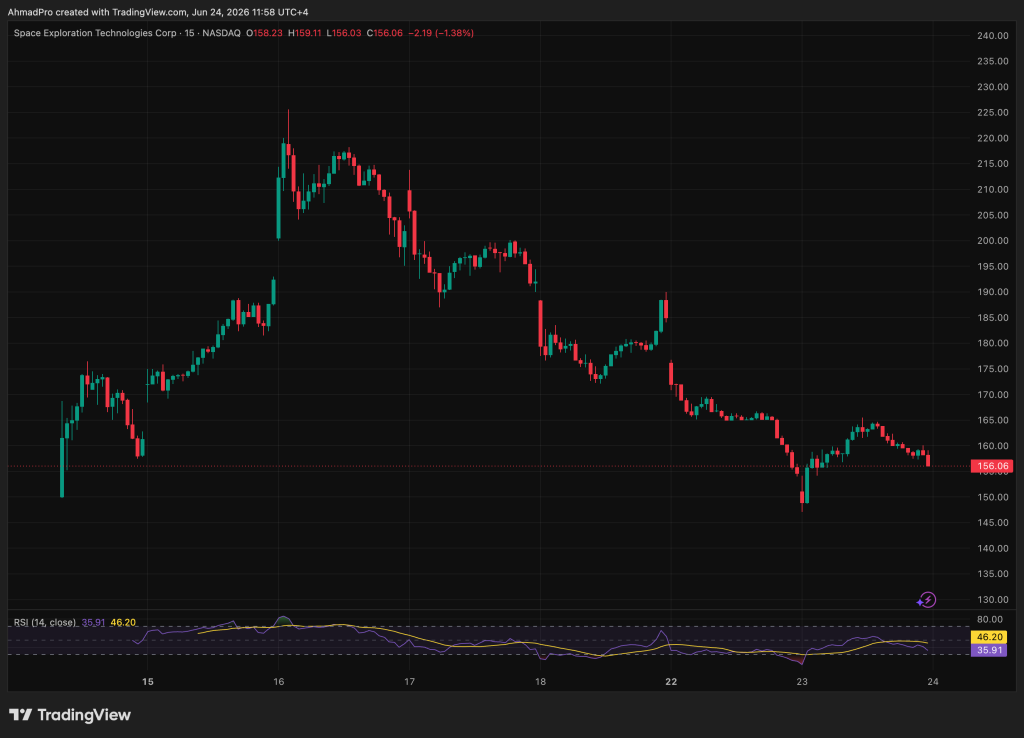
Price recently found support near $150, bounced toward $190, then faded again into the current $156 level, which puts it right in the middle of that post IPO trading range.
Immediate resistance sits near $165, then a tougher ceiling around $190 where the last bounce attempt stalled out. Support holds at $150, the same zone defended during the sharpest part of the recent selloff.
RSI is reading 35.91 against a signal line of 46.20, putting momentum well below its own average and firmly in weak territory for this short trading history. That wide negative gap signals sellers are still very much in control right now.
Overall momentum looks shaky rather than stabilizing at this point. Given how fresh this listing is, SpaceX will likely need to hold $150 and reclaim $190 before the $250 target starts looking like anything more than a longer-term bet on the story rather than the chart.
Don’t Miss Out on Our $1,000 USDT Airdrop on ByBit
LiquidChain Is Catching the Attention of SpaceX holders: ChatGPT AI Predicts It’s the Next 100x
The rotation is already happening. Most people will only see it in hindsight.
Large-cap crypto is not failing. It is capped. Bitcoin, Ethereum, and XRP have been pressing against the same resistance bands for weeks. The macro tailwinds keep getting delayed.
The institutional inflows keep getting pushed to next quarter. Holding assets where the upside depends on catalysts you cannot control is not a strategy. It is waiting.
A capital that has navigated enough cycles does not wait at resistance. It moves before the destination becomes obvious.
Early-stage infrastructure plays operate on different math entirely. A small enough market cap means a modest rotation produces dramatic price movement. The asymmetry exists because the market has not priced in what is being built yet. That gap between current valuation and what the project is actually worth is where the returns come from.
Multi-chain fragmentation costs DeFi real money every single day. Bitcoin, Ethereum, and Solana run completely isolated liquidity systems with no native way to connect them. Every user moving value between ecosystems absorbs that cost directly in fees, slippage, and failed transactions.
LiquidChain collapses all 3 networks into a single execution layer. One deployment. Full ecosystem access. No cross-chain tax on every interaction.
The market has not found this yet. That is the entire point.
The presale is at $0.01454 with just over $820,000 raised. Ground floor is not a marketing phrase here. It is a description of where this actually sits in its lifecycle.
Execution is unproven. Adoption is unknown. Those risks are real and worth naming directly. Established assets offer a smoother ride toward a ceiling that is already visible. This offers an earlier seat at a table that has not been set yet.
Explore the LiquidChain Presale
The post Sam Altman ChatGPT AI Predicts SpaceX Stock Price By End of 2026 appeared first on Cryptonews.


Bitcoin slipped to fresh two-week lows at the start of the Wall Street session on Wednesday, falling below $60,000 for the first time since June 10. The move reflects traders’ growing concern that the market is building pressure in the short term, even as many participants still frame the action as part of a broader range.
On the macro side, US stocks showed little immediate reaction to reported progress around US-Iran de-escalation efforts. Even with updated comments from President Donald Trump referencing the Strait of Hormuz route, risk assets remained largely stuck, limiting follow-through for a bullish impulse in crypto.
Key takeaways
- BTC traded below $60,000 for the first time since June 10, marking fresh two-week lows.
- Traders pointed to rising short interest and higher funding rates as reasons downside could extend before any bounce.
- A number of market commentators still expect a relief rally from lower time frames, with upside targets discussed closer to $70,000.
- US stock moves at the open were subdued despite Trump’s additional comments tied to the Strait of Hormuz.
BTC edges through $60,000 as traders watch for a low-timeframe bounce
TradingView data cited in market commentary showed BTC/USD dropping under the $60,000 level for the first time since June 10. For traders focused on intraday structure, the key question became whether this break signals a true trend change—or whether it represents a “range low” test that invites dip-buying.
Several participants suggested that conditions were becoming more conducive to a capitulation-style move. One recurring theme was the combination of rising short interest and increased funding rates, which can amplify sell pressure when leverage is positioned against the market.
Trader Killa argued that this was the time to begin looking for a bounce on lower time frames, using the “LTF” framing in his ongoing X commentary. In a separate post, he shared a chart scenario pointing to a relief move toward the vicinity of $70,000, described as something that should occur following the bounce structure he highlighted.
Another trader, RektProof, expressed a broadly similar view: Bitcoin, in his assessment, remained range-bound, with $60,000 acting as the “floor” that could hold for the remainder of the month. He added that the market could first move up to supply areas and then drop back toward “EQ lows” to set up a later sequence toward “poor highs + 70k,” keeping both the downside and the eventual rebound in play.
Why funding and positioning are getting attention
The focus on funding rates and short interest matters because it speaks to how much leverage is likely sitting on the wrong side of the move. When funding rises alongside increasing short activity, it can signal that traders are paying to maintain short exposure—or that crowded positioning is building a reflexive response if price stabilizes.
In that setup, analysts who expect a quick relief rally typically rely on a behavioral catalyst: once downside extends enough to trigger forced exits or reduce the viability of additional shorts, price can rebound sharply off the lower time frame structure. The reports from traders did not claim certainty, but they did converge on a similar near-term narrative: a downside attempt is plausible, yet a bounce from the range low is still the base case for many.
US market reaction appears muted despite Hormuz transit assurances
While crypto traders watched BTC’s chart levels, macro headlines were also in the background. According to the article’s reporting, US stocks appeared to have largely priced in relief related to US-Iran peace progress, leading to limited upside at the open.
President Trump described additional elements of cooperation on Truth Social, specifically referencing the Strait of Hormuz oil transit corridor. The post stated there would be “no tolls, no insurance costs, & no other charges of any kind being sought or received by Iran on ships traveling” via the route. Even with that detail, immediate price action in equities did not translate into strong risk-on momentum for the session.
At the time of writing in the source, the S&P 500 was up 0.4%, while the Nasdaq Composite had dipped slightly negative. This split—positive broad-market performance with a softer tech-heavy index—helped explain why the macro impulse was not strong enough to clearly lift sentiment across risk assets, including Bitcoin.
Traders also look ahead to upcoming data and earnings volatility
Crypto’s sensitivity to risk sentiment is often reinforced by scheduled economic and corporate catalysts. The earlier coverage referenced in the source highlighted factors that could keep enthusiasm restrained, including forward earnings guidance from Micron Technologies and the upcoming Personal Consumption Expenditures (PCE) index data due out on Wednesday and Thursday, respectively.
That matters because PCE is a key inflation gauge that can influence expectations for monetary policy. If inflation readings surprise, market pricing for rates can shift quickly—often affecting both equities and liquid crypto markets through broader liquidity and risk appetite channels.
For the next trading sessions, the main thing to watch is whether BTC holds the $60,000 area after this break and whether funding/positioning dynamics cool alongside any bounce attempts toward the $70,000 zone. If the market fails to reclaim support quickly, the range-low thesis may lose credibility; if it rebounds sharply, traders’ low-timeframe “relief” expectations could regain traction.
Bitcoin (BTC) is “compressed” at low levels but its classic cycles remain intact, say new research.
Key points:
- Bitcoin is acting similar to prior cycles as it circles a key four-year trend line.
- Analysis says that BTC price action is currently “compressed” as it trades below a $76,400 target.
- A new estimate put the bear market as just over 70% complete.
Analysis on $62,000 BTC price: Bitcoin “not broken”
In an X post on Wednesday, analyst David Eng said that BTC price action still “runs on two clocks.”
“400-day clock, $BTC looks cyclical. ~4-year clock, the cycle noise gets filtered out and the adoption structure appears,” he summarized.
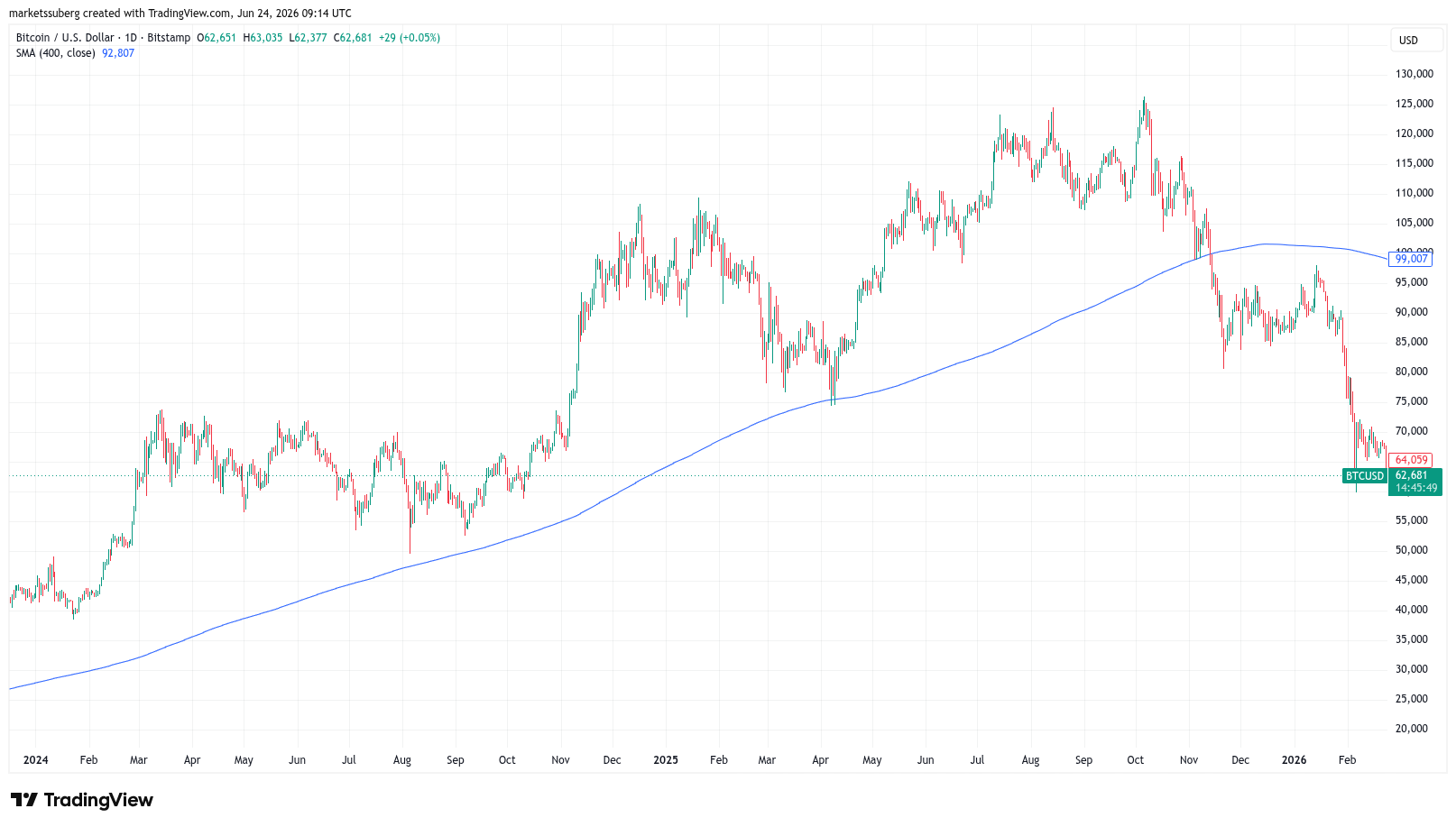
Marking time for Eng are the 400-day simple moving average (SMA), as well as its four-year equivalent. The former is notable for its ability to act as support throughout Bitcoin bull markets, seeing no daily candle closes below it this cycle or last.
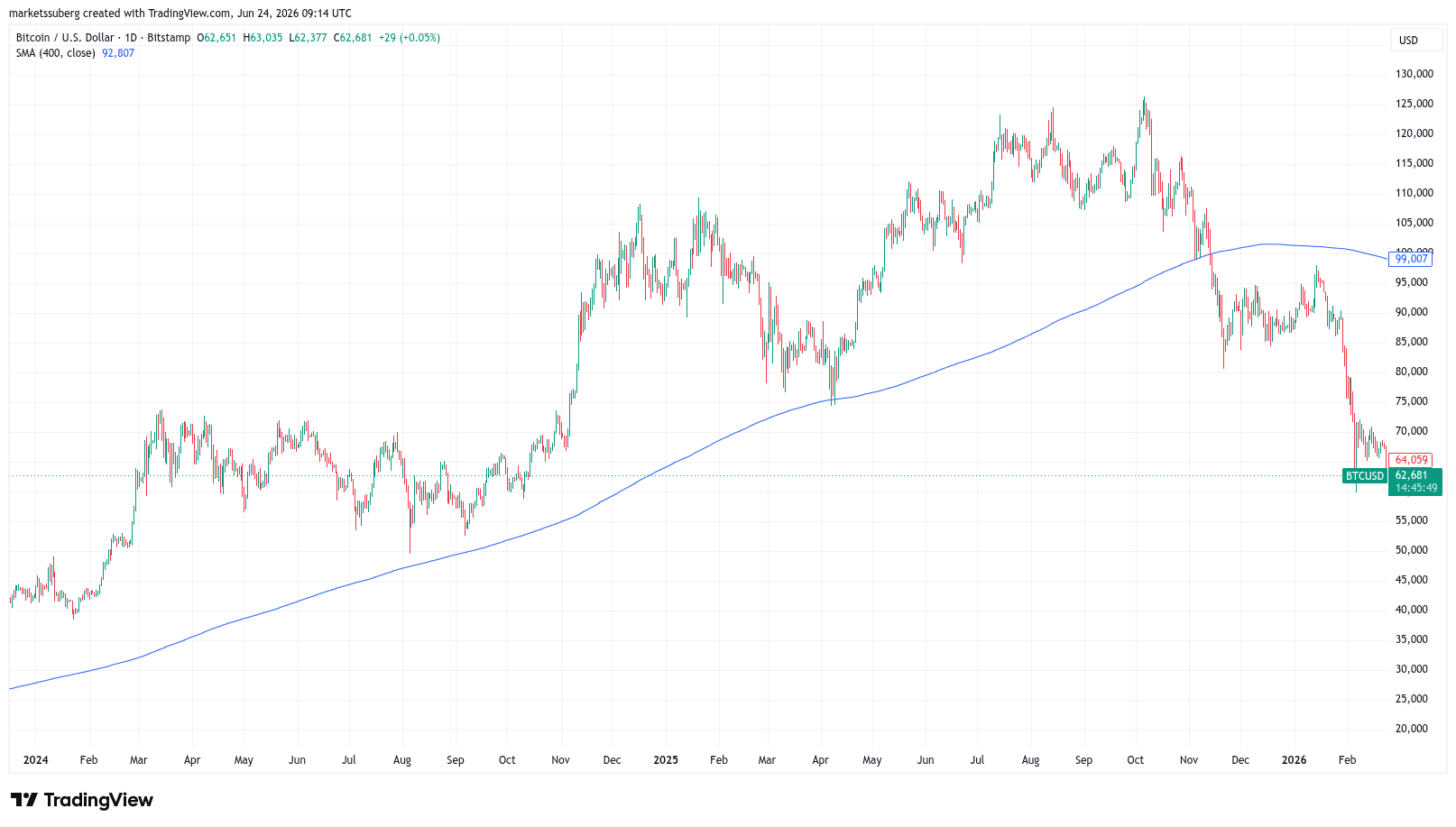
BTC/USD one-day chart with 400SMA. Source: Cointelegraph/TradingView
On four-year time frames, meanwhile, a cleaner uptrend emerges, with price fluctuating above and below the trend line depending on its position in the cycle.
“The point is that Bitcoin keeps stretching away from this adoption structure and then reverting back toward it,” Eng summarized.
Currently, the four-year trend line suggests a fair price of around $76,400, making BTC/USD undervalued by around 20%. A chart uploaded by Eng also shows Bitcoin’s Power Law price, this now well into uncharted territory at nearly $135,000.
“$BTC is not broken,” he concluded.
“It is compressed below its adoption structure.”
Bitcoin bear market losses could resume in August
As Cointelegraph reported, historical comparisons suggest that Bitcoin’s current bear market will continue for some months yet.
Related: US dollar strength hits highest since May 2025: Five things to know in Bitcoin this week
The latest estimates from trader and analyst Rekt Capital put the current downtrend at around 71% complete.
His analysis continues to focus on the fate of the 50-month exponential moving average (EMA), currently at $63,900.
“At this stage, if June Monthly Closes just like this at $62k then that would confirm the breakdown from the 50-Month EMA. So it July turns into a green month, then that could see price turn the 50 EMA into new resistance,” he told X followers.
“Then August would cancel out July and send Bitcoin into downside continuation.”
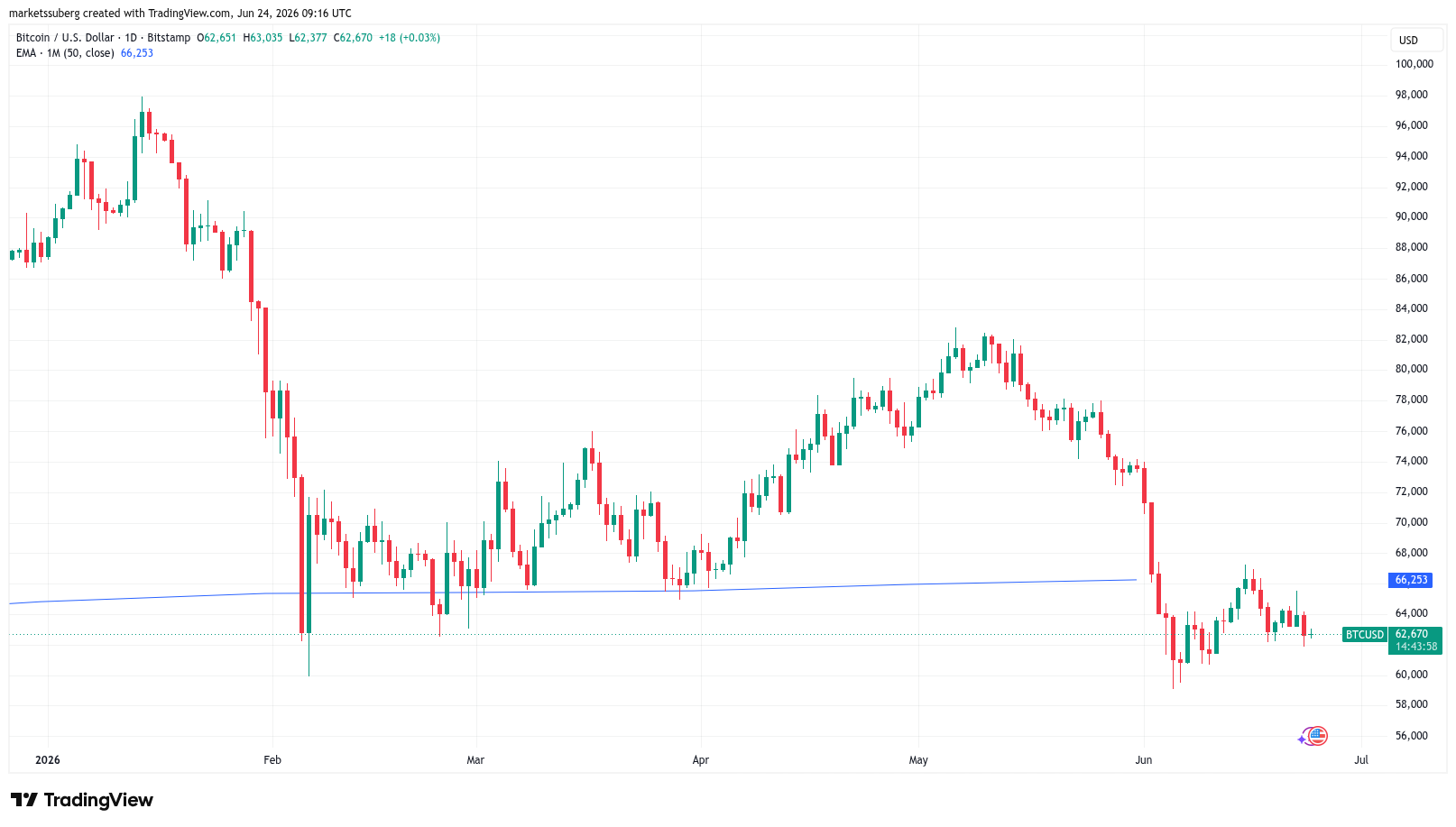
BTC/USD one-day chart with 50-month EMA. Source: Cointelegraph/TradingView
Michael Saylor’s Strategy (MSTR) is testing a technical setup that last appeared before the stock’s 99% collapse during the dot-com bubble burst in the early 2000s.
Key takeaways:
- MSTR is testing a monthly head-and-shoulders setup similar to the one that preceded its dot-com-era collapse.
- Strategy’s shrinking cash reserve and rising dividend obligations are increasing dilution risk for MSTR common shareholders.
MSTR bearish reversal pattern points to 80% downside risk
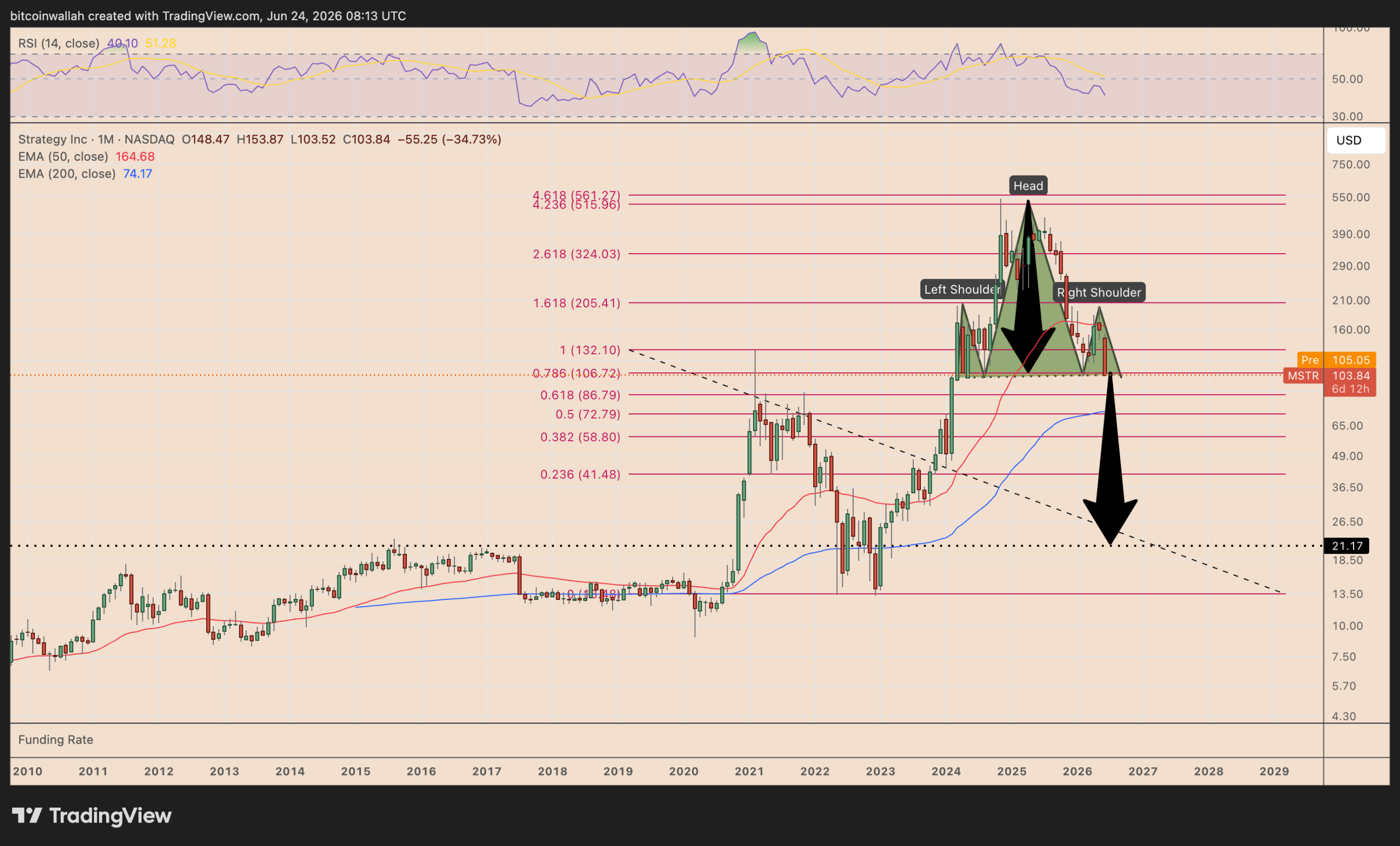
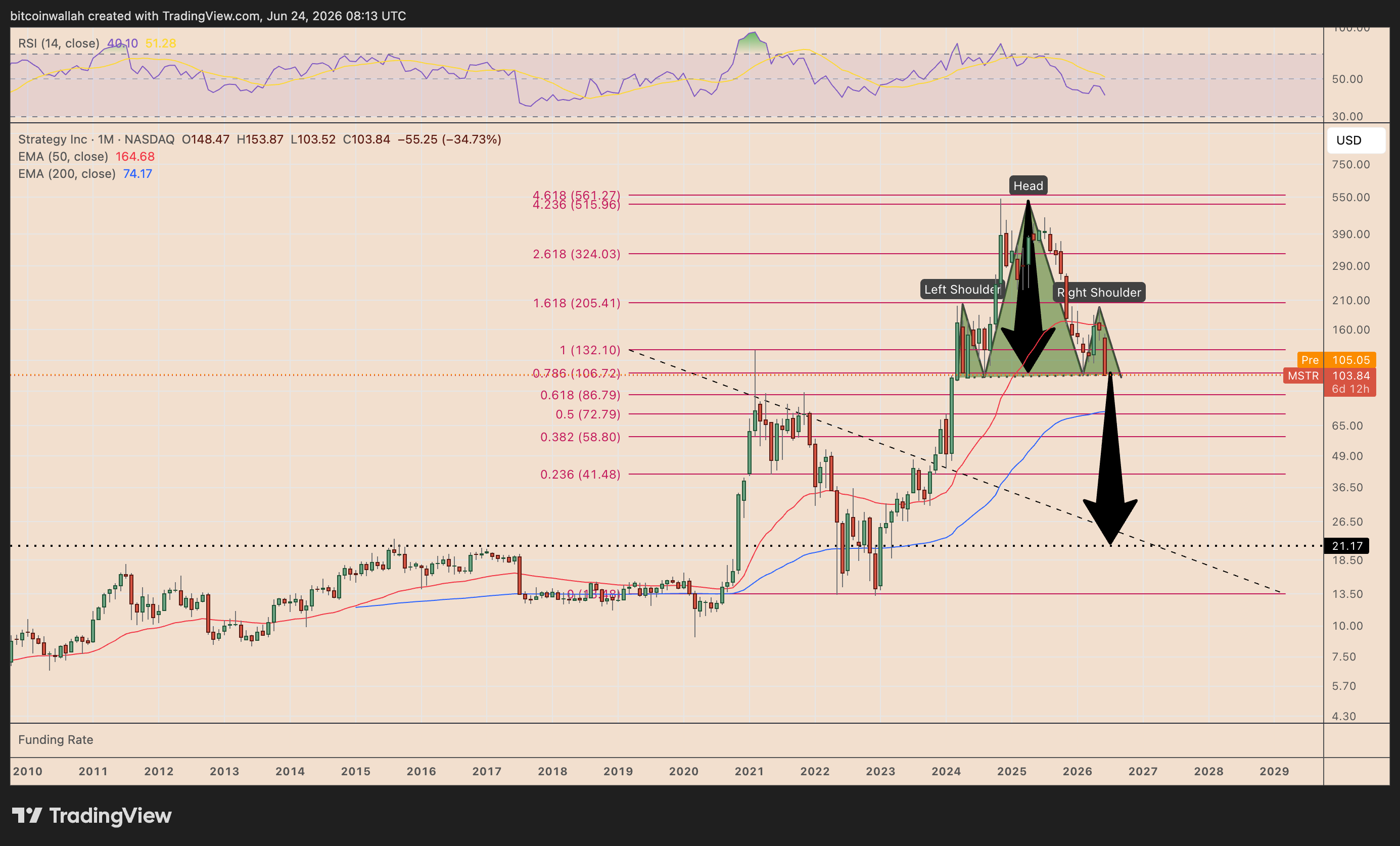
As of late June, MSTR’s monthly chart was painting a potential head-and-shoulders (H&S) pattern.
An H&S pattern develops when the price forms three peaks, with the middle peak, called the “head,” being steeper than the other two, which are called “shoulders.” The neckline is the support level connecting the major pullbacks between those peaks.
The pattern typically resolves when the price breaks below the neckline and, in a perfect scenario, falls by as much as the maximum distance between the head and the neckline.
MSTR monthly performance chart. Source: TradingView
MSTR has formed a near-perfect H&S pattern since March 2024 and risks a breakdown below the neckline support at $100–$105.
A decisive move below it would confirm the bearish setup. It could open the door to a deeper, multi-year correction toward the measured target of around $20, down approximately 80% from current levels.
The structure looks similar to the head-and-shoulders top MSTR formed during the dot-com bubble era. Back then, the stock broke below a comparable neckline setup before collapsing by more than 99% from its peak in two years.
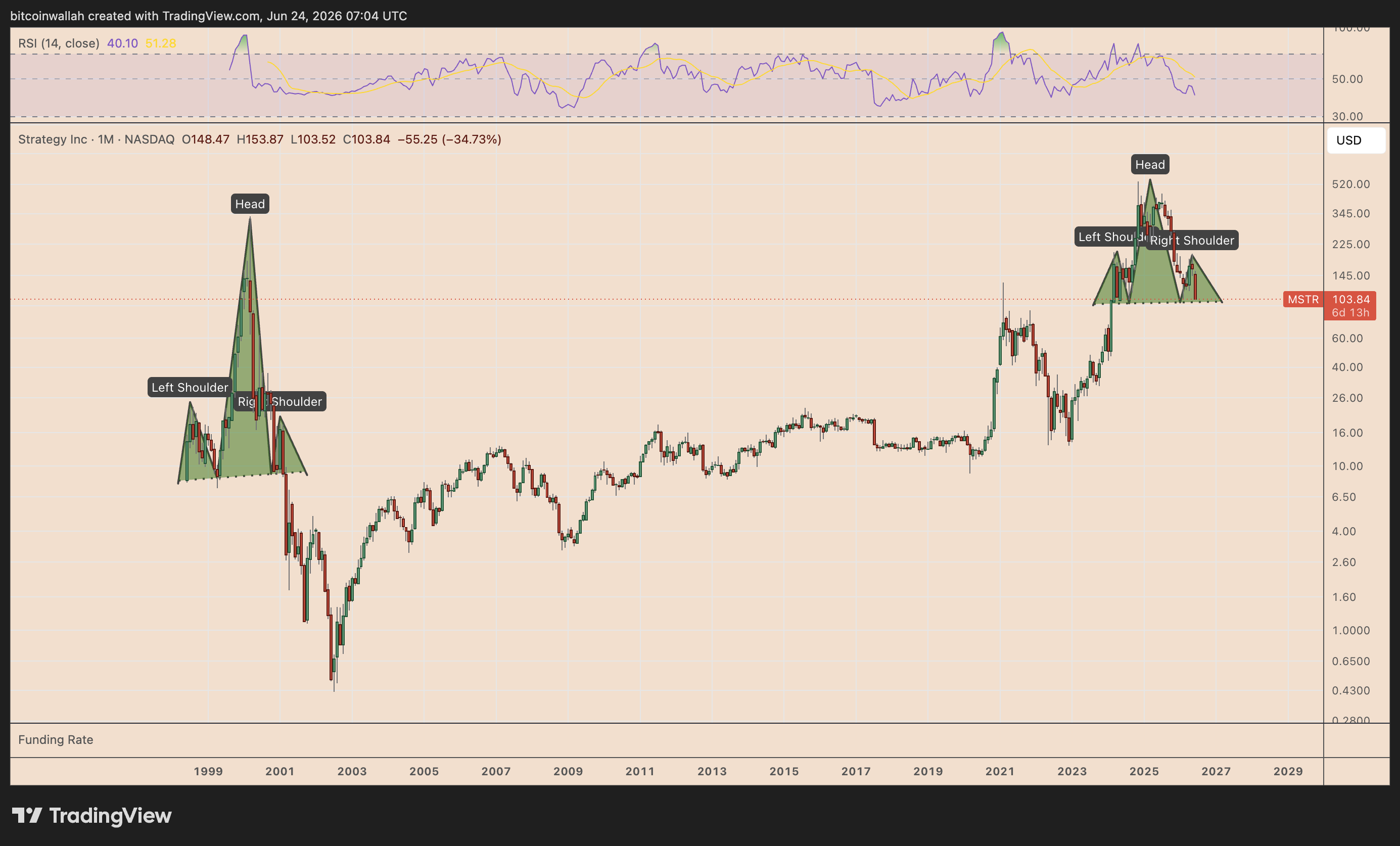
MSTR monthly performance chart. Source: TradingView
Strategy cash squeeze raises dilution risk for MSTR shareholders
Strategy’s common stock, MSTR, is facing fresh dilution risk as the company’s cash reserve shrinks and its preferred-stock dividend burden grows.
As of June, Strategy’s US dollar cash reserve had fallen 38% since the start of 2026, while its yearly dividend obligations had nearly quadrupled to $1.2 billion, according to CryptoQuant analyst Julio Moreno.
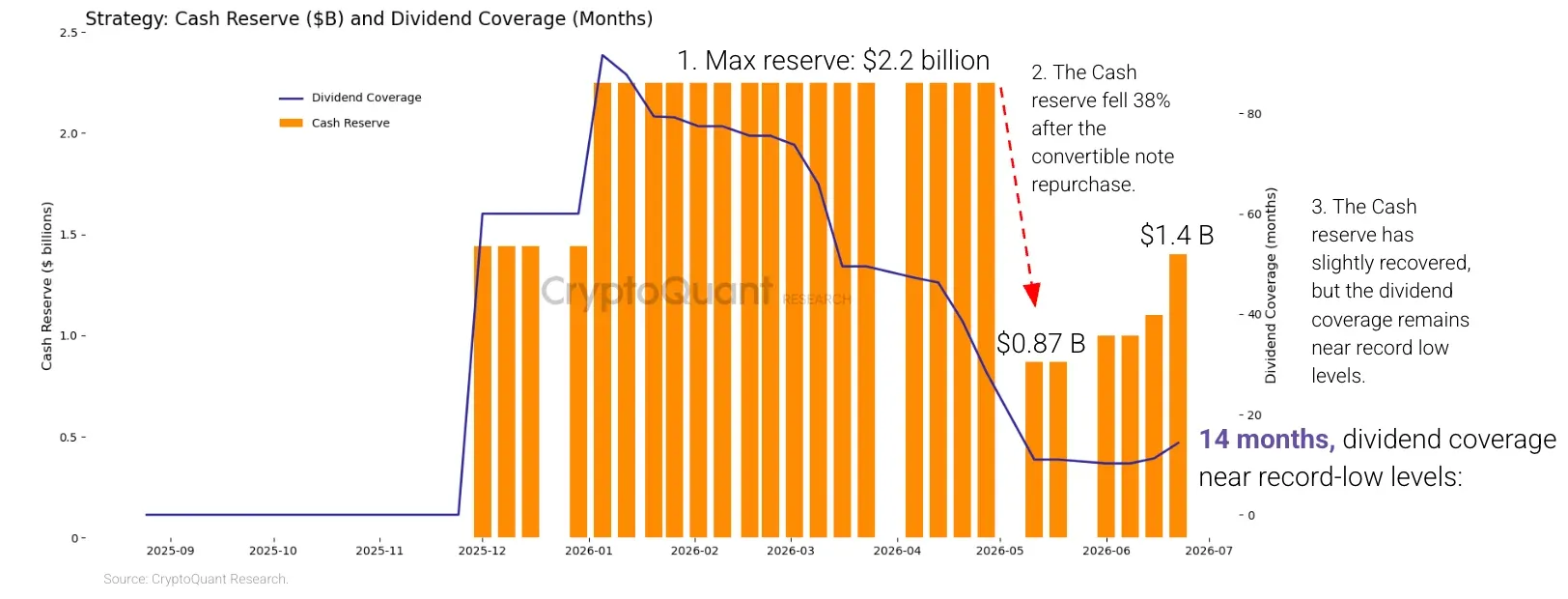
Strategy cash reserve and dividend coverage. Source: CryptoQuant
The company uses cash to pay dividends on its preferred stocks, primarily Stretch (STRC).
But Moreno said Strategy’s preferred-dividend coverage has dropped to about 14 months from more than seven years, meaning it now has enough cash to cover just over one year of STRC dividend payments.
That pressure has shown up in STRC’s market price. STRC fell to a record low of $82.50 last week and has since stayed mostly between $82 and $89, well below its $100 par value.
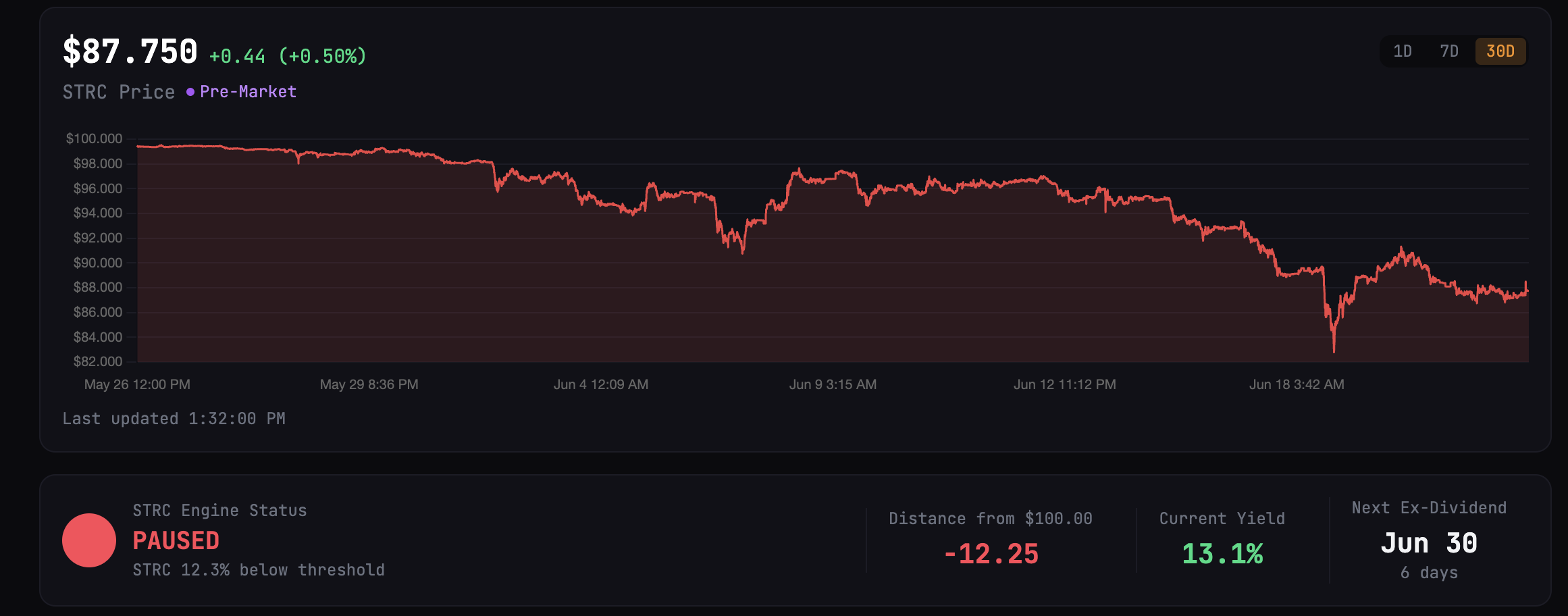
STRC price and yield chart. Source: STRC.LIVE
The decline has pushed STRC’s effective yield above 13%, compared with its stated dividend rate of about 11.5%, showing investors are demanding a higher return to hold it.
“At current dividend obligations of $1.2 billion per year, restoring 24 months of coverage would require a cash reserve of approximately $2.8 billion, roughly twice what Strategy holds today,” Moreno said, adding:
“A higher cash reserve is the most direct signal the market needs to regain confidence in STRC.”
Strategy holds 847,363 BTC, acquired at an average price of about $75,650 per coin, higher than today’s BTC price of around $62,600. Selling Bitcoin during a downturn could lock in losses and weaken its long-running accumulation narrative.
Instead, Strategy has raised STRC’s dividend rate and issued more MSTR common shares to raise cash. For instance, the company sold 2.71 million MSTR common shares for about $335.5 million in June, while using only $34.9 million of the proceeds to buy 520 BTC.
That keeps Strategy’s Bitcoin holdings largely intact, but it increases dilution risk for existing MSTR shareholders.
Related: Bitcoin price is down over 40% since STRC launched: Is Strategy ‘fine’?
If STRC remains below $100, Strategy may need to keep issuing common shares, slow Bitcoin purchases, or rebuild cash reserves. Each option could weigh on MSTR as the stock tests a bearish technical breakdown.

Ippei Naoi | Getty Images
Investors continue to rely on professional financial advisers for their final investment decisions, even as artificial intelligence becomes more widely used in the initial stages of research, according to a survey by HSBC.
The survey, which polled around 10,000 affluent and high-net-worth individuals across 10 markets, found that 62% use financial professionals and institutions as their main source of investment ideas.
About 37% of respondents said human financial experts had the greatest influence on their final investment decisions, three times as many as those who cited AI, according to HSBC.
Reassurance and strategic expertise were among the main reasons professional human advisors are preferred for the final decision, HSBC said. Unlike AI, human advisors can apply judgement, validate information, spot mistakes in AI-generated data and interpret complex data, it noted.
Still, younger investors are leading the charge for AI adoption. HSBC found that 86% of Gen Z respondents and 82% of millennials surveyed use AI for their financial and investment decisions.
However, AI is most commonly used by Gen Z to identify potential risks and avoid mistakes, while Millennials use AI mainly to speed up research and analysis, HSBC found.
Although AI plays a limited role in final investment decisions, nearly half of respondents said it has made them more confident and willing to take on calculated risks, especially among Gen Z and Millennials.
By markets, HSBC found that the effect was more pronounced in parts of Asia and the Middle East such as India, the United Arab Emirates, Malaysia and Hong Kong. Investors in the U.S., Singapore, Taiwan and the U.K, on the other hand, were “more measured in their approach.”
“Clients are increasingly using AI to explore their options, but when it comes to making investment decisions, they value judgement, context, and accountability from a trusted wealth adviser,” said Barry O’Byrne, CEO of International Wealth & Premier Banking at HSBC.

Abracadabra has moved to stabilize its dollar-pegged stablecoin Magic Internet Money (MIM) after the token fell more than 50% below its $1 peg. The DeFi protocol said it is rolling out emergency measures that increase borrowing costs across its lending system in order to encourage repayments and reduce the outstanding supply.
In a message posted Wednesday, Abracadabra acknowledged the MIM depeg and said the response will begin immediately. The plan centers on gradually raising interest rates across its “Cauldrons,” including markets it flagged as deprecated, aiming to spur debt repayment and contract MIM circulation.
Key takeaways
- Abracadabra launched emergency steps after MIM dropped at least 50% below its $1 peg.
- The protocol’s immediate lever is higher Cauldron interest rates to make borrowing more expensive and encourage repayments.
- MIM is minted against yield-bearing collateral, but it depends on sufficient liquidity in DeFi markets—an area where thin liquidity can worsen depegs.
- Recent volatility in broader crypto markets appears to be coinciding with selling pressure around MIM.
- A prior liquidity injection into Curve was intended to support peg stability, but the stablecoin still depegged further.
Emergency rates as MIM trades far below $1
Abracadabra described the current depeg as creating an incentive structure for borrowers. When MIM is trading at a discount to $1, borrowers can repay their debt for less than they originally owed, which should reduce circulating supply and help push the price back toward the peg. The protocol said its priority is to restore confidence, improve the market structure, and return MIM to a “healthy (and liquid) peg.”
Operationally, Abracadabra said it will begin gradually increasing interest rates across all Cauldrons. That includes both active and deprecated markets. By raising the cost of maintaining debt positions, the mechanism is designed to accelerate repayment, reduce MIM supply, and—if liquidity conditions cooperate—support a return toward $1.
“Our priority is simple: restore confidence, improve market structure, and return MIM to a healthy (and liquid) peg.”
How MIM’s design can amplify stress
MIM is an omnichain DeFi stablecoin built within Abracadabra’s lending framework. The protocol mints MIM by allowing users to borrow against interest-bearing tokens that sit inside its Cauldrons. While the system is collateralized, it remains exposed to market microstructure issues—particularly liquidity.
The depeg underscores a recurring structural vulnerability in crypto-collateralized stablecoins: even if the underlying collateralization is designed to absorb volatility, the stablecoin’s ability to maintain its peg depends heavily on liquidity depth in exchange venues. When liquidity is thin or imbalanced, selling pressure can push the stablecoin further away from $1, making recovery harder and potentially triggering additional discount dynamics.
The protocol’s own framing points to the difference between holding a theoretical peg and maintaining real-world liquidity. In stressed conditions, the presence or absence of deep pools can determine whether the market clears in a way that allows price to gravitate back toward $1.
From brief recovery to a deeper depeg
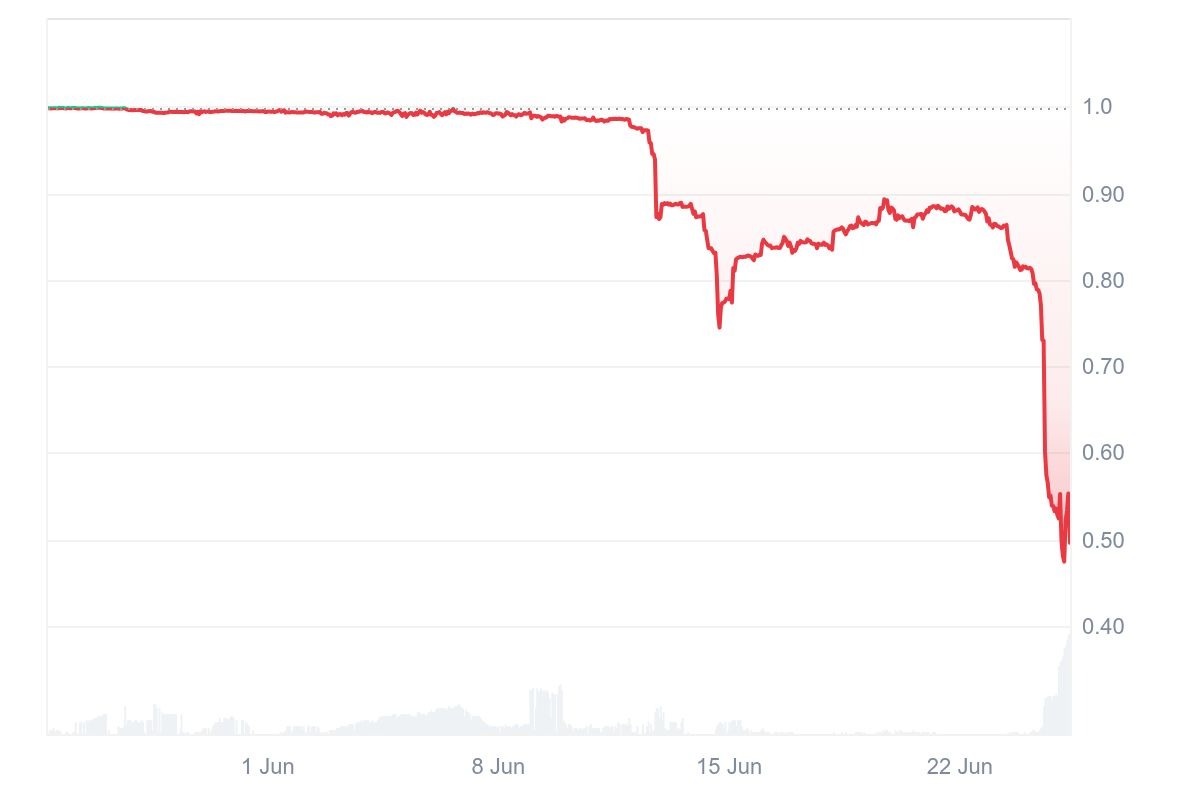
According to CoinMarketCap, MIM began to unravel in mid-June, when it slipped as low as around $0.74. It then briefly recovered to about $0.89, before falling again to roughly $0.49 by Wednesday. At the time of reporting, CoinMarketCap listed MIM’s circulating supply at about $104 million.
The sequence is notable because it shows how quickly stablecoin markets can oscillate during periods of reduced confidence. The earlier bounce did not hold, suggesting that the underlying liquidity or demand conditions that support peg stability were not fully restored—an issue Abracadabra is now attempting to address with its rate adjustments and additional incentives.
Liquidity support on Curve—and why it may not have been enough
Abracadabra’s current emergency plan arrives less than ten days after it attempted to shore up liquidity following the stablecoin’s first slip. On June 15, when MIM first moved away from its peg, the protocol said it injected $100,000 into its primary liquidity pool on Curve Finance. Abracadabra described that injection as a base for liquidity to help restore balance across Curve Pools after “unexpected liquidity withdrawals” linked to changes in DeFi incentive strategies.
Curve remains central to MIM’s liquidity pathway. Abracadabra’s Cauldrons rely on crypto collateral, and MIM’s peg stability is closely tied to how effectively liquidity providers and trading venues absorb flows. In this case, even after the Curve injection, MIM continued to deteriorate—suggesting that liquidity provisioning alone may not counteract wider market risk when stablecoin confidence fades.
Thin liquidity can create a feedback loop: weaker demand and heavier selling pressure worsen the price, while the price dislocation can further disrupt trading and liquidity behavior. Abracadabra appears to be betting that higher borrowing costs will realign incentives enough to reduce supply pressure faster than liquidity can deteriorate.
Broader market risk adds to the pressure
The MIM depeg also coincided with weakness across the broader crypto market. The article notes that the overall market was down about 3% over the prior 24 hours, while Bitcoin briefly dropped below $60,000. In such environments, stablecoins can face competing forces: traders may seek liquidity, liquidity providers may step back, and depegs can become more likely as market participants become more cautious.
For holders and traders of MIM, the immediate question is whether Abracadabra’s interest-rate intervention can reduce effective supply faster than liquidity conditions can worsen. If repayment behavior accelerates as intended, MIM could regain strength—though the speed of recovery will likely depend on how quickly market liquidity re-stabilizes around the $1 target.
Going forward, readers should watch MIM’s price relative to $1, changes in liquidity depth around Curve pools, and whether Cauldron repayment activity increases as rates rise—because those factors will determine whether this emergency response produces a durable return to the peg or merely delays further stress.
Decentralized finance platform Abracadabra said Wednesday that it launched emergency measures after its crypto-collateralized stablecoin, Magic Internet Money (MIM), fell 50% below its $1 peg.
“We’re acutely aware of the MIM depeg and are taking emergency actions to remedy the situation,” the team said on Wednesday.
It said effective immediately, it will begin gradually “increasing interest rates across all Cauldrons, including deprecated markets, to encourage debt repayment and reduce the outstanding MIM supply.”
The MIM depeg is a stark reminder that even overcollateralized DeFi stablecoins can be fragile in thin-liquidity environments and bear markets, underscoring the persistent risks of crypto-backed money.
Abracadabra describes itself as an omnichain DeFi lending platform that utilizes interest-bearing tokens as collateral to mint MIM, a dollar-pegged stablecoin that launched in May 2021.
MIM’s troubles began in mid-June, when it slipped to 74 cents before a brief recovery to 89 cents, then plunged to 49 cents on Wednesday, according to CoinMarketCap. The current circulating supply of MIM is about $104 million.
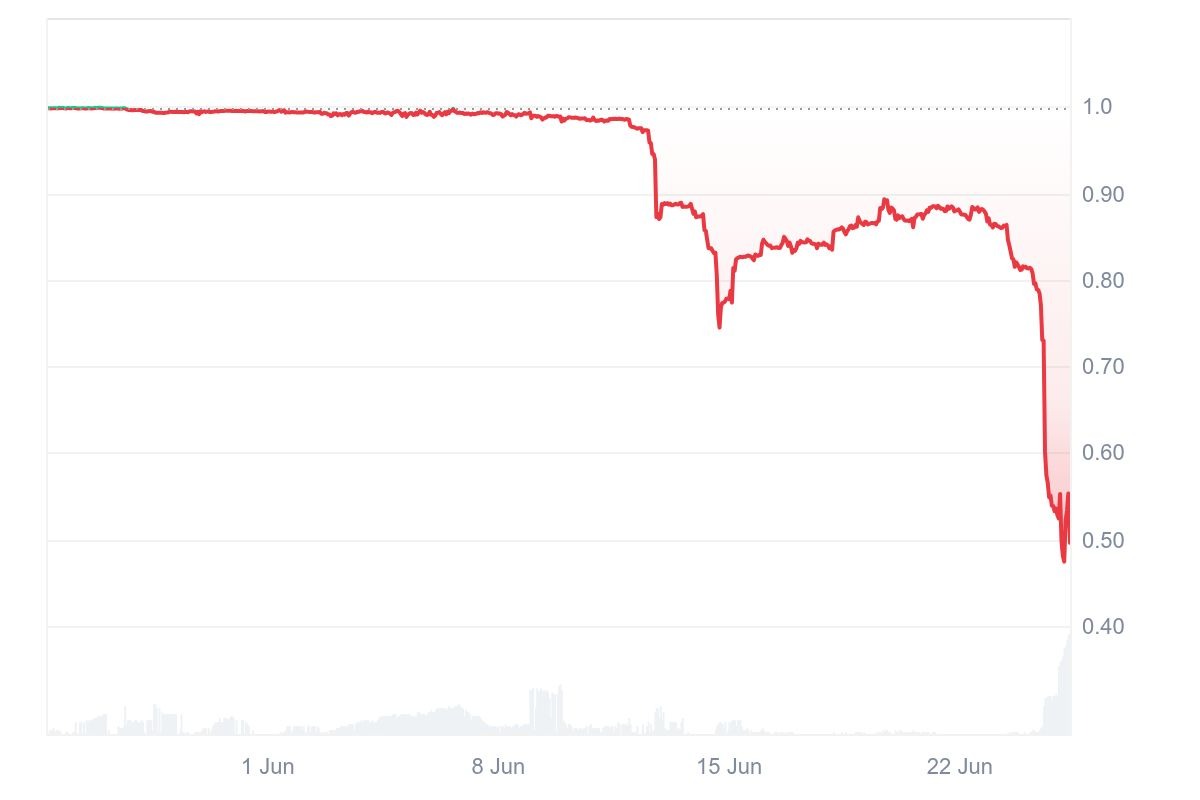
MIM depeg exceeds 50%. Source: CoinMarketCap
“The current depeg creates a natural incentive for borrowers to repay debt at a discount, accelerating supply contraction and strengthening the path back to the peg,” the team said.
“Our priority is simple: restore confidence, improve market structure, and return MIM to a healthy (and liquid) peg.”
Related: DeFi TVL drops 39% in 2026 amid market downturn and record hack activity
By raising Cauldron interest rates, the protocol makes it more expensive for borrowers to maintain positions, encouraging repayment that burns MIM, contracts supply and helps restore the peg.
It comes less than ten days after Abracadabra injected $100,000 into its primary liquidity pool on Curve Finance on June 15, when the stablecoin first slipped from its peg.
“This will serve as a base for liquidity to restore balance across Curve Pools after unexpected liquidity withdrawals due to recent DeFi incentive strategy changes,” it said at the time.
Cauldron liquidity is thin
The DeFi stablecoin is minted by borrowing against yield-bearing tokens in Abracadabra’s “Cauldrons,” but it relies on crypto collateral and deep liquidity pools, primarily on the Curve Finance platform, to maintain its $1 peg.
Thin and imbalanced liquidity in decentralized exchange pools is fueling selling pressure that makes the stablecoin vulnerable to further depegging, potentially amplified by broader market caution.
The broader crypto market has fallen about 3%, or roughly $60 billion, in the past 24 hours, with Bitcoin briefly dropping below $60,000.
Magazine: Japanese pension fund tips 1% in crypto, G7 urges action on NK hackers: Asia Express

Kalshi, a prediction markets platform, has filed a lawsuit in federal court challenging a newly enacted Illinois law that would require prediction market operators to be licensed in the state in order to offer sports event contracts. The company argues that the statute conflicts with federal regulation administered by the US Commodity Futures Trading Commission (CFTC) and would force it to either violate federal requirements or incur major costs to comply with Illinois rules.
In a Tuesday filing submitted to the US District Court for the Northern District of Illinois, Kalshi named Illinois Governor J.B. Pritzker, Attorney General Kwame Raoul, and other officials associated with the state’s gaming oversight body. Kalshi contends that the legislation—Illinois Senate Bill 3019—effectively “usurps” CFTC authority over prediction markets and imposes compliance burdens that are not recoverable if the company ultimately prevails.
Key takeaways
- Kalshi alleges Illinois Senate Bill 3019 conflicts with federal oversight of prediction markets under the Commodity Exchange Act.
- The company argues the law’s licensing regime would place it in jeopardy of breaching CFTC “uniformity” requirements if it complies.
- Kalshi says it faces irreparable harm starting July 1, when the law is set to take effect.
- The case adds to ongoing federal-state jurisdiction disputes over whether event contracts on prediction platforms fall under CFTC regulation.
- Courts may ultimately need to resolve the scope of federal preemption and the allocation of regulatory authority between states and the CFTC.
Illinois licensing for prediction market “sports event contracts”
According to Kalshi’s complaint, Illinois Senate Bill 3019 amended the state’s definition of an “exchange wager” by expanding it to include agreements, contracts, transactions, or swaps that are offered, traded, or executed on a prediction market or exchange tied to a sporting contest or sporting event. By redefining these arrangements as wagers, the law subjects prediction market platforms to the regulatory framework designed for sports betting operators.
Kalshi’s challenge focuses on the practical effect of the statute. The company argues that if it complies with Illinois’s licensing and regulatory requirements by ceasing to offer its sports event contracts in the state, it would conflict with CFTC-related requirements that it says demand uniform treatment across jurisdictions. Kalshi also contends that attempting to limit access only in Illinois would require “complex and expensive” technology measures and would still create legal risk.
Kalshi further maintains that it cannot avoid the conflict by simply ignoring Illinois requirements. The complaint states that enforcement by the state could expose the company to criminal penalties, reinforcing the alleged “untenable choice” between conflicting regulatory obligations.
Why the jurisdiction fight matters for compliance and market structure
Beyond the immediate dispute over Illinois, the case reflects a broader pattern in the regulation of prediction markets: the question of who has primary authority—federal regulators or state gaming authorities—over event contracts used by platforms that match user bets to specific outcomes.
For institutional stakeholders, the dispute has direct compliance implications. If federal authority governs a platform’s event contracts, states adopting licensing or restrictions may trigger conflict-of-laws questions, especially when federal rules seek consistent treatment across markets. Conversely, if states can regulate these contracts as wagering products, platforms may need multi-jurisdiction licensing strategies, heightened monitoring of customer access, and risk management designed for rapid changes in state regimes.
Kalshi’s complaint describes the compliance friction as both legal and operational. It argues that compliance measures could require geo-restrictions and other access controls, which can increase costs and create uncertainty about whether those measures satisfy federal expectations. For compliance teams, the central issue is not only licensing eligibility but also whether restrictions imposed by different regulators can be implemented without breaching federal frameworks.
CFTC’s position and the federal-state enforcement landscape
Kalshi’s lawsuit is positioned within an existing enforcement posture by the CFTC. The agency has claimed exclusive authority over certain prediction market arrangements, arguing that event contracts can be “swaps” within the agency’s remit under the Commodity Exchange Act.
As referenced in reporting on the broader conflict, the CFTC has pursued litigation against state authorities in prior disputes. In these cases, the agency has argued that state restrictions intrude into the CFTC’s jurisdiction. According to Kalshi’s filing, the Illinois statute represents a continuation of the same type of jurisdictional conflict.
Commissioner Michael Selig is described in the complaint framework as representing the CFTC’s approach. The filing also points to multiple prior legal challenges in which the CFTC sought to push back against state efforts to regulate prediction markets, including actions connected to restrictions introduced by other states.
The dispute raises typical preemption and regulatory allocation questions: whether Congress—through the Commodity Exchange Act—intended for the CFTC to have controlling authority over these contracts, and whether state licensing requirements can coexist with federal rules without undermining federal uniformity.
Potential path forward and what to watch
Observers have suggested that jurisdictional disputes in prediction markets could ultimately reach the US Supreme Court, particularly where regulators and states take opposing positions about authority and preemption. While Kalshi’s case does not itself guarantee a specific appellate path, it fits a pattern of litigation in which federal and state legal theories collide and courts must determine the extent to which federal commodities law displaces state gambling regulation.
In the near term, the immediate risk for firms is the operational and legal uncertainty created by diverging requirements across jurisdictions. With Illinois’s July 1 effective date approaching, analysts and compliance professionals will likely monitor any interim court rulings, arguments on federal preemption, and how courts interpret the scope of CFTC authority over event contracts. The resolution may also influence how exchanges and prediction market platforms structure market access, licensing strategies, and risk controls across state lines.
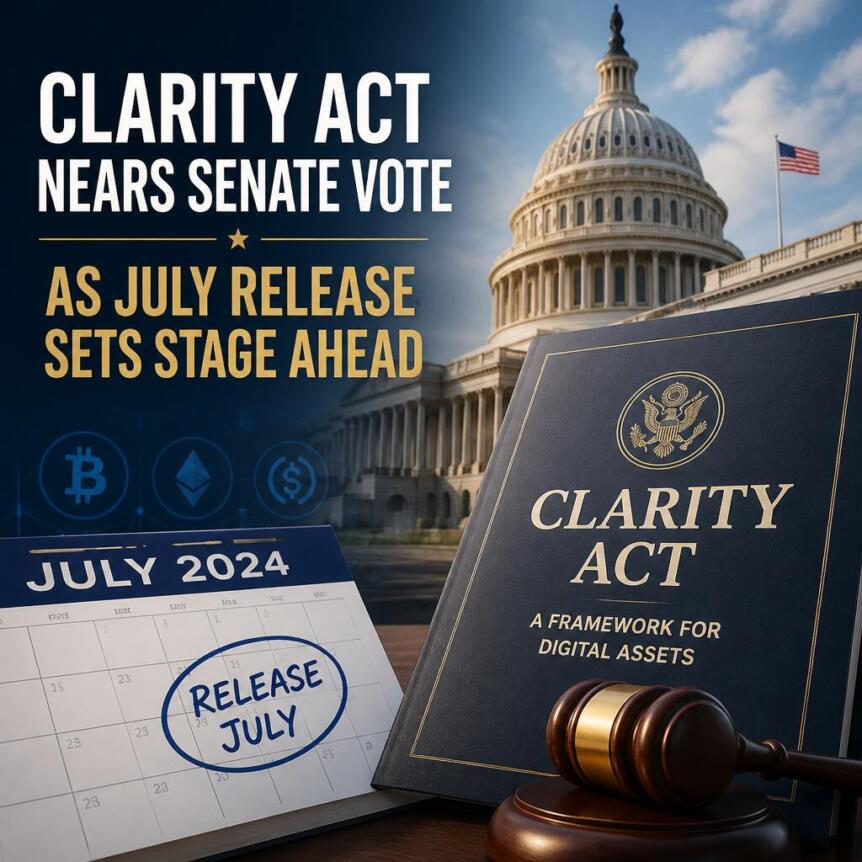
The CLARITY Act has entered its final review stage after months of negotiations, with Senator Cynthia Lummis confirming an early July release of the updated bill text. Lawmakers now aim to advance the crypto market structure legislation through the Senate later in July. Meanwhile, several organizations continue raising concerns about specific provisions tied to oversight and anti-money laundering requirements.
Senate Prepares Final Clarity Act Release
Senate negotiators are preparing to publish the updated CLARITY Act text around July 4. The release will provide lawmakers, industry participants, and other stakeholders with an opportunity to review the final draft. After that process, Senate leaders plan to move the legislation toward floor consideration.
Lummis indicated that negotiations have continued for several months and involved lawmakers, industry groups, and banking representatives. The discussions focused on refining provisions that generated concerns during earlier drafting stages. As a result, lawmakers introduced several revisions before reaching the final review phase.
Senate leadership is now working to secure time for debate during July. Discussions with Senate Majority Leader John Thune remain focused on placing the measure on the Senate agenda. Consequently, the legislation appears positioned for its next major procedural step.
Lawmakers Refine Framework for Digital Asset Markets
The legislation seeks to establish clearer regulatory boundaries for digital asset markets in the United States. Lawmakers have continued adjusting provisions while balancing industry priorities and regulatory concerns. At the same time, banking groups have pressed for stronger consumer safeguards.
Recent discussions also addressed concerns surrounding crypto rewards programs. Critics argued that some digital asset companies could offer products resembling interest-bearing bank accounts. Therefore, negotiators revisited relevant sections during the latest round of drafting.
According to information provided by Senate negotiators, revisions were made to address those concerns. The updated framework separates certain reward structures from traditional interest-based products. In addition, lawmakers incorporated further anti-money laundering measures into the legislation.
Section 604 Remains a Key Point of Debate
Despite progress toward publication, Section 604 continues attracting opposition from several organizations. The provision incorporates elements of the Blockchain Regulatory Certainty Act. As a result, it remains one of the most debated parts of the broader legislation.
Several law enforcement organizations recently urged federal officials to reconsider the section. The groups argued that the provision could create regulatory gaps involving digital asset activities. They also warned that investigations involving crypto transactions could become more difficult under certain circumstances.
The organizations raised concerns regarding the Know Your Customer and Anti-Money Laundering standards. They contend that the proposal could weaken oversight compared with requirements applied in traditional financial systems. Consequently, they have called for additional revisions before final approval.
Section 604 would prevent certain non-custodial participants from automatically receiving money transmitter classifications. The provision applies to groups including open-source developers and self-custody tool providers. It also covers software contributors and some decentralized finance infrastructure operators.
Separately, the Alliance to End Human Trafficking urged Senate leaders to revisit the same provision. The organization argued that the language could create uncertainty around monitoring illicit financial activity. It cited concerns involving human trafficking, organized crime, sanctions evasion, and child exploitation investigations.
Banking giant Standard Chartered has identified Aave as a potential beneficiary of tokenized assets as they move into decentralized finance (DeFi), saying the protocol could rebuild its position as a dominant onchain lending platform.
In a Wednesday research note, Geoff Kendrick, the bank’s global head of digital assets research, said active tokenized assets in DeFi could drive more deposits into Aave.
“Despite recent setbacks, we are bullish on the outlook for Aave, the largest [DeFi] lending protocol,” Kendrick wrote.
The bank said Aave’s recent performance had been weighed down by a broader decline in digital asset prices and the fallout from the April cybertheft involving KelpDAO. Standard Chartered said the $292 million incident affected Aave, contributing to a decline in the protocol’s lending market share as assets exited the platform.
“We think both of those negatives are poised to fade,” Kendrick said. “We forecast significant upside for digital asset token prices into year-end, and we think Aave has moved beyond the April incident.”
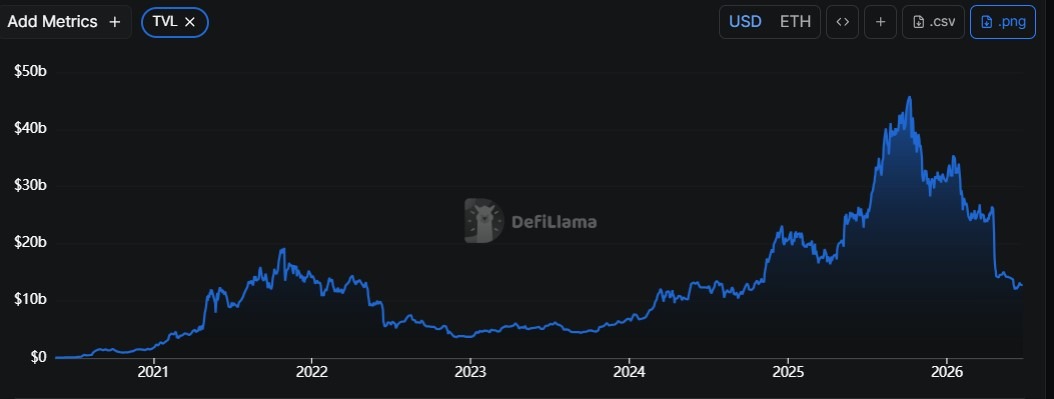
According to the research note, Aave’s October 2025 deposit base of about $75 billion would have ranked alongside the 30th-largest US bank by deposits. Kendrick added that Standard Chartered expects Aave to recover part of that scale as tokenized assets become more widely used as collateral and sources of liquidity within DeFi.
Aave’s total value locked. Source: DefiLlama
Standard Chartered expands tokenization thesis to lending
The Aave forecast extends Standard Chartered’s tokenization thesis from decentralized trading to lending, with the protocol emerging as a potential venue for borrowing against tokenized real-world assets (RWAs).
Standard Chartered said in an earlier research note that assets locked in DeFi could reach $2.7 trillion by 2030, driven by RWAs and other crypto-native assets moving through onchain protocols.
Related: StanChart says Ethereum price will catch up to bullish internal metrics
Kendrick identified decentralized exchange Uniswap as a possible trading hub for tokenized markets, citing its scale, brand and history of operating through multiple crypto market cycles.
Magazine: Japanese pension fund tips 1% in crypto, G7 urges action on NK hackers: Asia Express
Bitcoin has fallen below $60,000 for a second time this month, triggering more than $850 million in crypto liquidations and sending Strategy shares to an intraday low of $92.28 as investors reacted to mounting pressure across digital assets and technology stocks.
Summary
- Bitcoin fell below $60,000 for the second time in June, triggering more than $850 million in crypto liquidations.
- Technical indicators show BTC retesting June support near $59,200 after losing a key Fibonacci retracement level.
- Strategy shares dropped as much as 11% intraday, while crypto stocks and miners sold off alongside weakening ETF flows.
According to data from crypto.news, Bitcoin (BTC) price dropped nearly 6% to an intraday low of $59,175 before trading around $59,500 at press time. The move wiped out more than $850 million in leveraged positions, with long traders accounting for roughly $780 million of the total and short liquidations contributing about $84 million.
Selling quickly spread across major cryptocurrencies. Ethereum fell below $1,600 and traded near $1,590, while Solana slipped under $65 and XRP changed hands around $1.05. The total value of the crypto market declined to approximately $2.1 trillion, leaving the sector down about 3.6% on the day.
Bitcoin tests a key technical support zone
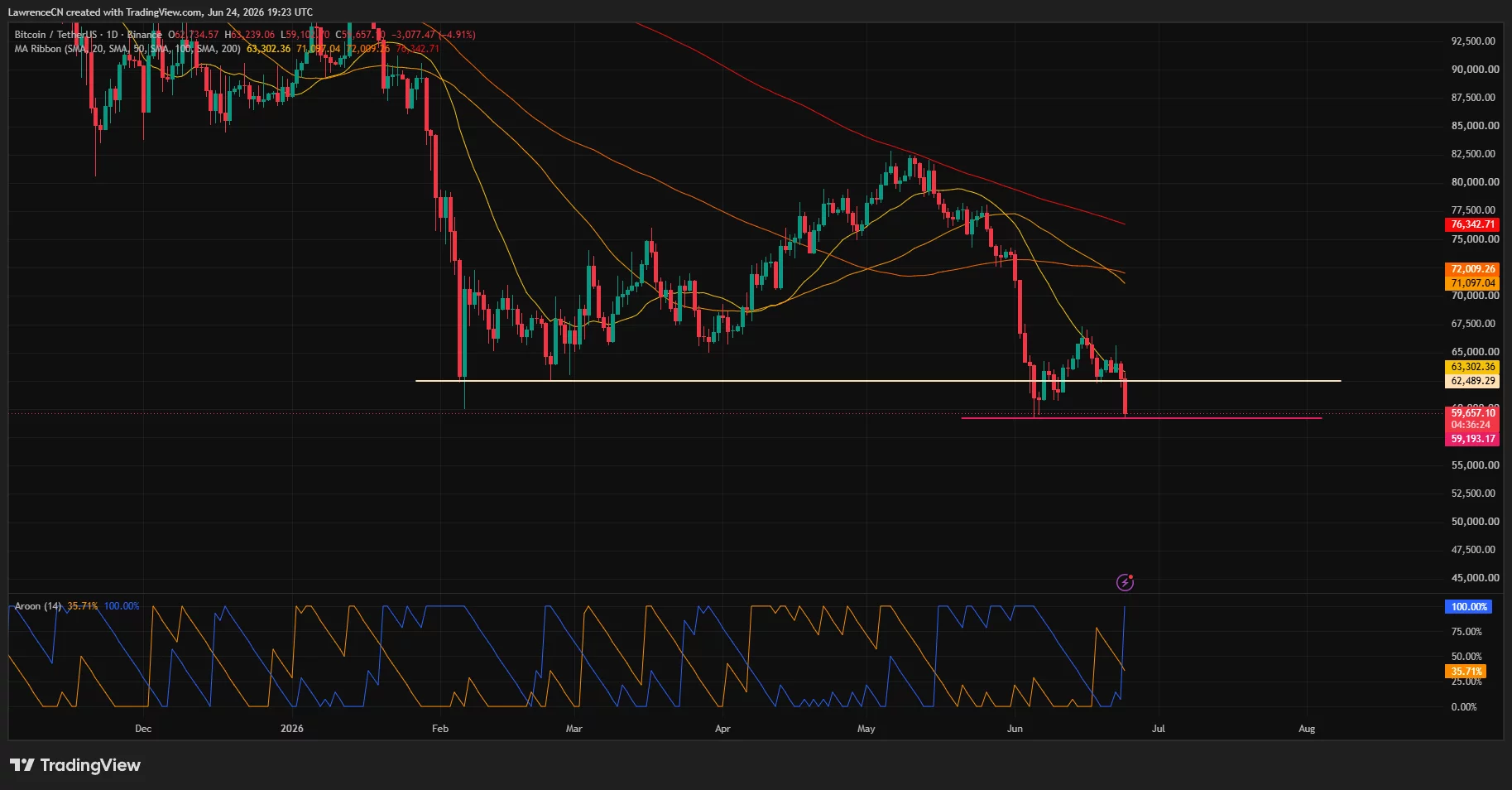
Technical indicators suggest Bitcoin has returned to a level many traders have been watching closely. The daily chart shows Bitcoin falling through a major support level and revisiting support around $59,200, a zone that aligns with the June lows.
Commenting on the setup, crypto analyst Daan Crypto Trades noted that Bitcoin had reached its 78.6% Fibonacci retracement level from the previous rebound. According to the analyst, major local tops and bottoms have often formed after strong rallies retraced toward that level, making it an important area for bulls to defend before a possible break below $60,000.
The chart also shows Bitcoin trading below all key moving averages, including the 50-day and 200-day MA, while the Aroon indicator signals continued downside momentum. On the daily timeframe, Aroon Down stood at 100%, compared with roughly 36% for Aroon Up, indicating that recent lows have continued to dominate market structure.
At the same time, concerns about institutional activity added to market unease. Whale Factor highlighted on X that wallets linked to BlackRock had transferred roughly 2,700 BTC, worth about $168.6 million, and nearly 53,000 ETH valued at around $88.1 million to Coinbase-linked addresses. The account suggested the transfers could precede selling activity, although no evidence has emerged that the assets were moved for that purpose.
Strategy shares underperform as criticism returns
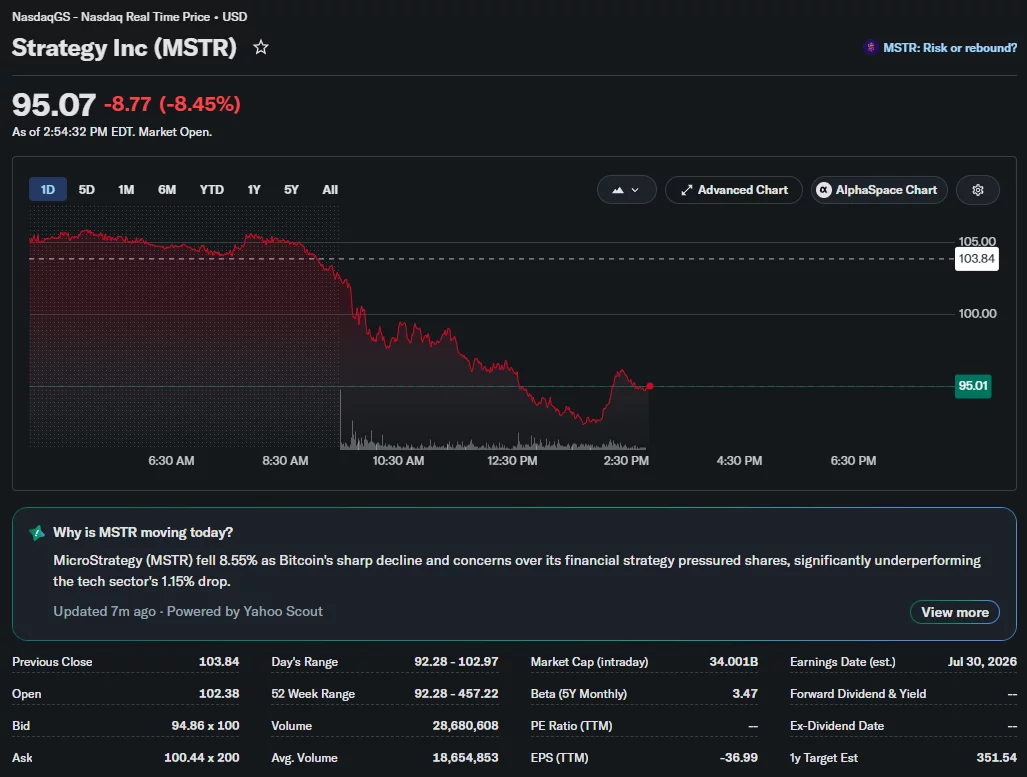
The decline in Bitcoin coincided with a sharp drop in crypto-linked equities, with Strategy suffering some of the steepest losses. After closing the previous session at $103.84, the stock fell as much as 11% during trading and reached an intraday low of $92.28 before recovering slightly to trade near $95. The move left the shares down more than 8% on the day.
Pressure was not limited to Strategy. Shares of Strive, Bitmine, and SharpLink also declined, while crypto-focused firms including Coinbase, Robinhood, Circle, Galaxy Digital, and Bullish traded lower alongside mining companies such as IREN, Cipher, TeraWulf, and Hut 8.
Fresh criticism from Bitcoin skeptic Peter Schiff added another layer to the debate surrounding Strategy’s Bitcoin treasury model. Schiff argued that the company could consider selling part of its Bitcoin holdings to finance stock buybacks and reduce the gap between its market valuation and underlying assets.
He also claimed that any meaningful Bitcoin sale by Strategy could pressure the cryptocurrency market, though he questioned whether such a move would restore investor confidence.
Institutional fund flows have also weakened. According to Farside Investors, U.S. spot Bitcoin exchange-traded funds recorded roughly $180 million in combined net outflows on Monday and Tuesday. Spot Ether ETFs posted approximately $152.5 million in net outflows during the same period.
Those withdrawals arrived as investors continued reducing exposure to risk assets. Since mid-June, the S&P 500 has fallen about 3%, and the Nasdaq has dropped nearly 4%, while several large technology stocks, including Nvidia, Microsoft, and Apple, traded lower. With
With Bitcoin price back below $60,000, the cryptocurrency has returned to price levels last seen in October 2024, extending a difficult month for both digital assets and the companies tied most closely to them.
Disclosure: This article does not represent investment advice. The content and materials featured on this page are for educational purposes only.

IRFC shares fall 2% as OFS worth Rs 2,212 crore opens for retail investors today. Here’s all you need to know

Bitcoin Drops Below $60K as Traders Price in 15% Rebound
Academy invites 529 new Oscars voting members: See who made the cut, from Jacob Elordi to Jenna Ortega


-

 Fashion5 days ago
Weekend Open Thread: Miami – Corporette.com
-

 Entertainment4 days ago
Renter of Home in Anne Heche Crash Denies Settlement With Son
-
 Sports1 day ago
Two goals and an assist by sheer aura: Cristiano Ronaldo just entered the World Cup chat
-

 Tech3 days ago
Microsoft accidentally kills epic Outlook email threads
-

 Business4 days ago
Soccer-U.S. defends Iran World Cup travel restrictions, says discussions ongoing
-
Crypto World1 day ago
Bitcoin (BTC) Dips Below $62K, Ethereum (ETH) Plunges 6% Daily: Market Watch
-

 Politics5 days ago
Andy Burnham and the meaning of Makerfield
-

 Politics6 days ago
BBC Reporter Discusses Cross Party Criticism Of Trumps Iran Deal
-

 Crypto World22 hours ago
Securitize Wraps Roubini's SEC-Registered ETF as Dubai VARA Digital Security
-
Business1 day ago
Entergy settles forward sale agreements, raises $672 million in cash proceeds
-
 Business5 days ago
Wall Street Week Ahead: Investors see Micron earnings as pulse check of AI rally momentum
-

 NewsBeat6 days ago
Keir Starmer Allies Question His Chances For No 10
-

 Tech7 days ago
AWS enters the context layer race with a graph that learns from agents, not manual curation
-
 Crypto World5 days ago
Can Charles Hoskinson Really Rescue Cardano?
-

 Crypto World5 days ago
HIVE shares jump as $220M AI deal speeds Bitcoin mining pivot
-

 Crypto World5 days ago
Jake Chervinsky accuses CME of protecting derivatives monopoly
-
 Tech4 days ago
Signal’s Meredith Whittaker says AI chatbots ‘are not your friends’ and calls Copilot agents a backdoor
-

 Entertainment5 days ago
Jose Alvarado Wants Taylor Swift at More Knicks Games
-

 Tech2 days ago
Nearly 7,000 fake Amazon domains registered ahead of Prime Day 2026, researchers warn
-

 Business6 days ago
Brexit cost 6% of UK economy, Bank of England company data suggests
You must be logged in to post a comment Login