

Crypto World
Samson Mow says SATA rebound could pull Strategy’s STRC to par

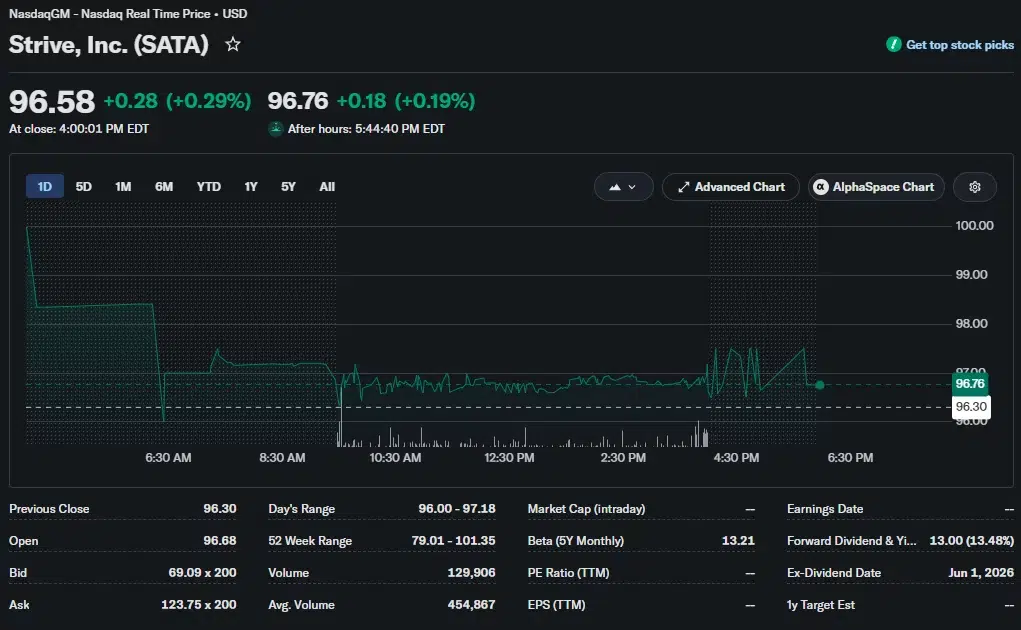
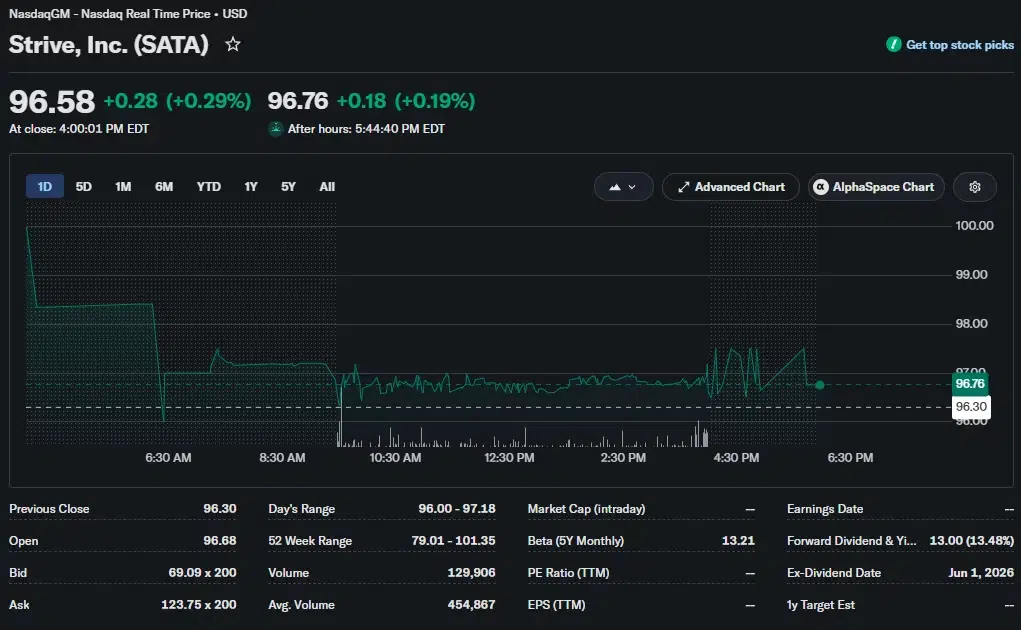
Strive’s SATA preferred shares have recovered nearly 16% from their June low to about $97, prompting Jan3 CEO Samson Mow to predict that the rebound could help Strategy’s STRC return to its $100 par value.
Summary
- Strive’s SATA has rebounded nearly 16% from its June low to about $97.
- Samson Mow expects SATA’s recovery to help Strategy’s STRC return toward its $100 par value.
- Three major U.S. preferred stock ETFs collectively hold $756 million worth of STRC.
Yahoo Finance data show SATA has climbed from $83.30 and now trades within roughly 3% of the level it was designed to track. The recovery has erased most of the preferred stock’s late-June decline, while STRC remains about 13% below par despite receiving increased demand from major U.S. exchange-traded funds.
According to Mow, steps taken by Bitcoin treasury companies to improve their balance sheets and support their preferred shares have started rebuilding confidence in the products. He told Cointelegraph that SATA’s return toward $100 could reassure investors that the funding structure used by Strive and Strategy remains functional.
“I think every action that Strategy has undertaken to strengthen their balance sheet and encourage STRC to go back to par is also working.”
Mow expects the two securities to move together because investors are assessing whether Bitcoin-linked preferred shares can continue funding their dividends and hold close to their stated values.
“But everything sort of works in tandem. I think as SATA returns to par, you’re going to see STRC return to par too, because people say, ‘OK, this model’s not broken.’ Everyone is capitalized for three or more years of dividend payments… there was no reason to panic all along,” he added.
SATA’s recovery supports confidence in Bitcoin preferred shares
Strive introduced SATA in November 2025 to raise money for expanding its Bitcoin holdings without issuing more common stock. The variable-rate perpetual preferred shares use dividend adjustments to encourage trading around their $100 par value.
By changing the payout rate when needed, Strive can make SATA more or less attractive to investors as its market price moves. The company designed the structure to provide recurring access to capital while limiting dilution for common shareholders, according to its stated treasury strategy.
Strategy launched STRC in 2025 under a similar model. The preferred stock also uses a variable dividend to keep its price near $100, placing it in a category that Strategy calls “digital credit.”
During the late-June selloff, both products dropped well below their intended levels. SATA has since recovered to around $97, but Yahoo Finance data show STRC closed at $86.89 on July 24 after gaining 2.29% during the session. It later rose to $87.14 in after-hours trading.
Mow views the difference between their recoveries as temporary rather than evidence that STRC’s structure has failed. His forecast rests on investors treating SATA’s rebound as proof that preferred shares backed by Bitcoin treasury companies can recover after a sharp decline.
Alongside the price recovery, Mow pointed to companies refining how they raise capital and manage their Bitcoin holdings. He cited Lyn Alden’s Orange Juice treasury company, launched on July 15, as an example of a new entrant using a different operating model and starting with a lower Bitcoin acquisition cost.
BitcoinTreasuries ranks Strategy as the largest corporate Bitcoin holder, with 843,775 BTC. Strive holds 19,921 BTC, placing it seventh among public companies tracked by the platform.
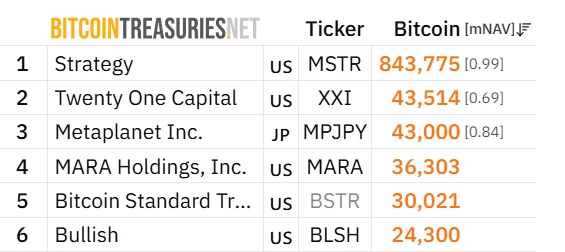
Those holdings create different levels of Bitcoin exposure, but both companies rely on capital-market products to support their treasury plans. For Strive, SATA offers a route to fresh funds without selling more common shares, while Strategy uses STRC and other securities to finance additional Bitcoin purchases.
ETF demand strengthens STRC despite its discount
Institutional demand has already placed STRC at the top of three large U.S. preferred stock ETFs, even though the security continues to trade well below par.
Michael Saylor, Strategy’s co-founder and executive chairman, disclosed on July 24 that STRC is now the largest holding in BlackRock’s iShares Preferred and Income Securities ETF, Virtus InfraCap’s U.S. Preferred Stock ETF and VanEck’s Preferred Securities ex Financials ETF.
According to figures shared by Saylor, the three funds collectively hold $756 million of STRC. Their portfolios also contain preferred shares issued by established U.S. companies, giving ETF investors indirect exposure to Strategy’s Bitcoin-linked security alongside traditional income products.
In his X post, Saylor presented the ETF positions as evidence that Strategy’s “digital credit” securities are entering institutional portfolios. The holdings show that asset managers have allocated substantial capital to STRC, although its July 24 closing price remained 13.11% below $100.
STRC’s discount matters to Strategy because the company sells the preferred shares to fund Bitcoin purchases. Strategy can issue stock near or above par and direct the proceeds into Bitcoin, but a large discount reduces the amount of capital it can raise from each newly issued share.
Selling more STRC while it trades around $87 would therefore produce less funding per share than an issuance completed near $100. The lower price could weaken the economics of using the security for Bitcoin accumulation, even if existing ETF demand continues.
Mow’s outlook links SATA’s recovery with a possible improvement in those conditions. If investors interpret Strive’s return toward par as evidence that variable-rate Bitcoin preferred shares can stabilize, his view suggests STRC could attract enough demand to narrow its discount and restore a more efficient funding channel for Strategy.



Odos Protocol has announced plans to shut down its decentralized exchange aggregator, giving users until July 30 to withdraw assets from the platform.
Summary
- Odos Protocol will shut down its DEX aggregator and has asked users to withdraw assets by July 30.
- The project said the Odos DAO will announce its own plans separately, while the ODOS token will continue to exist onchain.
- The closure follows a sharp decline in protocol trading volume and comes as several crypto platforms have announced shutdowns this year.
According to a Thursday announcement posted on X, the project will discontinue operations and has asked users to remove funds before the deadline. The team did not disclose why it decided to wind down the service.
Users have until July 30 to complete withdrawals before the platform ceases operations. The announcement did not indicate whether any extension would be offered or whether services would remain available after the deadline.
At the same time, the team clarified that the Odos DAO operates independently from the company behind the protocol. It said the DAO will communicate its own plans separately, while adding that the ODOS token will continue to exist onchain despite the shutdown of the operating business.
No changes to the token’s functionality, supply, or governance were announced alongside the closure notice. The statement also did not mention any security incident, regulatory issue, funding challenge, or acquisition connected to the decision.
Trading activity had fallen sharply since late 2024
The shutdown follows a prolonged decline in activity on the protocol over the past two years.
Data from DefiLlama shows Odos recorded approximately $169 million in DEX aggregator trading volume during July 2026. That compares with a monthly peak of roughly $7.8 billion reached in December 2024, when decentralized trading activity across multiple networks was considerably higher.
DefiLlama data also estimates the protocol generates about $2.72 million in annualized revenue. While the figures illustrate how activity has changed over time, the Odos team did not attribute the shutdown to declining trading volume or revenue.
Instead, the project’s public announcement remained limited to operational details, user withdrawal instructions, and clarification regarding the separation between the operating company and the Odos DAO.
Existing users have therefore been encouraged to focus on withdrawing assets before the July 30 deadline. The announcement did not mention any modifications to the withdrawal process or identify assets that would be affected differently during the wind-down.
DAO and token remain separate from the operating company
Although the protocol’s operating business is shutting down, the announcement distinguished it from the decentralized governance structure.
According to the team, the Odos DAO will announce its own next steps independently. No timetable was provided for those announcements, and the DAO has not yet disclosed whether governance activities, treasury management, or future ecosystem initiatives will change after the operating company closes.
Similarly, the ODOS token was not included in the shutdown plans beyond confirmation that it will continue to exist onchain. The announcement did not describe any migration, token swap, redemption program, or governance proposal associated with the closure.
For token holders, that means the shutdown currently applies to the operating company rather than automatically affecting the token itself.
More crypto platforms have announced closures in 2026
Odos joins a growing list of crypto companies and decentralized finance projects that have announced plans to wind down operations this year, although the reasons behind those decisions have varied considerably.
Earlier on Thursday, derivatives exchange BitMEX said it would cease operations after 11 years in business. The exchange outlined a phased shutdown process, with customer services being retired according to a scheduled timeline.
Security incidents have also forced several projects to discontinue operations. For instance, in June, crypto payments platform Pyra announced it would shut down after concluding it could not establish a sustainable path forward following losses tied to the Drift exploit.
The company immediately stopped accepting new customers, canceled all payment cards, and introduced a transition plan that allows existing users to withdraw balances and export private keys through a dedicated web portal until Sept. 15, 2026. Pyra also said it intends to distribute any future Drift recovery tokens to eligible users if those tokens become available.
Meanwhile, in May, Carrot protocol said it would discontinue operations after liquidity providers withdrew significant capital following the Drift exploit. The protocol explained that the resulting collapse in total value locked left it unable to continue operating despite efforts to recover. Users were provided time to withdraw remaining assets before services were fully retired.
Odos has not linked its own decision to either category. The project’s announcement did not identify declining activity, market conditions, funding constraints, security breaches, or technical problems as reasons for discontinuing operations.
For now, the only date provided by the project is July 30, when users are expected to complete withdrawals before the operating platform shuts down. The team has said the DAO will provide separate updates regarding its future plans.
Tether (USDT) walked away from Europe rather than follow its stablecoin rules. Now a top Circle executive has an idea that could bring it back.
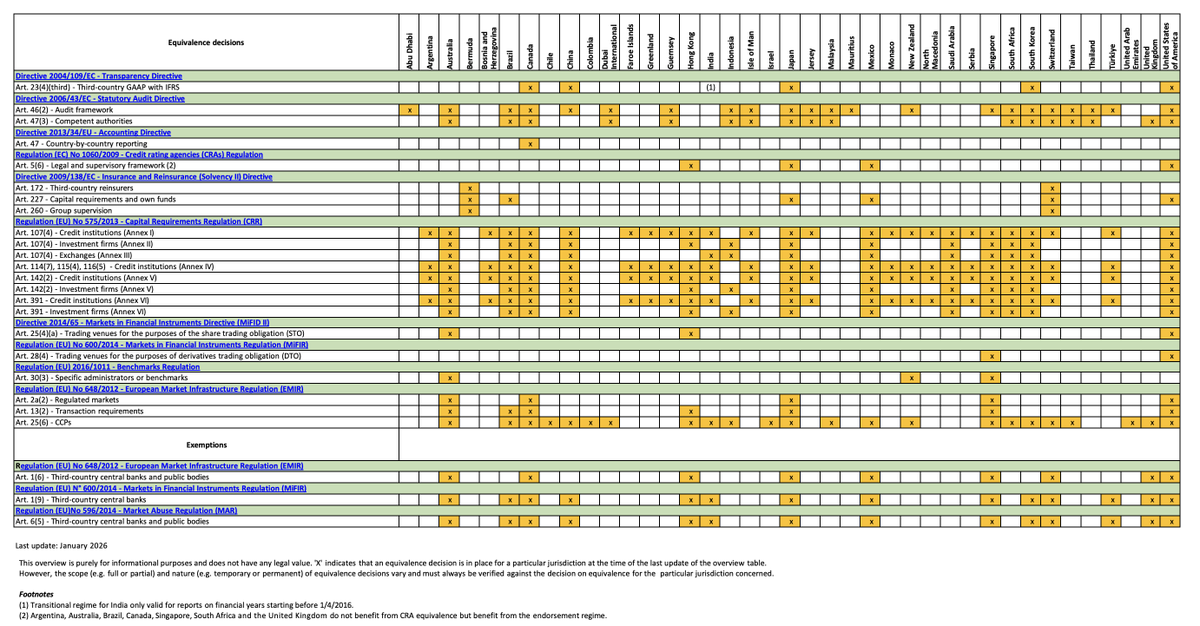
The idea is called equivalence. It lets the EU accept the home rules a company already follows, with no separate EU coin needed.
Why Most Stablecoins Skip Europe
MiCA is the EU’s rulebook for crypto. Its stablecoin rules reached their final deadline on July 1.
The rulebook has one big gap. It gives the EU no way to accept a foreign issuer’s home rules.
So any firm that wants EU users must first set up a licensed EU company. Patrick Hansen, Circle’s head of EU policy, calls that the hard way in.
By his estimate, about 99% of stablecoins are made outside the EU. That leaves the rules covering just a sliver of the market.

“Equivalence is emerging as a compelling alternative to the multi-issuance model, currently the only possible regulatory pathway for these global stablecoins under MiCA,” Hansen stated.
Follow us on X to get the latest news as it happens
How this Could Bring Tether Back
Tether is the largest stablecoin. Its live market value is about $184 billion. MiCA tells big issuers to hold at least 60% of their backing in banks. Tether keeps most of its money in US government debt. So it let USDT get dropped by EU exchanges rather than change.
Equivalence would flip that. The EU could accept Tether’s home rules instead. USDT could then return with no separate EU coin.
But whose home rules? Tether is now based in El Salvador. It has not cleared the new US stablecoin law. It even built a separate US coin instead of changing USDT. A quick return looks unlikely.
USD Coin (USDC) took the other path. It won a French license in 2024 and stayed. Circle is already inside MiCA, so the change would help its rivals more than itself.
An Old Tool for a New Problem
Equivalence is not new. The EU already accepts foreign rules in insurance, banking, and other areas.
It cleared the UK’s clearing houses this way in January 2025. It has just never done it for stablecoins.
That would mean changing MiCA. The best chance is the review the EU opened in May 2026.
The politics are hard. Most big stablecoins are tied to the US dollar, and the EU is wary. Its central bank is even testing a digital euro.
For now, the door stays shut. The review will show if the EU wants to open it.
The post Circle Pushes a MiCA Fix That Could Bring Tether Back to Europe appeared first on BeInCrypto.
S&P Global will release the July flash Purchasing Managers’ Indices (PMIs) for the United States (US) on Friday. These surveys of top private-sector executives are seen as an early indicator of the country’s economic health.
Market participants anticipate the S&P Global Services PMI to decline slightly to 51.0 from 51.2 in June, while the S&P Global Manufacturing PMI is expected to edge higher to 54.5 from 53.9, with both prints remaining in the expansion territory above 50. In addition to headline PMI figures, the surveys also include comments on employment and input inflation, which could influence the US Dollar’s (USD) valuation.
What Can We Expect from the Next S&P Global PMI Report?
While PMI surveys are forecast to reaffirm healthy business conditions in the private sector, details surrounding input costs could ramp up market volatility. Although the softer-than-expected June inflation data from the US eased bets for a Federal Reserve (Fed) interest rate hike in July, the recent increase in Oil prices caused investors to refrain from pricing in a prolonged policy hold.
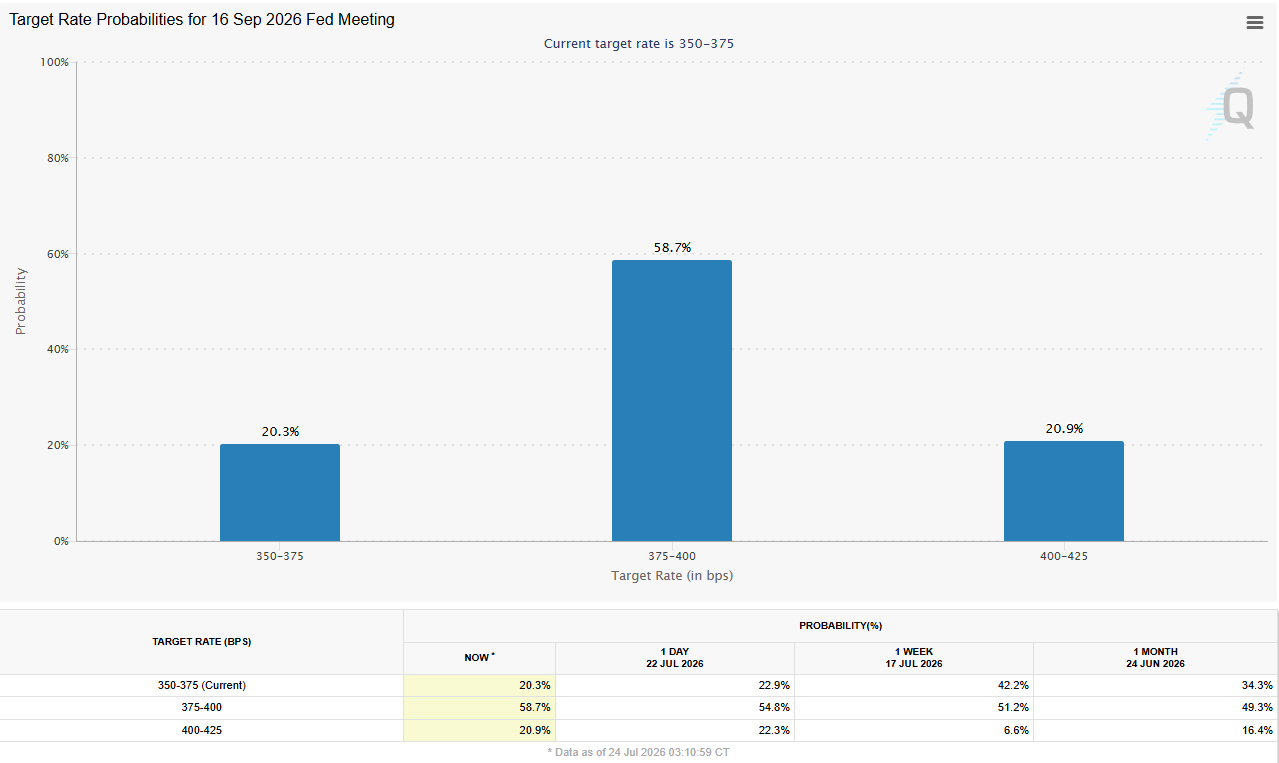
With the US and Iran ramping up military aggression in the Middle East, the barrel of West Texas Intermediate (WTI) is up nearly 30% in July. In the meantime, the CME FedWatch Tool shows that markets are pricing in a nearly 80% probability of an at least 25 basis points (bps) Fed rate hike by September.

Previewing the PMI data, “we expect both the S&P manufacturing and services PMIs to improve in July. Manufacturing is likely to rebound to 54.5, in line with strong regional surveys in the month (Empire and Philly Fed),” TD Securities analysts said.
“Meanwhile, services is likely to continue improving to 51.5. NY Fed services improved in July, and we expect S&P to begin catching up to ISM,” they added.
When will the June Flash US S&P Global PMIs be Released and How Could They Affect EUR/USD?
The S&P Global Manufacturing, Services, and Composite PMIs reports will be released at 13:45 GMT on Friday. As previously noted, they are expected to show that US business activity continued to expand in July.
In case the publication suggests that business owners are facing increasing input costs in July and considering transferring those costs to customers by raising prices, markets could see that as a sign of inflationary pressures resurfacing again in July. In this scenario, the USD could continue to gather strength heading into the weekend and weigh on EUR/USD.
Conversely, an unexpected drop into the contraction territory below 50, in either the headline Manufacturing or the Services PMI, could hurt the USD with the immediate reaction and help EUR/USD hold its ground.
Middle East tensions risk being underplayed in early July PMI signals
Analysts at Rabobank caution that the initial July PMI signals may not fully capture the latest geopolitical and commodity-market developments.
They argue that “this preliminary reading may understate the impact of the escalation in the Middle East,” noting that “the July poll was probably conducted in the past two weeks, so the results may be skewed if many respondents replied early – and therefore could not fully factor in the current situation in the Middle East, or this week’s increase in oil prices.”
Eren Sengezer, European Session Lead Analyst, shares a brief technical outlook for EUR/USD:
“EUR/USD trades below the 20-day Simple Moving Average (SMA) following multiple failed attempts to clear that level earlier in the week. Additionally, the Relative Strength Index (RSI) indicator on the daily chart stays near 40, reaffirming the bearish stance.”

“On the downside, 1.1370-1.1350 (Bollinger Band lower arm, static level) aligns as the first support area ahead of 1.1270 (static level) and 1.1160 (static level). Looking north, the immediate resistance level could be spotted at 1.1420 (20-day SMA), followed by 1.1470 (Bollinger Band upper arm) and 1.1570 (100-day SMA).”
The post US S&P Global PMI expected to show steady business growth in July appeared first on BeInCrypto.


World Foundation has raised $52.5 million through a strategic WLD token sale as it accelerates the rollout of its World ID identity network, with all purchased tokens locked for one year.
Summary
- World Foundation raised $52.5 million through a strategic WLD token sale to expand its World ID identity network, with all purchased tokens locked for one year.
- The nonprofit said the funding will support enterprise adoption of World ID as more than 39 million users have joined the network and over 18 million have completed Orb verification.
- The fundraising comes as World continues to expand globally while facing ongoing regulatory scrutiny and fresh attention on WLD ownership concentration following Grayscale’s ETF filing.
World Foundation announced on Friday that it completed the first close of a strategic WLD token sale, raising $52.5 million from a group of crypto-focused investors to support the expansion of its proof-of-human infrastructure. The nonprofit said every WLD token sold in the transaction will remain locked for one year.
Pantera Capital led the first close of the fundraising, while Bain Capital Crypto, WLD treasury company Eightco Holdings (Nasdaq: ORBS), Selini Capital, Susquehanna Crypto and several other investors also participated. Although the foundation described the fundraising as the “first close,” it did not confirm whether additional rounds are planned. A spokesperson declined to comment when asked whether more token sales would follow.
Unlike an equity financing, the foundation said the WLD purchased in the transaction is intended solely for use within the World Network ecosystem. According to the organization, the tokens do not provide ownership in Tools for Humanity, the company responsible for developing the project’s software and hardware, nor do they grant rights to profits or investment returns.
Fresh capital from the fundraising will be directed toward expanding World ID for enterprises, consumers and AI agents across international markets, the foundation said. The announcement comes as the organization says it is entering a new phase focused on increasing real-world use of its identity network after spending the past three years building the protocol.
World shifts focus toward enterprise adoption
As artificial intelligence systems become more capable, World Foundation said demand is rising for technology that can distinguish real people from automated agents online.
World allows users to verify they are unique humans by completing a one-time Orb scan, which generates a World ID without revealing their identity. According to the foundation, users keep their World ID on their own devices, while the verification process relies on advanced cryptography and anonymized multi-party computation that has been open-sourced to protect privacy.
Pantera Capital General Partner Cosmo Jiang said the acceleration of AI development has increased the need for proof-of-human technology as more businesses look for ways to verify online identities. He added that the investment firm continues to support World’s long-term mission as enterprise adoption grows.
Alongside the fundraising announcement, the foundation pointed to the release of World ID 4.0, which it said is designed for enterprise-scale deployments. The latest version enables developers to build additional identity credentials using zero-knowledge proofs while integrating them into the broader World ID framework.
According to the organization, World ID has already been integrated with services including Zoom, DocuSign, Okta, Vercel and Tinder. The foundation also said more than 39 million people have joined World Network, while over 18 million users have completed Orb verification. Since launch, the network has processed more than 475 million World ID proofs, which are generated whenever users verify their identity while accessing supported applications or services.
The organization also said applications ranging from digital advertising and online dating to voting platforms, creative marketplaces and video communication services could face increasing challenges from AI-generated content, synthetic identities and deepfakes without proof-of-human infrastructure.
Funding extends earlier capital raises
The latest financing follows another major fundraising completed earlier this year.
In May, World Foundation raised $135 million through a strategic WLD sale led by Andreessen Horowitz and Bain Capital Crypto. At the time, the foundation said the proceeds would expand the World ID ecosystem, while investors purchased WLD tokens at market value. Following that announcement, WLD climbed roughly 10% in a day as trading volumes and derivatives activity increased sharply.
Including the latest fundraising, World Foundation and its related entities have now raised approximately $200 million through WLD token sales, according to the organization. Separately, Tools for Humanity has secured around $240 million in venture equity funding. Combined, the World ecosystem has raised roughly $492.5 million to date.
Expansion continues alongside regulatory and governance scrutiny
While the network has continued to grow, regulatory scrutiny has remained a recurring challenge for the project.
Authorities in Spain, Kenya, Brazil, Indonesia, South Korea, Hong Kong and the Philippines have investigated, restricted, suspended or fined parts of World’s biometric identity verification operations over concerns involving privacy, user consent and data protection. The foundation said it continues engaging with regulators as the network expands into additional markets.
At the same time, governance and token ownership have also drawn attention following recent regulatory filings.
A registration statement submitted by Grayscale for its proposed spot Worldcoin ETF disclosed that the 100 largest wallets controlled about 90% of WLD’s circulating supply at the time of filing. The asset manager presented the ownership concentration as a material risk for prospective investors while also stating that governance of the network continues to be substantially influenced by the World Foundation.
Grayscale’s filing also noted that World Chain currently relies on a centralized sequencer, while upgrade authority remains shared among entities associated with the World Foundation, Tools for Humanity and Optimism. The filing further said Orb devices continue to be manufactured and distributed primarily under the direction of Tools for Humanity.
The ETF proposal followed Nasdaq’s filing to list the proposed Grayscale Worldcoin ETF under the ticker GWLD. If approved by U.S. regulators, the trust would hold WLD directly and provide investors with exposure to the token through traditional brokerage accounts instead of requiring direct custody.
Senate Majority Leader John Thune has ruled out passage of the CLARITY Act before the August recess, as Polymarket traders cut its chance of becoming law in 2026 to 33%.
Summary
- John Thune has ruled out CLARITY Act passage before the Senate’s August recess.
- Ron Hammond says election politics is drowning out the bill’s bipartisan support.
- Polymarket traders now give the CLARITY Act a 33% chance of passage in 2026.
Fortune reported on July 24 that Thune does not expect the Senate to approve the crypto market structure bill before lawmakers leave Washington, removing a deadline that industry supporters had viewed as critical to its passage this year.
Attention has now moved to the short period after the November midterm elections, when Congress will return with government funding measures, defense legislation and other unfinished business competing for floor time. Ron Hammond, head of policy and advocacy at Wintermute, told Fortune that the bill still has enough bipartisan support but has become caught in election-year disputes.
Hammond argued that political messaging, rather than an absence of Senate votes, has become the immediate problem. With Democrats preparing to campaign against President Donald Trump and alleged corruption, he expects some lawmakers to avoid supporting a major crypto bill before voters go to the polls.
“The votes are there, but the election politics are louder. The latter will dissipate after November and that’s a narrow but very possible window,” Hammond told Fortune.
Election politics has become the main obstacle
A dispute over Trump’s crypto businesses has complicated negotiations even after Republicans signaled that they would consider limits on digital asset activity by elected officials. Senate Democrats have demanded provisions preventing senior government figures from using public office to profit from crypto ventures.
Under the latest draft, ethics restrictions involving Trump and other federal officials would be enforced through the Department of Justice. Several Democratic lawmakers have rejected that approach because the department operates under the executive branch and, in their view, should not hold sole enforcement power over a sitting president.
Seven Senate Democrats have also opposed the updated text over ethics, consumer protection and enforcement concerns, according to a July 23 crypto.news report. Republicans hold 53 Senate seats and would need support from at least seven Democrats to reach the 60 votes usually required to advance the legislation.
Senate Minority Leader Chuck Schumer has encouraged Democrats to center their midterm message on allegations of corruption involving Trump, Fortune reported. Hammond believes that strategy could make Democratic senators less willing to hand the administration a legislative victory before November, even if they support federal crypto rules in principle.
Banking groups have added another source of resistance by opposing provisions that could allow rewards on stablecoin holdings. Those associations have warned that such products could pull customer deposits away from traditional banks, reducing funds available for lending.
According to Hammond, banks and other opponents used the extended negotiations to push the bill beyond an important deadline. Their campaign has kept disputes over stablecoin rewards, regulatory authority and ethics controls open while the remaining Senate calendar has continued to shrink.
Goldman Sachs CEO David Solomon, however, has separated his position from banking trade groups seeking tougher restrictions. As reported by crypto.news, Solomon was “very supportive” of advancing the legislation because it would establish a U.S. crypto market structure and give digital asset companies clearer operating rules.
While acknowledging that lawmakers could still debate parts of the proposal, Solomon argued that Congress should not abandon the entire framework because it remains imperfect. He believes the legislation could support market stability and place companies under more consistent rules, although he did not specifically endorse the disputed stablecoin reward language.
Passage odds have fallen to 33%
Crypto executives have continued pressing Congress to act despite the shrinking timetable. Ripple CEO Brad Garlinghouse backed comments from the company’s chief legal officer, Stuart Alderoty, who urged lawmakers not to abandon an achievable bill while searching for a perfect compromise.
Coinbase CEO Brian Armstrong has also argued that the bipartisan proposal is ready for Senate consideration after months of negotiations, according to crypto.news. Those appeals have not produced a scheduled vote, while Thune’s assessment indicates that the chamber will enter recess without resolving the remaining disputes.
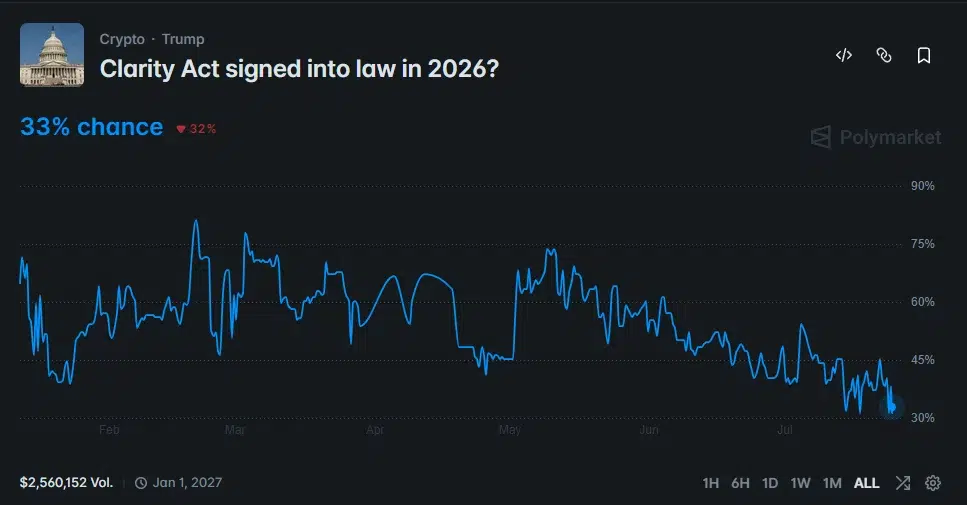
Prediction-market traders have responded by cutting their expectations further. Polymarket now gives the CLARITY Act a 33% chance of becoming law in 2026, with more than $2.56 million wagered on the contract.
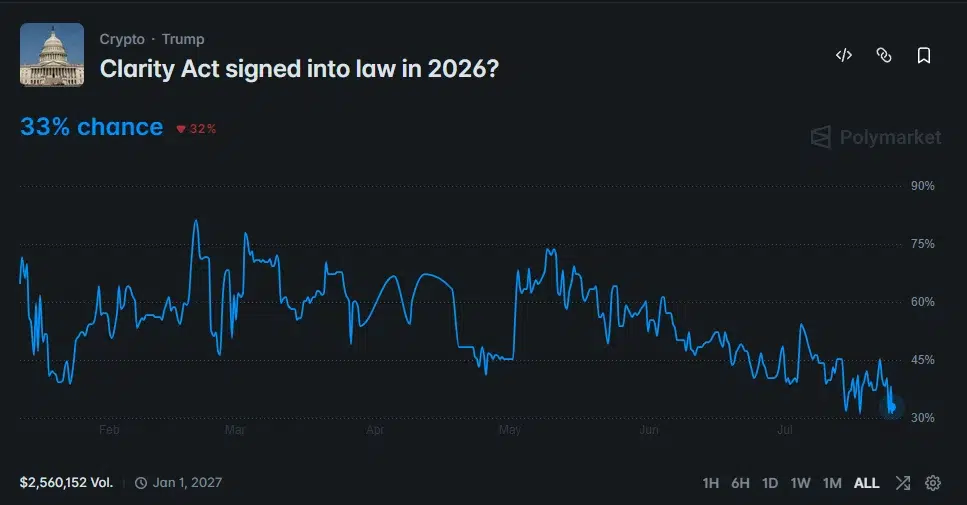
Polymarket’s chart shows that the odds climbed above 80% in late February before losing ground over the following months. The probability fell toward 30% in July as ethics disputes, banking opposition, and the approaching recess weakened confidence in passage.
Once lawmakers return after the elections, Hammond expects a narrow opportunity in which campaign pressure may ease enough to restart negotiations. Fortune reported that the effort would still compete with funding deadlines and defense legislation, leaving senators limited time to settle the remaining ethics, banking and enforcement disputes.

Strive’s variable-rate perpetual preferred shares, SATA, have rebounded sharply after hitting a June low of $83.30, rising to around $97 and recovering most of the selloff, according to Yahoo Finance data. The improvement has placed the shares within roughly 3% of their $100 par value.
The price recovery matters because SATA is part of a broader, fast-growing approach among Bitcoin-treasury companies: using preferred equity designed to trade close to par. The objective is to raise capital for a corporate Bitcoin (BTC) treasury without issuing more common stock, while dividends adjust to support the shares’ pricing.
Key takeaways
- SATA has climbed from a June low of $83.30 to roughly $97, putting it about 3% below its $100 par value, per Yahoo Finance.
- Strive introduced SATA in November 2025 to fund expansion of its Bitcoin treasury through preferred equity rather than additional common share issuance.
- Preferred-share “digital credit” strategies are increasingly being used by Bitcoin-treasury firms to structure financing around dividends that can adjust over time.
- Strategy’s STRC experienced a similar late-June decline but has partially recovered, trading around $87—still below par.
How SATA is structured and why it exists
Strive introduced SATA in November 2025 as part of its effort to finance expansion of its Bitcoin treasury through preferred equity. In Strive’s announcement about the Nasdaq listing and the related closing of an oversubscribed upsized IPO, the company described SATA as a variable-rate perpetual preferred designed to trade near $100 par by adjusting its dividend rate.
That structure is intended to offer investors a mechanism to “anchor” valuation around par without requiring Strive to repeatedly issue common shares. For the company, it creates a financing channel that is directly tied to the treasury-building thesis—supporting Bitcoin accumulation while attempting to manage the equity dilution burden that comes with selling additional common stock.
Strive’s approach also reflects a wider market trend. The article notes that SATA is one of several preferred-share products linked to Bitcoin treasury strategies, a segment some market participants describe as “digital credit.”
June selloff: SATA recovered, STRC remains below par
The key datapoint for traders is the swing back toward par. Yahoo Finance data shows SATA fell to $83.30 in June before recovering to about $97. While that still leaves room for improvement, the rebound suggests that the market is rewarding the shares’ par-focused design after periods of heightened stress.
Strive’s preferred structure sits within a peer set that includes Strategy’s STRC. Strategy’s preferred-like product was launched in 2025 with a similar objective—maintaining a $100 share price through a variable dividend. According to Yahoo Finance, STRC fell sharply during the late-June selloff as well, before recovering. However, STRC continues to trade below par at around $87.
As a practical matter, the divergence between SATA’s relative recovery and STRC’s remaining discount may shape near-term investor expectations for how quickly these instruments can reprice after market-wide pressure. It also highlights an important asymmetry: even when products share similar structural goals, their outcomes can differ based on investor sentiment, capital market conditions, and the companies’ execution over time.
Bitcoin treasury scale and the preferred-share thesis
Preferred-share strategies are ultimately tied to the broader credibility of the treasury-building plan. In that context, the article points to BitcoinTreasuries.NET for rankings of public Bitcoin treasury companies.
Strategy remains the largest public corporate Bitcoin holder, with 843,775 BTC, according to BitcoinTreasuries.NET. Strive, meanwhile, has risen to seventh place with 19,921 BTC. While Strive is smaller than Strategy by BTC holdings, the company’s positioning indicates it is still participating meaningfully in the treasury race.
This ranking dynamic matters for preferred shareholders because treasury scale can influence expectations about dividend sustainability and overall business resilience—especially in a market where equity instruments are often priced around confidence in both operations and long-term balance-sheet strength.
Samson Mow: preferred-share confidence is “restoring”
Samson Mow, founder and CEO of Jan3, told Cointelegraph that recent adjustments by Bitcoin treasury companies are beginning to restore confidence in preferred-share products and support his broader view that Bitcoin has already found its bottom.
In the same conversation, Mow pointed to actions by Strategy that encourage STRC to return to par. He said that SATA’s return toward par could reinforce market confidence in the overall model, adding that the products are capitalized for multiple years of dividend payments and that there was “no reason to panic” during the selloff.
Mow also connected the improved trajectory of preferred-share instruments to ongoing refinement across the Bitcoin treasury sector. In his view, newer entrants and alternative structures can further validate the approach—citing Lyn Alden’s Orange Juice treasury company, which launched on July 15 with plans to operate a Bitcoin treasury and an intention to use a different approach, including a lower Bitcoin cost basis.
What to watch from an investor’s perspective is whether these dynamics translate into sustained repricing toward par across the peer set. SATA’s movement back toward $100 is a signal, but the market will likely continue to judge each issuer based on how quickly its preferred instrument stabilizes and how resilient its dividend profile appears under changing conditions.
For traders and long-term investors, the next checkpoint is whether SATA’s recovery holds as other preferred-share offerings—particularly Strategy’s STRC—continue to find their footing. The broader unanswered question is how durable “near-par” performance remains across full market cycles, especially if Bitcoin volatility increases and treasury companies face new capital and balance-sheet decisions.


Robinhood Chain token launch platform Memecoin.Fun has raised $3.5 million in strategic funding as the network’s decentralized exchanges approach $9 billion in cumulative trading volume.
Summary
- Memecoin.Fun raised $3.5 million in strategic financing led by Becker Ventures.
- Funding will support launchpad infrastructure, cross-chain bridges, and a multichain memecoin platform.
- Robinhood Chain’s growing activity is increasing competition among token issuance platforms.
According to an official announcement from Memecoin.Fun, Becker Ventures led the financing, while BitValue Capital, Mason Labs, Negentropy Capital, and angel investor Billy Wen also participated. The platform completed the transaction through the USDG token, although the announcement did not disclose Memecoin.Fun’s valuation or the terms received by investors.
Memecoin.Fun plans to use the capital to build its core products and technical systems. Its proposed work includes launchpad infrastructure for Robinhood Chain, cross-chain bridge functions, and research and operations for a platform designed to support memecoins across multiple blockchains.
By developing launch and cross-chain tools at the same time, Memecoin.Fun is entering a market that already includes projects competing for token creators and traders on Robinhood Chain. The funding announcement did not provide a release schedule for its launchpad, bridge, or multichain product.
Funding targets launch and cross-chain tools
Memecoin.Fun’s financing arrives as token issuance platforms prepare new products for the recently launched Ethereum Layer 2 network. Robinhood Chain has focused on bringing traditional financial assets on-chain, but early trading has been led mainly by speculative tokens, according to data previously reported by crypto.news.
Memecoins have generated more than 80% of decentralized exchange activity on Robinhood Chain, crypto.news reported. The concentration gives token launch platforms access to the network’s most active trading segment, even as Robinhood Chain develops infrastructure for tokenized stocks and other real-world assets.
Another launchpad, Pons, unveiled plans for its V2 upgrade on July 23, according to an earlier crypto.news report. The update is scheduled for the following week and is expected to introduce an Ether-based bonding curve, Uniswap V4 integration, creator payments in ETH, and trading pairs linked to tokenized real-world assets.
According to the Pons team, V2 will change how tokens are issued, traded, and transferred into decentralized liquidity pools on Robinhood Chain. Two partners are still auditing the contracts, however, and Pons cautioned that its planned features could change before deployment.
Pons attributed the redesign to feedback collected during its first weeks of operation. After facing several attacks following launch, the team worked with infrastructure partners to stabilize the protocol and stated that it would continue developing products for Robinhood Chain traders.
The two platforms are taking different routes within the same emerging market. Memecoin.Fun has secured outside capital to develop a launchpad, bridge functions, and multichain support, while Pons is preparing an upgrade centered on ETH liquidity, Uniswap V4, creator revenue, and tokenized-asset pairs.
Neither announcement supplied comparable figures for users, trading volume, token launches, or revenue. As a result, the information released by the projects does not yet show which platform has gained more activity or whether their upcoming products will attract lasting liquidity.
Robinhood Chain activity raises competitive stakes
Within three weeks of its launch, Robinhood Chain attracted $431 million in total value locked and nearly $400 million in stablecoin market capitalization, according to figures previously cited by crypto.news. Those totals give launch platforms a growing pool of on-chain capital, although crypto.news noted that most decentralized exchange activity has remained tied to memecoins rather than tokenized real-world assets.
FalconX reported additional signs of rapid adoption in a research primer published Monday. Citing network data, the digital asset brokerage said Robinhood Chain was processing about 6 million transactions per day and serving more than 250,000 daily active users after its July 1 mainnet launch.
Using Artemis data, FalconX also reported that Robinhood Chain had moved ahead of Coinbase’s Base network on some activity measures. The research firm placed cumulative decentralized exchange volume near $9 billion, indicating that traders have generated substantial turnover during the chain’s opening weeks.
FalconX described Robinhood Chain as one of the busiest blockchains following its mainnet debut, though its primer did not establish how much of the activity would continue after the initial launch period. crypto.news data showing memecoins responsible for more than four-fifths of exchange activity also indicates that speculative assets have driven much of the network’s early use.
For Memecoin.Fun, the funding provides resources to compete for that trading activity while building links with other chains. Its planned bridge could allow assets or users to move between networks, while the all-chain product would extend its token-launch model beyond Robinhood Chain if the team completes the proposed development.
The announcement did not identify supported chains, bridge security partners, an audit schedule, or dates for product deployment. Those details will determine how quickly Memecoin.Fun can put the $3.5 million financing to work as Pons and other launchpads release competing tools for Robinhood Chain’s growing base of traders and token creators.
Ethereum (ETH) has printed its first sustained advance against Bitcoin (BTC) in almost a year, breaking out of the descending channel that capped the pair since August 2025.
Bitcoin dominance tells a more cautious story, however. The metric is climbing back to 60%, and analysts remain divided on whether a real altcoin season can start in 2026.
Ethereum Breaks Out Against Bitcoin as Price and Momentum Align
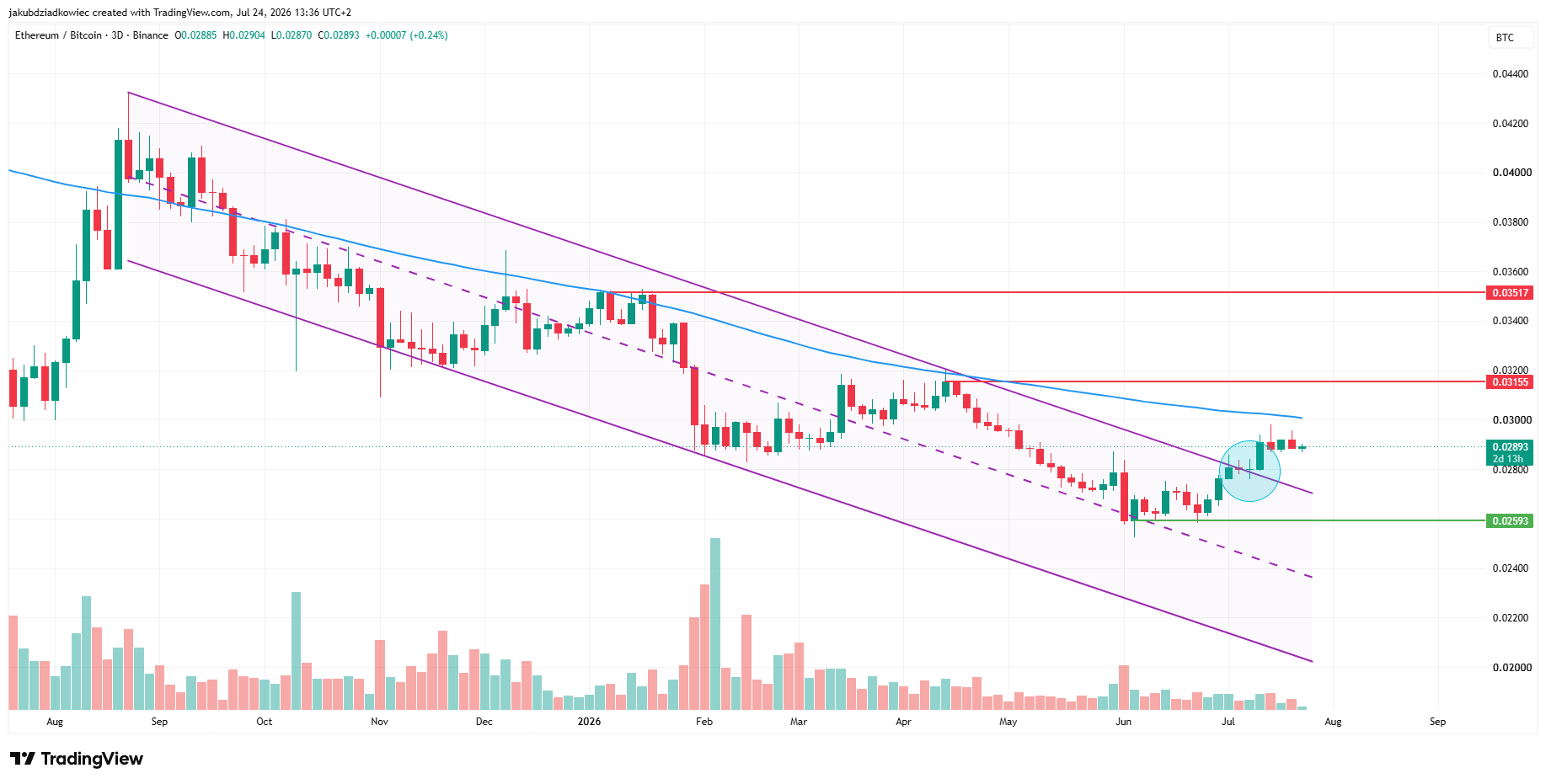
The ETH/BTC three-day chart shows a descending parallel channel in force since August 2025. The pair printed consistent lower lows and lower highs inside it for almost a year.
In July, the ratio finally closed above the channel’s upper boundary. It now trades near 0.0289, with Ethereum at $1,881, down 2.2% in 24 hours. Fresh whales accumulated 50,000 ETH this month as the ratio jumped 6%.
The breakout faces two obstacles overhead. The immediate resistance sits at 0.0316, while the next barrier waits at 0.0352. Moreover, the ratio still trades below the 200-day moving average (blue line). A reclaim of that line could open the road to the first resistance area.
If the pair pulls back, the nearest support stands at 0.0259. That level roughly coincides with the broken channel boundary, which may soon flip into confirmed support.

Momentum broke out first. The three-day Relative Strength Index (RSI) escaped a long-term falling wedge, a bullish pattern, at the end of June. Price followed weeks later, a sequence that often validates trend reversals.
The RSI now reads around 57. Therefore, it has cleared the neutral zone and holds room to run before overbought territory near 70.

Analyst Michael van de Poppe called the move the pair’s first real advance in over a year. Still, he expects Bitcoin to lead in the short term.
Bitcoin Dominance Defends 60% and Delays the Rotation Signal
The monthly Bitcoin dominance chart frames the bigger picture. A long-term descending trendline has capped the metric since 2017, and each touch (blue circle) has started an altcoin season. The first came in 2017 near 80%, and the second in 2021 near 73%.
The third touch arrived in mid-2025, when dominance was rejected at 66%. The metric then slipped below the 0.236 Fibonacci retracement at 59.63%. However, it never reached the 0.382 level at 55.66%, let alone the 0.618 at 49.23%. A drop to those levels would put a full rotation in place.

The three-day chart sharpens the trigger. Dominance has moved sideways between 58% and 60.7% since August 2025. An ascending support line inside that range broke down at the end of May.
Dominance now retests the broken line from below, near 59.5%. The retest coincides with the long-term 0.236 Fibonacci level, creating a confluence of resistance. A rejection here could send the metric through the 58% floor and directly to 55.66%. In contrast, a reclaim would target 61% and delay the altcoin rotation, even as the index shows early momentum.

Benjamin Cowen, founder of IntoTheCryptoverse, offered a counterpoint in his contribution to BeInCrypto’s Market Intelligence expert council and the accompanying video analysis. He argues the classic rotation may never arrive this cycle.
“This is a cycle where Bitcoin topped on apathy rather than euphoria.”
According to Cowen, an apathy top leaves no crowd to rotate into riskier assets. He points to 2019 as the closest parallel and keeps October 2026 as his base case for the cycle bottom.
What Would Confirm Altcoin Season 2026
The ETH/BTC charts suggest a rotation is loading. Price and momentum broke their downtrends within weeks of each other, and softer inflation has supported risk appetite.
The dominance charts demand patience, though. Bulls need dominance rejected near 59.6%, followed by a break under 58% and a slide to 55.66%. Until then, ETH/BTC holding above 0.0259 keeps the setup alive, while a dominance reclaim of 61% would hand the cycle back to bitcoin.
The post ETH/BTC Breakout Fuels Altcoin Season 2026 Hopes as Bitcoin Dominance Holds 60% appeared first on BeInCrypto.
BitMEX once ruled crypto trading. Now it is shutting down. On September 23, 2026, the exchange that invented the perpetual swap will close for good. The reasons why BitMEX shut down go far beyond the vague review it blamed.
The closing looks calm, not a crash. But three forces pushed BitMEX to quit instead of sell. The same forces now threaten other exchanges too.
1. BitMEX Lost the Market It Built
Why BitMEX Shut Down Began With a Lost Market
BitMEX launched in 2014. It invented the perpetual swap, a trade that never expires. Almost every rival later copied the idea. For years, it was the top spot for leveraged crypto bets.
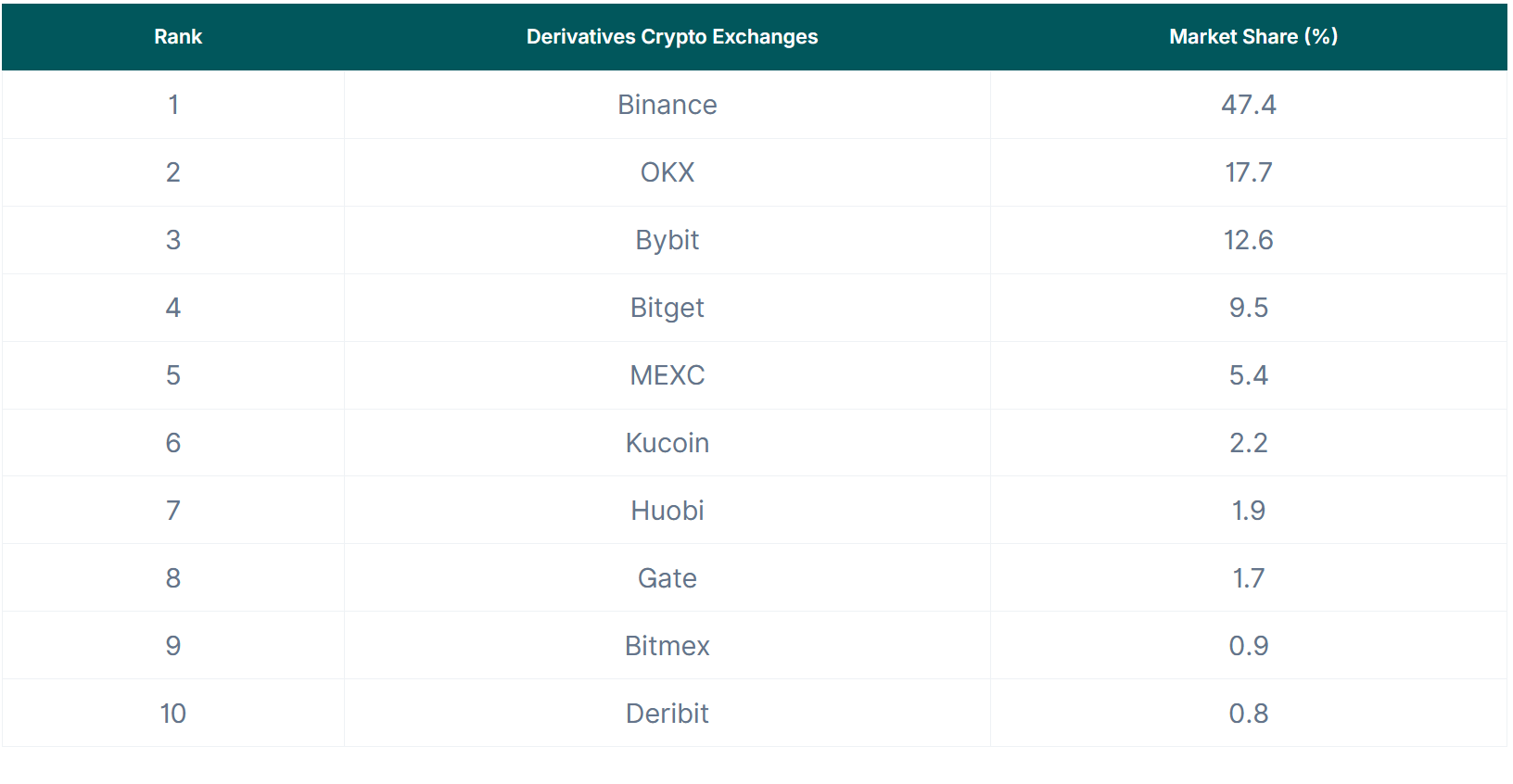
Then it fell behind. By August 2023, CoinGecko data ranked BitMEX 9th. It held just 0.9% of derivatives trades. Binance had 47.4%.

The slide kept going. This month, market tracker Kaiko put its share below 0.01%. Daily volume was about $400,000. Reuters reported the figures.
Traders go where other traders are. They left for bigger venues. BitMEX handed rivals its share of a market it once led.
2. No Buyer Would Take the Deal
A weak exchange can still be sold. BitMEX could not close a deal.
Crypto researcher Hasu has reportedly followed the firm since 2018. He says the exchange looked for a buyer from February 2025. No sale ever happened. Rivals, meanwhile, raised fresh capital from big finance.
The legal past scared buyers away. US regulators charged BitMEX and its founders in 2020 with weak anti-money laundering controls. All four fought the case, then pleaded guilty. They paid fines but avoided prison.
The bills piled up. A 2021 deal with two US regulators cost $100 million. In January 2025, BitMEX paid another $100 million in criminal fines and received two years of probation. President Donald Trump pardoned the founders in March. BitMEX announced its September shutdown this week.
3. A $270 Million Insurance Fund It Couldn’t Cleanly Sell
What the Insurance Fund and On-Chain Data Show.
Here is the deeper reason. Every leverage exchange keeps a safety pot. It is called an insurance fund. The pot pays out when a losing trade cannot cover itself. In busy times it grows, fed by scraps from closed-out trades.
BitMEX built one of the biggest. On-chain data tells the story. The fund peaked near 37,795 Bitcoin (BTC) in October 2021. Today, it holds about 3,694 BTC. It also holds roughly $30.8 million in Tether (USDT), a stablecoin. That is about 90% smaller than the peak.
BitMEX deliberately reduced the fund in November 2025. Even so, it kept far more cover than its rivals. Its cushion covered 0.88 times open bets. Binance covered just 0.11 times.

The fund was never in danger. On October 10, crypto had its biggest wipeout on record. Traders lost $19.35 billion due to forced sales, or liquidations.
BitMEX barely felt it. Its own report showed just $38.5 million of that on its books. The fund gave up only about $2 million.
So a big, healthy fund sat inside a dying exchange. That raised a simple question. Why keep so much cash in a business that is closing?

Analysts value what is left at nearly $270 million.
Hasu, like Martin, thinks the fund made BitMEX too hard to sell. He warned about its design back in 2018.
“It started as the golden goose, and then became the noose,” the researcher wrote.
Not everyone agrees. BitMEX calls the closure a business choice. On-chain, the fund has not moved since the news. Binance founder Changpeng Zhao (CZ) blamed years of US pressure instead.
A lawsuit landed the next day. Two former users say BitMEX took cash from their forced trades and fed the fund. They want about 623 BTC back in coins, not dollars. They point to a March 2020 outage. Users were locked out for 25 minutes while $800 million in bets were wiped.
“BitMEX announces it’s shutting down on Sept 23… then the NEXT DAY a proposed class action lands alleging the exchange deliberately designed its platform to FORCE LIQUIDATE customers and seize their bitcoin. Coincidence?” posed Ariel Givner, IP & corporate attorney in FinTech.
Who Could Be Next After BitMEX
BitMEX did not blow up like FTX, the exchange that collapsed in 2022. It closed while it still had the money to pay everyone. Even so, its exit is a warning.
The market keeps shrinking to a few winners. In 2023, the top three venues already ran about 78% of trades. That gap is wider now. Small players are getting squeezed.
The ones most at risk look alike:
- They offer high leverage.
- They hold little spare cash.
- They carry legal baggage.
- And they run a few other lines of business.
Much of this trading is also moving on-chain. The top perpetual futures venues there cleared trillions last year.
On-chain is not safe either. A TRM Labs report counted 207 hacks and about $972 million stolen in early 2026. In the October 10 crash, Hyperliquid alone saw $10.31 billion in liquidations.
Regulated rivals are moving in too. Kalshi launched the first US perpetual futures in May. Kraken added its own in June. Coinbase started a year earlier.
One big question remains. Where does the $270 million fund go after September? Neither BitMEX nor Arthur Hayes has said.
The lawsuit may force an answer.
For every other exchange, the lesson is simple. Stay relevant. Keep clean books. Be easy to sell. That may be what keeps you alive now.
The post 3 Real Reasons Why BitMEX is Shutting Down, and Who Could Be Next appeared first on BeInCrypto.

Strive’s SATA preferred shares have rebounded sharply after a late-June selloff, according to Yahoo Finance. The variable-rate perpetual preferred stock rose from a June low of $83.30 to roughly $97, recovering most of its declines and trading within about 3% of its $100 par value.
The rebound matters because SATA is part of a growing slate of Bitcoin-treasury-linked preferred-share products designed to keep their share price near par by dynamically adjusting dividend rates. For investors watching whether this “preferred equity for Bitcoin treasuries” model can hold up during market stress, the way SATA and peers respond to volatility may be the clearest near-term signal.
Key takeaways
- Yahoo Finance shows Strive’s SATA preferred shares recovered from a June low of $83.30 to around $97, nearing the $100 par value.
- SATA was introduced in November 2025 as Strive’s mechanism to fund expansion of its Bitcoin treasury through preferred equity rather than issuing more common shares.
- Similar products are emerging in the Bitcoin corporate sector; Strategy’s STRC launched in 2025 with a related “variable dividend near par” concept.
- Samson Mow argues that improvements across Bitcoin treasury balance sheets—and SATA’s return toward par—can help restore confidence in the broader preferred-share category.
- Data from BitcoinTreasuries.NET places Strive as the seventh-largest public Bitcoin treasury holder, with 19,921 BTC.
SATA’s move back toward par
Strive launched SATA in November 2025, framing it as a preferred-equity tool to support its Bitcoin treasury strategy. The company’s approach centers on a variable-rate perpetual preferred share: instead of relying on a fixed coupon, the dividend rate is designed to adjust so the security trades close to its $100 par value.
In practice, that structure gives the market a built-in adjustment lever during changing conditions. When investors re-price the expected dividend stream—whether due to interest-rate moves, crypto sentiment, or company balance-sheet expectations—SATA’s performance can reflect how well the variable dividend mechanism is restoring equilibrium.
After falling to $83.30 in June, the stock’s subsequent recovery to around $97 suggests sellers have largely faded and that the market may be recalibrating its view of the product’s stability.
Why preferred equity is gaining attention in Bitcoin treasuries
SATA is not an isolated concept. The same general idea—linking corporate capital-raising to Bitcoin treasury objectives while using preferred equity to manage dilution—has become a recognizable segment among companies that describe such structures as “digital credit,” an emerging framing that Cointelegraph has discussed previously in connection with Bitcoin-focused financing products.
Strive’s stated goal is straightforward: raise capital for its Bitcoin treasury without issuing additional common shares. For public equity holders, that can be a significant difference. Common-stock issuance can be dilutive in the near term, while preferred structures are often marketed as a way to finance growth while keeping the common share count stable.
That said, the market still has to price risk: preferred shares can be sensitive to how investors assess dividend durability, treasury management, and credit-like features tied to corporate performance. The question investors are effectively testing is whether the “variable dividend to par” design meaningfully limits downside during periods of broader risk-off sentiment.
Strategy’s STRC as a reference point
Strategy’s STRC provides a direct comparison point. Introduced in 2025 with a similar objective of maintaining a $100 share price through a variable dividend framework, STRC also fell sharply during the late-June selloff. However, it has not fully returned to par; Yahoo Finance shows STRC trading at about $87.
The divergence between SATA nearing par while STRC remains below it highlights an important reality: even products built on similar mechanics can experience different market trajectories depending on timing, investor expectations, and how quickly confidence returns.
Still, both examples appear to be rooted in the same investor promise—mechanical dividend adjustments supported by a treasury-focused balance sheet. If that promise continues to be validated, it could reduce the “model break” fear that emerges during drawdowns.
Market confidence and sector refinements
Speaking to Cointelegraph, Jan3 founder and CEO Samson Mow suggested that adjustments by Bitcoin treasury companies are starting to restore confidence in preferred-share products. He linked the broader improvement in this niche to ongoing efforts to strengthen balance sheets and encourage securities like STRC to move back toward par.
Mow’s core point was that market participants are looking for evidence that these structures can withstand volatility rather than requiring panic-driven repricing. In his view, when SATA returns to par, it could reinforce the argument that the overall model is functioning as intended—potentially supporting STRC’s path as well.
He also pointed to new entrants refining approaches to treasury management. As an example, Mow cited Lyn Alden’s Orange Juice treasury company, which launched on July 15 with plans to operate a Bitcoin treasury and with an explicit intent of running a lower Bitcoin cost basis through its own strategy.
For investors, the practical takeaway is not just that more products are appearing, but that the sector is iterating. The preferred-share idea is still young, and each cycle of stress tests can determine which variations earn durability in the eyes of the market.
Meanwhile, the underlying Bitcoin treasury competition remains a key backdrop. BitcoinTreasuries.NET data places Strive at seventh among public Bitcoin treasury companies, holding 19,921 BTC, while Strategy remains the largest with 843,775 BTC.
Going forward, traders and investors should watch whether SATA’s move near par translates into broader confidence for comparable products like STRC, and whether further treasury-linked preferred issuances continue to attract stable bids during risk-off periods. The durability of the variable-dividend-to-par mechanism—and investors’ belief in dividend resilience—will likely remain the central question.

Graduation outfits: Students tell us how to impress on a budget

Odos Protocol to shut down DEX aggregator on July 30

‘The Ultimatum’ Star Blake Robertson Shares Relationship Update

Renter of Home in Anne Heche Crash Denies Settlement With Son

No Jackpot Winner as $257 Million Prize Rolls Over to $269 Million Monday Draw

Weekend Open Thread: Staud – Corporette.com

If I learn this, can I achieve financial freedom?#Woodworking#HandmadeArt#WoodCarving#CreativeCrafts

BITCOIN : les frappes en Iran peuvent tout faire basculer (encore..)

Lawmaker details scope of financial fraud, scams: ‘Beyond pervasive’
-

 Crypto World7 days ago
Ripple Payments Joins MiCA With 14 Firms, Does It Mean Anything For XRP?
-

 Politics7 days ago
The House | The City of London can help the new chancellor deliver growth in every postcode
-

 Fashion6 hours ago
Weekend Open Thread: Brooks Brothers
-

 Politics5 days ago
Democrats look to World Cup watch parties to register thousands of voters
-

 Crypto World4 days ago
Grayscale Files For Worldcoin ETF, WLD Registers Sharp Rise
-

 Tech4 days ago
Sail Virtually Aboard The “Itanic” With IA-64 Emulator
-

 NewsBeat5 days ago
Unregistered fitter used Gas Safe logo on business flyers
-
 Tech4 days ago
Turtle Beach Command Series KB7 review: a nifty screen-equipped gaming keyboard
-
 Business3 days ago
New Jersey voter registration controversy explained: How 6,600 noncitizens got on the rolls, and what happens next
-

 News Videos5 days ago
Big Money Is Entering XRP
-

 Crypto World6 days ago
Kaspersky exposes OkoBot’s 20-module crypto wallet attack
-
 Entertainment3 days ago
Johnny Depp’s R-Rated Gothic Cult Classic Gets New Release Ahead of Sydney Sweeney Remake
-

 NewsBeat7 days ago
Durham County Council to send out electoral registration emails
-

 Crypto World2 days ago
Ethics, other provisions in crypto Clarity Act to be further discussed
-

 Crypto World7 days ago
MiCA Licensing Faces Delays as ESMA Adds 14 CASPs to Register
-

 Crypto World7 days ago
Chip Stocks Enter Bear Market After Moonshot Ai Unveils Kimi K3 Model
-
 NewsBeat4 days ago
Shanghai science forum photos show China’s AI and robotics advances in rivalry with US
-

 Tech4 days ago
Watch Flock Safety CEO Garrett Langley discuss the future of surveillance at TechCrunch Disrupt 2026
-
 Crypto World5 days ago
Circle’s President Sold Over 360,000 Shares, The Filings Explain Why
-

 Tech5 days ago
Subway Sandwich Computers Get a Second Life as Gaming Machines
You must be logged in to post a comment Login