

Crypto World
Strive’s SATA Rebounds, Recovers Most of June Drop and Holds Near Par


Strive’s SATA preferred shares have rebounded sharply after a late-June selloff, according to Yahoo Finance. The variable-rate perpetual preferred stock rose from a June low of $83.30 to roughly $97, recovering most of its declines and trading within about 3% of its $100 par value.
The rebound matters because SATA is part of a growing slate of Bitcoin-treasury-linked preferred-share products designed to keep their share price near par by dynamically adjusting dividend rates. For investors watching whether this “preferred equity for Bitcoin treasuries” model can hold up during market stress, the way SATA and peers respond to volatility may be the clearest near-term signal.
Key takeaways
- Yahoo Finance shows Strive’s SATA preferred shares recovered from a June low of $83.30 to around $97, nearing the $100 par value.
- SATA was introduced in November 2025 as Strive’s mechanism to fund expansion of its Bitcoin treasury through preferred equity rather than issuing more common shares.
- Similar products are emerging in the Bitcoin corporate sector; Strategy’s STRC launched in 2025 with a related “variable dividend near par” concept.
- Samson Mow argues that improvements across Bitcoin treasury balance sheets—and SATA’s return toward par—can help restore confidence in the broader preferred-share category.
- Data from BitcoinTreasuries.NET places Strive as the seventh-largest public Bitcoin treasury holder, with 19,921 BTC.
SATA’s move back toward par
Strive launched SATA in November 2025, framing it as a preferred-equity tool to support its Bitcoin treasury strategy. The company’s approach centers on a variable-rate perpetual preferred share: instead of relying on a fixed coupon, the dividend rate is designed to adjust so the security trades close to its $100 par value.
In practice, that structure gives the market a built-in adjustment lever during changing conditions. When investors re-price the expected dividend stream—whether due to interest-rate moves, crypto sentiment, or company balance-sheet expectations—SATA’s performance can reflect how well the variable dividend mechanism is restoring equilibrium.
After falling to $83.30 in June, the stock’s subsequent recovery to around $97 suggests sellers have largely faded and that the market may be recalibrating its view of the product’s stability.
Why preferred equity is gaining attention in Bitcoin treasuries
SATA is not an isolated concept. The same general idea—linking corporate capital-raising to Bitcoin treasury objectives while using preferred equity to manage dilution—has become a recognizable segment among companies that describe such structures as “digital credit,” an emerging framing that Cointelegraph has discussed previously in connection with Bitcoin-focused financing products.
Strive’s stated goal is straightforward: raise capital for its Bitcoin treasury without issuing additional common shares. For public equity holders, that can be a significant difference. Common-stock issuance can be dilutive in the near term, while preferred structures are often marketed as a way to finance growth while keeping the common share count stable.
That said, the market still has to price risk: preferred shares can be sensitive to how investors assess dividend durability, treasury management, and credit-like features tied to corporate performance. The question investors are effectively testing is whether the “variable dividend to par” design meaningfully limits downside during periods of broader risk-off sentiment.
Strategy’s STRC as a reference point
Strategy’s STRC provides a direct comparison point. Introduced in 2025 with a similar objective of maintaining a $100 share price through a variable dividend framework, STRC also fell sharply during the late-June selloff. However, it has not fully returned to par; Yahoo Finance shows STRC trading at about $87.
The divergence between SATA nearing par while STRC remains below it highlights an important reality: even products built on similar mechanics can experience different market trajectories depending on timing, investor expectations, and how quickly confidence returns.
Still, both examples appear to be rooted in the same investor promise—mechanical dividend adjustments supported by a treasury-focused balance sheet. If that promise continues to be validated, it could reduce the “model break” fear that emerges during drawdowns.
Market confidence and sector refinements
Speaking to Cointelegraph, Jan3 founder and CEO Samson Mow suggested that adjustments by Bitcoin treasury companies are starting to restore confidence in preferred-share products. He linked the broader improvement in this niche to ongoing efforts to strengthen balance sheets and encourage securities like STRC to move back toward par.
Mow’s core point was that market participants are looking for evidence that these structures can withstand volatility rather than requiring panic-driven repricing. In his view, when SATA returns to par, it could reinforce the argument that the overall model is functioning as intended—potentially supporting STRC’s path as well.
He also pointed to new entrants refining approaches to treasury management. As an example, Mow cited Lyn Alden’s Orange Juice treasury company, which launched on July 15 with plans to operate a Bitcoin treasury and with an explicit intent of running a lower Bitcoin cost basis through its own strategy.
For investors, the practical takeaway is not just that more products are appearing, but that the sector is iterating. The preferred-share idea is still young, and each cycle of stress tests can determine which variations earn durability in the eyes of the market.
Meanwhile, the underlying Bitcoin treasury competition remains a key backdrop. BitcoinTreasuries.NET data places Strive at seventh among public Bitcoin treasury companies, holding 19,921 BTC, while Strategy remains the largest with 843,775 BTC.
Going forward, traders and investors should watch whether SATA’s move near par translates into broader confidence for comparable products like STRC, and whether further treasury-linked preferred issuances continue to attract stable bids during risk-off periods. The durability of the variable-dividend-to-par mechanism—and investors’ belief in dividend resilience—will likely remain the central question.



When hackers hijacked Robinhood’s CEO’s X account, they did not run the usual smash-and-grab. They launched a token whose liquidity is locked forever, un-ruggable by design, and are collecting trading fees from it in perpetuity. The rug pull just evolved into a yield product, and the anti-scam infrastructure built the machine.
Summary
- Hackers compromised Robinhood CEO Vlad Tenev’s X account on Thursday and promoted Vladhood ($VLAD) as the “official mascot” of Robinhood Chain, drawing 175,000 views in under 20 minutes and $22 million in trading volume.
- The operation was premeditated, not opportunistic: the token contract deployed 46 minutes before the hacked post, through the Pons launchpad, with Tenev’s own X profile listed as the token’s official website.
- The mechanism is the story: Pons locks a token’s liquidity permanently, making rug pulls impossible, but lets creators claim trading fees, so the attacker farms income from every trade, roughly $59,000 claimed in the first hours and still accruing, atop total proceeds estimated at $1.2-1.3 million.
- The design inverts a decade of scam economics: instead of one exit event, the scammer holds a perpetual annuity on victim activity, and the anti-rug protection that legitimizes the launchpad is precisely what guarantees the income.
- It is the second executive-account token scam on Robinhood Chain in eleven days, six days before the company’s earnings call, and it poses a question the industry has not answered: who is liable when scam-proofing infrastructure becomes the scam’s business model.
Crypto crime has a classical form, refined over a decade: create a token, manufacture credibility, collect the victims’ money, and vanish, the rug pull, a crime with a beginning, a middle, and above all an end. What happened on Thursday, when hackers seized the X account of Robinhood’s chief executive and pointed 15 million followers at a memecoin called Vladhood, had the beginning and the middle and then, deliberately, no end.
The attackers launched $VLAD through a launchpad whose signature safety feature locks a token’s liquidity forever, which means the token cannot be rugged, which means, and here is the inversion worth an entire article, the scam never has to stop. The locked pool collects trading fees on every swap, the launchpad pays those fees to the token’s creator, and the creator is the hacker, who called the fee-collection function six times in the first two hours and has no reason ever to stop calling it. The rug pull was a robbery. This is a toll booth, built on stolen credibility, operated in public, generating income for its architect with every trade, protected by the exact mechanism the industry built to protect traders. The Defiant’s on-chain forensics documented the machine within hours; what the machine means, for scam economics, for the launchpads, and for the brokerage whose chain now hosts its second executive-impersonation token in eleven days, is the subject here.
The operation, reconstructed
The timeline, assembled from on-chain records and the forensic work of The Defiant and Onchain Lens, settles the fact that reframes everything else: this was a single coordinated operation, planned around the account takeover, not a scammer riding a lucky hack.
At 12:38 pm ET on Thursday, a wallet with no prior history launched Vladhood through Pons, the busiest of the Pump.fun-style launchpads that colonized Robinhood Chain in its first month. The launch parameters included a detail that functions as a confession of premeditation: the token’s official website field listed Tenev’s X profile URL, meaning the creators configured the token around an account they did not yet publicly control. Forty-six minutes later, the post appeared on that account: Does Robinhood love memes? The answer is yes, introducing $VLAD as the official mascot of Robinhood Chain, falsely promising a Robinhood app listing, signed off, Welcome to the Hood, with the contract address attached. The credibility stack was complete: a verified account, a CEO’s voice, a chain the CEO actually launched three weeks earlier, and a claim, app listing, that sat exactly on the boundary of plausible.
The market did what engineered credibility makes it do. The post drew more than 175,000 views in under 20 minutes; the token ran up more than 90,000% from launch; volume reached $22 million across roughly 85,000 swaps in the main pool; the market cap touched somewhere between $4 million and $10 million depending on the snapshot; 5,266 holders and 137,000 transfers accumulated on a contract deployed that afternoon. Robinhood’s communications team confirmed the compromise roughly 41 minutes after the post and worked with X to delete it; the chain’s own explorer flagged the contract as a likely scam. On-chain monitors estimate wallets tied to the operation extracted around 650 to 690 ETH, between $1.2 million and $1.3 million, through the classic half of the play, early wallets, holding a reported 70% of supply, selling into the spike.
And then the part that makes this a new genre: the sale was not the payday’s end. It was the down payment.
The mechanism: anti-rug as annuity
To see the innovation, start with the protection it exploits, because the protection is real and the exploitation is parasitic on its virtue.
Launchpads in the Pump.fun lineage answered the rug pull structurally: when a token graduates to a trading pool, the platform locks the liquidity in a locker contract the creator cannot drain. The creator cannot pull the pool, so the classic exit, remove liquidity, collapse the price to zero, vanish, is mechanically impossible, which is the safety pitch that lets these platforms describe themselves as scam-resistant and lets traders ape into anonymous tokens with one category of fear removed. Pons implements the standard design with the standard incentive attached: locked liquidity still generates trading fees on every swap, and those fees are claimable by the token’s creator, a reasonable arrangement meant to reward legitimate builders whose tokens sustain volume.
Now run the $VLAD operation through that machinery. The attacker cannot rug, and does not need to. Every trade in the pool, the panic selling after the exposure, the bagholders averaging down, the day traders playing the volatility, the bots arbitraging the chaos, pays a fee, and the fee flows to the creator wallet on demand. Starting seven minutes after the fake post, the wallet called the locker’s fee-collection function six times over roughly two hours, netting about 31.6 ETH, roughly $59,000, and the meter is still running: the balance grows as long as anyone, for any reason, trades the token. The Defiant’s framing captures the inversion precisely: the wallet did not need to pull liquidity to cash out. The token never rugged. It just collects.
The economics deserve to be stated as the design they are. A rug pull monetizes credibility once, in a single extractive event that ends the scam and starts the manhunt. The locked-liquidity structure converts the same stolen credibility into an income-producing asset: a perpetual claim on the trading activity of a token that cannot die by its creator’s hand, whose infamy itself sustains volume, and whose victims’ every attempt to trade out of their position pays the person who put them in it. The scam has acquired a business model, and the business model was donated by the anti-scam infrastructure. Eleven days earlier, crypto.news covered the predecessor eleven days earlier, the SCATMAN operation, run through SpaceX’s hijacked accounts onto this same chain, which took $135,000 in the classical style and ended. $VLAD’s operators took ten times that in the opening hours and, structurally, have not ended at all. That delta, between a robbery and a franchise, is the evolution this incident marks.
The venue, the timing, and the liability question
The setting compounds the story, because the chain hosting this evolution belongs to a licensed brokerage six days from its earnings call.
Robinhood Chain’s first month, as this publication has documented in the venue’s first-month composition problem, delivered $700 million in assets, 300,000 daily active addresses, top-tier DEX volume, third place in seven-day chain revenue, and a composition problem: memecoins driving the overwhelming majority of activity against roughly $13 million in the tokenized real-world assets the chain was built for. The scam wave is the composition problem’s sharpest edge, SCATMAN through hijacked SpaceX accounts on July 12, a launchpad going dark mid-boom with an estimated $12 million in fees, and now the chain’s own founder’s face on its most sophisticated fraud, a token the chain’s explorer flags as a scam while the chain’s fee mechanics, this is the uncomfortable part, collect revenue on every one of its trades, as does the sequencer’s operator. A brokerage whose regulatory identity is bringing compliant rails to digital assets is earning protocol revenue, however small, on a fraud impersonating its own CEO, and its earnings call, where management must frame the chain’s first month for analysts and its Say-platform retail questioners, now has its opening exhibit. That is the earnings call this incident now precedes.
The liability question is the one the industry has not answered, and $VLAD converts it from hypothetical to operational. The launchpad designed the locker; the locker guarantees the scammer’s income; the design choice that prevents one crime funds another. Is Pons, which profits from launch fees and whose factory contract the explorer flagged, a neutral tool provider, the Section 230 of token creation, or does operating a fee-annuity machine that any account thief can drive create obligations, to freeze creator-fee claims on flagged tokens, to require identity for fee withdrawal, to build the kill switch the anti-rug design deliberately omitted? Every answer has a cost: freezable fees reintroduce the trusted operator the architecture exists to remove, identity requirements gut the permissionless launch model that generates the volume, and doing nothing leaves the annuity running. The same trilemma applies one level up, to the chain, and one level higher, to X, whose verified-account security has now been the entry point for two nine-figure-audience token frauds in eleven days on the chain the scams chose alone, part of a lineage running from the 2024 celebrity-account wave through this month’s fake Armstrong coin. Executive social accounts have become, functionally, financial infrastructure, secured like consumer products.
The economics of borrowed trust, quantified
Step back from the mechanism and the incident yields something rarer than a forensic timeline: a clean measurement of what stolen credibility is worth per minute, and a market structure that prices it.
Run the numbers as a conversion funnel. The hijacked account held roughly 15 million followers; the post survived approximately 20 minutes in primary distribution and drew 175,000 views; the token processed $22 million in volume and accumulated 5,266 holders within hours; the operators extracted $1.2 to $1.3 million in direct proceeds plus the ongoing fee stream. That is roughly $65,000 of extraction per minute of post uptime, about $7.40 per view, and around $250 of eventual volume per view, numbers that explain, better than any security advisory, why executive account compromise has become a professionalized industry with its own supply chain: access brokers who source the credentials, operators who build the token infrastructure in advance, and distribution specialists who time the post. The 46-minute pre-deployment is the industrial tell, the attack was inventory waiting for its distribution moment, and the same funnel mathematics applied to the SCATMAN operation, a smaller account constellation and a cruder mechanism, yielded a tenth of the proceeds, which is exactly the relationship a maturing industry’s cohort analysis would predict: returns scale with audience quality and mechanism sophistication, and both are improving.
The funnel also identifies where defense actually binds, and it is not where the industry spends. Post-hoc measures, explorer flags, account restoration, post deletion, all activated within the hour here, and the operation was profitable within seven minutes; the deletion ended distribution after the extraction window had already closed. The binding constraint is upstream: the account security that gates the distribution moment, and the launch infrastructure that lets the monetization machine be assembled anonymously in advance. Which is why the two reforms with actual leverage are unfashionable ones, hardware-key mandates and session-hygiene requirements for accounts above an audience threshold, effectively treating large verified accounts as the financial infrastructure they now are, and creator-fee escrow periods on launchpads, a delay between fee accrual and fee claim long enough for flags to propagate, which would have converted $VLAD’s annuity into a frozen exhibit without touching the permissionless launch itself. Neither reform requires identifying anyone; both attack the funnel’s throughput rather than its aftermath. The industry’s current posture, in which a nine-figure-audience account is secured by whatever its owner chose and a flagged scam’s fees flow to its operator in real time, is not a policy. It is a bounty schedule, published daily, and Thursday’s operators simply read it.
What to watch
The fee meter. The creator wallet’s claims are public and ongoing. Whether the balance crosses six figures, and whether anyone, Pons, the chain, a court, ever interrupts it, is the cleanest measure of whether the industry treats this as an incident or a precedent. As of the first day, nothing in the architecture can stop it.
The launchpad’s response. Pons faces the trilemma first: freeze mechanics, identity gates, or explicit neutrality. Its choice, and whether Robinhood Chain pressures it, writes the first draft of the fee-annuity era’s rules, and every copycat is watching. The design is trivially replicable on any chain with a locked-liquidity launchpad, which is all of them.
The earnings call, July 29. Whether analysts or Say questioners force management to address the scam wave on the record, and whether the answer gestures at curation, moderation, or enforcement, would mark the first time a public brokerage defines its responsibility for frauds conducted on infrastructure it operates and profits from.
The security postmortem. How the attackers took the account, SIM swap, session theft, insider access, matters for every executive in the industry, because the $VLAD operation’s real innovation was pairing patient token engineering with account compromise as a single planned instrument. The 46-minute gap between deployment and post is the tell: this was manufactured, and manufacturing scales.
The rug pull is dying the way all crimes die, by evolving into something the law has not named yet. $VLAD’s architects understood what the industry’s own safety engineering had built: a machine that converts stolen credibility into permanent income, legally ambiguous, mechanically unstoppable, and hosted on the most scrutinized new chain in crypto. The $59,000 in claimed fees is a small number. The design it proves out is not, because every locked pool on every launchpad on every chain is now, visibly, a potential annuity for whoever can manufacture one hour of borrowed trust, and the industry that built the locks has not built the thing that comes after: a way to stop paying the thief.
A closing note on the naming problem, because it will shape the response. The legal system has vocabulary for the rug pull: theft, wire fraud, market manipulation, each with elements prosecutors know how to plead against an exit event. The fee annuity fits none of them cleanly. The initial impersonation is straightforwardly criminal, identity theft and securities-adjacent fraud in the account takeover and the false listing claim, and any eventual defendant will face those counts. But the ongoing income stream is stranger: after the exposure, every subsequent trader in $VLAD acts with full knowledge that the token is flagged, the fees are disclosed by the mechanism itself, and the operator extracts value not by deceiving anyone still present but by having once deceived people no longer trading. Whether collecting contractually-defined fees from a pool of informed speculators constitutes ongoing fraud, unjust enrichment, or merely distasteful legality is a question no court has answered, and the answer determines whether the annuity can be seized, whether launchpads face aiding liability for paying it out, and whether the design spreads with impunity. It is another case of when mechanism design meets adversaries. The industry’s enforcement history suggests the question gets answered slowly and by the worst possible case: some future iteration of this design, at ten times the scale, attached to a fraud egregious enough to force the doctrine. Until then, the $VLAD wallet keeps calling its function, the locker keeps paying, and the gap between what the mechanism permits and what the law has named sits open, collecting fees.
Frequently asked questions
What happened to Vlad Tenev’s X account?
Hackers took control of the Robinhood CEO’s verified X account on Thursday, July 23, and posted a promotion for a fake memecoin called Vladhood ($VLAD), presenting it as the official mascot of Robinhood Chain and falsely claiming it would be listed on the Robinhood app. The post drew over 175,000 views in under 20 minutes before removal. Robinhood confirmed the compromise about 41 minutes after the post and said it was working with X to restore access.
Was this an opportunistic hack?
No, it was premeditated and coordinated. On-chain records show the token contract was deployed through the Pons launchpad 46 minutes before the fraudulent post appeared, and the launch configuration listed Tenev’s own X profile as the token’s official website, meaning the operation was built around an account takeover that had not yet happened publicly. The account compromise and token launch were parts of a single planned instrument.
How much did the attackers make?
Two figures describe it. On-chain monitors estimate total proceeds of roughly 650 to 690 ETH, about $1.2 to $1.3 million, largely from early wallets, holding a reported 70% of supply, selling into the spike. Separately, the locked liquidity pool has paid the creator wallet approximately $59,000 in trading fees in the first hours, claimed across six withdrawals, and that stream continues to accrue with every trade.
Why is the token impossible to rug pull, and why does that matter?
The Pons launchpad locks a token’s liquidity in a locker contract the creator cannot drain, a standard anti-rug protection. That makes the classic exit scam impossible, but the locked pool still generates trading fees that the creator can claim. The attacker therefore holds a perpetual income stream from all trading in the token, converting a one-time scam into an ongoing annuity that the protection itself guarantees.
How does this compare to the SCATMAN incident?
SCATMAN, eleven days earlier, used hijacked SpaceX and Starlink accounts to promote a token on the same chain and extracted roughly $135,000 in the traditional pump-and-dump style, an operation with an end. $VLAD extracted roughly ten times more in its opening hours and structurally has no end, because the fee stream persists. The two incidents mark an evolution in method on the same venue within two weeks.
Does Robinhood bear responsibility for scams on its chain?
That is the unresolved question the incident sharpens. The chain is permissionless, and Robinhood did not authorize the token, but the network and its sequencer earn revenue on all activity, including fraud, and the chain’s explorer flagging cannot stop trading or fee claims. The launchpad faces the same trilemma: freezing fees or requiring identity would compromise the permissionless model, while inaction leaves the annuity running. No platform has yet defined its obligations.
What should users take from this?
That verified executive accounts are now a primary fraud vector: two major incidents in eleven days used hijacked official accounts, and posts announcing surprise tokens should be treated as compromises by default, checked against official company channels, which stayed silent in both cases. Locked liquidity means a token cannot be rugged; it does not mean the token is legitimate, and in this design, trading a flagged token pays its creator.
Could this scam model spread?
Easily, which is its significance. Any launchpad that combines locked liquidity with creator-claimable fees, the dominant design across chains, can host the same structure, and the required ingredient, an hour of borrowed credibility, can come from any compromised account with reach. Until platforms build mechanisms to interrupt fee claims on flagged tokens, each such pool is a potential perpetual payout for whoever manufactures the trust. This is educational analysis, not financial or legal advice.
Disclaimer: This article is for information and educational purposes only and does not constitute financial, investment, or legal advice. It describes an ongoing security incident based on on-chain data and reporting available at the time of writing, and figures may change as investigations continue. Never interact with tokens promoted through unverified or compromised channels. Always do your own research. Information is accurate as of July 24, 2026.


Samsung has unveiled plans to add stablecoin support to Samsung Wallet, extending its mobile payment platform into blockchain-based digital value transfers.
Summary
- Samsung has announced plans to add stablecoin support to Samsung Wallet, expanding the app beyond payments and rewards.
- The company has not disclosed the supported stablecoins, launch timeline or technology partners for the new Wallet feature.
- The move builds on Samsung’s recent crypto initiatives, including Coinbase integration and investments tied to South Korea’s digital asset market.
During the company’s Galaxy Unpacked event, Samsung Electronics said Samsung Wallet will support stablecoins as part of its next phase of development, combining payments, rewards and digital assets within a single mobile experience. The company has not disclosed which stablecoins it will integrate, when the feature will launch or which partners will support the rollout.
Speaking at the event, Samsung product manager Lee Dinham said Samsung Wallet will expand beyond cash and savings to include stablecoins. He said the company intends to become one of the first major smartphone brands to offer native stablecoin functionality, allowing users to transfer digital value directly from their devices.
Although Samsung outlined the direction of the product, it stopped short of announcing technical details. The company has not identified supported blockchain networks, reserve-backed assets or regional availability for the feature. Cointelegraph said it contacted Samsung for additional comment but had not received a response at the time of publication.
Samsung builds on existing crypto services
The planned Wallet upgrade follows several digital asset initiatives Samsung has introduced over the past year, indicating that the company has been steadily adding blockchain services to its mobile ecosystem rather than treating stablecoins as a standalone product.
In October 2025, Samsung expanded its partnership with U.S.-based crypto exchange Coinbase, allowing Galaxy users in the United States to buy cryptocurrencies directly through Samsung Wallet. The integration initially covered more than 75 million Galaxy users, with Samsung and Coinbase saying they planned to expand the service to additional markets over time.
At the time, Coinbase Chief Business Officer Shan Aggarwal said the partnership combined Samsung’s global user base with Coinbase’s crypto platform to make digital assets easier to access. Samsung also introduced promotional incentives, including a three-month Coinbase One subscription for new users and trading credits for eligible customers making their first crypto purchase through Samsung Wallet.
Samsung has continued adding financial services to the application alongside its crypto offerings. Samsung Wallet already stores payment cards, digital identification documents, rewards programs and other credentials, while the company recently introduced Galaxy Card as another financial product connected to the ecosystem.
Stablecoins remain part of Samsung’s expanding blockchain strategy
Outside its consumer wallet business, Samsung has also increased its involvement in South Korea’s digital asset sector through investments and partnerships linked to blockchain infrastructure.
In May 2026, Samsung Securities, Samsung SDS and Samsung Card agreed to acquire a combined 4% stake in Dunamu, the operator of South Korea’s largest cryptocurrency exchange, Upbit. According to ETNews, the three affiliates paid 612.8 billion won, or about $408 million, for 1.39 million Dunamu shares.
The investment came as South Korea prepared legislation covering stablecoins, tokenized securities and digital asset service providers. Samsung Securities said it planned to work with Dunamu on tokenized securities issuance and digital asset services, while Samsung Card identified potential collaboration on digital asset payments and possible won-backed stablecoins through Samsung’s Monimo financial platform. Samsung SDS also outlined plans to combine its cloud, AI and cybersecurity capabilities with Dunamu’s blockchain infrastructure.
Samsung has nevertheless remained selective about external stablecoin initiatives.
Earlier this month, the company distanced itself from Open Standard’s proposed OUSD stablecoin consortium after being listed as one of more than 140 founding partners. According to South Korean newspaper Chosun, a Samsung official said the company had not held official consultations with Open Standard and did not know what role it was expected to play in the project.
Other organizations, including Dunamu, Shinhan Bank and K-Bank, also told Chosun they were still reviewing the proposal and had not formally agreed to participate. Their responses raised questions about the composition of the consortium announced by Open Standard.
Against that backdrop, Samsung’s latest announcement focuses on integrating stablecoins into its own wallet platform instead of participating in an external stablecoin governance structure.
The company has yet to disclose which stablecoins it intends to support or when users will gain access to the new functionality. Even so, the planned integration adds another blockchain feature to Samsung Wallet as the company continues expanding digital asset services across its mobile ecosystem.
Bitcoin price has slipped back toward $65,000 after spot ETF outflows, a major options expiry and rising oil prices stopped its rebound from extending beyond $66,800.
Summary
- Bitcoin price retreated to $65,000 after spot ETFs recorded $225 million in net outflows.
- A $1.2 billion options expiry placed the closely watched maximum-pain level at $64,500.
- Losing $63,700 could expose Bitcoin to a deeper decline toward the $60,000 area.
According to data from crypto.news, Bitcoin (BTC) price traded near $65,050 on July 24, down about 2.6% from its July 21 peak. Traders remained cautious as the pullback brought the price closer to a large derivatives settlement level and a rising trendline that has supported the recovery since late June.
U.S. spot Bitcoin exchange-traded funds recorded $225 million in net outflows on July 23, according to SoSoValue data. BlackRock’s IBIT accounted for about $202 million of those withdrawals, reversing the steady institutional inflows that had helped Bitcoin recover from its June low near $58,000.
At the same time, U.S. technology shares suffered their sharpest sell-off since April 2025. The Magnificent Seven fell 4.8% on July 23 and lost about $797 billion in combined market value as investors questioned the scale of corporate spending on artificial intelligence. The Nasdaq 100 dropped 1.9%, while the S&P 500 lost 1.2%.
Bitcoin fell less than 1% during the equity sell-off, which showed relative strength against technology stocks. However, the decline in risk appetite denied BTC the new capital needed to clear the $66,800 resistance area.
Oil prices added another obstacle. West Texas Intermediate crude eased to about $90.59 on Friday but remained on course for a weekly gain of nearly 10%, while Brent held near $98.87 after briefly trading above $100.
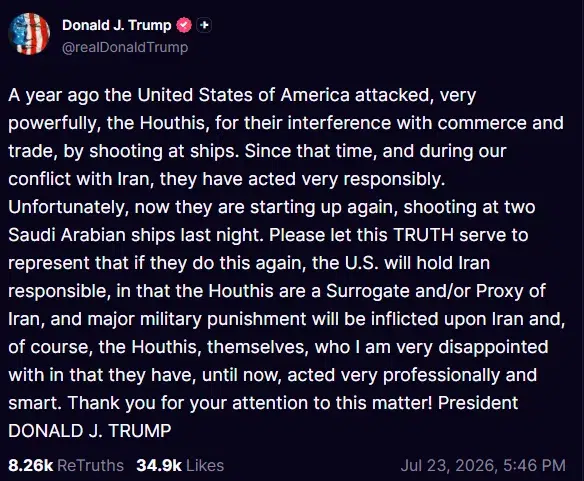
The United States carried out a 13th consecutive night of strikes on Iran as Washington and Tehran rejected immediate negotiations. President Donald Trump also threatened “major military punishment” against Iran and the Houthis after the militant group attacked two Saudi oil tankers in the Red Sea.
Higher energy costs could keep inflation elevated and reduce the Federal Reserve’s room to cut interest rates during the second half of 2026. Rising Treasury yields would also increase the appeal of income-producing assets over Bitcoin, which pays no interest.
Bitcoin price remains above its rising trendline despite weaker momentum
Bitcoin’s 4-hour chart shows an ascending support line connecting a series of higher lows formed since the price bottomed near $58,000 in late June. The trendline now sits between $63,700 and $64,300, placing the current price about 1.5% above the structure.
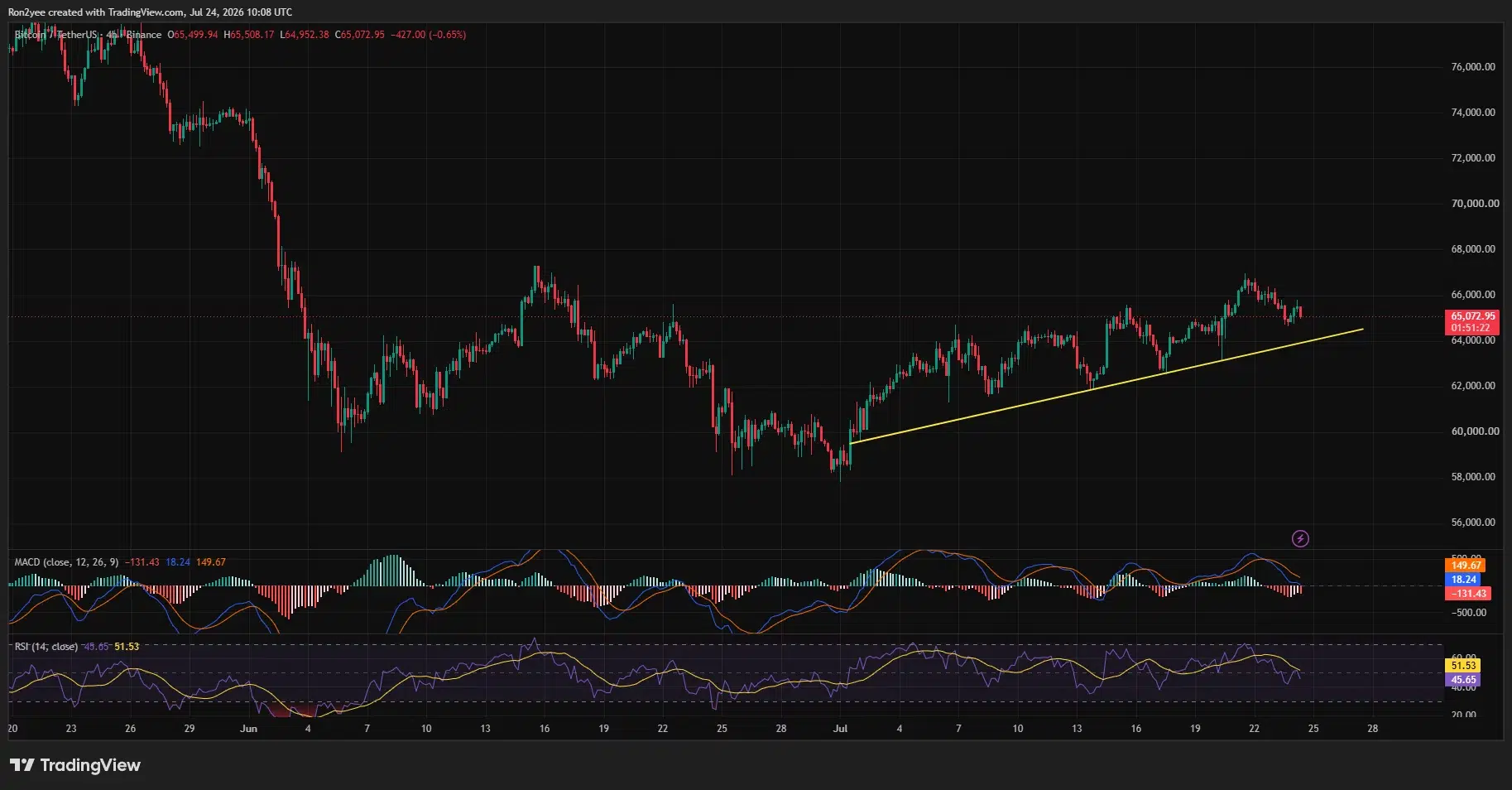
Momentum has weakened after BTC failed to hold above $66,000. The 4-hour Relative Strength Index fell to 45.65, below its signal average of 51.53, but remained above the oversold threshold of 30.
Meanwhile, the Moving Average Convergence Divergence line dropped below its signal line. The histogram reached negative 131, which shows that sellers have controlled the latest 4-hour candles following the rejection near $66,800.
On the daily chart, Bitcoin remains above its 20-day and 50-day simple moving averages at $64,293 and $63,181. The price must hold those levels to preserve the recovery structure formed since June.
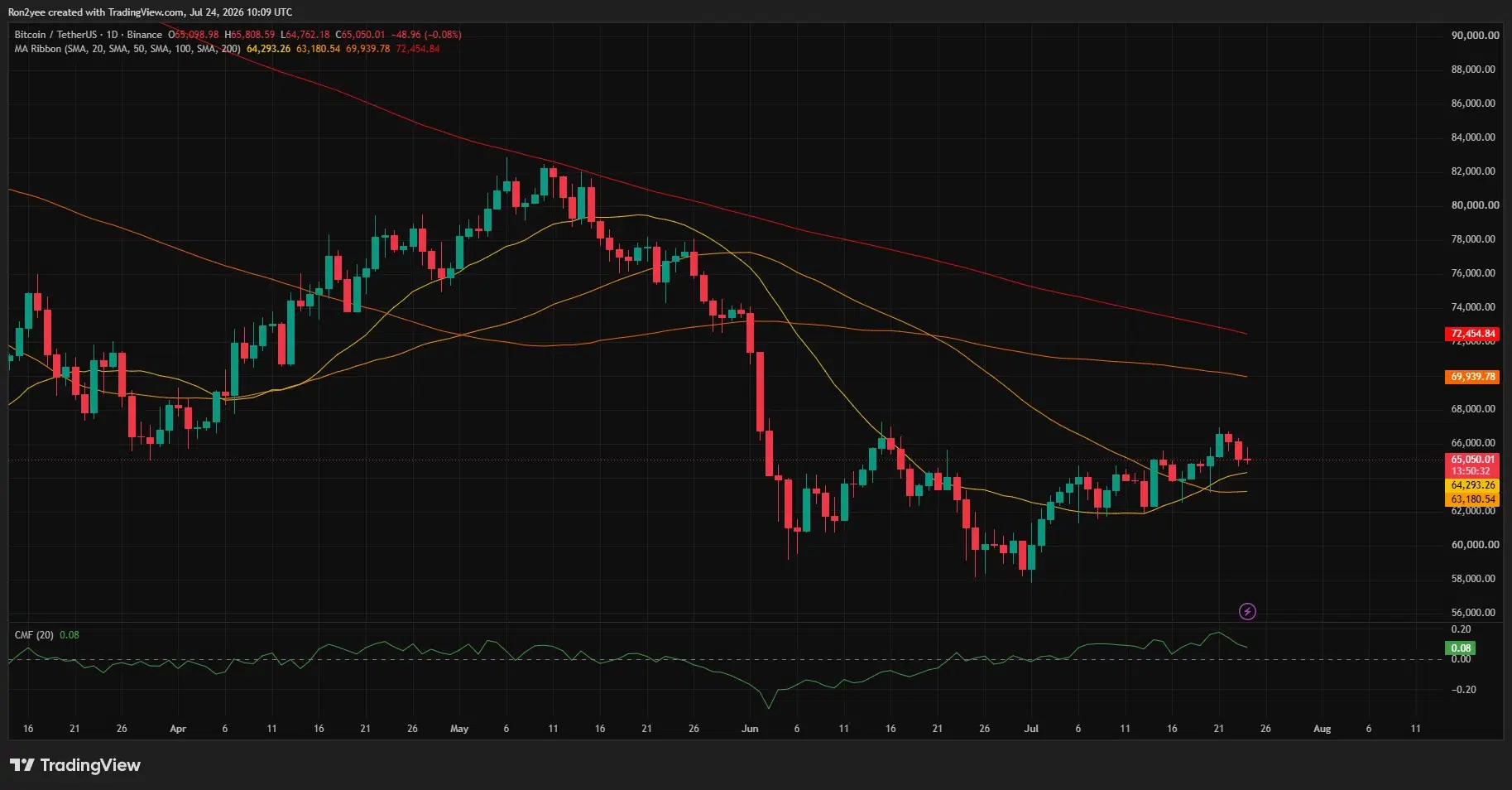
Chaikin Money Flow remained positive at 0.08, showing that buying volume has not fully left the market despite the ETF withdrawals. However, BTC still trades below its 100-day and 200-day moving averages at $69,940 and $72,455, leaving the long-term trend under seller control.
A daily close above $66,800 would open the path toward the 100-day average near $70,000. Bitcoin would then need to reclaim $72,455 to establish a stronger trend reversal.
The one-week CoinGlass liquidation heatmap places the nearest large pool of leveraged positions around $64,200–$64,500. Another dense cluster sits near $63,500, while upside liquidity has accumulated around $65,700 and between $66,500 and $67,300.
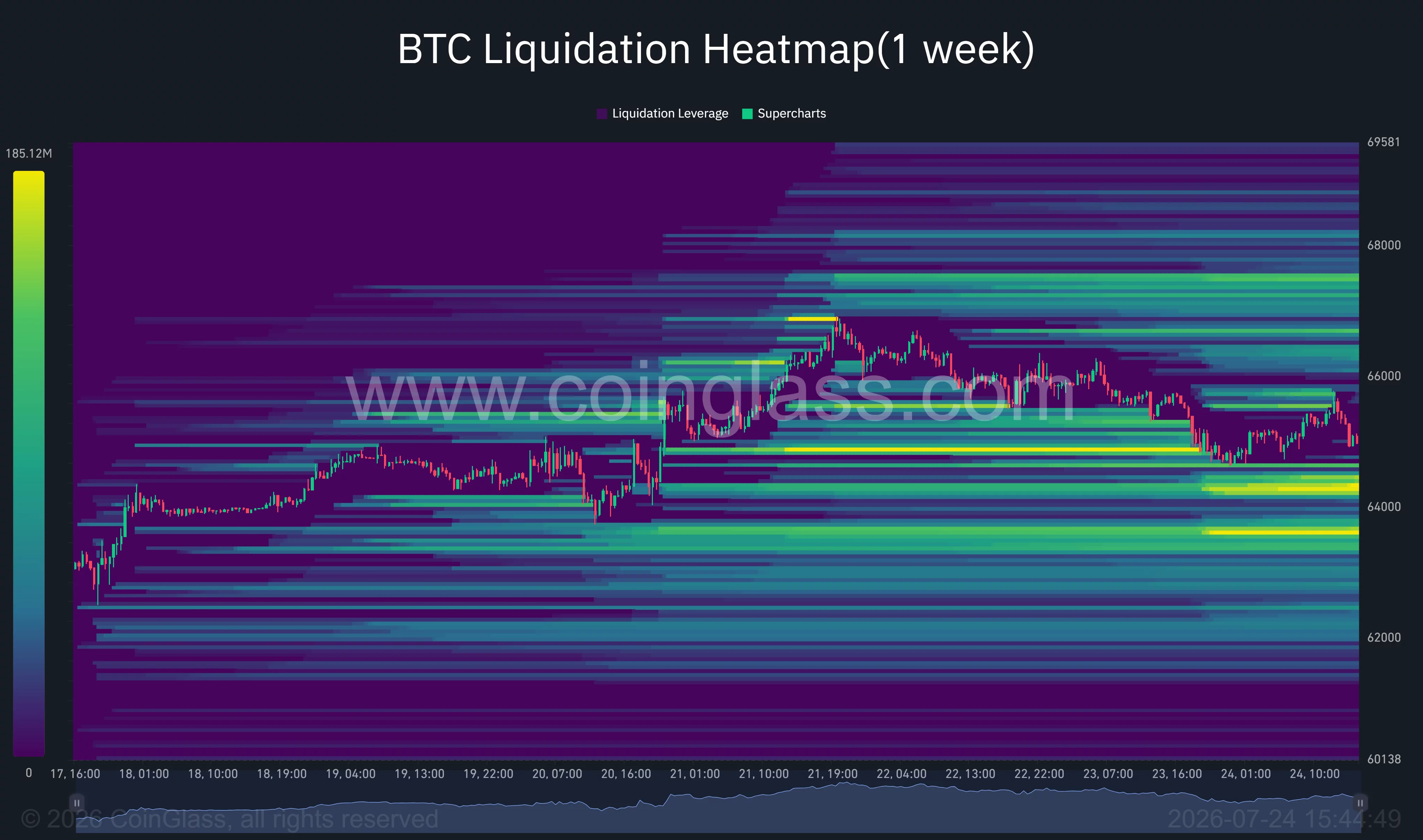
Those levels could attract price as traders approach the weekly derivatives settlement. About 19,000 Bitcoin options worth $1.2 billion expire on July 24, with a put-call ratio of 0.89 and maximum pain at $64,500, according to Greeks.live data. Implied volatility has also fallen toward 35%, while gamma exposure is concentrated at $65,000 and $72,000.
Drop under $63,700 would invalidate the local recovery
According to crypto analyst Lennaert Snyder, Bitcoin’s long setup remains active after BTC swept the $65,000 lows. Snyder identified $64,600 as a possible second-entry area and $67,000 as the next liquidity target.
“The invalidation for the local long thesis is the 63.7K low,” Snyder wrote.
A 4-hour close beneath $63,700 would break the rising trendline and expose the liquidation cluster near $63,500. Continued selling could then push BTC toward $62,000, followed by the June support zone between $58,000 and $60,000.
On the upside, $67,000 and $68,100 remain the immediate resistance levels. Snyder views $68,100 as both a profit-taking zone for long positions and a possible short entry, with $60,000 as the bearish target after a liquidity sweep.
Bitcoin’s outlook therefore depends on whether buyers defend the $63,700–$64,500 area after the options expiry. A renewed oil surge, further ETF withdrawals or an escalation in the U.S.-Iran conflict would raise the risk of a trendline breakdown, while a close above $66,800 would return control to buyers.
Disclosure: This article does not represent investment advice. The content and materials featured on this page are for educational purposes only.


The Senate treats the crypto bill as a finish line. It is a starting gun. Some provisions fire the moment the president signs, others wait years for two short-staffed agencies to write the actual rules, and the gap between those two speeds is where the market’s expectations will be made and broken.
Summary
- If the CLARITY Act becomes law, its effects split into two radically different speeds: provisions that operate by force of statute the day it takes effect, and provisions that exist only after the SEC and CFTC complete rulemakings that will take years.
- Day one by operation of law: the ETP grandfather clause classifying XRP, SOL, and DOGE as non-securities, the Section 604 shield for non-custodial developers, and federal preemption of conflicting state regimes.
- Waiting on rules: the self-certification process, digital commodity exchange and broker registration, the ancillary-asset disclosure regime, kiosk standards, and virtually everything the industry describes when it says the word clarity.
- The empirical base rate is discouraging: the GENIUS Act’s agencies missed their own statutory rulemaking deadline this month, one year after passage, and CLARITY hands a larger workload to a CFTC operating with a single confirmed commissioner.
- The bridge regime already exists and nobody voted on it: the SEC-CFTC joint interpretation naming 16 digital commodities is interim policy, revocable at will, which is both the preview of the law’s effects and the argument for why statute still matters.
Every conversation about the CLARITY Act ends at the same place: sixty votes, and then, implicitly, clarity. The bill passes, the classification wars end, the exchanges list, the institutions allocate, the industry exhales. It is the assumption underneath every price target conditioned on passage, every prediction-market contract, every analyst note describing the vote as the catalyst. And it mistakes a starting gun for a finish line. A market-structure law of this size does not operate; it instructs, and the instructions go to two federal agencies that must convert three hundred pages of statute into the registration forms, procedural rules, disclosure templates, and examination manuals that actually constitute a regulatory regime. Some of the bill’s provisions need none of that and fire the moment the president’s signature dries. Others, including nearly everything the industry actually means by the word clarity, exist on paper only until rulemakings finish, and the only empirical evidence available on how fast that happens arrived this month, when every agency responsible for the GENIUS Act’s rules missed the statute’s own one-year deadline. This piece maps the Monday morning after passage: what changes instantly, what waits, how long the wait plausibly runs, and why the gap between the two speeds is where the next two years of crypto-market surprises will come from.
What fires by operation of law
Statutes contain two kinds of provisions: those that instruct agencies to build something, and those that simply declare the law. The second kind needs no rulemaking, no forms, no staff, and CLARITY’s most consequential provisions belong to it.
The ETP grandfather clause is the purest case. The merged draft deems a token non-ancillary, and not a security, if it was the principal asset of an exchange-traded product listed on a national securities exchange on January 1, 2026. That is a self-executing classification: the moment the law takes effect, XRP, Solana, Dogecoin, and the rest of the late-2025 ETF class are non-securities by statute, with no SEC determination to await, no certification to file, no rule to write. Every listing decision, custody arrangement, and institutional compliance memo that currently hedges on those assets’ status can stop hedging that morning. It is the largest single legal event in the bill, and it happens at signature speed.
Section 604 behaves the same way. The shield for non-custodial software developers operates as a definitional exclusion from the Bank Secrecy Act’s money-transmitter category; it does not ask FinCEN to build anything, it declares what the law no longer reaches. The prosecution theory behind the privacy-software cases closes as a matter of statute on day one, which is why law enforcement fought the provision line by line instead of planning to contest it in rulemaking, and why its final text matters more than its implementation.
Preemption arrives the same morning. Where the act assigns exclusive federal jurisdiction over digital commodities, conflicting state regimes stop applying to covered activity, which converts a dozen simmering federalism disputes, the same architecture being litigated in the prediction-market war, into settled questions for the assets and intermediaries inside the framework. State regulators will contest the edges, and the edges will take years, but the default flips instantly.
Notice what these instant provisions share: they end things. They end classification ambiguity for the grandfathered class, end a prosecution theory, end state-law exposure for covered conduct. What they do not do is build anything, and everything the industry wants built sits on the slow track.
What waits for the rulemaking stack
The bill’s affirmative machinery, the parts that create a functioning regulated market, not merely decriminalize the existing one, is a list of instructions to agencies, and each instruction is a rulemaking with a docket, a comment period, a final rule, and a compliance date.
The self-certification process heads the list. The statute creates the certify-and-rebut structure and the 60-day window; it delegates the substance, what a certification must contain, what evidence rebuts one, how common control is measured against the 20% line, whether a challenged certification keeps operating. Until those procedural rules exist, no network can actually certify maturity, which means the bill’s celebrated exit door from securities treatment opens only when the SEC and CFTC finish building its hinges. That is the machinery that waits on rules. The registration regimes are next: digital commodity exchanges, brokers, dealers, and custodians are new federal categories that exist only as defined terms until the CFTC writes their registration forms, capital requirements, custody standards, and examination programs. The House framework’s answer to the gap, provisional registration that lets incumbents operate while final rules gestate, mitigates the freeze without ending it, since provisional status still requires the agency to stand up an intake process, and the terms of provisional operation are themselves a rulemaking. The ancillary-asset disclosure regime, the kiosk standards, the bank-custody provisions, the illicit-finance examination standards: each is an instruction, not a fact, and the statute’s own deadlines for them cluster between 180 days and two years, deadlines whose enforceability the next section prices.
This is the honest answer to what changes for markets on Monday morning: less than the vote’s price action will imply. Exchanges cannot register with a regime that has no forms. Issuers cannot certify through a process with no procedures. The tokens freed by the grandfather clause can trade with settled status, which is genuinely enormous, but the new products, venues, and capital-raising the bill enables arrive on the agencies’ calendar, not the Senate’s, and the agencies’ calendar is the subject of the only experiment ever run on it.
The GENIUS base rate
The GENIUS Act is the control group for every optimistic implementation forecast, because it is the same political system implementing a smaller crypto statute with more consensus behind it, and its first year produced a precise, discouraging number: zero final rules by the statutory deadline.
The stablecoin law passed in July 2025 with a one-year mandate for its implementing regulations. The deadline arrived this month; Treasury, the Federal Reserve, the OCC, and the FDIC collectively missed it, with proposed rules still circulating and the industry operating under interim guidance, no-action postures, and educated guesses. That is the base rate for every rulemaking forecast. The reasons are not scandalous, they are structural: interagency coordination, comment volumes in the tens of thousands, novel definitional questions, staffing, and the simple fact that statutory deadlines on agencies carry no enforcement mechanism beyond judicial prodding that itself takes years. Every one of those structural facts applies to CLARITY with the coefficients enlarged. The rule count is bigger, the interagency surface is bigger, two commissions rather than one lead the work, and the definitional questions, maturity, control, decentralization, are harder than anything in the stablecoin docket.
Then add the capacity problem this publication has documented all year. The CFTC, designated inheritor of the digital commodity market, is operating with one confirmed commissioner, a vacancy configuration the Senate’s own negotiators flagged as a precondition dispute, and the bill would hand that agency the largest jurisdictional expansion in its history. That is the capacity problem in full. The SEC is mid-transformation under its own crypto agenda, running Regulation Crypto as interim policy. And both commissions now sit, post-removal-jurisprudence, at presidential pleasure, meaning the personnel writing the rules, and therefore the rules, can turn over with an election in the middle of the implementation window. A reasonable central estimate, calibrated to GENIUS, to Dodd-Frank’s multi-year dockets, and to the agencies’ visible bandwidth: core registration and certification rules proposed within a year of passage, finalized in eighteen months to three years, with litigation over the first contested certifications and registrations extending the true settling-in past the current administration. Clarity, as an operating condition rather than a statute, is a 2028 story.
The bridge nobody voted on
The strangest feature of the implementation landscape is that a version of CLARITY’s regime is already running, administered by the agencies, on nobody’s vote.
The SEC and CFTC’s joint interpretation, issued this spring, names 16 digital assets as digital commodities and places staking, mining, and airdrops outside securities law: functionally, a preview of the statute’s classifications, delivered as interim agency policy. SEC leadership was explicit about its provisional character, framing the guidance as a bridge while only Congress can rewrite the law. The bridge is real, markets are pricing it, and it is also the argument for the statute in one object lesson: everything the interpretation grants, a different commission can revoke with a vote, and the commissioners who would do the revoking now serve entirely at the pleasure of whoever wins the next election. The industry currently enjoys most of CLARITY’s classification benefits as a matter of administrative grace. The bill’s actual product is converting grace into law, which is why the grandfather clause’s instant, irrevocable statutory classification is worth more than any interpretation, and why the slow track’s delays, however long, purchase something the bridge cannot: rules that survive the administration that wrote them.
That is the honest frame for Monday morning. Passage ends the era in which crypto’s American legal status was a revocable opinion, instantly, for the grandfathered class and the shielded developers. It begins, rather than ends, the construction of the regulated market, on agency timelines the GENIUS experiment has already measured. The market pricing passage as a binary is pricing the first fact. The businesses planning launches for the first quarter after signature are about to encounter the second.
The market’s implementation trades
The two-speed structure is not just an administrative forecast; it is a map of mispricings, because a market that prices passage as one event will misprice assets whose benefits arrive at different speeds, and the gaps are identifiable in advance.
The grandfathered class holds the cleanest claim. XRP, SOL, DOGE and the other ETP-anchored tokens receive their entire statutory benefit at signature, which means their passage-scenario repricing should be front-loaded and durable, unlike assets whose CLARITY story depends on the certification machinery. A market treating all altcoins as uniform CLARITY beneficiaries is treating a day-one statutory classification and a 2028 administrative possibility as the same asset, and they are not: the first is a settled legal fact the moment the pen moves, the second is a call option on two agencies’ rulemaking calendars, staffed by commissioners who serve at will. The spread between those two claims is real and currently unpriced.
The intermediaries invert the picture. Exchanges, brokers, and custodians are the bill’s largest long-run beneficiaries, a federal license replacing the state maze is the industry’s oldest wish, and its shortest-run non-beneficiaries, because their new regime exists only after the registration rulemakings finish, and their interim reality is provisional status on terms the CFTC has not written. The listed venues’ equities will trade the vote as an immediate catalyst; their filings, when they come, will describe a multi-year compliance build with meaningful cost before meaningful benefit, which is the gap earnings calls are made of. The same lag applies to the capital-markets provisions: the ancillary-asset offering exemption that would reopen compliant token fundraising is a rulemaking-dependent regime, meaning the first legal American token launch under the framework is realistically a 2027-2028 event, not a passage-week one. That is the category the agencies must operationalize.
And one asset class holds an implementation trade almost nobody discusses: the professionals. Rule-writing at this scale is a full-employment act for securities and commodities lawyers, compliance builders, and the consultancies that translate final rules into operating manuals, and the comment dockets, the first drafts of which will be written by the industry’s own counsel within weeks of any signature, are where the statute’s remaining ambiguities get allocated. The 300 pages Congress votes on are the constitution; the thousands of pages the agencies and their commenters produce afterward are the law as lived, and the firms positioned to shape that second corpus captured much of the value of every prior financial-regulation cycle. Dodd-Frank’s implementation decade built careers and practices; CLARITY’s will too, and the quiet bull market that begins the morning after passage is in billable hours.
What to watch after any signing
The provisional registration terms. The single biggest determinant of the transition’s speed: how quickly the CFTC opens provisional intake and how permissive its interim operating conditions are. Generous provisional terms make the two-year rule wait survivable; restrictive ones freeze the market the bill meant to open.
The first rulemaking calendar. Both agencies publish regulatory agendas; the first post-passage editions will reveal sequencing, whether certification procedures or exchange registration goes first, and the proposed-rule dates that mark the real countdown. Compare every date against the statute’s deadlines and against GENIUS’s slippage.
The commissioner math. Confirmation of CFTC commissioners is implementation policy by other means. A five-seat commission writes rules with durability; a one-seat commission writes rules a single resignation can orphan. The Senate fight over pairing nominations with the bill is, on this reading, the most underrated substantive dispute in the negotiation.
The first challenged certification. Whenever the machinery finally runs, the first SEC objection to a maturity certification becomes the test case that defines the regime, the way the first GBTC-era denials defined the ETF decade. The docket to watch will not exist for two years. It will then matter more than the vote everyone is watching this week.
Frequently asked questions
What actually changes the day CLARITY becomes law?
The self-executing provisions: tokens that anchored listed ETPs on January 1, 2026, including XRP, SOL, and DOGE, become non-securities by statute; non-custodial software developers exit the money-transmitter category under Section 604; and federal jurisdiction preempts conflicting state regimes for covered assets and activities. These operate by force of law without any agency action.
What does not change immediately?
Everything requiring construction: the self-certification process for blockchain maturity, registration of digital commodity exchanges, brokers, dealers, and custodians, the ancillary-asset disclosure regime, kiosk standards, and examination programs. Each exists only as statutory instruction until the SEC and CFTC complete rulemakings with proposals, comment periods, and final rules, a process realistically measured in years.
How long will the rulemakings take?
The best empirical guide is the GENIUS Act: its agencies missed the statute’s own one-year rulemaking deadline this month, with rules still in proposal stage. CLARITY’s workload is larger, split across two agencies, and includes harder definitional questions. A calibrated estimate puts core rules proposed within a year of passage and finalized in eighteen months to three years, with contested certifications and registrations litigated beyond that.
What is provisional registration and why does it matter?
A mechanism carried from the House framework letting existing firms operate under interim status while final rules are written. Its terms, how fast the intake opens, what conditions attach, decide whether the market functions during the rule-writing gap or freezes waiting for it. The generosity of provisional terms is arguably the most consequential implementation decision the CFTC will make.
Can the agencies handle the workload?
That is a live dispute inside the Senate negotiation itself. The CFTC, designated to oversee digital commodities, currently operates with a single confirmed commissioner, and demands to pair the bill with commissioner confirmations reflect implementation concerns, not procedural gamesmanship. The SEC is simultaneously running its own interim crypto framework. Both commissions’ members now serve at presidential pleasure, making rule durability partly an electoral question.
Is a version of this regime already operating?
Yes, without legislation. The SEC-CFTC joint interpretation names 16 assets as digital commodities and places staking, mining, and airdrops outside securities law, as explicitly interim policy. Markets already price much of CLARITY’s classification effect through this bridge. The statute’s added value is permanence: administrative interpretations are revocable by future commissions, while the grandfather clause’s statutory classification is not.
What does this mean for the assets the bill would classify?
The grandfathered tokens gain the bill’s full benefit instantly, settled non-security status, which supports listings, custody, and institutional allocation without waiting for rules. Newer tokens gain a defined path, but one that runs through the certification machinery, meaning their practical reclassification waits for procedures that do not yet exist. The distinction between the two classes is the implementation era’s most tradable fact.
How should investors read passage, if it comes?
As two events at different speeds: an immediate legal settlement for the grandfathered class and developers, and the start of a multi-year construction project for everything else. Expectations calibrated to the vote as a single catalyst will overshoot what changes in month one and undershoot what compounds by year three. The rulemaking calendar, provisional terms, and commissioner confirmations are the real post-passage tape. This is educational analysis, not investment or legal advice.
Disclaimer: This article is for information and educational purposes only and does not constitute financial, investment, or legal advice. It describes pending legislation and projected implementation processes that are uncertain and subject to change, and no legislative or regulatory outcome is guaranteed. Always do your own research. Information is accurate as of July 24, 2026.
Bitfinex has secured a Digital Asset Service Provider licence in El Salvador, completing a local regulatory structure covering spot trading, crypto derivatives and tokenized securities.
Summary
- Bitfinex now holds Salvadoran approvals spanning spot trading, derivatives and regulated tokenized securities services locally.
- CNAD registered two core Bitfinex entities in April, adding them to existing licensed operations there.
- El Salvador remains central to Bitfinex’s Latin American strategy for trading and tokenized capital markets.
The exchange announced the approval on May 12, after the National Commission of Digital Assets registered two Bitfinex-linked operating entities on April 23.
The new approval brings the core Bitfinex trading platform alongside Bitfinex Securities El Salvador and Bitfinex Derivatives El Salvador. Bitfinex said the structure gives the group a regulated presence across its main businesses in the country, although product access will still depend on customer eligibility, location and the platform’s terms.
Core Bitfinex platform joins regulated local entities
El Salvador’s CNAD public registry lists BFXNA El Salvador under registration PSAD-0082 and BFXWW El Salvador under PSAD-0083. Both registrations cover activities that include exchanging digital assets, operating trading platforms, transferring assets, custody, receiving client orders and executing trades in digital asset derivatives.
The registry entries were active before the company’s May public announcement, confirming the approval through CNAD’s database. Bitfinex described the licence as a deeper regulatory base for serving customers across Latin America.
“Holding licences across our spot, derivatives and securities businesses reflects our long-standing commitment to the country and to operating under proper and innovative supervision.” said Bitfinex’s chief technology officer Paolo Ardoino
The licence does not mean every Bitfinex product is available to every customer. The company’s notice states that U.S. persons and other prohibited users cannot open or operate accounts on its main platform. Local rules, onboarding checks and service restrictions also continue to apply.
Securities and derivatives approvals came earlier
Bitfinex Securities became the first platform approved under El Salvador’s Digital Assets Issuance Law. CNAD’s registry lists the securities entity under PSAD-0001, with a registration date of Oct. 24, 2023. The platform supports the issuance and trading of tokenized financial products, including debt, equity and fund-linked instruments.
As previously reported, Bitfinex Securities later launched a regulated tokenized U.S. Treasury product in El Salvador. The offering represented exposure to short-term Treasury bills and traded through the platform’s secondary market. Bitfinex also tested tokenized debt linked to a planned hotel project near the country’s international airport.
Bitfinex Derivatives followed with its own Digital Asset Service Provider approval in January 2025. The licensed entity became the regional base for the group’s derivatives activity. Crypto.news reported at the time that users continuing with the service had to accept revised terms tied to the Salvadoran operation.
El Salvador builds a wider digital asset market
El Salvador adopted its Digital Assets Issuance Law in 2023, creating a framework for token issuance, service providers and regulated trading venues. CNAD oversees the sector and maintains a public registry of approved operators, including exchanges, custodians, issuers and companies offering investment products based on digital assets.
Bitfinex said CNAD had licensed more than 70 digital asset service providers by the time of its May announcement. The registry also includes Binance, Bitget and other international firms. Those approvals cover separate entities and permitted activities, rather than one uniform licence for every crypto service.
The country has also expanded its rules beyond exchanges. El Salvador approved an investment banking framework allowing specialized institutions to offer Bitcoin and other digital asset services. The country has also explored tokenized small-business equity and cross-border regulatory projects.
Bitfinex links licence strategy to tokenized markets
Bitfinex has positioned El Salvador as a base for both trading and tokenized capital markets. Its securities business has worked on products linked to U.S. Treasuries, corporate financing and real-world assets. The group has also partnered with Tether-related infrastructure to study wider distribution and secondary-market liquidity for tokenized investments.
The latest licence gives the core exchange a local authorization alongside those existing businesses. It also allows Bitfinex to present one jurisdiction as covering three distinct lines: spot markets through the main platform, derivatives through its dedicated entity and securities through Bitfinex Securities.
However, the announcement did not provide local customer numbers, trading-volume targets or a timetable for new products. It also did not state whether operations will move from other jurisdictions to El Salvador. The immediate change concerns the regulated status of the core platform and its ability to offer approved services through registered local entities.
Bitfinex’s expansion comes as other crypto companies build operations in El Salvador. Tether announced plans in 2025 to establish its headquarters in the country after securing local approval, while Bitget obtained both Bitcoin and digital asset service licences.
The licence completes Bitfinex’s stated regulatory footprint in El Salvador, but continued operation will depend on CNAD supervision, customer checks and the rules attached to each entity. Future product launches will require separate disclosures and may carry additional eligibility limits.


Thailand’s Securities and Exchange Commission has filed a criminal complaint against crypto exchange Bitkub Online and two of its former directors, alleging they submitted false regulatory reports after a 2021 cyberattack that resulted in the loss of digital assets worth about 1.7 billion baht ($50 million).
Summary
- Thailand’s SEC has filed a criminal complaint against Bitkub and two former directors over alleged false reporting linked to its 2021 cyberattack.
- Bitkub said it delayed disclosing the hack to prevent a bank run and later replaced all stolen digital assets without customer losses.
- The case comes as Thailand continues expanding crypto regulations while increasing enforcement across the digital asset sector.
According to an announcement published by Thailand’s Securities and Exchange Commission (SEC) on Thursday, the complaint targets Bitkub Online, former directors Sakolkorn Sakavee and Thaweesap Rawan over information submitted in the exchange’s daily net liquid capital reports following the May 2021 hack.
The regulator alleged that the reports filed between May 10 and Oct. 30, 2021, did not accurately show the reduction in the exchange’s digital asset holdings after attackers stole 16 different cryptocurrencies. The SEC said the omission created the impression that customer assets remained intact and that the exchange had not suffered losses from the incident.
Authorities said the stolen assets were replaced by Oct. 31, 2021, but argued that the impact of the theft should have been reflected in the reports submitted during the period. The complaint accuses Bitkub and the two former directors of violating multiple provisions of Thailand’s digital asset regulations through the alleged false disclosures.
The SEC said the matter will now move through the country’s criminal investigation process before any decision on prosecution or court proceedings is made.
Bitkub disputes regulator’s allegations
Responding in a post on X, Bitkub said the case concerns decisions about when to disclose the wallet compromise rather than allegations of fraud or customer losses.
The exchange said it intentionally delayed announcing the incident because it wanted to prevent a potential bank run while it worked to recover from the theft. According to the company, its co-founders later purchased an equivalent amount of digital assets to replace the stolen funds, leaving customers and the company without financial losses.
Bitkub also said it has strengthened its governance framework, compliance procedures and security controls since the incident.
Founded in 2018, Bitkub has grown into Thailand’s largest cryptocurrency exchange. CoinGecko ranked the platform first among Thai exchanges by trust score, while its daily trading volume stood at about $712 million at the time of publication.
The complaint also comes as Bitkub continues to explore a public listing. The company confirmed in December 2025 that it was considering an initial public offering, including the possibility of listing in Hong Kong.
Cointelegraph said it contacted Bitkub for additional comment on the SEC complaint and the company’s IPO plans but had not received a response by the time the report was published.
Enforcement comes as Thailand expands crypto regulation
The enforcement action arrives as Thai authorities continue tightening oversight across different parts of the digital asset market.
Earlier this month, local outlet Thansettakij reported that the Bank of Thailand (BOT) and the SEC had begun examining high-value stablecoin transactions after identifying transfers that may have bypassed normal financial reporting requirements. According to the report, BOT Governor Vitai Ratanakorn said authorities were using data analytics tools to review large transactions, particularly involving Tether’s USDT, while assessing whether further regulatory action is required.
Beyond stablecoins, the report said regulators have also increased scrutiny of large cash deposits and withdrawals, gold trading and bank accounts linked to online gambling as part of anti-money laundering efforts.
At the same time, Thailand has continued moving ahead with policies designed to expand its regulated crypto market.
In February, the Thai government approved amendments recognizing cryptocurrencies as eligible underlying assets under the country’s Derivatives Trading Act, allowing regulated futures and options contracts to reference digital assets such as Bitcoin. Following the approval, the SEC was tasked with drafting detailed licensing rules and contract requirements for market participants.
The regulator later proposed easing licensing requirements for digital asset businesses by allowing firms to apply for derivatives licenses under a single corporate entity instead of establishing separate companies.
During the consultation process, SEC Secretary-General Pornanong Budsaratragoon said the proposal would support crypto as an investment asset class while giving investors access to additional regulated products under appropriate supervisory safeguards.
Crypto World
With the World Cup concluded, LONG DeFi cloud mining is now live; earn up to 50,000 USDT equivalent in BTC, XRP daily

Disclosure: This article does not represent investment advice. The content and materials featured on this page are for educational purposes only.
As XRP regains investor attention, cloud mining platforms like LONG DeFi are highlighting simplified access to digital asset participation and computing power.
Summary
- LongDeFi expands cloud mining services as renewed XRP interest drives demand for easier digital asset participation.
- LongDeFi highlights AI-powered cloud mining platform amid recovering crypto market and growing interest in BTC and XRP.
- LongDeFi promotes AI-driven cloud mining with newcomer rewards as XRP regains investor attention after World Cup.
As the World Cup concludes, the cryptocurrency market continues its recovery, with XRP once again becoming a focus of global investor attention.
With continued institutional investment and the ongoing development of the digital asset market, more and more investors are seeking more efficient and diversified asset allocation methods, hoping to capitalize on the long-term growth opportunities presented by mainstream digital assets such as BTC and XRP.

Under this trend, cloud mining computing power is gradually becoming a crucial infrastructure in the digital asset field. Compared to traditional models, it eliminates the need for equipment purchases and professional maintenance, allowing users to easily participate in the digital asset ecosystem and more conveniently plan for the future.
As a leading global cloud mining computing power platform, LongDeFi is committed to providing users with secure, stable, and efficient cloud mining services. The platform currently boasts:
- 150+ global cloud mining data centers
- Service coverage in 180+ countries and regions
- 5 million+ global registered users
- Enterprise-grade computing infrastructure and intelligent operation and maintenance system
LongDeFi utilizes a globally distributed computing network, green energy data centers, and a multi-layered security and risk control system to create a more stable, secure, and efficient cloud mining experience for users.
The new era of the digital economy has arrived, and AI, blockchain, and cloud mining are reshaping the global wealth landscape.
Join LongDeFi now! Register to receive a $17 newcomer reward, and earn up to 5% referral rewards by inviting friends. Join 5 million+ users worldwide to seize new opportunities in BTC and XRP digital assets!
How to get started with LongDeFi
The LongDeFi operation process is relatively simple:
Step 1: Register an Account
Step 2: Deposit Digital Assets
The platform supports mainstream digital assets such as BTC, ETH, USDT, XRP, SOL, DOGE, and LTC.
Step 3: Choose a Cloud Mining Plan
Choose a mining service that suits your needs. The minimum deposit is only $100. Once the system is configured, you can start mining.
Step 4: Automatically Receive Daily Rewards
The platform provides 24/7 intelligent mining services and automatically distributes daily rewards. Users can easily earn passive income without any manual operation.
For example:
Beginner: BTC [Smart Cloud Mining] $100 | Term: 2 days | Daily Earnings: $4 | Total Earnings: $100 + $8
Dogecoin [Digital Smart Cloud Mining System]: $500 | Term: 5 days | Daily Earnings: $6.25 | Total Earnings: $500 + $31.25
BTC [Supercomputing Cloud Mining System] $1000 | Term: 10 days | Daily Earnings: $13.1 | Total Earnings: $1000 + $131
Dogecoin [Hashrate Engine Cloud Mining System] $5000 | Term: 25 days | Daily Earnings: $72 | Total Earnings: $5000 + $1800
Bitcoin [Algorithm-Driven Cloud Mining System] $10000 | Term: 30 days | Daily Earnings: $158 | Total Earnings: $10000 + $4830
For contract details, visit the LONG DeFi website.
As the digital asset market continues to develop, more and more investors are focusing on long-term allocation and diversified participation methods. In addition to traditional cryptocurrency investment, cloud mining services have emerged, and platforms are constantly optimizing to provide users with more opportunities to participate in the digital asset ecosystem. Investing in digital assets has also become an option for some users to explore the digital asset ecosystem.
LongDeFi is committed to providing more convenient and secure cloud mining services and continuously optimizing the platform experience to provide users with better services.
Disclosure: This content is provided by a third party. Neither crypto.news nor the author of this article endorses any product mentioned on this page. Users should conduct their own research before taking any action related to the company.
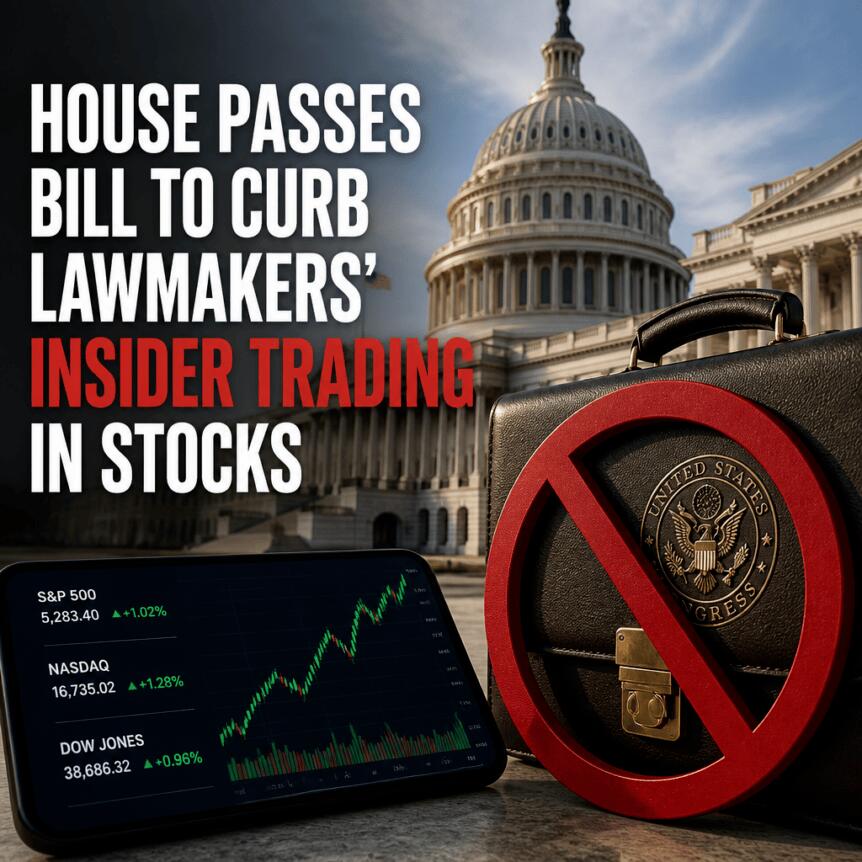
The U.S. House of Representatives has passed a bill aimed at tightening trading rules for lawmakers by restricting their ability to buy publicly traded stocks. The legislation, dubbed the Stop Insider Trading Act, passed the chamber on a 232-198 vote on Wednesday and now moves to the Senate for consideration.
The sponsor, Republican Representative Bryan Steil of Wisconsin, argues the measure would reduce incentives to profit from nonpublic information. Speaking on the House floor after the vote, Steil said the bill would “ensure no lawmaker can profit off of insider information” and would introduce “strict penalties” for violations.
Key takeaways
- The House approved the Stop Insider Trading Act by a 232-198 vote, sending it to the Senate after Wednesday’s passage.
- Under the bill, members of Congress, along with their spouses and dependent children, would be prohibited from purchasing publicly traded stocks.
- Steil outlined penalties including fines equal to $2,000 or 10% of the transaction value, plus disgorgement of profits.
- Critics— including Senator Elizabeth Warren—argue the bill is insufficient because lawmakers could still keep and sell stocks they already own.
- The vote comes as Senate discussions continue over a separate crypto-focused bill, the Digital Asset Market Clarity Act, which addresses broader restrictions on public officials.
What the Stop Insider Trading Act would change
According to the bill’s sponsor, the Stop Insider Trading Act targets the core conflict that arises when public officials participate in markets while possessing information that is not available to the general public. In Steil’s remarks, he emphasized that the legislation is designed to block new stock purchases by lawmakers and their immediate family members.
Steil also described the enforcement approach for alleged violations. As he stated on the House floor, the bill includes a fine equal to $2,000 or 10% of the transaction, along with disgorgement of profits. He further indicated that violators could forfeit any gain realized if they fail to comply.
One operational feature highlighted by Steil is a notice requirement tied to pre-existing holdings. While the bill would prohibit stock purchases, Steil said members of Congress would have to give seven days’ notice before selling stocks they already own, a rule he presented as a deterrent against insider trading.
Where Democrats say the bill falls short
Even with the House’s approval, some Democrats argue the legislation does not fully solve the problem of conflicts of interest. The main critique is that the measure would not require lawmakers to divest current holdings, potentially leaving room for market-sensitive actions based on nonpublic developments.
Senator Elizabeth Warren said on Thursday that the bill contains “major loopholes.” In her view, because lawmakers could continue owning and selling stocks already held, it “won’t solve the problem,” and she said the approach is unlikely to gain traction in the Senate. Warren’s position, as summarized in her comments, is that members of Congress should not own, buy, or sell stocks at all.
How it compares with broader Senate ethics proposals
The Stop Insider Trading Act is narrower than other policy efforts currently discussed in Congress. Unlike the proposed text for the Digital Asset Market Clarity Act—a Senate consideration focusing on cryptocurrency market structure—Steil’s bill is limited to investment restrictions for members of Congress. It does not extend the same coverage to the president or vice president and their families.
In earlier coverage of the Digital Asset Market Clarity Act, the discussion has included restrictions on public officials’ token activity. As described in connection with that measure, it would bar U.S. public officials from issuing or sponsoring tokens until 2029.
For crypto investors and builders, the difference matters because it reflects how lawmakers are calibrating ethics and restrictions across sectors. While the insider trading bill targets traditional markets and elected officials’ stock activity, the parallel crypto legislation is framed around market structure and digital-asset involvement by officials. Observers will be watching whether ethics-style restrictions expand beyond stocks—or remain compartmentalized by policy area—as the Senate considers each track.
From Congress trading to prediction markets
The House vote on the Stop Insider Trading Act followed Steil’s sponsorship of related legislation aimed at trading behavior on prediction market platforms. As noted in earlier developments, Steil previously backed the Stop Lawmakers from Predicting Act, introduced in June to prevent certain public officials, their spouses, and children from “wagering on public policy issues and political outcomes.”
Prediction markets have drawn renewed attention after high-profile reports of individuals allegedly placing large bets tied to real-world political events. Cointelegraph previously covered an incident involving a soldier accused of placing more than $400,000 in bets on Kalshi and Polymarket outcomes related to Venezuela President Nicolás Maduro, who was removed by U.S. forces in January. Earlier reporting also described claims that Donald Trump’s teleprompter operator made more than $100,000 in bets on Kalshi event contracts connected to phrases used in the president’s speeches.
Steil’s prediction-market legislation proposed a penalty structure similar to the stock trading proposal: violators would pay a $2,000 fee or 10% of the value of prohibited bets placed on the platforms. The similarity suggests a consistent legislative framework in Steil’s approach—using fines and disgorgement mechanics to reduce incentives for wagering or trading based on privileged information.
What happens next in the Senate
With the Stop Insider Trading Act now in the Senate, the immediate question is whether lawmakers will narrow the enforcement focus or widen the restrictions to address the objections raised by critics. For readers following the intersection of governance and markets—whether traditional equities or crypto-related policy—attention should shift to whether the Senate modifies the House bill to limit not only new purchases, but also ownership and sales of existing holdings.
The European Union has placed Justin Sun-linked HTX among 18 crypto companies accused of helping Russian users evade financial sanctions.
Summary
- EU lists Justin Sun-linked HTX among crypto firms accused of helping Russians evade sanctions.
- HTX faces transaction restrictions, but the EU action does not include an asset freeze.
- Separate rules will restrict Belarusian ownership of MiCA-regulated crypto firms from Aug. 25.
According to Reuters, the EU published the list on Friday after adopting its latest restrictions on Thursday, adding another regulatory challenge for one of the world’s largest crypto exchanges.
HTX, formerly known as Huobi, did not immediately respond to Reuters’ request for comment on the EU action. The exchange was founded in China in 2013, while Sun acquired a controlling stake in 2022, although the company describes the Tron founder as an adviser.
EU authorities included the crypto companies in the bloc’s 21st sanctions package against Russia over the war in Ukraine. The measures cover banks, crypto networks, oil traders, energy revenue channels and vessels suspected of operating within Russia’s shadow fleet.
While Reuters reported that 18 companies offering crypto services appeared on the published list, the Council of the European Union separately said it had extended transaction restrictions to 14 crypto-related platforms. Those services operate from Georgia, Panama, the United Arab Emirates, the Marshall Islands, Kyrgyzstan and Belarus.
The difference relates to how the measures count companies and the platforms they operate. According to the Council, the 14 services were targeted because EU authorities linked them to financial channels used by Russia to bypass existing restrictions.
HTX faces transaction limits rather than an EU asset freeze
Unlike a full sanctions designation, the EU measure against HTX does not require the exchange’s assets to be frozen, Reuters reported. The restriction instead places HTX within the group of crypto businesses covered by the package’s transaction controls.
For the first time, the package also gives the EU a mechanism to prohibit dealings with crypto providers in third countries when authorities determine that those services are helping Russia evade sanctions. The Council described the tool as a deterrent for jurisdictions hosting such platforms.
HTX had already faced sanctions in the United Kingdom. On May 26, British authorities targeted Huobi Global S.A., the Panama-based company behind HTX, over alleged financial services involving A7 and Garantex, two entities previously sanctioned over their links to Russia.
The UK Foreign Office alleged that HTX provided services to A7, a payments network backed by Russian state-controlled Promsvyazbank, and Moscow-based crypto exchange Garantex. British restrictions included an asset freeze and barred UK companies from processing payments or maintaining financial relationships with the designated entities.
Responding to the UK action, an HTX spokesperson rejected suggestions that the exchange disregarded regulatory requirements.
“Regulatory compliance remains our absolute top priority at HTX. We proactively monitor and strictly adhere to regulatory frameworks in all jurisdictions where we operate globally, including the UK,” the spokesperson told Reuters.
The exchange has not issued a corresponding response to the EU restrictions. Its earlier statement addressed only the British allegations and did not comment on the findings behind the EU package.
Beyond crypto, the Council imposed asset freezes and funding restrictions on 94 banks and major financial institutions. Transaction bans were also extended to another 33 Russian credit and financial institutions, one Kyrgyz bank connected to Russia’s System for Transfer of Financial Messages and three other non-Russian banks accused of helping circumvent sanctions.
EU crypto controls now reach ownership and management
Adopted on July 23, the package contains 218 individual listings, including 48 people and 170 entities. The Council called it the bloc’s largest batch of new listings in four years, spanning financial services, energy companies, military suppliers and organizations accused of supporting sanctions evasion.
EU High Representative Kaja Kallas stated that the measures cover more than 100 banks and crypto operators, over 40 vessels tied to Russia’s shadow fleet and several refineries in Russia and Belarus. More than 50 listings involve Russia’s military-industrial sector, including businesses connected to long-range drone production, according to Kallas.
Separate restrictions adopted through Council Decision (CFSP) 2026/1847 will also affect Belarusian participation in the EU crypto industry. Beginning Aug. 25, Belarusian nationals and residents will be prohibited from owning, controlling or managing crypto-asset service providers regulated under the Markets in Crypto-Assets framework.
Previous restrictions focused on companies offering crypto wallets, accounts and custody services. The amended rules expand the ban to every service category defined under MiCA, including operating trading platforms, exchanging crypto assets, executing client orders, processing transfers, placing tokens, providing investment advice and managing portfolios.
The Belarus measure entered into force on July 24, one day after its adoption, although the crypto ownership and management provisions have a one-month implementation period. It follows the end of MiCA’s transition window on July 1, after which unauthorized crypto firms were required to stop operating or face enforcement measures.
Together, the two decisions place foreign crypto platforms and ownership roles inside regulated EU firms under separate sanctions controls. HTX now faces transaction restrictions connected to alleged Russian activity, while Belarusian nationals and residents will encounter direct limits on their participation in MiCA-authorized businesses.


Odos Protocol has announced plans to shut down its decentralized exchange aggregator, giving users until July 30 to withdraw assets from the platform.
Summary
- Odos Protocol will shut down its DEX aggregator and has asked users to withdraw assets by July 30.
- The project said the Odos DAO will announce its own plans separately, while the ODOS token will continue to exist onchain.
- The closure follows a sharp decline in protocol trading volume and comes as several crypto platforms have announced shutdowns this year.
According to a Thursday announcement posted on X, the project will discontinue operations and has asked users to remove funds before the deadline. The team did not disclose why it decided to wind down the service.
Users have until July 30 to complete withdrawals before the platform ceases operations. The announcement did not indicate whether any extension would be offered or whether services would remain available after the deadline.
At the same time, the team clarified that the Odos DAO operates independently from the company behind the protocol. It said the DAO will communicate its own plans separately, while adding that the ODOS token will continue to exist onchain despite the shutdown of the operating business.
No changes to the token’s functionality, supply, or governance were announced alongside the closure notice. The statement also did not mention any security incident, regulatory issue, funding challenge, or acquisition connected to the decision.
Trading activity had fallen sharply since late 2024
The shutdown follows a prolonged decline in activity on the protocol over the past two years.
Data from DefiLlama shows Odos recorded approximately $169 million in DEX aggregator trading volume during July 2026. That compares with a monthly peak of roughly $7.8 billion reached in December 2024, when decentralized trading activity across multiple networks was considerably higher.
DefiLlama data also estimates the protocol generates about $2.72 million in annualized revenue. While the figures illustrate how activity has changed over time, the Odos team did not attribute the shutdown to declining trading volume or revenue.
Instead, the project’s public announcement remained limited to operational details, user withdrawal instructions, and clarification regarding the separation between the operating company and the Odos DAO.
Existing users have therefore been encouraged to focus on withdrawing assets before the July 30 deadline. The announcement did not mention any modifications to the withdrawal process or identify assets that would be affected differently during the wind-down.
DAO and token remain separate from the operating company
Although the protocol’s operating business is shutting down, the announcement distinguished it from the decentralized governance structure.
According to the team, the Odos DAO will announce its own next steps independently. No timetable was provided for those announcements, and the DAO has not yet disclosed whether governance activities, treasury management, or future ecosystem initiatives will change after the operating company closes.
Similarly, the ODOS token was not included in the shutdown plans beyond confirmation that it will continue to exist onchain. The announcement did not describe any migration, token swap, redemption program, or governance proposal associated with the closure.
For token holders, that means the shutdown currently applies to the operating company rather than automatically affecting the token itself.
More crypto platforms have announced closures in 2026
Odos joins a growing list of crypto companies and decentralized finance projects that have announced plans to wind down operations this year, although the reasons behind those decisions have varied considerably.
Earlier on Thursday, derivatives exchange BitMEX said it would cease operations after 11 years in business. The exchange outlined a phased shutdown process, with customer services being retired according to a scheduled timeline.
Security incidents have also forced several projects to discontinue operations. For instance, in June, crypto payments platform Pyra announced it would shut down after concluding it could not establish a sustainable path forward following losses tied to the Drift exploit.
The company immediately stopped accepting new customers, canceled all payment cards, and introduced a transition plan that allows existing users to withdraw balances and export private keys through a dedicated web portal until Sept. 15, 2026. Pyra also said it intends to distribute any future Drift recovery tokens to eligible users if those tokens become available.
Meanwhile, in May, Carrot protocol said it would discontinue operations after liquidity providers withdrew significant capital following the Drift exploit. The protocol explained that the resulting collapse in total value locked left it unable to continue operating despite efforts to recover. Users were provided time to withdraw remaining assets before services were fully retired.
Odos has not linked its own decision to either category. The project’s announcement did not identify declining activity, market conditions, funding constraints, security breaches, or technical problems as reasons for discontinuing operations.
For now, the only date provided by the project is July 30, when users are expected to complete withdrawals before the operating platform shuts down. The team has said the DAO will provide separate updates regarding its future plans.
Form 13D/A Atara Biotherapeutics For: 24 July

How $VLAD farms its victims

World Matchplay darts: Gerwyn Price sets up Gian van Veen semi-final


-

 Crypto World7 days ago
Ripple Payments Joins MiCA With 14 Firms, Does It Mean Anything For XRP?
-

 Politics7 days ago
The House | The City of London can help the new chancellor deliver growth in every postcode
-

 Fashion7 hours ago
Weekend Open Thread: Brooks Brothers
-

 Politics5 days ago
Democrats look to World Cup watch parties to register thousands of voters
-

 Crypto World4 days ago
Grayscale Files For Worldcoin ETF, WLD Registers Sharp Rise
-

 Tech4 days ago
Sail Virtually Aboard The “Itanic” With IA-64 Emulator
-

 NewsBeat5 days ago
Unregistered fitter used Gas Safe logo on business flyers
-
 Tech4 days ago
Turtle Beach Command Series KB7 review: a nifty screen-equipped gaming keyboard
-
 Business3 days ago
New Jersey voter registration controversy explained: How 6,600 noncitizens got on the rolls, and what happens next
-

 News Videos5 days ago
Big Money Is Entering XRP
-

 Crypto World7 days ago
Kaspersky exposes OkoBot’s 20-module crypto wallet attack
-
 Entertainment3 days ago
Johnny Depp’s R-Rated Gothic Cult Classic Gets New Release Ahead of Sydney Sweeney Remake
-

 NewsBeat7 days ago
Durham County Council to send out electoral registration emails
-

 Crypto World7 days ago
MiCA Licensing Faces Delays as ESMA Adds 14 CASPs to Register
-

 Crypto World2 days ago
Ethics, other provisions in crypto Clarity Act to be further discussed
-

 Crypto World7 days ago
Chip Stocks Enter Bear Market After Moonshot Ai Unveils Kimi K3 Model
-
 NewsBeat4 days ago
Shanghai science forum photos show China’s AI and robotics advances in rivalry with US
-

 Tech4 days ago
Watch Flock Safety CEO Garrett Langley discuss the future of surveillance at TechCrunch Disrupt 2026
-

 Crypto World5 days ago
Circle’s President Sold Over 360,000 Shares, The Filings Explain Why
-

 Tech5 days ago
Subway Sandwich Computers Get a Second Life as Gaming Machines
You must be logged in to post a comment Login