

Crypto World
SBI Expands Digital Asset Push With Bitbank Acquisition

Japan’s SBI Holdings has signed agreements to acquire full control of crypto exchange Bitbank through a 46.7 billion Japanese yen ($289 million) transaction, advancing a deal first disclosed in May that would create the country’s biggest crypto exchange.
On Thursday, SBI said that its wholly owned subsidiary SBICAH will acquire shares from Bitbank CEO Noriyuki Hirosue and other shareholders before subscribing to a third-party share allotment. The exchange will then buy back shares held by MIXI and Ceres, leaving SBI with 100% indirect ownership. SBI expects the transaction to close around October, subject to regulatory clearance.
The acquisition would expand SBI’s regulated crypto exchange footprint and customer base, giving it another potential distribution channel for the stablecoins, tokenized assets and onchain financial products.
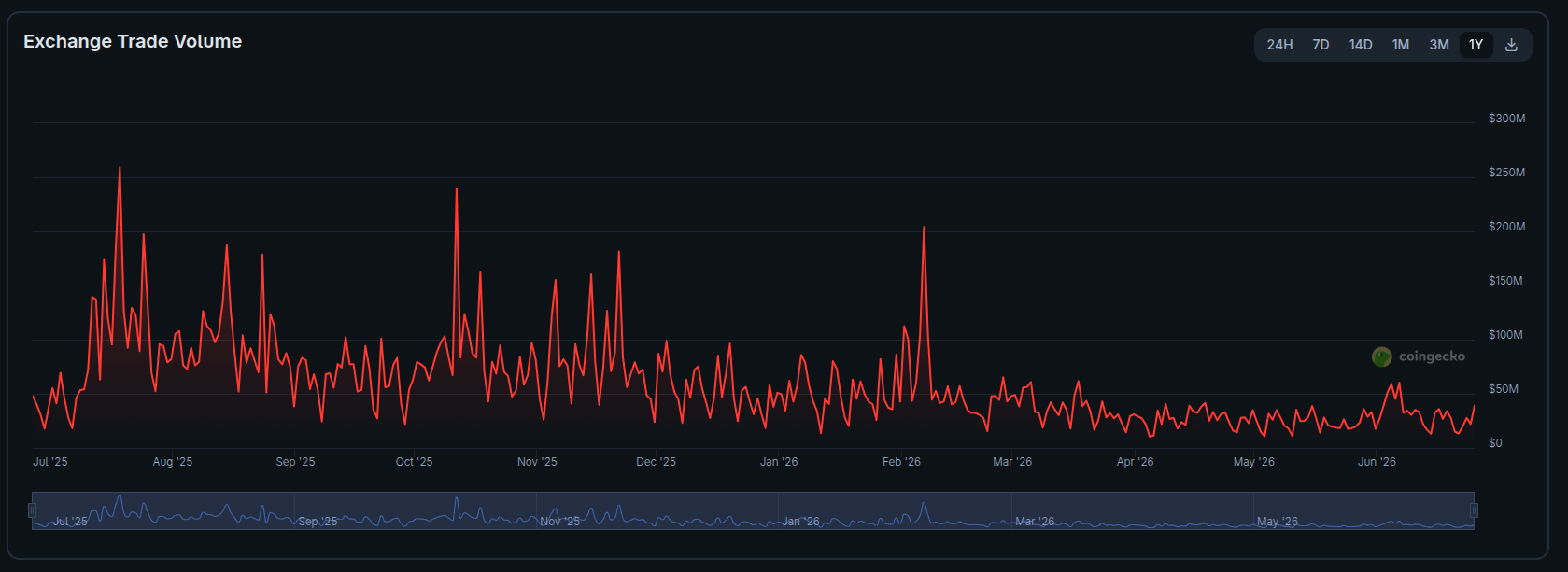
Bitbank’s daily trading volume has hovered below $50 million for most of the last four months, CoinGecko data showed. Volume is dominated by the BTC/JPY pair (39.5%), followed by XRP/JPY and ETH/JPY (both at 19.7%).
SBI said combining Bitbank with SBI VC Trade would give the group about 1.1 trillion yen in assets under custody and roughly 2.92 million crypto accounts, based on figures from the end of April. The company said the combined business would rank first among Japanese crypto exchanges by assets under custody and among the largest by account numbers.
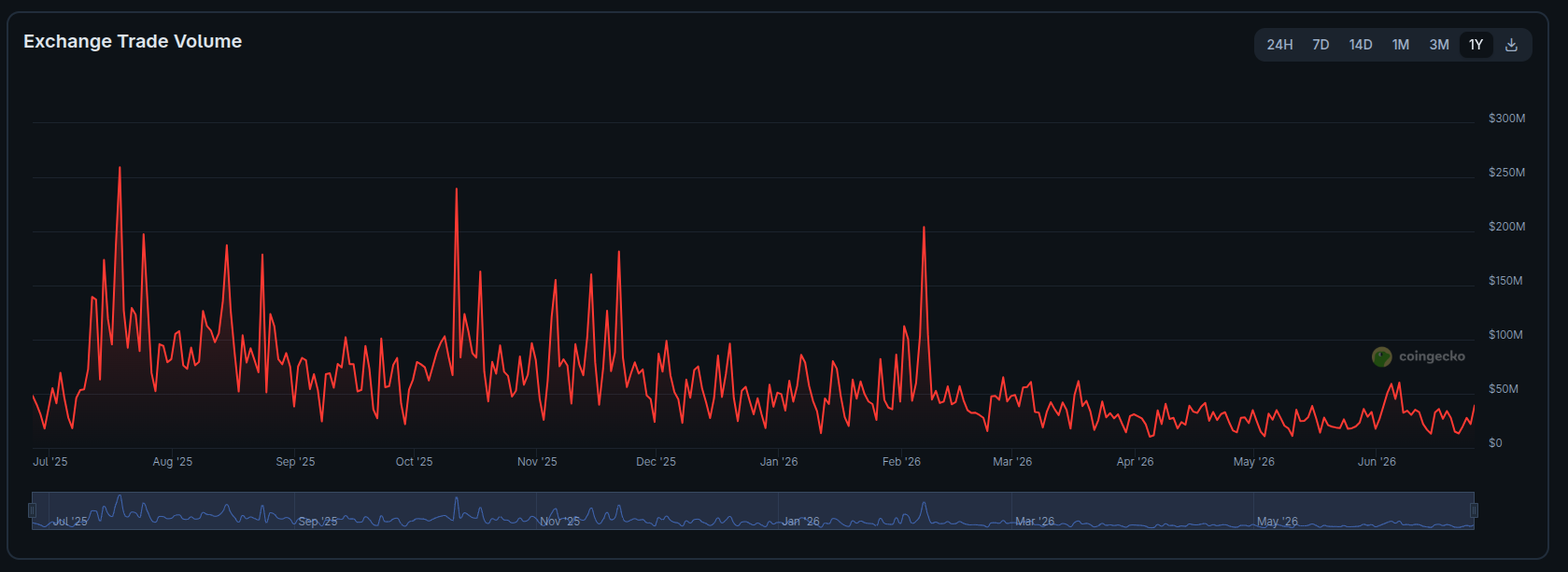
Bitbank trading volume has hovered below $50 million for most of the last four months. Source: CoinGecko
SBI builds broader digital asset ecosystem
The Bitbank deal is the latest in a series of moves by SBI to build infrastructure, including crypto trading, stablecoins and tokenized financial markets.
In February, SBI and Startale Group unveiled Strium, a layer-1 blockchain designed to support around-the-clock trading and settlement of tokenized equities and real-world assets.
Related: Circle, Nomura eye Japan corporate FX with stablecoin settlement: Report
On Wednesday, SBI and Startale launched the yen-pegged stablecoin, JPYSC. The token is issued by SBI Shinsei Trust Bank and distributed by SBI VC Trade. The stablecoin is initially limited to transfers within SBI VC Trade accounts, while public blockchain circulation will roll out after resolving outstanding legal and tax conditions, according to SBI.
The same day, Ripple and SBI Group launched the dollar-backed Ripple USD (RLUSD) stablecoin in Japan also through SBI VC Trade. At launch, RLUSD became available to institutional and retail customers after receiving approval under Japan’s regulatory framework for foreign-issued stablecoins.
Magazine: Japanese pension fund tips 1% in crypto, G7 urges action on NK hackers: Asia Express

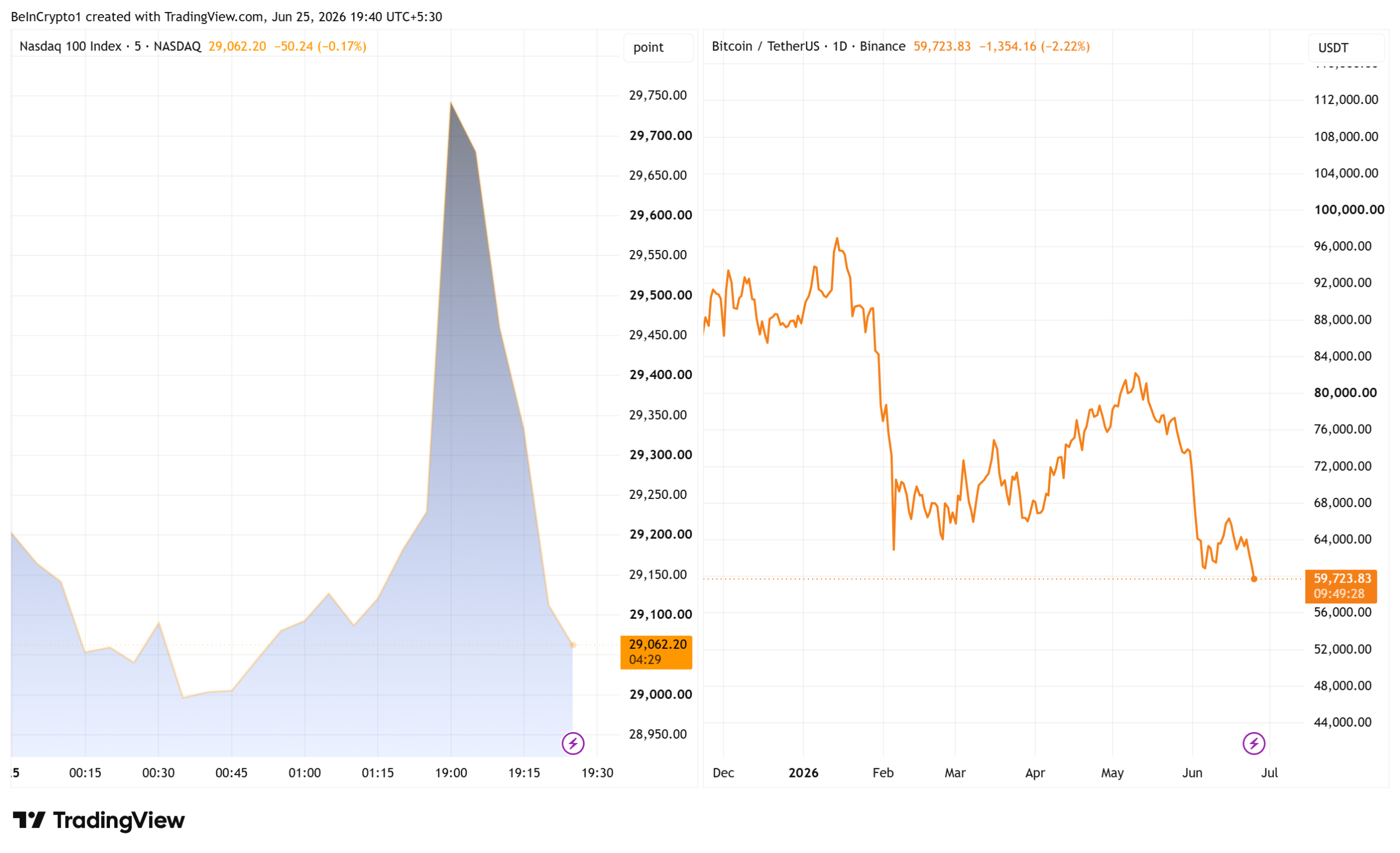
The Bitcoin (BTC) price fell to about $58,000 on Thursday, its lowest level since September 2024, after hotter US inflation dimmed hopes for near-term Federal Reserve rate cuts.
US stocks slid in tandem, with the Nasdaq 100 erasing an intraday rally. Both markets turned lower after the Fed’s preferred inflation gauge rose faster than expected in May.

Hot Inflation Dims Rate-Cut Hopes
The Personal Consumption Expenditures (PCE) price index rose 4.1% in May from a year earlier, its highest reading since April 2023. That was up from 3.8% in April, according to the government report. Core PCE, which strips out food and energy, climbed 3.4%.

The figures pointed to a resilient economy rather than a slowing one. Consumer spending rose 0.7% in May, above forecasts, while first-quarter gross domestic product was revised up to 2.1% from 1.6%. Some economists now see room for possible rate hikes instead of cuts.
Under Chair Kevin Warsh, the Fed held its benchmark rate at 3.5% to 3.75% in June and projected higher rates ahead. It tied part of the price pressure to energy supply shocks from the Middle East conflict. That stance has weakened Fed rate-cut hopes across markets, where traders had expected easing this year.
Follow us on X to get the latest news as it happens
Bitcoin Price Slide Mirrors Nasdaq Reversal
BTC had traded above $61,800 earlier in the session before the Bitcoin price decline accelerated. The token changed hands near $59,200 afterward, down about 2.6% on the day. That left it roughly 53% below its October 2025 record of $126,080.
The drop triggered a wave of forced selling. More than $450 million in leveraged long positions were liquidated within roughly an hour.
Across the market, total crypto liquidations reached $1.26 billion among more than 209,000 traders over 24 hours, according to Coinglass.
Crypto and tech stocks have tracked each other closely this year. The Nasdaq 100 had climbed before reversing, echoing a big tech selloff earlier in June that also dragged Bitcoin lower. \
Higher rates raise the cost of holding risk, weighing on both.
Whether $58,000 marks a floor may hinge on the Fed’s next meeting in late July. With inflation rising and growth steady, policymakers have little reason to cut. That leaves risk assets exposed to further swings.
The post PCE Inflation Shakes Markets: Nasdaq Rally Collapses, Bitcoin Falls to New 2026 Low appeared first on BeInCrypto.

Indonesia parliament just passed the revised crypto law, formally cementing OJK’s authority over crypto as a regulated financial asset just as Europe’s MiCA transitional window closes on July 1. Two of the world’s most consequential crypto jurisdictions are hardening their frameworks in the same month, from opposite sides of the globe.
The structural logic is identical: reclassify crypto from a peripheral asset into a supervised financial instrument, require licensing, and push non-compliant platforms out. The era of operating across major markets on thin regulatory registrations is closing simultaneously in Jakarta and Brussels.
Don’t Miss Out on Our $1,000 USDT Airdrop on ByBit
Indonesia Crypto Law: OJK Gets Full Authority
The P2SK Law revision, passed by the Indonesia Parliament expands OJK’s mandate across banking, capital markets, fintech, and digital financial assets, consolidating supervisory authority that was previously fragmented between OJK, Bappebti, and Bank Indonesia. For crypto specifically, this completes a reclassification that tokens are no longer traded commodities sitting inside Bappebti’s commodity-futures perimeter.
OJK can now impose bank-style prudential requirements on exchanges, capital adequacy, custody segregation, governance standards, and conduct rules. The law also amends Indonesia’s Capital Markets Act to expand the definition of securities to include investment contracts in digital form that confer economic benefits, opening the door for certain tokens and DeFi instruments to fall under full securities regulation. That is a direct structural parallel to MiCA’s treatment of asset-referenced tokens.
— Nael (@nael_idrx) June 25, 2026
 BREAKING: Indonesia Elevates Stablecoin and Digital Financial Assets to Statutory Recognition Under the P2SK Law
Indonesia has officially recognized and regulated digital financial assets under the Financial Sector Development and Strengthening Law (P2SK), placing them at… pic.twitter.com/gSsZrgP3W1
The immediate compliance pressure point governing governance and risk management for fintech innovation platforms, including digital asset providers, takes effect on July 1, 2026. Indonesian OJK crypto regulation now has its own hard deadline running in parallel with Europe’s. Exchanges operating in Indonesia crypto markets that have not completed their transition from Bappebti-era structures face an enforcement exposure window starting this month.
Tokocrypto CEO Calvin Kizana welcomed the revision but flagged the implementation gap that matters most to operators.
“We are also waiting and looking forward to the final draft being distributed to industry players so that they can see in more detail what changes will affect the ecosystem,” Kizana said. He added that “strong, clear, and adaptive regulations will be the key to increasing public confidence and accelerating the growth of the Indonesian crypto industry.”
That reads as an implicit acknowledgment that the law’s passage is a narrative event, the implementing rulebooks from OJK are the execution events that will define actual compliance costs.
Although not all industry voices are welcoming. The Indonesian Blockchain Association has raised concerns that draft provisions requiring all digital asset activity to flow through a single exchange could reduce existing platforms to brokers, concentrating market power in ways the original framework never intended.
Discover: The Best Token Presales
MiCA July 1 Hard Deadline: The Compliance Cull Arrives
Europe’s MiCA deadline is not a narrative event. July 1 is the date after which unlicensed crypto-asset service providers lose legal access to the EU’s 450 million users across all 27 member states.
As of today, of the approximately 3,000 firms that previously operated under national transitional arrangements, just about 230 have cleared the ESMA MiCA register. This has left the overwhelming majority either in the process of exiting EU markets or racing to complete authorization before enforcement begins.
Luxembourg is officially our MiCA home — Coinbase

We're looking forward to welcoming users from across the EU to Coinbase. https://t.co/6YiRoJRdJA
 (@coinbase) June 24, 2026
Coinbase Luxembourg opened its MiCA hub on June 24, securing a single EU passport from the Luxembourg CSSF that covers all 27 member states. Ripple also secured preliminary CASP approval under MiCA, positioning RLUSD for compliant EU distribution. Kraken is similarly cleared.
Don’t Miss Out on Our $1,000 USDT Airdrop on ByBit
However, Binance, the biggest crypto exchange in the world by volume, withdrew its Greek license application days before the deadline, leaving it absent from the ESMA register. Binance’s $4.3 billion DOJ settlement from 2023 is now a live liability in the EU authorization process.
The USDT situation underscores the reach of the regulation. Several EU exchanges delisted Tether ahead of the deadline because USDT does not meet MiCA’s e-money token requirements, while Circle’s USDC, structured to comply, retained listings.
Discover: The Best Crypto to Diversify Your Portfolio
The post Indonesia Crypto Overhaul and Europe’s MiCA Deadline: Who Gets Cut from Major Markets appeared first on Cryptonews.

Bitcoin slid to fresh 21-month lows Thursday at the Wall Street open, falling back toward the $58,000 area as a hotter-than-expected US inflation print rattled risk assets. The move underscored how tightly BTC trading has been tied to broader market volatility when macro data hits.
According to TradingView data cited in the report, BTC/USD on Bitstamp dipped to $58,035—an area last seen in September 2024. The pressure intensified shortly after the release of the May Personal Consumption Expenditures (PCE) report, with equities swinging sharply at the open.
Key takeaways
- BTC returned to levels last traded in September 2024, dropping to about $58,035 on Bitstamp during Thursday’s Wall Street open.
- US May PCE inflation came in at 4.1%, a three-year high for the year-over-year measure, contributing to fast, broad-market sell-offs.
- CoinGlass data cited in the coverage shows more than $600 million in liquidations across crypto within a single hour as BTC fell.
- Traders flagged potential “squeeze” dynamics around key psychological levels below $60,000.
- Technical commentary highlighted weakening $60,000 support and potential new resistance closer to $65,000.
Inflation hits, equities wobble—and BTC follows
The catalyst was the May PCE inflation release. The Bureau of Economic Analysis (BEA) reported that the PCE price index rose 4.1% year over year in May—recording a three-year high. In the monthly comparison, BEA said the PCE price index increased 0.4%, while excluding food and energy it rose 0.3%.
“From the same month one year ago, the PCE price index for May increased 4.1 percent. Excluding food and energy, the PCE price index increased 3.4 percent from one year ago.”
Markets reacted quickly. The report notes that the Nasdaq 100 dropped about 2% within roughly 30 minutes at the open, while the Nasdaq Composite was down modestly around the time of writing. The S&P 500, by contrast, managed a small gain—highlighting dispersion between large-growth and broader benchmarks as investors repriced near-term rate expectations.
Bitcoin’s decline mirrored that “risk-off” impulse. In the minutes after the open, BTC pushed lower in a move that traders often interpret as forced positioning rather than purely discretionary selling—especially given what followed in the derivatives market.
Liquidations top $600 million in an hour
As BTC slid through key levels, derivatives leverage appears to have accelerated the down move. CoinGlass, as referenced in the coverage, logged cross-crypto liquidations totaling more than $600 million over a single hour.
That kind of liquidation burst typically happens when price moves trigger margin calls for leveraged long positions, forcing liquidations that mechanically add to selling pressure. It also tends to increase volatility, making support levels harder to defend in the short term.
The report also included commentary from market participants who suggested the drop may have been intensified by order-book dynamics. A pseudonymous trader identified as “Killa” told X followers that BTC was in a “manipulation phase,” arguing that trading below $60,000 corresponded with a notable “swing low” region and that the orderbook was “stacked below” current pricing.
Bear-market analogies and the $60,000 test
Beyond the immediate macro-driven move, the article frames the latest dip within a broader bear-market pattern. Crypto analyst and trader Niels Klaver, cofounder of STABL Agency, characterized BTC/USD as moving toward what he called the “final leg down” of the current bear market. Klaver referenced a short-term target of $55,000, aligning with earlier popular bearish scenarios circulating among traders.
Other technical commentary focused on whether the market can stabilize after breaking below a key psychological level. The report cites Rekt Capital saying $60,000 support is “clearly weakening,” implying that any attempted rebound may face selling pressure from participants who sell after a breakdown or re-test.
Rekt Capital also pointed to the idea that the current market is behaving similarly to 2022, noting that a widely watched trend indicator—the 50-month exponential moving average (EMA)—is expected to become a resistance area. While that does not guarantee a rejection, it gives investors a concrete “where would resistance show up?” reference point if BTC tries to reclaim higher levels.
Another development highlighted in the report: Rekt Capital suggested that once June’s monthly close arrives, traders will be better able to judge whether July could produce a relief rally “from which price” the market can potentially pivot. This matters because monthly closes often influence how traders assess trend structure, risk management, and the probability of a reversal versus continued breakdown.
What to watch next: support, resistance, and follow-through
For investors and traders, the immediate question is whether BTC can regain and hold above the broken support zone around $60,000, or whether it turns into resistance as liquidation effects dissipate. The report’s cited technical views also imply that any rebound attempt could encounter selling pressure closer to the $65,000 area, with the broader bear-market analogy keeping downside risk in focus.
Going forward, the next macro releases and—just as importantly—whether the market sees sustained follow-through on either side of $60,000 and toward the $55,000 target will likely determine if this is a continuation leg or a transition into consolidation.
Crypto World
Polish Crypto Raid: FBI-Backed Arrests Hit Alleged SIM-Swap Gang Behind Millions in Theft


Poland’s Central Bureau for Combating Cybercrime (CBZC) arrested four members of an alleged crypto crime gang. The group drained cryptocurrency through SIM swap attacks, the FBI and Homeland Security Investigations revealed.
The suspects face charges that include running an organized criminal group, theft by hacking computer systems, and money laundering. All four remain in pre-trial detention and could face up to 25 years in prison.
How the Crypto Crime Gang Ran its SIM Swap Scheme
Investigators say the group broke into the IT systems of firms that work with telecom operators. Social engineering, rather than brute-force hacking, gave the attackers their initial foothold. They also obtained access to employee email accounts using specialized software.
That access let them run SIM swap attacks, which clone or hijack a victim’s phone number. With control over SMS and email, the group reset passwords, bypassed two-factor protections, and seized accounts on cryptocurrency exchanges.
Once inside, they drained the digital assets held in those accounts. The method exploits a known weakness, since many platforms still lean on phone-based recovery despite repeated telecom security failures.
The FBI counted more than $68 million in U.S. SIM-swap losses in 2021, taken from bank and virtual currency accounts.
Laundering and Cross-Border Cooperation
Police say the stolen funds moved quickly through a spread-out financial network. Prosecutors add that the suspects treated the thefts as a steady source of income. The group used personal bank accounts in Poland and abroad, payment platforms, and multi-currency crypto wallets.
Officials estimate the laundered total exceeds tens of millions of Polish zlotys, or several million dollars. The scale places it alongside other European crypto laundering networks disrupted this year.
U.S. prosecutors have pursued similar crews. Federal indictments describe the same playbook against cryptocurrency exchanges. One of the largest involved roughly $400 million stolen from the failed exchange FTX in 2022.
The Regional Prosecutor’s Office in Krakow supervises the case. The role of the FBI and HSI points to victims or infrastructure outside Poland. Such international crypto crime cases increasingly depend on cooperation across borders, echoing earlier FBI SIM swap arrests.
The CBZC, formed in 2022, has not named any suspect or released identifying photos, citing the active investigation. It did publish video of the operation on its official channels.
Subscribe to our YouTube channel to watch leaders and journalists provide expert insights
Unverified social media speculation has linked one detainee to a known online alias, “Merry.”
Police have not confirmed the claim. Officials say the case is still developing, and more arrests could follow as the inquiry continues.
The post Polish Crypto Raid: FBI-Backed Arrests Hit Alleged SIM-Swap Gang Behind Millions in Theft appeared first on BeInCrypto.


Remember BlackBerry? Yes, that BlackBerry: The phone with a physical keyboard that everyone used and suddenly became obsolete after Apple introduced the iPhone.
Well, it’s making a comeback.
The new BlackBerry isn’t a mobile device, but it’s a “mission-critical software layer in the physical AI stack,” and the stock is surging.
BlackBerry hasn’t made a consumer mobile device in years. Instead, it has quietly transformed into a high-tech powerhouse focused entirely on the world of “Physical AI” and robotics.
The secret weapon? The rock-solid software framework called QNX that acts as the “uncrashable” nervous system for autonomous machines. That means BlackBerry’s software is being used by massive chipmakers such as Nvidia and AMD to build smart cars and warehouse robots. The software makes sure those machines move safely with zero lag.
“As intelligent machines become increasingly autonomous and operate around people, the requirements for safety, security, reliability and real-time determinism become even more important,” CEO John Giamatteo said during an earnings call. “Unlike probabilistic AI systems, QNX technology is deterministic and safety certified, which is exactly why it is so hard to replicate and why customers trust it for systems where failure is not an option.”

The number of businesses operating with digital assets and crypto payments just keeps growing. These days, using traditional accounting software with crypto integrations is considered one of the easiest ways to track and reconcile transactions, whether it’s for corporate tax compliance or regular business invoicing.
It’s smart to set up a dedicated accounting system early on, mainly to keep your financial books audit-ready (and avoid a massive spreadsheet headache, of course). In this article, we’ll break down the best accounting software for crypto integrations of June 2026.
Since balancing digital currency requires extreme precision and seamless tracking across multiple blockchains, automated subledger syncing is the go-to solution. We’ve put together a list of top accounting platforms, taking into account their crypto subledger compatibility, ease of use, and multi-currency reporting.
Best crypto accounting software for June 2026

Xero
Traditional operations and decentralized finance teams use Xero as a central anchor for their corporate ledger. The software connects with premier crypto subledgers via a specialized ecosystem, turning chaotic blockchain data into compliant general ledger entries.
Pros & Cons
Extensive selection of dedicated Web3 subledger integrations
Seamless dual-entry journal creation via connected apps
Intuitive dashboard designed for small-to-midsize business scaling
Base software caps native asset decimal tracking to 4 places
Live blockchain data requires a third-party subledger connector
Review Integrations: Direct API links with Breezing, Cryptio, Ledgible, Koinly, and Cryptoworth.
Key features: Dynamic chart of accounts mapping, automated draft journal syncing, and reliable traditional bank feeds.
Price: Standard packages range between $5 and $15 per month, excluding separate subledger subscriptions.
Best for: Fast-growing businesses and accounting firms looking for a clean, highly extensible crypto-to-fiat accounting framework.

QuickBooks Online
Many small businesses rely on QuickBooks Online to manage day-to-day corporate operations alongside standard fiat accounting rules. Dedicated development pipelines from top cryptocurrency tracking tools make it simple to bridge on-chain histories into traditional balance sheets.
Pros & Cons
-
Massive accountant network familiar with the platform
-
Detailed inventory and specialized tax tracking tools
-
Robust multi-user permission toggles for finance teams
-
Internal tracking limits native handling of fractional token decimals
-
High-frequency trading data can clutter standard ledger reports
Review
Integrations: Automated data pipelines via Bitwave, Cryptoworth, Ledgible, and Koinly.
Key features: Real-time data syncing, customizable accounting modules, and extensive payroll functionality. Price: Monthly subscriptions span from roughly $38 to $115.
Best for: Established small businesses utilizing mainstream digital asset reporting tools.

NetSuite
Global corporations and large-scale decentralized autonomous organizations use NetSuite to manage multi-entity financial structures. Enterprise-grade tools within the platform scale to process millions of transactions while maintaining strict internal control frameworks.
Pros & Cons
Comprehensive multi-entity global consolidation
Immutable audit trails built for regulatory inspection
Handles massive on-chain data volumes without system lag
Deployment requires substantial initial development capital
Overengineered for small business models or early startups
Review Integrations: Institutional subledgers including Cryptio, Bitwave, and Tres Finance.
Key features: Full enterprise resource planning (ERP) suites, advanced data warehousing, and automated global taxation rules.
Price: Custom institutional contract pricing.
Best for: Enterprise-level Web3 conglomerates and high-volume asset management funds.

Sage Intacct
Finance teams at mid-sized firms deploy Sage Intacct to gain multi-dimensional insights into complex cash flows. The accounting engine processes digital currency balances through elite middleware, ensuring regulatory frameworks align with corporate accounting schedules.
Pros & Cons
-
Powerful multi-dimensional asset tracking architecture
-
Highly favored by specialized corporate CPA firms
-
Automated continuous consolidation for multiple subsidiaries
-
Integration setup often requires precision middleware configuration
-
System onboarding demands a steep learning curve
Review
Integrations: Enterprise-focused connections via Bitwave and Cryptio.
Key features: Multi-entity continuous ledger updates, advanced budgeting, and customizable compliance workflows. Price: Available via custom corporate quotes.
Best for: Mid-market digital asset companies navigating strict regulatory standards.
Platform
Price
Supported ecosystems
Key tracking features
Best for
Xero
~$5–$15/mo
Extensible via Xero App Store (Breezing, Cryptio, etc.)
Dynamic chart of accounts mapping, automated draft journal syncing, double-sided ledger entries
Fast-growing businesses and accounting firms looking for a clean, highly extensible crypto-to-fiat accounting framework
QuickBooks Online
~$38–$115/mo
Extensible via mainstream tools (Bitwave, Ledgible, etc.)
Real-time automated ledger updates, customizable tracking modules, robust payroll functions
Established small businesses utilizing mainstream digital asset reporting tools
NetSuite
Custom enterprise pricing
Institutional subledgers (Cryptio, Tres Finance, Bitwave)
Full ERP resource suites, immutable audit trail generation, advanced automated consolidation
Enterprise-level Web3 conglomerates and high-volume asset management funds
Sage Intacct
Custom quote pricing
Middleware subledgers (Bitwave, Cryptio)
Multi-dimensional financial tracking, continuous global closing, custom compliance reports
Mid-market digital asset companies navigating strict regulatory standards
How we picked the most reliable crypto accounting software
Finding the top accounting systems for digital assets required evaluating dozens of corporate finance platforms. Our team gathered operational data from public user reviews, software documentation, and feedback from certified public accountants to shortlist five high-performing systems.
Evaluation metrics prioritized platform scalability, integration stability with Web3 subledgers, and overall multi-currency report accuracy. Direct practitioner reviews provided an objective view of how each platform handles corporate bookkeeping in practice, helping isolate specific operational limitations and workflow strengths.
Why can’t I track crypto directly inside traditional accounting software?
Standard fiat ledger designs restrict decimal tracking to four places, creating compounding accounting errors when working with fractional tokens like Bitcoin or Ethereum. Blockchain architectures also operate outside traditional banking networks, meaning direct wallet feeds require specialized subledger applications to format the transactional data.
How do subledgers connect to systems like Xero or QuickBooks?
Subledger platforms link directly to blockchain addresses and exchanges to pull raw transaction histories, compute cost bases, and assign fair market value in fiat. Connected applications then synchronize these calculations with main systems like Xero, pushing normalized ledger records into the standard chart of accounts.
Is Xero suitable for high-volume enterprise DAOs?
Smaller to mid-sized entities thrive using Xero paired with a dedicated subledger, but massive decentralized entities with millions of monthly transactions typically choose customizable enterprise platforms like NetSuite. Selecting a system depends entirely on your compliance needs, internal audit structures, and overall transactional velocity.


Abracadabra.money declared emergency measures Wednesday after its dollar-pegged stablecoin Magic Internet Money (MIM) fell roughly 50% below its $1 target. MIM was trading around $0.48 Thursday, its worst sustained depeg on record. "We're acutely aware of the $MIM depeg and are taking emergency… Read the full story at The Defiant

According to analyst Shanaka Anslem Perera, the story everyone has been telling about Bitcoin (BTC) this year, that big money fled to gold and left crypto behind, is wrong.
He laid out the actual flow of data in a post on X, showing how the picture is considerably different from what the rotation narrative suggests.
ETF Flows Tell a Different Story
The analyst argued that, based on spot Bitcoin ETF data, investors have not abandoned the flagship cryptocurrency. Since their launch in January 2024, they have attracted more than $53 billion in net inflows, something that took gold ETFs some five years to achieve.
Things changed during the recent market correction, when about $4.4 billion flowed out in 13 consecutive trading sessions. But Perera pointed out that the money left Bitcoin to chase highs in AI and semiconductors, describing investors who made the shift as tourists who react to every changing narrative.
Per his analysis, BTC has found itself caught between two competing trades.
“When the market wanted offense, the money left Bitcoin to chase AI and chip stocks at fresh highs,” he wrote. “When the market wanted defense, the money left Bitcoin for Treasuries and cash.”
He also claimed that the gold side of the story had a similar hole in it. Indeed, big gold ETFs bled this year, but, according to Perera, the money didn’t go to BTC as some headlines had suggested, but it went into cheaper gold products, essentially meaning it was a “fee swap” and not a defection to Bitcoin.
There was a similar misread inside crypto, as XRP and Solana funds pulled money while BTC bled. Many market watchers thought it was a changing of the guard, but Perera pointed out that since those funds sit on bases 40 to 50 times smaller than Bitcoin’s, relatively modest inflows may look dramatic on a chart while having very little meaning at scale.
Debate Over Safe Haven Continues
What makes Perera’s analysis worthwhile is how it makes a distinction between what he called Bitcoin’s two shareholder bases: short-term ETF investors that react quickly and emotionally to economic data and market sentiment, and long-term holders who continue accumulating during periods of weakness.
According to the analyst, when most headlines about ETFs focused on outflows, the long-term holders added about 125,000 BTC to their holdings, basically buying the coins that the ETF crowd was panic-selling on every CPI print.
The debate around Bitcoin’s role has become quite loud this year, with billionaire Ray Dalio saying in March that gold and BTC cannot be compared, as institutions still prefer the metal as a store of value.
Other research also cast doubt on the rotation narrative, with analyst Charlie Bilello finding that both gold and Bitcoin were trading below their long-term trend levels at the same time, suggesting parallel weakness rather than capital moving directly from one to the other.
The post Bitcoin Didn’t Lose to Gold, the Rotation Story Is Wrong: Analyst appeared first on CryptoPotato.


So far, 2026 has been an interesting year for crypto VC funding. After dropping significantly in Q1, funding has recovered strongly. In May alone, crypto projects raised over $3.52 billion. Unsurprisingly, the majority of these fundings are being directed to AI-based ventures.
Canopy Network is one such project that successfully attracted investors with its AI pivot. The project has raised $8.5 million in seed funding for its AI-native blockchain development.
The Panama City-based project is developing a framework built to help founders, developers, and coding assistants create onchain applications with far less engineering overhead. The funds will support the mainnet launch, engineering hires, and continued work on developer experience and AI-native tooling.
The company also acquired Tanssi technology, a decentralized protocol for deploying customized apps on blockchains in minutes. Arrington Capital, Fenbushi Capital, Borderless Capital, and SNZ Capital joined Canopy as key stakeholders through the acquisition, bringing more investor backing around the project’s next phase.
AI-Native Development Brings Builders Closer to Launch
Canopy is designed to help people build blockchain apps with less technical work.
A founder could describe an app idea, such as a loyalty program, rewards platform, or onchain marketplace, then use Canopy to turn it into working code with help from AI coding tools. The code remains readable, so developers can review, edit, and improve it as the product grows.
Because the output is code, teams can extend or upgrade their applications over time. The same code can be read by human developers, giving founders a faster path from idea to deployed application.
Liposky said Canopy is “opening blockchain development to an entirely new audience of builders.”
Keli Callaghan, Partner at Arrington Capital, said Canopy’s combination of templates, security, interoperability, and a complete development framework gives builders a faster route from idea to launch.
“Builders can move from idea to launch in a fraction of the time,” Callaghan said.
Tanssi Technology
The Tanssi acquisition gives Canopy some of the blockchain infrastructure it needs before mainnet.
In simple terms, Tanssi was built to help teams launch their own app-specific blockchains without starting from zero. It gave builders a dashboard to set up a chain, manage tokens, fund block production, and bring the network online from one place.
This was important for Canopy as its pitch depends on speed. AI tools can help generate an app, but the app still needs blockchain infrastructure to run. Tanssi gives Canopy parts of that back-end system, including tools for appchain deployment, block production, and links to Ethereum.
The deal, announced on June 3, 2026, includes Tanssi’s core technology. That covers its appchain control panel, its sequencer system for producing blocks, and its Snowbridge-based Ethereum bridge for cross-chain communication.
Canopy plans to fold this technology into its own development framework. The standalone Tanssi network was expected to wind down over 30 days after the announcement.
Testnet Activity
Canopy’s public testnet has produced strong early activity. Builders launched nearly 27,000 projects during the first 12 days, and total launches have since surpassed 331,000.
The numbers point to demand from founders and developers seeking faster ways to create onchain products through AI-assisted tools.
Canopy’s near-term focus is mainnet, while its long-term roadmap centers on an integrated environment where non-technical founders can create, deploy, and upgrade applications from one place.
Canopy is currently live on public testnet.
The post Canopy Raises $8.5M to Bring AI-Native Blockchain Apps Closer to Mainnet appeared first on BeInCrypto.
Blockchain analytics firm TRM Labs traced $3.84 billion in flows from wallets linked to more than 60 sanctioned Iranian entities through CoinEx since 2019, identifying the exchange as the primary external conduit for Iran-linked capital moving into global crypto markets.
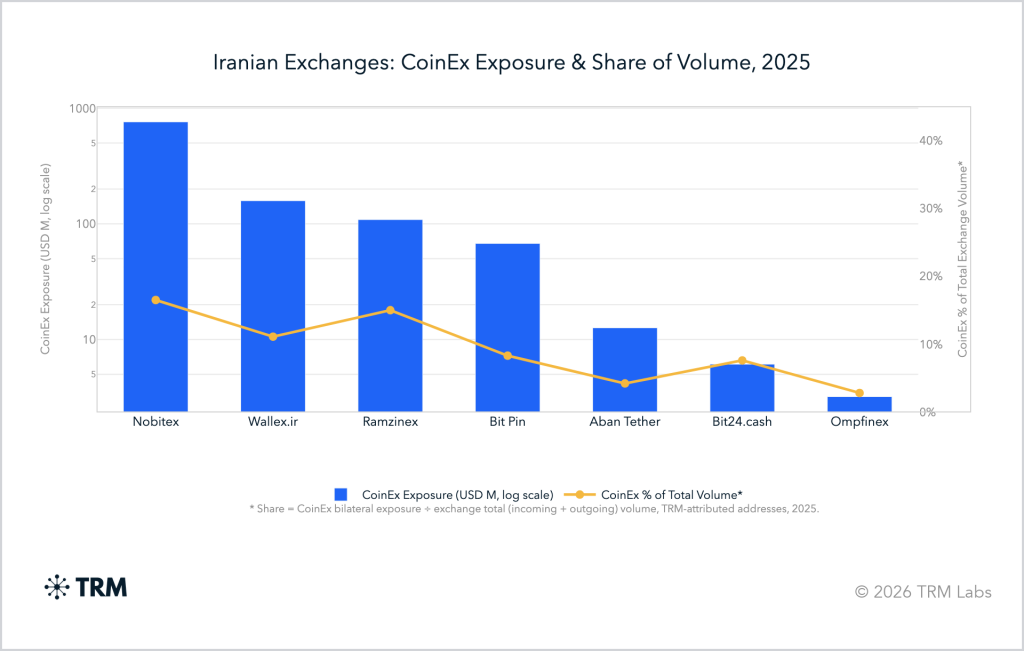
Of that total, $2.7 billion flowed specifically between CoinEx and Nobitex, Iran’s largest domestic exchange, at an average rate of approximately $1 million per day since 2018. By any documented measure, this is the largest single-exchange crypto sanctions-evasion pipeline tied to Iran yet identified.
The TRM Labs report landed three weeks after the US Treasury sanctioned four Iranian crypto exchanges as part of its Economic Fury campaign, with Treasury Secretary Scott Bessent separately confirming the seizure of $1 billion in crypto from Iranian exchanges and wallets since the start of the war.
CoinEx is not among the sanctioned entities. That gap, between what the blockchain data shows and what enforcement has acted on, is the structural tension this report forces into the open. The Iran-CoinEx controversy is now squarely on the US Treasury’s radar.
Don’t Miss Out on Our $1,000 USDT Airdrop on ByBit
CoinEx’s 8% Illicit Rate Is 27x the Industry Benchmark
The compliance gap TRM Labs documents is not marginal. CoinEx’s share of illicit transaction volume sits at nearly 8%, against a 0.3% threshold observed at compliant exchanges, a ratio of roughly 27 to one.
That number is not cosmetic; it is the quantitative basis for TRM’s conclusion that the CoinEx-Nobitex relationship reflects a “coordinated arrangement rather than organic adoption.”
The specifics reinforce that reading. By 2024, CoinEx was Nobitex’s largest external counterpart by volume, nearly nine times larger than the next-biggest exchange, a concentration TRM called “inconsistent with independent market behaviour.”
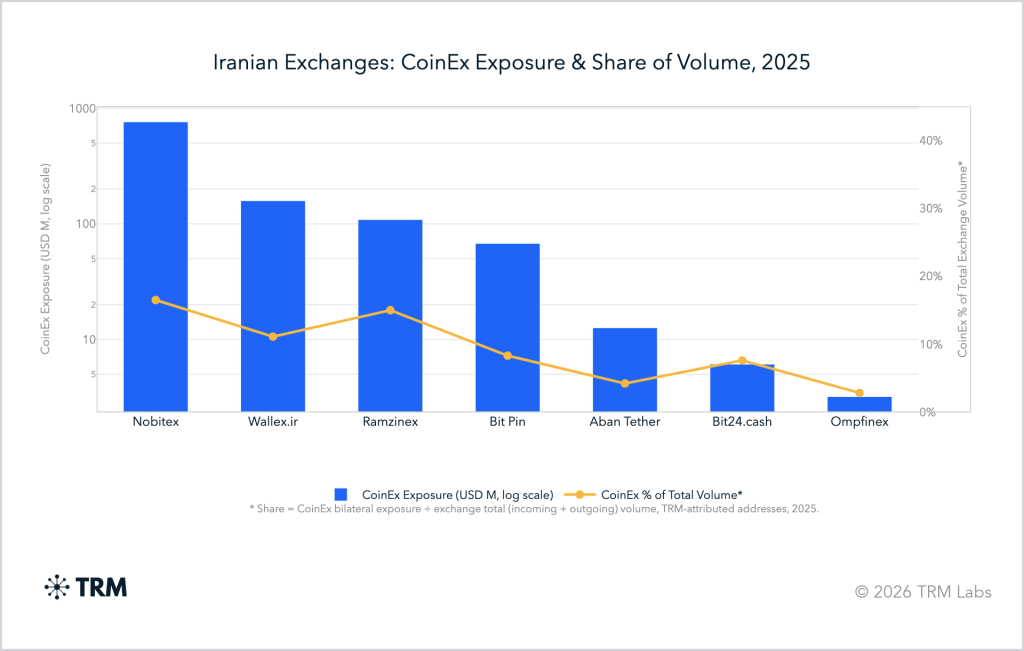
Major Iranian domestic exchanges route between 5% and 10% of their trading volume through CoinEx, a uniformity across platforms that would be statistically improbable if each exchange were making independent routing decisions.
CoinEx-affiliated mining pool ViaBTC adds another layer. TRM Labs traced $154 million in ViaBTC exposure to Nobitex through mining payouts.
More pointedly, ViaBTC supplied emergency liquidity to Nobitex following the Predatory Sparrow hack in June 2025, a $90 million breach that left Nobitex operationally stressed. An affiliated mining pool stepping in as a liquidity backstop for a sanctioned exchange is not a pattern that emerges from coincidence.
Discover: The Best Token Presales
Nobitex Was the On-Ramp, CoinEx Was the Exit
The architecture of the pipeline is straightforward. Sanctioned Iranian entities, including IRGC-linked wallets and entities tied to Iran’s domestic financial system, moved funds into Nobitex, which handled approximately 50% of Iran’s crypto trading volume, per a June 2 Chainalysis report.
Nobitex then routed capital outward through CoinEx, which provided access to global liquidity and the ability to convert into dollar-equivalent stablecoins beyond the reach of Iranian sanctions enforcement.
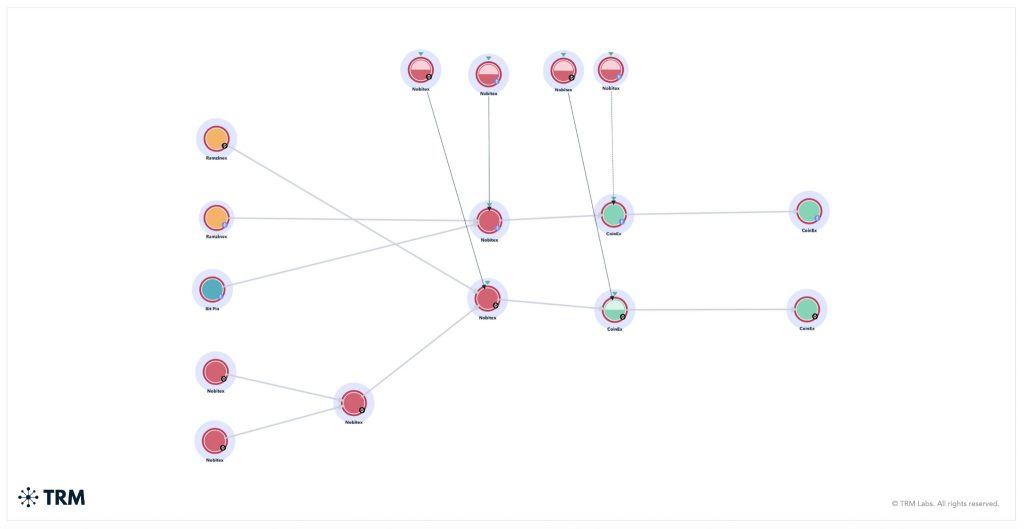
This flow pattern has been running since at least 2018 on the CoinEx-Nobitex corridor, and since 2019 for the broader universe of sanctioned entities TRM Labs tracked. Nobitex’s own political exposure sharpened the stakes: in May 2026, the exchange was reportedly linked to members of a powerful family with ties to Supreme Leader Ali Khamenei, suggesting the pipeline served interests at the apex of the Iranian state, not just retail traders seeking dollar access.
The displacement of other exchanges from Nobitex’s external routing is also analytically significant. CoinEx overtook Binance as Nobitex’s largest foreign counterparty by 2024, after Binance faced US enforcement pressure. That transition illustrates precisely the rerouting dynamic critics of venue-specific enforcement consistently flag: pressure on one exchange does not eliminate the demand, it reassigns it.
CoinEx Denies Government Ties. The On-Chain Data Is Not a Contract.
CoinEx issued a denial on X following the TRM Labs report, stating it has no commercial relationship with the Iranian government or domestic Iranian exchanges and has never provided funding channels to sanctioned parties.
The exchange also disputed TRM Labs’ interpretive framework directly, arguing that “onchain fund flows do not demonstrate a platform’s knowledge of or participation in illicit activity.”
The denial addresses contractual relationships; the TRM Labs report documents transaction flows. Those are not the same evidentiary category, and the distinction matters.
OFAC sanctions exposure does not require proof of a formal commercial agreement – it requires demonstrated facilitation of transactions involving sanctioned parties.
Whether CoinEx knew the identities behind the wallets routing $3.84 billion through its platform is a compliance question. That the flows existed at 27 times the illicit-volume rate of compliant exchanges is the data point that precedes that question.
Discover: The Best Crypto to Diversify Your Portfolio
The post CoinEx Named as Iran Largest Crypto Sanctions Exit Route by TRM Labs appeared first on Cryptonews.

Ghislaine Maxwell says the Epstein files prove she was wrongfully convicted. Trump’s DOJ wants to keep her locked up

US inflation tops 4% for first time in three years, keeping Fed hike in play

PCE Inflation Shakes Markets: Nasdaq Rally Collapses, Bitcoin Falls to New 2026 Low


-

 Fashion6 days ago
Weekend Open Thread: Miami – Corporette.com
-

 Entertainment5 days ago
Renter of Home in Anne Heche Crash Denies Settlement With Son
-
 Sports2 days ago
Two goals and an assist by sheer aura: Cristiano Ronaldo just entered the World Cup chat
-

 Tech3 days ago
Microsoft accidentally kills epic Outlook email threads
-

 Business5 days ago
Soccer-U.S. defends Iran World Cup travel restrictions, says discussions ongoing
-

 Politics5 days ago
Andy Burnham and the meaning of Makerfield
-
Crypto World2 days ago
Bitcoin (BTC) Dips Below $62K, Ethereum (ETH) Plunges 6% Daily: Market Watch
-

 NewsBeat6 days ago
Keir Starmer Allies Question His Chances For No 10
-

 Politics7 days ago
BBC Reporter Discusses Cross Party Criticism Of Trumps Iran Deal
-

 Crypto World1 day ago
Securitize Wraps Roubini's SEC-Registered ETF as Dubai VARA Digital Security
-
Business2 days ago
Entergy settles forward sale agreements, raises $672 million in cash proceeds
-
 Business6 days ago
Wall Street Week Ahead: Investors see Micron earnings as pulse check of AI rally momentum
-
 Crypto World5 days ago
Can Charles Hoskinson Really Rescue Cardano?
-

 Crypto World6 days ago
HIVE shares jump as $220M AI deal speeds Bitcoin mining pivot
-

 Crypto World5 days ago
Jake Chervinsky accuses CME of protecting derivatives monopoly
-

 Entertainment6 days ago
Jose Alvarado Wants Taylor Swift at More Knicks Games
-
 Tech4 days ago
Signal’s Meredith Whittaker says AI chatbots ‘are not your friends’ and calls Copilot agents a backdoor
-

 Sports4 hours ago
India vs Bangladesh LIVE Score, Women’s T20 World Cup: Bangladesh Opt To Bat; India Enter ‘Do-Or-Die’ Stage As Semi-Final Race Heats Up
-

 Tech3 days ago
Nearly 7,000 fake Amazon domains registered ahead of Prime Day 2026, researchers warn
-

 Sports7 days ago
FIFA World Cup 2026: Canada beat 9-men Qatar 6-0 to register first ever win | FIFA World Cup 2026
You must be logged in to post a comment Login