
Crypto World
SEC Regulation Crypto vs CLARITY Act: which framework wins



The Commission published 400 pages of token offering rules while Congress left town. If both frameworks survive, they will contradict each other on the questions that matter most.
Summary
- The SEC proposed Regulation Crypto Assets on Aug. 18, 2026, creating a $5 million startup exemption, a $75 million fundraising exemption, and an investment contract safe harbor that lets tokens exit securities status entirely.
- The CLARITY Act passed the House with 294 votes in July 2025 and cleared the Senate Banking Committee 15 to 9 in May 2026, but the Senate adjourned for August recess without a floor vote, and Polymarket odds for 2026 passage collapsed from 82% to roughly 16%.
- The two frameworks define decentralization differently: the CLARITY Act uses a statutory four part mature blockchain test with a hard 20% ownership cap, while the SEC safe harbor relies on issuer self certification that essential managerial efforts have ceased.
- Regulation Crypto Assets does not resolve the foundational jurisdictional question of whether a given token answers to the SEC or the CFTC, the exact problem the CLARITY Act was written to solve.
- Commissioner Hester Peirce, architect of the safe harbor concept, departs in November 2026, creating a narrow window in which the proposal must advance before the Commission loses the votes to finalize it.
The timing was not subtle. On Aug. 7, 2026, the United States Senate adjourned for its August recess without voting on the CLARITY Act, the most ambitious piece of crypto legislation to reach the chamber floor since the industry began lobbying for a federal framework. One week later, on Aug. 14, the Securities and Exchange Commission voted to publish Regulation Crypto Assets, a 400 page proposed rulemaking that would create the agency’s first bespoke offering regime for digital tokens. The full text landed on Aug. 18, the same week Polymarket odds for the CLARITY Act’s passage in 2026 dropped to roughly 16%.
The market read it as coordination. The SEC, under Chairman Paul Atkins, stepped into the vacuum that Congress left behind. But calling it a replacement misses the structural problem. The CLARITY Act is not dead. It sits on the Senate Legislative Calendar with a September 14 return window and three working weeks before the session runs out. If both frameworks proceed in parallel, the crypto industry will face two overlapping regimes that disagree on token classification, startup capital thresholds, the meaning of decentralization, and whether software developers owe regulatory obligations at all.
This is not a question of which framework is better. It is a question of which one survives.
What Regulation Crypto Assets actually proposes
The SEC’s proposal, filed as Release No. 33 11434 under docket S7 2026 27, runs roughly 400 pages and creates three distinct pathways for token projects that currently lack a workable compliance route.
The startup exemption, housed in Subpart B, allows teams to raise up to $5 million over four years with no accredited investor requirement and no per investor cap. The lane covers not just capital raises but also airdrops and network rewards, a deliberate expansion of scope that signals the Commission views token distribution itself as an offering event. Issuers must file a Form NOR (notice of reliance) before any distribution and post principles based disclosures on their website covering ten mandated topics, from token economics to governance mechanisms. There is no resale lockup, and general solicitation is permitted.
The fundraising exemption, in Subpart C, offers two tiers modeled loosely on Regulation A. Tier 1 allows $20 million per 12 month period with no audit requirement. Tier 2 raises the ceiling to $75 million annually but demands audited financial statements prepared under GAAS or PCAOB standards, plus ongoing reporting through annual (Form 1 KC), semiannual (Form 1 SC), and current (Form 1 UC) filings. Non accredited investors face a cap of 10% of the greater of their annual income or net worth. The offering circular, filed on Form 1 CRYPTO, requires disclosure across the same ten topic areas.
The investment contract safe harbor, in Subpart D, addresses the exit question. A token can shed its securities classification when the issuer has completed or permanently ceased all promised essential managerial efforts, made no new representations about such efforts, and filed a Form TR certifying compliance. The mechanism is issuer driven: the founding team decides when it has finished, self certifies, and the SEC retains the right to challenge.
Antifraud and antimanipulation provisions apply across all three lanes. Bad actor disqualification mirrors Regulation A. The comment period runs 60 days from Federal Register publication.
What the CLARITY Act would do instead
The Digital Asset Market Clarity Act, which the House passed with 294 votes in July 2025, takes a fundamentally different approach. Where Regulation Crypto Assets builds exemptions within the SEC’s existing authority, the CLARITY Act rewrites the jurisdictional map from scratch.
The bill classifies every digital asset into one of three categories: investment contract assets regulated by the SEC, digital commodities regulated by the Commodity Futures Trading Commission, and stablecoins subject to joint oversight under the separate GENIUS Act framework. The classification turns on an asset’s characteristics, issuance method, sale context, and whether it meets the mature blockchain test.
That test is the bill’s structural centerpiece. A token transitions from SEC to CFTC oversight when its underlying network satisfies four statutory conditions: the system must operate for actual transactions, services, validation, or governance; the code must be publicly accessible without permission requirements; operation must follow preset, transparent rules applied consistently; and no person or commonly controlled group may hold 20% or more of tokens or voting power.
The 20% threshold is the bill’s working definition of sufficient decentralization. Meeting it creates a rebuttable presumption that the asset qualifies as a digital commodity. The issuer can self certify, and the SEC has 60 days to contest the classification, with appeals heard in federal court.
On capital formation, the CLARITY Act allows new issuers to raise up to $75 million over 12 months without full securities registration, conditional on filing an offering statement covering blockchain details, source code, consensus mechanism, and insider holdings. The bill also includes DeFi developer protections, carving out software that never touches customer funds from both SEC and CFTC registration requirements. A separate provision exempts non controlling blockchain developers from money transmitter classification.
Three fights stalled the bill in the Senate: who enforces the ethics rules barring government officials from sponsoring digital assets, whether stablecoin yield arrangements survive a provision prohibiting interest on idle balances, and how far developer protections extend into the DeFi stack.
The collision map: clause by clause
The two frameworks agree on the broadest principle, that crypto assets need a regulatory home, and diverge on nearly everything else. The following comparison isolates the points of direct contradiction.
Token classification. The CLARITY Act creates a statutory three category system (security, digital commodity, stablecoin) and assigns each to a specific regulator. Regulation Crypto Assets does not classify tokens at all. It builds offering exemptions for assets already deemed securities and provides an exit ramp from that status, but it does not address what happens after the exit. A token that sheds its investment contract classification under the SEC safe harbor enters a jurisdictional void: it is no longer a security, but no rule designates it a commodity or routes it to the CFTC. The CLARITY Act fills that gap. Regulation Crypto Assets leaves it open.
Decentralization test. The CLARITY Act defines decentralization through four objective, statutory criteria anchored by the hard 20% ownership cap. The SEC safe harbor uses a subjective standard: the issuer must have ceased all essential managerial efforts and self certify that fact. There is no ownership threshold, no code transparency requirement, and no governance test. A project with a single entity holding 40% of tokens could theoretically qualify for the safe harbor if that entity convincingly argues it has stopped managing the network. Under the CLARITY Act, the same project would fail the mature blockchain test and remain a security.
Startup exemptions. Regulation Crypto Assets caps the startup lane at $5 million over four years. The CLARITY Act does not include a comparable small raise exemption; its $75 million offering pathway is the floor, not the ceiling. For a team seeking to raise $3 million through a token sale, the SEC framework offers a lighter compliance path. For a team raising $50 million, the CLARITY Act’s single tier structure may prove simpler than Regulation Crypto’s Tier 2, which demands PCAOB audited financials and ongoing semiannual reporting.
DeFi treatment. The CLARITY Act explicitly carves out DeFi developers who build non custodial software from registration requirements on both the SEC and CFTC sides. Regulation Crypto Assets contains no DeFi provisions. The March 2026 joint SEC CFTC interpretation placed staking, mining, and airdrops outside securities law as a temporary classification, but the proposed rule does not codify those carve outs. A DeFi protocol builder operating under the SEC framework today relies on guidance that a future commission could withdraw.
Staking. The joint interpretation treats staking as a non securities activity. Regulation Crypto Assets includes airdrops and network rewards as covered transactions under the startup exemption, which means distributing staking rewards could count against the $5 million cap. The CLARITY Act does not subject staking to offering limits; its mature blockchain test treats validation activity as evidence of decentralization, not as an offering event.
State preemption. Regulation Crypto Assets preempts state registration requirements for qualified purchasers in primary offerings and conditionally preempts state rules for secondary trading if the issuer maintains ongoing disclosure. The CLARITY Act goes further, preempting state property laws that would classify self custodied digital assets as abandoned due to inactivity and asserting federal primacy over token classification. Both frameworks preserve state antifraud authority, but the CLARITY Act’s preemption is broader and statutory, while the SEC’s is narrower and regulatory.
Resale and secondary markets. Regulation Crypto Assets imposes no resale lockup on tokens sold under either exemption, but the proposal explicitly does not address Exchange Act registration for secondary market participants such as exchanges, brokers, and dealers. The CLARITY Act requires digital commodity exchanges, brokers, and dealers to register with the CFTC and meet standards for custody, customer asset segregation, qualified custodian requirements, and market surveillance.
What this means for teams building today
The collision is not theoretical. Projects at different stages of development face materially different outcomes depending on which framework prevails, and many cannot afford to wait for resolution.
A pre launch token project seeking to raise $4 million has a clear path under Regulation Crypto Assets: file Form NOR, post the ten topic disclosures, distribute tokens under the startup exemption, and skip the accredited investor gatekeeping entirely. Under the CLARITY Act, the same team would need to file a full offering statement covering blockchain details, source code, and insider holdings, then navigate the $75 million pathway designed for much larger raises. The SEC framework is objectively lighter for small teams. But if the CLARITY Act passes six months later, every disclosure filed under Form NOR becomes legally uncertain, and the team may need to reclassify its token under the statutory three category system.
A mid stage protocol that has already distributed tokens and wants to exit securities status faces the opposite problem. Under Regulation Crypto Assets, the founding team self certifies through Form TR that it has ceased essential managerial efforts. Under the CLARITY Act, the protocol must pass the mature blockchain test, including the 20% ownership cap and the open source code requirement. A protocol where the founding entity still holds 25% of governance tokens qualifies for the SEC safe harbor (assuming it has stopped active management) but fails the CLARITY Act’s statutory test. If both frameworks apply simultaneously, that protocol sits in regulatory limbo.
DeFi builders face the starkest divide. A developer who writes and deploys a non custodial automated market maker has explicit statutory protection under the CLARITY Act’s carve out for software that never touches customer funds. Under Regulation Crypto Assets, that same developer has no explicit protection at all. The March 2026 joint interpretation offers informal comfort, but informal comfort is not a compliance program. Teams building DeFi infrastructure today must decide whether to invest in compliance architecture for a rule that may be superseded or to wait for a statute that may never arrive.
Staking service providers confront a subtler trap. The SEC framework treats network rewards as covered transactions under the startup exemption, which means a validator distributing staking yields to delegators could be conducting an unregistered offering if the aggregate value exceeds $5 million. The CLARITY Act treats validation as evidence of decentralization. Under one framework, staking is an offering. Under the other, it is proof that a token should no longer be treated as a security. The contradiction is not a matter of interpretation. It is a matter of text.
Why one framework could kill the other
The legal hierarchy is straightforward. Federal statute trumps agency rulemaking. If the CLARITY Act passes, its provisions override any SEC rule that conflicts with the statutory text. The token classification system, the mature blockchain test, the CFTC jurisdiction over digital commodities, and the DeFi developer protections would all supersede Regulation Crypto Assets to the extent they contradict.
But the reverse is also true in practice, if not in law. If the CLARITY Act dies in the Senate, Regulation Crypto Assets becomes the only structured framework available. Projects will build compliance programs around the SEC’s three lanes. Exchanges will develop listing standards based on the safe harbor criteria. Lawyers will advise clients using the Form NOR and Form 1 CRYPTO templates. Within 12 to 18 months, the industry’s operational infrastructure will have calcified around the SEC’s architecture, making any subsequent legislation politically and practically harder to implement.
This is the pattern that played out with the SEC CFTC joint framework announced in March 2026. That interpretation classified 16 major tokens as digital commodities, effectively pre deciding a classification question that Congress intended to resolve through legislation. By the time the CLARITY Act reached the Senate Banking Committee, those 16 classifications had already shaped exchange operations, custody arrangements, and compliance budgets across the industry.
Regulation Crypto Assets extends the same dynamic. TD Cowen managing director Jaret Seiberg described the proposal as creating a distinct compliance regime that eliminates the binary choice between registration and litigation risk. That is precisely the value proposition the CLARITY Act was supposed to deliver. If the SEC delivers it first through rulemaking, the legislative urgency evaporates.
The vulnerability the market is not pricing
The structural weakness of Regulation Crypto Assets is not its provisions. It is its durability. An SEC rule adopted under one commission can be amended, suspended, or repealed by the next. Commissioner Hester Peirce, whose safe harbor concept anchors Subpart D, departs the Commission in November 2026. If the proposal is not finalized before her exit, the Commission could lose the three vote majority needed to advance it. Even if finalized, a future commission hostile to crypto asset innovation could reopen the rulemaking, narrow the exemptions, or redefine essential managerial efforts so broadly that no project qualifies for the safe harbor.
The CLARITY Act, by contrast, would require an act of Congress to amend. Its classification system, once enacted, would bind every future SEC and CFTC chair until lawmakers chose to change it. The ethics provision, which bars the president, vice president, members of Congress, and federal judges from sponsoring digital assets for compensation while in office, carries civil penalties reported at up to $250,000 daily. That provision is one reason the bill stalled, but it is also one reason the bill, if passed, would be extraordinarily difficult to reverse.
The market is pricing Regulation Crypto Assets as a win and the CLARITY Act’s stall as a manageable delay. That framing ignores the possibility that the SEC framework, precisely because it is easier to enact, is also easier to dismantle. A regulatory framework that depends on the composition of a five member commission is not a framework. It is a truce.
Industry reaction reflected this tension. Groups broadly welcomed the proposal as a constructive step away from regulation by enforcement. But a16z, one of crypto’s most influential venture firms, supported the goal while urging the Commission to defer to Congress. That position captures the split: the SEC’s rules are better than no rules, but they are not better than statute.
The September window
The Senate returns on Sept. 14, 2026, with three working weeks before the session effectively ends. Senator Cynthia Lummis has circulated a consolidated draft merging Senate committee versions of the CLARITY Act, but Majority Leader John Thune publicly cast doubt on passage before the August recess, and the Senate prioritized other legislation.
The comment period for Regulation Crypto Assets runs 60 days from Federal Register publication, placing the deadline in mid to late October. If the CLARITY Act passes during the September window, the SEC would need to reconcile its proposal with the new statutory framework, potentially withdrawing or substantially revising the rule. If the CLARITY Act fails, the SEC proceeds to finalize Regulation Crypto Assets with no competing legislative constraint.
Both outcomes carry costs. Passage of the CLARITY Act after Regulation Crypto Assets has already shaped industry compliance would create a disruptive transition. Failure of the CLARITY Act would consolidate regulatory authority in an agency that, by design, can change its mind every time the White House changes hands.
The crypto industry spent three years asking for regulatory clarity. It may get two incompatible versions of it in the same quarter.
What to watch
Polymarket odds for CLARITY Act passage crossing 30% before Sept. 14. A sustained move above that threshold would signal that Senate leadership has committed floor time, changing the calculus for every project building compliance around Regulation Crypto Assets.
SEC comment letter volume during the first 30 days. If major exchanges and venture firms submit letters urging the Commission to defer to Congress, it signals the industry views the rule as a backstop, not a destination.
Whether the SEC schedules a second open meeting on Regulation Crypto Assets before Peirce’s November departure. Acceleration of the finalization timeline would indicate the Commission is racing the clock on its own composition.
Any amendment to the CLARITY Act’s ethics provision. The provision barring government officials from sponsoring tokens is the single largest obstacle to a floor vote. A narrowing or sunset clause would materially increase passage odds.
CFTC public statements on the safe harbor exit ramp. If the CFTC signals it will not automatically accept tokens that exit SEC jurisdiction under Subpart D, the safe harbor’s practical value collapses.
What is Regulation Crypto Assets?
Regulation Crypto Assets is a proposed SEC rulemaking published on Aug. 18, 2026, that creates three pathways for token offerings: a $5 million startup exemption, a $75 million fundraising exemption, and a safe harbor that allows tokens to exit securities classification when their founding teams cease essential managerial efforts.
What is the CLARITY Act?
The CLARITY Act, formally the Digital Asset Market Clarity Act, is federal legislation that classifies every digital asset as a security, digital commodity, or stablecoin and assigns regulatory authority to the SEC, CFTC, or joint oversight accordingly. The House passed it with 294 votes in July 2025.
How do the two frameworks define decentralization differently?
The CLARITY Act uses a four part mature blockchain test with a hard 20% ownership cap: no single entity or commonly controlled group may hold 20% or more of tokens or voting power. The SEC safe harbor relies on issuer self certification that essential managerial efforts have ceased, with no ownership threshold.
Can both frameworks exist at the same time?
If the CLARITY Act becomes law, its statutory provisions override any conflicting SEC rule. If it does not pass, Regulation Crypto Assets proceeds as the sole structured framework, but it lacks the jurisdictional clarity and CFTC integration that the CLARITY Act provides.
What happens to DeFi developers under each framework?
The CLARITY Act explicitly exempts non custodial software builders from SEC and CFTC registration. Regulation Crypto Assets contains no DeFi provisions. DeFi developers currently rely on the March 2026 joint interpretation, which a future commission could withdraw.
Does the SEC safe harbor send tokens to the CFTC?
No. The safe harbor ends a token’s securities classification but does not route it to any other regulator. A token that exits through Subpart D enters a jurisdictional gap unless the CLARITY Act or separate legislation assigns it to the CFTC.
Why did the CLARITY Act stall in the Senate?
Three unresolved disputes blocked a floor vote: enforcement of the ethics provision barring officials from sponsoring tokens, whether platforms may pay yield on stablecoin balances, and how far DeFi developer protections extend. The Senate adjourned for August recess without resolving any of them.
What is the deadline for the Regulation Crypto Assets comment period?
Public comments are due 60 days after the proposal is published in the Federal Register. Based on the Aug. 18 publication date, the deadline falls in mid to late October 2026. This is educational analysis, not investment advice.
Disclaimer: This article is for informational purposes only and does not constitute financial or legal advice. Cryptocurrency investments carry significant risk. Always conduct your own research before making investment decisions. Published Aug. 20, 2026.

MANTRA Chain halted its network on Aug. 21 while investigating an unidentified incident, freezing transactions and preventing assets from moving across the RWA focused Layer 1 blockchain.
Summary
- MANTRA Chain halted validators, public endpoints, bridges and managed relays while investigating an unidentified incident.
- The halt prevents transactions from processing, leaving assets currently unable to move across the network.
- MANTRA says engineering and security teams are investigating alongside external partners before considering any restart.
- Affected exchanges have paused deposits and withdrawals, while the team says users need no action.
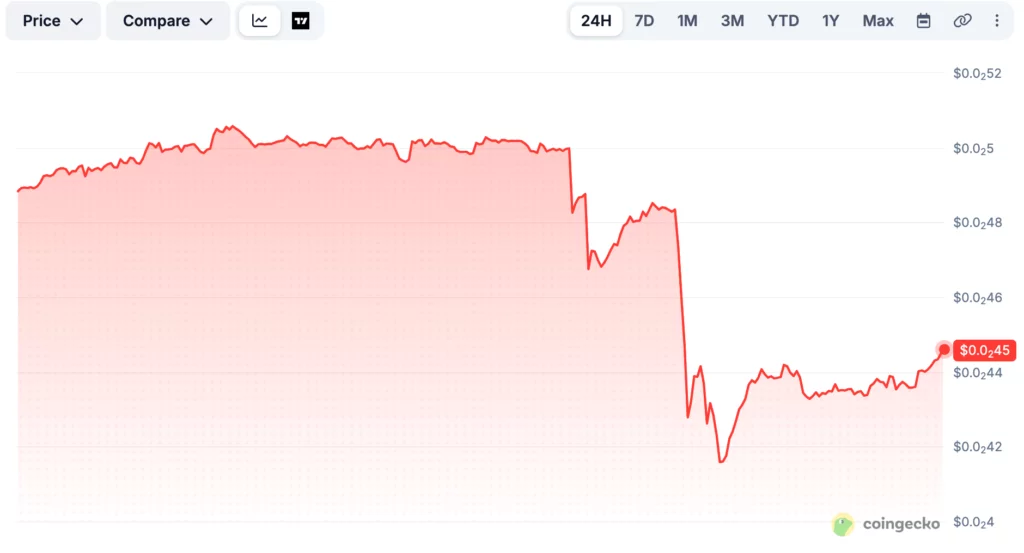
- MANTRA traded near $0.0044, down approximately 9.8% over 24 hours, according to CoinGecko market data.
The team initially described the shutdown as a precaution. Its latest status update said the network remained halted as engineering and security teams investigated alongside external partners.
Affected components include validators, public blockchain endpoints, MANTRA Bridge migration operations and MANTRA managed Inter Blockchain Communication relays. Deposits and withdrawals through affected exchanges have also been paused.
MANTRA has not disclosed the suspected cause, the block height where the incident began or whether an attacker gained access to funds. It has not reported any stolen, minted or otherwise compromised assets.
MANTRA Chain halt prevents assets from moving
The shutdown stops validators from processing new transactions. Users therefore cannot complete transfers, interact with applications or move assets through affected bridges while the halt remains active.
MANTRA said no action was required from users. It also warned against people offering “recovery” assistance, a common method used by scammers during blockchain disruptions.
“We will not resume the network until we are confident it is safe to do so,” the team said. It promised regular updates but did not provide a recovery estimate.
The project has notified exchanges and ecosystem partners. Upbit is among the platforms that have suspended deposits and withdrawals for the native MANTRA token. Trading can continue independently on centralized exchanges because internal orders do not require transactions on MANTRA Chain.
A network halt can preserve the existing ledger state while developers investigate. However, the action also demonstrates that validators or core participants can coordinate to suspend block production during an emergency.
Root cause and financial exposure remain unknown
MANTRA has not characterized the event as an exploit, validator failure, consensus problem or infrastructure outage. Claims assigning a cause remain unverified until the team publishes technical evidence.
No independent security researcher had released a confirmed transaction trail showing stolen funds at the time of writing. The halted network also prevents new onchain transfers, limiting the immediate movement of native assets.
The next update will need to identify the affected software or infrastructure, establish whether the chain’s recorded state remains valid and explain any required patch. Validators would then need to install or approve the relevant changes before block production could resume.
Developers may also need to determine whether the restart can continue from the latest accepted block. MANTRA has not indicated that it is considering a rollback, asset freeze or chain state modification.
The incident affects infrastructure developed for tokenized real world assets. MANTRA previously created a $108.8 million fund for RWA projects with a planned four year deployment period.
MANTRA price falls as trading activity increases
MANTRA traded near $0.0045 at the time of writing, falling approximately 9.8% over 24 hours, according to CoinGecko data. Its seven day decline reached about 12.8%.
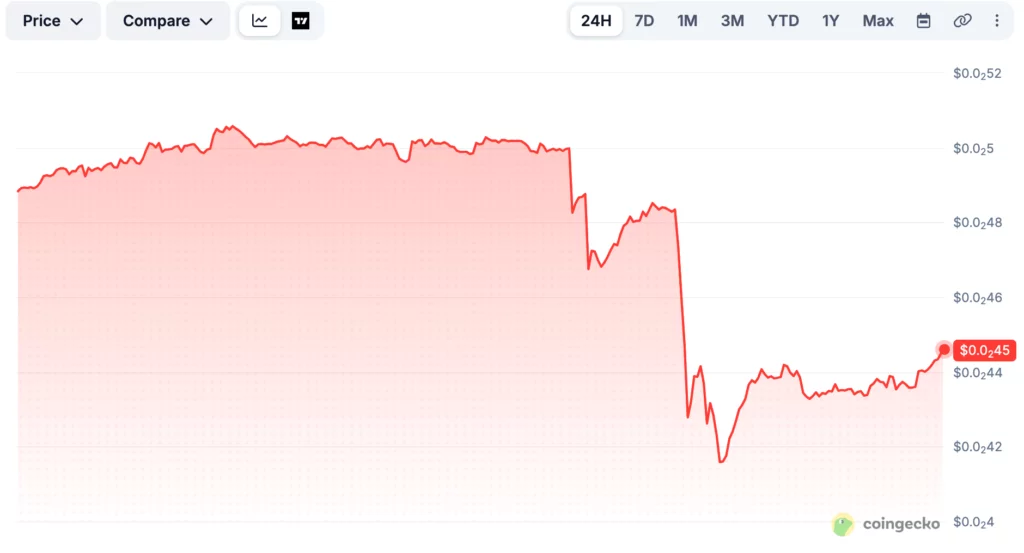
Trading volume rose by roughly 591% to more than $22.7 million. The increase shows greater market activity but does not establish whether every transaction was a direct response to the network shutdown.
The token reached a 24 hour low near $0.00413. Its market capitalization stood at approximately $27.8 million, based on CoinGecko’s estimated circulating supply of 6.3 billion tokens.
The current MANTRA token followed a March 2026 rebrand and denomination change. As previously reported, the project completed a one for four token split, replacing the former OM ticker without changing holders’ proportional value.
That change means current prices cannot be compared directly with the legacy OM price without adjusting for the split. The original OM token separately lost more than 90% during its 2025 collapse, which the project attributed to forced exchange liquidations. Other researchers questioned that explanation.
MANTRA said it would keep the network offline until its teams confirm that a restart is safe. Users must wait for an official root cause assessment, recovery plan and notice that validators and exchange transfers have resumed.


The two-day short liquidation total has reached about $3.8 billion, after Thursday’s figure set a record going back to 2021.


The UK’s HM Revenue and Customs (HMRC) sent 81,172 tax warning letters, emails and text messages to crypto investors during the 2025/26 financial year, according to figures reported on Aug. 20.
Summary
- 81,172 warnings reached crypto investors in 2025/26, up from 64,982 during the previous financial year.
- HMRC treats crypto sales, swaps, purchases and most gifts as potential taxable disposals for investors.
- UK service providers began collecting customer details under the Cryptoasset Reporting Framework in January 2026.
- Platforms must submit their first reports covering 2026 activity to HMRC by May 31, 2027.
- Unpaid domestic tax can attract penalties reaching 100% of tax due, plus accrued interest charges.
The number rose from 64,982 warnings in 2024/25 and 27,714 in 2023/24. The latest total was therefore about 25% higher than the previous year and nearly three times the figure recorded two years earlier.
The figures came from a Freedom of Information request obtained by accounting firm UHY Hacker Young and reported by the BBC. HMRC reportedly suspects that some undeclared liabilities arose from gains accumulated as crypto prices increased between late 2022 and 2025.
HMRC has not disclosed how much unpaid tax the latest warning campaign identified. A warning, commonly called a nudge letter, also does not automatically mean its recipient owes tax or faces a formal investigation.
HMRC crypto tax warnings target possible underpayments
HMRC sends warning communications when information available to the agency suggests that a taxpayer may have omitted income or capital gains. Recipients are generally asked to review their records and correct any errors.
UK taxpayers may owe Capital Gains Tax when they sell crypto for fiat currency, exchange one token for another, purchase goods with crypto or give tokens to another person. Gifts to spouses, civil partners and qualifying charities usually receive different treatment.
The tax applies to gains rather than the total value of a transaction. Individuals must calculate proceeds in pounds sterling and deduct eligible acquisition costs. HMRC’s official guidance also requires investors to maintain records for each token pool.
Crypto received through employment, mining, staking, lending or some decentralized finance arrangements may instead create Income Tax and National Insurance obligations. A later disposal can produce a separate capital gain.
Reporting rules will give HMRC more exchange data
The UK introduced the Cryptoasset Reporting Framework on Jan. 1, 2026. Since that date, covered crypto service providers have been required to collect identifying information and transaction data from customers.
Required information can include names, addresses, tax residences and tax identification numbers. Providers must submit their first reports covering 2026 activity between Jan. 1 and May 31, 2027, according to HMRC’s published rules.
The framework also supports information exchanges between participating tax jurisdictions. This could give HMRC access to records held by some overseas platforms serving UK residents. The agency estimates that the reporting measures could raise as much as £315 million by April 2030.
As previously reported, the new regime also introduced financial penalties for missing customer information. Customers who fail to provide required details can face a penalty of up to £300. Platforms can also receive penalties for incomplete or inaccurate reports.
Other countries are adopting related reporting systems. In related coverage, European Union rules have expanded tax data collection across crypto transactions, including some transfers involving external wallets.
Investors can correct unpaid crypto tax voluntarily
HMRC allows taxpayers to report previously unpaid crypto liabilities through its Cryptoasset Disclosure Service. The process can cover Capital Gains Tax and Income Tax arising from earlier financial years.
Taxpayers need transaction records from every platform and wallet used. Exchange statements alone may be insufficient because platforms do not always calculate pooled acquisition costs or track transfers between accounts belonging to the same person.
HMRC says unpaid domestic tax can result in penalties reaching 100% of the amount owed, plus interest. Offshore cases can attract higher penalties. The final charge depends on the taxpayer’s conduct, disclosure timing and cooperation.
The reporting regime does not create a new crypto tax. It gives HMRC more information for checking whether taxpayers followed rules that already applied. Investors receiving a warning should verify the agency’s calculations before confirming or disputing any liability.


Binance founder Changpeng Zhao said on Aug. 21 that countries could use tokenization to raise capital and attract foreign direct investment by offering digital representations of assets to global investors.
Summary
- CZ said tokenization could help governments raise capital and attract foreign direct investment from abroad.
- He supports issuing tokenized assets across multiple blockchains despite the resulting fragmentation of market liquidity.
- CZ argued that greater interchangeability between issuers could reduce some liquidity fragmentation across blockchain networks.
- BNB Chain reported 776,000 RWA holders, while RWA.xyz measured 776,428 addresses on August 19, 2026.
- Tokenized shares remain securities and must comply with applicable laws governing issuance and secondary trading.
“Let’s tokenize everything,” CZ wrote in an X post. He argued that countries and companies have an incentive to sell tokenized shares to investors worldwide.
CZ also backed issuing tokenized assets across every blockchain rather than selecting a single network. He acknowledged that this approach would create fragmented liquidity but said parallel development would be the fastest way to expand the sector.
His comments represented a policy and industry view, not a formal investment initiative from Binance, BNB Chain or any government. CZ did not identify countries preparing tokenized share offerings or provide a timeline for their launch.
Tokenization does not automatically create FDI
Tokenization converts ownership rights or economic claims into blockchain based units. Governments and companies can apply the model to shares, bonds, funds, commodities, property or other assets.
A token can broaden distribution by making an asset accessible through digital platforms. However, access does not guarantee new investment, liquidity or legal recognition across borders. Issuers must still address securities laws, custody, investor verification, disclosures and ownership rights.
CZ described tokenization as one of the best methods for attracting foreign direct investment. Under the OECD’s formal definition, FDI generally involves a foreign investor establishing a lasting interest and owning at least 10% of an enterprise’s voting power.
Smaller purchases of tokenized shares may instead qualify as portfolio investment. Whether a token sale counts as FDI therefore depends on the investor’s residence, voting rights, ownership level and relationship with the issuing company.
CZ supports growth across competing blockchains
CZ said issuing assets on multiple networks would allow more teams to develop tokenization infrastructure simultaneously. This could increase distribution but divide trading activity and capital between separate markets.
Liquidity fragmentation can produce different prices, wider spreads and shallower order books for representations of the same asset. Bridges and separate issuers can also introduce technical, custody and counterparty risks.
CZ said high interchangeability between issuers could address some of that fragmentation. Such compatibility would require consistent redemption rights, backing arrangements, settlement processes and legal claims. He did not propose a specific technical standard.
Existing projects are already expanding tokenized securities across several networks. As previously reported, Ondo developed infrastructure that moves tokenized stocks between supported blockchain markets while maintaining backing for transferred assets.
In related coverage, tokenized U.S. stocks were also extended into Hyperliquid’s blockchain trading environment, showing how issuers are seeking liquidity across multiple ecosystems.
BNB Chain reports rapid growth in RWA holders
CZ’s comments followed a BNB Chain statement that the network had reached approximately 776,000 holders of tokenized real world assets, up about 370% over 30 days.
RWA.xyz data recorded 776,428 RWA holders as of Aug. 19, an increase of 368.51% over the preceding 30 days. The platform listed $5.8 billion in distributed asset value and 1,284 assets.
The figures include categories selected by the data provider and should not be treated as proof of foreign investment or demand for tokenized national assets. A blockchain address also does not necessarily represent one individual investor.
BNB Chain’s recent growth includes institutional products. As crypto.news previously reported, the network secured 61.7% of assets on Franklin Templeton’s Benji platform, representing about $1.5 billion at the time.
Tokenized shares would remain subject to the laws governing their underlying securities. The U.S. Securities and Exchange Commission said in a January statement that stocks, bonds and other securities do not lose their legal status when represented through crypto networks.
CZ did not announce a product, regulatory application or launch deadline. The next developments would depend on issuers, governments and regulators establishing structures that define ownership, transfers, disclosures and cross border investor access.
CrowdStrike (CRWD) is set to report earnings on Aug. 26 after the regular session closes, and the options market is pricing in a 10% move in either direction. The stock has a solid recent history of strong performance following the cybersecurity company’s earnings reports. Bank of America recently raised its price targets on cybersecurity stocks, which could be good for…
Copyright ©2026 Investor’s Business Daily, LLC. All rights reserved. 87990cbe856818d5eddac44c7b1cdeb8
South Korean cryptocurrency exchange Upbit will add Bitcoin and Tether trading pairs for Biconomy, Bubblemaps, Nillion and ETHGas on Aug. 21.
Summary
- Upbit will add eight BTC and USDT pairs covering BICO, BMT, NIL and GWEI tokens.
- Trading was postponed three hours from 13:00 KST to 16:00 KST on August 21 officially.
- BICO, NIL and GWEI deposits use Ethereum, while BMT transfers require Solana network support only.
- Only limit orders remain available for roughly two hours after Upbit opens the new markets.
- Upbit may delay trading again if deposits do not provide sufficient liquidity before the launch.
The exchange originally scheduled the eight markets to open at 13:00 Korea Standard Time. Upbit updated its official notice at 12:50 KST and postponed trading until 16:00 KST, a three hour delay.
Upbit did not give a detailed reason for the change. It apologized for the inconvenience and retained the previously announced deposit networks and initial order restrictions.
The exchange warned that trading could face another delay if deposits and withdrawals fail to establish sufficient liquidity before the revised opening time.
Upbit listing covers eight new trading pairs
Each of the four tokens will receive one BTC pair and one USDT pair. Upbit did not announce Korean won markets for the assets.
BICO, NIL and GWEI deposits must use Ethereum. BMT deposits must use Solana. Upbit will not process transfers made through unsupported networks, even when another version of the same token exists elsewhere.
The exchange provided contract addresses for each supported asset. Users should verify those addresses and the selected blockchain before transferring funds. Deposits sent through the wrong network may require a lengthy recovery process or may not be recoverable.
Upbit can also request evidence explaining the source of large deposits. Transfers from exchanges that do not meet its Travel Rule requirements may not appear in customer accounts until additional checks are completed.
The exchange has expanded its non won markets through several recent listing rounds. As crypto.news previously reported, Upbit added nine tokens across its BTC and USDT markets in June.
Initial orders will carry temporary restrictions
Upbit will restrict buy orders for approximately five minutes after trading begins. It will also block sell orders priced more than 10% below the reference closing price during that period.
Only limit orders will be accepted for roughly two hours after the markets open. Other order types and execution conditions will become available after Upbit removes the restriction.
These controls are intended to manage the limited liquidity and rapid price movements that can occur when a market first opens. They do not guarantee price stability or prevent traders from incurring losses.
Previous Upbit listings have produced mixed market reactions. Some tokens have recorded abrupt increases in price and volume, while others have traded lower despite gaining access to the exchange.
In related coverage, Venice Token declined despite receiving three new Upbit trading pairs. Any price movement in BICO, BMT, NIL or GWEI would therefore require separate market data rather than being assumed from the listing announcement.
Four projects gain broader access to Upbit traders
Biconomy provides infrastructure designed to simplify blockchain transactions through account and chain abstraction. BICO supports governance and staking within its ecosystem.
Bubblemaps visualizes token distribution and links between blockchain addresses. Its BMT token supports platform use and incentives for community research through Intel Desk.
Nillion develops privacy focused computing services for storing data, running confidential computations and processing artificial intelligence workloads. NIL is used for network payments, node rewards and staking.
ETHGas is developing a market for Ethereum blockspace and transaction preconfirmations. Its system is designed to let validators sell future block capacity while traders and applications seek more predictable transaction execution. GWEI supports governance and staking.
Upbit had opened deposits and withdrawals within two hours of publishing the original notice at 09:48 KST. The next confirmed event is the revised 16:00 KST trading launch, although the exchange’s liquidity condition leaves room for another postponement.
The exchange has changed listing times before. As previously reported, Upbit postponed another token launch before opening trading in May. Traders should rely on the latest exchange notice rather than the original schedule.


Binance launched Binance Agent OS and its Model Context Protocol Server on Aug. 20, giving compatible artificial intelligence applications controlled access to market data and trading functions.
Summary
- Binance Agent OS connects AI applications with trading, wallet, payment and market data tools via permissions.
- The MCP Server supports spot, margin, Convert and two categories of Binance futures trading products.
- Agents cannot withdraw funds externally or transfer assets from users’ main accounts into subaccounts directly.
- Market data access requires no authentication, while account actions depend on specifically authorized user permissions.
- Binance currently lists Claude, Claude Code, Codex, ChatGPT and VS Code as compatible client applications.
The developer platform combines Binance APIs, Wallet Agentic Hub, x402, Skill Hub and MCP support. Binance said the broader system is intended to reduce the need for developers to build separate connections for each crypto function.
Its Binance MCP Server acts as the connection layer between supported AI clients and the exchange. Users can authorize compatible applications without storing Binance API keys locally, according to the company’s announcement.
Availability depends on the user’s location, account status and access to individual Binance products. The launch does not make every Binance function available through every AI application.
Binance Agent OS combines five developer components
Agent OS brings several existing and new developer services into one platform. Binance APIs provide access to trading, market, wallet and blockchain functions, while Wallet Agentic Hub supports wallet interactions controlled through user permissions.
Binance x402 provides payment and settlement tools for transactions initiated by software agents. Skill Hub gives developers a directory of modular functions covering trading, wallets, market information and blockchain activity.
The MCP Server provides a standardized method for compatible AI clients to discover and call those functions. MCP is an open protocol for connecting AI models with external services, data sources and software tools.
Binance lists Claude, Claude Code, Codex, ChatGPT and VS Code as compatible applications. This means those clients can connect to the server when they support the required MCP setup. It does not mean that Binance controls or operates those applications.
As previously reported, Coinbase also gave AI agents the ability to spend and trade crypto through wallets equipped with programmable controls. The launches show exchanges competing to become the execution layer for AI applications.
The MCP Server supports trading but blocks withdrawals
Public market information does not require authentication. An AI client can retrieve tickers, order books, candlestick data and funding rates without receiving access to a Binance account.
Authorized account functions include balance checks and internal transfers. Users can also grant access to supported spot, margin and Convert products. The system covers USDⓈ M and COIN M futures where the account and region are eligible.
Binance said agents cannot withdraw crypto to external addresses through the MCP Server. They also cannot move assets from a main Binance account into the dedicated Agentic subaccount.
Users must fund that subaccount themselves. The separation limits the assets available to an authorized agent, although it does not remove trading losses, faulty instructions or the risks associated with granting software transactional permissions.
The company advises users to review order and transfer details before confirming them. Scopes should also be limited to functions required for the intended task.
In related coverage, Base introduced a similar architecture that keeps transaction approval under the user’s control while allowing AI applications to prepare wallet actions.
Developers can connect through one MCP endpoint
Developers and users can connect a compatible client to Binance through its published MCP endpoint. They must then create and fund an Agentic subaccount before authorizing account related actions.
The subaccount can receive an optional read only view of the main account. Trading and transfers remain confined to the funds and permissions assigned to the Agentic environment.
Binance has not announced a deadline for adding more applications or functions. The company said Agent OS provides a foundation for expanding wallet capabilities, developer tools and agent skills over time. Such additions remain forward looking until Binance publishes product details.
The platform also includes Binance x402 as agent payment infrastructure. The protocol uses the HTTP 402 payment status to support automated payments between applications. As crypto.news reported, the standard has gained support from major cloud and payment companies.
Binance has published technical setup instructions through its developer documentation. Users must still check regional product restrictions and review every permission before making funds available.


Cointelegraph is committed to providing independent, high-quality journalism across the crypto, blockchain, AI, and fintech industries.
All news, reviews, and analyses are produced with full journalistic independence and integrity. For more details on our standards and processes, please read our Editorial Policy.
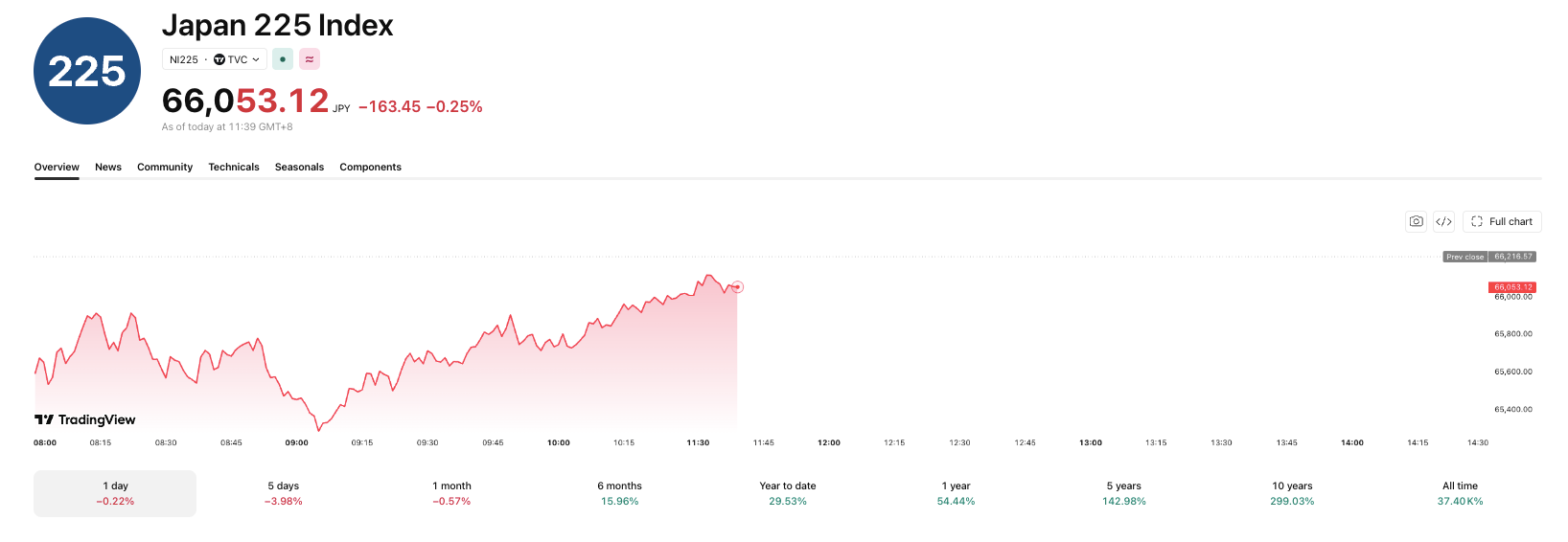
Most Asian share indices are headed for weekly losses as bond market stress persists. However, Bitcoin (BTC) and gold both rallied as investors reached for safe havens instead.
The moves reflect a broader flight from risk. Rising Treasury yields have hit stocks in Asia and the US this week. Traders are turning to assets seen as stores of value.
Asian Markets Buckle on Bond Stress
Japan’s Nikkei dropped 0.8% to open Friday’s trading. That extended its weekly loss to 4.4% before clawing a little back.

South Korea and Taiwan edged higher Friday. Both still finished the week lower, after a sharp Kospi sidecar halt earlier in the week. The broader MSCI Asia-Pacific index outside Japan managed only a 0.5% gain.
The sell-off traces back to US Treasury yields. They resumed climbing this week after a brief pause. The 30-year yield rose to 5.25%, and the 10-year hit 4.71%.
Secretary Scott Bessent said the government could expand bond repurchases. He also floated fiscal consolidation. Analysts doubt Washington can find enough spending cuts to narrow the deficit.
The deficit is running above 6% of GDP. Interest payments alone are set to top $1.2 trillion this year.
“Historically, markets have pushed back when they believe fundamentals, like record debt level and historically large deficits, are on their side, and further interventions could become too costly to bear.”
Deutsche Bank strategist Steven Zeng said.
Brent crude added to the regional pressure. It touched a one-month high of $94.71 a barrel. Prices eased to $93.12 after toughened US sanctions threats against Iran.
Bitcoin and Gold Rally as Safe Havens
While Asian equities struggled, Bitcoin and gold moved the other way. Bitcoin traded near $74,300 Friday, after touching an intraday high of $75,500.

Gold held near $4,513 an ounce, up 3.1% for the week. Treasury’s expanded buyback plans fed a debasement narrative. That has already pushed JPMorgan’s $5,000 gold target into view.
That backdrop has revived the case for Bitcoin as a weaker-dollar hedge. VanEck strategists are among those pointing to the recent strength as evidence.
Wall Street felt the same bond stress. US stocks fell hard on Thursday once the buyback relief faded. The Dow dropped 703 points, and Walmart fell 9% on soft US sales.
The S&P 500 was down 1.9% for the week through Thursday. The Nasdaq fell 2.5%. Futures pointed modestly higher Friday.
Nvidia’s results next week stand as the next test for the AI trade. The same risk appetite has also lifted Bitcoin’s price rally this month.
The dollar index is down almost 0.9% for the week, near a three-month low. The question for Asian investors is whether Bitcoin and gold keep working as a hedge. Or whether a Nvidia-driven swing on Wall Street drags every asset down together.
The post Asian Stocks Slide on Bond Stress: Will Safe Havens BTC and Gold Keep Rallying? appeared first on BeInCrypto.
Crypto World
Solana, Robinhood, BNB Clash for Meme Coin Season: Who is Winning the $3 Billion Rally?
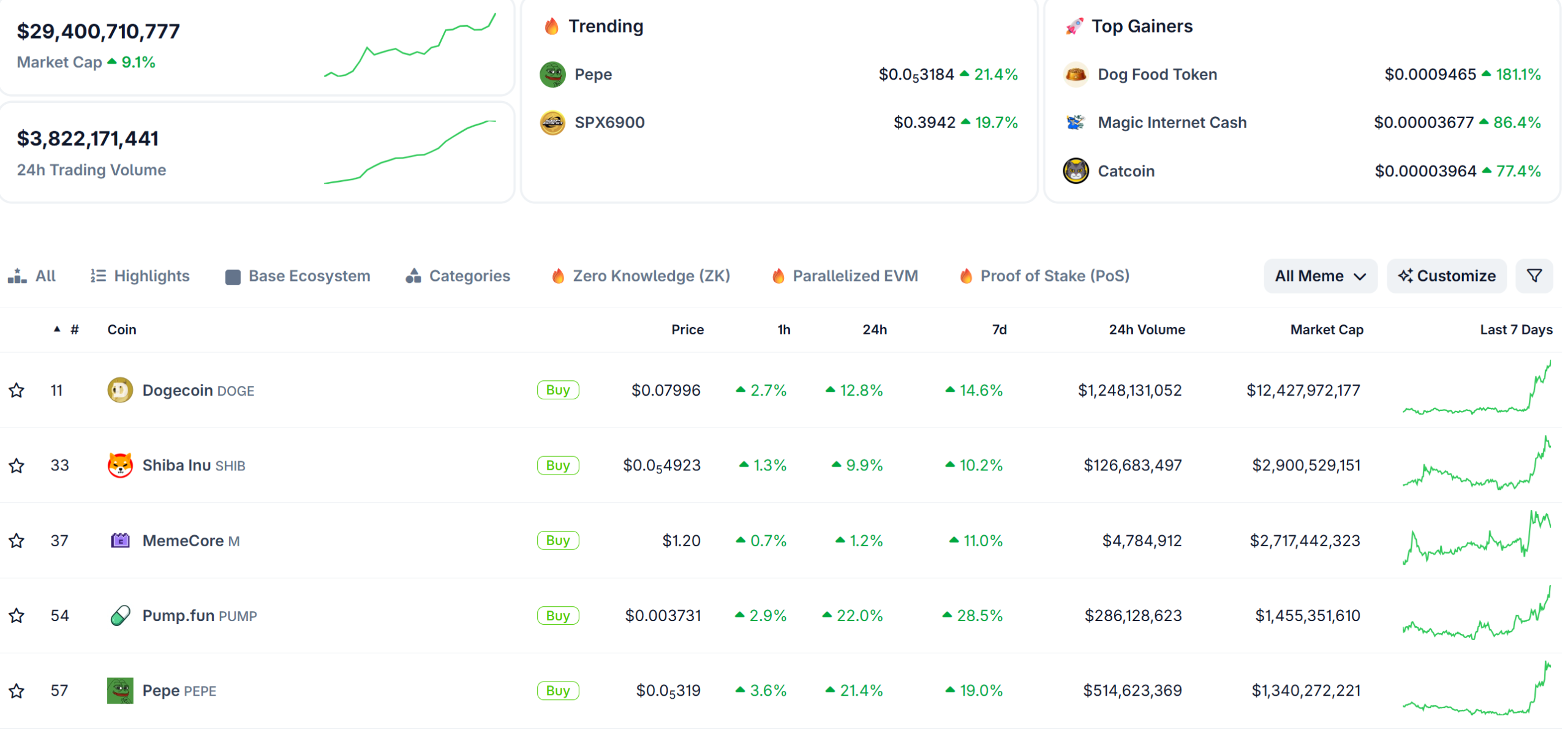
Meme coin market added close to $3 billion on Thursday. The sector is now worth $29.3 billion, up almost 10% today. Three blockchains are fighting over that money.
Solana, BNB Chain and Robinhood Chain each claim a share of it. Thursday’s trading data says only one of them is really winning.
Most of the $3 Billion Never Touched These Three Chains
The headline number flatters all three. Meme tokens traded $3.6 billion on Thursday, and three coins accounted for 59% of it.
Dogecoin (DOGE) led with $1.24 billion, and it runs on its own network. DOGE price rose 12.3%. Pepe (PEPE) followed with $514 million, and it sits on Ethereum. Official Trump (TRUMP) took $421 million.

So the contested pool is far smaller than the headline suggests. Market cap shows what a token is worth, not where traders went.
Two numbers show that. Volume records where money moved. Fees record what the chain kept.
Solana Wins Thursday’s Volume Test
Solana processed $3.01 billion in decentralized exchange trades over 24 hours, DefiLlama data show. BNB Chain handled $1.25 billion.
Robinhood Chain managed $510.8 million. It is the newest of the three, launched in July as a network for tokenized stocks.

Solana therefore out-traded both rivals combined. It took 63% of the three chains’ total flow.
Its launchpad token drew much of that. Pump.fun (PUMP) traded $286 million, fourth among all meme tokens.
One caveat applies to every figure here. These totals cover all tokens on each chain, not meme coins alone.
Fees Show Whose Volume Is Worth Something
Volume is the easier number to grow. Blockspace is cheap, and a dollar can change hands many times in a day.
Fees are harder. Solana earned $925,809 in chain fees on Thursday. BNB Chain took $689,745. Robinhood Chain collected $59,275.

The distance is stark. Solana moved 5.9 times Robinhood’s volume but earned 15.6 times its fees.
Now measure fees per dollar traded. BNB Chain converted 0.055% of its volume. Solana managed 0.031%. Robinhood Chain kept 0.012%.
That reorders the podium. Solana wins on scale, but BNB Chain extracts nearly twice as much value from each dollar.
The effect shows in the totals. Solana takes 63% of the three chains’ volume but only 55% of their fees.
Chains with no meme scene still earned more. Ethereum collected $1.22 million and Tron took $876,853.
Robinhood Chain ranked tenth among all chains, behind Polygon.
Who is Winning Meme Coin Season
Solana, on both measures. It leads on volume traded and on total fees earned, and no rival is close on either.
BNB Chain is the credible number two and the sharpest earner per dollar. Its flagship token lagged, with the Chinese-language meme BinanceLife up 4.7% against a sector up 10.1%.
Robinhood Chain runs third on everything. It can still produce a mover, and its flagship Cash Cat (CASHCAT) gained 30.3% on $32.27 million of volume.

One rival sits outside the three-way frame. Base matched BNB Chain on volume at $1.255 billion.
Its economics resemble Robinhood’s, however. Base earned $189,724, converting 0.015% of volume into fees.
The clash may already have four sides. Whether Solana keeps the crown rests on a number few traders watch.
Not how much volume it attracts, but how much of that volume it converts.
The post Solana, Robinhood, BNB Clash for Meme Coin Season: Who is Winning the $3 Billion Rally? appeared first on BeInCrypto.

The Light in Durham will open its doors this weekend

Greenock: The town whose council wants migrants to move in

MANTRA price falls 10% as network halts transactions





-

 Fashion6 days ago
Weekend Open Thread: Ann Taylor
-
 Tech7 days ago
11 Ways to Rank Your Videos
-

 Sports6 days ago
Birmingham 2026: Day 6 Timetable for Irish Athletes
-
 NewsBeat6 days ago
Myanmar says over 300,000 Rohingya refugees verified for repatriation as exodus enters ninth year
-

 Politics6 days ago
SEQ Code: The Three Letter Boarding Pass Code That Could Give You The Worst Seat
-

 Tech3 days ago
Qwen3.8-27B runs frontier-class coding agents and reasoning locally, no cloud API required
-

 Business3 days ago
SMA Solar Technology AG (SMTGY) Q2 2026 Earnings Call Transcript
-

 Crypto World6 days ago
Pi Network Protocol 27 endgame: last upgrade before what?
-

 Crypto World3 days ago
OCC Greenlights Trump Family Crypto Firm for Trust Charter
-
 Tech6 days ago
Every fusion startup that has raised over $100M
-

 Business7 days ago
15 Ways to Make Money From Your Phone (2026 Guide)
-
 Entertainment6 days ago
Marvel Studios Reveals New X-Men Cast Including Adam Driver and Sadie Sink
-

 Crypto World7 days ago
Robinhood Chain Approaches $1B TVL as Uniswap Integration Boosts Liquidity
-
 Entertainment7 days ago
10 Netflix Shows That Quietly Became Modern Classics
-

 Fashion6 days ago
Weekly News Update, 8.14.26 – Corporette.com
-

 News Videos1 day ago
Don’t Leave Your Financial Future To Chance | August 19, 2026
-
 Fashion7 days ago
Silver bangles for women – Newbridge Silverware
-
 Business6 days ago
Monarch Mutual Fund set to enter MF space with maiden overnight fund; files draft with Sebi
-

 Business6 days ago
Facebook Down Now? Users Report Login And Loading Problems As Outage Trackers Monitor Ongoing Issues
-

 Fashion7 days ago
Cart Confidential Vol. 44 – Julia Berolzheimer
You must be logged in to post a comment Login