
Crypto World
SEC Tokenized Stocks Rules: Key Winners and Losers Defined

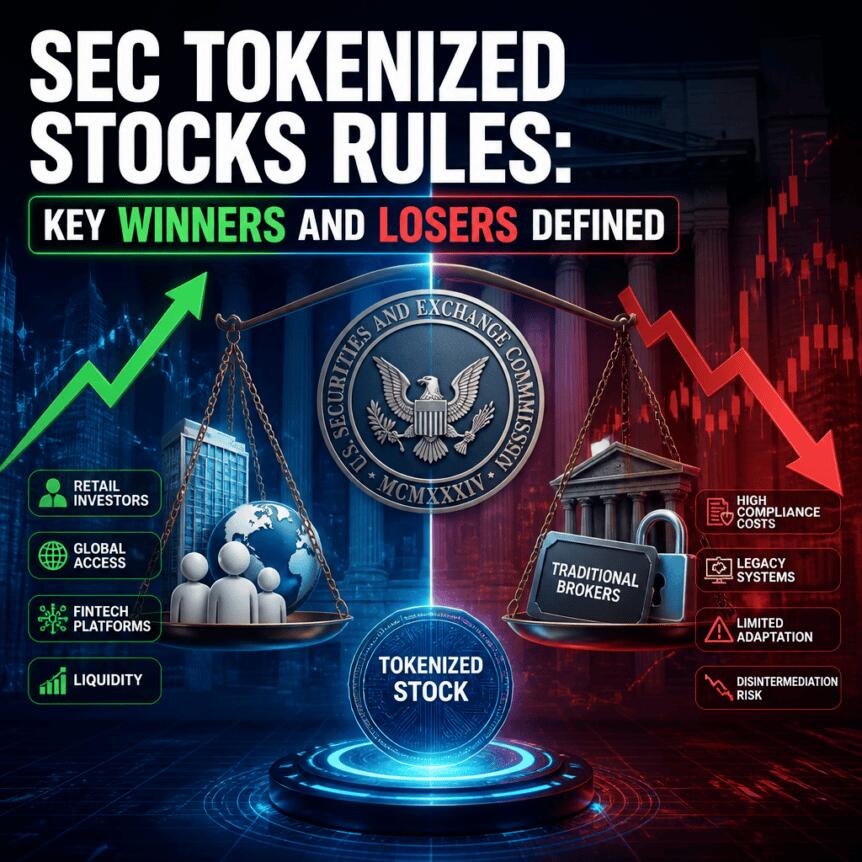
The U.S. Securities and Exchange Commission’s new “Innovation Exemption” is carving out a narrow regulatory lane for onchain trading of certain tokenized stocks—and early market reaction suggested traders believe the path is at least partially workable. After the announcement last week, Bitcoin and Ether both rallied by more than 10% while tokens tied to onchain trading infrastructure also jumped, including Uniswap’s UNI rising by over 30% in the days that followed, according to price data tracked by CoinGecko.
Still, the SEC’s relief is not a blanket approval for every form of tokenized equity. The exemption focuses on a particular structure that preserves core shareholder rights and channels trading through permissioned liquidity mechanisms. For many existing products, that means they may need redesign before they can fit through the SEC’s rules.
Key takeaways
- The SEC’s Innovation Exemption provides temporary relief for trading tokenized National Market System (NMS) stocks without registering as a securities exchange, but only under specific conditions.
- Compliance hinges on token design: qualifying tokenized shares must deliver holders the same rights and privileges as the underlying securities.
- Synthetic exposure models are singled out as non-compliant with this exemption, limiting how broadly the market can reuse existing tokenized equity products.
- Permissioned AMM liquidity pools appear central to the SEC’s framework, aligning naturally with trading infrastructure that can enforce compliance onchain.
- Even where infrastructure exists, issuers and venues still face real work to adapt products to the exemption’s exact requirements and the SEC’s broader regulatory posture.
A temporary exemption with a narrow route
The SEC’s September 17 order, published as a press release, grants certain venues temporary relief from having to register as exchanges when they trade tokenized NMS stocks on permissioned AMM liquidity pools. The exemption also contemplates third parties tokenizing stocks, but only if they meet the conditions laid out by the regulator.
A central requirement is that tokenized stockholders must receive the same “rights and privileges” as they would for the underlying shares. That includes protections tied to voting and dividends, along with the way corporate actions flow to holders. If a token tracks the price of a share without carrying those legal or economic rights, it falls into a category the SEC describes as “synthetic,” and therefore outside the exemption’s scope.
The SEC also leaves room for the idea that not every tokenization model will be treated the same way. Commissioner Hester Peirce emphasized that the exemption covers one particular model rather than every conceivable approach to trading tokenized securities, while noting the SEC is open to other models outside the specific tokenized stocks structure referenced in the order.
Who appears closest to the SEC’s framework
Several market participants are effectively being benchmarked against the exemption’s model. Cointelegraph’s earlier coverage highlighted ongoing developments across the tokenized securities landscape, but in this case the SEC’s requirements are what determine who is “close” and who would need major changes.
Coinbase’s tokenized stocks have been positioned publicly as non-synthetic and fully backed, with redemption features and dividends integrated. The company’s current offering, however, is described as aimed at non-U.S. customers, and its exchange infrastructure is built around a central limit order book rather than the permissioned AMM approach the SEC’s exemption is built around.
Ondo, by contrast, has taken steps that more directly map to the rights-and-entitlements theme. The project launched tokenized U.S. securities in June with shares held in traditional custody, while the token represents the investor’s entitlement onchain. Ondo also acquired Oasis Pro, which includes an SEC-registered broker-dealer, an ATS, and a transfer agent, giving it an infrastructure footprint across traditional and onchain market components.
Ondo’s head of global regulatory affairs, Peter Curley, argued in an interview with Magazine that the SEC’s action matters because it moved forward despite uncertainty about Congress finishing the job. Curley’s broader point was that not every tokenization effort will fit the exemption “and that’s fine,” as long as compliant pathways exist for products that do meet the SEC’s standards.
Permissioned AMMs and why Uniswap drew attention
The specific mention of permissioned AMM liquidity pools matters beyond compliance paperwork. It points to a technical design where issuers or regulated operators can enforce trading permissions through onchain mechanisms rather than relying solely on offchain gating.
Uniswap’s own development work may therefore be relevant even if the protocol itself is not a tokenized-stock venue in the same way a compliant intermediary would be. Uniswap introduced Permissioned Pools for v4 in July, aimed at enabling regulated assets to trade through AMMs where compliance can be enforced directly onchain. The key concept is that permissioned access—paired with KYC verification, record keeping, public notice requirements, and transaction transparency—can align the trading layer with regulatory constraints.
That creates a possible framework for how regulated token issuers could connect shareholder-rights systems to liquidity venues that restrict access appropriately. What remains uncertain, however, is whether existing implementations can be integrated end-to-end with the entitlement, corporate action handling, and issuer controls required by the SEC without additional adaptation.
Why some well-known products may be excluded
Not all tokenized equity products currently in circulation are positioned to qualify. Robinhood, for example, has deployed stock tokens on Robinhood Chain described as one-to-one backed and “fully DeFi composable.” But Robinhood’s token design has been a point of contention: analysts argue the SEC’s exemption excludes synthetic exposure and therefore rules out products like Robinhood’s Stock Tokens and Kraken’s xStocks in their present forms.
In Robinhood’s case, the stock tokens are described as tokenized debt securities issued by Robinhood Assets (Jersey) Limited. That structure means investors receive economic exposure to underlying stocks, but without the same legal or beneficial rights associated with conventional share ownership. Separately, they are not registered under U.S. securities laws and are not available to U.S. persons.
Kraken’s xStocks are also described as fully backed by underlying equities, but the article notes that they likewise may not give holders the same rights as conventional shares—illustrating a broader problem: backing alone is not enough if the exemption requires holders to receive the full set of rights and privileges embedded in ordinary share ownership.
RWA market intelligence platform RWA.xyz suggested in an interview that most tokenized equity products have been third-party sponsored but expects a shift toward issuer-sponsored models within the next 12 months. The logic is straightforward: the exemption framework appears to align token issuers with stock issuers, potentially reducing mismatches between who controls the token and who controls shareholder rights.
Five years to prove the model is worth adopting
The SEC describes the Innovation Exemption as temporary, with the relief lasting five years while the commission evaluates future rulemaking. The SEC’s chair, Paul Atkins, has framed the period as allowing the market to “develop,” but investors are still likely to ask a practical question: will tokenized stocks deliver clear advantages over conventional brokerage positions?
According to Ondo’s Curley, investors ultimately need outcomes that are faster, cheaper, or more useful than existing rails. There are also concerns that liquidity fragmentation for tokenized stock products could translate into less competitive pricing or weaker user experience—particularly if trading venues or token designs limit where liquidity can pool.
If the exemption’s requirements are met, tokenized stocks could theoretically support 24/7 trading, fractional ownership, faster settlement, and onchain composability while preserving shareholder rights and corporate action mechanics. But those benefits only matter if they translate into measurable improvements that users want—and if the industry can redesign products to fit the SEC’s model in the first place.
For now, readers should watch how issuers and trading venues operationalize the exemption’s constraints—especially the exact token rights requirements and the adoption of permissioned AMM liquidity models—and whether any major tokenized equity product teams announce changes aimed at becoming compliant within this five-year window.
This article was originally published as SEC Tokenized Stocks Rules: Key Winners and Losers Defined on Crypto Breaking News – your trusted source for crypto news, Bitcoin news, and blockchain updates.


All 11 Democrats on the Senate Banking Committee have asked Chair Tim Scott to hold a public hearing on prediction markets after Republican members met privately with Kalshi’s chief executive.
Summary
- The senators want all committee members to examine the markets’ effects on consumers and the financial system.
- They say some contracts tied to corporate results could fall under SEC oversight.
- Kalshi and Polymarket recorded about $53 billion in combined global trading volume in July, according to Pew Research Center.
- State disputes over sports contracts and a recent CFTC warning have added to the regulatory debate.
In a Sep. 23 letter, the Democratic members of the Senate Banking, Housing, and Urban Affairs Committee asked Scott to convene a hearing open to the full panel. Ranking member Elizabeth Warren and Sen. Catherine Cortez Masto led the request after reports that Republicans planned a private discussion with prediction market executives, including Kalshi representatives.
The senators said a public session would let lawmakers question industry participants about consumer exposure, market integrity and the financial products being offered. Their request focused in part on contracts linked to company performance, which they said could qualify as security-based swaps and come under Securities and Exchange Commission rules.
According to The Block, Republican committee members met Kalshi CEO Tarek Mansour on Sep. 23. Scott told the outlet that the discussion covered securities-linked products, how investors use them, retail protections, and regulatory questions for Congress.
Why Democrats want a public prediction markets hearing
The letter argues that both individual and institutional investors are gaining exposure to security-based prediction markets. As firms seek SEC approval for products tied to corporate earnings, the senators said the Banking Committee should examine how such contracts are offered and supervised.
“The full Senate Banking Committee has a critical oversight role to play,” the lawmakers wrote, referring to requests for approval of options linked to company earnings. Their letter asks Scott to allow every committee member to take part in a public hearing, rather than limit the discussion to a meeting with Republican members and industry executives.
The SEC question matters because prediction markets do not all involve the same underlying event. A contract on a sports result raises different regulatory issues from one tied to a public company’s earnings. The Democrats said the latter type could meet the legal definition of a security-based swap; the letter presents that as a possibility for examination, not a finding that every such contract falls under SEC authority.
Kalshi has separately pursued products linked to U.S. shares. As reported in September, it filed rules for stock and ETF perpetual futures with the SEC and CFTC, proposing 23-hour weekday trading and a minimum customer margin of 15.50%. Those proposed security futures differ from the event contracts discussed in the senators’ letter, but the filings show why both agencies feature in questions about Kalshi’s products. The CFTC had not approved the stock perpetual submissions when that report was published.
Trading volume has risen as lawmakers examine investor losses
For the scale of the industry, the senators pointed to the rapid growth of Kalshi and Polymarket. Pew Research Center found that their combined monthly global trading volume rose from less than $5 billion in September 2025 to about $24 billion in April 2026. Pew’s newer analysis put the total at $53 billion in July, up from $26 billion in May, with sports accounting for much of the increase.
Pew’s measure counts contracts at their $1 value if the outcome is correct, rather than the price a trader paid. It is a measure of trading activity, not an estimate of the cash traders put into their accounts. Its September report also found that combined volume remained around $47 billion in August after easing from July’s level.
The Democrats raised the risk of manipulation and trading by people with advance knowledge of an outcome. They also cited research suggesting that profits are concentrated among a small share of users while many others lose money. Those concerns formed part of their case for questioning platforms in public.
Pew’s study of 11,989 active Polymarket wallets provides a more specific view of trading results. Over a six-week period from May to June, 56% of the sampled accounts lost money, while 7% made more than $1,000 and 9% lost more than $1,000. Pew said the typical account was close to breaking even. Its sample did not cover Kalshi or Polymarket’s newer U.S. platform, so the findings do not describe the results of all prediction market users.
CFTC warnings and state cases add to the oversight debate
Market integrity is also receiving attention from the Commodity Futures Trading Commission. In coverage of its warning, crypto.news reported that CFTC staff had flagged contracts based on what a named person says, attends, or does as especially vulnerable to manipulation. The agency called for exchanges to explain how they would identify people who could influence an outcome and detect misuse of nonpublic information.
The CFTC has already brought cases involving traders whose access or conduct affected event-contract outcomes. In one case described in the agency’s orders, a former White House teleprompter operator used advance access to presidential speeches to trade contracts tied to President Donald Trump’s remarks. In another, former Rep. George Santos traded a contract concerning his attendance at the 2026 State of the Union while making public statements about his plans.
Sports contracts pose a separate question for U.S. customers: whether federal oversight of a registered derivatives exchange prevents states from applying their gambling laws. New Jersey asked the Supreme Court in September to review a ruling favoring Kalshi. As the state’s petition was previously covered, New Jersey argues that federal derivatives law does not strip states of authority over sports wagering within their borders. Kalshi maintains that its CFTC registration places the contracts under federal oversight.
At the same time, Kalshi has sought to expand access for professional traders through a proposed margin framework for selected event contracts. Its Sep. 22 filing would allow eligible participants to post margin rather than fund the full possible loss of a position at the outset. Sports contracts are excluded from the proposal, and access would be limited to participants trading through a registered futures commission merchant or approved to clear their own trades.

Coinbase has begun designing a post-quantum custody system intended to protect about $250 billion in institutional assets while supporting any new signature scheme adopted by Bitcoin or another blockchain.
Summary
- Coinbase is preparing custody infrastructure for several possible post-quantum signature schemes.
- Hash-based signatures may not work with the MPC systems used by many crypto custodians.
- Programmable hardware security modules could provide Coinbase with an alternative key-protection method.
- Bitcoin developers have not selected or activated a post-quantum signature standard.
Coinbase prepares custody for several signature schemes
MARA Foundation TV hosted Coinbase Chief Cryptographer Yehuda Lindell, who said the exchange wants its custody platform to remain usable regardless of which post-quantum signature schemes blockchains eventually select.
Bitcoin has not chosen a signature scheme for practical post-quantum use, leaving custodians without a single technical standard around which to rebuild their systems. Lindell said different blockchain communities may also reach different decisions instead of adopting one common scheme.
Coinbase is therefore preparing for several possible outcomes rather than building its system around one candidate. Lindell said the company wants to avoid a situation in which a blockchain approves a signature scheme that its custody infrastructure cannot handle.
The work carries added weight because Coinbase holds about $250 billion in assets for institutional customers, according to the figure Lindell gave during the program. Its clients include BlackRock, which uses Coinbase Custody for digital assets connected to its investment products.
An August U.S. custody review placed Coinbase’s institutional assets at approximately $376 billion and said the company safeguards more than 80% of assets held by U.S. spot Bitcoin and Ethereum exchange-traded funds. Differences between the two totals may depend on their reporting dates and the services or assets included in each estimate.
Custody systems protect the private keys needed to authorize transactions. Any future change to Bitcoin’s signature method would therefore require large custodians to update the technology used to create, store and operate those keys.
Post-quantum signatures challenge existing MPC custody
Many institutional custody platforms use Multi-Party Computation, or MPC, to divide control of a private key among several parties. Under such an arrangement, no participant needs to hold or assemble the full private key while approving a transaction.
Lindell said many post-quantum signature schemes may be “not friendly to MPC” because their mathematical design differs from the signatures now used by major blockchains. Hash-based signatures present a particular problem because they lack the arithmetic structure on which traditional cryptographic key splitting depends.
Researchers, including Stanford University cryptographer Dan Boneh, are studying possible ways to apply MPC-style controls to such signatures, Lindell said. The research remains highly experimental, however, and it is not yet clear whether a practical MPC-equivalent system can be created for hash-based signatures.
Coinbase’s existing interest in the field predates the latest custody design. In January, the company established an independent quantum computing and blockchain advisory board that includes Boneh, Lindell, Ethereum Foundation researcher Justin Drake, University of Texas professor Scott Aaronson, EigenLayer founder Sreeram Kannan and distributed-systems specialist Dahlia Malkhi.
According to Coinbase, its post-quantum roadmap includes changes to Bitcoin address handling, updates to internal key-management systems and research into supporting schemes such as ML-DSA within MPC infrastructure. The company tasked the advisory board with assessing quantum developments, publishing recommendations and responding to major technical advances.
Other custodians have started testing one possible route. In June, BitGo tested quantum-safe MPC with Silence Laboratories using an ML-DSA-based protocol integrated into BitGo’s custody platform. The simulation retained distributed key control, policy checks, and separation of duties, according to the companies.
ML-DSA is included in FIPS 204, a post-quantum digital signature standard published by the U.S. National Institute of Standards and Technology. Lindell’s comments indicate that Coinbase wants an architecture capable of handling schemes beyond ML-DSA if Bitcoin or another network chooses a different design.
Hardware modules could provide a custody fallback
To reduce its dependence on MPC compatibility, Coinbase is exploring a backup design built around programmable Hardware Security Modules, according to Lindell.
HSMs are physically protected devices used to store cryptographic material and perform sensitive operations. Under the architecture being considered by Coinbase, private keys would remain encrypted using post-quantum cryptography and would be assembled only inside secure HSMs.
Containing the complete key within the protected device would allow the custodian to work with signature schemes that cannot be divided through conventional MPC. Programmable modules could also give Coinbase room to add support as blockchain developers settle on new standards.
Lindell did not provide a completion date, saying the technical work could take time. Once the system is finished, however, he expects Coinbase to operate without having to predict which post-quantum scheme each network will choose.
“I will be able to say, I can support any scheme,” Lindell said.
Physical security becomes more important under the proposed model because the full key would temporarily exist inside an HSM. Coinbase would therefore need the modules to perform signing without exposing the key to outside software or operators.
The approach would not require Coinbase to abandon MPC for signature schemes that support it. Instead, the HSM architecture would serve as another custody method when a network’s chosen cryptography cannot work with distributed key generation and signing.
Bitcoin has not approved a quantum migration plan
Bitcoin currently uses elliptic-curve cryptography, and no publicly demonstrated quantum computer can derive its private keys from exposed public keys. Researchers and industry groups have still called for early preparation because changing Bitcoin’s security model would require software development, testing, wallet upgrades, and network consensus.
Crypto.news reported in June that Coinbase’s advisory board urged Bitcoin developers to begin creating migration tools before a cryptographically relevant quantum computer exists. The board estimated that about 1.7 million BTC sit in older pay-to-public-key addresses with exposed public keys, while address reuse could place as many as 5 million BTC within a future risk category.
The advisory board did not recommend freezing, burning, or leaving vulnerable coins available to a future attacker. It said Bitcoin’s community should decide through its consensus process how to treat coins that remain in older address formats after a migration deadline.
Draft proposals are examining separate parts of the problem. BIP 360, known as Pay-to-Merkle-Root, would remove Taproot’s quantum-vulnerable key-path spending option, while BIP 361 describes a phased retirement of legacy ECDSA and Schnorr signatures after Bitcoin gains a post-quantum output method.
Neither proposal has been activated. A recent migration assessment also found that SHRINCS, an experimental hash-based signature design under discussion, remains an unnumbered draft requiring further review and a completed security proof.
For U.S. investors, Coinbase’s preparations concern assets held through regulated investment products as well as coins stored by direct institutional clients. Spot Bitcoin and Ethereum ETF investors do not control the private keys behind fund holdings; those keys are managed by custodians selected by the issuers.
Coinbase’s ability to support multiple signature schemes could become relevant if Bitcoin, Ethereum, or another network used by a U.S.-listed fund adopts new cryptography. Any blockchain migration would still depend on network rules and action by users, wallet providers, exchanges, custodians and fund operators rather than a decision by Coinbase alone.

The London Company, an investment management company, released its second-quarter 2026 investor letter for its “Small Cap Strategy.” U.S. equities rebounded in the quarter, driven by AI infrastructure spending and positive earnings. The letter can be downloaded here. Despite this optimism, rate outlook uncertainty persisted. Technology, previously weak, surged to lead the market, especially in semiconductors, while energy declined as oil prices fell. Small caps outperformed large caps, with momentum and volatility factors leading, although quality and yield were headwinds for portfolios. The London Company Small Cap portfolio increased 12.9% during the quarter, underperforming the Russell 2000 Index’s 21.5% gain, primarily due to stock selection issues. The firm remains confident in the durable, high-quality businesses for attractive long-term compounding. Please review the Fund’s top five holdings to learn more about its key selections for 2026.
In its second-quarter 2026 investor letter, London Company Small Cap Strategy highlighted Murphy USA Inc. (NYSE:MUSA). Murphy USA Inc. (NYSE:MUSA) engages in marketing of retail motor fuel products and convenience merchandise. On September 21, 2026, Murphy USA Inc. (NYSE:MUSA) closed at $508.98 per share. Over the past month, Murphy USA Inc. (NYSE:MUSA) declined 6.49%, but its shares are up 29.72% over the past year. Murphy USA Inc. (NYSE:MUSA) has a market capitalization of $9.35 billion, and its stock has traded within a 52-week range of $349.83 to $636.05.
London Company Small Cap Strategy stated the following regarding Murphy USA Inc. (NYSE:MUSA) in its Q2 2026 investor letter:
“Reduced: Murphy USA Inc. (NYSE:MUSA) – We trimmed MUSA after the stock rallied on fuel margin strength, which is inherently cyclical and difficult to sustain at current levels. The core thesis and our long-term conviction remain intact, and we redeployed proceeds into additional opportunities within the portfolio.”

Murphy USA Inc. (NYSE:MUSA) is not on our list of the 40 Most Popular Stocks Among Hedge Funds. According to our database, 40 hedge fund portfolios held Murphy USA Inc. (NYSE:MUSA) at the end of the second quarter, down from 41 in the previous quarter. While we acknowledge the potential of Murphy USA Inc. (NYSE:MUSA) as an investment, we believe certain AI stocks offer greater upside potential and carry less downside risk. If you’re looking for an extremely undervalued AI stock that also stands to benefit significantly from Trump-era tariffs and the onshoring trend, see our free report on the best short-term AI stock.

Need to withdraw a large amount of cash? Be sure you know your bank’s ATM withdrawal limits first. ATM withdrawal limits place a cap on how much money you can take out over a certain period, even when you have plenty of cash in your account.
Knowing how these limits work — and what to do if you need more cash — can help you avoid an inconvenient surprise at the ATM.
What are ATM withdrawal limits?
ATM withdrawal limits are caps on how much cash you can withdraw from an ATM during a certain period. This may be a limit on the total amount per transaction or a limit on the total amount you can withdraw per day.
Withdrawal limits are primarily used as a safeguard against fraud; by limiting how much can be withdrawn, there’s less chance that the money in your account could be wiped out if your banking information falls into the wrong hands.
These limits also ensure that ATMs don’t run out of cash before they can be replenished.
ATM withdrawal limits vary quite a bit, from several hundred to several thousand dollars, depending on the bank and account. For example, a basic free checking account may have a lower limit than a more premium checking account for customers with larger balances.
If you need more cash than your limit permits, your bank may allow you to temporarily increase your limit. In other cases, you may need to request a larger amount in person from a teller at a branch.
How do I find out my bank’s ATM withdrawal limits?
The easiest way to find your bank’s ATM withdrawal limit is to log into your online banking account or mobile app, and look for the ATM limit under your debit card settings, account details, or a section labeled “transaction limits” or “card limits.”
If you can’t find it there, you can also:
-
Review your account or debit card agreement. Banks often disclose ATM withdrawal limits in the documents provided when you open an account or receive your debit card.
-
Call your bank. Use the customer service number on the back of your debit card and ask for your ATM withdrawal limit.
-
Visit a branch. A teller or customer service representative can typically look up your limit.
Keep in mind that your bank’s limit and an individual ATM’s limit aren’t necessarily the same. For example, your bank might allow $1,000 in ATM withdrawals per day, but a particular ATM could cap each transaction at $500. In that case, you may need multiple transactions — or a different ATM — to reach your bank’s daily maximum.
What to do if you’ve reached your ATM withdrawal limit
If you know you need to withdraw a large amount of cash that exceeds your daily limit, your best bet is to visit a local branch and make a withdrawal at the counter from a bank teller. These withdrawals don’t count toward your ATM withdrawal limit.
However, if you aren’t near a branch and need cash quickly, you can often contact customer support via telephone or use your mobile banking app to request an ATM withdrawal limit increase. Your bank will review your request and take into consideration factors such as your account type, available balance, and banking history. While it isn’t guaranteed that your request will be approved, this can be the fastest way to gain access to more cash.
Finally, if you need a smaller amount of cash but have already reached your ATM limit, you can visit a nearby retailer and request cash back after making a purchase. This does mean spending some money you may not have planned on, but it is an option if you’re in a pinch and absolutely need the cash.
Note that ATM withdrawal limits typically reset daily. So, if you can afford to wait until the next day to make a withdrawal, you may want to hold off and let your limit reset to avoid the added headache of getting around it.
Examples of ATM withdrawal limits
Remember, ATM withdrawal limits vary by account, card type, ATM, and sometimes the individual customer. So, there usually isn’t one universal limit for an entire bank.
Even so, you may want to get a ballpark figure of how much you may be allowed to withdraw in one day. Here’s a look at typical ATM withdrawal limits among a few popular banks:
The bottom line
ATM withdrawal limits may not be top of mind when choosing a bank account, but they’re a feature that can become important when you need access to cash.
When comparing account options, consider how often you withdraw cash in large amounts. If you’re a frequent ATM user, you may want to choose an account that offers a higher limit to avoid any potential hiccups.
Be sure to read your deposit agreement carefully to understand what your ATM withdrawal limit is, how often that limit resets, and if it’s possible to request an increase when needed.

A group of US state lawmakers has filed an amicus brief with the US Supreme Court, urging justices to weigh in on a case between prediction markets platform Kalshi and gaming authorities.
On Tuesday, the National Council of Legislators from Gaming States (NCLGS) filed in the US Supreme Court, supporting New Jersey’s Attorney General and gaming authorities’ petition for a writ of certiorari. The petition, filed on Sept. 2, asked the nation’s highest court to consider New Jersey’s case against Kalshi, potentially resolving whether state authorities or federal agencies have jurisdiction over prediction market companies.
In its amicus curiae filing supporting New Jersey’s position, the NCLGS argued that a ruling favoring Kalshi would “[render] states powerless” to regulate sports betting on prediction markets, causing “substantial harm and confusion.” According to the group, “gaming-related matters” should be left to individual US state authorities, though the filing did not address the competing argument that event contracts traded on federally regulated markets fall under the CFTC’s exclusive jurisdiction.
“If Kalshi’s self-described ‘sports betting’ activities are deemed beyond state regulation, then casinos, pari-mutuel operators, and other heavily regulated entities are certain to amend their business and products to seek the same status,” said state lawmakers. “Entire state regulatory regimes surrounding this vice activity will have to be reconsidered in light of any preemption found in this area.”
The Supreme Court petition, filed by New Jersey authorities as part of an appeal following a decision from the US Court of Appeals for the Third Circuit, has not received an official response from Kalshi. The company has until Nov. 9 to file a brief stating its position in the case, but a spokesperson told Cointelegraph after the initial filing that it could not be “regulated by 50 different regulators.“
Related: Kalshi joins Coinbase with own filing for US stock perpetual futures


The crypto executive and Dystopia Labs founder previously held senior roles at Stellar and Solana before joining venture capital firm Hack VC.
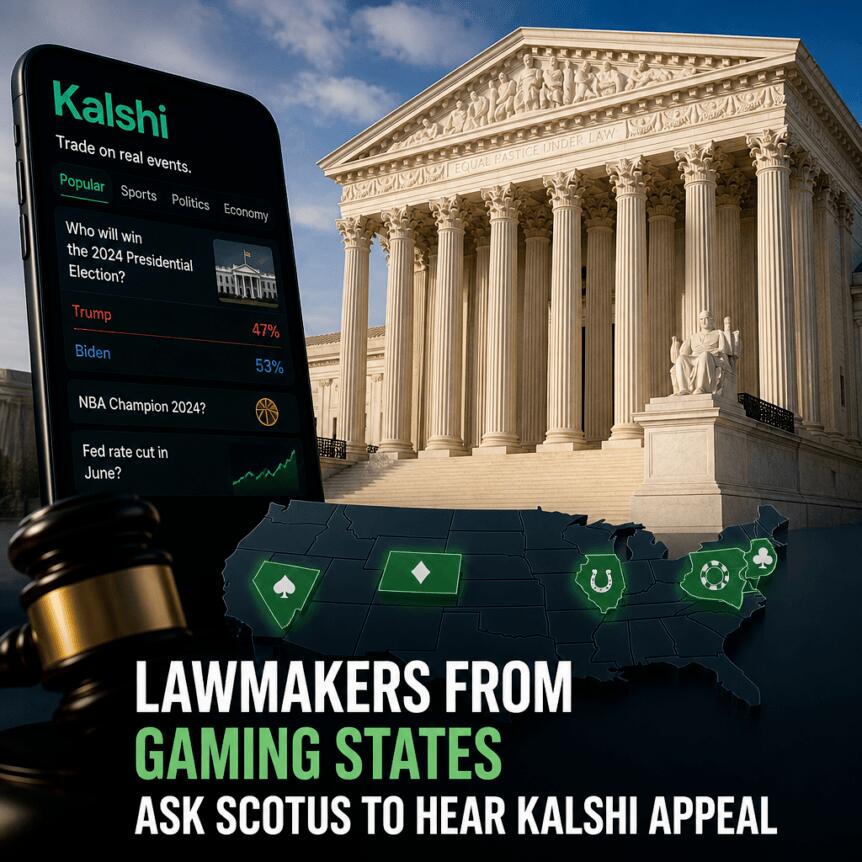
US state lawmakers have stepped into the Kalshi prediction-markets dispute, filing an amicus brief urging the Supreme Court to address whether state gaming regulators can rein in platforms that offer event-based “contracts” linked to sports and other outcomes.
The filing—submitted by the National Council of Legislators from Gaming States (NCLGS) on Tuesday—backs the position of New Jersey’s Attorney General and gaming authorities as they pursue a petition for a writ of certiorari. The Supreme Court docket in question stems from a Sept. 2 request, which asks justices to consider New Jersey’s legal challenge to Kalshi and to clarify the balance between state authority and federal oversight.
Key takeaways
- NCLGS filed an amicus brief supporting New Jersey and state gaming regulators in their dispute with Kalshi over prediction-market activity.
- The lawmakers argue that a ruling for Kalshi would effectively leave states “powerless” to regulate prediction-market sports betting.
- The brief warns that any preemption ruling could force broader changes to the regulated gaming landscape across US jurisdictions.
- Kalshi has not yet filed its official Supreme Court response; the deadline for its brief is Nov. 9.
Why the Supreme Court case matters for state gaming oversight
At the center of the controversy is jurisdiction: New Jersey and gaming authorities are asking the Supreme Court to weigh in on whether state governments—or federal agencies—have the legal authority to regulate prediction-market platforms operating through event contracts.
According to the amicus brief, if the Supreme Court rules in a way that limits state regulation of Kalshi’s so-called “sports betting” activities, states would lose the ability to set rules for how such products are marketed and offered within their borders. The NCLGS argues that this would create “substantial harm and confusion,” in part because it would undermine existing regulatory frameworks designed for heavily supervised gaming activities.
The lawmakers also frame the issue as one that should remain a matter for state control over “gaming-related matters.” However, the brief acknowledges a competing argument raised in the dispute: that certain event contracts traded on federally regulated markets could fall under the CFTC’s exclusive jurisdiction. In other words, the underlying fight is not only about whether states want to regulate, but about whether the law allows them to do so in light of federal regulatory authority.
Potential ripple effects beyond one platform
A notable part of the NCLGS filing is its emphasis on what a favorable ruling for Kalshi could trigger across the US gaming industry.
In its argument, the group contends that if Kalshi’s products are treated as beyond state regulation, then other highly regulated operators—such as casinos and pari-mutuel businesses—may seek to restructure offerings to obtain similar legal treatment. The amicus brief warns that this would compel states to reconsider entire regulatory regimes tied to “vice activity” if federal preemption is found in this area.
While the Supreme Court has not yet ruled, the way the lawmakers describe downstream consequences highlights a key investor and operator concern: if the legal boundary between state oversight and federal preemption shifts, the compliance costs and product design strategies for companies in regulated gambling ecosystems could change quickly.
How the dispute reached the Supreme Court
New Jersey’s petition for a writ of certiorari is part of an appeal that followed an earlier decision by the US Court of Appeals for the Third Circuit. The Supreme Court petition, filed Sept. 2, asks the Court to consider New Jersey’s case against Kalshi and potentially resolve a broader jurisdictional question affecting prediction markets.
The framing of the case is important because it may determine whether state regulators can enforce traditional gaming laws against prediction-market products, or whether federal regulation—particularly the CFTC’s role—dominates in areas where event contracts intersect with federally supervised markets.
At present, the Supreme Court has not announced a decision, and the outcome could hinge on how the Court interprets the relationship between state gaming authority and federal jurisdiction in this specific category of financial-like instruments tied to real-world events.
What happens next in Kalshi’s Supreme Court response
Kalshi has not yet provided an official response to the certiorari petition in the Supreme Court. The company has until Nov. 9 to file its brief stating its position.
In earlier commentary associated with the initial filing, a Kalshi spokesperson told Cointelegraph that the platform “could not be regulated by 50 different regulators.” That stance reflects a central theme in prediction-market regulation debates: companies argue that fragmented state regimes can create legal uncertainty, while state lawmakers argue that gaming should remain subject to local oversight.
As the case moves forward, attention will likely focus on whether the Court views the relevant contracts as properly falling within federal regulatory authority, and—if not—what standards states may apply to similar products going forward.
For now, market participants, gaming operators, and developers should watch for the Supreme Court’s progress on certiorari and, critically, the arguments Kalshi makes in its upcoming Nov. 9 brief—because the justices’ interpretation of jurisdiction could reshape how prediction markets and related products are offered across US jurisdictions.
Paramount Skydance has discussed bringing Elon Musk in as an equity investor, Semafor reported on Wednesday. Its stock, meanwhile, trades near its lowest levels in years.
CEO David Ellison wants wealthy backers to buy new shares, raising fresh cash after the Warner Bros. Discovery takeover.

Why Paramount Wants Elon Musk’s Money
Paramount agreed to buy Warner Bros. Discovery (WBD), owner of CNN, HBO, and the Warner Bros. studio, for $30 a share in cash. The offer valued WBD at $108 billion including debt, according to a February company release.
The Ellisons and RedBird Capital Partners committed $43.6 billion in equity, with $54 billion more in loans.
Oracle founder Larry Ellison, David’s father, personally guaranteed more than $40 billion of that equity, Semafor reported. New investors would spread that burden.
Musk has deep ties to the elder Ellison. Larry Ellison put $1 billion into Musk’s 2022 Twitter takeover. He also invested in Tesla in 2018 and sat on its board for years.
Musk, who became the world’s first trillionaire in June, is one of several rich individuals under consideration. The stake size is unknown.
Paramount Stock Nears Multi-Year Lows
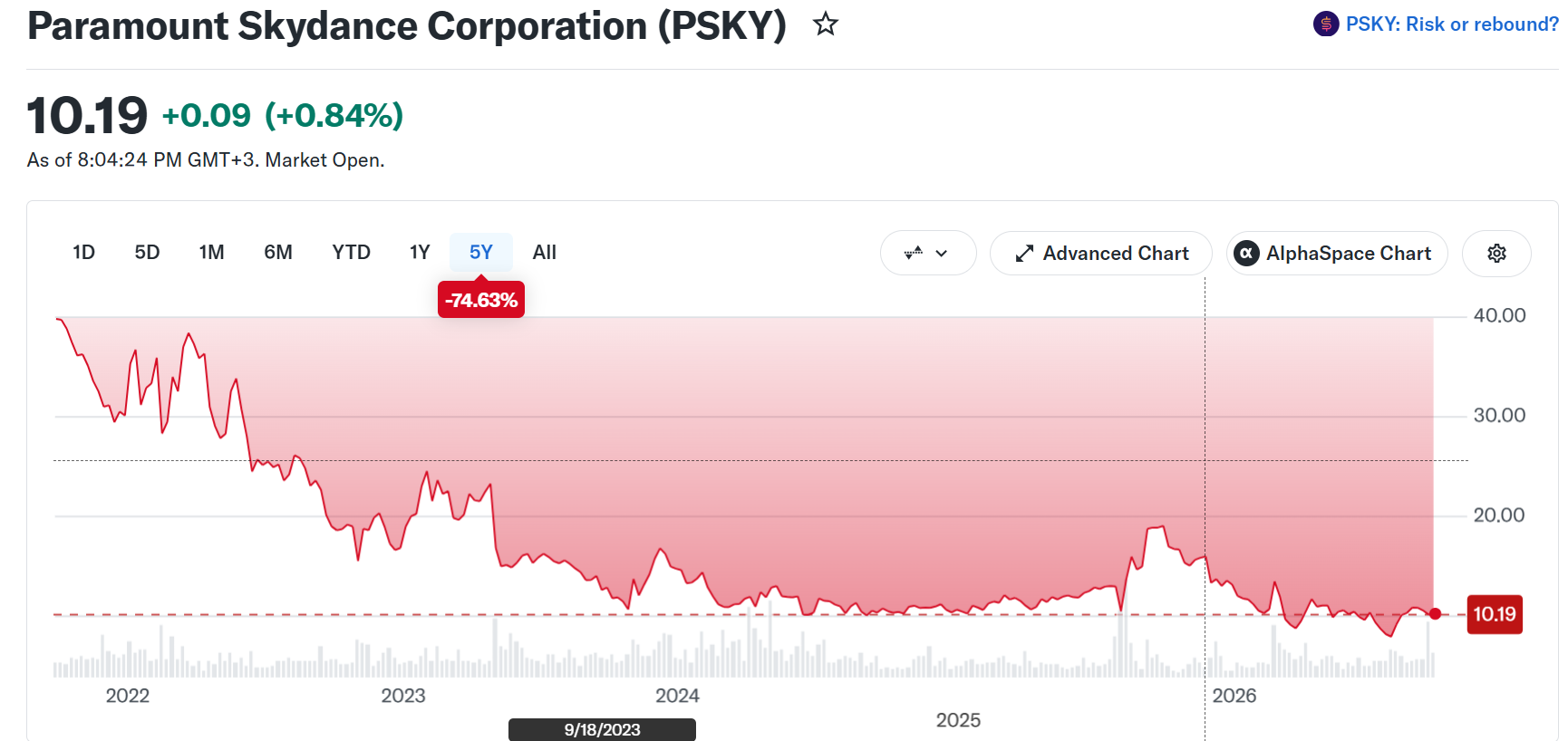
Paramount’s Class B shares (PSKY) rose 0.8% to $10.19 on Wednesday afternoon, according to Yahoo Finance. The small gain barely dents a 74.6% slide over the past five years.
The stock sits at less than half its 52-week high of $20.86. Its 52-week low is $7.62.
A weekly TradingView chart shows the shares stuck between roughly $10 and $15 for most of the past three years. In early 2021, under the old ViacomCBS name, they topped $95.

Earlier this week, Paramount settled an antitrust lawsuit brought by state attorneys general, removing a hurdle to the deal. A brief rally on that news has since faded.
Musk Stake Could Draw Scrutiny in Washington
According to a report on Semafor, a Musk check would be a vote of confidence from a billionaire with a devoted retail following.
However, the same report flags a political risk. Democrats raised concerns about Musk’s money and his control of X (Twitter) during the 2024 election.
Even a partial Musk stake in CNN and CBS would likely alarm Washington, the report said, though Musk would probably have no formal say. No commitment has been reported.
The post Paramount Courts Elon Musk for Investment as Stock Nears Multi-Year Lows appeared first on BeInCrypto.
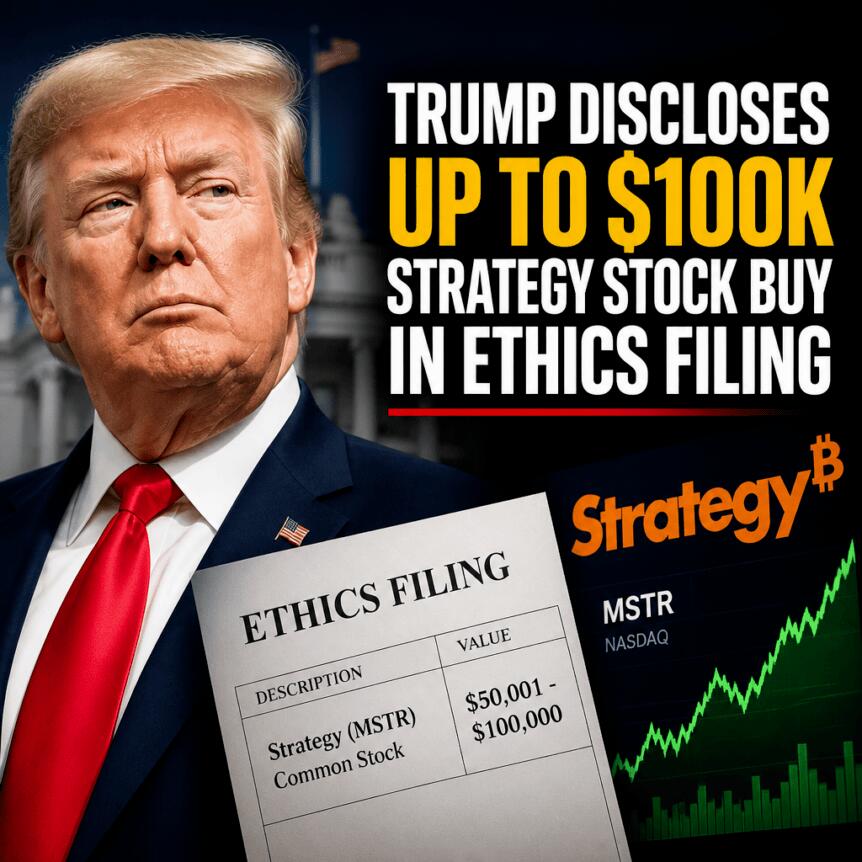
President Donald Trump disclosed that he bought between $50,001 and $100,000 worth of Strategy (Strategy, formerly MicroStrategy) shares in late July, according to a U.S. Office of Government Ethics filing released Tuesday. The disclosure also references earlier purchases of the bitcoin-linked software company, as well as other crypto-adjacent transactions.
In the same disclosure, Trump reported a smaller Strategy buy three days earlier and described additional activity tied to several other crypto-related firms, including stock trades involving Coinbase and sales of bitcoin miner holdings including MARA Holdings and CleanSpark. The Strategy purchase dated July 27 is the largest bitcoin-exposure transaction identified in the document.
Key takeaways
- Trump disclosed a $50,001–$100,000 Strategy share purchase on July 27, following a $1,001–$15,000 buy on July 24.
- Strategy remains one of the most widely followed public corporate bitcoin proxies, holding 846,000 BTC according to BitcoinTreasuries.net data referenced in the filing coverage.
- The filings report transaction values in ranges, not an ongoing share count, so remaining Strategy holdings cannot be directly determined.
- White House guidance to CNBC says Trump’s portfolio is managed independently by third-party financial institutions without input from Trump or his family.
- The disclosures land as U.S. regulators and lawmakers continue working through crypto policy issues amid stalled comprehensive market-structure legislation.
What the disclosure says about Strategy shares
According to the U.S. Office of Government Ethics filing linked in the report, Trump’s July trades included a purchase of Strategy shares valued between $50,001 and $100,000 on July 27, after buying between $1,001 and $15,000 worth on July 24. The document also indicates earlier Strategy activity, including another $50,001–$100,000 purchase disclosed previously on Feb. 12, as tracked by BitcoinTreasuries.net.
While the filings show multiple transactions over time, they do not provide a running total of shares held. Instead, reported activity is expressed in value brackets, meaning it is not possible to calculate how many Strategy shares—if any—remain in Trump’s portfolio based solely on the disclosures.
Strategy is described as the world’s largest publicly traded corporate bitcoin holder, with 846,000 BTC reported by BitcoinTreasuries.net. That fact matters for readers because Strategy’s stock is often treated by markets as a proxy for corporate bitcoin exposure—albeit with equity market dynamics layered on top of bitcoin price movement.
Broader portfolio trades and independent management
The Strategy purchase is presented in the context of a wider set of portfolio transactions reported for July. The filing indicates sales of between $5 million and $25 million each of Microsoft and Amazon stock on July 20, alongside several additional buys and sells in the $1 million to $5 million range.
On Tuesday, the White House told CNBC that Trump’s stock and bond portfolio is independently managed by third-party financial institutions and that Trump or his family do not provide input into those investment decisions. That characterization is important for interpreting the disclosure: it suggests investors should treat the reported trades as part of a broader managed portfolio process, rather than assuming a single direct investment thesis or immediate reaction to bitcoin market moves.
For traders, the key question is how to connect the disclosure to market pricing. The report notes that Strategy shares have rallied sharply in recent sessions—nearly 30% over the past five trading days and about 37% over the past month according to Yahoo Finance data—highlighting that the stock’s performance has been strong regardless of whether a specific public figure disclosed ownership.
Crypto policy backdrop: stalled legislation, active regulators
Trump’s Strategy disclosure arrives amid continued U.S. government activity around digital-asset regulation—even as comprehensive market structure legislation remains stuck in Congress. The report states that the Senate failed to advance the CLARITY Act on Sept. 15, but that regulators have proceeded using existing authorities.
Two days after the CLARITY Act cloture vote failed, the Securities and Exchange Commission (SEC) cleared limited onchain trading of tokenized U.S. stocks under a temporary exemption, according to coverage linked in the report. In parallel, the Commodity Futures Trading Commission (CFTC) eased registration requirements for certain software providers offering access to regulated derivatives markets, as described in the cited coverage.
Separately, the CFTC also sent a broader crypto market rulemaking initiative to the White House for review on Sept. 17. As characterized in the report, the initiative—titled “Regulation Crypto Asset Transactions and Regulation Crypto Asset Markets”—is still in preliminary stages and has not yet become a formal proposal.
For market participants, this regulatory sequencing matters. When omnibus legislation stalls, targeted exemptions and rulemaking under current legal frameworks can still change how tokenized assets, exchange functions, and market-access technology are regulated. Investors watching disclosure stories around publicly traded bitcoin proxies often should also track these regulatory moves, because they can shift demand for crypto-related products and the risk profile of platforms serving those markets.
Bitcoin policy efforts extend beyond markets
The report also ties the broader political context to bitcoin itself. It notes that the House Financial Services Committee voted 28–21 to advance legislation that would codify a “Strategic Bitcoin Reserve” into law and require bitcoin placed in the reserve to be held for at least 20 years, citing earlier coverage linked in the report.
In addition, the report says the U.S. government currently holds an estimated 324,527 BTC, referencing Arkham Intelligence data. While such estimates can vary by methodology, the figure underscores why bitcoin exposure is increasingly treated as a policy and balance-sheet topic—not only a market-trading theme.
Against that backdrop, disclosures involving corporate bitcoin holders like Strategy can quickly become part of the political narrative around digital assets, even when the disclosed transaction itself is comparatively small relative to broader holdings and portfolio trades.
As more filings surface, readers may want to watch two things next: whether Trump’s disclosed crypto-adjacent trades continue to shift over subsequent quarters, and whether the regulatory groundwork laid after the CLARITY Act setback translates into formal proposals that meaningfully affect tokenized markets and crypto derivatives access.

While announcing his resignation on Sept 8., the now-former Anthropic engineer Jacob Coxon wrote, “I don’t feel like we’re on track to prevent a global race” toward superintelligence. We might not be today, but we can change course quickly.
The momentum behind an international ban on developing superintelligence is picking up speed. Over 200 cross-party lawmakers across the UK and Canada have been ahead of the curve on superintelligence risks by recognizing it as a global and national security threat as part of ControlAI’s campaign. In addition to the newly introduced UK bill, Vice President J.D. Vance told AI companies this week, “If you’re building Frankenstein, stop.” Further, U.S. Senator Bernie Sanders and Representative Greg Casar announced in early September that they will introduce a bill prohibiting superintelligence development and calling for international agreements to prohibit it.
And in October 2025, a broad coalition called to prohibit superintelligence internationally. This was signed by the scientific “godfathers” of AI Geoffrey Hinton and Yoshua Bengio, and bipartisan political figures like former President Trump advisor Steve Bannon, Ambassador Susan Rice, and former Chairman of the Joint Chiefs of Staff Admiral Mike Mullen, former President Trump advisor Steve Bannon.

Emmerdale’s Tom King to return after two years away

Call for funding into industrial land

Prediction markets face hearing call from 11 Senate Democrats




-

 Fashion5 days ago
Weekend Open Thread: Talbots – Corporette.com
-

 Tech3 days ago
Researchers escape OpenAI Codex sandbox to run commands on host
-

 Crypto World5 days ago
Circle launches Arc Studio AI agent for building onchain apps
-
 NewsBeat5 days ago
Trump says US has reached an agreement to take permanent control of Greenland’s security
-

 Crypto World3 days ago
Who Needs CLARITY Anyway? ARB Could See 70X Increase: Hodler’s Digest
-

 Crypto World5 days ago
Trading Bitcoin on Robinhood? Why 2% Spread Has Traders Worried
-

 Crypto World6 days ago
Mortgage and refinance interest rates today, Thursday, September 17, 2026
-

 Crypto World5 days ago
Bitcoin price breaks channel as RSI climbs to 63
-

 Crypto World23 hours ago
Goldman Sachs and Deutsche Bank Agree: The S&P 500 Rally Isn't Over
-

 Crypto World7 days ago
US Charges Robinhood Engineers Over Crypto Listing Trades
-

 Tech2 days ago
Google’s $899 Googlebook is a bet that you’ll buy a new laptop for Gemini
-

 Business3 days ago
Analog Devices (ADI) Bets $1.35 Billion on Chips that Let Machines Think for Themselves
-

 Crypto World3 days ago
Coinbase, Robinhood, Circle Seen as Tokenized-Stock Winners
-

 Crypto World5 days ago
World Money launches in 150+ countries with Stripe
-

 Tech4 days ago
Trump suggests rebranding AI with a new name, says he’s also creating an AI Force
-

 Crypto World5 days ago
Silver prices recover quickly, hitting weekly high today
-

 Tech6 days ago
GPT-6 Astra Reached the Nether in Minecraft, Lost Its Stash to a Creeper, and Farmed Potatoes for Hours
-
 Business19 hours ago
Oil Price Today (September 23): Crude oil below $100 on hopes of US-Iran talks. What did Trump say?
-
 NewsBeat5 days ago
US was ‘on brink of war’ with China over false AI report of nukes moving in Middle East
-

 Crypto World2 days ago
Meta Jumps 11% As Muse Shines and Investors Show an Appetite for Advancing AI
You must be logged in to post a comment Login