
Crypto World
SEC Tokenized Stocks Rules: Key Winners and Losers Defined

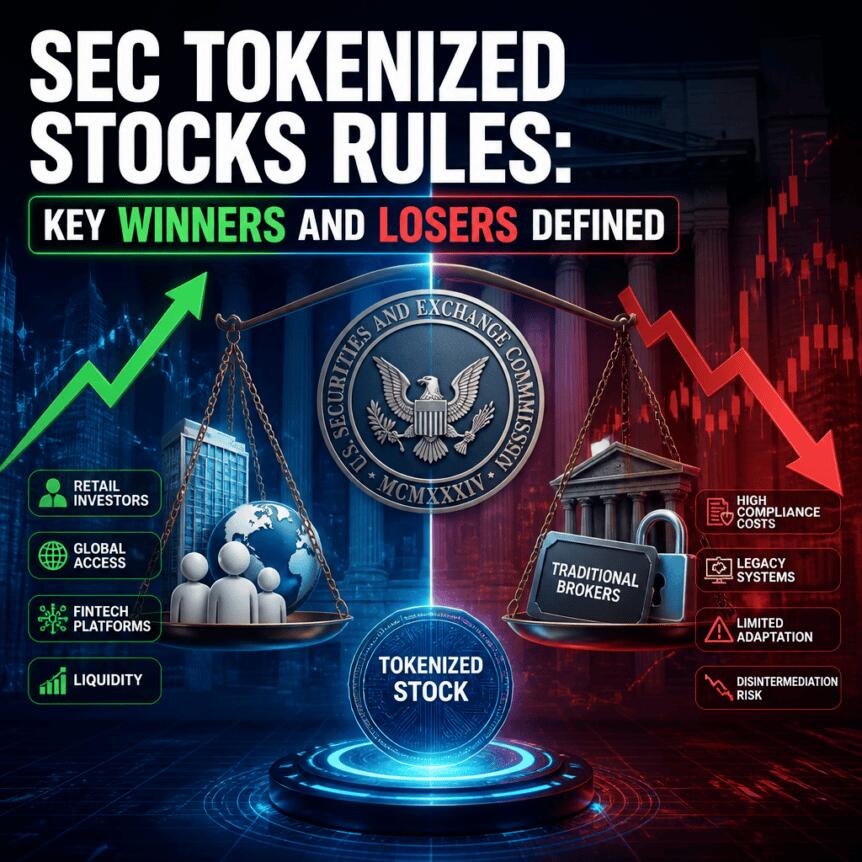
The U.S. Securities and Exchange Commission’s new “Innovation Exemption” is carving out a narrow regulatory lane for onchain trading of certain tokenized stocks—and early market reaction suggested traders believe the path is at least partially workable. After the announcement last week, Bitcoin and Ether both rallied by more than 10% while tokens tied to onchain trading infrastructure also jumped, including Uniswap’s UNI rising by over 30% in the days that followed, according to price data tracked by CoinGecko.
Still, the SEC’s relief is not a blanket approval for every form of tokenized equity. The exemption focuses on a particular structure that preserves core shareholder rights and channels trading through permissioned liquidity mechanisms. For many existing products, that means they may need redesign before they can fit through the SEC’s rules.
Key takeaways
- The SEC’s Innovation Exemption provides temporary relief for trading tokenized National Market System (NMS) stocks without registering as a securities exchange, but only under specific conditions.
- Compliance hinges on token design: qualifying tokenized shares must deliver holders the same rights and privileges as the underlying securities.
- Synthetic exposure models are singled out as non-compliant with this exemption, limiting how broadly the market can reuse existing tokenized equity products.
- Permissioned AMM liquidity pools appear central to the SEC’s framework, aligning naturally with trading infrastructure that can enforce compliance onchain.
- Even where infrastructure exists, issuers and venues still face real work to adapt products to the exemption’s exact requirements and the SEC’s broader regulatory posture.
A temporary exemption with a narrow route
The SEC’s September 17 order, published as a press release, grants certain venues temporary relief from having to register as exchanges when they trade tokenized NMS stocks on permissioned AMM liquidity pools. The exemption also contemplates third parties tokenizing stocks, but only if they meet the conditions laid out by the regulator.
A central requirement is that tokenized stockholders must receive the same “rights and privileges” as they would for the underlying shares. That includes protections tied to voting and dividends, along with the way corporate actions flow to holders. If a token tracks the price of a share without carrying those legal or economic rights, it falls into a category the SEC describes as “synthetic,” and therefore outside the exemption’s scope.
The SEC also leaves room for the idea that not every tokenization model will be treated the same way. Commissioner Hester Peirce emphasized that the exemption covers one particular model rather than every conceivable approach to trading tokenized securities, while noting the SEC is open to other models outside the specific tokenized stocks structure referenced in the order.
Who appears closest to the SEC’s framework
Several market participants are effectively being benchmarked against the exemption’s model. Cointelegraph’s earlier coverage highlighted ongoing developments across the tokenized securities landscape, but in this case the SEC’s requirements are what determine who is “close” and who would need major changes.
Coinbase’s tokenized stocks have been positioned publicly as non-synthetic and fully backed, with redemption features and dividends integrated. The company’s current offering, however, is described as aimed at non-U.S. customers, and its exchange infrastructure is built around a central limit order book rather than the permissioned AMM approach the SEC’s exemption is built around.
Ondo, by contrast, has taken steps that more directly map to the rights-and-entitlements theme. The project launched tokenized U.S. securities in June with shares held in traditional custody, while the token represents the investor’s entitlement onchain. Ondo also acquired Oasis Pro, which includes an SEC-registered broker-dealer, an ATS, and a transfer agent, giving it an infrastructure footprint across traditional and onchain market components.
Ondo’s head of global regulatory affairs, Peter Curley, argued in an interview with Magazine that the SEC’s action matters because it moved forward despite uncertainty about Congress finishing the job. Curley’s broader point was that not every tokenization effort will fit the exemption “and that’s fine,” as long as compliant pathways exist for products that do meet the SEC’s standards.
Permissioned AMMs and why Uniswap drew attention
The specific mention of permissioned AMM liquidity pools matters beyond compliance paperwork. It points to a technical design where issuers or regulated operators can enforce trading permissions through onchain mechanisms rather than relying solely on offchain gating.
Uniswap’s own development work may therefore be relevant even if the protocol itself is not a tokenized-stock venue in the same way a compliant intermediary would be. Uniswap introduced Permissioned Pools for v4 in July, aimed at enabling regulated assets to trade through AMMs where compliance can be enforced directly onchain. The key concept is that permissioned access—paired with KYC verification, record keeping, public notice requirements, and transaction transparency—can align the trading layer with regulatory constraints.
That creates a possible framework for how regulated token issuers could connect shareholder-rights systems to liquidity venues that restrict access appropriately. What remains uncertain, however, is whether existing implementations can be integrated end-to-end with the entitlement, corporate action handling, and issuer controls required by the SEC without additional adaptation.
Why some well-known products may be excluded
Not all tokenized equity products currently in circulation are positioned to qualify. Robinhood, for example, has deployed stock tokens on Robinhood Chain described as one-to-one backed and “fully DeFi composable.” But Robinhood’s token design has been a point of contention: analysts argue the SEC’s exemption excludes synthetic exposure and therefore rules out products like Robinhood’s Stock Tokens and Kraken’s xStocks in their present forms.
In Robinhood’s case, the stock tokens are described as tokenized debt securities issued by Robinhood Assets (Jersey) Limited. That structure means investors receive economic exposure to underlying stocks, but without the same legal or beneficial rights associated with conventional share ownership. Separately, they are not registered under U.S. securities laws and are not available to U.S. persons.
Kraken’s xStocks are also described as fully backed by underlying equities, but the article notes that they likewise may not give holders the same rights as conventional shares—illustrating a broader problem: backing alone is not enough if the exemption requires holders to receive the full set of rights and privileges embedded in ordinary share ownership.
RWA market intelligence platform RWA.xyz suggested in an interview that most tokenized equity products have been third-party sponsored but expects a shift toward issuer-sponsored models within the next 12 months. The logic is straightforward: the exemption framework appears to align token issuers with stock issuers, potentially reducing mismatches between who controls the token and who controls shareholder rights.
Five years to prove the model is worth adopting
The SEC describes the Innovation Exemption as temporary, with the relief lasting five years while the commission evaluates future rulemaking. The SEC’s chair, Paul Atkins, has framed the period as allowing the market to “develop,” but investors are still likely to ask a practical question: will tokenized stocks deliver clear advantages over conventional brokerage positions?
According to Ondo’s Curley, investors ultimately need outcomes that are faster, cheaper, or more useful than existing rails. There are also concerns that liquidity fragmentation for tokenized stock products could translate into less competitive pricing or weaker user experience—particularly if trading venues or token designs limit where liquidity can pool.
If the exemption’s requirements are met, tokenized stocks could theoretically support 24/7 trading, fractional ownership, faster settlement, and onchain composability while preserving shareholder rights and corporate action mechanics. But those benefits only matter if they translate into measurable improvements that users want—and if the industry can redesign products to fit the SEC’s model in the first place.
For now, readers should watch how issuers and trading venues operationalize the exemption’s constraints—especially the exact token rights requirements and the adoption of permissioned AMM liquidity models—and whether any major tokenized equity product teams announce changes aimed at becoming compliant within this five-year window.
This article was originally published as SEC Tokenized Stocks Rules: Key Winners and Losers Defined on Crypto Breaking News – your trusted source for crypto news, Bitcoin news, and blockchain updates.


Strategy resumed buying after a two week pause, but its latest purchase came from cash while its stock sales remained idle. Meanwhile a review of five Strive filings shows a different pattern: rapid Bitcoin growth alongside a rising common share count and a growing preferred stock obligation. The useful comparison is how much Bitcoin each common share can claim, not the size of a single purchase.
Summary
- Strategy bought 950 BTC for $75.7 million in the week ended Sept. 20, bringing its holdings to 846,000 BTC.
- Strive bought 1,355 BTC in the week ended Sept. 18 and reached 26,355 BTC.
- Strive’s BTC per effective common share rose 14.1% between Aug. 21 and Sept. 18, based on its SEC filings.
- Strategy sold zero shares through its ATM programs in the week it resumed buying Bitcoin.
- Strive’s SATA preferred share count rose from 8.27 million to 11.18 million over four reporting weeks.
Strategy has resumed Bitcoin purchases with 950 BTC bought for $75.7 million, while Strive has added 1,355 BTC in a substantially overlapping reporting period and continued expanding a preferred stock program that helps finance its treasury.
Strategy’s Sept. 21 Form 8-K says the company bought Bitcoin using existing USD Cash and sold no shares through its at the market programs from Sept. 14 through Sept. 20. Strive’s filing on the same day shows a larger purchase, a higher common share count and 786,194 additional SATA preferred shares outstanding. The two companies bought the same asset at almost the same average price, but the capital moving behind each purchase was different.
Strategy’s Bitcoin purchase did not restart its share sales
Strategy reported that it paid an average of $79,670 per BTC, including expenses. Its total position rose from 845,050 BTC to 846,000 BTC, a gain of 0.112%. The purchase ended two consecutive reporting periods in which Strategy bought no Bitcoin and sold no shares under its ATM programs. crypto.news previously examined the two week pause and the cash being directed toward preferred share repurchases.
Buying resumed. The financing method used for this purchase did not resemble the one that built much of Strategy’s position. In its Aug. 31 filing, the company said proceeds from MSTR share sales financed a 4,603 BTC purchase worth $369.7 million. The latest 950 BTC came from USD Cash already on the balance sheet. A company can repeat purchases funded by new issuance while buyers keep taking its securities. A cash funded purchase instead draws on a finite pool unless the money is replenished.
The cash pool had another claimant. Strategy used $174 million to repurchase 1,771,238 STRC preferred shares during the same week. That was approximately $2.30 spent on STRC for each dollar spent on Bitcoin. Its USD Cash declined from roughly $1.30 billion to $1.05 billion after the two transactions. Its separate USD Reserve fell from roughly $5.10 billion to $5.04 billion after $57.4 million in preferred dividends and debt interest.
STRC spending split detailed has already been reported. It should not be mistaken for proof that Strategy has abandoned accumulation. The company’s filing records one week’s uses of capital. Its Aug. 31 filing shows that it can resume ATM issuance when it chooses and the market permits it. The question posed by the latest period is narrower: how much new Bitcoin did each company put behind its common stock, and what claims came with it?
A bigger Bitcoin purchase does not answer the shareholder question
Strive paid about $79,475 per coin for 1,355 BTC from Sept. 14 through Sept. 18. Its holdings rose from 25,000 to 26,355 BTC, or 5.42%. Strategy’s 950 BTC purchase grew its much larger position by 0.112%. On those two percentages alone, Strive’s treasury expanded about 48 times faster in the latest disclosed period.
The comparison is striking, but a company’s coin count is only the numerator of what common shareholders ultimately hold. New common shares spread the exposure across more owners. Preferred shares can finance purchases without immediate common dilution, but they introduce a claim ahead of common equity. Cash and other assets matter too. Neither a coin count nor a single BTC per share calculation captures the entire balance sheet.
Strive’s same filing puts its effective common shares at 94,968,764 on Sept. 11 and 97,002,649 on Sept. 18. Its BTC position grew 5.42% while that share count grew 2.14%. Divide 25,000 BTC by the first share count and 26,355 BTC by the second: the result rises from about 26,324 to 27,169 satoshis per effective common share, a gain of 3.21%.
That increase is smaller than the 5.42% rise in the treasury because the denominator changed. It is still positive. An argument that the Bitcoin purchase was entirely offset by common share dilution would be contradicted by these particular snapshots.
Strive defines effective common shares as its Class A plus Class B shares. Its filing separately reports assumed fully diluted shares, options, employee awards and traditional warrants. Using assumed fully diluted shares instead produces approximately 25,474 sats per share on Sept. 11 and 26,317 on Sept. 18, an increase of roughly 3.31%. The filing excludes traditional warrants from that fully diluted count. These are transparent exposure ratios, not liquidation values or a substitute for Strive’s own reported performance measures.
Four weeks of filings show the change beneath Strive’s BTC total
A single week can make a young treasury look exceptionally fast. The longer series offers a better test. Strive’s Aug. 31,Sept. 8,Sept. 14 and Sept. 21 filings report both BTC holdings and share counts for consecutive dates. The calculations below divide reported BTC by reported effective common shares and multiply by 100 million to express the result in sats.
Reporting date
BTC held
Effective common shares
BTC per share, sats
SATA shares
Aug. 21
21,356
89,683,423
23,813
8,270,815
Aug. 28
23,156
93,262,570
24,829
9,073,914
Sept. 4
24,531
94,934,558
25,840
9,995,425
Sept. 11
25,000
94,968,764
26,324
10,397,966
Sept. 18
26,355
97,002,649
27,169
11,184,160
Strive added 4,999 BTC between Aug. 21 and Sept. 18. The arithmetic is 26,355 minus 21,356, equal to 4,999 BTC, or 23.4% of its starting position. Its effective common share count rose by 7,319,226, or 8.2%. Dividing the two end point BTC per share figures gives a gain of about 14.1%. The sequence was positive at each reported weekly snapshot, including weeks when the common share count rose substantially.
The company paid for the four disclosed BTC batches at average prices of approximately $79,431, $79,281, $77,954 and $79,475, inclusive of expenses. Multiplying each batch by its reported average gives roughly $393 million in aggregate purchase cost. That total is an estimate because each average is rounded in the filings. It is not a reconciliation of all funding inflows and outflows.
There is a second denominator. SATA preferred shares outstanding rose by 2,913,345 during the same four weeks, from 8,270,815 to 11,184,160, or about 35.2%. These preferred shares are not common shares, so adding them to the common share denominator would be misleading. Their holders nevertheless have contractual rights that rank ahead of common equity. A growing BTC per common share figure therefore answers one question while leaving the cost of financing open.
Preferred shares put the two companies on different sides of a trade
Strategy’s STRC is variable rate perpetual preferred stock with a $100 stated amount. Strive owns 505,000 STRC shares, a position it marked at $49.748 million on Sept. 18. Strategy has been repurchasing its own STRC while Strive’s holdings of the security remained constant across the filings reviewed. The price of Strive’s position changed, but its share count did not.
Strive has meanwhile expanded SATA, its own variable rate preferred security. SATA outstanding rose by 786,194 shares during the latest week even as Strive bought 1,355 BTC. In the week ended Sept. 11, SATA rose by 402,541 shares while effective common shares barely moved. Earlier Strive’s SATA funding arrangements described proceeds from the preferred program as the financing source for its 469 BTC purchase in that period.
The share count changes in the latest filing do not, by themselves, show exactly which day’s issuance paid for which Bitcoin trade. Cash is pooled and transaction timing can differ. Strive ended the Sept. 18 period with $229.6 million in cash and equivalents, up from $204.2 million a week earlier, despite buying more than $107 million in Bitcoin at its reported average price. The combined cash and asset changes show why treating a purchase as an isolated transfer from one security to another would overstate what the filing proves.
Strategy’s own STRC preferred stock repurchases have had a different immediate purpose: reducing outstanding preferred claims. STRC carried a 12% annualized dividend rate for September, while Strive’s SATA carried 13%, according to the companies’ September disclosures described in that coverage. Dividends are subject to the securities’ terms, and a simple rate comparison cannot measure either issuer’s total financing cost. It does show why issuing a preferred share and buying one back are different uses of capital even if both companies are Bitcoin treasuries.
At the $100 stated amount, 2,913,345 additional SATA shares represent approximately $291.3 million in additional stated preferred capital over the four reporting weeks. That is not a claim that Strive raised exactly $291.3 million in cash: offering prices, transaction costs and any other changes must be checked separately. Applying a 13% annual rate to that incremental stated amount yields roughly $37.9 million per year at an unchanged rate and share count. SATA’s rate is variable, so this is an illustrative run rate, not a fixed future bill.
Strategy’s scale changes what a restart can accomplish
Strategy held roughly 32 times Strive’s 26,355 BTC at the latest disclosed dates. Buying 1,355 BTC would add just 0.16% to Strategy’s starting position of 845,050 BTC. For Strive, the same batch represented 5.42% of its 25,000 BTC starting position. A smaller treasury can show faster percentage growth with a purchase far below the largest issuer’s historical deal size.
The reverse is true of capital needs. To expand its 846,000 BTC position by 5%, Strategy would need 42,300 BTC. At the $79,670 average price it paid in the latest week, that would cost roughly $3.37 billion before any change in price or execution costs. Strive’s 5.42% weekly expansion required 1,355 BTC and roughly $107.7 million at its stated average. This comparison fixes prices solely to make scale visible. It does not forecast either company’s next purchase.
Strategy’s ability to raise capital should not be inferred from the last zero issuance week alone. Its Aug. 31 share financed purchase preceded the two week pause. The SEC filing for that earlier period says the company directed $369.7 million of MSTR issuance proceeds into Bitcoin. It has used the mechanism recently; its absence in the latest filing is an observed choice for that period, not proof that the market has permanently closed.
There is a shareholder benefit in the latest cash funded purchase. Because the company reported no ATM sales for the week, the 950 additional BTC did not come with new common shares sold under those programs. The filing, however, does not give a fresh, directly comparable end of week MSTR diluted share count alongside the Bitcoin disclosure. Assigning a precise BTC per MSTR share increase from this filing alone would mix sources and methodologies. For Strategy, the verified measure here is treasury growth of 0.112% without reported ATM issuance that week.
The strongest case for each company is narrower than the headline
Strategy could have sensible reasons to use cash for both Bitcoin and STRC. Retiring preferred stock can reduce future dividend claims, especially when it trades below its $100 stated amount. A large cash reserve gives management options during a difficult market. Strategy’s filing reports approximately $5.04 billion in its USD Reserve after the latest payments and $1.05 billion in USD Cash after its Bitcoin and STRC purchases. Both figures have distinct stated purposes and should not be collapsed into one discretionary balance.
Strive’s own filings support a positive reading of its accumulation. Its BTC per effective common share increased on every weekly snapshot in the series reviewed, despite growth in the common share count. Its latest cash balance rose even as the treasury expanded. The September SATA financing coverage points to another potential advantage: raising preferred capital can reduce the need for simultaneous common stock sales for a given purchase.
But the preferred claim does not disappear because it sits outside the BTC per common share calculation. At Sept. 18, Strive had 11.18 million SATA shares outstanding. Strive’s common shareholders own a residual claim after the preferred rights and other liabilities are accounted for. BTC per share is a useful operating measure of accumulation; it is not a promise that each share could be redeemed for that quantity of BTC.
The companies are not in a controlled experiment. Their share prices, issuance terms, existing holdings, cash assets and preferred obligations differ. The reporting windows overlap substantially but are not identical: Strive reports through Sept. 18 and Strategy through Sept. 20. The 48 times weekly growth ratio measures a defined change in treasury size. It cannot rank the long term value of either company’s common stock.
What the numbers settle and what they leave open
The SEC filings confirm three separate developments. Strategy resumed buying Bitcoin without reporting an ATM sale for the latest week. Strive bought more BTC in its overlapping period and increased both its effective common shares and SATA shares. Across four consecutive weekly snapshots, Strive’s BTC per effective common share rose 14.1% even after the growth in common shares.
The filings do not prove that all Strive purchases were funded exclusively by SATA issuance, that the preferred financing will be profitable, or that Strategy’s financing channel will remain idle. The illustrative SATA dividend calculation does not account for future rate changes or redemptions. The BTC per share series does not subtract cash, operating liabilities or senior claims. It tests a narrower proposition: whether reported BTC accumulation outpaced the growth in reported effective common shares during the selected period. It did.
Nor does the series support saying every Strategy imitator continued buying. It measures Strive, which disclosed purchases in each of the four reporting weeks, against Strategy, which disclosed two inactive weeks and one cash funded purchase. The proposed sector wide claim would require a defined sample of other public treasuries, their dated filings and the same calculation for each. Strive is one counterexample to a uniform pause, not proof of a universal trend.
For the earlier financing loop to be observable again at Strategy, a subsequent filing would need to show fresh securities issuance linked to BTC purchases. For Strive’s current run to persist on these measures, BTC per effective common share would need to keep rising while its preferred obligations remain financeable on the terms disclosed. A week of common issuance that outruns BTC growth would reverse the first measure. A change in SATA’s dividend rate or market price would change the economics of the second.
What to watch in the next filings
Strategy ATM sales. Its weekly Form 8-K reports whether shares were sold and, when applicable, how proceeds were used. New issuance funding BTC would identify a different sort of restart from the latest cash purchase.
Strategy USD Cash and USD Reserve. The Sept. 20 balances were approximately $1.05 billion and $5.04 billion. Subsequent changes will show whether cash purchases and security repurchases continue without replenishment.
Strive BTC per effective common share. Divide BTC held by Class A plus Class B shares at each dated snapshot. The Sept. 18 reference point is approximately 27,169 sats.
SATA shares and dividend rate. Strive reported 11,184,160 SATA shares on Sept. 18. Both the outstanding count and the announced variable rate determine the scale of the preferred claim.
STRC repurchases and Strive’s STRC holding. Strategy bought back 1,771,238 STRC shares in the latest period; Strive still held 505,000. The next filings can show whether those positions keep moving in opposite directions.
FAQ
How much Bitcoin did Strategy buy in September 2026?
Strategy disclosed a purchase of 950 BTC for $75.7 million between Sept. 14 and Sept. 20. It reported holdings of 846,000 BTC at the end of the period.
Did Strategy issue shares to buy that Bitcoin?
No ATM share sales were reported for that week. Strategy said it funded the 950 BTC purchase using USD Cash, while it also spent $174 million repurchasing STRC preferred shares.
How much Bitcoin did Strive buy in the same week?
Strive reported buying 1,355 BTC from Sept. 14 through Sept. 18 at an average price of approximately $79,475. It held 26,355 BTC at Sept. 18.
Why did Strive’s treasury grow faster than Strategy’s?
Strive began the latest period with 25,000 BTC, while Strategy began with 845,050 BTC. The respective purchases increased their positions 5.42% and 0.112%, although the reporting end dates differed by two days.
Did Strive’s new common shares cancel out its Bitcoin purchases?
No, based on the disclosed end point share counts. Between Aug. 21 and Sept. 18, BTC per effective common share rose from roughly 23,813 to 27,169 sats, or 14.1%.
What is the difference between STRC and SATA?
STRC is Strategy’s variable rate preferred stock, and SATA is Strive’s variable rate preferred stock. Strategy repurchased 1,771,238 STRC shares in its latest week; Strive’s outstanding SATA shares rose by 786,194 in its latest reporting period.
Does more BTC per common share guarantee a higher stock price?
No. It counts reported Bitcoin against a particular common share denominator, but it does not subtract preferred claims, liabilities or other costs. Market prices can move independently of that ratio.
What would show that Strategy’s financing loop restarted?
A future filing showing renewed securities issuance with proceeds allocated to Bitcoin would give direct evidence of that financing method returning. The Sept. 21 filing instead records a cash funded purchase and no ATM sales. This is educational analysis, not investment advice.
Disclaimer: This article is for information and educational purposes only and does not constitute financial or investment advice. Figures reflect regulatory filings and reporting available at the time of writing and change with each disclosure. Nothing here is a recommendation to buy, sell, or hold any security or asset. Always do your own research. Information is accurate as of September 15, 2026.

Berkshire Hathaway (BRKB) raised its stake in Lennar (LEN) and now owns more than 10% of the homebuilder, sparking a rally among beaten-down homebuilding stocks. Warren Buffett’s investment firm disclosed it purchased roughly $200 million of Lennar stock in transactions made Thursday, Friday and Monday, according to Securities & Exchange Commission filings. With the new purchases, Berkshire’s stake goes from…
Copyright ©2026 Investor’s Business Daily, LLC. All rights reserved. 87990cbe856818d5eddac44c7b1cdeb8
Michigan’s Republican nominee for governor, Rep. John James, told reporters on Tuesday that “we need to end this war quickly. Because war is terrible, and no one likes war.”
Earlier this month, Republican Reps. Zach Nunn and Mariannette Miller-Meeks, who both are in the midst of close-fought reelection races in Iowa, cited concerns about the lack of a clear plan to end the conflict after voting for the first time in favor of a resolution to constrict Trump’s ability to continue military action in Iran without congressional approval.
“With the negotiating window closed, sustained combat operations now require congressional authorization,” Nunn, an Air Force combat veteran and colonel in the U.S. Air Force Reserve, said in a statement. “Having deployed multiple times and flown over 700 combat hours in the Middle East, I will not support another open-ended war.”
Miller-Meeks, who served for more than two decades in the U.S. Army, voiced a similar sentiment in a post on X—as well as referencing the conflict’s impact on gas prices. “I said it in March: the mission had to stay focused and limited, because Americans do not want another forever war,” she wrote. “I will not vote to keep our soldiers in an open-ended war, with Iowans paying too much at the pump.”

Amazon (AMZN) powered through its 50-day moving average on Monday with the stock finishing the day up nearly 2%. Amazon looks to have recovered from its recent correction and could provide an attractive candidate for bullish option traders. Traders looking for a way to play Amazon stock via options could use a bull put spread. As a reminder, a bull…
Copyright ©2026 Investor’s Business Daily, LLC. All rights reserved. 87990cbe856818d5eddac44c7b1cdeb8

MoonPay has agreed to acquire North Capital in an all-stock deal valued at more than $60 million, pushing the crypto payments firm deeper into regulated US securities infrastructure. The acquisition is designed to support MoonPay’s broader push into tokenized real-world assets (RWAs), particularly private-market securities.
According to MoonPay’s announcement shared with Cointelegraph, the deal would enable the company to move into functions such as issuance, custody, and secondary trading of private securities, including tokenized securities. North Capital operates broker-dealer, alternative trading system (ATS), transfer agent, and investment adviser businesses—all registered with the US Securities and Exchange Commission.
Key takeaways
- MoonPay will pay for North Capital with an all-stock transaction worth more than $60 million, according to a person familiar with the matter cited by Cointelegraph.
- The target brings SEC-registered broker-dealer, ATS, transfer agent, and investment adviser capabilities, aligning the acquisition with MoonPay’s RWA strategy.
- North Capital reports having supported more than $8.7 billion in primary and secondary transaction volume.
- The companies’ boards have approved the deal, which remains subject to regulatory approvals and customary closing conditions.
Why MoonPay’s move matters for tokenized securities
Tokenized RWAs have long faced a practical bottleneck: getting “onchain” products to connect with traditional capital markets functions such as custody, issuance workflows, and compliant secondary trading. MoonPay’s planned acquisition of North Capital is framed as an effort to bridge those components through “modern, programmable infrastructure,” as MoonPay CEO Ivan Soto-Wright said in the company’s statement shared with Cointelegraph.
For investors and market participants, the significance is less about a new headline promise and more about operational capabilities. North Capital’s existing regulatory footprint—covering broker-dealers and an ATS as well as transfer agent and investment adviser roles—suggests MoonPay could attempt to formalize end-to-end rails for private securities. That is particularly relevant for tokenized private market assets, where settlement, custody, and trading controls are typically expected to fit within established compliance frameworks.
North Capital’s infrastructure and reported scale
North Capital, based in Midvale, Utah, provides multiple lines of securities-market infrastructure. The company’s portfolio includes broker-dealers and an alternative trading system (ATS), along with services such as a transfer agent and an investment adviser, all registered with the US Securities and Exchange Commission.
In its announcement, MoonPay said North Capital has supported more than $8.7 billion in primary and secondary transaction volume. While that figure does not, by itself, indicate what portion would be tied to tokenized assets after the acquisition, it does provide a baseline for the business’s market activity and indicates established relationships and operational readiness in US private securities workflows.
Under the terms described, North Capital will become a wholly owned MoonPay subsidiary after the transaction closes. Both companies’ boards approved the acquisition, and the deal is still subject to regulatory approvals and other customary closing conditions.
Deal structure, valuation, and MoonPay’s funding backdrop
MoonPay’s agreement to acquire North Capital is structured as an all-stock transaction valued at more than $60 million, according to a person familiar with the matter cited by Cointelegraph. MoonPay has not been described as paying a cash premium in the provided details; instead, the focus is on combining equity-linked ownership with infrastructure expansion.
For context on MoonPay’s financial trajectory, Cointelegraph points to data compiled by Traxcn showing that MoonPay last raised funding in October 2021 through a $2.18 million seed round at an unspecified valuation. The same dataset places MoonPay’s valuation at $3.4 billion at the time of reporting, with investors including Karlani Capital and Fiduciary Trust International.
MoonPay’s valuation and earlier funding history are relevant because they frame the company’s capacity to pursue acquisitions as it expands from crypto payments into broader capital markets roles. Even without additional deal-specific terms in the source, the move signals a strategic reorientation toward regulated market infrastructure rather than relying solely on payment rails.
Building beyond crypto payments: MoonPay’s broader acquisition pattern
This North Capital deal is described as the latest entry in MoonPay’s acquisition push during the year, as the company expands beyond pure crypto payment services. Cointelegraph previously reported MoonPay’s purchases of key institutional crypto infrastructure provider Sodot and the DFlow trading infrastructure platform, as well as an AI finance operations platform called Entendre.
Taken together, those earlier acquisitions highlight a recurring theme: MoonPay is attempting to assemble a stack that supports institutional custody, onchain trading capabilities, and broader financial operations—then extend that stack further into compliant securities infrastructure via regulated entities like broker-dealers and ATS platforms.
For market observers, the key question is what changes after closing. Will MoonPay’s existing institutional toolset be used to onboard issuers and intermediaries into tokenized private securities workflows more efficiently? The provided details stop short of outlining specific product launches or timelines for tokenized secondary markets, so readers should watch for follow-through: regulatory filings, integration milestones, and any public expansion of tokenized securities offerings that leverage North Capital’s licensed roles.
As the acquisition moves through approvals, the most important uncertainties remain practical and regulatory: the pace of closing, how MoonPay integrates North Capital’s SEC-registered functions, and whether the resulting infrastructure can translate tokenized private securities into consistently compliant issuance and secondary trading at scale.

October WTI crude oil (CLV26) is down -0.17 (-0.18%) today, and October RBOB gasoline (RBV26) is up +0.0673 (+1.94%).
Crude oil and gasoline prices are mixed today, with crude falling to a 3-week low. Today’s rally in the dollar index ($DXY) to a 7-week high is bearish for energy prices. Crude prices also fell today on a report that said Iran will reopen the Strait of Hormuz in seven days if the US lifts its blockade. Crude prices recovered from their worst level after the crude crack spread rose to a record high, encouraging refiners to purchase crude oil and refine it into gasoline and distillates.
More News from Barchart
Crude prices fell today after Japan’s Kyodo News Agency reported that Iran has proposed reopening the Strait of Hormuz within seven days if the US lifts its blockade of Iranian ports.
Crude prices are also pressured by signs that diplomacy may bring an end to Middle East hostilities after a spokesman for Iran’s Islamic Revolutionary Guard said that “if our national interests require us to negotiate alongside the war, we must negotiate.” In addition, people familiar with the matter said Saudi Arabia is in the early stages of restarting its East-West pipeline and resuming crude exports from its Red Sea port of Yanbu later this week.
Signs that more crude supplies are moving through the Strait of Hormuz are easing supply concerns and are bearish for crude prices. On Monday, Admiral Brad Cooper, head of US Central Command, said crude and liquefied natural gas flows through the Strait of Hormuz over the past two weeks are running at a six-month high. Also, data from the European Union’s Sentinel 2 satellite showed oil supertankers with the capacity to collect 14 million bbl of oil were observed at Saudi Arabia’s export installations inside the Persian Gulf, signaling the country has shifted its crude exports back toward the Strait of Hormuz following the shutdown of its East-West pipeline.
Crude oil prices rallied to a 4-month high last Tuesday on fears that global oil supplies will tighten further after Saudi Arabia shut down its key East-West pipeline, disrupting a key route that bypasses the Strait of Hormuz. The 750-mile-long East-West pipeline, which carries 7 million bpd of crude, was closed as a precaution following attacks by Houthi rebels. The pipeline moves oil away from the Persian Gulf toward the Red Sea, where it can be loaded on tankers. Last Tuesday, Saudi Aramco said it is delaying oil deliveries to some European customers because of the pipeline closure.
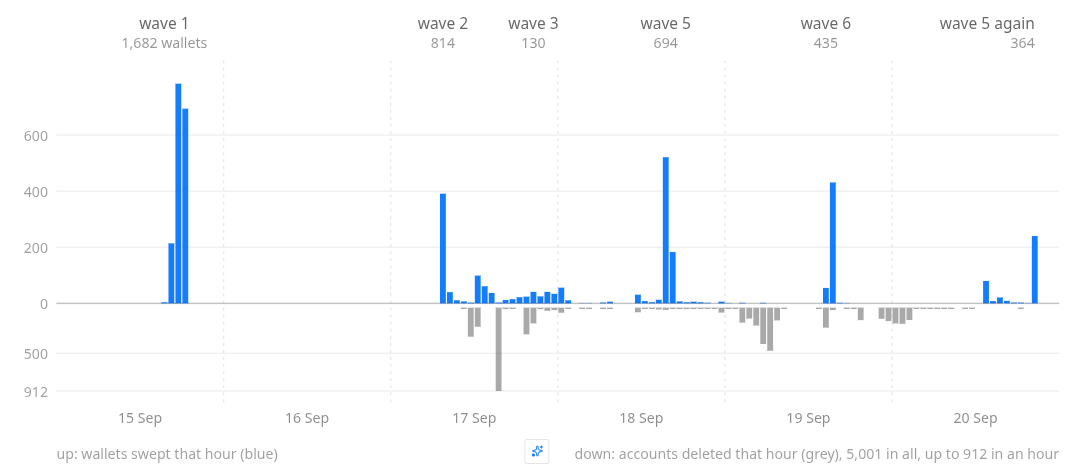
Attackers drained roughly 11.7 million XRP from thousands of D’CENT App Wallet users. The theft, worth close to $20 million, unfolded between September 15 and 20. XRPL.to published the on-chain forensic timeline.
The operation unfolded across six separate waves. It hit a combined 6,678 wallets using keys the thief already controlled.
How the Attack Actually Unfolded
Someone manually drained eight wallets, each holding over 99,999 XRP, within an hour on September 15. An automated script then swept a total of 1,682 wallets that same day.
Five more waves followed through September 20. Each wave reused the same script, manual tool, and stolen keys.
Attackers went beyond simple transfers, too. They deleted 5,001 accounts entirely to claim their remaining reserve balances, XRPL.to reported.
Notably, 2,470 of those wallets had never been swept. That detail suggests the thief held a broader list of compromised keys than the initial drain revealed.
Follow us on X to get the latest news as it happens.

The stolen funds moved fast. Roughly 5.6 million XRP crossed into Ethereum through THORChain. Other funds are routed through exchanges, including Binance, as well as services like unionchain.ai and NEAR Intents.
Each sweep often reached an off-ramp within hours, limiting the window available for freezing stolen funds. About 1.3 million XRP still sat in the attacker’s own wallets as of September 21.
Why Are D’CENT Users Specifically at Risk?
D’CENT confirmed abnormal transfers affecting its App Wallet on September 16. The company clarified that hardware wallets remained unaffected. It later urged users to move funds immediately, though it has not confirmed whether reimbursement will follow.
Notably, no XRP Ledger exploit caused this incident. Every sweep used valid signatures from the wallets’ own private keys. That detail means the compromise originated from how those keys were exposed, not from any flaw in the network itself.

XRPL.to’s analysis found the operation reused identical scripts and fee patterns across multiple waves. That pattern strongly suggests a single coordinated actor carried out every stage. Security researchers now recommend one specific step.
Anyone who used D’CENT’s App Wallet at any point should migrate funds to a new wallet immediately. The exact method behind the original key compromise still remains unconfirmed.
XRP trades near $1.49 at the time of writing. That figure marked a 6% drop over the past 24 hours, according to BeInCrypto data. The token’s market cap stood near $93.82 billion, ranking fifth among all cryptocurrencies.
Subscribe to our YouTube channel to watch leaders and journalists provide expert insights.
The post $20 Million in XRP Stolen From Thousands of Hardware Wallets appeared first on BeInCrypto.
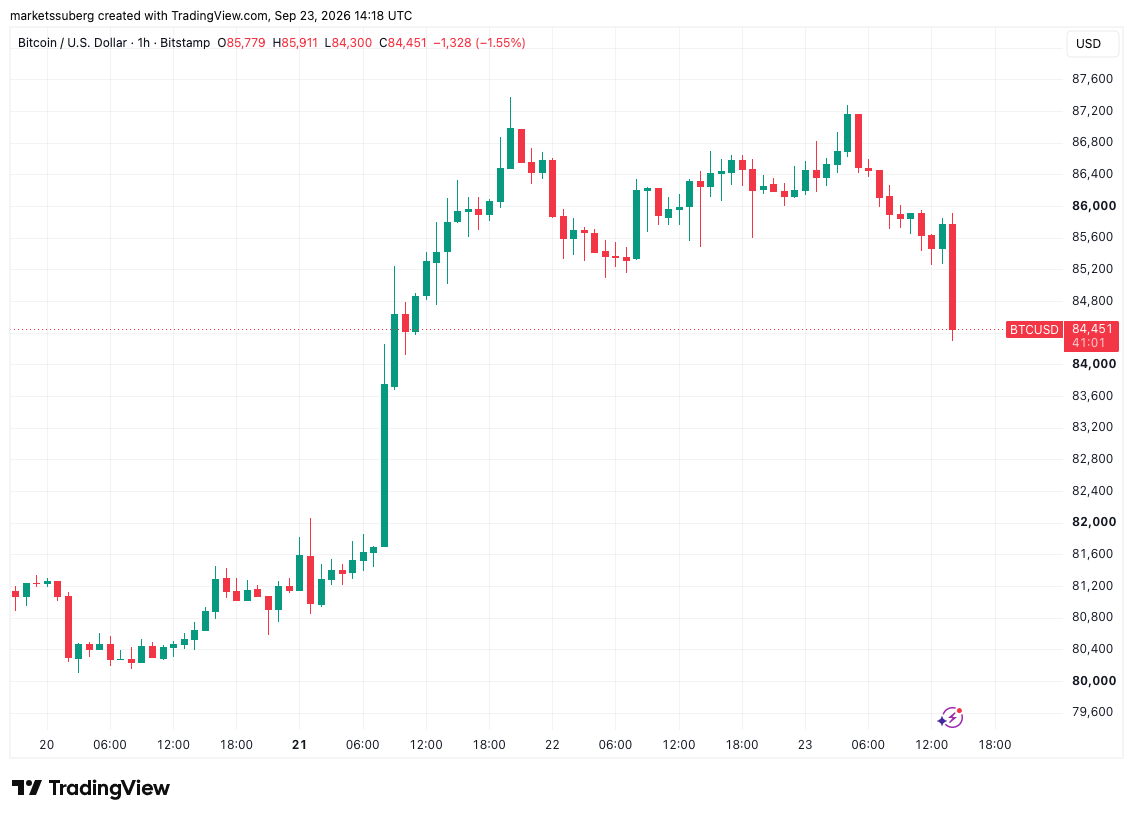
Bitcoin (BTC) was rejected near $87,000 on Wednesday as onchain data showed negative spot demand.
Key points:
- Bitcoin suffered a correction below $84,000 around Wednesday’s Wall Street open, causing $280 million in long liquidations over the course of four hours.
- Analysis saw $82,000 as key support to hold in the event of a further breakdown.
- Bitcoin cumulative spot demand remained negative on a rolling 30-day time frame
BTC price falls toward $84,000, nears week-to-date low
Data from TradingView tracked a second attempt to break beyond $87,000 before BTC/USD fell to local lows under $84,000 into the Wall Street open.
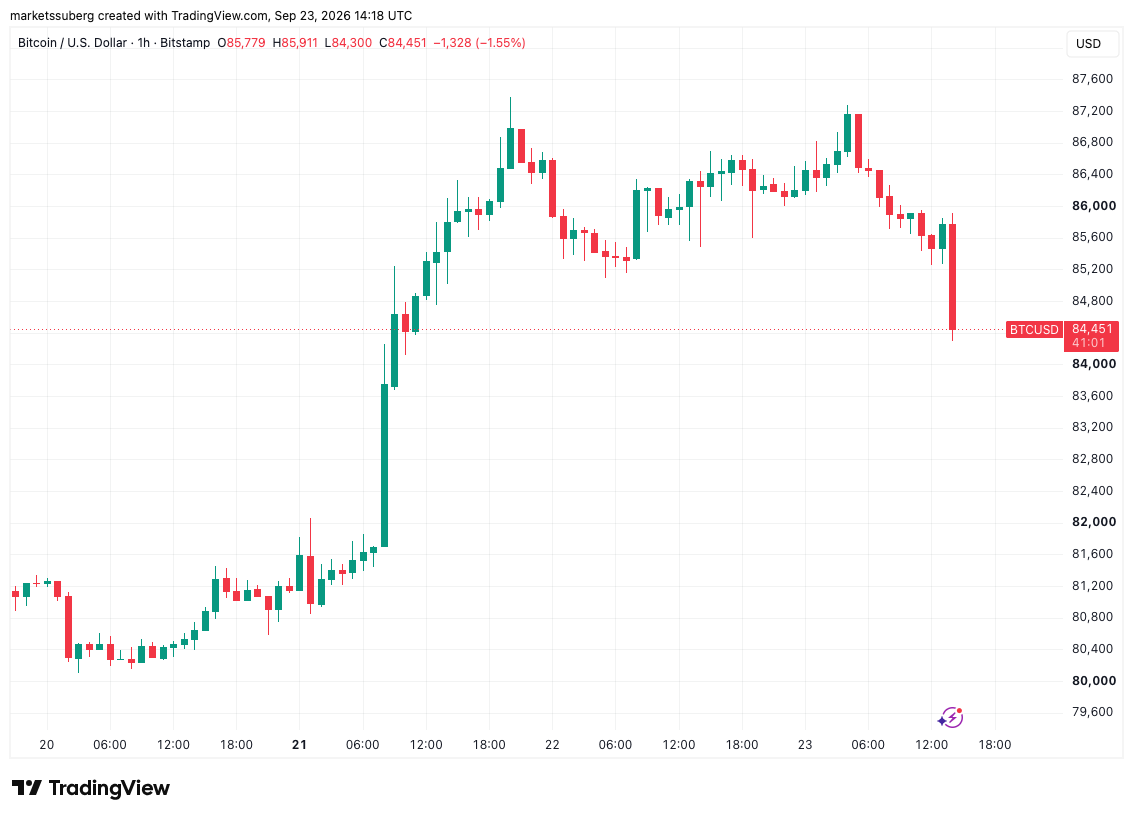
BTC/USD one-hour chart. Source: Cointelegraph/TradingView
These levels marked the upper and lower boundaries of a narrow intraday range. Liquidity thickened on both sides of the spot price as traders attempted to force a breakout from the sideways range. Data from CoinGlass tallied liquidations over the four hours prior to the time of writing at $280 million.
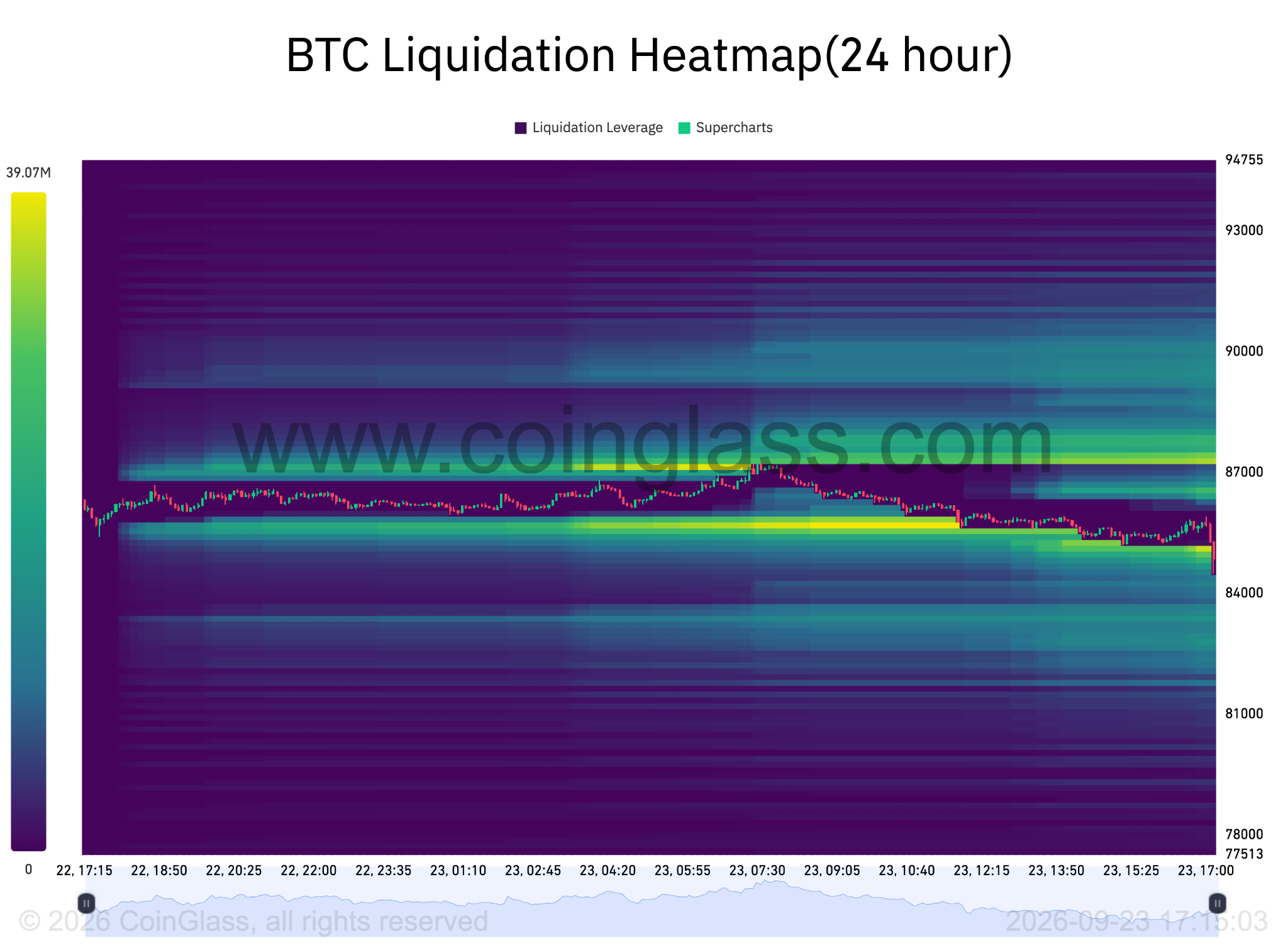
BTC liquidation heatmap. Source: CoinGlass
Commenting on the current landscape, trader and analyst Rekt Capital flagged $82,000 as a level for bulls to hold should the low-timeframe structure break down.
“For bullish continuation and to avoid reverting back into the $60k-$80k Range, Bitcoin would need to stay above or at minimum successfully retest ~$82k on any future dip,” he wrote in a post on X.
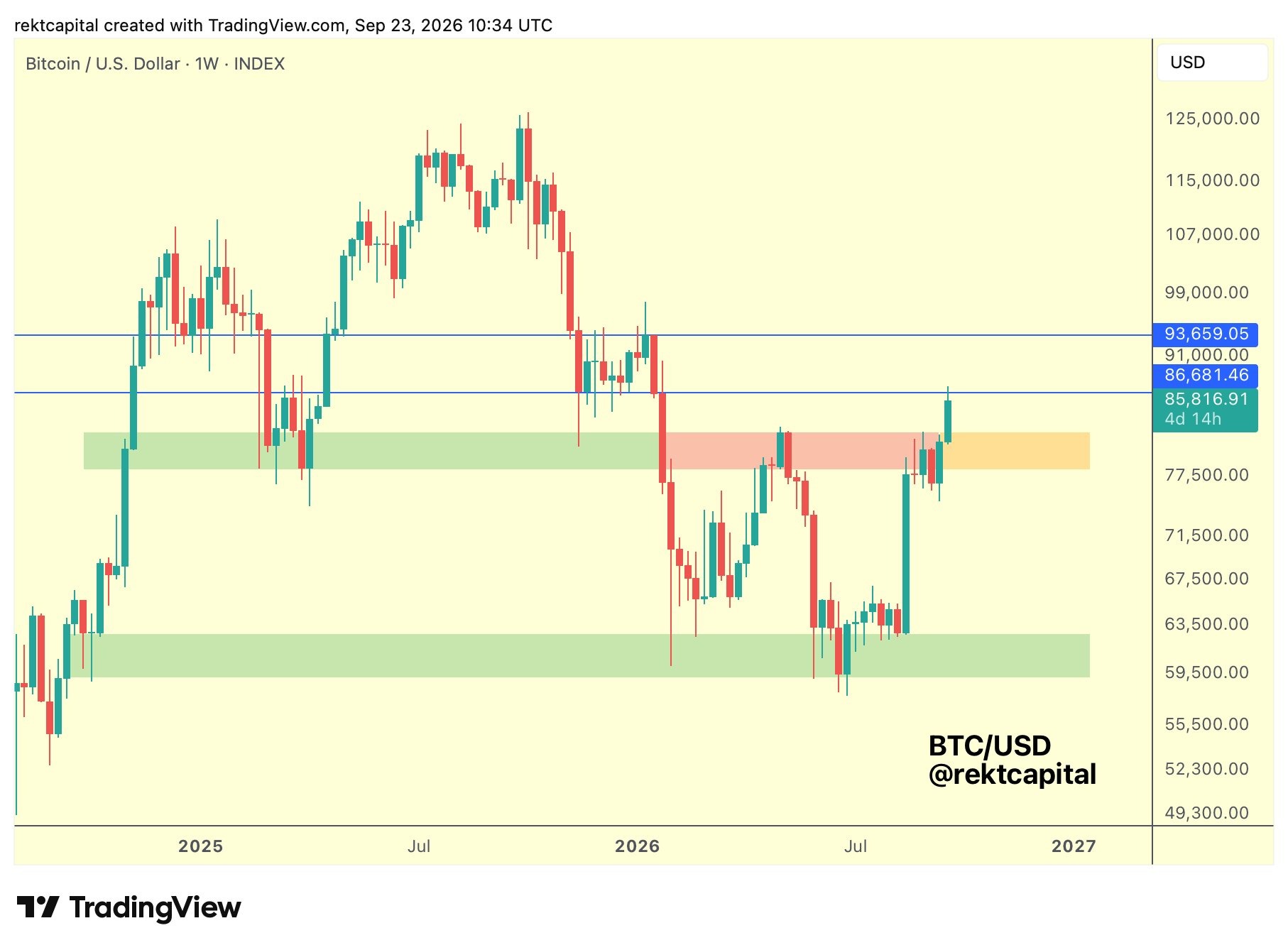
BTC/USD one-week chart. Source: Rekt Capital on X.com
As Cointelegraph reported, the current range has implications for certain investor cohorts. The US spot Bitcoin exchange-traded funds (ETFs) have their aggregate cost basis at just below $86,000.
Earlier, analysis highlighted $90,000 as the likely next area in which BTC/USD will consolidate due to the increased likelihood of profit-taking by traders.
Spot demand shows only modest improvement
Despite gaining over 35% since the week beginning Aug. 17, Bitcoin faces an ongoing struggle to attract spot-market demand.
Related: Crypto metric signals altseason as Bitcoin market-cap share stalls below 60%
In its latest research, onchain analytics platform CryptoQuant claimed that interest was still largely confined to derivatives markets.
“The negative value of $BTC spot demand has narrowed slightly, while futures demand continues to increase. Total demand is also showing a slight recovery compared to the previous day,” it reported in a blog post on the day.
An accompanying chart showed that cumulative 30-day apparent spot demand measured -180,000 BTC as of Tuesday. Negative values reflect supply outpacing demand over the 30-day lookback period.
“Although total demand remains in negative territory, the trend is shifting toward the positive. If the current momentum persists, spot demand will also flip to positive. That moment will mark the beginning of a more significant rally,” CryptoQuant added.
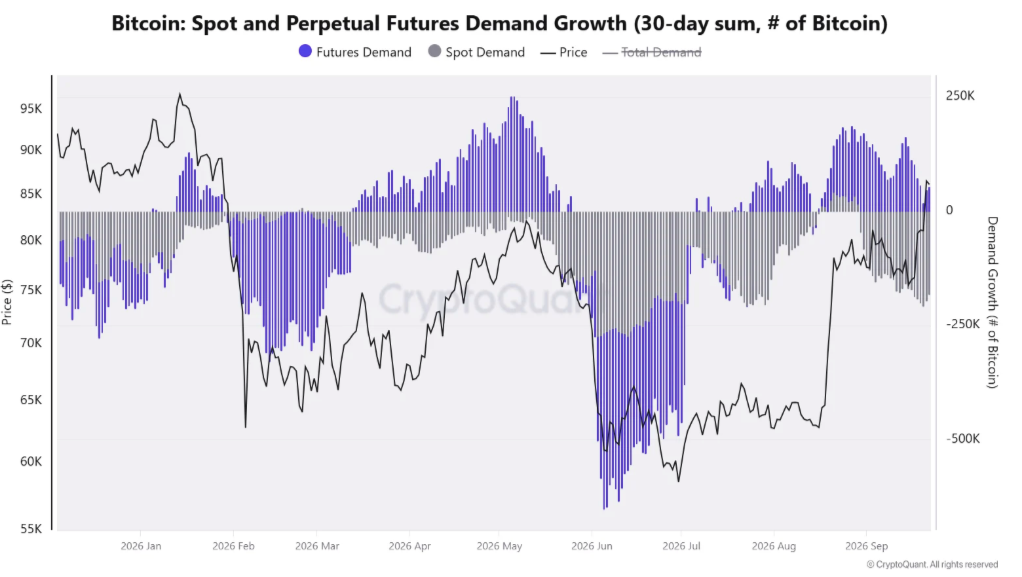
Bitcoin spot vs. futures apparent demand (screenshot). Source: CryptoQuant
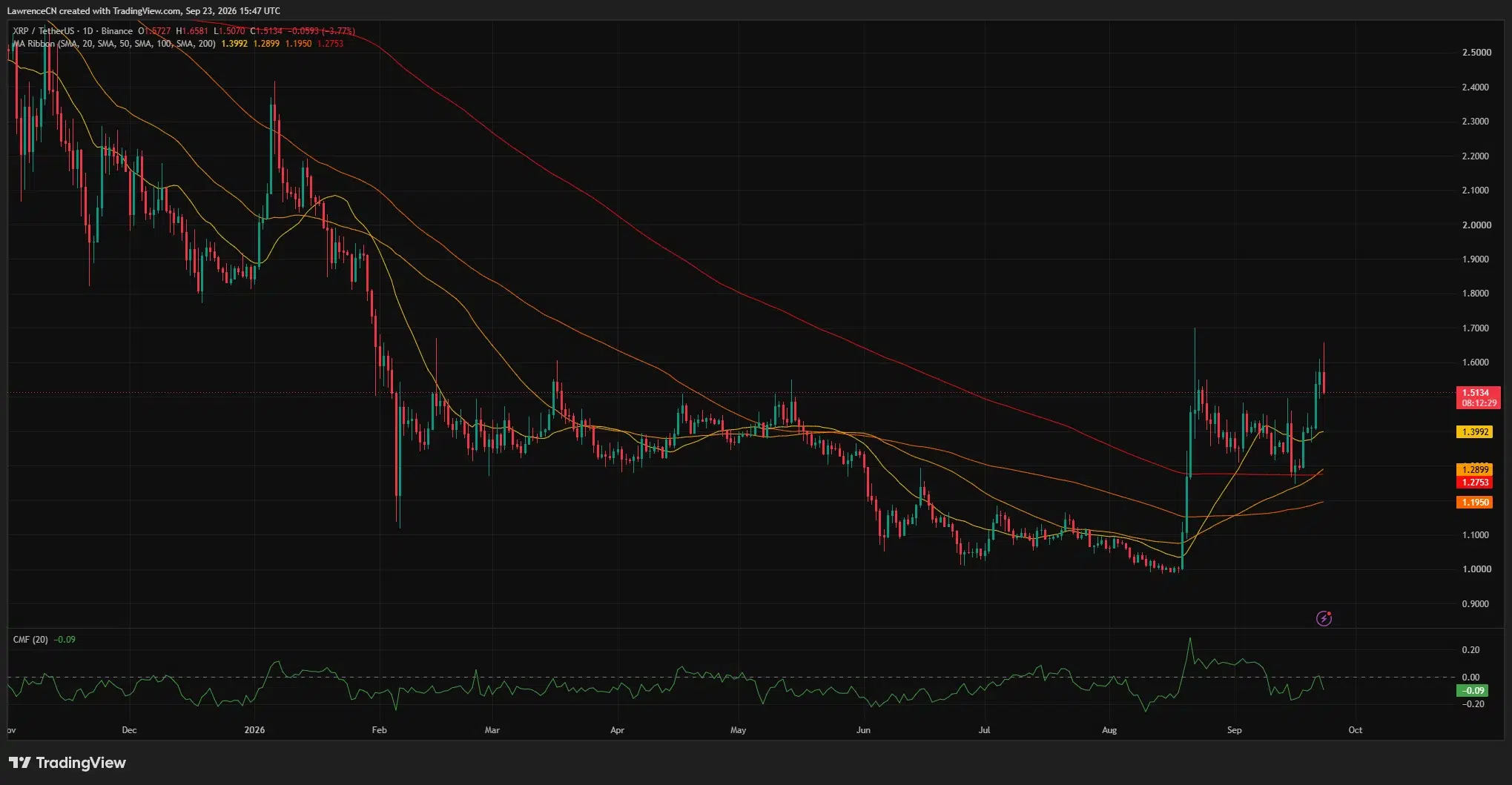
XRP price pulled back to about $1.51 on Sep. 23 after briefly rising above $1.65, leaving $1.60 as the first price level to reclaim while the XRP Ledger’s native lending proposals remain in validator voting.
Summary
- XRP price reached $1.6581 during the daily session before retreating to about $1.51.
- XLS-65 and XLS-66 would add pooled vaults and fixed-term lending directly to the XRP Ledger.
- Neither lending amendment has activated on mainnet; each needs sustained validator support.
- XRP remained above its 20-day moving average near $1.40, though money flow was negative.
XRPL Commons describes the proposed system as a way to bring pooled lending onto the XRP Ledger without deploying separate smart contracts. The plan depends on two amendments: XLS-65 would create Single Asset Vaults, while XLS-66 would let loan brokers use funds in those vaults for fixed-term credit. Both remain subject to validator approval.
XRP Ledger lending still needs validator approval
A Single Asset Vault would hold one type of asset, such as XRP, RLUSD, or another supported token. Depositors would receive shares representing their portion of the vault. Loan brokers could then arrange loans using the pooled funds, with the ledger recording terms, payments, and defaults.
The proposed system would leave borrower checks and lending decisions to the firms operating the loans. It also allows a broker to provide first-loss capital, which could absorb part of a default. Neither feature removes the risk that a borrower fails to repay or that depositors lose money.
A further amendment, LendingProtocolV1_1, would add vaults with set periods for deposits, lending and withdrawals. It would also count interest as income only when a borrower pays it. As crypto.news reported on the XRP Ledger’s 3.4.0 software release, adding those rules to server software did not activate them on mainnet.
The approval process matters more than the software release for timing. XRP Ledger amendments need support from more than 80% of trusted validators for two consecutive weeks before activation. XLS-65 and XLS-66 have yet to complete that process, so native lending has no confirmed mainnet start date.
Would lending create demand for XRP?
A lending launch would give developers and financial firms another reason to use the XRP Ledger, but the size of any effect on XRP would depend on which assets they lend. An XRP-funded vault would use XRP as its lending asset. A vault funded with RLUSD or another issued token would use that asset for its loans, while XRP would retain its role in network fees and account reserves.
That distinction is relevant to the planned RLUSD credit product previously covered by crypto.news. The product was being tested for working-capital loans to fintech and payment companies, with RLUSD rather than XRP serving as the credit asset. Its development shows a possible use for the lending rules, but it does not establish how much XRP borrowers or lenders would need to buy.
For U.S. holders watching the proposal, validator approval and actual use of the lending system are separate milestones. A vote could make the feature available; subsequent vault deposits and loans would show whether firms adopt it and whether XRP itself becomes a material lending asset.
XRP price faces another test near $1.60
XRP’s daily trading range shows why $1.60 remains the immediate test. The token opened near $1.57, reached $1.6581, and fell as low as $1.5070 before trading around $1.51 in the Sep. 23 chart snapshot. A move back above $1.60 would put the day’s high near $1.66 in view. The previous September spike near $1.70 marks the next visible area above it.
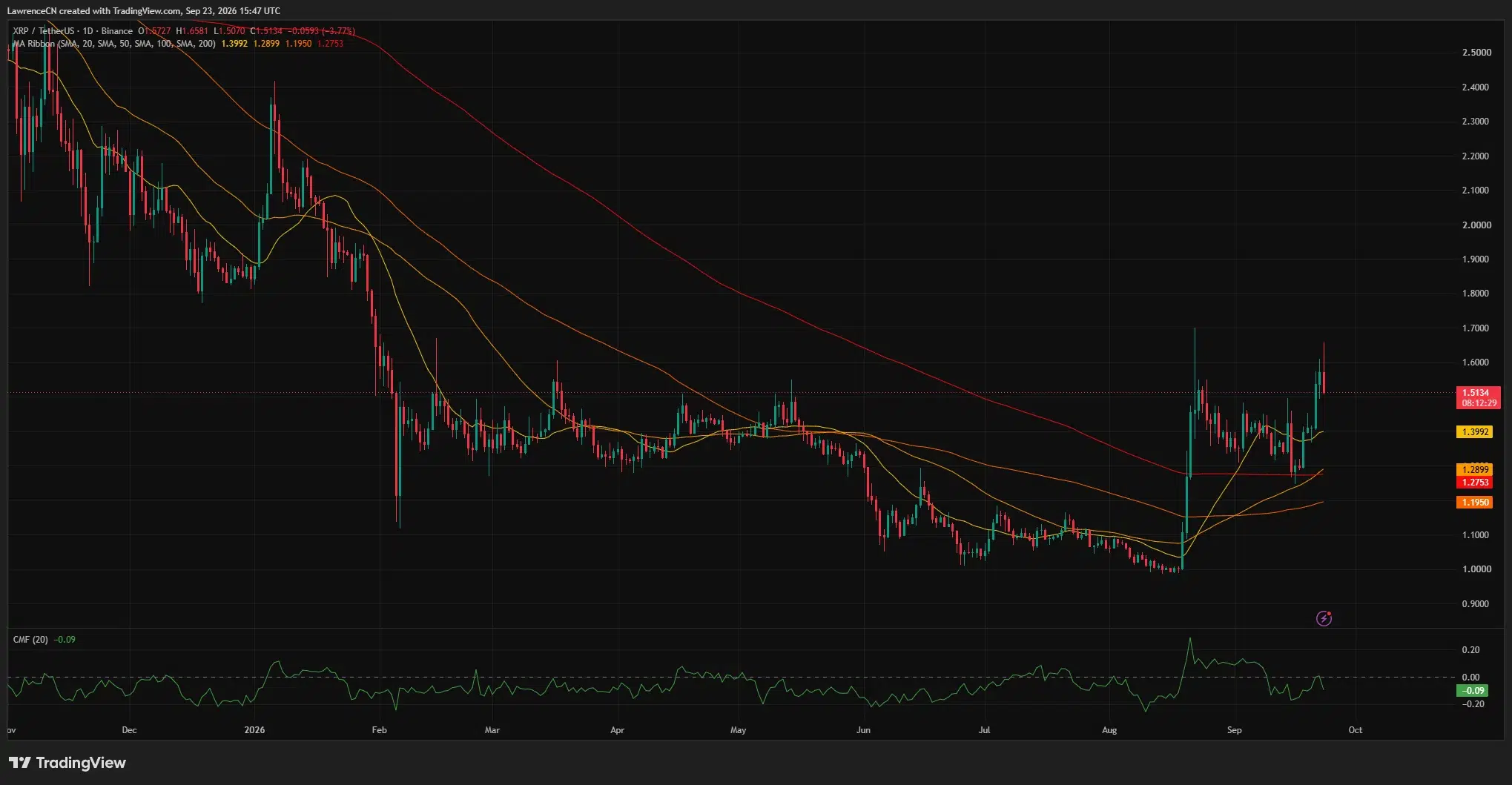
On the downside, the 20-day simple moving average near $1.40 sits below the current price. The chart also shows moving averages clustered around $1.28–$1.29. A loss of $1.40 would weaken the recent rebound and bring that lower area back into focus.
The 20-day Chaikin Money Flow reading stood at −0.09, indicating that buying pressure had not strengthened alongside the latest rise. XRP can still retest resistance, but the intraday retreat and negative money-flow reading leave the $1.60 break unconfirmed. The validator vote offers a development to watch; the chart has yet to show that it will carry XRP through resistance.
Disclosure: This article does not represent investment advice. The content and materials featured on this page are for educational purposes only.

The U.S. Securities and Exchange Commission (SEC) has moved to dismiss civil enforcement actions against multiple crypto-related companies that were filed under the prior administration, according to SEC Commissioner Mark Uyeda. Speaking at the Psaros Center for Financial Markets and Policy’s Financial Markets Quality Conference, Uyeda said the agency’s decision was tied to an intended shift in how it approaches rulemaking and litigation strategy.
Uyeda, who served as acting SEC chair from January to April 2025 before Paul Atkins took over following confirmation, argued that continuing cases authorized under earlier leadership could undermine the SEC’s credibility if the agency’s legal posture changes. His remarks point to a broader tension at the intersection of crypto enforcement and evolving regulatory interpretation within the SEC.
Key takeaways
- SEC Commissioner Mark Uyeda said civil crypto cases were dropped to avoid an “180-degree change” in positions becoming inconsistent in court.
- Uyeda linked the dismissals to preparations for a major shift in SEC rulemaking and litigation approach.
- The commissioner suggested there were doubts about whether the earlier cases were “justifiable under law,” as the SEC anticipated reversal in its stance.
- The SEC’s leadership structure is also in flux, with Commissioner Hester Peirce’s departure expected in November and no announced replacements by Trump.
Why the SEC moved to end crypto enforcement cases
Uyeda described the early-2025 decision as a pragmatic step to manage consistency between what the SEC argues in litigation and what it plans to adopt through rulemaking. He said the commission determined that litigators should not continue cases that had been authorized under the previous administration if doing so would conflict with a new set of policy objectives.
In Uyeda’s account, the SEC was concerned that courts could receive interpretations from the agency that effectively reverse course compared with the positions it had previously advanced. He said this would erode the agency’s credibility—especially when the SEC is attempting to persuade judges while simultaneously pivoting its regulatory framework.
Uyeda framed the issue around the potential for litigators to defend earlier arguments while the SEC prepares to issue a fundamentally different approach. “I’m not about to have our litigators… stand up in court and have a commission interpretation be issued that is a 180-degree change from what they’d been arguing for,” Uyeda said, according to his remarks at the conference (via Psaros Center for Financial Markets and Policy).
Dismissals under the prior administration’s approach
Uyeda’s comments align with reporting that the SEC dropped several crypto-related lawsuits earlier in 2025. Earlier coverage from Cointelegraph noted that the commission dismissed a case involving Kraken, and it also dropped actions involving other industry names including Ripple Labs and Coinbase.
Those dismissals had drawn sharp criticism from opponents of the agency’s previous strategy, who described the moves as part of a politically charged shift rather than a purely legal recalibration. Cointelegraph’s earlier reporting tied the enforcement pattern to concerns about retaliation dynamics following President Donald Trump’s 2024 campaign. That reporting also pointed to Trump’s pledge to fire then-SEC Chair Gary Gensler “on day one,” with Gensler resigning the day Trump took office.
While Uyeda’s conference remarks focused on litigation coherence and institutional credibility, the political backdrop matters for how market participants interpret the SEC’s enforcement trajectory. For industry observers, the question is whether dismissals should be understood as a correction of legal weaknesses, a change in policy direction, or both.
Rulemaking overhaul and “credibility” in court
The SEC’s legal posture in crypto has long been contentious because enforcement actions often serve as a proxy for regulatory interpretation in the absence of comprehensive, sector-specific rules. In that context, Uyeda’s stated rationale—avoiding situations where the SEC’s court arguments would conflict with its future policy—highlights a core challenge for the agency: how to transition from one interpretive approach to another without weakening its ability to persuade judges.
Uyeda’s argument suggests the SEC is seeking to reduce the likelihood that it appears internally inconsistent. If an agency simultaneously pursues litigation based on one theory while planning to issue an opposing theory through rulemaking, the court may treat the shift as a retreat from prior positions rather than a natural evolution of policy. Uyeda said that outcome could harm the SEC’s credibility.
For investors and market participants, this matters because the SEC’s enforcement strategy can influence compliance expectations and legal risk premiums. Even when a case is dismissed, the underlying uncertainty about what the SEC considers acceptable activity may persist—especially in a regulatory environment where guidance and rules are still developing.
Leadership transition at the SEC adds uncertainty
Uyeda’s remarks came as the SEC itself is preparing for additional leadership change. He has served as an SEC commissioner since 2022 and is currently part of the agency’s leadership alongside Paul Atkins and Commissioner Hester Peirce. However, the source reporting indicates Peirce’s departure is expected in November.
That expected change could significantly alter the SEC’s internal balance at a time when the agency is already adjusting its posture toward crypto litigation and rulemaking. According to the same account, the agency would then have only two members on its leadership panel out of five, and Trump has not announced nominations to replace potential departing leadership.
For crypto market participants, fewer confirmed decision-makers can mean slower consensus on enforcement priorities and rulemaking direction. It also raises the likelihood that upcoming SEC leadership changes could influence whether earlier enforcement dismissals represent a pause, a broad retreat, or the beginning of a new era of regulatory strategy.
As the SEC continues navigating the shift Uyeda described, readers should watch for the next steps in rulemaking and any subsequent enforcement signals. The key open question is whether the agency’s “credibility” rationale will translate into clearer, consistent standards for crypto compliance—or whether legal uncertainty will simply move from active lawsuits to new forms of guidance and litigation.

Twelve S’pore industries have already lost over 10,000 jobs in 2026

‘I started weight loss injections and some of the side effects hit hard’

DoorDash reaches $131.5M settlement with NYC over courier pay




-

 Fashion5 days ago
Weekend Open Thread: Talbots – Corporette.com
-

 Tech3 days ago
Researchers escape OpenAI Codex sandbox to run commands on host
-

 Crypto World5 days ago
Circle launches Arc Studio AI agent for building onchain apps
-

 Crypto World3 days ago
Who Needs CLARITY Anyway? ARB Could See 70X Increase: Hodler’s Digest
-
 NewsBeat5 days ago
Trump says US has reached an agreement to take permanent control of Greenland’s security
-

 Crypto World5 days ago
Trading Bitcoin on Robinhood? Why 2% Spread Has Traders Worried
-

 Crypto World1 day ago
Goldman Sachs and Deutsche Bank Agree: The S&P 500 Rally Isn't Over
-

 Crypto World6 days ago
Mortgage and refinance interest rates today, Thursday, September 17, 2026
-

 Crypto World5 days ago
Bitcoin price breaks channel as RSI climbs to 63
-

 Tech2 days ago
Google’s $899 Googlebook is a bet that you’ll buy a new laptop for Gemini
-

 Business3 days ago
Analog Devices (ADI) Bets $1.35 Billion on Chips that Let Machines Think for Themselves
-

 Crypto World3 days ago
Coinbase, Robinhood, Circle Seen as Tokenized-Stock Winners
-

 Crypto World5 days ago
World Money launches in 150+ countries with Stripe
-

 Tech4 days ago
Trump suggests rebranding AI with a new name, says he’s also creating an AI Force
-

 Crypto World6 days ago
Silver prices recover quickly, hitting weekly high today
-

 Tech6 days ago
GPT-6 Astra Reached the Nether in Minecraft, Lost Its Stash to a Creeper, and Farmed Potatoes for Hours
-
 Business21 hours ago
Oil Price Today (September 23): Crude oil below $100 on hopes of US-Iran talks. What did Trump say?
-
 NewsBeat5 days ago
US was ‘on brink of war’ with China over false AI report of nukes moving in Middle East
-

 Crypto World2 days ago
Meta Jumps 11% As Muse Shines and Investors Show an Appetite for Advancing AI
-

 Crypto World3 days ago
Bitcoin price holds above $81K as key catalysts line up
You must be logged in to post a comment Login