
Crypto World
SEC’s advisory group backs tokenized securities push, outlines how to keep it safe


A committee that advises the U.S. Securities and Exchange Commission recommended the agency move forward on a tokenized-securities policy that would allow traders to cut out the kind of go-between settlement that Wall Street investment firms have relied on for decades.
The SEC’s Investor Advisory Committee voted Thursday to recommend narrow exemptions for the blockchain-based innovation for the trading of stocks, as long as the activity comes with mandatory disclosures, routine outside supervision and “a requirement that the trading of tokenized equity securities seeks to ensure that all investors receive the best terms for their orders.”
These crypto assets still meet the definition of securities under the law, as SEC Chairman Paul Atkins has regularly contended, which means the activity needs parallel safeguards to the traditional system. Atkins said his agency is working toward formal regulations on tokenization. Now this work has the backing of an official recommendation from the committee, whose members include veterans from major trading firms, institutional investors and academics.
The traditional approach to stock trading features brokers, transfer agents and centralized settlement databases and can take a day or more to execute, but in placing that same stock on-chain, “the delivery of the tokenized security and the payment can happen as a single transaction, with ownership records embedded directly into a single blockchain.”
The group told the commission that the newer approach doesn’t come without risks:
“The most significant risk associated with the tokenization of equity securities is that these reforms or grants of exemptive relief could introduce new risks that investors do not understand and impose higher costs that outweigh the benefits of tokenization,” according to the recommendation document approved by the committee.
In remarks on Thursday, Atkins praised the committee for its “recognition that tokenization can enhance settlement efficiency, reduce settlement risk, and eliminate unnecessary intermediaries.
“I expect the Commission to soon consider an innovation exemption to facilitate limited trading of certain tokenized securities with an eye toward developing a long-term regulatory framework,” he said.

MEXC, one of the world’s fastest-growing digital asset exchanges and a pioneer in zero-fee trading, has announced a series of initiatives to integrate and expand the use of USD1, a US dollar stablecoin, across its ecosystem. By incorporating USD1 into its trading infrastructure and product suite, MEXC aims to broaden its use cases across the platform, including trading support, product integration, and wider ecosystem participation, while providing global users with more diverse and resilient stablecoin options.
USD1 is a stablecoin redeemable on a 1:1 basis for U.S. dollars. Each USD1 is 100% backed by a reserve consisting of short-term U.S. government Treasuries, U.S. dollar deposits, and other cash equivalents. These reserve assets are held or maintained by BitGo Trust Company, Inc. and/or its affiliates. USD1 is issued by BitGo, while World Liberty Financial provides branding and certain operational support.
MEXC remains committed to offering a broad range of high-quality assets. Through this integration, MEXC will leverage its established product suite to expand the utility of USD1 across its ecosystem:
- Deep Product Integration: MEXC plans to gradually integrate USD1 across its product offerings, including Launchpool, Savings, and Futures collateral, subject to platform availability. Through these integrations, USD1 may be used as payment and settlement asset within the ecosystem, broadening its utility across the platform.
- Liquidity and Zero-Fee Support: MEXC will introduce additional USD1 trading pairs and launch associated zero-fee promotions. Leveraging the platform’s deep liquidity and industry-leading low-fee structure, MEXC provides global users with a more convenient and cost-effective channel for USD1 interaction.
- Ecosystem Activity Empowerment: To enhance user awareness and experience with the stability of USD1, MEXC will launch a series of ecosystem incentive programs. Through various interactive mechanisms, these initiatives aim to lower the barrier to entry and accelerate the adoption of USD1 in real-world trading scenarios.
Vugar, Chief Operating Officer of MEXC, stated: “USD1 strengthens our mission to make high-quality assets more accessible, efficient, and usable at scale. Stablecoins are only as powerful as their distribution. By integrating USD1 into the MEXC ecosystem, we are expanding compliant stablecoin choice while enhancing trading and capital allocation tools. With over 40 million users and a strong zero-fee conviction, MEXC delivers immediate scale, deep liquidity, and real utility for USD1, accelerating its adoption across global markets.”
As USD1 trading pairs and related features go live, MEXC will continue to explore practical use cases that bring added value to users across the platform. More details on upcoming initiatives will be shared in the coming weeks.
About MEXC
Founded in 2018, MEXC is committed to being “Your Easiest Way to Crypto.” Serving over 40 million users across 170+ countries, MEXC is known for its broad selection of trending tokens, everyday airdrop opportunities, and low trading fees. Our user-friendly platform is designed to support both new traders and experienced investors, offering secure and efficient access to digital assets. MEXC prioritizes simplicity and innovation, making crypto trading more accessible and rewarding.
MEXC Official Website| X | Telegram |How to Sign Up on MEXC
The post MEXC Integrates USD1 into Full-Spectrum Infrastructure for Global Users appeared first on BeInCrypto.
Algorand price shot up 21% on Friday, April 3, becoming the top gainer of the day, bucking the relative stillness of the broader crypto market that has gone cold amid the escalating war situation in the Middle East.
Summary
- Algorand price jumped 21% to a nine-week high, becoming the top gainer as the broader crypto market remained subdued amid geopolitical tensions.
- The rally was driven by a Google Quantum AI research mention, Revolut enabling ALGO staking, and dip-buying after a recent all-time low.
- A confirmed falling wedge breakout and bullish indicators signal potential upside toward $0.139, with further gains possible if resistance is cleared.
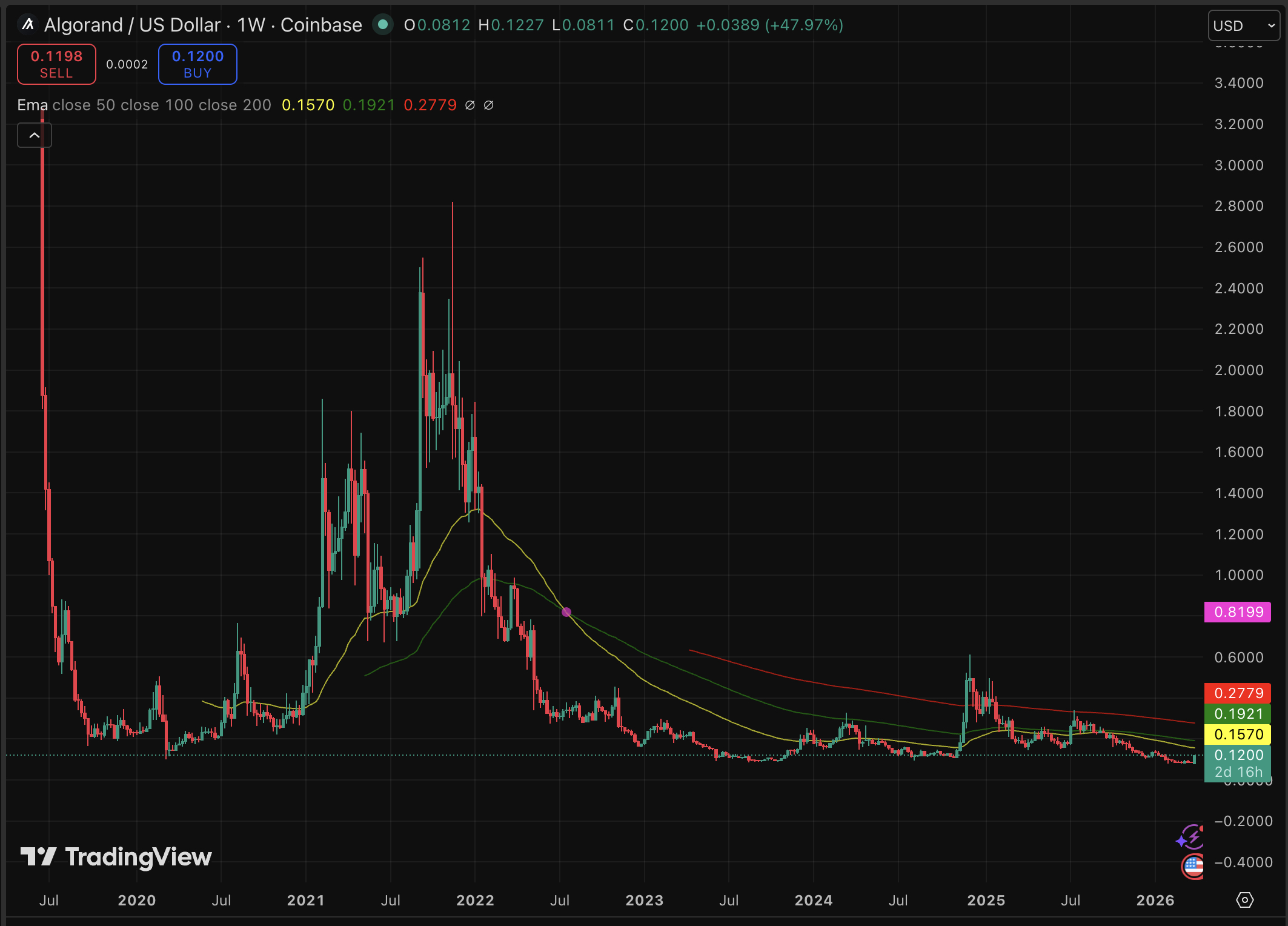
According to data from crypto.news, Algorand (ALGO) price rallied to a 9-week high of $0.122 on Friday before settling at $0.121 at press time. Its gains pushed it to become the leading gainer among the top cryptocurrencies by market cap in both the daily and weekly timeframes.
There are three main reasons why Algorand price rallied today.
First, Algorand was recently cited by Google Quantum AI in a research paper focused on threats faced by major blockchains from quantum computing. The paper made several mentions of Algorand for its post-quantum security and advanced Falcon signature technology, placing it ahead of other major players and trailing only behind Bitcoin and Ethereum.
This citation from one of the most prominent tech labs gave the project a big push to new investors while increasing hype for existing ones.
Second, Revolut has officially enabled staking for Algorand on its platform. This enables its customer base of over 70 million investors to stake ALGO directly from the app.
The move has increased investor demand for the token as it triggered a jump in the total amount being staked on the platform, effectively removing those tokens from circulation and hence lowering potential selling pressure.
Third, Algorand’s rebound follows the token hitting an all-time low just five days ago. The token dropping to its floor likely made it very attractive for buyers who bought the dip following its high-profile citation.
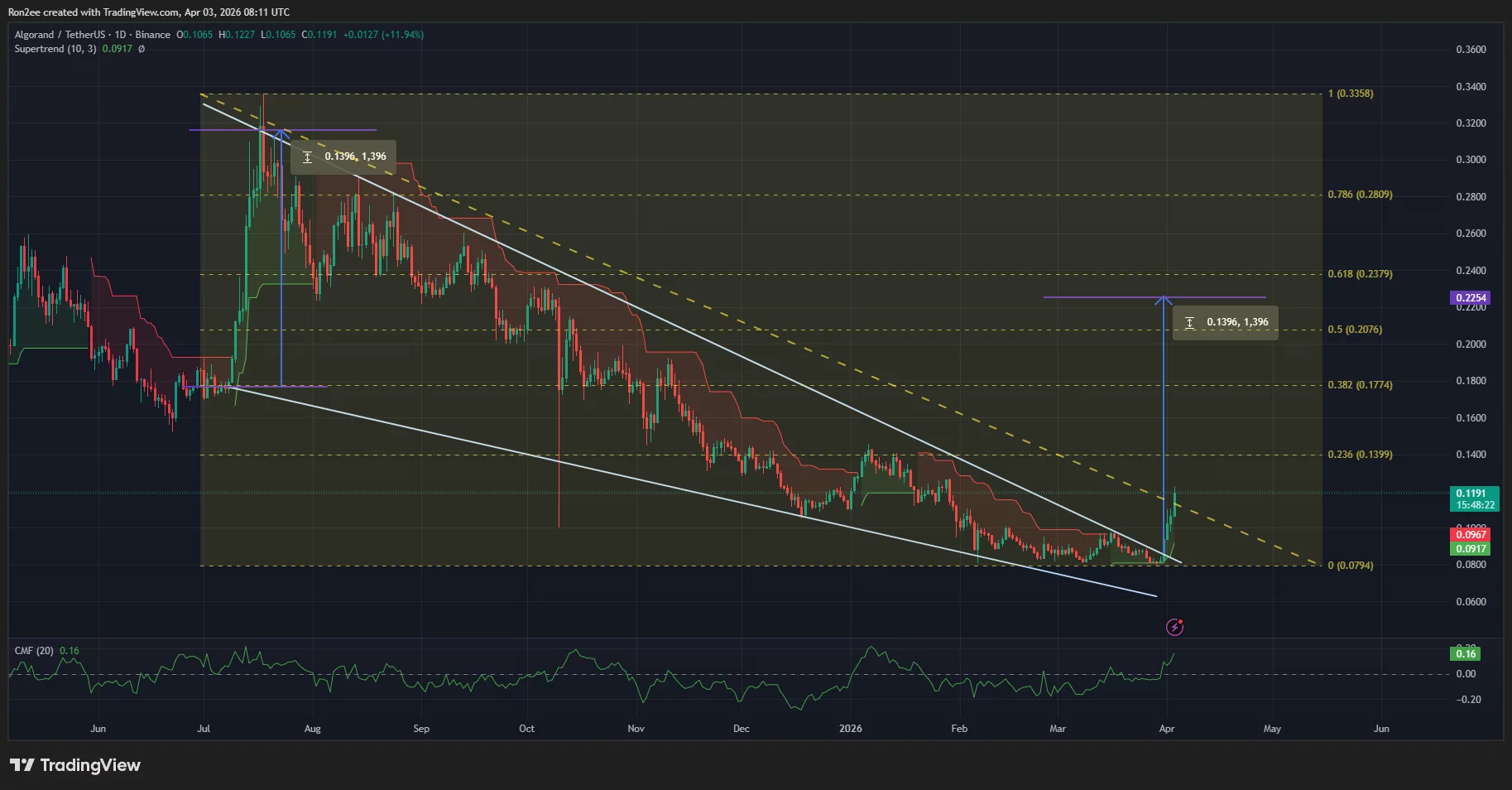
On the daily chart, Algorand price has formed a multi-month falling wedge pattern. Following its recent rebound, it has broken out from the upper trendline of the pattern, thereby confirming a bullish reversal. When such patterns are confirmed, the asset often enters a period of sustained growth.
At press time, a similar bullish outlook for ALGO was supported by technical indicators. Notably, the Supertrend has turned green, a notable sign of a trend shift. The Chaikin Money Flow index read 0.19, a strong positive reading hinting that buyers are in control.
For now, $0.139, which sits at the 23.6% Fibonacci retracement level, is the most immediate resistance level to keep an eye on for identifying more upside. A decisive break above that could potentially trigger a rally to $0.225, a target calculated by adding the height of the wedge to the point at which the breakout occurred.
On the contrary, a drop below the $0.085 support level can invalidate this bullish setup.
Disclosure: This article does not represent investment advice. The content and materials featured on this page are for educational purposes only.
Key Insights
- Crypto market reversed fast as Trump’s Iran war stance crushed hopes of de-escalation and triggered risk-off selling.
- Bitcoin trades like a macro asset, while altcoins lead losses as oil spikes, yields rise, and the dollar strengthens.
- Market outlook remains fragile, with traders watching war signals and dollar strength for the next crypto move
What happens when markets price in peace but receive a tougher war stance instead? They sell first and reassess later. That is exactly what unfolded after Donald Trump addressed the Iran conflict from the White House on April 1.
Ahead of the speech, expectations had been building around a possible de-escalation. Analysts, including Kobeissi Letter, pointed to signals suggesting a potential wind-down. Instead, Trump reinforced a hardline position, stating that the United States would continue its aggressive posture toward Iran.
The next big question tonight:
Tons of major news outlets reported the same information ahead of President Trump’s address to the nation, sending markets sharply higher.
Almost all “insider sources” signaled Trump would be “winding down” the war tonight.
What just happened?
— The Kobeissi Letter (@KobeissiLetter) April 2, 2026
The reaction was immediate and broad-based—crypto, equities, oil, and the U.S. dollar all reversed sharply.
Crypto Market Reverses After Trump’s Iran Remarks
The crypto market quickly erased its short-lived relief rally following the speech. Investors hoping for clarity on de-escalation or a reopening timeline for the Strait of Hormuz were left disappointed.
Source: Coinmarketcap
As a result, selling pressure returned across digital assets:
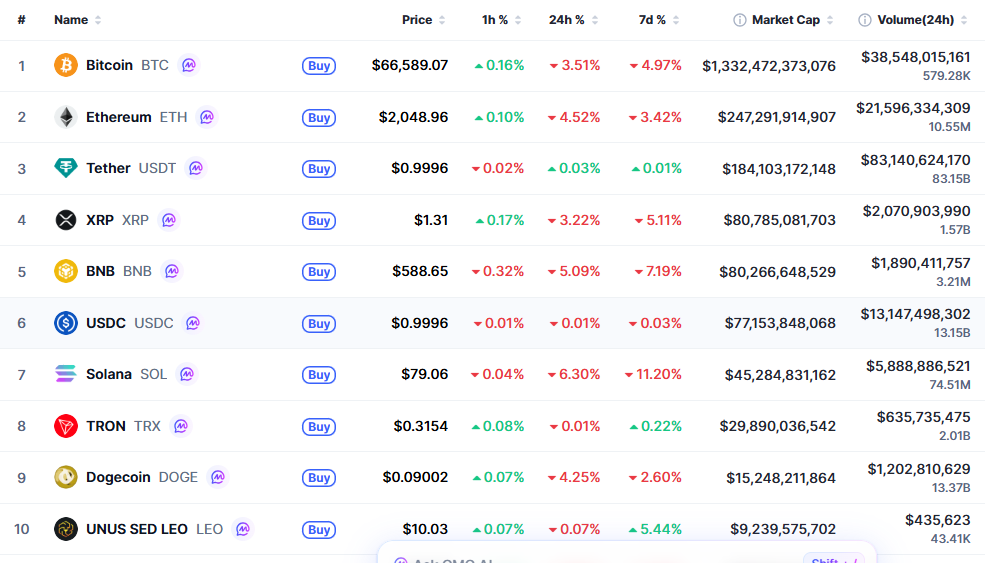
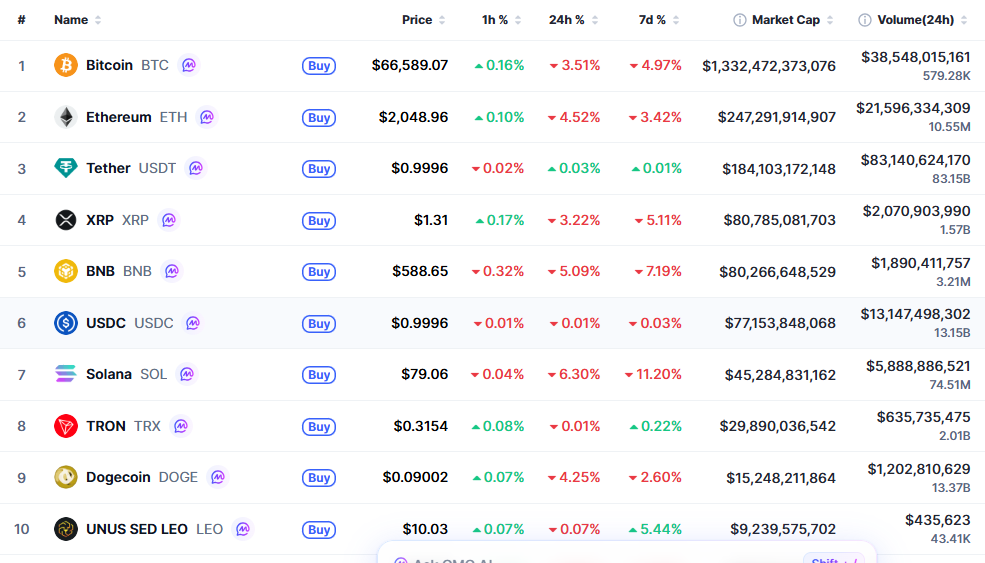
- Bitcoin hovered around $66,600
- Ethereum dropped near $2,050
- XRP traded around $1.31
- BNB held near $590
- Solana led losses among major altcoins
This price action reinforces a key trend: Bitcoin is not behaving as a traditional safe-haven asset during this conflict. Instead, it is trading more like a macro-sensitive risk asset.
The speech effectively dismantled the emerging peace narrative, pushing markets back into a defensive stance. Altcoins, particularly high-beta assets like Solana, absorbed the heaviest losses as traders reduced risk exposure.
Oil Surge and Macro Pressure Weigh on Crypto
Beyond crypto, the broader macro environment shifted rapidly. Following Trump’s remarks, Brent crude surged over 6% to $107.69, reflecting heightened geopolitical risk and concerns over supply disruptions.
Global markets reacted sharply:
- U.S. stock futures fell 1.3%
- Japan’s Nikkei dropped 2.4%
- South Korea’s Kospi declined 4.7%
For crypto markets, this macro shift is critical.
Rising oil prices can fuel inflation expectations, which in turn strengthens the U.S. dollar and keeps bond yields elevated. These conditions typically pressure risk assets, including cryptocurrencies.
At the same time:
- The 10-year Treasury yield climbed to 4.376%
- The U.S. Dollar Index (DXY) held firm above 100
This environment explains why altcoins sold off more aggressively than Bitcoin, as traders moved to reduce volatility exposure rather than chase uncertain upside.
Traders Shift to Risk-Off Mode
The immediate takeaway from the market reaction is clear: traders are prioritizing capital preservation.
Going forward, markets will focus on two key signals:
- Any softening in geopolitical rhetoric
- Reduced risk to global shipping routes, particularly the Strait of Hormuz
Without improvement on either front, the crypto market is likely to remain highly sensitive to headlines and prone to sharp swings.
The pre-speech rally demonstrated that bullish sentiment still exists—but it is fragile and easily disrupted by macro developments.
Macro Now Drives Crypto
The latest selloff highlights a broader shift in how digital assets are behaving.
Geopolitics is influencing crypto through macroeconomic channels rather than crypto-native factors. Oil prices, bond yields, the U.S. dollar, and equity markets are now leading indicators, with crypto reacting afterward.
While blockchain-specific developments still matter, traders increasingly need to interpret global macro conditions before making crypto decisions.
Outlook: Defensive Trend Likely to Continue
Looking ahead, digital assets are expected to remain in a defensive posture as long as geopolitical tensions persist in the Middle East.
Although April seasonality has historically favored bullish momentum, the current environment is dominated by a hope → headline → reversal cycle. The Trump Iran speech is a clear example of how quickly sentiment can shift.
A sustained recovery in crypto will likely depend on:
- A formal ceasefire or de-escalation
- Stabilization in oil prices
- Weakness in the U.S. dollar
Until then, the U.S. Dollar Index (DXY) remains a critical indicator. A strengthening dollar continues to act as a major headwind for Bitcoin and the broader altcoin market.


Researchers at Google DeepMind have warned that the open internet can be used to manipulate autonomous AI agents and hijack their actions.
Summary
- DeepMind researchers have identified six attack methods that can be used to manipulate autonomous AI agents as they browse and act online.
- The study warned that hidden instructions, persuasive language, and poisoned data sources can influence agent decisions or override safeguards.
The study titled “AI Agent Traps” comes as companies deploy AI agents for real-world tasks and attackers begin using AI for cyber operations.
Instead of focusing on how models are built, the research looks at the environments agents operate in. It identifies six types of traps that take advantage of how AI systems read and act on information from the web.
The six attack categories outlined in the paper include content injection traps, semantic manipulation traps, cognitive state traps, behavioural control traps, systemic traps, and human in the loop traps.
Content injection stands out as one of the most direct risks. Hidden instructions can be placed inside HTML comments, metadata, or cloaked page elements, allowing agents to read commands that remain invisible to human users. Tests showed these techniques can take control of agent behaviour with high success rates.
Semantic manipulation works differently, relying on language and framing rather than hidden code. Pages loaded with authoritative phrasing or disguised as research scenarios can influence how agents interpret tasks, sometimes slipping harmful instructions past built-in safeguards.
Another layer targets memory systems. By planting fabricated information into sources that agents rely on for retrieval, attackers can influence outputs over time, with the agent treating false data as verified knowledge.
Behavioural control attacks take a more direct route by targeting what an agent actually does. In these cases, jailbreak instructions can be embedded into normal web content and read by the system during routine browsing. Separate tests showed that agents with broad access permissions could be pushed into locating and transmitting sensitive data, including passwords and local files, to external destinations.
System-level risks extend beyond individual agents, with the paper warning that coordinated manipulation across many automated systems could trigger cascading effects, similar to past market flash crashes driven by algorithmic trading loops.
Human reviewers are also part of the attack surface, as carefully crafted outputs can appear credible enough to gain approval, allowing harmful actions to pass through oversight without raising suspicion.
How to defend against these risks?
To counter these risks, researchers suggest a mix of adversarial training, input filtering, behavioural monitoring, and reputation systems for web content. They also point to the need for clearer legal frameworks around liability when AI agents execute harmful actions.
The paper stops short of offering a complete fix and argues that the industry still lacks a shared understanding of the problem, leaving current defenses scattered and often focused on the wrong areas.
Crypto World
Algorand Crypto Jumps 20% Thanks to Google AI Paper: Cited 32 Times, Revolut Integration Adds Momentum
Algorand (ALGO) is experiencing a +23% surge in 24 hours, the sharpest single-day move up since the name faded from the crypto space after the 2021 bullrun. The catalyst is not a protocol upgrade or exchange listing. A Google Quantum AI whitepaper dropped at the end of last month comes with the Algorand name appearing 32 times. Why?
The Google Quantum AI research examined quantum computing threats across major blockchains, ranking chains by post-quantum cryptography readiness. Algorand landed third by citations, behind only Bitcoin and Ethereum, acknowledged for live deployments covering signatures, state proofs crypto, key rotation, and smart contracts.
Solana received 16 mentions, XRP just 14. Hedera and Avalanche: zero. YouTuber Zach Humphries summarized the community reaction bluntly: “Google Quantum AI basically published a landmark paper yesterday on quantum threats to every major blockchain.” Trading volume spiked +429% to a reported $440 million in 24 hours.
Discover: The best pre-launch token sales
Algorand Crypto Momentum: More Upward Movement?
Apart from Google AI Paper, the simultaneous integration of PostFinance and Revolut opened ALGO exposure to 2.5 million Swiss banking customers, adding institutional weight to what might otherwise have been a short-lived spike.
The confluence of technical recognition, banking access, and a rebound from an all-time low creates a setup worth mapping precisely. Here’s where the levels stand:
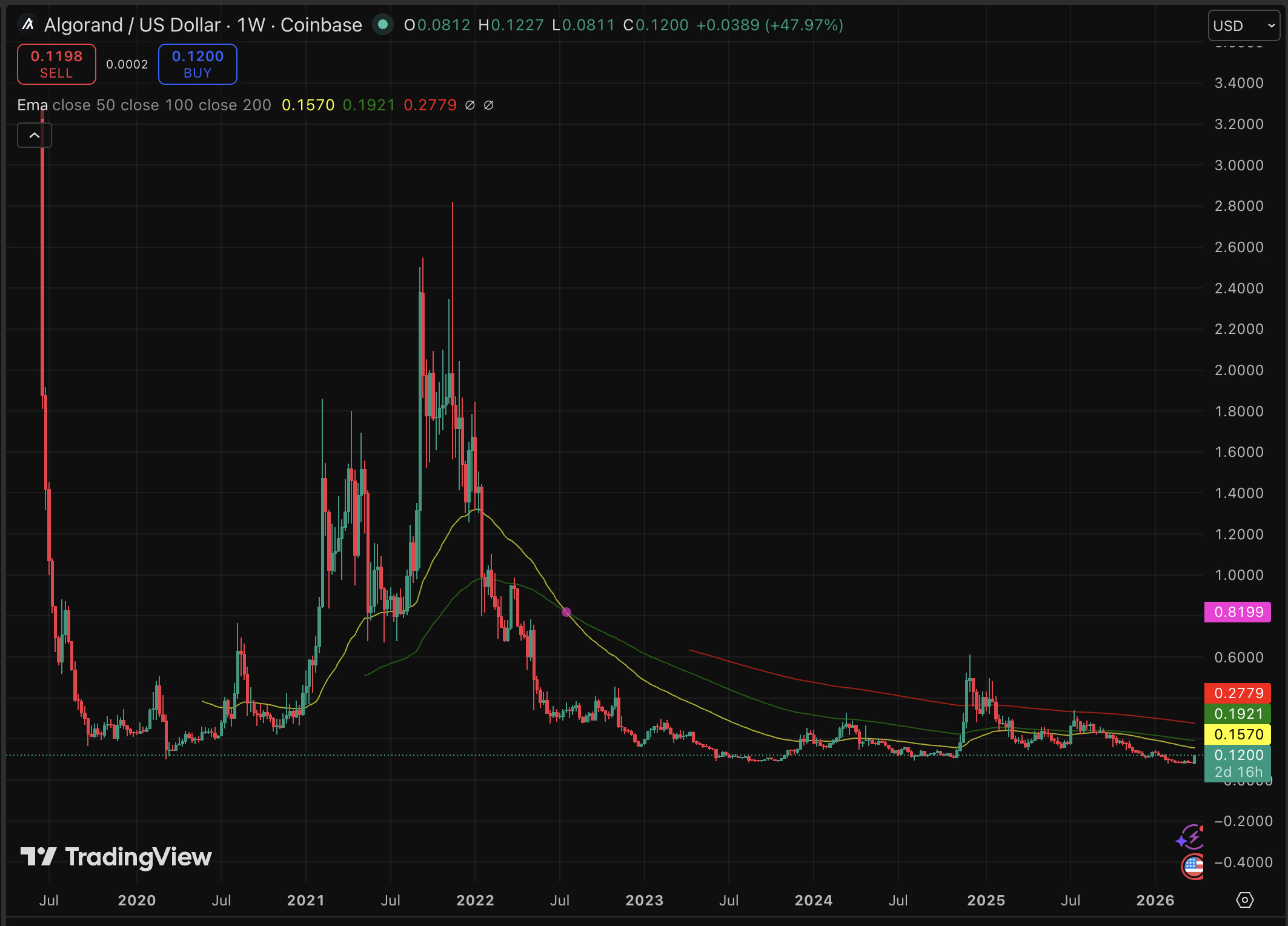
ALGO bottomed at $0.08 on just 4 days ago, an all-time low, before reversing +27% to an 8-week high of $0.1052 within 48 hours. The 24-hour range printed $0.085–$0.105, with the close above $0.10 representing a decisive reclaim of a key psychological level.
Support now sits at $0.082 as the former wedge base and horizontal shelf. Resistance clusters near $0.115–$0.12, the zone where overhead sellers from the previous range are likely concentrated. Market cap sits around $930 million, still sub-$1B, meaning any sustained institutional rotation could move price aggressively. But remember, Algo is 96% below its all-time high in 2019, a good 7 years ago, the day it launched.
Discover: The best crypto to diversify your portfolio with
LiquidChain Targets Early Mover Upside Just Like ALGO 7 Years Ago
ALGO’s move is real, but at a $930M market cap off an all-time low, the asymmetric upside is already partially priced in. Early buyers who caught $0.08 are sitting on +27%. Those entering at $0.105 are chasing a narrative that’s now front-page. That compression of entry quality is exactly where early-stage presales become relevant.
LiquidChain ($LIQUID) is a Layer 3 infrastructure project positioning itself as the cross-chain liquidity layer, fusing Bitcoin, Ethereum, and Solana liquidity into a single execution environment. The architecture centers on a Unified Liquidity Layer, Single-Step Execution, Verifiable Settlement, and a Deploy-Once model that lets developers access all three ecosystems without redeployment.
A new layer emerges. Only a few see it first. — LiquidChain (@getliquidchain) March 24, 2026
The future is LiquidChain  ⟁https://t.co/vqvBcdSj94 pic.twitter.com/R7ZeZ0NPGl
Current presale price is $0.01445, with more than $630K raised to date. Not just cheap and early, the contract is audited by Certik to ensure investors’ safety, plus a bonus of 1700% staking APY for early believers.
Still, for traders who missed the ALGO entry and want exposure to infrastructure-level crypto bets at ground floor, research LiquidChain here.
This article is not financial advice. Crypto assets are highly volatile. Always conduct your own research before investing.
The post Algorand Crypto Jumps 20% Thanks to Google AI Paper: Cited 32 Times, Revolut Integration Adds Momentum appeared first on Cryptonews.
Crypto World
Microsoft (MSFT) Commits $10B to Japan AI Infrastructure with SoftBank and Sakura Internet Partnership

Key Highlights
-
- Sakura Internet’s stock price climbed 20.27% following Microsoft’s revelation of a $10 billion AI commitment in Japan
- The tech giant will deploy 1.6 trillion yen from 2026 through 2029 focusing on AI systems and cybersecurity initiatives
- Partnership includes Sakura Internet and SoftBank delivering Japan-based AI computational power, featuring GPU resources
- Training initiative targets 1 million Japanese engineers and developers by the end of the decade
- SoftBank Group shares increased 0.22% while SoftBank Corp. climbed 1.02% following the announcement
Shares of Sakura Internet experienced a significant 20.27% surge on Friday following Microsoft’s revelation of a substantial AI investment strategy in Japan, with the cloud services provider designated as a primary collaborator along with SoftBank.
Microsoft announced a four-year, $10 billion investment package in Japan, part of the US company’s Asia-wide push to expand in a region hungry for artificial intelligence services- Bloomberg
•$10B for data centers and AI infrastructure through 2029
•Builds on $2.9B announced… pic.twitter.com/laIAvfd383— Yeboah Walee (@YeboahWalee) April 3, 2026
The Redmond-based technology giant confirmed plans to deploy 1.6 trillion yen — approximately $10 billion — across Japan from 2026 to 2029. This capital allocation encompasses AI infrastructure development, cybersecurity collaboration efforts, and an ambitious commitment to educate 1 million engineers and developers over the next six years.
Brad Smith, Microsoft Vice Chair and President, disclosed these plans during his Tokyo visit, which included meetings with Prime Minister Sanae Takaichi.
Sakura Internet, operating a network of data centers throughout Japan, will collaborate with SoftBank to deliver AI computational capabilities through this alliance. The partnership specifically includes graphics processing units situated physically inside Japanese borders.
This infrastructure arrangement enables corporations and governmental bodies to handle confidential information domestically while maintaining access to Microsoft Azure cloud services.
Additional discussions between SoftBank and Microsoft Japan involve creating a combined solution allowing Azure users to access SoftBank’s AI computing infrastructure seamlessly.
Friday’s trading saw SoftBank Group finish 0.22% higher, with SoftBank Corp. posting gains of 1.02%.
Japan’s Strategic Importance
Microsoft highlighted Japan’s robust AI adoption rates as a key motivation behind this investment decision. Data from Microsoft’s AI Diffusion Report indicates that approximately 20% of Japan’s working-age population currently utilizes generative AI technologies, surpassing the global average of roughly 16%.
Smith emphasized the expanding demand for cloud computing and AI capabilities in Japan, noting that this investment supports Prime Minister Takaichi’s strategic vision of leveraging cutting-edge technology for economic expansion and national security objectives.
Extended Collaboration Framework
In addition to Sakura Internet and SoftBank, Microsoft revealed partnerships with five additional prominent Japanese technology firms to achieve its goal of training 1 million AI professionals by 2030. This roster includes industry leaders such as NTT Data Corp., NEC, Fujitsu, and Hitachi.
The collaborative framework will also facilitate advancement of indigenous large language models within Japan’s technology ecosystem.
Microsoft’s cybersecurity collaboration with Japanese authorities encompasses intelligence exchange regarding cyber threats and coordinated crime prevention measures.
Sakura Internet concluded Friday’s session at 2,967.00 JPY, representing a 500.00 JPY increase for the trading day.


In a recent note, the International Monetary Fund (IMF) has warned that tokenized finance poses four distinct risks to the global financial system.
Authored by Tobias Adrian, the IMF’s Financial Counselor and Director of the Monetary and Capital Markets Department, the note frames tokenization as a structural reconfiguration of how trust, settlement, and risk management are organized.
4 Risks the IMF Sees in Tokenized Finance
The first risk centers on interoperability and fragmentation. Multiple platforms operating without common standards could split liquidity across digital silos, reduce netting efficiency, and impair par convertibility between assets.
Second, the IMF warns that tokenized systems amplify financial stability threats. Automated margin calls, continuous settlement, and algorithmic feedback loops compress the time available for intervention during stress events.
Traditional end-of-day buffers disappear, and shocks propagate faster, especially in highly interconnected systems.
Follow us on X to get the latest news as it happens
“Public authorities have a key role to play in setting interoperability standards and promoting common protocols. International coordination is essential to ensure that cross-border transactions achieve atomic settlement and legally recognized finality. Absent such coordination, tokenization may exacerbate existing inefficiencies in cross-border finance, rather than resolve them,” the note read.
Third, cross-border resolution becomes far harder. Tokenized transactions span multiple jurisdictions on shared ledgers, yet resolution powers remain nationally anchored.
This mismatch could produce jurisdictional conflict or paralysis precisely when decisive action is most needed.
Fourth, Emerging and Developing Economies (EMDEs) face acute exposure. Dollar-denominated stablecoins could accelerate currency substitution, volatile capital flows, and erosion of monetary sovereignty in countries with weaker financial systems.
The IMF’s five-pillar policy roadmap calls for anchoring settlement in safe money, applying consistent regulation across equivalent activities, establishing legal certainty for tokenized assets, promoting interoperability standards, and adapting central bank liquidity tools for 24/7 automated environments.
The note concludes that the window for shaping tokenized finance remains open but will not remain so indefinitely. This comes amid strong growth in the tokenization sector.
The total on-chain distributed RWA value has climbed 4% over the past month to $26.7 billion. The represented asset value has jumped 31.61% in the same period. The number of asset holders also increased to 710,792, up 5.56%.
Subscribe to our YouTube channel to watch leaders and journalists provide expert insights
The post IMF Identifies 4 Risks Tokenized Finance Poses to Global Financial System appeared first on BeInCrypto.
Crypto World
Solana Price Prediction: After The Exploit, Is The Network Still Safe? Will Price Recover?
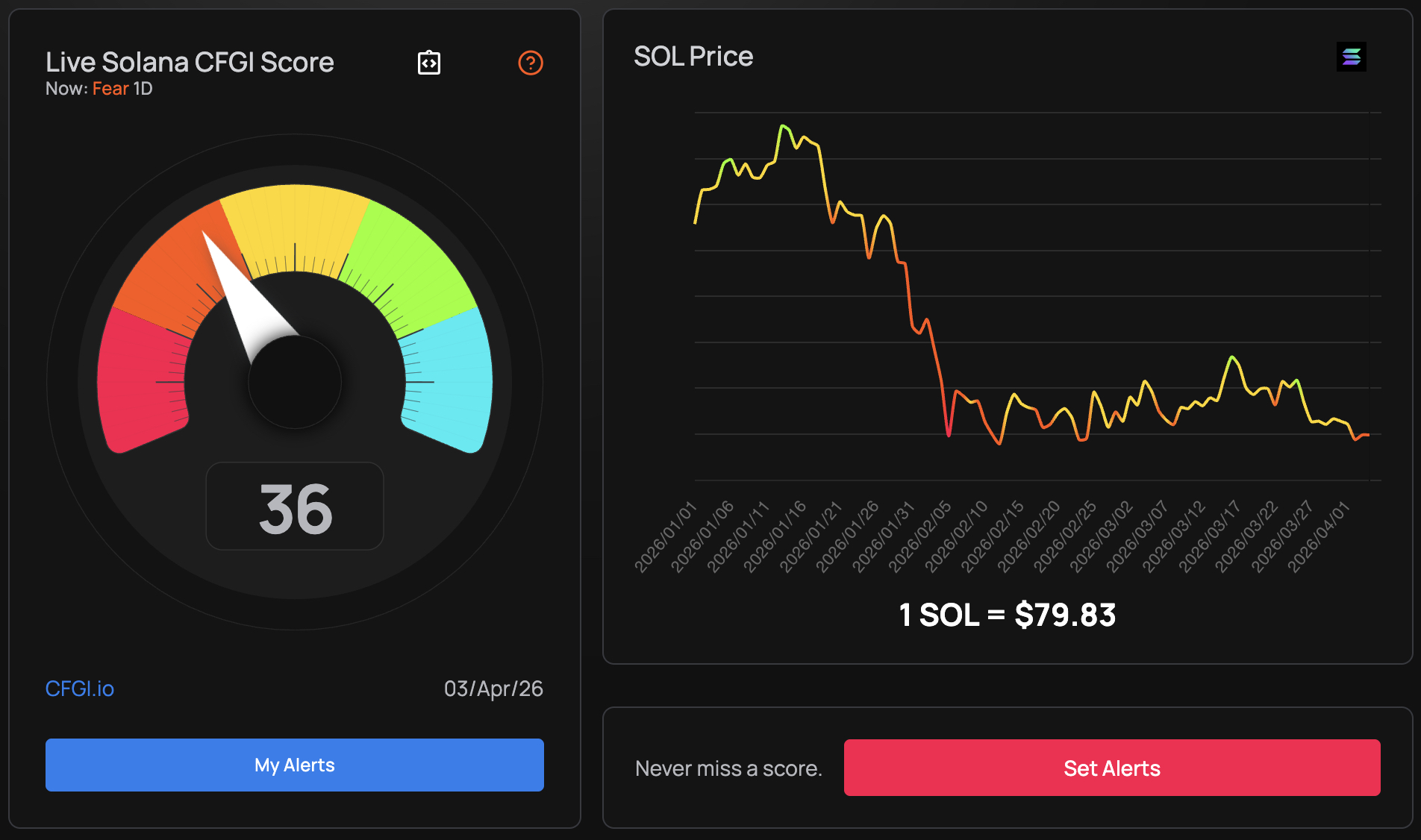
Solana price appears to be stabilizing below $80, but the Drift Protocol exploit raised questions, followed by bearish prediction. Is the network’s infrastructure fundamentally compromised, or is this selloff noise masking a recovery setup?
The Drift Protocol attack drained at least $270 million in under 60 seconds, but notably, no code was broken. The attacker exploited “durable nonces,” a legitimate Solana feature that allows transactions to remain valid indefinitely by replacing the standard 60–90 second expiring blockhash with a fixed on-chain code.
Security council members were tricked into pre-signing administrative transfers weeks before execution, with no way to revoke approval once given. The exploit required more than a week of setup and less than a minute to detonate.
That distinction of feature abuse versus protocol failure is critical for price recovery timing. Macro headwinds compound the damage, BTC hovering at $66,000, S&P 500 under pressure, and oil above $100 stoking stagflation fears that are already suppressing risk appetite across the crypto markets.
Discover: The best crypto to diversify your portfolio with
Solana Price Prediction: Hold $80 Support, or a Drop to $50
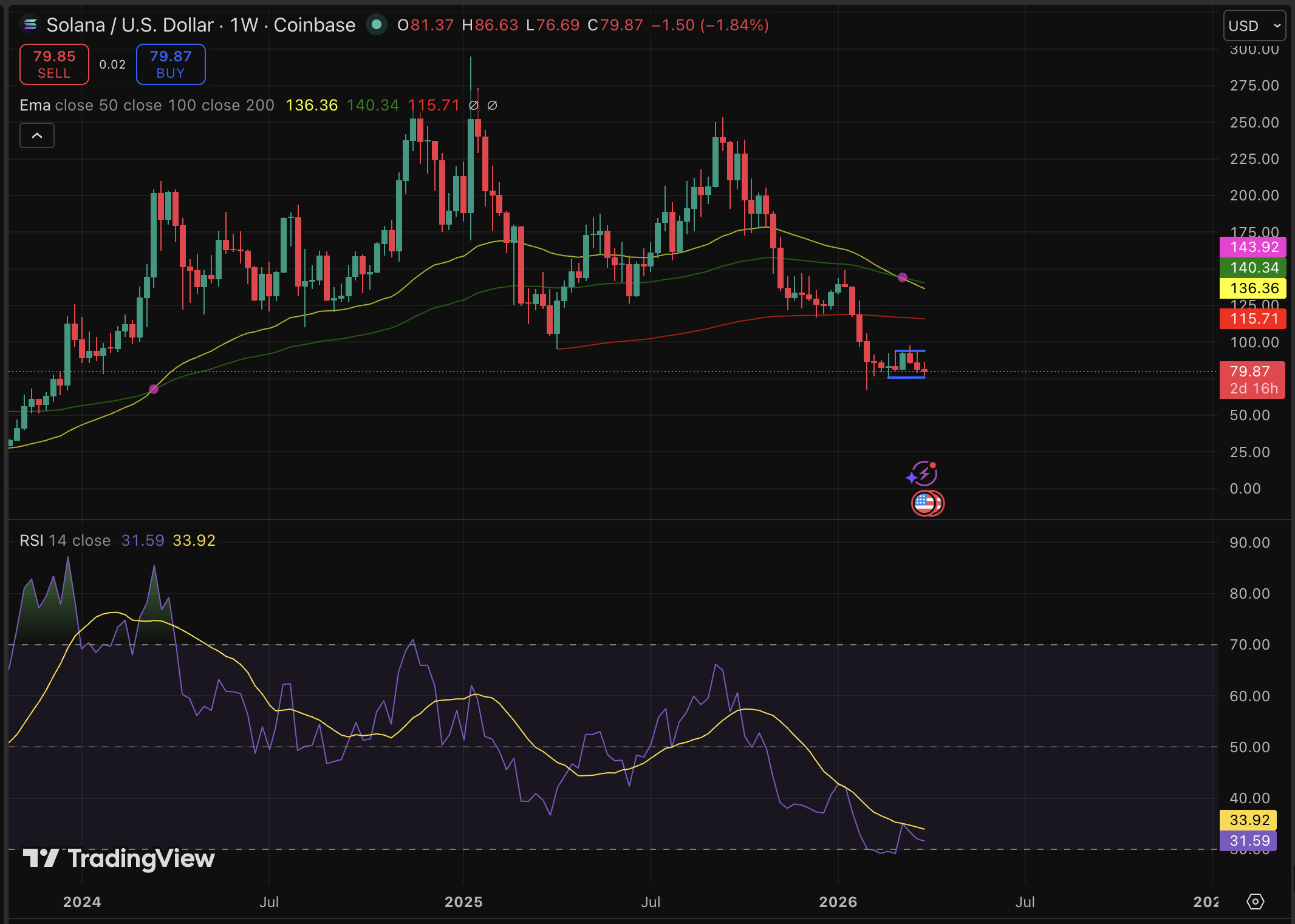
SOL’s technical picture is unambiguously bearish. The RSI sits at 32 on the daily, approaching oversold, but it looks like bears haven’t exhausted themselves just yet. The 50-day SMA at $117 is overhead resistance; the 200-day SMA at $30 is dropping to the 100-day SMA. Only 13% of technical signals read bullish, with the Fear & Greed Index locked at 29 for 46 consecutive days.
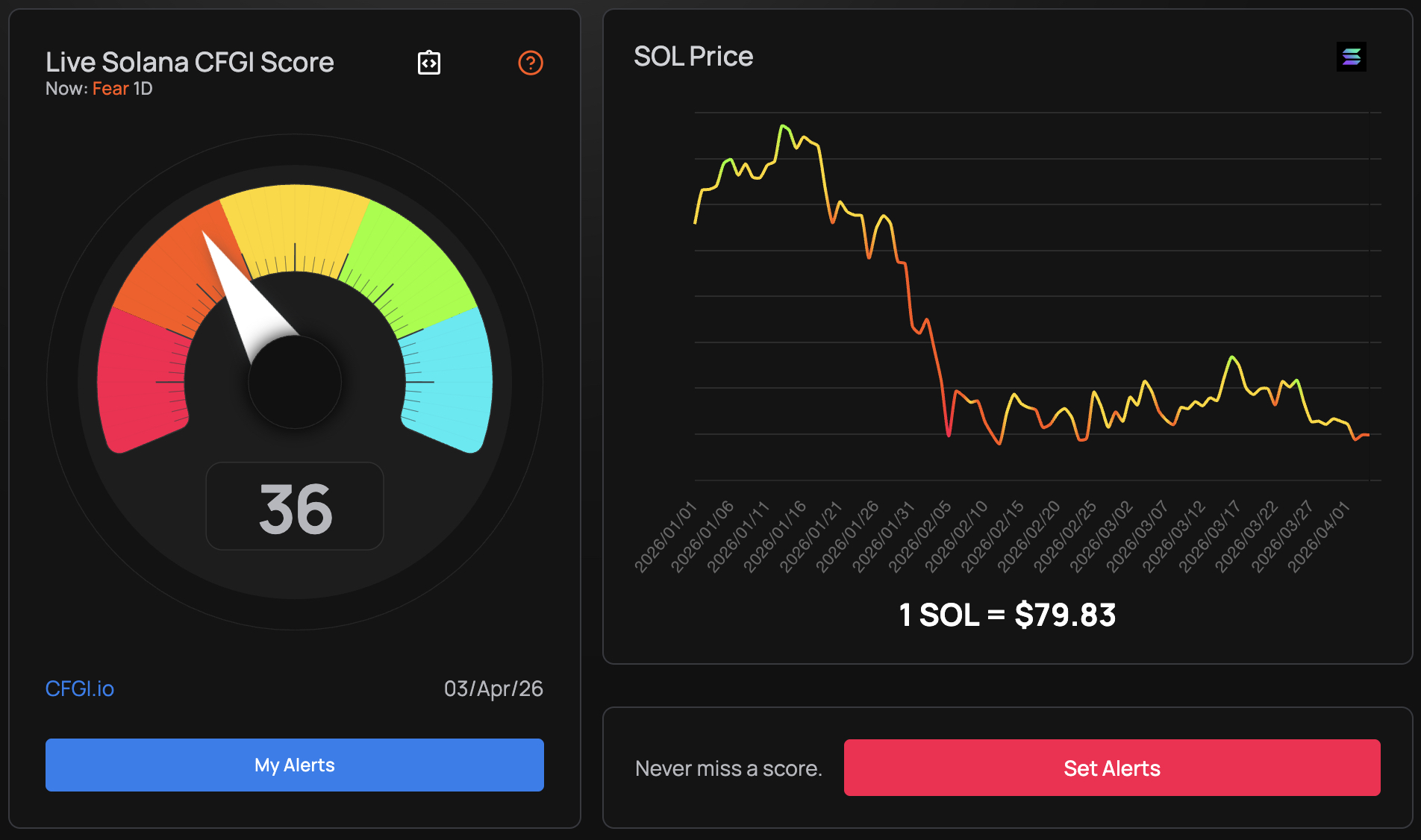
The critical level is $85, and failure to reclaim it confirms the breakdown. Analyst warns a sustained break below $85 opens a flush toward the $50–$30 Fair Value Gap accumulation zone. Network revenue remains 93% below January peaks, undermining any near-term fundamental rebound argument.
The exploit doesn’t erase Solana’s infrastructure roadmap. It does reset near-term trust, and trust is priced faster than fundamentals.
Discover: The best pre-launch token sales
Maxi Doge Targets Early-Mover Upside as Solana Tests Key Levels
SOL at $80 is a setup, but it’s also a waiting game with real downside risk attached. Traders rotating out of established-layer-one volatility are increasingly eyeing early-stage presales where entry price, not recovery timing, does the heavy lifting.
Maxi Doge ($MAXI) is one attracting attention. Built on Ethereum (ERC-20), the project packages a 240-lb canine mascot with genuine community mechanics: holder-only trading competitions with leaderboard rewards, a Maxi Fund treasury dedicated to liquidity and partnerships, and a meme-first marketing engine built around gym-bro culture and the tagline “Never skip leg-day, never skip a pump.”
It’s unambiguously meme-first, which, in this market, is exactly where retail attention is rotating. We know risk-off macro tends to funnel speculative capital toward low-cap narratives, not $80 SOL recovery bets.
Hard numbers: current presale price is $0.0002811, with $4.7 million raised to date and 66% staking APY as a bonus.
Research Maxi Doge before the next price increase.
This article is not financial advice. Crypto markets are highly volatile. Always conduct your own research before investing.
The post Solana Price Prediction: After The Exploit, Is The Network Still Safe? Will Price Recover? appeared first on Cryptonews.
Crypto World
Cardano Climbs the Google Quantum AI Rankings Above Ethereum as the Security Discussion Heats Up

Key Insights
- In Google Quantum AI report, Cardano was ranked above Ethereum as it showed better quantum resistance.
- Exposed wallets and vulnerable smart contracts are major risks to Ethereum.
- The UTXO model used by Cardano provides increased resistance to quantum attacks in the long term.
Cardano was mentioned 5 times (plus 3 citations) on the Google Quantum AI whitepaper.
And it was ranked in the second-best tier for quantum resistance, right behind purpose-built quantum-proof chains.
Above Ethereum. Above Solana. Above XRP.
The UTXO architecture gives Cardano…
— Dan Gambardello (@dangambardello) April 1, 2026
Cardano Making Progress in Google Quantum AI Report
The recent Google Quantum AI whitepaper has rattled the crypto sector with the ranking of Cardano over Ethereum in quantum resistance. The results confused most investors and developers particularly considering the fact that Ethereum had dominated the decentralized applications and smart contracts.
The report stated that Cardano has performed better than Ethereum as well as Solana and XRP, which were ranked in the second-best rank in the field of quantum resilience. Quantum-proof blockchains were only ranked higher by specially designed blockchains.
This acknowledgement is an important achievement of Cardano, which supports the reputation of the blockchain as a research-based and security-oriented one.
The whitepaper mentions Cardano several times, indicating the increasing academic and institutional attention to its architecture. These results are now leading to a more general re-evaluation of the way blockchains need to be ready against future quantum threats.
The UTXO Model of Cardano Is Unique Because of the Following Reasons
The use of the UTXO (Unspent Transaction Output) model is one of the largest strengths of Cardano. UTXO structures provide greater transaction exposure and wallet security compared to the account-based system of Ethereum.
Public keys are not incessantly revealed in the system of Cardano following transactions. This minimizes the attack surface that quantum computers may utilize in future. Cardano offers extra protection to users because of its ability to make sensitive cryptographic data harder to see by restricting the time that the data is in view.
On the contrary, Ethereum design reveals the public keys after a transaction. These keys are stored on the blockchain permanently, which provides a long-term weakness. With the development of quantum computing, this design decision might be a significant security threat.
The results of Google give indirect support to the strategy adopted by Cardano and imply that the architecture would be more resistant to upcoming quantum threats. This competitive edge makes Cardano a good competitor in the dynamic blockchain security market.
The Structural Risks of Ethereum Get into Focus
The same report cast serious doubt on the strength of Ethereum during a quantum computing era. Five possible attack vectors were described by researchers, which focus on various elements of the network.
Wallet exposure is one of the most urgent problems. The report approximates the number of ETH already in wallets with exposed public keys to be 20.5 million. In case a quantum computer powerful enough appears, these wallets would be broken in the nearest future, which may be in a few minutes per key.
The wallets with high value are especially vulnerable. Tens of billions of dollars of digital assets could be at risk with a potential of being exposed to dozens of major wallets. More vulnerabilities are also brought about by the smart contract ecosystem of Ethereum.
Most of the smart contracts that are run by an administration, such as stablecoins and token issuance, use a set of cryptographic standards that might not resist quantum attacks. The report indicates that there are approximately 70 large contracts that are in this high risk category.
The Future of Ethereum
These risks are not being overlooked by Ethereum developers. As a reaction, a post-quantum research program was initiated earlier this year, with a long-term upgrade roadmap expected to be completed by 2029. The plan will contain various hard forks that will enhance the cryptographic defenses.
Nevertheless, these upgrades are associated with enormous challenges. The current smart contracts cannot be updated automatically through the network. Every protocol should update its codebase separately, adopt new cryptographic standards, and change keys in the cases when it is required.
This piecemeal system may slow the adoption and expose sections of the ecosystem to long durations. Other projects can postpone or even skip upgrades, which exposes the risk window.
A Movement toward Structural Resilience
The results of Google Quantum AI have changed the discussion to long-term security instead of short-term performance. Although Ethereum remains the most widely used and innovative, its architecture is under greater scrutiny now.
Cardano, in its turn, enjoys the advantage of being founded on formal approaches and proactive security standards. Its model is based on UTXO and eliminates the need for more intricate upgrades and quantum threats.
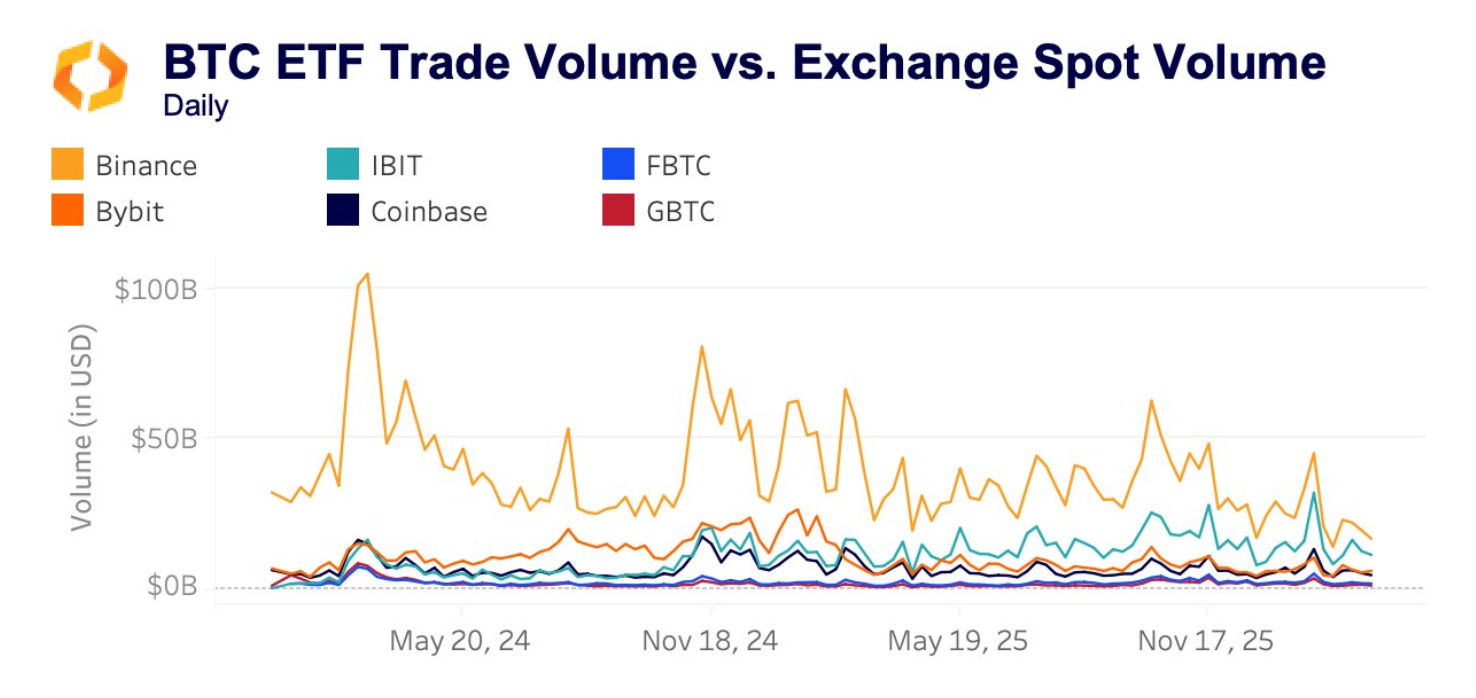
BlackRock’s iShares Bitcoin Trust (IBIT) now processes between $16 billion and $18 billion in daily trading volume, positioning the regulated fund as a direct competitor to the world’s largest crypto exchanges.
The data, reported by analytics firm Kaiko, signals that institutional-grade products are pulling liquidity away from crypto-native platforms at a pace few anticipated.
A Regulated Giant Takes on Crypto Exchanges
IBIT’s daily turnover now more than doubles the $6 billion to $8 billion that Coinbase processes on its spot market.
The figure also approaches Binance’s spot trading activity, long considered the benchmark for global crypto liquidity.
The shift suggests regulated financial products are becoming competitive alternatives to traditional cryptocurrency exchanges. For an ETF that launched in January 2024, the speed at which IBIT has scaled is striking.
BlackRock’s fund commands roughly 70% market share by volume among U.S. spot Bitcoin (BTC) ETFs.
That dominance has only grown as institutional allocators increase their exposure through listed products rather than direct exchange access.
Q1 2026 Tested ETF Conviction
Despite IBIT’s trading volume surge, broader ETF flows told a more complicated story during the first quarter.
Spot Bitcoin ETFs saw $496.5 million in net outflows during Q1, with $1.8 billion leaving in the first two months.
Bitcoin fell 23.8% in Q1 2026, its worst first-quarter performance since 2018. The selloff, compounded by geopolitical tensions in the Middle East and the Federal Reserve’s cautious policy, triggered heavy redemptions in January and February.
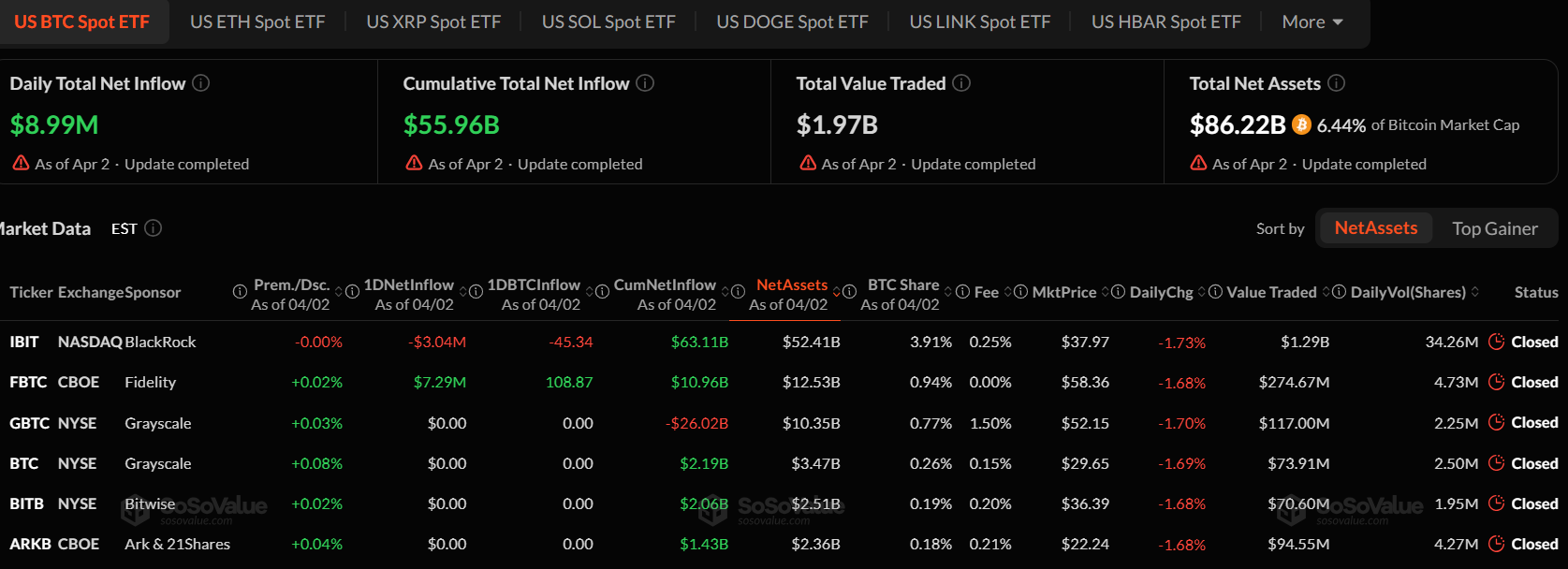
However, figures from SoSoValue show that the funds added $1.32 billion in March and ended a dry spell that had lasted since October 2025. March’s reversal marked the first monthly gain for spot BTC ETFs in 2026.
On April 2, U.S. spot Bitcoin ETFs recorded a modest $8.99 million in total net inflows, led by Fidelity’s FBTC with $7.29 million.
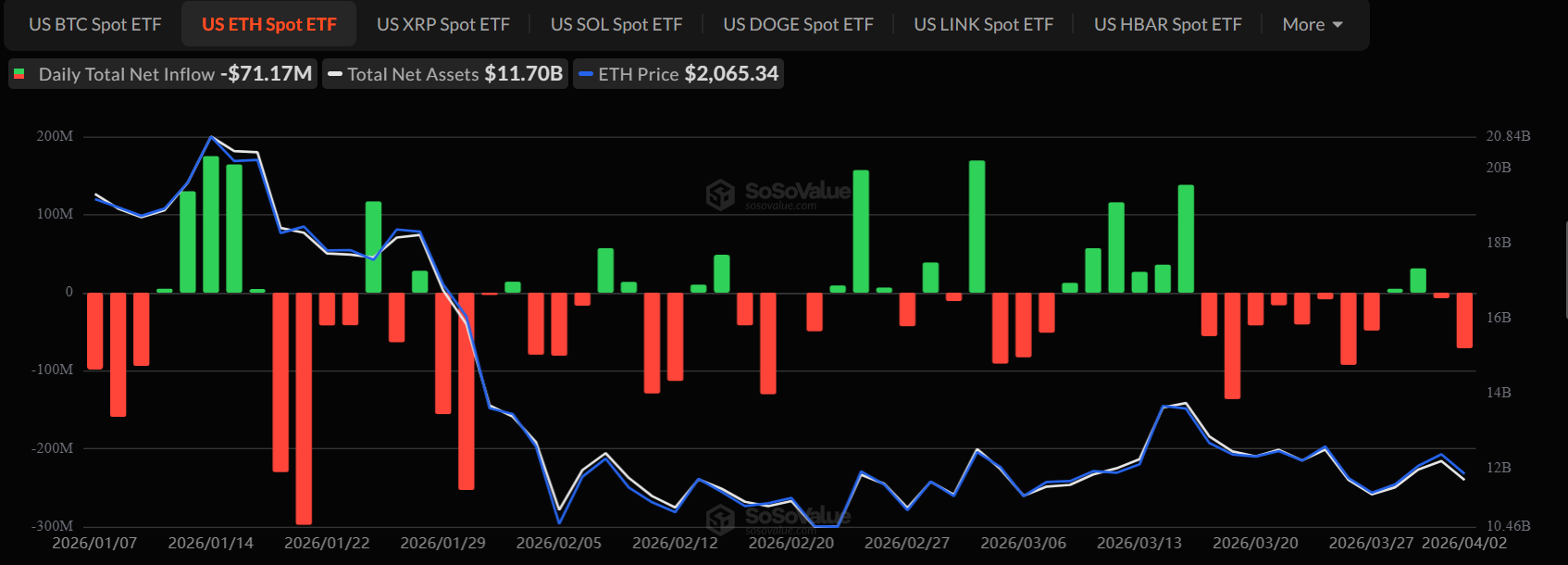
Spot Ethereum ETFs, meanwhile, posted $71.17 million in net outflows, with BlackRock’s ETHA seeing the largest single-day withdrawal at $46.66 million.
What Comes Next for ETF Flows
The contrast between IBIT’s surging volume and the broader category’s uneven flows raises an important question.
- Trading activity does not always equal fresh capital entering the market.
- High volumes can also reflect hedging, rebalancing, or short-term positioning.
Spot Bitcoin ETFs closed Q1 as their second-worst quarterly performance since launch, only behind Q4 2025’s $1.15 billion in cumulative outflows.
Whether April sustains March’s momentum or reverts to the pattern seen earlier in the quarter will likely depend on macroeconomic signals and BTC price stability.
In the meantime, IBIT’s ability to match crypto-native exchange volumes confirms that the line between TradFi and digital asset markets continues to blur.
The post BlackRock’s Bitcoin ETF Now Rivals Binance, Doubling Coinbase in Daily Volume appeared first on BeInCrypto.

From Tokyo Neon To Okinawa Beaches

Kanye West Defies Backlash With Packed LA Show
MEXC Integrates USD1 into Full-Spectrum Infrastructure for Global Users


-

 NewsBeat7 days ago
The Story hosts event on Durham’s historic registers
-

 NewsBeat14 hours ago
Steven Gerrard disagrees with Gary Neville over ‘shock’ Chelsea and Arsenal claim | Football
-

 Sports6 days ago
Sweet Sixteen Game Thread: Tide vs Michigan
-
Entertainment4 days ago
Fans slam 'heartbreaking' Barbie Dream Fest convention debacle with 'cardboard cutout' experience
-
 Entertainment5 days ago
Lana Del Rey Celebrates Her Husband’s 51st Birthday In New Post
-

 Crypto World2 days ago
Gold Price Prediction: Worst Month in 17 Years fo Save Haven Rock
-
Crypto World3 days ago
Dems press CFTC, ethics board on prediction-market insider trades
-

 Tech4 days ago
The Pixel 10a doesn’t have a camera bump, and it’s great
-

 Sports3 days ago
Tallest college basketball player ever, standing at 7-foot-9, entering transfer portal
-

 Tech3 days ago
EE TV is using AI to help you find something to watch
-

 Business9 hours ago
No Jackpot Winner and $194 Million Prize Rolls Over
-

 Fashion5 days ago
Amazon Sundays: Soft Spring Layers
-

 Business1 day ago
Login and Checkout Issues Spark Merchant Frustration
-

 Crypto World3 days ago
U.S. rule change may open trillions in 401(k) funds to crypto
-

 Tech3 days ago
How to back up your iPhone & iPad to your Mac before something goes wrong
-

 Tech4 days ago
Avatar Legends: The Fighting Game comes out in July and it looks pretty slick
-

 Tech4 days ago
Apple will hide your email address from apps and websites, but not cops
-

 Politics4 days ago
Should Trump Be Scared Strait?
-

 Tech3 days ago
Flipsnack and the shift toward motion-first business content with living visuals
-

 Tech5 days ago
Elon Musk’s last co-founder reportedly leaves xAI
You must be logged in to post a comment Login