

Crypto World
Seized Crypto Lapses Push South Korea to Enforce Tighter National Controls


TLDR
- South Korea launched a nationwide audit to strengthen controls over seized crypto assets.
- The Finance Ministry and financial regulators reviewed storage methods and internal access procedures.
- Officials aimed to identify weak practices and introduce stronger technical safeguards.
- Police in Gangnam lost 22 BTC after giving custody to an external firm without private key control.
- The National Tax Service apologized after exposing recovery phrases that led to a major theft.
South Korea moved fast to reinforce digital asset controls as officials addressed recent security failures, and the government ordered urgent checks across agencies, and leaders demanded strict oversight to prevent further losses.
Audit of Seized Crypto Holdings
South Korea launched a nationwide audit after new directives reshaped digital asset management practices. Authorities examined seized coins across agencies and reviewed storage controls. The Finance Ministry coordinated the process with the Financial Services Commission and the Financial Supervisory Service. Officials targeted holdings gained through tax and criminal cases.
Officials reviewed hardware wallets and custodial accounts and assessed access controls. They said the audit aimed to expose weak procedures and guide new protections. Leaders stated that agencies must “fix system gaps fast” to stop unauthorized transfers. They also confirmed that operational reports will go directly to senior oversight teams.
Police losses in Gangnam triggered stronger demands for new custody rules. Investigators confirmed that officers lost 22 BTC after handing assets to an outside firm. Officials said the officers never controlled private keys, which raised concerns about current arrangements. Regulators asked agencies to track crypto flows better.
A separate error at the National Tax Service pushed the government to act. The agency disclosed recovery phrases in a public release. Thieves drained most of a $5.6 million holding, and leaders called the failure preventable. The agency apologized and began internal checks.
Legal and Structural Shifts in South Korea
The Supreme Court of Korea ruled in January that exchange-held Bitcoin qualifies as property. This decision cleared earlier confusion over enforcement powers. Officials said the ruling eased asset seizure procedures. They added that agencies can pursue digital holdings more quickly under clear rules.
The government continued updating its Digital Asset Basic Act. Phase two will impose rules for stablecoin reserves and investor protection. Officials said the updates will strengthen oversight for market players. They also confirmed that agencies will publish final provisions soon.
Regulators ended a nine-year block on corporate crypto trading in February. They allowed listed firms and professional traders to reenter markets. Authorities said new compliance rules will govern trading activities. They will also monitor corporate flows under updated reporting systems.



XRP slips about 4% in 24h as $652m flows to Binance amid Iran‑linked risk‑off move.
Summary
- Around 472m XRP (≈$652m) moved to Binance in a week, the largest February inflow stretch, coinciding with US–Iran tensions.
- XRP trades roughly $1.3–$1.4, down about 4% daily and over 35% year‑on‑year, while 24h volume holds near multi‑billion levels.
- On‑chain data shows clustered late‑February exchange inflow spikes, signaling defensive positioning and potential short‑term sell‑side pressure.
XRP (XRP) exchange inflows to Binance have risen sharply, creating potential sell-side pressure as geopolitical tensions involving the United States, Israel and Iran escalate, according to CryptoQuant contributor Darkfost.
The exchange received more than 472 million XRP over the past week, representing what Darkfost described as the largest inflow stretch recorded on Binance for XRP during February, according to data shared by the analyst.
The market reaction intensified following weekend escalations in the Middle East, when strikes were launched shortly after the close of traditional financial markets, Darkfost stated. The timing amplified uncertainty across risk assets, with cryptocurrency markets reacting to the geopolitical developments, according to the analysis.
Chart data shared by Darkfost shows a cluster of unusually large inflow bars in late February, including several daily spikes well above prior February levels, while XRP’s price remained relatively unstable.
“Such inflows typically reflect a more defensive posture from investors holding XRP,” Darkfost wrote. “When large amounts of tokens move onto exchanges, it often signals a potential willingness to sell or at least to position liquidity closer to the market.”
Large transfers onto exchanges often precede increased liquidations or discretionary selling, particularly during broader risk-off periods, according to market observers. The transfers do not confirm outright selling, but shift substantial supply closer to the market during a period of elevated uncertainty.
“When amounts of flows like this are recorded, they can create the conditions for a sudden wave of selling pressure capable of impacting price action in the short term,” Darkfost stated.
The analyst noted that traders should monitor “whether it reflects the start of a broader distribution dynamic on XRP or simply short-term panic movements triggered by geopolitical uncertainty.”
During periods of geopolitical stress, traders typically reduce directional exposure and move assets into venues where they can exit quickly if volatility increases, according to market analysts.


Bitcoin trades flat as Hong Kong readies March stablecoin licenses and 2026 dealer–custodian rules to boost tokenized finance.
Summary
- HKMA will issue the first fiat‑backed stablecoin issuer licenses in March, limited to a small cohort under a strict regime.
- SFC and FSTB plan 2026 legislation for virtual asset dealers and custodians, aligning standards with securities brokers and licensed custodians.
- Authorities prioritize tokenization, allowing debenture registers on-chain and piloting EnsembleTX wholesale CBDC for 24/7 settlement of tokenized deposits and cross‑border assets.
Hong Kong is set to grant its first stablecoin issuer licenses in March and introduce legislation for crypto asset dealers and custodians later this year, according to regulatory announcements.
The licensing regime, which is already in place, will permit regulated issuers to explore applications in a compliant, risk-controlled manner, officials stated. Approvals for fiat-backed stablecoin issuers are expected to be granted in March.
Beyond stablecoins, Hong Kong plans to expand oversight to digital asset dealing, which covers the regulated buying, selling, or exchanging of virtual assets, as well as custodian services. The Securities and Futures Commission is focused on enhancing liquidity and enabling a wider range of products for professional investors, including crypto margin financing and derivatives, according to the regulator. The SFC will also launch an accelerator designed to speed innovation.
Tokenization of traditional financial instruments represents a key priority for Hong Kong authorities. Guidance will allow debenture registers to be maintained on blockchains, while electronic signatures may be adopted for tokenized bond issuance, regulators said.
The Hong Kong Monetary Authority continues to develop its EnsembleTX platform, a pilot program for its wholesale central bank digital currency designed for 24/7 real-value settlement of tokenized deposits and cross-border digital assets, according to the HKMA.
On tax compliance, Hong Kong will amend the Inland Revenue Ordinance over the next two years to implement the Organisation for Economic Co-operation and Development’s Crypto Asset Reporting Framework and updated Common Reporting Standard, aligning with global standards for crypto asset transparency.
The combined regulatory efforts are aimed at strengthening Hong Kong’s regulatory framework, promoting market liquidity, and positioning the city as a hub for tokenized finance and compliant stablecoin issuance, according to government statements.
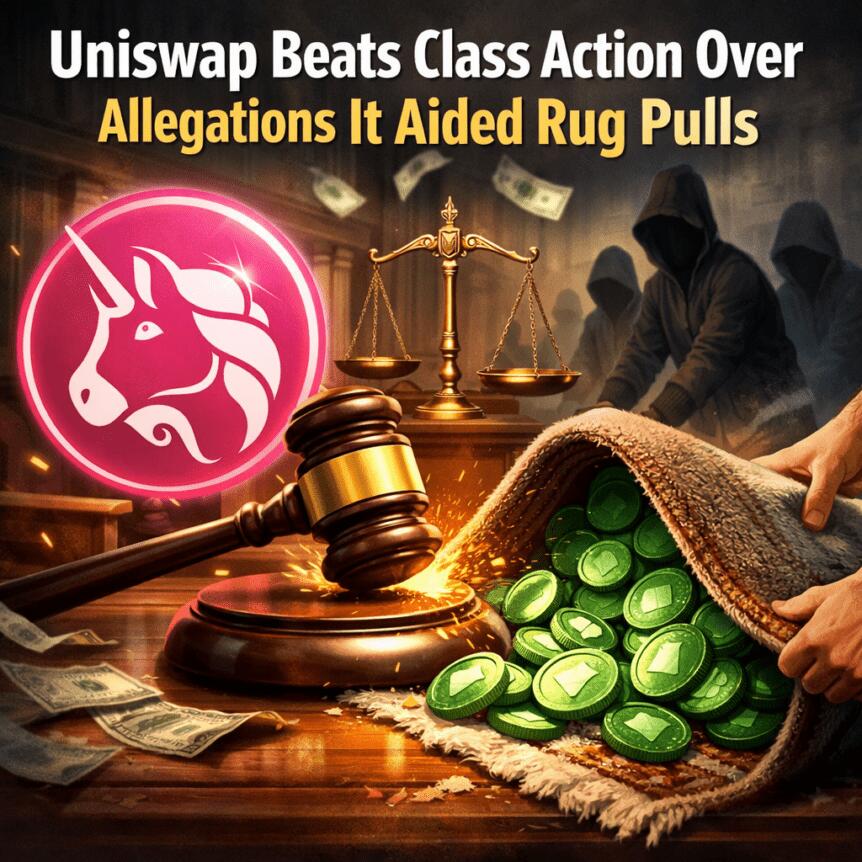
Uniswap Labs and its founder Hayden Adams secured a decisive legal victory in a four-year dispute that challenged the decentralized exchange’s role in allegedly enabling scam tokens. A Manhattan federal judge, Katherine Polk Failla, dismissed the class-action suit against Uniswap with prejudice, effectively ending the case and signaling that platform operators should not be held liable for the misdeeds of unaffiliated third-party token issuers. The plaintiffs had pursued what they described as state-level consumer-protection claims, arguing that Uniswap’s open marketplace facilitated rug pulls and pump-and-dump schemes. The ruling arrives after the plaintiffs amended their complaint to sharpen their theories around consumer protection and DeFi conduct.
The case first landed in federal court in April 2022. After an initial dismissal in August 2023, the appellate process did not overturn the lower court’s view, setting the stage for the latest decision. Adams reacted to the ruling on social media, deeming it a “good, sensible outcome” and portraying it as a potential legal precedent for the open-source, permissionless design that underpins many DeFi projects. The court’s written opinion underscores a central theme in the legal treatment of decentralized finance: platform operators that provide the infrastructure, without actively participating in fraudulent activity, may not be deemed to have aided fraud simply by hosting services used by others.
In her opinion, Judge Failla rejected the core theory advanced by the class representatives: that Uniswap’s platform knowledgeably facilitated fraud or substantially assisted those responsible for it. The judge stressed that the plaintiffs failed to allege that Uniswap “had knowledge of the fraud and substantially assisted in its commission.” Merely creating an environment where unlawful activity could occur does not equate to affirmative participation or control over the wrongdoing. The decision aligns with a line of reasoning that emphasizes the distinction between providing a service that is agnostic to misuse and actively enabling or enabling criminal behavior.
The court’s formal ruling came after the plaintiffs, led by Nessa Risley, continued to pursue a theory that framed Uniswap as a conduit for consumer harm, despite the platform’s status as an open, on-chain exchange protocol. The complaint tied alleged misdeeds to the broader ecosystem of projects launched on Uniswap, but Failla’s order makes clear that the presence of scammers in a marketplace does not automatically impose liability on the platform operator. As the judge wrote, “No matter how they try to dress up their allegations, Plaintiffs are basically alleging that Defendants substantially assisted fraud by providing ordinary services that anyone could use for lawful purposes, but that some used for unlawful purposes.”
The decision also touches a longstanding tension in crypto law: how to apportion responsibility in an ecosystem built on code that anyone can inspect and deploy. Adams, for his part, has framed the ruling as a protective precedent for developers who contribute to open-source smart contracts. In a platform-agnostic sense, the ruling delineates boundaries between hosting infrastructure and actively enabling illicit activities. It remains to be seen how other courts will interpret similar claims against different DeFi protocols or open-source projects, but Failla’s order provides a reference point for future cases that hinge on the line between standard platform services and substantive assistance to fraud.
While the litigation ended for Uniswap in the current forum, the episode sits within a broader debate about consumer protection in crypto markets and the accountability of developers and platforms. The plaintiffs had also named venture financiers Paradigm, Andreessen Horowitz, and Union Square Ventures as defendants in the original complaint, highlighting the ecosystem’s interconnected web of developers, capital providers, and marketplaces. The court’s analysis, however, centers on Uniswap’s role as a protocol provider and its duties, or lack thereof, to police every token listed on its decentralized exchange. The opinion avoids endorsing a blanket shield for all DeFi activity but reinforces the principle that liability is not triggered by mere platform exposure to potential misuse.
The backdrop to this ruling includes ongoing regulatory and legal scrutiny over crypto markets, especially around how consumer protections apply to decentralized technologies. A separate line of legal and regulatory developments continues to evolve as courts weigh questions of oversight, responsibility, and the allocation of risk among platform operators, project issuers, and investors. While the decision neither endorses a laissez-faire approach nor endorses unbridled liability for developers, it does clarify that the legal standard for “substantial assistance” is nuanced and demands concrete demonstrations of active participation rather than mere facilitation by offering a widely accessible tool.
As Adams noted in his post, the ruling represents a boundary-setting moment for the open-source community behind DeFi. The sentiment among developers and investors is that the decision preserves the ability to innovate without being automatically tethered to criminal activity that occurs off-chain and outside the direct control of protocol builders. Yet, the judge’s explicit insistence that plaintiffs must establish knowledge and substantial assistance if they claim fraud implies that future lawsuits may still test how courts interpret the duties of platform operators in relation to on-chain activity and off-chain outcomes. The line remains nuanced, and the possibility of further litigation in related cases or different jurisdictions persists.
Why it matters
For users and builders, the ruling offers a clearer framing of risk and responsibility within DeFi ecosystems. It emphasizes that the mere existence of a marketplace where bad actors can operate does not automatically pin liability on the platform. This distinction matters for innovation, as developers can continue to contribute open-source code and deploy smart contracts with confidence that liability will not be presumed merely because someone else exploited the system for wrongdoing. At the same time, the decision preserves a path for consumer-protection claims under specific contexts, should plaintiffs be able to demonstrate concrete knowledge or affirmative assistance by a platform.
From a market perspective, the dismissal reduces near-term litigation risk for open-source DeFi protocols and their funders, while underscoring the importance of sound security practices, transparent governance, and robust auditing of smart contracts. It signals that regulators and courts may demand careful consideration of the line between providing a generic service and actively enabling unlawful conduct. In practice, that means protocol teams may continue to rely on established best practices—audits, formal verification, transparent disclosures, and clear user protections—without fearing automatic liability for every token or project launched with their tooling.
Yet the case also demonstrates that the legal framework surrounding crypto remains unsettled in important ways. The judge’s critique of the plaintiffs’ theory—treating ordinary platform services as substantial assistance—serves as a reminder that litigation strategies will need to articulate more precise evidence of knowledge and intent to secure a favorable ruling. Investors and developers should monitor how courts define “substantial assistance” in future disputes, particularly as on-chain activity becomes more complex and as regulatory attention intensifies around DeFi governance, token issuance, and consumer protections.
What to watch next
- Whether the plaintiffs pursue any further appellate action or attempt new claims under different theories.
- Any regulatory guidance or policy shifts that address platform liability in open networks and consumer protection in DeFi markets.
- Rulings in parallel cases involving other DeFi protocols or token issuers that might refine the standard of care for platform operators.
- Market and developer responses in the wake of the decision, including governance discussions around risk management and compliance tooling for on-chain projects.
Sources & verification
- Order by U.S. District Judge Katherine Polk Failla in Risley v. Uniswap, docket: 63213270/126 (New York Southern District Court).
- Original April 2022 complaint and the May 2022 amendment focusing on consumer-protection theories.
- Historical dismissal in August 2023 and subsequent appellate posture as described in the cited coverage.
- Hayden Adams’ X post commenting on the ruling as a “good, sensible outcome.”
- Cointelegraph coverage of related litigation and regulatory context, including references to Bancor patent cases and other crypto-law developments linked in the article.
Key details and context
Uniswap Labs and its founder successfully navigated a complex civil action that tested the boundaries between open-source platforms and accountability for misuse. The decision reaffirms a fundamental principle: simply hosting a platform or providing broadly available tooling does not automatically amount to substantive participation in fraudulent activity. The court’s analysis focused on the plaintiffs’ ability to show that Uniswap knew of the fraud and actively assisted it, rather than merely offering a general-purpose service used by others for legitimate or illegitimate purposes. The judge’s language makes clear that the court does not imply immunity for platform builders in every circumstance, but it places a high bar on claims that seek to reframe ordinary platform services as preparatory steps for wrongdoing.
Why this topic matters for the crypto landscape
The outcome contributes to the ongoing calibration of risk for DeFi developers, investors, and users. By drawing a line between open infrastructure and direct facilitation of fraud, the ruling supports continued innovation while signaling that meaningful evidence of knowledge and intent remains essential to establish liability in similar disputes. As the ecosystem evolves, market participants will closely watch how courts across jurisdictions interpret liability standards for platform operators, the role of auditing and governance, and the balance between consumer protection and the permissionless ethos that underpins decentralized finance.
The Bitcoin market is currently navigating a high-stakes “defensive liquidity” environment as global markets reel from the sudden escalation of the US-Iran conflict.
Summary
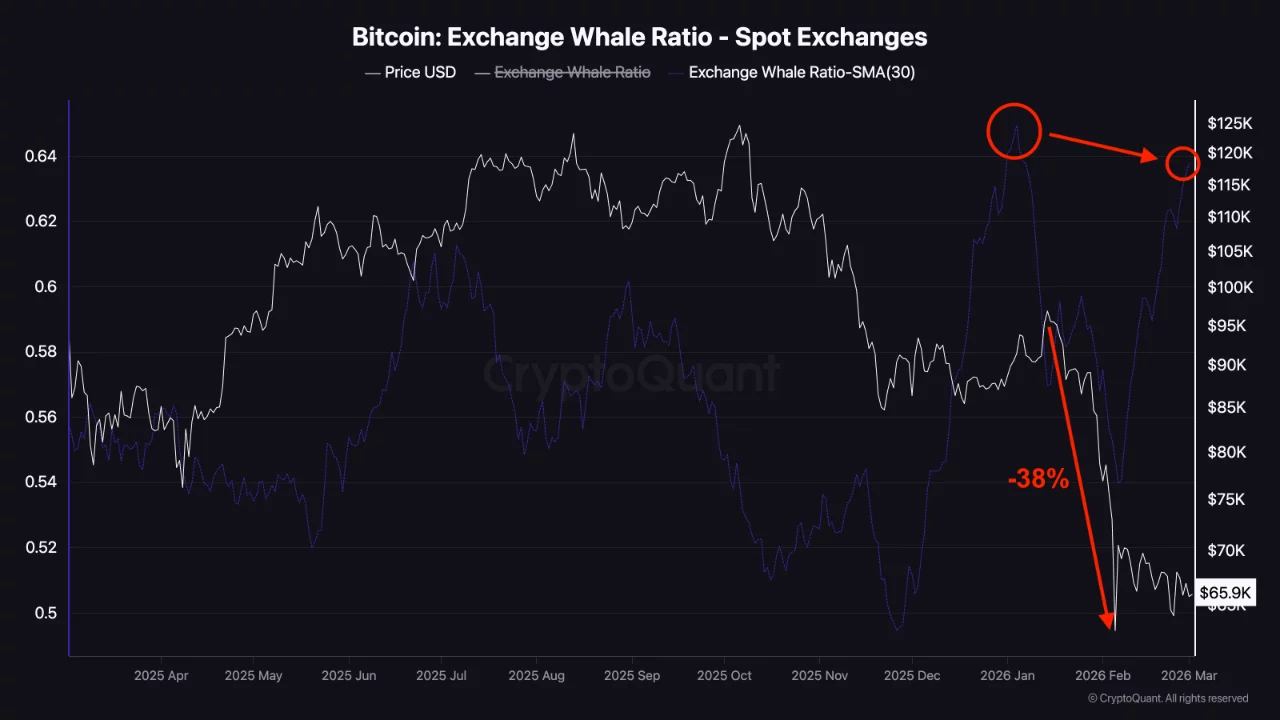
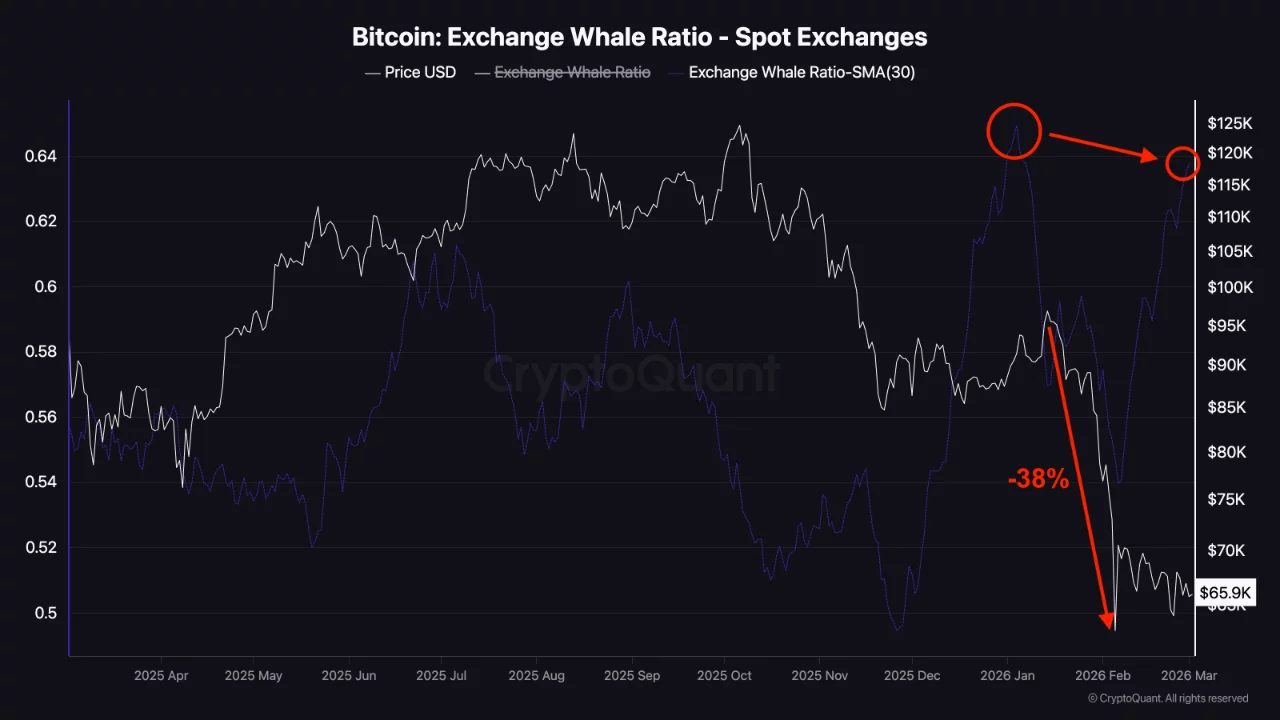
- The “Exchange Whale Ratio” has spiked to levels that historically preceded a 38% price drop, suggesting that large holders are actively repositioning as the US-Iran military conflict escalates following the death of Iran’s Supreme Leader.
- Despite high whale activity, the Coinbase Premium Index remains negative, indicating that organic U.S. buying interest has vanished as investors pivot toward traditional safe havens like gold and oil.
- While USDC inflows suggest capital is returning to exchanges, this liquidity remains sidelined and inactive, creating a fragile market structure where price action is driven by speculative flows rather than fundamental accumulation.
BTC whales position for volatility amid Middle East strikes
Following military strikes on February 28, 2026, and subsequent retaliatory drone attacks across the Gulf, the Bitcoin’s (BTC) Exchange Whale Ratio (30d SMA) has begun a sharp ascent.
CryptoQuant data highlights that this specific technical spike historically mirrors the lead-up to major price corrections, such as the 38% decline seen earlier this cycle. While whales aren’t necessarily dumping, their rising activity suggests large-scale players are aggressively repositioning in anticipation of further geopolitical fallout.
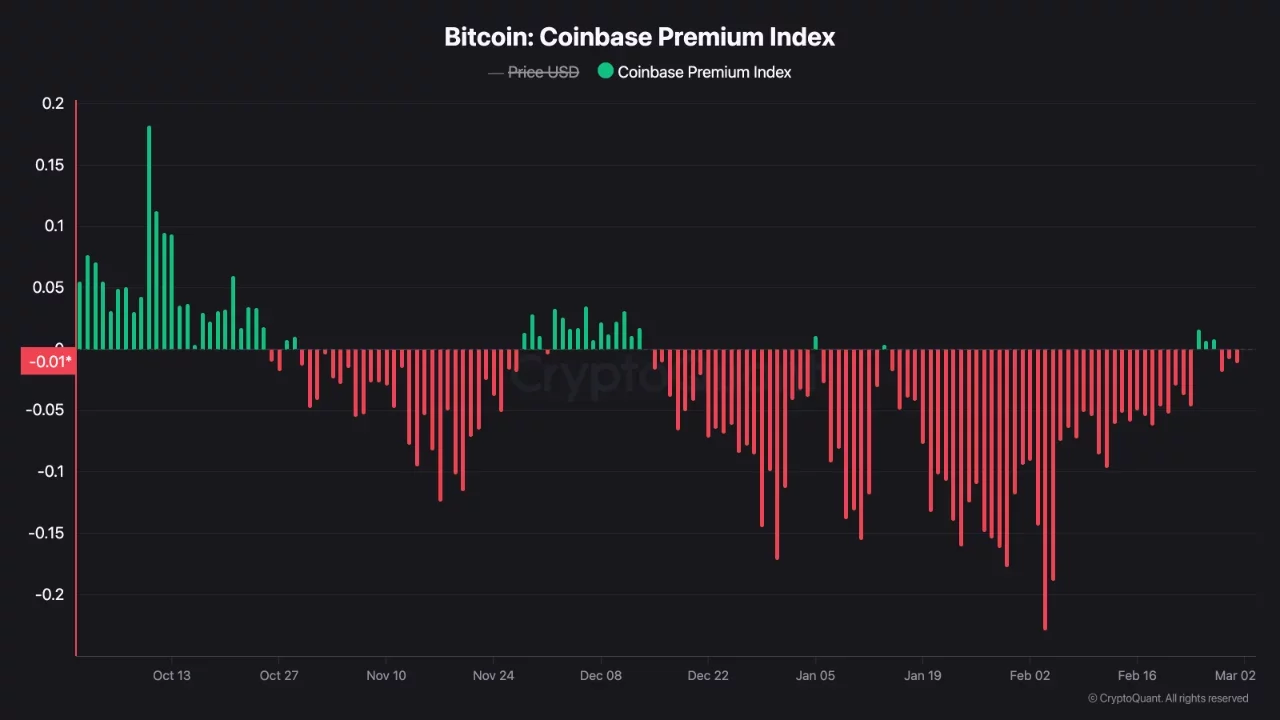
Despite the surge in whale movements, organic buying remains notably absent.
The Coinbase Premium Index is firmly in negative territory, signaling that U.S. spot demand has vanished as investors pivot toward traditional safe havens like gold and oil.
On-chain data reveals a “liquidity trap”: while USDC (ERC-20) netflows to exchanges have turned positive, this capital remains sidelined, serving as a defensive buffer rather than fueling Bitcoin purchases.
Meanwhile, USDT continues to migrate toward alternative rails like Tron, further indicating a fragmented and cautious liquidity structure.
The current price action is no longer being driven by fundamental adoption but by tactical positioning against a backdrop of war.
With the Strait of Hormuz effectively closed and global equity futures plunging, Bitcoin’s recent rebound to $66,600 appears fragile. Without a return of sustained spot demand, the market remains susceptible to “flow-driven” volatility where whales dictate the trend.
Until the geopolitical dust settles and U.S. buyers return to the fold, any upward momentum is likely to be met with heavy overhead resistance.
Key insights
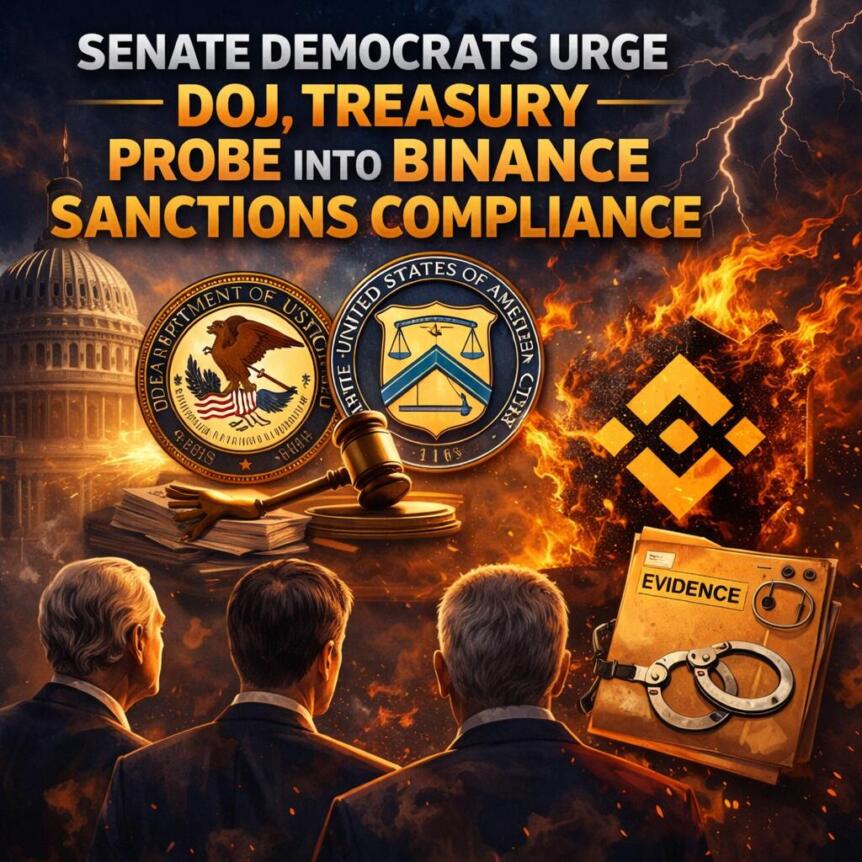
- Lawmakers request a DOJ and Treasury review of Binance’s sanctions and AML controls.
- Reports allege $1.7B in crypto flowed to Iran-linked entities via the exchange.
- Senators cite concerns over post-settlement compliance and political ties.
Senate Democrats have asked the U.S. DOJ and Treasury to examine whether Binance has violated U.S. sanctions and the terms of its 2023 settlement with federal authorities. The request raises fresh scrutiny of the exchange’s controls against illicit finance.
🚨NEW: Eleven Senate Banking Dems including @SenWarren, @MarkWarner, @CortezMasto, @Sen_Alsobrooks and @SenRubenGallego sent a letter to @PamBondi and @SecScottBessent urging DOJ and Treasury to investigate @binance over media reports of illicit finance activity, including…
— Eleanor Terrett (@EleanorTerrett) February 27, 2026
The letter came from eleven Democrats on the U.S. Senate Banking, Housing, and Urban Affairs Committee. It urged a comprehensive review of Binance’s compliance systems after media reports linked the platform to transactions involving Iranian entities.
Allegations of Iran-linked transactions
The senators stated that internal compliance findings at Binance suggested about $1.7 billion in digital assets moved through the exchange to Iranian actors. The letter referenced groups tied to terrorism and Iran’s security apparatus. Lawmakers said a vendor connected to Binance allegedly handled a large share of the transfers.
The letter, led by Mark Warner and signed by Ranking Member Elizabeth Warren, also claimed that Iranian users accessed more than 1,500 accounts. It further warned that Russian-linked actors may have used the platform to evade sanctions.
Senators expressed concern that Binance dismissed staff who flagged suspicious activity. They also referred to reports that the exchange lowered the collaboration with the law enforcement. They argued that such actions would be against its federal agreement.
Compliance obligations and prior settlement
In 2023, Binance pleaded guilty to charges tied to sanctions violations and anti-money laundering failures. The exchange agreed to pay more than $4 billion and accepted U.S. oversight. The settlement required stronger know-your-customer checks and sanctions screening.
Under its agreement with the Treasury’s Office of Foreign Assets Control, Binance committed to blocking prohibited transactions. Senators claimed that the reported flows to Iran would undermine those commitments. They asked regulators to confirm whether Binance maintains effective controls.
Political ties and broader risks
The letter also noted Binance’s recent business links involving Donald Trump and his family’s crypto ventures. Lawmakers cited promotion of a Trump-backed stablecoin issued by World Liberty Financial, a major investment tied to the project.
They also referenced Trump’s pardon of Binance founder Changpeng Zhao, who had pleaded guilty upon failing to implement an effective anti-money laundering program and served a four-month prison sentence.
Beyond Iran, senators pointed to Binance’s expansion in parts of the former Soviet Union and partnerships that could expose the platform to sanctions risks involving Russia. They requested responses from federal officials by March 13.


On April 14–15, 2026, Moscow will host Blockchain Forum 2026 — the largest crypto and Web3 event in the CIS region. Over the years, the forum has evolved into a key industry platform where digital asset leaders, banks, investment funds and technology companies converge to shape the future of the market.
Blockchain Forum is not merely a conference; it is an infrastructure-level meeting point for the ecosystem. It is where strategic discussions take place, partnerships are formed and projects that define the direction of the digital asset industry are launched.
Scale and Market Concentration
The 2026 edition is expected to bring together over 20,000 participants from 100+ countries, 250 exhibiting companies and more than 200 exclusive speakers, many of whom will be speaking in Russia for the first time.
This creates a rare concentration of expertise, capital and technological innovation on a single platform.
Attendees include investors, venture funds, banks, crypto exchanges, Web3 startups and infrastructure providers, enabling direct dialogue between builders, capital and institutional stakeholders.
200+ Exclusive Speakers
The agenda will feature leaders of major crypto platforms, investment executives, digital asset regulation experts and technology innovators. Many of these speakers rarely appear in the region, making Blockchain Forum a valuable opportunity for direct engagement and first-hand insights.
Exhibition and Practical Use Cases
The exhibition area will host 250 leading crypto companies presenting infrastructure solutions, new products and emerging technologies. Participants will not only hear about trends from the stage but also explore real-world applications — from product premieres to direct interaction with founders and teams.
AI Future Forum: The Convergence of AI and Web3
A dedicated AI Future Forum will take place alongside the main agenda, focusing on the integration of artificial intelligence and blockchain technologies. The convergence of AI and Web3 is widely regarded as one of the defining directions of digital economy development in the coming years.
Networking as a Strategic Asset
Blockchain Forum is recognized as a strategic networking environment. Beyond the main stages, negotiations take place, investment discussions unfold and long-term partnerships are initiated. The structure of the event enables participants to gain, in two days, the level of access and insights that would otherwise require months of fragmented communication.
Official Afterparty Headliner — L’One
The official Afterparty will be headlined by L’One, one of the most prominent artists on the Russian stage. His live performance will serve as the culmination of the forum, bringing participants together in the atmosphere of a large-scale show combined with premium networking.
The Afterparty traditionally extends the business agenda into a more informal yet equally valuable environment for relationship-building.
Blockchain Forum 2026 represents a combination of strategic dialogue, technological innovation, and capital concentration, creating a space where decisions are made and the future of the market is shaped.
Tickets are available on the official website. A 10% discount is available with promo code beincrypto.
More details: https://blockchain.forum/en/
TLDR
- Experts state that the conflict in Iran does not threaten the global Bitcoin mining network.
- Analysts report that online claims about large hashrate losses in Iran are overstated.
- Data shows the Bitcoin hashrate stayed stable and continued to operate normally.
- Wolfie Zhao explains that any mining issues in Iran would not affect global network performance.
- Ethan Vera confirms that Iran contributes less than one percent of global hashrate.
Industry analysts stated that current unrest in Iran does not threaten the wider Bitcoin network, and they stressed that global hashrate levels remain stable. They pointed out that early online claims overstated the scale of possible outages, and they said the Bitcoin market continues to absorb regional shifts without stress.
Iran’s Mining Capacity Faces Pressure But Experts Reject Major Network Impact
Analysts addressed new concerns as online discussions raised fears about large-scale power failures, and they argued that the network can withstand local disturbances. They said the situation differs greatly from earlier global shocks, and they insisted that Iran’s role remains small in global output.
Wolfie Zhao stated that the conflict does not threaten the network, and he dismissed claims of sharp disruption. He said “individual miners may face issues,” but argued that the broader system operates normally and continues to handle load shifts.
Market posts referenced the risk of large sell-offs and grid failures, and they warned that thousands of rigs could shut down. However, analysts countered these claims and said projections on social platforms lacked data support.
Bitcoin Mining Outlook and Reported Hashrate Changes
Observers tracked hashrate levels after the first attacks, and they found that the network output held its range over several days. They noted that the network rose above one zettahash before easing slightly early Tuesday.
Ethan Vera said Iran controls less than one percent of global hashrate, and he stressed that the network would not slow down even if local operations paused. He said “there will be no material impact to block times” and argued that security would remain intact.
He added that the sector includes small private miners and older operations tied to former Chinese groups, and he said these firms do not anchor global output. Analysts also said Iran’s regulatory hurdles limit growth and keep its mining share relatively low.
Iran’s Crypto Activity and Rising Exchange Outflows
Reports showed that Iran uses crypto channels to move funds outside the dollar system, and analysts said these flows track political tensions. They added that the country’s crypto sector reached several billion dollars last year, based on recent research.
A blockchain report found that some activity links to state-connected groups, and it said domestic events often drive short bursts in trading behavior. It also recorded a sharp jump in outgoing exchange transfers within minutes of the latest attacks.
A market platform run by Dastan displayed a higher probability estimate for a change in Iran’s leadership, and its users increased wagers over the weekend. This shift mirrored rising speculation across social feeds, which pushed new claims about possible mining losses.
Data from multiple trackers continued to show stable performance, and they indicated that the network functions without delay or stress. New readings early Tuesday placed the hashrate slightly below one zettahash, which aligned with trends observed throughout the week.
NoOnes founder Ray Youssef is being investigated by the US Department of Justice (DOJ). The probe centers on allegations that Youssef’s peer-to-peer crypto marketplace, Paxful, operated without proper licensing and failed to implement effective anti-money laundering (AML) controls before it shut down in 2025.
Prosecutors also claimed Paxful facilitated transactions linked to unlawful activities, including payments tied to commercial sex advertising platforms. Youssef disputed the allegations, arguing the move represents a further continuation of the war on crypto.
Prosecutors Cite Years Of Compliance Gaps
Federal prosecutors have charged Youssef in the US District Court for the Eastern District of California. The indictment focuses on his role as co-founder and former CEO of Paxful.
According to court documents obtained by BeInCrypto, prosecutors alleged that Paxful lacked adequate Know Your Customer procedures and meaningful internal compliance controls. Authorities further alleged the platform did not timely file Suspicious Activity Reports as required under federal law.
Authorities also claimed Paxful facilitated transactions linked to unlawful online enterprises, including commercial sex advertising platforms.
The indictment cited specific, dated Bitcoin transfers that prosecutors say were sent from Paxful wallets to addresses linked to Backpage, an online platform accused of facilitating illegal commercial sex advertising.
Youssef has strongly rejected the charges in a series of social media posts.
Youssef Publicly Rejects Criminal Allegations
In a video uploaded to his X account, Youssef claimed that he was in Mexico when authorities deported him to Los Angeles, under orders from the DOJ. He was subsequently arrested and sent to a prison in Santa Ana until a judge ordered his release under supervision following his arraignment. Until the case’s resolution, Youssef cannot leave the United States.
Youssef described the charges as “bogus” and claimed that the case largely rests on approximately $240 worth of Bitcoin transactions.
According to the indictment, Paxful embedded a “Pay with Paxful” button directly on Backpage, allowing users to buy Bitcoin through Paxful and use it to pay for ads on the site.
It further stated that undercover federal agents opened Paxful accounts and successfully completed these transactions, which prosecutors cited as evidence that the payment system actively facilitated related activity.
For Youssef, the situation reinforced his belief that the war on crypto never stopped existing. Instead, it just became more selective.
“If you were doing a token like our president, and retail lost a couple billion, well that’s fine. If you’re like CZ and sold a couple of hundred billion by liquidations and price manipulation, well that’s fine. If you just stole money from retail, no one cares. Go ahead,” Youssef said in an X video.
The latest events come at a difficult time for Youssef’s role in different crypto projects.
Paxful To Pay Million-Dollar Fine
Last week, NoOnes announced on social media that Youssef was no longer the company’s CEO. It also clarified that the legal matters he currently faces are “personal and unrelated to” the company’s decision.
Four days before the DOJ indicted Youssef, Paxful pleaded guilty to three federal criminal charges related to Backpage.
According to court documents, Paxful admitted it conspired to promote illegal prostitution through interstate commerce, operated as an unlicensed money transfer business, and failed to put proper anti-AML controls in place.
In July 2024, Paxful co-founder Artur Schaback pleaded guilty to conspiracy to fail to maintain an effective AML program in relation to the same scheme.
Although federal guidelines suggested a much higher penalty, Paxful will pay $4 million based on its financial condition. The company is scheduled to be sentenced in February 2026.


Some of the comments below the company’s post said this purchase shows “conviction, not hesitation.”
After hinting about another purchase on Sunday, Strategy’s co-founder and former CEO, Michael Saylor, has made it official, indicating that his firm has splashed $204.1 million to acqure additional 3,015 BTC.
The average cost for the latest transaction was $67,700, and the company’s stash has grown to 720,737 BTC. It was purchased at an average price of just under $76,000, which means that the NASDAQ-listed firm continues to be deep in the red on its bitcoin position.
With the cryptocurrency’s price trading at around $66,000 as of press time, Strategy’s fortune is worth around $47.5 billion, which represents an unrealized net loss of over $7 billion.
Strategy has acquired 3,015 BTC for ~$204.1 million at ~$67,700 per bitcoin. As of 3/1/2026, we hodl 720,737 $BTC acquired for ~$54.77 billion at ~$75,985 per bitcoin. $MSTR $STRC https://t.co/rqDIhlUDNx
— Michael Saylor (@saylor) March 2, 2026
Most comments below Saylor’s posts outlined their support for the move, with one user calling the purchase of 3,015 BTC during the current macro conditions a show of “conviction” and not hesitation.
Strategy’s stock price has not opened for trading yet after the weekend events in the Middle East, but is down by 0.5% in pre-market trading. More volatility is expected when Wall Street opens in a few hours.
Binance Free $600 (CryptoPotato Exclusive): Use this link to register a new account and receive $600 exclusive welcome offer on Binance (full details).
LIMITED OFFER for CryptoPotato readers at Bybit: Use this link to register and open a $500 FREE position on any coin!
The tokenized gold market has surged past $4 billion, significantly contributing to Ethereum’s Real-World Asset (RWA) market, which now exceeds $15 billion.
Ethereum’s real-world asset (RWA) market has grown significantly, reaching $15 billion and accounting for 58% of the global RWA market. This expansion is largely driven by the increasing popularity of tokenized gold.
“Tokenized gold, such as PAX Gold (PAXG) or Tether Gold (XAUT), offers investors the security of owning fully backed physical bullion while enjoying the liquidity and portability of digital assets,” according to ARKM Research. This blend of traditional and digital finance facilitates a seamless transition for investors seeking stability and growth.
Gold-backed tokens are now competing directly with leading crypto derivatives, shedding their niche status. Tether Gold (XAUT) is the largest tokenized gold token by market capitalization, backed by physical gold stored in Swiss vaults. Meanwhile, Paxos Gold (PAXG) is regulated by the New York Department of Financial Services (NYDFS), with each token backed by one troy ounce of gold.
In addition to gold, the on-chain perpetual futures trading market for gold and silver, exemplified by platforms like TradeXYZ, has seen record levels of interest and volume in recent months, further indicating the growing appetite for tokenized commodities.
This article was generated with the assistance of AI workflows.

Perfect Comedy On Netflix Laughs In Death’s Face

What is the release date for The Pitt season 2 episode 9 on HBO Max?

Biggest Bitcoin Manipulation IN HISTORY


-

 Fashion3 days ago
Weekend Open Thread: Iris Top
-

 Politics4 days ago
ITV enters Gaza with IDF amid ongoing genocide
-

 Tech2 days ago
Unihertz’s Titan 2 Elite Arrives Just as Physical Keyboards Refuse to Fade Away
-

 Business6 days ago
True Citrus debuts functional drink mix collection
-
Sports3 days ago
The Vikings Need a Duck
-

 Crypto World7 days ago
XRP price enters “dead zone” as Binance leverage hits lows
-
 NewsBeat2 days ago
Dubai flights cancelled as Brit told airspace closed ’10 minutes after boarding’
-

 Tech6 days ago
Unsurprisingly, Apple's board gets what it wants in 2026 shareholder meeting
-

 NewsBeat5 days ago
Cuba says its forces have killed four on US-registered speedboat | World News
-
 NewsBeat5 days ago
Manchester Central Mosque issues statement as it imposes new measures ‘with immediate effect’ after armed men enter
-
 NewsBeat3 days ago
The empty pub on busy Cambridge road that has been boarded up for years
-

 NewsBeat2 days ago
‘Significant’ damage to boarded-up Horden house after fire
-

 NewsBeat2 days ago
Abusive parents will now be treated like sex offenders and placed on a ‘child cruelty register’ | News UK
-
 NewsBeat6 days ago
Police latest as search for missing woman enters day nine
-

 Entertainment21 hours ago
Baby Gear Guide: Strollers, Car Seats
-

 Business5 days ago
Discord Pushes Implementation of Global Age Checks to Second Half of 2026
-

 Business4 days ago
Only 4% of women globally reside in countries that offer almost complete legal equality
-
 Tech4 days ago
NASA Reveals Identity of Astronaut Who Suffered Medical Incident Aboard ISS
-

 Crypto World6 days ago
Entering new markets without increasing payment costs
-
Politics2 days ago
FIFA hypocrisy after Israel murder over 400 Palestinian footballers