
Crypto World
September Fed decision now a coin flip as rate hike odds increase

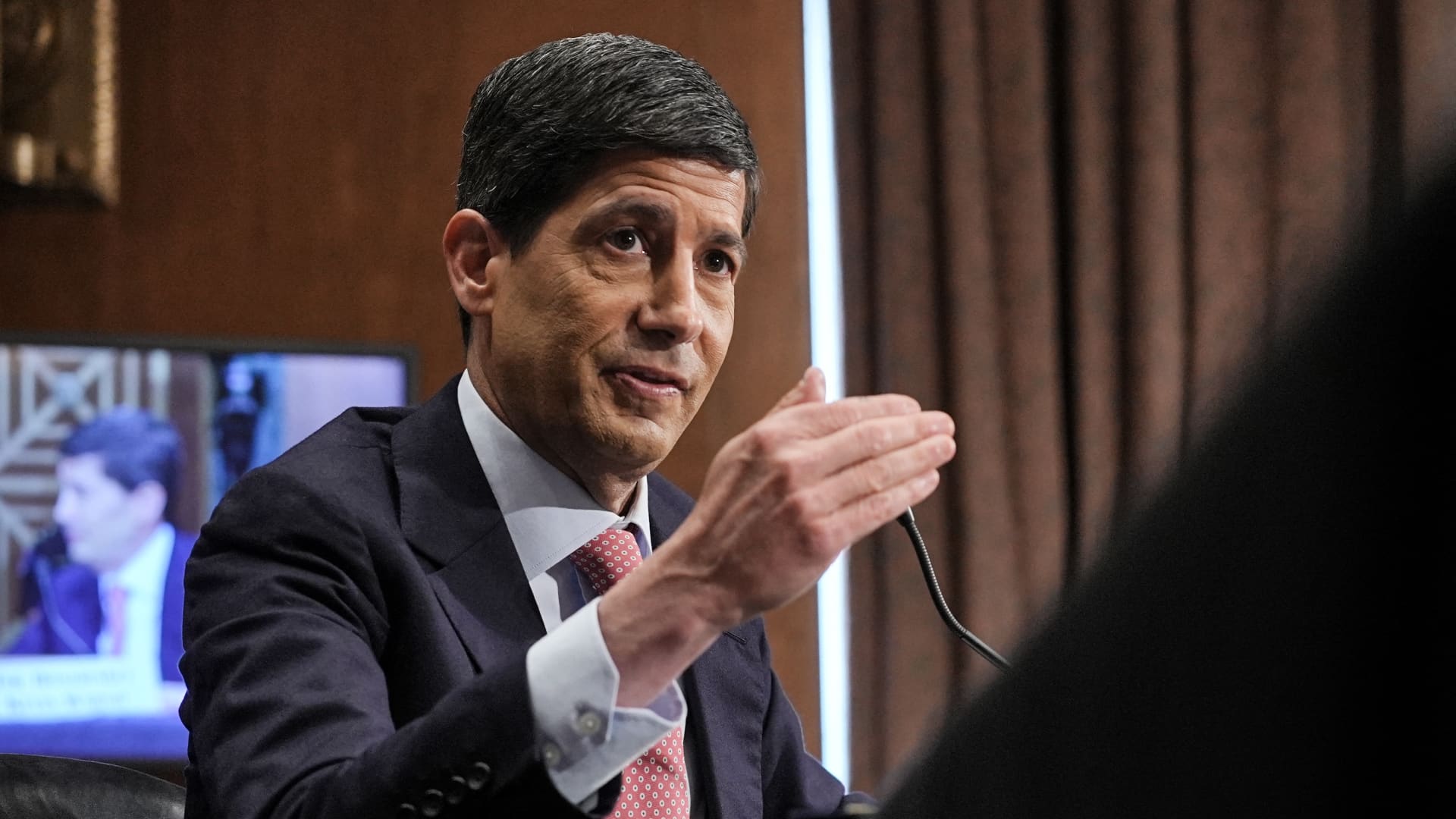
Federal Reserve Chairman Kevin Warsh testifies during a Senate banking committee hearing on Capitol Hill, in Washington, July 15, 2026.
Ken Cedeno | AFP | Getty Images
Kevin Warsh’s keynote speech at the central bank’s annual symposium in Jackson Hole, Wyo. has altered investors’ outlook for an interest rate hike in September after the Fed chairman said he was committed to fighting inflation.
Traders on prediction market platform Kalshi now believe there are 48% odds that the Fed will hike rates by 25 basis points. Before Warsh’s speech, odds that the central bank would maintain the status quo in September were nearly 70%. ‘
Traders of fed funds futures now see a nearly 56% chance of a quarter-point hike in September, per the CME’s FedWatch tool. And on Polymarket, speculators indicated 49% odds that the Fed raises rates.
After the Fed’s July meeting, investors were fairly certain of a rate hike in September, especially considering that three members of the Federal Open Market Committee disagreed with the majority’s decision to keep interest rates steady. Those three members, instead, argued rates needed to move higher in response to elevated inflation.
But odds for a rate hike in September declined in the past month after a weaker-than-expected employment report showed the U.S. lost jobs in July, and that inflation — while remaining above the Fed’s 2% target — cooled.
Warsh directly addressed those data reports in his Friday speech, but cautioned the central bank needed to see more. “While this summer’s [inflation] readings were better than expected,” he said, “they do not tell me that underlying trends have meaningfully improved,” Warsh said.
Addressing the situation more directly Warsh said, “We must be confident that underlying inflation is moving to our objective, clearly and at sufficient speed. Otherwise, we have work to do. That’s our job, our mandate and our charge to keep.”
In response, short-term yields rose, with the 2-year Treasury yield, which closely follows short-term rate decisions by the Fed, hitting its highest level since late July.
The Fed’s rate decision is Sept. 16.
Disclosure: CNBC and Kalshi have a commercial relationship that includes customer acquisition and a minority investment.



A highly contentious proposal to alter the inflation rate of SOL, a vote called SGP-0002, has passed with precisely 67% ayes. Official rules require two-thirds of participating stake to pass, so the proposal cleared the bar by barely 0.33 percentage points.
As a result of the vote, SOL’s so-called “disinflation rate” will double from 15% to 30%.
SGP-0002 instructs the network to continue creating new SOL but shrink the inflation rate twice as fast.
After switching its vote at the eleventh hour, holders of staked SOL at crypto exchange Kraken tipped the voting outcome. Its 8.9 million SOL validator, labeled “Kraken 2,” cast 90.34% of its stake in favor of the measure.
Had Kraken’s votes cast No instead of Yes, SGP-0002 would have failed at approximately 63.9%, i.e. below the 66.66% threshold.
Helius CEO Mert Mumtaz celebrated Kraken changing its earlier No indication to a Yes during the final whipsaw.
Contributors from Mumtaz’s firm wrote many of the technical proposals for SGP-0002.
Kraken was mathematically decisive but not uniquely responsible. Galaxy and other late voters also moved the tally.
Still, the exchange supplied enough Yes votes to secure a winning margin and was widely credited on social media with flipping the vote.
Read more: First US-listed Solana treasury firm moves and protects executives
Doubling Solana’s disinflation rate doesn’t end inflation
Solana is still inflationary. The change doesn’t flip the rate of new SOL entering the market negative.
To be clear, SOL will always remain inflationary at a positive rate, the only matter of debate was how positive the rate would be.
Solana validators voted to cut future SOL issuance by roughly 18.9 million tokens over six years, but over the long haul, those tokens will still enter the market eventually.
Technical specifications for the change keep terminal (a.k.a. “long tail”) inflation at 1.5%, but estimates reaching that terminal rate 2.8 years after activation instead of 5.7 years.
It’s the first Solana governance proposal to pass under the network’s new binding, on-chain voting system. A prior attempt at similar territory, SIMD-0228, failed in March 2025 with about 61% support.
Developers now project approximately 18.9 million fewer SOL created over the next six years.
Under the old 15% annual reduction, SOL wasn’t due to hit the 1.5% floor until around 2032. Doubling that rate to 30% moves the date to roughly 2029.
Developers must still re-anchor the supply curve, test the change, and activate its feature gate. In other words, the vote creates no instantaneous supply shock.
The vote temporarily improves SOL’s scarcity pitch over the next few years. If demand for SOL persists, fewer coins entering the market should provide less supply overhang.
Solana splits votes on two other proposals
The disinflation vote was the most consequential, but the combined vote also included two other proposals, SGP-0001 and SGP-0003.
Stakeholders approved SGP-0001, the “Solana Constitution,” with 85.97% support. It formalized governance processes that accompanied today’s cliffhanger.
Over the past few years, governance of the Solana network has mostly occurred off-blockchain, and this new constitution aims to bring more democratic processes on-chain.
Voters rejected SGP-0003 with 53.90% support, below the two-thirds threshold.
This Solana inflation-related proposal sought to burn a usage-based resource charge while paying block leaders a fixed inclusion fee.
Got a tip? Send us an email securely via Protos Leaks. For more informed news and investigations, follow us on X, Bluesky, and Google News, or subscribe to our YouTube channel.


BitGo has acquired the institutional trading business of Bitcoin infrastructure company NYDIG, adding derivatives and financing capabilities as it expands services for institutional crypto clients.
BitGo said it completed the acquisition of NYDIG’s institutional trading business under a definitive agreement, the company announced Thursday. The transaction includes NYDIG’s institutional client trading relationships and about 30 employees who joined BitGo. The companies did not disclose financial terms.
The acquired business provides derivatives, structured products, financing and capital markets services to clients including asset managers, hedge funds and companies. BitGo CEO Mike Belshe said the acquisition will “meaningfully scale” the company’s trading and infrastructure capabilities and allow it to serve a broader range of institutional clients.
“This transaction allows our team to continue delivering the same innovative solutions, execution quality, and dedication clients have come to expect, now backed by an even deeper set of resources,” said Pete Janney, head of financial infrastructure at BitGo.
The companies said the sale will allow the company to focus its resources on power generation, Bitcoin mining and high-performance computing data centers. According to the announcement, NYDIG’s development pipeline exceeds 3 gigawatts, including more than 1 GW of capacity it expects to deliver in 2027 and 2028.
Cointelegraph reached out to BitGo for additional details about the transaction but had not received a response by publication.
Related: BitGo posts $19M Q2 loss despite 80% revenue surge to $4.3B
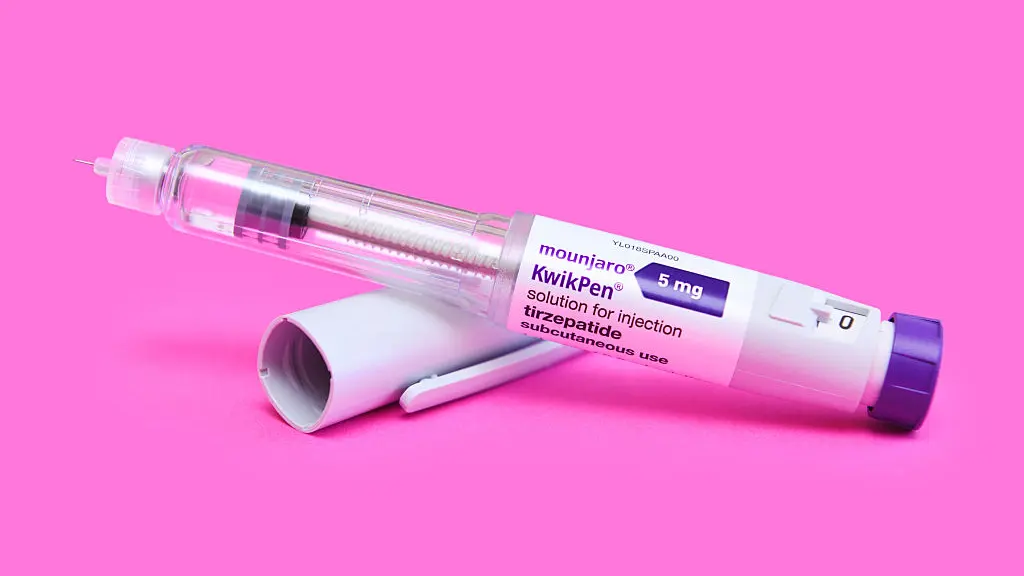
“This study was in patients with Type 2 diabetes, in whom the No. 1 cause of death is cardiovascular disease,” says Dr. Rachel Batterham, senior vice president of medical innovation and external engagement for cardiometabolic health at Lilly. “So reducing that risk is critically important.”
Batterham says Lilly decided to compare Mounjaro’s potential in reducing heart risk to an existing drug, Trulicity, that already reduced heart risk to see if Mounjaro would have any additional benefit. “We set ourselves a very high bar,” she says.
But the study design means that the heart benefit results cannot be directly compared to Mounjaro’s competitor drug, Ozempic, from Novo Nordisk. Ozempic, which is approved to treat diabetes, and Novo Nordisk’s Wegovy, approved to treat overweight and obesity, are both approved to lower the risk of heart disease risk by 20%. Lilly is, however, currently conducting a study tracking people who don’t have Type 2 diabetes who take the weight-loss version of their drug, Zepbound, for heart events. In that study, says Batterham, the researchers will be looking at whether Zepbound can prevent second heart events from occurring in people who have already had one, as well as whether the drug can prevent first heart events from occurring.
According to some metrics, Bitcoin (BTC) has ended its bear market as a composite BTC price indicator flips bullish for the first time since October 2025.
Key points:
- Bitcoin has exited its 2026 bear market, Ki Young Ju says as a profitability metric prints a positive reading of 0.042.
- The breakout from negative to positive numbers repeats a bull-market recovery signal also visible in early 2023.
- Concerns remain over insufficient market liquidity to support a macro BTC price trend change.
Bitcoin profit metric offers first bull signal in ten months
The latest data from onchain analytics platform CryptoQuant has led its CEO, Ki Young Ju, to call time on Bitcoin’s 2026 bear market.
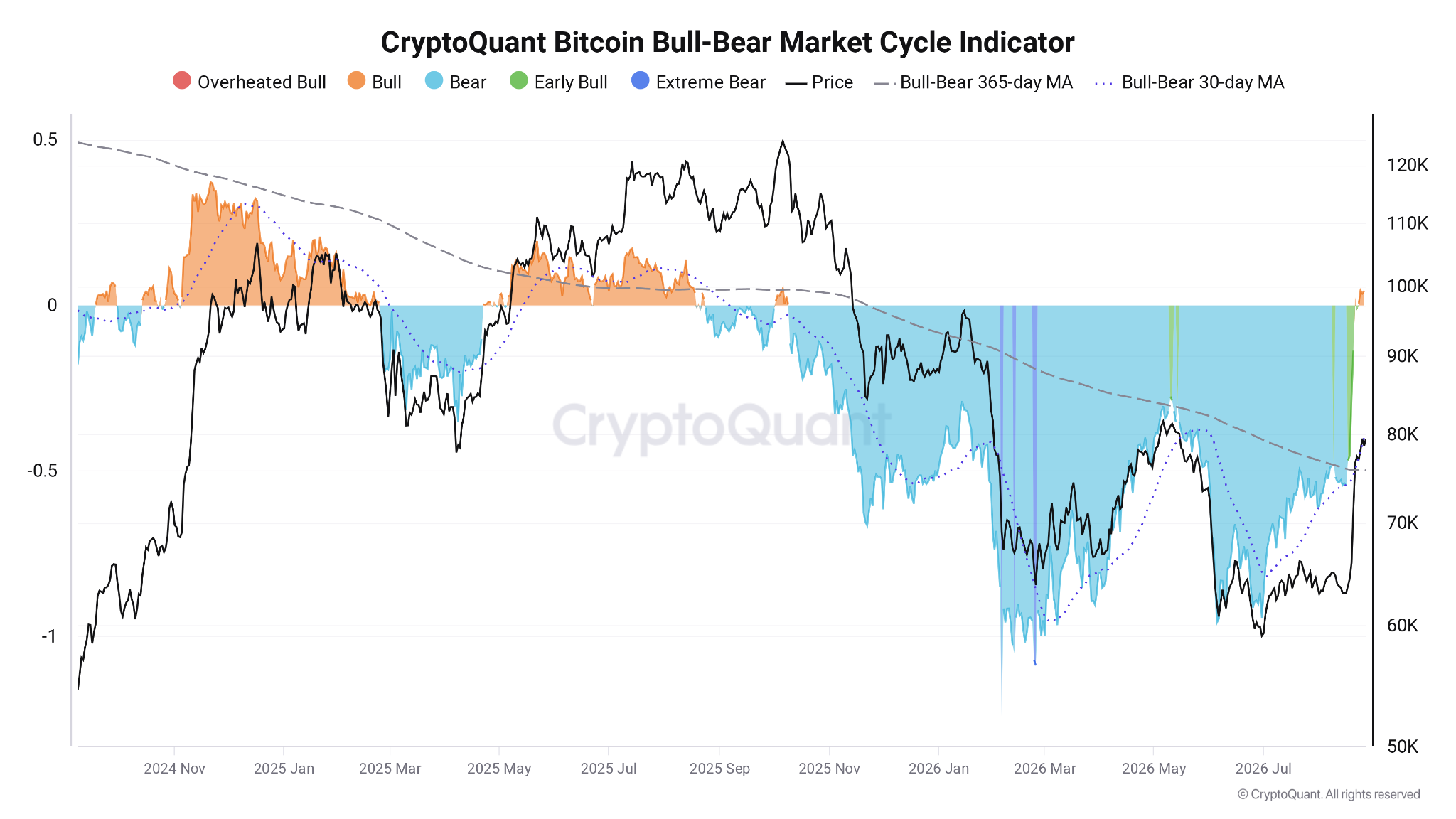
In an X post on Wednesday, Ki flagged the first positive reading on CryptoQuant’s Bull/Bear Market Cycle Indicator since early October.
“The Bitcoin bear cycle is over,” he wrote in accompanying commentary.
The indicator is derived from the P&L Index — initially devised by CryptoQuant’s head of research — and measures the P&L Index’s distance from its 365-day moving average. The P&L Index itself is composed of several onchain profitability metrics: the market value to realized value (MVRV) ratio, net unrealized profit/loss (NUPL) and the spent output profit ratio (SOPR). Together they provide an overall picture of Bitcoin investors’ realized and unrealized profits and losses. Values above zero for the Bull/Bear indicator point to bullish phases in the BTC price cycle as profitability improves.
Current cycle lows came on Feb. 5 as BTC/USD fell to $60,000, with a reading of -1.244 corresponding to “extreme bear” conditions. As of Aug. 26, the most recent date for which full data is available, Bull/Bear displayed a positive reading of 0.042, placing it in its “bull” bracket.
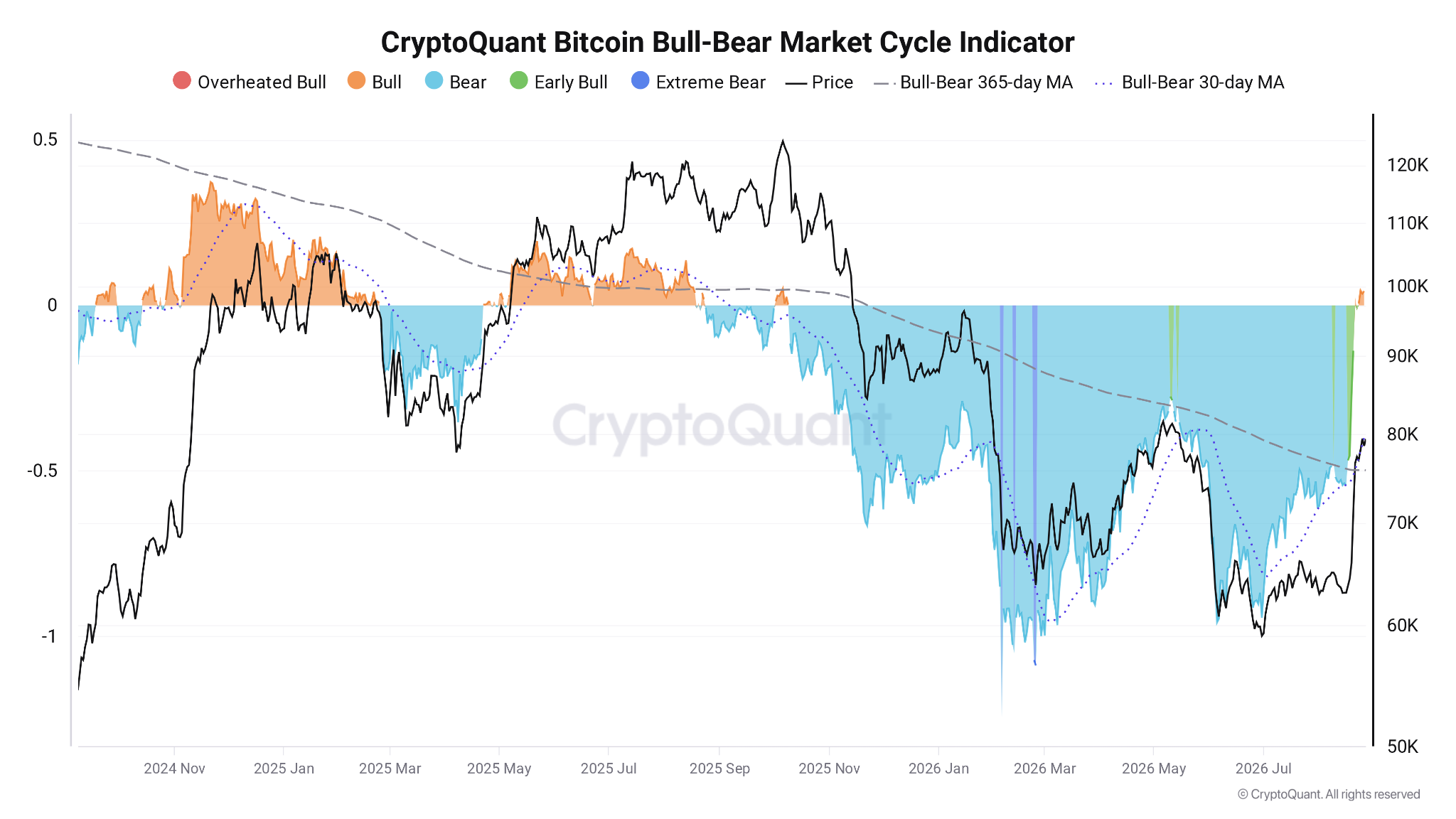
Bitcoin Bull/Bear Market Cycle Indicator. Source: CryptoQuant
The combination of P&L metrics and their 365-day moving averages has proven accurate at confirming macro BTC price trend changes. Ki notes that Bull/Bear likewise called the end of the previous bear market as upside returned in early 2023.
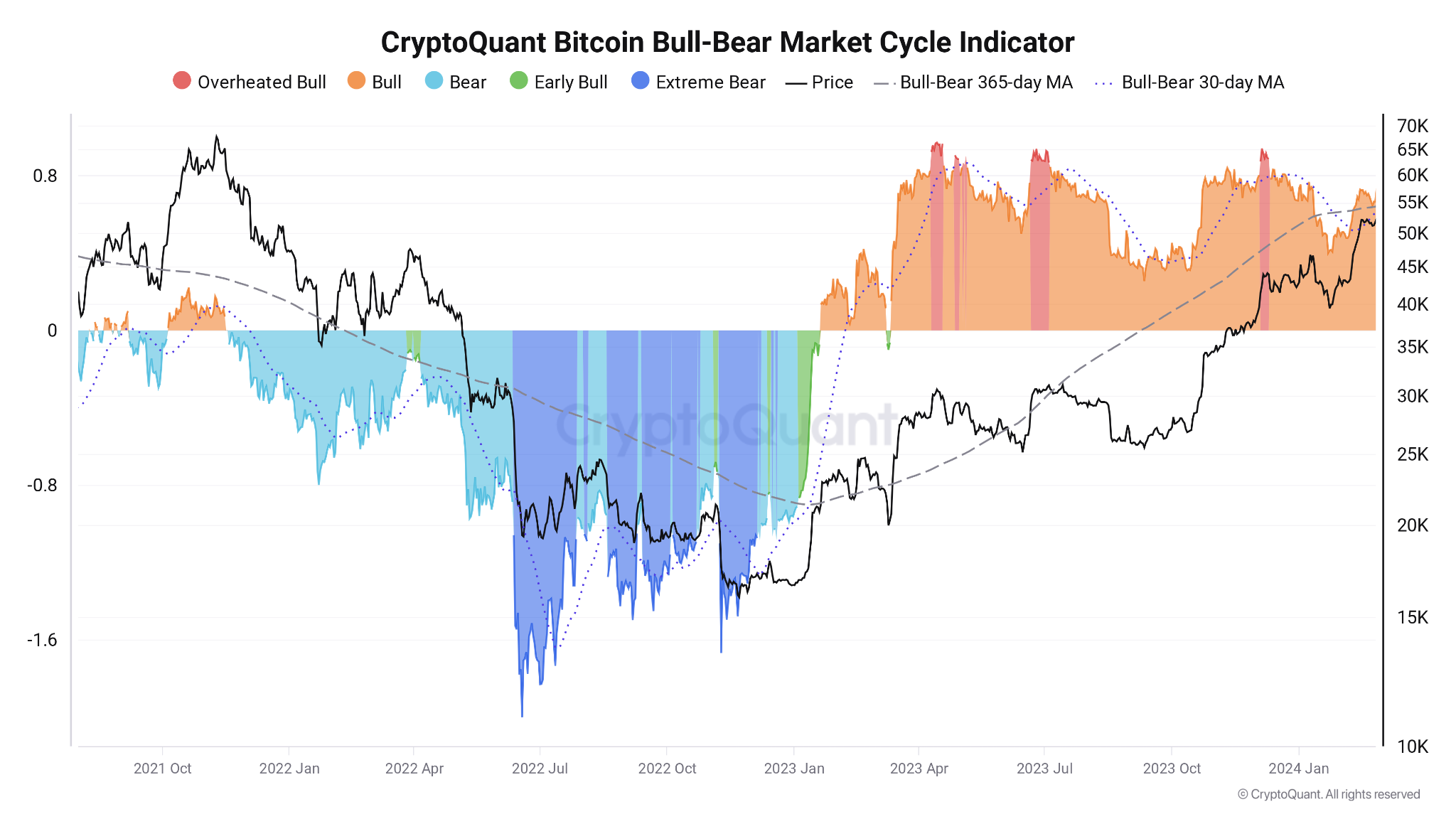
Bitcoin Bull/Bear Market Cycle Indicator historical data. Source: CryptoQuant
Misgivings over BTC price strength continue to mount
Bitcoin has seen the slow return of bull signals from various indicators in recent weeks, including the relative strength index (RSI), a recovery for which was also present at the end of 2022.
Related: Supply absorption ‘key question’ as Bitcoin fails to reclaim $80K: Analysis
Consensus among market participants over Bitcoin’s recent upside marking the end of its macro downtrend is by no means unanimous. Previously, Cointelegraph reported on concerns that a lack of demand could see BTC/USD revert to downside, with multiple liquidity hurdles lined up immediately above spot price.
In ongoing market commentary, trader and analyst Rekt Capital argued that the August monthly close would be “pivotal” for the fate of the recovery, referring to a potential breakout from a downward-sloping resistance trend line in place since October last year.
Just a few days ago, Ripple’s cross-border token jumped to a multi-month high of around $1.70 but later retreated to the current 1.42.
The move south hasn’t changed the predominant bullish tone across analysts on X, as some expect a price explosion in the near future. Here are some of the most optimistic (and even ridiculous) targets.
Giant Surge on the Way?
X user JAVON MARKS, who bragged about successfully calling XRP’s bull run in the past, returned with another big prediction. The analyst claimed that the asset’s current structure is showing signs of a breakout from a smaller bullish wedge/flag formation, which could initiate a major continuation above the all-time high and open the door to a rally towards $15. The market observer said this is “a measured-move target” and reminded of what happened nine years ago.
“After breaking out of a much larger structure in 2017, XRP reached a similar measured-move objective before going on to greatly exceed it. Today, XRP is holding a breakout of an extremely similar larger structure,” they stated.
The analyst believes that if the ongoing structure holds and the smaller formation confirms its breakout, the asset’s valuation could indeed rocket to the aforementioned peak, representing a nearly 1,000% increase from current levels.
Amonyx is also highly optimistic, envisioning a pump to $20 and “there’s nothing anyone can do about it.” It is important to note that such an astronomical surge would require XRP’s market cap to jump beyond $1 trillion. As of press time, only the market’s undisputed leader, Bitcoin (BTC), has a higher market capitalization, making the forecast a bit far-fetched (to say the least).
$15 and $20 may sound like implausible targets (for the moment), but Ripple’s token may indeed head north in the short term, considering the solid institutional interest. Last week, spot XRP ETFs saw their best week since May, while the positive performance continued. Data show that these products have posted eight consecutive green days; the last time this was observed was at the very start of the year.

Major Walls Ahead
According to X user CW, the bulls might struggle to initiate a new leg up since the sell wall near $1.49 “remains solid.” Shortly after, the analyst claimed that XRP failed to break through the “point of control” once again, arguing that the biggest resistance blocked the rise.
“$1.4692 and $1.53 are currently the biggest resistance levels. To rise, these two lines must be broken,” they added.
The post Crazy Ripple Prediction: Is XRP Preparing for a 1,000% Explosion? appeared first on CryptoPotato.
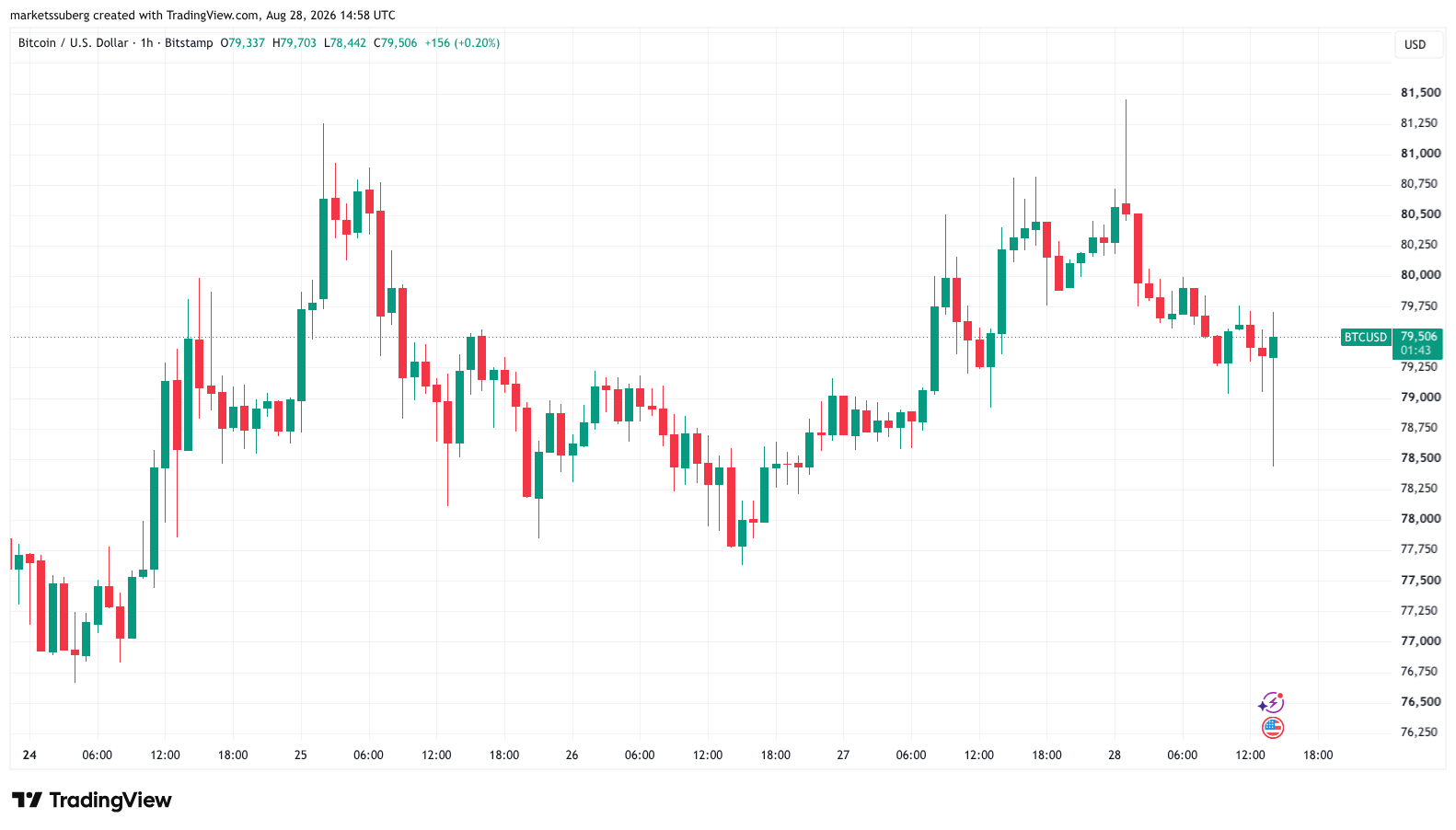
Bitcoin (BTC) saw volatility after Friday’s Wall Street open as markets reacted to US Federal Reserve chair Kevin Warsh’s comments on future monetary policy.
Key points:
- Bitcoin initially fell during Fed chair Kevin Warsh’s Jackson Hole keynote speech before circling $79,500.
- Warsh said he sees no trend change in inflation despite recent lower PCE and CPI prints.
- BTC price action sustaining above $83,000 hinges on Bitcoin derivatives traders, analysis says.
Warsh: Inflation trends have not “meaningfully improved”
Data from TradingView showed BTC/USD dipping to $78,442 on Bitstamp in volatile trading conditions, down around 1% at the time of writing.
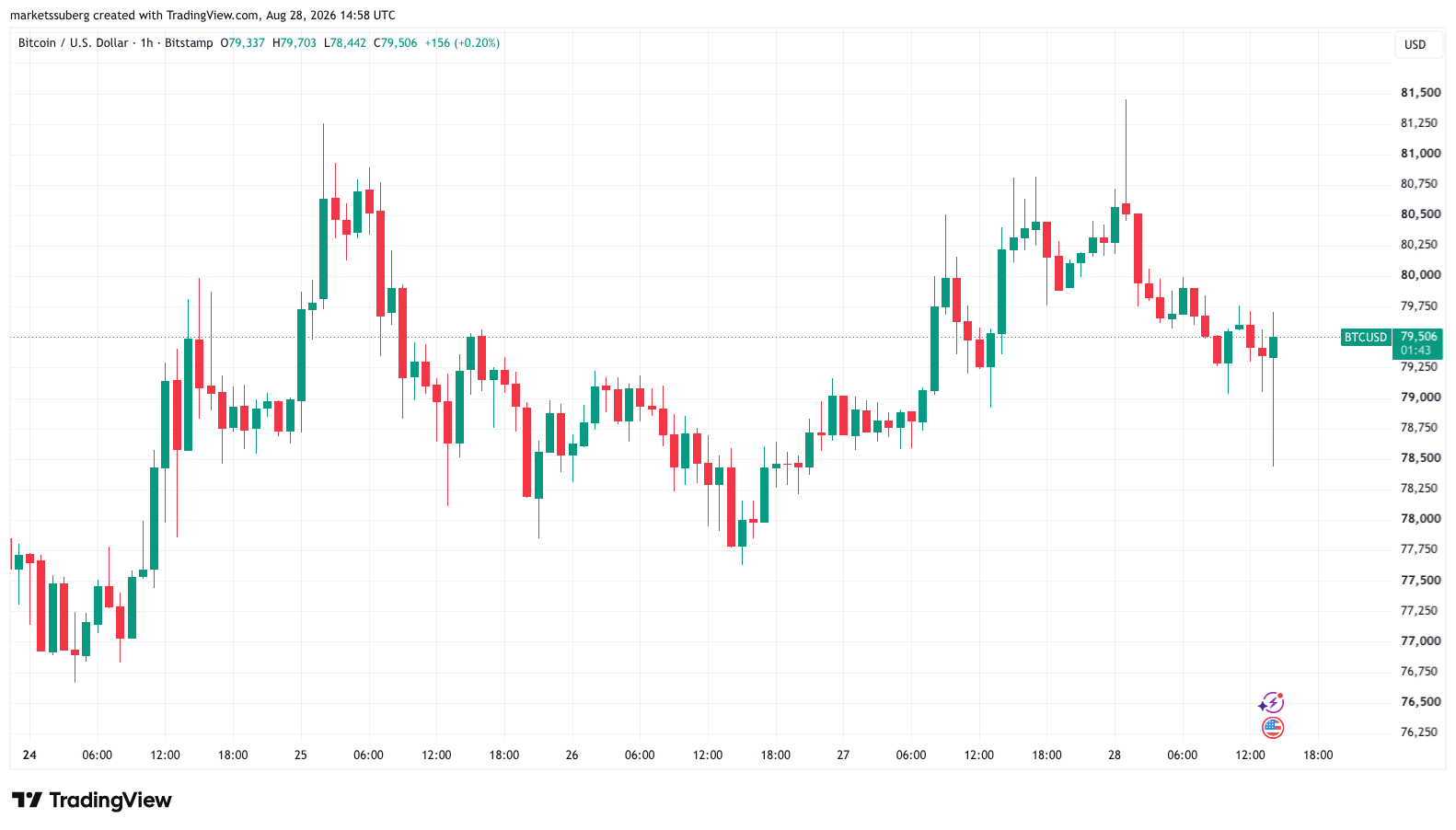
BTC/USD one-hour chart. Source: Cointelegraph/TradingView
In his first keynote speech at the annual Jackson Hole Symposium, Warsh delivered a cautionary tone on inflation, committing to the Fed’s 2% target. The Fed chair doubled down on an earlier pledge to reduce the scope of hints over future policy that the Fed offers to markets, avoiding forward guidance altogether and stating that it would not make a reappearance in the future.
“Forward guidance as a regular practice was adopted by my colleagues and me during the Global Financial Crisis. It was essential at the time, and we introduced it with much fanfare. But, as with other legacies of crises past, I believe that the practice has overstayed its welcome,” he stated.
Warsh further dismissed recent lower-than-expected inflation prints in the Consumer Price Index (CPI) and Personal Consumption Expenditures (PCE) index as a sign of a downtrend being in progress.
“Each of these broad inflation measures have fallen significantly from their highs of a few years ago, but progress through the past couple of years has been more modest, and while this summer’s PCE and CPI readings were better than expected, they do not tell me that underlying trends have meaningfully improved,” he continued.
US stocks avoided losses on the back of Warsh’s words, which also included a complimentary view of business performance and AI sector growth. Both the S&P 500 and the tech-heavy Nasdaq Composite Index were up around 0.5% at the time of writing.
Analysis stresses derivatives’ role in further BTC price gains
BTC price action thus continued to gyrate around the $80,000 mark, acting in a narrow intraday range ahead of the August monthly close.
Previously, Cointelegraph reported on expectations for the monthly close, with analysis demanding that BTC/USD break above a downward-sloping trend line and defend the 50-week exponential moving average near $77,250 to sustain the uptrend.
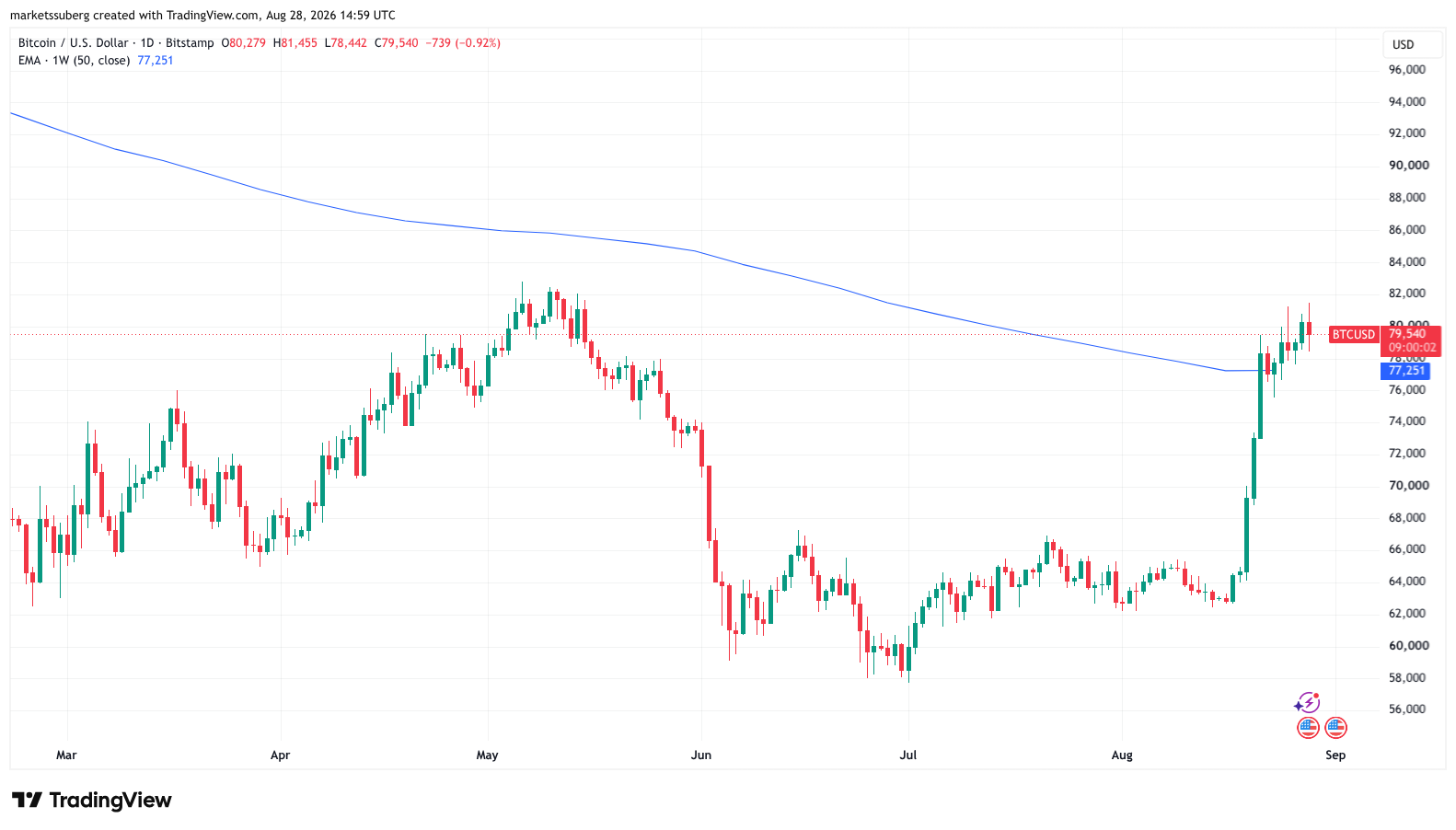
BTC/USD one-day chart with 50-month EMA. Source: Cointelegraph/TradingView
Related: Bitcoin bear market ‘over’ as price metric copies 2023 recovery: CryptoQuant CEO
Onchain data additionally revealed a thick patch of resistance between the current spot price and $86,000, slowing upside momentum.
Commenting in its latest analysis, trading company QCP Capital argued that even if price were to break higher, derivatives markets would need to provide the necessary support by keeping both funding rates and open interest growth in check.
“If price continues higher while funding remains contained and open interest rebuilds gradually, that would indicate a different market structure from one where leverage accelerates rapidly alongside price,” QCP Capital wrote, adding:
“The key distinction is therefore not simply whether BTC trades above or below $83.3k, but whether subsequent price action continues to be supported by spot participation or becomes increasingly driven by leveraged positioning.”
At the time of writing, BTC/USD was up 26.35% month-to-date, per data from CoinGlass, marking its best August performance since 2017.
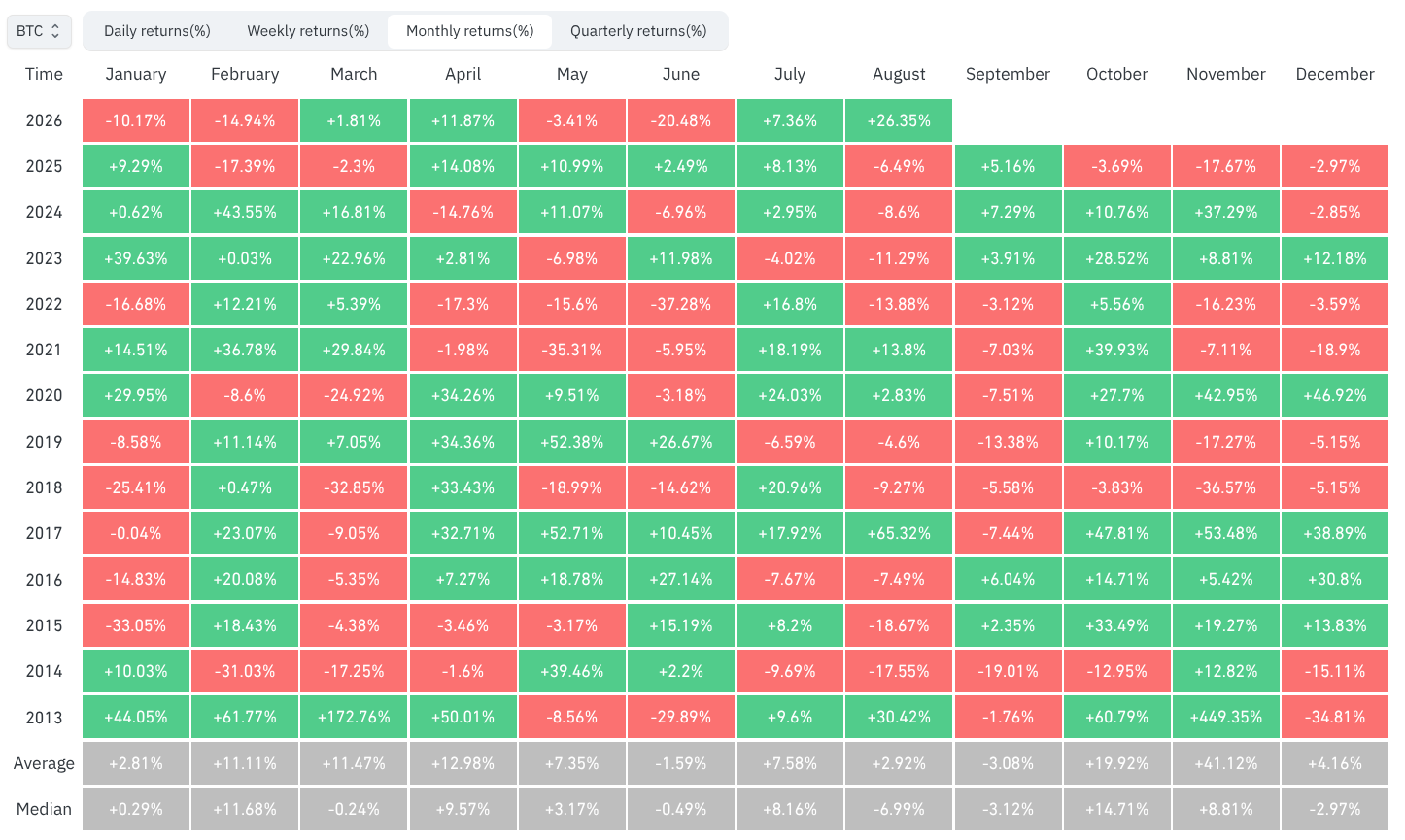
BTC/USD monthly returns (screenshot). Source: CoinGlass


Former U.S. Defense Secretary Mark Esper has urged the Senate to pass the CLARITY Act before its Sept. 15 procedural vote, arguing that delayed crypto rules could weaken U.S. financial and national security.
Summary
- Mark Esper said regulated U.S. crypto markets would improve oversight of digital asset transactions.
- The Senate’s Sept. 15 cloture vote requires 60 votes to advance the bill.
- House lawmakers approved the CLARITY Act by a 294–134 vote in July 2025.
- Stablecoin rewards, political ethics, and decentralized finance remain central points of dispute.
The Financial Times published Esper’s policy argument on Aug. 7, with the former defense secretary describing the Digital Asset Market Clarity Act as “not merely a financial services bill” but also a “national security bill.”
Esper, who led the Pentagon from 2019 to 2020, said U.S. power relies partly on the dollar and the payment networks that carry it around the world. Clear rules for digital assets, he argued, would help preserve Washington’s view into financial activity while supporting sanctions enforcement.
When crypto companies and transactions move through offshore venues with weaker controls, Esper said U.S. agencies lose some of their ability to follow funds and act against illicit networks. He also warned that delays in Washington give China more time to build payment systems outside U.S. influence.
Esper currently serves on Coinbase’s Global Advisory Council, which advises the exchange’s leadership on policy and strategic matters. Coinbase lists him among several former government and national security officials appointed to the council.
Coinbase Chief Policy Officer Faryar Shirzad shared Esper’s comments on X, quoting his call for lawmakers to treat the legislation with urgency.
CLARITY Act faces a 60-vote test on Sept. 15
Senate Majority Leader John Thune filed cloture on the motion to proceed to H.R. 3633 before lawmakers left Washington for their August recess. The resulting vote is scheduled for Sept. 15, after senators return to regular business.
Cloture would require support from 60 senators. Republicans cannot reach the threshold without Democratic votes, leaving the bill dependent on a cross-party agreement that has remained difficult during negotiations.
A successful vote would not send the legislation to the president. It would allow the Senate to start formally considering the measure, after which lawmakers could debate the proposal and offer amendments before a final passage vote.
The House approved H.R. 3633 by 294–134 in July 2025. The Senate Banking Committee later advanced its market-structure text by a 15–9 vote, with two Democrats joining Republicans.
Any Senate text that differs from the House-approved bill would need additional action before reaching the White House. Congress could send the revised version back to the House or form a conference committee to settle differences between the two chambers.
The proposal would divide responsibility for digital assets between the Commodity Futures Trading Commission and the Securities and Exchange Commission. Qualifying digital commodities would generally come under the CFTC, while the SEC would keep authority over tokens and transactions treated as securities.
For U.S. investors, the division could determine which agency supervises trading platforms, brokers, and other intermediaries. It could also create federal registration standards for parts of the spot crypto market that do not currently face routine CFTC supervision.
Esper links crypto oversight to sanctions enforcement
Esper’s security case rests partly on the role of the U.S. dollar in global trade and finance. American authorities can monitor or restrict transactions that pass through banks and payment networks subject to U.S. law, giving Washington tools to enforce sanctions and investigate illicit finance.
Digital asset activity routed through lightly regulated foreign platforms can make that work harder, according to Esper. He cited threats from sanctioned networks and North Korean cyber groups while arguing that a U.S.-regulated market would give law enforcement more reliable access to transaction and customer records.
Treasury records have identified the Lazarus Group as a North Korean state-sponsored cyber organization. U.S. authorities have linked the group to major digital asset thefts, including the roughly $625 million attack on the Ronin network in 2022.
Esper also pointed to China’s work on payment infrastructure that does not depend on U.S.-controlled financial channels. In his assessment, allowing other countries to set digital asset standards first could reduce Washington’s influence over future payment networks.
Parts of the Senate proposal address the same concerns through specific enforcement powers. A merged draft released in July contains an illicit-finance title covering foreign adversary activity, law enforcement training and international cooperation.
Section 10303 would expand the Treasury Department’s special-measures authority under Section 311 of the USA PATRIOT Act. Under the proposal, Treasury could prohibit or place conditions on certain digital asset transfers linked to foreign jurisdictions, institutions or transaction classes found to present a primary money-laundering concern.
Senate Banking Committee Chair Tim Scott has also argued that the legislation would make it harder for criminals and foreign adversaries to misuse the U.S. financial system. Esper’s argument places the same provisions within a defense and foreign-policy framework.
Senate disputes continue despite security argument
National security support does not resolve the disagreements holding up the bill. Lawmakers and industry groups remain divided over stablecoin rewards, decentralized finance rules, and ethics restrictions for public officials with digital asset interests.
The current draft distinguishes between passive returns on idle stablecoin balances and rewards generated through activities such as lending or supplying liquidity. Banks have pressed lawmakers to prevent exchanges and stablecoin businesses from offering interest-like products without the capital, insurance, and oversight rules applied to bank deposits.
In July, U.S. banking organizations asked Senate leaders to revise Section 404, warning that unclear restrictions could move deposits away from community and regional banks. Circle shares fell more than 2% in pre-market trading as the bank lobbying dispute added to uncertainty surrounding the legislation.
Crypto companies have argued that overly strict limits could push customers toward less regulated services. Coinbase, which earns revenue from its relationship with Circle and USDC-based customer rewards, has sought changes to the proposed restrictions.
Political ethics provisions have created a separate obstacle. Democratic lawmakers have sought tighter rules covering digital assets issued or held by senior government officials, while disagreements remain over whether officials should have to divest existing holdings.
Decentralized finance has also complicated negotiations because lawmakers have not agreed on how to classify protocols or determine when a blockchain network is sufficiently decentralized. The classification can affect whether a token falls under SEC securities rules or the CFTC’s proposed digital commodity framework.
Prediction-market traders have responded to the delays by lowering their expectations for passage. An August analysis found that passage odds had fallen to 10% after reaching 82% in February, with unresolved policy disputes and the limited Senate calendar weighing on the contract.
CFTC prepares an alternative regulatory path
While Congress considers the bill, CFTC Chair Michael Selig has said his agency can continue developing digital asset proposals within its existing authority.
“Crypto will get market structure regardless of bill,” Selig said in remarks reported on Aug. 20.
The CFTC already oversees crypto derivatives, including regulated futures and options. It can also pursue fraud and manipulation in spot commodity transactions, but it lacks routine supervisory power over spot crypto exchanges comparable to its oversight of registered derivatives markets.
Any regulations adopted without new legislation would have to remain within the Commodity Exchange Act. The agency could address derivatives venues, intermediaries, and disclosure requirements, although Congress would still need to grant the full spot-market powers contemplated by the CLARITY Act.
As previously reported by crypto.news, Selig did not identify which proposals were ready, when the CFTC could release them, or how much of the planned framework could proceed under current law.
President Donald Trump called for a “fair version” of the CLARITY Act during an Aug. 19 White House meeting attended by representatives from Coinbase, Ripple, Gemini, Kraken, Anchorage Digital, Chainlink Labs, Grayscale and OKX.
The CFTC’s Innovation Advisory Committee met the following day to discuss digital assets, artificial intelligence and prediction markets. Its crypto session covered customer protection, market integrity and ways the commission could use its present authority, but the advisory body cannot adopt binding regulations or expand the agency’s jurisdiction.
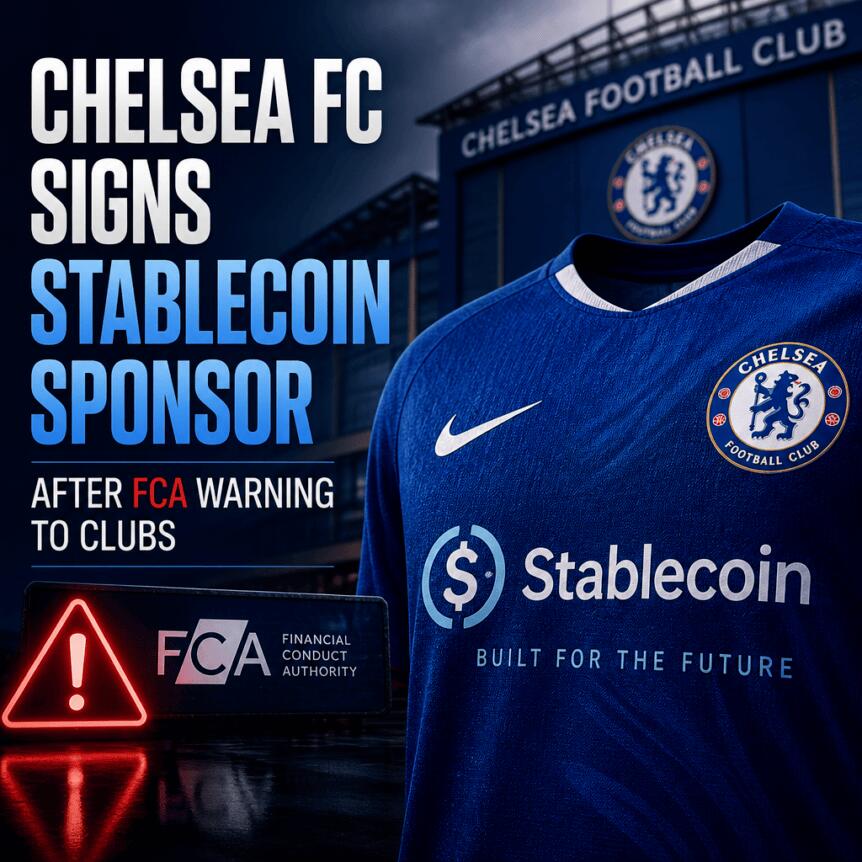
Circle, the issuer behind the USDC stablecoin, is set to become a sponsor of Chelsea Football Club, with its USDC branding appearing on player jerseys for the 2026/2027 season. The move arrives just months after the UK’s financial regulator warned Premier League clubs about sponsorship arrangements involving “unauthorized” financial firms, including some crypto-related businesses.
In a press release on Friday, Circle said it will bring the USDC name to the “global game” through a partnership with the London club. The announcement follows a period of heightened scrutiny in the UK over how digital asset companies market financial products to retail audiences—particularly through mainstream sports sponsorships.
Key takeaways
- Circle says USDC branding will feature on Chelsea FC jerseys in the 2026/2027 season.
- The sponsorship comes about three months after the UK FCA warned football clubs about deals with “unauthorized” financial firms.
- Regulators focused on whether such sponsorships could push potentially non-compliant products to millions of fans.
- Circle notes that USDC is issued by certain regulated affiliates, but it is not issued or regulated under UK law.
Why the Chelsea sponsorship drew regulatory attention
The FCA’s warning to football clubs was triggered by concerns that some sponsorships were being used to reach football supporters in ways that may conflict with UK financial services rules. According to the FCA’s press release, the watchdog had sent warning letters to Premier League clubs regarding sponsorships with companies it described as “unauthorized,” including crypto businesses.
FCA messaging emphasized the consumer-facing nature of football sponsorship. The regulator warned that “unauthorized” firms could exploit the trust fans place in club branding to promote products that may not be properly authorized or comply with UK financial services requirements.
FCA director of consumer investments Lucy Castledine said football fans trust their club’s badge and that clubs should not allow unauthorized financial firms to put “potentially dodgy products” in front of large audiences.
What Circle says about authorization and USDC’s legal status
Circle’s sponsorship announcement includes a key distinction relevant to the FCA’s earlier concerns. The company says Circle UK Trading Limited—the group’s UK entity—has been listed as an authorized company with the FCA since 2018 to provide certain financial services to residents.
Stablecoins like USDC are also described as legal to use in the UK. However, Circle also states that USDC is “issued by certain regulated affiliates” and is “not issued or regulated under the laws of the United Kingdom.” That phrasing matters because the FCA warnings were tied specifically to unauthorized financial firms and potential breaches of UK rules.
Cointelegraph reached out to Circle and the FCA for comment, but did not receive an immediate response.
US stablecoins in the UK: legal use, but regulatory construction is still underway
While the UK recognizes stablecoins as usable, the regulatory perimeter for crypto assets continues to evolve. The article notes that lawmakers are working to establish a more comprehensive regulatory framework for digital assets, with ongoing discussion around how stablecoins—particularly those linked to fiat currencies such as the US dollar—should be treated.
In this context, Chelsea’s sponsorship deal highlights a persistent tension faced by crypto issuers and regulators: even where a product may be legal to use, the marketing channels and consumer exposure can become the focal point of compliance concerns.
The FCA’s earlier warning did not target football sponsorship as a concept; instead, it pointed to the authorization status of the firms behind the sponsorships. For investors and industry participants, that distinction suggests the marketing strategy and the corporate compliance structure of a crypto brand may matter as much as the underlying legality of a token.
What to watch next for the USDC–UK compliance picture
Chelsea’s jersey branding announcement is likely to intensify attention on how the UK’s regulators interpret “unauthorized” sponsorship risks, especially when stablecoin issuers operate through multiple affiliated entities. Circle’s reference to regulated affiliates contrasts with its statement that USDC itself is not issued or regulated under UK law—an asymmetry that may remain important for compliance assessments.
For the next steps, readers should watch whether the FCA provides further clarifications on how sponsorships should be handled when the issuer ecosystem spans authorized and non-UK-issued components, and whether any industry guidance follows the regulator’s earlier letters to clubs.
Until regulators or issuers provide more direct detail, the Chelsea deal will likely serve as a live case study for how UK oversight could shape crypto marketing and brand partnerships in the lead-up to broader stablecoin regulation.


Circle, the issuer behind the USDC stablecoin, will be the latest sponsor for the Chelsea Football Club just months after the UK’s financial watchdog warned about “questionable sponsorship deals with unauthorized financial firms,” including crypto companies.
In a Friday announcement, Circle said its name and USDC would appear on jerseys for Chelsea FC players in the 2026/2027 season. The partnership deal between the football club and the digital asset company came about three months after the UK’s Financial Conduct Authority (FCA) said it had sent warning letters to clubs in the Premier League, potentially including Chelsea.
The letters concerned “unauthorized” companies, including crypto businesses, using sponsorship deals to target football fans, potentially breaching UK financial services laws.
“Millions of football fans trust their club’s badge,” said Lucy Castledine, the FCA’s director of consumer investments. “Clubs should not let unauthorised financial firms exploit that loyalty by putting potentially dodgy products in front of millions of fans.”
Circle UK Trading Limited, the company’s UK arm, has been listed as a company authorized under the FCA to provide certain financial services to residents since 2018. Stablecoins like USDC are also legal to use in the country, though lawmakers are working to establish a comprehensive regulatory framework for the digital assets.
Notably, although Circle said that USDC was “issued by certain regulated affiliates,” the stablecoin was “not issued or regulated under the laws of the United Kingdom.” Cointelegraph reached out to Circle and the FCA for comment but did not receive an immediate response.
Related: UK government reports 240 crypto millionaires in 2025
Crypto World
Bitcoin Loses Its Price Anchor After $6.4 Billion Options Expiry. Will the Fed Replace It?
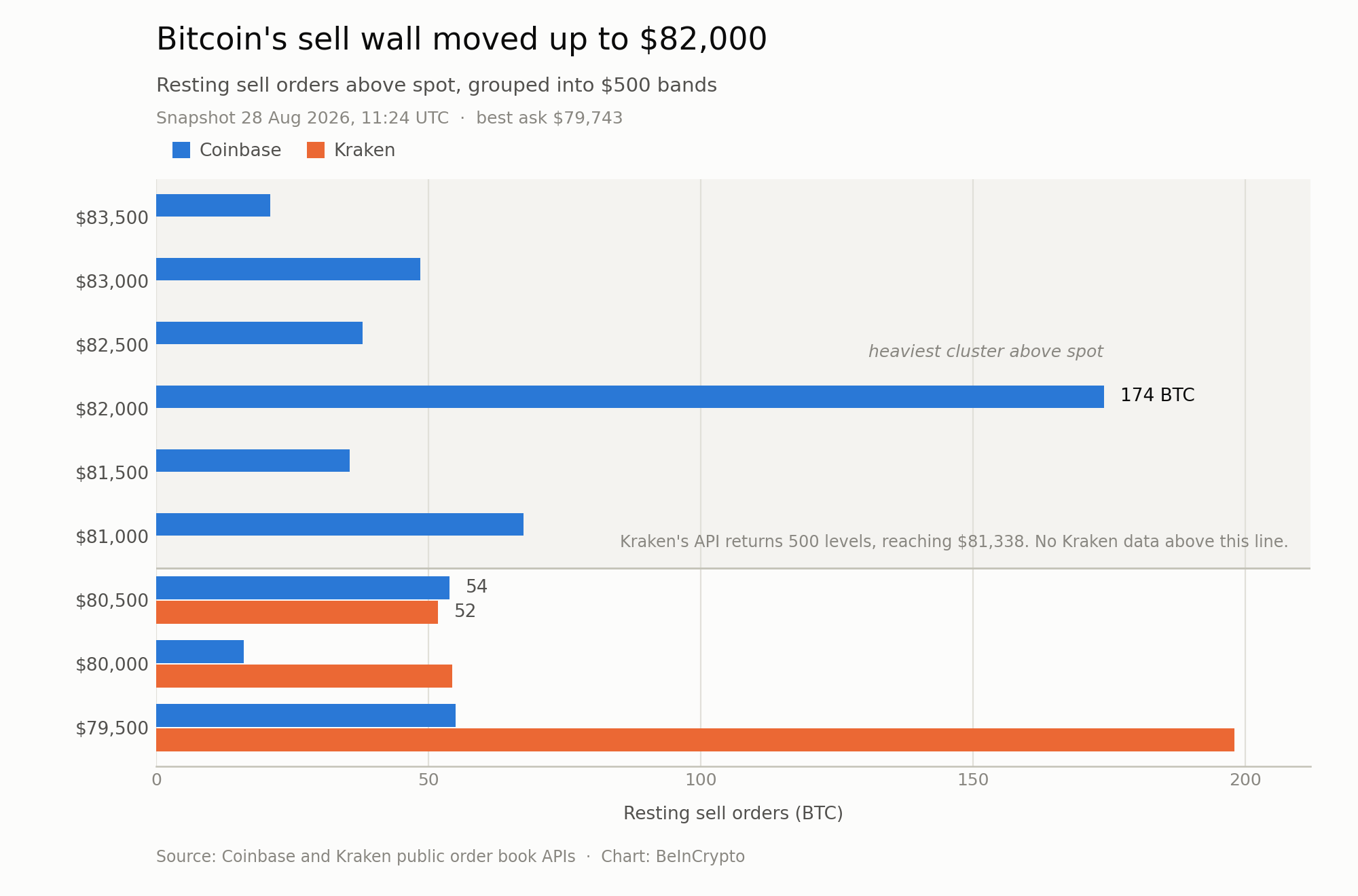
Bitcoin options worth $6.4 billion settled Friday morning at $79,682, effectively removing the hedging flows that had held BTC near $80,000 all week.
Now that the pin is gone, what replaces it arrives in stages, starting with Kevin Warsh at 10 a.m. Eastern time.
What the $6.4 Billion Bitcoin Options Expiry Cleared
Approximately 81,700 contracts settled at 8 a.m. UTC on Deribit, with the official settlement price at $79,682.33. Calls at the $80,000 strike expired worthless, missing by just $318. Calls at $75,000 paid out.
Those two strikes held the most money in the batch. They also explain the week’s trading range.
When traders sell options, market makers hedge by trading the underlying asset. They sell BTC as price rises toward a heavy strike. They buy as it falls away.
That creates an invisible magnet, and Bitcoin sat inside it for three days, much as it did during previous large options expiries.
With today’s options expiry, the magnet switched off at 08:00 UTC on Deribit.
The Ceiling Moved to $82,000
Analyst Ted Pillows flags a sell wall of roughly 1,052 BTC at $80,500 seen across four venues.
As of 11:24 a.m. UTC, only 101 BTC now rests at $80,500 on Kraken and Coinbase combined. The wall has largely gone.

The offers moved higher, such that at $82,000, the two exchanges hold 173 BTC, the largest cluster anywhere above spot.
Options data points to the same level. On the September 4 expiry, the $82,000 strike holds 5,931 contracts. That is 22% of everything open for that date, by far the heaviest concentration.

Therefore, two separate datasets now agree that the ceiling that mattered this week has shifted about $1,500 higher.
Why the Fed Matters More Than Usual This Year
Warsh delivers his first keynote as Federal Reserve chair on Friday morning. The theme of this year’s symposium is financial innovation, and the agenda names cryptocurrencies and stablecoins directly.
Considering crypto is not a side topic at the Fed’s biggest annual gathering this year, that is unusual. It is the subject.
“…cryptocurrencies, and stablecoins. This year’s symposium will explore how the rapid evolution of the payments system has implications for the future of currency, banking, monetary policy implementation, and global financial integration,” read an excerpt in the release.
The rate backdrop is also tense, because in July the Fed held its target range at 3.50% to 3.75%. Three officials dissented, and all three wanted a hike.
Beth Hammack, Neel Kashkari and Lorie Logan pushed for a quarter point increase. Traders now put roughly a one-in-three chance on a rise at the September 16 meeting.
Risk assets rarely price a hike well. Yet past Jackson Hole reactions have been mild. Across eight years, Bitcoin’s median move was about 1%.
The exception was 2022. Jerome Powell turned hawkish and BTC fell 6% in a day. Warsh has no record at this podium, and his long policy silence leaves economists guessing.
Frank Hepworth, chief executive of New Market Trading, urged calm on the expiry itself.
“expiry weeks always sound scarier than they are.”
The Next Anchor Is Already Forming
Bitcoin’s current spot price sat near $79,699 on Friday, up by 0.2% in the last 24 hours. The options market has stopped setting its boundaries.

The September 25 expiry already holds 155,393 contracts, roughly 40% of all open Bitcoin options on Deribit. It is nearly twice the size of the batch that just cleared.
It also settles nine days after the Fed decides. The heaviest strike sits at $70,000, and calls outnumber puts two to one. So the anchor has not disappeared. It has moved to a date that sits on the other side of the Fed.
The post Bitcoin Loses Its Price Anchor After $6.4 Billion Options Expiry. Will the Fed Replace It? appeared first on BeInCrypto.

Right-wing firebrand Milo Yiannopoulos detained by ICE at Louisiana airport

Banco BBVA Argentina S.A. (BBAR) Q2 2026 Earnings Call Transcript

Kraken tips Solana’s razor-thin inflation vote





-

 Crypto World3 days ago
SpaceX stock could rise 75% to $240, JPMorgan says
-

 Crypto World20 hours ago
Bitcoin’s 22% rally now needs real demand to outlast Treasury liquidity boost
-

 Business6 days ago
Musk’s Tesla, SpaceX Confirm $16.8 Billion ‘Terafab’ Chip Plant as World’s Largest Building in Texas
-

 Crypto World7 days ago
anatomy of crypto’s biggest liquidation event since 2021
-

 Crypto World4 days ago
A $30 Billion AI Fund Implodes, Now the SEC Is Investigating Wall Street’s Role
-

 Crypto World2 days ago
Warsh Jackson Hole keynote puts financial innovation first
-

 Politics6 days ago
6 months on, Irish renters crushed by effects of government housing bill
-
 Crypto World3 days ago
Did Trump Just Move SpaceX Stock With One Truth Social Post?
-

 Business18 hours ago
Salesforce Stock Soars 19% as Blowout Earnings and Agentforce AI Growth Silence Software Skeptics
-

 Business5 days ago
Mystery AI Model ‘Ox Alpha’ Draws Developers With Free Access as Chinese Lab Origins Remain Debated
-
 NewsBeat6 days ago
The ‘Lucky Dip Gang’ causing carnage for clicks: After five thugs were killed speeding in the wrong direction on a motorway, GUY ADAMS investigates a sick new trend… and why police aren’t even allowed to pursue them
-
 Crypto World7 days ago
Nvidia Stock Suffers Longest Losing Streak Since 2022: Will Q2 Earnings End It?
-

 Business2 days ago
Walmart takes aim at younger shoppers with new fashion brand
-
 Business4 days ago
Moderna CEO warns China is pouring state money into mRNA technology
-

 Business4 days ago
NVIDIA Stock Drops Nearly 2 Percent to $210 on Seventh Losing Day Ahead of Critical AI Earnings
-

 Business6 days ago
Will Tesla Stock Be Higher or Lower a Year From Now? Here’s What Wall Street Analysts Are Saying
-
 Crypto World5 days ago
$92 Billion Nvidia Earnings Could Make or Break the AI Trade
-

 Business3 days ago
Thailand’s Eastern Economic Corridor Capital City (EECiti): Key Developments and Investment Opportunities
-
 NewsBeat2 days ago
Lindsay Clancy jury braces for closing arguments as judge tells court: ‘You’ve heard all the evidence’ – Live updates
-

 Tech7 days ago
Unitree’s New Superman Robot Claims to Outjump and Outrun Every Human, Usain Bolt Included
You must be logged in to post a comment Login