
Crypto World
Shib Holds Ground As Spot Flows Remain Mixed

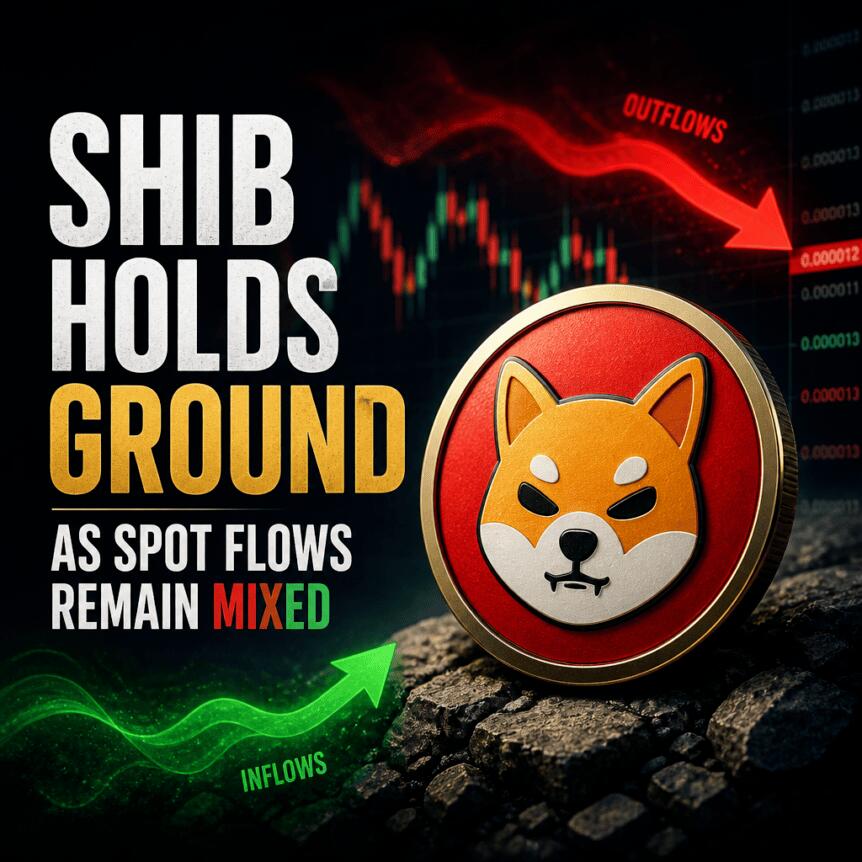
SHIB Knight argues that SHIB is not in its process of moving and is still early. The opinion is based on the analysis of the chart that displays prices close to long-term lower-ranges consolidation. However, the current structure of the chart does not show that a breakout from resistance occurred.
The extended timeframe shows a clear downtrend to $0.00000546. Before that happened, there was a sharp rise up to the level of $0.000045. Price had several attempts that resulted in failure at the levels of $0.000020 and $0.000030. It means that these levels were zones of active sales before.
The price began to fall slowly while being in the range of $0.000005-$0.000007. There are recent candles that are compressed at this lower level. It means that there is a transition from active selling to trading.
The current market chart displays the price at $0.000005416. The token rose by 0.4% over the past 24 hours shown on the chart. Trading activity was within the range of about $0.00000535 and $0.00000550.
Spot Flows Still Mixed Across Exchanges
$0.00000550 still looks like the nearest visible resistance point. Multiple attempts to reach this resistance point have not succeeded in sustaining a price advance there. In the meantime, the immediate downside reference for the range is $0.00000535–$0.00000540.
The spot-flow chart demonstrates many alternations of positive and negative flows. Both green and red bars have been seen all the way from November through September. No side showed any consistent behavior during the whole period.
There were several positive spikes in December and January. However, the price line kept deteriorating further despite these periods. This indicates that occasional inflows could not generate a consistent upward price formation.
The largest visible inflow was registered at the end of July. It was a green spike that exceeded $5 million and looked higher than the majority of other spikes. However, it had no effect on the subsequent price movement.
Resistance Defines The Technical Phase Ahead
Exchange volumes continue to be split between the large exchanges as well. There was trading of approximately $119.10K on Binance, whereas there was trading of about $84.04K on Upbit. Trading of about $44.08K and $34.64K was done on OKX and Bybit respectively.
The short-term technical analysis continues to see multiple attempts at recovering near $0.00000550. If the price manages to breach that level, it will change the immediate technical phase of the market and indicate that bulls have gained more power. Until then, price remains inside the defined consolidation phase.
The longer-term technical picture sees a possible rise towards $0.000010 and $0.000013. However, this is still speculative and price movement is needed to validate these moves.
There is also higher time frame resistance in the form of $0.000020 and $0.000030. In previous bullish waves, sellers emerged near both those levels. Any bullish wave will therefore have to navigate several resistance levels.
For the time being, SHIB continues to trade near its long-term base, with mixed flow in the spot market and resistance defining the current recovery phase. The reaction near $0.00000550 is an important technical level.

The Zcash Foundation has denied any connection to two third-party products, ZRC-20 and the CASH token, after a post published through its X account described them as additions to the Zcash network.
Summary
- The Zcash Foundation says ZRC-20 and CASH have no official connection to the organization.
- ZRC-20’s draft specification relies on shielded memos and off-chain indexers.
- The proposed standard requires no Zcash protocol change or formal ZIP approval.
- U.S. investors must distinguish third-party tokens from products endorsed by a network’s developers.
Zcash Foundation says it had no prior knowledge
The Zcash Foundation said in a statement that it had not known about the ZRC-20 project or the related CASH token before the matter emerged publicly. According to the organization, both products come from an independent third party and are not official parts of the Zcash protocol.
The clarification followed an X post published through the Foundation’s account that announced a token standard for Zcash. The post said ZRC-20 would soon allow users to deploy, mint, and transfer tokens on the privacy-focused blockchain, with CASH presented as the first token using the system.
“Zcash now has a token standard,” the post said before directing users to the project’s website.
In its later response, however, the Foundation rejected any association with the products and urged users to conduct their own research before interacting with them. The statement identified ZRC-20 as a privately developed system rather than a feature created, approved, or operated by the nonprofit.
No public explanation has established how promotional material for an unrelated project appeared through the Foundation’s account. Without confirmation from the organization, the incident cannot be described as an account compromise or hack.
Public information about the team operating ZRC-20 also remains limited. The project has released technical documentation and promotional pages, but the reviewed material does not clearly identify a company, legal entity, or group of named developers responsible for the system.
ZRC-20 uses Zcash memos without changing its protocol
According to the project’s technical documentation, ZRC-20 is a draft fungible-token specification that stores JSON instructions inside encrypted memo fields attached to shielded Zcash outputs. Independent indexers would read the instructions in block order and calculate token balances outside the Zcash consensus system.
The documents describe three operations: deploy, mint, and transfer. A deployment would create a ticker and set its maximum supply, minting would issue units up to that limit, and transfers would move balances between accounts recognized by the indexer.
ZRC-20 borrows its basic structure from Bitcoin’s BRC-20 format, but the proposed data carrier differs. BRC-20 records token instructions through Bitcoin inscriptions, while the ZRC-20 draft would place them in the 512-byte memo field available in shielded Zcash outputs.
The specification states that ZRC-20 is not a consensus change and does not require smart contracts. Zcash nodes would neither validate nor reject its token instructions because the indexer, rather than the blockchain protocol, would maintain the balance sheet.
As a result, Zcash consensus would only confirm the underlying transactions. Recognition of CASH balances would depend on software following the third party’s indexing and validation rules.
The project also would not provide automatic privacy for publicly traded tokens. According to its documentation, an indexer needs access to the memos before it can calculate balances. One proposed design sends operations to a common protocol address and publishes its incoming viewing key, allowing indexers to decrypt the token instructions even though other parts of the transaction remain shielded.
Ownership would rely on signatures embedded in each payload because a Zcash shielded address does not publicly reveal who created an output. The draft proposes separate account identifiers and Ed25519 signatures to authorize minting and transfers at the indexing layer.
Several features remain unresolved. The documentation lists atomic trading, payloads exceeding 512 bytes, structured memos, and possible naming conflicts among its open questions. Early exchanges would also need to be custodial because the draft does not contain an atomic trading method comparable with tools used by some Bitcoin markets.
Official Zcash changes follow a separate process
The official Zcash Improvement Proposal system provides the established route for proposing protocol features, publishing implementation details, gathering community feedback, and recording design decisions. ZRC-20 does not appear as an adopted protocol feature under that process.
A third-party application can use Zcash transactions without gaining approval from the Foundation or becoming part of the network’s consensus rules. The Foundation’s statement makes that distinction central to the dispute: ZRC-20 may attempt to build on Zcash infrastructure, but its use of the blockchain does not make it an official Zcash token standard.
The name carries another source of possible confusion. ZetaChain already uses ZRC-20 for its omnichain fungible-token format, while members of the Zcash community discussed the same label years earlier when considering how token functionality could increase activity involving ZEC.
Recent Zcash development has instead centered on formal network changes. Planned NU7 proposals have included reducing the block target from 75 seconds to 25 seconds while adjusting block rewards to retain the existing issuance schedule. Unlike the independent token system, such protocol changes require coordination among network developers, node operators and other participants.
U.S. token buyers face separate issuer questions
For U.S. users, a third party’s use of an established blockchain does not settle how regulators may treat its token offering or sale. The legal assessment can depend on how the asset is issued, marketed and sold, rather than whether the underlying network’s foundation endorsed it.
In August, the U.S. Securities and Exchange Commission proposed crypto-asset rules covering certain investment contracts involving digital assets. The proposal included possible exemptions for offerings of up to $5 million over four years and up to $75 million during a 12-month period, subject to the proposed conditions.
The SEC proposal does not classify CASH or determine its status under U.S. law. It does, however, make the identity of a token’s operator, the terms of its distribution, and the claims made to purchasers relevant details for American participants reviewing a new launch.
The Foundation’s warning also arrived while ZEC was experiencing large price swings. As crypto.news reported on Sep. 7, ZEC gained about 43% during the first week of September and traded near $1,197 after breaking above $1,000.
By Sep. 14, the privacy coin had retreated toward $1,139 after touching a multi-year high near $1,290. Futures open interest fell by about 20% over 24 hours during the pullback, while roughly $17.2 million in long positions were liquidated.
ZEC then rose more than 20% to approximately $1,337 on Sep. 16, having reached an intraday high near $1,385. The move followed renewed attention on the NU7 vote and came as traders monitored resistance around $1,375 and $1,500.

Bitcoin Core developers have moved version 32.0 into release-candidate testing, with the stable software scheduled for a possible Oct. 10 release after weeks of public checks.
Summary
- Bitcoin Core 32 entered release-candidate testing on Sep. 14 following an August feature freeze.
- Parallel database reads could reduce block-validation times without changing Bitcoin’s block production rate.
- Four wallet commands will use PSBT version 2 by default while retaining the older format.
- Security fixes address unsafe wallet names and unauthenticated HTTP requests that caused heavy memory use.
Bitcoin Core 32 targets an Oct. 10 release
Bitcoin Core’s official release schedule shows that developers created the version 32 branch and started the release-candidate cycle on Sep. 14. The first candidate, known as v32.0rc1, is now available for testing before developers decide whether to tag the stable release.
The project set Oct. 10 as the intended date for version 32.0, though the schedule describes it as a target rather than a confirmed deadline. Problems found during candidate testing could require additional releases and delay the final version.
Preparations began months earlier. Developers opened translations and introduced a soft freeze on translation changes on Aug. 6, followed by a feature freeze on Aug. 20. From that date, the version 32 branch accepted bug fixes but no new features ahead of final testing.
When the branch separated from the main codebase on Sep. 14, development of Bitcoin Core 33 also began on the main branch. The split allows contributors to test and repair the upcoming release without stopping work on the next version.
Release candidates give node operators, wallet developers and other users time to find bugs under different hardware and software conditions. Bitcoin Core’s testing process covers functions including block validation, peer-to-peer communication, wallet operations and remote procedure calls used by applications connected to a node.
Parallel database reads speed up block checks
One of the main performance changes allows Bitcoin Core to read data from its database in parallel while checking blocks. The method can shorten validation time because the software no longer has to complete every relevant database read one after another.
Faster validation does not mean Bitcoin will produce blocks more quickly. Miners still compete to add blocks under Bitcoin’s proof-of-work rules, which target an average interval of roughly 10 minutes. Version 32 changes how a node processes required information rather than the network’s issuance schedule or block timing.
The distinction matters because Bitcoin Core is node software, not a centrally managed update to the Bitcoin network. Operators decide which version to install, and the release does not automatically replace the software running on every node.
Version 32 also does not introduce a new consensus rule or require a soft fork. Its release process differs from protocol changes that need coordination among miners, node operators, and other network participants.
As previously reported by crypto.news, LayerTwo Labs CEO Paul Sztorc said every proposed Bitcoin soft fork since Taproot has failed to activate. BIP-110, a disputed proposal linked to transaction-relay policy, received 2.53% miner support before its enforcing branch stalled after two blocks.
Bitcoin Core 32 can therefore improve software performance without depending on the activation process required for a consensus change. Node operators remain free to test the candidate, continue using an older release, or install the stable version after publication.
Wallet commands adopt the newer PSBT format
Wallet functions account for another set of changes in version 32. Four commands will create partially signed Bitcoin transactions using PSBT version 2 by default, according to details shared by Bitcoin News.
A PSBT lets separate wallets, devices, or participants exchange the information needed to build and sign a Bitcoin transaction without exposing private keys. The format is commonly used with hardware wallets, offline signing setups, and transactions that require more than one signature.
PSBT version 2 changes how transaction information is organized and permits participants to update parts of a transaction without first creating a complete unsigned transaction. The older PSBT format will remain available when users or connected applications require it.
Keeping both versions reduces the chance of abruptly breaking wallets and services that have not adopted the newer format. Developers integrating Bitcoin Core with other software will still need to check whether their systems expect the previous default.
For individual holders, the change does not alter Bitcoin balances, private keys or the rules governing valid transactions. Its practical effect falls on wallet workflows and applications that call the affected commands.
Security fixes reduce command and memory risks
Version 32 also includes a patch for custom wallet names that could cause commands to run on non-Windows nodes. The issue concerned how specially constructed names interacted with command execution, rather than a change to Bitcoin’s underlying cryptography.
A separate fix addresses memory growth caused by unauthenticated HTTP activity. In one test cited by Bitcoin News, memory use reached about 3.2 gigabytes before the patch, compared with roughly 3 megabytes after developers applied the change.
Remote interfaces allow other programs to communicate with Bitcoin Core, making memory controls relevant to operators who expose node services to connected applications. Access settings, firewalls and authentication remain separate parts of securing a deployment.
For U.S. users, the candidate is most relevant to node operators, wallet providers, exchanges, miners and infrastructure companies that run Bitcoin Core in their systems. The release does not change the SEC’s treatment of spot Bitcoin exchange-traded products, investor tax rules or the legal status of BTC.
American financial firms have also increased their support for Bitcoin’s open-source security work. In July, Anchorage Digital, ARK Invest, BlackRock, Block, Blockstream, Coinbase, Fidelity Digital Assets, Galaxy and Strategy formed the Bitcoin Security Consortium with $15 million in pledges over three years.
According to the consortium’s announcement, each member will direct its funding independently rather than placing the money in a shared pool. The group said it will not control Bitcoin development, take positions on specific protocol proposals or speak for the project’s contributors.
Mike Schmidt, executive director of Bitcoin developer-funding nonprofit Brink, coordinates the consortium’s daily work in a volunteer role. Its initial focus is research into long-term security issues, including protections against future quantum-computing risks.

Crypto-backed super PAC Fairshake has prepared an expenditure of at least $30 million to oppose former Sen. Sherrod Brown’s return to the U.S. Senate following the failure of the CLARITY Act.
Summary
- Fairshake reportedly plans its largest expenditure of the 2026 election cycle against Brown.
- Brown is challenging Republican Sen. Jon Husted in Ohio’s November special election.
- Brown previously chaired the Senate Banking Committee and opposed several crypto-backed proposals.
- Fairshake and its affiliates had accumulated more than $193 million by January.
Fairshake prepares its largest 2026 expenditure
Eleanor Terrett, host of Crypto in America, reported on X that Fairshake plans to spend at least $30 million against Brown, citing an initial report from The New York Times and confirmation from a spokesperson for the political action committee.
If completed, the allocation would become Fairshake’s largest expenditure during the current election cycle. The decision arrived after the Senate rejected a procedural motion on the Digital Asset Market Clarity Act, an industry-backed bill intended to divide federal oversight of digital assets between the Securities and Exchange Commission and the Commodity Futures Trading Commission.
Brown is seeking an Ohio Senate seat in a special election against Republican Sen. Jon Husted. Describing the campaign as a re-election bid would be inaccurate because Brown lost his former seat to Republican Bernie Moreno in November 2024.
Husted, Ohio’s former lieutenant governor, joined the Senate in January 2025 after Gov. Mike DeWine appointed him to the seat vacated by JD Vance. Vance left the chamber to serve as vice president. The winner of the November 2026 election will complete the remaining portion of Vance’s term, which runs through January 2029.
According to Reuters, election analysts moved the contest from “likely Republican” to “lean Republican” after Brown entered the race in August 2025. Brown had represented Ohio in the Senate for 18 years before Moreno defeated him 50.1% to 46.5%.
CLARITY Act defeat raises the political stakes
The proposed spending follows the failed Senate vote on Sep. 15, when the motion to begin debate on the CLARITY Act received 50 votes to 49. Advancing the measure required support from 60 senators.
Several lawmakers involved in the negotiations voted against the motion, including Democratic Sens. Ruben Gallego, Kirsten Gillibrand and Angela Alsobrooks. Republican Sens. Susan Collins, Josh Hawley, Jerry Moran and Thom Tillis also withheld support.
Disagreements over presidential ethics, stablecoin rewards, protections for decentralized software developers and state authority prevented senators from reaching a final deal. Democrats had sought tighter limits on crypto businesses connected to President Donald Trump and his family, while banking groups pressed lawmakers to restrict rewards offered through stablecoin products.
A revised version would have assigned the CFTC authority over qualifying digital commodities and registered spot-market intermediaries. The SEC would have retained jurisdiction over assets and transactions governed by federal securities laws.
Hours before the vote, Democrats presented a counterproposal through talks involving Senate Minority Leader Chuck Schumer’s office. Republicans rejected it, saying their 635-page bill already included 126 changes requested during bipartisan negotiations.
Fairshake had supported the legislation before the vote through a national television advertising campaign. The PAC’s move into the Ohio race places its election spending behind the same policy campaign after the bill failed to secure enough Senate support.
Public pressure had also grown before the vote. Ripple Chief Legal Officer Stuart Alderoty urged undecided senators to speak with individual token holders, while a National Cryptocurrency Association survey estimated that 67 million Americans owned cryptocurrency in 2026.
Brown’s possible Banking Committee return concerns Fairshake
Brown’s record on the Senate Banking Committee has made his comeback bid important to the crypto industry. As committee chairman from 2021 until January 2025, he raised concerns about illicit finance, money laundering and consumer risks linked to digital assets.
Politico reported in August 2025 that Brown had blocked or resisted several Republican proposals supported by crypto companies while leading the committee. Fairshake spokesperson Josh Vlasto responded at the time by promising continued spending against candidates the group considered hostile to the sector.
“We will continue to support pro-crypto candidates and oppose anti crypto candidates, in Ohio and nationwide.”
A Brown victory would not automatically return him to the chairmanship or make him the committee’s senior Democrat. Senate Democratic rules generally treat service as interrupted when a former member leaves the chamber and later returns, meaning Brown would not necessarily retain the seniority accumulated during his previous 18 years.
Democratic leaders could change their caucus rules or grant Brown an exception, according to Politico. Control of the committee would also depend on whether Democrats win enough seats to take the Senate majority.
Husted has supported legislation favored by the crypto industry since entering the chamber. Politico reported that he backed relevant measures on the Senate floor and supported the sector’s policy goals while serving as Ohio lieutenant governor, although he had not made digital assets a central issue during his early months in Congress.
Crypto PAC enters an expensive Ohio contest
Fairshake has enough available funding to make the reported $30 million commitment. Axios reported in January that Fairshake and its affiliated committees had accumulated more than $193 million for the 2026 midterm elections, almost $60 million above the network’s total spending during the 2024 cycle.
Coinbase and Ripple each contributed another $25 million, while venture capital firm a16z supplied $24 million, according to Axios. Fairshake operates alongside two affiliated groups: Protect Progress, which participates in Democratic races, and Defend American Jobs, which focuses on Republican contests.
The network supports candidates from both parties based on their positions on digital-asset policy. Federal rules allow super PACs to raise and spend unlimited amounts, but they cannot coordinate expenditures directly with candidates or their campaign committees.
Ohio has already drawn heavy outside spending. Reuters reported on Sep. 18 that approximately $298 million in advertising had been spent or reserved for the race, placing it among the most expensive Senate contests of 2026.
Recent surveys cited by Reuters placed Brown three to five percentage points ahead of Husted. Brown’s campaign had raised $38.6 million, compared with $14.3 million for Husted, while Republican organizations launched a separate $14 million advertising campaign supporting the incumbent.
Fairshake previously made Ohio its most expensive target. During the 2024 election, the network spent more than $40 million supporting Moreno against Brown, exceeding its spending in every other race it entered. Moreno defeated Brown by about 207,000 votes and later joined the Senate Banking Committee.
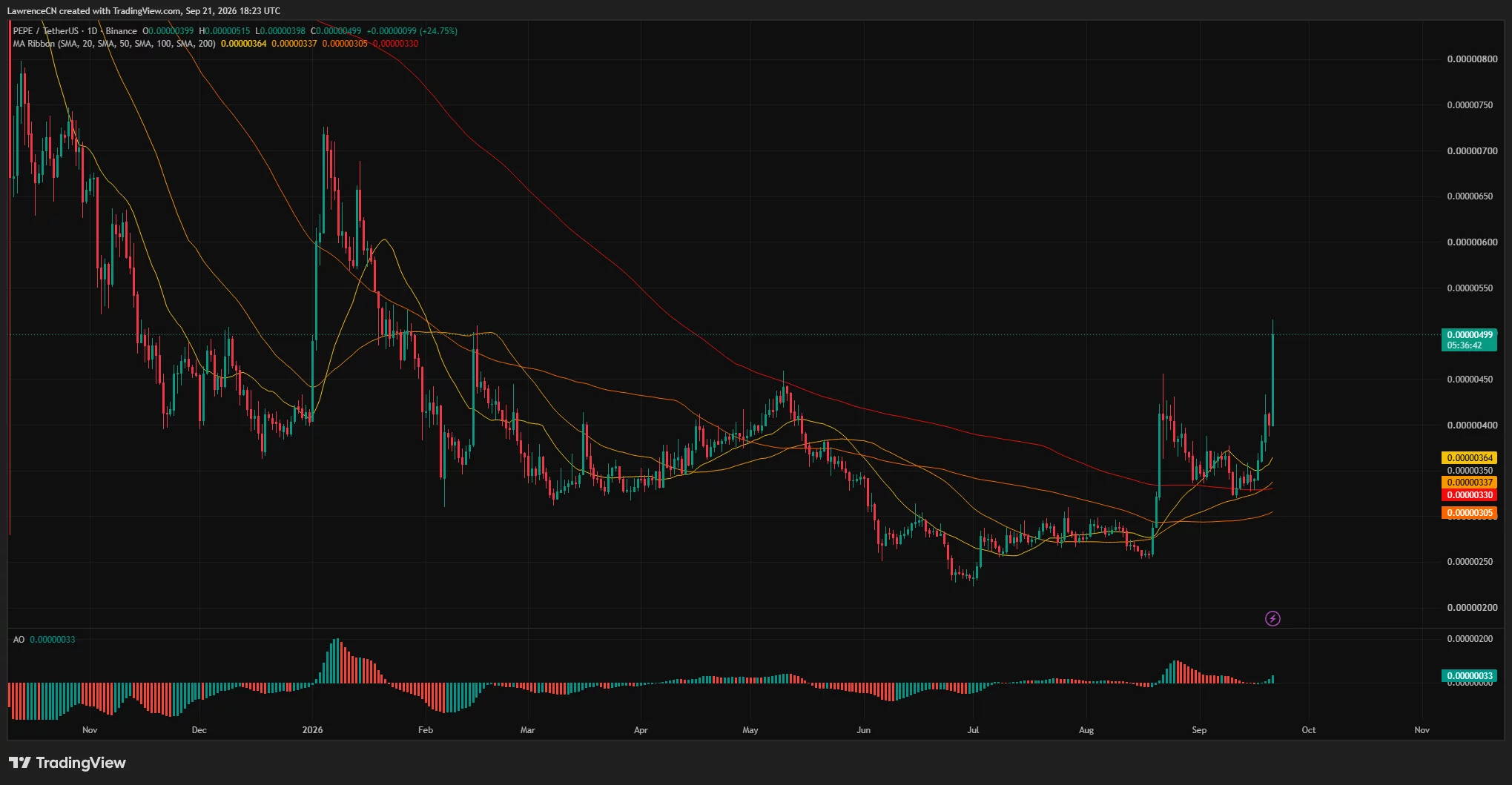
Pepe price surged nearly 25% on Sep. 21 as the meme coin cleared a major resistance level, although an overbought 4-hour reading raises the risk of a short-term pullback.
Summary
- PEPE price rose 24.75% on the daily chart and traded near $0.00000499.
- Price broke above $0.00000458, a level identified as a key structural barrier.
- The 4-hour RSI reached 82, placing PEPE deep in overbought territory.
- Liquidation data show large leverage clusters below the market near $0.00000360.
According to data from crypto.news, Pepe (PEPE) price traded around $0.00000499 at the time of writing after reaching an intraday high of $0.00000515. The rally lifted the meme coin by 24.75% during the daily session and extended its seven-day gain to nearly 40%, according to CoinGecko.
The token’s market capitalization climbed above $2 billion, while its 24-hour trading volume approached $900 million.
PEPE’s advance came alongside a wider crypto rally led by Bitcoin, which crossed $85,000 for the first time in eight months. Bitcoin exchange-traded funds operated by firms including BlackRock and Fidelity received about $433 million on Friday, according to JPMorgan data cited by the Wall Street Journal.
Broader demand for risk assets helped PEPE accelerate beyond the gradual recovery visible earlier in the week. However, its latest technical readings suggest that buyers may struggle to maintain the same pace without a period of consolidation.
Pepe price clears its major moving averages
The daily PEPE/USDT chart shows that the token has moved above its 20-day, 50-day, 100-day and 200-day simple moving averages.
PEPE’s 20-day SMA stood near $0.00000364, while the 50-day and 100-day averages were located around $0.00000337 and $0.00000330, respectively. The 200-day SMA remained lower at approximately $0.00000305.
Trading above all four averages marks a sharp change from the bearish structure that controlled the market during the first half of 2026. Price had fallen from above $0.000007 in late 2025 to a June low near $0.00000220 before forming a base.
The daily Awesome Oscillator also moved into positive territory at approximately 0.00000033. A positive reading means short-term momentum is stronger than longer-term momentum, supporting the current bullish setup.
The next technical test sits between $0.00000515 and $0.00000550. PEPE briefly touched the lower end of that area during the rally but had not produced a confirmed daily close above it at the time the chart was captured.
4-hour RSI warns of an overheated rally
Shorter-term readings show greater pullback risk after the rapid price increase.
The 4-hour Relative Strength Index rose to 82.05, well above the 70 level commonly used to identify overbought conditions. Its RSI-based moving average stood at 70.13, confirming that momentum accelerated sharply during the breakout.
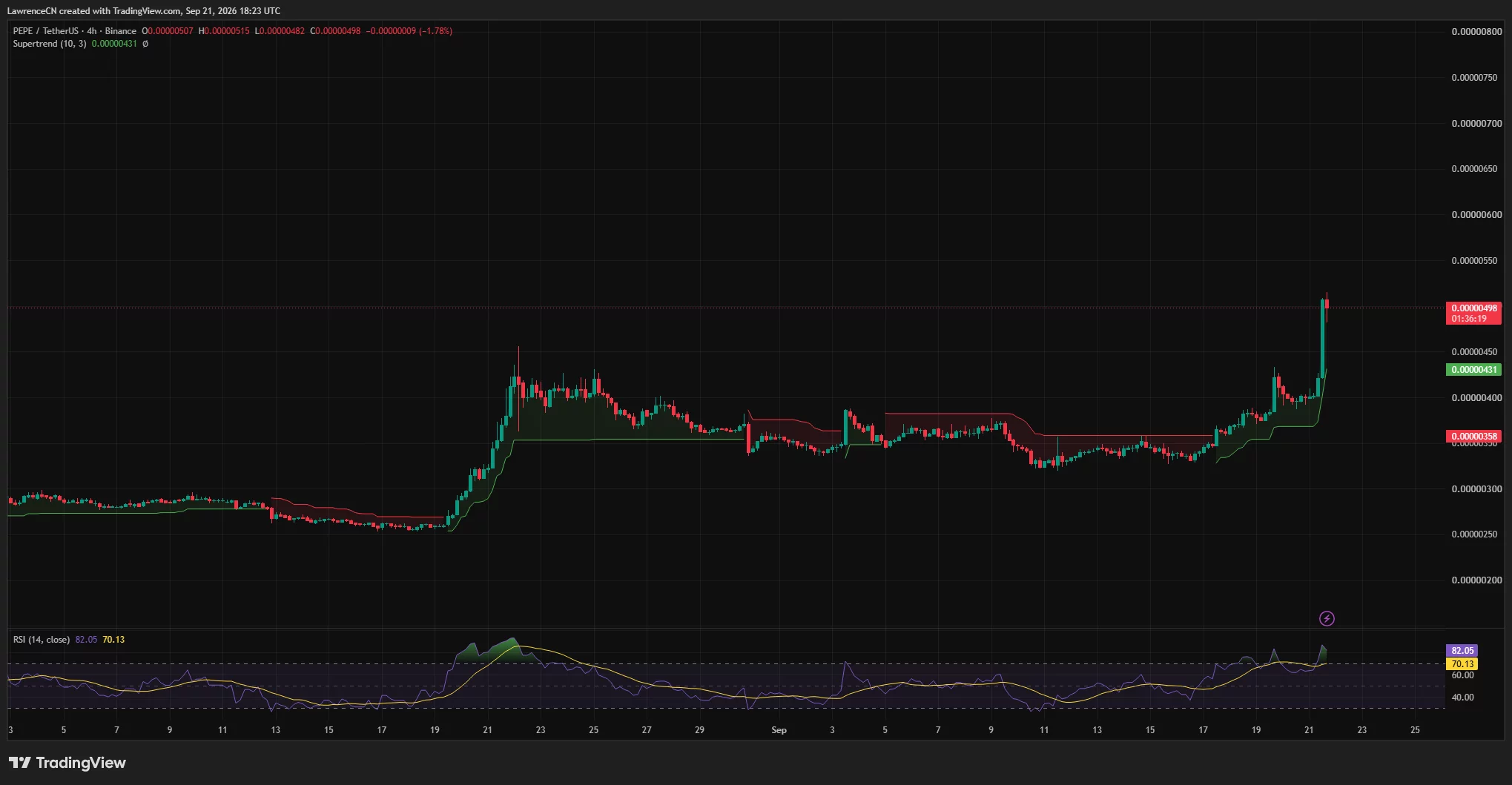
An overbought RSI does not guarantee an immediate fall, but it can indicate that buyers have already committed substantial capital over a short period. PEPE’s latest 4-hour candle had declined 1.78% from its opening price after reaching $0.00000515, showing early profit-taking near the session high.
The 4-hour Supertrend remained bullish, with its support line near $0.00000431. Holding above that level would preserve the current short-term trend and could allow buyers to retest $0.00000515.
A drop below $0.00000431 would weaken the breakout and expose the former resistance area around $0.00000400. Deeper support sits near the 20-day moving average at $0.00000364.
PEPE liquidation clusters increase pullback risk
CoinGlass’s one-week liquidation heatmap shows that PEPE’s rally moved through several concentrations of leveraged positions between $0.00000410 and $0.00000450.
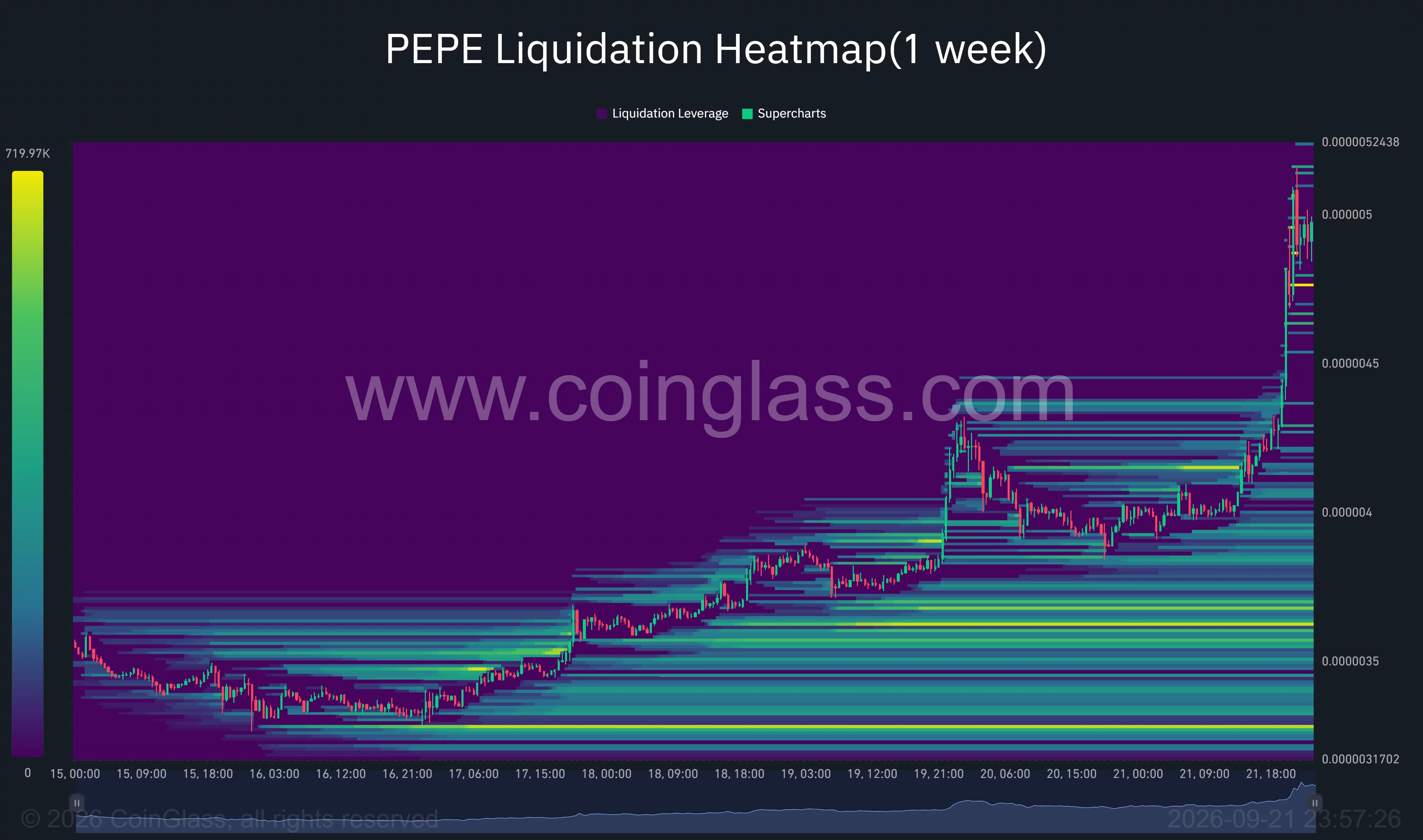
The largest remaining liquidity concentrations appear below the current price. Dense bands are visible around $0.00000355–$0.00000370, with another strong cluster near $0.00000320.
Liquidation heatmaps show where leveraged positions could face forced closure if the market reaches certain prices. They do not establish that price must move toward those zones, but concentrated leverage can add volatility when a reversal begins.
Smaller clusters also sit above PEPE near $0.00000510–$0.00000524. A renewed move through the intraday high could force additional short liquidations and extend the rally before the market tests higher resistance.
PEPE breakout puts $0.00001 back in focus
Crypto analyst Crypto Patel said PEPE has risen about 97% from a higher-time-frame accumulation zone between $0.00000200 and $0.00000270.
“The accumulation move is already underway. The next trigger is the breakout.”
Patel identified $0.000004583 as the level PEPE needed to reclaim and convert from resistance into support. The market has now traded above that threshold, but a daily close and successful retest would provide stronger confirmation than the initial intraday break.
The analyst listed $0.000010, $0.0000,16 and $0.000027 as possible longer-term targets if PEPE also breaks its higher-time-frame downtrend. Those levels remain projections rather than confirmed destinations, with the first target requiring the token to roughly double from its current price.
PEPE’s immediate outlook depends on whether buyers can defend $0.00000458 after the 25% daily advance. Holding that level would keep $0.00000515 and $0.00000550 in view, while losing it could send the token toward Supertrend support at $0.00000431 or the larger liquidation zone near $0.00000360.
Saudi Arabia has withdrawn from mBridge, a China-backed cross-border digital currency project designed to enable direct transactions between central banks, according to the Financial Times.
SAMA, Saudi Arabia’s central bank, joined mBridge as a full participant in June 2024 and ended its participation after completing a proof of concept on May 13, 2025, FT reported, citing a statement from the central bank. SAMA said it had planned to end its participation.
MBridge was established in 2021 through a collaboration between the Bank for International Settlements (BIS) Innovation Hub and the central banks of China, Hong Kong, Thailand and the United Arab Emirates, with the aim of making cross-border payments faster and cheaper.
Rather than using a single stablecoin, the platform allows participating central banks to issue and transact in their own digital currencies on a shared ledger, including for cross-border payments and foreign exchange transactions.
The project continued to develop under the BIS until October 2024, when the organization handed it over to the participating central banks after mBridge reached its minimum viable product stage. Then-BIS General Manager Agustín Carstens said the BIS departure was not politically motivated.
The project has nevertheless drawn scrutiny from US policymakers. A 2024 report from the US-China Economic and Security Review Commission said mBridge could eventually provide an alternative cross-border settlement system for countries seeking to evade US sanctions.
Cointelegraph contacted the Saudi Central Bank for comment but did not receive a response by the time of publication.
Related: Chinese newspaper warns of Bitcoin extortion scam using its name
China weighs digital currencies’ role in cross-border payments
China’s central bank, meanwhile, has increasingly focused on the role stablecoins could play in cross-border payments as their use expands globally.
In June, People’s Bank of China Research Bureau director General Wang Xin called for closer monitoring of stablecoins and central bank digital currencies in cross-border payments, along with greater international coordination.
His comments came months after Chinese authorities restricted the unauthorized issuance of renminbi-pegged stablecoins and tokenized real-world assets, including by foreign entities.
Magazine: Who needs CLARITY anyway? ARB could see 70X increase: Hodler’s Digest
The SEC has opened a five-year route for tokenized U.S. stock trading, but TD Cowen has found that domestic investors, institutions, and listed companies show little appetite for the products.
Summary
- TD Cowen expects limited adoption among U.S. retail and institutional investors.
- Figure recorded 99.9% of examined trading through its conventional Nasdaq-listed shares.
- SEC relief requires stock tokens to preserve economic, dividend, voting, and liquidation rights.
- Nvidia perpetual futures generated 96% of related notional volume in a Binance snapshot.
TD Cowen said U.S. investors already have efficient access to listed shares, leaving tokenized venues under pressure to offer benefits that outweigh thin liquidity and added operational work.
Reid Noch, vice president of U.S. equity market structure at TD Cowen, wrote in a Friday paper that both retail and institutional demand will likely remain limited during the market’s early stage.
“U.S. investors already have efficient access to the underlying shares,” Noch wrote, adding that tokenized platforms need a compelling benefit to offset their operational complexity and restricted liquidity.
The assessment followed the U.S. Securities and Exchange Commission’s five-year tokenized stock exemption, announced on Sep. 17. The conditional relief lets qualifying Tokenized Securities Venues use permissioned automated market makers and liquidity pools to trade tokenized National Market System stocks.
Eligible liquidity providers can also receive temporary relief from certain dealer-registration requirements. Each participating venue remains subject to limits on the number of stocks it supports and the trading volume processed through the system.
Tokenized stocks must compete with efficient U.S. markets
For American investors, TD Cowen’s concern centers on whether tokenization improves a market that already offers deep liquidity, low-cost brokerage services and fast electronic execution.
Blockchain-based venues could extend stock trading into nights, weekends and holidays. Their automated market makers, or AMMs, would price transactions through asset pools and preset rules instead of matching buyers and sellers in a conventional order book.
In practice, Noch warned that continuous access does not guarantee favorable execution. A pool with limited assets may produce weaker prices, especially when fewer traders and liquidity providers are active outside the main U.S. session.
AMM pricing also places more weight on the amount and composition of assets deposited in each pool. Although a venue may remain technically open around the clock, TD Cowen’s analysis indicates that investors could still prefer established exchanges if the onchain market offers less liquidity or higher trading costs.
U.S. exchanges generally operate their main sessions between 9:30 a.m. and 4 p.m. Eastern Time on weekdays. Several brokers already provide premarket and after-hours access, reducing the value that some domestic traders may place on a separate blockchain venue.
The SEC has attached investor protections to its experiment. Approved tokens must represent NMS stocks and preserve the economic interest, dividends, voting power, and liquidation rights associated with the underlying shares.
Synthetic products that merely follow a company’s stock price do not qualify. As previously covered by crypto.news, the agency’s investor-rights requirements separate qualifying stock tokens from offshore products that may offer economic exposure without making the buyer a shareholder.
Issuer objections could restrict tokenized stock listings
Before a third party tokenizes a company’s shares, the SEC framework requires the proposed venue to notify the issuer. The company then has 30 days to object, according to the TD Cowen paper.
Listed businesses therefore retain some control over whether unrelated operators create blockchain versions of their securities. Trading cannot proceed under the exemption when an issuer objects.
According to Noch, discussions with dozens of issuers found little interest in offering tokenized shares. The group included several companies with large retail investor bases, although crypto-linked businesses such as Figure showed more interest.
“Our conversations with dozens of issuers” revealed minimal demand outside crypto-adjacent companies, Noch wrote.
Figure provides an existing comparison between traditional and blockchain-based shares. Its Nasdaq-listed FIGR stock trades alongside blockchain-native FGRS shares carrying the same economic exposure and voting rights.
During the 24-hour period studied by TD Cowen, conventional FIGR shares accounted for 99.9% of the company’s notional trading. The finding suggests that equal economic and governance rights have not been enough to move meaningful activity away from the Nasdaq-listed security.
Other SEC conditions may also limit how quickly venues can add markets. Smart contracts must be public and auditable, while operators must disclose trading activity, related-party transactions, and key details about their systems.
A venue must also halt a tokenized stock whenever the primary exchange stops trading the underlying shares. As a result, round-the-clock availability would not override an official halt related to volatility, company news or a regulatory issue.
In early September, the SEC also proposed a transfer-agent rule overhaul covering digital ownership records, cybersecurity, asset protection and third-party technology providers. Transfer agents maintain the official shareholder register used for voting, dividends, stock splits and other corporate actions, making their records important when a token claims to represent legal ownership.
Stock perpetuals show stronger demand than tokenized shares
For crypto traders seeking exposure to public companies, TD Cowen found more activity in perpetual futures than in spot stock tokens.
A snapshot of Nvidia-related trading on Binance showed that perpetual futures generated 96% of notional volume, while spot products accounted for 4%. Perpetuals track the price of an asset without transferring ownership of the referenced shares.
The contracts have no fixed expiration date and use recurring funding payments to keep their prices close to the underlying stock. They may also offer leverage, which lets traders control a larger position with less capital but increases liquidation risk when prices move against them.
“As we continue to outline, we see perpetual futures as the stronger demand story,” Noch wrote.
TD Cowen expects platforms to keep adding the products inside and outside the United States, citing retail demand for leverage.
Recent filings support the comparison. On Sep. 18, Coinbase submitted proposals for 50-plus stock perpetuals tied to companies including Nvidia, Microsoft and Tesla. The exchange plans to offer 24-hour trading from Monday through Friday if U.S. regulators clear the contracts.
Coinbase’s proposed products would provide leveraged price exposure without voting rights, dividends or ownership of the referenced shares. Their listing remains subject to regulatory review, and the company has not announced a launch date or complete contract specifications.
Earlier in September, Ondo Finance also asked the SEC and Commodity Futures Trading Commission to apply existing security-futures rules to stock perpetuals. Its Panama-based affiliate had processed $8 billion in cumulative volume within about six weeks, according to Ondo’s regulatory submissions.
Ondo said the offshore platform settles contracts in stablecoins and remains unavailable to American users. Many of its perpetuals reference U.S.-listed companies, allowing eligible non-U.S. traders to follow their stock prices without opening a conventional brokerage account.
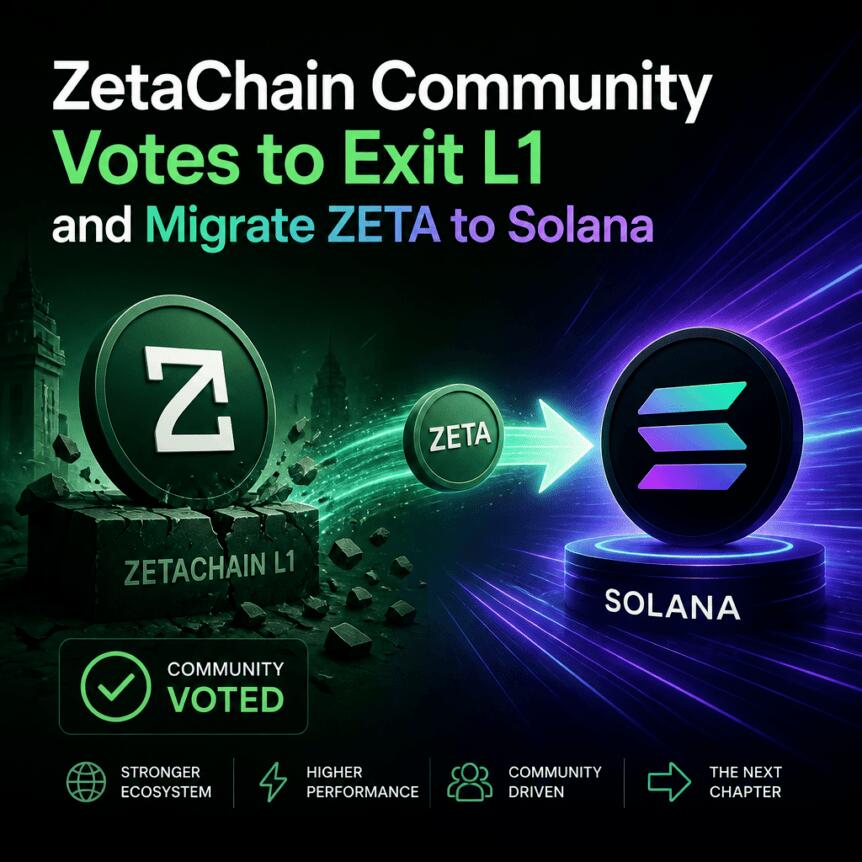
ZetaChain’s token community has voted to wind down its own layer-1 blockchain and migrate its native ZETA token to Solana. The change was approved via governance proposal 68, with 99.4% of votes supporting the plan and participation at 58%, surpassing the network’s 40% quorum requirement.
While the vote clears the way for the transition, ZetaChain said it will not immediately trigger a full shutdown or migration. A second proposal is expected to lay out the practical details—timing, asset withdrawal windows for cross-chain holdings, token snapshot mechanics, and the conversion process duration.
Key takeaways
- Governance proposal 68 passed with 99.4% approval and 58% participation, clearing the first step toward ZetaChain’s layer-1 shutdown.
- ZETA will move to Solana as an SPL token via a 1:1 conversion, keeping the same ticker and total supply.
- The initial vote does not start the shutdown immediately; a follow-up proposal will specify withdrawal and conversion windows.
- Validators are expected to remain operational during the transition, with staking rewards continuing.
- ZetaChain cites a strategic shift toward its Anuma AI application and encrypted “Private Memory Layer,” reducing the need for a standalone Cosmos SDK chain.
Governance approval clears the path to a Solana token migration
According to the terms outlined in proposal 68, ZETA will become an SPL token on Solana through a 1:1 conversion. The migration is designed to preserve continuity for tokenholders: the ticker remains ZETA and the total supply stays unchanged.
The proposal also clarifies what comes next. It does not itself dictate an immediate cessation of ZetaChain’s layer-1 operations or the start of token migration. Instead, core contributors will bring a second proposal that covers operational specifics, including how and when tokenholders can withdraw assets related to other blockchains, the snapshot block height used to determine entitlements, the shutdown timetable, and the claim and exchange conversion period.
ZetaChain also indicated that validators will continue running, and staking rewards will continue through the transition. That matters for holders who rely on staking income, because it suggests there is intended continuity rather than an abrupt end to network participation.
Why ZetaChain is winding down: focus shifts to Anuma and private AI memory
ZetaChain framed the shutdown as a strategic realignment. The project said that maintaining its own layer-1—built on the Cosmos SDK—no longer fits its current priority around Anuma, its private-focused artificial intelligence application.
In the project’s view, moving the ZETA token to Solana will let it redirect resources away from blockchain maintenance and toward Anuma and the “Private Memory Layer.” The Private Memory Layer is positioned as a way for users to carry encrypted context across AI models, which would be difficult to support without dedicated product and infrastructure investment.
For tokenholders, the core question is how the token’s role changes when the layer-1 network is retired. The proposal keeps supply and ticker consistent, but it leaves open—pending the follow-up documentation—how governance, staking, and token utility will function after migration.
A broader pattern: other crypto projects retreat from standalone chains
ZetaChain’s decision aligns with a wider trend in crypto where teams choose to shut down standalone networks and migrate tokens elsewhere. The article notes that BounceBit and Harmony have both announced plans to retire their own layer-1 infrastructure.
BounceBit reportedly decided to retire its standalone blockchain after an authorization flaw was exploited to steal approximately $3 million in BB tokens. Instead of restarting its layer-1, BounceBit migrated its token to BNB Smart Chain at a 1:1 ratio.
Harmony’s approach has also centered on a pivot away from its layer-1. Earlier coverage cited that Harmony proposed shutting down its layer-1 and migrating its ONE token to Ethereum as an ERC-20, as part of a broader pivot toward an AI video initiative. That proposal followed a period of disruption tied to an exploit that created unauthorized ONE tokens and prompted a rollback plan affecting more than 109,000 transactions.
Security history and the settlement mechanics tokenholders should watch
ZetaChain’s migration comes with additional context around security. The project previously faced a $334,000 exploit in April targeting its cross-chain gateway contract, which drained funds from ZetaChain-controlled wallets across multiple networks including Ethereum, Arbitrum, Base, and BNB Smart Chain.
After the incident, ZetaChain acknowledged that it had dismissed an earlier bug bounty report, claiming it was intended behavior. That decision triggered a review of security processes.
In this light, the operational content of the second governance proposal becomes especially important. Tokenholders and users with assets tied to cross-chain functionality will want clarity on several items that proposal 68 did not specify: the precise withdrawal window for assets connected to other blockchains, how the snapshot block height will be determined, and the mechanics and timeline for token claims and conversion to Solana.
Investors and traders will likely also pay close attention to whether the transition period maintains staking participation and rewards as promised, and whether any changes to token administration accompany the migration.
Going forward, the key thing for ZetaChain stakeholders is the follow-up proposal that defines the shutdown and claim details. Until the network publishes the timeline, snapshot parameters, and conversion window, holders should treat the Solana migration as approved in principle—but not operationally complete.

SlowMist has warned that attackers may have adapted the Darksword exploit chain to compromise devices running iOS 26.5 and extract private keys from self-custody crypto wallets.
Summary
- Darksword attacks can begin when an iPhone user opens a malicious link in Safari.
- SlowMist says attackers may have adapted the exploit chain to iOS 26.5.
- Google previously confirmed Darksword activity against iOS 18.4 through iOS 18.7.
- Three U.S. investors separately allege fake wallet apps caused $1.835 million in Bitcoin losses.
SlowMist Chief Information Security Officer 23pds said attackers are using Darksword to bypass Apple’s security controls, gain extensive access to affected iPhones, and collect data from locally installed cryptocurrency wallets.
The reported iOS 26.5 exposure has not been independently confirmed by Apple or Google. Google Threat Intelligence Group’s published research documented support for iOS versions 18.4 through 18.7, while 23pds said attackers have since modified the tool to work against the newer operating system.
Darksword may reach iOS 26.5 devices
Google’s Threat Intelligence Group identified Darksword as a full iOS exploit chain that combines six vulnerabilities to compromise devices and deliver separate malicious payloads. The company tracked related activity from at least December 2025 through March 2026.
According to Google, the original framework supported iOS 18.4 through iOS 18.7. One flaw used against iOS 18.6 to 18.7 devices, tracked as CVE-2025-43529, affected JavaScriptCore, the engine that processes JavaScript in Safari. Apple patched the flaw in iOS 18.7.3 and iOS 26.2 after Google reported it.
SlowMist’s latest assessment extends the potential exposure to iOS 26.5, although the security company’s claim has not received official confirmation. No technical analysis cited in the warning established which vulnerability or replacement exploit could let Darksword compromise the newer release.
Attackers generally initiate the compromise through social engineering, according to 23pds. A target receives a link through a social network, messaging app, or another communication channel and opens the page in Safari. Malicious web content then attempts to exploit the browser and other iOS components without requiring the user to install a conventional application.
Once the chain succeeds, the attacker may obtain root-level control, 23pds said. Such access can remove the isolation that normally prevents one application from reading files and credentials belonging to another, placing private keys and other wallet records stored on the device at risk.
Malicious Safari links can expose wallet data
Google found several groups using Darksword with different final-stage payloads, rather than one fixed piece of malware. Depending on the campaign, the payloads could collect account details, messages, browser records, files, location history, saved Wi-Fi data and information linked to cryptocurrency wallets.
The security company connected separate operations to victims in Saudi Arabia, Turkey, Malaysia and Ukraine. Google associated some activity with commercial surveillance providers and suspected state-linked groups, while researchers also found signs that financially motivated actors had gained access to advanced iPhone exploitation tools.
No victim total or confirmed amount of cryptocurrency stolen through Darksword was included in the material supplied by SlowMist. The warning instead focused on the framework’s ability to reach wallet information after compromising the device that stores it.
A similar delivery method appeared in an earlier mobile threat. In March, crypto.news covered Google’s findings on Coruna, an exploit kit containing 23 vulnerabilities across five attack chains. Coruna targeted iPhones running versions from iOS 13 through iOS 17.2.1 and could search files and images for terms such as “backup phrase” and “bank account.”
Google researchers said Coruna fingerprinted a visitor’s device before selecting an exploit suited to the iPhone model and software version. Some operators placed the kit on fake gambling and cryptocurrency sites, allowing the compromise to begin when a target loaded the page.
Recent iOS threats have targeted private keys
Darksword is not the only recent security threat involving cryptocurrency data on Apple devices. Binance warned iPhone and iPad users on Sep. 19 about malicious code found in FomoPeek versions 1.1 and 1.2.
Researchers examining the app found a kernel exploitation framework with eight attack methods and declared support covering iOS 12.0 through 18.7.2 and iOS 26.0 through 26.1. The malicious modules could escape the iOS sandbox, decrypt Keychain data, and access private keys, wallet recovery phrases, account credentials, and files held by other applications, according to a report on FomoPeek.
Binance advised anyone who had installed the affected versions to remove the app, update iOS, and avoid reinstalling it. Self-custody users were also told to create a new wallet on a clean device and transfer their assets, since deleting a malicious app would not protect a wallet if its private key or recovery phrase had already been copied.
Darksword uses a different route because its documented campaigns rely on malicious or compromised websites. Both cases, however, involve attempts to defeat the controls that ordinarily prevent software from obtaining sensitive records held elsewhere on an iPhone.
SlowMist advised users to install mobile operating-system updates promptly and avoid opening unsolicited links sent by strangers. Google and Apple have also treated current software as a central defense because Apple has patched the six vulnerabilities documented in the original Darksword chain.
U.S. investors have also sued Apple over fake wallets
For U.S. crypto holders, the Darksword warning follows a separate dispute over malicious wallet software distributed through Apple’s official marketplace. Three investors filed a federal lawsuit alleging that fake applications impersonating Sparrow Wallet appeared in the App Store and caused about $1.835 million in Bitcoin losses, according to earlier court coverage.
The plaintiffs’ allegations concern fraudulent applications rather than a browser-based exploit. Their case nevertheless centers on the security of Apple’s mobile distribution system and the financial damage that can occur when users trust software presented as a legitimate cryptocurrency wallet.
Another counterfeit application posing as Ledger Live allegedly stole at least $9.5 million from more than 50 victims between April 7 and April 13. Blockchain investigator ZachXBT traced funds from Bitcoin, Ethereum, Solana, Tron, and XRP users to more than 150 KuCoin deposit addresses and a mixing service.
The fake Ledger application asked users to enter their 24-word recovery phrases during what appeared to be a standard wallet setup. Apple later removed the listing, while one victim said he downloaded it while configuring a Ledger device on a new MacBook.
Unlike the Darksword chain, the fraudulent Ledger app did not need to break the operating system’s security controls. Users exposed their wallets by entering recovery phrases into the impersonating software, giving its operators control of every address derived from those phrases.

Trump’s latest comments on the matter came Monday.
“Russia has unfortunately lost control of its Diesel Oil Industry due to its War with Ukraine. A large number of their Diesel refineries have been blown up and are, at least temporarily, out of commission,” Trump said on Truth Social on Sept. 21. “This ridiculous and never ending War with Ukraine must be ended.”
Beginning Saturday, as Russia entered its last day of voting, the government said it intercepted more than 1,600 Ukrainian drones, including 450 directed toward Moscow. The figures, attributed to Moscow Mayor Sergey Sobyanin and reported by state media TASS, have not been independently verified.
According to a statement by Sobyanin on Telegram, this was the largest ever drone attack on the Russian capital, damaging the city’s oil refinery.
How the world reacted to the preliminary election results
European powers have largely condemned the results. That includes France’s foreign ministry, which released a statement on Monday saying that the vote did not meet the conditions for “free, pluralistic, democratic elections.”
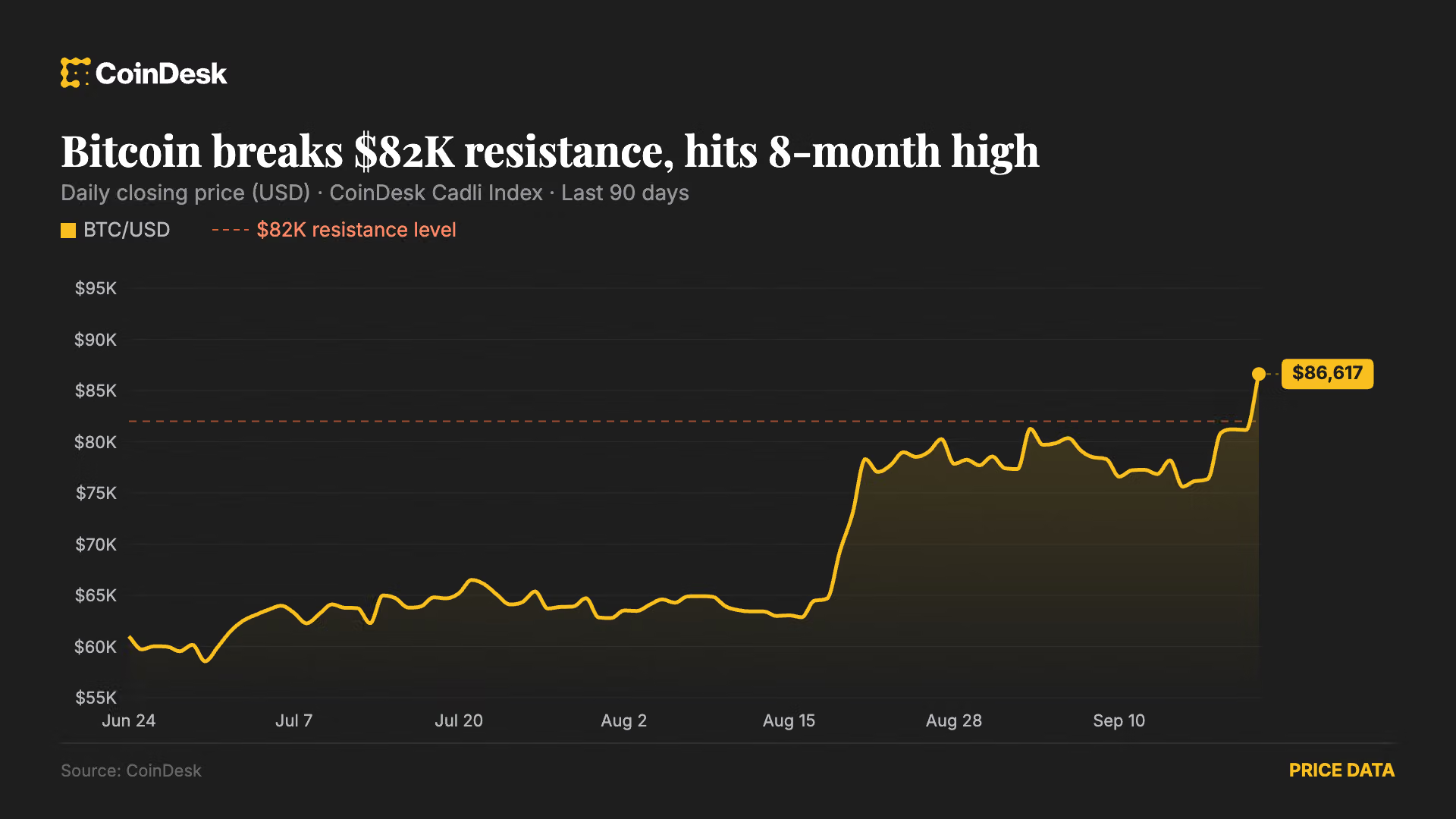
Bitcoin has broken out to $86,000, but analysts say the next leg depends on whether spot buyers continue to show up as leverage builds.
Source link
5 days left to save up to $200 on your Disrupt 2026 ticket

Ke Huy Quan reveals eye-watering sum of first residuals check as a teenager after starring in Indiana Jones and the Temple of Doom

Hitachi: Still Positive With Data Center Opportunity And Capacity Expansion Plans (HTHIY)

Weekend Open Thread – Corporette.com

Weekend Open Thread: Talbots – Corporette.com

Memory prices are slowing because buyers ran out of money

Ripple XRP Is Going To $32 A Coin This Is Going To Shock The Daylights Out Of You

The UNTHINKABLE is About to Happen to the Dollar (& Why Gold and Silver are Next)

GARLINGHOUSE DROPS A MASSIVE STATEMENT!!!! (TRILLIONS TO XRP!?!)
-
 Fashion3 days ago
Weekend Open Thread: Talbots – Corporette.com
-

 Tech23 hours ago
Researchers escape OpenAI Codex sandbox to run commands on host
-

 Crypto World7 days ago
Revolut Attackers Warn of Ongoing Daily Customer Data Leaks
-

 Crypto World3 days ago
Circle launches Arc Studio AI agent for building onchain apps
-

 Crypto World6 days ago
Robinhood engineers charged over $50K crypto scheme
-
 NewsBeat3 days ago
Trump says US has reached an agreement to take permanent control of Greenland’s security
-

 Crypto World7 days ago
Kraken Lets xStocks Holders Earn Yield Through DeFi
-

 Crypto World3 days ago
Bitcoin price breaks channel as RSI climbs to 63
-

 Crypto World5 days ago
US Charges Robinhood Engineers Over Crypto Listing Trades
-

 Crypto World6 days ago
What Is the Status of the U.S.-Iran Peace Talks? Here's What Both Sides Are Saying
-
 Crypto World7 days ago
NVIDIA Analysis: Attempted Rising Wedge Breakout Amid Pressure on the AI Sector
-

 Tech6 days ago
Webb’s IC 348 Mosaic Includes Two-Jupiter Dwarfs, Twin Jets, and a Nursery Still Making Worlds
-

 Crypto World3 days ago
World Money launches in 150+ countries with Stripe
-

 Crypto World22 hours ago
Who Needs CLARITY Anyway? ARB Could See 70X Increase: Hodler’s Digest
-

 Crypto World7 days ago
Kraken Adds DeFi Yield on Tokenized Stocks and ETF Assets
-

 Crypto World3 days ago
Silver prices recover quickly, hitting weekly high today
-

 Crypto World3 days ago
Trading Bitcoin on Robinhood? Why 2% Spread Has Traders Worried
-
Crypto World7 days ago
Can Circle’s Arc Repeat Robinhood Chain’s Meme Coin Boom?
-

 Entertainment6 days ago
Big Brother Update: Melody Explodes at Drew as Illness Sweeps BB28 House
-
 NewsBeat3 days ago
US was ‘on brink of war’ with China over false AI report of nukes moving in Middle East
You must be logged in to post a comment Login