
Crypto World
Short squeeze drives bitcoin toward $85,000 as $648 million shorts liquidated

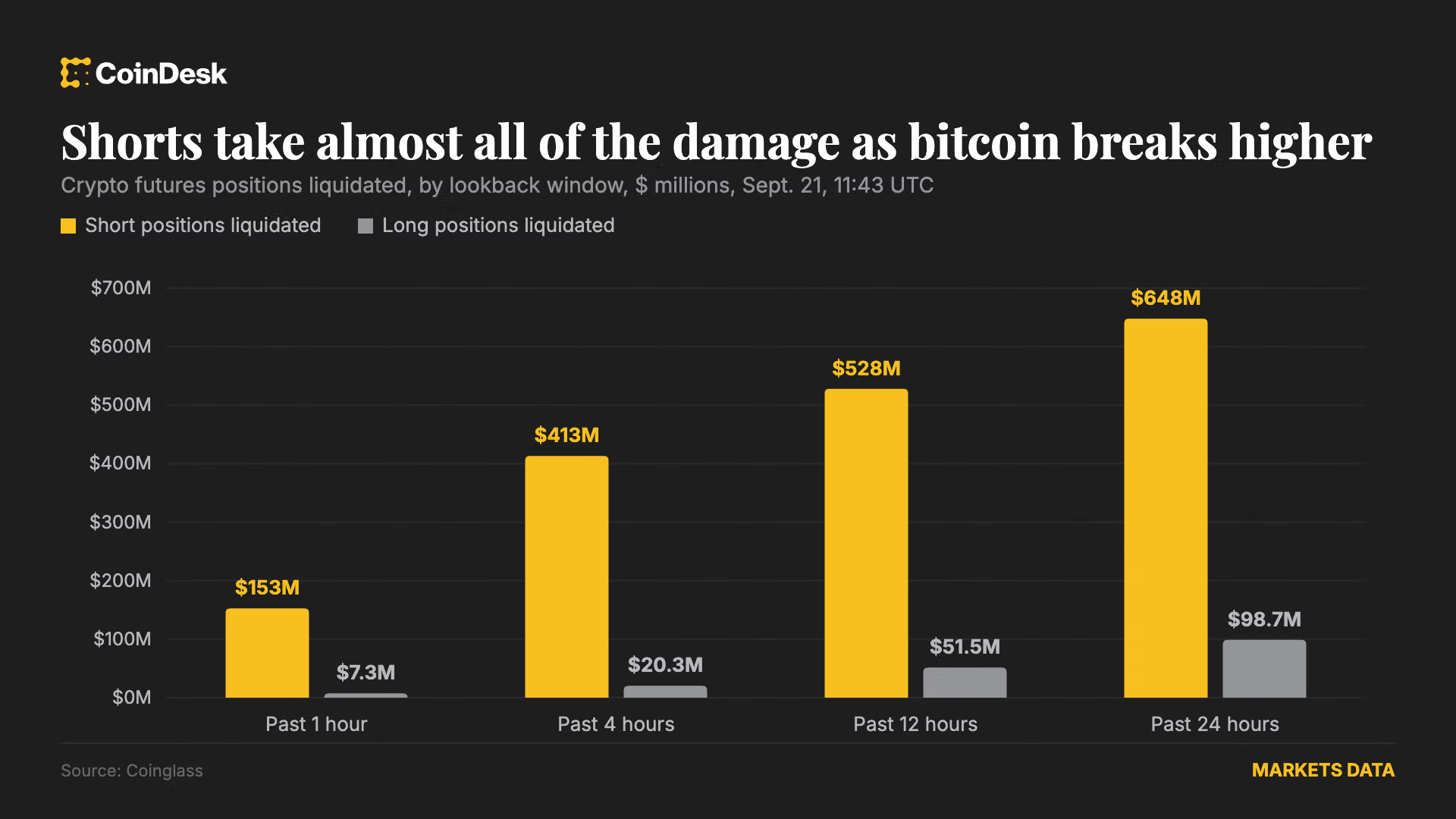
Bitcoin extended its break above the top of its September range on Monday, trading at $84,984 in the late European morning, a gain of 5.4% over 24 hours that leaves it well clear of the $82,284 high of Sept. 4.
The move is being driven by forced buying more than fresh conviction, with $746 million of positions liquidated over 24 hours, of which $647.9 million were shorts, and a further $159.9 million in the past hour alone, 95% of that on the short side. Bitcoin shorts accounted for $277.5 million of the 24-hour total and ether shorts $122.8 million, on Coinglass figures.
Open interest across the market has risen 7.59% to $156 billion even as those shorts were closed out, and 24-hour volume is up 39% at $224 billion, a combination that suggests traders are replacing the positions being liquidated rather than stepping back.

Crypto World
Arthur Hayes Says Crypto Regulation Was Never the Catalyst as Bitcoin Blasts Past $84,000

Bitcoin surged above $84,000 during Monday morning trading, up roughly +5%, just days after the Senate blocked the CLARITY Act and the Federal Reserve delivered its first rate hike since July 2023. Arthur Hayes says that sequence proves crypto regulation was never the catalyst.
The Flop Labs CEO called the stalled bill “nonsense” in an X post late last week, arguing that crypto never needed the legislation, only a rate hike that puts more dollars in the hands of wealthy investors who then plow that liquidity into financial assets, according to the post.
BTC USD is up more than +8% over the past week, with this surge above $84,000 fueling the narrative that the bottom is in and a full-blown bull market is on the way in Q4 2026.
What Moved Bitcoin: A Rate Hike or a Failed Bill?
The two events landed within 24 hours of each other, which is exactly why Hayes’s framing is contestable rather than obvious. The Senate failed to invoke cloture on the CLARITY Act last Tuesday by a 49-50 vote.
This fell well short of the 60 needed to advance the bill, a defeat detailed further in coverage of the CLARITY Act’s stalled Senate vote and revival prospects.
The next day, the Federal Open Market Committee voted 12-0 to raise the federal funds target range by a quarter point to 3.75%-4%, its first increase in more than three years.
The Federal Reserve said inflation remains elevated and framed the move as supporting a faster return to its 2% target, as reported in detail by The Block.
— Bitcoin Intelligence (@BitcoinIntelX) September 21, 2026
 BREAKING
THE U.S. SENATE IS SET TO HOLD THE KEY VOTE ON THE $CLARITY ACT TOMORROW AT 2:15 PM ET. ACCORDING TO THE LATEST REPORTS, DEMOCRATS HAVE APPARENTLY AGREED TO SUPPORT AN UPDATED VERSION OF THE BILL.
IF IT PASSES → THE CRYPTO MARKET COULD SEE A STRONG BULLISH… pic.twitter.com/vfmDpHs94k
Earn $50 and Enter $300K Prize Draw on EdgeX
The Arthur Hayes Liquidity Argument Meets a Grayscale Counterpoint
Hayes argues that higher interest rates typically attract capital to cash, but he claims they instead direct more funds toward wealthy holders of financial assets, with some ultimately flowing into Bitcoin.
In contrast, Grayscale’s Zach Pandl views the rate hike as a mid-cycle adjustment similar to the Fed’s one-off increase in March 1997, which didn’t disrupt the Nasdaq bull market.
He believes the expected hikes through 2026 will not significantly impact capital allocation, though he noted stablecoin issuers might benefit from higher cash rates and see increased flows into tokenized assets.
Bitcoin’s price rebound followed the legislative defeat and the rate hike within 48 hours, supporting Hayes’s liquidity thesis but leaving room for other interpretations.
Coinbase CEO Brian Armstrong expressed disappointment over the Senate’s outcome, highlighting the political investment in the bill. Despite Bitcoin’s rise, retail sentiment on Stocktwits remained bearish, illustrating that price recovery and investor conviction can diverge.
Make Your BTC Prediction With $25 For Free on Kalshi
Where Next for Bitcoin? Is $90,000 on the Way?
If BTC breaks above $85,000, things start to get interesting. $87,000-$88,000 is the main short-liquidation cluster, while $80,000 is the major long-liquidation/support pocket.
Above $85K, watch $ 87,200-$87,800 for a short squeeze. However, if we lose $83,500, then $80,000 becomes the downside magnet.
Daily trading volume has surged alongside the price, with CoinGecko data reporting $85.6Bn in transactions, up from $72.4Bn the previous day.
Supercharge Your Trading in 2026 With BloFin AI Trading Bots
The post Arthur Hayes Says Crypto Regulation Was Never the Catalyst as Bitcoin Blasts Past $84,000 appeared first on Cryptonews.

Mike will lead our commercial business and work across TIME’s platforms to expand our presence and build long-term partnerships throughout the region.
Mike brings more than 17 years of experience building strategic partnerships across global markets. Most recently, he served as Chief Commercial Officer of The Observer.
As many of you know, he previously spent six years at TIME, ultimately serving as VP, Partnerships and Head of EMEA. During his tenure, he helped grow TIME’s international business and developed several multiyear partnerships, including the inaugural TIME100 AI Impact Awards in Dubai. He also expanded the TIME100 Impact Awards into new markets and led the launch of TIME100 Africa in Rwanda.
Mike’s extensive knowledge of TIME, international leadership experience and proven ability to build meaningful partnerships position him well to lead the next chapter of our growth across APAC.

South African crypto companies have put at least R2.2 billion in deals on hold as proposed exchange control rules threaten to restrict how digital assets can be used for cross border transactions, according to people familiar with the matter.
Summary
- South African crypto firms have paused at least R2.2 billion in deals over proposed exchange control rules.
- The changes would bring crypto assets under the country’s capital flow regime and tighten oversight of cross border transfers.
- Industry participants warn the rules could push legitimate crypto activity offshore and potentially trigger legal challenges.
People familiar with the transactions said at least 3 deals have been paused directly because of the proposed regulatory changes. They include an investment from a private equity firm and transactions intended to support capital formation for small businesses and corporate treasury management.
Industry participants have warned that the proposed framework could push some legitimate digital asset activity offshore or into informal channels. Some executives are considering legal action if the rules are adopted without significant changes, the people said.
South Africa crypto rules have stalled R2.2 billion in deals
South Africa is the second largest crypto asset market in Africa, where stablecoins are increasingly used by companies moving funds between regional operations.
Businesses have used stablecoins to repatriate profits and receive dividends from subsidiaries in African markets where access to hard currencies can be limited. Tether’s USDT has become the preferred stablecoin for such activity in South Africa.
Onchain USDT transactions across 3 of the country’s largest licensed crypto exchanges approached R27 billion in the year through April, according to central bank data. The figure shows the scale of stablecoin activity already passing through regulated domestic platforms.
South Africa does not recognize crypto assets as legal tender. The South African Reserve Bank has previously identified digital assets as an emerging financial stability risk and has been monitoring activity as stablecoin use expands internationally.
Regulators are now seeking to bring crypto assets within a capital flow system built around the Currency and Exchanges Act, legislation that dates back roughly 9 decades.
The National Treasury first published its proposed framework in April as part of an overhaul of the country’s capital flow management regime. As crypto.news previously reported, the draft would formally classify crypto assets as capital under South Africa’s foreign exchange rules and extend declaration, approval and enforcement powers to digital asset transactions.
Officials said the framework is intended to improve oversight of cross border transactions, reduce opportunities for regulatory arbitrage and address illicit financial flows.
Cross border crypto transfers face tighter controls
More detailed rules released in August set out how digital asset transfers would operate under the proposed system.
Under the cross border crypto rules, transfers would generally need to pass through authorized providers and be reported to the South African Reserve Bank. Transactions involving offshore crypto providers or private wallets would fall within the regulated cross border category.
Individuals moving crypto outside South Africa would remain subject to the country’s existing foreign currency allowances. The annual single discretionary allowance permits transfers of up to R1 million without tax clearance, while the foreign capital allowance permits up to R10 million subject to tax compliance requirements.
Authorized crypto asset service providers would be required to collect information on cross border transfers, including the identities of the sender and recipient, the assets involved, transaction values and destination wallet details.
The National Treasury and South African Reserve Bank said in a joint statement that the detailed manual released last month does not yet incorporate feedback submitted during the earlier consultation.
Officials attributed that gap to the timing of the release and the volume of comments received after the government invited interested parties to respond to the April proposals.
Some digital asset executives have objected to the process, arguing that the current draft does not adequately account for industry submissions. People familiar with their concerns said executives view parts of the framework as unfavorable to technology being used to reduce transaction costs.
If the regulations proceed in their current form, companies believe they could affect billions of rand in tax revenue generated by the sector and potentially lead to legal challenges, according to the people.
Stablecoins remain part of South Africa’s regulatory focus
Stablecoin activity has become a particular area of attention as regulators assess how dollar linked tokens interact with domestic currency and capital controls.
An International Monetary Fund assessment published in August found that dollar stablecoins had gained only limited traction in South Africa, while rand denominated alternatives had attracted even less demand. The IMF cautioned that it was still too early to determine whether the pattern would persist. Dollar stablecoin adoption remains dominant globally, with nearly 99% of stablecoins denominated in U.S. dollars.
South Africa’s treatment of digital assets extends beyond capital controls. The South African Revenue Service published draft guidance in July explaining how existing tax rules apply to crypto transactions rather than proposing a separate tax regime.
Under the draft crypto tax guidance, SARS maintained that crypto assets are not currency for tax purposes. Buying, selling, swapping, spending, mining, staking or receiving digital assets can create tax consequences under existing income and capital gains rules, depending on the nature of the activity.
South Africa has separately begun implementing the OECD’s Crypto Asset Reporting Framework. Its first CARF reporting period runs from March 1, 2026, through Feb. 28, 2027, with crypto service providers required to collect information that will support automatic exchanges of tax data between participating jurisdictions.
The government has yet to finalize the proposed capital flow rules after receiving industry comments, leaving the detailed framework subject to further consideration by the National Treasury and South African Reserve Bank.
Pontes will expand its services and operating hours gradually, with full implementation expected by 2028 and more participants set to join.

Covenergo and Delta Capacity have started construction on the AKKU One battery energy storage system (BESS) project in Lapinlahti, Finland.
The site will feature a stand-alone battery with a capacity of 125MW and an energy storage capability of 300MW-hours (MWh).
The companies expect to commission the facility in the fourth quarter of 2027 (Q4 2027).
The AKKU One project was acquired as a ready-to-build asset from Helios Nordic Energy.
Covenergo holds the majority ownership and expects to use its experience in renewable energy development, project finance and asset management to support the scheme.
Delta Capacity is responsible for securing offtake agreements, delivering construction and handling long-term management of the asset as the engineering, procurement and construction management contractor. It will work alongside Covenergo’s team.
According to Covenergo, the move supports the company’s strategy of expanding its flexible asset portfolio and increasing its involvement in the Nordic energy market.
Covenergo CEO František Kalivoda said: “This partnership and acquisition is an important step forward for Covenergo’s flexible asset portfolio and reinforces our growing footprint in the Nordic energy market. We remain fully committed to delivering high-quality, investment-ready projects that support Europe’s energy transition.”
For Delta Capacity, AKKU One is its second BESS storage project in Finland. Earlier this year, the company completed the 70MW/160MWh Ånge BESS in Sweden, reflecting its increased activity in the Nordic region.
Delta Capacity CEO Patrik Hes said: “AKKU One once again reaffirms our belief in the Nordic market and our expertise in delivering high-quality battery storage projects – including as a trusted partner for developers like Covenergo. We are proud to bring the same speed and execution that delivered Ånge to our new project in Finland.”
A Nordic team is providing support throughout construction and for future operations.
Rejlers, an engineering consultancy, is delivering technical project support. Sungrow will supply the battery system, following a 1GW-hour framework agreement with Delta Capacity signed earlier this year.
NYAB is conducting balance of plant works, and Ampner is responsible for grid connection studies and compliance.
GreenPowerMonitor will provide energy management and supervisory control and data acquisition systems for operational monitoring and control.
Once operational, the AKKU One project is expected to deliver flexibility services to the Finnish electricity network, including frequency regulation and balancing, as the country expands its wind and solar generation.
“Covenergo, Delta begin construction on AKKU One BESS in Finland” was originally created and published by Power Technology, a GlobalData owned brand.
Crypto World
ECB launches Pontes to bridge tokenized asset markets with Eurosystem payment infrastructure
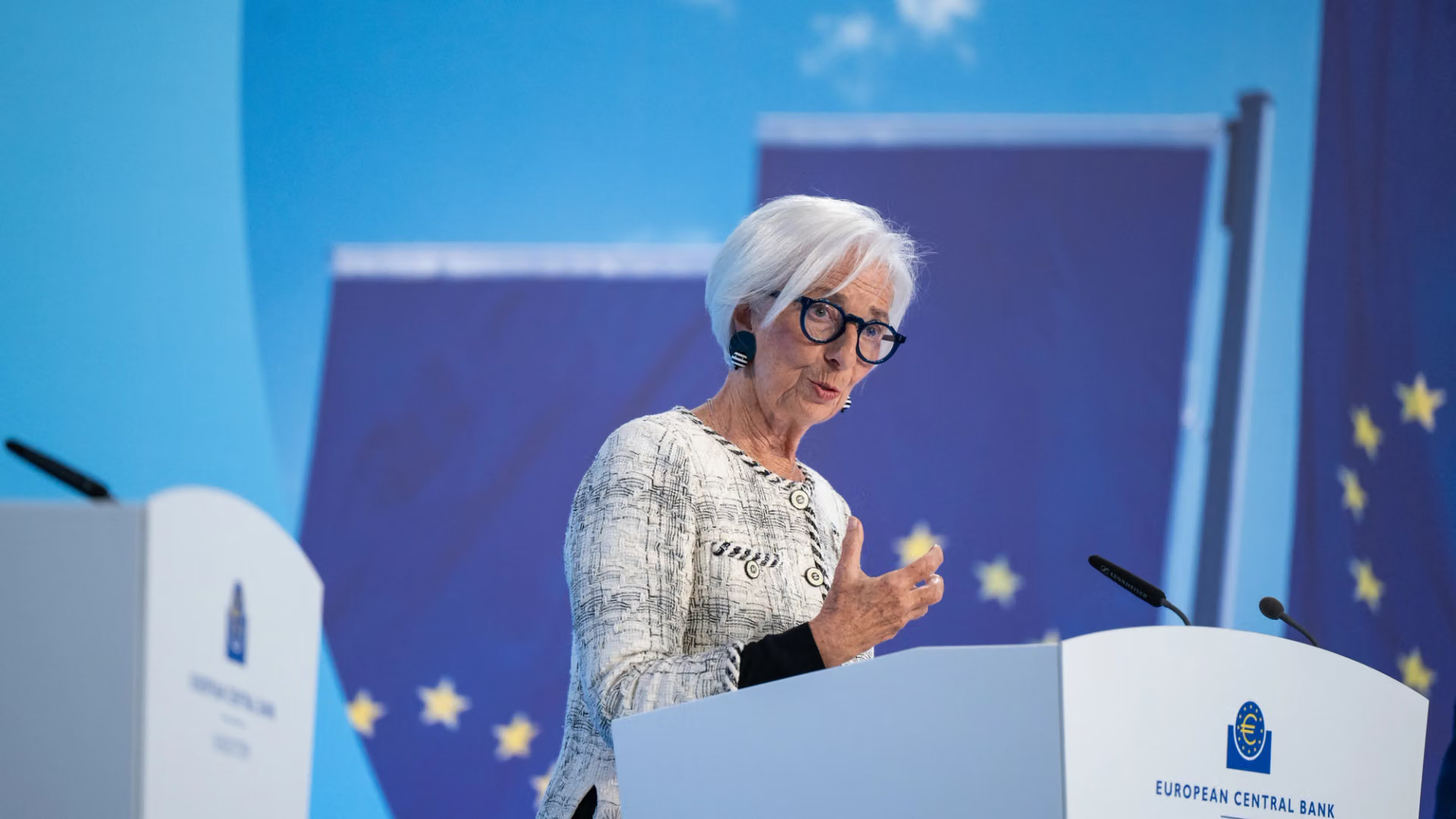
The European Central Bank (ECB) launched Pontes on Monday, a platform that enables banks and other eligible financial institutions to settle tokenized-asset transactions in central-bank money.
ECB President Christine Lagarde announced the go-live at a Eurogroup meeting on Friday.
“Now, Pontes is, to summarize it quickly for you, it’s a digital euro made available for banks so that they can transact amongst themselves using tokenized assets and distributed ledger technology,” said Lagarde during a Eurogroup summit on Friday.
Pontes links market distributed-ledger technology platforms to the Eurosystem’s TARGET Services, enabling participating banks to settle tokenized wholesale transactions in central-bank money. It will only be available to eligible financial institutions and market infrastructure providers.
Tokenized bonds, funds and other financial assets need a reliable way to settle the cash side of a trade. Pontes gives European institutions a central-bank-money option, rather than requiring them to rely solely on stablecoins or tokenized commercial-bank deposits.
The platform is part of the ECB’s broader effort to keep central-bank money at the core of Europe’s increasingly tokenized financial markets. The ECB has said Pontes will be developed in stages, alongside its longer-term Appia initiative for wholesale tokenization.
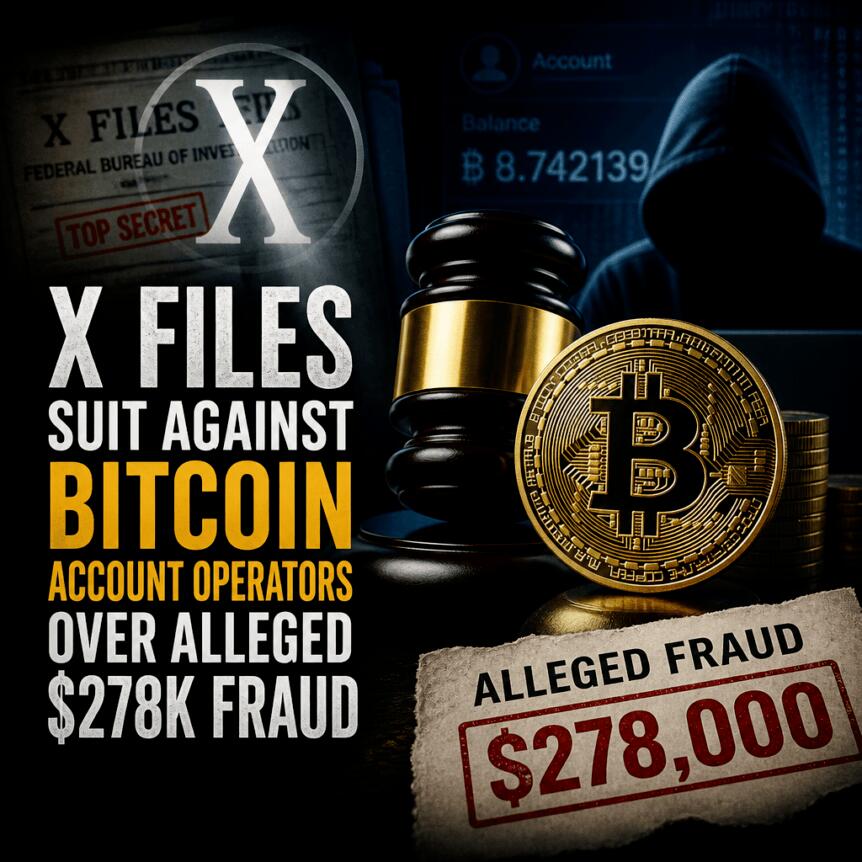
Elon Musk’s X has launched legal action in England and Wales against alleged operators of a network of Bitcoin-themed accounts, accusing them of manipulating engagement to collect payouts from the platform’s former creator revenue-sharing program. The lawsuit seeks to recover at least £207,384 (about $278,000) in creator earnings that X says were fraudulently obtained.
In a filing submitted to the High Court of England and Wales on Thursday, X named Vivek Kumar Sen, Zamyang Sherpa, and unidentified account operators as defendants. The complaint is posted on X’s Transparency Center here.
Key takeaways
- X claims the defendants coordinated multiple Bitcoin-focused accounts to artificially inflate engagement for creator payouts.
- The lawsuit targets at least six X profiles enrolled in the former creator revenue-sharing program and links them to two named individuals.
- X alleges the accounts used reposting, liking, and near-identical posts to create a “false appearance of genuine” interaction.
- The company also cites expected investigation and remediation costs, projecting losses of at least £282,384 before interest and legal expenses.
- X says it suspended the implicated accounts on Aug. 18 and later retired the revenue-sharing program on Sept. 7.
X ties six creator accounts to two defendants
According to the court filing, X identified six accounts that were enrolled in the platform’s creator revenue-sharing program. The profiles named are @Vivek4real_, @Bitcoin_Teddy, @saylordocs, @TrendingBitcoin, @Kalshibacktest, and @PolyBackTest.
X’s complaint links Stripe account details associated with the first three profiles to Sen, and Stripe account details associated with the remaining three profiles to Sherpa. The filing states that these accounts joined the revenue-sharing program between August 2023 and February 2026.
Beyond those six, the lawsuit argues the coordination extended further. X also named additional accounts—@BTC_Vibes, @MrSuperBitcoin, and @Laserlump—which X says repeatedly liked, replied to, and reposted content from the defendants’ accounts to help manufacture engagement.
Alleged engagement “loop” aimed at creator payouts
X’s complaint centers on how the former creator revenue-sharing program worked. Under that system, creators received a share of platform revenue based on engagement generated by their posts from other users.
The filing describes the alleged mechanism as coordinated interaction between multiple accounts—reposting and liking each other’s content, and publishing identical or substantially similar posts—to generate engagement that looked organic. X characterizes this behavior as fraudulent, saying it created what the company calls a false appearance of genuine human communication and interaction.
The court documents include an example dated Aug. 5, in which X alleges that @Vivek4real_ and @TrendingBitcoin posted substantially similar content within 11 seconds of each other.
To X, the pattern matters because engagement-based payout systems can be particularly vulnerable to coordinated amplification. When interaction appears broad and timely across multiple accounts, it can trigger revenue-sharing calculations even if the underlying activity is manufactured rather than community-driven.
Program changes and suspension raise the stakes
X says it suspended the implicated accounts on Aug. 18 over what it described as creator revenue-sharing fraud and platform manipulation. The lawsuit also comes in the context of a broader shift in X’s creator monetization approach.
In the filing, X notes that it retired the original creator revenue-sharing program on Sept. 7. It then began rolling out access to a replacement program called Original Content Rewards the following day.
While the company does not frame the litigation as a direct justification for program changes in the excerpted material, the timeline highlights a key sequence: enforcement against alleged manipulation in August, retirement of the engagement-based revenue share in early September, and transition toward a different rewards structure.
X’s complaint also seeks not only recovery of allegedly fraudulent creator earnings but money to cover what it describes as additional costs. It says it expects at least £75,000 (about $100,000) in investigation and remediation expenses, bringing its claimed and projected losses to at least £282,384 before interest and legal costs.
What to watch next for investors and builders
This case underscores a practical risk for creator-economy platforms: whenever payouts are tied to engagement, coordinated behaviors—especially in niche communities such as cryptocurrency—can blur the line between genuine audience interaction and orchestrated amplification. For investors, it’s a reminder that monetization schemes and their enforcement posture can affect platform trust and compliance risk, particularly as regulators globally focus more on misleading or fraudulent online behavior.
For builders and teams designing rewards systems, the lawsuit also points to the importance of robust detection and governance around account networks, timing similarities, and cross-engagement patterns. The alleged near-simultaneous posting described in the filing is an example of the kind of signals that can differentiate organic community activity from coordinated marketing.
As the case proceeds, readers should watch how the High Court handles questions of evidence—such as account-level linkage via payment records and the characterization of coordinated posting—and whether X’s enforcement changes (including the switch to Original Content Rewards) further reshape creator monetization on the platform.
Nintendo Switch 2 owners are putting 20 cent bananas in their Walmart carts, because the fruit forces a grocery promo code to work on games. The code takes $10 off.
Walmart’s banana listing now shows as unavailable for online shipping. The order itself happens in the app, not in the produce aisle.
How a Grocery Promo Code Slipped Onto Nintendo Switch 2 Games
Walmart runs a checkout code that takes $10 off pickup and delivery orders. However, it targets grocery baskets, not games.
Nintendo Switch fans found that Fire Emblem Fortune’s Weave, Nintendo’s newest strategy game, qualified anyway. Therefore, one banana was enough to make the cart read as produce, and deal forums now call it the banana trick.
The code discounts the whole order, not one product. Any Nintendo Switch 2 game in the cart can therefore ride along, though reports so far name Fire Emblem.
The 20 cent bananas add almost nothing to the bill. Some buyers then deleted the fruit before paying, and the discount still held.
A download cannot sit in a pickup order, so the gap needs a physical copy. Fire Emblem ships as a full cartridge, though Nintendo also sells key cards that hold nothing but a download, and Sony will stop making game discs in 2028.
Why the Banana Trick Is Already Fading
Meanwhile, the listing became the bottleneck. Nintendo Switch 2 copies show low stock, and the code now fails more often.
The retailer has not said whether it capped the item to close the gap. Pickup and delivery orders do send a worker to the produce aisle, so some of these bananas are real. One piece of fruit per order hardly drains a store.
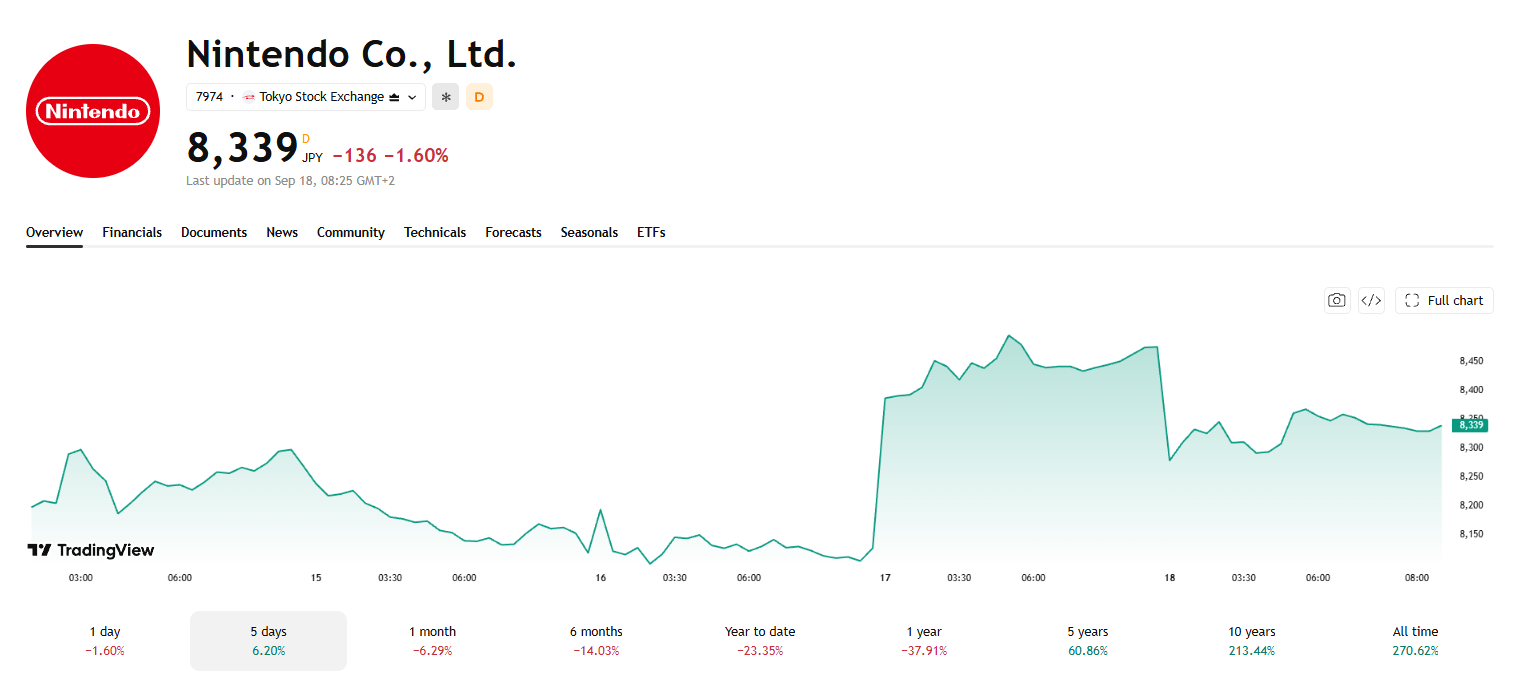
Nintendo stock gained 6% across the five sessions around the launch, a bounce back from the slide after the September game reveals. The shares still trade well below where they started the year.

Walmart, meanwhile, spooked traders in August with a rare sales miss.
Walmart has not commented publicly. Until it rewrites the rule, every Nintendo Switch 2 launch invites another run at the cheapest item in the cart.
The post Why Are Nintendo Switch 2 Fans Putting 20 Cent Bananas in Their Walmart Carts? appeared first on BeInCrypto.
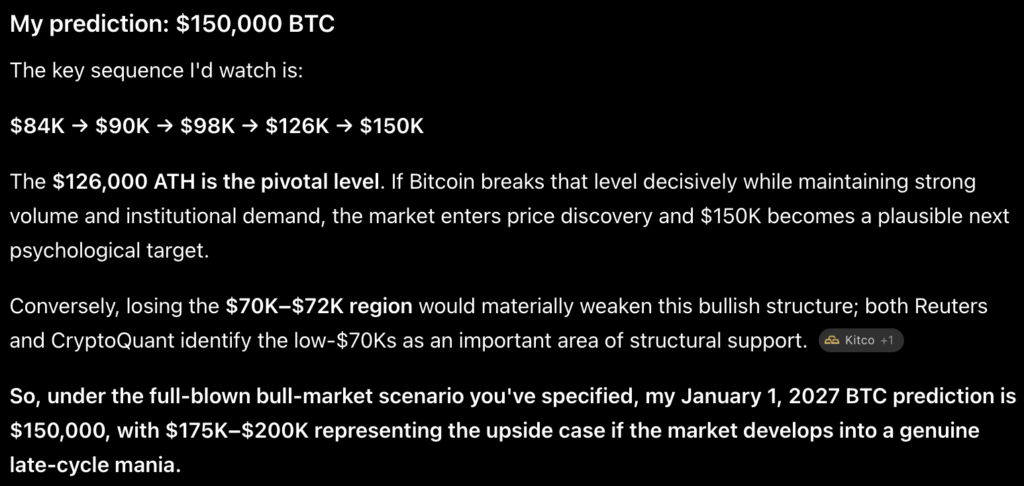
Elon Musk’s Grok AI predicts that in a full-blown bull market, Bitcoin could hit $150,000 before January 1, 2027. The bullish range is listed at $135,000–$175,000, with a genuine late-cycle blow-off potentially pushing Bitcoin toward $200,000+.
At roughly $82,000, $150,000 would be about an +80% move. The interesting thing about Bitcoin’s current setup is that it has already corrected substantially from its previous cycle high. BTC reached approximately $126,200 on October 6, 2025, before falling sharply during 2026. As of right now, it has recovered into the $80,000s.

Bitcoin has already shown it can produce enormous gains during strong cycles. According to historical annual data, BTC gained about 154% in 2023 and 110% in 2024.
A move from ~$82,000 to $150,000 is “only” around 80%, substantial, but nowhere near the percentage gains seen during earlier Bitcoin bull phases.
Grok AI Predicts Bitcoin to $150,000, Does the Technical Analysis Back it Up?
Bitcoin recently broke out of a sequence of lower highs that developed from May onward and reclaimed several key moving averages.
Reuters’ technical analysis identified the $71,781 area as important support, with $82,793 representing a major resistance level. Above that, the next technical objectives were around $90,000 and $97,867.
CryptoQuant has identified a similar progression. It sees $81,700 as particularly important because it matches Bitcoin’s 365-day moving average. Resistance levels above are around $84,600 and $88,700.
The first major test is therefore the $82K–$84K region. Bitcoin has now pushed through that area, which is important because a sustained breakout would remove one of the largest technical obstacles between the current price and the $100,000 level.
The next major milestone is approximately $98,000. Above that, the market is approaching the $126,200 all-time high, and this is where things get interesting.
Once BTC decisively breaks $126,000, it enters genuine price discovery. Very little historical resistance sits above that level. At that point, psychological targets such as $130K, $140K, and $150K can become magnets for momentum traders and institutional flows.
Never Miss a Swing Again: Use AI Copy Trading Bots From CryptoHopper
Historical Price Action Supports the Bull Case

Bitcoin’s previous cycles provide some context for what could happen if liquidity returns aggressively. In 2020, BTC rose from a March crash low of roughly $5,000 to nearly $29,000 by year-end. It then rose to about $69,000 in 2021.
The 2022 bear market subsequently took BTC down to around $15,700 before the next cycle began.
The recovery was substantial:
2022 low: ~$15,700
2023 high: ~$44,200
2024 high: ~$106,100
2025 high: ~$126,200
2026 low: ~$58,300
Historical annual data show just how dramatically Bitcoin can move when the cycle turns bullish. Another potentially encouraging technical development: Bitcoin recently produced a 50-day/200-day golden cross, the first such signal since May 2025.
That’s not a guarantee of another bull run, but in the scenario we’re assuming, it provides additional technical support for the thesis. If a full-blown bull market develops, a roughly 80% move from the current level is well within Bitcoin’s historical volatility.
There’s also an interesting external benchmark: Bernstein analysts currently expect Bitcoin to reach $150,000 by mid-2027, while their accelerated bull case projects about $200,000 around that time.
Make Your Prediction Count With $25 For Free on Kalshi
Bitcoin Hyper Targets Early Mover Upside as Bitcoin Tests Key Levels
A near +5% daily pop is fine if the position is already sized. For anyone watching from the sidelines, chasing BTC into resistance near $84,500 with the Grok AI predicts thesis still unconfirmed as active news is a thin trade.
The upside math at a $1.5 trillion-plus market cap simply moves more slowly than early-stage infrastructure plays, which is where attention is rotating.
Bitcoin Hyper ($HYPER) is positioning itself as the first Bitcoin Layer 2 with full SVM integration. It boasts smart contract execution built for speed that outpaces Solana itself, while settling back to Bitcoin’s base-layer security.
As of today, the presale has raised $33.1M at a current token price of just $0.0136864, with staking rewards live at launch at a huge 35% APY.
The pitch: solve Bitcoin’s slow transactions, high fees, and lack of programmability without abandoning what makes BTC trusted in the first place. A Decentralized Canonical Bridge handles BTC transfers natively.
Gain Access to New Bitcoin Layer 2 Early Here
Discover: The Best Token Presales
The post Grok AI Predicts Bitcoin to Hit $150,000 in Q4 appeared first on Cryptonews.

Eugene Investment & Securities has signed an agreement with blockchain company BEATOZ to test stablecoin settlement for tokenized securities subscriptions, targeting an onchain process that covers subscription, payment and settlement.
Summary
- Eugene Investment and BEATOZ will test stablecoins for settling tokenized securities subscription payments onchain.
- The proof of concept will examine whether subscription, payment and settlement can operate within a single blockchain based system.
- Eugene built its tokenized securities platform in 2024 and is participating in Hana Financial Group’s won stablecoin consortium.
- South Korea is preparing to introduce its regulated tokenized securities framework from February 2027.
According to Eugene Investment & Securities, the memorandum of understanding signed on Sept. 21 will initially focus on a proof of concept that applies stablecoins to subscription payments for tokenized securities. The firms will examine whether the payment leg can be moved onto blockchain infrastructure alongside securities records.
Current tokenized securities systems can record ownership and changes in investor rights onchain, while subscription funds continue to move through conventional bank accounts. Eugene and BEATOZ plan to test a structure in which stablecoins handle the payment side so that subscription, payment and settlement can operate through a single blockchain based flow.
Stablecoin settlement could bring payments onchain
Under the agreement, Eugene will contribute its securities operations experience and existing tokenized securities infrastructure, while BEATOZ will provide its hybrid blockchain technology. The companies will jointly review where stablecoins could be used across securities operations before deciding on potential infrastructure connections and subsequent cooperation based on the PoC results.
Eun Seok hoon, head of Eugene Investment & Securities’ AX innovation division, described the agreement as a “first step” toward infrastructure connecting tokenized securities and stablecoins.
“We will use our existing tokenized securities issuance platform to find concrete ways to apply it,” Eun said.
Eugene already has infrastructure that can be used for the trial. The brokerage built its tokenized securities platform in 2024 and participated in a tokenized securities pilot operated by the Korea Securities Depository in 2025. It is currently part of Hana Financial Group’s consortium working on a Korean won denominated stablecoin.
The trial comes as South Korea prepares to formally incorporate tokenized securities into its regulated capital markets system. Crypto.news previously reported that the country has laid out a three stage tokenization plan, with the first phase scheduled to begin when amendments to the Electronic Registration Act take effect on Feb. 4, 2027.
Selected privately pooled money market funds and institutional bonds are expected to become eligible for tokenization during the first phase, along with unlisted stocks issued through trust structures and publicly offered fractional investment securities. A later phase is expected to extend tokenization to publicly offered securities before the final stage introduces onchain payment infrastructure linked to stablecoins.
Existing licensed financial companies will be permitted to handle tokenized securities within the scope of their licenses. Qualifying issuers will be able to manage their own securities accounts, while distributed ledgers will serve as legally recognized records under the amended framework.
South Korea is building tokenized securities infrastructure
Technical work has been moving alongside the regulatory changes. Samsung SDS won a contract earlier this year to build the Korea Securities Depository platform that is expected to support tokenized securities when the new framework takes effect.
The system is expected to connect blockchain based distributed ledger records with KSD’s existing electronic securities account infrastructure. Planned functions include tokenized securities issuance, circulation checks, rights management and real time monitoring of issuance and circulation volumes. Samsung SDS previously conducted functional analysis for KSD in 2024 and built a test platform in 2025.
Private securities companies have been preparing their own systems ahead of the regulatory rollout. Hanwha Investment & Securities has completed a tokenized securities platform supporting Avalanche and Hyperledger Besu after beginning development with FairSquare Lab in 2025.
KSD’s infrastructure is being designed to connect with Avalanche, Hyperledger Besu and Hyperledger Fabric, giving participating securities companies multiple distributed ledger options as they prepare their systems for the incoming framework.
Institutional experiments are extending beyond the underlying securities records into the payment side of tokenized assets. South Korea has expanded deposit token trials to nine banks, with the tokens being examined for government payments, AI agent transactions and settlement of tokenized assets.
Financial firms test different tokenization models
Other South Korean financial companies are running separate trials before the 2027 framework takes effect. Shinhan Asset Management and Plume signed an agreement in August to test a won denominated tokenized fund backed by one of Shinhan’s ultra short term bond funds.
The proof of concept is being conducted offshore and excludes South Korean residents. No tokens will be issued or distributed as part of the test. Shinhan and Plume are examining investor whitelisting, know your customer checks, anti money laundering procedures and other onchain operating requirements.
BNK Investment & Securities has taken another route through a partnership with EverTreasure covering investment products backed by cultural content. BNK is responsible for arranging and distributing potential tokenized securities, recruiting investors and advising on regulatory requirements, while EverTreasure will identify underlying assets and connect blockchain technology to the products.
BNK is among the securities companies participating in Koscom’s joint tokenized securities issuance platform project. The companies plan to conduct due diligence on underlying assets and product structures before any potential offerings are made available to investors.
Eugene and BEATOZ have not disclosed a timetable for completing their stablecoin settlement PoC. The companies said the results will determine potential infrastructure integration and subsequent cooperation, while their initial work will focus on testing stablecoins for subscription payments and examining their possible use across other securities operations.
Acting premier wants premiership prize
Arthur Hayes Says Crypto Regulation Was Never the Catalyst as Bitcoin Blasts Past $84,000

9 Perfect Thriller Miniseries, Ranked



![Money Money - NINJA [Official MV] Deep Jandu - Mahi Music](https://wordupnews.com/wp-content/uploads/2026/09/1789990634_maxresdefault-80x80.jpg)

-

 Fashion3 days ago
Weekend Open Thread: Talbots – Corporette.com
-

 Tech13 hours ago
Researchers escape OpenAI Codex sandbox to run commands on host
-

 Crypto World2 days ago
Circle launches Arc Studio AI agent for building onchain apps
-

 Crypto World7 days ago
Revolut Attackers Warn of Ongoing Daily Customer Data Leaks
-
 NewsBeat3 days ago
Trump says US has reached an agreement to take permanent control of Greenland’s security
-

 Crypto World6 days ago
Kraken Lets xStocks Holders Earn Yield Through DeFi
-

 Crypto World6 days ago
Robinhood engineers charged over $50K crypto scheme
-

 Crypto World2 days ago
Bitcoin price breaks channel as RSI climbs to 63
-

 Crypto World5 days ago
What Is the Status of the U.S.-Iran Peace Talks? Here's What Both Sides Are Saying
-

 Crypto World5 days ago
US Charges Robinhood Engineers Over Crypto Listing Trades
-

 Crypto World7 days ago
Elon Musk Drops a Bombshell: Grok 5 Could Be the AGI Breakthrough
-
Business7 days ago
SK Hynix ADRs Fall More Than 6% as Memory Rally Breaks on Fears of Slower AI Spending
-
 NewsBeat7 days ago
‘Sick conspiracy’: Trump says only guardrails AI needs is ‘a strong and smart (High IQ!) president’ in all-caps rant
-

 Crypto World6 days ago
NVIDIA Analysis: Attempted Rising Wedge Breakout Amid Pressure on the AI Sector
-

 Tech5 days ago
Webb’s IC 348 Mosaic Includes Two-Jupiter Dwarfs, Twin Jets, and a Nursery Still Making Worlds
-
Crypto World7 days ago
Can Circle’s Arc Repeat Robinhood Chain’s Meme Coin Boom?
-

 Crypto World3 days ago
Silver prices recover quickly, hitting weekly high today
-

 Crypto World2 days ago
World Money launches in 150+ countries with Stripe
-
 NewsBeat3 days ago
US was ‘on brink of war’ with China over false AI report of nukes moving in Middle East
-

 Crypto World7 days ago
DOJ Seeks to Seize $61M in Iran Oil Funds From Binance Accounts It Vouched For
You must be logged in to post a comment Login