
Crypto World
Six signs a crypto winter is ending



5) Thermocap multiple: The thermocap multiple is a measure like price to book that compares bitcoin’s market capitalization to the cumulative dollar value ever paid to miners, with each coin valued at its market price when it was mined. Prior crypto winters ended at single-digit multiples, but this cycle it only declined to 13 times, according to Glassnode data as of June 30, 2026. These levels are not a guarantee of future price action.
6) Price action: A 50% rally from the low has historically coincided with prior market troughs, although no such relationship guarantees future outcomes.
Once the next cycle does begin, we expect two key debates to persist throughout:
Will bitcoin reach a new high before the next halving? During both the 2012 to 2016 cycle and the 2016 to 2020 cycle, bitcoin did not surpass its prior cycle high until after the halving. However, in the 2024 cycle, bitcoin surpassed the 2021 high one month before the April 2024 halving, according to Bloomberg data.
Has AI replaced crypto as the market’s leading speculative/disruptive-technology narrative? In 2020 and 2021, crypto was one of the clearest expressions of a high-liquidity, disruptive-technology market. Since 2024, however, AI has become the dominant growth story.


There are neuroimaging studies to back up that finding, she continues. “When you read fiction, particularly stories that are rich in social content, it activates areas in the brain that we know are involved in social cognition, areas that always come up when you’re doing studies of theory of mind or understanding things from other people’s point of view,” she says.
Surveys indicate a link to stress reduction as well. “With reducing stress, it seems to happen really quickly,” Sahakian says. “If you get engrossed in a book, then your mind and your attention are really focused on reading and the content, which means it takes your attention away from other things. You don’t start ruminating about problems that you have…you forget all of that. So it’s a little bit like mindfulness in that regard, because the attention is so focused.”
The benefits of reading in older age
Some of the research Sahakian finds most exciting focuses on older people’s reading habits. She refers to one study in Taiwan that followed people over age 64 for 14 years. “People who just read once a week had a significantly reduced risk of cognitive decline over that 14-year period, and importantly, it didn’t relate to educational levels,” she says. “What is so good about reading is that you get these benefits regardless of socio-economic background or educational level. It will improve your brain. It will improve your cognition. It will improve your well-being,” she says.
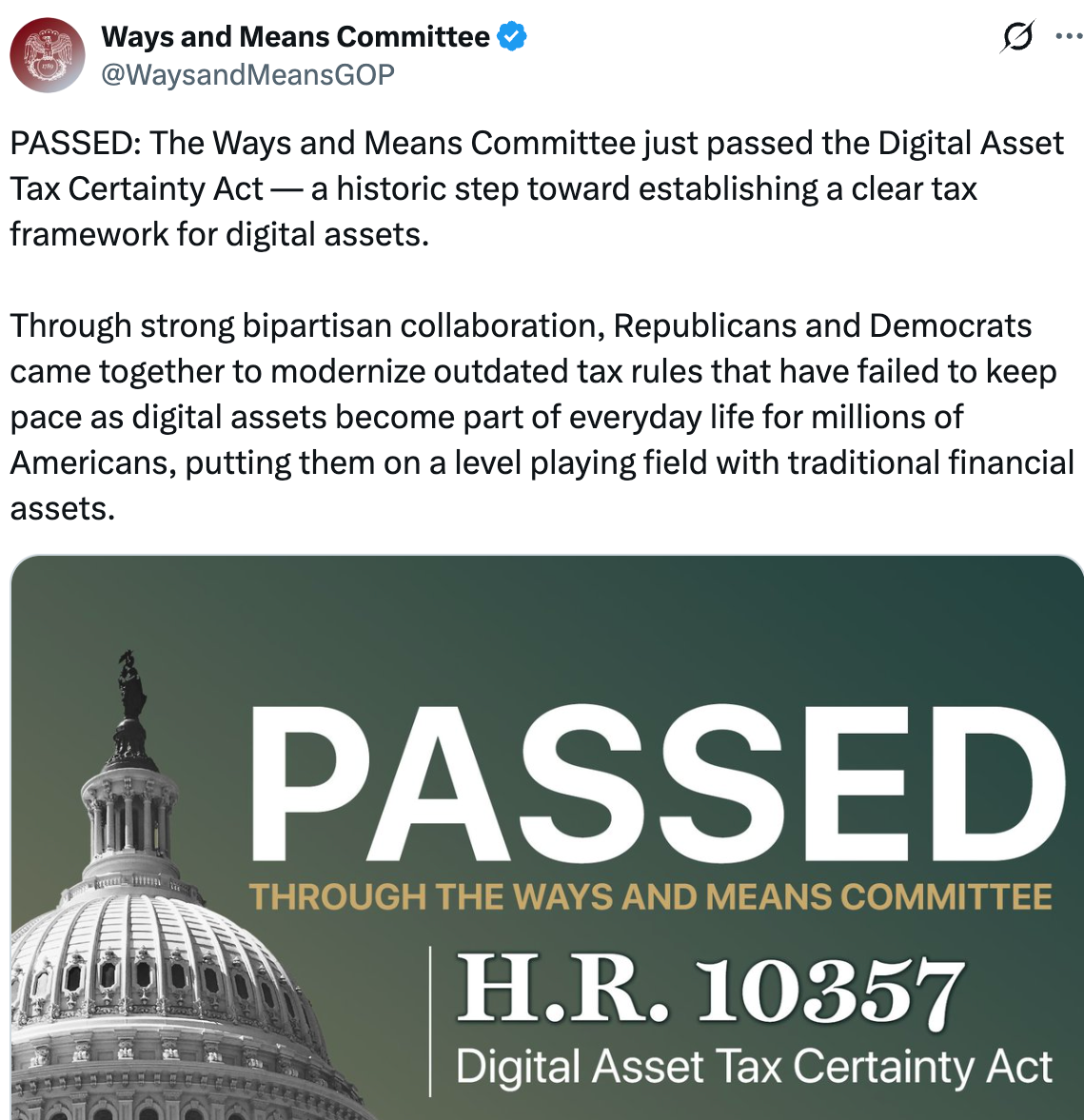
The US House Ways and Means Committee passed the Digital Asset Tax Certainty Act with bipartisan support on Wednesday, advancing legislation aimed at reshaping the federal tax treatment of digital assets.
The bill advanced in a 38-5 vote and covers stablecoins, mining and staking, digital asset lending, transaction fees and other crypto-related activity.
Among its provisions, the bill would establish special tax treatment for qualifying dollar-pegged stablecoins and certain crypto lending agreements, extend wash-sale rules to widely traded digital assets and establish new rules for mining and staking income.
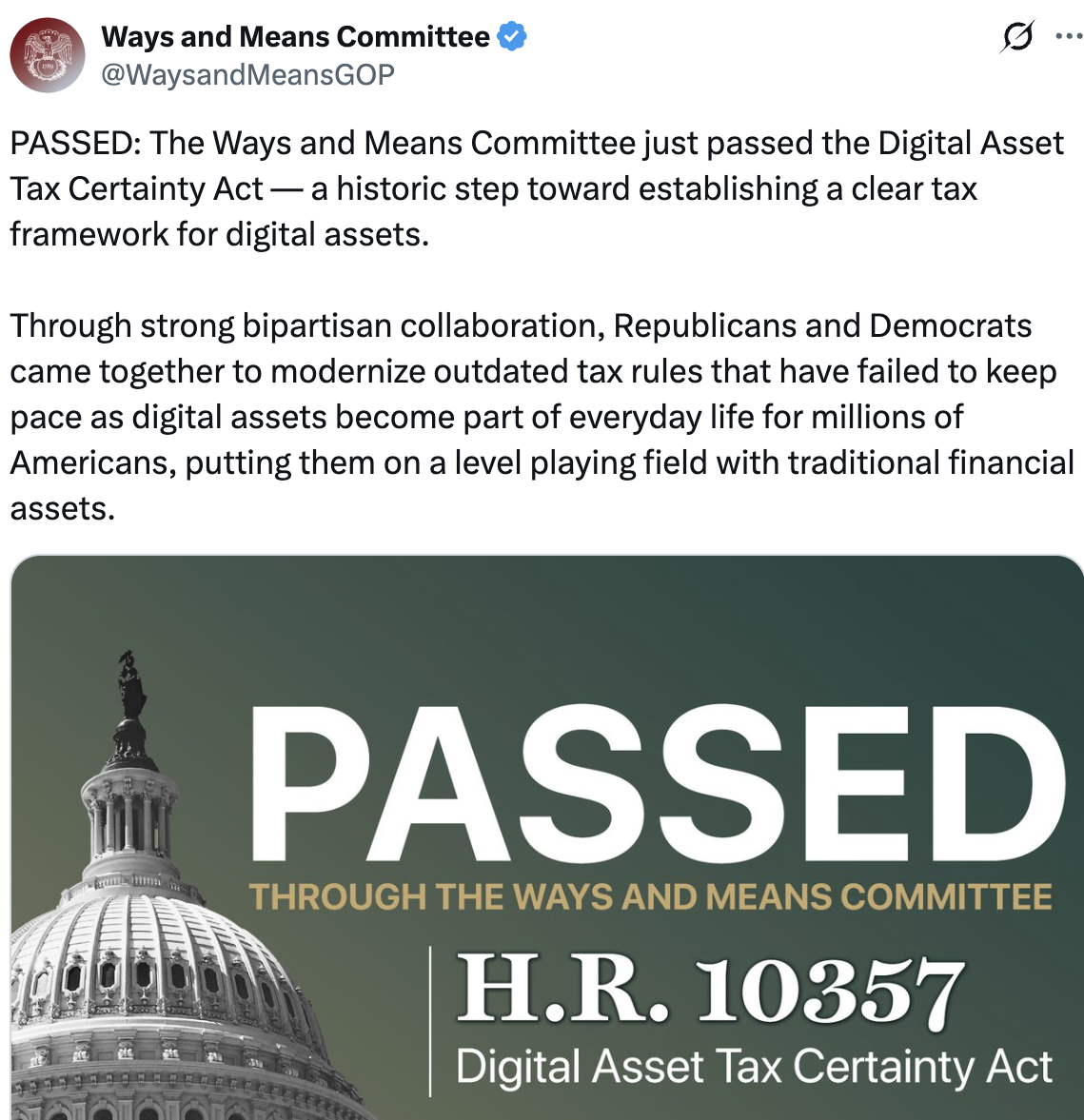
Source: Ways and Means Committee
The legislation would also create a de minimis exemption for certain crypto transaction fees, allowing taxpayers to avoid recognizing gains or losses when digital assets are used to pay qualifying network or transaction fees of $10 or less.
The committee’s approval sends the bill to the full House of Representatives for consideration.
Related: Coinbase faces greater fallout from CLARITY Act setback: Saxo
CLARITY Act failure shifts focus to regulators
The committee vote comes a day after the Senate failed to advance the CLARITY Act, a broader market structure bill that would establish a federal regulatory framework for digital assets and clarify the respective roles of the Securities and Exchange Commission and Commodity Futures Trading Commission.
The cloture motion failed 49–50 on Tuesday, falling short of the 60 votes needed to advance the legislation to debate on the Senate floor.
Senator Cynthia Lummis, chair of the Senate Banking Subcommittee on Digital Assets and a lead sponsor of the legislation, blamed Democrats for the bill’s failure following the vote.
“For over a year, they presented demands and the second we met them, they made new demands and moved the goal posts,” Lummis said in a post on X, adding that Democrats had voted against proposed consumer protections and restrictions on politicians’ personal crypto investments.
With the bill’s failure to advance in the Senate, SEC Chair Paul Atkins signaled Wednesday that the agency would continue moving forward on crypto regulation under its existing authority.
“With or without legislation, we will act decisively within the SEC’s statutory authority to deliver certainty for American investors and for the entrepreneurs shaping our technological future,” Atkins said in a post on X, adding: “Stay tuned.”
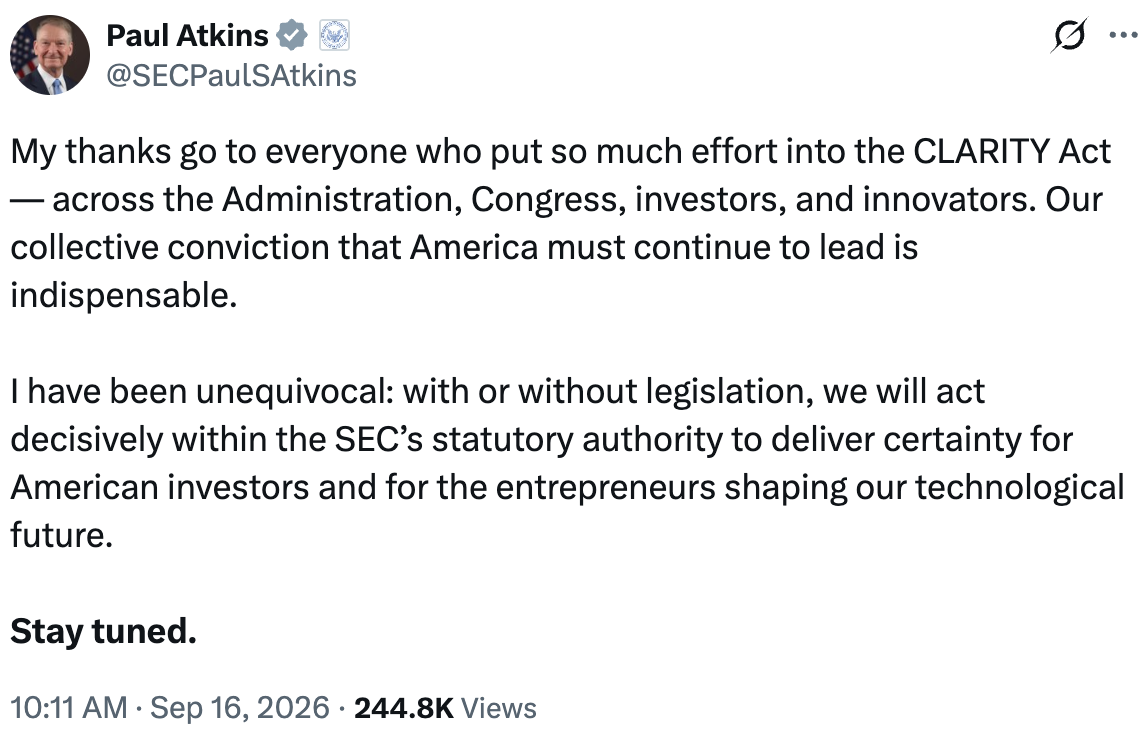
Source: Paul Atkins
CFTC Chair Michael Selig echoed Atkins, saying the agency would move ahead using its existing statutory authority despite the Senate vote.
“The CFTC is locked in and ready to ship its rules for the new frontier of finance,” Selig said in a Wednesday post on X, adding that Americans “deserve regulatory clarity, legal certainty, and consumer protections in crypto asset markets.”
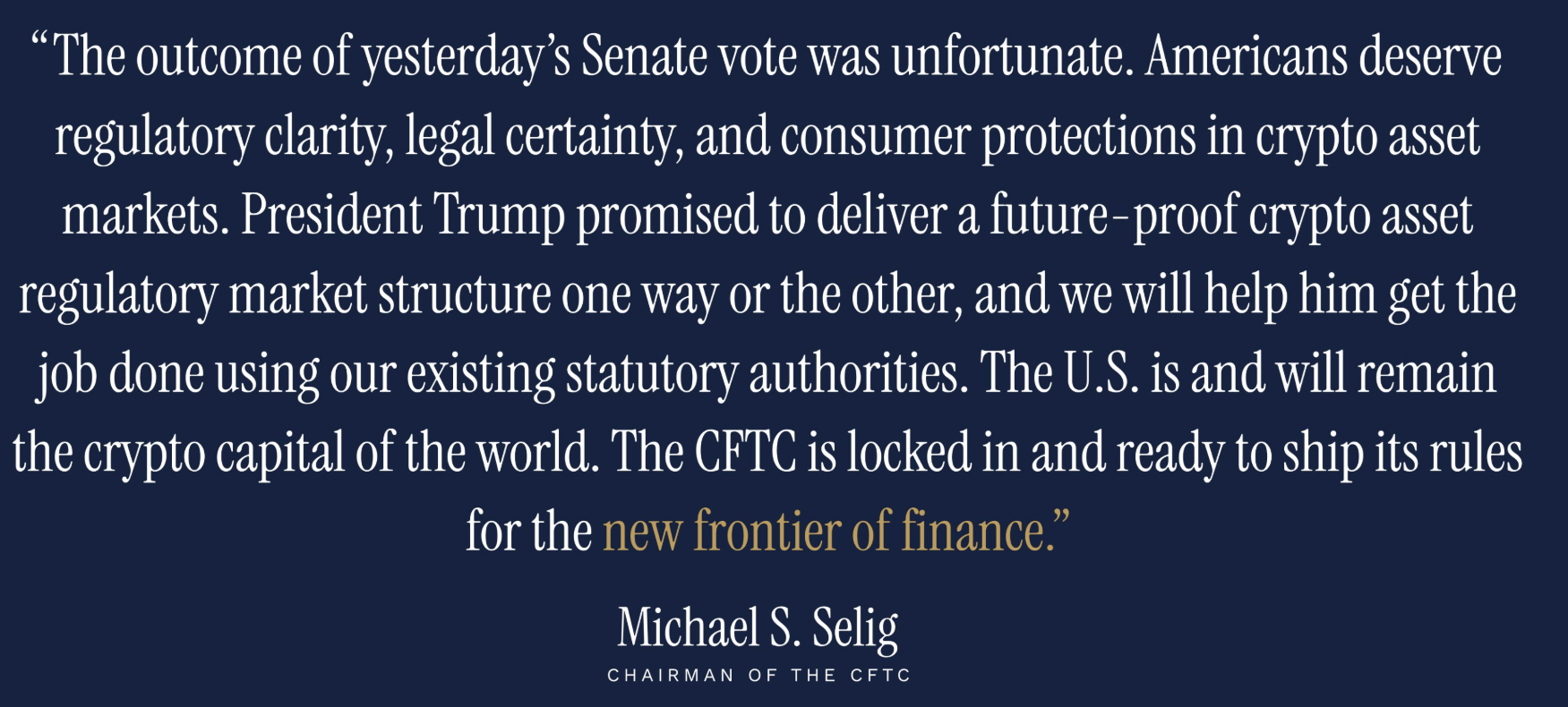
Source: Mike Selig
Magazine: Revolut ID thefts highlight KYC’s dangers: Here’s how to fix it
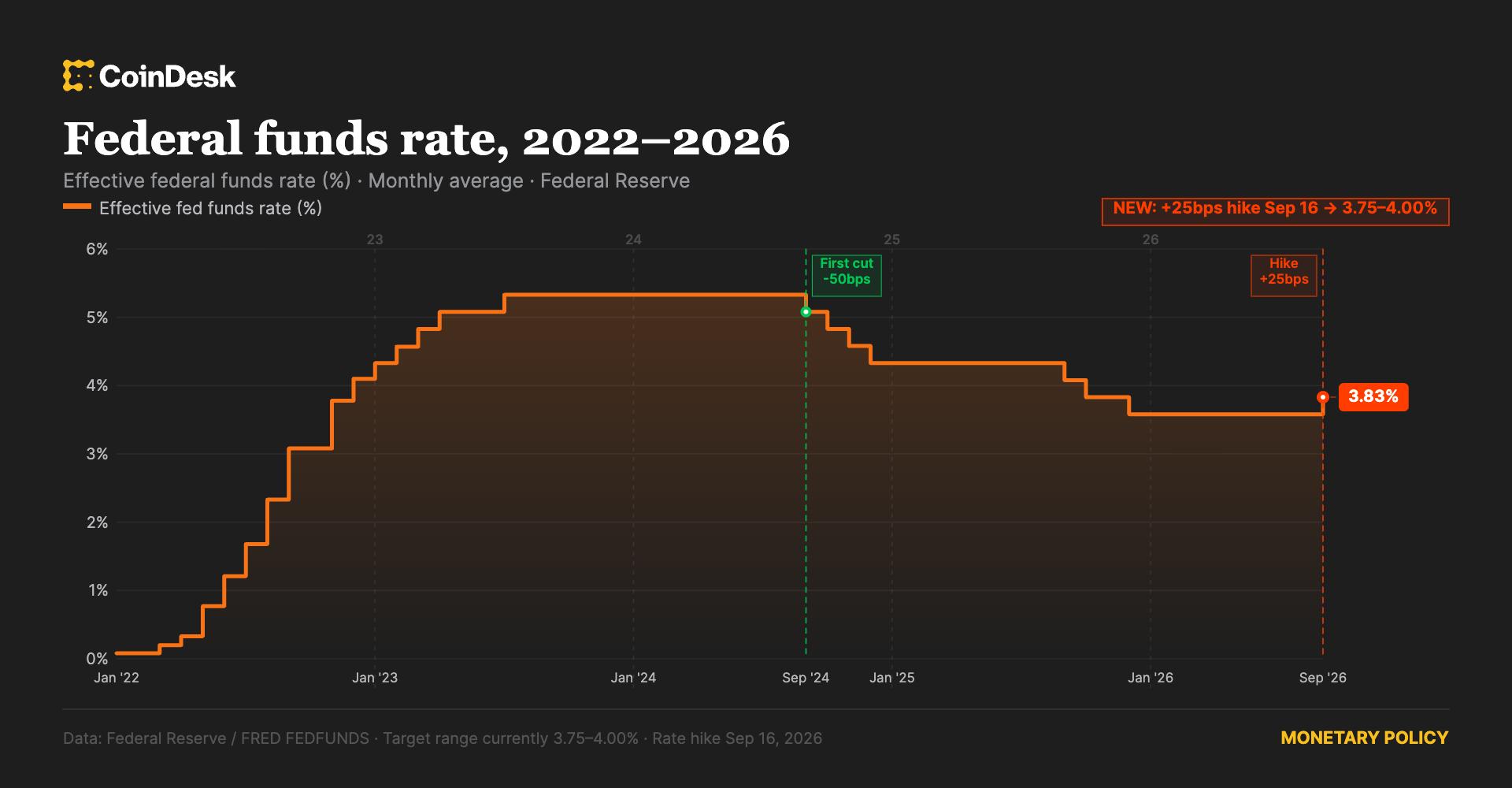
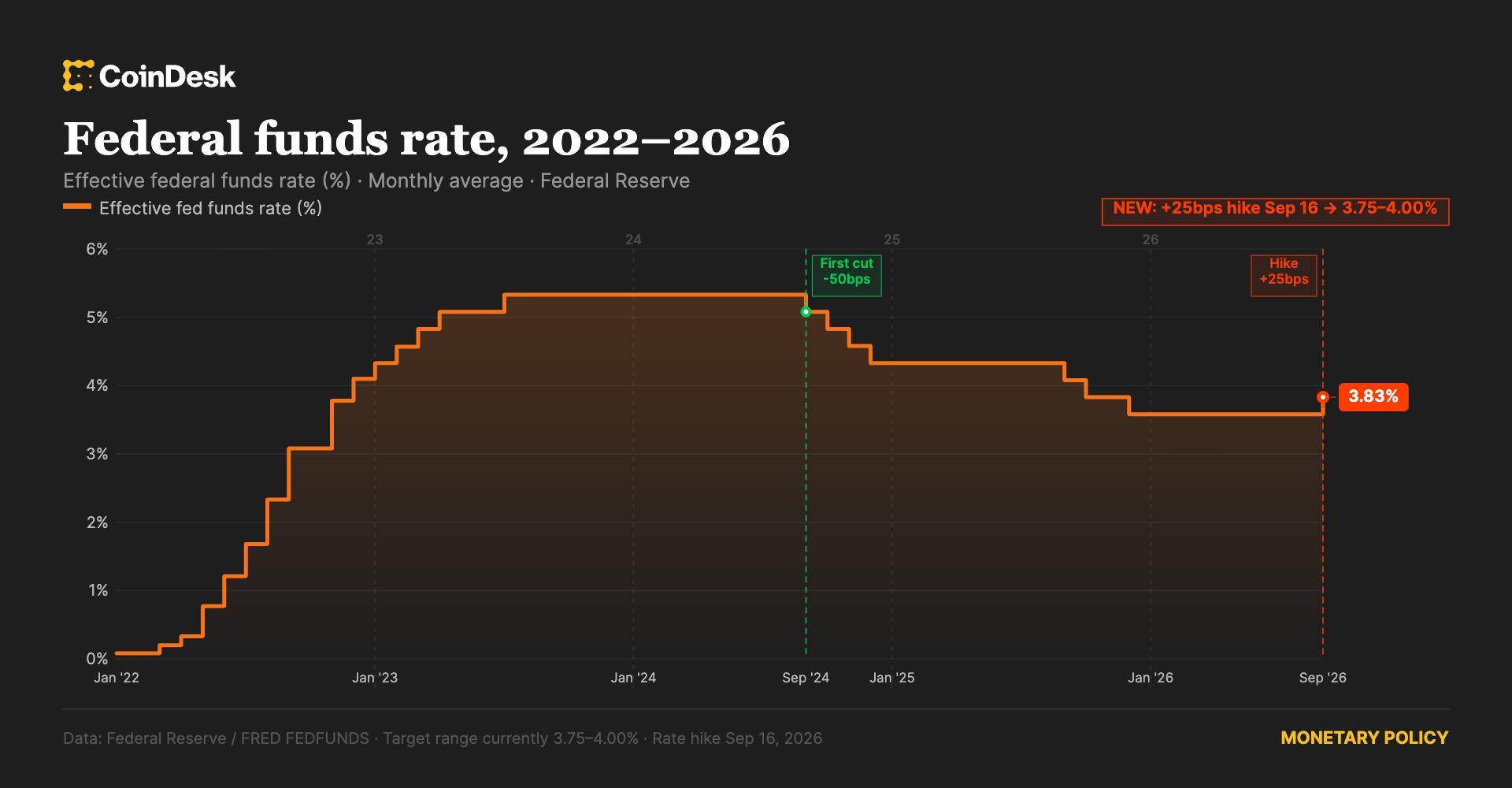
The U.S. Federal Reserve tightened monetary policy for the first time in more than three years on Wednesday.
In a nearly-universally anticipated move, the central bank lifted its benchmark fed funds rate range by 25 basis points to 3.75%-4%.
The vote to hike rates was unanimous, and the “dots” signal an expectation for one more rate hike in 2026.
“Economic activity is expanding at a solid pace,” said the FOMC in its policy statement. “While uncertainty remains elevated owing, in part, to geopolitical developments, domestic spending has been resilient … Inflation remains elevated. Today’s policy action will support a timelier return to the Committee’s 2 percent goal. The Committee will deliver price stability.”
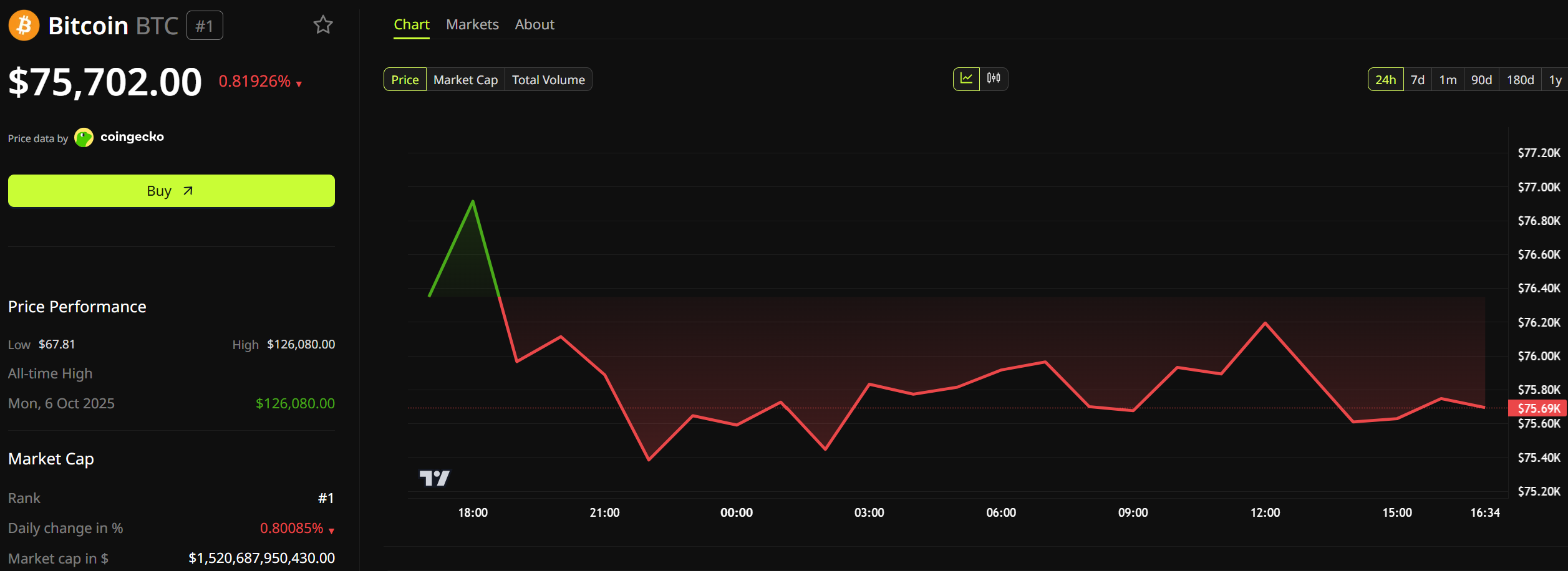
Bitcoin is volatile in the moments following the decision, but currently little changed from prior to the news at $75,700. U.S stocks continue modestly higher and bond yields slightly lower.
Fed Chair Kevin Warsh’s post-meeting press conference begins at 2:30 pm ET.
Celsius Network’s bankruptcy estate has sued five BitMEX companies over 6,360.1666 Bitcoin (BTC) seized in two forced liquidations during the March 2020 crash.
The September 12 filing landed 11 days before BitMEX stops trading for good. Celsius lost the coins under founder Alex Mashinsky, now serving 12 years for fraud.
The Two Liquidations at the Center of the Case
A liquidation is the forced closure of a leveraged trade once the collateral behind it runs short. BitMEX closed Celsius’s Bitcoin futures position late on March 12, 2020, taking 1,325.8385 BTC.
Celsius had sent 350 BTC of extra margin at 23:47 UTC. BitMEX emailed five minutes later to say it had seen the transfer but not yet confirmed it. The position was gone before that confirmation arrived.
The second liquidation hit JST Alpha 1, a Cayman Islands fund Celsius had invested in, at 02:50 UTC on March 13. It cost another 5,034.3281 BTC. JST assigned its claims to Celsius in April 2025.
In that same minute, the filing says, the best offer price on the contract fell from $4,502 to $3,422. Celsius argues the move cannot be rationally explained by trading.
“Instead of maintaining an orderly market, BitMEX intentionally designed its platform and liquidation procedures to cause liquidations of collateral and defraud its own customers,” Celsius said in the complaint.
Follow us on X to get the latest news as it happens
What the Estate Wants Before September 23
Blockchain Recovery Investment Consortium filed the case in the US Bankruptcy Court for the Southern District of New York. The VanEck and GXD Labs venture was appointed in 2024 to chase Celsius assets for creditors.
It names HDR Global Trading, ABS Global Trading, Shine Effort, 100x Holdings and HDR Global Services. Nine counts cover fraud, price manipulation and replevin, a demand for the property itself.
The coins are worth roughly $481 million at Wednesday’s Bitcoin price of $75,702. The same recovery team pulled a $299.5 million settlement out of Tether last October.

BitMEX force closes all remaining positions on September 23 at 04:00 UTC. It has tied the reasons behind its shutdown to a strategic review rather than insolvency, a hack or regulator action.
None of the allegations have been tested, and BitMEX has not answered them. Mashinsky, who ran Celsius when the coins vanished, was permanently barred from trading regulated US derivatives markets in June.
The post Celsius Sues Dying BitMEX Exchange for 6,360 Lost Bitcoin appeared first on BeInCrypto.
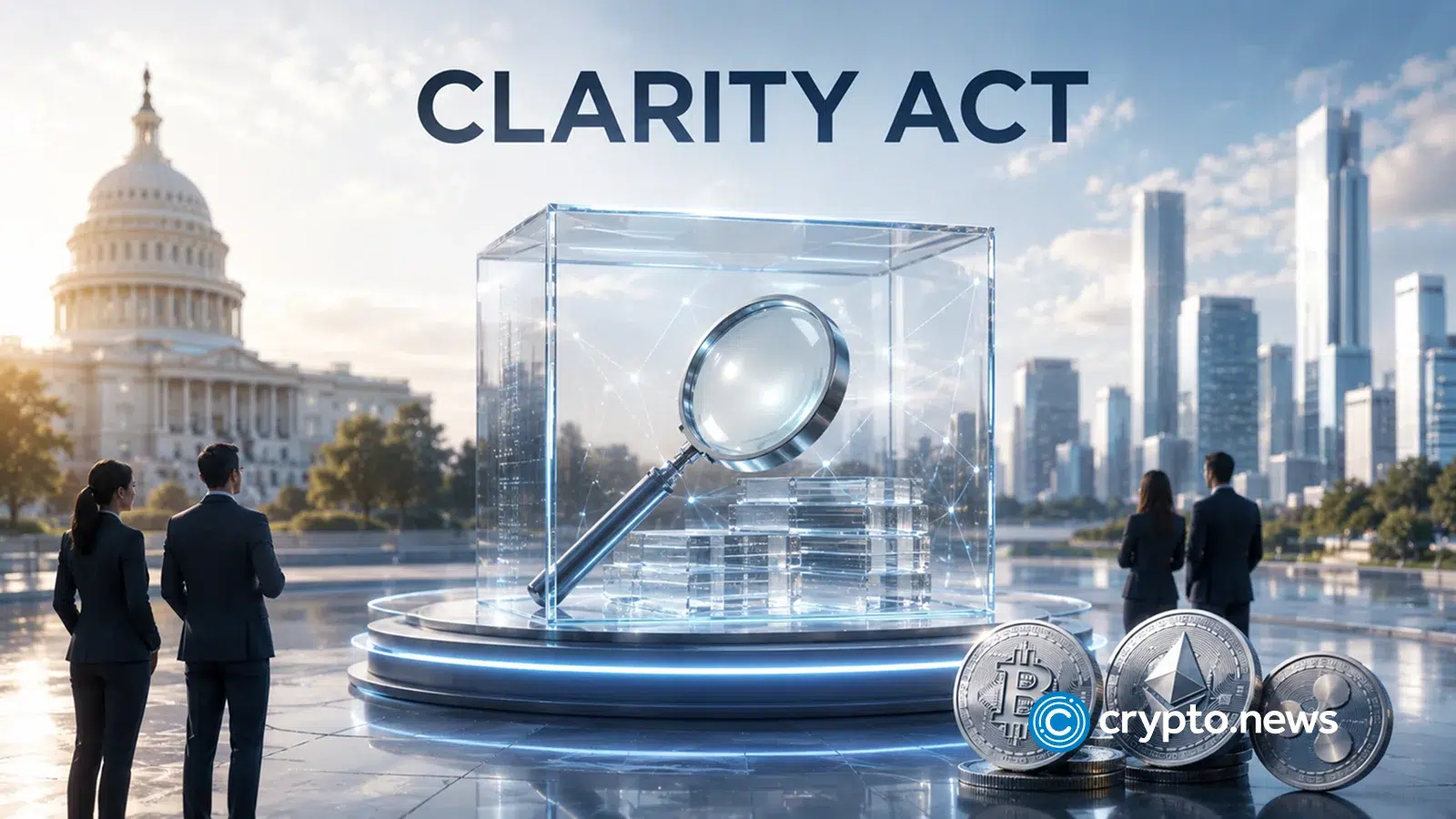
The failed Senate vote on the CLARITY Act has shifted attention toward the SEC and CFTC, while crypto founders and investors prepare for a longer period without a federal market structure law, industry experts told crypto.news.
Summary
- The SEC and CFTC may shape near-term crypto rules after the Senate failed to advance the bill.
- Founders are expected to keep building, but some may place more operations outside the United States.
- Bitcoin faces less regulatory uncertainty than altcoins, DeFi platforms, exchanges and token issuers.
- Institutional adoption may slow as banks and asset managers wait for more durable legal certainty.
- Experts said rates, yields and liquidity remain larger near-term market forces than the failed vote.
The U.S. Senate failed to invoke cloture on the motion to proceed with the Digital Asset Market Clarity Act on Sep. 15. The procedural vote recorded 49 votes in favor and 50 against, leaving the measure 11 votes short of the 60 required to open debate.
The result did not formally kill the bill, but it removed its immediate route through the Senate. The legislation sought to divide oversight of digital assets between the Securities and Exchange Commission and Commodity Futures Trading Commission while creating registration paths for crypto trading platforms and other intermediaries.
CLARITY Act setback turns attention to US agencies
Sid Powell, CEO and co-founder of Maple Finance, said the regulatory focus would now move from lawmakers to federal agencies. He expects the SEC and CFTC to use existing law, rulemaking and guidance to define the industry’s operating boundaries over the next year.
“The SEC and CFTC can do a great deal within existing law, through rulemaking and guidance, and that is where the perimeter actually gets drawn over the next year.”
Powell said market structure legislation was always more difficult to pass than to introduce. He expects meaningful near-term direction to come from regulators, with comprehensive legislation more likely to return in the next Congress.
Gabor Gurbacs, founder and CEO of OpenAssets, reached a similar conclusion, saying the vote did not resolve questions about regulatory authority, asset classifications or the framework institutions can use.
“The vote may have stalled. Regulatory work has not.”
Gurbacs, however, favors industry-led standards over broad top-down requirements. He argued that large regulatory bodies rely on committees, precedent and risk avoidance, which can produce rules that move more slowly than the technology.
Courtney Olujobi, principal at Moon Pursuit Capital, also expects regulators to deliver most of the immediate progress. She distinguished between agency action, which can change under later administrations, and legislation that gives founders and investors greater long-term confidence.
“What this vote means is that, for now, most of the progress will come from regulators rather than Congress.”
Edwin Mata, co-founder and CEO of Brickken, agreed that government action does not end when Congress stalls. He said agencies can use their current authority to issue rules and guidance, although the quality of those rules matters more than the mere existence of a framework.
“The SEC, CFTC and other regulators still have to do their jobs, and we are already seeing them use their existing powers to provide their own rules and guidance.”
Former CFTC Chairman J. Christopher Giancarlo made a similar argument after the vote, saying the two agencies could continue developing digital asset frameworks under existing law, crypto.news reported.
Founders may build globally instead of waiting for Congress
The experts broadly rejected the idea that the vote would stop crypto development. Several said it could instead affect where companies hire employees, seek licenses, raise capital and launch products.
Kyle Sonlin, president and co-founder of Global Settlement Network, said founders serving institutions need to know how regulators will treat assets and which agency will supervise their businesses. He expects companies to retain an interest in the United States while considering clearer jurisdictions from the beginning.
“I do think more companies will build with a global footprint from the start and keep jurisdictions with clearer rules firmly in the mix.”
Varun Datta, founder and CEO of Truth Ventures, also said serious founders would continue operating in the United States. However, he expects regulatory predictability to take on greater weight when companies compare the country with competing markets.
“Founders deciding where to incorporate, hire, raise money will increasingly compare the US not just on access to capital, but on regulatory predictability.”
Olujobi described uncertainty as a cost that appears before a company faces a formal legal bill. It can influence whether an early hire is an engineer or compliance specialist, whether a product launches in the United States, and whether founders first approach American or overseas investors.
Mata pointed to the European Union’s Markets in Crypto-Assets framework as an example of both the benefits and costs of clear regulation. MiCA gave companies a defined entry point, he said, but also introduced compliance costs and rules that he considers excessive.
Bobby Gray, founder of TEXITcoin, offered a stronger version of the builders-will-continue argument. He said founders should create businesses that can withstand changes in the political and regulatory environment instead of relying on Congress to deliver certainty.
“Policymakers will eventually have to decide how America participates in this industry, but builders have already decided to keep building.”
The United States still offers deep capital markets, institutional buyers and an expanding base of regulated custody and investment products, according to Olujobi. Mata warned, however, that overseas decisions can become permanent once companies establish teams, banking relationships, licenses and customers in other jurisdictions.
Institutional adoption could become slower and more selective
The lack of legislation may have a larger effect on institutions that require stable compliance standards before committing capital or building products.
Raj Kamal, CEO and founder of TransFi, expects the setback to slow institutional adoption in the United States and other markets that take cues from American regulation. He also sees a risk that more activity will move to jurisdictions such as the United Arab Emirates and Singapore.
“In terms of the impact on the sector, this is going to delay institutional adoption and slow down the pace of stablecoin usage across payments and other parts of the financial sector, as well as the growth of tokenised deposits.”
Kamal expressed concern that the delay could bring back regulation through enforcement. Sonlin made a related point, saying financial infrastructure needs rules that can remain in place beyond one administration.
Jeff Ko, chief analyst at ViaBTC, drew a distinction between institutions that already hold Bitcoin through regulated exchange-traded funds and the next group considering broader crypto services. He expects banks exploring custody and trading, asset managers developing multi-token products and companies studying tokenization to move more slowly rather than leave the market entirely.
“The impact falls on the next wave of adoption, like banks building custody and trading desks, asset managers launching multi-token products, and corporates exploring tokenisation in the US.”
HashKey Group senior researcher Tim Sun also expects institutions to divide their capital according to regulatory risk rather than abandon crypto altogether. Assets and products that already fit established rules could continue attracting demand, while sectors that depend on new legislation may face more caution.
“This does not imply a total institutional retreat, but rather a sharp bifurcation in capital allocation strategies based on risk stratification.”
Sun said Bitcoin benefits from its relatively settled non-security status. Tokenized securities and real-world assets could also face less disruption because they can operate within existing securities and fund rules. DeFi developer liability and exchange token-listing standards remain more dependent on future policy decisions, he added.
Bitcoin remains more insulated than altcoins and DeFi
Bitfinex head of derivatives Jag Kooner said the muted initial response showed that traders had not positioned heavily for the bill to pass. With limited bets on approval, the failed vote produced fewer positions that needed to be closed.
“With few market participants betting on the bill’s approval, there were correspondingly few positions to unwind after it failed, which helps explain the market’s modest reaction.”
Kooner said the more important effect was the extension of regulatory uncertainty rather than a sudden repricing. His assessment matches Powell’s view that the failed vote was the more likely outcome throughout the legislative process.
Ko similarly said the bill had stalled without becoming legally dead. He argued that Bitcoin already has access to regulated ETFs and that the GENIUS Act has established a framework for payment stablecoins, leaving the largest regulatory gap elsewhere in the market.
“The real impact falls on the rest of the market.”
Ko expects altcoins, token issuers, DeFi protocols and U.S. exchanges to carry the largest regulatory discount because the divide between securities and commodities remains unresolved. He said that could keep Bitcoin dominance elevated and widen performance differences among tokens, favoring assets with clearer legal status and cash-generating businesses.
Sun offered a similar view, noting that crypto-linked companies could react more sharply than Bitcoin because their business models depend more directly on regulatory boundaries. Ko and Sun therefore both expect the delay to produce a more selective market rather than an equal effect across digital assets.
Rates and liquidity may matter more than the Senate vote
The regulatory setback is only one of several forces shaping the market. Ko said sticky inflation, oil prices above $95 and increased expectations of further interest-rate increases remained the larger headwinds.
“Crypto has rarely sustained a bull run while yields are rising and liquidity is tightening.”
Ko said a bull-market return this year was possible but not his base case. Such a recovery would likely require sustained ETF inflows, softer inflation readings and improved liquidity, with capital concentrating in fewer assets than in previous cycles.
Sun similarly said rising risk-free rates and the loss of regulatory optimism both pressured crypto following the vote. He expects Federal Reserve policy, long-term Treasury yields and U.S. dollar liquidity to determine Bitcoin’s next sustained move more than the timetable for legislation.
Despite differences over the severity of the delay, the experts largely agreed that development and investment would continue. The failed vote changes who shapes U.S. crypto rules in the near term, while making regulatory strength, jurisdiction and access to liquidity more important in decisions about what to build and where to allocate capital.
Crypto World
Saudi Arabia Declares Mecca a ‘Red Line’ as Houthis Deny Targeting Holy Site In Latest Conflict Escalation

“Defending Mecca is going to create legitimacy domestically in their countries if they engage with the Saudis in a war against the Houthis,” says Al-Muslimi.
But Gerges suggests that support from Turkey and Pakistan would be largely ineffective, and therefore unlikely.
“The problem is how could Pakistan and Turkey really provide support since the armies are not integrated,” he says. “The key challenge facing Saudi Arabia is ground forces.”
Gerges notes that Riyadh’s aerial capabilities alone are not enough to inflict necessary damage on the Houthis.
Therefore, diplomacy could be the most viable option.
Gerges says that “the Houthis have proved to be very resilient, very dynamic, very resourceful, very nimble,” throughout the conflict, maintaining significant control in Yemen.
“Taking on the Houthis again in an all-out war, I doubt very much whether there is a viable military option,” he says.

Four blue-chip layer-1 blockchains from the last market cycle have lost more than 99% of the value once locked on them, and a crypto researcher is asking if Robinhood Chain is next.
Stacy Muur pointed to steep TVL losses at Fantom, Aurora, Canto and Songbird, putting Robinhood Chain’s recent growth against a less forgiving history.
Four Blue-Chip L1s That Cratered
In a post on X, Muur called out the damage bluntly. “Blue-chip L1s from the last cycle got absolutely deleted,” she wrote before running through the numbers. Fantom peaked at $7.7 billion in locked value and now sits at $4.8 million, with daily decentralized exchange volume down to under $9,000 even though $318 million worth of stablecoins are still parked on the chain.
Aurora went from $2.6 billion to $3.1 million, and DefiLlama shows just 133 addresses touching the chain in the past day, despite the project having raised $102 million over its lifetime. Canto fell from $200 million to $3.6 million, with its token now trading at $0.0017 for a market cap of roughly $1 million.
On its part, Songbird dropped from $50 million to about $200,000, though it still pulled in over 2,500 daily active addresses even with chain fees sitting at just $77 for the day.
Current DefiLlama data shows Robinhood Chain itself holds about $928 million in DeFi TVL, several orders of magnitude above where any of the four chains Muur cited stand today, with a stablecoin market cap of $1.026 billion. Its 24-hour DEX volume was $1.552 billion, while perpetuals volume hit $577.58 million.
The chain recorded $524,989 in fees and $471,769 in revenue over the same period, although it also had net outflows of $11.11 million. Its DeFi TVL is up 3.35% over seven days and 71% across 30, and it ranks 10th among the biggest chains by that metric, behind more established networks like Ethereum, Solana, Base, BSC and Tron.
Despite the impressive performance, Muur closed her post by asking, flatly, whether Robinhood Chain’s own TVL will still be around in 2030.
Activity High, but TVL Durability Remains Untested
Robinhood Chain’s DEX volume hit a daily high above $1.3 billion in early September, with Arkham data at the time showing the chain generating more in fees than Solana, Base, or Ethereum, one of the drivers being the direct trading of meme coins against tokenized stocks.
It has since beaten that mark repeatedly, going as far as $2.61 billion in DEX volume on September 11, with yesterday’s coming in at over $1.6 billion.
But Muur’s comparison raises a different question: whether the current usage can translate into TVL that persists through another market cycle, and the four older chains have shown how dramatically liquidity can disappear after an L1 falls out of favor.
The post Robinhood Chain’s TVL Nears $1B, but Failed L1s Raise Sustainability Question appeared first on CryptoPotato.

Bloom Energy (BE), an AI energy infrastructure play, has gained important validation for the use of fuel cells to power data centers, an analyst said. BE stock popped near a buy point on Wednesday. Analysts at RBC Capital said in a research note on Tuesday that Bloom Energy is enjoying “another meaningful proof point” with its fuel cells set to…
Copyright ©2026 Investor’s Business Daily, LLC. All rights reserved. 87990cbe856818d5eddac44c7b1cdeb8


Ondo Finance has become the first tokenization company to enter DTCC’s Fund/SERV network, connecting its regulated U.S. subsidiary with infrastructure that processes more than 85% of domestic mutual fund transaction volume.
Summary
- Oasis Pro Markets can connect with fund companies and financial distributors through one standardized network.
- Fund/SERV processes transactions, confirmations, reconciliation, distributions, and several reporting functions.
- Oasis Pro holds registrations covering broker-dealer, trading system, and transfer-agent services in the United States.
- Ondo has also expanded its tokenized securities business through U.S., Japanese, and blockchain-based products.
Ondo Finance said its subsidiary Oasis Pro Markets has joined Fund/SERV as a member, making it the first tokenization platform to enter the Depository Trust & Clearing Corporation-operated network.
The membership gives Oasis Pro, a U.S.-registered broker-dealer, a standard route to fund companies, wealth platforms and other service providers already connected to Fund/SERV. Without such a link, the company could need separate technical connections for each distributor.
Fund/SERV sits at the center of mutual fund transaction processing in the United States. According to Ondo, DTCC infrastructure handles more than 85% of U.S. mutual fund transaction volume, giving participating firms access to an established network used across the investment industry.
Ondo gains one connection to multiple fund distributors
Through Fund/SERV, Oasis Pro can process several parts of a fund transaction within the same system. The network supports transaction confirmations, reconciliation and distributions, while account records, tax information and regulatory reports can also move through its infrastructure.
Using one established network may reduce the number of separate integrations required when Oasis Pro connects with fund companies, broker-dealers, advisers or wealth platforms. Ondo expects the connection to support distribution of its tokenized investment products through firms that already rely on DTCC systems.
“We’re excited to be the first tokenization platform to become part of Fund/SERV,” Ondo President Ian De Bode said.
De Bode added that the standardized connection allows Oasis Pro to reach multiple companies without building a new integration for each firm. His comments describe an operational benefit rather than a change to the legal status of the underlying investment products.
DTCC Managing Director Talia Klein said participation by a tokenization business shows how existing financial systems can accommodate products issued or managed using blockchain technology.
“Ondo’s participation in Fund/SERV demonstrates how established industry infrastructure can support the next phase of market evolution,” Klein said.
The connection deals mainly with distribution and fund processing. It does not replace the securities rules, custody arrangements, or investor protections that apply to each product offered through Oasis Pro.
Oasis Pro gives Ondo a regulated route into US markets
Oasis Pro Markets operates as an SEC-registered broker-dealer and alternative trading system and is a member of the Financial Industry Regulatory Authority and the Securities Investor Protection Corporation. Its affiliated Oasis Pro TA business is registered with the SEC as a transfer agent.
In July, Oasis Pro received FINRA authorizations covering tokenized corporate equities and fund products for U.S. institutions and retail investors. According to Ondo’s announcement at the time, the permissions support over-the-counter retail transactions, underwritten primary offerings, private placements and secondary trading.
The authorizations cover National Market System equities and interests in ETFs, mutual funds and index funds. Oasis Pro also said transactions could settle through fiat currencies or supported stablecoins, including transfers between blockchain wallets.
For American investors, the distinction between Ondo’s U.S. and overseas businesses remains important. Oasis Pro’s registrations provide the regulated channel for products offered domestically, while some Ondo products issued through offshore structures are restricted from U.S. persons unless they are registered or qualify for an exemption.
Omnibus account support also allows Oasis Pro to connect with existing broker-dealer and advisory channels. Ondo has said the structure could give institutions, registered investment advisers and retirement accounts access to tokenized securities through financial firms they already use.
Registration with the SEC and membership in FINRA or SIPC do not mean regulators have approved or recommended a particular tokenized security. Ondo’s regulatory disclosure also warns that buyers may lose some or all of the money invested in such products.
DTCC ties deepen after tokenization working group
The Fund/SERV membership builds on Ondo’s earlier involvement with DTCC. In June, crypto.news reported that Ondo had joined a DTCC tokenization working group alongside more than 50 financial companies, including BlackRock, Goldman Sachs, JPMorgan, Nasdaq, NYSE, Robinhood and Circle.
DTCC formed the group to test operational and technical processes for tokenizing assets held at the Depository Trust Company. The planned service covers DTC-custodied securities and is designed to preserve the ownership rights, investor protections and entitlements attached to their conventional forms.
A no-action letter issued by the SEC in December 2025 authorized DTC to operate the defined tokenization service for three years. DTCC said the eligible assets include Russell 1000 stocks, ETFs tracking major indexes and U.S. Treasury securities.
DTCC planned limited production transactions for July 2026, followed by a full launch in October. The organization said DTC held more than $114 trillion in assets when it announced the timetable in May.
Fund/SERV serves a different function within DTCC’s infrastructure. While the tokenization service focuses on converting eligible DTC-held securities into blockchain-recorded forms, Fund/SERV handles communication and transaction processing between fund managers and distributors.
Ondo has expanded its tokenized securities operations
Ondo has been adding products and distribution channels while developing its U.S. infrastructure. Oasis Pro can issue Ethereum-based tokens backed by securities held with regulated custodians, linking blockchain records with assets kept inside conventional custody systems.
In July, Ondo completed an onchain securities deployment tied to BlackRock’s iShares Core S&P 500 ETF and shares of Micron Technology. The underlying securities remained with regulated U.S. custodians under a structure Ondo said followed an SEC staff framework.
The arrangement was designed to keep the underlying shares inside the regulated custody system while using Ethereum-based tokens to represent exposure to them. Investor rights and product terms still depend on the legal structure of each token rather than the blockchain record alone.
Ondo has also developed Ondo Network as an execution layer for tokenized financial markets. The network launched in July with separate functions for trade execution, validation, and settlement, while supporting tokenized assets and stablecoin-based payments.
Outside the United States, Japan’s SBI Group agreed in July to tokenize Japanese stocks with Ondo. Under the proposed structure, Ondo Global Markets would issue the products, SBI would distribute them through its financial platforms, and the JPYSC stablecoin would support settlement and collateral.
The SBI-linked products have not been registered under the U.S. Securities Act and cannot be offered to U.S. persons unless they receive registration or qualify for an exemption.


Bitcoin has failed to activate every proposed soft fork since Taproot went live in 2021, leading Drivechain creator Paul Sztorc to argue that the network cannot approve any such upgrade for the foreseeable future.
Summary
- BIP-110 attracted 2.53% miner support before its enforcing branch stalled after two blocks.
- Paul Sztorc said every proposed soft fork since Taproot has failed to activate.
- Drivechains would place experimental rules on separate chains but require a Bitcoin consensus change first.
- Sztorc said sidechain fee revenue would influence miners’ incentive to protect Drivechain withdrawals.
Paul Sztorc, CEO of LayerTwo Labs and creator of the Drivechain proposal, told crypto.news that BIP-110’s failed activation points to a problem extending far beyond one disputed Bitcoin upgrade.
“All soft forks since Taproot have failed to activate, and this was no exception,” Sztorc said.
His assessment followed the collapse of BIP-110, a proposed temporary soft fork that sought to restrict some forms of non-financial data stored in Bitcoin transactions. The proposal drew only 51 supporting blocks during a 2,016-block difficulty period, leaving miner signaling at 2.53%.
BIP-110 enforcing nodes later split from the dominant Bitcoin network at block 961,632 on Aug. 8. The new branch produced only two blocks before stalling, while the main chain continued processing blocks at its usual pace.
BIP-110 failure points to a frozen Bitcoin upgrade process
The BIP-110 result showed how difficult it has become for developers to secure support for changes to Bitcoin’s consensus rules, according to Sztorc.
The proposal’s voluntary activation process required 55% of blocks to signal support. By Aug. 2, the target had become mathematically unreachable because just 28 of the first 1,108 blocks had signaled, according to earlier miner data.
Its enforcing software still entered a mandatory signaling period at block 961,632. Nodes running BIP-110 then rejected blocks that did not signal support, although most miners continued building on the non-enforcing Bitcoin chain.
By Aug. 9, the minority branch remained frozen at block 961,633 as the main chain moved 111 blocks ahead. OCEAN’s BIP-110 endpoint showed about 257 petahashes per second assigned to the branch at the time, while Strategy Executive Chairman Michael Saylor estimated that roughly 99.85% of Bitcoin’s hash power had remained with the dominant chain.
The two-block chain stall became more severe because the branch inherited Bitcoin’s mining difficulty of 127.48 trillion. Without enough computing power, its miners could not quickly produce the remaining blocks required to reach a difficulty adjustment.
BIP-110, formally called the Reduced Data Temporary Softfork, proposed seven consensus restrictions lasting 52,416 blocks, or approximately one year at Bitcoin’s normal block rate. The rules included an 83-byte cap on OP_RETURN outputs, a 256-byte limit on certain data pushes, and restrictions affecting some Taproot functions.
Supporters, including Bitcoin Knots maintainer Luke Dashjr, argued that the restrictions would reduce arbitrary data storage linked to inscriptions and keep Bitcoin focused on monetary transactions. Critics such as Saylor and Blockstream co-founder Adam Back said the proposal could undermine Bitcoin’s neutrality by rejecting transaction structures that the network currently accepts.
Even OP_CAT faces the same Bitcoin consensus barrier
Sztorc said BIP-110 was not an isolated failure, pointing to the lack of activation for other proposed soft forks since Taproot.
Taproot activated at block 709,632 on Nov. 14, 2021, after miners used the Speedy Trial process to signal readiness. The upgrade introduced Schnorr signatures and new Taproot spending rules without forcing non-upgraded nodes onto a separate blockchain.
Since then, proposals seeking to add features or change Bitcoin’s scripting rules have remained under discussion without activation. Sztorc cited OP_CAT as an example, describing it as a small code change that appeared in Bitcoin’s original software and has attracted support from developers.
“Nothing can — not even OP_CAT, which is just 13 lines of code and was in the original software and had lots of support,” he said when asked how BIP 300 could overcome resistance to consensus changes.
“Bitcoin cannot activate any soft forks, for the foreseeable future.”
OP_CAT would let Bitcoin scripts join two data elements. Satoshi Nakamoto disabled the operation in 2010 over security concerns, but a later proposal sought to restore it through a backward-compatible soft fork.
Supporters say the opcode could help developers create covenants, vaults, bridges and other programmable spending conditions. However, the OP_CAT proposal still depends on technical review and sufficient agreement among Bitcoin developers, miners, node operators and users.
Other proposals face the same coordination problem. BIP-360, for example, proposes a new output type designed to support post-quantum signatures through a soft fork. Its authors present the design as a possible path for users to move funds into quantum-resistant addresses, though activation would require the type of network agreement that Sztorc says Bitcoin can no longer achieve.
Drivechains would move experimentation away from Bitcoin’s base layer
Drivechains are designed to let developers test different rules and applications on opt-in sidechains instead of seeking repeated changes to Bitcoin’s base layer.
Under BIP 300, users could move BTC between Bitcoin and separate sidechains through a two-way peg. Each sidechain could apply its own rules, allowing developers to test privacy systems, smart contracts, faster transactions, or other functions without requiring every Bitcoin user to adopt them.
Sidechains would also maintain separate brands and software, which Sztorc compared with existing systems such as Liquid and Lightning. Users could choose whether to move funds into a particular chain, while Bitcoin’s base rules would remain unchanged after the initial Drivechain upgrade.
Asked whether multiple Drivechains could fragment liquidity and leave users unsure which implementations to trust, Sztorc compared the model with developers launching separate altcoins.
“Each Drivechain will have its own brand, same as Liquid, Lightning, etc.,” he said.
Drivechains would still face the same immediate obstacle identified in Sztorc’s assessment: BIP 300 itself needs a consensus change on Bitcoin. Without activation, developers cannot deploy its proposed withdrawal system as part of the network’s rules.
“It cannot,” Sztorc said when asked how BIP 300 could overcome the resistance that stopped other proposals.
Miner control remains Drivechain’s central security dispute
BIP 300 would assign Bitcoin miners a major role in approving withdrawals from Drivechains, an arrangement that has drawn concerns about theft, censorship and miner collusion.
Under the proposal, withdrawal requests would remain pending while miners vote on them through Bitcoin blocks. A request receiving enough support over the required voting period could release BTC from the sidechain peg.
Sztorc said the security model depends partly on the economic value that a popular sidechain creates for miners.
“If the chain is popular, it will be generating fees for miners. If this fee revenue is large, relative to the number of circulating coins on the L2, then it will be secure.”
Users would therefore need to assess the relationship between sidechain fee revenue, miner incentives, and the value of BTC held within the peg. Critics argue that miners could coordinate to approve an invalid withdrawal, while supporters contend that attacking a profitable sidechain could destroy future fee income and damage confidence in the system.
For U.S. participants, BIP-110 already demonstrated how American mining operations can become involved in Bitcoin governance disputes. Foundry USA Pool asked mining customers to vote on BIP-110 signaling before the mandatory period, while Strategy, a U.S.-listed company and one of the largest corporate Bitcoin holders, publicly opposed the proposal through Saylor.
The failed fork also created a practical risk for holders because BIP-110 did not include automatic replay protection. Bitcoin developer Kevin Loaec warned that a transaction sent on one branch could potentially be copied to the other, putting pre-fork coins at risk if users tried to move or sell assets on the minority chain without first separating them.
BIP-110 supporters also prepared code for a possible proof-of-work change, which would allow the stalled branch to abandon Bitcoin’s existing mining algorithm. The code included a configurable hard-fork time, although developer Chris Guida described it as a contingency and had not set an activation date.
Dollar gains after Fed raises interest rates

The Surprising Health Benefits of Reading for Pleasure
What happened to the cast of “Frasier”? See the sophisticated sitcom’s stars 30-plus years later



-

 Fashion5 days ago
Weekend Open Thread – Corporette.com
-

 Business7 days ago
Micron Stock Climbs Above $1,031 as AI Memory Crunch and a $50 Billion Outlook Fuel the Rally
-

 Tech3 days ago
The Latest Weird Thing to Play Doom Is the Mapped-Out Brain of a Fruit Fly
-

 Business7 days ago
AMD Stock Climbs After Management Lifts 2027 Data Center Outlook Toward $70 Billion in AI Sales
-

 Business5 days ago
10 Most-Streamed Songs On Spotify In 2026 So Far, Led By Ella Langley’s Dominant Run On The Charts This Year
-

 Crypto World5 days ago
XAG/USD: Silver’s Short-Term Rally Meets Its Moment of Truth
-

 Crypto World6 days ago
2 Chip Stocks Broke Out This Week. Neither Was Nvidia
-

 Crypto World7 days ago
Pi Network ships Protocol 27 on a network with 14 million users and zero DeFi
-

 Tech6 days ago
Battery life is the only iPhone 18 Pro and iPhone Duo upgrade I care about. Apple didn’t disappoint
-

 Crypto World6 days ago
OKX launches 10x OpenAI, Anthropic X-Perps in Europe
-

 Crypto World5 days ago
Diesel Tops $6 a Gallon for the First Time as 28 States Set Records
-

 Tech7 days ago
Apple Watch Ultra 4 vs Watch Ultra 3: Should you really spend another $799?
-

 News Videos5 days ago
Facing Financial Fears
-

 Business6 days ago
Western Digital Slips 2.7% as AI Storage Rally Cools After Record Cash and Guidance
-

 Crypto World7 days ago
Bitcoin price risks $70K if $78K neckline breaks
-

 Entertainment7 days ago
Case Sees Major Update As Jury Deliberations Begin
-

 Business4 days ago
Rivals Sam Altman and Elon Musk Rally Behind Dario Amodei’s Call for a Slowdown in AI Development
-

 Crypto World2 days ago
Elon Musk Drops a Bombshell: Grok 5 Could Be the AGI Breakthrough
-

 Business6 days ago
Five Leading AI Experts Warn Superintelligence Could Kill Humans and Explain Their Case
-
 Crypto World7 days ago
Ethereum price breakout hinges on a close above $2,535
You must be logged in to post a comment Login