

Crypto World
SoFi and Mastercard Join Forces to Integrate SoFiUSD for Global Settlement



The U.S. neobank first announced its stablecoin, which is built on a “public, permissionless blockchain,” late last year.
United States-based neobank SoFi and Mastercard announced a strategic partnership to use the bank’s stablecoin, SoFiUSD, in Mastercard’s global payments network.
Per a press release today, March 3, SoFiUSD will be integrated as a settlement option across Mastercard’s network, and is expected to simplify the settlement process for card issuers and acquirers.
The stablecoin will also be used across Mastercard’s digital asset platform, the Mastercard Multi-Token Network (MTN), according to the release
As The Defiant previously report, SoFi first announced the launch of SoFiUSD back in December. According to the firm’s communications, the USD-backed stablecoin is built on “a public, permissionless blockchain,” though The Defiant was unable to verify which blockchain network. The neobank said at the time that it was launching its own stablecoin as part of its broader strategy to innovate financial infrastructure for banks, fintechs, and enterprise partners.
SoFi did not not immediately respond to The Defiant’s request to clarify which blockchain the bank is using for SoFiUSD, as well as whether or not the stablecoin will integrate yield sharing — a possibility previously mentioned by SoFi’s CEO Anthony Noto at an event in October.
“By working with SoFi to enable SoFiUSD across the Mastercard network, we’re expanding how trusted digital currencies can be used at global scale,” stated Sherri Haymond, Mastercarcd’s global head of digital commercialization was quoted as saying in today’s release.
This partnership follows SoFi’s relaunch of crypto trading services in November, after shuttering said services back in 2023, citing regulatory uncertainty, as The Defiant reported.
The move also marks a continuation of Mastercard’s ongoing efforts to integrate blockchain technology. Last June, Mastercard partnered with blockchain oracle provider Chainlink to let cardholder purchase crypto directly on-chain, as The Defiant reported at the time.
This article was generated with the assistance of AI workflows.

Meanwhile, another analyst explained where’s bitcoin most likely bottom.
Bitcoin’s price went through some intense volatility in the past week or so, especially since the attacks between Israel and the USA on one side, and Iran, on the other began on Saturday morning. Within this timeframe, the asset tried to reclaim the coveted $70,000 level on a couple of occasions, but to no avail.
The last such example was on Monday when it skyrocketed by $5,000 in minutes, going from $65,200 to $70,150. However, the bears intercepted the move and pushed the cryptocurrency to under $66,400.
Although it has recovered some ground and is close to $69,000 as of press time, popular analyst CW believes there’s a massive obstacle in its path.
Citing data from Coinglass, they indicated that bitcoin whales are forming sell orders at just over the current levels, which is “holding down the price.” Bitcoin could move higher “when these sell orders disappear,” they added.
$BTC whales are forming sell orders and holding down the price.
When these sell orders disappear, the next move will occur. pic.twitter.com/RsLIajaxpM
— CW (@CW8900) March 4, 2026
Fellow analyst Ali Martinez also weighed in on BTC’s recent performance, and more specifically on its expected bottom during this bear cycle. He noted that the asset has historically bottomed somewhere between the 1.0 and 0.8 MVRV Pricing Bands.
The Market Value to Realized Value Metric is calculated by dividing the former by the latter. Higher levels typically mean that the underlying asset could be overvalued, and vice versa.
You may also like:
If history is any indication, bitcoin’s bottom might not be in yet. Instead, Martinez’s graph shows that it could be somewhere between $43,600 and $54,500.
Over the past decade, Bitcoin $BTC has consistently bottomed between the 1.0 and 0.8 MVRV Pricing Bands. pic.twitter.com/bETaOvRPNN
— Ali Charts (@alicharts) March 4, 2026
Binance Free $600 (CryptoPotato Exclusive): Use this link to register a new account and receive $600 exclusive welcome offer on Binance (full details).
LIMITED OFFER for CryptoPotato readers at Bybit: Use this link to register and open a $500 FREE position on any coin!
Crypto World
Ray Dalio says ‘there is only one gold’ even as bitcoin holds up better during Iran crisis


Ray Dalio picked an interesting week to trash bitcoin.
The Bridgewater Associates founder said on the popular All-In Podcast on Tuesday that investors should stop comparing bitcoin to gold, arguing that the largest cryptocurrency lacks central bank support, has no privacy, and faces long-term threats from quantum computing.
“There is only one gold,” Dalio said. “Gold is the most established money” and the second-largest reserve currency held by central banks.
The timing undermined the thesis, however. On the day Dalio made those comments, gold dropped $168 to $5,128, a 3% decline, while bitcoin fell just 0.7% to $68,700. Five days into the U.S.-Iran war, the asset Dalio prefers was getting hit harder by exactly the kind of crisis he says it’s supposed to protect against.
The decoupling isn’t new. Bitcoin and gold moved together from July through early October, until the broader crypto crash in October wiped out $20 billion in leveraged positions. Since then the two assets have gone in opposite directions. Bitcoin is down over 45% from its October peak. Gold rallied 30% to over $5,100 in the same period.
Gold spiked on Saturday’s initial strikes, then gave back those gains as the conflict widened and oil disruption became the dominant concern. Bitcoin sold off on Saturday, bounced on Sunday after Iran supreme leader Khamenei’s death, got rejected at $70,000 on Tuesday, and has since settled in the mid-$67,000s.
That shows neither asset has fully operated as a safe haven this week. Both have been volatile. Bitcoin has just been less volatile, which isn’t the outcome Dalio’s framework predicts.
Dalio’s specific criticisms aren’t new either. He flagged bitcoin’s transparency, noting that “any transaction can be monitored and directly, perhaps, controlled.” He questioned whether central banks would ever accumulate an asset that runs on a public ledger. And he raised quantum computing as a longer-term existential risk.
He’s not entirely bearish. Dalio holds roughly 1% of his portfolio in bitcoin for diversification and recommended a 15% allocation to bitcoin or gold in July, calling it the “best return-to-risk ratio” given America’s debt trajectory.
Dalio warned last month that the “World Order” led by the U.S. had “broken down” and that investors needed to rethink how they protect wealth. Whether gold is still the only prescription is the part the market is actively debating, and this week’s price action hasn’t made his case any easier to make.

TLDR
- Bridge, now owned by Stripe, is partnering with Visa to bring stablecoin-enabled payment cards to over 100 nations by late 2026
- Users can make purchases at 175 million Visa-accepting merchants using crypto wallets including MetaMask and Phantom
- Stablecoin transactions through Visa reached an annualized volume of $4.6 billion by December 2025
- Direct onchain settlement is now operational through Lead Bank’s participation in the program
- Bridge secured conditional national bank charter approval from US regulators in February 2026
The partnership between Visa and Bridge, Stripe’s recently acquired subsidiary, is set to deliver stablecoin-connected payment cards to consumers in more than 100 nations before 2026 concludes. Initially launched across Latin American markets in 2025, the service currently operates in 18 countries.
These innovative cards enable consumers to complete everyday transactions using digital currency stored in their cryptocurrency wallets. Compatible wallets include popular options like MetaMask and Phantom. Businesses receiving payments get funds in their local fiat currency, maintaining the familiar transaction experience.
The geographic rollout will encompass European nations, Asia-Pacific territories, African markets, and Middle Eastern countries. All 175 million merchant locations within Visa’s established network will support these payment cards.
Stripe completed its $1.1 billion acquisition of Bridge, which has subsequently expanded its stablecoin operations and pursued US banking authorization.
Regulatory approval came from the Office of the Comptroller of the Currency in February 2026, granting Bridge conditional authorization. This regulatory green light permits Bridge to hold cryptocurrency, create stablecoins, and oversee stablecoin reserve management.
The payment system accommodates four distinct stablecoins: Circle’s USDC, the euro-backed EURC, PayPal USD, and Paxos’s Global Dollar. These digital currencies operate on four different blockchain platforms: Solana, Ethereum, Stellar, and Avalanche.
Stablecoin Settlement Goes Onchain
A significant enhancement to this initiative allows transactions to complete directly using stablecoins. Bridge’s collaboration with Lead Bank, a commercial banking institution participating in Visa’s experimental program, makes this possible.
Previously, Bridge’s system required converting stablecoin holdings to traditional currency before finalizing transactions. The updated infrastructure enables settlement to occur entirely onchain through Visa’s network.
Cuy Sheffield, who leads Visa’s cryptocurrency division, explained that the payment giant is positioning itself where commerce is increasingly happening—which now includes blockchain networks.
By December 2025, Visa’s stablecoin settlement activity had achieved an annualized processing volume of $4.6 billion.
Custom Stablecoins Enter the Picture
Visa is exploring compatibility with Bridge-created stablecoins. These are proprietary digital currencies that companies design and operate using Bridge’s platform, offering an alternative to established issuers like Tether or Circle.
Zach Abrams, serving as Bridge’s CEO, indicated this capability would empower companies to integrate their own branded stablecoins into card payment programs.
Mastercard has similarly entered this market segment. The competing payment network recently activated stablecoin card functionality within the United States through MetaMask’s non-custodial wallet service.
Stripe is simultaneously working with investment firm Paradigm on Tempo, a blockchain network designed specifically for payment processing. The GENIUS Act, landmark US legislation addressing stablecoin regulation, has been enacted and is encouraging traditional financial institutions to explore this technology space.
Bridge’s conditional banking charter approval from US regulators in February 2026 represents the latest milestone in this evolving narrative.
Key Takeaways
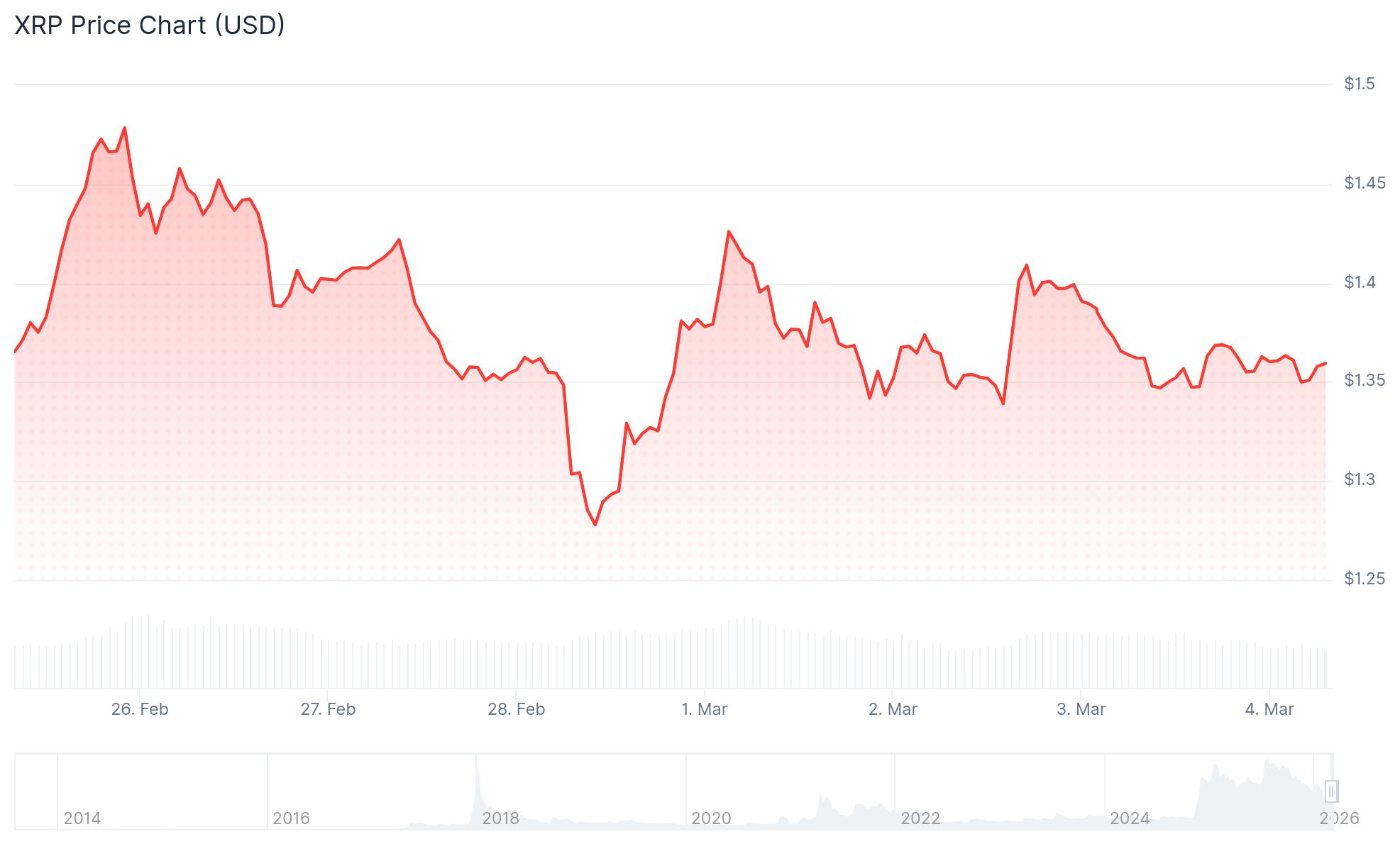
- XRP declined 2.4% over a 24-hour period, settling around $1.36 with trading activity between $1.34 and $1.40
- Market-wide selloff intensified due to Middle Eastern geopolitical tensions pushing oil prices upward
- Ripple announced integration of stablecoin capabilities, including RLUSD, into its payment infrastructure
- Technical analysis shows crucial support at $1.3320 with resistance positioned at $1.3880
- Market observers note RLUSD could potentially rival XRP’s traditional bridge currency function within Ripple’s network
On Tuesday, March 3, 2026, XRP experienced a 2.4% decline over 24 hours, settling near $1.36 based on CoinGecko market data. The digital asset fluctuated within a $1.34 to $1.40 price corridor throughout the trading day.
The token maintained a market capitalization hovering around $83 billion. Trading volume reached approximately $3 billion within the same 24-hour timeframe.
The price decline mirrored a wider retreat across risk-sensitive assets. Market participants attributed the selloff primarily to intensifying U.S.-Israel military operations targeting Iran.
“The market is concerned that the US is getting pulled deeper into this conflict,” said Tim Ghriskey, senior portfolio strategist at Ingalls & Snyder.
Bitcoin experienced a parallel downturn, declining 1.35% to $68,496 during the identical period. Data from Chainalysis revealed significant cryptocurrency withdrawals from Iranian trading platforms, totaling $10.3 million between Saturday and Monday.
Ripple Unveils Enhanced Payment Infrastructure
Tuesday brought Ripple’s announcement regarding the expansion of its Ripple Payments platform to accommodate both conventional fiat currencies and stablecoin assets. The firm is strategically positioning RLUSD, its dollar-backed stablecoin, as a primary instrument alongside XRP within the enhanced platform.
“Success in this space requires enterprise-grade infrastructure, extensive licensing, and deep liquidity,” said Monica Long, Ripple’s president.
Throughout the previous year, Ripple has strategically transformed itself into a stablecoin infrastructure provider. This transformation included the $200 million acquisition of Rail, a stablecoin payment solutions company, and the subsequent RLUSD launch following the Genius Act’s passage, which established clearer regulatory guidelines for stablecoins.
Implications for XRP’s Market Position
Historically, XRP has functioned as the primary bridge currency within Ripple’s international payment infrastructure. RLUSD now presents an additional option operating within the identical ecosystem.
Certain market analysts contend this development presents complications for XRP’s value proposition. Financial institutions utilizing XRP for transaction settlements typically execute conversions almost instantaneously, generating minimal sustained buying pressure.
RLUSD introduces a stable, regulatory-compliant alternative that may prove more attractive to banking institutions and financial service providers.
From a technical analysis perspective, XRP is currently positioned beneath its 100-hourly Simple Moving Average. A descending trend line has established itself with resistance concentrated near $1.3880 on the hourly timeframe.
Should the price breach $1.3880, subsequent resistance levels appear at $1.40 and $1.4320. On the downside, support levels are identified at $1.3320, followed by $1.3085.
XRP reached peak values approaching $3.50 in late 2025 before entering a correction phase. The token has remained below $1.50 since that downward adjustment.
As of Tuesday’s close, XRP was valued at roughly $1.36.

Locking in Tomorrow’s Transaction Costs Today. In decentralized finance, everyone obsesses over yield, leverage, and tokenomics. But there’s a quieter, far more structural variable that shapes everything: blockspace.
On networks like Ethereum, blockspace is the scarce resource. Every transaction competes for inclusion in a block, and users pay gas fees to win that competition. When demand surges—NFT mints, memecoin frenzies, liquidation cascades—fees can explode in minutes.
Now imagine if you could hedge that risk.
Welcome to the idea of Gas Futures & Blockspace Hedging: markets where users lock in future transaction costs—like airline tickets, but for blockchain execution.
Why Gas Is a Financial Risk
Gas fees are not just a UX annoyance. They’re a real economic variable.
High gas costs:
-
Wipe out DeFi yield strategies
-
Make liquidations unprofitable
-
Block DAO governance participation
-
Kill arbitrage spreads
-
Force traders to delay execution
For funds, market makers, NFT projects, and on-chain businesses, gas volatility is operational risk.
And what do markets do with risk?
They price it.
The Core Idea: Gas as a Tradable Commodity
Blockspace is finite per block. That makes it:
-
Scarce
-
Auctioned
-
Variable in price
In other words, perfect for derivatives.
A gas futures market would allow users to:
-
Lock in a maximum gas price for a future time window
-
Buy guaranteed transaction inclusion rights
-
Hedge against expected congestion
Instead of reacting to network chaos, you pre-purchase execution capacity.
How Gas Futures Could Work
Here are a few possible models:
1. Fixed-Price Forward Contracts
A user agrees today to pay a fixed gas price next month.
If market gas spikes above that level, they win.
If it stays low, the seller profits.
Think: Over-the-counter blockspace forwards.
2. Blockspace Options
Buy the right—but not obligation—to transact at a specific gas ceiling.
If network demand surges, you exercise.
If not, you let it expire.
This mirrors commodity options markets.
3. Block Inclusion Tokens
Validators could tokenize future block capacity
For example:
-
“Slot #X in Epoch Y” becomes tradable
-
Users buy inclusion guarantees in advance
-
Validators receive upfront capital
This transforms execution priority into a financial instrument.
Who Would Actually Use This?
This isn’t for casual users sending $20.
The real demand would come from:
🏦 On-Chain Funds
Need predictable execution costs for rebalancing or liquidation defense.
🖼 NFT Projects
Launching during peak hype? Pre-locking gas ensures mint success.
⚖️ MEV Searchers
Guaranteed inclusion = edge preservation.
🏛 DAOs
Governance proposals executed without being priced out.
Why This Doesn’t Exist (Yet)
Several structural challenges:
1. Validator Coordination
On networks using Proof-of-Stake like Ethereum, block proposers rotate frequently. Futures would require coordination across validators or protocol-level changes.
2. Demand Uncertainty
Gas prices are reflexive. If everyone hedges, pricing models must adjust dynamically.
3. MEV Interaction
Blockspace is not just space—it contains MEV opportunities. Pricing execution without pricing MEV is incomplete.
The Bigger Picture: Financializing Infrastructure
We’ve already seen:
Gas futures are the next logical layer: derivatives on execution itself.
This turns blockchain infrastructure into a financial market of its own.
Instead of:
“I hope gas isn’t high tomorrow.”
It becomes:
“I’ve hedged my execution risk.”
That’s a fundamental shift.
What This Unlocks
If gas futures become liquid and reliable:
-
DeFi strategies become more stable
-
DAO governance becomes more predictable
-
Launches become more structured
-
On-chain businesses can forecast operational costs
It transforms blockchain from a chaotic fee auction into a hedgeable production environment.
Final Thought
Most people treat gas like weather—unpredictable and annoying.
But blockspace isn’t weather.
It’s a commodity.
And once a commodity becomes hedgeable, it becomes programmable.
Gas futures wouldn’t just smooth transaction costs—they’d complete the financial stack of decentralized networks.
The real alpha isn’t in the token.
It’s in owning tomorrow’s blockspace.
REQUEST AN ARTICLE
In a memo titled “The Weekend That Changed Finance,” Bitwise Chief Investment Officer Matt Hougan says a recent geopolitical shock has revealed a fundamental shift in how financial markets operate, potentially accelerating the migration of global finance onto blockchain-based infrastructure.
Summary
- A geopolitical event exposed the value of 24/7 on-chain financial markets when traditional markets were closed.
- Decentralized platforms like Hyperliquid and tokenized asset markets played a central role in price discovery.
- Hougan believes this signals a faster-than-expected shift toward blockchain-based infrastructure in global finance.
According to Hougan’s commentary, the markets’ response to an unexpected U.S. military strike on Iran late on a Sunday demonstrated the growing relevance of 24/7 on-chain trading venues at times when traditional exchanges are closed.
Hougan noted that during the early morning hours Eastern Time, conventional financial markets, including U.S. equities, futures and forex trading, were largely offline. Instead, crypto-enabled markets continued to price assets and process trades around the clock, with on-chain platforms such as the decentralized exchange Hyperliquid and tokenized commodity markets taking center stage in price discovery.
Hyperliquid’s perpetual futures on both crypto and real-world assets saw significant volume spikes, and Bloomberg reportedly referenced its crude oil contract when reporting on the strike’s market impact.
In the memo, Hougan argued that the episode showed more than just a temporary anomaly in trading hours; it illustrated a structural evolution in the global financial system. In his view, investors no longer need to wait for traditional markets to open to respond to major news, because blockchain rails and stablecoin-based trading venues operate continuously and globally.
That, he suggested, creates a competitive imperative for institutional participants, hedge funds, banks and asset managers, to onboard stablecoin wallets and familiarize themselves with decentralized finance mechanisms if they want to remain relevant in future market environments.
Hougan’s memo frames the weekend as a milestone moment that could hasten the adoption of on-chain finance, challenging the conventional belief that digitized finance will slowly edge into traditional markets over many years.
Instead, he suggests, the transition might unfold much more rapidly as market participants adapt to systems that never close.
Most analysts are blaming a lack of liquidity for Bitcoin’s dire performance, but there is more to it than just that.
Bitcoin’s 50% decline from all-time highs in just four months comes at a time when global liquidity has increased, which counters the common premise that the price follows liquidity.
“The divergence is striking, and it demands explanation,” said Chris Tipper, chief economist and strategist at the Ainslie Group. Global liquidity has climbed around $5 trillion since Bitcoin’s peak in October and is now almost $190 trillion, according to Ainslie Wealth.
However, this is being driven by the People’s Bank of China, which added $1 trillion in 2025 and likely another trillion this year, said Tipper.
Chinese Favor Gold Over Bitcoin
Chinese liquidity doesn’t flow into Bitcoin (which is banned), it flows into gold reserves, domestic infrastructure, and the real economy, he added.
“So when you strip out the Chinese contribution and look only at the Western liquidity that Bitcoin actually responds to, momentum peaked in October and has been decelerating since.”
Gold markets reacted to this and reached all-time highs in late January, with the precious metal trading just 5% down from that peak today. Bitcoin responded to the Western component and corrected.
“Two assets, same headline liquidity number, opposite performance, entirely explained by the bifurcation.”
The economist concluded that when Western liquidity momentum re-accelerates, whether from a Federal Reserve response to market stress, dollar weakness, or a “disorderly event that forces intervention,” Bitcoin has significant ground to recover.
The US Dollar Index (DXY), as a “rough proxy for Western liquidity, seems to support your argument,” commented Abra CEO and Algorand chairman, Bill Barhydt.
You may also like:
The DXY has recovered in recent days following the escalation of military strikes in Iran. From a low of 97.5 in late February, it climbed to 99.6 on Tuesday as the dollar strengthened, according to TradingView. A stronger dollar is also bad news for Bitcoin markets.
BTC Price Outlook
At the same time, Bitcoin tanked below $67,000 again in late trading on Tuesday but managed to recover to $68,500 by Wednesday morning in Asia.
The asset has seen heavy resistance at $70,000 and is unlikely to break above it until Western liquidity improves through Fed rate cuts or more money printing.
Binance Free $600 (CryptoPotato Exclusive): Use this link to register a new account and receive $600 exclusive welcome offer on Binance (full details).
LIMITED OFFER for CryptoPotato readers at Bybit: Use this link to register and open a $500 FREE position on any coin!
Key Takeaways
- Large holders accumulated 320K ETH in the past week while smaller investors offloaded 210K ETH
- Daily active addresses on the network reached 837,200, the highest in 10 years
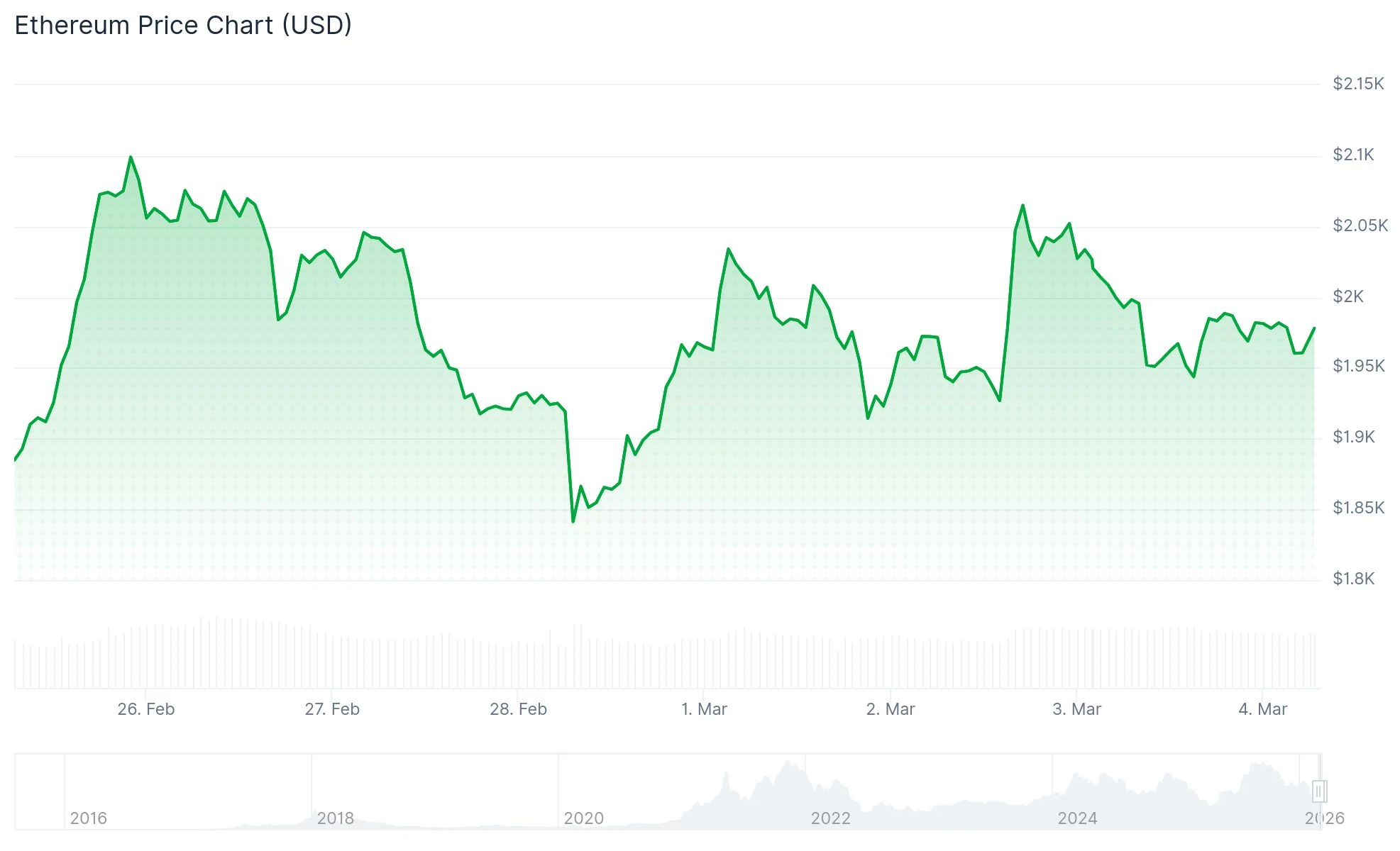
- ETH price remains around $1,980–$1,990, facing resistance at the $2,000 mark
- Spot Ethereum ETFs in the United States saw net inflows of $38.6 million on Monday
- Binance short positions have declined, yet ETH trades below critical moving averages
Ethereum continues trading near $1,980, struggling to breach the significant $2,000 resistance level even as large holders increase positions and on-chain metrics reach historic highs.
During the previous seven days, addresses containing 10,000 to 100,000 ETH accumulated 120,000 coins on Sunday and Monday combined. Total net accumulation by these major holders reached 320,000 ETH throughout the week. Simultaneously, smaller addresses holding 100 to 10,000 ETH distributed approximately 210,000 ETH.
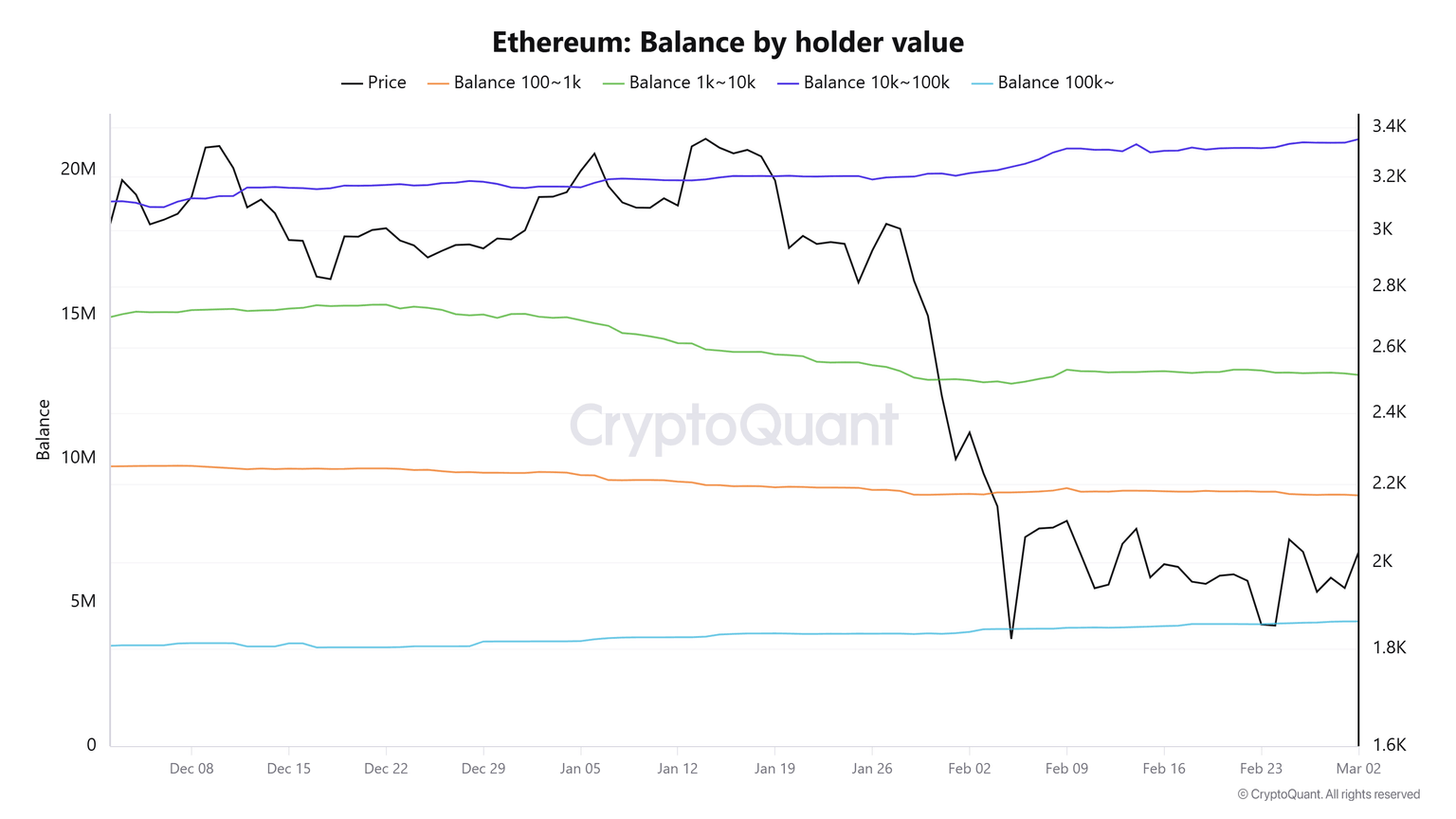
American market participants have maintained steady sentiment. The Coinbase Premium Index, measuring buying pressure from US traders, remained positive. Spot Ethereum ETFs in the United States also reversed their trend on Monday, attracting $38.6 million in net inflows with zero outflows reported across all nine available products.
On the Binance platform, short position dominance in ETH futures markets has decreased substantially throughout the week. This indicates reduced bearish positioning among derivatives traders.
Network Engagement Reaches Decade Milestone
Data from Santiment reveals Ethereum’s daily active addresses climbed to 837,200, marking the highest level in ten years. This represents an 82% increase compared to the five-year average and exceeds decade-old figures by more than 1,100%.
Daily new wallet creation has similarly increased 64% over the past five years, currently averaging 284,800 new addresses daily. Historical patterns indicate such surges in these metrics often correlate with extended bullish phases for Ethereum.
However, price action hasn’t reflected this increased activity. ETH continues trading significantly below its 50-day exponential moving average around $2,300 and its 200-day EMA near $2,945.
Critical Price Zones
Ethereum experienced $78.3 million in liquidations during the last 24 hours. Long positions accounted for $48 million of these forced closures.
The Relative Strength Index currently reads approximately 43, indicating subdued momentum without reaching oversold territory. Immediate resistance levels appear at $2,020, $2,050, and $2,080. A successful push above $2,120 could clear the path toward $2,200.
For support, initial levels exist near $1,960, followed by $1,932. A breakdown beneath $1,895 might accelerate selling pressure toward $1,850 or potentially $1,820.
Glassnode analytics indicate substantial accumulation around the $1,800 level, with approximately 1.23 million ETH acquired at an average entry price of $1,890 during the past 30 days.
CoinGlass information reveals long liquidation clusters concentrated between $1,900 and $1,950. Short squeeze potential intensifies above the $2,000 threshold.
ETH’s present trading price near $1,990 places it squarely within this compressed volatility zone.


Visa and Bridge plan to roll out stablecoin-linked cards to more than 100 countries by the end of 2026.
Visa is a global payments technology company. Bridge is a stablecoin infrastructure platform acquired by Stripe that enables businesses and fintech developers to offer Visa cards backed by stablecoins.
Why it matters:
- Visa and Bridge unveiled the stablecoin-linked card issuance product last year.
- The 100-country rollout would move stablecoin-linked cards from a niche product to a near-global payment option.
- Visa is also exploring the possibility of supporting Bridge-issued assets in future transactions. The evaluation will focus on how these assets could enhance Visa’s global network and create a new settlement option for partners.
The details:
- Visa and Bridge confirmed the expansion in an official announcement, targeting a 2026 rollout across Europe, Asia Pacific, Africa, and the Middle East.
- The card is currently live in 18 countries. It allows customers to use stablecoin balances in their crypto wallets to make purchases at businesses that accept Visa.
- Crypto platforms such as Phantom and MetaMask are utilizing cards to allow millions of users to use stablecoins for their daily purchases seamlessly.
The big picture:
- The move reflects growing adoption of stablecoins as functional payment instruments rather than speculative assets.
- Recent reports suggest that Meta may also re-enter the stablecoin market.
The post Visa and Bridge to Roll Out Stablecoin-Linked Cards Across 100+ Countries appeared first on BeInCrypto.
Key Takeaways
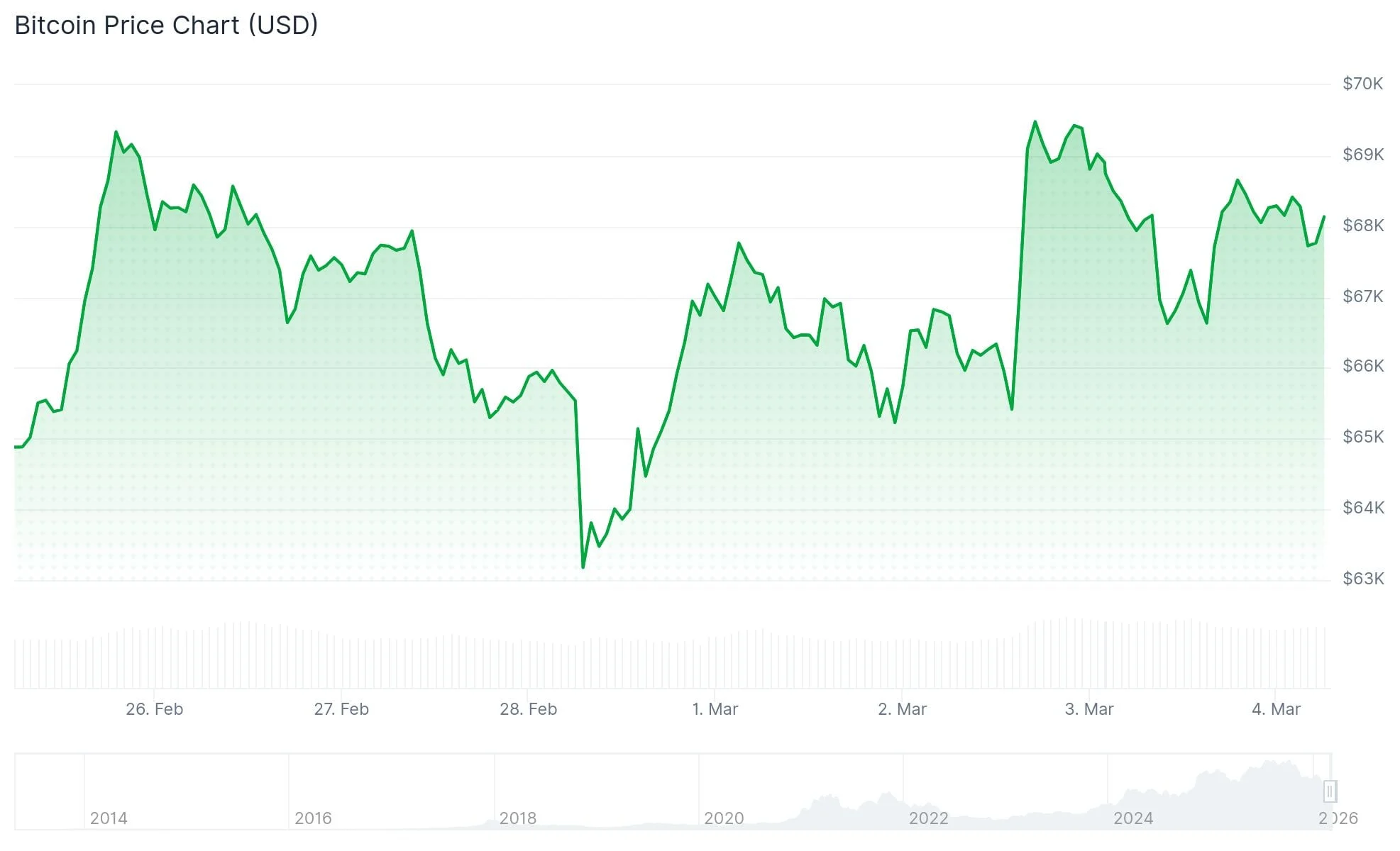
- BTC recovered to approximately $68,000 following a weekend decline to $63,000
- Bitcoin ETFs attracted $1.45 billion in aggregate net inflows across five consecutive sessions
- Short liquidations primarily fueled the rebound rather than new long positioning
- Technical indicators improved: RSI increased from 36 to 41, while volume surged from $6.6B to $9.6B
- Betting platforms indicate reduced probability of BTC reaching $65K or $60K in March
Bitcoin staged a notable recovery on March 4, pushing back toward the $70,000 level and settling near $68,000 during Hong Kong trading hours.
This upward movement came after a volatile weekend that saw BTC plunge to approximately $63,000, with Middle Eastern geopolitical tensions cited as the primary catalyst.
According to market maker Enflux, the price rebound stemmed largely from forced short liquidations. Bearish traders who anticipated further downside were compelled to close their positions when escalating conflict failed to materialize.
“The market is not pricing catastrophe, but it is not pricing resolution either,” Enflux communicated in correspondence with CoinDesk.
Cryptocurrency markets typically react more swiftly to geopolitical developments than conventional financial markets. Enflux characterized Bitcoin as functioning like a “pressure valve” for capital flows during periods of heightened uncertainty.
Institutional Capital Supports Price Floor
Institutional accumulation has emerged as a critical stabilizing force. Bitcoin spot ETFs collectively accumulated approximately $1.45 billion in net inflows throughout the previous five trading sessions.
In a March 2 conversation, Bitwise Chief Investment Officer Matt Hougan revealed that numerous institutional allocators view recent price weakness as an attractive entry point. He referenced one prospective investor who committed $11 million following a two-year evaluation period with Bitwise.
“They’re not surprised that crypto is volatile,” Hougan explained. “They’ve been waiting for an entry point.”
Hougan highlighted that Bitwise’s typical institutional client requires an average of eight meetings before finalizing an allocation, with many conducting reviews only on a quarterly basis. He emphasized that what appears as reluctance often reflects standard institutional due diligence procedures.
As of the fourth quarter, three out of four leading wirehouses now have authorization to proactively present Bitcoin investment opportunities to their client base.
Blockchain Metrics Reveal Measured Optimism
Glassnode analytics indicate gradual improvement, though decisive bullish momentum remains absent.
The Relative Strength Index for Bitcoin climbed to 41 from the previous week’s reading of 36. However, it continues trading beneath the critical 50 threshold that would confirm buyer dominance.
Daily trading volume expanded to $9.6 billion from $6.6 billion, while spot market order flow has achieved greater equilibrium between buyers and sellers.
Futures markets continue displaying seller predominance over buyers, and funding rates for leveraged long positions have declined.
Prediction market data reinforces the cautious sentiment. The likelihood of Bitcoin declining to $65,000 during March decreased by 11 percentage points to 73%. Similarly, the probability of reaching $60,000 dropped 10 points to 41%.
A corresponding Polymarket contract measuring whether Bitcoin touches $60,000 before reaching $80,000 declined 12 points to 61%.
At the time of publication, BTC was changing hands at $66,360.

Iran-US war latest: Israel launches fresh strikes on Tehran as US names soldiers killed in drone attack

At Close of Business podcast March 4 2026

The Massive ‘Obstacle’ Holding Bitcoin’s Price Down


-

 Politics5 days ago
ITV enters Gaza with IDF amid ongoing genocide
-

 Politics23 hours ago
Alan Cumming Brands Baftas Ceremony A ‘Triggering S**tshow’
-

 Fashion5 days ago
Weekend Open Thread: Iris Top
-

 Tech3 days ago
Unihertz’s Titan 2 Elite Arrives Just as Physical Keyboards Refuse to Fade Away
-

 NewsBeat6 days ago
Cuba says its forces have killed four on US-registered speedboat | World News
-
Sports4 days ago
The Vikings Need a Duck
-
 NewsBeat4 days ago
Dubai flights cancelled as Brit told airspace closed ’10 minutes after boarding’
-
 NewsBeat6 days ago
Manchester Central Mosque issues statement as it imposes new measures ‘with immediate effect’ after armed men enter
-

 NewsBeat3 days ago
‘Significant’ damage to boarded-up Horden house after fire
-
 NewsBeat4 days ago
The empty pub on busy Cambridge road that has been boarded up for years
-

 NewsBeat3 days ago
Abusive parents will now be treated like sex offenders and placed on a ‘child cruelty register’ | News UK
-

 Business6 days ago
Discord Pushes Implementation of Global Age Checks to Second Half of 2026
-

 Entertainment2 days ago
Baby Gear Guide: Strollers, Car Seats
-

 Business5 days ago
Only 4% of women globally reside in countries that offer almost complete legal equality
-
 Tech5 days ago
NASA Reveals Identity of Astronaut Who Suffered Medical Incident Aboard ISS
-
Politics3 days ago
FIFA hypocrisy after Israel murder over 400 Palestinian footballers
-
 NewsBeat3 days ago
Emirates confirms when flights will resume amid Dubai airport chaos
-

 Crypto World5 days ago
From Crypto Treasury to RWA: ETHZilla Retreats and Relaunches as Forum Markets on Nasdaq
-

 NewsBeat2 days ago
Is it acceptable to comment on the appearance of strangers in public? Readers discuss
-

 Tech3 days ago
Viral ad shows aged Musk, Altman, and Bezos using jobless humans to power AI