
Crypto World
Solana Treasury Firm Dangles 13% Dividends to Bankroll Its Next SOL Buys

DeFi Development Corp. plans to raise up to $20 million through a preferred stock offering. It carries an initial annual dividend rate of 13%.
The Solana (SOL) treasury company intends to use part of the proceeds to buy more SOL. It resumed accumulation last week as market conditions turned more favorable.
What the Preferred Stock Offers
DFDV announced that it plans to conduct an IPO of its Variable Rate Series C Perpetual Preferred Stock, known as CHAD Stock.
Dividends will accrue on a stated amount of $10 per share. Payments will be made each business day of each calendar month, beginning October 1, 2026.
The initial annual dividend rate is 13%, subject to adjustment under the stock’s terms. DFDV also intends to deposit $1.30 per share into a separate account at closing.
The reserve would cover 12 months of dividend payments at the initial 13% rate. The company can fund it with existing cash, financial instruments, and/or digital assets. R.F. Lafferty & Co. is acting as the sole book-running manager.
“The Company intends to use the net proceeds from the offering for general corporate purposes, including for working capital, the acquisition of SOL and other digital asset-related investments, strategic transactions and growth initiatives,” the firm said.
Follow us on X to get the latest news as it happens
Buying Restarted Days Before the Offering
The firm is already one of the largest public holders of SOL. Last week, it added 19,000 SOL at an average price of $98.14.
That purchase lifted its treasury to about 2.33 million SOL and SOL equivalents. The company partly funded the acquisition by divesting its ZeroStack position, citing improving market conditions.
Chief Executive Joseph Onorati described DFDV as a leveraged way for investors to gain exposure to SOL.
“When SOL performs well, we believe DFDV has the potential to amplify that performance. Month-to-date, DFDV’s return has been more than twice that of SOL,” he said.
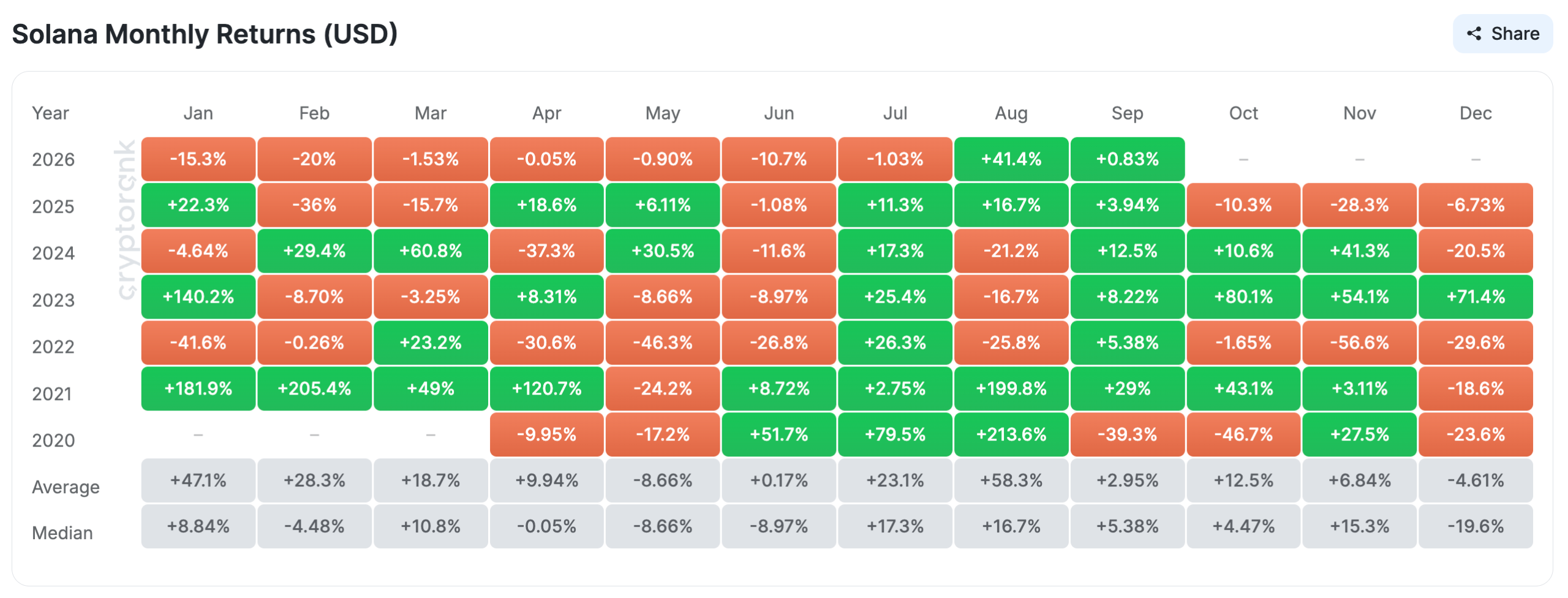
The move comes as the broader crypto market strengthens. SOL gained 41.4% in August, making it the token’s first positive month of 2026 after losses in every month since January.

Strategy also resumed Bitcoin (BTC) accumulation after a 10-week pause, while Strive and BitMine continued adding to their digital asset holdings.
For now, the raise shows treasury firms testing investor appetite again after a difficult stretch. Whether that window stays open will shape how much more SOL DFDV can add.
Subscribe to our YouTube channel to watch leaders and journalists provide expert insights
The post Solana Treasury Firm Dangles 13% Dividends to Bankroll Its Next SOL Buys appeared first on BeInCrypto.


XRP is down 1.80% on the day, but a New York Stock Exchange-listed fund has some big news, revealing that Ripple makes up the largest share of its holdings. The crypto is surpassing even assets tied to companies better known for their role in the crypto exchange industry.
C1 Fund Inc. (NYSE: CFND) disclosed its Q2 2026 holdings, revealing Ripple Labs as its largest position at 17.5% of net assets, edging out Kraken parent Payward at 16.9%. The fund’s net asset value landed at $6.49 per share, and its Ripple stake alone generated 150% in four months, a return the fund partly credits to Ripple’s own share repurchase program.
— Xaif Crypto (@Xaif_Crypto) August 31, 2026
 C1 Fund ($CFND) Q2results: NAV $6.49/share, now holding 11 crypto companies up from 7.
Ripple Labs is their #1 holding at 17.5% of net assets, Kraken close behind at 16.9%. Added Polymarket this quarter too. Real institutional money betting on crypto infra. https://t.co/RgS0AMPlqc pic.twitter.com/AS4Wyej7IM
C1 also deployed $33.07 million across 11 private digital companies, adding Polymarket to the mix during the quarter. It is a signal that institutional appetite for crypto-adjacent private equity isn’t slowing down.
This TradFi validation lands against a choppier technical backdrop, and the two don’t always move in sync. Institutions buy conviction on a quarterly basis; traders react to candles by the hour.
Discover: The Best Crypto to Diversify Your Portfolio
Can XRP Price Hit $1.50 This Week Amid The Bullish Ripple News?
XRP sits at $1.36, off 1% intraday, with the broader 7-day trend still negative after a volatile stretch that saw the token swing between $1.33 and $1.39. ETF-linked inflows have kept a bid under price even as the token trades below key resistance.

Momentum readings are mixed-to-constructive. RSI near 61 and a MACD buy signal on daily charts, though shorter-term oscillators flash overbought. Traders are watching $1.34–$1.35 as the line in the sand. Hold that zone, and a push toward $1.42–$1.43 resistance opens the door to the $2 targets some analysts have floated for September. Lose it, and the setup risks a slide toward $1.25.
A scheduled Ripple escrow release adds a supply-side variable worth tracking this week, separate from the fund-flow narrative entirely.
Trade XRP on Bybit and Get a Chance to Win Our $1,000 USDT Airdrop
Bitcoin Hyper Targets Early Mover Upside as XRP Tests Key Levels
XRP holders riding the C1 Fund headline have reason to feel validated. Institutional money doesn’t chase a dead asset. But a token already carrying a market cap in the tens of billions doesn’t offer the same asymmetric upside as something still in price discovery. This is where rotation logic kicks in for traders looking beyond the next resistance test.
Bitcoin Hyper ($HYPER) is building the first Bitcoin Layer 2 with native SVM integration with smart contract execution running faster than Solana itself, bridged to Bitcoin’s base-layer security through a decentralized canonical bridge.
The presale has raised $33 million so far, with tokens priced at $0.0136855 and a huge 35% staking rewards live for early participants. The pitch: Bitcoin’s trust layer, without the slow throughput and missing programmability that’s kept it sidelined from DeFi.
Research Bitcoin Hyper before the next raise milestone.
Discover: The Best Token Presales
The post Ripple News: XRP is Top Asset in New York-Traded C1 Fund appeared first on Cryptonews.
After dipping below $77,000 on Monday morning following the new strikes in the Middle East, BTC jumped by two grand, but it was stopped again and now sits in the middle of this range.
Most larger-cap alts have failed to recover the recent losses, with ETH still struggling at $2,450, XRP well below $1.40, and BNB beneath $690.
BTC Settles at $78K
After its best week of the year marked in the middle of August, bitcoin tried to take full advantage of this resurgence at the end of the month, surging past $81,000 on a couple of occasions. However, the bears stepped up and didn’t allow another leg up.
Just the opposite; BTC started to lose value rapidly on Friday after the hawkish speech by new Fed Chair Kevin Warsh at Jackson Hole, and dipped below $77,000. It managed to quickly erase some of the losses and spent Saturday trading above that level.
The bulls returned on Sunday with a minor increase to $79,000. However, the resumed strikes between the US and Iran resulted in another nosedive. Bitcoin slipped to $77,000 once again on Monday before it rebounded to $79,000 and now sits between the two boundaries.
Its market capitalization remains stagnant at $1.560 trillion on CG, while its dominance over the alts is at just under 58%.

UNI Keeps Pumping
Uniswap’s native token is the top performer today once again, surging by another 10% daily (over 32% weekly) to a multi-month peak of almost $6.00 earlier today before it retraced to the current $5.65. RAIN and NEAR have posted gains of around 4%, while HYPE is up by over 2%.
In contrast, TRX is down by nearly 2% to $0.33, SOL has slipped toward $100 after another 1% dip, and ETH remains below $2,450. BNB can’t get past $690, while XRP struggles below $1.40. Even more painful declines come from MNT and SKY.
On the other hand, CRV and ARB have returned to the top 100 alts by market cap. The former has rocketed by 15%, while the latter is up by 24% daily.
The total crypto market cap remains just over $2.7 trillion on CG.

The post Uniswap (UNI) Skyrockets 32% Weekly, Bitcoin (BTC) Calms at $78K: Market Watch appeared first on CryptoPotato.
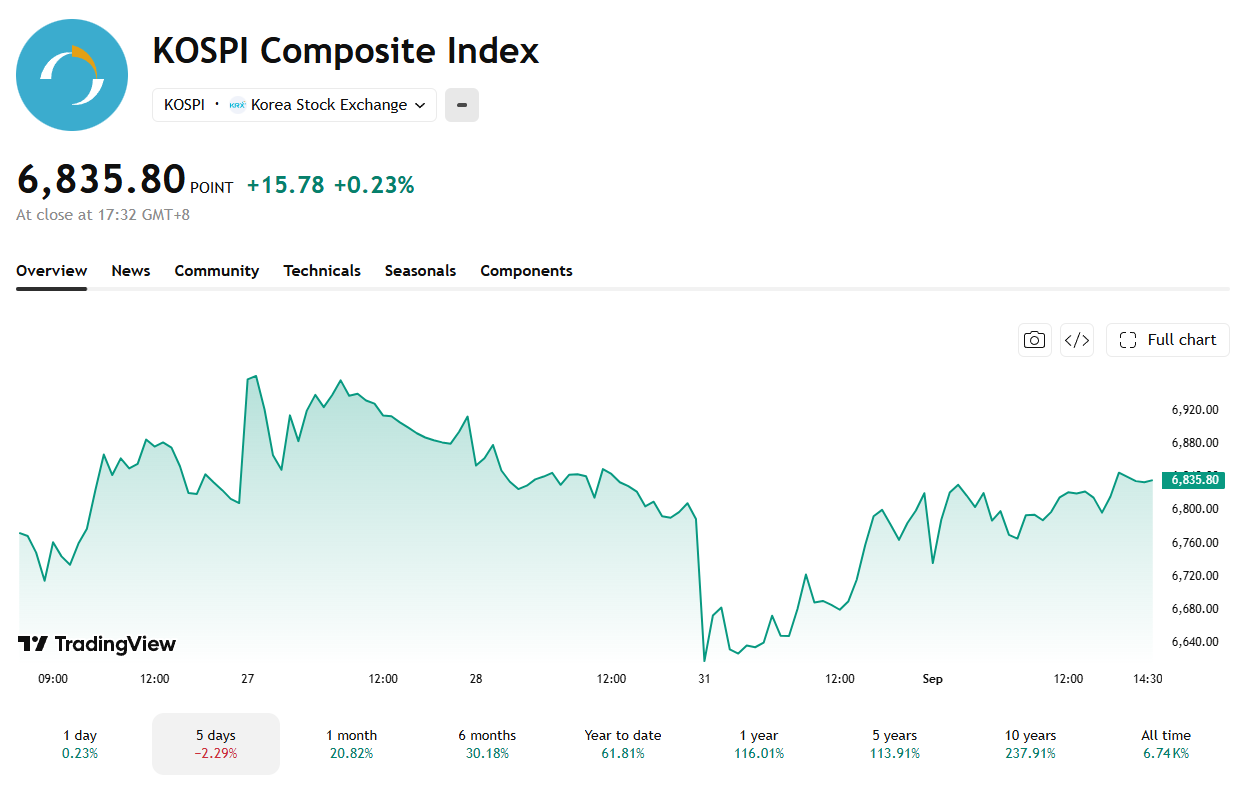
South Korea’s Kospi closed at 6,835.8 points on Tuesday, up 0.23%, as buyback-driven gains in Samsung Electronics and SK Hynix offset net selling from foreign, institutional, and retail investors alike.
The index marked its second straight gain, having opened 0.52% lower after fresh U.S.-Iran airstrikes and a hawkish Fed speech from Chair Kevin Warsh unsettled global markets. The Kospi has since recovered from a session low near 6,617 on Monday.
Chip Stocks Reverse an Early Slide
Wall Street had fallen overnight, with the Dow Jones Industrial Average down 0.7% and the S&P 500 off 0.33%, after Warsh’s Jackson Hole speech fanned concerns over a possible rate hike at the Fed’s meeting later this month.

However, the Kospi erased those losses in the afternoon as government data showed Korea’s August exports stayed solid on strong chip demand, extending the Kospi’s chip-driven rally. Samsung rose 0.38% and SK Hynix advanced 1.14%, both aided by recently announced buyback programs.
“External uncertainty dampened investor sentiment, but strong buying from big companies backed up the index,” said Lee Kyung-min, an analyst at Daishin Securities.
Sellers Outnumbered Buyers Despite the Gain
Trade volume was light at 263.7 million shares worth 17.5 trillion won ($12.8 billion), with advancers narrowly beating decliners 444 to 421. Foreign investors sold a net 491.9 billion won, institutions sold 634 billion won, and retail investors sold 539.8 billion won.
Oil refiners gained on rising crude prices, with SK Innovation up 7.81% and S-Oil up 1.07%. Meanwhile, Hanwha Aerospace fell 3.99% and Celltrion slipped 0.48%.
The won weakened 1.8 won to trade at 1,370.4 per dollar as of 3:30 p.m., reflecting broader risk-off pressure from the Middle East escalation.
The post Kospi Gains as Chip Buybacks Offset Broad Investor Selling appeared first on BeInCrypto.

Shakur’s murder in September 1996 at the age of 25 had left so many questions unanswered and has been the subject of conspiracies for years.
But the investigation into his death was revived after Davis published his memoir, Compton Street Legend, in 2019. In the memoir and during promotions, he outlined the role of the Crips in Shakur’s death. The Crips were feuding with the Mob Piru, which had ties to Shakur and his record label, Death Row Records.
Nevada law allows Davis to be charged with murder even if he did not pull the trigger.
Davis, who was arrested in 2023, could face life in prison. Clark County District Court Judge Carli Kierny ordered that Davis be held without bail and scheduled his sentencing on Oct. 13.
The former gang leader, however, said in court that he would appeal the conviction.
How the verdict was reached
The trial against Davis began on Aug. 17. More than two dozen witnesses testified before a panel of 16 jurors, four of whom are alternates. Jurors also watched footage about the fight that broke out a few hours before Shakur and Death Row Records co-founder Marion “Suge” Knight, who was riding with him, were shot by a man in a white Cadillac on Sept. 7, 1996, while Shakur’s car stopped at a red light.

Perhaps the most notable piece of news within the crypto industry on Monday came from Strategy, as the company started buying more BTC again after completing a few sales and rebuilding its USD reserve to over $6.7 billion.
Although that might sound celebratory at first, it’s worth taking a closer look at when the firm sold and when it bought more bitcoin, as it turns out it realized substantial losses amid the asset’s price recovery.
Back to Buying
As reported yesterday, the largest corporate holder of the leading cryptocurrency spent $370 million to acquire 4,603 BTC at an average price of $80,310 per unit. This means that the acquisition took place during the previous week when bitcoin jumped past $80,000 for the first time since last May. However, its actual time spent above that coveted level was quite brief.
Nevertheless, this purchase came after four consecutive sales completed between June 30 and August 10, as Santiment explained. Within this timeframe, the company offloaded 6,916 BTC, worth roughly $430 million at the time, at an average price of approximately $62,100.
Consequently, the reacquired 4,603 BTC managed to offset approximately two-thirds of everything the firm sold during the summer. What’s quite intriguing is that Strategy’s purchase came at a price almost $18,000 per BTC higher than the average during the sales.
Analysts such as Michaël van de Poppe brought up the timing, saying that they are “genuinely impressed” by the fact that the purchasing power has returned around BTC’s recent peak.
On the plus side, bitcoin’s spectacular resurgence from the recent low-$60,000s to almost $80,000 as of press time means that Strategy’s massive position has turned green again. The firm, which stood at an unrealized loss of well over $10 billion until a few weeks ago, is now above water by around $2.3 billion.
STRC Recovers
Strategy used the past couple of months, in which it sold some BTC and didn’t buy any to raise additional funds by selling MSTR to increase its USD reserve. The total is now over $6.7 billion.
In addition, it repurchased a significant portion of its STRC shares, whose price had tumbled far below the par level of $100 to as low as $75. However, rebuilding the USD reserve and buying back shares helped STRC recover to just over $97 as of Monday’s closing price.
The post Saylor’s Bitcoin U-Turn: Strategy Sells at $62K, Buys Back at $80K appeared first on CryptoPotato.

Ripple’s native token turned the tables in August, although the month saw a few dips to a multi-year low of just under $1.00.
Now, though, the XRP Army has refocused on September, which is expected to be highly volatile. Some even called it XRP’s “most loaded month” in history.
The August Gains
Following a very modest gain of 2.11% in July, XRP went into August with little hope for a turnaround. After all, all four previous editions were in the red, with the asset dumping by as much as 26.6% in August 2023.
The month indeed began on the wrong foot, as by the middle of it, XRP had slipped below the key psychological support of $1.00 on a few occasions. While some bears speculated about another potential leg down toward $0.80 or even lower, the trend changed in an instant.
On August 19, the entire crypto market came to life, led by bitcoin’s massive surge from under $65,000 to $80,000 within less than 48 hours. XRP was a little late to the party, but once it joined, it couldn’t be contained. For 72 hours, that is. Perhaps due to returning ETF inflows or whales going on a big accumulation spree, XRP skyrocketed by 70% from Wednesday to Saturday and touched a multi-month high of $1.70.
However, it was quickly halted there and retraced in the following weeks. Ultimately, it ended the month at just under $1.40, which is still a 30% surge in its worst-performing month in history.
What’s Next, September?
Unlike all August editions between 2022 and 2025, all Septembers within the same period were in the green, some in a modest manner (0.42% increase in 2023), and some in a highly impressive fashion (46.2% in 2022).
This one is expected to be volatile, to say the least. RippleXity called it “the most loaded month in XRP’s history.” Aside from the highly anticipated FOMC meeting scheduled in two weeks, which is likely to impact all financial markets, the US Senate will return on September 14 and vote on the CLARITY Act the following day.
The legislation is expected to influence most altcoins, and the voting in two weeks is likely to set the course for what might occur by the end of the year.
The month will also end with another major XRP-related event. Evernorth’s shareholders will vote on whether the XRP treasury company will become public on Nasdaq as XRPN. It currently holds nearly 475 million tokens.
In terms of price action, many analysts are convinced that the cross-border token has exited its bear phase and is now well-positioned for major gains.
The post XRP Enters Its ‘Most Loaded Month’ in History After 30% August Surge appeared first on CryptoPotato.

Polymarket is reportedly preparing a major new funding push that would significantly deepen its backing from politically connected capital. According to the Wall Street Journal, 1789 Capital—where Donald Trump Jr. is a partner—is set to invest around $300 million in the blockchain-based prediction market as part of a broader $1 billion fundraising round.
The same report says the round could value Polymarket at $21 billion. If it closes as described, 1789 Capital’s participation would be large enough to move the firm into one of Polymarket’s most prominent investors.
Key takeaways
- 1789 Capital is reportedly planning an approximately $300 million investment in Polymarket within a $1 billion round.
- The reported round would value Polymarket at about $21 billion, potentially reshaping the company’s investor cap table.
- ICE is still Polymarket’s largest disclosed investor, with $1.6 billion invested in preferred shares reported in an ICE 10-Q filing.
- Polymarket’s fundraising momentum is unfolding amid growing US and international regulatory pressure on prediction markets.
What 1789 Capital’s reported entry could mean
Money matters in prediction markets because it funds liquidity, infrastructure, and the ability to scale participation across event categories. A $300 million commitment—if confirmed—would represent a substantial injection of risk capital at a time when the sector is trying to expand while regulators scrutinize how these markets function.
The Wall Street Journal report also indicates that 1789 Capital is already invested in Polymarket, bringing its total exposure to about $500 million. That would position the firm among Polymarket’s largest backers once the additional investment is completed, potentially increasing its influence in governance discussions that often accompany major rounds.
Cointelegraph says it reached out to both 1789 Capital and Polymarket for comment, according to the article text provided.
Valuation questions and how the funding fits prior fundraising efforts
Polymarket’s reported funding strategy appears to be evolving alongside competition in US prediction-market offerings. Earlier coverage cited in the source notes that Polymarket reportedly began talks in April to raise $400 million at a potential $15 billion valuation—lower than the valuation of Kalshi, Polymarket’s main competitor at the time, which was referenced at $22 billion.
By contrast, the new reported valuation in the Wall Street Journal—$21 billion—would reflect a different pricing environment than the earlier fundraising attempt. Whether that shift signals improved traction, investor sentiment, or simply negotiation dynamics remains unclear from the provided information, but the reported numbers suggest Polymarket is aiming for a materially higher valuation than what it sought months earlier.
Investors watching similar rounds often focus on whether valuation increases coincide with clearer compliance pathways or deeper liquidity partnerships—especially in a sector where regulatory outcomes can change quickly.
ICE’s disclosed stake highlights how concentrated backing is
Even with new entrants, Polymarket’s ownership remains dominated by large institutional investors. In a July 30 10-Q filing, ICE reported that it invested a combined $1.6 billion in Polymarket preferred shares.
ICE’s filing further states that the holdings had a carrying value of approximately $2 billion as of June 30. It also says the preferred shares represented about 22% of outstanding shares, or 14% on a fully diluted basis.
These figures illustrate a key structural point for readers: while new capital can increase the total funding available to Polymarket, the largest disclosed backer—ICE—already holds a significant portion of equity-linked exposure. Any incoming round will likely be interpreted against that backdrop, particularly when assessing how much ownership and control different investors retain after issuance.
Regulatory pressure remains the central risk as capital seeks a path forward
The funding headlines arrive during a period of intensified scrutiny of prediction markets. The provided source recounts that on Aug. 14, JPMorgan Chase reportedly ended a banking relationship with Polymarket over regulatory concerns, though it said it remains interested in potentially providing underwriting support if Polymarket seeks to go public.
On the legal front, the source says that more than a dozen US states have filed actions against Polymarket, Kalshi, or both over sports event contracts. It also notes that authorities in several countries have blocked or restricted access to Polymarket, citing gambling-related concerns—an escalation that reinforces why banks, platforms, and corporate partners may be cautious.
This regulatory pressure is relevant to fundraising for a straightforward reason: capital providers tend to price regulatory uncertainty, because outcomes can affect revenue models, user access, and the feasibility of future listings or partnerships. In that sense, Polymarket’s reported push for a high-value round is not occurring in a vacuum—it is happening while multiple jurisdictions test legal boundaries for prediction and event-contract products.
Where things stand next
If 1789 Capital’s reported $300 million commitment and the overall $1 billion round come to pass, Polymarket’s investor base would grow further at a time when the firm’s operating environment is still contested. Market participants should watch for confirmation of the deal terms, any changes to the regulatory strategy being pursued, and whether banking and compliance hurdles ease enough to support sustained growth.
Five equity-backed notes issued through Luxembourg’s ORO II fund will trade against dollars, USDT and Bitcoin for eligible non-US investors.


Binance launched stock options on Sept. 1, giving eligible users access to physically settled contracts linked to selected U.S.-listed stocks and exchange-traded funds.
Summary
- Binance launched physically-settled options on selected U.S.-listed stocks and exchange-traded funds for eligible users globally.
- Buyers can purchase calls or puts but cannot write contracts or open short options positions.
- Exercised contracts settle through underlying shares held by Alpaca Securities for Binance users in custody.
- Phase one supports limit orders only, with maximum buyer losses capped at premiums paid upfront.
- Most contracts trade during regular U.S. market hours from 9:30 a.m. until 4:00 p.m. Eastern.
The product allows users to buy calls, which provide the right to purchase shares at a specified strike price, and puts, which provide the right to sell shares. Each contract has a fixed expiration date, according to the announcement.
The exchange is offering the service through Nest Trading Limited as the introducing broker. U.S.-regulated Alpaca Securities acts as the clearing broker and holds shares delivered through exercised contracts on behalf of Binance users.
Binance stock options use physical settlement
Physically settled options deliver the underlying shares when qualifying contracts are exercised. This differs from cash-settled derivatives, which close by paying the difference between a contract’s strike price and the asset’s settlement value.
For a call option, exercise gives the buyer the right to acquire the underlying shares at the strike price. A put gives the buyer the right to sell shares at that price, subject to the platform’s exercise, funding and position requirements.
Shares resulting from settlement are held in custody by Alpaca Securities. Binance users can monitor the resulting positions through the platform’s stock trading interface and Funding Account.
The exchange did not publish a complete list of supported stocks and ETFs in its general announcement. Users must open a stock’s price page and check whether an Options tab appears. Available expiration dates and strike prices are displayed through the relevant options chain.
The contracts represent conventional securities options rather than tokenized stocks or crypto perpetual futures. They follow U.S. market schedules and settle into underlying shares instead of blockchain tokens.
Long-only trading limits losses to premiums
The initial product is long-only. Users can buy calls and puts but cannot write options or create uncovered short positions. This removes the open-ended risk associated with selling certain options without holding the underlying asset.
For buyers, the maximum direct loss is limited to the premium paid for the contract. A contract can expire without value if the market price does not move sufficiently beyond its strike price before expiration.
Defined losses do not make options low-risk products. Contract values can fall quickly because they depend on the underlying share price, remaining time before expiration, expected volatility and interest rates.
Users must complete an options suitability questionnaire and sign a disclaimer before trading. Customers who have not activated Binance’s stock service can open the stock and options products through the same onboarding process.
Only limit orders are supported during phase one. Traders must specify the maximum price they are prepared to pay rather than submitting market orders that execute at the best available price.
The exchange has not disclosed when it might add other order types, options writing or multi-leg strategies. The phase-one label indicates that the product could change, but no additional rollout schedule was announced.
Nest and Alpaca divide the brokerage roles
Nest Trading acts as the introducing broker, providing the interface through which eligible Binance users submit orders. Alpaca Securities handles the U.S. brokerage functions behind execution, clearing and custody.
Alpaca describes itself as a regulated, self-clearing broker-dealer. It previously partnered with Binance when the exchange launched direct access to U.S. stocks and ETFs in June.
Nest Trading is authorized by the Financial Services Regulatory Authority of Abu Dhabi Global Market. Its permissions cover activities including arranging investment transactions, dealing as an agent and arranging custody.
The structure keeps securities execution and custody within regulated brokerage entities while allowing customers to access the service from a Binance account. The exchange itself is not described as the U.S. clearing broker.
In related coverage, crypto.news reported that ETFs reached 25% of Gen Z equity trading volume on Binance during early August. Binance noted that its direct-equities data covered a short period and did not establish a lasting investment trend.
Trading follows regular U.S. options hours
Most supported stock options trade between 9:30 a.m. and 4 p.m. Eastern, matching regular U.S. market hours. Certain ETF and exchange-traded note options can remain open until 4:15 p.m.
The product generally does not support pre-market or after-hours trading. Binance stops accepting new orders when the relevant options market is closed, although users can cancel existing orders.
Unfilled orders remain on the order book during closures but cannot match until trading resumes. U.S. holidays, early closes, exchange halts and other market events can also change availability.
Users can fund the service through their Funding Account, Spot Account or Flexible Earn holdings. Supported assets include USDC, USDT, USD1, U and BNB, although the final securities transactions are processed through the brokerage arrangement.
The announcement does not provide a complete list of eligible countries. Binance warned that the product may be unavailable in some regions, meaning account access and local restrictions must be checked before trading.
The next developments to watch are the addition of more underlying securities, broader order support and any expansion beyond long-only contracts. Binance has not set deadlines for those changes.


Strategy has formally opposed MSCI’s proposed screening rules for companies with large non-operating asset holdings, arguing that the methodology unfairly targets digital asset treasury firms and could push companies including Strategy out of major global equity indexes.
Summary
- Strategy called MSCI’s proposed screening rules discriminatory and argued they unfairly target digital asset treasury companies.
- Companies with operating assets below 50% of total assets would face five additional tests, with four failures potentially making them ineligible for MSCI indexes.
- A May simulation identified Strategy, Metaplanet and Yellow Cake for possible deletion under the proposed methodology.
- Strategy said MSCI’s operating and non-operating asset distinction is not defined under U.S. GAAP, IFRS or existing U.S. securities law.
- MSCI is accepting feedback until Sept. 30, with a decision expected by Oct. 16 and any changes taking effect in December.
In a Monday letter signed by Executive Chairman Michael Saylor and CEO Phong Le, Strategy called MSCI’s proposal “discriminatory, arbitrary, and misguided” and asked the index provider to withdraw it.
“If adopted, the proposal would have no meaningful impact on Strategy’s business, but it would profoundly harm MSCI’s reputation as a reliable and neutral index provider,” Strategy wrote.
Strategy says MSCI proposal targets digital asset treasury firms
MSCI opened its latest consultation in August, proposing a new method for identifying companies whose balance sheets contain large amounts of assets it considers non-operating.
Companies whose operating assets account for less than 50% of total assets would face five additional financial-ratio tests under the proposed system. Triggering at least four of the five conditions could classify a company as non-operating and make it ineligible for the MSCI Global Investable Market Indexes.
The methodology examines operating asset intensity, expenses, operating cash flow, fair value changes tied to assets considered non-operating and dependence on financing to accumulate those assets.
Strategy argued that the proposal effectively revives MSCI’s earlier attempt to address digital asset treasury companies through a different screening process. The company described the latest methodology as a “pretext” for targeting DATs and challenged MSCI’s distinction between operating and non-operating assets.
MSCI considered a separate framework last year that could have removed companies with digital assets accounting for 50% or more of their total assets. Following industry opposition, the index provider kept crypto treasury firms in its indexes in January while it prepared a new review covering companies with substantial non-operating assets, as crypto.news previously reported.
Strategy opposed that earlier proposal as well, arguing that holding a large amount of Bitcoin should not make an operating company equivalent to an investment fund.
The new framework has since expanded beyond a crypto-specific threshold, though Strategy maintains that its practical effect remains concentrated on digital asset treasury companies.
MSCI simulation puts Strategy and Metaplanet at risk
The possible impact became clearer when a simulation based on May 2026 data identified Strategy, Metaplanet and U.K.-listed uranium investment company Yellow Cake as companies that would face deletion under the proposed methodology.
The MSCI simulation identified Strategy with a free-float-adjusted market capitalization of $23.93 billion, while Yellow Cake stood at $1.81 billion and Metaplanet at $654 million.
SharpLink, Center Laboratories and Lydia Holding were placed on a watchlist in the simulation because MSCI proposes different treatment for existing constituents. Under the proposed methodology, current index members would need to fail the applicable screening test in two consecutive annual reviews before removal.
Strategy challenged the basis of the screening process, saying MSCI’s use of “operating” and “non-operating” does not match established accounting definitions.
The company said neither U.S. generally accepted accounting principles nor International Financial Reporting Standards provides the distinction MSCI proposes to use. Strategy argued that existing U.S. securities law does not provide an equivalent test either.
Bitcoin is central to Strategy’s objection. MSCI treats the cryptocurrency on Strategy’s balance sheet as a non-operating asset, while Strategy reports its Bitcoin treasury as an operating segment.
According to the company, gains and losses related to its Bitcoin holdings are recorded as operating expenses following discussions with the U.S. Securities and Exchange Commission.
Strategy said MSCI would therefore be applying an index-level classification that differs from the accounting treatment used in its financial statements.
The company questioned why similar treatment would not apply to other businesses whose balance sheets contain large pools of assets. Its letter cited real estate investment trusts, timber businesses and energy infrastructure companies as examples of asset-heavy firms that could remain eligible under the proposed methodology.
Strategy argued that the difference would concentrate the effects of the test on digital asset treasury firms even though MSCI has presented the proposal as a company-wide screening framework.
Strategy wants MSCI to define its asset test
If MSCI proceeds with the proposal, Strategy asked the index provider to base any final methodology on recognized accounting or legal standards.
The company wants the rules applied only to financial filings released after the methodology has been finalized, preventing companies from being assessed retrospectively against a classification that did not exist when earlier filings were prepared.
Strategy requested a published record of the consultation process and asked MSCI to explain why the screening method is needed.
It wants the index provider to set objective criteria separating operating assets and activities from those considered non-operating, instead of relying on classifications that Strategy said lack established definitions.
The current dispute follows months of uncertainty over how major index providers should treat companies that use their balance sheets to hold Bitcoin and other digital assets.
When MSCI paused its earlier DATCO exclusion in January, Strategy shares rose as the immediate risk of removal from MSCI indexes eased.
The earlier debate had raised concerns about potential passive selling if companies were removed from benchmarks followed by index-tracking funds. JPMorgan estimated at the time that exclusion from MSCI indexes alone could lead to roughly $2.8 billion in selling of Strategy shares, with potential outflows reaching $8.8 billion if other index providers followed.
The estimate related to MSCI’s previous crypto-specific proposal and was not a forecast for the methodology currently under consultation.
MSCI is accepting comments on the latest proposal until Sept. 30 and plans to publish the outcome by Oct. 16. Any changes adopted following the consultation are expected to take effect in December.
Strategy continues building its Bitcoin position
The MSCI dispute comes as Strategy continues operating the world’s largest corporate Bitcoin treasury.
Strategy shares gained 4.42% on Monday to close at $132.94. On the same day, the company said it purchased 4,603 BTC during the previous week at an average price of $80,318 per Bitcoin.
Its capital structure has changed considerably during 2026 as the company has balanced Bitcoin purchases with cash reserves, preferred dividends and share issuance.
In June, Strategy added another 520 Bitcoin for roughly $35 million at an average price of $67,068 per coin, taking its holdings at the time to 847,363 BTC. The same filing showed the company had increased its U.S. dollar reserve by $300 million to $1.4 billion.
Treasury activity later moved in the opposite direction as Strategy used Bitcoin sales and equity financing for capital management.
By late July, the company had begun directing proceeds from common-share issuance toward its dollar reserve instead of immediately using the funds for additional Bitcoin purchases. One weekly filing showed Strategy raised $544.5 million by selling nearly 5.43 million MSTR shares while making no Bitcoin purchase during that period.
The company said the cash reserve could be used to cover preferred dividend obligations and other corporate needs.
Strategy later resumed Bitcoin purchases, including the 4,603 BTC acquisition disclosed Monday, while MSCI’s consultation determines whether companies with balance sheets dominated by assets it classifies as non-operating should remain eligible for its global equity indexes.

Trump Gets Reality Check Over Irans Kharg Island Claim

McLaughlin: Week Zero Reactions, Reflections & Analysis

iPhone 18 Pro Max vs iPhone 18 Pro: All Key Differences So Far





-

 Crypto World6 days ago
SpaceX stock could rise 75% to $240, JPMorgan says
-

 Fashion4 days ago
Weekend Open Thread: Maeve – Corporette.com
-

 Crypto World4 days ago
Bitcoin’s 22% rally now needs real demand to outlast Treasury liquidity boost
-

 Crypto World6 days ago
Warsh Jackson Hole keynote puts financial innovation first
-

 Business4 days ago
Salesforce Stock Soars 19% as Blowout Earnings and Agentforce AI Growth Silence Software Skeptics
-

 Crypto World5 days ago
Elon Musk Grok Bot Promise: We Will Make You Whole if AI Loses Your Money
-

 Business4 days ago
Apple Confirms September 9 Keynote and Reveals Its Full Pre-Order Schedule
-

 Crypto World6 days ago
Did Trump Just Move SpaceX Stock With One Truth Social Post?
-

 Business3 days ago
Onto Innovation Stock: AI’s Next Bottleneck Is Yield (NYSE:ONTO)
-

 Business6 days ago
Walmart takes aim at younger shoppers with new fashion brand
-
 NewsBeat6 days ago
Lindsay Clancy jury braces for closing arguments as judge tells court: ‘You’ve heard all the evidence’ – Live updates
-

 Crypto World3 days ago
Bitcoin price tests $82K resistance as Brandt stays long
-

 Crypto World5 days ago
NVIDIA revenue hits $96.2B as AI demand doubles
-

 Business6 days ago
Thailand’s Eastern Economic Corridor Capital City (EECiti): Key Developments and Investment Opportunities
-

 Business4 days ago
iPhone 18 Pro Pre-Orders Could Shift to Saturday as Apple Reportedly Avoids September 11 Anniversary
-
 Crypto World6 days ago
Nvidia Q2 Earnings Reveal $96.2 Billion Beat, So Why Is NVDA Falling?
-

 NewsBeat6 days ago
Trump’s trade truce with China faces test with Iran effort
-
 Tech5 days ago
Claude Cowork gets its own browser that doesn’t touch your tabs, bookmarks, or saved passwords
-
 Tech3 days ago
Hugging Face built a $4.5 billion empire on free AI models. Now Nvidia is buying it for $12.9 billion
-

 Crypto World4 days ago
Truflation calls for Fed rate cut after PCE forecast
You must be logged in to post a comment Login