
Crypto World
Solana Votes on Plan to Cut $1.5 Billion in Future SOL Emissions: What It Means for Price?

Solana (SOL) validators are voting on two supply proposals. One would raise the disinflation rate, and the other would burn more SOL.
Together, they would reduce projected emissions by about $1.4 billion to $1.5 billion over six years. But what could that mean for Solana’s price? Other protocols may offer some precedent.
What Solana Is Voting On
Solana’s staking yield sits near 5.25%, drawing mainly from protocol inflation of about 3.78%. Transaction fees and maximal extractable value (MEV) supply the rest.
SGP-0002, which corresponds to the technical proposal SIMD-0550, proposes reducing the inflation schedule. This would be done by increasing the disinflation rate.
“It doubles Solana’s annual disinflation rate from -15% to -30%, compressing the timeline to Solana’s 1.5% terminal inflation rate from approximately 5.7 years to 2.8 years, reaching that level by H1 2029 rather than H1 2032,” 21Shares explained.
Under this, nominal staking yield falls to roughly 4.34% in the first year. It drops to 3% in year two and 2.25% in year three.
SGP-0003, based on SIMD-0553, would divide Solana’s current 5,000-lamport signature fee into two parts: a 2,500-lamport base inclusion fee paid to the block leader and a resource fee determined by requested compute units and the applicable resource fee rate, which would be burned.
“At current network activity, daily SOL burns would rise from approximately 600–800 SOL to approximately 7,500–9,000 SOL, or $712,500 to $855,000, as of August 24. It is a meaningful acceleration in supply destruction, though not sufficient alone to offset current inflation of roughly $4.5 million per day,” the blog added.
Voting is set to continue through epoch 1023. According to 21Shares, the two proposals could roughly halve staking yields within two years and make the asset “structurally scarcer.”
Follow us on X to get the latest news as it happens
Ethereum and Cosmos Offer an Imperfect Comparison
21Shares pointed to two previous upgrades to gauge how markets could react to Solana’s supply-reduction proposals.
Cosmos’ (ATOM) Proposal 848 cut maximum inflation in November 2023. ATOM gained 25% over the following month and 10% over three months. However, the period also coincided with growing optimism around the approval of spot Bitcoin (BTC) ETFs.
Ethereum’s EIP-1559 introduced a burn mechanism in August 2021. ETH climbed 37% in one month and 60% over three months. However, broader market conditions also supported the rally as the crypto market approached its cycle peak.
The two examples suggest that supply-reduction upgrades can strengthen a token’s narrative. However, broader market conditions can have a larger influence on price.
“In both cases, the near-term move (1–3 months) likely came from a mix of the deflationary signal and supportive market conditions, not the upgrade alone. At the same time the subsequent 6–12 month drawdowns had little to do with the upgrades: for ETH, the onset of the 2022 bear market and the Fed beginning its rate hiking cycle; for ATOM, the broader summer 2024 slump,” the team added.
21Shares suggested that for SOL holders, the precedents offer a potentially bullish signal, but they do not guarantee a similar price reaction.

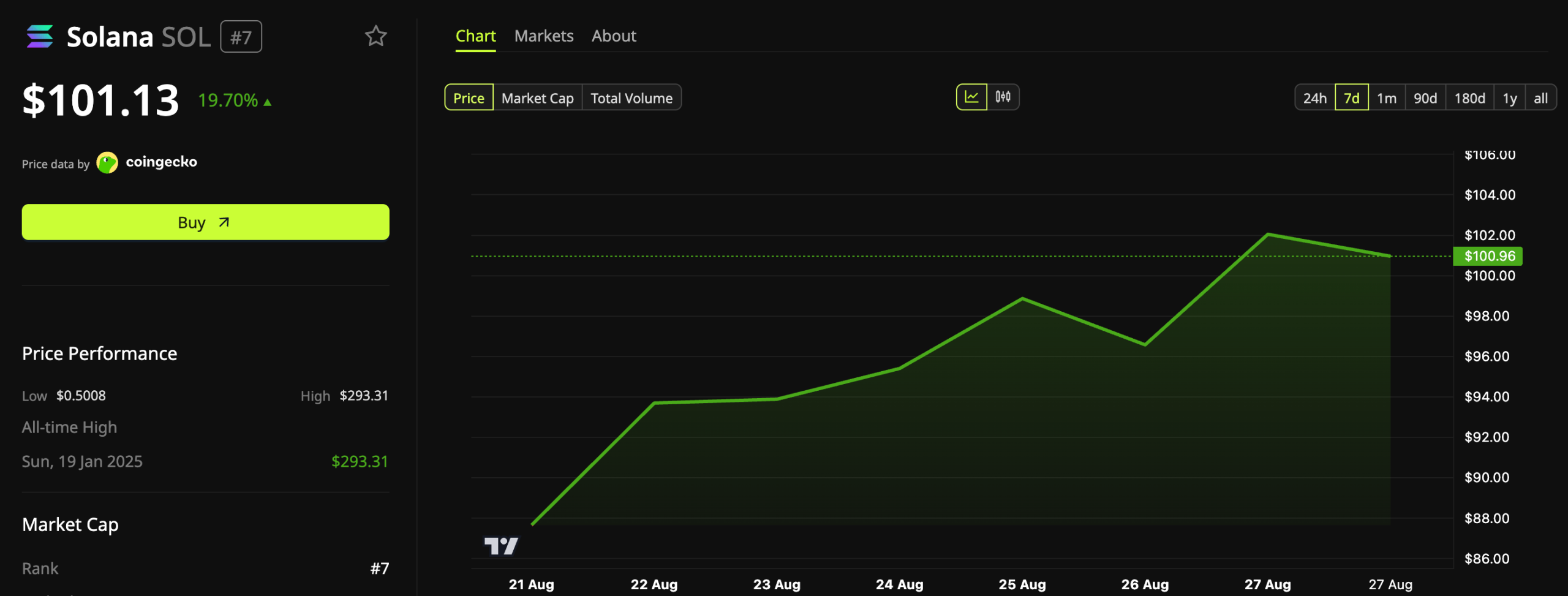
SOL trades near $101 after gaining close to 20% over the past week. The advance tracks a broader market rally rather than the governance vote itself.
Neither proposal alters the protocol on its own. Approval would hand developers a mandate, with the technical work and activation timing still to be settled.
That leaves two open questions for holders. Whether the changes reach mainnet and whether tighter supply extends the current rally will take months to answer.
Subscribe to our YouTube channel to watch leaders and journalists provide expert insights
The post Solana Votes on Plan to Cut $1.5 Billion in Future SOL Emissions: What It Means for Price? appeared first on BeInCrypto.



StarkWare said Wednesday that a quantum-safe Bitcoin (BTC) transaction has been mined on the live network, a first for the method.
On-chain data shows the transaction spent a 10,000-satoshi output, worth about $8 at current prices, and paid a fee of 5,179 satoshis.
Follow us on X to get the latest news as it happens
How the Quantum-Safe Bitcoin Transaction Works
Quantum-Safe Bitcoin (QSB) attaches a hash-based lock beside the elliptic curve signature that normally guards a Bitcoin output. Shor’s algorithm, the quantum technique that derives private keys from published public keys, cannot break hash functions.
StarkWare researcher Avihu Levy published the QSB method in April. It uses signature grinding. This produces a valid Bitcoin signature without a private key.
The sender grinds offchain until a candidate spending transaction hashes to a value that is itself a validly formatted signature.
Security then rests on reversing a hash rather than keeping a private key secret. The technique builds on Binohash, developed by Robin Linus, the creator of BitVM.
MARA Pool mined the transaction in block 964,199. What worked was a single construction, not an upgrade, and Bitcoin itself remains unchanged.
What the QSB Method Cannot Do
StarkWare said the method does not make Bitcoin quantum-safe. Three constraints narrow what the spend actually protects.
The first limit is prior exposure. An address whose public key already sits on-chain gains nothing, because an adversary with a quantum computer could derive the corresponding private key.
The second is the migration step. Coins reach a hash-secured output through a transaction signed the ordinary way, which exposes the sending address’s public key. The output spent on Wednesday was funded in July by exactly such a transaction.
The third is delivery. QSB transactions use nonstandard formats, so ordinary nodes will not relay them, and MARA’s Slipstream service supplied the route to a miner.
Cost compounds the limits. Levy’s repository puts the offchain compute at $75 to $150, while StarkWare described this transaction as costing several hundred dollars.
“People have long assumed that protecting Bitcoin holdings from a quantum adversary would require changing the Bitcoin protocol. Today shows otherwise. A soft fork is still the better long-term answer, as StarkWare has argued for consistently, but it is no longer the only option,” the blog read.
Bitcoin has not adopted a protocol-level fix, and Wednesday’s transaction does not change that.
Subscribe to our YouTube channel to watch leaders and journalists provide expert insights
The post Is Bitcoin Quantum-Safe Now? One Transaction Says Partly appeared first on BeInCrypto.
The tech-heavy Nasdaq composite jumped while the Dow Jones Industrial Average dipped Thursday as Wall Street reacted to big earnings reports, with Nvidia (NVDA), Salesforce (CRM) and CrowdStrike (CRWD) surging on the stock market today. Just after Thursday’s open, the Dow industrials were down 0.2%, while the S&P 500 moved up 0.3%. The Nasdaq advanced 0.8% in morning trading. West…
Copyright ©2026 Investor’s Business Daily, LLC. All rights reserved. 87990cbe856818d5eddac44c7b1cdeb8

U.S. fiscal concerns and digital-asset legislation news have emerged as separate forces in the Bitcoin market. Senator Cynthia Lummis has linked Bitcoin to the country’s $39.2 trillion national debt. Now, the Digital Asset Market CLARITY Act remains subject to significant procedural and policy hurdles in the Senate.
Bitcoin posted a 22% weekly gain after Treasury yields fell following a Treasury intervention in the bond market. The move into crypto was later amplified by a short squeeze, with CoinGlass data showing $2.7 billion in crypto short positions liquidated.
— paulatalkscrypto (@paulatalkshxrp) August 20, 2026
 $2.7 BILLION IN CRYPTO SHORTS JUST GOT WIPED OUT.
Bears got caught on the wrong side of the trade.
Liquidations are accelerating.
Momentum is shifting.
And the crypto market just sent a loud warning:
Never underestimate what happens when shorts get trapped. 
 #Crypto pic.twitter.com/nRVNMX0HTt
CNBC also reported that concern about U.S. debt levels and borrowing costs was part of the market backdrop. The report described the Treasury’s decision to double its buybacks of long-dated government debt as an effort aimed at long-term yield concerns, while noting that Bitcoin remained below its 2026 high and its all-time high despite the rally.
The same report said investor sentiment improved amid a late effort by the White House and crypto industry leaders to advance the CLARITY Act. It characterized the bill as a potential market catalyst, while saying its prospects for passage appeared relatively slim.
Discover: The Best Crypto to Diversify Your Portfolio
Lummis Links Debt Concerns to the CLARITY Act
On June 15, Senator Cynthia Lummis publicly tied Bitcoin to America’s $39.2 trillion national debt crisis. The report said she presented Bitcoin as a potential hedge against currency debasement for younger Americans who will inherit the effects of decades of deficit spending.

Lummis has argued that Bitcoin’s fixed supply makes it structurally distinct from sovereign debt instruments. According to the report, she described the U.S. fiscal trajectory as unsustainable and said Bitcoin could help address the consequences for younger Americans. She also acknowledged that the legislative timetable remained uncertain.
The Clarity Act would establish a jurisdictional division between the Securities and Exchange Commission and the Commodity Futures Trading Commission. Under the framework described in the primary report, the SEC would oversee digital-asset securities and new token offerings, while the CFTC would have jurisdiction over spot digital commodities, including Bitcoin and Ethereum.

The legislation would also create registration frameworks for exchanges, brokers, and custodians. Its provisions include capital-segregation requirements, protections for software developers publishing code, and a rule giving exchange customers first claim on custodial assets in bankruptcy.
For tokens that operate in regulatory ambiguity, the proposed activity-based test would determine whether sufficiently decentralized assets fall under CFTC oversight as digital commodities. The bill would also ban passive stablecoin yield products while protecting activity-based platform usage rewards.
Trade XRP on Bybit and Get a Chance to Win Our $1,000 USDT Airdrop
News on Senate Obstacles Remain as Bitcoin Stabilizes
Galaxy Research put the probability of the CLARITY Act becoming law in 2026 at 60–75%, according to the primary report. But the White House’s July 4 signing target faced pressure from unresolved ethics provisions, competing House and Senate versions that require reconciliation, and the Senate’s 60-vote cloture threshold.
The House and Senate versions also differ over the SEC–CFTC balance. The Senate Banking discussion draft gives the SEC primary authority over ancillary assets and calls for joint SEC–CFTC rulemaking on margining and disclosures, while the House version is described as more CFTC-forward.
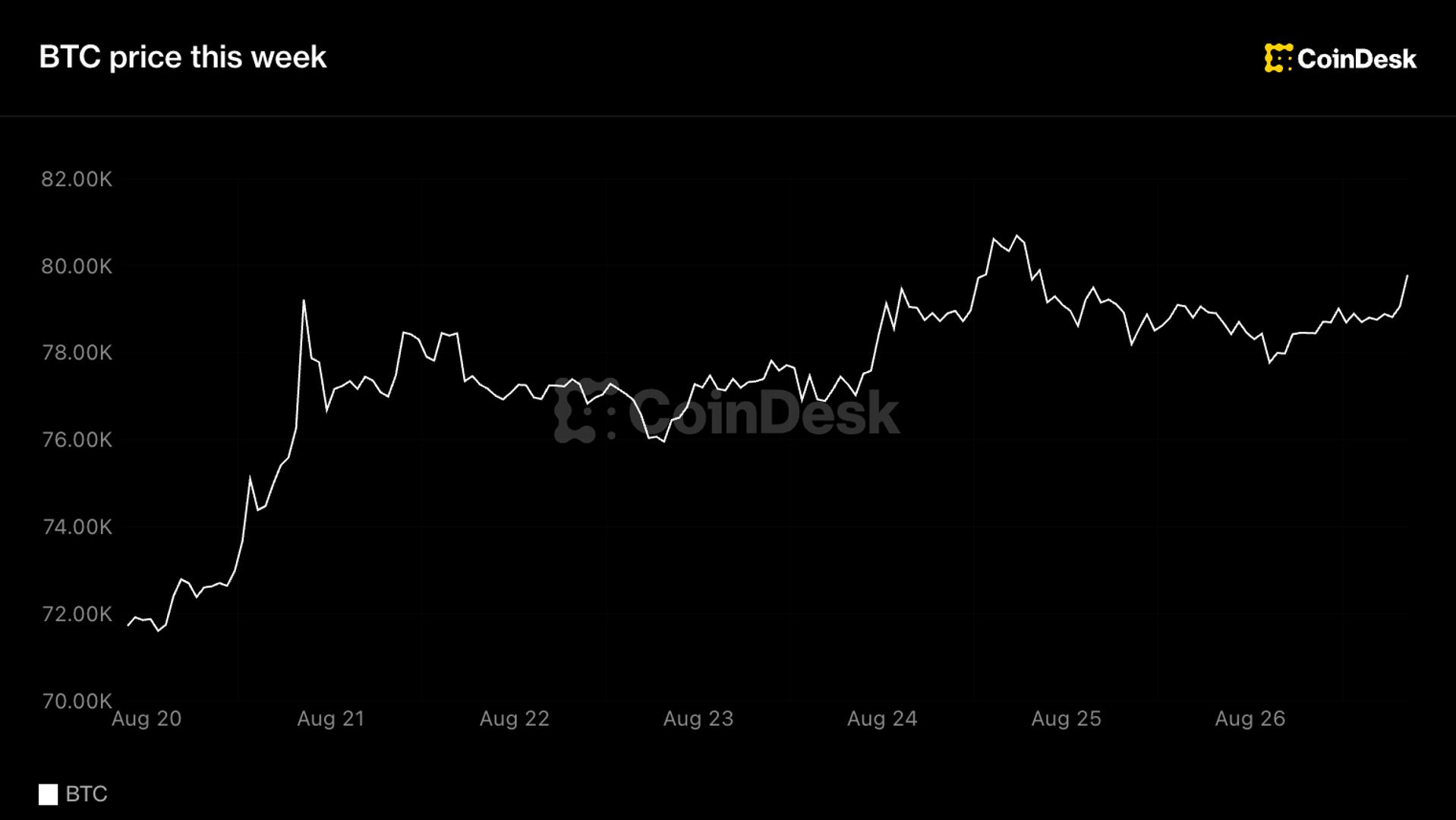
Despite the news, Bitcoin is still trading at around $80,000, with BTC holding near the key psychological level after briefly climbing above $80,000. The move keeps Bitcoin firmly in its recent uptrend, although the $80,000 to $82,000 area remains an important resistance zone after its three-month high.
Discover: The Best Token Presales
The post Bitcoin News: Debt Hedge Case Meets Senate Roadblocks for CLARITY Act appeared first on Cryptonews.
Crypto World
TIME Reveals the 2026 TIME100 AI List of the World’s Most Influential People in Artificial Intelligence

Today, TIME reveals the fourth annual TIME100 AI list, recognizing the 100 most influential people in artificial intelligence.
The 2026 TIME100 AI issue includes one worldwide cover featuring listmakers, Sam Altman, Dario Amodei, Jeff Bezos, Doreen Bogdan-Martin, Marian Croak, Larry Ellison, Joseph Gordon-Levitt, Paris Hilton, Lila Ibrahim, Arvind Krishna, Fei-Fei Li, Mira Murati, Elon Musk, David Sacks, Liz Shuler, Ilya Sutskever, and Eddie Wu.
Published alongside the TIME100 AI are in-depth interviews with Thinking Machines Lab chief executive officer Mira Murati, Secretary-General of the International Telecommunication Union Doreen Bogdan-Martin and OpenEvidence founder and chief executive officer Daniel Nadler.
Crypto World
Kansas City Fed’s Schmid says inflation ‘stubborn’ and ‘sticky,’ policy rate not restrictive
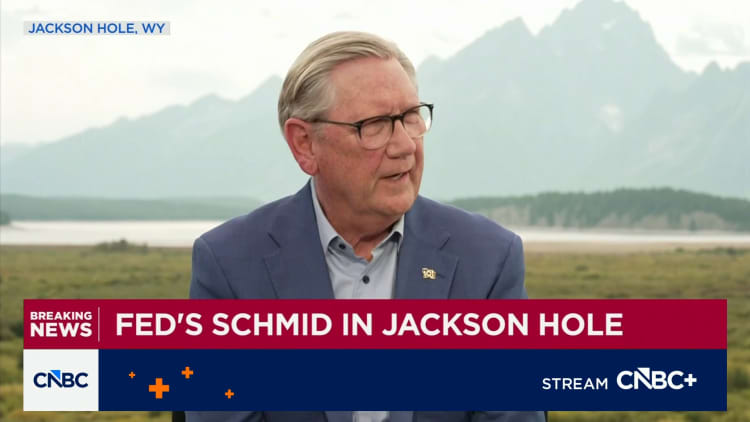

Kansas City Federal Reserve President Jeffrey Schmid said Thursday that inflation is still too high, though he stopped short of calling for an interest rate hike.
Speaking from the central bank’s annual symposium in Jackson Hole, Wyo. that the Kansas City Fed hosts, Schmid said in a CNBC interview that inflation has proven resilient.
“It’s still stubborn and it’s still sticky, and we’re we’ve got to continue to find ways to break through,” he said on “Squawk Box.” “We’re going to have our work cut out for us as we move into the [Federal Open Market Committee] cycle.”
The comments came the day after the Commerce Department reported that the Fed’s primary inflation gauge showed core prices, which exclude food and energy, rose 3.3% from a year ago, well above the central bank’s 2% target.
Coupled with an economy that grew at 1.5% in the second quarter and an unemployment rate sitting at 4.1%, Schmid said it’s not clear that the Fed’s current policy rate target of 3.5%-3.75% is restrictive.
“I don’t know what we’re restricting currently with the rate policy that we’re at today,” he said. “I do know moving the rate does change behaviors in the market in a macro level market.”
Schmid does not vote this year on the FOMC, though he still gets to express his views at meetings. When he was a voter last year, he twice dissented against rate cuts.
However, he said he is not sure whether he would support a rate increase now.
“I think we need a little bit more information. What I’m trying to figure out is the demand side of what’s driving both growth and inflation,” Schmid said.
Separately, Schmid said he sees “some room” to consider an idea that Chairman Kevin Warsh raised in July to reduce the number of FOMC meetings per year to six from the current eight.

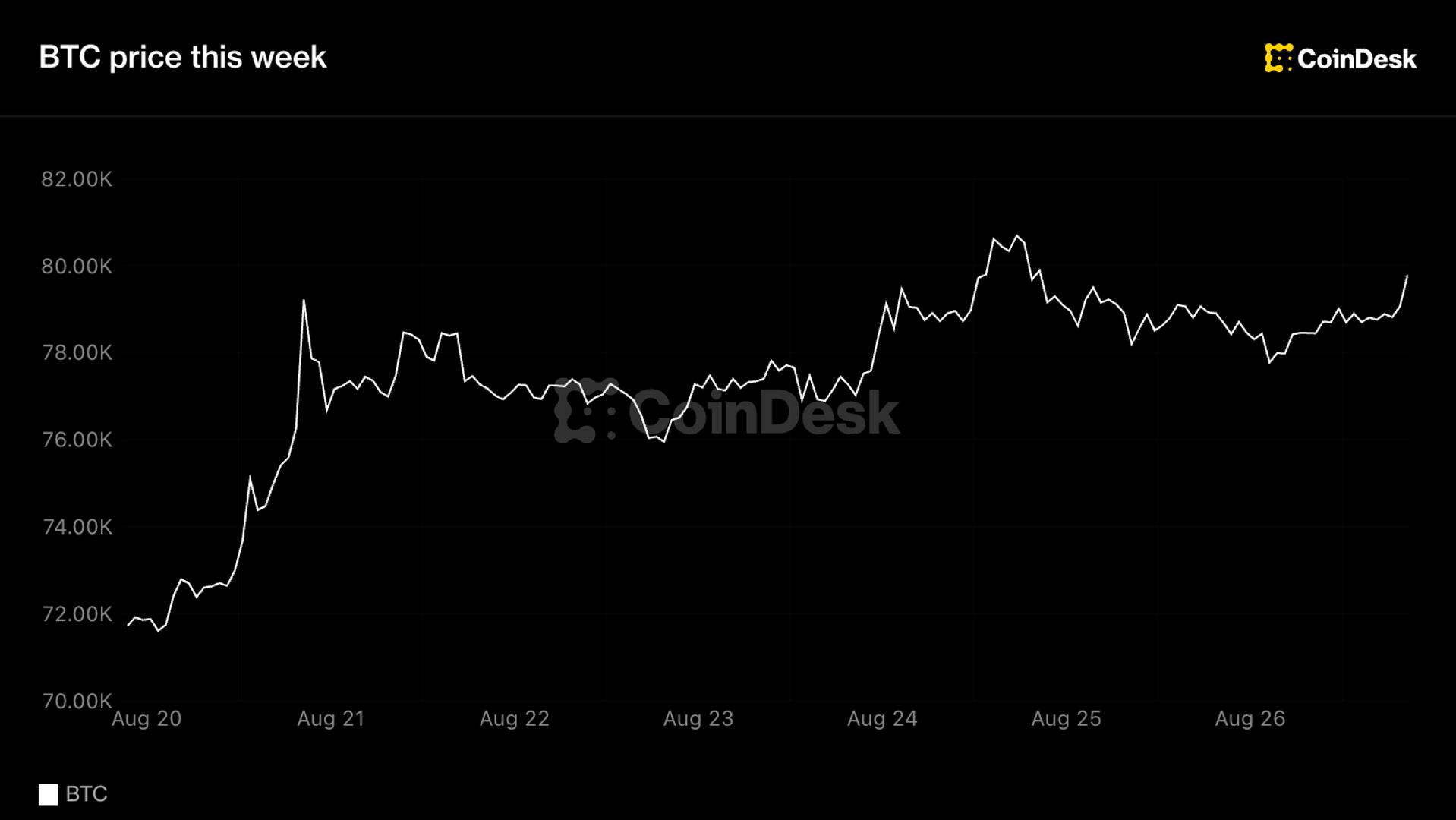
BTC held its ground Thursday as spot bitcoin ETFs logged an eighth straight day of net inflows, while altcoins drifted lower across the board.


Bitfinex Securities completed a record $50 million raise for Alkemya, whose token represents interests in a partnership that holds nickel assets.
Crypto World
Unstoppable Domains drops $2 million plan to bring .crypto and .bitcoin to standard internet


The abandoned bids would have cost over $2 million in base fees alone, leading the firm to prioritize financial viability over broader internet adoption.


Developers are holding details for two weeks while fixes reach operators, in the second Lightning security emergency this month traced to AI work on Bitcoin code.


The UK is moving to put stablecoins at the center of a new Bank of England mandate aimed at supporting innovation in digital payments.
The government plans to give the Bank of England, the UK’s central bank, a secondary objective to support innovation in payment systems and emerging forms of digital money, HM Treasury announced on Thursday.
The mandate will cover payment systems that use digital settlement assets such as stablecoins, while financial stability will remain the BoE’s primary objective.
The proposal comes as the UK steps up its work on stablecoins through regulatory changes, payment experiments and closer coordination with the US.
BoE innovation mandate faces September debate
The new responsibility would extend an existing approach used to regulate central counterparties (CCPs) and central securities depositories (CSDs), which help clear, hold and settle financial assets.
Under the proposed change, the central bank would report annually to Parliament on its progress toward the payments innovation objective.
“Developments in digital payments technology, including tokenisation and DLT [distributed ledger technology], have the potential to transform financial markets across the globe,” City Minister Lucy Rigby said.
The government expects to implement the objective through amendments to the Financial Services and Markets Bill, which is scheduled for further debate in the House of Lords on Sept. 7 and 9.
Stablecoin rules still face industry concerns
The new mandate’s impact may depend on how BoE uses its annual reporting requirement, Maksym Sakharov, co-founder and CEO of on-chain banking infrastructure provider WeFi, told Cointelegraph.
“The objective is secondary to financial stability, so it overrides nothing, but the bank will have to publish an annual account of its innovation efforts in payments and digital money,” Sakharov said. This requirement could put greater public scrutiny on stablecoin rules the central bank finalized in June.
Related: Binance to plan UK relaunch with FCA license application: Report
Sakharov pointed to requirements for systemic stablecoin issuers to hold at least 30% of their backing assets in non-interest-bearing deposits at the central bank.
“The reserve split is the first thing to fix,” he said, adding that the requirement could determine whether a stablecoin business is commercially viable.
UK steps up stablecoin push
The new mandate follows increasing UK efforts involving stablecoins, or crypto assets designed to maintain a stable value by tracking assets such as the US dollar.
In August, a group participating in the Bank of England’s Digital Pound Lab began testing whether a stablecoin and a simulated digital British pound could work together in a cross-border trade payment. The experimental platform does not use real customers or money.
Related: Revolut rolls out euro stablecoin in 3 European markets
In mid-July, the UK and US published a joint statement on stablecoins, with the governments saying they “intend to enable the use of stablecoins in cross-border finance” and calling for greater alignment of their regulatory frameworks.
BoE also previously dropped plans to limit stablecoin holdings to 20,000 British pounds for individuals and 10 million pounds for businesses, replacing them with a temporary 40 billion pound ($52.9 billion) issuance cap for each systemic stablecoin.
Magazine: MiCA cracks down on USDT in Europe… but no one else cares

Her Husband Knew She Took the Money And Then Use The Best Technique For Finding #shorts #money#funny

Scandal as kids isolated over wrong school uniform and sky-high costs forces parents into debt

Family offices making bullish bet on stocks, according to CNBC tracker





-

 Fashion6 days ago
Weekend Open Thread: Madewell – Corporette.com
-

 Crypto World2 days ago
SpaceX stock could rise 75% to $240, JPMorgan says
-

 Business5 days ago
Musk’s Tesla, SpaceX Confirm $16.8 Billion ‘Terafab’ Chip Plant as World’s Largest Building in Texas
-

 Crypto World5 days ago
anatomy of crypto’s biggest liquidation event since 2021
-

 Crypto World3 days ago
A $30 Billion AI Fund Implodes, Now the SEC Is Investigating Wall Street’s Role
-

 Politics5 days ago
6 months on, Irish renters crushed by effects of government housing bill
-

 Crypto World1 day ago
Did Trump Just Move SpaceX Stock With One Truth Social Post?
-

 Business4 days ago
Mystery AI Model ‘Ox Alpha’ Draws Developers With Free Access as Chinese Lab Origins Remain Debated
-
 NewsBeat5 days ago
The ‘Lucky Dip Gang’ causing carnage for clicks: After five thugs were killed speeding in the wrong direction on a motorway, GUY ADAMS investigates a sick new trend… and why police aren’t even allowed to pursue them
-

 Business3 days ago
Moderna CEO warns China is pouring state money into mRNA technology
-

 Business7 days ago
Five Below: Kids Discount Retailer Reaps Rich Rewards
-
 Crypto World6 days ago
Nvidia Stock Suffers Longest Losing Streak Since 2022: Will Q2 Earnings End It?
-

 Business3 days ago
NVIDIA Stock Drops Nearly 2 Percent to $210 on Seventh Losing Day Ahead of Critical AI Earnings
-

 Sports4 days ago
Deshaun Watson fires back at Browns fans after being booed: ‘It’s a disrespectful thing’
-

 Business6 days ago
UK firms in critical financial distress rise 9% to 53,756
-
 Crypto World4 days ago
Google Gemini AI Predicts Ethereum Could Become the Trade Retail Misses in 2026
-

 Tech6 days ago
Unitree’s New Superman Robot Claims to Outjump and Outrun Every Human, Usain Bolt Included
-

 Tech6 days ago
Faster chip in a familiar form factor
-

 Crypto World6 days ago
SEC Regulation Crypto vs CLARITY Act: which framework wins
-

 Business5 days ago
Will Tesla Stock Be Higher or Lower a Year From Now? Here’s What Wall Street Analysts Are Saying
You must be logged in to post a comment Login