
Crypto World
Solana’s Founder Warns AI Could Crack Post-Quantum Cryptography Schemes



Solana co-founder Anatoly Yakovenko called artificial intelligence the biggest near-term threat to crypto cryptography. He said AI could break post-quantum cryptography (PQC) signature schemes before the industry hardens them.
Bitcoin developers and analysts are converging on a consensus over future quantum threats without disturbing Satoshi Nakamoto’s holdings.
Yakovenko Pushes Multisig Defense for Post-Quantum Cryptography
The Solana co-founder argued the industry does not yet grasp the math or implementation weaknesses of PQC.
He wants wallets to combine multiple signature schemes through two-of-three multisig. This setup could be supported natively in Solana’s transaction processor through Program Derived Addresses.
“I think the biggest risk is that PCQ signature schemes will get broken by AI, we don’t know all the implementation footguns even, let alone the math footguns,” Yakovenko warned.
Curve Finance founder Michael Egorov asked whether formal verification could close the gap. However, according to Yakovenko, verification helps only when developers know exactly what to verify.
He still favors redundancy across two of three independent schemes.
Bitcoiners Reach Early Consensus on Satoshi’s Coins
Alex Thorn, head of firmwide research at Galaxy Digital, said a growing agreement is forming around Satoshi’s holdings. He cited talks held this week in Las Vegas with skeptics, advocates, and other Bitcoiners.
Satoshi’s estimated 1.1 million Bitcoin (BTC) sits across roughly 22,000 P2PK addresses of 50 BTC each. Thorn argued any long-range attack would have to crack each address separately. Exchanges, by contrast, can migrate to post-quantum addresses before Q-day.
He added that Bitcoin markets routinely absorb more than one million BTC of selling pressure. That suggests the network could withstand a worst-case unwind without compromising core property rights.
Whether wallet redundancy or protocol restraint offers the stronger near-term defense remains the open question as quantum research accelerates.
The post Solana’s Founder Warns AI Could Crack Post-Quantum Cryptography Schemes appeared first on BeInCrypto.

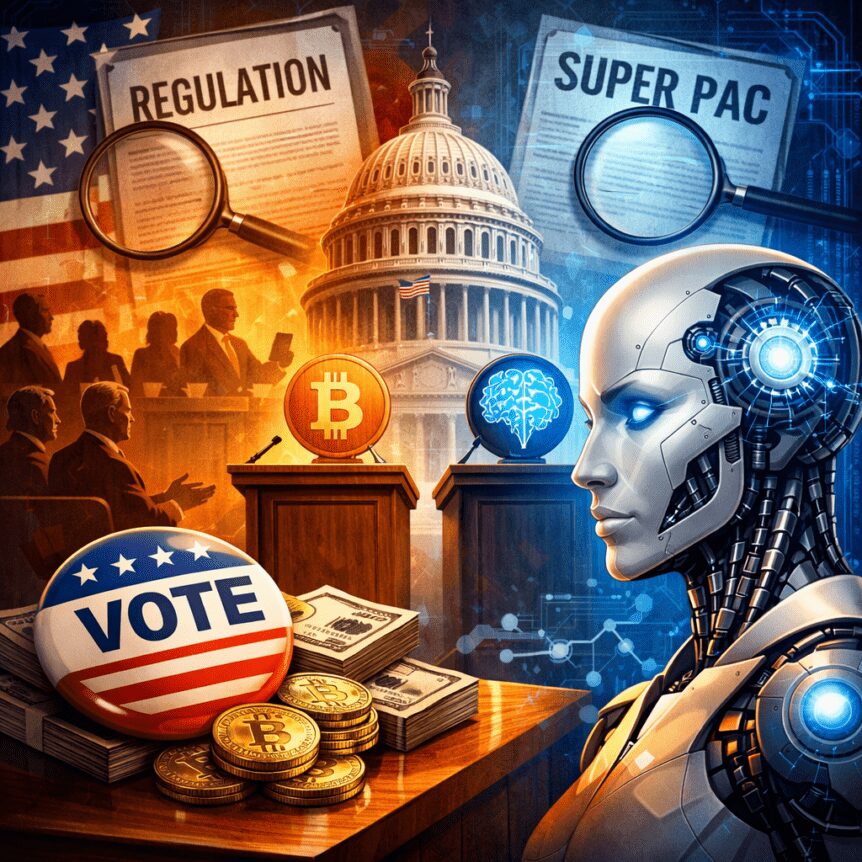
In the run-up to the 2026 midterm elections, industry groups aligned with crypto and artificial intelligence are channeling tens of millions of dollars into political committees, even as a new survey indicates broad skepticism among Americans toward both sectors. According to an April 2026 poll conducted by Public First for Politico, 45% of Americans say investing in cryptocurrency is not worth the risk, and 44% believe AI is developing too fast. The survey also found that nearly half of respondents trust traditional banks more than crypto platforms, and two-thirds want Congress to impose strict regulations or broad oversight on AI.
The findings pose a regulatory and political challenge for candidates accepting money from industry-aligned super PACs. In hypothetical matchups, respondents were notably less likely to back candidates supported by groups pushing looser AI regulations than those backed by groups advocating tighter tech rules. The report warned that public skepticism could translate into voter backlash if Americans grow weary of heavy industry spending.
The poll sampled 2,035 U.S. adults online between April 11 and 14, 2026, with results weighted for age, race, gender, geography and education. The margin of sampling error was ±2.2 percentage points. Source: Politico via Public First.
Key takeaways
- Crypto investments: 45% say investing in cryptocurrency is not worth the risk.
- AI development: 44% think AI is developing too fast.
- Trust in institutions: nearly 50% favor traditional banks over crypto platforms.
- Regulatory preference: about 66% want Congress to impose strict regulations or broad oversight on AI.
- Electoral impact of funding: voters favor candidates backed by groups backing tighter AI rules over those backed by groups seeking looser regulation.
- Awareness gap: a minority of voters are aware of industry-aligned PACs, signaling potential rapid shifts if voters connect donor ties to industries.
- Sample size and rigor: the survey encompassed 2,035 online adults with a ±2.2-point margin of error.
AI and crypto in the campaign finance landscape
Industry-aligned political action committees are deploying substantial funds to influence primaries and general election outcomes. Leading the Future, a pro-AI super PAC launched in August 2025, has raised more than $75 million and has deployed resources across primaries in North Carolina, Texas, Illinois and New York. Fairshake, the pro-crypto PAC backed by major industry players including Coinbase, Andreessen Horowitz and Ripple Labs, has already spent about $28 million across competitive races.
Beyond direct contributions, lobbying activity underscores intensifying policy work. OpenAI and Anthropic reported record lobbying expenditures in the first quarter of 2026 as AI policy became a central congressional agenda item. In the crypto policy arena, industry advocates are pressing the CLARITY Act in the U.S. Senate, a measure aimed at providing regulatory clarity for digital assets and their market structure.
The policy milieu includes a historical thread of industry influence on legislation. For instance, Fairshake-linked activity in 2024 contributed to efforts that helped defeat Ohio Senator Sherrod Brown, a noted crypto skeptic who is stating a run for office again. This context highlights how PAC funding intersects with regulatory narratives and election outcomes. Cointelegraph has previously reported on the crypto policy agenda and regulatory proposals such as the CLARITY Act, which lawmakers have discussed as a pathway to clearer market rules.
Public awareness and potential electoral implications
Despite the notable sums behind AI and crypto advocacy, public recognition of these groups remains low. Polling showed that only about 9% of respondents have heard of the Leading the Future AI PAC, and roughly 3% recognize Fairshake. Observers cited by Politico noted that once voters connect the money to the industries behind it, backlash could be swift and meaningful.
Former Ohio Representative Jim Renacci, quoted by Politico, suggested that voters may view candidates backed by crypto fundraising as a political liability once donor affiliations are understood. This dynamic underscores how campaign finance transparency and regulatory narratives can influence electoral perceptions, independent of the underlying technology’s merits.
The policy conversation surrounding these factions sits within a broader regulatory framework that includes U.S. and global considerations. While the EU’s MiCA framework seeks harmonized rules for crypto markets, U.S. regulators—led by agencies such as the SEC, CFTC and DOJ—continue to refine guidance on registration, compliance, customer due diligence (AML/KYC) and licensing requirements. The ongoing lobbying and proposed statutes like the CLARITY Act demonstrate the high-stakes contest over how digital assets and AI-enabled services will be overseen in a rapidly evolving market structure.
Looking ahead, the convergence of public sentiment, policy proposals and campaign finance will shape how crypto and AI ecosystems interact with traditional financial systems and regulators. For institutions, this means heightened attention to compliance risk, licensing trajectories, and cross-border regulatory differences as lawmakers weigh stricter oversight against innovation and capital formation.
In the near term, observers will watch for clarity on how AI oversight and crypto market rules are harmonized at the legislative level, how regulators define permissible activities for crypto platforms and AI-assisted services, and how political fundraising disclosures influence voter trust and candidate viability in key battleground districts.
What to watch next: the trajectory of the CLARITY Act in the Senate, ongoing lobbying activity from AI and crypto interests, and the potential for voter backlash as campaign finance visibility increases. These developments will inform institutional risk assessments, regulatory monitoring programs, and compliance planning across crypto firms, exchanges and financial entities engaged in AI-enabled services.
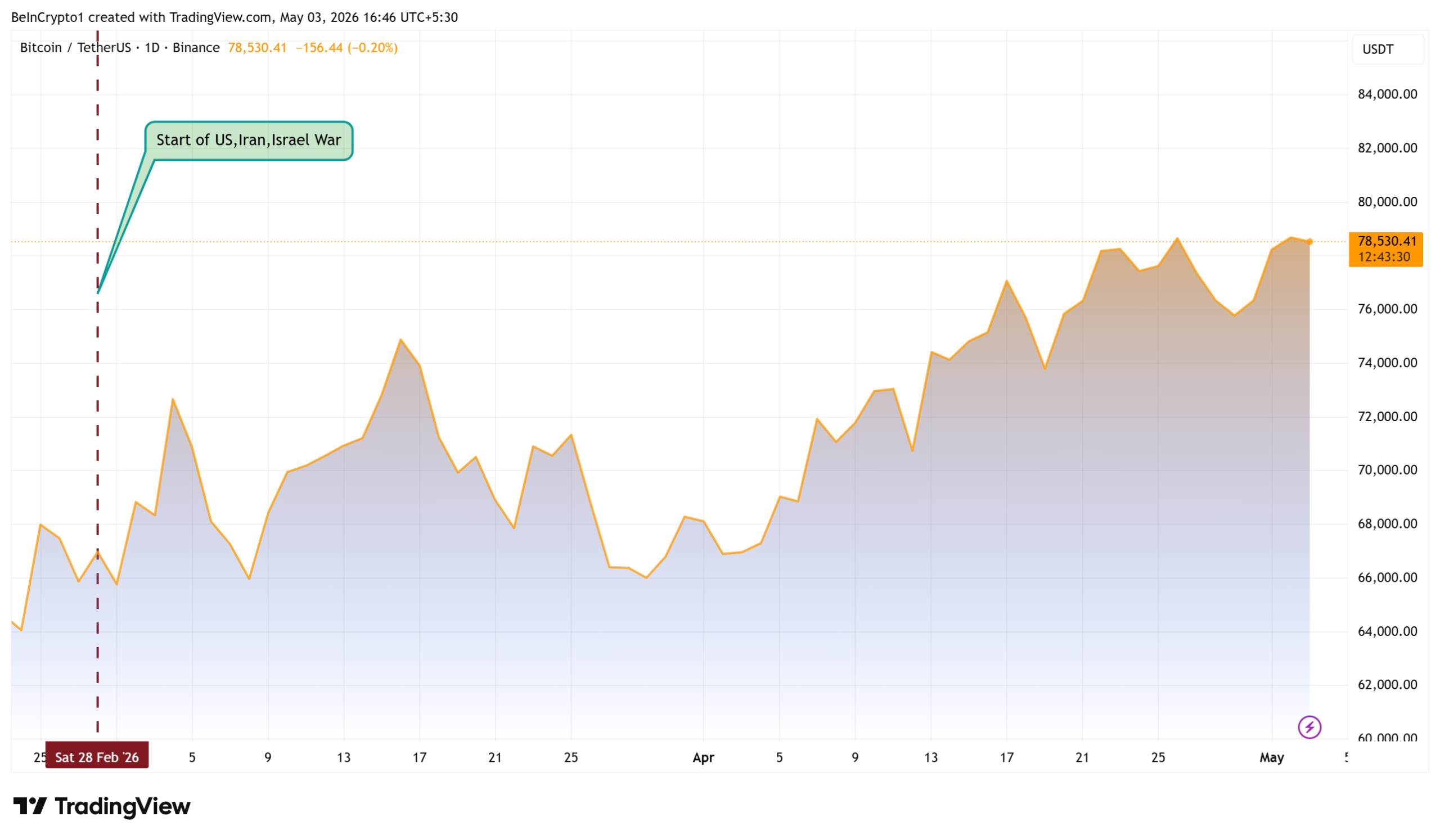
Late-night activity at pizzerias near the Pentagon and SOUTHCOM jumped sharply into the early hours of May 3. The spike has reignited trader speculation that the fragile 2026 Iran ceasefire may be wobbling behind closed doors.
Open-source trackers flagged above-average crowds at Wiseguy Pizza, Papa John’s, and Nighthawk Brewery around 11.30 p.m. ET. Similar activity appeared near the US Southern Command in Florida, where President Donald Trump was reportedly staying.
Iran Ceasefire Tensions Drive the Pizza Speculation
Geopolitical pressure has stayed elevated since the US and Israeli strikes on Iran earlier in 2026. The ceasefire that emerged afterward remains brittle.
Earlier rounds of negotiations in Islamabad collapsed before being revived. Traders now read every signal for clues on whether enforcement is holding.
Bitcoin (BTC) has tracked each twist closely. Prior ceasefire shifts moved the asset by thousands of dollars within hours.

The Strait of Hormuz scare earlier in the conflict drove safe-haven assets to record levels of demand.
How the Pizza Index Plays In
The Pentagon Pizza Index uses Google Maps Popular Times data to identify unusual spikes at restaurants near defense sites. Prior surges have lined up with major operations dating back to the Cold War.
Based on reports, Wiseguy Pizza, directly across from the Pentagon, was busier than usual.
The closest Papa John’s to SOUTHCOM also flagged elevated traffic at the same time. The Florida link mattered to traders because President Trump was reportedly based there during the spike.

Skeptics Push Back on the Signal
Critics note the indicator stems from Cold War-era observations and can be gamed by small order volumes or coordinated trolling.
The Pentagon has not commented on the May 3 activity. The department also maintains internal food services that reduce reliance on outside delivery.
Traders watching geopolitical risk treated the spike as one input among many. Oil flows, prediction markets, and on-chain positioning will reveal more in the coming days.
The post Pizza Orders Near Pentagon Spark Fresh Iran War Jitters appeared first on BeInCrypto.

Reuters’ in-depth examination casts a revealing light on Nobitex, Iran’s largest crypto exchange, and the powerful family behind its emergence. The investigation traces Nobitex to Ali and Mohammad Kharrazi, two brothers who operated under the alias “Aghamir” to obscure links to the Kharrazi dynasty, a lineage with longstanding proximity to Iran’s political leadership. The findings place Nobitex at the heart of Iran’s crypto activity while raising questions about governance, influence, and the broader sanction landscape surrounding Iran’s financial footprint in digital assets.
The Kharrazi family’s proximity to the country’s leadership stretches across generations. Reuters reports ties that reach Ali Khamenei and Mojtaba Khamenei, with the brothers’ grandfather said to have served on the Assembly of Experts, and their father, Ayatollah Bagher Kharrazi, linked to early staffing of the Islamic Revolutionary Guard Corps. The brothers’ use of an alternate surname in corporate records illustrates how entrenched networks can intersect with Iran’s burgeoning crypto economy, even as Nobitex positions itself as a gateway for millions of users navigating a sanctions-ridden financial landscape.
Key takeaways
- Nobitex’s founders reportedly used the alias “Aghamir” to mask ties to the Kharrazi dynasty, a lineage with deep political connections in Iran, according to a Reuters investigation.
- The exchange remains operational amid ongoing conflict, serving more than 11 million customers and handling substantial trade activity, including during internet blackouts, with analysts noting significant on-chain outflows.
- On-chain analytics identify substantial flows linked to sanctioned entities and centralized bank activity, with Elliptic estimating about $366 million in suspect transfers, Chainalysis about $68 million, and Crystal Intelligence about $22 million in direct transfers from sanctioned wallets.
- Investigators have noted that wallets tied to Iran’s central bank sent hundreds of millions of dollars to Nobitex in 2025, as part of a broader strategy to bypass financial restrictions, alongside a separate dispute that surfaced $20 million in routed state funds via Babak Zanjani’s wallets.
- The United States has intensified its Iran-focused crypto crackdown, with seizures approaching half a billion dollars in Iranian digital assets, a development Cointelegraph characterizes as a major escalation in Operation Economic Fury, and with Tether reportedly assisting in freezing some of the assets.
Nobitex’s role in Iran’s evolving crypto economy
Nobitex is described by Reuters as Iran’s biggest crypto exchange and a dominant conduit for crypto activity in the country. The platform reportedly serves a user base exceeding 11 million, illustrating how a single marketplace can anchor a large portion of Iran’s on-chain financial activity even as the country navigates sanctions and international scrutiny. Analysts cited by Reuters noted that Nobitex continued to operate through wartime disruptions, including nationwide internet outages, underscoring the exchange’s centrality to everyday crypto use in Iran during periods of heightened conflict.
Beyond sheer volume, the article highlights a paradox at the heart of Iran’s crypto environment: while Nobitex supports ordinary users, its activity has drawn scrutiny over possible links to sanctioned entities. Investigators cited by Reuters describe a spectrum of on-chain movements that appear to intersect with Iranian state interests and sanctioned actors, raising questions about how the exchange is governed and how it manages compliance with international sanctions regimes.
Where the data points to on-chain flows
The analysis of on-chain activity presents a bifurcated picture. On one side are the volumes associated with regular citizens and legitimate commerce; on the other are flows that analysts label as suspect or high-risk. Elliptic’s assessment flagged roughly $366 million in flows deemed suspect, while Chainalysis placed the figure at about $68 million. Crystal Intelligence identified around $22 million in direct transfers from sanctioned wallets. While these figures reflect different methodologies and timeframes, they collectively sketch a landscape in which Nobitex sits at a nexus of sanction risk and international enforcement attention.
In addition to sanction-related movements, Reuters cites findings about Iranian central-bank wallets engaging with Nobitex, with reports suggesting hundreds of millions of dollars moved to the exchange in 2025. A separate dispute involving businessman Babak Zanjani exposed wallet addresses that analysts say revealed at least $20 million in routed state funds. Taken together, these points underscore the degree to which Nobitex sits at the intersection of political economy, financial sanctions, and the security considerations that come with a high-volume crypto exchange operating within a tense geopolitical environment.
Nobitex has publicly denied formal ties to the Iranian government, arguing that illicit transactions constitute a small share of its overall activity. The exchange’s stance reflects a common tension in sanctioned markets: while platforms may operate commercially and serve ordinary users, the boundaries of acceptable activity are contested and subject to ongoing enforcement scrutiny.
Crackdowns beyond borders: the U.S. sanctions regime and seizures
Cointelegraph has reported that U.S. authorities have seized nearly $500 million in cryptocurrency linked to Iran, marking a pronounced escalation of enforcement under a campaign known as Operation Economic Fury. This sum sits alongside previously disclosed totals, including about $344 million in frozen assets, with the stablecoin issuer Tether said to have assisted in freezing portions of the funds. The mounting seizures illuminate a broader policy shift in which digital assets become a focal point of financial pressure aimed at constraining Iran’s access to the global financial system.
The seizures reflect a wider arc of U.S. policy that seeks to disrupt illicit finance channels tied to Iran. For market watchers, this intensifies the imperative for exchanges operating in or serving Iran to maintain robust sanctions screening and on-chain analytics capabilities, as well as transparent governance practices to reassure counterparties and regulators abroad.
What this means for investors, users, and the broader market
The Reuters profile of Nobitex, paired with the mounting enforcement actions described by Cointelegraph, highlights a dual reality for the crypto ecosystem in sanctioned environments. On one hand, crypto exchanges in Iran provide essential access to digital assets for millions of users, enabling remittances, trading, and cross-border transaction flows in a market beset by external financial pressure. On the other hand, the same activity invites intense scrutiny from international regulators and sanctions authorities, creating an environment in which governance, compliance, and traceability are as critical as the technology itself.
For investors and builders, the episode underscores several practical takeaways: the importance of transparent ownership structures and verifiable governance in high-risk markets; the need for rigorous on-chain analytics and sanctions screening to mitigate exposure to sanctioned flows; and the reality that geopolitical risk remains a material factor shaping liquidity, risk premiums, and regulatory trajectories in crypto ecosystems connected to Iran.
regulators and industry participants will be watching closely how Nobitex navigates these pressures going forward. The combination of elite political connections, persistent sanctions exposure, and a large user base means Nobitex sits at a crossroads – potentially catalyzing both greater adoption of crypto tools inside Iran and more disciplined, internationally aligned compliance practices demanded by global markets.
As the story unfolds, observers will be looking for three questions in particular: how Nobitex tightens governance and compliance to address sanction-related concerns; whether central-bank wallet activity remains a recurring channel of state-directed flows into the exchange; and how U.S. and allied sanctions policies evolve in response to the broader political economy of Iran’s crypto ecosystem.
Readers should stay tuned for updates on regulatory developments connected to Iran’s crypto landscape, the evolving relationship between Iranian financial authorities and domestic exchanges, and any shifts in on-chain flow patterns that might signal a new phase in enforcement or market adaptation.
Sources referenced in this report include a Reuters investigation detailing Nobitex’s founder ties and aliases, plus independent on-chain analyses cited by Reuters. For the enforcement context, Cointelegraph’s reporting on U.S. seizures and the broader Operation Economic Fury provides additional perspective on how sanctions policy intersects with crypto markets.
Peter Thiel’s Founders Fund has closed a new $6 billion fund, marking the largest raise in the venture capital firm’s history.
Summary
- Founders Fund closed a record $6 billion fund focused mainly on late-stage startup investments.
- Limited partners provided $4.5 billion, while Thiel and insiders contributed another $1.5 billion.
- The raise shows major venture firms still attract capital for mature technology companies.
The vehicle will focus mainly on late-stage companies as private startups continue to seek large funding rounds outside public markets.
Bloomberg reported that Founders Fund raised $6 billion for a new late-stage investment vehicle, citing people familiar with the matter. The raise marks the firm’s biggest fund haul since its launch two decades ago.
The fund will target more mature startups rather than early-stage companies. That focus places the firm in competition for large private deals at a time when high-growth technology firms are staying private for longer.
Thiel and team commit $1.5 billion
About $4.5 billion of the new fund came from limited partners, including sovereign wealth funds, according to Bloomberg’s report. The remaining $1.5 billion came from Thiel, Founders Fund management, and employees.
That internal commitment may draw attention from investors because it shows that the firm’s own team has capital tied to the fund’s results. Founders Fund has often followed a concentrated investment style, backing fewer companies with larger checks.
Additionally, the new fund is Founders Fund’s fourth growth-stage vehicle. It was raised less than one year after its prior growth fund, marking the fastest fund cycle in the firm’s 20-year history.
The speed of the raise reflects rising demand for late-stage capital. Many private companies now prefer large private rounds over public listings, especially when IPO markets remain selective.
Reports also said the firm’s prior $4.6 billion fund was deployed faster than planned. Founders Fund backed a small number of companies with large checks, including investments tied to artificial intelligence and defense technology.
Venture market favors large funds
The raise adds to a wider trend in venture capital, where large firms continue to attract major commitments while smaller managers face harder fundraising conditions. Investors have shown strong interest in artificial intelligence, defense, infrastructure, and other capital-heavy sectors.
Andreessen Horowitz also raised more than $15 billion across five funds earlier this year, including capital for scaling startups and AI infrastructure. That raise showed that major venture firms are still drawing large pools of capital despite a mixed private market.


Mike Cagney has been here before, just not with blockchain.
In the early 2010s, he helped reshape consumer lending with SoFi by connecting borrowers directly with capital. Now, at Figure Technology Solutions (FIGR), he said he’s trying to do something similar on a much larger scale: rebuild the infrastructure of credit markets themselves.
The plan may be working. Figure crossed $1 billion in monthly loan originations for the first time in March, part of a $2.9 billion first quarter that puts the firm on roughly $12 billion in annualized volume.
Cagney, who is speaking at Consensus Miami conference next week, told CoinDesk that the goal is to build new plumbing for these markets.
“We’re building a marketplace where credit can move efficiently, without all the traditional layers,” he said.
Three levers of value
Cagney broke Figure’s model into three core advantages.
The first is cost. Tokenizing loans reduces the friction and expense of securitization, cutting out intermediaries that have historically taken significant fees.
The second is liquidity. Figure has built what it describes as one of the only continuously updating marketplaces for consumer credit outside of government-backed mortgage systems like Fannie Mae and Freddie Mac.
“The loans update in real time, which creates a different kind of market,” Cagney said.
The third is access. By bringing these assets onchain, Figure can plug them into decentralized finance (DeFi), allowing a broader range of investors to gain exposure, or borrow against them.
That’s where the model starts to blur the line between traditional finance and crypto, Cagney said.
Figure’s latest push is into what Cagney calls “democratized prime,” essentially opening up prime brokerage-style lending to a wider audience.
Through products like its Forge platform, loans are pooled into standardized vaults and converted into tokens that can be used as collateral in DeFi protocols. That standardization is key.
“DeFi only works if the collateral is liquid and transparent,” he said.
Figure has launched related initiatives on networks like Solana, with plans to expand to Ethereum, allowing users to invest in tokenized credit pools or borrow against them.
The company is also experimenting beyond loans.
It has introduced a yield-bearing stablecoin, YLDS, backed by traditional assets like Treasurys, with roughly $600 million in balances, and is exploring tokenized equities, issuing its own stock onchain in a way that allows investors to lend against it directly.
Cagney pointed to a stark inefficiency in traditional markets. Stock lending can carry borrow rates of 30% or more, while investors often receive only a fraction of that yield.
“We can put that value back in the hands of the asset owner,” he said.
Pragmatic blockchain
For all the ambition, Cagney is quick to draw boundaries.
Not everything belongs onchain, he said. Tokenizing property itself, for instance, may not be an efficient use of capital. But financial abstraction, meaning loans, securities and equity are a different story.
That pragmatism reflects a broader critique of the crypto industry, which he said has often chased ideas without clear economic grounding.
“A lot of things were done just for the sake of it,” he said. “What matters is, does this actually improve the system?”
Figure’s growth suggests, at least in one corner of the market, the answer may be yes. The company is profitable, scaling, and approaching $30 billion in cumulative originations. That’s still small relative to traditional finance, but it’s large enough to be noticed.
Cagney said he sees much more room to run.
“Blockchain is the most transformative technology, and it will reallocate more public market cap than any technology ever has,” he said. “There are whole industries that are going to disappear when it becomes ubiquitous. Someone has to do the work to get there, and that’s exactly what we’re doing.”
Read more: Private credit may be the breakout use case for tokenization: Maple’s Sidney Powell
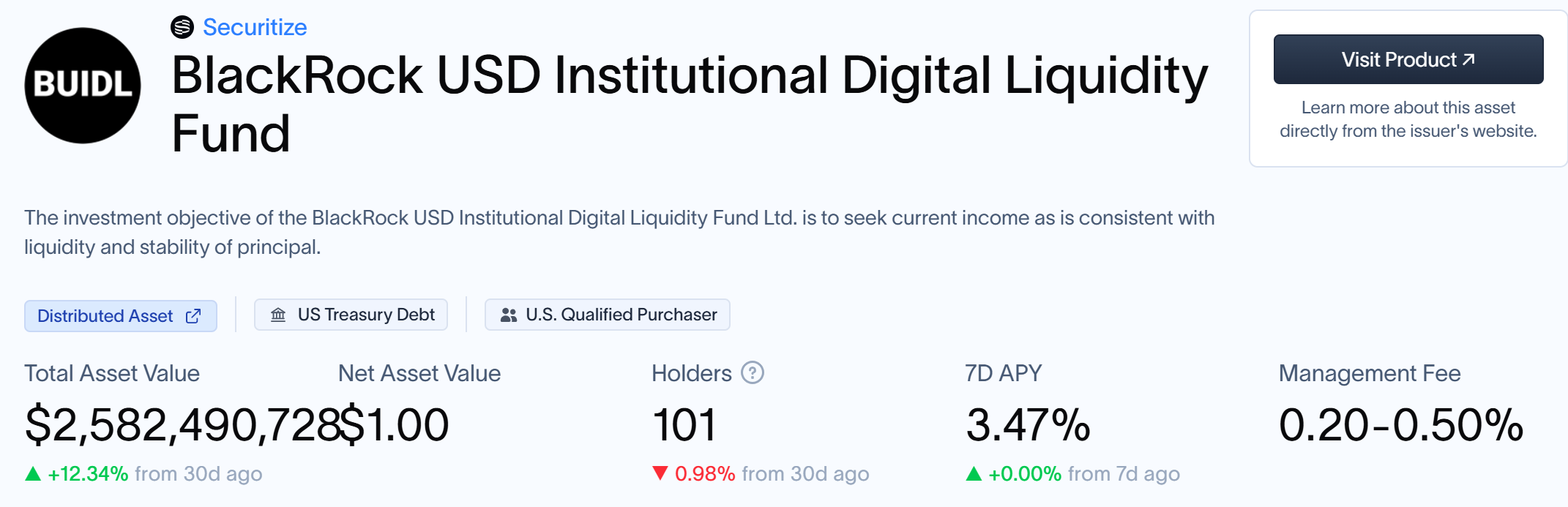
BlackRock filed a 17-page comment letter asking the Office of the Comptroller of the Currency (OCC) to scrap a proposed 20% cap on tokenized reserve assets in its draft rules for the GENIUS Act.
The world’s largest asset manager submitted the filing on the final day of the agency’s 60-day comment window, which opened when the OCC’s proposal was published in the Federal Register on March 2.
Why a Tokenized Reserve Cap Threatens BUIDL
BlackRock called the proposed cap “extraneous” to the agency’s objectives in its letter, filed in the public docket.
The firm argued that reserve risk depends on credit quality, duration, and liquidity. It does not matter whether an asset moves on a distributed ledger.
That position carries commercial weight. The firm’s BUIDL fund holds nearly $2.6 billion in assets, according to RWA.xyz data.

It supplies more than 90% of the reserves behind Ethena’s USDtb and Jupiter’s JupUSD on Solana.
“[The limit is] extraneous [to the OCC’s objectives…risk profiles are driven by credit quality, duration, and liquidity]…not whether the asset is held or transferred on a distributed ledger,” read an excerpt in the comment letter.
A 20% ceiling would restrict how aggressively BUIDL can scale inside permitted payment stablecoin issuer reserves.
Circle’s USYC currently leads the tokenized field with $2.9 billion in assets under management.

Other Asks in the Letter
The firm pressed the OCC to confirm that ETFs qualify as reserves under Section 4 of the law. The treatment would extend to Treasury ETFs invested solely in eligible assets.
It also urged the agency to add two-year US Treasury floating-rate notes to the eligible asset list. The notes carry weekly coupon resets and limited price volatility.
Roland Villacorta and Benjamin Tecmire signed the letter on behalf of BlackRock. The Brookings Institution filed separately Friday, urging higher capital charges on uninsured deposits held as reserves.
The 376-page proposal sits alongside parallel rulemakings from the FDIC, Treasury, FinCEN, and OFAC. All face a January 2027 compliance deadline.
How the OCC handles tokenization will shape how quickly BUIDL becomes a fixture in bank-issued stablecoin reserves.
The post BlackRock Signals OCC Tokenized Reserve Cap Would Threaten BUIDL Growth appeared first on BeInCrypto.
Crypto World
Algorand Emerges as the Go-To Blockchain for Post-Quantum Security as Industry Threats Grow

TLDR:
- Algorand uses Falcon signatures, a lattice-based system designed to resist future quantum computing attacks on blockchain networks.
- Google, Coinbase, and IEEE have each recognized Algorand’s post-quantum security framework as a leading solution in the DLT space.
- Quantum algorithms like Shor’s could expose private keys on ECC-based blockchains, putting wallets and transactions at serious risk.
- Most blockchains will require hard forks and wallet migrations to become quantum-safe, while Algorand’s infrastructure is already prepared.
As quantum technology advances, concerns over its potential to break existing cryptographic systems are growing across the blockchain industry.
Algorand has emerged as a leading distributed ledger technology (DLT) recognized for its post-quantum security approach.
Major names, including Google, Coinbase, and the IEEE, have acknowledged the network’s capabilities in this space.
Developers have been actively addressing quantum risks for some time, and attention around their efforts has grown considerably.
Algorand’s Falcon Signatures Set It Apart From Other Blockchains
Most blockchains today rely on elliptic curve cryptography, commonly known as ECC. This system secures wallets, transactions, and digital signatures across the crypto space.
The core assumption behind ECC is that deriving a private key from a public key is computationally impossible. However, quantum computing challenges that assumption directly.
Quantum algorithms, particularly Shor’s algorithm, could theoretically extract private keys from public keys. This creates serious risks for blockchain networks that have not updated their cryptographic foundations.
Wallets could become vulnerable, transactions could be forged, and signature systems could be compromised entirely.
Algorand has already integrated post-quantum cryptography into its design to address these threats. The network uses Falcon signatures, which are lattice-based cryptographic systems built to resist quantum attacks.
This makes Algorand’s security framework relevant not just today but in a future where quantum computing is widely available.
As @theweb3alert noted on X, Algorand “isn’t just secure for today… It’s being built to remain secure in a post-quantum world.” That forward-looking design separates it from many competing networks currently operating on older cryptographic standards.
Industry Recognition Grows as Quantum Computing Advances
The involvement of Chris Peikert, a world-leading quantum security researcher, in the Algorand ecosystem signals the project’s seriousness in this field.
His contributions helped lay an early technical foundation for the network’s quantum-resistant architecture. That foundation is now drawing broader attention from major industry players.
Google, Coinbase, and IEEE are not minor voices in the technology world. Their recognition of Algorand’s quantum security work carries real weight across both the crypto and broader tech industries. These acknowledgments come as quantum computing moves closer to practical, real-world use.
Most competing blockchains will eventually need to upgrade their cryptography, migrate wallets, and potentially execute hard forks to remain secure.
These processes carry technical risk and can disrupt network activity significantly. Algorand, however, has already built quantum resistance into its existing infrastructure.
The broader blockchain industry is still catching up to the reality that quantum computing poses a genuine threat to current security models. Algorand’s proactive approach puts the network in a strong technical position ahead of that shift.

TLDR:
- TAO broke above the $288.1 Fibonacci level on the daily chart for the first time since March 2026.
- Volume hit 23.57K TAO on the breakout day, exceeding recent consolidation averages by a notable margin.
- The 200-day MA at $272.4 has shifted from overhead resistance to a rising support floor below price.
- The measured upside target sits at $348.7, representing approximately a 21% move from current price levels.
Bittensor (TAO) is drawing attention after breaking a critical price level not seen since March. The asset closed above $288.1 on the daily chart, a level tied to the 0.382 Fibonacci retracement.
Volume on the daily timeframe came in at 23.57K TAO, above recent consolidation averages. The 200-day moving average sits at $272.4, now acting as rising support below price.
TAO Forms Textbook Base After Three-Month Decline
TAO peaked at $377 in November 2024 before entering a controlled downtrend. The asset found its floor at $143 in early February 2026.
That bottom aligned closely with the 0.618 Fibonacci extension from the prior bull cycle. The depth and structure of that base drew attention from technically focused traders.
From $143, price bounced sharply back toward the $377 region within weeks. It then pulled back into a consolidation range between $232 and $288.
That range held for roughly six weeks, forming a pattern of higher lows throughout. The structure is consistent with a base-building phase before a directional move.
Crypto analyst @2xnmore noted the setup on social media, stating: “$TAO just broke a level on the daily chart that has not been touched since March. Most people have not noticed yet.”
The post outlined a full technical breakdown across both the 4-hour and daily timeframes. The analyst pointed to the Fibonacci base, 200-day MA reclaim, and volume confirmation.
The 200-day moving average shifted from overhead resistance to a rising floor over the past two weeks. Price held above it consistently during that period. That transition is often a key structural signal for trend continuation.
Daily Close and Volume Drive Technical Case for TAO
The 4-hour chart confirmed the $288.1 break earlier in the session. However, the daily candle carries more weight for institutional participants.
Fund managers and systematic strategies typically track daily closes over intraday timeframes. A confirmed close above $288.1 brings a broader buyer profile into the asset.
Volume confirmation separates a genuine breakout from a false one. The 23.57K TAO recorded on the daily exceeded recent consolidation averages by a meaningful margin.
That activity aligned directly with the price break, adding credibility to the move. Traders watch for exactly this combination before positioning.
From current levels near $288.5, the next key test sits at $300. That level carries psychological weight and may produce resistance or shakeout attempts.
Beyond that, $348.7 represents the 0.618 retracement of the full $143 to $377 swing. That target reflects a roughly 21% move from current price.
The level to watch on the downside is $288.1, which must hold on any daily retest. A daily close below it resets the setup. The $272.4 200-day MA remains the last critical level bulls must defend on a weekly close.
Coinbase says Senate negotiators have reached a deal on a disputed crypto bill provision tied to stablecoin rewards.
Summary
- Coinbase says negotiators reached a rewards compromise, easing a key delay for the CLARITY Act.
- Banks secured limits on deposit-like yield, while crypto firms kept activity-based user rewards under rules.
- The Senate markup path now depends on committee support, regulatory details, and wider political backing.
The agreement could help the CLARITY Act move toward a Senate markup after months of delay.
According to a Reuters report, the debate centered on whether crypto firms and stablecoin issuers should offer rewards to customers. Banks opposed the provision because they said yield-style rewards could pull deposits away from traditional lenders.
Crypto companies argued that they need room to reward users for real platform activity. Coinbase said the new language protects that ability while adding more limits around rewards that look like bank interest.
Coinbase Chief Policy Officer Faryar Shirzad said, “In the end, the banks were able to get more restrictions on rewards, but we protected what matters.” He added that crypto platforms kept the ability for Americans to earn rewards based on real usage of crypto platforms and networks.
Banks win limits on deposit-like yield
The compromise was negotiated by Senators Thom Tillis and Angela Alsobrooks, according to reports. The language would ban rewards offered in a way that is economically or functionally equal to interest or yield on a bank deposit.
That wording gives banks part of what they sought. It prevents crypto firms from offering rewards that closely mirror savings account interest, while leaving room for activity-based rewards.
The deal also asks regulators to create rules on stablecoin disclosures and define which reward activities remain allowed. That step may decide how exchanges, stablecoin issuers, and payment firms design reward programs.
CLARITY Act may return to markup
The agreement could clear a path for the CLARITY Act to move forward in the Senate. The bill aims to create clearer U.S. rules for digital assets and define how federal agencies oversee crypto markets.
Crypto.news reported that the Senate Banking Committee is targeting a markup during the week of May 11. The SEC has also scheduled a May roundtable tied to the CLARITY Act and digital asset market structure.
The roundtable follows earlier SEC and CFTC work on digital asset taxonomy. Crypto.news reported that the agencies had named 16 digital assets as commodities in a framework that the CLARITY Act could turn into federal law.
The rewards deal removes one barrier, but the bill still faces political tests. Some Democrats have raised concerns about crypto conflicts tied to the Trump family, while other lawmakers remain focused on law enforcement and consumer protection issues.
Nobitex, Iran’s biggest crypto exchange, was founded by two brothers from one of the Islamic Republic’s most influential families with ties to the supreme leaders, according to a Reuters investigation.
The exchange, which now accounts for the majority share of Iran’s crypto activity, was launched by Ali and Mohammad Kharrazi. The duo operated under the alternative surname “Aghamir,” which they used across corporate records and professional life, masking links to the Kharrazi dynasty, according to the report.
The Kharrazi family has long occupied positions close to the country’s leadership, with ties spanning generations of power, including links to Ali Khamenei and his successor Mojtaba Khamenei.
Ali and Mohammad’s grandfather reportedly served on the Assembly of Experts, the body responsible for appointing Iran’s supreme leader, and once tutored Mojtaba Khamenei. Their father, Ayatollah Bagher Kharrazi, founded an Iranian political group named Hezbollah and was involved in early staffing of the Islamic Revolutionary Guard Corps following the 1979 revolution, per the report.
Related: Iran is Weighing Crypto Tolls for Ships using Strait of Hormuz: Report
Nobitex remains operational even during war times
Nobitex, which reportedly serves over 11 million customers, has remained operational throughout the ongoing conflict involving the United States and Israel, even during a nationwide internet blackout. Analysts told Reuters that more than $100 million in transactions were processed during the war, with significant outflows moving abroad.
At the same time, investigators cited by Reuters say the platform has processed transactions linked to sanctioned entities. However, estimates vary. Analytics firm Elliptic identified roughly $366 million in suspect flows, while Chainalysis placed the figure closer to $68 million and Crystal Intelligence identified about $22 million in direct transfers from sanctioned wallets.
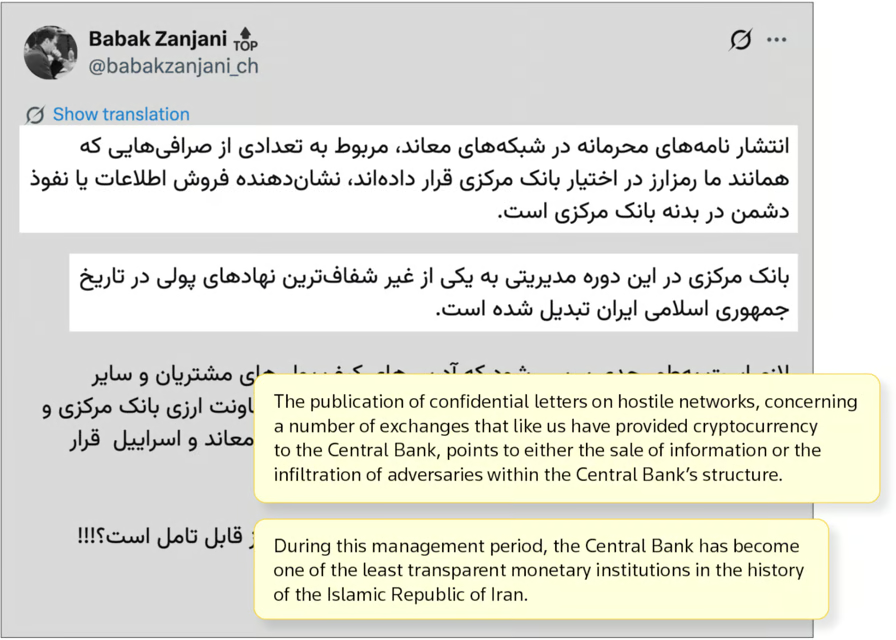
Separate findings indicate wallets associated with Iran’s central bank sent hundreds of millions of dollars’ worth of cryptocurrency to Nobitex in 2025, part of a broader strategy to bypass financial restrictions. A dispute involving businessman Babak Zanjani also exposed wallet addresses that analysts say revealed at least $20 million in routed state funds.

The post by Babak Zanjani, an Iranian billionaire convicted of fraud, criticises the Central Bank of Iran. Source: Reuters
Nobitex has reportedly denied any government affiliation, claiming that illicit transactions represent a small share of overall activity.
Related: Iran views BTC as strategic asset, but USDt still dominates oil tolls: BPI
US seizes $500 million in Iranian crypto
As Cointelegraph reported, the US has seized nearly $500 million in cryptocurrency linked to Iran, significantly expanding its financial crackdown under a campaign known as Operation Economic Fury.
The latest figure marks a sharp increase from previously disclosed totals, including $344 million in frozen digital assets, with stablecoin issuer Tether assisting in freezing funds.
Polanski suggests he shared ‘inaccurate’ criticism of Golders Green officers because he was traumatised

Buy or Sell as AI and Cloud Growth Fuel Analyst Optimism?

Midterms Spur Regulatory Scrutiny Over Crypto and AI Super PACs

Manchester United reach agreement with Casemiro over contract clause amid transfer speculation

US brings back mandatory military draft registration

Steven Gerrard disagrees with Gary Neville over ‘shock’ Chelsea and Arsenal claim | Football


-

 Tech6 days ago
Register Renaming | Hackaday
-

 Politics6 days ago
Drax board avoid their own AGM, accused of greenwashing & environmental racism
-

 Tech6 days ago
Why Blue Badges Disappeared From Toyota Hybrids
-

 Tech6 days ago
Images of Samsung’s rumored smart glasses have leaked
-
 Tech2 days ago
Trump’s 25% EU auto tariff breaches Turnberry Agreement that also covers semiconductors and digital trade
-

 Fashion5 days ago
Kylie Jenner’s KHY Enters a New Era with ‘Born in LA’
-

 Business5 days ago
Most Commercial Energy Audits Miss the Real Losses
-

 Crypto World5 days ago
CFTC’s AI will review U.S. crypto registration applications, chairman tells CoinDesk
-

 Business6 days ago
(VIDEO) Charlize Theron Climbs Times Square Billboard to Promote New Netflix Thriller ‘Apex’
-

 Business4 days ago
Barclay Brothers Avoid Bankruptcy: HSBC Drops High Court Petitions After IVA Deal
-
 Sports2 days ago
Paul Scholes issues Marcus Rashford reality check as agreement emerges over Man United star
-
 Business4 days ago
Tesla Officially Registers Elon Musk’s Stock: What Investors Need to Know
-
 Entertainment6 days ago
Alicia Keys Calls Out Music Industry ‘Boys Club’
-

 Tech5 days ago
Get Ready for More Brain-Scanning Consumer Gadgets
-

 Tech7 days ago
Dyson Vacuums And The Curse Of Cooked Capacitors
-
Crypto World5 days ago
Robinhood Phishing Scam Exploits Gmail Dot Feature to Bypass Security
-

 Entertainment6 days ago
Sister Wives: Janelle Posts New Scary Warning
-

 Crypto World5 days ago
Gmail Dot Trick Underpins Robinhood Phishing, Sending Real-Looking Emails
-

 Business7 days ago
AI-Driven App Creation at Your Fingertips
-

 Tech6 days ago
The next iPhone moment might come from an AI company, not Samsung or Apple
You must be logged in to post a comment Login