

Crypto World
South Korea Fines Bithumb $136K for Overseas User Data Sharing


South Korea’s Personal Information Protection Commission (PIPC) has ordered cryptocurrency exchange Bithumb to pay a $136,000 fine after finding that the platform violated the country’s personal data protection rules by transferring user information overseas without obtaining separate consent.
In a notice published Thursday, the regulator said the breach occurred during Bithumb’s processes for sharing order books and transferring virtual assets with overseas exchanges. The PIPC’s findings place additional compliance pressure on major South Korean trading venues as authorities tighten both privacy and financial-crime controls.
Key takeaways
- The PIPC fined Bithumb $136,000 for transferring personal data abroad without separate consent during certain exchange-to-exchange operations.
- The regulator linked the violation to order book sharing and virtual asset transfers tied to overseas platforms.
- PIPC acknowledged that anti-money laundering (AML) needs can justify data provision, but said overseas personal data transfers still require strict adherence to legal procedures and the data subjects’ self-determination rights.
- Bithumb’s case comes amid heightened scrutiny from South Korean regulators and law enforcement, following past enforcement actions and reported raids.
PIPC’s rationale: AML use is not a blanket permission
According to the PIPC, Bithumb transferred personal information overseas in connection with order book sharing and virtual asset transfers involving foreign exchanges. The regulator concluded that the exchange handled personal data in a way that did not satisfy the consent and procedural requirements set out under South Korea’s Protection Act.
The notice also explained the logic of its decision. The PIPC said there is a necessity to provide personal information for AML purposes when transferring virtual assets to other exchanges. However, when it comes to overseas transfers of personal data, the PIPC emphasized that the data subject’s right to control their information must be respected through strict compliance with required procedures.
“As this is a closely related matter, it is necessary to strictly comply with the requirements and procedures stipulated in the Protection Act,” the PIPC said in its notice (translation).
The PIPC’s published decision is available on the regulator’s website.
Tether order-book sharing and overseas exchange data handling
While privacy regulators rarely disclose every operational detail in enforcement notices, the PIPC’s account connected Bithumb’s breach to specific activities. The regulator said the incident was related to Bithumb sharing Tether (USDT) order books with BingX between September and November 2025.
The PIPC noted that Bithumb had obtained consent to share data with Stellar, but the order-book sharing described in the notice involved an overseas exchange partner—where the regulator determined separate consent for the overseas personal data transfer was not obtained.
In addition to the order book-sharing matter, the PIPC said the violation also involved Bithumb sharing user information with 13 overseas exchanges. Taken together, the regulator’s framing suggests the problem was not limited to a single counterpart; rather, it reflected how personal data was handled across multiple foreign relationships during exchange operations.
Why this matters for South Korea’s crypto compliance landscape
South Korea has been one of the most actively regulated crypto markets in Asia, and enforcement actions have increasingly targeted more than just anti-money laundering. The PIPC’s decision underscores that exchanges operating locally must manage privacy obligations with the same rigor they apply to financial compliance.
For investors and market participants, the practical effect is straightforward: compliance failures can lead to fines and reputational damage, and repeated regulatory scrutiny can influence how quickly exchanges adapt their systems for data handling, third-party information sharing, and cross-border workflows.
Just as importantly, the PIPC’s reasoning draws a line between AML-related data sharing needs and what it described as the separate right of data subjects regarding self-determination. In other words, AML necessity does not automatically override consent and procedural safeguards when personal data crosses borders.
Bithumb under pressure amid broader enforcement and public attention
Bithumb is among the largest crypto exchanges in South Korea, and the PIPC fine adds to an already difficult regulatory environment for the platform.
Earlier, South Korea’s financial watchdog imposed a six-month suspension on Bithumb’s activities in March over alleged violations of the country’s Financial Information Act. A court later reversed that decision in April, but the history shows that Bithumb’s compliance challenges have been a recurring theme.
More recently, police reportedly raided Bithumb’s offices as part of an investigation into alleged nepotism involving South Korean lawmaker Kim Byung-gi. While that matter is separate from the PIPC’s personal data ruling, it contributes to the perception that the exchange remains at the center of multiple, overlapping investigations.
Related coverage in earlier reporting noted: Cointelegraph previously reported on the financial watchdog’s suspension decision (link).
South Korea crypto regulation isn’t slowing: taxes and law-enforcement upgrades
The fine arrives as other policy and enforcement developments continue to shape the South Korean crypto market. The country’s Finance Ministry confirmed in May that a 22% tax on cryptocurrency gains will be imposed starting in January 2027, after earlier timelines shifted away from an expected 2025 start. According to the Yonhap news agency, about 16 million South Koreans were invested in digital assets as of March 2025.
Separately, Chainalysis said it signed a memorandum of understanding with the Korean National Police Agency (KNPA) aimed at building investigative capability within South Korea’s law enforcement. Earlier coverage tied the pact to efforts to combat North Korea-linked crypto attacks, with police “at the forefront” of tackling these threats.
Earlier coverage mentioned: Cointelegraph reported on the Chainalysis and KNPA memorandum of understanding (link).
For traders, developers, and users, the combined picture is clear: compliance requirements in South Korea are broadening across privacy, taxation, and investigative capability—meaning operational choices like cross-border data sharing during exchange partnerships are now likely to be scrutinized more closely.
Going forward, market watchers should focus on how major exchanges revise consent management and cross-border data-transfer processes, and whether South Korean regulators publish additional guidance or enforcement actions that clarify how AML-driven data provision should be implemented alongside privacy protections.


“Ethereum is cheap, but the data says the bottom isn’t in yet,” said onchain analytics platform CryptoQuant on Thursday. ETH is trading around 17% below its realized price, “but only two of five signals have reached historical bottoming levels,” they added.
“Selling pressure is easing. Capitulation is still missing.”
ETH realized price – which is a measure of the average price at which every token currently in circulation last moved onchain – is currently at $2,300.
Historically, trading below the realized price signals holder losses that tend to exhaust sellers and mark bottoms.
ETH/BTC Metrics Still Not Bottoming
The analysts said trading below the aggregate cost basis means the marginal holder is sitting on losses, “which historically exhausts sellers and compresses downside.”
However, cheapness alone has never been sufficient since the timing of a bottom has depended on Ethereum’s position relative to Bitcoin. This can be measured by the ETH/BTC MVRV ratio, which has fallen from “extreme overvaluation to neutral,” but not to extreme cheapness.
Additionally, the exchange inflow ratio has also dropped from over 1.5 to about 0.8 as selling pressure eased, but it hasn’t reached the ~0.4 low-pressure zone seen at past bottoms, they said.
Spot volume ratios have also collapsed to levels last seen in ETH/BTC bottoms, but the three other signals are not there yet.
CryptoQuant concluded that while ETH remains cheap, a “final bottom and the ETH outperformance that would follow may still take more time to form.”
“ETH is approaching undervalued levels relative to Bitcoin, which points to lower downside pressure ahead.”
Fundamentally, Ethereum remains strong with growing real-world asset tokenization and agentic AI payment narratives.
“Ethereum has the characteristics that institutions need,” said Sharplink CEO Joseph Chalom on Thursday.
“I don’t know a lot for certain in life, but I spent 20 years at BlackRock. And I know for sure, before you move financial rails that are 40, 50, 60 years old, you want it to move to something that’s trusted, always on, secure, with the most liquidity.”
Sharplink resumed its Ethereum buying in late June, scooping up 10,000 ETH worth around $16 million.
ETH Price Outlook
Despite the bullish fundamentals, ETH prices have retreated this week. The asset has fallen back from a seven-week high of $1,950 on Wednesday to $1,860 in early Asian trading on Friday morning.
ETH has lost almost 3% on the day but remains up 12% over the past 30 days. It needs to reclaim the $2,000 psychological barrier to measure any further momentum.
The post Ethereum (ETH) Is Cheap, But Not at Bottom Yet: Analysts appeared first on CryptoPotato.
The U.S. Securities and Exchange Commission will hold a public roundtable on Sept. 17 to discuss preparations for 24-hour trading in U.S. equity markets.
Summary
- SEC will host public September talks on overnight equity trading, resilience, infrastructure and investor safeguards.
- Nasdaq and Cboe are targeting longer weekday sessions, subject to regulatory approval and system readiness.
- Crypto’s 24/7 model is shaping demand, but tokenized stocks remain separate from exchange-listed shares.
According to the SEC’s official announcement, the meeting will take place at the agency’s headquarters in Washington, D.C., and will also stream online.
The regulator said the discussions will cover overnight trading, market operations, system resilience and investor protection. SEC Chair Paul Atkins said, “We are moving towards a new day – and night – in the U.S. equity markets.” He added that continuous trading could bring the U.S. market closer to other markets that already operate around the clock.
SEC reviews systems needed for longer trading sessions
U.S. stocks already trade beyond the regular session, which runs from 9:30 a.m. to 4 p.m. Eastern Time. Several exchanges and brokers offer premarket, after-hours or overnight access. However, the national equity market does not operate as one connected system for almost the entire weekday.
The SEC’s Division of Trading and Markets has said wider access will require changes across market infrastructure. In remarks on overnight equity trading, division director Jamie Selway identified market data, clearing, corporate actions, trade reporting and investor protection as areas that require coordination.
Longer trading hours also depend on consolidated market data systems. Those systems collect prices and trading information from exchanges before distributing them to brokers and investors. Any move toward 24-hour trading would require those services to operate for longer periods.
Clearing firms would also need to process transactions and manage risks outside the traditional market day. Meanwhile, brokers would have to monitor orders, maintain systems and support customers across longer operating periods.
Nasdaq, Cboe and LSE prepare extended trading hours
Nasdaq has been working with U.S. regulators on a plan to offer trading 24 hours a day, five days a week. The exchange aims to introduce the schedule during the second half of 2026, subject to regulatory approval and industry readiness.
According to Nasdaq’s extended-hours trading information, the company expects global investors to benefit from access to U.S. stocks during their local daytime hours. Nasdaq has said any expansion must maintain liquidity, transparency, stability and fair market access.
Cboe Global Markets is also preparing near-continuous weekday trading on its EDGX Equities Exchange. Under Cboe’s proposed schedule, trading would begin at 9 p.m. Eastern Time on Sunday and continue until 8 p.m. on Friday. A one-hour daily break would allow the exchange to complete operational work.
Cboe plans to make all National Market System stocks available during the extended sessions. However, the proposal still depends on SEC approval and preparations by brokers, clearing firms and market data providers.
The London Stock Exchange is pursuing a similar plan outside the U.S. In its LSE 24 announcement, the exchange said it plans to introduce a separate venue for near-continuous weekday trading.
The LSE expects to begin client testing before the end of 2026. It plans to launch exchange-traded products on the venue during the first half of 2027, subject to regulatory approval. The main London market will retain its current trading hours.
Overnight trading raises liquidity and resilience questions
Keeping markets open for longer periods involves more than extending exchange operating hours. Market makers must be willing to provide buy and sell prices during overnight sessions. Lower participation could reduce liquidity and create wider differences between the highest buying price and lowest selling price.
The SEC roundtable will also examine how exchanges and connected firms respond to outages and technical problems. Maintenance periods may become shorter as markets move closer to continuous weekday operations.
Investor protection will remain another part of the discussion. Prices can move more sharply when fewer traders are active. Investors may also receive different execution prices during overnight sessions than they would during regular market hours.
The SEC announcement does not establish a final rule or a common launch date for U.S. exchanges. Instead, the agency will collect comments from exchanges, brokers, investors, clearing firms and other market participants.
The SEC has opened a public comment file for the roundtable and will publish the agenda and speaker list before Sept. 17.
Crypto markets shape demand for round-the-clock trading
Cryptocurrency exchanges have operated continuously for years, allowing investors to trade during weekends, public holidays and overnight periods. That model has contributed to demand for similar access to traditional assets.
Global investors may also want to trade U.S. shares during local business hours rather than waiting for markets in New York to open. Exchanges see extended sessions as a way to attract those investors and compete with crypto platforms and alternative trading venues.
Crypto companies are also expanding into tokenized equities. As previously reported, Binance introduced bStocks with continuous trading for tokenized U.S. equities.
Similarly, Franklin Templeton and Ondo launched tokenized investment products that eligible users outside the U.S. can access through crypto wallets around the clock.
However, tokenized equities are not identical to shares traded directly on a national securities exchange. Their custody, ownership and redemption structures may differ. A crypto.news guide to tokenized stocks explains how blockchain-based equity products represent or track traditional shares.
The SEC’s September meeting will focus on regulated U.S. equity markets rather than approving tokenized stock products. Nasdaq, Cboe and other operators will continue preparing their systems while the regulator gathers public input on market access, resilience and investor safeguards.
BitMEX is facing a class action lawsuit accusing the crypto derivatives platform of fraudulently engineering customer liquidations to seize traders’ Bitcoin collateral.
On Thursday, BKX Services Inc. and David Namdar filed the complaint in the US District Court for the Southern District of New York. The plaintiffs allege they lost a combined 622.66 BTC through forced liquidations on BitMEX, with BKX claiming losses of at least 305.81 BTC and Namdar alleging losses exceeding 316.85 BTC.
The lawsuit revives long-running allegations about the platform’s internal trading operations and liquidation engine and comes just as the exchange is preparing to close in September.
“BitMEX deliberately developed a system that profited from the liquidations,” the plaintiffs alleged. The complaint claimed that an internal trading desk had access to private customer information and could continue trading during server freezes that prevented ordinary users from accessing or closing their positions.
Cointelegraph reached out to BitMEX for comment but did not receive a response before publication.
BitMEX users seek Bitcoin return under fraud claims
According to the filing, BitMEX allowed customers to use leverage of up to 100 times their collateral, then automatically liquidated positions while collateral was still allegedly worth twice the losses incurred.
The remaining BTC was placed into the platform’s insurance fund, allowing BitMEX to profit from forced liquidations, the plaintiffs claim.
The plaintiffs are seeking the return of the allegedly withheld Bitcoin as well as compensatory and punitive damages. They aim to represent US customers who purchased BTC swap products in transactions dating back to July 23, 2018.
Related: BitMEX delists 65 trading pairs, derivatives in July amid exchange shutdown
The complaint also pointed to a class action filed in 2020 by Brett Messieh and other traders alleging similar conduct. That case, which brought claims under the Commodity Exchange Act, was voluntarily dismissed without prejudice on June 30, 2025.
Lawsuit lands as BitMEX announces shutdown
The proposed class action lawsuit was filed on the same day BitMEX announced that it would close after 11 years of operation.
BitMEX said it would stop providing services on Sept. 23 after a strategic review by its owner, HDR Global Trading.
It has stopped accepting new registrations and plans to prevent users from opening new positions starting on Aug. 26. The announcement was followed by a roughly 90% plunge in BitMEX’s BMEX utility token.
Magazine: Ethereum’s EEZ could pull other blockchains into its orbit
[PRESS RELEASE – Toronto, Canada, July 23rd, 2026]
CoinRabbit and GoMining have published a report on Bitcoin mining profitability, showing why managing mined Bitcoin is becoming as important as producing it.
The report highlights how the post-halving environment is redefining success in mining, with operators relying on stronger treasury management, capital discipline, and long-term asset strategies to navigate tighter margins. With the block reward reduced to 3.125 BTC and network difficulty near record levels, operational efficiency alone is no longer enough. The next phase of mining will be shaped by smarter capital allocation and long-term conviction in Bitcoin.
The Four Pillars of the Bitcoin Mining Efficiency Mindset
The report presents a clear framework built around four key pillars:
1) Operational Cost Efficiency
Low-cost power procurement, high uptime, efficient cooling, and disciplined maintenance remain the foundation of any viable mining operation. These factors determine the baseline production cost and are essential for competitiveness.
2) Collateralization Over Liquidation
Instead of selling freshly mined Bitcoin to cover expenses, effective operators are using it as collateral. This approach allows them to meet short-term cash needs while retaining full ownership and long-term exposure to the asset’s value.
3) Operational Liquidity and Tax Optimization
Bitcoin-backed lending provides flexibility to cover recurring operating costs, including power, hosting, and payroll, while avoiding taxable sales. At the same time, it preserves the deductibility of operational expenses.
4) Long-Term Vision and Capital Discipline
Sustainable operators treat mining as a disciplined, capital-intensive business. They maintain the flexibility to hold Bitcoin through market cycles and reinvest in hardware upgrades when opportunities arise, avoiding forced sales during downturns.
The full report can be downloaded here.
Walter Barrett, Chief Strategy & Growth Officer at CoinRabbit, commented: “Long-term success is built on conviction in the assets you hold and the discipline to manage them through different market cycles. At CoinRabbit, we are proud to work with clients who share this long-term vision and recognize the value of staying focused through periods of uncertainty. We appreciate the collaboration with GoMining experts and their contribution to sharing deeper industry insights with the mining community.”
Jeremy Dreier, Chief Business Development Officer at GoMining and Managing Director of GoMining Institutional, added: “In the post-halving environment, discipline is critical. The miners that are winning are those with efficient operations and cash put aside for this exact time. This is the best possible moment to deploy capital into expanding your fleet, because it’s cheap to add hash rate when Bitcoin’s price is down. There’s a lot of opportunity in the market. At GoMining, this is our third bear market, and we’ve seen that the operators who are prepared look at these conditions as an opportunity. Those who aren’t prepared are the ones who panic.”
About CoinRabbit
CoinRabbit is a crypto asset management platform built for long-term capital preservation. It enables users to manage liquidity seamlessly across instant payments, lending, trading products, and the Private Program — all within a single ecosystem. Since 2020, CoinRabbit ensures 100% capital reserve, keeping clients’ funds safe and never reused.
For more information, users can visit coinrabbit.io
About GoMining
GoMining is an all-in-one Bitcoin ecosystem that makes it simple and secure to mine, earn, and use Bitcoin every day. GoMining serves 5 million users and ranks among the top-10 Bitcoin miners by hashrate globally, with data centers in the U.S. and internationally. The company makes Bitcoin accessible through tokenized hashrate, daily BTC rewards, and an expanding suite of payment and earning products.
For more information, users can visit gomining.com
The post CoinRabbit and GoMining Report: Managing Bitcoin Matters More Than Mining Volume appeared first on CryptoPotato.


Gemini Trust Company sent more than $10 million in Bitcoin to MAGA Inc., a super political action committee that supports President Donald Trump.
Summary
- Gemini sent two Bitcoin contributions totaling over $10 million to Trump-supporting super PAC MAGA Inc.
- The donations followed Gemini and CFTC’s joint request to vacate ongoing terms of their settlement.
- Gemini will not recover its $5 million penalty even if the court grants relief requested.
A July Federal Election Commission filing lists two Bitcoin contributions made on June 19, with each valued at more than $5 million. The committee can use the funds for independent spending that supports Trump.
The transfers came about three weeks after Gemini and the U.S. Commodity Futures Trading Commission filed a joint motion in a New York federal court. The parties asked the judge to remove the continuing terms of a January 2025 consent order. Available records do not establish that the donation affected the CFTC’s decision, and neither side has publicly linked the events.
FEC filing records two Bitcoin contributions
MAGA Inc. disclosed the payments in its monthly report covering June. The filing identifies Gemini Trust Company as the contributor and records both payments on the same date. By June 30, the super PAC had reported more than $397 million in total receipts, according to reports citing the filing.
The contributions extend the Winklevoss brothers’ political support for Trump and pro-crypto groups. Cameron and Tyler Winklevoss each gave $1 million in Bitcoin to Trump’s 2024 campaign. They later donated $21 million in Bitcoin to the Digital Freedom Fund, a PAC created to support the administration’s crypto policy goals.
CFTC seeks relief from Gemini consent order
The CFTC sued Gemini in June 2022. The agency alleged that the exchange made false or misleading statements while seeking approval for a Bitcoin futures product. Gemini settled the case in January 2025 without admitting or denying the findings. The consent order required a $5 million civil penalty and imposed a permanent injunction.
On May 27, 2026, the CFTC joined Gemini’s request for relief from that judgment. The agency said a later review found that the complaint “should not have been filed” under its current enforcement standards. It cited questions about the evidence, a whistleblower’s credibility and staff conduct during the investigation.
However, the motion does not seek repayment of the fine. The CFTC said both sides agreed that the $5 million “will not be returned to Gemini.” The requested relief covers the future-facing parts of the order, including the injunction. As crypto.news reported in May, the regulator said keeping those terms in force would not be equitable. No public ruling had appeared by July 24.
Warren questions the agency’s independence
Senator Elizabeth Warren challenged the reversal request in a June 5 letter to CFTC Chair Michael Selig. She tied the matter to concerns about staffing cuts, reduced enforcement and contacts between the regulator and crypto or prediction-market firms. Warren called the developments “concerning signs of a CFTC beholden to political pressures and interests of the wealthy insiders.”
The letter states Warren’s position and does not prove that Gemini’s political giving shaped the agency’s action. The CFTC said its decision followed a review of the investigation, evidence, litigation tactics and current policy. It also said Gemini had been a fraud victim and that the earlier complaint relied heavily on an account lacking credibility.
Warren renewed her scrutiny on July 22 by asking the Government Accountability Office to examine CFTC staffing cuts and their effect on enforcement. Her office said the workforce had fallen by about 25% since January 2025. The CFTC’s current website lists Selig as its only commissioner, although federal law provides for a five-member commission.
Crypto election spending reaches new records
The Gemini contribution arrived during a surge in crypto-linked political spending. As previously reported by crypto.news,Public Citizen estimated that crypto companies had contributed about $189 million during the 2026 U.S. election cycle by late June. The group said this represented about 37% of corporate political contributions tracked during the cycle.
Several large crypto firms have funded PACs supporting candidates from both parties. Fairshake and related committees have received backing from Coinbase, Ripple and other companies. Meanwhile, MAGA Inc. has attracted money from Gemini and other technology or crypto businesses. Super PACs may accept unlimited corporate contributions for independent spending, but they cannot contribute directly to candidates or coordinate communications with them.
The spending comes as Congress considers the CLARITY Act, which could give the CFTC a larger role in digital asset oversight. Lawmakers continue to debate the regulator’s staffing, authority and leadership structure before expanding its duties.
The court has not publicly resolved the Gemini-CFTC motion. The Bitcoin transfer remains a separately disclosed political contribution. Gemini has already paid the $5 million penalty, and the agreement with the CFTC prevents its return even if the judge removes the order’s continuing restrictions.


Coinbase is allowing businesses to accept USDC payments from autonomous AI agents as part of a wider expansion of its agent-focused financial tools.
Summary
- Coinbase Business will accept USDC payments initiated by AI agents through its native x402 support.
- Coinbase for Agents adds live market views and conditional actions controlled by user-defined trading guardrails.
- Developers can add agent payment acceptance to online services using Coinbase’s streamlined CDP x402 SDK.
The exchange announced the rollout on July 23, 2026, alongside new trading commands for users and a developer kit for adding x402 payments to online services.
Coinbase said software-generated traffic exceeded human traffic on its Base documentation pages for the first time in June. The company argued that most online payment systems still assume “a human clicking the button,” leaving businesses and developers without a simple way to serve autonomous software.
Coinbase Business adds agent payments
Beginning this week, Coinbase Business users can accept USDC payments sent by AI agents. Coinbase Payments powers the feature, while native x402 support handles internet-based, pay-per-use transactions. Businesses can receive, track, reconcile and cash out agent payments from the same account used for other payment activity.
Coinbase Business also offers rewards on eligible idle USDC balances. Its current business page lists a 3.35% annual reward rate, although Coinbase says rates can vary by region and may change. The company also states that USDC payments do not carry chargeback risk because Coinbase does not act as a party to transactions between businesses and their customers.
New commands expand Coinbase for Agents
Coinbase also added real-time market views and conditional actions to Coinbase for Agents. The new commands let an agent stream open orders, view an asset’s order book and watch live price and volume data. Users can set a condition that triggers a planned action, including a buy, sale or order cancellation.
The company presented examples such as selling assets when Bitcoin falls below a set level or cancelling an order after a fixed period. Users define those instructions and related guardrails.Coinbase for Agents already allowed authorised AI tools to trade, manage portfolios and complete financial workflows through linked Coinbase accounts.
CDP x402 SDK targets developers
Coinbase Developer Platform introduced a new CDP x402 SDK that lets developers add agent payments to an API, Model Context Protocol server or web service with a small code setup. Coinbase said the kit arrives preconfigured with its preferred infrastructure and extensions, reducing the manual work previously required to choose payment middleware and service providers.
The x402 standard uses the HTTP 402 “Payment Required” response to send payment instructions directly between an online service and a client. An AI agent can receive the request, sign a stablecoin payment and retry access with proof of payment. Coinbase launched the open standard in May 2025 for APIs, applications and autonomous agents.
The latest products extend a series of agent-payment releases from Coinbase. As previously reported, Amazon added Coinbase x402 to Bedrock AgentCore Payments in May, allowing agents to pay for services in USDC. Coinbase-backed x402 also launched Agentic.market in April to help agents discover and purchase compatible online services.
The company has not disclosed payment volumes expected from the feature.Coinbase said the three updates cover businesses receiving payments, people directing financial agents and developers building agent services. The rollout remains tied to user-set controls, supported regions and product availability. Coinbase Business currently operates in the U.S. and Singapore, while individual features and USDC reward rates may differ by market.


Bitcoin held near $65,000 in Asia morning hours on Friday, barely moving while nearly $800 billion evaporated from the biggest U.S. technology stocks – a rare stretch of independence for an asset that has tracked the AI trade all month.
The largest cryptocurrency traded at about $65,400, down less than 1% on the day and up 3% on the week. Ether slipped 3% to $1,879, and the rest of the majors leaned red. Dogecoin was the worst of them, down 5% on the day to $0.069 and 4% on the week. XRP fell 2% to $1.11, Solana lost 3% to $76, and Hyperliquid’s HYPE dropped to $58, down 4% over seven sessions. The moves were losses, but modest ones against what was happening in equities.
The Magnificent Seven, a colloquial term for the megacap group that has driven U.S. stocks for three years, fell 4.8% on Thursday and shed $797 billion in market value in their worst day since the tariff selloff of April 2025, according to Bloomberg.
The drop dragged the S&P 500 down 1.2% and the Nasdaq 100 down 1.9%, and it left the group 11% below its late-May record, erasing $2 trillion.


Binance has added Across Protocol (ACX), Lisk (LSK) and Stacks (STX) to its Monitoring Tag list after completing its latest project reviews.
Summary
- ACX, LSK and STX now carry Binance’s Monitoring Tag and face regular listing reviews ahead.
- Binance will assess liquidity, development, security, communication and token supply before changing each token’s status.
- STX fell sharply after the announcement, while ACX showed a smaller daily decline on Binance.
The change took effect on July 24, 2026, and places the three tokens under closer checks for volatility, liquidity, development activity and operational risk. The decision does not stop spot trading or related services.
The exchange said Monitoring Tag assets carry higher volatility and risk than other listed tokens. However, the tag does not mean Binance has decided to remove ACX, LSK or STX. The company said the tokens are “at risk of no longer meeting our listing criteria and being delisted” if later reviews find continued concerns.
Binance expands its risk review list
Binance reviews tagged projects at regular intervals. Its assessment covers team commitment, development quality, trading volume, liquidity, network security and smart contract stability. The exchange also checks public communication, responses to due diligence requests and any major changes to token supply or tokenomics.
The review also considers evidence of fraud, negligence or conduct that may harm the wider market. Binance did not give a project-specific reason for adding each token. It also said other services linked to ACX, LSK and STX would remain available, while the new tags would appear shortly after the notice. Binance can later remove the tag or move toward delisting after further checks. The exchange said the process aims to ensure listed assets continue to meet its current compliance standards.
ACX, LSK and STX face market pressure
Market data showed different reactions across the three assets. At the time of writing, Binance listed STX near $0.150, down about 10.4% over 24 hours. ACX traded near $0.041 after a 2.6% decline. Separate market data placed LSK near $0.085 as traders assessed the announcement. Prices may continue to change as trading activity develops.
ACX joined Binance in December 2024 with a Seed Tag and rose about 147% after the listing announcement. More recently, Across Protocol approved a plan that gives holders a route to exchange ACX for equity in a new U.S. company or accept a USDC buyout. Binance did not say whether that restructuring influenced its decision.
Projects continue separate development plans
Lisk has also changed its network structure in recent years. The project moved from its original layer-1 model to the Optimism Superchain. As crypto.news reported, its community later considered whether to burn 100 million LSK, equal to 25% of the planned supply, or place the tokens in a long-term DAO fund.
Stacks, meanwhile, continues to develop Bitcoin-based smart contract products. The network uses STX for fees, smart contract execution and miner rewards. In 2025, digital asset custodian Hex Trust added support for STX and sBTC, expanding institutional access to the Stacks ecosystem.
The Monitoring Tag now makes Binance’s future reviews the main listing test for all three tokens. A project can later lose the tag if the exchange finds that conditions have improved. It can also face delisting if Binance decides it no longer meets the platform’s standards.
Trading remains available, and Binance said other services will not be affected. The exchange plans to update the Monitoring Tag labels after publication. It did not set a date for the next review or give a timetable for a delisting decision.
Binance added Across Protocol (ACX), Lisk (LSK), and Stacks (STX) to its Monitoring Tag on July 24, signaling all three now carry delisting risk on the world’s largest crypto exchange.
The tag marks tokens that show higher volatility and risk than other listed assets. Binance reviews these projects regularly and can delist them if they fail to meet its criteria.
Why the Binance Monitoring Tag Matters
The Monitoring Tag is Binance’s warning system for assets it deems higher risk. It does not remove a token right away.
Instead, it puts projects on notice. Binance weighs team commitment, development activity, trading volume, network stability, and tokenomics changes during each review. Evidence of fraud or negligence can also trigger the tag.
“These tokens are closely monitored, with regular reviews conducted. Keep in mind that tokens with the Monitoring Tag are at risk of no longer meeting our listing criteria and being delisted from the platform,” the exchange said.
Follow us on X to get the latest news as it happens
Token Prices Slide Amid Binance Delisting Threat
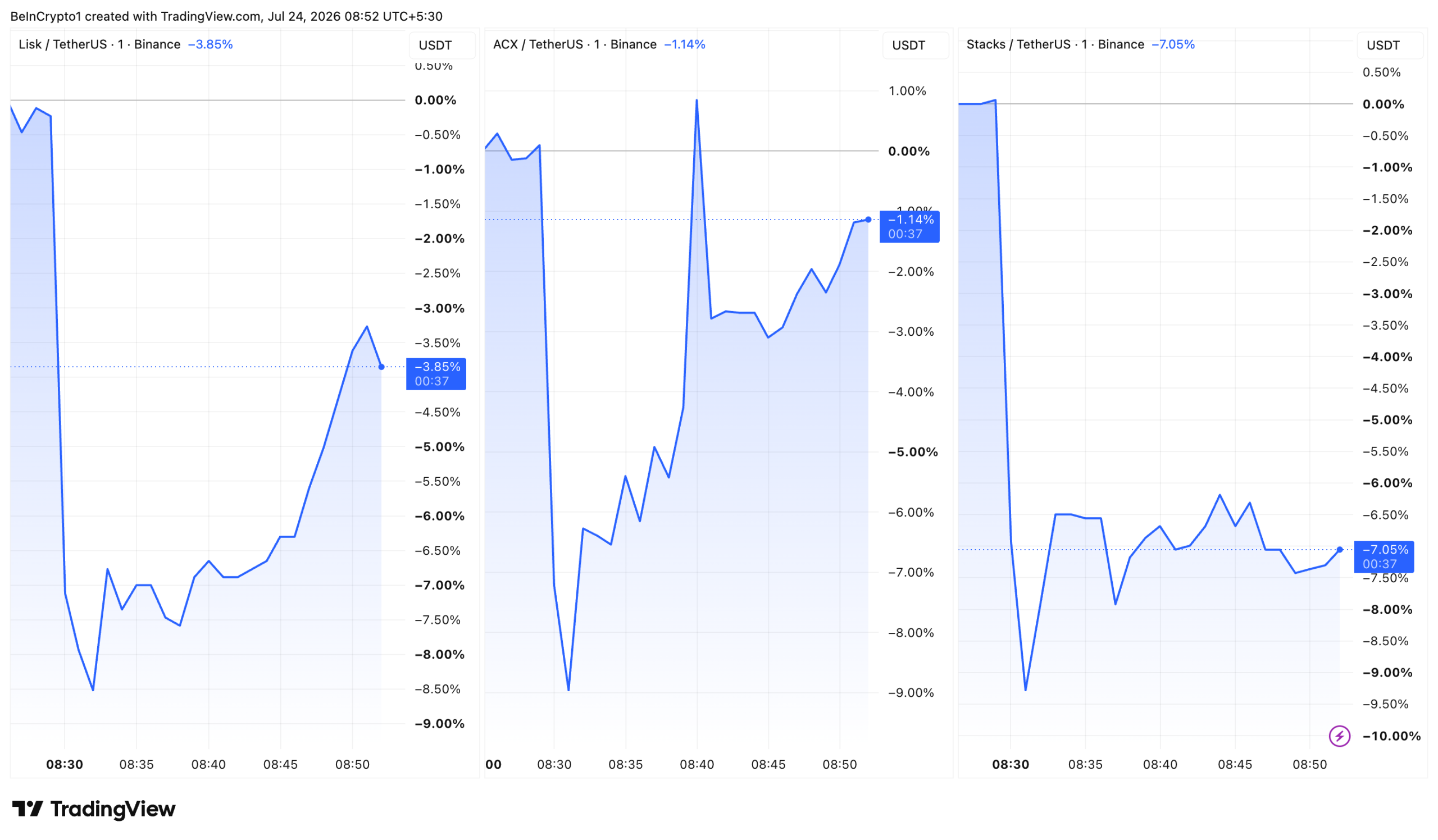
All three tokens fell sharply after the news before paring some losses. Lisk dropped to $0.074 on Binance, an all-time low.

At press time, LSK traded down 3.85% on the day. Across Protocol slid to an intraday low of $0.035, its weakest level since March.
ACX had recovered to a 1.14% loss by press time. Stacks fell to an intraday low of $0.143, its lowest since late 2020. STX showed the steepest drop of the three, down 7.05% at press time.
The tag does not guarantee removal. Still, it serves as a warning signal. The exchange added it to Beefy.Finance (BIFI) and Measurable Data Token (MDT) in June 2025.
FunToken (FUN) and Orchid (OXT) received it in March 2026. All four were confirmed for delisting from Binance in April 2026, alongside FIO Protocol (FIO) and Wanchain (WAN).
Subscribe to our YouTube channel to watch leaders and journalists provide expert insights
The post 3 Altcoins Decline as Binance Flags Delisting Risk appeared first on BeInCrypto.
A federal court is set to review whether a $5 million settlement between the US Commodity Futures Trading Commission (CFTC) and Gemini should be reversed, even as Gemini co-founder Cameron and Tyler Winklevoss have directed substantial Bitcoin donations to political groups supporting President Donald Trump. The latest development comes from a new disclosure by the MAGA Inc. Super PAC.
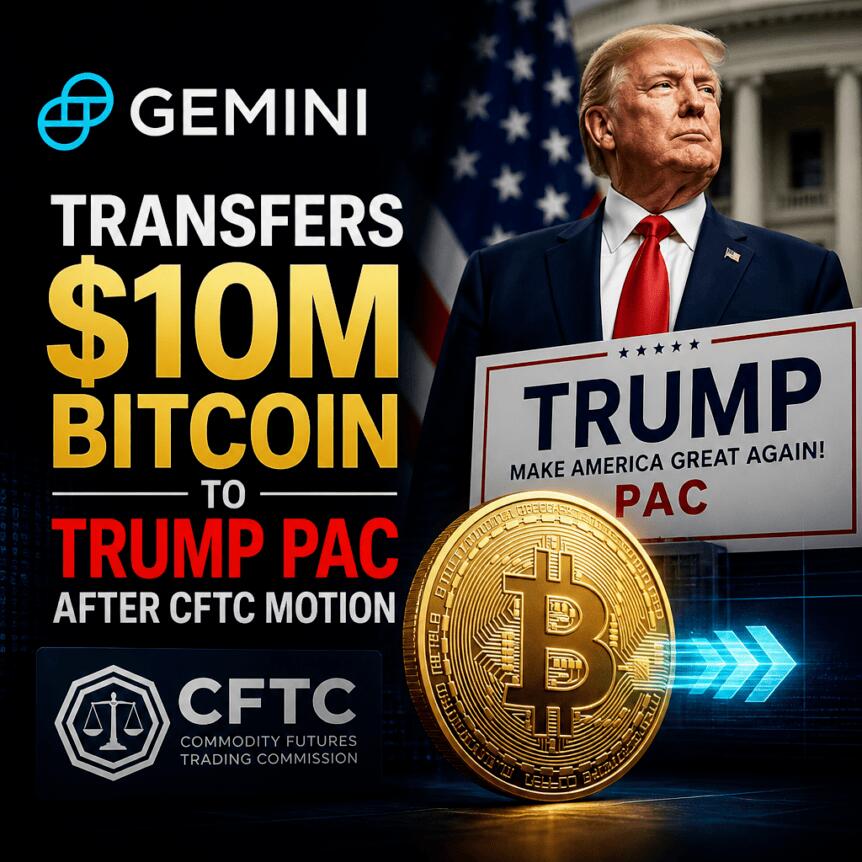
In a Federal Election Commission (FEC) filing dated Monday, MAGA Inc. Super PAC reported receiving two Bitcoin contributions exceeding $5 million each on June 19—totaling $10 million in BTC—sent by the Winklevoss-run Gemini Trust Company. The donation timing overlaps with the period when the CFTC and Gemini are seeking to revisit the earlier enforcement outcome in federal court.
Key takeaways
- MAGA Inc. Super PAC’s July FEC report says Gemini Trust Company sent two Bitcoin contributions of more than $5 million each on June 19.
- The payments were made about three weeks after the CFTC and Gemini jointly filed a motion to reverse a January 2025 settlement.
- CFTC Chair Michael Selig previously characterized the original enforcement as politically targeted under the prior administration.
- A CFTC spokesperson told Cointelegraph in June that, if the court grants relief, the $5 million penalty would not be returned to Gemini.
- Separately, lawmakers have pushed the Trump White House to nominate additional CFTC commissioners as the agency prepares to oversee broader crypto-market rules.
Bitcoin donations disclosed amid court fight over Gemini settlement
According to the MAGA Inc. Super PAC report filed with the FEC, Gemini Trust Company made two separate transfers of Bitcoin on June 19. Each contribution was valued at more than $5 million, bringing the disclosed total to $10 million.
The filing indicates the super PAC can use the funds for independent expenditures supporting Trump. That matters because super PAC spending can influence elections indirectly—by funding advertising and other political activities—rather than making direct coordination with candidates.
The June 19 contributions came roughly three weeks after the CFTC and Gemini jointly moved in federal court to revisit a settlement dated to January 2025. In that earlier case, the CFTC alleged Gemini made false or misleading statements. The current joint filing seeks a reversal of that settlement in the US District Court for the Southern District of New York.
When the CFTC and Gemini filed their joint motion, Cointelegraph reported that CFTC Chair Michael Selig argued at the time that the enforcement during the Biden administration “politically targeted” the Winklevosses. The broader implication is that the dispute is not only about legal interpretation of statements, but also about whether the CFTC’s enforcement posture should be treated as politically motivated.
What’s known about the CFTC-Gemini motion—and what remains unanswered
While the joint motion was filed in May, Cointelegraph reported that no decision has yet been posted to the public docket. That means the court’s view on whether the settlement should be reversed is still pending.
Cointelegraph also said it reached out to the CFTC and Gemini’s counsel, Avi Perry, for comment on the $10 million contribution but did not receive an immediate response. A CFTC spokesperson, however, provided context in June about the penalty outcome: both sides “agreed that the $5 million penalty will not be returned to Gemini” if the court grants the reversal.
This point is important for market watchers because it separates two possible outcomes. Even if the settlement is overturned, the agency’s position (as relayed by a spokesperson) suggests the immediate financial consequence may not change in Gemini’s favor. In other words, the court fight may affect precedent or regulatory record more than it affects the transfer of funds already paid.
The dispute is occurring as crypto regulation in the US continues to evolve—especially around how regulators determine what constitutes improper statements and how they translate market-facing communications into enforcement actions.
Winklevoss political support spans multiple BTC donations
The MAGA Inc. disclosure is the latest entry in a broader pattern of political involvement by the Winklevoss brothers and Gemini leadership.
Cointelegraph reported that both brothers donated $1 million each to Trump’s 2024 election campaign and supported the then-candidate through social media posts. After Trump took office in January 2025, the twins attended a stablecoin payments bill signing ceremony for the GENIUS Act. They also supported American Bitcoin, a crypto mining venture associated with Trump’s sons, and contributed $21 million in Bitcoin to the Digital Freedom Fund PAC, according to earlier coverage.
These actions do not establish any legal relationship to the CFTC-Gemini case on their own. But they do intensify political attention on the timing and dynamics between regulatory enforcement, court strategy, and high-profile political backing—particularly when lawmakers are already debating the degree of independence regulators should maintain.
Concerns from lawmakers and a CFTC shaped by a lone chair
Criticism of the CFTC’s joint approach to reversal has come from members of Congress. Cointelegraph reported that Senator Elizabeth Warren, in a June letter to CFTC Chair Selig, described the joint motion for reversal and other factors as “concerning signs” of a commission influenced by political pressures and aligned interests, rather than governed strictly by rule of law and a duty to protect investors and market integrity.
At the same time, the CFTC’s internal composition remains a central policy issue. Cointelegraph noted that Selig remains the sole commissioner leading the agency, with no additional nominations announced as of Thursday. The CFTC is usually governed by a bipartisan set of five commissioners, so a one-person board structure can shape both enforcement priorities and how quickly the agency can adopt new regulatory approaches.
Many lawmakers have been urging the Trump administration to nominate additional commissioners. That pressure coincides with congressional work on crypto market structure legislation, including the Digital Asset Market Clarity (CLARITY) Act, which—per Cointelegraph’s reporting—is expected to expand the CFTC’s authority in regulating and overseeing digital assets.
With the White House not yet announcing nominations, Selig effectively directs the agency’s agenda for now. That matters to investors and market participants because the CFTC’s leadership and regulatory posture can influence which enforcement theories are pursued, how compliance expectations are interpreted, and what rulemaking momentum looks like in practice.
Separately, Cointelegraph reported that as of June 30, MAGA Inc. had received more than $397 million. That figure underscores the scale of political fundraising activity around the election cycle, even as individual disclosures like the June 19 BTC transfers keep drawing scrutiny to the intersection of crypto wealth, regulation, and politics.
As the court considers whether the Gemini settlement should be reversed, the key watchpoints are whether the docket produces a ruling soon, how the CFTC frames the reversal in legal terms if relief is granted, and whether additional CFTC commissioner nominations are announced—developments that could determine how aggressively the agency’s crypto oversight evolves next.
Ethereum (ETH) Is Cheap, But Not at Bottom Yet: Analysts

Harry Maguire might just have dropped a major hint about Man United’s transfer business

There are more entry-level jobs than graduates in S’pore. So why are they still struggling to be hired?

Renter of Home in Anne Heche Crash Denies Settlement With Son

No Jackpot Winner as $257 Million Prize Rolls Over to $269 Million Monday Draw

Weekend Open Thread: Staud – Corporette.com

6 Documentos que debes tener antes de jubilarte #jubilation #finance #dinero #patrimonio

Wale ft. Rick Ross, Meek Mill, and T Pain – “Bag Of Money” (Official Music Video)

Senate prepares for crypto bill vote to limit elected officials’ ability to profit off of crypto
-

 Fashion6 days ago
Weekend Open Thread – Corporette.com
-

 Politics6 days ago
The House | The City of London can help the new chancellor deliver growth in every postcode
-

 Crypto World6 days ago
Ripple Payments Joins MiCA With 14 Firms, Does It Mean Anything For XRP?
-
 Crypto World7 days ago
Two July Windows Left: The CLARITY Act’s Senate Fight and What Failure Means
-

 Politics5 days ago
Democrats look to World Cup watch parties to register thousands of voters
-

 Crypto World6 days ago
Ripple wins EU-wide access as ESMA adds it to MiCA register
-

 Crypto World3 days ago
Grayscale Files For Worldcoin ETF, WLD Registers Sharp Rise
-

 NewsBeat4 days ago
Unregistered fitter used Gas Safe logo on business flyers
-

 Tech3 days ago
Sail Virtually Aboard The “Itanic” With IA-64 Emulator
-
 Tech3 days ago
Turtle Beach Command Series KB7 review: a nifty screen-equipped gaming keyboard
-

 NewsBeat7 days ago
Registration is now open for March for Men with Kev 2026
-

 News Videos5 days ago
Big Money Is Entering XRP
-
 Business2 days ago
New Jersey voter registration controversy explained: How 6,600 noncitizens got on the rolls, and what happens next
-

 News Videos7 days ago
Money | Class 12 Economics | CBSE Board Exam 2026-27
-

 Crypto World6 days ago
Kaspersky exposes OkoBot’s 20-module crypto wallet attack
-

 Business6 days ago
Airlines warn Sunshine Protection Act could disrupt flight scheduling
-
 Entertainment2 days ago
Johnny Depp’s R-Rated Gothic Cult Classic Gets New Release Ahead of Sydney Sweeney Remake
-

 NewsBeat6 days ago
Durham County Council to send out electoral registration emails
-

 Crypto World6 days ago
MiCA Licensing Faces Delays as ESMA Adds 14 CASPs to Register
-

 Crypto World1 day ago
Ethics, other provisions in crypto Clarity Act to be further discussed
You must be logged in to post a comment Login