

Crypto World
South Korea Makes First DEX Rug Pull Arrest in Catfi Case


South Korea, Seoul Southern District Prosecutors’ Office has arrested and indicted operators behind Catfi. This is the country’s first-ever rug pull prosecution tied to a decentralized exchange.
The case, brought under the Virtual Asset User Protection Act, charges the group with market manipulation after 256 investors lost 900 million won($586,000), when liquidity was drained following an artificial price surge.
The scheme began on Pump.fun in early 2025, where the main suspect, identified by the surname Park, operating online as the influencer ‘Eth Father,’ created Catfi before listing it on a decentralized exchange. Park allegedly posed as an unrelated third party to recommend purchases, inflated follower counts, managed project social accounts, and spread tokens across multiple wallets while using circular trading to obscure issuer control.
Catfi’s price surged 1,001-fold within 26 hours of issuance, with 6,000 investors buying in before the liquidity vanished. The group used approximately 10 million won in criminal funds and walked away with 400 million won, or $260,000, in proceeds.

Discover: The Best Crypto to Diversify Your Portfolio
South Korea Catfi Arrest and DeFi Regulation
Until this Catfi case, South Korea virtual asset enforcement had concentrated almost entirely on centralized exchanges. DEX fraud occupied a legally murky space: non-custodial design, pseudonymous wallet operators, and the absence of a regulated intermediary made it structurally difficult to assign criminal liability under frameworks built for traditional finance or even CEX abuse.
The Virtual Asset User Protection Act, which took effect in July 2024, gave prosecutors a statutory basis, covering “the use of fraudulent means, plans, or techniques” and false statements about material facts in digital asset trading, regardless of venue.
The Catfi prosecution is only the second known matter under the Act, following the January 2025 ACE token manipulation case on Bithumb, but the first to reach into a DEX environment.
Seoul Southern District prosecutors framed the enforcement mandate explicitly, stating the office would “resolutely deal with acts that disrupt the digital asset market and undermine public trust.”
DeFi regulation in South Korea has now moved from exchange oversight to on-chain conduct, and operators who assumed decentralization meant immunity are reading that statement very carefully right now.

The Tracing Mechanism
The Catfi case illustrates the investigative template that makes on-chain forensics increasingly dangerous for rug pull operators. Prosecutors identified circular trading patterns, coordinated wash trades across wallets controlled by the issuing group, which created artificial volume and masked insider ownership concentration.
From there, the off-ramp is typically the exposure point: converting criminal proceeds into fiat or stablecoins requires touching a centralized exchange with KYC obligations, and that intersection is where pseudonymous operators become identifiable individuals.
South Korea’s enforcement bodies have developed this pattern across prior cases; the 149-arrest USDT laundering ring announced earlier this year demonstrated that prosecutors can map complex multi-wallet schemes at scale. The Catfi group’s use of approximately 10 million won in traceable criminal funds suggests the on-chain trail was coherent enough to anchor the indictment.
Two suspects were arrested and indicted for market manipulation; one was indicted without detention; two others were charged for helping the main suspect flee. Similar reconstruction methods were visible in the Squid protocol exploit, where on-chain tracing helped identify the flow of drained funds across multiple hops.
Discover: The Best Token Presales
The post South Korea Makes First DEX Rug Pull Arrest in Catfi Case appeared first on Cryptonews.

OKX moves core exchange functions to a permissionless protocol
OKX has unveiled an open, permissionless trading infrastructure it calls X Layer, shifting core exchange functions such as matching, margining, liquidation, settlement and risk management down to a protocol layer. The company said the system allows any developer to deploy spot, perpetual and outcomes markets, and it will support both institutional participants and Web3-native builders.
The first live deployment on the new architecture is a prediction market: OKX’s 2026 World Cup Outcomes Market, which the company scheduled to launch on May 28. OKX founder and CEO Star Xu published a company blog post outlining the project. The announcement marks a notable step in the industry trend of moving traditionally centralized exchange features closer to the protocol level.
What the change means for market creation
By relocating matching and risk functions to a protocol layer, OKX is effectively offering a set of reusable infrastructure primitives. That could lower the technical barrier for third parties to create markets because builders would no longer need to recreate complex exchange engines from scratch. Instead they would plug into the protocol to launch spot pairs, perpetual contracts or event-based outcomes markets.
For institutional users, the appeal is predictable settlement and standardized risk controls. For Web3-native teams, the benefit is composability and the potential to integrate markets with on-chain tooling. In practice, a permissionless model can enable faster product iteration and a broader variety of market types, including bespoke markets tailored to niche use cases.
Technical and market implications
Moving matching, margining and liquidation into a protocol layer introduces a few important implications for market microstructure and capital efficiency. On the positive side, shared protocol-level margining and risk modules can enable cross-market capital efficiencies, reducing the need for isolated margin pools. Standardized settlement primitives can also simplify integrations with wallets, custody solutions and liquidity providers.
At the same time, permissionless market creation risks liquidity fragmentation. If many similar markets compete for liquidity, spreads may widen and execution quality could vary across deployments. The success of a permissionless market ecosystem often depends on incentives for liquidity providers and mechanisms to aggregate or route orders across listings.
Another technical consideration is oracle dependency. Outcomes markets require reliable real-world data inputs to resolve event outcomes. Protocol-level reliance on oracles raises questions about redundancy, decentralization and dispute resolution processes. Similarly, moving liquidation and margin logic to a shared protocol places greater emphasis on the security and correctness of those contract modules.
Prediction markets and regulatory context
Prediction markets, particularly those tied to sports outcomes, occupy a complex regulatory space. Many jurisdictions classify betting and gambling separately from financial trading, imposing specific licensing, consumer-protection and advertising rules. A permissionless architecture that permits any builder to spin up a World Cup outcomes market may therefore encounter differing legal regimes depending on where users are located and where the operator chooses to comply.
OKX’s announcement does not change those cross-border regulatory realities. Operators and builders using an open protocol will still need to implement compliance measures and controls where required. That dynamic raises broader questions about how exchanges and protocol providers will coordinate on KYC, AML and geo-blocking enforcement in a permissionless environment.
Risk management and smart contract considerations
Centralizing core functions as on-chain or protocol-level modules can improve transparency, but it also concentrates systemic risk. Bugs in matching, margining or liquidation code could affect multiple markets simultaneously. This amplifies the importance of rigorous audits, formal verification where feasible, and careful upgrade governance.
Users should also weigh custody models and counterparty exposure. Even if market logic is permissionless, funds custody and settlement arrangements determine who ultimately bears credit and operational risk. The balance between decentralized market mechanics and custodial controls will be a key design choice for builders and institutional adopters.
What to watch next
Key indicators of the protocol’s early traction will include liquidity metrics for the World Cup Outcomes Market, third-party deployments on X Layer and the composition of liquidity providers. Observers will also track how OKX and downstream builders address oracle design, dispute resolution and regulatory compliance.
Finally, the broader industry will be watching whether other major venues adopt similar protocol-layer approaches. If successful, the model could accelerate the modularization of exchange infrastructure, with potential benefits for innovation and interoperability, but also new operational and regulatory tradeoffs.
For now, OKX’s move signals a continued push by trading platforms to blend exchange-grade capabilities with the composability that has defined much of the Web3 ecosystem. The practical outcomes will depend on adoption, security practices and how the industry balances openness with the controls that regulators and institutional participants expect.
Disclosure
This article is based on company communications and publicly available information. It does not include proprietary or confidential details about the protocol’s technical design beyond what the company has disclosed.
Welcome to our institutional newsletter, Crypto Long & Short. This week:
- Ravi Tanuku on how the GENIUS Act repriced bitcoin’s monetary premium
- Jesper Johansen on looped ETH staking without lending market exposure
- Top headlines institutions should pay attention to by Francisco Rodrigues
- “NEAR Intents fee run-rate holds as price recovers off $1 lows” in Chart of the Week
Thanks for joining us!
Expert Insights
The GENIUS Act Repriced Bitcoin’s Monetary Premium
– By Ravi Tanuku, managing member & general partner at Natural Capital & Director at Krakacquisition Corp.
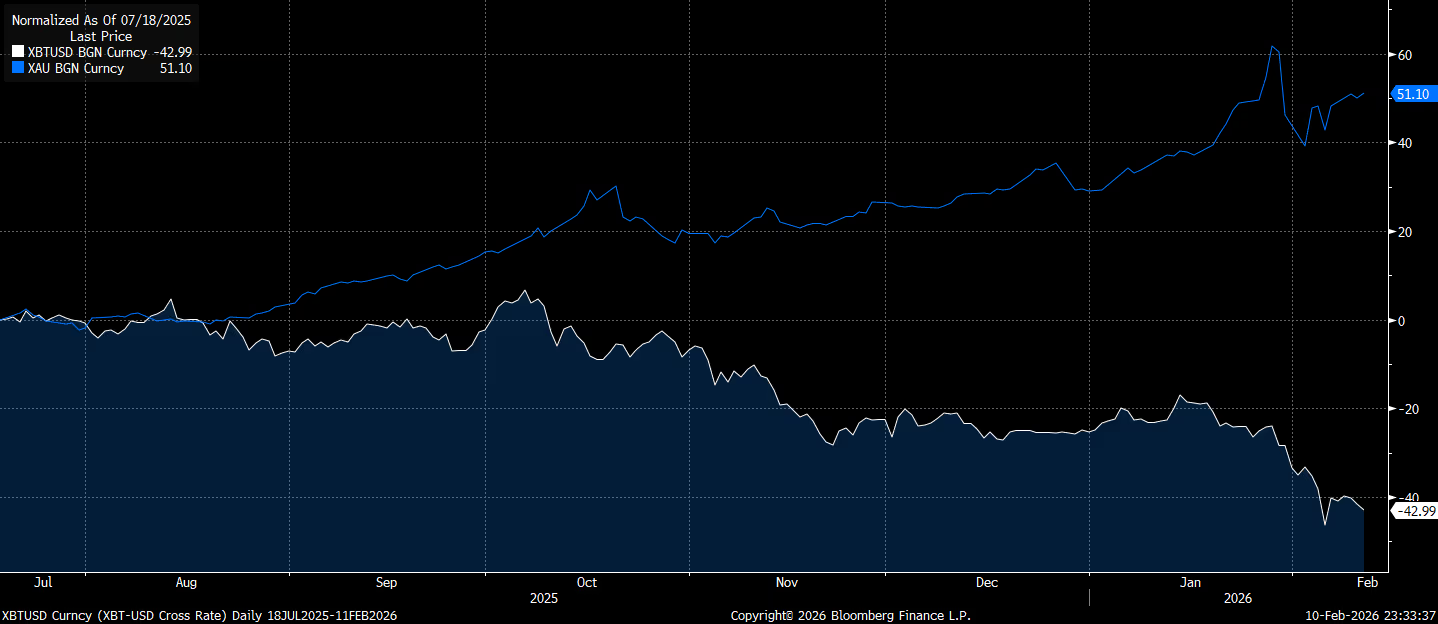
Gold has outperformed Bitcoin by nearly 100% since July 18, 2025. Same macro environment. Opposite outcomes.
The usual explanations don’t survive the simplest question: if this is just a cycle top, why is gold still working?
Bitcoin didn’t break because of cycles, sentiment or quantum risk. It broke because the U.S. government built a better version of what Bitcoin provided to millions around the world, and signed it into law on that date. The GENIUS Act regulated stablecoins with 100% reserves in U.S. dollars or Treasuries. In doing so, it created a government-sanctioned alternative to Bitcoin, in effect shifting “digital dollar” demand from Bitcoin to stablecoins.

Chart: Normalized performance of bitcoin (XBTUSD) vs Gold (XAU), in BGN. Source: Bloomberg.
What bitcoin was actually used for
The standard framing is that bitcoin has three use cases: dollar access, digital gold and speculation. Most of the discourse focuses on the latter two. The adoption data points somewhere else.
According to Chainalysis, the top crypto-adopting countries are Nigeria, Vietnam, Turkey, Argentina and Ethiopia. The common thread isn’t speculation or sound money ideology. It’s capital controls and currency depreciation against the dollar.
That pattern suggests bitcoin’s dominant real-world function was as an alternative dollar access point for consumers and businesses whose governments restricted it. Speculative flows and institutional vehicles like ETFs can be larger in dollar terms at any given moment. But dollar access was the most consistent secular demand. It was the structural bid that gave bitcoin its floor and its long-running relationship with global M2 money supply.

Chart: Bitcoin vs global M2 money supply. Source: Bloomberg.
The risk-adjusted data make this concrete. Since the November 2021 cycle peak, a buyer in Nigeria, Turkey, Ethiopia or Vietnam who held bitcoin spent 26 of the next 52 months underwater relative to someone who simply held U.S. dollars. Both delivered strong absolute returns in local currency terms: bitcoin returned 275%, dollars returned 172%. But bitcoin’s annualized volatility was 68% versus 18% for dollars, producing a Sharpe ratio of roughly 0.5 compared to 1.5 for just holding USD. Bitcoin’s maximum drawdown was 66%. The dollar holder’s was 6%.

Chart: Bitcoin vs dollars in emerging markets, indexed from Nov 2021 cycle peak. Source: Bloomberg.
These buyers weren’t making a speculative bet on digital gold. They were trying to hold dollars. bitcoin was the best available wrapper, but the returns accrued to the dollar exposure, not to bitcoin specifically. A regulated stablecoin captures the same currency depreciation tailwind without the drawdowns.
The migration was already underway before the GENIUS Act. According to Artemis, B2B stablecoin payments surged 30x to over $3 billion monthly by early 2025, with cross-border settlement as the primary driver. The Act accelerated a shift that was already visible.
What happened after
Stablecoin market cap went from ~$211 billion in January 2025 to over $306 billion by October, up 45%. Monthly issuance doubled from ~$6.6 billion pre-GENIUS to over $13 billion in the three months after the Act. Bitcoin fell 43%. Capital didn’t leave crypto. It just stopped needing bitcoin to get where it was going.

Chart: Gold vs bitcoin (scaled) vs stablecoin supply (market cap), with GENIUS Act passage marked. Source: author chart data from Bloomberg.
Then the macro gave us a clean test of the digital gold thesis. In late 2025, cyclical reacceleration built across the real economy. Commodities rallied. Gold, silver and copper made new highs through January 2026. Bitcoin sold off alongside SAAS stocks and unprofitable tech. By fourth quarter 2025, its quarterly correlation with IGV hit +0.64, the tightest since the 2022 bear market.
In this cycle, the market did not treat bitcoin as a monetary hedge.
The test ahead
The CLARITY Act aims to regulate bitcoin as a commodity. That classification could matter. Right now Bitcoin sits in regulatory limbo that makes it hard for institutional allocators to slot it into commodity portfolios alongside gold and silver. Formal commodity status changes the compliance conversation, creates index inclusion logic and gives pension funds and endowments a framework to allocate.
The GENIUS Act may have impaired the dollar access use case permanently. CLARITY could revive the digital gold thesis under a new regulatory identity.
The test isn’t whether bitcoin rallies post-CLARITY. Any oversold asset can bounce on a catalyst. The test is the correlation regime. Within one to two quarters of CLARITY’s passage, does Bitcoin begin recoupling with gold? Or does it continue trading with long-duration growth?
There’s an irony here. The crypto industry spent years lobbying for regulatory clarity. The first major regulation formalized a competitor that made bitcoin’s core function obsolete. Whether the second major regulation gives it a new structural identity or confirms the old one is gone is the open question.
Watch what bitcoin trades with, not where it trades. The correlation regime will be the signal.
Principled Perspectives
Looped ETH Staking Without Lending Market Exposure
– By Jesper Johansen, CEO & founder, Northstake
Most leveraged staking strategies on Ethereum follow the same playbook: deposit ETH, receive a liquid staking token, borrow against it on a lending protocol and repeat. It works — until it doesn’t. Liquidation risk, variable borrow rates and smart contract exposure across multiple protocols make the approach fragile at institutional scale.
There is a simpler path. One that captures a comparable yield without ever touching a lending protocol.
The rates and the spread
Native Ethereum validator staking currently yields approximately 2.9% APY. Lido’s stETH — the largest liquid staking token — yields approximately 2.4%. The gap exists because Lido socialises rewards across all stETH holders, including ETH that is sitting idle in entry and exit queues earning nothing. The more queue activity there is, the wider the spread.
That rate differential varies but recently hit 50 basis points. The rate differential is the foundation of this strategy.
How it works
Strategy execution leverages Lido V3 staking vaults and Northstake’s Staking Vault Manager to capture the rate differential and loop it. A vault operator stakes ETH natively on Ethereum validators, earning the full ~2.9% APY. You then mint stETH against that staked position – not by borrowing, but through Lido’s native minting mechanism within the stVault. The minted stETH is exchanged for staked ETH, which can be consolidated back into the vault’s validators via EIP-7251 consolidation. Each loop adds exposure. Minted stETH can also be exchanged for liquid ETH and staked in the stVault, however, this makes it subject to the entry queue.
At ten loops, the strategy delivers approximately 6.6% APY — roughly double the base staking rate. A 6.94% liquidity buffer is maintained as a reserve. The full position can be unwound as fast as the validator exit queue, currently sitting at around eight days, or immediately by depositing stETH back into the vault to bring down vault liability, while ETH is unstaking.
Crucially, no lending protocol is involved. The leverage is structural, created entirely by leveraging the rate differential of stETH within Lido’s vault architecture. There are no liquidation thresholds, no variable borrow costs, and no counterparty dependency on a lending market.

Example: Uses wstETH (non-rebasing version of stETH) and assumes secondary market as opposed to consolidation.
The risks are real but known
Duration risk is the primary consideration. Initial seed capital must pass through the validator entry queue, currently around 56 days. Subsequent scaling uses validator consolidation rather than the queue, but full deployment still takes 60–76 days depending on consolidation cycles.
Validator underperformance or slashing events can erode the spread. If the rate differential compresses, additional loops can be added; if it widens uncomfortably, the position can be reduced by partially unstaking.
Crucially, you can always redeem 1 stETH for 1 ETH with Lido. A depegging of stETH does not create a negative carry, due to the mechanics of how Lido’s stVaults manages vault liability. In the worst case, should the stVault liability become unhealthy, Lido executes a forced rebalance of the stVault where ETH is unstaked bringing down the liability.
Adding downside protection using CESR
One emerging development worth noting: staking risk insurance products now exist that can guarantee a minimum yield benchmarked to the Composite Ether Staking Rate (CESR), representing the average annualised validator yield. Under these policies, if a validator underperforms relative to CESR due to slashing, technical failure or operational error, the insurer covers the shortfall. For institutional allocators who need yield predictability, this converts the strategy’s variable return profile into something closer to a fixed-income instrument — leveraged staking yield with a guaranteed floor.
Who is this for?
Institutional capital is moving into staking structurally, not speculatively. They are looking for strategies that can deliver enhanced yield without introducing lending-market exposure or adding complexity. For asset managers, this strategy can also help reinforce the liquidity management of staked ETH ETFs.
The spread is there. The infrastructure and tooling to capture it exists.
Headlines of the week
– By Francisco Rodrigues
Institutional crypto kept filling in around the edges this past week as the SEC moved toward tokenized stocks on DeFi and cleared cash-settled bitcoin options for Nasdaq, Prometheum staked out broker-dealer distribution for onchain securities, and prediction markets faced a House Oversight insider-trading probe just as Hyperliquid pushed deeper into the same product line.
- SEC to propose tokenized stock framework as Wall Street efforts deepen: The planned innovation exemption would let third parties issue tokenized public equities for DeFi trading without issuer approval. The move extends the March approval of Nasdaq’s tokenized securities framework.
- Bitcoin options are coming to Nasdaq. Here’s what it means for you: The SEC conditionally approved Nasdaq PHLX to list cash-settled, European-style bitcoin index options under QBTC, tracking the CME CF Bitcoin Real Time Index.
- Hyperliquid is emerging as a challenger to traditional exchanges and prediction markets, says FalconX: HIP-3 markets are pulling pre-IPO bets on Cerebras, Anthropic and SpaceX onto the platform, with HIP-4 outcome contracts targeting Polymarket and Kalshi and HYPE up 94% in three months.
- Congress hits Polymarket and Kalshi with a massive insider trading probe: House Oversight Chair James Comer sent letters to Shayne Coplan and Tarek Mansour demanding records by June 5 on identity verification, geo-restrictions and unusual-trade detection, after Bubblemaps flagged 80 Polymarket bets with a 98% win rate tied to US military operations.
- Prometheum bets Wall Street distribution is the missing link for tokenized securities: The SEC-registered firm launched infrastructure to let broker-dealers and RIAs offer tokenized securities and crypto assets through traditional brokerage accounts, covering issuance, trading, custody, clearing and settlement.
Chart of the Week
NEAR Intents fee run-rate holds ~$36 million annualized as price recovers off $1 lows
Weekly fees on NEAR Intents annualized to $36 million as of week ending May 24, holding within a $32–58 million band since late February after peaking at $124 million in mid-November — even as NEAR round-tripped from $3.16 in late September down to a $1.06 low in late February, before recovering to $2.7 at the start of this week

Listen. Read. Watch. Engage.
Looking for more? Receive the latest crypto news from coindesk.com and market updates from coindesk.com/institutions.
Note: The views expressed in this column are those of the author and do not necessarily reflect those of CoinDesk, Inc., CoinDesk Indices or its owners and affiliates.
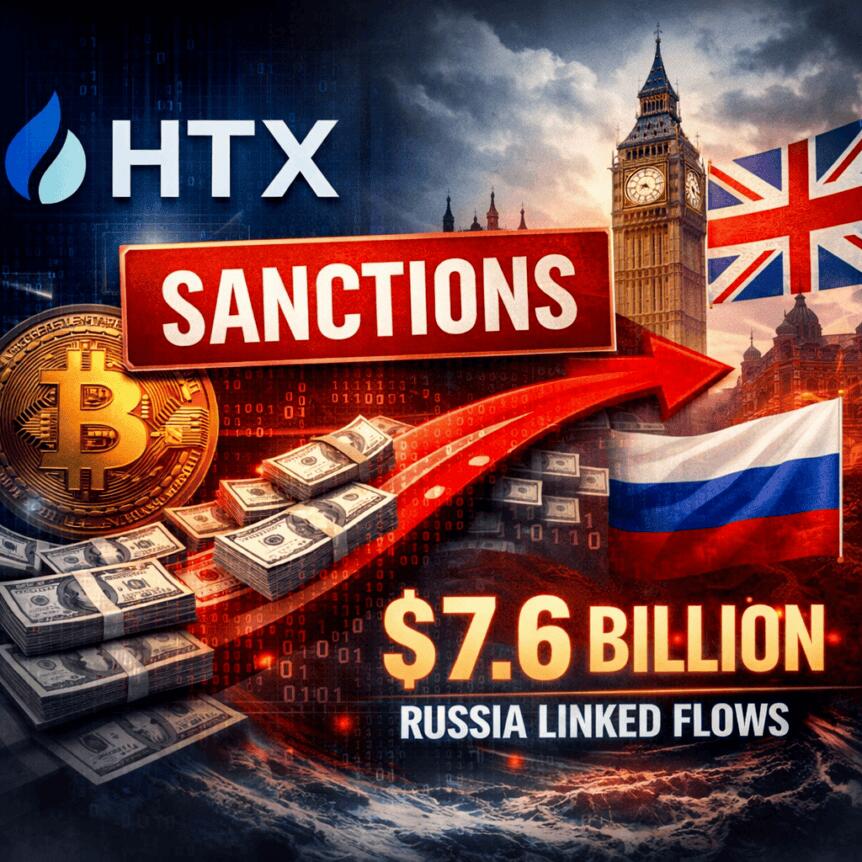
Western authorities intensified scrutiny of Russia-linked crypto flows this week as the United Kingdom designated Huobi Global S.A. — the Panamanian entity behind the Huobi Global exchange — in a broader package aimed at choking Moscow’s war economy. The designation flags Huobi Global as part of a network of 18 entities tied to illicit finance channels used to move money for Russia, including a shadow transfer system known as A7.
The UK’s May 26 sanctions package alleges that the designated entities operate as part of crypto and financial networks that support the Kremlin and its war effort. Among the targets is a Kyrgyz bank and what the Foreign Office described as a “major global cryptocurrency exchange” suspected of funneling more than $1.5 billion back into Russia. The measures subject these entities to asset freezes and restrictions on providing financial services.
HTX, which runs the HTX-branded platform and is associated with the Huobi brand in some markets, pushed back on the designation via a post on X. The firm said the designation applies to Huobi Global S.A. as a separate legal entity and asserted that its online exchange and user funds remain unaffected. Yet a blockchain analytics report circulated to Cointelegraph contends that the sanctioned platform processed billions of dollars tied to Russian counterparties and darknet markets, complicating the enforcement picture for peers and regulators.
Key takeaways
- The UK formally designates Huobi Global S.A. under a sanctions package aimed at disrupting Russia’s sanctioned financial networks, including the A7 shadow system.
- UK authorities allege the package targets infrastructure and services that could move funds into Russia’s war economy, including a Kyrgyz bank and what’s described as a major global cryptocurrency exchange.
- HTX asserts the designation applies only to Huobi Global as a separate legal entity and maintains that its exchange operations and user funds remain safe and accessible.
- A blockchain analytics firm raises questions about HTX’s activity, reporting substantial high-risk flows linked to Russian counterparts and darknet markets between 2021 and May 2026.
- Regulatory pressure in the UK compounds a broader global push, with the FCA pursuing enforcement actions against Huobi Global for alleged illegal promotions in the UK.
UK sanctions cast a wider net on crypto rails linked to Russia
According to the UK government, the package designates a constellation of “A7-linked infrastructure” that underpins illicit finance flows into Russia’s war economy. The measures target not only the entities themselves but also the financial networks and services that could facilitate sanctioned activity. In addition to Huobi Global, the designation highlights the potential role of a Kyrgyz bank and other crypto service providers as critical nodes in these shadow channels. The government’s stance reflects growing Western concern that Russia’s access to liquidity within centralized exchanges persists despite sweeping sanctions.
HTX pushes back on the designation while reiterating compliance commitments
HTX’s public reply via X stresses that the sanction applies to Huobi Global S.A., a distinct legal entity, and that its exchange operations and user funds should remain unaffected. The firm emphasizes its cooperation with law enforcement and its ongoing commitment to compliance. The assertion sits against a backdrop of independent blockchain analytics suggesting HTX’s activity spans a broader set of high-risk flows, raising questions about cross-border compliance and the boundaries of sanction enforcement for multi-entity exchanges.
Blockchain analytics illuminate the scale of high-risk flows
A report shared with Cointelegraph, drawing on blockchain analytics, asserts that HTX processed roughly $21.06 billion in high-risk crypto flows from 2021 through May 2026. Of that total, about $7.64 billion is linked to Russian high-risk entities and darknet markets, including platforms such as Garantex, its successor Grinex, A7A5, Hydra, and other marketplaces that have surfaced in sanctions discourse. The report also flags exposure to other entities and networks, including Huione Group, Nobitex, Hezbollah, and Lazarus, implying that the sanctioned channel risk extends beyond Russia alone.
UK officials cited Bloomberg reporting noting that HTX helped move approximately $1.5 billion back to Russia’s coffers, a figure described as a fraction of Global Ledger’s broader estimate of sanctioned networks’ liquidity on centralized exchanges, which the firm tallies at about $7.6 billion over a multi-year horizon. The competing estimates underscore the challenge of mapping illicit flows across on-chain data, jurisdictional lines, and the rapid evolution of crypto-related sanctions compliance.
The Global Ledger analysis relies on on-chain tracing across multiple networks (including Bitcoin, Ether, and Tron-based Tether) to map flows associated with Russia-linked entities and darknet markets, painting a picture of continued liquidity access even as sanctions tighten. HTX and Huobi-related entities have not publicly reconciled these figures, and Cointelegraph sought comment from both HTX and Global Ledger without a response by publication.
Regulatory backdrop and market implications
Complicating the landscape for crypto platforms, the UK case sits alongside a broader regulatory push in Western markets. The UK Financial Conduct Authority (FCA) has taken enforcement action related to illegal crypto promotions linked to Huobi Global, with High Court proceedings initiated in October 2025 against Huobi Global and individuals accused of advertising crypto trading services to UK consumers in breach of promotional rules. The FCA’s actions underscore the heightened risk for platforms that operate across multiple jurisdictions and host users from regions with divergent regulatory regimes.
For traders, investors, and builders, the episodes highlight several practical implications: the importance of clear entity-level governance and oversight to avoid conflating a brand’s diverse subsidiaries in sanctions regimes; the ongoing value—and fragility—of on-chain analytics in informing risk assessments; and the potential for policy shifts that could constrain access to exchange-based liquidity for sanctioned networks. The regulatory emphasis on “backdoor” or shadow channels suggests that exchanges with global footprints may face intensified due diligence requirements, especially when user bases span restricted or sanctioned jurisdictions.
HTX’s public messaging indicates a continued commitment to compliance and a willingness to engage with authorities, but the divergence between government designations and independent flow analyses adds a layer of uncertainty for users who rely on exchange services for cross-border activity. The combined regulatory and analytic framework signals that the coming months could see further designations, more granular guidance on acceptable counterparties, and tighter monitoring of high-risk counterparties across centralized and decentralized rails.
Cointelegraph reached out to HTX and Global Ledger for additional comment on the sanctions, the designation, and the accompanying analytics, but did not receive responses by publication.
As the policy debate evolves, market watchers should watch how regulators balance the need to curb illicit finance with maintaining access to legitimate crypto services for users and institutions worldwide. The next phase will likely hinge on the precision of enforcement actions, the specificity of designated entities, and the capacity of firms to demonstrate robust compliance across complex, multinational operations.
Readers should keep a close eye on regulatory updates from the UK and other jurisdictions, along with fresh on-chain analyses that illuminate how sanctioned flows shift in response to enforcement. The coming weeks could redefine how exchanges navigate sanctions and how policymakers translate these moves into practical safeguards for the broader crypto ecosystem.


Mastercard, the world's second-largest card payment network, has secured a BitLicense from the New York State Department of Financial Services, a key regulatory clearance as the company moves to support stablecoin and tokenized deposit settlement across its global infrastructure. The license was… Read the full story at The Defiant

The United Kingdom has expanded its Russia-related sanctions, designating Huobi Global S.A. as a sanctioned entity and signaling intensified scrutiny of crypto networks that authorities say support Moscow’s war economy. The measures, part of a broader package announced on May 26, target crypto and illicit-finance channels linked to Russia, including the A7 “shadow” system alleged to channel funds into the Kremlin’s war effort. In parallel, HTX—the operator of the sanctioned platform—pushed back, arguing the designation applies only to Huobi Global as a separate legal entity and that its own exchange operations and user funds remain unaffected.
Regulatory filings and blockchain-analysis work cited by authorities point to ongoing concerns that Russian-linked actors continue to move funds through major centralized exchanges despite sweeping restrictions since Moscow’s invasion of Ukraine. The sanctions package designates 18 entities and pieces of infrastructure tied to the A7 network, including a Kyrgyz bank, and references a major global crypto exchange suspected of funneling more than $1.5 billion to Russia. The response underscores Western regulators’ focus on on-chain channels, cross-border compliance gaps, and the potential for asset freezes and service prohibitions to disrupt illicit financial flows.
The UK’s action comes as authorities increasingly rely on blockchain analytics to map flows across networks and counterparties. HTX, which has faced separate enforcement actions in the UK, says the designation targets Huobi Global and emphasizes that its own operations remain normal and its customers’ funds are secure. Nonetheless, a new report prepared for Cointelegraph by Global Ledger contends that HTX-linked activity and a broader set of Russian-linked flows continue to channel liquidity through centralized platforms, a claim that regulatory and compliance teams will want to scrutinize as part of ongoing monitoring and licensing considerations.
Key takeaways
- UK designates Huobi Global S.A. as a sanctioned entity, subjecting it to asset freezes and restrictions on providing financial services, as part of a broader package targeting Russia-related crypto and illicit-finance networks.
- The sanctions describe A7-linked infrastructure, including a Kyrgyz bank and what the government characterizes as a “major global cryptocurrency exchange” implicated in moving more than $1.5 billion back into Russia’s war economy.
- HTX contends the designation affects only Huobi Global as a separate legal entity, asserting its own exchange operations and user funds are unaffected and that it remains committed to compliance with law enforcement.
- Independent blockchain-analytics work presents a broader view of flows, citing billions of dollars in high-risk activity connected to Russia and other sanctioned networks, including entities linked to darknet markets and other high-risk counterparties.
- The UK Financial Conduct Authority has pursued its own enforcement against Huobi Global and individuals connected to its promotion of crypto trading in the UK, reinforcing the cross-agency, cross-border regulatory posture toward crypto platforms.
Regulatory action and the scope of the package
The UK government’s sanctions package designates Huobi Global S.A., a Panamanian-registered entity, and targets a network described as central to evading Moscow-era restrictions. The Foreign, Commonwealth & Development Office said the measures focus on “crypto and illicit finance networks” used to sustain Russia’s war economy. In particular, the A7 designation framework points to a cluster of related infrastructure, including a Kyrgyz financial-institution and a large exchange suspected of transmitting substantial sums to Russia.
Asset freezes and bans on providing financial services apply to entities linked to these pathways, with authorities stressing that the sanctions aim to disrupt the flow of funds to sanctioned actors and networks. The action reflects a broader intent to close loopholes that sanctions-dodging actors purportedly exploit through crypto rails and high-risk exchange activity.
HTX response and the legal nuance of designation
HTX addressed the designation in a Tuesday post, stating that the sanctions designate Huobi Global as a separate legal entity and that its own exchange operations and user funds remain unaffected. The response frames the move as a targeted action against a distinct corporate entity, rather than HTX as a whole. The company reiterated its commitment to compliance and cooperation with law-enforcement authorities, and it asserted that day-to-day operations continue normally for its global user base.
Meanwhile, a blockchain-analysis briefing circulated to Cointelegraph argues that the sanctioned platform processed substantial volumes of funds tied to Russian counterparties and darknet markets. The report asserts that the HTX-flagged platform has seen billions of dollars transit through high-risk channels over a multi-year horizon. The interpretation of these findings will be central to ongoing regulatory scrutiny and any potential licensing or oversight implications for HTX and similar exchanges.
On-chain flows and the broader enforcement context
Independent analysis cited by authorities depicts a substantial footprint of high-risk activity, with reported totals suggesting several billions of dollars linked to Russian entities and darknet markets traversing centralized exchanges. The report identifies notable names—some previously associated with illicit activity—and flags the potential exposure of HTX-linked flows to sanctioned networks. The UK government, citing on-chain tracing, indicated that around $1.5 billion of flows were moved back into Russia’s coffers, a figure presented as a portion of a much larger pool believed to involve Russian-linked actors in the wider $7.6 billion range across multiple entities and marketplaces.
In addition to the Russia-focused action, the UK government’s designation carries broader implications for exchange risk management, AML/KYC programs, and cross-border compliance obligations. Observers note that the emphasis on A7 and related infrastructure underscores the importance of robust screening, suspicious-activity reporting, and co-operation with international regulators to prevent sanctioned funds from re-entering legitimate financial systems through crypto rails.
The FCA’s involvement adds another layer of enforcement pressure. In October 2025, the regulator commenced High Court proceedings against Huobi Global and individuals described as controlling the entity, alleging violations of the UK’s strict financial-promotion rules. The case highlights the growing convergence of consumer-protection mandates and crypto-market regulation in the UK landscape, with potential implications for licensing, advertising standards, and the risk controls expected of activity directed at UK residents.
Regulatory implications for exchanges, banks, and policy
The combination of UK sanctions and FCA enforcement actions reinforces a tightening regime for crypto platforms operating in or with access to the UK market. For exchanges, the measures reinforce the expectation of rigorous AML/KYC controls, comprehensive monitoring of counterparties, and clear attribution of which legal entity is serving as the operating arm for a given jurisdiction. The designation against Huobi Global S.A. also raises questions about corporate layering, ownership structures, and the ability of sanctions regimes to pinpoint liability across multi-entity platforms with regional affiliates.
Regulators emphasize licensing and oversight as ongoing priorities. While MiCA governs the EU’s crypto-market framework, the UK continues to pursue its own post-Brexit regulatory approach, with sanctions-implementation and enforcement reflecting broader international cooperation in AML/CFT standards. For banks and financial institutions, the sanctions extend a clear expectation that correspondent relationships, payment rails, and custody arrangements consider the heightened risk associated with sanctioned platforms and their on-ramps and off-ramps. In this light, cross-border enforcement and information-sharing between jurisdictions will be critical to maintaining effective oversight.
Broader policy context and risk considerations
The sanctions action sits at the intersection of national security policy and financial-market regulation. The A7 network’s alleged role as a backchannel for funds tied to Russia’s war economy illustrates ongoing concerns about sanctions evasion through crypto channels. The reported exposure of HTX-linked flows—and the discussion around a “major global exchange” being used to move funds—highlights the practical implications for compliance teams: robust detection of sanctioned-counterparty ties, forensics-led tracing of on-chain movements, and timely risk-scoring of high-risk counterparties are now central to day-to-day operations and strategic licensing decisions.
Observers note that the outcomes of these cases will feed into a broader policy debate about how best to harmonize cross-border oversight, ensure transparent corporate governance for multi-jurisdiction platforms, and prevent the leakage of sanctioned liquidity into legitimate markets. The relationship between on-chain analytics, traditional financial-crime controls, and enforcement action will continue to shape how exchanges structure compliance programs, onboarding procedures, and liquidity partnerships in markets globally.
Closing perspective
As regulators intensify scrutiny of crypto platforms in relation to sanctioned networks, institutions should monitor ongoing designations, enforcement developments, and cross-border collaborations. The HTX-Huobi case illustrates how legal distinctions between affiliated entities can influence compliance obligations, while the broader analytics-driven narrative underscores the enduring importance of robust AML/KYC practices and transparent governance in safeguarding market integrity.


After losing 90% of its stock price over the past year, the first US-listed Solana (SOL) treasury company, DeFi Development Corp, filed a clever maneuver yesterday. Relocating from Delaware to Nevada, it is now much harder to fire members of its Board of Directors.
In a new SEC filing yesterday, the once-$600 million, now-$118 million company bolted from Delaware to Nevada without a full shareholder vote. It simply informed minority stockholders of the decision by its ‘Special Committee’ and majority stockholders.
“YOUR VOTE OR CONSENT IS NOT REQUESTED OR REQUIRED,” the company informed common shareholders in all caps.
Read more: Largest Solana treasury company falls below 1X mNAV
Importantly, its new Nevada charter raises the bar for shareholders to remove directors who have presided over the company’s 90% decline over the past 52 weeks.
Insiders controlling 81.79% of voting power authorized the move. Most shareholders found out by reading the SEC filing.
As one explanation for the move, the Board of Directors literally cited litigation risk. “Our Board also considered the increasingly active litigation environment in Delaware, where well-funded plaintiffs’ firms have brought a greater frequency of opportunistic claims against corporations and their directors and officers, creating unnecessary distraction and costs,” it admitted plainly.
It also claimed Nevada taxes would be lower than in Delaware and celebrated the end of any “unwarranted scrutiny” against its officers.
Nevada “will provide greater protection from such claims [and] better allow our directors and officers to focus,” it explained.
Supervoting in the Solana treasury
The mechanics of the vote were striking. There are 30,118,205 common DFDV shares, each carrying one vote. However, DeFi Development also has 10,000 Series A Preferred shares, all held by management and management-affiliated entities. Each preferred share enjoys 10,000 votes.
That supervoting structure gave Chairman and CEO Joseph Onorati 36.46% of total voting power. As a group, 10 officers and directors controlled 81.94% voting power.
The new Nevada charter raises the threshold to remove a director without cause to two-thirds of the voting power. Delaware, in contrast, allowed removal by simple majority.
Read more: CHART: Solana survived six years of near-death experiences
Any opposing coalition, even including every other remaining shareholder, would thus fall short of the two-thirds power required to remove a board member.
Despite framing the Nevada relocation as a defense against “opportunistic claims” in Delaware courts, the filing insists that it is not “in response to any present attempt known to our Board to acquire control of the Company.”
Moving to Nevada after losing 90%
In spring 2025, a group of former Kraken executives led by Onorati acquired control of an old real estate fintech. They pivoted it into a Solana accumulation company. For one day, the stock traded over $53 per share. Its 52-week high of $38.21 was exactly one year ago: May 27, 2025.
Yesterday, after losing 9/10ths of its value, this stock closed its Nasdaq trading session at $3.94 per share.
Delaware’s corporate code lets a majority of voting power approve corporate actions in writing, with no shareholder meeting. DeFi Development’s Board approved the Nevada conversion on May 21.
DeFi Development is not the only company to have left Delaware for Nevada. TripAdvisor, Dropbox, and Tesla have led a broader “Dexit” movement.
What is notable is the package DeFi Development bundled into its move. Insiders who already outvote everyone else used a written consent to install a new state charter that raised their removal hurdle even higher.
The board’s own filing says the change “is not being effected to prevent a sale of the Company.”
Common holders are left with a 90% decline in 52 weeks and insiders who just made themselves harder to fire.
Got a tip? Send us an email securely via Protos Leaks. For more informed news and investigations, follow us on X, Bluesky, and Google News, or subscribe to our YouTube channel.


Longtime DeFi platform Stake DAO has become the latest victim in an increasingly worrying run of DeFi hacks.
In what appears to be a private key compromise, an attacker was able to mint 5.4 trillion of the project’s vsdCRV tokens on the Arbitrum network.
Blockchain monitoring firm Blockaid explains that an attacker used the compromised deployer to reconfigure the token’s LayerZero OFT contract to grant minting authority to an “attacker-deployed malicious contract.”
Read more: Bridge hacks back in vogue as Verus exploit brings 2026 total to $329M
The hacker swapped a portion of the tokens, a yield-bearing, wrapped version of Curve Finance’s CRV, for a total of 44 ETH. After presumably depleting on-chain liquidity, the approximately $91,000 of total profit was then bridged back to Ethereum.
The project posted to X that it is “aware of the ongoing situation,” urging users not to interact with csdCRV. Additionally, Curve Finance advised its users to exit LlamaLend positions involving asdCRV to avoid the risk of liquidation.
Launched in 2021, Stake DAO has weathered DeFi’s stormy seas for over five years. But this isn’t the first time it has faced trouble.
On March 12 this year, the platform’s Votemarket rewards program was attacked via a “peripheral oracle update mechanism.” Most of the $175,000 stolen on Arbitrum and Base was later returned.
Read more: Polymarket exploited for $700K in private key hack
Crisis of confidence in DeFi security
Today’s Stake DAO hack comes amidst a heated, ongoing debate over DeFi security in the age of AI.
Hours before the hack, Manuel Aráoz, co-founder of OpenZeppelin, posted to X that he considers all of DeFi “unsafe.”
Read more: DeFi sector in $14B meltdown as $290M rsETH hack fallout burns Aave
OpenZeppelin, founded in 2015, provides secure standards for smart contracts for use in DeFi applications and audit services for projects. But Aráoz believes that “superhuman” coding agents put even “low-risk ‘blue chips’ like Aave, MakerDAO & Compound” at risk.
However, former Aave delegate Marc Zeller calls Aráoz’ post “moronic.” He argues that the majority of DeFi losses are down to “bad parameter configuration, collateral blow up and poor opsec,” rather than smart contract exploits.
Pseudonymous Yearn developer banteg agrees that DeFi’s asymmetric security landscape means “one small mistake is enough to kill you.” However, they agree that recent hacks are dominated by “privileged role or key compromises or configuration errors.”
Got a tip? Send us an email securely via Protos Leaks. For more informed news and investigations, follow us on X, Bluesky, and Google News, or subscribe to our YouTube channel.


A major experiment led by the Bank for International Settlements (BIS) found that tokenization could help fix some of the biggest pain points in cross-border payments, from slow settlement times to costly reconciliation between banks.
Project Agorá, a joint effort between the BIS, seven central banks and more than 40 private financial institutions, concluded that tokenized central bank reserves and commercial bank deposits could support atomic settlement across currencies and jurisdictions.
Atomic settlement refers to transactions completing on an “all-or-nothing” basis, reducing the risk that one side of a cross-border payment fails while the other succeeds.
The initiative involved the Federal Reserve Bank of New York, Bank of England, Bank of Japan, Swiss National Bank and other central banks alongside large commercial banks and financial firms.
Project Agorá participants now plan to move beyond simulations toward testing real-value transactions involving some currencies and institutions. The Bank of Canada also joined the initiative this week.
The findings landed as global banks and asset managers ramp up their own tokenization efforts. DTCC, Wall Street’s clearing house, plans to roll out its tokenized settlement infrastructure for stocks, ETFs and U.S. Treasuries, while Nasdaq and NYSE-owner Intercontinental Exchange are both developing blockchain-based systems for tokenized stocks.
A cross-border transfers can bounce between several intermediary banks before reaching its destination at present, often taking days to settle and creating operational risks along the way. Using tokenization and blockchain rails could mean fewer delays and failed payments in the global financial system, the report showed.
The BIS, often described as the “central bank for central banks,” has become increasingly active in blockchain and tokenization research as governments and financial firms rethink how money and securities move globally.
The agency, however, warned that stablecoins — digital currencies tied to fiat money issued on blockchain by private companies — could pose risks to the financial system, urging to speed up efforts to regulate the sector.

TLDR:
- Hyperliquid generated nearly $800M revenue in 2025 without raising venture capital funds.
- The HYPE token reached a $13B market cap despite the platform remaining blocked in the U.S.
- Hyperliquid processed $2.9T in perpetual futures volume during 2025 across global markets.
- Grayscale believes HYPE remains undervalued compared with traditional exchange businesses.
Grayscale Research has identified Hyperliquid as the standout success story in modern digital assets. The decentralized exchange generated approximately $800 million in revenue during 2025.
It reached the 8th largest crypto asset by market capitalization. All of this was achieved without a single dollar of venture capital funding.
Notably, the platform remains geoblocked in the United States, yet its growth trajectory has drawn serious institutional attention.
How Hyperliquid Built a $800M Revenue Machine Without VC Backing
Grayscale’s report frames Hyperliquid’s rise as something the digital assets industry rarely produces. The platform launched publicly in August 2023, before Bitcoin ETPs arrived in U.S. markets.
It built its foundation during a relatively quiet period for decentralized finance. That timing proved deliberate rather than coincidental.
Rather than raising venture capital, Hyperliquid distributed approximately 30% of its HYPE token supply directly to early users. That decision shaped who owned and cared about the platform from day one.
The initial holder base consisted of traders, builders, and community participants. They had already used the product before they ever held the token.
This funding model created a different kind of alignment than most crypto projects carry. There were no VC lockup schedules or insider allocations waiting to pressure the market.
Trust, which Grayscale notes is scarce in this category, became a genuine competitive advantage. Users perceived Hyperliquid as a platform building for them rather than extracting value from them.
Grayscale’s report also points to product focus as central to the revenue story. Hyperliquid was engineered specifically around perpetual futures trading. It was not a general-purpose chain that happened to support a trading application.
That narrow focus allowed the team to prioritize exactly what active traders demand: fast order entry, deep liquidity, and reliable execution.
The Platform That Geoblocks America Yet Ranks 8th by Market Cap
Perhaps the most striking detail in Grayscale’s report is what Hyperliquid achieved while locked out of the United States.
U.S. users remain unable to access the platform due to regulatory ambiguity around perpetual futures and decentralized exchanges.
Despite that, HYPE carries a circulating market capitalization of roughly $13 billion. That places it among the eight largest crypto assets globally by market value.
Grayscale processed $2.9 trillion in perpetual futures volume across the platform during 2025. Open interest currently sits at around $7 billion.
That positions Hyperliquid as the third or fourth largest crypto perpetual futures exchange by open interest. All of this activity came exclusively from non-U.S. participants.
The report further notes that Hyperliquid has moved well beyond crypto-native markets. Through its HIP-3 framework, third-party developers can deploy perpetual contracts on traditional assets.
Oil perp volume on the platform surpassed $4 billion in a single 24-hour session on April 9, 2026. During that window, it briefly exceeded Bitcoin perpetual volumes on the same platform.
Bloomberg described Hyperliquid as a round-the-clock venue for leveraged commodity bets. An officially licensed S&P 500 perpetual contract now trades on the platform every day of the week.
Silver perp volume reached over $4 billion daily during the February 2026 price spike. Grayscale frames these data points as evidence that Hyperliquid is evolving into a 24/7 market structure layer for real-world assets.
What Comes Next for Hyperliquid and the HYPE Token
Grayscale’s report identifies U.S. regulatory clarity as the most consequential near-term catalyst for Hyperliquid. The Commodity Futures Trading Commission has recently signaled movement toward frameworks that could accommodate perpetual-like products.
Coinbase, Kraken, Robinhood, and Kalshi are already positioning for compliant perp offerings. That momentum points toward a market structure shift that could directly benefit Hyperliquid.
The HYPE token currently trades at roughly 14 times earnings over the four quarters ending Q1 2026. Grayscale compares this to high-growth public exchange businesses like Robinhood and Interactive Brokers.
Those companies trade at multiples between 35 and 50 times earnings. That gap forms the basis of Grayscale’s view that HYPE offers meaningful upside over time.
Fee mechanics reinforce the token’s value case. Around 99% of platform trading fees flow into an assistance fund that converts fees into HYPE and burns them.
Because burns consistently exceed new token issuance, circulating supply has trended lower. Grayscale draws a direct parallel to share buyback programs in traditional equity markets.
Risks remain part of the picture Grayscale presents. HYPE carries annualized price volatility near 80%, roughly 40 percentage points above Bitcoin.
The platform runs on closed-source software with a more centralized validator set than comparable blockchain networks. U.S. market access remains contingent on regulatory decisions that have not yet reached a final form.

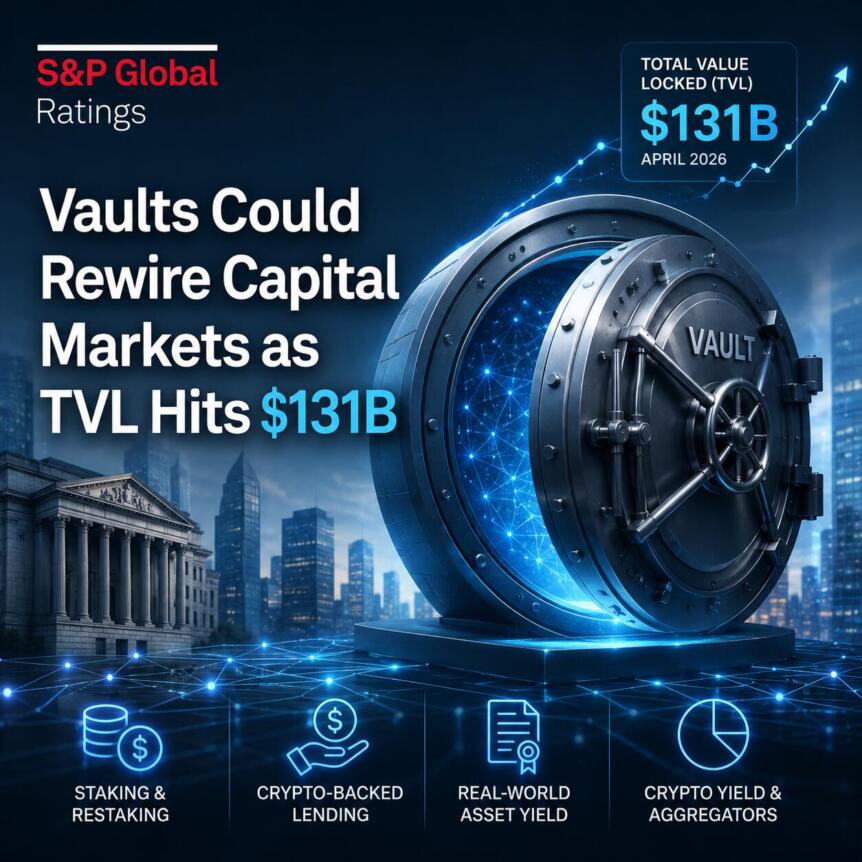
Growing fast, but still nascent: S&P lays out the promise and pitfalls of on‑chain vaults
S&P Global Ratings released a primer this week examining the role of digital asset “vaults”—on‑chain pooled investment vehicles that issue share tokens and deploy capital according to a defined strategy. The report highlights rapid expansion in deposits and says vaults could migrate beyond crypto-native uses to handle tokenized real‑world assets (RWAs) and functions traditionally performed by funds and intermediaries. At the same time, S&P warns that leverage mechanics, uneven disclosure practices, technical failure modes and regulatory ambiguity could constrain their path to wider institutional adoption.
What vaults are and how they have grown
Vaults aggregate deposits and allocate them across strategies via smart contracts, or a hybrid of automated code and discretionary manager decisions. Investors receive tokenised shares that represent a proportional claim on the pooled assets and any returns. That structure makes vaults a different primitive from direct asset ownership: they can implement dynamic, multi‑asset strategies, reallocate automatically and integrate with other protocols.
Market metrics cited by S&P show the space has expanded sharply: total deposits in vaults rose to about US$131 billion as of April 2026, from roughly US$24 billion in April 2023. But the firm notes that approximately 94% of current activity is concentrated in crypto‑native strategies such as staking, crypto‑backed lending and yield aggregation.
Why vaults might matter to capital markets
S&P argues vaults could eventually support a wide range of financial functions traditionally carried out by private credit funds, money market vehicles, hedge funds and more. The combination of automation, composability and secondary‑market liquidity turns pooled on‑chain assets into reusable building blocks: vault shares can be traded, posted as collateral, or blended into composite strategies.
The report also points to a potential bridge to much larger markets. For example, tokens representing treasury or repo‑like instruments could be used as collateral on‑chain; because global repo turnover is many times the market capitalization of crypto assets, even modest uptake could materially increase vault activity.
Key risks S&P flags
Leverage and looping. Vault architectures and composability enable recursive reuse of collateral. Borrowed funds can be redeployed as collateral to generate additional exposure, a practice S&P calls “looping.” Looping can occur at the depositor level—similar to margin—or at the vault level, where curators’ actions raise leverage for all depositors. That amplifies returns in good times and can accelerate deleveraging and cascading liquidations during stress.
Technical failure modes. Reliance on smart contracts, external oracles and protocol integrations introduces risks not seen in traditional funds. Code bugs, oracle failures or integration errors can produce direct losses or disrupt settlement and rebalancing processes.
Disclosure and transparency gaps. While on‑chain transactions are visible, S&P notes that raw blockchain data is often hard to interpret and does not substitute for structured disclosures. Many vaults focus on headline yield figures and provide limited, non‑standardised information on mandate, allocation limits, leverage practices and governance. Where disclosures exist, mechanisms such as “time locks”—typically several days for concentration changes—are used to give depositors exit windows, but monitoring these changes can be resource intensive.
Regulatory ambiguity. Uncertainty over whether vault tokens constitute securities or other regulated instruments is a major constraint on institutional participation. Vault shares can represent tokenised ownership of RWAs or resemble investment contracts under legal tests used by regulators. Without clearer cross‑jurisdictional frameworks, many institutions remain cautious.
Market structure and consolidation
S&P observes early consolidation among vault curators and infrastructure providers. On one relatively mature platform, Morpho, two curators accounted for roughly 77% of deposits as of April 2026. The ratings firm expects further concentration as operators scale, risk and disclosure standards rise, and traditional finance entrants and established market makers expand their presence. Names mentioned as active or interested participants in the market include Apollo, Wintermute and Bitwise—signalling growing crossover between legacy asset managers, trading firms and crypto infrastructure players.
Implications for institutional adoption and next steps
The primer’s central contention is that vaults have technical and economic features that could make them useful building blocks for tokenised capital markets, but that a series of market‑level changes is likely required before large institutional flows arrive. Those include clearer regulatory guidance, more standardised disclosures and independent operational controls—custody, audited smart contracts, resilient oracles and third‑party risk engines. Without those, S&P warns, vaults risk remaining a predominantly crypto‑native toolkit rather than forming the plumbing for broader financial markets.
For market participants and policymakers, S&P’s analysis provides a roadmap of trade‑offs: vaults can improve capital efficiency and liquidity, but the same composability that delivers benefits also increases interconnectedness and systemic risk. How participants, platforms and regulators respond will determine whether vaults evolve into core market infrastructure or remain an increasingly sophisticated corner of the crypto ecosystem.

OKX Launches Permissionless Trading Protocol on X Layer

Only 5 DC Heroes Can Officially Beat Batman in a Fight

Manchester Airport emergency as police race to Terminal 2 and drop-off closed


-

 Crypto World6 days ago
Blockchain.com files with SEC for U.S. IPO
-

 Fashion5 days ago
Holiday Weekend Open Thread – Corporette.com
-

 Crypto World5 days ago
Bitcoin Accumulation Weakens as BTC Realized Losses Hit $600M
-

 Business5 days ago
Dell Technologies DELL Stock Surges 15% on AI Server Momentum and Analyst Upgrades in 2026
-

 Crypto World4 days ago
Robinhood crypto COO Tanya Denisova exits
-

 Tech2 days ago
Microsoft’s quiet Claude Code retreat and the real cost of enterprise AI
-

 Politics5 days ago
Makerfield: a tale of two social-media histories
-

 Business3 days ago
NYT Strands Answers May 24 2026 Revealed for Puzzle No. 812 Theme Summer Essentials
-

 Crypto World5 days ago
Space X IPO Is ‘Bad News’ for Tech Stocks: But What About Bitcoin?
-

 Business5 days ago
Trump Invests $1M-$5M in Kura Sushi USA Chain With 27 California Locations
-

 Crypto World6 days ago
MicroStrategy’s Saylor Says Miners No Longer Set Bitcoin Price, Another Force Has Taken Over
-

 Tech6 days ago
WhatsApp ads could make Irish debut after discussions with DPC
-
 NewsBeat6 days ago
Charity run by Reform leader Malcolm Offord accused of ‘law breaking’ over Scottish registration
-
 Tech5 days ago
A 0.12% parameter add-on gives AI agents the working memory RAG can’t
-

 Crypto World5 days ago
AI infrastructure race heats up as IREN pitches full-stack strategy, WhiteFiber lands $160M deal
-
Tech4 hours ago
The Samsung pay deal is the moment Korean unions changed register
-
 Crypto World2 days ago
Nvidia (NVDA) CEO Calls on Super Micro to Strengthen Export Controls Amid Smuggling Probe
-

 Tech6 days ago
You Can Now Add ChatGPT To PowerPoint
-

 Tech2 days ago
Westone Audio and Etymotic Acquired by Fidelity Collective in Major IEM Market Move
-

 Sports6 days ago
2026 CJ Cup Byron Nelson leaderboard: Brooks Koepka finds putting stroke in Round 1
You must be logged in to post a comment Login