
Crypto World
South Korea plans wallet tracing tools to enforce 2027 crypto tax



South Korea’s National Tax Service has said it will introduce commercial crypto tracing software used by domestic and overseas investigative agencies as it prepares to tax income generated through private wallets from 2027.
Summary
- South Korea’s National Tax Service plans to use commercial tracing software to track digital asset movements between private wallets ahead of the 2027 crypto tax rollout.
- The tax agency acknowledged that identifying all unreported private wallet transactions remains difficult because taxpayers directly control the assets.
- Crypto income generated through private wallets and overseas exchanges will be taxable, with qualifying gains subject to a combined 22% tax.
- South Korea plans to use CARF data for overseas transactions, with information exchanged in 2028 expected to cover crypto activity conducted during 2027.
- Taxable crypto income generated from January 2027 will first be reported in May 2028 under South Korea’s filing timetable.
Digital Asset reported on Aug. 31, citing responses provided by the NTS to People Power Party lawmaker Kim Sang-hoon, that the agency plans to use software capable of tracing and analyzing digital asset movements between wallets. Similar tools are used by prosecutors, police and the U.S. Internal Revenue Service.
The plan addresses one of the main enforcement problems surrounding South Korea’s incoming cryptocurrency income tax: authorities have limited visibility into transactions conducted through wallets controlled directly by taxpayers.
The NTS acknowledged that the nature of private wallet transactions makes it difficult to identify every unreported transaction. Tax officials said they would continue working to prevent gaps in enforcement, including through the planned tracing system.
South Korea plans to trace private wallet transactions
Self-custody does not remove a taxpayer’s liability under the planned regime. South Korea’s Ministry of Economy and Finance and the NTS previously told Kim’s office that income from transferring or lending digital assets can be taxable regardless of whether the assets are held in a private wallet or on an overseas exchange.
Crypto.news previously reported that South Korea had confirmed the planned tax would cover private wallets and foreign exchanges when the rules take effect.
The tax will apply to qualifying digital asset income generated from Jan. 1, 2027. Annual gains above a 2.5 million won deduction will face a 20% national income tax, with a 2% local income tax bringing the combined rate to 22%.
Taxpayers will not file returns for 2027 income immediately when the rules take effect. The first filing period is scheduled for May 2028, when investors will report qualifying income generated during the previous calendar year.
South Korean authorities have spent months preparing systems for the rollout. The NTS has completed development of a tax-source management system and has been building an integrated analysis system for digital asset taxation, according to government responses previously submitted to Kim’s office.
Work has extended to centralized exchanges. The NTS has been preparing implementation guidance with Upbit operator Dunamu, Bithumb, Coinone, Korbit and Gopax, covering records and other information needed to calculate taxable cryptocurrency income.
The preparations follow several delays to the tax, which was created through amendments to the Income Tax Act. Implementation was initially scheduled for 2022 before being postponed to 2023, 2025 and eventually 2027.
The government kept that date unchanged when it finalized its tax proposal in August, although the National Assembly can still amend the provisions before they take effect.
CARF will cover data held by overseas crypto platforms
For cryptocurrency held through foreign platforms, South Korea plans to rely partly on the OECD’s Crypto-Asset Reporting Framework, or CARF, to obtain transaction information from participating jurisdictions.
CARF creates a system through which tax authorities can automatically exchange information concerning reportable crypto asset transactions. South Korean officials have treated the framework as part of their preparations for identifying taxable activity conducted outside domestic exchanges.
Questions have emerged over jurisdictions where the first CARF information exchanges will occur later than South Korea’s 2027 tax start date.
The United Arab Emirates is one example raised in the material provided by Kim’s office because major international crypto businesses operate from the country. UAE government guidance states that its CARF rules will apply to the 2027 calendar year, with the first exchanges of information expected in 2028.
A Ministry of Economy and Finance official told Digital Asset that this timetable would not necessarily create a one-year information gap for South Korean taxation because information exchanged in 2028 would concern transactions conducted during 2027.
South Korea’s own filing schedule works on a similar timeline. Income earned from crypto transactions during 2027 will be reported by taxpayers in May 2028, meaning the first filing period comes after the year in which the taxable transactions occur.
The NTS gave Kim’s office the same explanation, saying the UAE’s first CARF information exchange in 2028 is expected to cover crypto asset transactions attributable to 2027.
Whether information concerning Binance would be supplied through the UAE under CARF has not been confirmed, according to the original report.
Private wallets remain harder for tax authorities to track
CARF does not remove the separate enforcement problem created by self-custodied assets because private wallets can operate without a centralized exchange maintaining the same type of customer and transaction records.
The NTS told Kim’s office that practical limits remain when authorities attempt to identify unreported private wallet activity. Its proposed use of commercial tracing software would give investigators another way to follow transfers between blockchain addresses when examining potentially taxable transactions.
South Korean authorities have already been expanding controls around transfers involving self-hosted wallets and foreign platforms. The Cabinet approved rules in August that tighten overseas crypto transfers by applying risk-based controls to transactions involving foreign exchanges and personal wallets.
Under those amendments, transfers of at least 10 million won involving overseas exchanges or private wallets require domestic exchanges to operate internal suspicious-transaction monitoring systems. Higher-risk counterparties can face transfer restrictions, while transfers between registered Korean virtual asset service providers will fall under expanded Travel Rule requirements.
Tax authorities have separately examined how crypto held outside centralized exchanges can be handled during enforcement proceedings. In July, officials proposed a self-custodied crypto seizure framework that would address assets controlled through private keys.
The proposal called for changes to the Criminal Procedure Act to establish clearer procedures for seizing such assets. Officials recommended warrant requirements and court-supervised joint wallets for storing cryptocurrency obtained during enforcement proceedings.
Political disagreement over the underlying crypto tax remains unresolved ahead of the 2027 deadline. People Power Party lawmakers have pursued several routes to stop or postpone the levy, including legislation seeking its repeal and another proposal that would move implementation to 2030.
Lawmaker Park Soo-young argued in August that the tax could drive more Korean investment capital toward overseas cryptocurrency platforms. The government, however, has continued preparing for the existing timetable, under which taxable crypto income begins accruing on Jan. 1, 2027 and the first returns covering that income are filed in May 2028.



Kalshi has issued former congressman George Santos its first-ever lifetime trading ban. The platform fined him more than $70,000 for manipulating a market tied to his own State of the Union attendance.
The ban lands less than a year after Trump commuted Santos’s seven-year prison sentence. He walked free after serving less than three months.
A Congressman Undone by His Own Story
Santos won New York’s third congressional district in 2022. Reporters then found he had fabricated his education and employment history.
He also lied about parts of his family background. Federal prosecutors later charged him with misusing campaign funds and stealing identities.
The House expelled him in December 2023. He became only the sixth member ever removed from Congress.
He pleaded guilty to wire fraud and aggravated identity theft. A judge sentenced him to 87 months in prison. Trump commuted that sentence in October, wiping out the remaining term along with fines and probation.
“George Santos was somewhat of a ‘rogue,’ but there are many rogues throughout our Country that aren’t forced to serve seven years in prison.”
Trump wrote that in a Truth Social post announcing the commutation. However, Trump had never endorsed Santos’s 2022 campaign for Congress. In that same post, he praised Santos’s party loyalty as reason enough for clemency.
Lifetime Trading Ban Follows Insider Trading Allegations
Kalshi is a federally regulated prediction market. It flagged unusual activity in Santos’s account on a contract betting on his own State of the Union attendance.
Between February 2 and 25, Santos placed large bets on that contract.
He also made public statements that misstated his plans. Those statements moved the contract’s price.
Santos ultimately profited nearly $17,840. He wagered against his own attendance, then skipped the event.
Kalshi gave him a permanent ban, in contrast to the temporary suspensions given four other recent cases. He had refused to cooperate with its investigation.
Meanwhile, Santos had already agreed in July to pay $35,000. That settled a Commodity Futures Trading Commission (CFTC) probe into the same trades, detailed in Santos’s earlier CFTC fine.
Santos thanked Kalshi for the ban on social media. He also mocked the platform’s own longevity.
The case follows Kalshi’s earlier staffer penalty for similar Trump speech bets. That signals prediction markets are tightening their oversight.
The post Trump Let Him Out of Prison, Now He's Banned for Life From Trading appeared first on BeInCrypto.


More Markets has suffered an exploit on Flow EVM that drained about 15.5 million WFLOW from the lending protocol, with blockchain security firm Blockaid estimating the impact at roughly $9.3 million.
Summary
- More Markets was exploited on Flow EVM, with 15.5 million WFLOW drained from its mFlowWFLOW lending reserve.
- Blockaid estimated the impact at roughly $9.3 million and linked the attack to an Ankr bonded LST and More Markets’ E Mode mechanism.
- The security firm identified a cluster of transactions used to move funds after the exploit, while the final losses and destination of the assets remain under investigation.
- Blockaid has not said Ankr or the Flow blockchain itself was compromised, with its initial disclosure identifying More Markets as the protocol targeted.
Blockaid said in an Aug. 31 X post that an attacker exploited More Markets, developed by More Labs, by using an Ankr bonded liquid staking token together with the protocol’s E Mode mechanism. The security firm identified the mFlowWFLOW lending reserve as the source of the drained tokens and published transactions linked to the attack.
https://twitter.com/blockaid_/status/2094317778719142172
The firm’s initial assessment puts the amount removed from the reserve at 15.5 million WFLOW. Blockaid described the roughly $9.3 million figure as its detected impact, meaning the final loss has yet to be confirmed as investigators trace the transactions and determine where the assets ultimately moved.
Blockaid published an exploit transaction, the contract deployment transaction and a cluster of post exploit transfers. The firm said the cluster contained transactions used to move funds after the reserve was drained, but had not provided a final accounting of the attacker’s holdings at the time of writing.
More Markets exploit targeted its WFLOW lending reserve
More Markets is a decentralized, noncustodial lending protocol deployed on Flow EVM and built using Aave V3 architecture. Its public repository lists nine supported markets and allows users to supply assets for interest, borrow against collateral at variable rates and liquidate positions that fall below required collateral levels.
WFLOW and ankrFLOW are among the assets supported by the protocol. More Markets lists WFLOW with a loan to value ratio of 81.5% and a liquidation threshold of 83%, while ankrFLOW has a 78.5% loan to value ratio and an 81% liquidation threshold.
The protocol’s documentation identifies ankrFLOW as a liquid staking token, or LST, while WFLOW serves as the native wrapped asset within the lending market.
Blockaid specifically tied the attack to an Ankr bonded LST and E Mode, but its initial disclosure did not provide a detailed technical breakdown explaining the sequence used to drain the WFLOW reserve. It remains unclear from the disclosure whether the underlying issue originated in More Markets’ implementation, the way the Ankr asset was handled within the lending protocol, its pricing assumptions, or an interaction between the two components.
Ankr’s documentation describes ankrFLOW as a reward bearing liquid staking token issued when users stake FLOW through its staking service. Its value relative to FLOW increases as staking rewards accumulate, while the number of ankrFLOW tokens held by the user remains unchanged.
Ankr lists separate smart contracts on Flow EVM for the ankrFLOW token, staking pool, staking configuration and ratio feed. The ratio feed contains the token’s ratio certificate, according to its documentation.
The company’s Flow liquid staking documentation says users can deploy ankrFLOW in DeFi applications, including lending markets, to borrow against the value represented by their staked FLOW. Ankr states that the Flow liquid staking contracts on Cadence and EVM underwent external audits by Halborn.
Blockaid had not said that Ankr itself was compromised in the incident. Its disclosure only identified the bonded LST and More Markets’ E Mode mechanism as components used by the attacker.
Flow EVM has remained separate from the attack vector disclosed so far
The Aug. 31 incident targeted an application running on Flow EVM based on the information released by Blockaid, with no indication in the initial disclosure that the Flow blockchain itself had been compromised.
Flow EVM provides an Ethereum compatible environment on Flow, allowing applications written for the Ethereum Virtual Machine to operate on the network. More Markets runs its lending contracts in that environment.
Flow has previously promoted both More Markets and Ankr as applications available to users within its DeFi ecosystem. Its Community Rewards program, for example, offered rewards for activity involving lending protocols such as More Markets and for staking FLOW through Ankr’s liquid staking product.
The distinction between the More Markets incident and a network level exploit is particularly relevant because Flow suffered a separate security breach in late 2025.
As crypto.news previously reported, a Dec. 27 attack exploited a vulnerability in Flow’s Cadence execution layer and allowed an attacker to duplicate fungible tokens before extracting approximately $3.9 million in value.
Flow Foundation’s subsequent post mortem said the attacker deployed more than 40 malicious smart contracts in a coordinated sequence. A flaw in Cadence runtime version 1.8.8 allowed a protected asset that should not have been copyable to be disguised as a standard data structure and duplicated.
More than 1 billion counterfeit FLOW tokens were sent to centralized exchanges during that incident. Flow said 484.4 million FLOW were later returned by OKX, Gate.io and MEXC and destroyed, while the network isolated 98.7% of the remaining counterfeit supply.
Flow previously changed its recovery plan after $3.9 million exploit
The December attack forced Flow validators to halt the blockchain within hours of the first malicious transaction. Flow Foundation initially proposed a full chain rollback, which would have returned the network to a checkpoint before the exploit.
The proposed Flow chain rollback faced opposition from bridge operators and other ecosystem participants. Critics warned that reversing confirmed transactions could produce duplicated balances for users who had moved assets through bridges during the affected period and create losses for users who had bridged assets in.
Flow subsequently abandoned the global rollback and adopted an isolated recovery process designed to identify and destroy counterfeit assets while retaining legitimate transaction history.
During the recovery, developers worked on restoring both Cadence and Flow EVM functionality. Accounts linked to suspicious activity faced temporary restrictions while external forensic firms helped verify affected accounts, with Flow estimating that more than 99.9% of accounts would regain full access once the recovery was completed.
The fallout later extended to South Korea, where Flow Foundation and Dapper Labs sought a court order in March to stop Upbit, Bithumb and Coinone from ending trading support for FLOW. The exchanges had moved toward delisting after the December security incident, while Flow maintained that existing user balances had not been compromised.
For the More Markets attack, Blockaid’s Aug. 31 disclosure remained an initial assessment. The security firm said more details were still being investigated after identifying the 15.5 million WFLOW outflow and the subsequent transaction cluster used to move funds after the exploit.
On Aug. 21, 2026, decentralized exchanges across the chains tracked by DeFiLlama processed about $10.5 billion in spot volume over 24 hours.
Summary
- Solana handled about $48.5 billion in monthly decentralized exchange volume, according to DeFiLlama data reviewed.
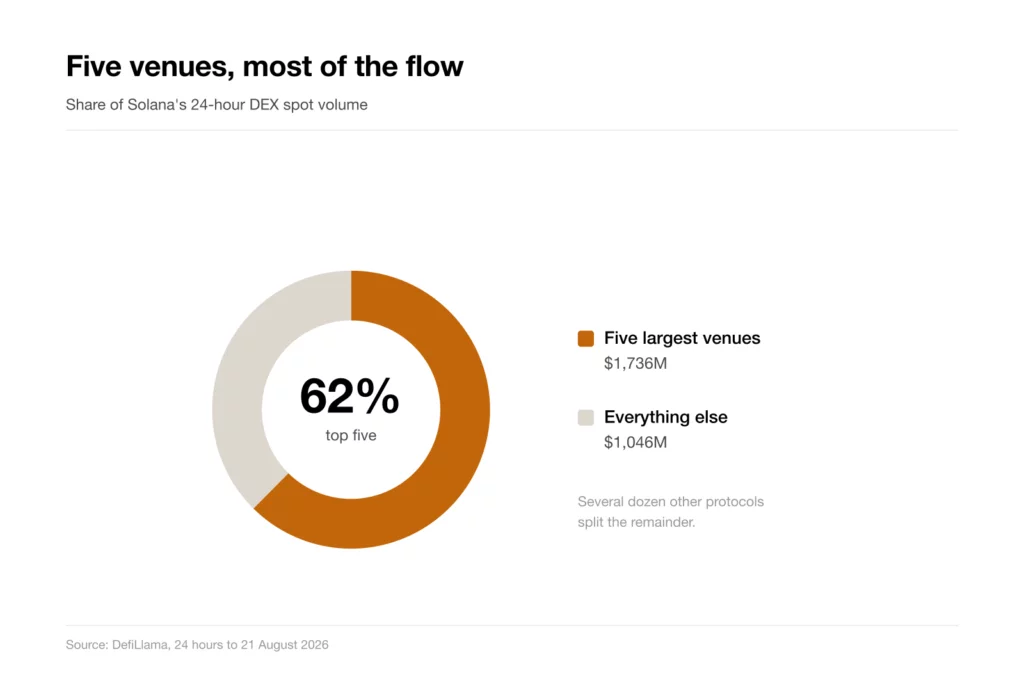
- Five leading venues generated roughly 62% of daily volume, showing liquidity remained highly concentrated overall.
- Low network fees support frequent trading, but priority auctions can raise execution costs during congestion.
- AMMs, order books and hybrid venues offer different tradeoffs involving depth, transparency, execution and custody.
- Traders should examine pair-specific depth, slippage, incentives and custody arrangements before routing large orders onchain.
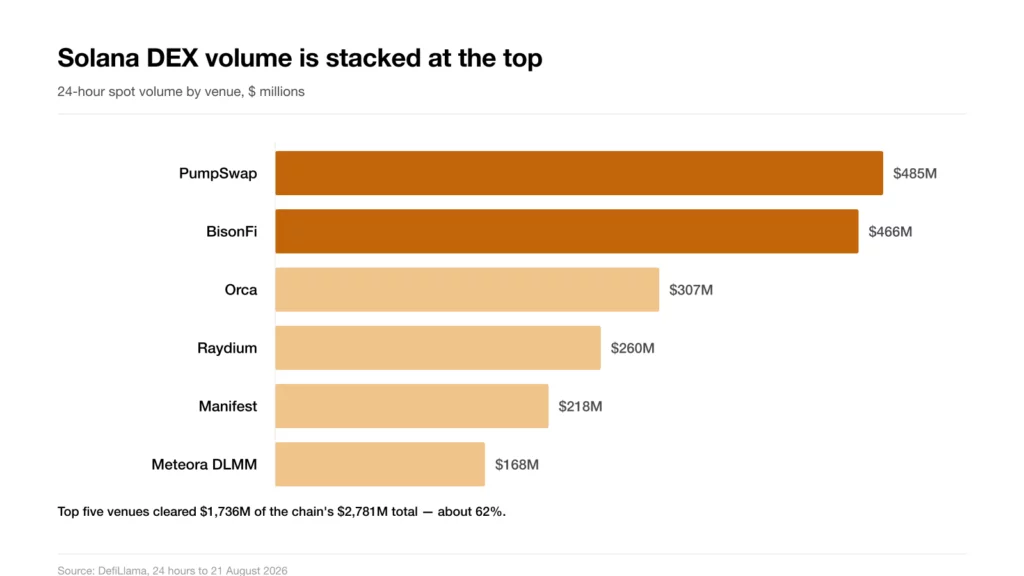
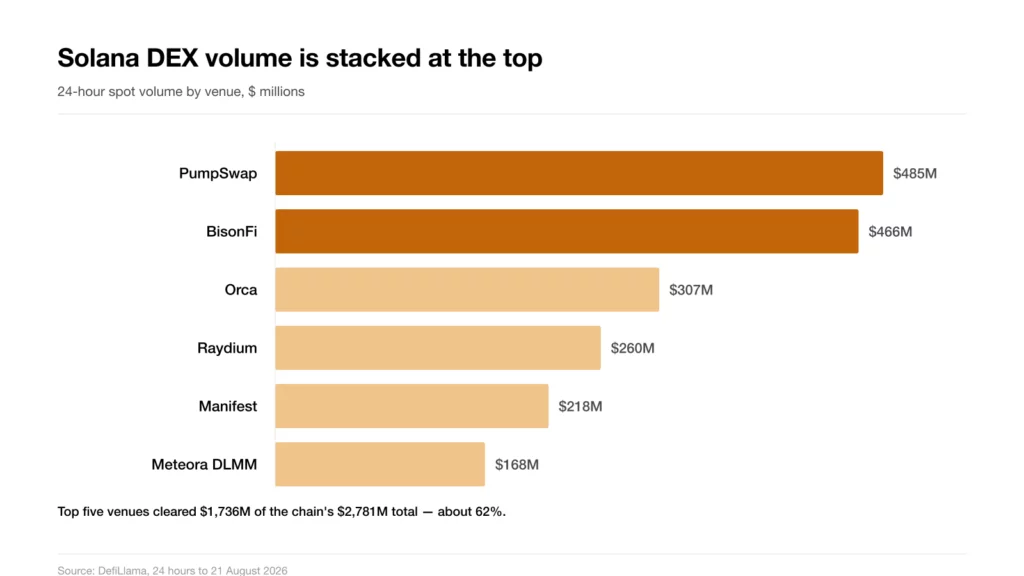
Solana accounted for roughly $2.8 billion. The picture was similar over 30 days: $48.5 billion of the market’s $181.2 billion total, or just under 27%.
That is a large share for one layer-1 network, but the headline figure does not tell traders where they can get a reliable fill.
Aggregate volume measures how much value changed hands, not where usable liquidity sits. On the same day, PumpSwap processed about $485 million, BisonFi $466 million, Orca $307 million, Raydium $260 million and Manifest $218 million. Together, those five venues handled roughly $1.74 billion, or 62% of Solana’s total. Dozens of other protocols shared the remainder. The practical question is therefore not how many pairs a DEX lists. It is whether the venue can absorb a specific order when the trader needs to execute, and how much slippage appears when it cannot. SOL is not limited to Solana-based venues either; it also trades as a perpetual contract on platforms built on other networks, including Arbitrum.
1. The fee model quietly shapes how people trade
Solana’s cost structure is unusual enough to change behavior. Every transaction pays a base fee of 5,000 lamports per signature, with an optional prioritization fee priced in micro-lamports per compute unit, as the protocol documentation lays out. At current prices the base component rounds to fractions of a cent.
Those low costs influence trading in two distinct ways.
The advantage is straightforward. Cheap transactions make frequent retail trading possible where the same strategy could be uneconomical on Ethereum mainnet. Splitting a position into 15 smaller orders adds little network cost.
The drawback becomes clearer during congestion. Cheap failed transactions also make it inexpensive to flood the network. Priority fees can then become the real cost of getting a transaction included, with traders competing in an auction they may not win. Anyone budgeting only for the base fee can face delays or failed execution when timing matters most.
2. Volume charts have three blind spots
Routing can inflate totals. An aggregator may split one order across several pools. Each venue records the portion it fills, while the aggregator may also record the complete trade. The activity is genuine, but adding every reported figure can count the same order more than once.
Incentives can make liquidity look more durable than it is. Volume attracted by token rewards often leaves when those rewards end. A busy pool can become much thinner within a quarter, while historical charts offer little warning.
MEV creates another hidden cost. A large order submitted to a public mempool can attract sandwiching, backrunning and priority-fee competition. The loss does not appear as a separate charge; it appears in a worse execution price.
Onchain volume remains useful, but it should be treated as a starting point rather than a final verdict.
3. Automated market makers and order books are answering different questions
Most of the Solana venues above are variations on the constant-product idea Uniswap popularized, where a pool prices assets against a formula instead of against resting bids and offers, a mechanic the protocol’s own documentation still describes more clearly than anyone else has managed. It works remarkably well for long-tail assets, because a pool can exist for a token nobody would bother quoting by hand.
The limitation is depth. Price impact on an AMM rises as an order consumes more of a pool, and liquidity outside leading pairs can be thinner than the interface suggests. Order books reverse that tradeoff: they can offer stronger execution where market makers are active, but may have little usable depth elsewhere.
Derivatives venues concentrate liquidity differently from spot exchanges. Perpetual platforms focus activity in a smaller group of heavily traded contracts instead of spreading it across thousands of tokens. A BTC or SOL perpetual order book can therefore be deeper than a spot market for the same asset. Some hybrid platforms match orders offchain and settle them onchain, aiming to provide order-book execution without requiring users to give up custody.
4. The decentralization question does not resolve itself
The Bank for International Settlements made an argument back in its December 2021 Quarterly Review that has aged well: DeFi protocols exhibit what the authors called a decentralization illusion, since governance, sequencing and upgrade authority almost always concentrate somewhere identifiable.
Five years later, Solana’s DEX market offers a useful example. Its settlement layer is permissionless, but liquidity remains concentrated, a few aggregators route much of the order flow, and incentive programs controlled by small teams can shape activity. This is not evidence that the network has failed to decentralize. It shows that a decentralized ledger does not automatically create a decentralized market structure.
How the three venue models compare
Venue type
How the price is set
Best at
Where it breaks
AMM pool
A formula against pool reserves
Long-tail tokens nobody quotes by hand
Price impact grows fast with size
On-chain order book
Resting bids and offers
Transparent, verifiable matching
Thin books outside the top pairs
Hybrid perpetual venue
Off-chain matching, on-chain settlement
Depth concentrated in a few contracts
The matching engine is not public
What to check before routing a large order
Check depth, not just volume. Review the order book or pool reserves for the exact pair and model the expected fill at the intended trade size. Two venues with similar daily volume can produce very different results.
Separate protocol fees from network fees. Solana’s network fee may be small, but venue charges, spreads and price impact can still materially change the final cost.
Identify the source of liquidity. Organic market-maker activity can behave differently under stress from liquidity attracted mainly by temporary rewards.
Understand the custody model. Assets held in an exit-ready smart contract present different risks from collateral placed with an intermediary whose balance sheet cannot be inspected. Execution quality does not answer the custody question.
Test the venue against difficult conditions. A market can look deep during calm trading and deteriorate quickly during a sharp hourly move.
Solana’s onchain trading market has earned a large share of decentralized exchange activity. Still, a chain processing $48 billion in monthly volume does not prove that every venue can handle every order. Traders need pair-specific evidence before choosing where to execute.
Trading-volume data: DeFiLlama, retrieved Aug. 21, 2026.
Tether CEO Paolo Ardoino has challenged the Bank for International Settlements’ preference for tokenized bank deposits, arguing that fully reserved stablecoins give users a stronger alternative to money held under fractional reserve banking.
Summary
- Tether CEO Paolo Ardoino challenged the BIS preference for tokenized bank deposits, arguing that fully reserved stablecoins offer users a safer alternative.
- BIS chief Pablo Hernández de Cos said stablecoins face problems with redeemability, interoperability, financial integrity and monetary sovereignty.
- Ardoino questioned why savers would keep money in fractional reserve products when stablecoins can hold reserves in liquid assets such as U.S. Treasuries.
- The debate has reached U.S. lawmakers as banking groups warn that stablecoin rewards could pull deposits from banks and reduce funds available for lending.
The Bank for International Settlements laid out the case for tokenized deposits on Aug. 28, when General Manager Pablo Hernández de Cos told the Jackson Hole Economic Symposium that stablecoins still fall short of several properties needed to function as money at scale. Ardoino responded by questioning why savers would choose bank deposits when stablecoins can hold reserves in highly liquid assets such as U.S. Treasuries.
“BIS is rightfully worried about the fact that stablecoins are exposing the emperor without clothes,” Ardoino said. “Why someone should choose to put his savings into a fractional reserve product while stablecoins are fully reserved?”
Tether CEO challenges the BIS case for tokenized deposits
Hernández de Cos argued that stablecoins face problems with redeemability at par, interoperability and financial integrity, while their use outside the United States can create concerns over monetary sovereignty and digital dollarization.
In the BIS model, tokenized deposits remain liabilities of commercial banks and settle through central bank accounts. De Cos said this structure preserves the “singleness” of money because different bank liabilities remain redeemable at par through central bank settlement.
Stablecoins work differently. A user holding USDT who needs to pay someone accepting only USDC may first need to exchange one token for the other in a secondary market, where prices can deviate from their dollar pegs, particularly during periods of stress.
Public blockchains create another concern for the BIS. Stablecoins can circulate across multiple networks and through self-custody wallets, while moving the same asset between chains can require bridges or other infrastructure. De Cos argued that this structure creates interoperability problems and makes consistent enforcement of anti-money laundering and counterterrorism financing controls more difficult.
Ardoino focused his response on the reserve structure behind the two forms of digital money. The Tether executive argued that stablecoins can be backed almost entirely by liquid reserves, including U.S. government debt, while commercial banks operate under a fractional reserve system in which only part of their liabilities are held in liquid assets.
His comments put the reserve question at the center of a debate that has increasingly divided stablecoin issuers and the banking sector as both compete to move fiat-denominated money onto blockchain networks.
Crypto.news recently examined how a tokenized bank deposit remains on the issuing bank’s balance sheet even after being represented on a blockchain. Unlike stablecoins, customer funds do not move into a separate reserve portfolio and can remain available to support the bank’s lending operations.
Tokenized deposits are moving beyond pilot programs
Banks have started building infrastructure around that model as stablecoins take a larger role in digital payments.
JPMorgan Chase, Bank of America, Citigroup and Wells Fargo are developing a shared deposit token network through The Clearing House, with a launch targeted for the first half of 2027. The planned system would initially give multinational companies access to programmable treasury and cross-border payment services.
SWIFT has pursued a similar route. In July, the financial messaging network launched a blockchain-based shared ledger with 17 major banks, including Citi, HSBC, UBS and BNP Paribas. The system was designed around tokenized bank deposits for round-the-clock cross-border payments.
Custodia Bank and Vantage Bank have taken a different approach by combining the two structures. Their dual-purpose token model is designed to operate as a bank deposit while inside the Hazel network and function as a stablecoin when transferred outside it. The Ethereum-based system has been under testing ahead of a planned fourth-quarter 2026 rollout.
Despite supporting tokenized deposits, Hernández de Cos acknowledged that the model has its own unresolved problems. No multi-bank or cross-jurisdictional ecosystem currently issues tokenized deposits through a fully interoperable framework, he said. Existing systems remain concentrated on permissioned platforms, while some designs resemble bank-issued stablecoins.
The BIS chief said stablecoins and tokenized deposits could ultimately coexist, but argued that tokenized deposits should handle most everyday payments while stablecoins serve more specialized functions.
Stablecoin growth raises the deposit flight question
Ardoino’s criticism comes as the competition for deposits has become part of the U.S. debate over crypto market structure.
Banking groups have repeatedly pushed lawmakers to tighten stablecoin reward provisions in the Digital Asset Market Clarity Act. In July, the American Bankers Association, Independent Community Bankers of America and 76 state banking associations urged Senate leaders to revise Section 404 before the legislation reached the Senate floor.
The groups argued that allowing crypto platforms to provide certain rewards on stablecoin balances could encourage customers to move funds out of traditional bank accounts. Under that argument, deposit losses could leave community banks with less funding available for lending.
Citigroup CEO Jane Fraser repeated the concern in August while supporting passage of the CLARITY Act. Fraser warned that stablecoin rewards could draw deposits away from banks and affect their ability to extend credit.
The dispute partly traces back to the GENIUS Act, which prevents payment stablecoin issuers from directly paying interest or yield to holders. Crypto exchanges and other service providers can still offer some rewards depending on how their programs are structured, leaving lawmakers and banking groups divided over where the restrictions should apply.
Hernández de Cos raised a similar funding issue at Jackson Hole. Stablecoin issuers can increase demand for government debt by placing reserves into Treasury securities, potentially lowering sovereign borrowing costs, he said. At the same time, money leaving commercial bank deposits could increase bank funding costs and eventually raise borrowing costs for households and companies.
Ardoino presented the same movement of funds from the opposite perspective.
“What happens to financial system if people start realizing that stablecoins are safer and move their savings into the better asset class?” he said. “We’re in the Find Out phase.”
USDT remains the largest stablecoin by circulation and has developed a substantial user base outside the United States. Ardoino has repeatedly positioned the token as a dollar-based savings and payments product for markets where access to U.S. dollars or conventional banking services can be limited.
Tether has pursued that market through payment and remittance investments, including its May investment in cross-border platform LemFi, which serves users across African and Asian remittance corridors.
Ardoino said some economies now rely heavily on USDT for both domestic and foreign commerce, while the BIS has warned that increasing use of dollar-denominated stablecoins outside the United States could weaken monetary policy transmission and increase dependence on external monetary conditions.


Disclosure: This article does not represent investment advice. The content and materials featured on this page are for educational purposes only.
A common misconception in the realm of cryptocurrency investment is that making money through mining requires an understanding of complex blockchain technology and the purchase of expensive mining hardware.
However, the launch of FT mining—a cloud mining service—has completely shattered this barrier to entry. Now, even ordinary individuals with no knowledge of mining equipment can easily participate in cryptocurrency mining and generate stable passive income.
For many ordinary users, cryptocurrency mining still sounds like a “high-barrier-to-entry technical job for professional engineers and mining farms.” However, now, through FT mining, even those completely unfamiliar with mining rigs and algorithms, and without the need for hardware or maintenance, can easily participate in mining.
Legitimate and Regulated Cloud Mining Services
Headquartered in England and regulated by the UK Financial Conduct Authority (FCA), FT mining operates in full compliance with the EU’s MiFID II financial regulatory framework, ensuring:
- Transparent and lawful platform operations
- Secure and reliable custody of user funds
- Daily settlement and traceability of mining returns
Furthermore, the platform holds annual security certification from PwC, and its digital asset custody is underwritten by Lloyd’s of London, guaranteeing full protection for user assets even in extreme scenarios. CEO Faye Victoria Thompson stated:
“FT mining aims to enable users to generate stable passive income within a legitimate and secure environment; we prioritize the safety of user funds above all else, regardless of market volatility or technical threats.”
FT mining Cloud Mining Model: No mining hardware required—start with a single click.
Register an Account — Sign up for free and get started immediately
Deposit Crypto Assets — Supports BTC, ETH, USDT, XRP, etc.
Select a Hashrate Contract — Activate mining with one click; earnings calculated automatically
Daily Earnings Payout — Automated settlement for true passive income
Examples of Popular Contracts:
Starter Contract: $100 — 2-day term — Total profit approx. $108
Stable Contract: $800 — 5-day term — Total profit approx. $852.50
Professional Contract: $5,000 — 20-day term — Total profit approx. $6,520
Premium Contract: $36,000 — 35-day term — Total profit approx. $582,448
For further details regarding the contract, please visit the official website.
Comprehensive Fund Security Safeguards
FT mining has built a top-tier security infrastructure:
Multi-signature cold wallets: User funds are stored in regulated cold wallets.
AI risk monitoring system: Real-time analysis of abnormal transactions to block potential risks.
Cloudflare Enterprise Firewall + McAfee Cloud Security Certification: Round-the-clock defense against external attacks.
PwC audits and Lloyd’s insurance: Transparent, traceable funds covered by full insurance.
CTO Lucas Yip emphasizes:
“Our goal is for users to earn returns in a completely secure environment. Security and transparency are FT mining’s unwavering bottom line.”
Real Feedback from Global Users
John, a retired investor from the US:
“Seeing my earnings automatically deposited every day without any hassle gives me the peace of mind to hold long-term.”
Anna, a retiree from Germany:
“A regulated platform, fund insurance, and transparent earnings—FT mining gives me the utmost confidence.”
Elena, an investor from Bulgaria:
“Even when the crypto market is volatile, my daily earnings arrive steadily; it gives me great peace of mind.”
Start Your Passive Income Journey
In today’s rapidly evolving digital economy, seizing innovative investment opportunities is crucial. With its low entry barrier, high transparency, and stable returns, FT mining cloud mining is becoming the preferred path to financial freedom for more and more people.
Whether you are a busy professional, a retiree seeking extra income, or an everyday investor interested in digital currency but lacking a technical background, FT mining offers a simple and reliable passive income solution.
Official Website: https://ftmining.com
App Download: https://ftmining.com/xml/index.html#/app
Customer Service Email: [email protected]
XRP Ledger validators are considering two amendments that would add single-asset vaults and fixed-term lending directly to the network’s core protocol.
Summary
- XLS-65 and XLS-66 remain below the 80% validator threshold required before XRP Ledger mainnet activation.
- Single Asset Vaults would pool one token, while XLS-66 would issue fixed-term uncollateralized institutional loans.
- Ripple joined Clearpool and Cicada as an investor, but does not guarantee the fund’s losses.
- RLUSD would serve as the credit asset, while XRP would pay transaction fees and reserves.
- Activation requires validator support above 80% for two consecutive weeks, leaving the launch date uncertain.
The amendments, XLS-65 and XLS-66, are open for validator voting but have not reached the support required for activation. An amendment must maintain support from more than 80% of trusted validators for two consecutive weeks before it can become active.
Ripple’s validator voted in favor of both amendments in August. However, Ripple cannot approve the changes independently because validators decide whether to support each amendment.
Current support remains well below the activation threshold, according to the XRP Ledger’s amendment records. The percentage can change as validators update their positions, making the threshold and subsequent two-week period more important than any single daily reading.
XRP Ledger lending separates credit from execution
XLS-65 would introduce Single Asset Vaults. These structures would pool one type of asset from multiple depositors and issue vault shares representing their proportional interest in the assets.
A vault could hold XRP, Ripple USD or another supported XRP Ledger asset. The vault manager could then allocate pooled liquidity to lending or other financial services under predetermined rules.
XLS-66 would use that pooled liquidity to fund fixed-term loans. The proposed XRP Ledger lending system relies on off-chain underwriting rather than automatic overcollateralization and liquidation.
Institutions would conduct identity checks, assess borrowers, negotiate loan terms and complete legal reviews outside the blockchain. The network would then record and execute agreed activities such as loan issuance, interest accrual, repayments and defaults.
This structure reduces reliance on application-level smart contracts. It does not eliminate credit, operational or counterparty risk. Depositors could still lose money when borrowers default or when underwriting proves inadequate.
Ripple, Clearpool and Cicada prepare an RLUSD fund
Product development is already taking place while validators consider the amendments. Clearpool is testing an institutional credit product on the XRP Ledger development network.
The planned fund would provide RLUSD-denominated working-capital loans to fintech and payment companies. Cicada Partners would source borrowers, establish lending terms and monitor their financial condition. Clearpool would provide the infrastructure for creating and operating the credit pools.
Ripple will participate as a limited partner alongside other investors. The company is providing capital, but it is not serving as a financial backstop. Ripple would therefore invest on comparable terms and would not guarantee losses suffered by other participants.
The companies have not disclosed the fund’s target size or Ripple’s commitment. As the planned RLUSD credit fund remains in testing, it cannot use the proposed native lending functions on mainnet before both amendments activate.
Clearpool said its integration will use isolated markets managed by independent risk specialists. This approach is designed to prevent a problem involving one borrower or pool from spreading across every lending market.
What the lending vote means for XRP holders
The amendments could create new uses for XRP Ledger assets, but they would not automatically provide yield to every XRP holder. Access would depend on which vaults launch, the assets they accept, their eligibility rules and their underlying borrowers.
Some institutional pools may use permissioned domains and verified credentials. Retail participation is therefore not guaranteed. Each product could impose separate restrictions based on jurisdiction, investor classification and compliance requirements.
RLUSD is expected to serve as the main credit asset in the Clearpool and Cicada fund. XRP would retain its network role by covering transaction fees and account reserve requirements.
XRP Ledger transaction fees are destroyed rather than paid to validators. Greater lending activity could consequently increase XRP fee consumption, but fees are normally very small. The effect on total XRP supply would depend on sustained transaction volume and should not be described as a major source of scarcity before real usage data exists.
XRP traded around $1.06 at the time of writing. No verified price movement could be attributed directly to the latest lending vote.
Security reviews do not remove lending risks
The lending code has undergone formal verification and independent security reviews. Halborn’s re-audit found no critical or high-risk vulnerabilities.
The review identified one medium-risk issue, two low-risk issues and two informational findings. The reported matters were resolved, accepted or acknowledged by Ripple’s engineering team, according to the audit findings.
Those reviews address technical behavior, not whether borrowers will repay their loans. Institutions considering a vault must still evaluate its manager, underwriting standards, first-loss protection, withdrawal rules and exposure concentration.
The next formal milestone is validator approval. If either amendment crosses 80%, it must hold that level for 14 days. Clearpool must also finish its development-network testing before moving its product to mainnet.
A related Federal Reserve master-account application submitted through Standard Custody remains separate from the lending vote. Approval could improve RLUSD settlement infrastructure, but the outcome and timing remain uncertain. BNY continues serving as the primary custodian for RLUSD reserves.


Ontology has temporarily halted mainnet block production after its core developers identified a potential security concern during a routine check, leaving on-chain transactions suspended while validators conduct an emergency review.
Summary
- Ontology has temporarily halted mainnet block production after its core developers identified a potential security concern during a routine security check.
- No confirmed security incident or user asset loss has been identified, with ONT, ONG and other on-chain assets currently considered unaffected.
- On-chain transactions will remain unavailable during the security review, and users have been advised to avoid time-sensitive transactions.
- Ontology has not set a restart time and said block production will resume only after the network has been assessed and deemed safe.
The Ontology Network said in an official announcement that its core development team detected the potential issue during a daily security check and immediately moved to stop block production as a precaution. No security incident has been confirmed, and the team said it has found no evidence that ONT, ONG or other user assets have been lost or compromised.
Ontology mainnet remains paused during security review
With block production stopped, transactions submitted to the Ontology mainnet cannot be processed until network operations resume. The team has not provided an estimated time for the restart and said the review will take priority over restoring the chain quickly.
Ontology described the halt as a preventive measure, distinguishing it from a response to an active attack or confirmed theft. Developers and network validators are reviewing the mainnet and related components to determine whether the potential concern presents an actual security risk.
Users have been told not to move ONT, ONG or other assets because of the announcement. However, the network advised against attempting time-sensitive on-chain transactions while the pause remains in place.
“Block production will remain temporarily suspended,” Ontology said, adding that the network will not restart until it has been “sufficiently assessed and deemed safe to operate.”
The team has not disclosed the technical nature of the potential security concern, which component triggered the review or whether developers have identified a vulnerability requiring a software change.
Ontology said it is working with validators and relevant ecosystem partners during the investigation. A separate announcement will be released before or when block production resumes, after the security assessment and any required upgrades have been completed.
No user asset losses have been identified
The network emphasized that the current investigation has not produced evidence of compromised user funds.
“There is currently no indication of any loss or compromise of user assets,” the team said. “ONT, ONG, and other on-chain assets remain unaffected based on our current assessment.”
The distinction leaves the mainnet in an unusual operational state: the chain is intentionally unable to process transactions, but Ontology has not reported an exploit, unauthorized asset movement or an ongoing attack.
A mainnet is the production blockchain where transactions involving assets with real economic value are recorded. As crypto.news explained in August, production networks depend on protocol software, economic incentives and validator infrastructure to maintain security while processing live transactions.
The Ontology team has chosen to keep transaction processing offline while the potential issue is examined instead of allowing normal block production to continue during the investigation.
Network pauses can prevent new state changes while developers and validators assess a problem, although the specific reason for Ontology’s decision remains limited to the potential security concern disclosed by its developers.
Ontology did not say whether exchanges or other services using the chain would separately restrict ONT or ONG deposits and withdrawals during the review.
A previous Ontology network upgrade produced similar restrictions at the exchange level without involving a reported security incident. In 2022, Binance suspended ONT deposits and withdrawals while supporting an Ontology upgrade, with services scheduled to reopen after the upgraded network was considered stable.
ONT and ONG form Ontology’s dual-token system
Ontology operates with ONT and Ontology Gas, or ONG, as its two native assets. ONT is used within the network’s governance and staking structure, while ONG serves a separate role in its economic model.
The network has changed its staking framework over time. Crypto.news previously reported that Ontology reduced its minimum staking requirement from 500 ONT to one ONT as part of a governance and staking model update. Requirements for candidate nodes seeking to participate in consensus were reduced from 100,000 ONT to 10,000 ONT.
Ontology’s architecture has historically focused on decentralized identity and data infrastructure. The project uses ONT ID as part of that framework, allowing identity information and credentials to be managed through its blockchain infrastructure.
Interest in that part of the ecosystem resurfaced earlier in 2026 as traders focused on digital identity projects. ONT jumped more than 20% on March 30 as market attention turned to the European Union’s eIDAS 2.0 digital identity wallet rollout. The token traded between roughly $0.0568 and $0.0959 during the 24-hour period covered at the time.
The current mainnet interruption concerns the network’s operation, with Ontology’s announcement making no claim that ONT’s token contract, ONG or another on-chain asset has been exploited.
Ontology has not set a restart time
For now, the mainnet will remain unable to produce blocks while developers and validators work through the security review.
Ontology said the duration of the shutdown is undetermined and that it will prioritize a complete examination of the potential risk over speed. Normal block production will resume only after the network has been assessed and the team considers it safe to operate.
Any upgrades found necessary during the investigation would have to be completed before the restart, according to the announcement. The team did not specify whether an upgrade is currently expected or whether the review could end without requiring changes to the network software.
Users therefore do not need to take action with their ONT, ONG or other on-chain holdings based on the information currently available, but transactions requiring mainnet processing will remain unavailable throughout the pause.
Ontology said updates on the investigation will be published through its official channels as more information becomes available. The network plans to issue a separate notice before or at the time operations resume once the security review and any required upgrades have been completed.
Bitcoin traded near $78,400 on Aug. 31 and headed toward its strongest August performance since 2017 after gaining roughly 24% during the month.
Summary
- Bitcoin traded near $78,400 after gaining roughly 24% during August, its strongest August since 2017.
- U.S. spot Bitcoin ETFs attracted $1.92 billion during their strongest weekly inflow since October 2025.
- Crypto derivatives recorded $6.55 billion in short liquidations across two weeks, according to CoinGlass data.
- Treasury will double bond buybacks to $4 billion per operation beginning on September 9.
- Bitcoin must reclaim $80,000 to strengthen momentum, while September jobs data could reset rate expectations.
BTC recovered from approximately $63,000 in mid-August and briefly crossed $80,000 before losing momentum near that level. The rally reversed much of the pressure recorded during the first half of 2026.
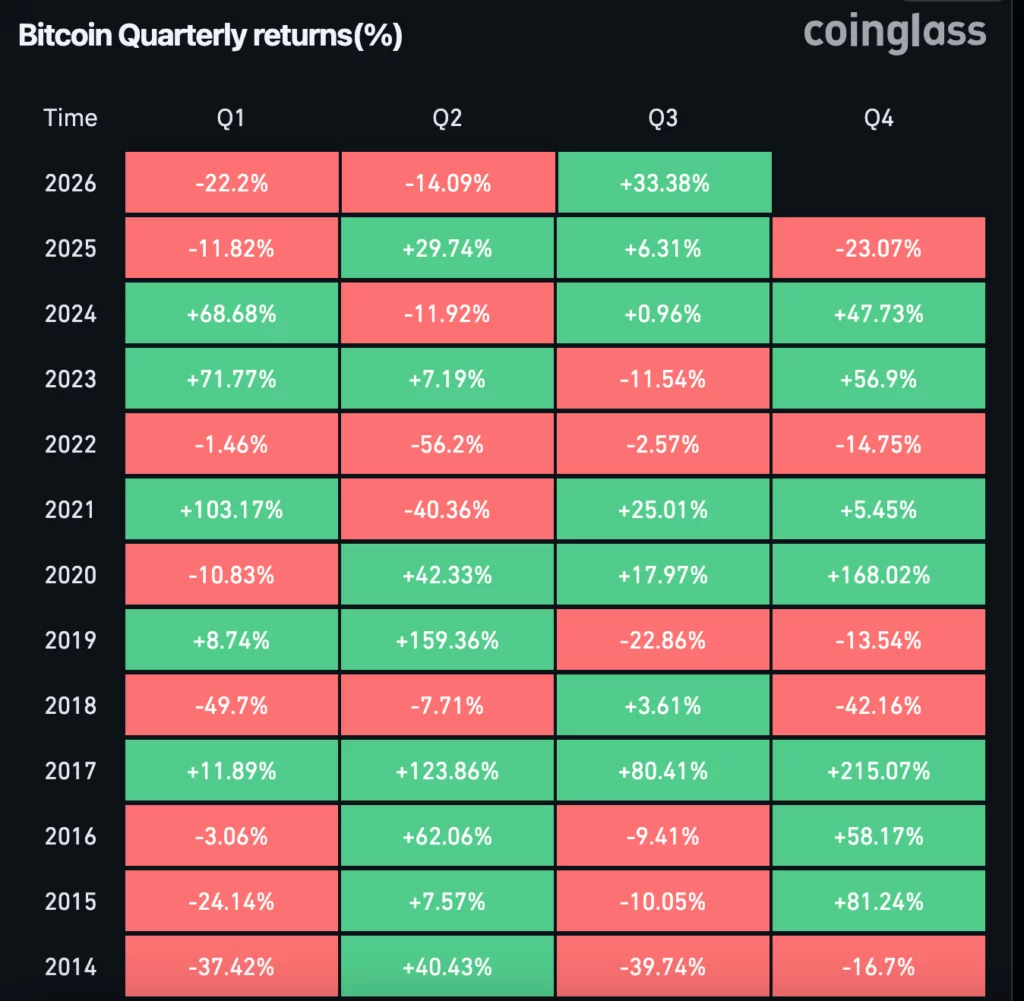
The final monthly return remains subject to Bitcoin’s closing price. Still, current historical data places August 2026 well ahead of every August since the 2017 bull market.
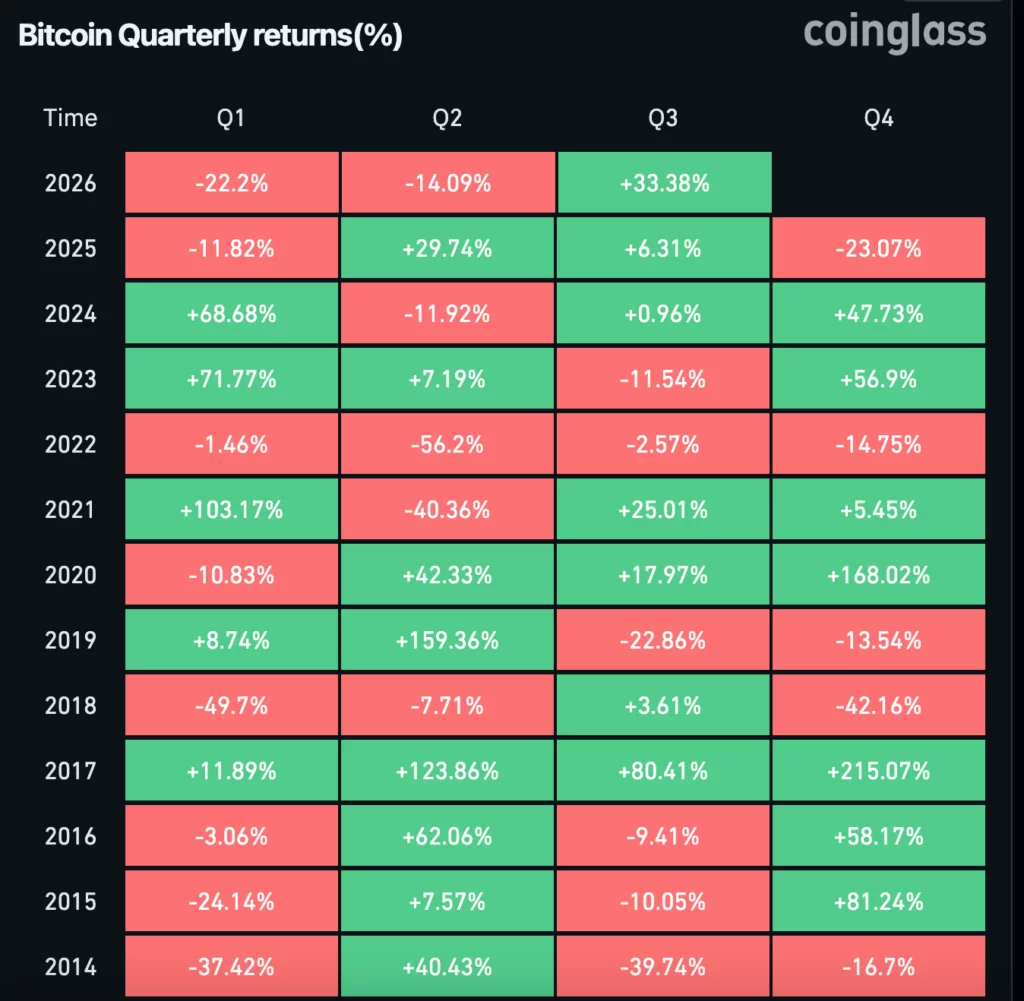
Bitcoin’s third-quarter return stood near 32% at the time of writing. That compares with losses of approximately 22% during the first quarter and 14% during the second, although September’s performance will determine the final quarterly result.
Bitcoin’s August rally reversed a difficult first half
Bitcoin entered August after spending several months under pressure. The cryptocurrency fell toward $58,000 in July before recovering above $60,000 and beginning its sharp late-August advance.
The rally carried BTC beyond $70,000 and eventually above $80,000 for the first time since May. It also pushed the asset above several short-term resistance levels that had restricted previous recovery attempts.
Derivatives positioning amplified the move. Data attributed to CoinGlass showed approximately $9.71 billion in cryptocurrency liquidations across two weeks. Short positions accounted for $6.55 billion, while long liquidations reached $3.16 billion.
Those figures cover the broader cryptocurrency market rather than Bitcoin positions alone. They show that bearish traders absorbed most of the forced closures, but they do not prove that new spot demand caused the entire rally.
As Bitcoin’s 22% advance confronted a demand test, analysts noted that futures open interest measured in BTC had declined. Contained funding rates also suggested short covering contributed to the initial breakout without excessive leveraged long positioning.
ETF inflows provided a clearer demand signal
U.S. spot Bitcoin exchange-traded funds attracted approximately $1.92 billion during the five trading sessions through Aug. 21, according to SoSoValue.
It was their strongest weekly inflow since October 2025. August inflows had reached approximately $2.72 billion by Aug. 24, making the month the strongest of 2026 at that point.
The renewed accumulation followed a difficult period for the products. Spot Bitcoin ETFs recorded heavy redemptions during May and June before investor demand recovered in August.
One session delivered $517 million in net inflows as Bitcoin broke above $70,000. As spot ETF demand strengthened during the breakout, nearly $2.7 billion in bearish cryptocurrency positions was liquidated.
ETF flows provide a more direct measure of regulated U.S. investment demand than futures liquidations. However, daily flows can reverse quickly, making continued September accumulation important for supporting prices near $80,000.
Treasury buybacks shaped the macro backdrop
The U.S. Treasury announced on Aug. 19 that it will at least double its long-end liquidity-support buybacks. Maximum purchases will rise from $2 billion to at least $4 billion per operation.
The expanded program covers Treasury securities in the 10-to-20-year and 20-to-30-year sectors. Operations are scheduled to begin Sept. 9 and continue through Nov. 4, according to the official announcement.
The policy aims to improve trading conditions in parts of the bond market where liquidity has weakened. It is not a direct BTC purchase program, and the Treasury has not described supporting cryptocurrency prices as an objective.
BTC and gold nevertheless rose as bond yields initially declined and the U.S. dollar weakened. Some market participants interpreted the policy as another reason to hold scarce assets, although that explanation remains an analyst view rather than a confirmed causal relationship.
That backdrop has since become less supportive. Federal Reserve Chair Kevin Warsh delivered hawkish remarks at Jackson Hole, prompting markets to raise their expectations for a September interest-rate increase.
Higher rates can strengthen the dollar and increase the opportunity cost of holding assets without yield. These conditions could test whether BTC’s August recovery can survive a less favorable monetary-policy outlook.
Bitcoin faces an $80,000 resistance test in September
Bitcoin ended the month closer to resistance than support. Trader Carl Moon said buyers need to push BTC back above $80,000, warning that failure to reclaim the level could expose the market to a deeper pullback.
Miles Deutscher said the recovery did not resemble a typical “dead cat bounce,” citing Bitcoin’s relationship with gold and increased on-chain activity. However, he questioned whether sufficient external capital was entering the market to sustain the advance.
Fidelity’s Jurrien Timmer said BTC had held the floor of his power-law model and may have satisfied the time component of its four-year correction. The model is an analytical framework, not a guaranteed price signal.
Comparisons with 2017 also require caution. BTC gained 80.41% during the third quarter of 2017 and 215.07% in the fourth. The current market has different liquidity, regulation, derivatives and institutional participation.
The next tests include the Sept. 4 U.S. employment report, Treasury buybacks beginning Sept. 9 and the Federal Reserve’s September decision. Sustained ETF inflows and a confirmed break above $80,000 would provide stronger evidence that August’s rally can continue.
Disclosure: This article does not represent investment advice. The content and materials featured on this page are for educational purposes only.
Crypto World
Catapult Trade Names Its Backers as Total Raised Reaches $6.6 Million Ahead of $PULT TGE
KuCoin Ventures, Oddiyana Ventures, and Venture Vault VC are among the investors behind Catapult Trade, the company confirmed following the close of its fourth funding round.
Summary
- Catapult Trade says four funding rounds raised $6.6 million before its planned PULT token launch.
- KuCoin Ventures, Oddiyana Ventures and Venture Vault VC participated alongside unnamed funds, traders and angels.
- The platform reports over $6 billion in trading volume and $3.3 million in net revenue.
- Catapult targets a fall 2026 token launch, with planned listings and liquidity across multiple blockchains.
- PULT economics will include token buybacks and burns funded by revenue, according to the company.
The disclosure covers backers across four completed rounds totalling $6.6 million, none of which had been named publicly until now.
Catapult Trade runs a consumer trading product that merges trading mechanics, gamification, and provably fair technology. Prices are not sourced from any external market. Each session is generated algorithmically using Geometric Brownian Motion, committed to a public cryptographic hash before trading opens, and revealed once it closes, so that any participant can confirm the chart was never altered mid-session. Halborn and Hashlock have both audited the system independently.
The platform has been live since December 2025 and has cleared more than $6 billion in cumulative trading volume and $3.3M in net revenue ahead of its token launch. Users can create their own tokens and open trading sessions on them. Tokens published to the discovery feed earn their creators a share of trading fees, while private tokens stay visible only to the accounts that made them.
A 1% notional fee on every trade is split between the protocol and the creator, with an additional fee applied to profitable positions. Protocol revenue funds buybacks and burns and feeds a portion back into ecosystem reward pools.
On the funding itself, the Seed round raised $500,000. Alongside the three funds named above, a T1 fund participated whose name cannot be disclosed at this stage, and three early angels joined: Kyle Klemmer, Co-Founder and CMO at Blockstreet, advisor to WLFI and USD1; MacnBTC, a 2017 OG trader; and Aamir Ghai, ex CSO at Manta Network and a mentor at Harvard Blockchain.
The $2.1 million Private round brought in founders of consumer trading businesses. Among them are the founder of LIS Skins, a CS:GO skin marketplace in the $50 million AUM range, and the founder of Trady, a multichain trading terminal. The remaining participants are not being named at this time. A further $400,000 came from 30+ tier 1 traders and analysts in the KOL round, and the Early Public Round closed at $3.6 million on Catapult Trade’s own platform at $0.06 per token. Participants in the current Strategic round will be announced before TGE.
Over the same period, Catapult Trade ran joint campaigns with the Binance, KuCoin, and Gate wallets.
Three products are due before the token launches: Gamified Futures, a gamified prediction market powered by Obsidian, and TradFi & Crypto Classic Futures. The team is targeting a TGE in the fall of 2026, with more than eight centralized exchange listings planned around it. $PULT will be issued as an omnichain asset through LayerZero, with liquidity across BNB Chain, Robinhood, HyperEVM, and others.
Catapult Trade built its user base, volume, and revenue first, and is introducing $PULT to distribute the economics that activity already produces through buybacks and burns.
The full list of investors across all rounds will be disclosed a few weeks prior to the TGE.


Vienna, Austria — August 31, 2026 — Bybit EU, headquartered in Vienna and operating under a MiCAR license granted by Austria’s Financial Market Authority (FMA), has been selected as a recommended alternative for MEXC users based in the Netherlands. This shift follows MEXC’s cessation of operations in the Netherlands in compliance with European regulatory requirements.
“We’re pleased to welcome Dutch users who are looking for a regulated, compliant platform to continue their crypto journey,” said Nazar Tymoshchuk, Regional Country Manager at Bybit. “The MiCAR framework exists to protect European users, and we’re committed to providing a secure, seamless experience for everyone transitioning to Bybit EU.”
MEXC has announced it will no longer serve users in the Netherlands due to the implementation of the Markets in Crypto-Assets Regulation (MiCAR), which requires all crypto-asset service providers operating in the EU to hold appropriate authorization.
“Partnering with Bybit represents an important step in ensuring a secure, compliant, and seamless transition for our users. said Robert MacDonald, Chief Compliance Officer at MEXC. “Bybit’s strong regulatory framework and commitment to user protection give us confidence that our users will continue to receive reliable services and a high standard of care throughout the transition.”
What This Means for Dutch Users
MEXC users in the Netherlands will receive direct communication from MEXC with guidance on next steps and timelines. Those who choose to move to Bybit EU will need to create and verify a new account independently – no accounts or assets will be automatically migrated.
Users are encouraged to complete their transition by October 31, 2026, with final offboarding from MEXC set for November 16, 2026.
About Bybit EU
Bybit EU operates under a MiCAR authorization granted by the Austrian Financial Market Authority (FMA) since May 2025. The platform segregates user funds from company assets as required by regulation, supports EUR top-ups and withdrawals via SEPA and iDEAL, and offers 115+ tokens across 135 trading pairs in both USDC and EUR. The platform is available in Dutch.
Supporting the Transition
To support users through the transition, Bybit EU is offering a welcome package for eligible new registrants, including bonus rewards, preferential trading fees, and cashback on the Bybit Card. Full details and terms will be available on the dedicated landing page.
A dedicated landing page is available for Dutch users with step-by-step guidance, FAQs, and links to customer support.
Users can also join the Dutch-language Bybit community for transfer support:
- Telegram: https://t.me/Bybit_NL
- X (Twitter): https://x.com/BybitNL
Bybit EU
Bybit EU GmbH is an Austrian Crypto-Asset Service Provider (CASP) authorized under the Markets in Crypto-Assets Regulation (MiCAR) in Austria. Bybit EU serves customers across the entire European Economic Area (EEA), with the exception of Malta, via bybit.eu platform.
Bybit EU GmbH is authorized to offer the following services:
– custody and administration of crypto-assets on behalf of clients;
– exchange of crypto-assets for funds
– exchange of crypto-assets for other crypto-assets
– placing of crypto-assets; and
– transfer services for crypto-assets on behalf of clients.
Bybit EU GmbH is neither the operator of a trading platform for crypto-assets nor provides investment advice.
Media Contact: press@bybit.eu
Disclaimer: This press release is provided for informational purposes only and does not constitute investment advice or an offer to buy or sell digital assets. Investing in crypto-assets is associated with risks, including high volatility and the potential loss of capital. Inform yourself thoroughly about the risks before making an investment decision. The products and services mentioned herein are subject to applicable laws and regulations in the relevant jurisdictions and may not be available in certain regions.
The post Bybit EU Partners with MEXC to Support a Seamless User Transition in the Dutch Market appeared first on BeInCrypto.

Games Inbox: Are retro video games becoming more popular?
Global Market Today: Asian bonds fall as geopolitical risks lift oil, yields

Trump Let Him Out of Prison, Now He's Banned for Life From Trading





-

 Crypto World6 days ago
SpaceX stock could rise 75% to $240, JPMorgan says
-

 Fashion3 days ago
Weekend Open Thread: Maeve – Corporette.com
-

 Crypto World4 days ago
Bitcoin’s 22% rally now needs real demand to outlast Treasury liquidity boost
-

 Crypto World6 days ago
Warsh Jackson Hole keynote puts financial innovation first
-

 Business4 days ago
Salesforce Stock Soars 19% as Blowout Earnings and Agentforce AI Growth Silence Software Skeptics
-

 Crypto World5 days ago
Elon Musk Grok Bot Promise: We Will Make You Whole if AI Loses Your Money
-

 Crypto World6 days ago
Did Trump Just Move SpaceX Stock With One Truth Social Post?
-

 Business4 days ago
Apple Confirms September 9 Keynote and Reveals Its Full Pre-Order Schedule
-

 Business3 days ago
Onto Innovation Stock: AI’s Next Bottleneck Is Yield (NYSE:ONTO)
-
 NewsBeat5 days ago
Lindsay Clancy jury braces for closing arguments as judge tells court: ‘You’ve heard all the evidence’ – Live updates
-

 Business6 days ago
Walmart takes aim at younger shoppers with new fashion brand
-

 Crypto World3 days ago
Bitcoin price tests $82K resistance as Brandt stays long
-

 Business6 days ago
Thailand’s Eastern Economic Corridor Capital City (EECiti): Key Developments and Investment Opportunities
-
 Crypto World5 days ago
NVIDIA revenue hits $96.2B as AI demand doubles
-

 Business3 days ago
iPhone 18 Pro Pre-Orders Could Shift to Saturday as Apple Reportedly Avoids September 11 Anniversary
-

 NewsBeat6 days ago
Trump’s trade truce with China faces test with Iran effort
-
 Crypto World5 days ago
Nvidia Q2 Earnings Reveal $96.2 Billion Beat, So Why Is NVDA Falling?
-
 Tech5 days ago
Claude Cowork gets its own browser that doesn’t touch your tabs, bookmarks, or saved passwords
-
 Crypto World4 days ago
Truflation calls for Fed rate cut after PCE forecast
-
 Tech2 days ago
Hugging Face built a $4.5 billion empire on free AI models. Now Nvidia is buying it for $12.9 billion
You must be logged in to post a comment Login