

Crypto World
South Korea to review crypto seizure practices after security lapses



South Korea’s finance minister has pledged reforms to strengthen how government agencies manage seized cryptocurrency, following a digital asset information leak involving the National Tax Service.
Summary
- South Korea’s finance minister announced a full inspection of digital assets held by public institutions through seizure and tax enforcement.
- The review follows a National Tax Service data leak and past incidents where police lost access to seized Bitcoin due to custody failures.
- Authorities plan to strengthen digital asset security management and implement safeguards to prevent future breaches.
Seized Bitcoin under scrutiny as South Korea tightens digital asset controls
In a statement posted on social media, the minister said the government will work with the Financial Services Commission and the Financial Supervisory Service to conduct a full inspection of digital assets held by public institutions through legal enforcement measures such as seizures from tax delinquents.
The review will assess the current status and management practices of those holdings and introduce measures to prevent future incidents, including tighter digital asset security controls.
“Together with relevant agencies such as the Financial Services Commission and the Financial Supervisory Service, the government will inspect the current status and management practices of digital assets held and managed by government and public institutions through seizure and other enforcement measures,” Koo said on X.
The minister clarified that the government does not actively invest in or hold cryptocurrency beyond assets acquired through legal enforcement processes.
The move comes after past security lapses raised concerns about how authorities safeguard confiscated crypto. South Korean police lost access to Bitcoin seized in 2021 after relying on a third-party custodian without maintaining control of private keys, exposing weaknesses in custody oversight.
The issue only came to light following an internal probe, drawing criticism over law enforcement’s digital asset handling procedures.
Authorities later arrested two suspects accused of stealing Bitcoin from wallets linked to seized assets, further highlighting vulnerabilities in state-managed crypto storage.
With digital asset seizures becoming more common in tax enforcement and criminal investigations, the latest review signals an effort to standardize custody practices and reinforce accountability. The government’s inspection is expected to evaluate storage methods, access controls, and inter-agency coordination to reduce operational risks tied to holding volatile and technically complex assets.
The finance minister said reforms would be implemented promptly once the review is complete, aiming to restore confidence in the state’s ability to securely manage seized digital assets.

By Omkar Godbole (All times ET unless indicated otherwise)
The conflict between U.S., Israel and Iran remains the day’s biggest story as the attacks intensify and spread.
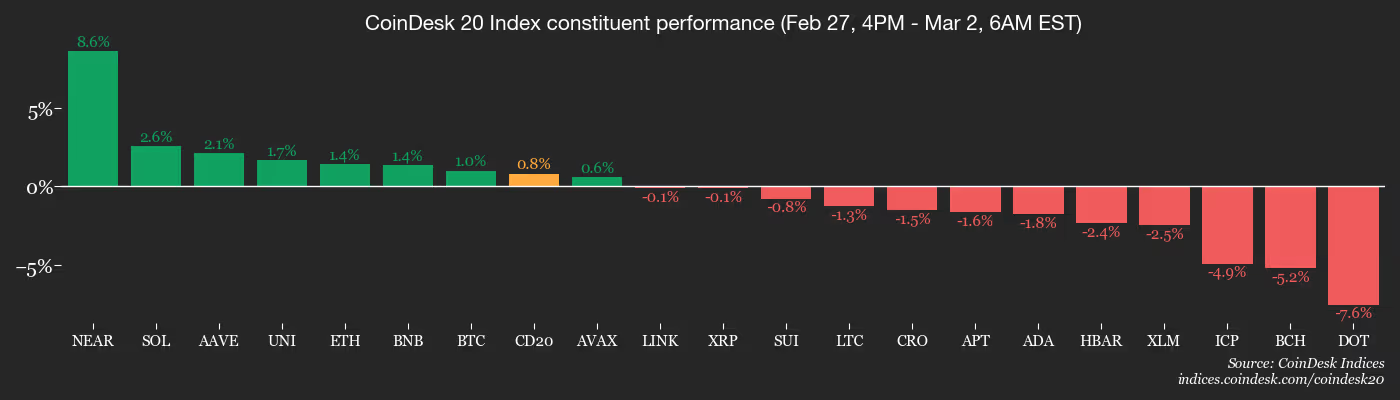
Markets reacted as they typically do: by de-risking and sending oil prices higher. Bitcoin dropped to $66,300, down 0.5% over 24 hours, having hit a high of $68,000 over the weekend. The CoinDesk 20 Index fell over 2%, signaling broader losses in the crypto market and futures tied to the S&P 500 index lost 1%.
Looking past the headlines and panic, the war could only strengthen the “debasement trade,” a strategy in which investors rotate into scarce-supply assets like gold and bitcoin in anticipation of a decline in the value of fiat (paper) currencies.
Governments in the U.S. and elsewhere already owe more than they generate in economic growth. Their finances will only worsen the longer the war drags on. In such situations, governments don’t collect enough in taxes. Instead, they force central banks to “print money” through bond purchases or quantitive easing (QE) to monetize debt. This floods fiat supply and dilutes purchasing power. Hello debasement.
Traders front-run that process by loading up on store-of-value assets like gold and BTC. The yellow metal has been on a tear for over a year mainly on debasement flows. BTC did not participate back then. But now, having nearly halved to under $67,000 since October, it looks oversold. The possibility of the debasement trade catalyzing a bounce in the largest cryptocurrency cannot be ruled out.
Besides, historically the Fed turns dovish with liquidity easing during geopolitical stress, supporting asset prices, as Maelstrom Fund’s CIO Arthur Hayes noted in his blog post.
Let’s see how things unfold. In the meantime traders need to watch headline risks and oil upswings. Stay alert!
Read more: For analysis of today’s activity in altcoins and derivatives, see Crypto Markets Today
What to Watch
For a more comprehensive list of events this week, see CoinDesk’s “Crypto Week Ahead“.
- Crypto
- March 2: SuperRare to release Delirium, a new collection by artist Xer0x
- March 2: Mantra’s OM to change to MANTRA with a 1:4 coin split as the MANTRA Chain upgrades from v6 to v7.
- Macro
- March 2, 10:00 a.m.: U.S. ISM manufacturing PMI for February est. 52.3 (Prev. 52.6)
- Earnings (Estimates based on FactSet data)
- March 2: Riot Platforms (RIOT), post-market, -$0.32
- March 2: Core Scientific (CORZ), post-market, -$0.18
Token Events
For a more comprehensive list of events this week, see CoinDesk’s “Crypto Week Ahead“.
- Governance votes & calls
- PoolTogether DAO is voting to manually resubmit and execute the remaining actions for the PTBR-35 Governance Shutdown after a previous execution error. Voting ends March 2.
- Angle DAO is voting to orderly wind down the EURA and USDA stablecoins, providing users a one-year 1:1 redemption period followed by a final settlement airdrop. Voting ends March 2.
- GMX DAO is voting to transition to a defined leadership model by hiring a CEO with performance-tied compensation and forming an interim leadership committee to guide the restructuring. Voting ends March 2.
- Unlocks
- Token Launches
- March 2: Dovu (DOVU) to be listed on Kraken.
Conferences
For a more comprehensive list of events this week, see CoinDesk’s “Crypto Week Ahead“.
Market Movements
- BTC is up 0.98% from 4 p.m. ET Friday at $66,194.78 (24hrs: -0.35%)
- ETH is up 1.48% at $1,950.67 (24hrs: -1.63%)
- CoinDesk 20 is up 0.78% at 1,916.46 (24hrs: -1.11%)
- Ether CESR Composite Staking Rate is up 1 bp at 2.85%
- BTC funding rate is at -0.0011% (-1.2147% annualized) on Binance

- DXY is up 0.64% at 98.23
- Gold futures are up 3.03% at $5,406.80
- Silver futures are up 2.64% at $95.75
- Nikkei 225 closed down 1.35% at 58,057.24
- Hang Seng closed down 2.14% at 26,059.85
- FTSE is down 0.78% at 10,825.36
- Euro Stoxx 50 is down 1.89% at 6,022.64
- DJIA closed on Friday down 1.05% at 48,977.92
- S&P 500 closed down 0.43% at 6,878.88
- Nasdaq Composite closed down 0.92% at 22,668.21
- S&P/TSX Composite closed down 0.47% at 34,339.99
- S&P 40 Latin America closed down 0.82% at 3,741.78
- U.S. 10-Year Treasury rate is up 0.4 bps at 3.966%
- E-mini S&P 500 futures are down 1.04% at 6,817.25
- E-mini Nasdaq-100 futures are down 1.42% at 24,650.00
- E-mini Dow Jones Industrial Average Index futures are down 1.11% at 48,458.00
Bitcoin Stats
- BTC Dominance: 58.63% (0.22%)
- Ether-bitcoin ratio: 0.02944 (-0.18%)
- Hashrate (seven-day moving average): 1,068 EH/s
- Hashprice (spot): $29.01
- Total fees: 2.55 BTC / $169,782
- CME Futures Open Interest: 109,280 BTC
- BTC priced in gold: 12.2 oz.
- BTC vs gold market cap: 4.42%
Technical Analysis

- The chart shows ether’s daily price swings with Bollinger bands, which are volatility bands placed two standard deviations above and below the 20-day simple moving average of the price.
- The gap between the bands has shrunk to $226, the narrowest since June 2025.
- Volatility typically booms when bands narrow, which means the token could soon see big price moves in either direction.
Crypto Equities
- Coinbase Global (COIN): closed on Friday at $175.85 (-2.88%), -2.42% at $171.60 in pre-market
- Circle Internet (CRCL): closed at $83.44 (-4.32%), -3.46% at $80.55
- Galaxy Digital (GLXY): closed at $20.59 (-6.15%), -2.19% at $20.14
- Bullish (BLSH): closed at $31.39 (-4.09%), -3.73% at $30.22
- MARA Holdings (MARA): closed at $8.94 (+5.80%), -1.23% at $8.83
- Riot Platforms (RIOT): closed at $16.29 (-4.68%), -2.70% at $15.85
- Core Scientific (CORZ): closed at $16.97 (-5.62%)
- CleanSpark (CLSK): closed at $9.95 (-4.69%), -2.01% at $9.75
- CoinShares Valkyrie Bitcoin Miners ETF (WGMI): closed at $39.88 (-5.43%), -3.61% at $38.44
- Exodus Movement (EXOD): closed at $10.20 (-2.39%), -2.25% at $9.97
Crypto Treasury Companies
- Strategy (MSTR): closed at $129.50 (-2.92%), -0.39% at $129.00
- Strive (ASST): closed at $7.94 (-3.05%), -2.39% at $7.75
- SharpLink Gaming (SBET): closed at $6.82 (-5.41%), +0.44% at $6.85
- Upexi (UPXI): closed at $0.66 (-12.88%)
- Lite Strategy (LITS): closed at $1.13 (-0.88%)
ETF Flows
Spot BTC ETFs
- Daily net flows: -$27.5 million
- Cumulative net flows: $54.78 billion
- Total BTC holdings ~1.27 million
Spot ETH ETFs
- Daily net flows: -$43 million
- Cumulative net flows: $11.63 billion
- Total ETH holdings ~5.7 million
Source: Farside Investors
While You Were Sleeping
- Trump says Iran war may last ‘four weeks or less’ as strikes escalate (Euronews): Trump says the Iran war could last four weeks or less as U.S. and Israeli forces continue their strikes in Iran, which is responding with hits on Gulf states, Israel and U.S. targets.
- New Iranian strikes reported across region, including in Saudi Arabia, as US planes crash in Kuwait (BBC): New Iranian strikes were reported across the Middle East, with explosions in Bahrain, Dubai and Saudi Arabia.
- U.S. equity futures fall in pre-market trading as oil, gold retreat from highs (CoinDesk): U.S. equities fell in pre-market trading. The Invesco QQQ ETF declined 1.5%. A Saudi Arabia oil refinery was hit by Iran, pushing WTI crude oil as high as $75 per barrel. Gold rallied more than 2% to $5,400 per ounce.
- Hedge funds, insurers rush to gauge exposure as Iran spirals (Bloomberg): Hedge funds, banks and insurers rushed to size up their exposure to the Middle East after weekend attacks on Iran fueled chaos across the region.
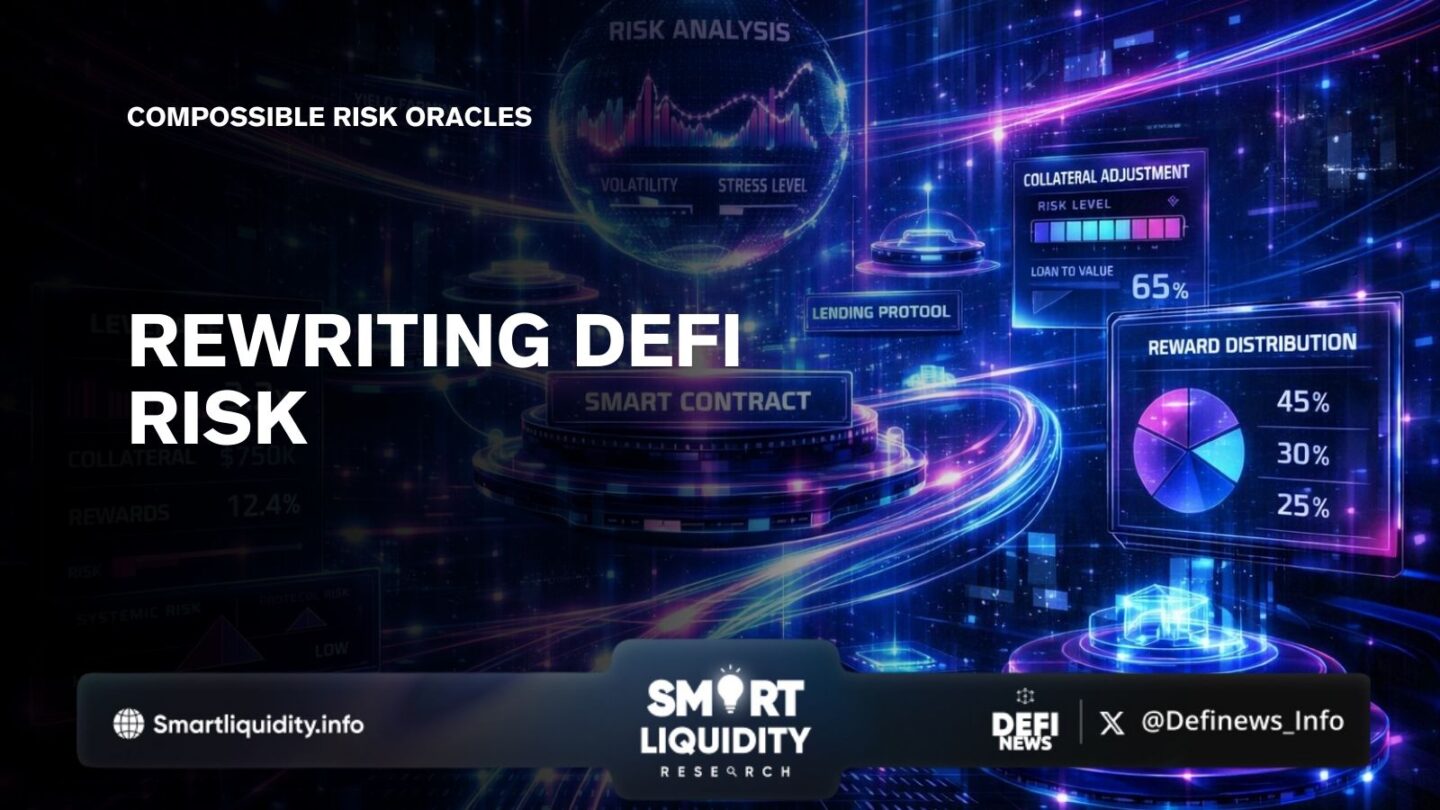
In the current DeFi landscape, conversations almost always orbit around yield optimization, governance mechanics, or the scaling capabilities of layer-2 solutions. Yet one critical piece of infrastructure remains largely overlooked: risk oracles. While price oracles and data feeds have become standard tools, the notion of composable risk oracles—systems that dynamically quantify and communicate both systemic and protocol-specific risk across multiple platforms—is still in its infancy.
What Are Composable Risk Oracles?
A composable risk oracle is more than a price feed. It aggregates real-time data from across the DeFi ecosystem—borrowing/lending metrics, leverage exposure, liquidity depth, liquidation history, protocol governance signals, and even cross-chain activity—to produce standardized risk signals. These signals are then usable by any smart contract or protocol, enabling dynamic risk management instead of static, one-size-fits-all rules.
Imagine a lending protocol that no longer sets fixed collateralization ratios but instead adjusts them continuously based on the asset’s aggregated risk score. Or a yield aggregator that modifies reward rates according to the systemic risk of the pools it taps into. Risk oracles allow protocols to react proactively, not reactively, to volatility or emerging threats.
Why DeFi Needs Them
The current ecosystem assumes either that token price alone drives risk or that risk is manually managed by developers or governance processes. This has clear limitations:
-
Systemic Blind Spots: Individual protocols may look safe in isolation, but become fragile when interdependencies are ignored.
-
Slow Reaction: Manual updates or governance votes lag behind market realities, leaving funds exposed.
-
Inefficient Capital Allocation: Overly conservative or overly aggressive parameters reduce yield efficiency and user participation.
Composable risk oracles provide a single, unified “risk layer” that protocols can plug into, enabling smarter leverage, collateral, and incentive designs that respond to real-time ecosystem dynamics.
A Vision for DeFi with Risk-Aware Protocols
Picture this: a cross-chain DeFi ecosystem where protocols continuously query risk oracles to:
-
Adjust collateralization ratios based on the health of underlying assets.
-
Scale leverage limits according to current market volatility and systemic exposure.
-
Dynamically modulate reward rates to incentivize safer behavior during periods of high stress.
This would turn DeFi from a reactive landscape, where users and protocols chase yield at the risk of systemic failure, into a self-regulating, adaptive financial network. Essentially, risk moves from the shadows into the core protocol logic.
Challenges and Opportunities
Implementing composable risk oracles is non-trivial. Key challenges include:
-
Data aggregation across chains and platforms without introducing latency or oracle manipulation risks.
-
Standardizing risk metrics so diverse protocols can interpret and act upon them consistently.
-
Governance coordination is especially important in decentralized systems where incentive alignment is complex.
Yet the upside is enormous. Risk oracles could underpin capital-efficient DeFi, unlock higher-leverage yet safer markets, and even help regulators or insurance protocols quantify systemic exposure in real time.
Conclusion
The DeFi ecosystem has made leaps in tokenization, yield, and scaling—but risk remains the silent variable. Composable risk oracles have the potential to fundamentally transform how protocols manage risk, aligning incentives and protections in real-time, dynamically. They could become as indispensable to DeFi as price oracles are today—turning a collection of isolated protocols into a coherent, resilient financial network.
DeFi’s next frontier may not be more yield—it may be smarter, composable risk.
REQUEST AN ARTICLE

Hong Kong and Shanghai authorities unveiled a joint plan to deepen blockchain-enabled collaboration in trade finance and cargo documentation, signaling a practical shift toward digital infrastructures for cross-border commerce. The memorandum of understanding, signed on March 2, 2026, brings together the Hong Kong Monetary Authority (HKMA), the Shanghai Data Bureau (SDB), and the National Technology Innovation Center for Blockchain (NTICBC) to explore a blockchain-based cross-border platform that would interlink trade data, electronic bills of lading, and associated financial applications as part of HKMA’s Project Ensemble. Officials framed the move as a concrete step toward more efficient, transparent and regulatorily sound trade workflows, with pilots and research guiding the rollout.
Key takeaways
- HKMA, SDB, and NTICBC formalize cooperation to digitize cargo trade and finance via a blockchain-driven cross-border platform.
- The project aligns with HKMA’s Project Ensemble and aims to integrate trade data, electronic bills of lading, and financial services within a unified digital rails framework.
- The initiative leverages the Commercial Data Interchange (CDI), HKMA’s blockchain-based data infrastructure launched in 2022 to enable institutional access to corporate data for lending and financing.
- Project CargoX is expected to play a role in strengthening trade and cargo data capabilities for financing and related services.
- Separately, Hong Kong is pursuing tax concessions for digital assets, proposing to broaden qualifying investments for funds and family offices, with potential exemptions on profits if approved.
Tickers mentioned:
Market context: The MoU arrives amid a broader push to modernize financial infrastructure in Asia, with Hong Kong positioning itself as a hub for digital finance and cross-border tokenized services, and Shanghai advancing its fintech ambitions within the broader mainland regulatory framework.
Sentiment: Neutral
Price impact: Neutral. The announcement describes strategic cooperation and policy considerations rather than immediate market moves.
Trading idea (Not Financial Advice): Hold. The collaboration signals long-term structural changes in trade finance infrastructure rather than short-term price triggers.
Market context: The plan sits at the intersection of regulatory clarity, digitization of trade finance, and growing interest in tokenized and data-driven financial services, within a macro environment of ongoing digitization and cross-border coordination in the Asia-Pacific region.
Why it matters
The memorandum underscores a concerted effort by two of Asia’s largest financial centers to reimagine how trade and finance data move across borders. By pursuing a blockchain-enabled cross-border platform, the partners aim to reduce paperwork, shorten settlement times, and improve data integrity for cargo finance. The initiative is designed to harmonize digital records with traditional documents like bills of lading, marrying the reliability of paper-based processes with the efficiency of digital ledgers. In practice, a platform of this kind could lower the operational friction that has historically dogged freight finance, where misaligned documents and slow reconciliation can stall shipments and funding cycles.
On the technical side, the collaboration will leverage the HKMA’s CDI, a blockchain-based financial data infrastructure launched in 2022 to give institutional lenders access to a broader set of corporate data. CDI is already being used to streamline lending decisions by consolidating disparate data sources, and its extension into trade finance could yield faster underwriting and more accurate risk assessment for shipments and financing arrangements. The plan also references Project CargoX, an HKMA initiative intended to strengthen data capabilities across cargo and trade workflows to support financing and related services. Taken together, the effort signals a shift from standalone digital pilots toward interoperable, end-to-end digital rails that can support a wider ecosystem of trade-related financial products.
“We look forward to driving innovative application of digital technology in areas such as cargo trade and finance, promoting joint achievements in digital innovation, exploring a digital infrastructure that links Shanghai and Hong Kong, promoting digitalisation of trade finance.”
The officials framing the MoU emphasized that the collaboration is not merely a theoretical exercise but a milestone in building practical, data-powered digital infrastructure. In remarks from the Shanghai Data Bureau, the partnership was described as a meaningful step toward data-powered, innovation-driven development, with the ambition of creating a secure, efficient, and open digital ecosystem for cross-border trade. By aligning Shanghai’s data capabilities with Hong Kong’s financial services ecosystem, the parties hope to demonstrate how a regulated, standards-based, and transparent approach to data can improve outcomes for traders and financiers alike.
Beyond the cross-border platform itself, the policy dimension of the announcement signals a broader regulatory openness to digital assets as a legitimate investment category. In parallel to the MoU, Hong Kong’s government laid out a policy path to make its tax concessions more attractive to investment funds and family offices by expanding qualifying investments to include digital assets. If the proposal passes through the legislative process, profits from digital assets held within these investment structures could qualify for tax exemptions, subject to approval. This element complements the tech push by creating a more favorable fiscal environment for capital deployment into digital asset strategies, potentially drawing more global fund participants to Hong Kong as a gateway to the region’s digital economy.
Taken together, the announcements reflect a broader regional strategy: to blend cutting-edge digital infrastructure with a clear, asset-backed regulatory framework that can support both traditional finance and newer digital assets. The MoU’s emphasis on data interoperability and risk-aware automation—paired with a thoughtful tax policy—suggests policymakers are seeking a stable yet forward-looking path for the digitization of trade and finance in a way that can be scaled and exported to other markets in the region.
What to watch next
- Progress of pilot deployments or go-live plans for the cross-border platform under Project Ensemble, including milestones and timelines for the joint research program.
- Results and findings from CDI-enabled pilots in trade finance, and how cargo data integrates with eBLs and financing workflows.
- Further details on Project CargoX’s role, timelines for its adoption, and how it interfaces with existing trade-data standards.
- Regulatory and legislative updates on the digital assets tax concessions, including timing of any approvals from the Legislative Council Financial Affairs Committee.
Sources & verification
- Official MoU announcement from info.gov.hk describing the HKMA–SDB–NTICBC collaboration on cross-border trade data and Project Ensemble.
- HKMA – Commercial Data Interchange (CDI) documentation and its role in institutional access to corporate data since 2022.
- HKMA – Project CargoX description for enhancing cargo and trade data capabilities in financing.
- Remarks by Hui Ching-yu on digital asset concessions, including the Legislative Council Financial Affairs Committee meeting (P2026030200210).
Hong Kong–Shanghai cross-border blockchain initiative: what it means for markets and users
The collaboration represents a shift from isolated pilots toward integrated, governance-aligned digital rails that can support a broader set of trade-finance products. By weaving together trade data, electronic bills of lading, and financing tools within a blockchain framework, the partnership seeks to reduce friction in invoicing, risk assessment, and settlement—benefits that could resonate across supply chains and the banks that finance them. The emphasis on using CDI as the backbone for data access underscores a belief in regulated, auditable data flows as a bedrock for confidence in digital trade structures. If successful, the cross-border platform could serve as a model not only for Hong Kong and Shanghai but for other hubs looking to harmonize trade data standards with financial services in a standards-based, interoperable manner.
From a policy standpoint, the digital asset tax concessions reflect a recognition that financial technologies and crypto-adjacent assets are increasingly relevant to institutional investment. While the policy is still subject to legislative approval, the proposal indicates a willingness to create incentives for funds and family offices to allocate to digital assets, potentially accelerating institutional exposure to this broader asset class. The policy, paired with the MoU’s focus on infrastructure, positions Hong Kong as a testbed for regulated digital rails that can support both traditional financing and newer digital-asset strategies, all within a framework designed to promote transparency and governance.
In the broader market context, these developments occur amid growing interest in tokenization, data-centric finance, and cross-border fintech collaboration across Asia. While actual market prices for assets will reflect a multitude of macro and idiosyncratic variables, the signaling value of such coordinated public-private efforts is meaningful: they indicate a pathway toward more efficient trade finance channels, enhanced data privacy and security, and a regulatory posture that seeks to balance innovation with oversight.


Around 46% of BTC, or 9.09m coins, sit at a loss in early 2025, nearing 2022 bear‑market loss concentrations after the 2024–2025 rally unwound.
Summary
- About 9.09m BTC, roughly 46% of the 19.8m circulating supply, are below their last on‑chain transaction price, the second‑highest loss reading since mid‑2022’s ~10m‑coin peak.
- Previous cycle lows saw 50–60% of BTC supply in loss; current levels mirror late‑2022 conditions but at much higher absolute prices, as many 2024–2025 entrants are now underwater.
- CryptoQuant data show net realized profits flipping to net losses since late 2025, with holders realizing up to 69k BTC in aggregate losses, resembling the 2021–2022 bull‑to‑bear transition
Approximately 9.09 million Bitcoin (BTC), representing roughly 46% of the cryptocurrency’s circulating supply, is currently held at a loss as of early 2025, according to data from CryptoQuant.
The figure marks the second-highest loss concentration recorded in CryptoQuant’s dataset spanning from July 2020 through early 2026, falling just below the peak reached during the 2022 bear market.
The BTC Supply in Profit/Loss chart from CryptoQuant displays coins held at a loss as a negative figure, with the current reading of negative 9.09 million coins approaching the deepest loss concentration visible on the chart. That record was set in mid-2022, when approximately 10 million coins were underwater as Bitcoin fell following the Luna and FTX contagion events.
The circulating supply of Bitcoin totals approximately 19.8 million coins, meaning nearly half of all Bitcoin that has moved on-chain is currently held below its last transaction price.
A key distinction separates the current period from the 2022 bear market. While a comparable number of coins were held at a loss during both periods, Bitcoin’s absolute price level remains significantly higher now than in 2022. The current loss concentration reflects holders who entered the market during the 2024-2025 rally and are now underwater, according to the data.
High supply-in-loss readings create specific market dynamics, according to market analysts. Holders facing losses experience pressure to either sell or maintain positions through corrections. Those with the highest cost basis relative to current prices typically exhibit lower conviction in long-term recovery.
The 2022 period provides a historical reference point. The supply-in-loss figure peaked near 10 million coins in late 2022 before declining as the market bottomed and new buying brought coins back into profit. That decline from peak loss concentration preceded the sustained price recovery that extended through 2023 and 2024.
Whether the current 9.09 million coin reading represents a peak depends on price stabilization at current levels or further decline, according to analysts tracking the metric.
Crypto is built on a powerful idea: align incentives correctly, and rational actors will secure the system.
Most protocol design rests on this belief.
But there’s a blind spot few teams model seriously:
What if harming the network is rational — just not within the network itself?
This is the foundation of what we can call crypto griefing markets: situations where actors willingly lose money on-chain because they profit elsewhere.
Not hacks.
Not exploits.
Not rug pulls.
But economically rational sabotage.
Defining Crypto Griefing
In game theory, griefing refers to behavior where an actor accepts a cost in order to impose a cost on others. Traditionally, it’s seen as irrational or malicious.
In crypto, however, griefing can be rational when:
-
The attacker has off-chain exposure (derivatives, venture positions, competitive businesses).
-
The damage creates external financial gain.
-
The cost of sabotage is lower than the external payoff.
The protocol may observe a net loss from the attacker’s wallet.
The attacker sees a net gain across their portfolio.
This distinction is crucial.
Most tokenomic models assume participants optimize within the system. Crypto griefing breaks that assumption by introducing cross-market incentives.
Why Incentive Alignment Breaks Down
Protocols often rely on the principle that:
If attacking costs money, rational actors won’t attack.
This only holds if:
-
Actors are exposed primarily to the protocol’s token.
-
There are no correlated positions elsewhere.
-
There are no strategic non-financial motives.
In modern crypto markets, these assumptions rarely hold.
Large participants often maintain:
-
On-chain token exposure
-
Off-chain derivative positions
-
Venture stakes in competitors
-
Business models dependent on specific governance outcomes
When incentives extend beyond the protocol boundary, alignment becomes fragile.
Common Forms of Economically Rational Sabotage
1. Short-and-Destabilize Strategies
An actor builds a significant short position on a token via centralized derivatives or OTC markets.
They then:
-
Thin liquidity depth through aggressive trading
-
Increase volatility during sensitive periods
-
Trigger liquidation cascades in leveraged markets
-
Amplify panic during narrative inflection points
They may incur direct losses from destabilizing trades.
But if the short position profits significantly from price collapse, the strategy becomes rational at the portfolio level.
From the protocol’s perspective, it appears irrational.
From a cross-market view, it is calculated.
2. Governance Griefing
DAO governance assumes token-weighted voting aligns long-term incentives.
However, voters may:
-
Operate competing protocols
-
Run businesses dependent on alternative outcomes
-
Hold asymmetric exposure elsewhere
A voter might rationally support a proposal that harms token value if it protects off-chain revenue.
The DAO sees a participant voting against their own economic interest.
In reality, they are protecting a broader one.
3. Oracle and Liquidation Engineering
In tightly coupled DeFi systems, small price distortions can cascade.
Actors may:
-
Push thin markets during low-liquidity windows
-
Exploit Oracle update timing
-
Trigger liquidations to create reflexive price drops
-
Profit from correlated positions outside the affected protocol
Even temporary distortions can cause lasting reputational damage.
The attacker does not need perfect control — only sufficient pressure to tip a fragile system.
4. Network Congestion and Launch Sabotage
During high-profile launches, congestion becomes an attack surface.
A competitor or short-exposed fund could:
-
Spam transactions degrade user experience
-
Drive gas prices higher
-
Cause failed transactions during critical moments
-
Create a public perception of instability
The attacker may lose transaction fees.
But if the reputational damage reduces adoption or weakens funding prospects, the indirect payoff may justify the cost.
In narrative-driven markets, perception has measurable economic value.
Why Fully On-Chain Systems Are Especially Vulnerable
Transparency is a core strength of crypto systems.
But transparency also enables precise attack modeling.
On-chain data reveals:
When attack costs are visible, they become quantifiable.
When costs are quantifiable, they become tradable.
Protocols optimize for capital efficiency.
Attackers optimize for cross-market asymmetry.
The protocol sees only the visible ledger.
The attacker sees the entire financial landscape.
Destructive Equilibria in Reflexive Markets
Crypto markets are reflexive: price influences confidence, and confidence influences price.
This creates conditions where:
-
Small shocks cascade into large moves.
-
Liquidity dries up rapidly under stress.
-
Panic spreads faster than fundamentals can correct.
If multiple actors benefit from a downturn — such as through short positions — destructive equilibria can form.
In these scenarios, sabotage doesn’t need to be large. It only needs to initiate reflexivity.
Defensive Design Strategies
While eliminating griefing may be impossible, protocols can reduce vulnerability.
1. Nonlinear Cost Structures
-
Dynamic fee adjustments during congestion
-
Escalating governance deposits
-
Anti-spam economic filters
The goal is to make sabotage costs rise faster than external payoffs.
2. Anti-Reflexive Mechanisms
-
Time-weighted average price (TWAP) oracles
-
Smooth liquidation curves
-
Circuit breakers during extreme volatility
Reducing cascade effects lowers the leverage of small attacks.
3. Governance Hardening
Increasing commitment reduces opportunistic interference.
4. Cross-Market Risk Modeling
This is the most difficult defense.
Protocols must consider:
-
Correlated derivatives markets
-
Concentrated token ownership
-
Competitive industry dynamics
However, off-chain incentives are inherently opaque.
Complete visibility is impossible.
The Emergence of Griefing Risk Markets
If griefing risk becomes measurable, it may also become insurable.
Potential future developments include:
-
Insurance products covering congestion or governance attacks
-
Derivatives tied to network performance degradation
-
DAO treasury hedging strategies against sabotage risk
If hacks created smart contract insurance markets, economic sabotage may create new meta-markets around strategic risk.
Once risk can be priced, it becomes financialized.
Conclusion
Crypto is often described as a system that aligns incentives through code.
But code cannot contain incentives that exist outside its boundaries.
As protocols grow in importance, they become strategic assets.
Strategic assets attract strategic behavior.
Griefing markets do not require criminals.
They require rational actors operating across interconnected markets.
The lesson is not that crypto is broken.
It is that incentive alignment only works within the scope you model.
And in a globally interconnected financial system, that scope may be far smaller than we assume.
REQUEST AN ARTICLE

TLDR
-
Magic Eden discontinues Ethereum & Bitcoin NFT marketplaces, pivoting to Dicey casino platform.
-
Platform maintains Solana NFT packs while eliminating underperforming blockchain integrations.
-
Bitcoin NFT traders will lose API & wallet functionality by early April.
-
Dicey’s closed beta generated over $15M in wagers, driving iGaming strategy.
-
Company pivots toward profitable revenue streams & blockchain gaming experiences.
The NFT marketplace Magic Eden has announced it will discontinue support for Ethereum and Bitcoin NFT trading to prioritize Dicey, its crypto casino platform. Support for EVM and Bitcoin-based marketplaces will cease on March 9. Subsequently, the Bitcoin API will be terminated on March 27, with the Magic Eden Wallet shutting down completely by April 1.
NFT packs—collections of randomized NFTs similar to physical trading card packs—will continue as one of the platform’s remaining offerings. Company leadership indicated this restructuring enables concentration on revenue-generating products while eliminating operational redundancies. The strategic realignment comes as NFT market valuations dipped below $1.5 billion in February. Since the 2021 NFT market peak, trading activity has declined substantially, forcing Magic Eden to reevaluate its strategic direction. Moving forward, the platform will emphasize products that complement its Solana-based foundation.
Scaling Back Ethereum NFT Operations
The platform will terminate all Ethereum NFT functionality, eliminating features associated with EVM chain compatibility. This shutdown impacts trading capabilities, listing functions, and associated marketplace services for Ethereum-based digital collectibles. According to the company, this consolidation enables better resource distribution toward priority offerings like NFT packs and iGaming ventures.
Ethereum-focused operations delivered minimal revenue contribution while demanding substantial operational expenditures. Leadership disclosed that approximately 80% of operational expenses originated from product segments producing just 20% of total revenue. Eliminating Ethereum integration allows the company to emphasize high-performance segments and pursue sustainable expansion.
While discontinuing EVM compatibility, the platform will maintain NFT-focused offerings on Solana. Magic Eden intends to sustain user activity through collectible pack releases and specialized features. This approach emphasizes operational efficiency and revenue generation over extensive multi-chain presence.
Exiting Bitcoin NFTs and Runes Marketplaces
Magic Eden will simultaneously discontinue Bitcoin NFT trading platforms, encompassing both Ordinals and Runes marketplaces, effective March 9. The Bitcoin-focused API infrastructure will be shut down later that month, eliminating all associated platform functionality. The proprietary Magic Eden Wallet will be permanently discontinued on April 1 as this transition concludes.
This withdrawal addresses minimal user adoption and substantial maintenance requirements for Bitcoin NFT offerings. By channeling resources toward Dicey and NFT pack products, Magic Eden redirects investment toward solutions with greater scalability potential. This consolidation enhances the company’s competitive positioning within the developing crypto entertainment landscape.
Users currently trading Bitcoin NFTs must migrate to alternative marketplace platforms for continued asset management. Magic Eden’s priority remains preserving revenue-positive services while eliminating underperforming product lines. The strategic transformation acknowledges current marketplace conditions and evolving user preferences.
Betting on Dicey and Crypto iGaming
The company’s future roadmap centers on expanding Dicey, its blockchain-based casino, alongside launching a cryptocurrency sportsbook for wagering activities. Throughout a two-month limited-access beta period, approximately 200 participants placed over $15 million in total wagers. This platform merges entertainment with financial services, establishing a fresh growth trajectory for Magic Eden.
Leadership views crypto gaming as a sustainable long-term opportunity given diminishing NFT marketplace revenues. Dicey exemplifies Magic Eden’s transformation toward crypto-based entertainment, blending gaming mechanics, betting functionality, and blockchain technology. The platform targets users interested in both digital asset ownership and online gaming participation.
Magic Eden anticipates Dicey will stimulate user engagement while preserving ME token functionality throughout its product ecosystem. NFT packs will persist as an offering, though primary resource allocation will support iGaming platform development. This strategic direction demonstrates the organization’s dedication to revenue sustainability and pioneering blockchain implementations
Crypto World
Article explains Vitalik’s ETH plan to cut proving costs via binary state tree and RISC-V VM.


ETH tackles 80% proving bottleneck as Vitalik proposes binary state tree and long-term RISC-V VM swap.
Summary
- EIP-7864 replaces the hexary keccak Merkle Patricia Tree with a unified binary state tree using BLAKE3 (or a future Poseidon2), cutting Merkle proof size by about 75% and branches by 3–4x.
- Page-based storage groups 64–256 adjacent slots so early-slot dapps can save over 10k gas per transaction, while simpler, more uniform depth improves auditing and sets up future state expiry.
- Long-term, Vitalik proposes replacing the EVM with a RISC-V VM, arguing state tree plus VM drive over 80% of proving cost and that a RISC-V stack would align with existing ZK provers, reduce precompiles, and keep old contracts via staged migration.
Ethereum (ETH) co-founder Vitalik Buterin has proposed two technical changes aimed at addressing proof-efficiency challenges in the blockchain network, according to a proposal outlined in EIP-7864 and related documentation.
The near-term proposal, designated as EIP-7864, would replace Ethereum’s current hexary keccak Merkle Patricia Tree with a binary tree structure utilizing a more efficient hash function. The existing hexary structure was designed for priorities that differ from the proving-heavy architecture Ethereum developers are currently pursuing, according to the proposal.
The binary tree structure would produce Merkle branches that are four times shorter than the current system, as binary operations require 32 times log(n) compared to hexary’s 512 times log(n) divided by 4, according to technical specifications in the proposal.
The reduction would decrease costs for client-side branch verification and reduce data bandwidth requirements for tools including Helios and private information retrieval systems by the same factor, the proposal states.
Proving efficiency gains would extend beyond branch length improvements. The proposal indicates that shorter branches would deliver a three to four times improvement, separate from hash function optimization. Implementing blake3 instead of keccak could provide an additional three times improvement, while a Poseidon variant could potentially deliver 100 times improvement, though additional security analysis is required before Poseidon deployment, according to the document.
The binary tree design includes a page-based storage system that groups adjacent storage slots into pages of 64 to 256 slots, approximately 2 to 8 kilobytes. The block header and the first 1 to 4 kilobytes of code and storage would share the same page, allowing contracts that read from initial storage slots to benefit from batch efficiency rather than individual access costs. The proposal estimates this could save more than 10,000 gas per transaction for decentralized applications that load data from initial storage slots, which represents a substantial portion of active deployed contracts.
Binary trees offer simpler implementation and auditing processes, according to the proposal. The structure provides more predictable access depth across contracts of varying sizes, reducing variance in execution costs, and creates space for embedding metadata required for future state expiry development.
The longer-term proposal involves replacing the Ethereum Virtual Machine with a more efficient virtual machine such as RISC-V. The proposal argues that the EVM’s architecture is not optimized for a proving-heavy blockchain and that replacing it would address fundamental inefficiencies rather than managing them through accumulated precompiles and workarounds.
Buterin’s proposal cites four advantages of RISC-V over the EVM. First, raw execution efficiency: RISC-V outperforms the EVM to a degree that would eliminate the need for many precompiles, as underlying computations could run efficiently within the VM itself. Second, prover efficiency: zero-knowledge provers are currently written in RISC-V, creating natural alignment with existing proving infrastructure. Third, client-side proving: a RISC-V VM would enable users to generate zero-knowledge proofs locally about account interactions with specific data, enabling privacy and verification applications not currently supported by the EVM without external tools. Fourth, simplicity: a RISC-V interpreter can be implemented in several hundred lines of code, according to the proposal.
The deployment roadmap outlined in the proposal includes three stages. In the first stage, a new virtual machine, potentially RISC-V, would handle precompiles only, with current and new precompiles becoming code blobs in the new VM. In the second stage, users could deploy contracts directly in the new VM. In the third stage, the EVM would be retired and reimplemented as a smart contract written in the new VM, preserving backwards compatibility for existing contracts with the primary change being gas cost adjustments, which are expected to be overshadowed by concurrent scaling developments.
Buterin characterizes both changes as addressing the same fundamental challenge from different angles. The state tree and the VM together account for more than 80 percent of the bottleneck in efficient proving, according to the proposal. Addressing either component without the other leaves the larger problem partially unresolved, while addressing both would produce a protocol structurally aligned with the zero-knowledge-proof-heavy architecture Ethereum has been developing, rather than retrofitting that architecture onto infrastructure designed for different requirements.
The proposal acknowledges that the VM replacement does not currently represent consensus within the Ethereum development community, describing it as a change that will become more apparent once state tree modifications are completed. The proposal presents the changes as sequential: binary trees first, followed by VM replacement once proving infrastructure matures around the new state structure. The EVM has accumulated complexity through years of incremental additions, and the proposal states that meeting Ethereum’s functionality requirements necessitates addressing the VM rather than continuously implementing workarounds.
On Friday, we warned that trading on Monday could be volatile — but not to this extent! The situation sharply escalated over the weekend following a large-scale strike by Israel and the US on targets in Iran, during which the supreme leader Ali Khamenei was reportedly killed. In retaliation, Iran launched missiles and drones at Israel, Saudi Arabia, and other targets.
Although financial markets had priced in some escalation risks, they reacted very sensitively:
→ Gold (XAU/USD): the price surged above $5,400 per ounce.
→ US Dollar Index (DXY): the US currency strengthened, not only as a safe-haven asset but also amid expectations of a new wave of global inflation driven by higher fuel costs.
→ Equity indices: opened sharply lower. Airlines and the tech sector were hit hardest, while defence stocks rose against the broader market.
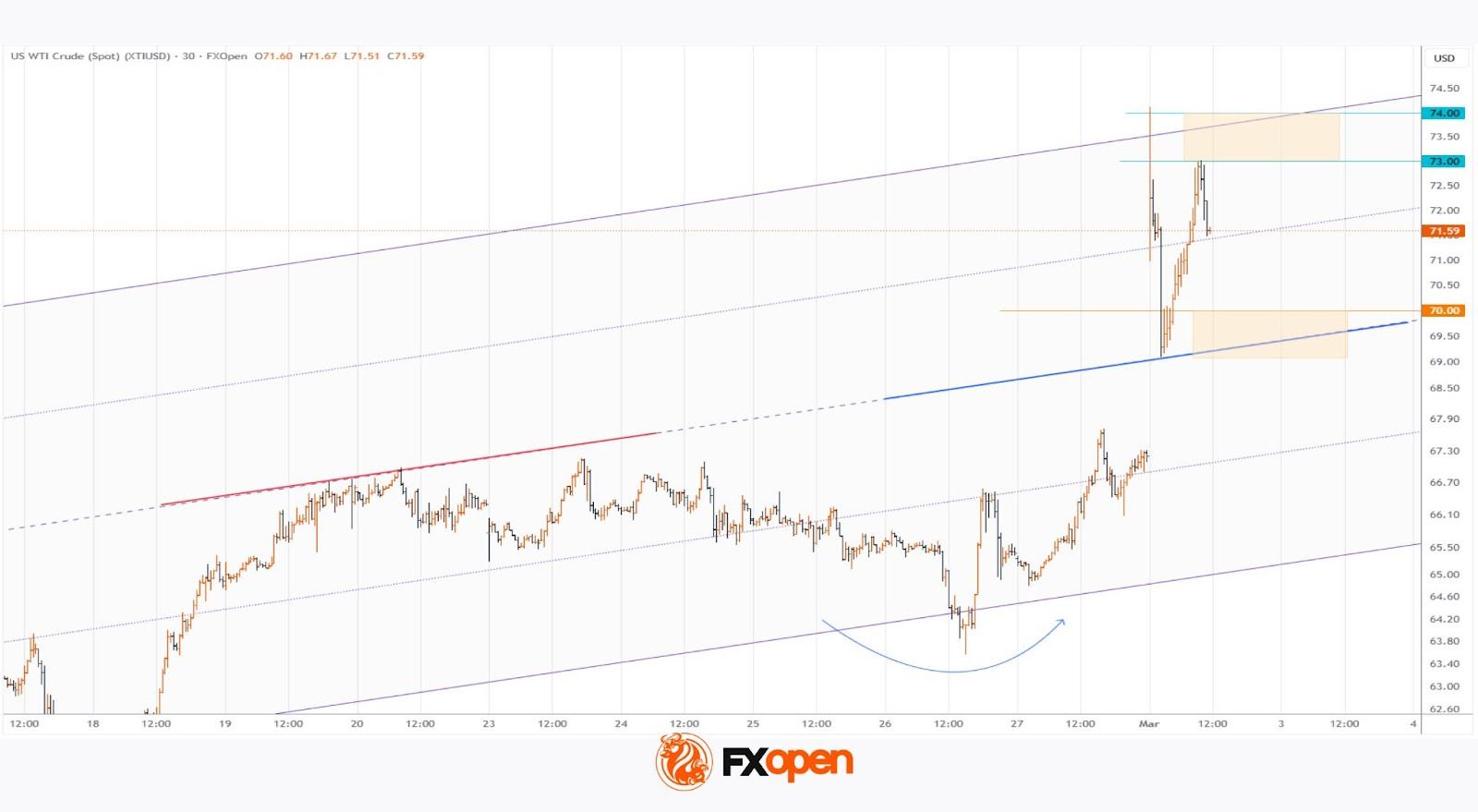
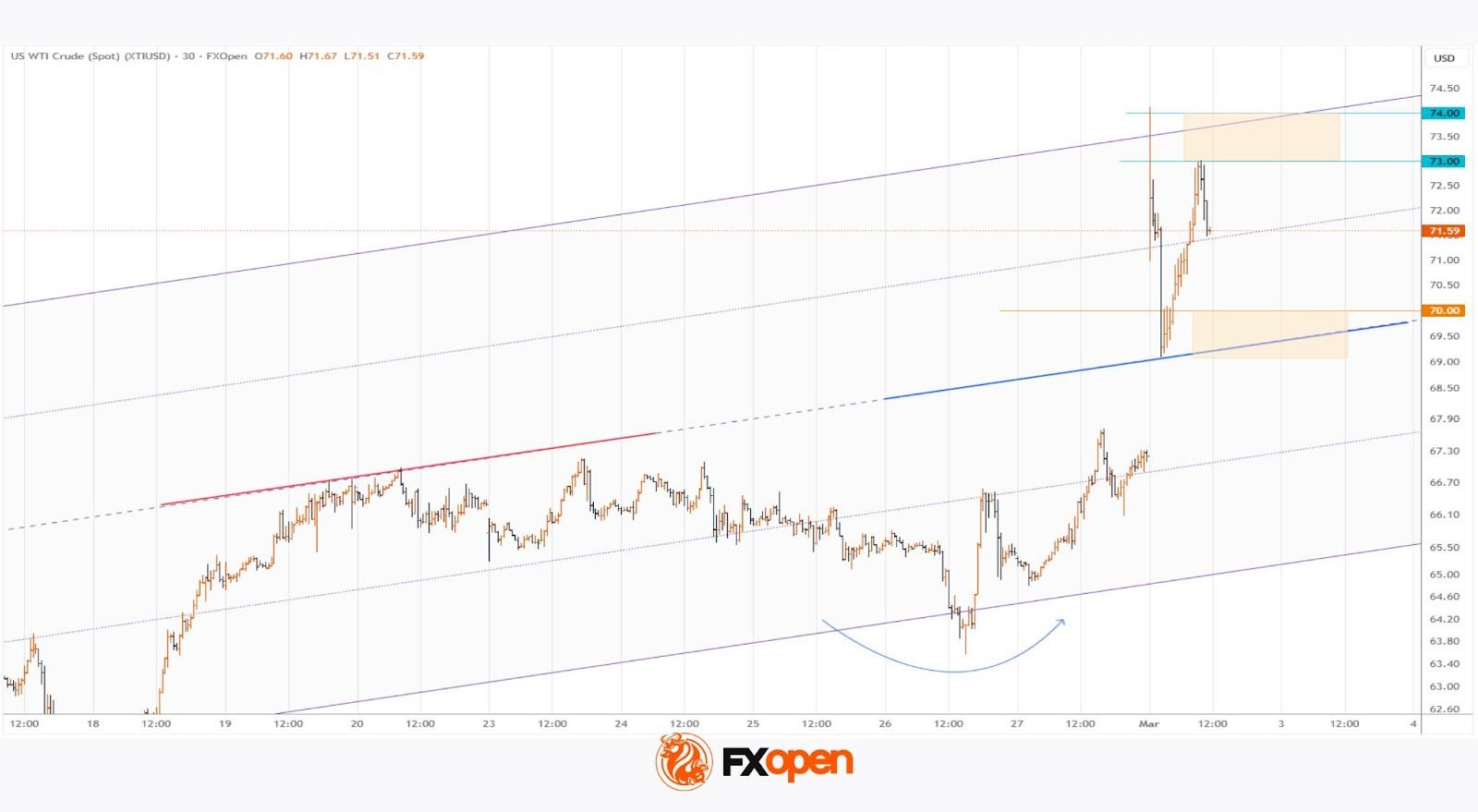
→ Oil: showed the most aggressive reaction, with WTI opening at a bullish gap of roughly 10% compared with Friday’s close.
Shipping in the Strait of Hormuz (through which around 20% of global oil supply passes) is effectively paralysed following attacks on tankers. As shown on the XTI/USD chart, barrel prices are fluctuating widely as traders attempt to determine a fair value under these extraordinary circumstances.
Technical Analysis of XTI/USD
Three days ago, we drew an ascending channel on the oil price chart, which has held up:
→ its upper boundary acted as resistance at Monday’s open;
→ its median pushed the price upwards.
Bearish perspective:
→ following the bullish gap, prices failed to continue higher and fell sharply;
→ the round level of $73 acted as resistance.
Bullish perspective:
→ the channel median previously acted as resistance but now serves as support;
→ the psychological level of $70 favours buyers.
It is reasonable to expect WTI oil to remain volatile within a broad $70–73 range, with price impulses largely driven by political statements regarding escalation in the Middle East.
Start trading commodity CFDs with tight spreads (additional fees may apply). Open your trading account now or learn more about trading commodity CFDs with FXOpen.
This article represents the opinion of the Companies operating under the FXOpen brand only. It is not to be construed as an offer, solicitation, or recommendation with respect to products and services provided by the Companies operating under the FXOpen brand, nor is it to be considered financial advice.
Crypto World
Bitcoin holds up after Iran strike, outpacing equities in risk-off session: Crypto Markets Today


Bitcoin is trading near $66,500 after adding 1.1% since midnight UTC and more than 5% from the weekend low of $63,000.
The crypto market is back in the middle of a trading range that has persisted since the start of February, with a volatile past week testing $70,000 to the upside and $62,500 to the downside.
Weekend price action was driven by the military strikes that killed Iran’s Supreme Leader Ayatollah Khamenei, triggering retaliatory attacks and raising concerns about potential disruption to traffic in the Strait of Hormuz.
According to trading firm QCP, the strike sparked roughly $300 million in long liquidations — but the scale of forced selling was relatively contained, suggesting markets were already positioned for a volatile weekend.
The escalation pushed investors toward traditional havens, sending gold and silver to their highest levels in more than a month. Oil surged 13% to $82 a barrel, the highest price since July 2024.
U.S. equity index futures fell, with the S&P 500 futures and Nasdaq 100 down 1.1% and 1.5%, respectively, since midnight UTC.
The crypto market showed resilience, with most of the losses occurring on Saturday when U.S. markets were closed.
Derivatives positioning
- The fallout from the Iran war has been more contained than might have been expected. While cumulative crypto futures open interest has dropped 2% to $93.78 billion, it remains above the recent low of $92.40 billion.
- Over $300 million in leveraged bets have been liquidated by centralized exchanges in 24 hours, with bullish bets accounting for most of the tally.
- Annualized perpetual funding rates for major cryptocurrencies, including bitcoin and ether, are little changed to negative, indicating a slightly bearish bias.
- Still, the market isn’t showing signs of panic, as evidenced from the bitcoin 30-day annualized implied volatility index, BVIV. It remains steady at around 58.8%, well within the price range seen last week. The same is true for the ether volatility index.
- On Deribit, short-term bitcoin puts traded at an 8%-10% volatility premium to calls, a sign of heightened downside worries. The $60,000 put, or bearish bet, remains the most popular on the exchange.
- Block flows featured demand for bitcoin put spreads.
Token talk
- The altcoin market largely tracked bitcoin over the weekend, but one of the fastest to recover was lending token MORPHO, which continued its impressive two-week streak with a 5% jump over the past 24 hours having risen by 2.6% since midnight UTC.
- Decentralized finance (DeFi) tokens JUP, AAVE and LDO are all in the black as speculative appetite remains relatively strong despite a global shift to haven investments.
- Hyperliquid’s HYPE token surged by more than 29% on Saturday to snap February’s downtrend. While it lost 3.8% on Monday, losing 3.8% it remains above the crucial $30 level of support.
- , the DeFi token linked to U.S. President Donald Trump’s family, exentended declines, falling 2.5% of its value since midnight. It is now down by more than 44% since mid-January following a series of lower highs and lower lows.
- CoinDesk’s DeFi Select (DFX) Index is the only benchmark that is positive over the past 24 hours. The worst performing was the CoinDesk Computing Select Index (CPUS) and the CoinDesk Smart Contract Platform Select Capped Index (SCPXC), down by 1.87% and 1.71%, respectively.
Binance Coin took the lead today by surpassing its XRP rival.
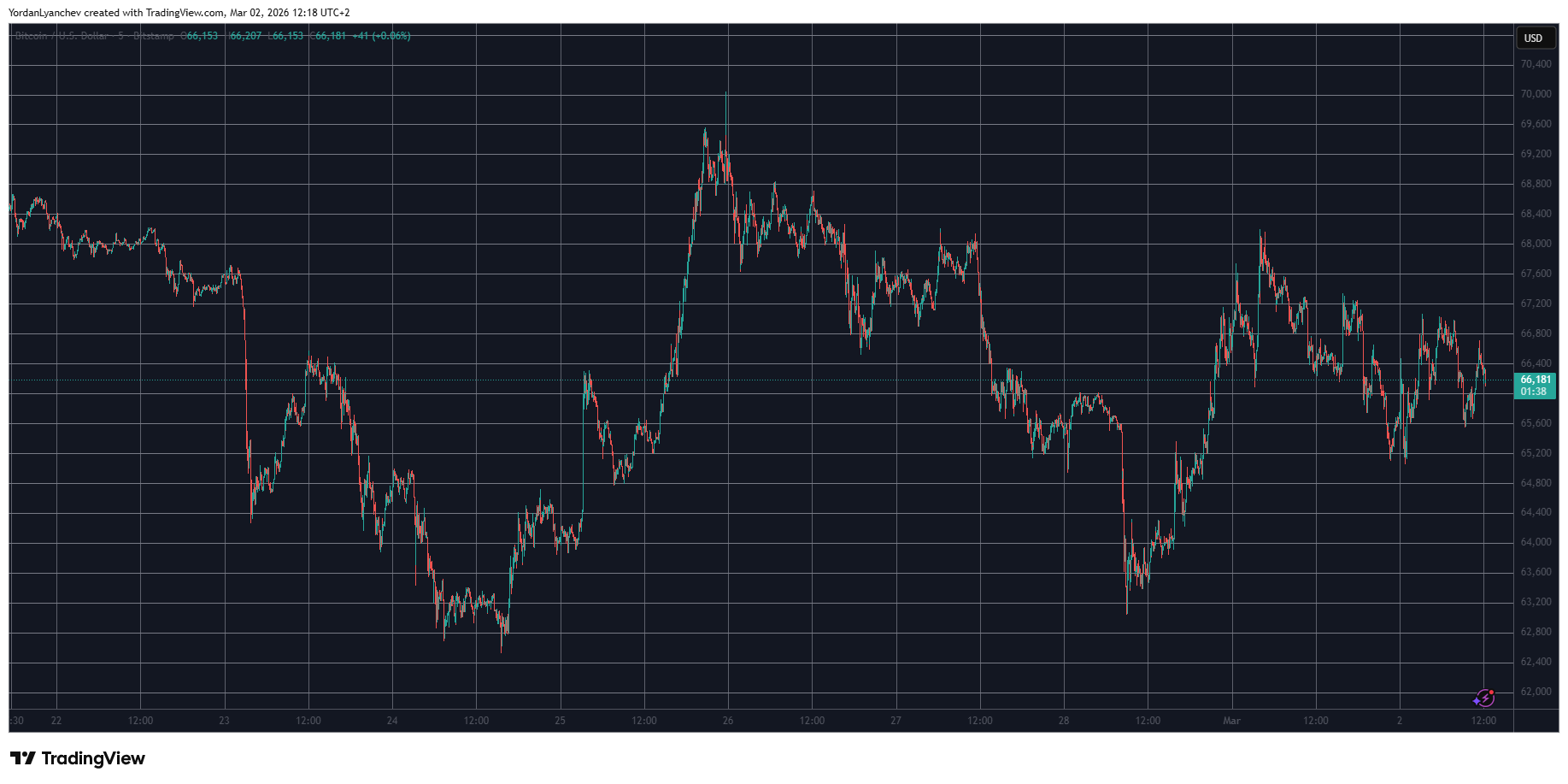
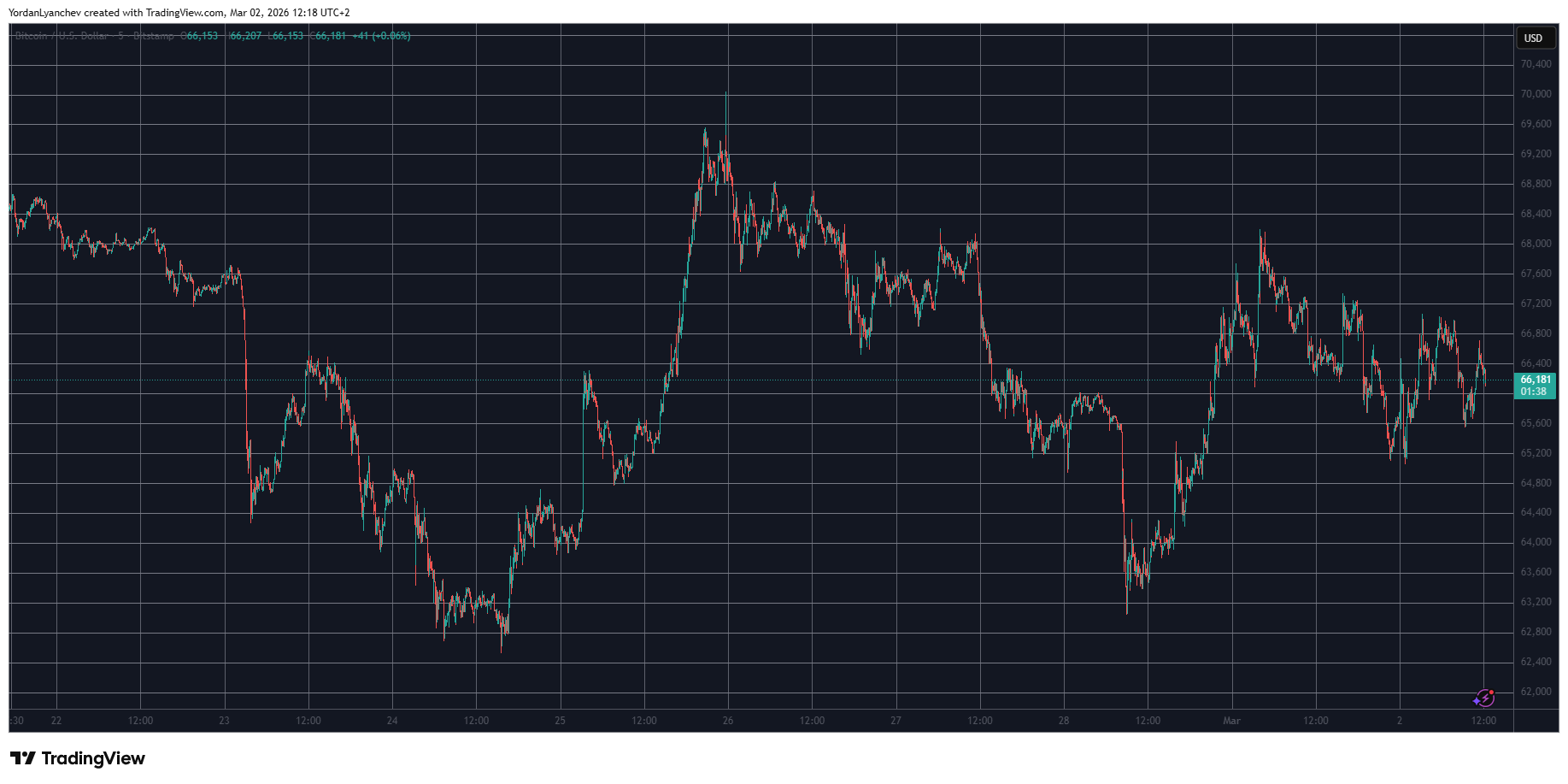
Although the traditional financial markets in Asia and Europe opened earlier this morning and the US futures markets joined, BTC’s price has actually remained relatively calm at around $66,000 following the weekend developments.
Most altcoins are also unexpectedly quiet today, but minor losses continue to dominate. Ethereum continues to struggle below $2,000.
BTC Calms at $66K
After last Wednesday’s rejection at $70,000, the primary cryptocurrency dropped below $67,000 a day later but found support and entered the weekend at $68,000. However, Saturday began with intense volatility as the US and Israel launched numerous airstrikes against Iran.
The Middle East country retaliated against several nations in the region, including the UAE, Qatar, and Bahrain, and BTC’s price tumbled to a new multi-day low of $63,000. However, reports emerged later that day that Iran’s Supreme Leader was killed during the attacks, and bitcoin erased all losses and touched $68,000 once again.
It failed there and dipped to $65,200 on Sunday, and even more volatility was expected on Monday morning when the futures and some legacy markets opened. However, BTC has remained relatively stable and now sits around $66,000.
Its market capitalization remained inches above $1.320 trillion, while its dominance over the alts is north of 56%.
BNB Back to 4th
XRP was among the poorest performers after the attacks began, which allowed BNB to surpass it in terms of market cap. The two changed positions yesterday once again, but BNB has the upper hand today with a price tag of $617 and a market cap of $84.2 billion compared to XRP’s $82.5 billion.
Most other larger-cap alts are slightly in the red, with ETH losing the $2,000 support once again. SOL, DOGE, ADA, BCH, HYPE, and LINK are down by around 2-3%, while CC and DOT have lost more than 4% daily. In contrast, HTX is up by over 3%.
The total crypto market cap has declined by about $30 billion in a day and is down to $2.350 trillion on CG.

Binance Free $600 (CryptoPotato Exclusive): Use this link to register a new account and receive $600 exclusive welcome offer on Binance (full details).
LIMITED OFFER for CryptoPotato readers at Bybit: Use this link to register and open a $500 FREE position on any coin!
Disclaimer: Information found on CryptoPotato is those of writers quoted. It does not represent the opinions of CryptoPotato on whether to buy, sell, or hold any investments. You are advised to conduct your own research before making any investment decisions. Use provided information at your own risk. See Disclaimer for more information.

Tommy Robinson is opening his fool mouth again

Nico Echavarria's clubs: What's in his Cognizant-winning bag

Greene King plan to refurbish Ye Olde Starre Inne in Stonegate, York


-

 Sports7 days ago
Women’s college basketball rankings: Iowa reenters top 10, Auriemma makes history
-

 Politics7 days ago
Nick Reiner Enters Plea In Deaths Of Parents Rob And Michele
-

 Fashion3 days ago
Weekend Open Thread: Iris Top
-

 Business6 days ago
True Citrus debuts functional drink mix collection
-

 Politics4 days ago
ITV enters Gaza with IDF amid ongoing genocide
-

 Tech1 day ago
Unihertz’s Titan 2 Elite Arrives Just as Physical Keyboards Refuse to Fade Away
-
Sports2 days ago
The Vikings Need a Duck
-

 Crypto World6 days ago
XRP price enters “dead zone” as Binance leverage hits lows
-

 Tech6 days ago
Unsurprisingly, Apple's board gets what it wants in 2026 shareholder meeting
-
 NewsBeat2 days ago
Dubai flights cancelled as Brit told airspace closed ’10 minutes after boarding’
-

 NewsBeat4 days ago
Cuba says its forces have killed four on US-registered speedboat | World News
-
 NewsBeat5 days ago
Manchester Central Mosque issues statement as it imposes new measures ‘with immediate effect’ after armed men enter
-
 NewsBeat2 days ago
The empty pub on busy Cambridge road that has been boarded up for years
-

 NewsBeat22 hours ago
‘Significant’ damage to boarded-up Horden house after fire
-

 NewsBeat2 days ago
Abusive parents will now be treated like sex offenders and placed on a ‘child cruelty register’ | News UK
-
 NewsBeat6 days ago
Police latest as search for missing woman enters day nine
-

 Business4 days ago
Discord Pushes Implementation of Global Age Checks to Second Half of 2026
-

 Entertainment4 hours ago
Baby Gear Guide: Strollers, Car Seats
-

 Business4 days ago
Only 4% of women globally reside in countries that offer almost complete legal equality
-
 Tech3 days ago
NASA Reveals Identity of Astronaut Who Suffered Medical Incident Aboard ISS