
Crypto World
Spartans.com Built the 14th Biggest Casino in Beta – Now Watch What August 1st Does to Winna and Betano’s Market


Spartans.com is in its beta stage and has already posted numbers that most fully operational platforms take years to produce. The top crypto casino contender already holds a 14th global ranking with $1 billion in wagers and a $7M leaderboard running, all before August 1st. This is the story the industry is tracking. Winna, launched in 2024, is building a crypto-native audience through instant rakeback and VIP status match programmes, including a strong selection of live casino games.
Betano, operated by Kaizen Gaming, is now live in 20 regulated markets following its February 2026 Ghana launch, with a deep catalogue that includes competitive live casino games across its global network. Both represent serious operators. The question August 1st poses to all of them is the same.
Spartans.com: The Record Setting Beta Stage is a Sign Things to Come
Spartans.com is in its beta stage. That is where every number in this article was produced. $1,000,000,000 in total wagers. $100,000,000 in player deposits. $40,000,000 in Gross Gaming Revenue. 27,000 first-time depositors acquired before full global access. A 14th global ranking earned ahead of platforms with years of full operation. This is not a warm-up act. This is a platform that spent its beta stage building the kind of commercial track record that made August 1st inevitable.
The top crypto casino architecture behind these numbers is not complicated to understand. The 33% CashRake system returns up to 33% of the house edge automatically on every wager, plus 3% cashback on losses, from the very first bet with no VIP tier requirements. Near-instant withdrawals and uncapped limits removed every friction point the traditional industry depends on. The $7,000,000 leaderboard, the largest prize pool in online casino history, with $5,000,000 reserved for a single first-place winner, is running live right now, in beta. The community’s first millionaire was crowned during the beta stage.
Era Istrefi, Conor Benn, and streaming duo Sweetflips are active brand ambassadors before the global launch. A $3,000,000 Mansory Koenigsegg Jesko giveaway is running simultaneously. Every element of the platform, the prize infrastructure, the CashRake, the instant payouts, the cultural partnerships, is operating in beta, producing results that put Spartans.com in the same rankings as platforms that have been running for years.
August 1st is when every remaining barrier to global access comes down simultaneously. The beta already answered what this platform is. August 1st answers what happens next.
Winna: A Crypto-Native Platform Built Around VIP Retention
Winna launched in 2024 under a Tobique Gaming Commission licence and has built its identity around ongoing rewards rather than one-off welcome bonuses. The platform stands out with instant rakeback every seven minutes, a $1 minimum crypto deposit, and over 5,200 slots in its library. Its seven-tier VIP programme scales from Bronze through to Nebula, with the top-tier prize wheel offering up to $3.25 million.

A distinctive VIP Status Match programme allows high-volume players to transfer their ranking from another casino and receive cash bonuses of up to $27,000 from day one. Winna’s live casino games section is powered by Evolution and Pragmatic Play Live. As of February 2026, the platform faced increased scrutiny on Trustpilot following reports of a display issue that users interpreted as a security breach, though Winna characterised it as a visual bug with no financial impact on accounts.
Betano: 20 Regulated Markets and Expanding
Betano, operated by Kaizen Gaming, reached a significant milestone in February 2026 with its launch in Ghana, its 20th regulated market launch worldwide and its second market in Africa after Nigeria. The platform operates under licences including the UK Gambling Commission and the Alcohol and Gaming Commission of Ontario, offering over 3,000 casino games and a comprehensive sportsbook covering more than 35 sports.

Its live casino games section features over 500 live dealer tables powered by NetEnt, Pragmatic Play, and Games Global. Betano won EGR’s Operator of the Year award in 2024 and continues to expand its regulated footprint across Europe, Africa, and the Americas. The platform does not currently support cryptocurrency payments, positioning it within the traditional fiat-first regulated market segment.
Summing Up
Winna is building a loyal VIP-focused crypto community through a retention model that rewards consistent play with instant live casino games access and rakeback every seven minutes. Betano is executing a disciplined regulated expansion with 20 market launches and a growing presence across three continents. Both represent serious platforms with clear strategies.
And both now operate in an industry where Spartans.com, a top crypto casino still in its beta stage, has already produced $1 billion in wagers, crowned a community millionaire, launched the largest leaderboard prize pool in casino history, and earned a 14th global ranking before its first day of unrestricted global operation. August 1st is not a beginning. It is the next chapter.

Find Out More About Spartans:
Website: https://spartans.com/
Instagram: https://www.instagram.com/spartans/
Twitter/X: https://x.com/SpartansBet
YouTube: https://www.youtube.com/@SpartansBet
Disclaimer: This is a Press Release provided by a third party who is responsible for the content. Please conduct your own research before taking any action based on the content.


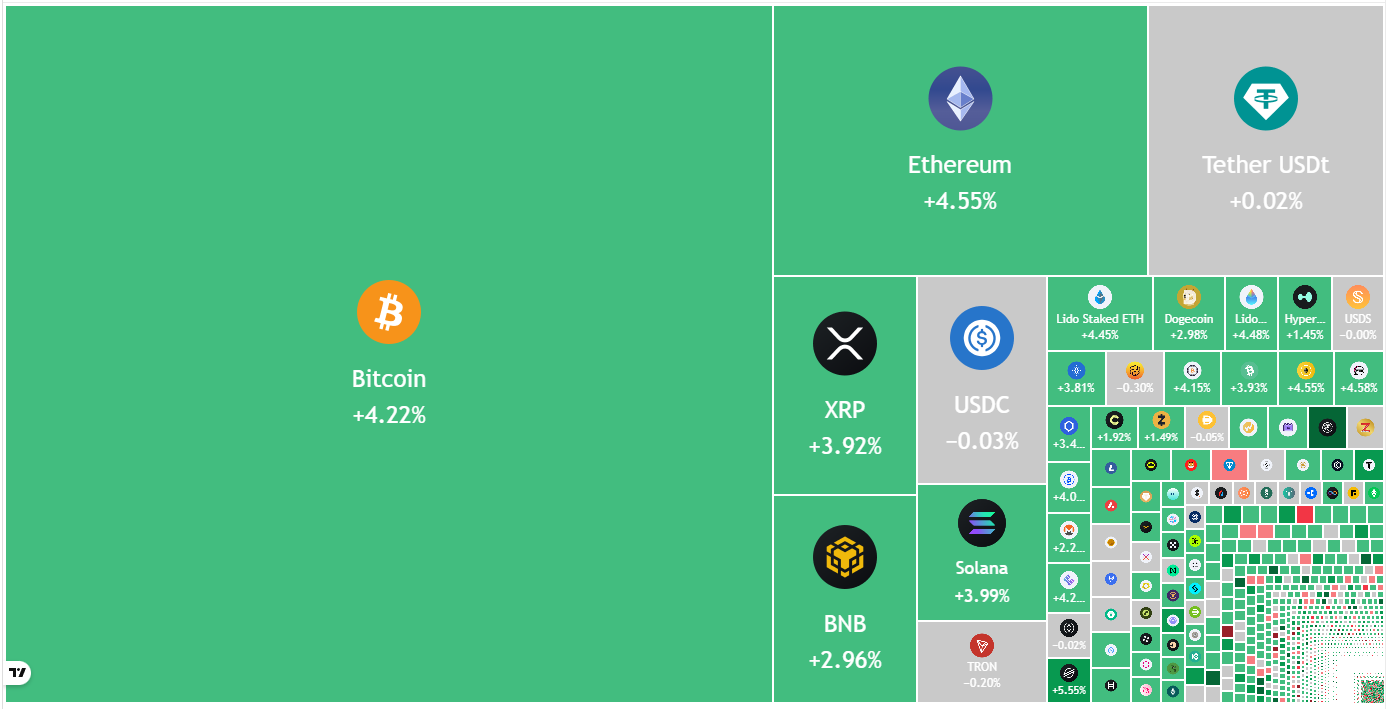
Key points:
-
Bitcoin soared above $76,000, opening the doors for a further rally toward $84,000.
-
Several major altcoins are showing strength, signaling broad-based buying by the bulls.
Bitcoin (BTC) skyrocketed above the $76,000 resistance on Friday after Iran’s foreign minister said that the Strait of Hormuz will remain open for the remainder of the ceasefire between the US, Israel and Iran.
Another positive sign for the bulls is that BTC’s rise has been supported by solid accumulation by the whales. According to CryptoQuant data, BTC whales holding more than 1,000 BTC have added about 270,000 coins in the past 30 days, the largest buying spree since 2013.
However, some analysts remain skeptical about BTC’s advance. Glassnode said in its latest Week Onchain newsletter that the current recovery has more legs to it, but is likely to face selling pressure at the True Market Mean at $78,100. Buyers will have to sustain the price above $78,100 on a mid-term basis to create a “structural shift toward a bull market.”

Another cautious view came from trading resource Material Indicators. In a video posted on X, Material Indicators said that BTC will have to cross the yearly open at $87,500 and the 50-week moving average near $97,000, and the relative strength index has to close above the 41 level on the weekly time frame to confirm that a bull market has returned.
Could BTC and select major altcoins sustain above their overhead resistance levels? Let’s analyze the charts of the top 10 cryptocurrencies to find out.
Bitcoin price prediction
BTC surged above the $78,000 level on Friday, its highest level in ten weeks, indicating sustained buying by the bulls.

The upsloping 20-day exponential moving average ($72,136) and the RSI near the overbought zone indicate that the bulls are attempting to seize control. A close above the $76,000 level will complete a bullish ascending triangle pattern, opening the door to a rally to $84,000, then to the pattern target of $92,000.
The moving averages are critical support levels to watch on the downside, as a close below them suggests the bears remain in control. The BTC/USDT pair may then tumble toward the triangle’s support line.
Ether price prediction
Sellers attempted to halt the recovery at the $2,415 level in Ether (ETH), but the bulls continued to exert pressure and did not allow the price to dip below the 20-day EMA ($2,235).

If the ETH price closes above the $2,415 resistance level, the recovery may extend to $2,800, then to $3,050. Such a move suggests that the ETH/USDT pair may have bottomed out at $1,748.
This bullish view will be invalidated in the near term if the price turns down sharply and breaks below the moving averages. That suggests the break above the $2,415 level may have been a bull trap. The pair may then decline to the $1,916 level.
XRP price prediction
XRP (XRP) closed above the 50-day simple moving average ($1.38) on Wednesday, indicating that the bears are losing their grip.

The 20-day EMA ($1.37) has started to turn up gradually, and the RSI is in the positive territory, indicating an advantage to the bulls. The XRP price may rally to the downtrend line of the descending channel pattern, which is expected to behave as a formidable hurdle. If buyers clear the hurdle, the XRP/USDT pair will indicate a potential trend change.
The moving averages are the vital support to watch out for on the downside. If the support breaks down, the pair may retest the crucial $1.27 level.
BNB price prediction
BNB (BNB) closed above the 50-day SMA ($626) on Thursday, indicating that the selling pressure is reducing.

If the BNB price remains above the moving averages, the next stop is likely to be the $687 level. Sellers will try to halt the recovery at $687, but if buyers bulldoze their way through, the rally may reach $730 and eventually $790.
On the contrary, if the price turns down from the current level or the overhead resistance and breaks below the moving averages, it signals that the BNB/USDT pair may remain within the $570 to $687 range for a while longer.
Solana price prediction
Solana’s (SOL) close above the moving averages suggests that the bulls are attempting to push the price to the $98 resistance.

Sellers are expected to fiercely defend the $98 level. If the SOL/USDT pair turns down sharply from $98 and breaks below the moving averages, it signals that the consolidation may extend for a few more days.
The first sign of strength on the upside will be a break and close above the $98 resistance. That opens the doors for a rally to the $117 level, where the bears are again expected to step in.
Dogecoin price prediction
Dogecoin (DOGE) turned up from the moving averages on Wednesday and rallied to the $0.10 level on Thursday.

Sellers will strive to halt the recovery at the $0.10 level, but if buyers do not give up much ground from the current level, it increases the possibility of a rally to $0.11 and subsequently to $0.12.
The bears are likely to have other plans. They will attempt to pull the DOGE price back below the moving averages. If they succeed, the DOGE/USDT pair may plummet to the solid support at $0.09.
Hyperliquid price prediction
Sellers are attempting to pull Hyperliquid (HYPE) back below the breakout level of $43.76, but the bulls have held their ground.

If the HYPE price continues higher and breaks above the $46 level, it suggests that the bulls have flipped the $43.76 level into support. That increases the likelihood of a rally to the $50 to $51.43 zone.
Time is running out for the bears. They will have to pull the HYPE/USDT pair below the 20-day EMA ($40.78) to make a comeback. If they manage to do that, the pair may slump to the 50-day SMA ($37.38).
Related: Bitcoin price quietly sets new 10-week high as trader sees $88K in weeks
Cardano price prediction
Cardano (ADA) continued its recovery and is likely to test the resistance at the downtrend line of the descending channel pattern.

Sellers are expected to aggressively defend the downtrend line, but if the bulls prevail, the ADA/USDT pair may climb to $0.32, then to $0.37. Such a move signals a potential short-term trend change.
On the contrary, if the ADA price turns down from the downtrend line and breaks below the moving averages, it suggests the pair may remain within the channel for some time.
Bitcoin Cash price prediction
Bitcoin Cash (BCH) pierced the 20-day EMA ($447) on Thursday, but the relief rally is facing selling at the 50-day SMA ($454).

The 20-day EMA is flattening out, and the RSI is near the midpoint, suggesting that the selling pressure is reducing. If bulls prevent the BCH price from dipping below $443, it could signal a shift in sentiment. That increases the likelihood of a break above the 50-day SMA. If that happens, the BCH/USDT pair may surge to $486, then to $520.
Alternatively, if the price breaks below $443, it signals that the bears remain sellers on rallies. The pair may then plunge toward the solid support at $419.
Chainlink price prediction
Chainlink (LINK) is attempting to break above the $8 to $10 resistance, where bears are expected to mount a strong defense.

If the price turns down from the overhead resistance and breaks below the moving averages, it suggests that the LINK/USDT pair may consolidate inside the range for a few more days.
On the other hand, if the LINK price closes above the $10 level, it indicates that the consolidation has resolved in favor of the bulls. The pair may then rally to the $11.61 level, where the bears are expected to step in. There is resistance at $10.94, but it is likely to be crossed.
This article does not contain investment advice or recommendations. Every investment and trading move involves risk, and readers should conduct their own research when making a decision. While we strive to provide accurate and timely information, Cointelegraph does not guarantee the accuracy, completeness, or reliability of any information in this article. This article may contain forward-looking statements that are subject to risks and uncertainties. Cointelegraph will not be liable for any loss or damage arising from your reliance on this information.


A House GOP revolt 2026 collapsed both a five-year and an 18-month FISA extension in back-to-back overnight votes, with 20 Republicans joining most Democrats to kill each plan and force Speaker Mike Johnson into a last-resort 10-day stopgap passed at 2:09 AM Friday.
Summary
- The procedural vote on the 18-month clean renewal failed 197-228 after rebels demanded a warrant requirement before the government can query Americans’ communications incidentally collected under Section 702.
- The 20 Republicans who voted no include Lauren Boebert, Thomas Massie, Paul Gosar, Andy Harris, Warren Davidson, Scott Perry, Ralph Norman, and Chip Roy, among others.
- The revolt represents a significant defeat for Speaker Johnson and the White House, who spent the week with CIA Director Ratcliffe personally briefing lawmakers and Trump posting directly on Truth Social urging Republican unity.
A House GOP revolt 2026 sank two separate FISA renewal plans Thursday night, forcing Republican leadership into a 2 AM fallback after a week of intense White House lobbying, CIA briefings, and internal negotiations produced nothing capable of holding together Johnson’s narrow majority.
Section 702 of the Foreign Intelligence Surveillance Act was set to expire Monday. Trump had spent the week demanding a clean long-term renewal, posting on Truth Social that “our Military Patriots desperately need FISA 702” and citing the program’s role in the Iran campaign.
Twenty Republicans voted against advancing the 18-month clean extension on the procedural vote, which failed 197-228. The bloc includes longtime civil-liberties conservatives: Lauren Boebert, Thomas Massie, Paul Gosar, Andy Harris, Diana Harshbarger, Eli Crane, Warren Davidson, Scott Perry, Ralph Norman, Keith Self, Victoria Spartz, Andy Ogles, John Rose, Michael Cloud, Andrew Clyde, Eric Burlison, Tim Burchett, Mary Miller, Sheri Biggs, and Mark Harris.
Their core demand is a warrant requirement before the government can query Americans’ communications collected incidentally under Section 702 — a provision existing law does not require. “We need to figure out how we’re protecting American citizens in the process,” said Rep. Chip Roy of Texas. “Right now, I don’t know what the pitch is, other than what it always is, which is we got to have this stuff to go after bad guys. Yes, we know. We all agree.”
Earlier in the evening, leadership tried a five-year extension with privacy-related revisions. That also failed. A handful of Democrats stepped in to try to help advance both longer extensions, but most Democrats opposed any version without significant reforms, leaving Johnson without a coalition for either proposal.
The Broader Pattern
With 218 Republican seats and one independent, Johnson can afford virtually no defections on any party-line vote. The 20-member rebellion is the same structural problem that has repeatedly threatened CLARITY Act passage and budget reconciliation throughout 2026: a handful of conservatives who prioritize specific demands over party unity can collapse any bill at any time.
Rep. Jim McGovern of Massachusetts said from the floor during debate: “Are you kidding me? Who the hell is running this place?”
The April 30 FISA deadline arrives in the same window as the CLARITY Act markup target, budget reconciliation, and the FOMC meeting, compressing an already overcrowded pre-midterm legislative calendar further.

Hong Kong-based Flow Capital Partners plans to bring its $150 million private credit fund onchain. The firm will use DigiFT to offer tokenized shares. The move is expected by the end of April. It marks a step toward wider blockchain-based fund access in Asia.
Flow Capital Prepares Onchain Fund Launch with DigiFT
Flow Capital will make its private credit fund available through DigiFT Tech Pte. The platform focuses on real-world asset tokenization. The fund was first launched in June 2025. Now, the firm is expanding its distribution using blockchain.
The company plans to raise an additional $30 million through tokenized shares. This fundraising effort will run through the end of 2026. The firm also aims to grow the fund to $250 million in total size. This would expand its reach among global investors.
Jacky Tian, the firm’s chief investment officer, shared the growth target in a Bloomberg report. The company sees tokenization as a way to attract new capital. It also expects easier access for a broader investor base.
At the same time, DigiFT provides regulated infrastructure in Singapore. This allows compliant issuance of tokenized financial products. As a result, Flow Capital can offer shares in a digital format while meeting regulatory needs.
Rising Interest in Tokenized Real World Assets
The move comes as more firms adopt tokenization for traditional assets. Large financial institutions have already launched similar products. BlackRock introduced its tokenized Treasury fund, known as BUIDL. It operates on public blockchain networks.
JPMorgan also entered the space with its tokenized fund called MONY. The bank seeded the product with $100 million. Later, it opened access to outside investors. These efforts show growing activity in blockchain-based finance.
Data shows rapid growth in the real-world asset market. Total market value reached $58 billion as of April 14. This is up from $21.5 billion one year earlier. The increase reflects rising demand for tokenized exposure.
Ethereum remains a key network for such assets. Its RWA market cap reached $19.3 billion. This represents more than 200 percent growth year over year. The trend supports further adoption by asset managers.
Analysts Point to Risks in Liquidity Structure
Despite growth, some analysts have raised concerns. They note that tokenization does not change core fund risks. Liquidity remains a key issue in private credit markets. These funds often hold long-term assets.
Nic Puckrin, commented on the trend. He said, “bringing private credit funds onchain solves the distribution problem.” He added that it opens access to more investors. However, risks still remain.
He also warned about liquidity mismatch concerns. He stated, “the availability of instant settlement can create the illusion of liquidity.” This may lead investors to expect faster redemptions. Yet, underlying assets may not support that speed.
As tokenized funds grow, such risks may draw more attention. Investors may need to assess both access and liquidity limits. The shift to blockchain improves distribution, but structural challenges remain.


The price of bitcoin has again pushed above $76,000 alongside about a 10% plunge in the price of crude oil on an apparent reopening of the Strait of Hormuz.
“The passage for all commercial vessels through Strait of Hormuz is declared completely open for the remaining period of ceasefire,” said Iranian Foreign Minister Seyed Abbas Araghchi in an X posting.
President Trump quickly responded on Truth Social, thanking Iran for the full reopening.
The news sent the price of WTI crude oil down nearly 10% to $85.90 per barrel, about its lowest price since shortly after the outbreak of the war in early March.
Alongside bitcoin has risen to $76,400, up 3 over the past 24 hours. U.S. stock index futures are higher by about 1% across the board.
Why the $76,000 area is important
Bitcoin was trading around the $76,000-$78,000 level in the days before the Feb. 5 crash that sent its price tumbling all the way back to $60,000. In recent days, BTC has risen above $76,000 on numerous occasions, only to be met with a wave of quick selling.
Technicians believe that a sustained break to around $77,000 could set the stage for a return to significantly higher levels.
More green shoots over Iran
Separately, Axios reported that the U.S. and Iran are negotiating over a three-page plan to end hostilities. Among the discussion points: the U.S. releasing $20 billion in frozen Iranian funds in return for that country giving up its stockpile of enriched uranium.
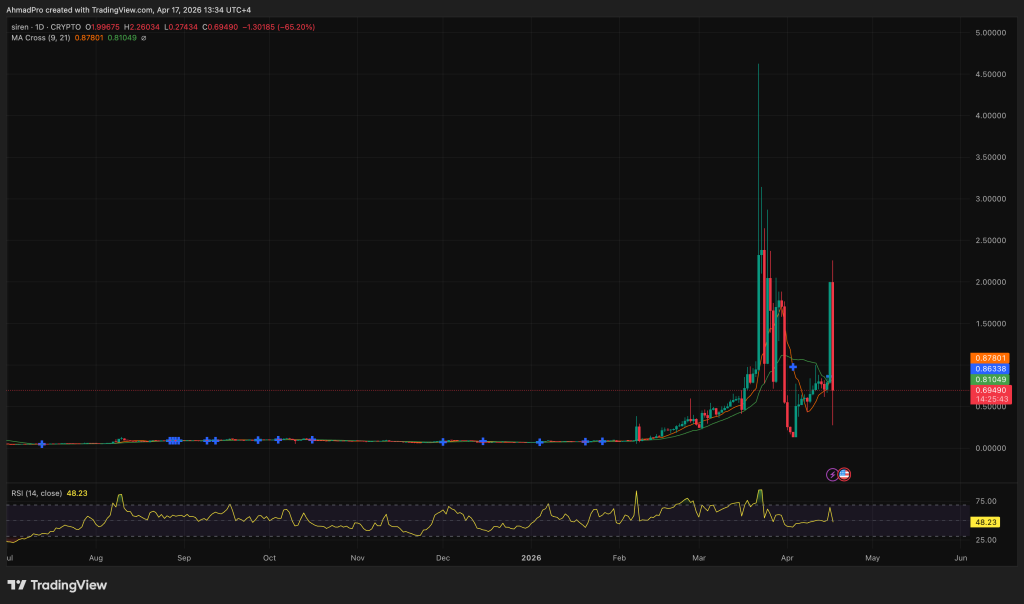
Two tokens. Vertical charts. And a lot of unanswered questions. Siren crypto surged 32.97% in 24 hours to $0.927893 before consolidating near $0.62, while RaveDAO (RAVE) executed a 40x move from $0.30 to $18 in just five days.
Both rallies now drawing serious manipulation scrutiny from on-chain analysts. The question the market keeps circling: organic demand, or something more coordinated?
The RAVE case looks damning on paper. On-chain analyst Yu Jin flagged that the team transferred 30.58M RAVE (approximately $42M) to Bitget ahead of the spot pump, with the move appearing designed to bait short sellers before squeezing them out, triggering $37M in liquidations, $31M of which were shorts.
ChainCatcher’s report described the pattern as suspected price manipulation via derivatives. RAVE eventually hit an ATH of $18.62, a 3,765% weekly gain. SIREN, meanwhile, saw whale wallets accumulate 93% of supply ahead of a 185% single-session spike to $2.18.
Whether these moves were engineered or simply benefited from thin liquidity and aggressive momentum trading, the price action left marks across the broader altcoin market, and exposed just how quickly leverage can amplify both gains and pain.
Can SIREN Price Hit $1.88, and Can RAVE Crypto Hold Its Gains?
SIREN just had a sharp run and now it is sitting at that classic decision point, because $0.60 is the level holding the entire move together, and as long as it stays intact with volume holding strong, that is where continuation becomes real and a grind toward higher targets like $1.88 starts to look possible.
Right now though it is already showing signs of cooling, with resistance around $0.72 and price pulling back slightly, so the more realistic path is a range between roughly $0.70 and $0.65 while the market digests the move.
The risk is pretty clear, because if $0.60 breaks, that usually signals the move was more hype than structure, and once that happens, price can unwind fast back toward the $0.40 to $0.50 area where the rally originally started.
And with moves this aggressive, especially across related tokens, sharp reversals are common once the squeeze runs out, so watching volume and positioning shifts is way more important here than just the price itself.
RAVE crypto right now is a classic squeeze machine, not a normal trend, and that is exactly why it keeps going up while everyone is trying to short it.
The logic makes sense on paper, people saw what happened with SIREN and expect the same outcome, so they pile into shorts early, but that actually fuels the move instead of stopping it, because every time price pushes higher, those shorts get forced out and turn into buy pressure.
Maxi Doge Targets Early-Mover Upside as RAVE and SIREN Test Key Levels
With SIREN already up 307% on the week and RAVE printing a 3,765% move, late entries face an uncomfortable reality: the asymmetric upside window has likely closed. That math drives attention toward earlier-stage setups — where price discovery hasn’t happened yet.
The pattern of explosive altcoin rallies consistently pulls trader attention toward presale markets as participants hunt the next entry before the crowd arrives.

Maxi Doge (MAXI) is an ERC-20 meme token built around what its team calls “1000x leverage mentality” — a 240-lb canine mascot embodying the grind-and-hold ethos of aggressive bull market trading.
The presale has raised $4,738,881.42 at a current price of $0.0002813, with dynamic APY staking already live. Features include holder-only trading competitions with leaderboard rewards, a Maxi Fund treasury managing liquidity and partnerships, and meme-first marketing rooted in gym-bro culture (“Never skip leg-day, never skip a pump”).
The project is approaching $5M raised — a milestone that historically accelerates presale momentum. Meme tokens carry high volatility risk; presale assets are illiquid until listing.
How Buyers Can Access the MAXI Presale
Investors can buy MAXI through the official presale website by connecting a wallet and paying with ETH, BNB, USDT, or USDC. A bank card option is also available.
The purchase process is also available through Best Wallet, which can be downloaded from the Apple App Store and Google Play.
After purchase, holders can stake tokens in the rewards pool, where the current staking APY is around 66%.
For project updates, users can follow Maxi Doge on X and join the project’s Telegram group.
The post Is Market Maker Manipulation Behind RAVE and SIREN Crypto Skyrockets? appeared first on Cryptonews.
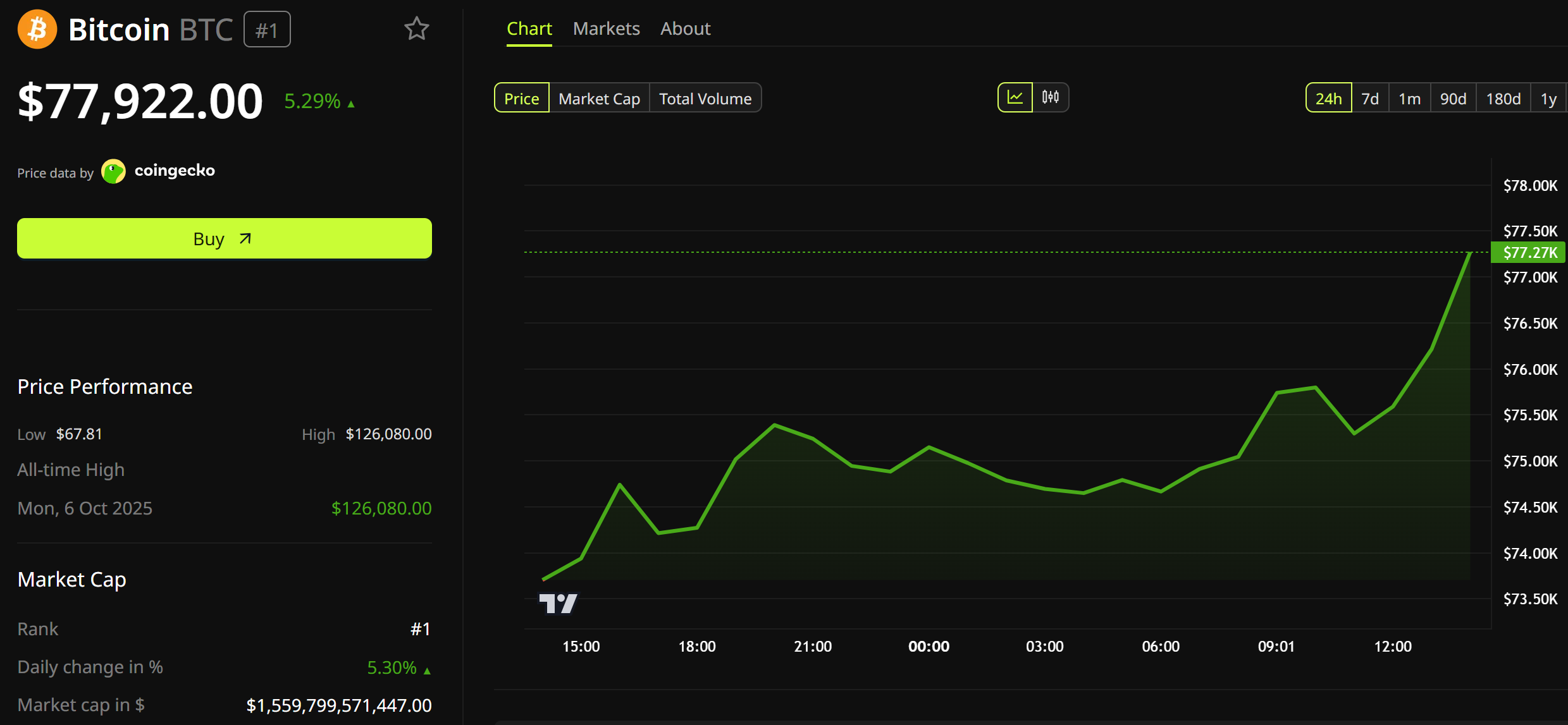
Bitcoin (BTC) climbed above $78,000 on Friday, reaching its highest level in over two months as a confirmed double-bottom breakout fueled momentum toward the $80,000 zone.
The rally followed Iran’s reopening of the Strait of Hormuz under ceasefire terms, which triggered a broad risk-on move across equities and crypto. Yet analysts remain sharply divided on whether BTC can sustain the push through heavy overhead resistance.
Weekly Close Holds the Key to $80,000
As of this writing, Bitcoin was trading for $77,922, just shy of the $80,000 psychological level last tested on January 31, 2026.
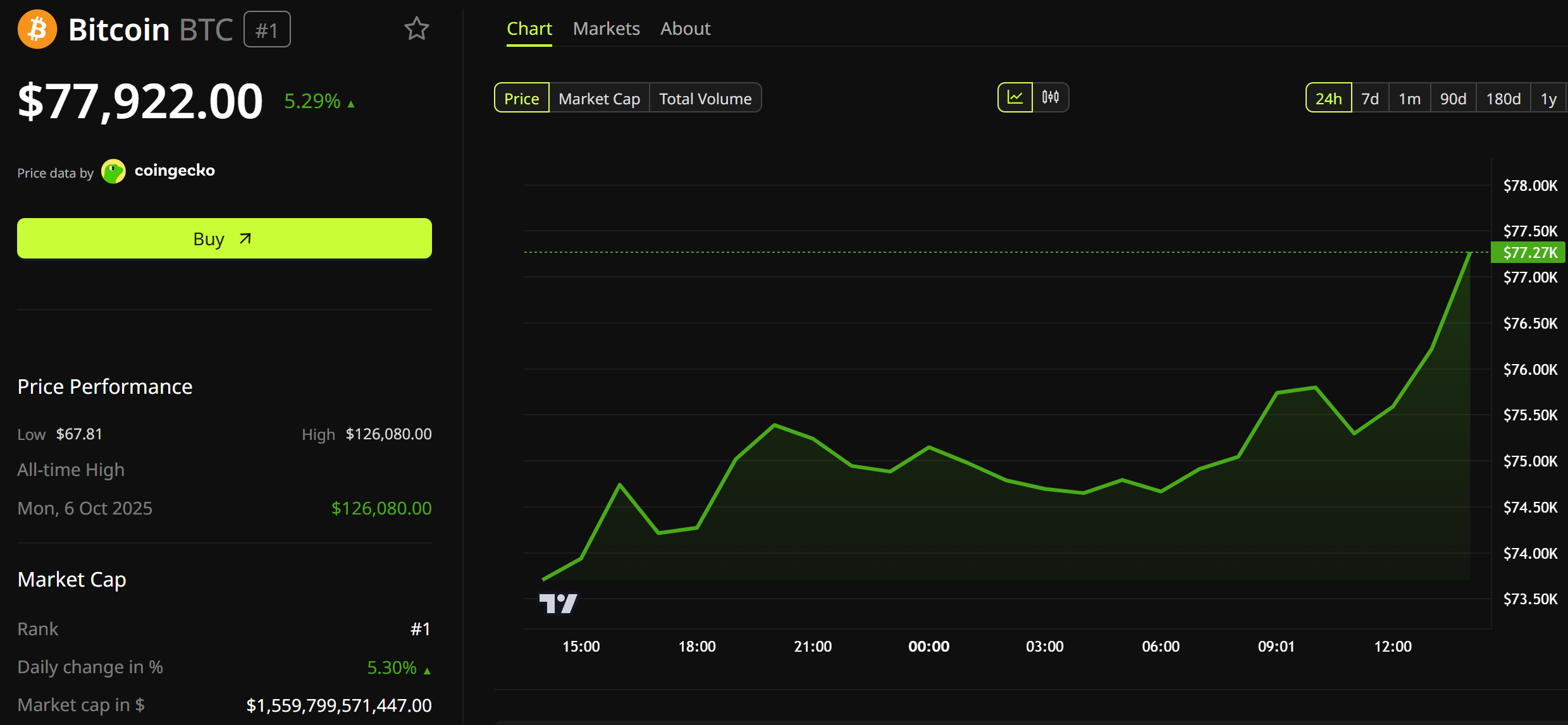
The surge comes after reports that Iran opened the Strait of Hormuz completely, amid ongoing ceasefire terms.
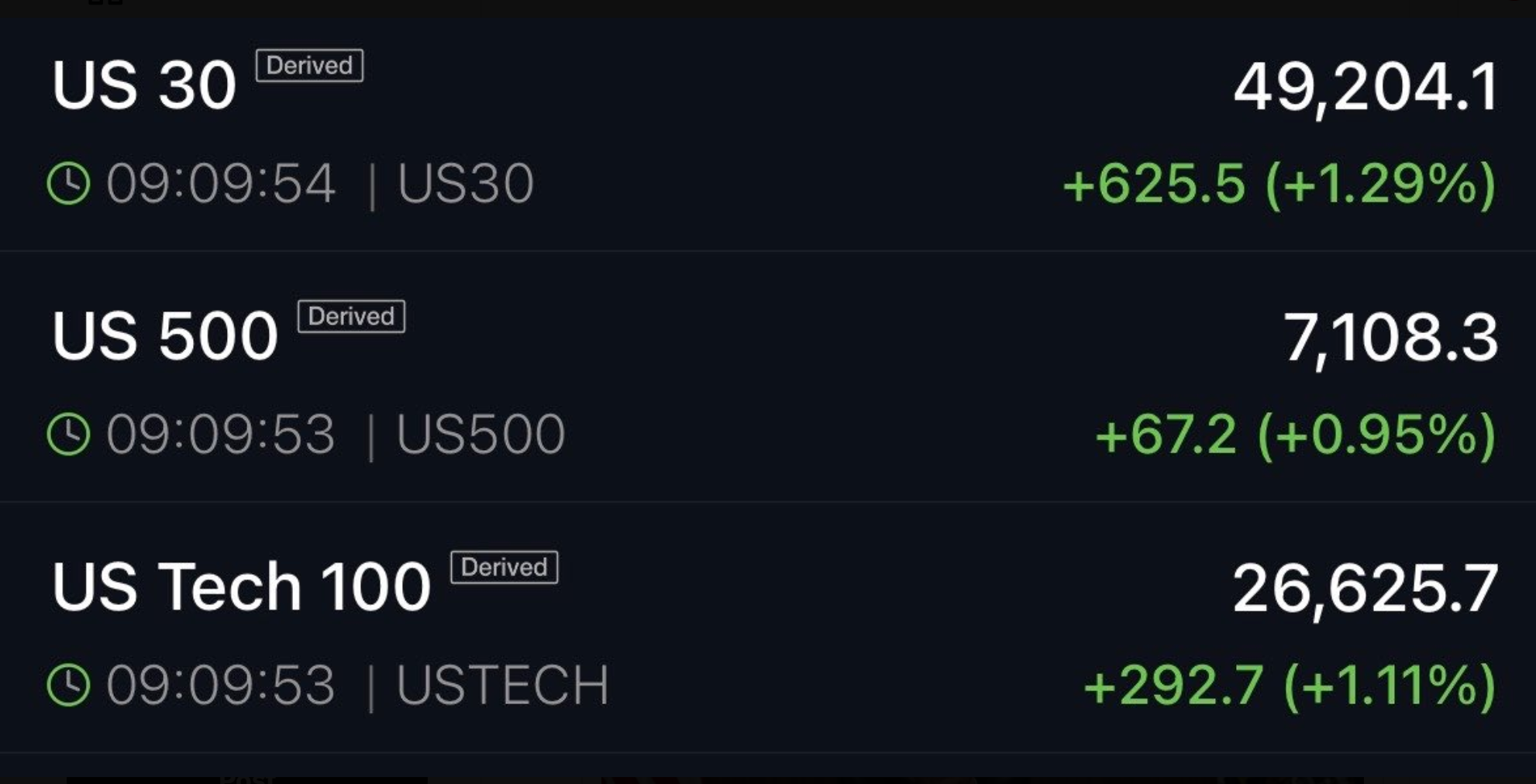
Against this backdrop, eyes remain peeled on whether the Bitcoin price can reclaim the $80,000 psychological level this weekend, potentially drawing tailwinds from resounding risk-on sentiment.
Crypto analyst Rekt Capital highlighted that BTC has maintained itself above the double-bottom formation top near $73,000, positioning price for a positive weekly close.
However, he cautioned that a similar setup in March ended with an upside wick and a subsequent rejection.
“Bitcoin’s progression on the Daily timeframe has been promising, enabling price to maintain itself above the Double Bottom formation top of ~$73,000… it is the upcoming Weekly Close that will be most important to watch for,” wrote Rekt Capital.
On the daily chart, BTC has flipped former resistance levels near $73,000 into support, with consecutive daily closes above prior breakdown zones.
If this behavior continues, it could confirm the breakout from a multi-week consolidation range.
Meanwhile, prediction market Kalshi now prices a roughly 40% chance that BTC hits $80,000 this month, but several key levels remain in focus for Q2.
Trader Ted Pillows identified $76,000 as the key reclaim level that could propel price into the $78,000 to $80,000 band.
“The key zone for Bitcoin here is $76,000 and a reclaim could push BTC towards the $78,000-$80,000 zone. This is where I’ll go short on Bitcoin,” wrote Ted.
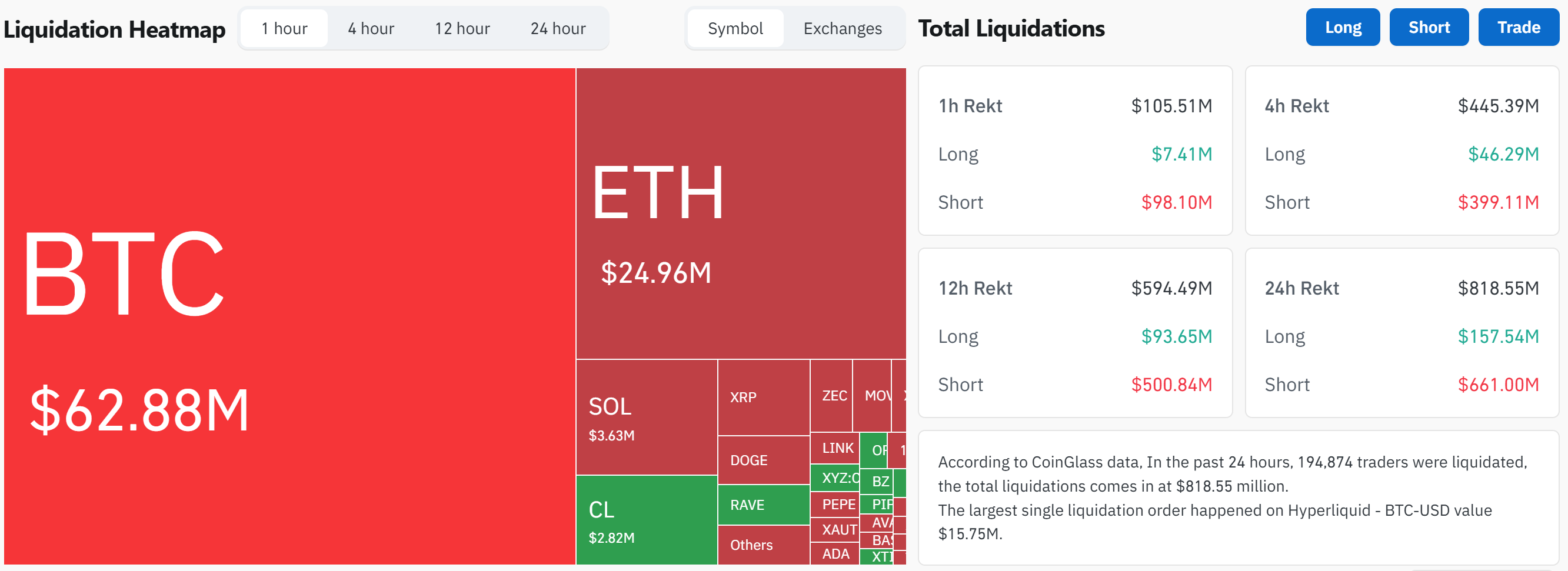
Indeed, Bitcoin’s foray past $76,000 provided an entry for long positions, with a brief test of the $78,000 threshold on Friday catching many naysayers off guard. According to Coinglass data, nearly $100 million in short positions were liquidated in the last hour.
Bear Market Warnings Temper Optimism
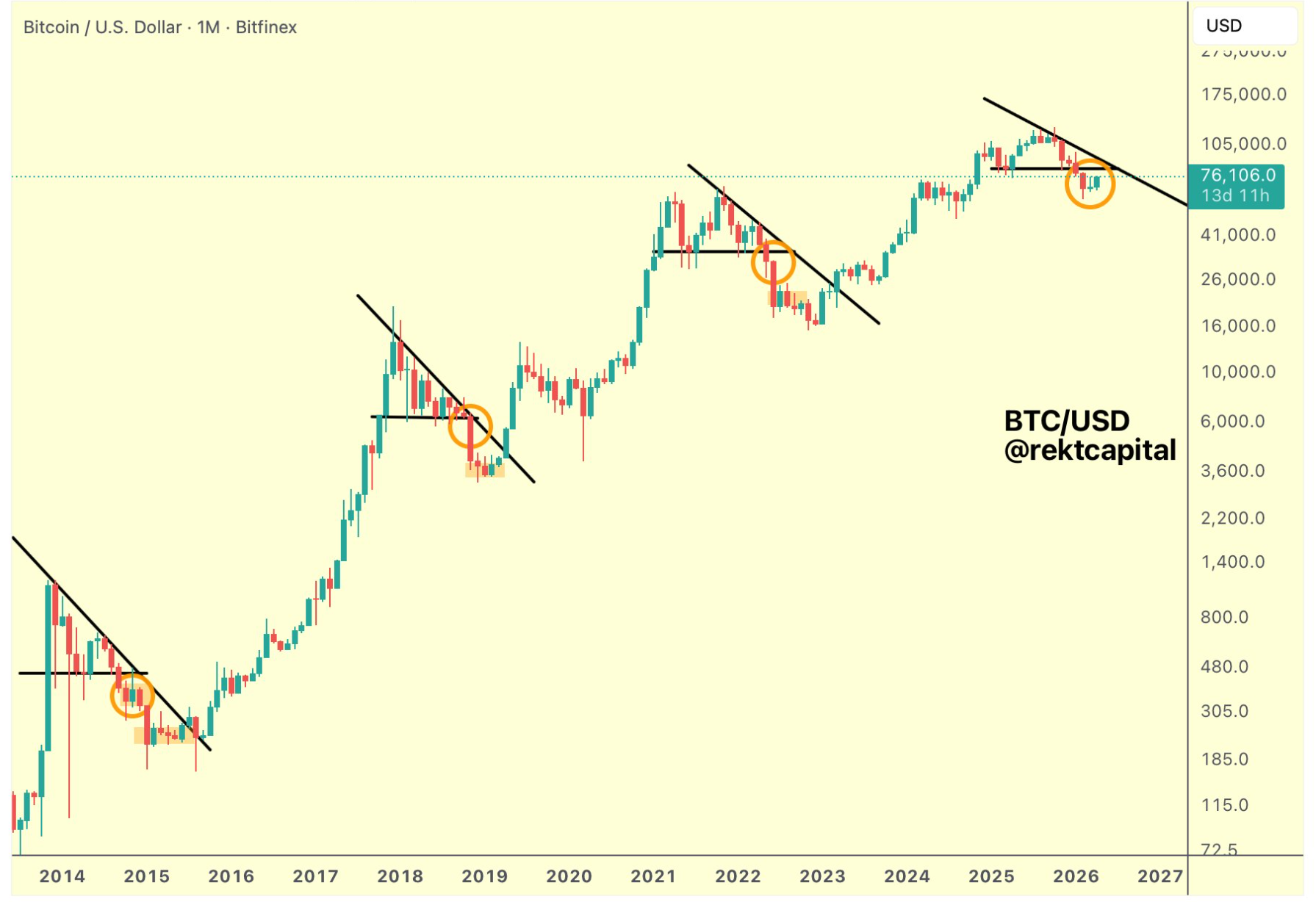
Despite the short-term bullish structure, Rekt Capital also flagged significant macro headwinds. He argued that for BTC to build sustained bullish momentum, it would need to reclaim $82,500 and break its multi-month series of lower highs.
History suggests neither milestone will happen, with roughly six months of bear market potentially remaining.
The 21-week exponential moving average (EMA), which tends to act as resistance during bear markets, sits directly in the current price path. The broader oil shock from the Hormuz crisis adds another layer of macro uncertainty.
BTC is also clustering beneath a macro triangle it broke down from months ago, a pattern that in 2014 resolved through distribution to the downside.
QCP Group echoed the caution, noting that derivatives desks still favor downside protection. The rally appears spot-driven and fragile rather than a structural trend change.
Ted Pillows separately disclosed plans to short BTC near the $79,000 to $80,000 zone, citing a pattern from the last two local tops where price took out the capitulation candle’s highs before reversing.
On-Chain Data Signals Accumulation but Needs Confirmation
Meanwhile, multiple on-chain indicators have flashed mixed signals throughout April. CryptoQuant analyst Woo Mink Yu pointed to the Bitcoin Combined Market Index, or BCMI, which has dropped into the 0.2 to 0.3 range.
This zone has historically marked deep undervaluation.
“We are entering a ‘Value-Accumulation Zone.’ The data suggests the downside is becoming limited compared to the long-term upside. However, wait for price stabilisation to confirm the index’s bottom signal,” wrote Cryptoquant analyst Woominkyu.
Supporting the case for a healthier rally, separate CryptoQuant data showed that Binance open interest has plunged even as the price climbs.
A rally built on spot demand rather than leverage significantly reduces the risk of sudden liquidation cascades.
Meanwhile, exchange inflows on Binance have fallen to 2020 levels, suggesting holders prefer to sit tight rather than sell into strength.
Still, a separate data point flagged roughly 11,000 BTC per hour moving to exchanges this week, the highest rate since December 2025.
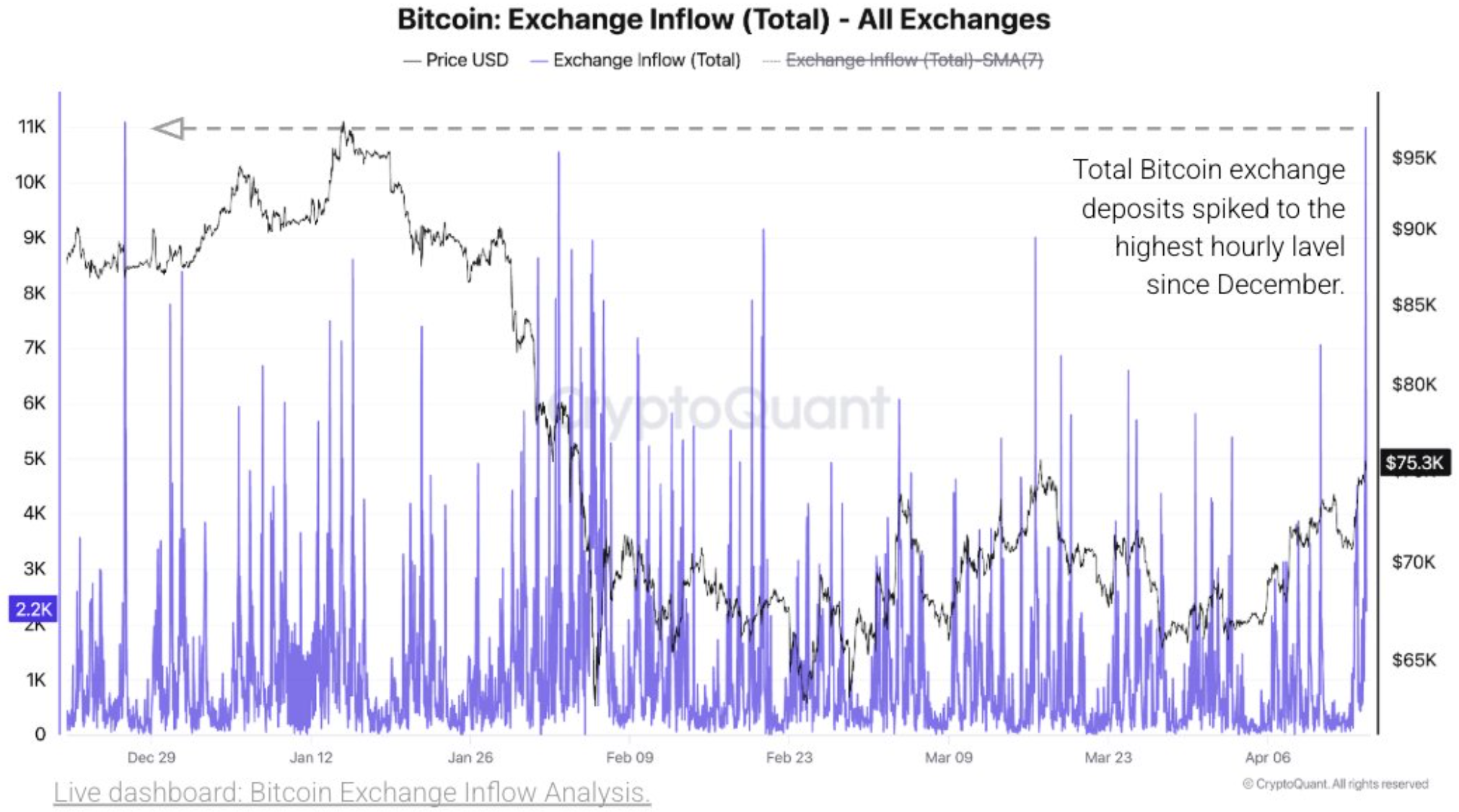
Large holders may be positioning to distribute if the rally extends further.
Earlier forecasts for April projected BTC reaching the mid-$70,000s by month’s end. Friday’s daily close will likely determine whether BTC’s breakout above $77,000 translates into a genuine push toward $80,000 or becomes another failed attempt in a broader bear market structure.
The post Can Bitcoin Reach $80,000 This Weekend as the Strait of Hormuz Opens? appeared first on BeInCrypto.


BTC has broken $77K with 3.45% daily gains, but Coinglass shows $2.221B of longs below $73,610 and $913M of shorts above $81,264, turning the range into a leverage trap.
Summary
- Bitcoin has broken through $77,000 on Gate, with BTC/USDT last changing hands around $77,019 and up 3.45% over the past 24 hours.
- The move comes as Coinglass data show roughly $2.221 billion in BTC longs sitting below $73,610 and $913 million of shorts above $81,264, turning the $70,000–$80,000 band into a heavily levered zone.
- Traders now face a market where even a 5–7% swing can trigger multi‑billion‑dollar liquidation cascades, echoing earlier patterns around $65,000 and $68,000 flagged by Bitcoin liquidation maps.
Bitcoin (BTC) pushed through another psychological round number on Friday, with Gate’s BTC/USDT pair trading around $77,019 and posting a 24‑hour gain of 3.45% as bids continued to grind higher. The latest leg up extends a broader run that has taken BTC from the mid‑$60,000s into the high‑$70,000s over recent weeks, aided by steady spot demand and persistent futures leverage.
BTC clears $77K with liquidations looming
Derivatives data from Coinglass suggest that climb is now happening inside a tight, leveraged corridor. The platform’s liquidation‑levels dashboard shows that “if BTC falls below $73,610, the cumulative long liquidation intensity on major CEXs will reach $2.221 billion,” while a break above $81,264 would put about $913 million of short positions at risk. In other words, a few thousand dollars in either direction from current levels sit atop roughly $3.1 billion of potential forced flows.
Coinglass describes its Bitcoin liquidation heatmap as a way to “estimate price ranges where large‑scale liquidation events may occur,” aggregating leverage across venues such as Binance, OKX and Bybit. Its public materials warn that when price crosses dense liquidation bands, exchanges closing positions “may cause sharp price movements and significantly impact traders’ positions,” especially when open interest is elevated.
A recent crypto.news story on Bitcoin’s liquidation map highlighted an earlier setup around $65,000 and $68,000, where about $1.143 billion of longs and $754 million of shorts were clustered in a narrow range. At that time, Coinglass called those levels “sensitivity zones” that could turn a modest move into an outsized liquidation cascade, a pattern now re‑appearing at higher prices.
Similar leverage dynamics have been visible on Ethereum, where Coinglass data recently flagged near‑$2,000 “trapdoor” levels for longs and a $2,451 liquidation wall threatening $1.47 billion of shorts. Another crypto.news analysis of ETH liquidation walls between $2,057 and $1,863 described how densely packed futures positions can amplify even routine pullbacks.
With BTC now above $77,000, the focus for traders is whether spot demand can keep climbing without triggering the $73,610 downside “trapdoor” or a violent short squeeze beyond $81,264. Those running aggressive leverage into either band are effectively betting that they can front‑run the next liquidation wave rather than be on the wrong side of it.

Bitcoin moved to ten-week highs near $77,000 on Bitstamp as the market readied for the weekly close and weighed the potential for a broader rally back toward the upper end of the $80,000s. The price action came amid a broader risk-on environment, with equities and macro indicators pointing to a calmer backdrop after weeks of volatility driven by geopolitical and supply concerns.
Data from TradingView confirmed BTC briefly topping $77,027, its highest level in roughly two and a half months. The move coincided with a surge in stock benchmarks, as the S&P 500 reached a level of about 7,050 points on Thursday—the first time the index has traded at that mark and sealing its highest-ever close, marking a second all-time high for the week. In crypto markets, the mood shifted toward relief as geopolitical tensions appeared to ease, supporting appetite for risk assets overall.
Meanwhile, traders watched how on-chain liquidity and market structure might shape the next leg. Prominent voices in the space highlighted the role of growing interest from institutional players and the potential for spot BTC ETFs to attract new inflows as macro volatility declines.
“As long as the VIX continues to fall, and we’re in a new equilibrium where oil volatility and gold volatility drop, we should see renewed interest from allocators toward Bitcoin,” wrote Michaël van de Poppe, a well-known trader, on X. He added that a shift in sentiment toward BTC ETFs could bring broader inflows into the space. In the same thread, he projected a path toward the mid-to-high $80,000s if momentum persists.
“What will you start to see? More inflows in the BTC ETF as allocators can allocate more towards Bitcoin.”
Late-week data from Farside Investors underscored that sentiment in the U.S. spot BTC market, noting that weekly inflows into US spot Bitcoin ETFs reached a net $330 million for the week-to-date. The prospect of sustained ETF demand, together with improving risk appetite, fed expectations that Bitcoin could accelerate its ascent in the coming weeks, potentially lifting other digital assets in tandem with BTC.
Van de Poppe reiterated a bullish short- to medium-term thesis, suggesting that if ETF demand and macro conditions hold, Bitcoin could advance toward the $85,000–$88,000 area within the next two to four weeks. He linked the potential rally to a reduction in macro-volatility alongside a cooling in broader market fear gauges, and to new ETF inflows that could unlock fresh capital allocation into the space.
On the chart, the analyst offered a technical view that aligns with a broader bullish scenario: the price could extend its gains so long as the market maintains constructive support above key levels. A separate trader, Rekt Capital, pointed to $72,800 as a pivotal daily close level for BTC/USD to sustain a weekly breakout above resistance around $72,810. He warned that failing to hold that level on dips could trap price in a deeper pullback toward the established weekly range.
“If Bitcoin wants to Weekly Close above the Weekly resistance ($72,810), then price would need to hold the blue level as support on any upcoming dip,” he explained. “The last time Bitcoin rejected from the black resistance in mid-March, price also lost the blue level as support. Which is why a Daily Close below the blue level after any upcoming dip could see price drop back into the blue-blue Weekly Range.”
In parallel, another perspective cautioned that volume dynamics could foreshadow a correction rather than a continuation of the rally. Trader Roman argued that declining trading volume into the highs signals fading momentum, while a high-volume move could push prices lower in a macro-downtrend environment. “We’re in a macro downtrend which when we see high volume continues downward. Low volume implies consolidation/correction to continue the overall trend,” Roman wrote, adding that the next high-volume move is likely to take BTC lower.
The near-term path for Bitcoin sits at a crossroads. On one hand, stronger ETF demand and easing macro volatility could deliver a fresh impulse for BTC and, by extension, for the broader crypto market. On the other hand, thin liquidity during rallies and the risk of a volume-led pullback remind traders to stay mindful of the potential for a test of key supports should momentum fade.
To put the current price action in context, observers have pointed to a broader spectrum of possible macro outcomes. Some analysts argue the market could see a deeper drawdown toward sub-$50,000 levels if macro risk resurges or if volume dries up and fails to sustain a breakout. That framing underscores the importance of watching not just price but also liquidity and institutional flow as Bitcoin navigates this phase of renewed attention from traders and investors alike.
In sum, Bitcoin’s attempt to extend gains beyond $77,000 comes at a moment when ETF inflows, macro calm, and selective risk appetite are aligning to push the narrative higher. While the path to $85,000–$88,000 remains contingent on ongoing demand and favorable technicals, the evolving dynamics around ETF participation and volume will likely shape the next few weeks as investors weigh what comes next for BTC and the wider crypto market.
This article is based on market data and commentary available as of the time of writing. Readers should note that crypto markets remain volatile, and outcomes depend on a range of evolving factors including policy, liquidity, and global risk sentiment.
Crypto World
Ethereum Whales Are Sitting on a Breakeven Ceiling at $2,400 Price: Are They About to Kill the Rally?
Ethereum price is trading at $2,350–$2,351 after posting back-to-back daily gains of 4.76% and 6.32% in recent sessions, but the chart is telling a more complicated story.
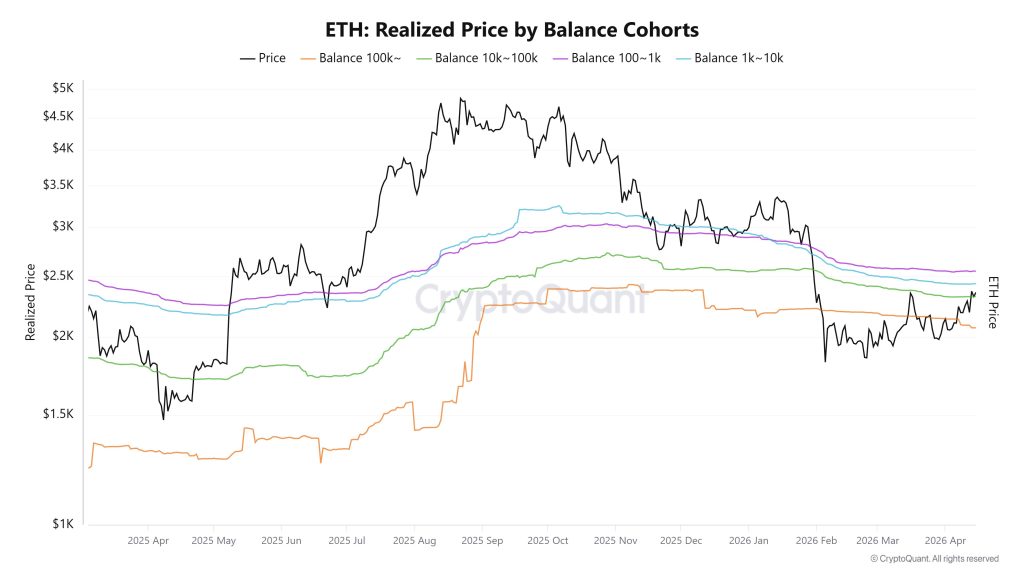
Distribution pressure from whale cohorts sitting near their average cost basis is creating a ceiling that bulls haven’t cracked yet. One resistance level, in particular, is doing most of the heavy lifting right now.
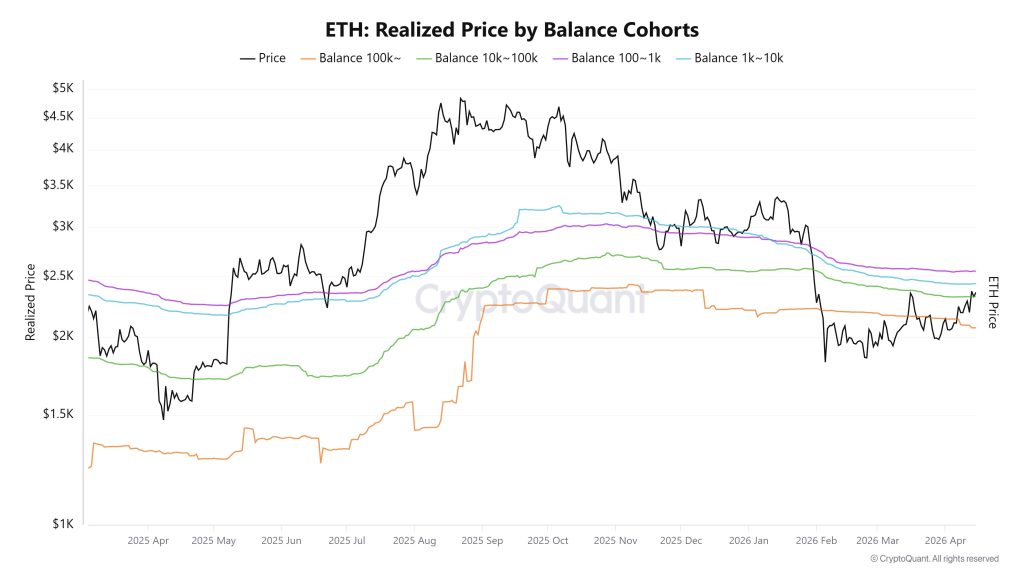
According to Cryptoquant, key whale and retail cohorts carry average cost basis levels between $2,324 and $2,436, a band that neatly brackets current price action and creates natural sell pressure as holders look to exit near breakeven.
US spot ETH ETF inflows returned at $67.8 million on Wednesday after five straight days of net inflows per SoSoValue data, signaling slow but real institutional re-engagement.
Meanwhile, $111.6 million in liquidations hit over the last 48 hours, $70.8 million of that in longs, per Coinglass, a bruising reminder that leverage remains a liability at these levels.
Broader crypto sentiment has stabilized alongside equity markets, but ETH’s internal metrics suggest the recovery lacks the volume conviction needed to flip the next major resistance zone. The next 72 hours may determine whether this is a base-building phase or a fakeout.
Discover: The best crypto to diversify your portfolio with
Can Ethereum Price Break $2,400 and Confirm a Bullish Trend Reversal?
Ethereum price is basically stuck right under a ceiling, and $2,400 is the level doing all the damage, because it lines up with both resistance and the 100-day EMA, and every push into it keeps getting rejected.
The structure underneath still looks solid, though, with price holding above the 20 and 50-day averages, which keeps the bias slightly bullish as long as that holds.
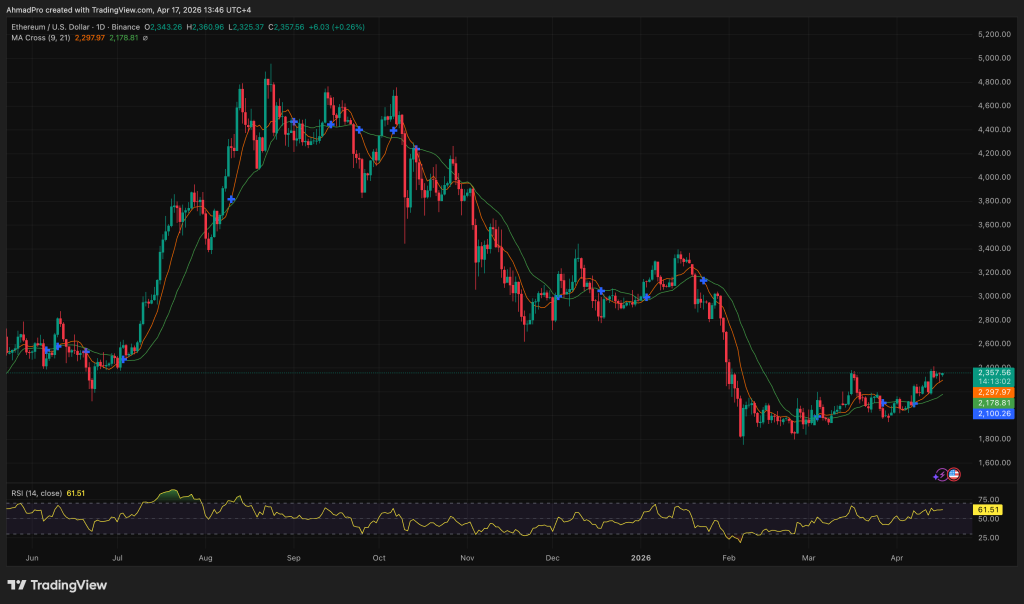
Momentum is kind of neutral right now, RSI is sitting in the middle, and MACD is still weak but flattening, which usually means a bigger move is building but has not picked a direction yet.
If ETH can break above $2,400 with real volume, that is where things open up quickly toward $2,500 and higher, because the structure is already in place for continuation.
But if it keeps failing at this level, a pullback becomes more likely, with $2,200 as the first area that needs to hold, and if that goes, it can slide further down fast.
So this is one of those tight setups where everything comes down to one level, break it, and it runs, fail it again, and it pulls back.
Discover: The best pre-launch token sales
LiquidChain Targets Early-Mover Upside as Ethereum Tests Key Resistance
ETH’s recovery is real, but the math of upside from $2,350 to, say, $3,000 represents roughly 27% — respectable, but not the kind of asymmetric return that early crypto cycles are built on.
For traders watching Ethereum’s open interest dynamics and waiting for confirmation before sizing up, there’s a parallel conversation happening in early-stage infrastructure.
LiquidChain (LIQUID) is an L3 infrastructure project with a specific, structural pitch: it fuses Bitcoin, Ethereum, and Solana liquidity into a single execution environment, which the project calls a Unified Liquidity Layer. Developers deploy once and access all three ecosystems.
The mechanics include Single-Step Execution, Verifiable Settlement, and a Deploy-Once Architecture designed to eliminate the fragmentation that still quietly kills cross-chain DeFi strategies. The presale is currently priced at $0.0145, with $675,934.65 raised to date.
That’s early-stage traction, not a completed raise — and the distinction matters. Presales carry execution risk, no liquidity guarantees, and token unlocks that can pressure price post-launch. Do the work before committing capital.
The post Ethereum Whales Are Sitting on a Breakeven Ceiling at $2,400 Price: Are They About to Kill the Rally? appeared first on Cryptonews.
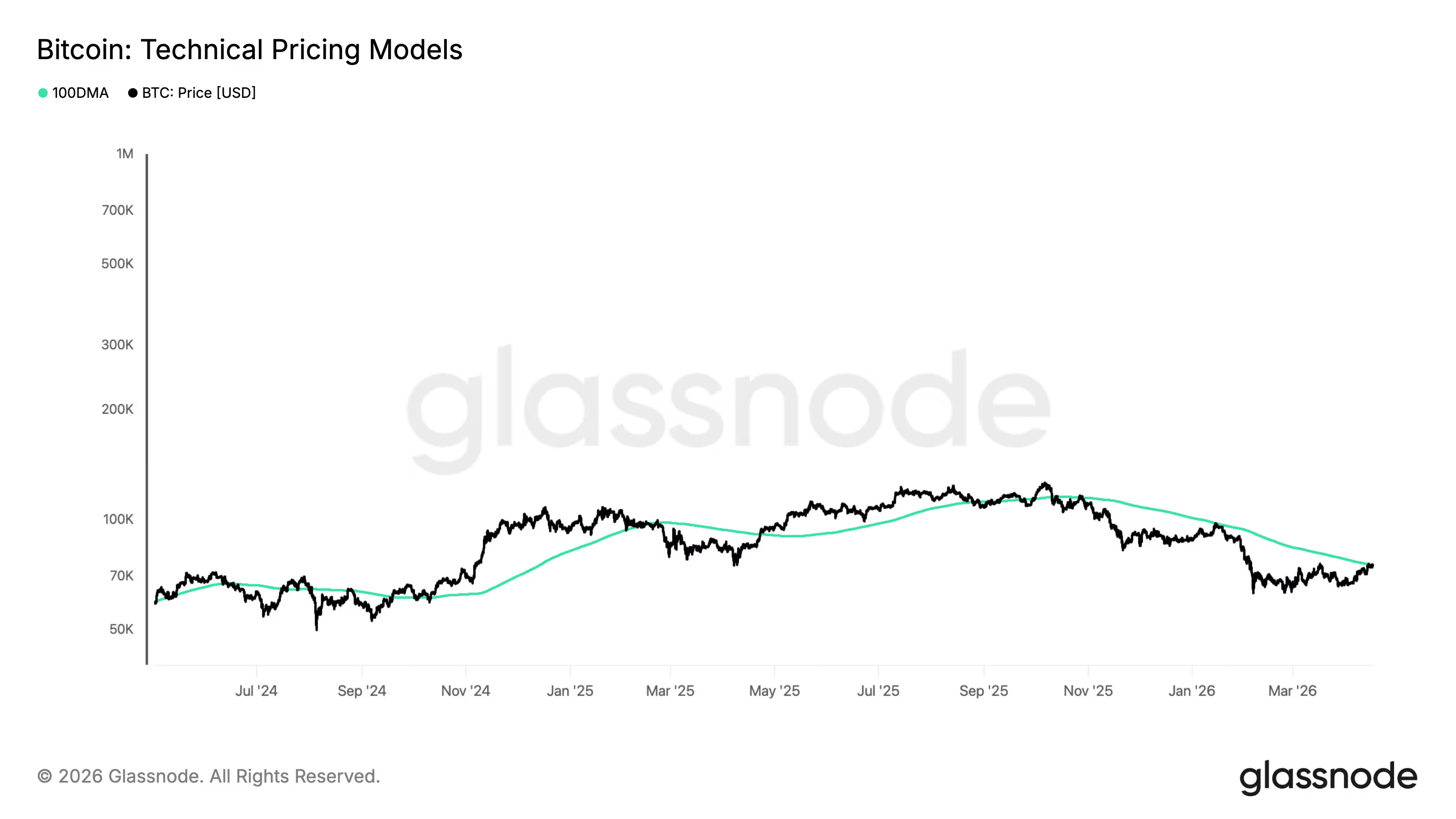
Bitcoin has decisively broken above $77,000 for the first time since its sharp selloff on Feb. 5, when it dropped to a low near $60,000.
The breakout also carries positive implications for Strategy (MSTR), the largest publicly traded holder of bitcoin. The company is now back in profit on its bitcoin holdings, with an average purchase price of $75,577.
Ahead 8% today, MSTR is also trading above its 200-week moving average, a long-term trend indicator that smooths price data over roughly 4 years.
BTC has rallied more than 25% and now trades above its 100-day moving average (100DMA) of $74,774 since bottoming in early February. The previous two tests of this level resulted in rejections and further downside, adding weight to the current move higher.
Bitcoin briefly traded as high as $76,700 on Feb. 4 before continuing lower. A later recovery attempt on March 17 also stalled at $76,013, making the current breakout above $76,300 more notable.

Form 6K Lloyds Banking Group plc For: 17 April

Bitcoin, Altcoins Soar After Iran Opens Strait of Hormuz

Social Mentions Remy Ma After “Dream Car”


-

 Politics7 days ago
US brings back mandatory military draft registration
-

 Fashion7 days ago
Weekend Open Thread: Veronica Beard
-

 Politics5 days ago
World Cup exit makes Italy enter crisis mode
-

 Business7 days ago
Tesla Model Y Tops China Auto Sales in March 2026 With 39,827 Registrations, Beating Cheaper EVs and Gas Cars
-

 Crypto World4 days ago
The SEC Conditionalises DeFi Platforms to Be Avoided for Broker Registration
-

 Crypto World4 days ago
SEC Signals Exemption for Crypto Interfaces From Broker Registration
-

 News Videos2 days ago
Secure crypto trading starts with an FIU-registered
-
 NewsBeat5 days ago
Pep Guardiola and Gary Neville agree over Arsenal title problem that benefits Man City
-

 Sports8 hours ago
NWFL Suspends Two Players Over Post-Match Clash in Ado-Ekiti
-

 Crypto World4 days ago
SEC Proposes Certain Crypto Interfaces Don’t Need to Register as Brokers
-

 Business6 days ago
Ireland Fuel Protests Enter Day 5 as Blockades Spark Shortages and Government Prepares Support Package
-

 NewsBeat3 days ago
Trump and Pope Leo: Behind their disagreement over Iran war
-

 Crypto World7 days ago
Federal judge blocks Arizona from bringing criminal charges against Kalshi
-
 NewsBeat5 days ago
JD Vance announces ‘no agreement’ with Iran over nuclear weapons fear
-

 Business7 days ago
IMF retains floor for precautionary balances at SDR 20 billion
-
Sports5 days ago
Dexter Lawrence, Stefon Diggs, Trading for De’Von Achane
-

 Business7 days ago
Former Liverpool CEO eviscerates FIFA for World Cup ticket pricing
-
 Crypto World5 days ago
Sei Network Enters Quiet Reset Phase as On-Chain Metrics Signal a Slowdown in 2026
-

 Crypto World4 days ago
Trump whales load up ahead of Mar-a-Lago luncheon.
-
Business7 days ago
Coreweave CSO Venturo sells $5.5m in class a common stock
You must be logged in to post a comment Login