
Crypto World
Stablecoins Gain Ground for Paychecks and Daily Spending, BVNK Report

A cross-border snapshot from BVNK and YouGov shows stablecoins moving from niche crypto wallets into mainstream payroll and everyday spend. The online survey, conducted in September and October 2025 among 4,658 adults who currently hold or plan to acquire cryptocurrency across 15 countries, reveals a broad willingness to use dollar- and euro-pegged coins for earnings, remittances, and purchases. Key findings include that 39% already receive income in stablecoins, 27% use them for daily payments, and average holdings sit around $200 globally, rising to roughly $1,000 in higher-income economies. The data also suggests strong demand for wallet access via banks or fintechs and for linked debit card usage.
Key takeaways
- 39% of survey respondents report earning income in stablecoins, with 27% using stablecoins for everyday transactions, highlighting a shift from speculative trading to functional payroll utilities.
- Respondents hold an average of about $200 in stablecoins worldwide, while holdings in high-income economies average near $1,000, indicating material savings potential for more affluent users.
- 77% would consider opening a stablecoin wallet with their primary bank or fintech provider, and 71% express interest in a linked debit card to spend stablecoins, signaling traditional financial institutions’ potential pivotal role.
- People receiving stablecoin income report that stablecoins constitute roughly 35% of their annual earnings on average; cross-border transfers with stablecoins save about 40% in fees compared with traditional remittance methods.
- Ownership is highest in lower- and middle-income economies, with Africa showing the strongest uptake at 79%, underscoring a regional tilt toward cost-effective digital payments.
Market context: The findings arrive during a wave of regulatory attention and enterprise adoption around stablecoins. In the United States, the GENIUS Act is shaping the policy debate on stablecoins and embedded finance, while Europe’s Markets in Crypto-Assets Regulation (MiCA) is catalyzing compliance-driven use cases for wages and cross-border settlements. Meanwhile, the stablecoin market has surged to roughly $307.8 billion in total value, up from around $260.4 billion in mid-2024, underscoring growing scale and willingness to use digital currencies for non-speculative purposes.
A BVNK spokesperson emphasized that the study was designed to illuminate usage patterns among current and prospective crypto users rather than measure broad population adoption. The respondents tend to diversify across multiple dollar- and euro-pegged stablecoins rather than relying on a single issuer, suggesting a preference for multi-token liquidity management. When it comes to where to manage these assets, exchanges are favored by 46% of respondents, followed by crypto-enabled payment apps (like PayPal or Venmo) at 40% and mobile wallet apps at 39%. Only a minority—13%—prefer hardware wallets for custody.
BVNK, a London-headquartered company founded in 2021, built its business around stablecoin-enabled payments infrastructure for enterprises. In June, it partnered with San Francisco-based Highnote to introduce stablecoin-based funding for embedded-finance card programs, signaling a broader push to integrate digital assets into everyday financial services. The collaboration aims to streamline funding flows for card programs that rely on stablecoins as a settlement medium, reducing friction for merchants and employers alike.
An ecosystem narrative is emerging around payroll and cross-border payments. In the United States, the GENIUS Act has accelerated discussions about how payrolls can be paid with digital assets within a regulated framework, while Europe’s MiCA framework pushes providers toward transparent disclosures and robust consumer protections. The combination of regulatory clarity and corporate experimentation is accelerating the adoption of stablecoins in payroll workflows and cross-border settlements, as businesses seek faster settlement cycles and lower costs. The underlying stability of pegged coins makes them more reliable for wage payouts and reimbursements than traditional crypto assets with heightened volatility.
Beyond payroll, the market is advancing toward regulated, enterprise-grade integrations. For instance, Deel announced on Feb. 11 that it would begin offering stablecoin salary payouts through a collaboration with MoonPay, starting with workers in the United Kingdom and European Union and later expanding to the United States. Under the arrangement, employees can opt to receive part or all of their wages in stablecoins to non-custodial wallets, with MoonPay handling conversion and on-chain settlement while Deel continues to manage payroll and compliance. MoonPay has been positioned as the on-ramp for gateway conversions in this setup.
On the enterprise side, the pace of consolidation continues. Paystand recently acquired Bitwage, a platform focused on cross-border stablecoin payouts, a move that broadens Paystand’s B2B payments network for digital-asset settlements and foreign exchange capabilities. Paystand notes that its network has already processed more than $20 billion in payment volume, reflecting growing demand from businesses for stablecoin-enabled settlement and liquidity management. The deal signals that corporate back offices are increasingly viewing stablecoins as a legitimate, scalable settlement layer rather than a speculative vehicle.
While the strict price stability of stablecoins—tied 1:1 to fiat currencies such as the U.S. dollar or euro—addresses volatility concerns for payments, the research also hints at ongoing diversification. Respondents indicated a tendency to hold multiple stablecoins rather than relying on a single issuer, a pattern that could complicate compliance and liquidity management for institutions that serve as on/off ramps for ordinary users. DefiLlama’s data reinforces the point: the stablecoin sector has grown rapidly to hundreds of billions in market capitalization, underscoring that stablecoins are no longer peripheral to crypto markets but are becoming central to payment rails and cross-border transfer ecosystems.
As this secular shift unfolds, questions remain about the pace of mainstream adoption and the regulatory guardrails that will shape long-term viability. The GENIUS Act and MiCA are not just about consumer protection; they are about enabling compliant, bankable use cases for digital assets in payroll, benefits, and enterprise settlement. The rise of payroll-focused stablecoins, in particular, could help workers in regions with limited banking access and high remittance costs participate more fully in the digital economy, while offering employers a more cost-efficient and auditable method of payroll settlement.
What to watch next
- Regulatory developments around the GENIUS Act and the US approach to stablecoins as payroll instruments (timeline updates and potential amendments).
- Progress of Europe’s MiCA implementation and how financial institutions integrate stablecoin-based payroll and cross-border payments within the regime.
- Deel’s rollout of stablecoin payroll in the UK/EU and subsequent US rollout timelines, along with adoption metrics and employee uptake.
- Paystand’s continued integration of Bitwage and the broader adoption of enterprise-grade stablecoin settlement across global B2B networks.
- Regional variations in stablecoin ownership, particularly in Africa and other emerging markets, and how these dynamics influence merchant acceptance and wallet adoption.
Sources & verification
- BVNK-YouGov survey methodology: online fielded in September–October 2025 across 15 countries with 4,658 respondents who currently hold or plan to acquire cryptocurrency.
- Survey findings on income in stablecoins, everyday use, and average holdings, including the 39%/27% figures and the $200 global average (rising to ~$1,000 in high-income economies).
- Banking/fintech adoption metrics: 77% would open a stablecoin wallet with their primary bank or fintech provider; 71% interested in a linked debit card.
- Enterprise movements: Deel’s stablecoin payroll pilots with MoonPay; Paystand’s acquisition of Bitwage and its impact on cross-border settlements.
- Regulatory context and market size: GENIUS Act references and MiCA, along with DefiLlama’s stablecoin market capitalization data.
Stablecoins move from wallets to payroll: how a global survey maps the shift
The report’s narrative centers on a pragmatic shift in how people interact with digital assets. Stablecoins are increasingly viewed not as a speculative instrument but as a practical tool for earning, paying, and moving money across borders. In the 4,658-person sample, a substantial portion already earns in stablecoins, and a growing share uses them for routine payments. The implication for merchants is equally striking: more than half of crypto holders have made purchases specifically because a merchant accepts stablecoins, and the propensity to spend stablecoins rises to 60% in emerging markets. This suggests a feedback loop where consumer demand for stablecoin-enabled checkout can spur broader merchant adoption and, in turn, drive demand for compliant, scalable on-ramps and off-ramps.
From a banking and fintech perspective, the data hints at a possible reorientation of product design. If 77% of respondents would consider opening a stablecoin wallet with a bank or fintech and 71% want a linked debit card, incumbents may respond with regulated wallets, insured custodianship, and seamless settlement rails that reduce friction for wages and cross-border payroll. The fact that a meaningful share of earnings already comes in stablecoins points to a future where payroll providers, payroll tech platforms, and banks co-create wage ecosystems that can operate inside regulatory constraints while offering on-chain settlement where appropriate. The partnership of BVNK with Highnote to embed stablecoin funding into card programs signals how the industry is pursuing this convergence, aligning corporate cards with stablecoin liquidity as a basic building block of embedded finance.
Beyond payroll, the story touches on regulatory readiness. The GENIUS Act and MiCA collectively push the market toward standardized disclosures, consumer protections, and clear tax and accounting treatments for stablecoins used in wages and cross-border payments. In this environment, the operational and technological investments—such as Deel’s stablecoin payroll via MoonPay and Paystand’s acquisition of Bitwage—reflect a broader trend of enterprises rethinking how digital assets can underpin scalable, compliant financial operations. The data also underscores a geographic dimension: ownership and usage skew higher in Africa and other lower- and middle-income economies, suggesting that stablecoins could play a critical role in expanding financial access where traditional rails are costly or fragile.
As the market grows, so does the importance of robust, verifiable data. The DefiLlama figure placing the stablecoin market around $307.8 billion reinforces that stablecoins have transcended their early-stage, speculative perception. They are increasingly intertwined with the actual plumbing of payments—settlement, remittance, and payroll—where speed, cost, and regulatory compliance are essential. While the path to full mainstream adoption remains uneven across regions and assets, the convergence of consumer demand, enterprise infrastructure, and regulatory clarity paints a credible trajectory for stablecoins to become an integral part of everyday financial life. For stakeholders—whether individuals earning in the digital currency economy, merchants seeking lower-payment friction, or institutions building the next generation of compliant digital finance—this survey provides a map of where trust, convenience, and policy align to unlock real-world value.


The online gambling industry has seen a noticeable trend in recent months. More players are searching for alternatives to Stake.com, one of the biggest names in crypto gambling. While Stake remains a major player, a growing number of users appear to be looking for something new. One platform that keeps showing up in those conversations is ZunaBet, a crypto-focused casino and sportsbook that launched in 2026.
So what is driving these searches, and does ZunaBet actually offer something different? This article breaks down both platforms and looks at why players are exploring new options.
The Rise of Stake.com
Stake.com has been one of the most recognized names in crypto gambling for several years. It built its reputation on a clean interface, fast crypto transactions, and a strong presence in the sports sponsorship space. The platform offers thousands of casino games, a full sportsbook, and its own original games that have attracted a loyal user base.
Stake also gained significant visibility through partnerships with high-profile figures and sports teams. That marketing push helped it become a household name in the crypto gambling world.
However, no platform stays on top without facing competition. As the crypto casino market has matured, players have started looking for platforms that offer better rewards, bigger game libraries, or a fresh experience. Search data suggests that terms like “Stake alternative” and “sites like Stake” have been climbing steadily. This is not unusual in a fast-moving industry where players are always looking for the next best option.
What Is ZunaBet?
ZunaBet is a crypto-first online casino and sportsbook that launched in 2026. It is owned by Strathvale Group Ltd and operates under an Anjouan gaming license (ALSI-202510047-FI2). The team behind it has over 20 years of combined experience in the online gambling industry.
The platform offers 11,294 games from 63 providers, making it one of the larger crypto-focused game libraries currently available. Providers include well-known names like Pragmatic Play, Hacksaw Gaming, Evolution, Yggdrasil, and BGaming. The game selection covers slots, RNG table games, and live dealer titles.
Beyond the casino, ZunaBet runs a full sportsbook covering major sports like football, basketball, tennis, and NHL, along with esports titles including CS2, Dota 2, League of Legends, and Valorant. Virtual sports and combat sports are also available, making it a genuine hybrid platform.
ZunaBet supports over 20 cryptocurrencies including BTC, ETH, USDT across multiple chains, SOL, DOGE, ADA, and XRP. The platform does not charge processing fees and emphasizes fast withdrawals, which is a selling point for crypto users who are used to waiting at traditional casinos.
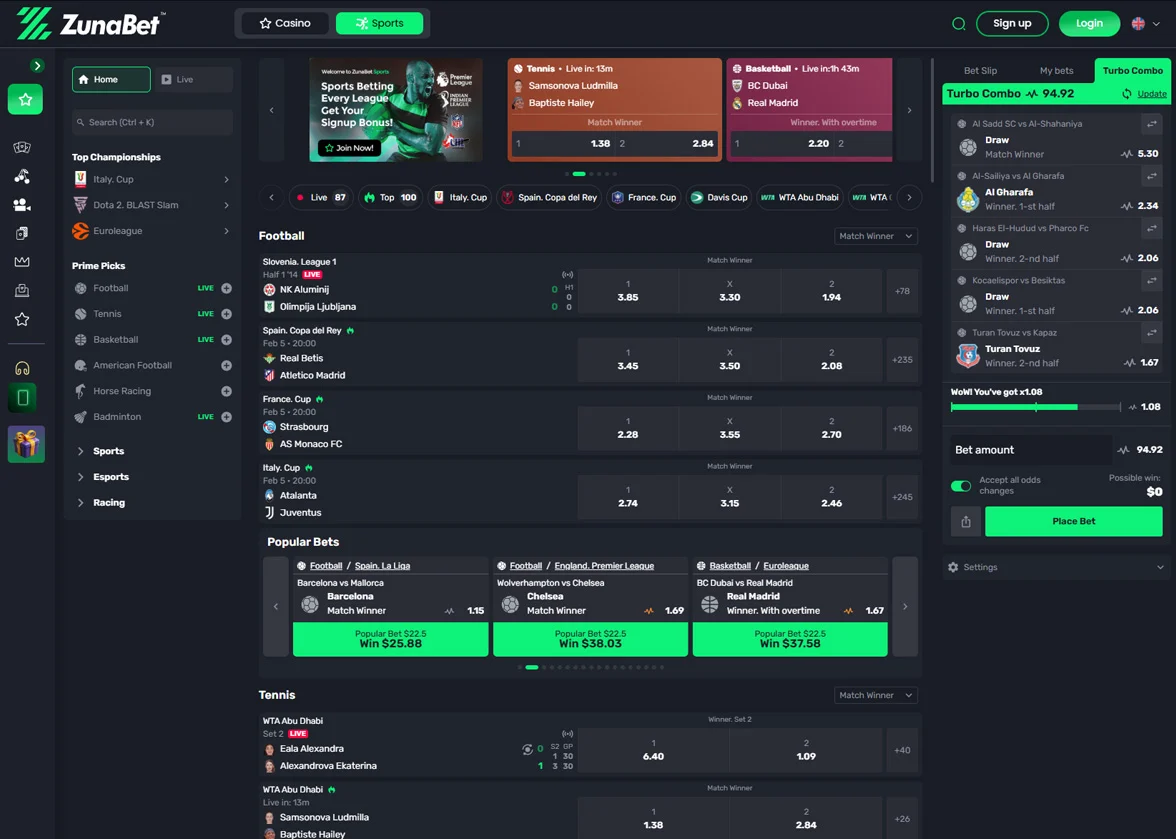
The platform also offers dedicated apps for iOS, Android, Windows, and MacOS, along with 24/7 live chat support.
The Welcome Bonus Comparison
One area where ZunaBet stands out is its welcome offer. New players can access up to $5,000 in bonuses plus 75 free spins spread across their first three deposits. The breakdown is straightforward: 100% up to $2,000 plus 25 spins on the first deposit, 50% up to $1,500 plus 25 spins on the second, and 100% up to $1,500 plus 25 spins on the third.
This structure encourages players to stick around beyond their first session, which benefits both the platform and the player. Compared to many crypto casinos that offer a single deposit bonus, the multi-deposit approach gives players more value over time.
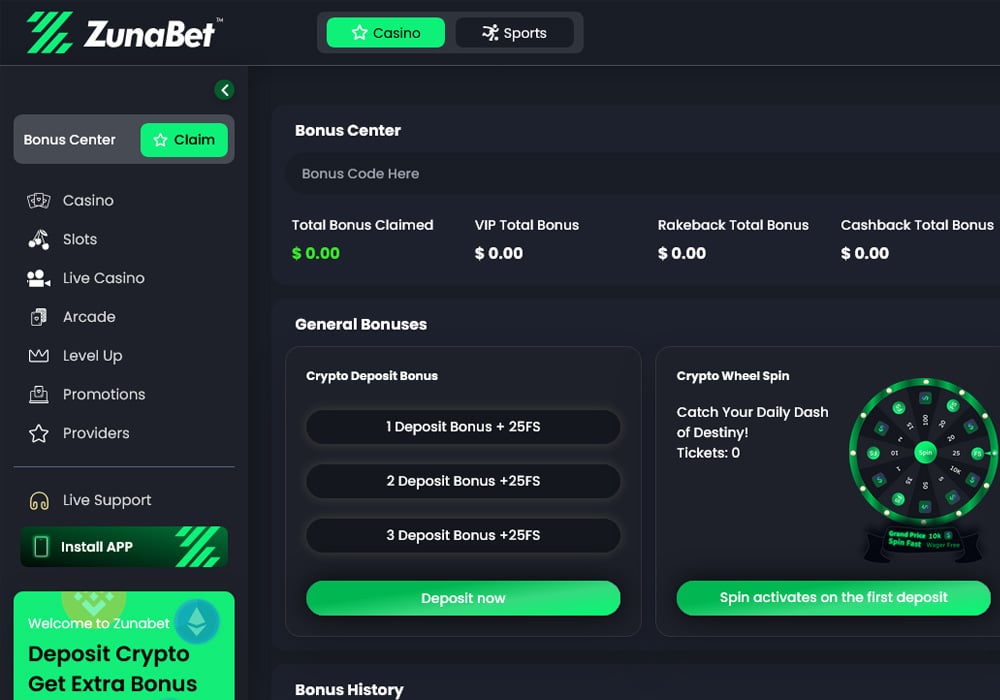
Stake.com, by contrast, has historically taken a different approach to bonuses, often relying on its VIP program and reload offers rather than large upfront welcome packages. For players who want immediate bonus value from day one, ZunaBet’s offer is hard to ignore.
Loyalty Programs: Dragons vs. Traditional VIP
This is where things get interesting. Most online casinos use a fairly standard VIP system with generic tier names and incremental perks. ZunaBet has gone a different route with what it calls a dragon evolution system.
The program has six tiers: Squire, Warden, Champion, Divine, Knight, and Ultimate. Each tier comes with increasing rakeback percentages, starting at 1% for Squire and going up to 20% for Ultimate. Other benefits include tier-based free spins (up to 1,000), VIP club access, and double wheel spins. The program is built around a mascot called Zuno, giving it a gamified feel that sets it apart from the typical loyalty experience.
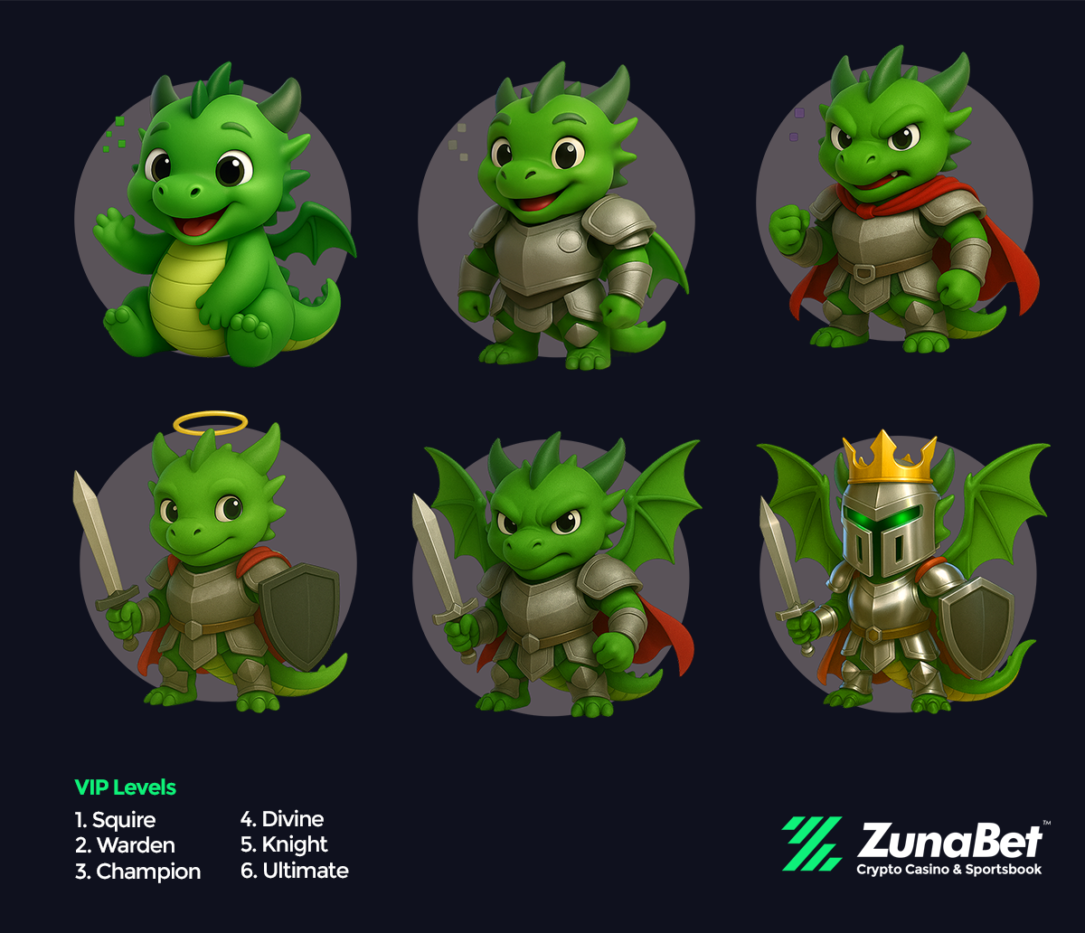
For players who grind regularly, the difference between 1% and 20% rakeback is significant. It directly impacts how much value they get back from their play over time. This kind of structured, transparent reward system appeals to a generation of players who grew up with progression systems in video games and want that same sense of advancement in their gambling experience.
Stake.com has its own VIP program, which is well-regarded in the industry. But it operates on a more invite-based, less transparent model. Some players prefer knowing exactly where they stand and what they need to do to reach the next level, which is where ZunaBet’s approach has an edge.
Crypto-First vs. Traditional Platforms
The broader trend behind all of this is the ongoing shift from traditional fiat-based gambling platforms to crypto-first operators. Major brands like DraftKings, BetMGM, Caesars, and FanDuel still dominate in regulated markets, but they are built around traditional payment methods. Deposits and withdrawals often take days, come with fees, and require extensive verification processes.
Crypto casinos like ZunaBet and Stake flip that model. Transactions are faster, fees are lower or nonexistent, and players have more control over their funds. For a growing segment of players who already hold and use cryptocurrency, this is simply a better experience.
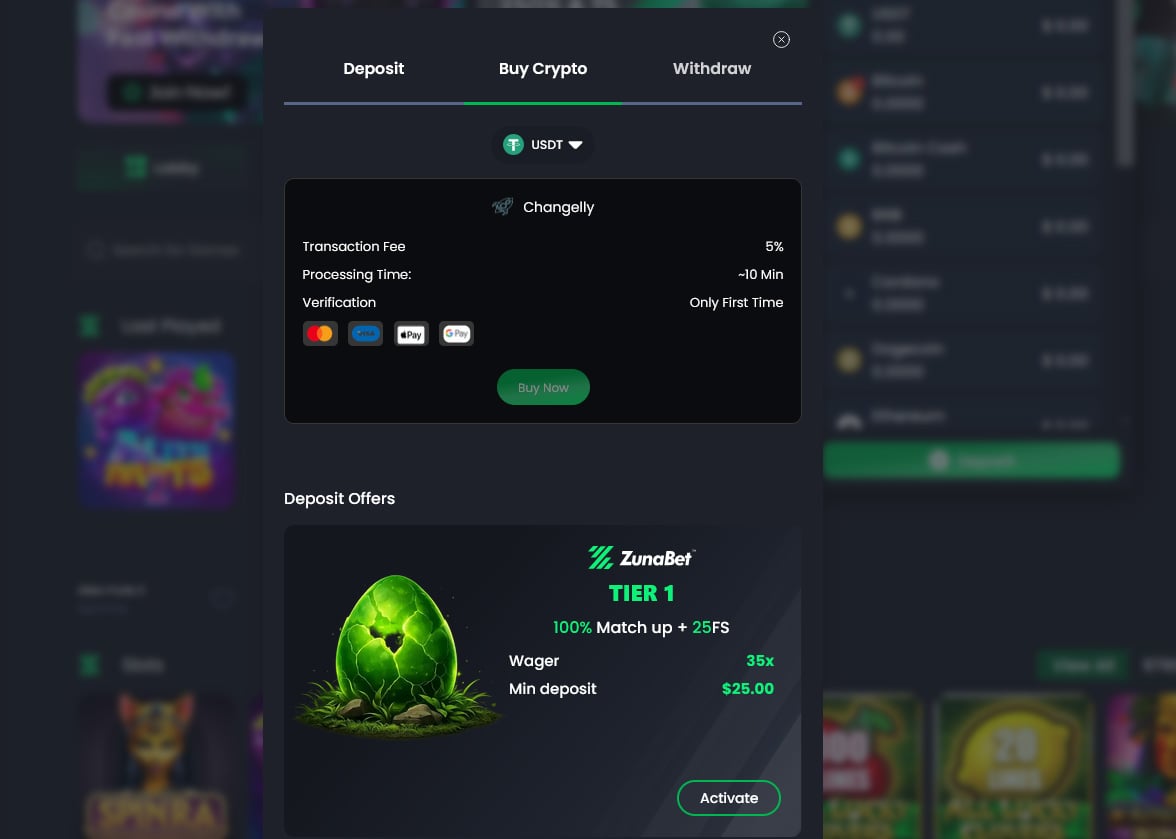
ZunaBet leans into this fully. With support for 20+ coins and no platform processing fees, it is built from the ground up for crypto users rather than being a traditional casino that added crypto as an afterthought.
Is ZunaBet the Future for a New Generation of Players?
There is a reasonable case to be made that platforms like ZunaBet represent where online gambling is heading. The combination of a massive game library, integrated sportsbook and esports betting, crypto-native payments, and a gamified loyalty system checks a lot of boxes for younger, digitally native players.
This is a generation that expects fast transactions, transparent rewards, mobile-first design, and variety. They are not interested in waiting three to five business days for a withdrawal or navigating clunky interfaces built a decade ago.
ZunaBet is still new, and it will need to prove itself over time in areas like customer service consistency, game fairness, and long-term reliability. But the early signs suggest it is a platform worth watching. The fact that it is already appearing in conversations about Stake alternatives says something about the demand for fresh options in the crypto gambling space.
The Bottom Line
The rise in searches for Stake.com alternatives reflects a healthy, competitive market where players are not locked into one platform. Stake remains a strong option with a proven track record, but ZunaBet is making a compelling case as the more exciting new entry in the space.
With 11,000+ games, 20+ supported cryptocurrencies, a $5,000 welcome bonus, a unique dragon-themed loyalty program, and a full sportsbook, ZunaBet offers a package that is hard to overlook. For players looking for something fresh in the crypto casino world, it is quickly becoming the platform to watch in 2026.
Disclaimer: This is a Press Release provided by a third party who is responsible for the content. Please conduct your own research before taking any action based on the content.


Robert Kiyosaki, the author of Rich Dad Poor Dad, argues that the long-running economic shifts set in motion more than five decades ago are now unfolding in full force. He has repeatedly urged readers to consider Bitcoin and gold as hedges against rising debt, inflation and retirement risk, framing them as “real money.”
In a recent post on X, Kiyosaki pointed to 1974 as a turning point that reshaped money and retirement in the United States, linking the move toward a petrodollar framework with policy changes affecting pensions. “The future created in 1974 has arrived,” he wrote, tying the dollar’s evolution after the end of the gold standard to today’s inflationary pressures and energy tensions. He also highlighted the Employee Retirement Income Security Act, known as ERISA, which introduced new rules for pension plans and reflected a broader shift toward market-based retirement savings.
According to Kiyosaki, that transition replaced guaranteed lifetime income for many workers with vehicles such as 401(k)s, placing more risk on individuals. “Millions of baby-boomers will soon find out they have no income once they stop working,” he warned.
Kiyosaki’s stance: Bitcoin and gold as anchors in a shifting era
Kiyosaki reiterated his call for financial education and diversification into non-traditional stores of value. He continues to advocate assets like gold, silver and Bitcoin, which he describes as “real money.”
Last month, he warned that a major financial bubble could be approaching and suggested that a crisis might trigger a sharp rally in scarce assets like Bitcoin. He has previously floated a scenario in which Bitcoin could reach about $750,000 within a year of such a crash.
Bearish sentiment climbs, but contrarian signals linger
In the broader market, Bitcoin sentiment on social media has tilted toward caution. Data from crypto analytics firm Santiment shows the bullish-to-bearish comment ratio has dropped to 0.81—the lowest level in weeks and the strongest bearish tilt since late February. While such mood can reflect near-term pressure, Santiment notes it can also serve as a contrarian indicator, with markets often moving opposite to crowded sentiment.
Cointelegraph has previously highlighted how macro risk and liquidity cycles influence Bitcoin’s price, and recent coverage underscored the dynamics of investor behavior during periods of inflation and tightening financial conditions. For example, Cointelegraph reported that rich Bitcoin traders faced significant daily losses in Q1 2026, underscoring the tension between risk appetite and market fragility. Rich Bitcoin traders lost $337M daily in Q1 2026.
Macro backdrop and what investors should watch next
The thread tying Kiyosaki’s argument is a macro narrative: a decades-long drift from the gold standard toward a petrodollar paradigm, alongside reforms that shifted retirement risk to individuals. Investors are watching how debt levels, inflation, energy geopolitics and retirement policy interact with demand for scarce assets like Bitcoin and gold. The market context remains nuanced, with both optimistic and cautionary viewpoints coexisting as policy signals and macro data evolve.
What matters going forward is not only the timing of any potential price moves but how the broader environment—rising debt, policy shifts, and energy dynamics—shapes demand for hedges and stores of value. The conversation around Bitcoin as a hedge and as a potential growth asset continues to be framed by longer-term macro developments as much as by short-term price action.
Looking ahead, readers should monitor inflation readings, policy guidance, and any shifts in retirement reform or energy supply that could influence demand for Bitcoin and gold as alternative anchors in a changing financial system.


XRP fell to fifth in crypto market cap rankings as BNB moved ahead, with weekly ETF outflows and a seven-month slide weighing on price now.


Bitcoin is showing mixed signals as on-chain data points in two different directions.
Summary
- CryptoQuant said record Bitcoin inflows to accumulation addresses showed whales were quietly building positions daily.
- XWIN Research Japan said STH-SOPR near one showed short-term holders were selling at losses.
- Negative Coinbase Premium showed weak US demand, keeping Bitcoin bottom confirmation out of reach now.
CryptoQuant analyst CW8900 said Bitcoin inflows to accumulation addresses are setting new records each day. The analyst said a large amount of BTC is moving into these wallets even as the market trades in a sideways range.
According to CW8900, whale activity appears to be keeping price action stable while accumulation continues. The analyst said large holders are maintaining prices and adding Bitcoin instead of selling into the market and creating panic among smaller investors.
CW8900 also said retail participation has thinned out. The analyst wrote that most retail investors have already left the market, leaving only a small group of participants while whales continue to build positions.
That reading supports the view that large players are buying quietly during a period of weak volatility. CW8900 said the trend increases the chance of an upward move if buying pressure continues without major disruption to price.
XWIN Research Japan presented a different view and said the market bottom is “not confirmed.” The firm pointed to the Short-Term Holder SOPR, or STH-SOPR, which tracks whether short-term holders are selling Bitcoin at a profit or a loss.
The report said the indicator is hovering around or below 1. That level usually shows that short-term holders are selling at a loss, a pattern often seen when weaker hands exit during a correction.
XWIN Research Japan said this can appear in the early stage of bottom formation. Still, the firm said that selling pressure alone does not confirm a reversal unless buyers step in with clear demand.
That is why the firm also focused on the Coinbase Premium Gap. The metric tracks the price difference between Coinbase and other exchanges and is often used as a signal for US spot demand.
Weak Coinbase premium keeps bottom debate open
XWIN Research Japan said the Coinbase Premium remains in negative territory. The firm said that reading shows US investors are not buying Bitcoin aggressively at current levels.
The report added that earlier bull phases often featured a steady positive premium, which helped support stronger upside momentum. That condition has not returned in the current market, according to the firm.
Taken together, the two views show a divided setup for Bitcoin. Whale wallets appear to be absorbing supply, but weak US demand is keeping the “bottom not confirmed” argument in place for now.
Disclosure: This article does not represent investment advice. The content and materials featured on this page are for educational purposes only.

TLDR:
- Bitcoin’s Easter prices show a steady rise from $5 in 2012 to $84.5K in 2025 before easing in 2026.
- Historical data reveals repeated cycles of growth followed by corrections across different market phases.
- The 2026 Easter price near $67K reflects a cooldown after the late 2025 peak above $120K.
- Current price action remains range-bound, signaling consolidation as the market searches for direction.
Bitcoin traded near $67,000 during Easter 2026, marking a pause after a sharp correction from late 2025 highs. Historical Easter data shows how the asset has evolved through cycles, reflecting both rapid growth phases and periods of consolidation.
Bitcoin’s Easter Prices Trace Its Evolution Across Market Cycles
Data shared by Watcher.Guru outlines Bitcoin’s Easter price history from 2012 to 2026. The asset traded at $5 in 2012 and climbed steadily over the years. By 2017, it had reached $1,195, reflecting early adoption and rising demand.
The trend continued into later cycles, with Easter 2021 recording $58,000 during a strong rally. However, prices have not moved in a straight line.
For instance, Easter 2018 saw $6,850, followed by a drop to $5,325 in 2019. This pattern shows alternating growth and correction phases.
Moving forward, Bitcoin reached $70,000 in Easter 2024 and $84,500 in 2025. These levels followed a strong upward phase that pushed the asset above $120,000 later in 2025. Yet, Easter 2026 shows a pullback to $67,000, reflecting a cooling period after the peak.
This historical data presents a clear pattern of expansion followed by retracement. Each cycle builds on the previous one, although corrections remain part of the trend. As a result, Easter prices provide a snapshot of Bitcoin’s position within broader market cycles.
2026 Easter Reflects Consolidation After Sharp Decline
Price action places Bitcoin near $66,795 as of writing, holding within a narrow range. The market has formed lower highs and lower lows since the late 2025 peak. This structure confirms a bearish trend despite the recent stabilization.
At the same time, the price is moving sideways between $65,000 and $75,000. This range indicates a balance between buyers and sellers after the earlier sell-off. Such periods often appear after strong declines, as the market searches for direction.
Technical indicators support this view of stabilization. The Relative Strength Index remains below 50, showing limited bullish strength. However, it has recovered from oversold levels, suggesting that selling pressure has slowed.
Similarly, the MACD shows weak momentum, with a slight negative reading and limited follow-through. Although a crossover attempt occurred, it has not developed into a clear trend. This aligns with the ongoing consolidation phase.
Key levels remain unchanged during this period. Support holds near $65,000, while $60,000 stands as a deeper floor. On the upside, resistance near $75,000 continues to limit upward movement, with $90,000 acting as a higher barrier.
Looking at the broader cycle, Bitcoin has moved through accumulation, markup, distribution, and markdown phases. The current period appears to be a pause following the markdown phase of early 2026. Price behavior within this range will determine the next stage.
Bitcoin’s Easter history continues to reflect its cyclical nature. While long-term growth remains visible, short-term movements show that corrections remain part of the market structure.
TLDR:
- Ethereum is nearing a multi-year support zone, where demand has historically driven strong price reversals.
- Monthly chart structure shows ETH moving within a defined range between $1,500 and $5,000 levels.
- Tightening volatility suggests a breakout may occur soon as price compresses near key support.
- Traders monitor for bullish confirmation signals before positioning within the current range setup.
Ethereum is approaching a critical support range on higher timeframes, as recent market structure points to a prolonged consolidation phase.
Analysts are closely watching price behavior near key levels, where risk-to-reward setups tend to favor strategic positioning within established boundaries.
Ethereum Tests Range Extremes on Higher Timeframes
Recent analysis shared by market participant Lennaert Snyder points to Ethereum revisiting a key monthly support zone.
His observations focus on a “sell-to-buy” candle that initiated the move toward the all-time high. That area now acts as a technical reference for long-term traders.
According to the tweet, price is testing the lower boundary of a multi-year range. This zone aligns with previous demand and remains a focal point for potential accumulation.
The presence of a long wick in that candle suggests liquidity remains in that region. Markets often revisit such wicks before establishing a directional move.
The broader monthly structure presents a clear cycle. Ethereum surged during 2020 and 2021, followed by a sharp decline in 2022.
Since then, price has moved sideways, forming a wide horizontal range. This structure indicates a market without a strong directional trend.
The range is defined by resistance near $4,800 to $5,000 and support between $1,500 and $1,700. These levels have repeatedly acted as turning points. Buyers tend to step in near the lower boundary, while sellers dominate near the upper limit.
Snyder’s commentary suggests that testing this lower range extreme could offer favorable setups. Traders often seek entries in such zones due to tighter risk control. However, confirmation through price action remains essential before any directional bias is established.
Consolidation Phase Signals Potential Expansion
On lower timeframes, Ethereum reflects a similar pattern of compression. After a sharp decline earlier this year, price stabilized and moved within a narrower range. This aligns with the broader monthly structure, reinforcing the idea of consolidation.
Technical indicators show reduced volatility, as Bollinger Bands have tightened. This typically precedes larger price movements, although direction remains uncertain. At the same time, momentum indicators indicate weakening bullish pressure in the short term.
Price currently trades near the middle to lower portion of its recent range. Resistance remains firm around $2,200 to $2,300, while support sits near $1,900. These levels act as immediate barriers within the broader structure.
The projected path shared in the analysis suggests a possible dip into deeper support. This move could sweep liquidity before a potential reversal. Such behavior is common in range-bound markets, where stop levels attract price action.
Two scenarios remain in focus. If Ethereum holds the lower support zone, a gradual move toward mid-range levels near $3,000 could follow. Continued strength may then push price toward the upper boundary of the range.
On the other hand, a breakdown below $1,500 on a monthly close would shift the structure. This would indicate a loss of support and open the door for further downside. Market participants continue to monitor these levels closely as price approaches a decision point.
As Ethereum trades near range extremes, attention remains on confirmation signals. The coming months are expected to provide clearer direction within this established structure.


Crypto platforms — and investors — have long suffered from hacker attacks and exploits. Now, artificial intelligence (AI) is making that threat even worse.
That’s the view of Charles Guillemet, chief technology officer at crypto wallet provider Ledger, who said the economics of cybersecurity are breaking down as AI tools make it faster and cheaper to attack systems.
“Finding vulnerabilities and exploiting them becomes really, really easy,” Guillemet told CoinDesk in an interview. “The cost is going down to zero.”
His remarks come as crypto heists are in the headlines again. Just this week, Solana-based decentralized finance protocol Drift was exploited, with attackers draining $285 million worth of digital assets. It is one of the most severe exploits of the year so far. A week before that, an attack on yield protocol Resolv led to $25 million in losses.
Altogether, over $1.4 billion in assets were stolen or lost in crypto attacks over the course of the past year, according to data by DefiLlama.
From asymmetry to arms race
Security has long relied on an imbalance: it should be harder and more expensive to hack a system than the potential reward.
But AI is eroding that advantage. Tasks that once took skilled researchers months, like reverse engineering software or chaining exploits, can now be done in seconds with the right prompts.
For crypto, where code often controls large pools of funds, that shift raises the stakes.
“You need to be perfect,” Guillemet warned teams developing blockchain protocols.
The problem is compounded by AI-generated code. As more developers rely on AI tools, vulnerabilities could spread faster.
“There is no ‘make it secure’ button,” he said. “We are going to produce a lot of code that will be insecure by design.”
Raising the security bar
For crypto protocols, that means rethinking security from the ground up.
Guillemet pointed to formal verification — using mathematical proofs to validate code — as a stronger approach than traditional audits, which may miss bugs.
Hardware-based security is another layer, he said. Devices like hardware wallets isolate private keys from internet-connected systems, reducing exposure.
“When you have a dedicated device not exposed to the internet, it is more secure by design,” he said.
That approach is becoming more relevant as malware grows more advanced. Guillemet described attacks that scan compromised phones for wallet seed phrases, allowing hackers to drain funds without user interaction.
For average crypto users, Guillemet’s message is blunt: assume systems can and will fail.
“You can’t trust most of the systems that you use,” Guillemet said.
That could push more users toward cold storage, stronger operational security and keeping sensitive data offline. Even then, risks extend beyond software, including physical attacks targeting crypto holders.
Guillemet expects a divide ahead. Critical systems like wallets and protocols will invest heavily in security and adapt. But much of the broader software ecosystem may struggle to keep up.
“It’s really easier to hack everything,” he said.
TLDR:
- The Cayman Islands officially holds $427 billion in U.S. Treasuries, but Fed research puts the true figure far higher.
- Fed researchers identified a $1.4 trillion undercount, making the Cayman Islands the largest foreign Treasury holder.
- Hedge funds domiciled in the Cayman Islands absorbed 37% of all net Treasury issuance between 2022 and 2024.
- Unlike central banks, hedge funds can exit Treasury positions rapidly, posing a risk to U.S. debt market stability.
The Cayman Islands, a Caribbean territory with just 90,000 residents, holds more U.S. Treasuries than Japan or China.
Federal Reserve researchers have found that official data undercounts the island’s actual holdings by $1.4 trillion. This discovery reshapes long-held assumptions about who finances American debt.
For decades, analysts pointed to Asian economic giants as the backbone of Treasury demand. The real picture, however, tells a different story entirely.
Hedge Funds Drive Cayman Islands’ Treasury Holdings Beyond Official Figures
Official records place Cayman Islands holdings at $427 billion, ranking it sixth among foreign holders. Japan leads on paper at $1.22 trillion, followed closely by China.
However, Fed researchers determined the official count misses over $1.4 trillion in actual Cayman-linked purchases.
The reason behind this gap is structural. The Cayman Islands serves as the legal domicile for roughly three-quarters of the world’s offshore hedge funds.
When those funds buy Treasuries, the purchases register under the Cayman Islands, regardless of where the fund managers actually operate.
Between 2022 and 2024, hedge funds domiciled there purchased $1.2 trillion in Treasury securities. That figure absorbed 37% of all net issuance during that period. As @BullTheoryio noted, that is nearly equal to what all other foreign investors combined purchased.
After the Fed’s adjustment, the Cayman Islands surpasses Japan, China, and the United Kingdom combined. This makes a nine-square-mile island the single largest foreign financier of U.S. government debt today.
Treasury Market Stability Faces Questions as Hedge Fund Exposure Grows
Central banks and sovereign wealth funds tend to hold Treasuries as long-term reserve assets. They rarely exit positions abruptly, even during periods of market stress. Hedge funds operate under an entirely different framework.
These funds carry leveraged positions and answer to performance mandates, not policy goals. They have no obligation to remain invested when market conditions shift against them. That difference matters greatly when the largest buyer controls such a large share of demand.
In April 2025, a sudden tariff announcement triggered simultaneous unwinding across multiple funds. That coordinated exit added pressure across the entire Treasury market at once. The event exposed just how quickly this pool of demand can reverse.
The Fed’s own paper concluded with a direct warning directed at analysts and policymakers. Researchers wrote that “data users should be aware that this major gap exists.” That single line carries weight given the scale of the miscounting involved.
The Cayman Islands’ GDP stands at $7 billion, yet funds registered there finance positions worth many times that figure overnight.
The concentration of leveraged, short-term capital in one jurisdiction now sits at the center of U.S. debt market dynamics.
Large Bitcoin investors are absorbing significant realized losses as the flagship cryptocurrency remains trapped in a prolonged sideways slump below $70,000.
According to on-chain data from Glassnode, wallets holding between 100 and 10,000 BTC are currently realizing daily losses of over $200 million based on a 7-day moving average. These large investors are often referred to as “whales” and “sharks.”
Bitcoin Slump Forces Major Holders Into Deep Losses
Notably, this pain is particularly acute among “Long-Term Holders.” This represents investors who acquired their coins more than six months ago near the peak of the previous rally.
The 30-day simple moving average of Long-Term Holder Realized Losses has climbed steadily since November 2025. This upward trend confirms that veteran investors are increasingly capitulating and selling at a loss.
While this flush-out of underwater buyers is a standard feature of bear-market resolutions, Glassnode analysts note it is not yet sufficient to call a bottom.
To signal the structural exhaustion that typically precedes a new bull cycle, selling pressure will likely need to decelerate to below $25 million in daily realized losses.
However, the chances of reaching that exhaustion point quickly seem slim, as the market is currently gripped by its most bearish sentiment in months.
Blockchain analytics firm Santiment reports that fear, uncertainty, and doubt (FUD) have crept back into the community.
Citing data across social media platforms, including X, Reddit, and Telegram, Santiment noted that Bitcoin is seeing its highest bearish discussion ratio since late February.
The firm noted that BTC is showing a ratio of just 0.81 bullish comments per bearish one amid this extended period of stagnation.
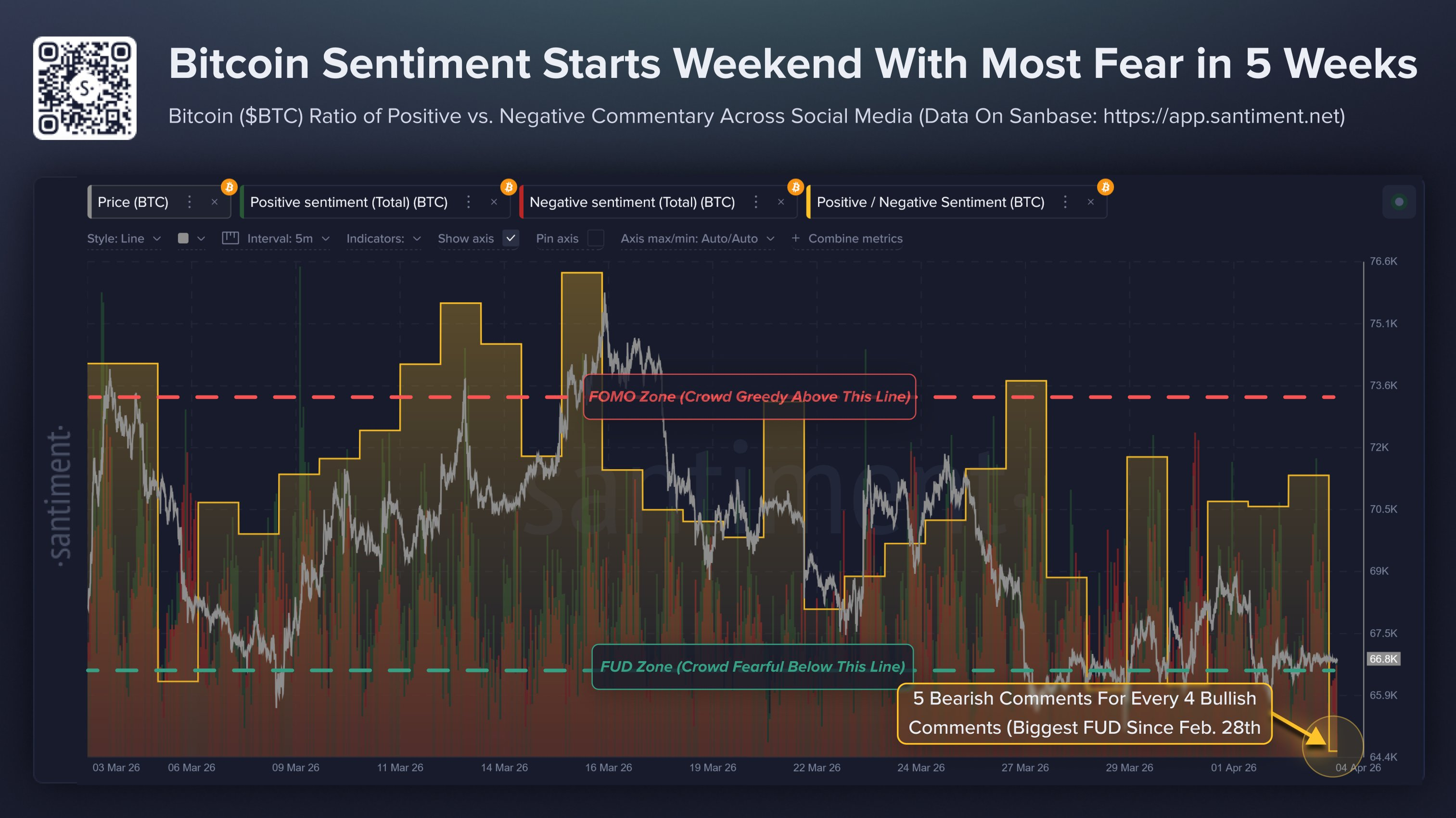
With Bitcoin’s price hovering around $66,800, ongoing geopolitical tensions and domestic regulatory debates are fueling widespread pessimism.
Yet, Santiment pointed out that there is a silver lining for contrarian traders as markets typically move in the opposite direction of the crowd’s expectations.
Historically, this heightened fear has fueled price rebounds. This suggests the current market conditions could turn positive sooner than the broader community anticipates.
The post Bitcoin Whales Are Losing $200 Million Daily As Market Fear Rises appeared first on BeInCrypto.


Robert Kiyosaki said current economic pressure reflects changes that began in the 1970s.
Summary
- Kiyosaki said 1974 policy shifts still shape debt, inflation, retirement pressure, and demand for Bitcoin.
- He warned baby boomers may face retirement income gaps as pensions gave way to market-based accounts.
- Santiment data showed Bitcoin bearish sentiment rose, while contrarian traders watched fear levels for reversal signs.
Robert Kiyosaki said 1974 marked a major shift in how money and retirement worked in the United States. In a post on X, he wrote that “the future created in 1974 has arrived” and tied today’s financial stress to policy changes from that period.
He connected that year to the petrodollar system and to changes in retirement planning. Kiyosaki said those changes helped shape the debt and inflation concerns now facing households and investors.
Kiyosaki also referred to the Employee Retirement Income Security Act and the wider move away from pension structures that paid workers for life. He said many workers now depend on market-based retirement accounts instead of guaranteed income after leaving work.
He warned that this shift placed more responsibility on individuals. In the same post, he wrote that “millions of baby-boomers will soon find out they have no income once they stop working,” linking that concern to long-term pressure on retirement security.
In addition, Kiyosaki repeated his long-running support for gold, silver, and Bitcoin. He described those assets as “real money” and said people should focus on financial education while looking at alternative stores of value.
His latest remarks follow similar warnings from recent months. Last month, he said a major financial “bubble burst” could send capital into scarce assets and push Bitcoin much higher. He also said Bitcoin could reach $750,000 within a year after such a crash.
Bitcoin sentiment turns more negative
At press time, Bitcoin traded near $66,826. Kiyosaki’s latest comments arrived as market sentiment around the asset weakened. Data from Santiment showed bearish discussion on social platforms rose to its highest level since late February.
The platform said the bullish-to-bearish comment ratio fell to 0.81, showing weaker confidence among traders. Santiment also said that extreme fear can sometimes act as a contrarian signal, with markets often moving against the crowd when negative sentiment grows too strong.

North East CEO to take on Great Wall of China charity trek

Micron: I Was Wrong, This Time Is Indeed Different (Rating Upgrade) (NASDAQ:MU)

Is ZunaBet Benefiting From Rising Stake.com Alternative Searches?


-

 NewsBeat3 days ago
Steven Gerrard disagrees with Gary Neville over ‘shock’ Chelsea and Arsenal claim | Football
-

 Business3 days ago
No Jackpot Winner and $194 Million Prize Rolls Over
-

 Fashion2 days ago
Weekend Open Thread: Spanx – Corporette.com
-
Entertainment6 days ago
Fans slam 'heartbreaking' Barbie Dream Fest convention debacle with 'cardboard cutout' experience
-

 Crypto World4 days ago
Gold Price Prediction: Worst Month in 17 Years fo Save Haven Rock
-

 Tech7 days ago
The Pixel 10a doesn’t have a camera bump, and it’s great
-
Crypto World5 days ago
Dems press CFTC, ethics board on prediction-market insider trades
-

 Tech6 days ago
Avatar Legends: The Fighting Game comes out in July and it looks pretty slick
-

 Business4 days ago
Login and Checkout Issues Spark Merchant Frustration
-

 Sports18 hours ago
India men’s 4x400m and mixed 4x100m relay teams register big progress | Other Sports News
-

 Tech6 days ago
Apple will hide your email address from apps and websites, but not cops
-

 Sports5 days ago
Tallest college basketball player ever, standing at 7-foot-9, entering transfer portal
-

 Tech5 days ago
EE TV is using AI to help you find something to watch
-

 Politics6 days ago
Should Trump Be Scared Strait?
-

 Tech5 days ago
Flipsnack and the shift toward motion-first business content with living visuals
-

 Fashion6 days ago
The Best Spring Trends of 2026
-

 Sports6 days ago
Women’s hockey camp eyes fitness boost, tactics ahead of WC 2026 campaign | Other Sports News
-

 Tech5 days ago
How to back up your iPhone & iPad to your Mac before something goes wrong
-
Crypto World7 days ago
Bitcoin’s Six-Month Losing Streak: What On-Chain Data Says About the Market’s Next Move
-

 Politics6 days ago
BBC slammed for ignoring author of The Fraud
You must be logged in to post a comment Login