
Crypto World
Stellar’s $3B RWA market faces a $2M DeFi gap



Stellar’s tokenized real-world asset market has climbed from about $785 million in January to more than $3 billion in July, while only just over $2 million has entered Blend pools that accept RWAs.
Summary
- Stellar’s RWA value increased almost fourfold during the first seven months of 2026.
- Four tokenized products account for hundreds of millions of dollars each on the network.
- Blend has $127 million in TVL, but its RWA-enabled pools hold only slightly more than $2 million.
- RedStone says round-the-clock pricing remains necessary before more RWAs can serve as DeFi collateral.
Stellar’s RWA market has crossed $3 billion
RedStone’s latest report has found that Stellar’s RWA market expanded almost fourfold between January and July, driven by tokenized money market funds, U.S. Treasury products and corporate credit.
Several individual products have reached values normally associated with established investment funds rather than early blockchain trials. The Amundi and Spiko Overnight Swap Fund, a French-regulated UCITS cash-management product, has grown to hundreds of millions of dollars in onchain value since going live on Stellar in March.
RedStone’s report identified Spiko’s tokenized U.S. Treasury bill fund as another major contributor. The product had reached about $536 million, while Ondo Finance’s USDY held more than $533 million on Stellar.
USDY is a yield-bearing asset supported by short-term U.S. Treasuries and bank demand deposits. Ondo expanded the product to Stellar in September 2025, after which its value on the network rose from slightly more than $1 million at the beginning of 2026 to over $533 million.
Corporate credit has added another large pool of tokenized value. VuMe Bond 2030, issued under Luxembourg securitization rules, launched on Stellar in February and has since reached approximately $500 million.
Franklin Templeton has maintained an earlier institutional presence through the Franklin OnChain U.S. Government Money Fund. Launched on Stellar in 2021, the fund uses the BENJI token and invests primarily in U.S. government securities, cash, and repurchase agreements. RedStone placed the value tokenized on Stellar at about $460 million.
The concentration of several large products shows that Stellar has already attracted issuers capable of placing hundreds of millions of dollars on a public network. Yet issuance records how much value has been tokenized, not how much of it is being traded, supplied to lending markets, or used as collateral.
RWA use in Stellar DeFi remains limited
Stellar’s decentralized finance market remains much smaller than its tokenized asset base. RedStone placed total DeFi value on the network at about $259 million when its report was prepared, compared with more than $3 billion in RWAs.
Blend, Stellar’s largest lending protocol, accounted for roughly $127 million of that DeFi total. Pools capable of accepting RWAs, however, held only slightly more than $2 million.
Templar Protocol provides another example of the limited use of tokenized assets in lending. Its Stellar application allows users to borrow against assets including deJAAA, deJTRSY, CETES, and USTRY, but the protocol had about $8.4 million in total value locked on the network, according to RedStone.
DeJAAA represents exposure to AAA-rated collateralized loan obligation tranches, while deJTRSY is tied to short-term U.S. Treasury securities. CETES tracks Mexican government Treasury certificates, and USTRY is backed by short-term U.S. Treasury bills.
Royal Fool, the pseudonymous co-founder and chief executive of Templar Protocol, said dependable pricing is required before a lending market can safely accept an RWA.
“Listing a real-world asset as collateral works best if we can price it reliably around the clock.”
According to the executive, SEP-40 feeds allow Templar to accept real-world collateral and support borrowing against it on Stellar. Lending protocols need current prices to calculate loan-to-value ratios and determine when a position no longer has enough collateral.
A tokenized security does not automatically become usable in DeFi simply because it exists on a blockchain. Trading venues need a defensible price before listing it, while lending protocols must keep valuing collateral even when the market for its underlying asset is closed.
Continuous pricing could bring more RWAs into DeFi
Price discovery becomes harder when an onchain token represents an asset that does not trade continuously. Bitcoin, Ether, and other liquid cryptocurrencies change hands around the clock, allowing oracle providers to combine quotes from several active exchanges.
Traditional assets follow different schedules. U.S. stocks trade mainly during set market hours, while government debt products may only have reliable spot prices when their domestic markets are open.
Money market funds add another complication because their value depends on the securities held in their portfolios rather than on constant secondary-market trading. Fund administrators may also distribute net asset value data through systems that cannot send information directly to a smart contract.
Corporate debt requires additional inputs, including credit quality, maturity, settlement terms, and the structure of the security. According to RedStone, an oracle must account for such differences rather than applying the same method used to price a liquid crypto token.
Stellar’s SEP-40 Oracle Consumer Interface provides a common format through which Soroban smart contracts can request price information. Before the standard was introduced, each provider could use a separate interface, requiring developers to build a new adapter whenever they added another data source.
Under SEP-40, compatible providers follow the same set of functions for identifying supported assets, price precision, update intervals, and timestamps. Applications can retrieve the latest value, request historical records, and check whether a price has become stale.
RedStone joined Stellar in March and later adopted SEP-40. Materials provided with the report said the oracle provider now supports 55 price feeds covering U.S. Treasuries, sovereign debt, corporate credit, tokenized gold, and money market products.
Among the covered assets are Ondo’s USDY, Franklin Templeton’s BENJI and Matrixdock’s XAUm gold token. RedStone also supplies data for Centrifuge-linked Treasury and credit products, along with tokenized Mexican and Brazilian government debt issued by Etherfuse.
Martin Quensel, founder of Anemoy and co-founder of Centrifuge, said tokenization places regulated funds within reach of decentralized finance, while standardized pricing allows protocols to use them as collateral.
“Reliable, standardized pricing on Stellar by RedStone is what lets protocols actually use them as collateral.”
Stellar had previously added another data layer when it integrated Chainlink services in October 2025. The arrangement covered Data Feeds, Data Streams, and the Cross-Chain Interoperability Protocol for applications working with DeFi and tokenized assets.
DTCC brings a U.S. market catalyst for 2027
The Depository Trust & Clearing Corporation plans to add tokenized versions of DTC-custodied assets to Stellar in the first half of 2027, extending the network’s RWA pipeline into U.S. market infrastructure.
As reported in May, the initial eligible assets are expected to include Russell 1000 shares, major index exchange-traded funds, U.S. Treasuries, and several classes of corporate and other bonds.
DTCC received a no-action letter from the U.S. Securities and Exchange Commission in December 2025. The relief allows it to test tokenized securities under specified conditions while maintaining existing investor protections, disclosures and control over ownership records.
The $114 trillion figure attached to the agreement represents assets held in custody by DTC, not the value that will move to Stellar. DTCC has not said that its entire custody base will be tokenized or transferred onto the network.
For U.S. investors, tokenization under DTCC’s system would keep the securities within established custody and regulatory structures. Eligible assets could receive blockchain-based representations while ownership records remain tied to the securities held at DTC.
DTCC has already begun testing tokenized public-market assets with major financial firms. In July, BlackRock, JPMorgan, Goldman Sachs, Vanguard, the New York Stock Exchange, and almost 40 other institutions participated in a tokenization pilot involving stocks, ETFs, and U.S. Treasuries.
Microsoft and Circle shares, the Invesco QQQ Trust, the SPDR S&P 500 ETF and BlackRock’s iShares 0–3 Month Treasury Bond ETF were among the first assets included. JPMorgan also completed a conversion of QQQ shares into a tokenized representation during the pilot.
The active trial uses permissioned infrastructure, including Hyperledger Besu and Canton, while the separate Stellar deployment remains scheduled for 2027. DTCC said participants would test collateral transfers, repurchase agreements, and equity transactions before the current program enters its planned operational phase.



Aave V4 deposits have reached a record $806 million after climbing 30% over seven days, while active loans have increased to $206 million.
Summary
- Aave V4 deposits rose above $800 million within six days of crossing $600 million.
- Ethereum Core leads the six listed markets with $378 million in deposits.
- Active EtherFi loans reached $62 million as the market’s utilization rate climbed to 92%.
- Aave V3 remains much larger, holding approximately $31 billion in deposits.
Aave V4 deposits accelerate past $800 million
Aave’s on-chain dashboard shows that V4 deposits reached $806 million on Aug. 27, extending a rapid rise that began earlier in the month. Deposits passed $500 million on Aug. 19 and exceeded $600 million two days later before adding more than $200 million over the following six days.
Within the total, V4 deposits on Ethereum passed $500 million on Aug. 25. The dashboard divides the capital among several markets with separate collateral rules, borrowing limits, and risk settings instead of placing every asset inside one common lending pool.
Ethereum Core is the largest market, holding $378 million, or about 47% of all V4 deposits. EtherFi Cash on Optimism follows with $257 million, giving the two markets a combined $635 million and nearly 79% of the version’s deposits, based on figures from the dashboard.
Among the remaining markets, Ethereum Global Dollar holds $75 million, and Ethereum Prime accounts for $63 million. Avalanche Core has attracted $18 million, while Ethereum Plus holds another $15 million. Combined, the six listed markets account for the full $806 million reported on the dashboard.
The latest figures have placed V4 well above the $400 million level reported in mid-August. Deposits had stood near $350 million at the start of the month, meaning the value supplied to the system has more than doubled in less than four weeks.
Active loans reach $206 million
Borrowing has risen alongside deposits, with active V4 loans reaching $206 million. EtherFi accounts for $62 million of the total as users deposit wrapped EtherFi staked Ether, known as weETH, as collateral to borrow wrapped Ether.
According to the dashboard, the EtherFi market has reached a utilization rate of 92%. Utilization measures the portion of deposited assets currently being borrowed, making the figure important for both lenders and borrowers. High utilization can increase returns for suppliers, but it can also raise borrowing costs and leave less immediately available liquidity for withdrawals.
A recent crypto.news report on Aave’s debt concentration found that Ether staking and restaking tokens, including weETH, rsETH and wstETH, made up about 66.2% of collateral among the protocol’s largest leveraged positions. WeETH alone accounted for roughly 42%, while WETH represented about 73% of the debt held by that group.
The report also found that 9% of positions carried roughly half of Aave’s total debt. Average health factors for the group stood near 1.06, while debt-to-equity ratios were close to 10.7 times, according to the analysis. A health factor below 1 can trigger an automatic liquidation under Aave’s rules.
Such figures cover Aave’s lending system beyond the new V4 markets and therefore should not be treated as a direct measure of V4 risk. Still, they provide context for the 92% utilization recorded in the EtherFi market, where weETH collateral supports borrowing in the closely related WETH asset.
WeETH leads Aave V4’s deposit mix
WeETH is also the largest individual asset supplied to V4, with deposits of $97 million. The Global Dollar stablecoin, or USDG, ranks second at $90 million, followed by WETH and USDC at $81 million each.
Liquid staking and yield-bearing assets account for several other large positions. LiquidETH holds $77 million, while liquidUSD accounts for $58 million. Wrapped Bitcoin deposits have reached $54 million, giving users another crypto asset that can be deployed under V4’s market-specific collateral settings.
The seven named assets together represent $538 million, or about two-thirds of all V4 deposits. Other supported tokens make up the remainder of the $806 million total.
V4’s structure separates its markets into liquidity hubs and specialized spokes. Hubs manage supplied capital and accounting, while spokes set the terms for individual borrowing markets, including which collateral can be used and how much users can borrow.
The design differs from Aave V3, where each market generally operates as its own pool. V3 still holds approximately $31 billion in deposits, nearly 38 times the amount recorded in V4. The comparison shows that most Aave capital remains in the older system even as deposits move into the new version.
During the Aave V4 launch in April, the protocol presented the hub-and-spoke model as a way to create lending markets with tailored risk controls without dividing liquidity across entirely separate pools. Supported uses included fixed-rate loans, tokenized real-world asset collateral, and structured credit.
Aave’s DAO had previously approved $25 million in stablecoin funding and 75,000 AAVE tokens for protocol development. The funding framework established V4 as the system’s long-term technical base while directing revenue from specified Aave Labs products to the DAO treasury.
Avalanche adds a U.S. Treasury lending route
Outside Ethereum and Optimism, Avalanche Core accounts for $18 million of current V4 deposits. Aave launched V4 on Avalanche in July, making the network its first V4 deployment beyond Ethereum.
As reported in July, Aave said the Avalanche rollout would support lending markets backed by tokenized real-world assets. Planned collateral included tokenized U.S. Treasuries, money market funds, private credit and corporate bonds.
The planned Treasury-backed markets provide a direct connection to U.S. financial assets, although on-chain access does not by itself determine whether a product can legally be offered to U.S. investors. Any access rules would depend on the issuer, the structure of the tokenized instrument, and the regulations applying to its distribution.
Avalanche’s deployment also sits alongside an effort to reduce support for markets with little activity. In July, an Aave governance proposal targeted six deployments and dozens of low-use reserves covering about $98.1 million in supplied assets and $15.6 million in debt.
The proposal called for retiring deployments on Sonic, Scroll, zkSync, Metis, Soneium and Aptos while removing 50 low-adoption reserves and 21 matured Pendle principal tokens from other markets. Under the proposed process, Aave would first freeze affected reserves and cut their supply and borrowing caps before gradually reducing the remaining positions.



New York Times-bestselling thriller author Andrea Bartz struggled for years to hone her writing style and gain success in the literary world. So when she found out in 2023 that pirated versions of her books were being fed into AI systems, allowing them to spit out dozens of pages in her prose style in a matter of seconds, “it was like a gut punch,” she says.
The New York-based writer fought back by becoming one of the three main plaintiffs (alongside Charles Graeber and Kirk Wallace Johnson) in a class-action lawsuit against Anthropic that accused the company of using stolen works to train its chatbot Claude. Bartz being alphabetically first of the trio, she “got the privilege and the tax of having my name become shorthand” for the legal precedent. After a judge ruled that Anthropic’s downloading of pirated books was not protected as fair use, the company agreed to pay $1.5 billion, the largest known copyright settlement in history. Authors whose work was stolen would receive $3,000 for each book.
Critics charge that the case didn’t settle larger questions about AI and copyright—only that Anthropic violated the law because the company trained its models on pirated books. Bartz hopes other lawsuits set stronger precedents, but nonetheless views her case as “a crucial victory.”
The author—whose next novel, which she calls a “tech thriller,” is due to be released in May 2027—also hopes the settlement serves as a morale boost for writers and a symbol of defiance. “This makes it clear that it is illegal for big tech companies to download troves of pirated e-books to use however they see fit,” she says. “It is theft, and it sounds pretty obvious, but that had not been established before.”


Financial stability would remain its primary duty, with annual reports to Parliament on the new objective being planned.


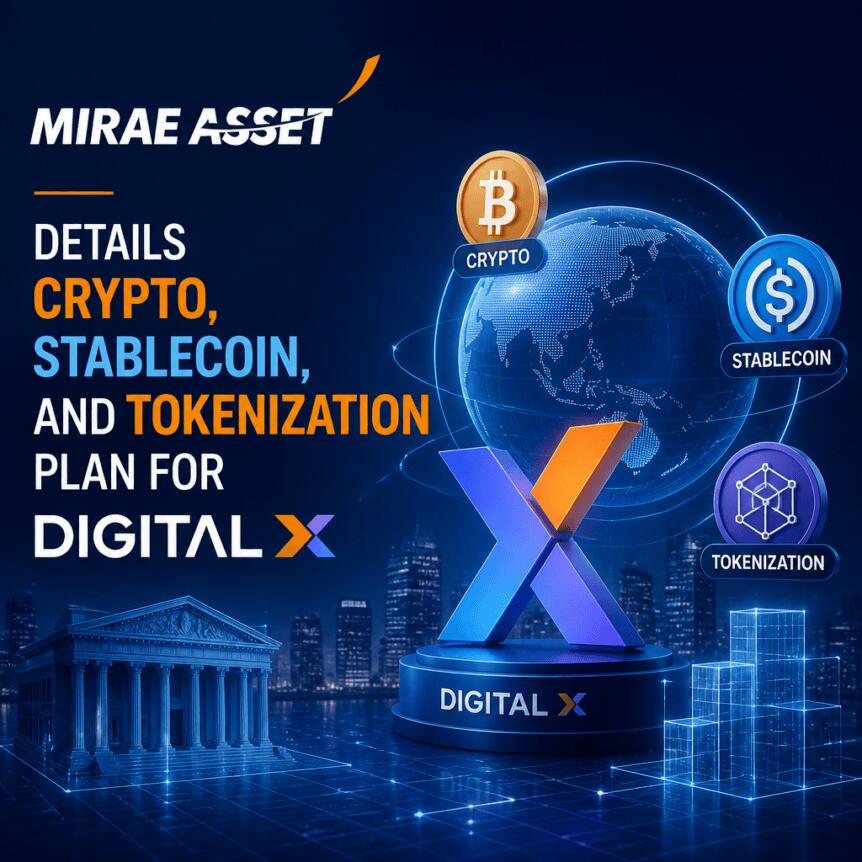
Mirae Asset is looking to turn its control of South Korean crypto exchange Digital X into a large-scale digital asset platform, targeting 150 trillion won (about $109 billion) in business value, according to The Korea Times.
The plan builds on Mirae Asset Consulting’s acquisition of a controlling 97.15% stake in Korbit last July—an effort the report describes as the first time a South Korean financial group affiliate has taken control of a domestic crypto exchange. After the takeover, Korbit was rebranded as Digital X.
Key takeaways
- Mirae Asset aims to grow Digital X into a broad digital asset business worth 150 trillion won, focused on crypto, stablecoins, real-world assets, and security tokens.
- The strategy follows Mirae Asset Consulting’s July acquisition of a 97.15% stake in Korbit for a total 141.4 billion won, with the exchange later renamed Digital X.
- Digital X has started waiving trading fees for won-denominated assets, with the zero-fee period planned through Aug. 24, 2027.
- The initiative comes despite Korbit—Digital X’s predecessor—having only about 0.5% of South Korea’s crypto trading market in 2025, per the country’s Fair Trade Commission.
From Korbit control to Digital X’s expansion blueprint
Digital X’s projected growth is anchored in what The Korea Times says will be a multi-pronged digital asset lineup. The report states Digital X will focus on cryptocurrencies, stablecoins, real-world assets (RWAs), and security token offerings (STOs).
Beyond tokenized financial products, the outlet also reports that the exchange is considering tokenizing physical assets such as gold, silver, and—more unusually—electricity. If pursued, that would position Digital X at the intersection of tokenization narratives and tangible-asset markets, where product design, custody, and regulatory treatment tend to be complex.
Why Mirae Asset’s stake matters for South Korea’s exchange landscape
According to The Korea Times, Mirae Asset Consulting completed its purchase of the 97.15% stake in Korbit in July for a cumulative 141.4 billion won. The deal effectively gave a major financial group affiliate control of a domestic exchange—something the report highlights as a first in South Korea.
That matters because it suggests the market may be shifting from niche crypto venues to exchange models backed by large financial institutions. Such a transition typically brings new priorities—risk management frameworks, institutional-grade product standards, and distribution through broader financial services—though the exact implementation details were not provided in the report.
For context, Korbit’s scale was modest before the rebrand. The Korea Times notes that despite being founded in 2013, Korbit represented just 0.5% of South Korea’s crypto trading market in 2025, citing the country’s Fair Trade Commission. That creates an immediate tension for the new strategy: Mirae Asset’s large target implies a substantial expansion in both users and product depth beyond the exchange’s prior market share.
Fee waivers and the push to widen won-denominated activity
Digital X has already begun changing its trading economics. As reported in the original coverage, on Monday the exchange started waiving trading fees across all won-denominated assets, with the policy scheduled to last through Aug. 24, 2027.
On its face, fee reduction is a competitive lever: it can lower trading costs for active users and improve liquidity during periods when exchanges often compete on price. However, investors and traders typically watch for follow-on effects—such as whether volumes rise enough to offset reduced revenue per trade, and whether the firm’s broader tokenization and stablecoin roadmap receives a corresponding ramp-up in product availability.
Digital X’s stated fee change is tied to its won-denominated markets, and readers can review the exchange’s trading fee information via its own site: https://korbit.co.kr/info/fee/?tab=trade.
Leadership messaging: “Mirae Asset 3.0” and a platform approach
In the lead-up to its expansion, Mirae Asset founder and chairman Park Hyeon-joo reportedly discussed the initiative at an employee event in Seoul on Wednesday. The Korea Times says Park positioned Digital X as a core component of “Mirae Asset 3.0.”
That framing is significant because it indicates the project is not being treated solely as an operational acquisition; it is being pitched as part of a wider corporate evolution. Still, the report does not spell out how Digital X will integrate with other Mirae Asset businesses or what governance and risk controls will be applied as the platform adds stablecoins, RWAs, and security tokens.
Next, market participants should watch how Digital X converts its long-term ambition—tokenizing assets and supporting STOs—into concrete regulatory and product milestones, while also tracking whether the multi-year fee waiver meaningfully boosts trading activity in won-denominated markets. The scale of the 150 trillion won target sets a high bar, and the critical question will be whether the exchange can grow beyond its earlier market share while sustaining a viable revenue model.


Genius Group has proposed raising capital through perpetual preferred securities to build an $827 million Bitcoin treasury and an $800 million AI portfolio within a $2 billion total-asset target for fiscal 2031.
Summary
- An initial preferred securities offering would seek $12.5 million from income-focused investors.
- Proceeds would be divided among Bitcoin, AI investments, and an 18-month dividend reserve.
- Genius Group plans to restart Bitcoin purchases after liquidating its holdings to repay $8.5 million.
- Final offering terms remain subject to board approval, securities rules, and market conditions.
Genius Group turns to preferred capital
Genius Group said on Aug. 27 that it intends to use its $1.2 billion shelf registration to issue publicly registered perpetual preferred securities, placing the financing method at the center of its five-year treasury plan.
The Securities and Exchange Commission declared the shelf registration effective on July 18, 2025. Such a registration allows the NYSE American-listed company to offer securities over time, but it does not represent SEC approval of the securities or their investment merits.
Under the preliminary proposal, Genius Group would seek $12.5 million in its first preferred securities offering. The company expects the instruments to be non-convertible and to carry a variable dividend paid monthly.
Funds from the sale would be allocated among the Bitcoin treasury, the AI treasury, and a U.S. dollar reserve equal to approximately 18 months of preferred dividend payments. Genius Group did not disclose how much of the initial proceeds each party would receive.
Discussions have begun with investment banks that have experience in preferred securities and digital asset treasury financing. However, the final issue price, dividend rate, offering size, exchange listing, and sale date have not been decided.
Any offering would require separate materials filed with or furnished to the SEC. The structure will also depend on board approval, applicable securities laws, regulatory requirements, and market conditions, according to the announcement.
Shareholders provided some of the required corporate authority at Genius Group’s annual meeting in July. About 97.58% of votes supported giving the board authority to issue preferred shares, while 99.54% approved a mandate allowing the company to repurchase up to 20% of its ordinary shares.
The $2B target covers total assets
Rather than placing $2 billion entirely into Bitcoin and AI investments, Genius Group has set separate fiscal 2031 targets of $827 million for its Bitcoin treasury and $800 million for its AI portfolio.
Operating businesses, cash, and other holdings would account for the remaining assets under the $2 billion plan. The company currently reports net assets of $106.6 million, following a 57% year-over-year increase announced on Aug. 13.
Genius Group calculated its net asset value at $0.62 per ordinary share. With GNS closing at $0.18 on Aug. 26, the company said its stock was trading at approximately 0.29 times book value, compared with what it described as a 2.60-times average for the U.S. education sector.
Management has forecast that net asset value could reach between $2 and $4 per share over five years if the company executes its financing, asset-purchase, and share-buyback plans. The projection also depends on market conditions and the performance of Bitcoin and its AI investments.
Chief executive Roger James Hamilton described perpetual preferred capital as a way to fund treasury purchases without issuing more ordinary shares.
“Every dollar of preferred capital deployed into our Bitcoin and AI Treasury that generates returns above the preferred dividend rate flows directly to our ordinary shareholders’ net asset value.”
Returns above the dividend cost could add to the assets attributable to ordinary investors. If the acquired assets lose value or earn less than the dividend rate, however, the preferred payment obligations would remain senior to ordinary shareholder distributions.
Genius Group identified Bitcoin price volatility, changes in private technology company valuations, financing costs, and capital availability among the factors that could cause actual results to differ from its forecasts.
Strategy provides the financing model
For its proposed securities, Genius Group has taken Strategy’s Bitcoin financing program as its main reference. The company said Strategy has raised more than $16 billion through four perpetual preferred stock series since introducing STRK in January 2025.
The preferred securities have no fixed maturity and do not require repayment on a set date. Their dividends and senior claims still create costs that treasury assets must cover before any excess return reaches ordinary shareholders.
Investor demand has emerged for some of the products. In May, Strategy’s STRC security recorded $1.53 billion in daily trading volume, crypto.news reported, drawing attention to the use of dividend-paying stock to fund corporate Bitcoin holdings.
Market prices can also depart from the issue or liquidation value. STRC fell to an intraday low of $82.50 on June 18 before closing near $88.59, well below the approximately $100 level around which the security was designed to trade.
Strategy later used Bitcoin sales to support the preferred program. An Aug. 10 SEC filing showed that the company sold 1,690 BTC for $108.6 million between Aug. 3 and Aug. 9, using the proceeds to repurchase about 1.15 million STRC shares.
A subsequent filing showed Strategy spent $132.2 million on additional STRC repurchases and $52.4 million on related dividends during the following week. It also placed $149.1 million into its U.S. dollar reserve, bringing the cash pool to $4.8 billion.
For U.S. investors, Genius Group’s final prospectus will determine the economic and legal terms of the proposed security. Until those documents are available, its dividend rate, liquidation preference, call provisions, exchange access, and possible tax treatment remain unconfirmed.
Bitcoin purchases are scheduled to restart
Before developing the dual-treasury plan, Genius Group pursued a Bitcoin-first policy under which it intended to hold at least 90% of its reserves in BTC.
The company adopted the policy in November 2024 and planned an initial $120 million purchase program. By January 2025, it held 420 BTC after buying another $5 million at an average price of $95,912 per coin. Holdings later reached a peak of 440 BTC.
A U.S. court order disrupted the program in early 2025 by restricting the company from selling shares, raising funds or buying Bitcoin during a legal dispute tied to its asset purchase agreement with Fatbrain AI. Genius Group reduced its Bitcoin holdings while seeking relief from the restrictions.
After the order was lifted, the company resumed purchases in June 2025 and increased its balance to 100 BTC. Management also restored a target of accumulating 1,000 BTC.
Liquidity needs later forced another change. Genius Group sold its remaining Bitcoin during the first quarter of 2026 and used the funds as part of the repayment of $8.5 million in debt.
Before the final sale, the company reported holding 84 BTC valued at approximately $5.7 million in March. Its April 1 operating update said it would rebuild the treasury when management considered market conditions more favorable.
Under the latest timetable, Bitcoin purchases are expected to restart in the fourth quarter of 2026. The company has not disclosed the size or price of its first planned acquisition.
Genius Group established the second part of its treasury in May 2026, when the board authorized an AI portfolio with an initial investment plan of up to $100 million. The company made its first allocation in June through funds providing exposure to private companies, including OpenAI, Anthropic, Anduril, and Databricks.
SpaceX held the largest look-through weighting at 13.5% of the AI portfolio, according to the company. Genius Group said its portfolio also contained exposure to xAI, Figure AI, Replit, and other companies involved in AI models, robotics, and infrastructure.
Zcash could emerge as a meaningful challenger to Bitcoin’s dominance among digital assets as the rapid adoption of artificial intelligence puts a premium on financial privacy and fuels concerns over AI-powered surveillance, according to Grayscale.
In a new research report, Grayscale head of research Zach Pandl said Zcash (ZEC) has “second mover advantages” that could help it challenge Bitcoin’s (BTC) entrenched network effects, something previous alternatives such as Litecoin (LTC) have failed to achieve.
Central to Pandl’s argument is financial privacy. Zcash can shield transaction information, which Grayscale argues could become increasingly valuable as AI systems become better at analyzing financial activity at scale.
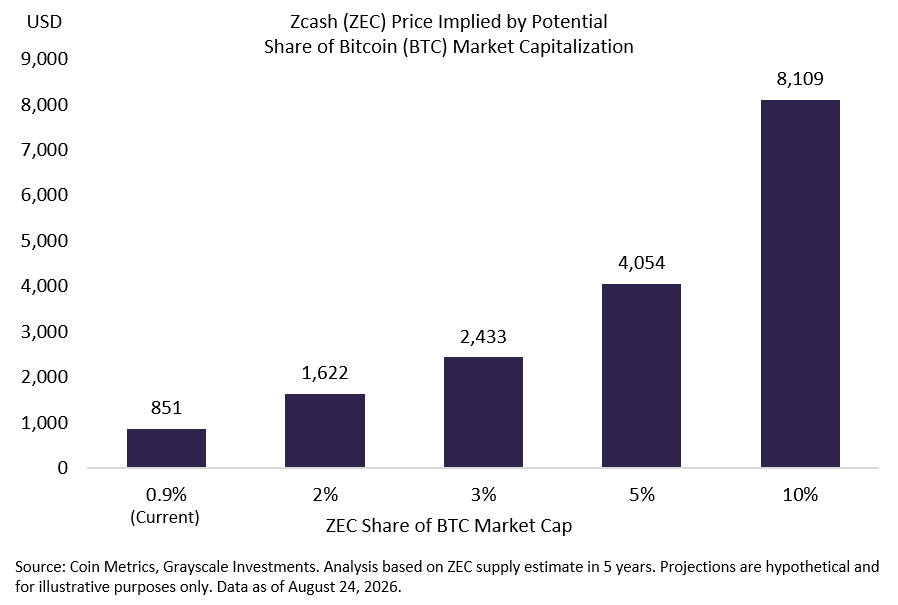
The report comes after ZEC’s roughly 19-fold increase over the past year. Despite those gains, Zcash remains valued at less than 1% of Bitcoin’s market capitalization, a disparity Grayscale sees as evidence of further upside if Zcash can capture market share.
Pandl acknowledged that Bitcoin’s liquidity and entrenched network remain powerful defenses of its dominant position. Grayscale also warned that Zcash remains a high-risk investment and that any further gains could be volatile and uneven.
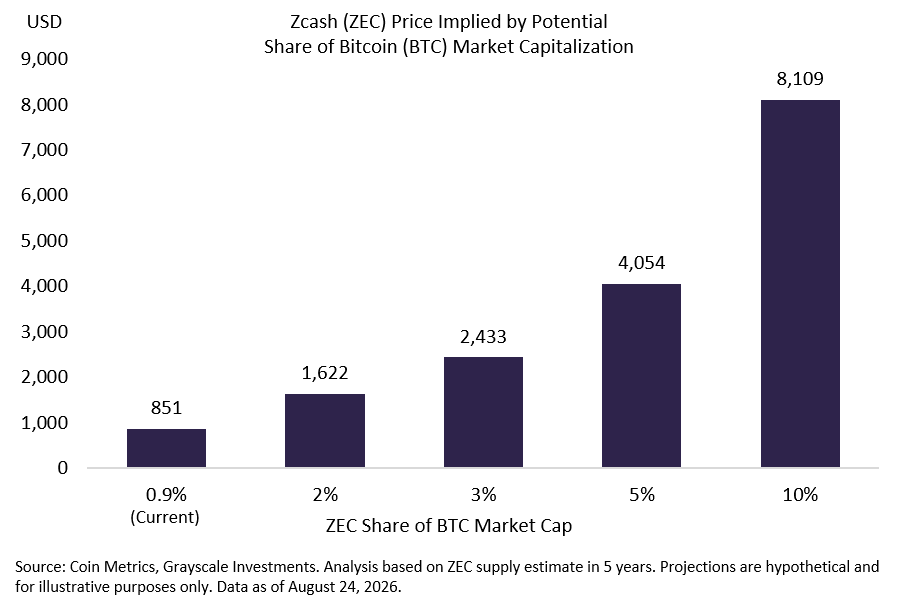
Zcash could be valued at more than $4,000 if its market capitalization reached 5% of Bitcoin’s. Source: Grayscale
Related: Zcash’s Ironwood upgrade faces possible delay over infrastructure readiness
Zcash ecosystem attracts institutional capital
Interest in the Zcash ecosystem is broadening alongside ZEC’s strong price performance. As Cointelegraph recently reported, Nasdaq-listed privacy technology company Cypherpunk Technologies expanded its Zcash exposure by acquiring a mining fleet from Winklevoss Capital in a $33.33 million equity-based transaction.
The operation is already online across US facilities, producing about 4.2 GSol/s of Equihash hashrate, or roughly 18% of the Zcash network’s total computing power. Cypherpunk said the deal made its mining arm the network’s largest active fleet.
Related: Strategy’s $66B Bitcoin machine hinges on capital markets, not BTC price: Report

Since the release of the 2000 Oscar-winning movie about her, the name Erin Brockovich has been synonymous with grassroots activism against powerful institutions. This year, Brockovich has turned her attention to a new target: AI data centers. When Brockovich asked people online how they felt about the issue, she received a “flood” of impassioned responses, she wrote in May.
So Brockovich launched a tool to map data centers across the country, allowing community members to submit their own information about nearby data centers. That map has since received more than 9,000 reports and has become a repository for information, including about data centers’ energy usage, physical size, and economic impact. The site also tracks local legislative and community efforts to push back. (Similar efforts include the Data Center Proposal Tracker and Data Center Watch.)
While Brockovich has elevated all kinds of concerns, she herself is particularly concerned about data centers’ lack of transparency and public participation. “Transparency means notifying residents before decisions are made, not after,” she wrote on her blog in May. “It means elected officials who answer to their constituents first, not to the corporations seeking tax breaks and zoning variances.”


Nvidia’s earnings beat and strong outlook lifted technology stocks, bitcoin and AI infrastructure companies.

Aave V4 deposits hit record $806M after 30% weekly rise

You have 7 days left for the Bitcoin and XRP move

Men arrested after high-speed chase towards Irish border





-

 Fashion6 days ago
Weekend Open Thread: Madewell – Corporette.com
-

 Crypto World2 days ago
SpaceX stock could rise 75% to $240, JPMorgan says
-

 Business5 days ago
Musk’s Tesla, SpaceX Confirm $16.8 Billion ‘Terafab’ Chip Plant as World’s Largest Building in Texas
-

 Crypto World6 days ago
anatomy of crypto’s biggest liquidation event since 2021
-

 Crypto World3 days ago
A $30 Billion AI Fund Implodes, Now the SEC Is Investigating Wall Street’s Role
-

 Politics5 days ago
6 months on, Irish renters crushed by effects of government housing bill
-

 Crypto World2 days ago
Did Trump Just Move SpaceX Stock With One Truth Social Post?
-

 Business5 days ago
Mystery AI Model ‘Ox Alpha’ Draws Developers With Free Access as Chinese Lab Origins Remain Debated
-
 NewsBeat6 days ago
The ‘Lucky Dip Gang’ causing carnage for clicks: After five thugs were killed speeding in the wrong direction on a motorway, GUY ADAMS investigates a sick new trend… and why police aren’t even allowed to pursue them
-
 Crypto World6 days ago
Nvidia Stock Suffers Longest Losing Streak Since 2022: Will Q2 Earnings End It?
-

 Business3 days ago
Moderna CEO warns China is pouring state money into mRNA technology
-

 Business3 days ago
NVIDIA Stock Drops Nearly 2 Percent to $210 on Seventh Losing Day Ahead of Critical AI Earnings
-

 Tech6 days ago
Unitree’s New Superman Robot Claims to Outjump and Outrun Every Human, Usain Bolt Included
-

 Business6 days ago
UK firms in critical financial distress rise 9% to 53,756
-

 Sports5 days ago
Deshaun Watson fires back at Browns fans after being booed: ‘It’s a disrespectful thing’
-
 Crypto World5 days ago
Google Gemini AI Predicts Ethereum Could Become the Trade Retail Misses in 2026
-

 Tech6 days ago
Faster chip in a familiar form factor
-

 Business6 days ago
Will Tesla Stock Be Higher or Lower a Year From Now? Here’s What Wall Street Analysts Are Saying
-

 Business4 days ago
Tesla Recalls Nearly 3 Million Cars in China Over Hidden Door Handles Linked to Multiple Deaths Amid New Ban
-

 Crypto World7 days ago
SEC Regulation Crypto vs CLARITY Act: which framework wins
You must be logged in to post a comment Login