
Crypto World
Strategy Adds 950 BTC for $76M and Repurchases $174M in STRC

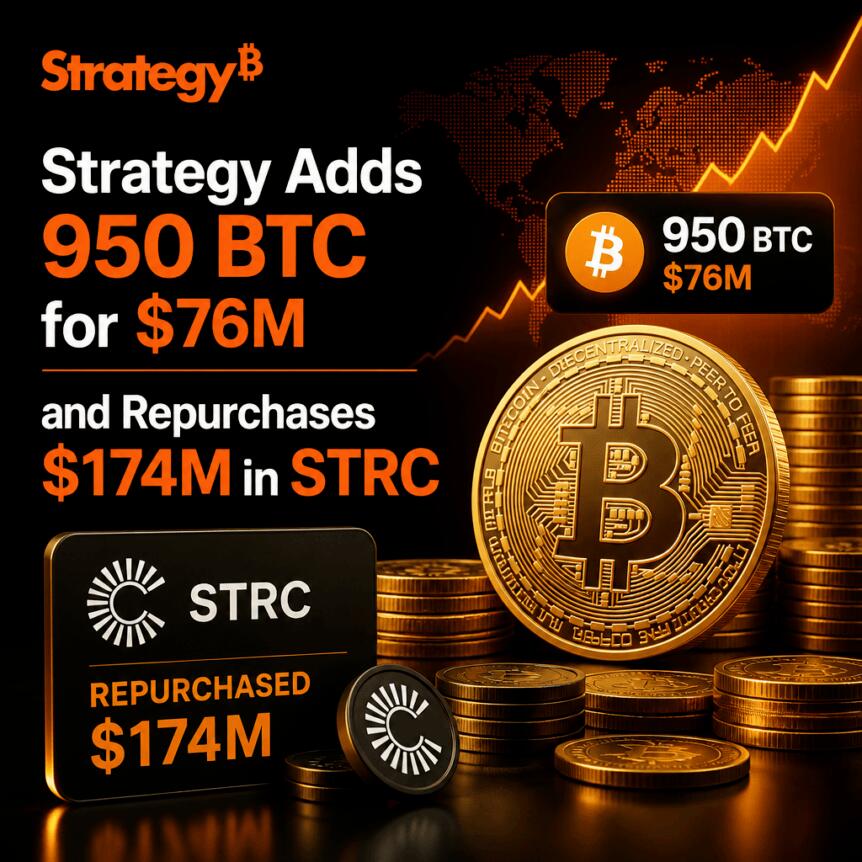
Strategy, the publicly traded Bitcoin treasury company led by Michael Saylor, resumed its Bitcoin purchases after a two-week pause, according to a Form 8-K filed with the U.S. Securities and Exchange Commission on Monday. The company acquired 950 BTC for $75.7 million during the week from Monday through Sunday, at an average price of $79,670 per coin.
The new buy lifts Strategy’s total Bitcoin holdings to 846,000 BTC, accumulated for roughly $63.8 billion at an average cost of $75,416 per Bitcoin (including fees and expenses). At the time of publication, Bitcoin was trading at $84,925, implying an unrealized gain of about $8.05 billion on the treasury’s position, based on figures referenced in the filing. The update also arrives as Strategy continues to balance Bitcoin accumulation with ongoing preferred stock management and a large cash position.
Key takeaways
- Strategy bought 950 BTC for $75.7 million at an average price of $79,670 per coin after a two-week buying pause.
- Total holdings now stand at 846,000 BTC, with Strategy reporting an average cost basis of $75,416 per Bitcoin.
- Bitcoin’s referenced market price of $84,925 implies an unrealized gain of about $8.05 billion on the treasury.
- Strategy continued repurchasing STRC preferred stock, spending $174 million on about 1.77 million shares.
- Strategy’s “USD Cash” fell nearly 20% to $1.05 billion week over week, reflecting dividend and debt-related payments.
Bitcoin buys restart after a brief pause
Strategy’s latest SEC filing describes a resumption of its steady accumulation approach. Between Monday and Sunday, the company purchased 950 Bitcoin for $75.7 million, averaging $79,670 per BTC. The filing also notes the company’s broader position—846,000 BTC in total—indicating the restart did not meaningfully change the scale of its treasury strategy, but it does show a deliberate pause followed by renewed buying activity.
For investors, the practical significance is less about the week’s number of coins and more about consistency: Strategy is still deploying capital into Bitcoin while maintaining liquidity and continuing to manage its preferred securities. That balance can matter in periods where capital allocation becomes more constrained or where financing needs shift.
Strategy’s treasury position and the gains at market price
With Bitcoin trading at $84,925 at the time of publication, Strategy’s holdings are positioned for substantial paper gains relative to its reported average cost of $75,416. The article’s referenced math suggests an unrealized gain of approximately $8.05 billion on the full 846,000 BTC balance.
While unrealized gains are not cash, they can influence market perception of treasury strength. In addition, the company’s ability to keep buying without disrupting preferred-stock obligations depends on its cash management framework—particularly the split between “USD Cash” and “USD Reserve,” which Strategy reports separately.
Preferred stock repurchases continue alongside Bitcoin accumulation
Strategy also used capital to reduce its exposure to preferred-stock obligations through ongoing buybacks of STRC. The company repurchased approximately 1.77 million shares for $174 million during the same week, and STRC was up slightly in pre-market trading on Monday, according to the information cited alongside Yahoo Finance data.
Strategy stated it still had $875.1 million available under its preferred-stock repurchase program and $1 billion remaining under its MSTR share repurchase program. That matters because it shows the company still has authorization headroom—meaning buybacks can continue even after deploying $174 million in the most recent repurchase window.
The filing period also included at-the-market offering programs, and Strategy reported no sales under those plans between Sept. 14 and Sept. 20. In other words, during that window, the company did not appear to raise funds through its at-the-market channels, relying instead on existing treasury resources for purchases and repurchases.
Cash reserves decline as dividends and interest payments land
In a sign of how treasury priorities are being sequenced, Strategy’s cash balances moved down. Its “USD Cash” balance fell nearly 20% to $1.05 billion from $1.30 billion a week earlier, when the company reported its prior cash figures. Separately, “USD Reserve” declined to $5.04 billion from $5.10 billion.
The filing attributed the change in part to cash used for preferred-stock dividends and interest on outstanding debt—amounting to $57.4 million. Strategy’s “USD Cash” is described as serving broader treasury purposes, including funding Bitcoin purchases and capital management, while “USD Reserve” is intended primarily to support preferred-stock dividends and debt interest.
For readers tracking these companies, the cash split is often as important as the Bitcoin buy totals. If “USD Cash” keeps compressing while buyback and dividend needs continue, investors may begin to focus more on whether additional financing is required or whether the company tightens other deployments. Conversely, if the “USD Reserve” remains stable while operational outflows are contained, it can suggest the preferred obligations are covered without forcing abrupt changes to accumulation pacing.
Rival treasury holder Strive also adds Bitcoin
Strategy’s update landed alongside another corporate treasury move: Strive, described as the world’s fifth-largest corporate Bitcoin holder, announced additional Bitcoin purchases on Monday. According to the SEC filing referenced in the article, Strive added 1,355 BTC last week, bringing its total to 26,355 BTC, and its shares rose in pre-market trading.
Taken together, the two updates reinforce that large-cap Bitcoin treasury operators are continuing to pursue accumulation and capital management in parallel—using equity markets and repurchase programs to structure shareholder returns while still building Bitcoin exposure through direct purchases.
Moving forward, the key question for Strategy is whether the renewed weekly Bitcoin buys continue at a similar pace while “USD Cash” remains under pressure from dividends, interest, and repurchases. Investors may want to watch the next SEC disclosures for how quickly cash balances stabilize and whether the company changes the cadence of Bitcoin acquisitions or preferred-stock buybacks.
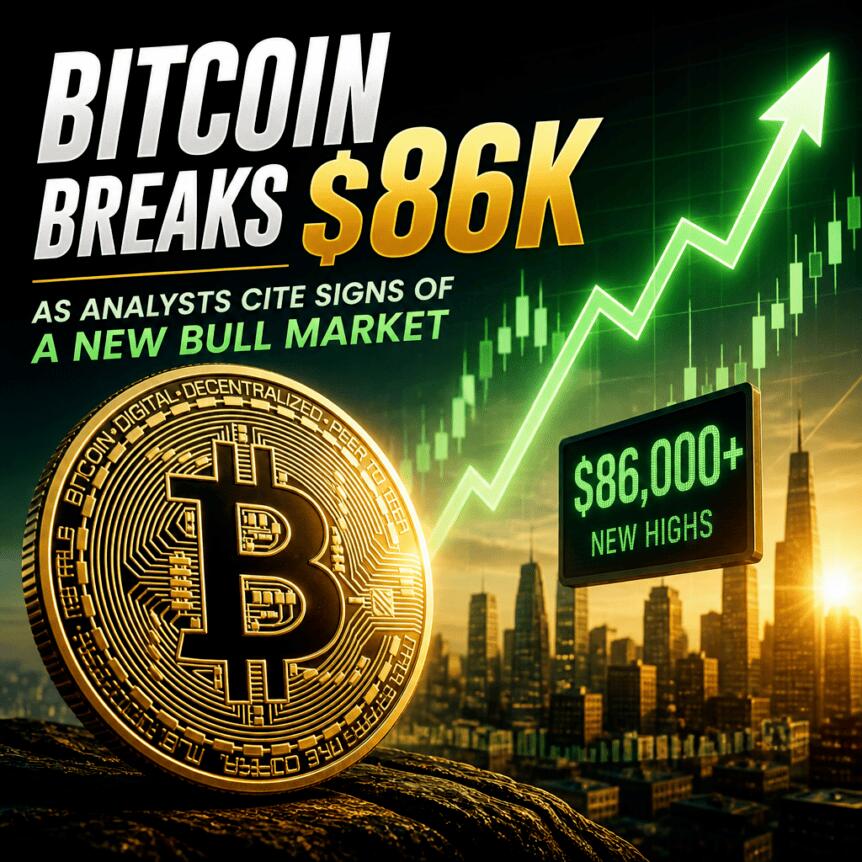
Bitcoin rallied sharply on Monday, pushing above $86,000 for the first time since late January as broader risk sentiment improved and oil prices continued to slide. The move came after a strong Sunday close near $81,120 and was reinforced by reports pointing to renewed momentum in efforts to de-escalate tensions in the Middle East.
Alongside the price strength, traders focused on positioning—particularly the scale of short liquidations—while analysts debated whether the breakout signals a sustained trend or a short-lived burst that could reverse if key technical levels fail to hold.
Key takeaways
- Bitcoin climbed nearly 6% on Monday and briefly topped $86,000, reaching $86,332 on Bitstamp, according to TradingView data.
- Crypto short liquidations totaled almost $800 million over 24 hours, with CoinGlass cited as the data source.
- US stocks opened higher as WTI crude fell below $92 per barrel, with the report linking the move to expectations of calmer geopolitical risk.
- Analysts at Bitfinex Alpha pointed to spot Bitcoin ETF inflows, rising open interest, and buyer support as prerequisites for follow-through.
- Rekt Capital argued BTC/USD has ended a longer pattern of lower highs since October 2025, setting a new projected trading range.
Oil drops and equities rise as geopolitical risk cools
Bitcoin’s upside accelerated after the Wall Street open, with TradingView data showing a high of $86,332 on Bitstamp—up about 5.7% at the time of writing. The sudden strength followed a Sunday weekly close at $81,120, the highest level since the start of May, suggesting sellers had less room to push the market lower.
Crude oil weakness provided an important macro backdrop. The report notes that WTI fell as low as $91.59 per barrel on Monday. It attributed part of that drop to signals involving diplomatic efforts around the US-Iran conflict, including statements from Qatar’s Foreign Ministry and remarks from US President Donald Trump.
In addition, JPMorgan analysts were cited—via coverage from CNBC and others—saying Middle East oil flows remain “surprisingly strong” despite disruption to Saudi Arabia’s East-West pipeline. Separately, The New York Times reported that the US planned to extend its trade deal with China by six months ahead of Xi Jinping’s visit scheduled for Sept. 23–25.
At the time of writing, the S&P 500 and the Nasdaq Composite were up 1% and 1.6%, respectively, reinforcing the idea that calmer oil and improved equity sentiment helped support speculative demand across markets.
Short liquidations surge as traders talk “bull market” again
BTC’s jump quickly attracted bullish interpretation from analysts and traders, particularly because the rally appeared to force shorts to unwind. According to the report, crypto short liquidations approached nearly $800 million over a 24-hour period, referencing CoinGlass.
The Kobeissi Letter—cited in the article—described the market as being “in a new bull market,” pointing to roughly 50% gains for BTC/USD over two months. While such framing is always subjective, the underlying liquidation data offers a concrete reason why momentum can build quickly when leverage is crowded.
Still, analysts stressed that whether liquidations translate into a durable trend depends on what happens next—especially whether spot demand can overpower any renewed selling pressure after a breakout attempt.
Bitfinex Alpha: watch net taker buying, open interest, and ETF inflows
Bitfinex Alpha, the research arm of Bitfinex, highlighted three factors it said are important for further upside: visible buyer support, expansion in coin-denominated open interest, and fresh capital entering US spot Bitcoin ETFs.
In a Monday blog post referenced by the report, Bitfinex Alpha noted that a breakout is more likely to be “validated” if trading behavior shifts toward net taker buying rather than profit-taking that previously capped the advance around Sept. 18 and Sept. 19.
“For a breakout to be validated, we would want to see net taker buying rather than the profit-taking that capped the advances on 18 and 19 September,” Bitfinex Alpha said, adding that coin-denominated open interest should expand to indicate new positioning rather than a move driven mainly by short covering.
The same analysis also provided an explicit technical risk level: it said a daily close beneath $77,100 would invalidate the structure to the downside, exposing what it described as the True Market Mean at $76,677. For traders, that matters because strong breakouts often fail when they retrace below the most recent “line in the sand,” especially after leverage-driven liquidations.
Rekt Capital marks the end of a downtrend pattern and sets a range target
Another market read came from trader and analyst Rekt Capital, who the report says confirmed that BTC/USD has broken out of a cycle of lower highs that had been in place since October 2025. In his related X commentary, he argued this move suggests the prior macro downtrend has weakened.
Rekt Capital further outlined a new potential trading zone between $86,681 and $93,659. He also referenced a broader range framework, suggesting that if Bitcoin confirms a breakout from the $60,000–$80,000 zone, the next milestone would be attempting to enter a higher “blue-blue” range that featured prominently toward the end of 2025.
Taken together, these perspectives show a common theme: multiple analysts view the current push as more than just a single-day spike, but they also stress that confirmation will depend on sustained demand and follow-through above key thresholds.
As Monday’s momentum filters into the next sessions, readers should watch whether Bitcoin can hold above the levels highlighted by Bitfinex Alpha—particularly around $77,100—while monitoring whether open interest grows alongside net buying, rather than fading back into another leveraged unwind.

However, in a study published Sept. 18 in JAMA Network Open looking at 14.8 million seniors, researchers at the U.S. Food and Drug Administration found that the vaccines were highly effective, reducing the chances of an RSV-related hospitalization or death by around 80%.
Vaccines protect against RSV in older adults
Since the rollout, a handful of studies have looked at the effectiveness of these two vaccines, which are made by GlaxoSmithKline and Pfizer. “These have all—very interestingly, and comfortingly—really paralleled and mimicked the exact results of the efficacy trials,” says Walsh, who was not involved in the new study. But this new work examines the entire U.S. population over 65 who are enrolled in Medicare, which is “vastly greater than the other studies,” he says. So these results are particularly reassuring. In general, both vaccines performed similarly.
The study found that people who received an RSV vaccine were more likely to live in affluent areas and more likely to have been vaccinated for flu and COVID, raising the question of whether their higher survival numbers have to do with access to health care. However, when researchers performed an analysis meant to test for whether access to health care was a factor, the high efficacy of the RSV shot remained. “That was nice to see, that the data really was identical,” says Walsh.

Justin Sun recently announced that his new “Justin Sun Prize” would begin in earnest, with $1 million being offered for those who can solve 66 mathematical problems and verify their proof.
The only problem? Sun hasn’t shown any evidence that there’s $66 million in funding for those who are able to solve the problems.
Comparisons to Nobel ring true
Sun took to X to announce the competition and immediately compared it to the Nobel Prize, acknowledging that Nobel created the prize after he was labeled “The Merchant of Death” and he became terrified for his legacy.
Sun neglected to state why he may feel similarly about his own reputation, but he’s recently been embroiled in a bitter break-up and surrogacy drama with Chinese actress Jing Tian, that has seen Mainlanders resolutely siding with Jing.
Read more: Justin Sun has ruined his reputation in China
However, Sun’s woes don’t stop with the hatred that Chinese nationals apparently have for him: he recently brought a lawsuit against the Trump family related to his personal investment in World Liberty Financial, and has previously been sued by the SEC.
A prize without a prize
Alarmingly, while Sun has clearly laid out the rules of the Justin Sun Prize and stated that any winners will receive either USDT or USDC in lieu of US dollars wired to a bank account.
He’s also suggested that he can only donate funds to the prize pool, not take any funds out, and says the prize pool address will be available for the public to check.
The only problem is that there’s no publicly available address showing any funds for possible solvers of the 66 unsolved math problems. The prize effectively has no prize.
Protos reached out to The Justin Sun Prize for any confirmation of a public wallet we could verify and got no response.
Got a tip? Send us an email securely via Protos Leaks. For more informed news and investigations, follow us on X, Bluesky, and Google News, or subscribe to our YouTube channel.

Bitcoin began the week near its strongest levels in almost eight months, pushing to $85,248 on Monday—its highest point since Jan. 29. The move follows a weekly advance after BTC ended Sunday’s session at $81,120, its best weekly close since the week of May 4, according to TradingView data cited in the report.
Beyond the headline price action, traders are watching two closely related dynamics: whether Bitcoin can hold above a previously marked local high around $82,950, and how quickly market participants take profit as spot Bitcoin ETF-related investors near their estimated breakeven area near $86,000.
Key takeaways
- BTC reached $85,248 on Monday, extending gains to levels not seen since Jan. 29, after a strong weekly close on Sunday.
- Crypto liquidations jumped, with CoinGlass reporting cross-crypto liquidations above $600 million over 24 hours.
- ETF cost-basis pressure is rising: Glassnode estimates a spot ETF breakeven cost basis at $85,638.
- Macro attention is shifting toward oil and bond yields, with WTI trading below $94 as diplomacy chatter around US-Iran talks grows.
- Rates remain a swing factor: CME’s FedWatch tool points to about a 53% chance of a 0.25% hike in October, with roughly a 40% chance of another before year-end.
Breakout attempt meets “moment of truth” levels
Bitcoin’s push above $85,000 coincides with renewed attention to prior resistance. The report highlights a key reference point: the local high at $82,950 from May, which traders are now testing for whether it becomes a support level rather than a ceiling.
Earlier, trader and analyst Rekt Capital described BTC’s positioning below that level as a “moment of truth.” In his view, a bearish divergence on the daily RSI—where the indicator’s lower highs contrasted with higher price highs—suggested insufficient momentum to sustain an upside move, raising the risk of a sharper reversal. The report also notes that, with Bitcoin trading back around the $84,000 area, the daily RSI is nearing the “overbought” region around 70 at the time of writing.
At the same time, the move higher is not occurring in a vacuum: the report states that Bitcoin has reclaimed its 50-week exponential moving average (EMA) near $77,769. In the market narrative included here, that level has previously been treated as a prerequisite for continued upside.
For short-term traders, the practical implication is straightforward: any failure to hold gains above the reclaimed levels could quickly change the tape, especially given the volatility signals coming from liquidation data.
Liquidations surge as leverage unwinds
CoinGlass data referenced in the report indicates that short liquidations accelerated alongside the jump in BTC price. The cross-crypto liquidation total for the last 24 hours exceeded $600 million, reflecting how quickly leveraged positioning can unwind when price breaks upward through widely watched thresholds.
Liquidation spikes often matter because they can temporarily amplify rallies—pushing spot higher while forced sell orders clear leverage on the short side. However, they also make the move more fragile: once the most aggressive liquidations are absorbed, the market can become more sensitive to profit-taking and renewed macro pressure.
Spot ETF breakeven nears $86,000—and flows shift
The rally also intersects with spot ETF economics. The report cites Glassnode’s estimate that the cost basis relevant to US spot Bitcoin ETF investors sits at $85,638. With BTC pressing toward the mid-$85,000s and described as approaching the breakeven point near $86,000, the market may be nearing a zone where some investors feel less pressure to add exposure—or where incremental buying can slow if traders decide to lock in gains.
CoinShares-style “profit” framing isn’t the only factor, though. The report highlights that US ETF activity ended the week strong. Per data from Farside Investors, US ETFs recorded $435 million in net inflows on Friday—its largest daily total since Sept. 3. In addition, the day-to-day flow picture appeared to improve even as broader regulatory progress remained uneven.
Although the CLARITY Act reportedly failed to advance in the Senate last week, the report notes that the SEC and CFTC moved forward with crypto-related policy work on Thursday. That combination coincided with a reported $159 million in net crypto ETF inflows on the day.
One detail investors may want to watch is not just how much money came in, but where it went. The report says the largest Bitcoin ETF, BlackRock’s iShares Bitcoin Trust (IBIT), did not dominate inflows as it often does; instead, most investors shifted toward Fidelity’s Wise Origin Bitcoin Fund (FBTC), which accounted for $310 million of the total. CryptoQuant attributed the change to a redistribution of “flow leadership,” citing that IBIT’s dominance over FBTC that existed around Sept. 3 flipped by about Sept. 18.
Oil, yields, and Fed pricing influence risk appetite
While crypto-specific factors are in focus, the report ties the week’s macro backdrop to oil and rates—two variables that can affect liquidity conditions and investor risk appetite.
After oil spiked above $100 per barrel last week, WTI crude traded below $94 on Monday. The move is linked to hopes of renewed diplomacy in the Middle East. A spokesperson for Qatar’s Foreign Ministry, Majed Al-Ansari, told Bloomberg that efforts to restart US-Iran talks have been ongoing for “the past couple of weeks.” The report also references comments attributed to President Donald Trump, who said his options in the Iran conflict include “wiping Iran out,” “letting them rot economically,” or “making a deal,” and suggested he would likely be open to meeting Iranian President Masoud Pezeshkian at the United Nations General Assembly.
Lower oil prices feed into inflation expectations, and the report connects that with bond yield cooling. US 30-year yields, it states, fell to 5.301% on Monday from highs of 5.425% seen on Sept. 11—levels described as the highest since June 2004. The downward trend in borrowing costs is one reason equity markets could maintain gains, and it’s also one channel through which Bitcoin often benefits when liquidity conditions improve.
Still, the rate path isn’t settled. According to CME Group’s FedWatch Tool cited in the report, markets assign about a 53% probability to a 0.25% rate increase at the Fed’s October meeting, with near 40% odds of a third quarter-point hike later in the year.
A scheduled appearance by Thomas Barkin, the Richmond Fed president, is flagged as a potential near-term catalyst. The report says he is set to speak to the CFA Society Baltimore, with the agenda including insights on the economic landscape and current monetary policy developments.
For the next phase, investors will likely focus less on whether Bitcoin can tag new highs and more on whether it can hold above the reclaimed levels while ETF breakeven approaches. If liquidation pressure fades without follow-through, traders may look for confirmation from both spot ETF flow direction and the next leg in bond yields.
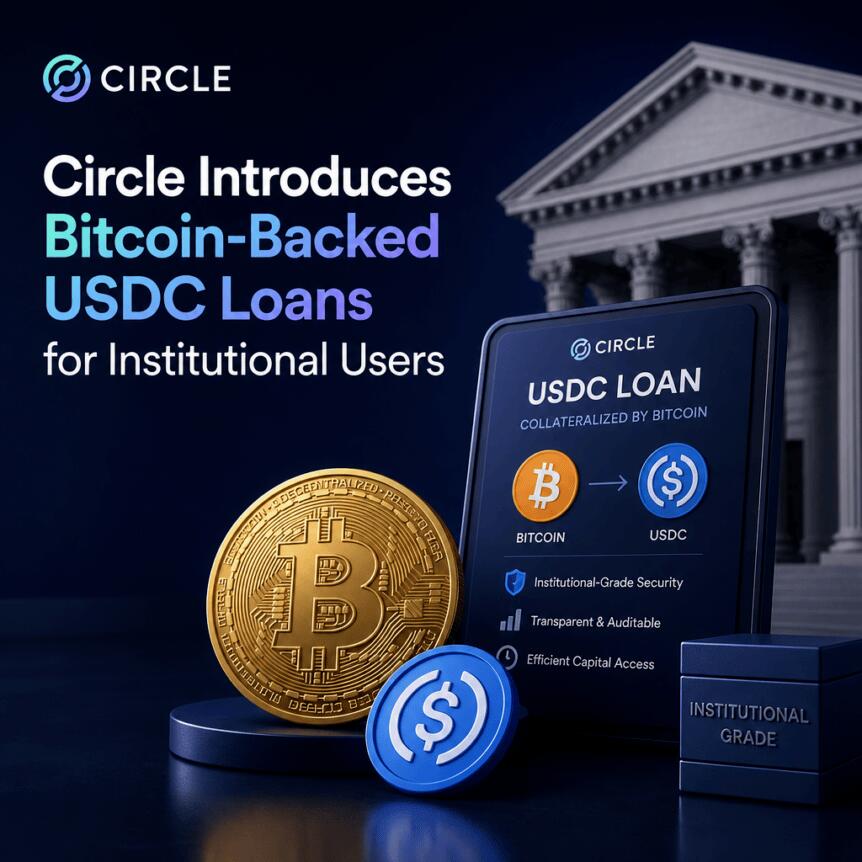
Stablecoin issuer Circle is moving deeper into regulated crypto lending with a new Bitcoin-backed borrowing service designed for institutions. Through its Circle Mint platform, eligible customers can deposit Bitcoin, use Circle’s wrapped token cirBTC as collateral, and borrow USDC via supported onchain lending markets.
Circle says the rollout aligns with a broader infrastructure push around its Arc network, which is positioned as a layer-1 for stablecoin-based payments and financial services. The borrowing service—called Digital Asset-Backed Borrowing—adds a new way for Bitcoin holders to access USDC liquidity without handing custody of the underlying assets to the lending venues themselves.
Key takeaways
- Circle’s new service lets eligible Circle Mint customers use Bitcoin as collateral to borrow USDC on supported DeFi lending protocols.
- The borrowing workflow uses cirBTC as the collateral token, which Circle says is backed 1:1 by Bitcoin held in custody by Circle National Trust.
- Borrowing terms such as rates, collateral requirements, and liquidation thresholds are determined by the third-party lending market, not by Circle.
- Circle plans to start with Morpho and later add Aave and other protocols.
- New York clients are excluded from the offering.
How Circle’s Bitcoin-backed borrowing works
Circle’s announcement details a custody-aware structure aimed at institutional users. Under Digital Asset-Backed Borrowing, eligible Circle Mint customers can deposit Bitcoin and mint cirBTC, Circle’s wrapped Bitcoin token. That cirBTC is then supplied as collateral to supported third-party lending markets.
Circle states that borrowed USDC is credited directly into the customer’s Circle Mint balance. From there, the customer can use USDC as needed—while the collateral posting and liquidation mechanics are governed by the specific lending protocol used.
Importantly, Circle positions this as a model that keeps the customer’s collateral control in the foreground. The company says the collateral is supplied via a customer-controlled wallet to the third-party DeFi protocol rather than lent out directly by Circle. Circle also characterizes the arrangement as overcollateralized, meaning borrowers must post more value in collateral than the amount of USDC borrowed.
Circle also notes that parameters affecting the position—such as borrowing rates, required collateral, and liquidation thresholds—are set by the third-party lending market. That design shifts the day-to-day risk and mechanics to the underlying DeFi venue, while Circle focuses on eligibility, the wrapping process, and the institutional onramp.
Morpho first, with Aave and others planned
For the initial launch, Circle is supporting Morpho as the first lending protocol for cirBTC-collateralized borrowing. Circle indicated that it plans to expand support to Aave and additional lending markets over time.
Separately, Circle’s timing matters for users watching Arc’s ecosystem. The service rollout coincides with cirBTC going live on Arc. According to Circle, cirBTC was launched on Ethereum in June, and its network availability is now expanding.
Circle also confirmed that it intends to connect these institutional borrowing flows to the broader Arc environment—an approach that could reduce friction for participants that prefer to use USDC as a settlement and payments asset within a single chain ecosystem.
Why the structure matters for institutions
Circle’s model reflects a recurring institutional demand in crypto: access to borrowing and leverage-like liquidity strategies without disrupting existing custody arrangements. By using cirBTC—backed 1:1 by Bitcoin held in custody by Circle National Trust—Circle provides a path to onchain credit while keeping a clear chain of custody and token backing on the issuer side.
This stands in contrast to some earlier institutional designs aimed at preserving underlying Bitcoin custody without wrapping. In a previous approach described earlier in the market, Lombard partnered with Bitwise to develop a system for borrowing against BTC held in custody, with Morpho supplying lending infrastructure. That model, as described in coverage at the time, was designed to avoid converting the underlying Bitcoin into a separate wrapped asset—opting instead to keep the Bitcoin in custody without using wrapping or bridging.
Circle’s decision to introduce cirBTC instead indicates a different tradeoff: the wrapped token enables easier integration with existing lending markets that support ERC-asset collateral, while Circle can still point to a specific backing mechanism for cirBTC.
More broadly, the development fits a pattern of institutional-oriented lending platforms emphasizing “qualified custody” and controlled collateral rather than open-ended asset movement. Earlier, Anchorage Digital partnered with Kamino to enable institutions to borrow against staked Solana held at Anchorage Digital Bank, avoiding a direct requirement to move collateral out of qualified custody. And BitGo expanded its institutional lending efforts with a portfolio-based framework, enabling multiple assets to serve as collateral depending on the structure of the financing.
In that context, Circle’s offering is best understood as an additional layer to the institutional lending stack—one that combines an issuer-backed collateral token, an institutional balance interface through Circle Mint, and DeFi lending mechanics executed on third-party protocols.
Arc mainnet timing and the USDC-centered roadmap
The borrowing service arrives just days after Circle rolled out the Arc mainnet, a layer-1 network designed around stablecoin payments and financial market use cases. Circle’s Arc positioning includes USDC as the native gas token, and support for tokenized assets such as BlackRock’s BUIDL and Circle’s USYC, according to earlier coverage.
That sequencing matters because it suggests Circle is aligning two different parts of its business: the transport layer (Arc) and the financial layer (stablecoin issuance, tokenization, and now institutional borrowing). For investors and builders, it also raises practical questions about where collateral and liquidity will concentrate—whether users will continue to rely primarily on Ethereum for DeFi borrowing, or whether Arc’s stablecoin-native design will draw activity from the start.
At the same time, the biggest determinants of user experience and risk remain anchored in the third-party lending markets that set borrowing rates and liquidation parameters. That means the real impact for end users may vary quickly depending on how Morpho (and later Aave and others) structure collateral factors and liquidation thresholds for cirBTC.
What to watch next
Circle’s next milestones—adding Aave and expanding the lending venue lineup, as well as observing how cirBTC usage develops across Arc versus Ethereum—will reveal whether this is merely an incremental product launch or a step toward a more standardized, issuer-coordinated institutional borrowing workflow. For now, institutional participants should pay close attention to protocol-specific borrowing terms, liquidation behavior, and eligibility constraints, including the exclusion of New York clients.

Advanced Micro Devices (AMD), an artificial intelligence leader, surged Monday, breaking out past a new buy point, as the stock market climbed amid falling oil prices and Treasury yields. That makes AMD stock Monday’s pick for IBD 50 Growth Stocks To Watch from Investor’s Business Daily. Santa Clara, Calif.-based AMD, a recent IBD Stock Of The Day, is seeing continued…
Copyright ©2026 Investor’s Business Daily, LLC. All rights reserved. 87990cbe856818d5eddac44c7b1cdeb8
It’s been a busy weekend for one black hat who stole hundreds of millions of tokens from Fetch.ai, NuNet and SingularityNET, netting around $2.25 million of realized profits.
According to a report from Bitquery, however, the nominal value of the tokens minted was several times higher at the time of the theft. Indeed, blockchain security auditor Peckshield, which flagged the third incident, put the attacker’s unrealized profits at almost $17 million.
Read more: Osmosis took 74 days to discover 40-BTC Nomic exploit
Two of the three projects, all of which are part of the “Artificial Superintelligence Alliance” ecosystem, were hit almost simultaneously.
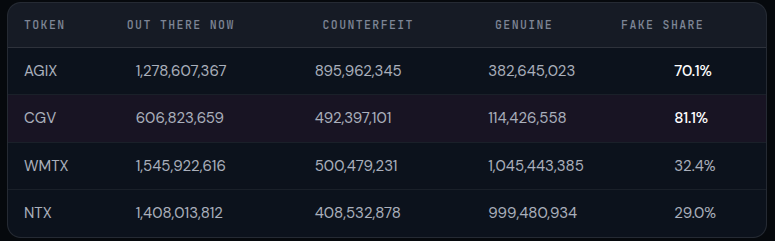
The hacker first drained 8.7 million FET tokens from Fetch.ai’s bridge and minted 400 million of NuNet’s NTX token.
The SingularityNET bridge was exploited hours later, with 900 million of its own AGIX token, and 500 million each of World Mobile Chain’s WMTx and Cogito’s CGV minted out of thin air.
The sale of Fetch.ai’s FET tokens for 523 ETH (approximately $1.2 million) generated the lion’s share of the attacker’s gains, with subsequent sales returning just 183 ETH ($420,000) between the four remaining tokens.
The half billion CGV tokens returned just $30 due to extremely thin liquidity.
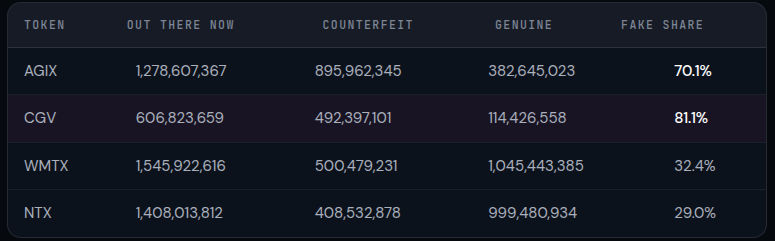
With considerable portions of their supply made up of freshly minted counterfeit tokens, the prices of minted assets have collapsed.
Conversely, the sale of the (genuine) FET tokens resulted in a 5% drop.
Bitquery also highlighted a preliminary sweep of ETH and BNB from 16 wallets, four of which it had previously labelled as “SingularityNET or NuNet staff wallets,” indicating widespread penetration of the interconnected companies’ infrastructure.
In addition, $289,575 in USDC was later drained from a payroll contract.
The report warns that the majority of the signing keys have not been changed.
Got a tip? Send us an email securely via Protos Leaks. For more informed news and investigations, follow us on X, Bluesky, and Google News, or subscribe to our YouTube channel.
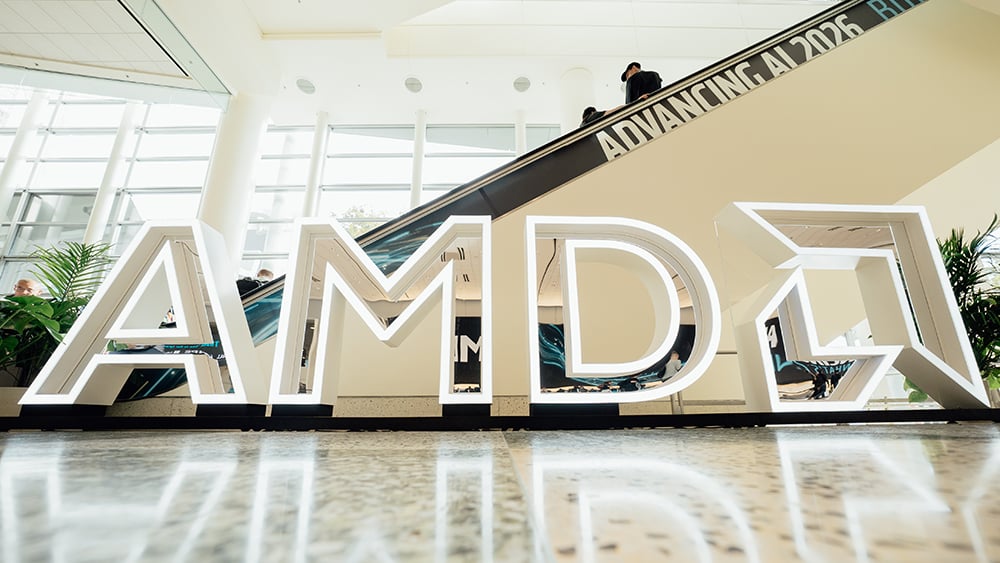
The Philadelphia semiconductor index, known as SOX, rose Monday after completing its annual reconstitution. Gainers include four new constituent stocks, which replaced four other chip stocks. In afternoon trades on the stock market today, the SOX rose 3.7%. It’s on pace for its fifth straight trading day of gains. The SOX, officially called the PHLX Semiconductor Sector Index, substituted four…
Copyright ©2026 Investor’s Business Daily, LLC. All rights reserved. 87990cbe856818d5eddac44c7b1cdeb8

The crypto industry spent much of the past two years preparing for regulatory clarity in Washington. This week, one of its biggest legislative priorities hit a major roadblock.
The CLARITY Act failed to advance in the Senate on Tuesday, falling short of the 60 votes needed to bring the bill to the floor for debate. The setback significantly narrows the bill’s path this year, with the Senate calendar tightening ahead of the Nov. 3 midterm elections.
Strategists say crypto exchanges such as Coinbase may have more at stake than most from the stalled legislation.
Elsewhere, Standard Chartered is betting big on Arbitrum, Bitmine is turning its Ether treasury into a source of staking revenue, and Phemex’s CEO says AI has been a “net negative” for crypto.
Coinbase faces greater CLARITY Act fallout, Saxo strategist says
Saxo Bank strategist Ruben Dalfovo said Coinbase has more at stake in the CLARITY Act setback because its trading business is directly exposed to US market-structure rules.
In a Wednesday note following the bill’s failed procedural vote, Dalfovo said Coinbase is particularly exposed because new rules could determine registration requirements, tradable assets and who can participate on its platform. The setback could also affect other crypto-linked companies, though Dalfovo said their businesses are less directly tied to market-structure rules. Circle’s exposure is tied more closely to USDC adoption and reserve interest, while Strategy relies primarily on its Bitcoin holdings and access to financing.
The market reaction reflected those concerns. Coinbase, Circle and Strategy shares fell between 5% and 10% after the vote and continued lower the following day.
Standard Chartered sees Arbitrum hitting $10 as Wall Street moves onchain
Standard Chartered sees Arbitrum outperforming Bitcoin and Ether through 2030, driven by traditional finance firms moving assets onchain and transforming the network’s economics.
Geoff Kendrick, Standard Chartered’s global head of digital assets research, said Arbitrum receives 10% of net protocol revenue from companies building on it. Robinhood Chain, launched in July, has materially changed Arbitrum’s economics, with September revenue expected at $5 million, over five times the prior level. Kendrick projects ARB at $10 by 2030, a 70-fold increase from current prices around $0.14, which have gained 86% in the past month.
Standard Chartered’s thesis relies on tokenized assets reaching $39 billion and forecasts of $4 trillion by 2028. Arbitrum’s layer-2 infrastructure and revenue-sharing model position it as a beneficiary, but adoption pace remains uncertain.
Bitmine eyes $334 million in annual staking revenue from Ether treasury
Bitmine projects $334 million in annual staking revenue from its $15.8 billion crypto treasury, with over 5 million Ether now staked to generate recurring income even during volatile conditions.
Bitmine added 27,180 ETH last week, bringing its holdings to 5.95 million ETH worth $15.4 billion, representing roughly 4.9% of Ether’s circulating supply. More than 5.06 million ETH is now staked, generating an estimated $334 million in annualized revenue at current rates. Grayscale Ethereum Staking ETF stakes 84.6% of its Ether, according to its webpage.
Unlike Bitcoin treasury companies, Bitmine can earn recurring income from its crypto holdings through staking. Its stock has gained nearly 38% over the past month but remains down year to date, according to Yahoo Finance. Strategy, meanwhile, went a second straight week without buying Bitcoin, instead spending $139.3 million to repurchase preferred stock.
AI is draining crypto liquidity and empowering attackers, Phemex CEO says
Phemex CEO Federico Variola said AI has been a “net negative” for crypto, diverting liquidity from the industry while empowering attackers who exploit protocols.
Speaking on Cointelegraph’s Chain Reaction, Variola said AI has “empowered a lot of bad actors” and driven up cybersecurity costs for smaller teams. In July, attackers drained roughly $116 million in Bitcoin from more than 5,200 addresses tied to a Coldcard hardware wallet flaw widely believed to have been found through malicious AI use. Coinkite CEO Rodolfo Novak warned that AI-assisted code review now outpaces seasoned experts.
Variola warned AI threats could make self-custody and DeFi less appealing to retail users, pushing the industry toward greater centralization. He sees practical benefits in AI agents for portfolio building and trading decisions, but said they will not fully replace human judgment. CertiK’s Natalie Newson, however, noted AI can also be “one of the biggest defenses.”
Crypto Biz is your weekly pulse on the business behind blockchain and crypto, delivered directly to your inbox every Thursday.

Stablecoin issuer Circle has launched a Bitcoin-backed borrowing service for institutional clients, allowing eligible Circle Mint customers to use BTC as collateral to borrow USDC through onchain lending markets.
The service, called Digital Asset-Backed Borrowing, lets customers deposit Bitcoin, mint Circle’s wrapped Bitcoin token cirBTC and supply it as collateral to supported third-party lending markets on Arc or Ethereum. Morpho is the first lending protocol supported, with Circle planning to add Aave and other protocols. The rollout coincides with cirBTC going live on Arc on Monday.
According to Circle, borrowed USDC is deposited directly into the customer’s Circle Mint balance, while borrowing rates, collateral requirements and liquidation thresholds are set by the third-party lending market. The borrowing positions are overcollateralized, with collateral supplied through a customer-controlled wallet to third-party DeFi protocols rather than lent directly by Circle. New York clients are excluded.
Circle previously launched cirBTC on Ethereum in June. The token is backed 1:1 by Bitcoin held in custody by Circle National Trust.
Both launches come days after Circle rolled out the Arc mainnet, its layer-1 blockchain targeting stablecoin payments and financial markets. Arc uses USDC as its native gas token and supports tokenized assets including BlackRock’s BUIDL and Circle’s USYC.

Source: Circle
Institutional crypto lending expands
Circle’s launch follows a broader push to give institutional investors access to crypto-backed borrowing while keeping collateral within established custody arrangements.
In February, Anchorage Digital partnered with Kamino to allow institutions to borrow against staked Solana (SOL) held at Anchorage Digital Bank, giving borrowers access to onchain liquidity without moving the collateral out of qualified custody.
Bitcoin-backed models followed in March, when Lombard partnered with Bitwise to develop a system for borrowing against BTC held in custody, with Morpho providing the lending infrastructure. Unlike Circle’s model, which converts deposited BTC into cirBTC for use as collateral, Lombard’s system was designed to keep the underlying Bitcoin in custody without wrapping or bridging it.
BitGo also expanded its institutional lending offering in March, launching a financing platform for borrowing and lending against liquid, staked and locked crypto assets held in custody. Its portfolio-based model allows multiple assets to serve as collateral rather than requiring collateral to be posted for individual loans.
Magazine: Kyle Samani predicts SOL flippening, claims ‘no one’ uses ETH

Coffee Break: Elissa Belt – Corporette.com

My Financial Audit experience

Paramount reaches settlement with states in $110bn Warner Bros merger




-

 Fashion3 days ago
Weekend Open Thread: Talbots – Corporette.com
-

 Tech19 hours ago
Researchers escape OpenAI Codex sandbox to run commands on host
-

 Crypto World7 days ago
Revolut Attackers Warn of Ongoing Daily Customer Data Leaks
-

 Crypto World3 days ago
Circle launches Arc Studio AI agent for building onchain apps
-
 NewsBeat3 days ago
Trump says US has reached an agreement to take permanent control of Greenland’s security
-

 Crypto World7 days ago
Kraken Lets xStocks Holders Earn Yield Through DeFi
-

 Crypto World6 days ago
Robinhood engineers charged over $50K crypto scheme
-

 Crypto World3 days ago
Bitcoin price breaks channel as RSI climbs to 63
-

 Crypto World5 days ago
US Charges Robinhood Engineers Over Crypto Listing Trades
-

 Crypto World6 days ago
What Is the Status of the U.S.-Iran Peace Talks? Here's What Both Sides Are Saying
-

 Crypto World6 days ago
NVIDIA Analysis: Attempted Rising Wedge Breakout Amid Pressure on the AI Sector
-

 Tech6 days ago
Webb’s IC 348 Mosaic Includes Two-Jupiter Dwarfs, Twin Jets, and a Nursery Still Making Worlds
-

 Crypto World3 days ago
World Money launches in 150+ countries with Stripe
-

 Crypto World19 hours ago
Who Needs CLARITY Anyway? ARB Could See 70X Increase: Hodler’s Digest
-

 Crypto World7 days ago
Kraken Adds DeFi Yield on Tokenized Stocks and ETF Assets
-

 Crypto World3 days ago
Silver prices recover quickly, hitting weekly high today
-
Crypto World7 days ago
Can Circle’s Arc Repeat Robinhood Chain’s Meme Coin Boom?
-

 Entertainment6 days ago
Big Brother Update: Melody Explodes at Drew as Illness Sweeps BB28 House
-
 NewsBeat3 days ago
US was ‘on brink of war’ with China over false AI report of nukes moving in Middle East
-

 Crypto World3 days ago
Trading Bitcoin on Robinhood? Why 2% Spread Has Traders Worried
You must be logged in to post a comment Login