
Crypto World
Strategy stock sinks as Saylor puts Bitcoin buys on hold

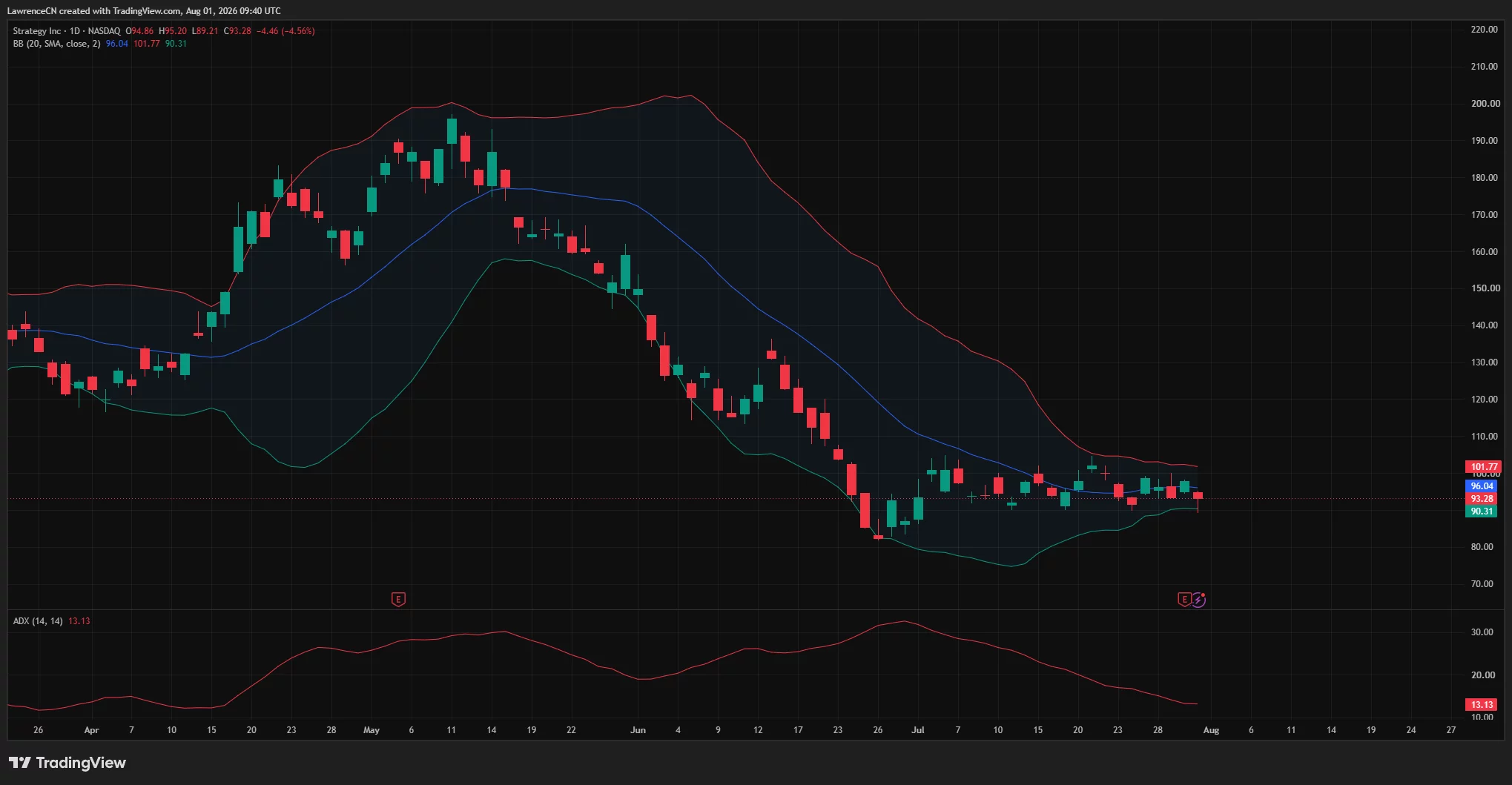
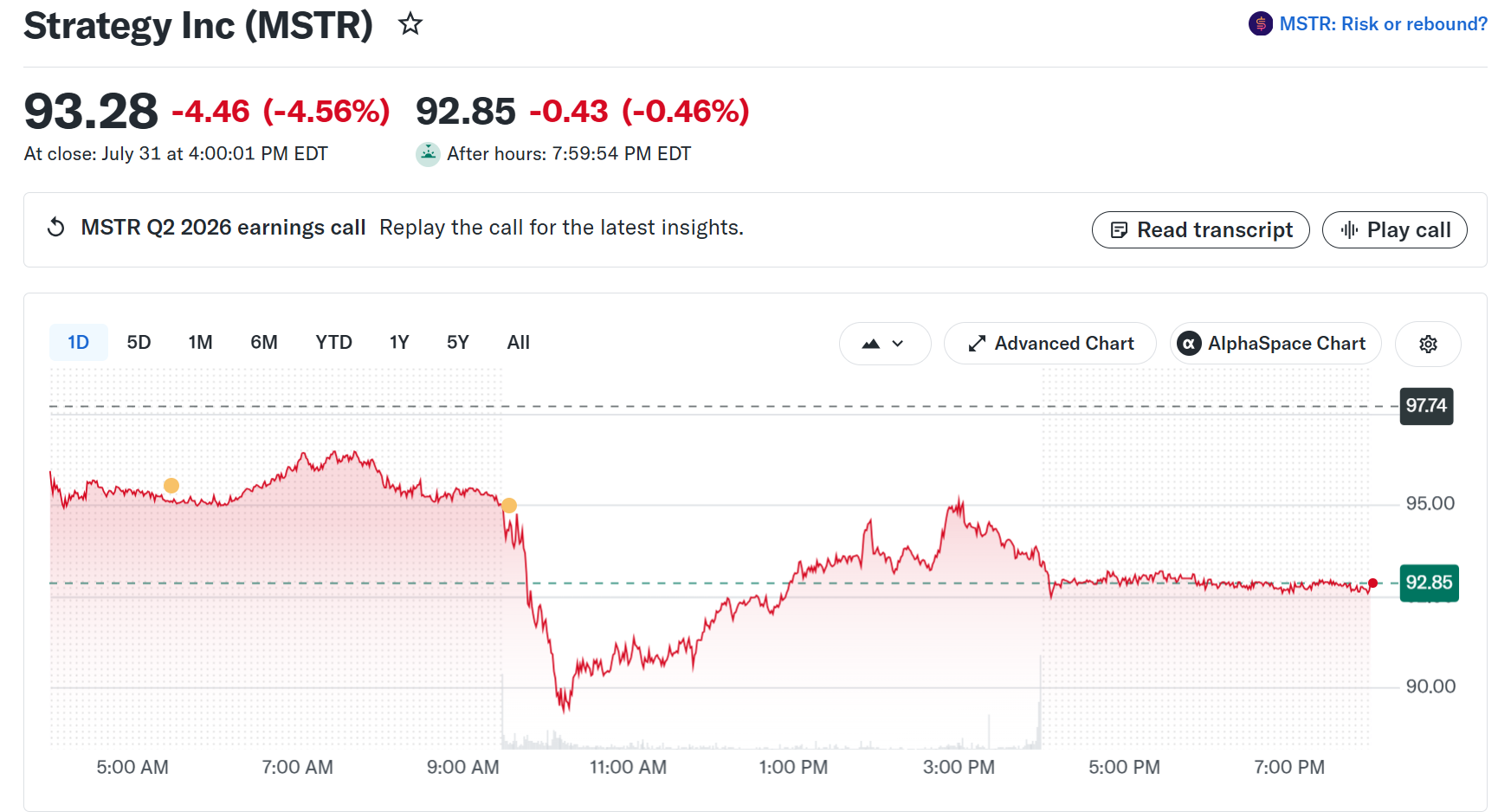
Strategy shares fell 4.56% to $93.28 on July 31 after the company reported an $8.22 billion quarterly loss and prioritized restoring its STRC preferred stock to its $100 par value.
Summary
- Strategy stock closed at $93.28, approaching its lower Bollinger Band at $90.31.
- The company reported an $8.22 billion net loss after recording an $8.32 billion unrealized Bitcoin loss.
- Michael Saylor said Strategy would hold both cash and Bitcoin instead of directing all available capital toward BTC.
- Analysts at Benchmark and H.C. Wainwright maintained their buy ratings despite the sell-off.
Strategy stock slides after $8.22B quarterly loss
Strategy stock traded as low as $89.21 on Thursday before recovering to close at $93.28. The 4.56% decline took the Nasdaq-listed company below $90 during the session for the first time since July 1.
The decline followed Strategy’s second-quarter results, which included an $8.32 billion unrealized loss on its Bitcoin holdings. That pushed the company to a net loss of $8.22 billion, or $24.45 per share, during the quarter.
Strategy held 843,775 BTC at the end of the reporting period, representing a 25% increase from the start of the year. The company acquired the holdings for approximately $63.69 billion at an average price of $75,476 per coin.
Lower Bitcoin prices reduced the market value of the position to about $54.77 billion. Under fair-value accounting rules, changes in Bitcoin’s market price flow through Strategy’s reported earnings, exposing quarterly results to large swings.
Operating revenue offered one positive data point. Revenue increased 6.9% from $114.5 million in the comparable period last year to $122.4 million.
Why Strategy is prioritizing STRC over immediate BTC purchases
Executive Chairman Michael Saylor said during the earnings call that Strategy would move away from directing all available funds toward immediate Bitcoin purchases. The company instead plans to maintain a combination of cash and BTC.
“Perhaps the best way to buy the most Bitcoin is not to buy the most Bitcoin immediately,” Saylor said.
Chief Executive Phong Le said Strategy would refrain from buying additional Bitcoin while STRC traded below its $100 par value. The company’s variable-rate preferred stock ended July 31 at approximately $89.
Strategy repurchased about $25 million of STRC between July 20 and July 24 while raising $544 million through sales of its common stock. The transactions indicate that management views support for the preferred share as necessary to preserve its broader capital-raising model.
Restoring STRC to par could improve investor confidence in Strategy’s preferred securities and make future issuance more efficient. Those instruments have become part of the company’s strategy for raising capital without relying exclusively on common-share sales or conventional debt.
Strategy also held a $3.75 billion cash reserve, giving it room to cover dividend and interest obligations without selling Bitcoin during a market downturn.
MSTR chart points to weak momentum near $90
The daily chart shows Strategy stock trading near the lower end of its recent consolidation range. Thursday’s decline took the price below the Bollinger Band midpoint at $96.04 and toward the lower band at $90.31.
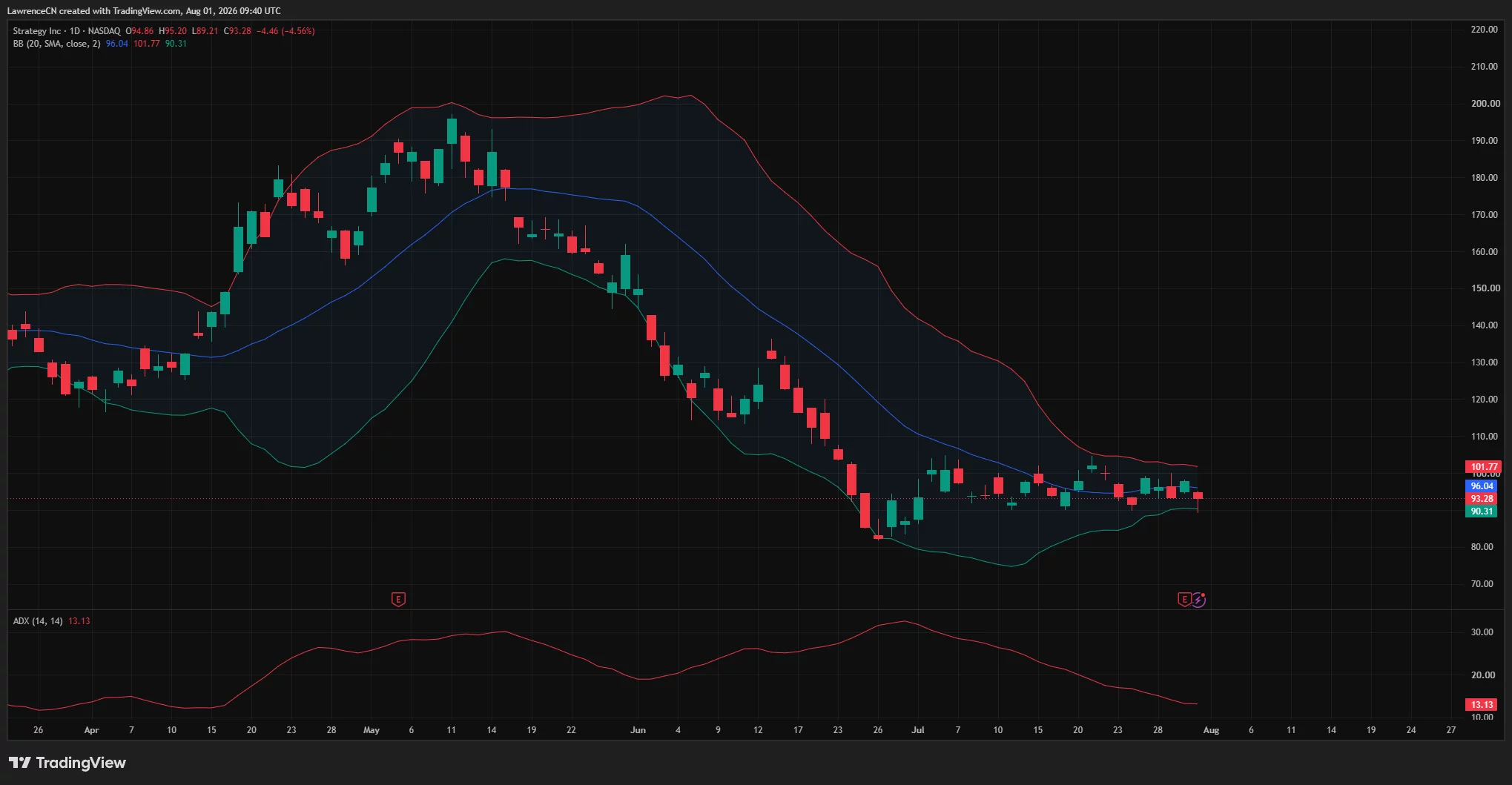
A daily close below $90.31 could confirm renewed selling pressure and expose the late-June low around $81 to $82. That area marked the bottom of the stock’s decline before its July stabilization.
The Average Directional Index stood at 13.13. An ADX reading below 20 generally indicates that the market lacks a strong directional trend, suggesting Strategy shares remain in consolidation despite the latest bearish session.
On the upside, MSTR would first need to recover above the $96.04 midpoint. A sustained move above that level could place the upper Bollinger Band at $101.77 within reach.
The narrow distance between the bands also shows that volatility has contracted following the stock’s steep decline from its May high near $200. A break outside the $90.31–$101.77 range could determine its next short-term direction.
Wall Street analysts retain bullish Strategy targets
Benchmark maintained its buy rating on Strategy but reduced its price target from $570 to $435. Analyst Mark Palmer said Saylor’s focus on bringing STRC back to par could strengthen the company’s ability to raise funds for future Bitcoin purchases.
H.C. Wainwright also maintained a buy rating and assigned Strategy stock a $325 target. The firm cited the company’s cash reserve and STRC repurchases as measures that could strengthen its balance sheet and limit the need to take on additional debt.
Both targets imply substantial upside from the July 31 closing price. However, their outlooks remain closely tied to Bitcoin’s performance and Strategy’s ability to issue securities on favorable terms.
For US investors, MSTR remains a publicly traded way to gain leveraged exposure to Bitcoin without holding the asset directly. That exposure also carries company-specific risks, including preferred-share obligations, equity dilution and earnings volatility caused by Bitcoin fair-value adjustments.
Bitcoin and STRC remain the next key catalysts
Strategy’s short-term stock performance will likely depend on whether STRC moves back toward $100 and whether Bitcoin recovers above the company’s average acquisition cost.
Management’s decision to preserve cash does not amount to abandoning its Bitcoin strategy. Instead, it delays immediate purchases while the company works to support the securities used to finance future acquisitions.
MSTR could remain range-bound while the ADX stays weak. A close below $90 would strengthen the downside case, while a recovery above $101.77 would signal that buyers are regaining control.
Disclosure: This article does not represent investment advice. The content and materials featured on this page are for educational purposes only.


It was precisely six years ago when a rather unknown company in the cryptocurrency industry at the time made a revolutionary change to its asset reserve strategy and adopted Bitcoin. The entity in question, called MicroStrategy back then, started to accumulate BTC en masse and only accelerated its purchases after the 2024 presidential elections in the US.
The community became accustomed to hearing about new acquisitions made by the company, some of which were worth billions of dollars. Its total stash grew exponentially and currently sits at 843,775 units. Within this timeframe, BTC bulls consistently heard that the company (and its former CEO) would never sell… until they did. And then everything changed.
During the most recent earnings call, the company hinted that it has plans to sell up to $5 billion in bitcoin, which is significantly higher than the previously claimed $1.25 billion.
The Latest Shift
Strategy (as it is called now) has gone five consecutive weeks without purchasing BTC, marking its longest acquisition pause in years. Instead of deploying capital into BTC, the firm has steadily increased its cash reserve through recent fundraising activities. As we previously reported, Strategy has been rebuilding its USD position while continuing to explore financial options tied to its expanding portfolio of preferred stock offerings.
In the most recent official change, CEO Phong Le took to X to announce the company’s new primary corporate objective, which reads:
“Our corporate objective is for STRC to trade at $99-$100 over time.”
In the earnings call, he was more specific:
“Our intent is to sell bitcoin for three reasons when we think it’s appropriate for the company. One, fund the U.S. dollar reserve up to $1.25 billion. Additional reasons include funding dividend and interest payments of $1.76 billion a year and funding up to $2 billion in common and preferred stock repurchases,” Le said, according to a FactSet transcript.
The tweet and comments garnered immediate reactions from some well-known industry commentators as well as constant critic Peter Schiff, who was quick to determine that: “In other words, common shareholders are screwed.”
Crypto Kaleo, though, a popular analyst who recently argued that Strategy would have to sell at least 50,000 BTC in the next couple of years to fund dividend payments, wasn’t so kind. In one tweet, he ironically asked whether the CEO remembers when the company’s primary corporate objective was to increase Bitcoin per share before adding: “It was only two months ago, so shouldn’t be difficult!”
In another post, though, he brought the bashing to a higher level, claiming that Strategy is no longer a BTC company. Instead, it operates as a credit company, and its credit rating is “atrocious.”
Strategy went from having a primary objective of increasing Bitcoin per share to trying to make sure their preferred shares trade back to $100… in just two months.
They’re no longer a BTC company.
They’re a credit company.
And their credit rating is atrocious. https://t.co/fHoXr376QY
— K A L E O (@CryptoKaleo) July 31, 2026
The comments below his post were split. Some agreed that Strategy is increasingly resembling a leveraged financial organization rather than a straightforward BTC holding company. Others defended the firm’s approach, noting that maintaining confidence in STRC is essential if Strategy wants to continue raising capital efficiently and safely for future crypto purchases.
STRC Matters
The Saylor-co-founded company launched STRC as part of its growing suite of preferred stock offerings designed to finance its long-term BTC accumulation strategy. However, it needs to trade at its par price of $100 to function properly, and it hasn’t been able to for months. It dumped below $75 at one point, before the company shifted its focus to rebuilding its USD reserve. It has since recovered to almost $90.
As such, some investors view Le’s comments as a tactical, short-term objective rather than believing Strategy has abandoned its Bitcoin-focused vision. Still, the timing has fueled questions about the firm’s evolving identity and strategy, especially given the ongoing market uncertainty.
The post Analyst Blasts Strategy After CEO Signals New Priority Beyond Bitcoin appeared first on CryptoPotato.
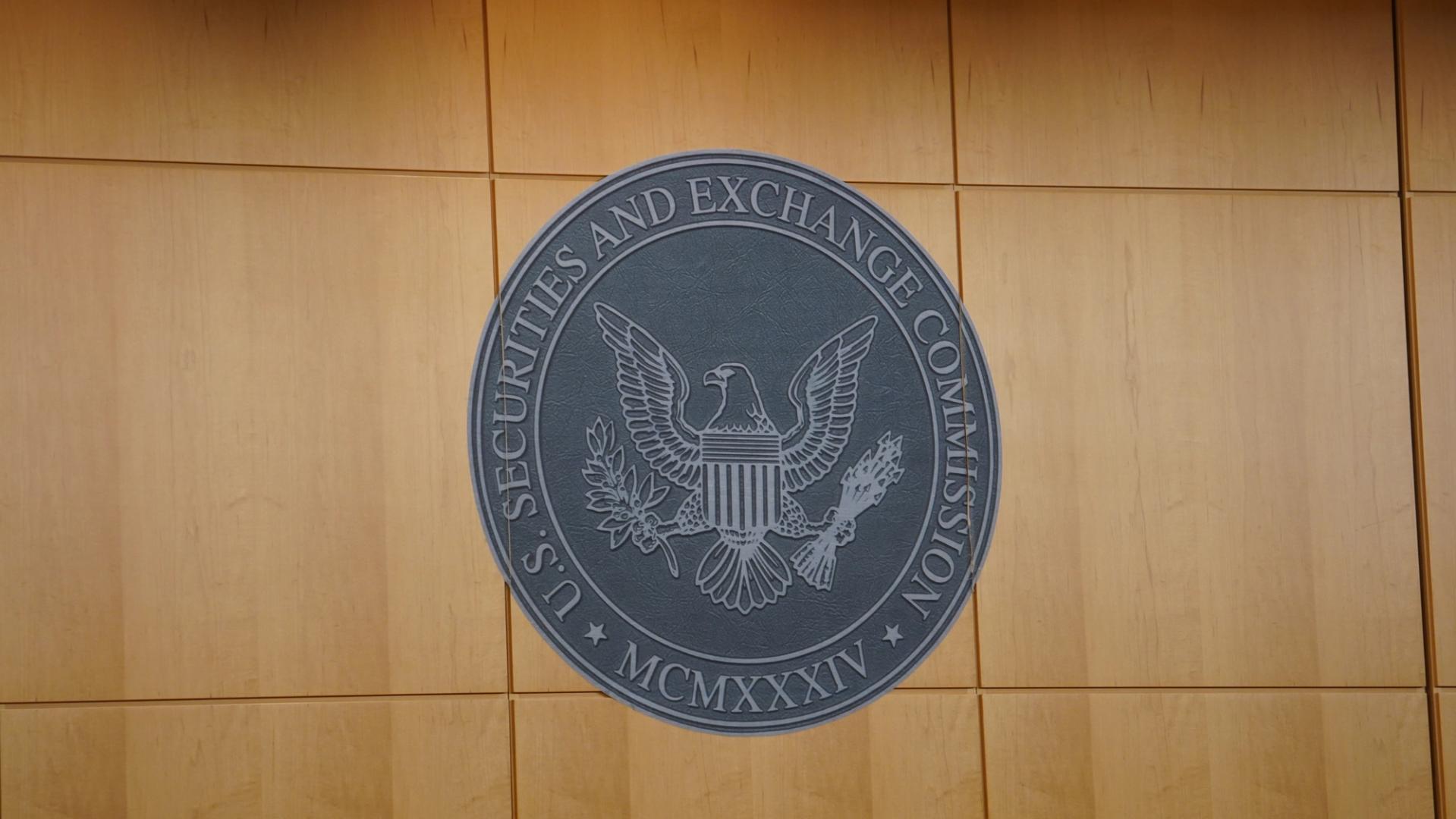
The U.S. Securities and Exchange Commission (SEC) has paused Nasdaq’s approval of cash-settled bitcoin index options and will reconsider the decision following a legal challenge from CME Group, the agency said in an order released for public inspection on July 31.
Back in May, the SEC granted Nasdaq PHLX conditional approval to list cash-settled bitcoin index options under the ticker QBTC. The product still required exemptions from the Commodity Futures Trading Commission (CFTC) before it could launch.
CME Group challenged the approval in June, arguing that bitcoin is a commodity and, as such, options tied directly to its value fall under the CFTC’s exclusive jurisdiction rather than the SEC’s.
If the CME is right, the SEC would have no authority to approve QBTC, and Nasdaq would need to register as a CFTC-regulated futures or swaps venue, or redesign the contracts to track a security such as a spot bitcoin exchange-traded fund.
The CME already operates regulated bitcoin futures and options markets, while Nasdaq’s QBTC would compete for the same trading activity without Nasdaq registering under the CFTC framework that governs the CME.
Crypto World
Bitcoin mining difficulty shrinks 14% from this year’s high as plunging revenues force operators to pivot
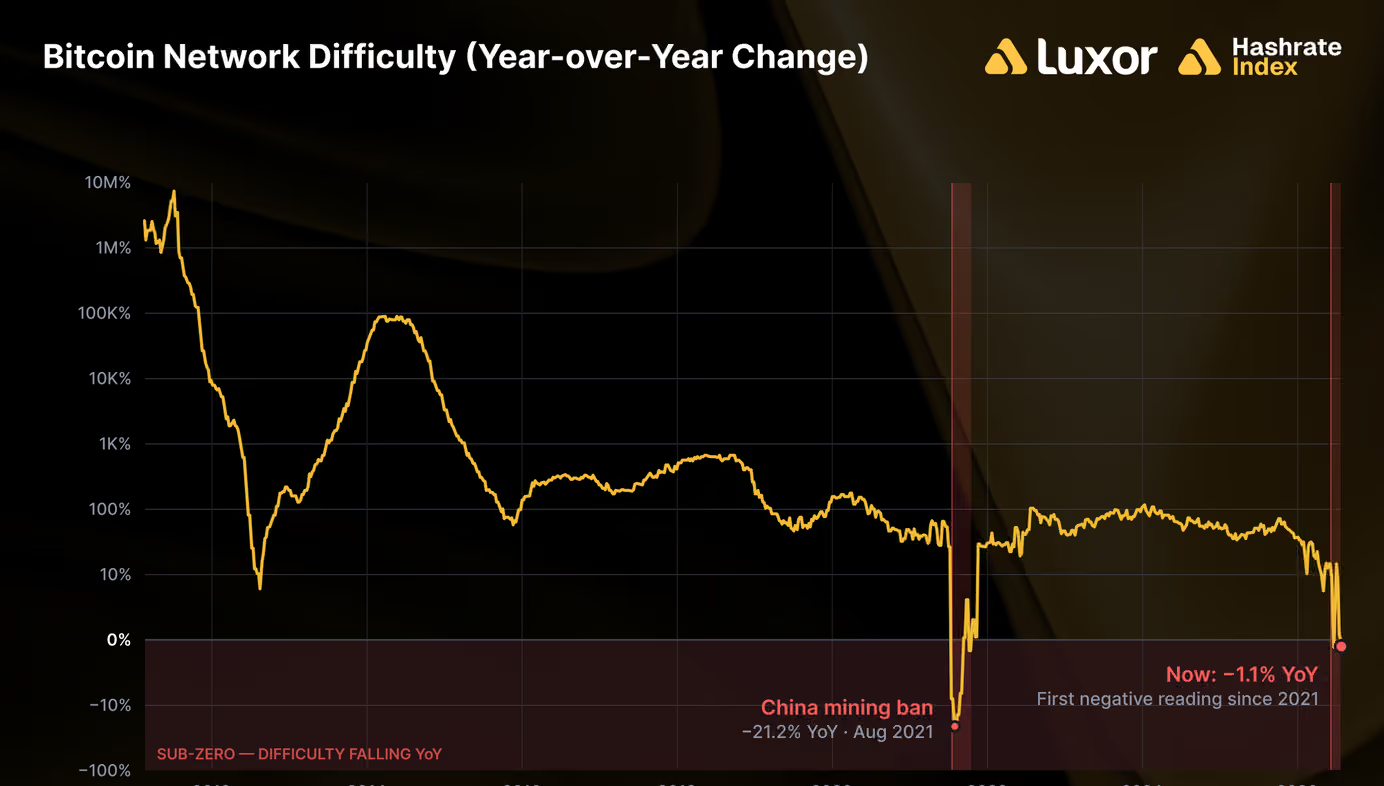
Bitcoin’s mining difficulty has fallen below its year-earlier level for only the second time in the network’s history as weak mining economics and the shift toward artificial intelligence weigh on capacity growth.
The metric, which measures how difficult it is to mine a Bitcoin block, is now at 126.23 trillion after falling 0.74%, about 1.1% below the 127.62 trillion reached a year earlier and 19.1% from the 155.97 trillion all-time high seen in November 2025.
Difficulty adjusts every 2,016 blocks, or roughly every two weeks, to keep Bitcoin’s average block time near 10 minutes. Falling difficulty indicates that less computing power was competing during the previous adjustment period, while reducing competition for miners that remain online.
The metric has dropped about 14% from its January peak, reached this year, following declines of 10% in June and 5% earlier in July, according to network data.
The only previous year-over-year decline was after China’s 2021 mining ban, which temporarily removed roughly half of the network’s computing power. Difficulty recovered as miners relocated to other regions.

This time around, the plunge is more mining economics-based.


For years, stablecoins have been marketed as crypto’s breakthrough application for cross-border payments, promising near-instant transfers at a fraction of the cost charged by traditional remittance providers.
Sending USDC across a blockchain may indeed cost only a few cents but a new study from the Bank of Italy suggests that isn’t what most people actually pay when they send money home.
In a mystery-shopping exercise spanning 10 international remittance corridors, researchers found that stablecoin-based transfers were not systematically cheaper than conventional money transfer operators once the full journey, from bank account to crypto wallet and back into local currency, was taken into account.
The study, published as Markets, Infrastructures and Payment Systems Paper No. 86, tracked transfers of 200 USDC from Italy to destinations including Argentina, Brazil, South Africa, the UAE and Japan.
End-to-end costs varied dramatically, ranging from roughly 0.3% to almost 9% of the value transferred depending on the corridor and service providers used. Settlement times also differed widely, from around 20 minutes where domestic instant payment systems supported withdrawals to as long as two business days when recipients relied on conventional bank transfers.
Blind spots
A central bank highlighting shortcoming in the promises that stablecoins may make is in some ways to be expected. Traditional financial (TradFi) institutions may have a vested interest in undermining adoption of stablecoins – digital tokens pegged to fiat currencies. Digital currencies and blockchain were designed to remove much of the need for intermediaries, such as central banks, after all.
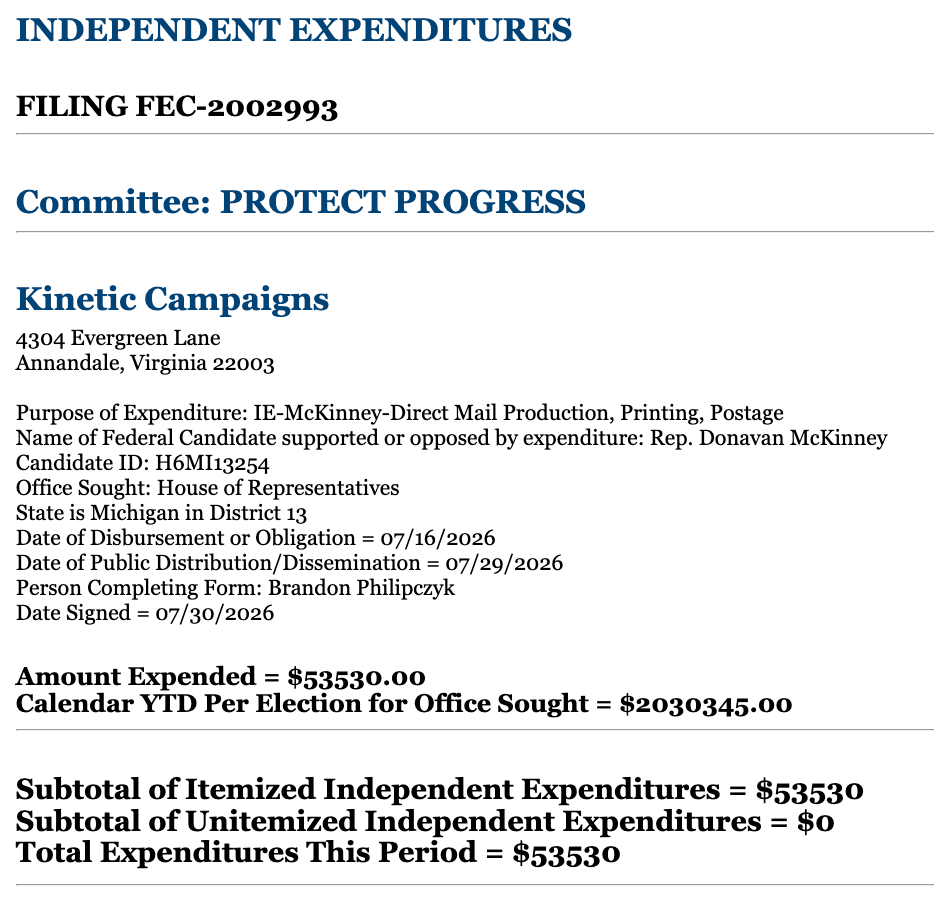
An affiliate of a political action committee (PAC) funded largely by contributions from cryptocurrency companies Ripple Labs and Coinbase has poured more cash into ads for next week’s primary race in Michigan’s 13th Congressional District.
According to Federal Election Commission (FEC) filings as of Thursday, the Protect Progress PAC had spent more than a combined $2 million on media to support Michigan Representative Shri Thanedar in the state’s 13th district and oppose his Democratic challenger, Donavan McKinney.
The most recent filings effectively doubled what the PAC had reported spending a week prior, with an additional $884,240 on ads to support Thanedar and more than $150,000 to oppose McKinney.
Source: FEC
During his time in the US House of Representatives, Thanedar voted in favor of the stablecoin-focused GENIUS Act legislation and the crypto market structure bill currently under consideration in the Senate, the Digital Asset Market Clarity (CLARITY) Act. He also cosponsored the Promoting Innovation in Blockchain Development Act in an effort to protect developers.
In a July 21 statement on the PAC spending supporting Thanedar, McKinney said “the crypto lobby is paying my opponent back for helping Trump make over $1 billion since taking office.” He was likely referring to the US President disclosing that he earned more than $1.4 billion from crypto investments in 2025, including from his memecoin, Official Trump (TRUMP) and through his family’s business, World Liberty Financial. Many Democrats have accused Trump of using his position to profit from the presidency through laws like GENIUS.
Cointelegraph reached out to Thanedar’s and McKinney’s campaigns for comment on the PAC expenditures but did not receive an immediate response.
Related: US senators sent revised ethics rules to White House for CLARITY Act: Report
Protect Progress is an affiliate of the Fairshake PAC, which was responsible for spending more than $170 million in the 2024 US election cycle through media supporting candidates it considered favoring crypto industry-aligned policies. The Michigan primary is scheduled for Tuesday, but the PAC and its affiliates have already poured millions of dollars into 2026 races in Texas, Illinois and other states.
The US consumer advocacy group Public Citizen reported in June that Fairshake and its affiliates were responsible for spending more than $82 million out of the roughly $189 million crypto companies had used in the 2026 election cycle. Fairshake reported holding a $193 million war chest as of January.
PAC spending in Washington and Alabama with primaries looming
In addition to Michigan’s primaries, the Fairshake affiliate Defend American Jobs PAC spent more than $65,000 on media to support a Republican running in Washington’s 4th congressional, according to FEC filings. Washington is scheduled to hold primaries the same day as Michigan.
Alabama, scheduled to hold primaries on Aug. 11, has also been a focus for Fairshake. FEC filings showed that Defend American Jobs spent more than $511,000 on media to support Jerry Carl Jr., a Republican who represented the state’s 1st congressional district from 2021 to 2025. Notably, the former Alabama lawmaker was one of the wealthiest in the state’s House delegation, with a reported net worth of up to $15 million in 2023.
Magazine: Crypto lobby spending on Republicans far outpaces Democratic support
MicroStrategy endorsed the CLARITY Act on Friday, one day after reporting an $8.22 billion quarterly loss. The bill would rewrite how the United States regulates digital asset trading.
The endorsement hands MSTR shareholders a second variable to price. Regulatory momentum now sits beside the loss, a rising dividend bill, and a share price near 52-week lows.
Why the Timing Matters
Strategy, formerly MicroStrategy, reported second quarter results on July 30 and backed the market structure bill the next day. That sequence turned a policy statement into an earnings postscript.
The quarter was brutal. An $8.32 billion write-down produced an $8.22 billion net loss, or $24.45 per diluted share. A year earlier the same line delivered $32.60 of profit.
The market answered on Friday. MSTR closed at $93.28, down 4.56%, within 14% of its 52-week low of $81.81. Clear Street trimmed its price target to $201 from $240.

Management therefore needed a story the quarter could not supply. Backing clearer rules delivered one.
What Clearer Rules Would Change for MSTR
The bill’s central jurisdictional split is plain enough. Securities-like tokens would sit with the Securities and Exchange Commission (SEC).
Digital commodities would move to the Commodity Futures Trading Commission (CFTC).
For MicroStrategy, that is a funding question rather than a Bitcoin question. The company raised $17.06 billion through at-the-market equity programs this year.
STRC preferred issuance added $7.53 billion, a 254% jump. The catalyst runs through the price of that capital.
Strategy pays 12% on STRC because the shares keep clearing below their $100 stated amount. A wider institutional bid would let it pay less.
Cheaper credit lowers the 10.8% hurdle. If that hurdle ever drops beneath the Bitcoin yield, per-share accretion resumes. That spread is the whole argument for owning MSTR instead of Bitcoin.
Those buyers answer to compliance committees. Executive Chairman Michael Saylor has argued for years that regulation accelerates institutional acceptance rather than restraining it.
“I support advancing the CLARITY Act through bipartisan work to establish clear, durable rules, protect property rights, promote innovation, and strengthen American capital markets. Bitcoin will succeed with or without legislation, but America needs clarity for digital assets,” he articulated.
Follow us on X to get the latest news as it happens
The Spread Clarity Would Have to Close
Clarity would not close that spread quickly. Chief Financial Officer Andrew Kang put the effective cost of credit at 10.8%. Strategy’s Bitcoin yield for the year is 4.5%.
Preferred dividends consumed $400.7 million last quarter, against $49.1 million a year earlier. The STRC rate now stands at 12.00%.
Investors are not paying par for that paper. Strategy repurchased 288,930 STRC shares at an average $86.53, a 13.47% discount to the $100 stated amount.
Bitcoin traded near $63,016 on Saturday, down 1.3% over 24 hours. At that price the 843,775 coin position is worth about $53.2 billion, roughly $10.5 billion below cost.
MSTR carries a market value of $35.87 billion. That collapse in MSTR’s premium tracks the senior claims stacked ahead of common shareholders, not the legal status of Bitcoin.
Strategy also authorized $1.0 billion to repurchase MSTR and has bought nothing. Management will act only below intrinsic value, a threshold it has not declared reached.
The bill’s record is stronger than its calendar. The House passed it 294 to 134 in July 2025. Senate Banking then advanced it 15 to 9 on May 14 under Chairman Tim Scott.
No floor vote is scheduled, however, and the Senate’s state work period begins August 10. MSTR holders inherit a catalyst with no date, while the 10.8% hurdle keeps its own schedule.
The post MicroStrategy Post-Earnings CLARITY Act Push Could Add New Catalyst for Its Stock appeared first on BeInCrypto.

Although Bitcoin has gone through countless phases of massive fear, uncertainty, and doubt (FUD), the current crisis around Coldcard has triggered the worst wave of fear ever recorded on crypto social media channels.
So far, BTC has been able to weather the storm in terms of price moves to a large extent, even though it has slipped by a few grand. However, it appears that those losses are largely connected to other factors, such as the escalating tension in the Middle East.
Fear Through the Roof
Data provided by the analytics company Santiment Intelligence shows that Bitcoin has registered its lowest positive-to-negative commentary ratio since the firm began tracking such discussions across some of the most used platforms like X, Reddit, and Telegram. The current numbers show just 0.58 bullish comments for every bearish one, indicating that fear has overwhelmingly replaced optimism.
What’s even more intriguing is that this reaction is quite unusual since it has dwarfed all previous market shocks, including the rapid collapse of FTX, Mt. Gox, and the COVID-19 “Black Thursday” crash. None of them generated such extreme levels of negative comments online.
Santiment attributed the difference to psychological factors. While earlier crises primarily involved centralized exchanges or broader macroeconomic events, the Coldcard incident has raised questions about self-custody itself, which has long been considered Bitcoin’s safest storage method.
Binance’s Changpeng Zhao also commented on the recent developments, suggesting that even old wallets with a long history can have bugs. He believes nothing is 100% certain, which is why investors need to stay informed.
What Happened With Coldcard?
Security researchers disclosed last week that attackers had distributed malicious firmware capable of stealing wallet seed phrases during the device setup process. Coldcard users who installed the compromised software unknowingly exposed their recovery phrases, allowing attackers to drain their wallets after funds were deposited.
The estimated scale of the incident has grown significantly over the past few days. Current data shows that roughly 1,200 wallets have been compromised, losing nearly 1,100 BTC (worth over $70 million at current prices) during a coordinated 41-minute operation.
All transactions shared the same unusual fingerprint: identical 30sat/vB transaction fees, far above prevailing network rates, suggesting an automated sweeping tool. Furthermore, the attack occurred more than a day before Coldcard publicly warned customers about the compromised firmware.
The post Bitcoin Fear Reaches Record High as Coldcard Exploit Shakes Confidence in Self-Custody appeared first on CryptoPotato.
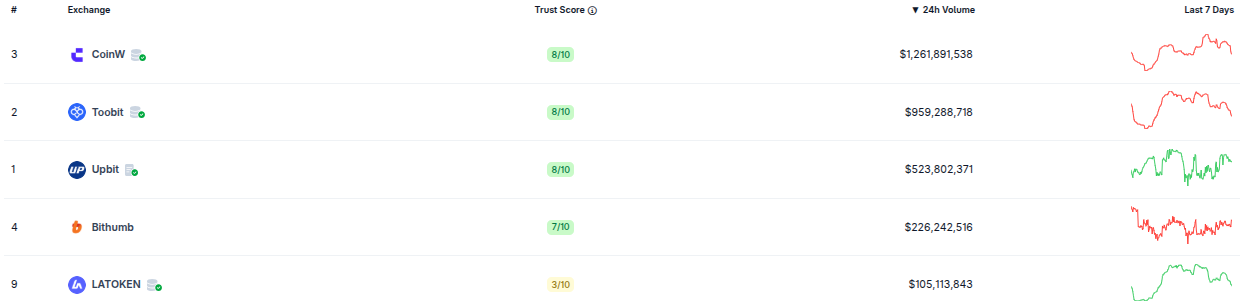
South Korea confirmed a 22% crypto tax starting in 2027, just as trading volume across its five main exchanges collapsed nearly 55% during the first half of the year.
The timing raises an uncomfortable question about taxing a market that is already shrinking fast.
How the 22% Crypto Tax Will Work
Other income is a tax category covering gains that fall outside wages or business revenue. Under the Income Tax Act, profits from transferring or lending virtual assets will sit in that bracket.
Deputy Prime Minister and Finance Minister Koo Yun-cheol confirmed the schedule on July 29 during a National Assembly committee meeting, saying the government is pushing forward as planned.
The mechanics are straightforward. Annual gains above 2.5 million won, roughly $1,740, face a 20% national tax, while a local levy raises the combined rate to 22%.
Follow us on X to get the latest news as it happens.
Investors below that threshold owe nothing. First returns are expected in May 2028, covering income earned throughout 2027. The measure has a long history of delays. Lawmakers approved it in 2020 for a January 2022 start, postponed it to 2025, then pushed it to 2027.
Opposition remains active. People Power Party lawmaker Kim Sang-hoon criticized the design because investors cannot offset losses against gains earned in later years.
That restriction could push traders offshore. Kim warned activity might migrate toward overseas exchanges, decentralized platforms, or peer-to-peer markets, reducing both volume and tax visibility at home.
Koo acknowledged the concern but resisted changes. Moving crypto into a capital-gains framework would require a review of the broader tax treatment of financial markets, he argued.
Why Is South Korean Trading Volume Collapsing
A separate opposition bill filed in March seeks to remove crypto income from the Income Tax Act entirely. Lawmakers referred it to a subcommittee, keeping repeal or another delay legally possible.
The volume figures explain the anxiety. Upbit, Bithumb, Coinone, Korbit, and Gopax generated roughly $366.58 billion in combined trading volume during the first six months.
That marked a 54.6% drop from the same period in 2025. The contraction continued through July, with cumulative volume falling by 16.9% compared with June.
Concentration is reshaping the market. Upbit processed about 11.69 trillion won in July, and while its volume fell 10%, its market share climbed from 62.3% to 67.4%.
Bithumb moved in the opposite direction. Its share slipped from 30.7% to 27.1%, widening the gap with Upbit to 40.3 percentage points.
Subscribe to our YouTube channel to watch leaders and journalists provide expert insights.

These figures may be attributable to the shift in liquidity concentration toward larger platforms during periods of slowdown.
Deeper order books absorb bigger trades with less slippage, reinforcing dominance when overall activity falls.
Smaller exchanges face real pressure. Coinone, Korbit, and Gopax are reportedly exploring partnerships with securities firms, institutional services, and restructuring.
Future competition may hinge less on raw volume. Stablecoin liquidity, regulatory compliance, and institutional access could matter more than retail spot trading alone.
The post South Korea’s 22% Crypto Tax Crashes Trading Volume appeared first on BeInCrypto.


While exploits in crypto often grab headlines because of the sheer amount of money that gets stolen, Coates emphasized that many of these hacks actually originate outside of blockchain compromises themselves. “In many cases, it is an operational security issue or a Web2 issue that led to a key compromise,” he said.
This will only prove to be more difficult as artificial intelligence advances gives attackers better tools to exploit security practices.
“The social engineering piece is going to get a lot worse because of the power of AI and deepfakes,” Coates said. “We should expect full spoofed phone calls with voices of people that we know… there’s really no reason this won’t hyperscale.
To prevent that, Coates thinks crypto needs to come up with better systems that remain secure and work when people fall for these scams.
“You cannot fully prevent anyone from falling victim,” he said. “Eventually, you will be fooled because the cons are that good.” Organizations should thus have multiple layers of various degrees of security controls, so “when someone gets fooled, the other things take over to protect you.”
For the longer-term, the question of quantum computing largely looms on various crypto ecosystem’s futures, including that of Solana.


The obvious objection is that this is leveraged speculation in new language, and that traditional markets keep their frictions for good reasons. Both points have force. A funding rate is not a substitute for the price discovery that settlement enforces, and continuous leverage on volatile assets concentrates risk in ways periodic markets do not. But those are arguments for building the structure carefully, not for assuming it will not be built. The demand is already here, and it moves toward the venue that offers universal access to global assets, whether stocks, crypto or FX.
There is one place crypto’s progress this cycle has not yet reached. Over the past year, tokens acquired real economic rights, revenue shares, buybacks and votes, while projects with nothing behind them were delisted and some of the strongest teams chose IPOs over token launches. Even the IPO no longer sits outside this system: SpaceX’s shares changed hands as synthetic pre-IPO perpetuals on Hyperliquid for weeks before its June 2026 listing, trading tens of millions of dollars a day in May and swelling to roughly $1.3 billion on debut day as investors shut out of the traditional allocation turned to crypto rails. The market structure beneath perps has not fully followed. The next stage is to build that alignment in, with the transparency now expected across the rest of crypto. That consolidation is happening on centralized venues as much as onchain: the largest exchanges now run multi-asset books where equities, crypto and FX clear side by side, and a single centralized platform accounted for more than half of all real-world-asset perp volume in May 2026. The pull is structural rather than speculative, with 52% of Bitget’s users already holding both stocks and crypto.

10 Gangster Movies With Absolutely No Flaws

CWG 2026: Priya Ghanghas defeats Marie-Bathoul Al-Ahmadieh to win Women’s 60kg Boxing Gold | Commonwealth Games News

What 20 Million Bans Reveal About The Stress On Wikipedia’s Volunteers


-
 Sports6 days ago
Commonwealth Games boxing: Jadumani Singh seals dominant 5-0 win over Pakistan’s Sumama Rehman to enter quarter-finals | Commonwealth Games News
-

 Business3 days ago
Why Trees Belong on the Risk Register
-

 Fashion23 hours ago
Weekend Open Thread: Wit & Wisdom
-

 Politics19 hours ago
Meta enters AI-training agreement with far-right ‘propaganda rag’ Newsmax
-

 Tech6 days ago
Intel is reversing course and bringing hyper-threading back to its server chips
-

 Crypto World7 days ago
Ripple bought a bank in pieces. The $4 billion audit
-

 Politics5 days ago
Luke Littler dismantles Gerwyn Price to retain title in Blackpool
-

 Crypto World2 hours ago
MicroStrategy Post-Earnings CLARITY Act Push Could Add New Catalyst for Its Stock
-

 Politics4 days ago
The Part of the Electric Transition Nobody Wants to Discuss
-

 News Videos6 days ago
BITCOIN JUST ENTERED THIS CRITICAL ZONE…
-
 Entertainment4 days ago
‘Stargate’ Creator’s New Sci-Fi Series Returns for Season 3 Tomorrow
-

 Business3 days ago
Major shareholder moves on Canyon
-

 Crypto World6 days ago
XRP Ledger adds $2.6B as RWA inflows rank second
-

 Politics6 days ago
Spain sweeps the board at 2026 World Cup with individual awards
-

 News Videos2 days ago
Bitcoin Enters the 3rd Stage of the Bear Market
-
Crypto World10 hours ago
XRP Ledger v3.3.0 brings five institutional features
-

 Entertainment7 days ago
Sara Gilson Killed By Husband After Viral “Pedophile” TikTok Video
-

 Crypto World4 days ago
Kraken Enables Retail Access to Jersey Mike’s IPO via Tokenized Shares
-

 Tech5 days ago
New macOS Sequoia & Sonoma security updates for older Macs
-

 News Videos4 days ago
Claude: Build Financial Dashboards in Minutes (2026)
You must be logged in to post a comment Login