

Crypto World
SUI Price Holds at $1.06 as Chart Base and Whale Accumulation Signal a Potential Reversal

TLDR:
- SUI is trading at $1.0651, sitting 17.6% below its 200-day moving average resistance level of $1.2873.
- RSI has recovered from extreme oversold levels to a neutral 51, leaving room for price to move in either direction.
- MACD has not crossed bullish yet, but the narrowing gap between lines signals building momentum below the surface.
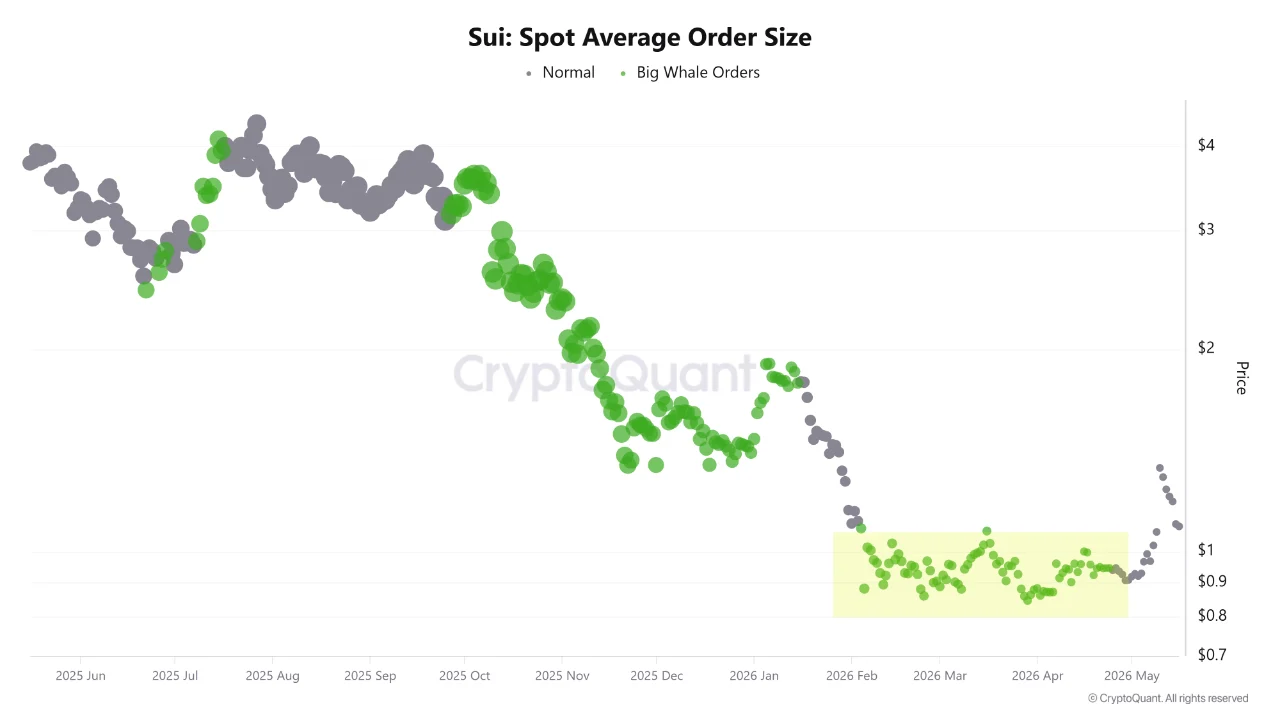
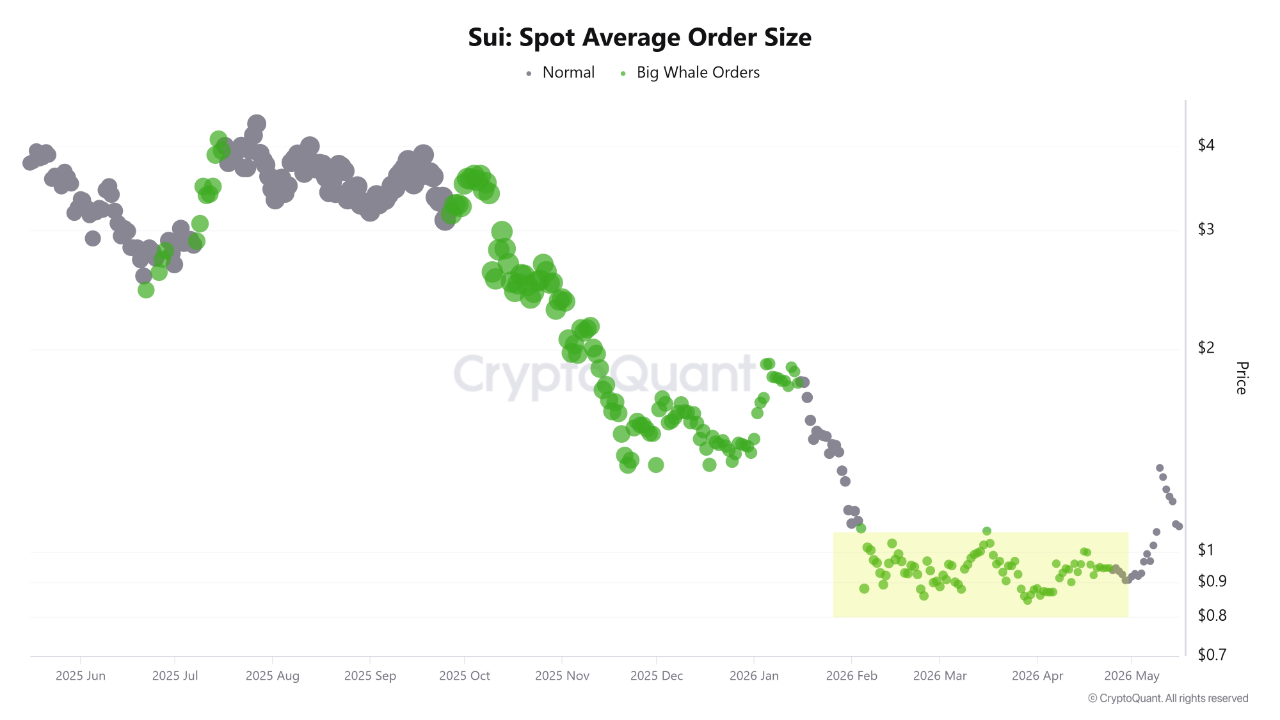
- CryptoQuant data shows large orders clustering at $0.90–$1.00, pointing to whale accumulation ahead of a potential rebound.
SUI is trading at $1.0651, sitting 17.6% below its 200-day moving average of $1.2873. The token dropped from $4.00 to $0.50 over four months before stabilizing.
Technical analysts are now watching closely as momentum indicators show early signs of recovery. Meanwhile, on-chain data from CryptoQuant points to large-order accumulation near key support zones. The chart structure tells a more layered story than the price decline alone suggests.
Technical Indicators Point to a Market in Transition
SUI printed a capitulation bottom near $0.50 in late 2025. Volume spiked sharply at those lows, which typically marks seller exhaustion rather than continued distribution. That kind of price action usually separates a dying asset from one completing a base.
Since that bottom, the Relative Strength Index has climbed from extreme oversold territory back to 51. That reading is neutral — not extended to the upside, and not under further selling pressure. It gives the chart room to move in either direction.
Analyst account @2xnmore noted that the MACD has not crossed bullish yet, but the gap between the MACD line and the signal line is narrowing.
The momentum engine is building without having triggered a confirmed buy signal. That is an important distinction.
The 200-day moving average at $1.2873 remains the key structural line. A high-volume daily close above that level would shift the chart from bearish to neutral.
A MACD crossover on top of that would then move the structure from neutral to bullish. Neither has happened yet.
Whale Order Data Suggests Accumulation at the $0.90–$1.00 Zone
On-chain researcher Rei Researcher referenced CryptoQuant’s Spot Average Order Size data to track large-player behavior.
The data shows large-volume orders clustering around the $0.80–$1.00 range during market lulls, without pushing price lower. That pattern has preceded rebounds before.
Source: Cryptoquant
The $0.90–$1.00 zone appears to function as a solid support band. When large orders repeatedly fill at that level without breaking it, it suggests institutional positioning rather than exit. That behavior contrasts with panic-driven retail selling at cycle lows.
If SUI corrects back toward that range and large-order activity increases, analysts consider it a bullish signal for the next move higher. The re-fill pattern at that level is what traders are now watching for on future dips.
The broader picture is that SUI remains in a technical rebuild phase. Price is below the 200-day MA, but the base structure and whale footprint both suggest the selling pressure has already been absorbed at lower levels.



TLDR:
- BSP has explicitly banned VASPs from listing or supporting anonymity-enhancing privacy virtual assets.
- VASPs must assess tokens across six pillars including issuer background, liquidity, and legal compliance.
- Ongoing monitoring is required, with deviation thresholds set as automatic triggers for token delisting.
- Misleading disclosures, market abuse, and cybersecurity risks are grounds for immediate token suspension.
The Bangko Sentral ng Pilipinas has moved to strengthen oversight of the digital asset market in the Philippines. The BSP privacy virtual assets ban prohibits virtual asset service providers from listing or supporting anonymity-enhancing coins.
Alongside this, the central bank has ordered VASPs to adopt stricter token listing, monitoring, and delisting standards. The move marks a significant tightening of regulatory control over the fast-growing crypto sector.
BSP Sets Six-Pillar Framework for Token Listing
The BSP issued a memorandum requiring VASPs to establish a robust due diligence process for listing virtual assets. The directive was released by BSP Deputy Governor Lyn Javier and applies to all regulated platforms.
VASPs must assess each token across six defined pillars before listing. These cover issuer background, market maturity, use cases, transparency, traceability, security, liquidity, and legal compliance.
For issuer background, VASPs may review incorporation documents, financial statements, and ownership structures. Fitness checks on directors, officers, and operators of the issuing entity are also required.
VASPs must also examine potential conflicts of interest involving the issuer, other VASPs, or government officers. This level of scrutiny brings VASP standards closer to those applied to traditional financial institutions.
Market maturity factors include market capitalization, average 30-day trading volume, and issue price. The number of on-chain holders and the exchanges already supporting the asset are also considered.
VASPs must make whitepapers and project documentation readily accessible to customers. These documents should cover tokenomics, target users, supported blockchains, and relevant risk disclosures.
For transparency and security, VASPs may review the token’s underlying blockchain technology, consensus algorithm, and known vulnerabilities. Independent audits and coverage by blockchain analytics firms are also evaluation factors.
Asset-backed and fiat-backed tokens face additional scrutiny around minting, issuance, redemption, and value maintenance protocols.
Liquidity providers, withdrawal rights, and reserve composition are reviewed under the redemption and liquidity pillar.
Ongoing Monitoring and Immediate Delisting Triggers Required
Beyond listing approval, the BSP requires VASPs to conduct continuous monitoring of listed virtual assets. Platforms must set deviation thresholds that serve as automatic triggers for suspension or delisting.
Tokens that no longer meet the standards applied during initial listing must be removed. This ongoing requirement prevents platforms from treating listing as a one-time compliance exercise.
VASPs must suspend or delist tokens in cases involving adverse market developments or abnormal price movements.
Legal and regulatory non-compliance, cybersecurity concerns, and consumer protection risks also qualify as delisting grounds.
Misleading disclosures and market abuse are included in the list of immediate suspension triggers. The BSP’s framework applies a continuous risk-based lens to all listed digital assets.
The BSP privacy virtual assets ban is among the most direct provisions in the memorandum. Privacy coins, which obscure transaction details and user identities, are now explicitly prohibited from VASP platforms.
The ban targets anonymity-enhancing virtual assets that limit traceability and complicate anti-money laundering efforts. This positions the Philippines alongside other jurisdictions that have moved to restrict privacy coin access.
While the BSP outlined specific documentary requirements, it noted the list is not exhaustive. VASPs are permitted to develop their own internal listing frameworks, provided they align with BSP guidelines.
The regulator’s approach gives platforms some flexibility while maintaining baseline standards. This balance reflects a practical stance toward a market that continues to evolve rapidly.
Crypto World
SpaceX and Ripple: How Will the IPO Impact XRP’s Price? (2 AIs Make Informed Predictions)

The largest initial public offering in history is already in the books, as Elon Musk’s 24-year-old spaceflight behemoth debuted on Wall Street with a whopping $1.77 trillion valuation after it raised $75 billion.
It also became a retail investor’s dream, with more than $100 billion worth of orders from such investors. As such, we decided to ask whether one of the most popular altcoins, which is also among retail’s favorites, could feel the impact of this massive financial event.
XRP’s Less Bullish Narrative
Unlike with bitcoin, where the link between the two assets was quite direct and obvious, ChatGPT said that the answer for XRP is “more complicated,” and perhaps “less bullish than some investors would like.” SpaceX has publicly disclosed it has a substantial exposure to BTC, but there is no major indication that it holds XRP, uses the XRP Ledger, or “plans to integrate Ripple’s payment technology.”
As such, XRP’s price reaction will be more dependent on the broader market flows rather than on SpaceX’s IPO or stock moves. The AI warned that the short-term perspective for Ripple’s token leans more bearish, as a “listing of this size can suck liquidity out of speculative markets, especially when retail investors are heavily involved.”
“XRP is still a high-beta crypto asset, and when traders need cash to chase a massive IPO, altcoins are often among the first positions to be reduced.”
Gemini also noted that the immediate threat to the cross-border token is the “liquidity vacuum.” It added that even XRP’s loyal and active retail community is being tested when such a “generational tech narrative like SpaceX emerges.”
Or Maybe Not So Fast
Similar to its bitcoin narrative, Gemini said the “wealth effect” could be highly beneficial to XRP in the long run. This is because when the dust of the IPO and the $75 billion raise settles, an “enormous amount of new wealth will have been unlocked for early private investors.” Such capital tends to be redistributed “down the risk curve,” and high-cap altcoins could be among the largest beneficiaries, as they sometimes offer “asymmetric returns.”
ChatGPT also noted that there’s a positive side to this IPO, as it’s not “purely negative” for XRP. If SpaceX trades strongly and the broader market enters a new risk-on phase, the cross-border token could “benefit alongside other large-cap cryptocurrencies.”
XRP also has its own separate bullish case as the company behind it continues to push into payments, stablecoins, tokenization, and institutional infrastructure.
“If the market begins rewarding real-world utility again, XRP could still outperform many speculative tokens, even if it is not directly linked to SpaceX.”
The post SpaceX and Ripple: How Will the IPO Impact XRP’s Price? (2 AIs Make Informed Predictions) appeared first on CryptoPotato.
TLDR:
- Spot Bitcoin ETFs shed $4.4B over 14 sessions before Thursday marked the first day of marginal inflows.
- Strategy added 1,550 BTC at $65,200, lifting its total treasury to 845,256 BTC amid retail panic selling.
- On-chain exchange outflows hit 6,133 BTC on Friday, signaling institutional accumulation at cycle lows.
- Oil falling to $85.25 and a US–Iran MOU draft lifted Bitcoin back to $63,600 in Friday’s relief rally.
Bitcoin bottom hunters are finding reasons for cautious optimism this week as several converging factors point to a potential market floor.
A 14-day ETF outflow streak finally snapped on Thursday, while institutional buyers quietly accumulated through the panic.
Falling oil prices tied to Iran deal progress and the anticipated SpaceX IPO are also drawing investor attention back to risk assets.
Together, these developments suggest early signs of a return to crypto markets, though confirmation remains pending.
Easing ETF Outflows and Institutional Accumulation Point to a Shift
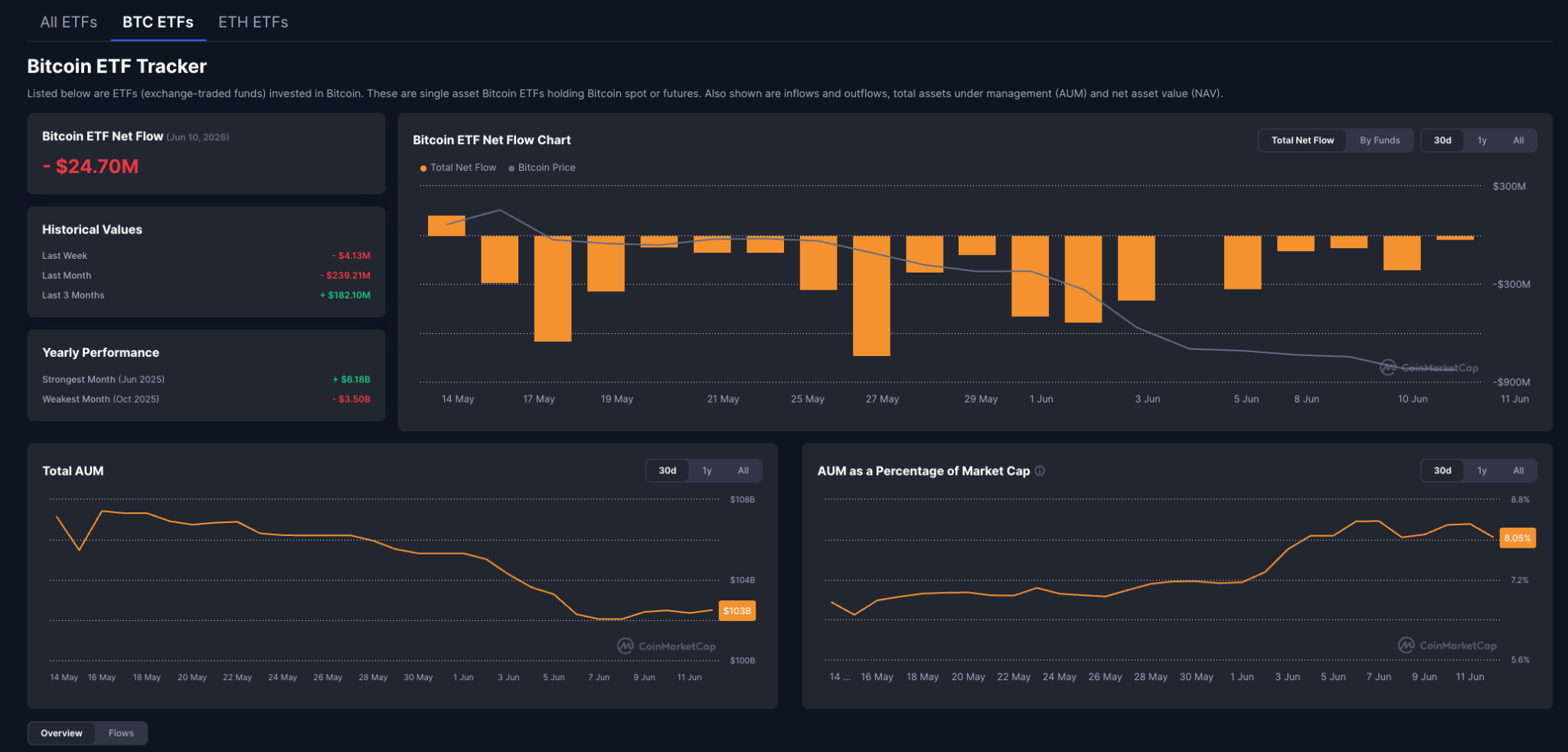
Spot Bitcoin ETFs bled roughly $4.4 billion across a brutal 14-session outflow streak. Total AUM compressed from approximately $104 billion to $80 billion, the heaviest redemption run in over a year.

Source: CoinMarketCap
BlackRock’s IBIT and Fidelity’s FBTC absorbed the steepest selling pressure during that stretch. Spot Ether ETFs lost more than $700 million across the same period.
Thursday marked the first day of marginal inflows, snapping the negative streak entirely. The Fear & Greed Index sat at 16, deep in “Extreme Fear” territory, while the MVRV Z-score registered 0.34.
That level has historically aligned with capitulation lows in prior Bitcoin cycles. Bitcoin’s realized price near $53,500 further strengthens the case for a value entry zone.
Retail investors capitulated throughout the selloff, with Glassnode’s SOPR holding below 1.0 for most of the period. Coins changed hands at a loss, confirming broad panic among smaller participants.
Institutions, however, moved in the opposite direction. Strategy added 1,550 BTC between June 1 and June 7 at roughly $65,200, lifting its treasury to 845,256 BTC.
On-chain exchange data recorded net outflows of 4,281 BTC on Thursday and 6,133 BTC on Friday. Coins leaving exchanges typically indicate larger players moving assets into custody rather than preparing to sell.
On Hyperliquid, whales built their largest net long position in two months. The divergence between retail panic and institutional accumulation is currently at cycle extremes, a setup that has historically preceded a Bitcoin bottom.
SpaceX IPO Buzz and Falling Oil Prices Lift Risk Appetite
The anticipated SpaceX IPO is drawing fresh capital attention toward high-growth and speculative assets. Risk appetite tied to a landmark listing of that scale tends to lift sentiment across adjacent markets, including crypto.
Investors rotating into growth exposure ahead of a major IPO often broaden their positions into digital assets. That dynamic could channel incremental buying into Bitcoin at a critical technical juncture.
Oil prices falling to $85.25 per barrel after a draft US–Iran Memorandum of Understanding further improved the macro backdrop. The deal, if signed, could include suspended US oil sanctions and a Strait of Hormuz reopening.
Lower energy prices directly ease the inflation pressure that has kept the Fed sidelined. That matters for crypto, as the rate-cut narrative has been the primary macro headwind all week.
Bitcoin reclaimed $63,600 on Friday after Trump canceled threatened Iran strikes following the MOU draft. The Russell 2000 gained 3.0%, and equities staged their strongest session of the week.
However, the MOU remains unsigned, and the relief rally’s durability hinges on formal deal closure. Traders should treat the current bounce as conditional until confirmation arrives.
The macro picture remains complicated, with May CPI at 4.2% and Goldman Sachs pushing its first rate-cut forecast to late 2027.
Still, the combination of snapping ETF outflows, institutional accumulation, SpaceX IPO momentum, and easing oil prices marks a meaningful shift in tone.
Whether these signals compound into a confirmed bottom depends on the next several days of ETF flow data. For now, the setup is the most constructive it has been in two weeks.
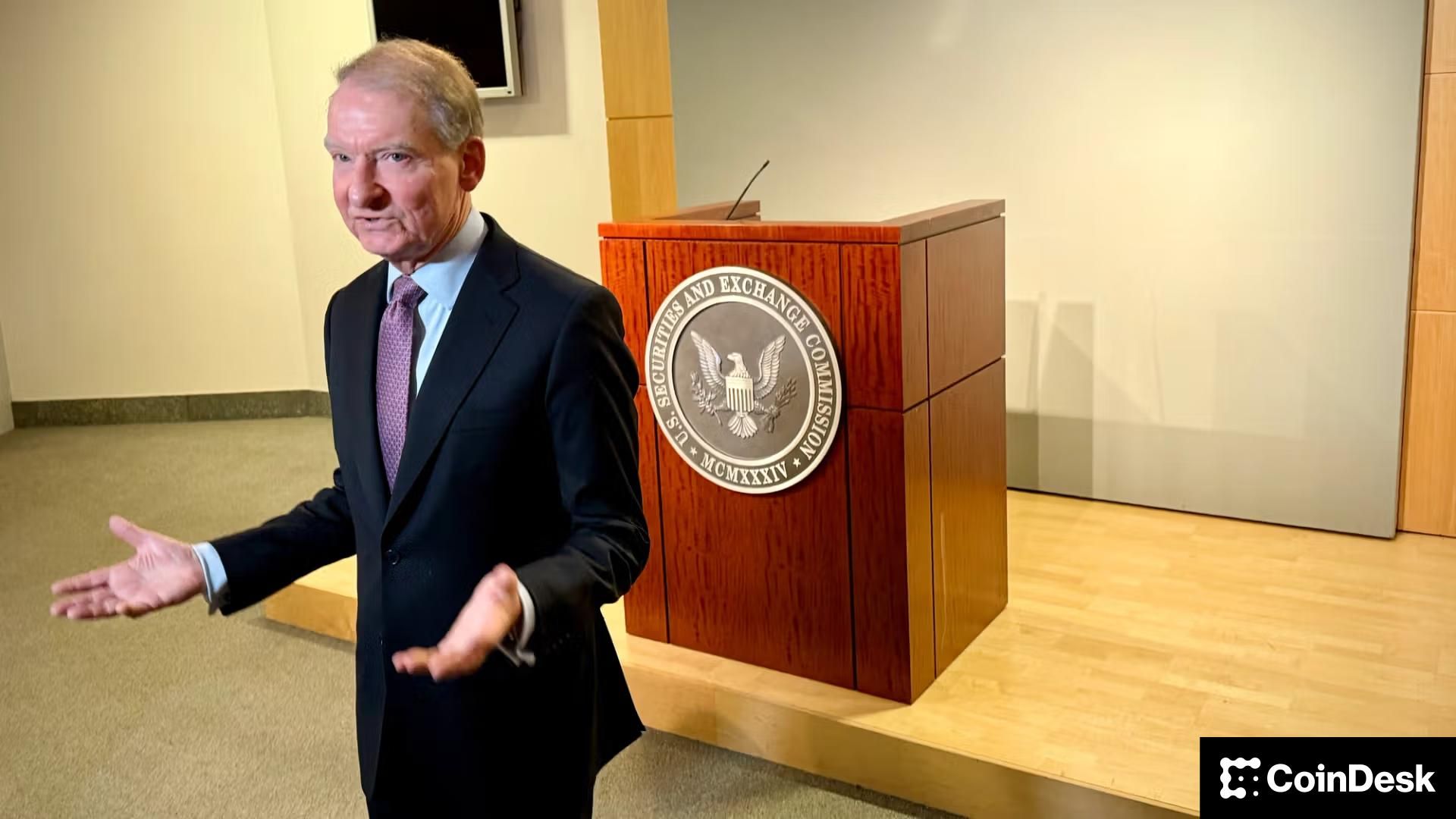
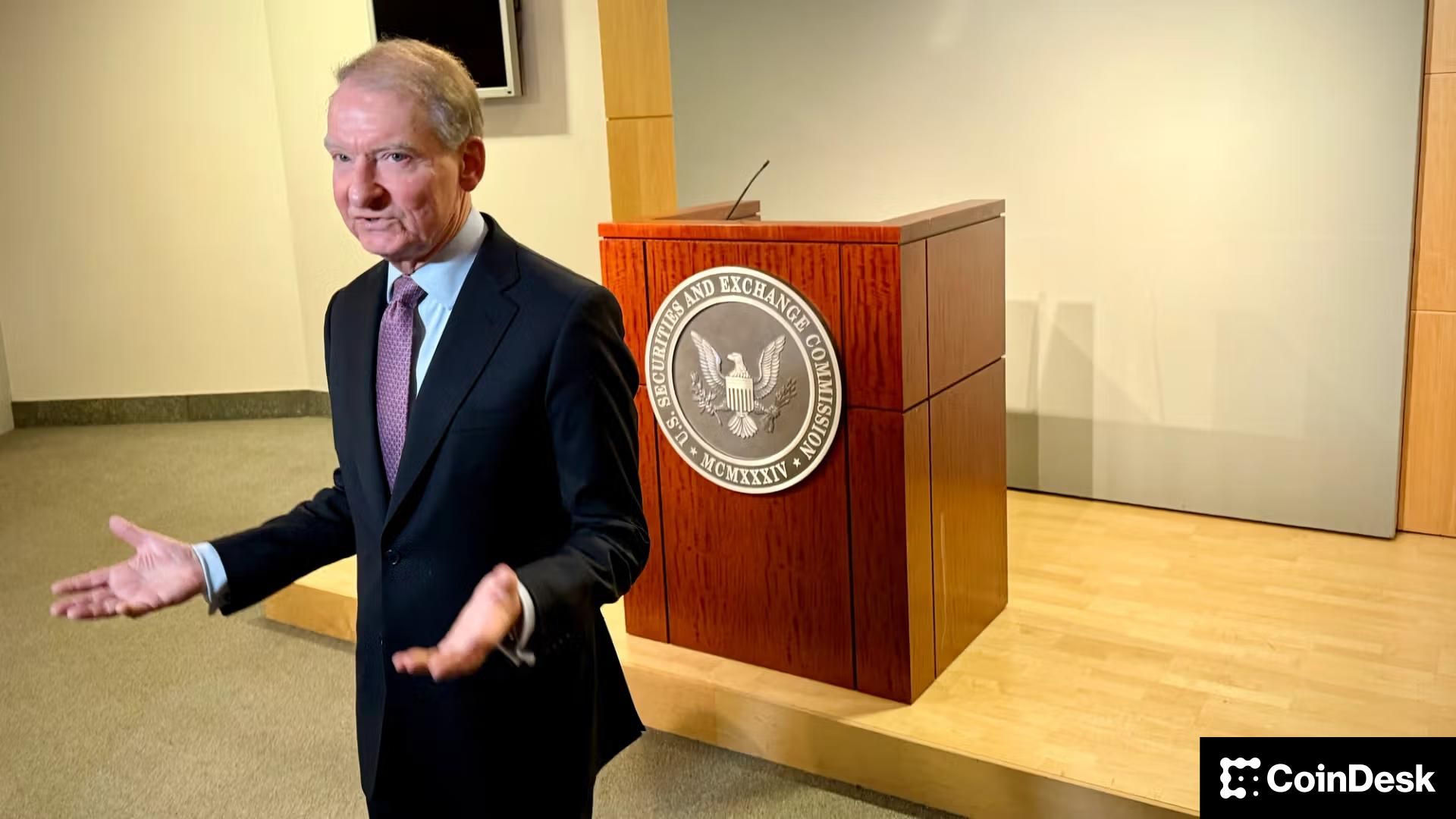
“It doesn’t have to be done as a rulemaking,” said SEC Commissioner Hester Peirce, who has led much of the agency’s crypto work since the start of last year. In response to a question from CoinDesk, she said the SEC has exemptive authority that it routinely uses. “We can do it as a rule, but we don’t have to do it as a rule.”
In March, SEC Chairman Paul Atkins described the incoming policy as “an innovation exemption to facilitate limited trading of certain tokenized securities with an eye toward developing a long-term regulatory framework.” He said it would be “limited in time and scope, but long enough so that we can craft more durable rules that harness the full potential of these new technologies.”
More recently in May, he added: “I also think we should consider what a future-proofed framework may look like, which would take the form of notice-and-comment rulemaking and would address the ‘exchange’ definition as applied to onchain trading systems.”
CoinDesk canvassed the views of several lawyers who are former officials at the SEC, asking questions about the choice to put off formal rulemaking, and whether the interim work on this will hold up. Most agreed that the approach may not carry the highest force of SEC authority, but it’d still be difficult to put the toothpaste back into the tube if the next administration sees things differently.
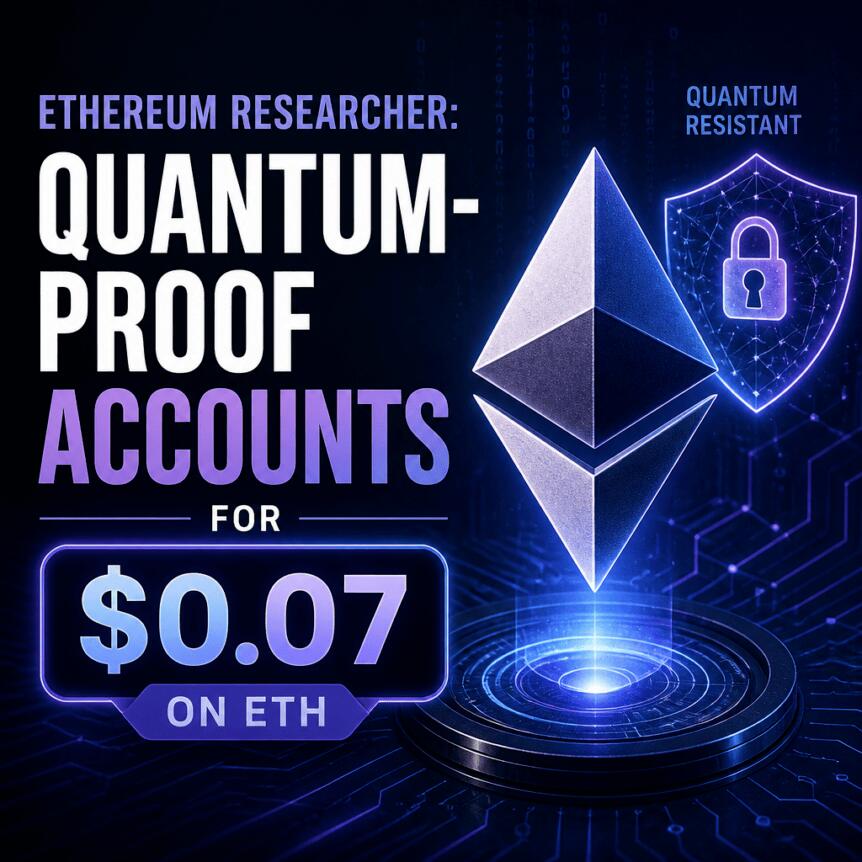
Ethereum researchers are exploring a way to harden user accounts against future quantum-computing threats without waiting for a disruptive network upgrade. According to Ethereum Foundation project lead Nicolas Consigny, the “SPHINCS-” proposal could start delivering post-quantum protections for as little as $0.07 in on-chain verification costs, avoiding the need for a hard fork.
Consigny shared the idea in a Saturday post on X, linking to a technical paper hosted on Ethresear.ch. The work adapts SPHINCS+, a post-quantum signature scheme standardized by the US National Institute of Standards and Technology (NIST), to run more efficiently on Ethereum’s execution environment.
Key takeaways
- Ethereum could add early post-quantum account protections using Consigny’s “SPHINCS-” approach without requiring a hard fork.
- The proposal targets lower on-chain signature verification costs by adapting SPHINCS+ to the EVM more efficiently.
- “SPHINCS-” is positioned as a transitional step toward a future, even more cost-efficient system called “leanSPHINCS.”
- The broader objective is to reduce long-term risk to Ethereum’s current Elliptic Curve Digital Signature Algorithm (ECDSA) once quantum capabilities advance.
A bridge to post-quantum signatures on the EVM
In the X thread, Consigny points to a paper proposing “SPHINCS-,” a variant designed to make SPHINCS+ signatures cheaper to verify on Ethereum. Unlike some migration plans that require protocol changes, the proposal is intended to reduce on-chain verification costs without mandating a protocol update or a dedicated precompile.
That distinction matters for Ethereum users and developers because it aims to make post-quantum readiness possible on a shorter timeline. Hard forks are expensive in governance and coordination, and they introduce additional operational complexity for wallets, contracts, and infrastructure. A solution that can be introduced with fewer low-level changes lowers the practical barrier to moving away from purely ECDSA-based assumptions over time.
The paper’s core framing is that “SPHINCS-” can function as a bridge—a starting point that brings account protections closer to post-quantum security while the ecosystem works toward a longer-term, more optimized signature scheme.
Why Ethereum is looking beyond ECDSA
The quantum concern is straightforward: if sufficiently capable quantum computers become available, the cryptography underpinning today’s elliptic curve signatures becomes vulnerable. The article attributes the motivation directly to the long-term threat posed to Ethereum’s use of the Elliptic Curve Digital Signature Algorithm (ECDSA).
Consigny’s approach is built around the idea that post-quantum signatures should be available before the ecosystem reaches a point where a dedicated hard fork or a full replacement becomes unavoidable. In other words, the proposal is less about “solving quantum tomorrow” and more about narrowing the window of unpreparedness.
For investors and operators, this shifts the discussion from purely theoretical security to migration readiness. Even if timelines for large-scale quantum attacks remain uncertain, the key economic question becomes how quickly the network can reduce reliance on vulnerable primitives.
“leanSPHINCS” and the direction of travel
In describing SPHINCS-, Consigny also highlights a further goal: eventual migration to “leanSPHINCS.” The paper characterizes leanSPHINCS as a future system intended to cut verification costs even more, with the help of signature aggregation.
This matters because signature verification costs are not just a technical detail—they affect how feasible post-quantum security is for everyday transactions. If aggregation reduces the amount of computation or on-chain work required per authorization, it can help move post-quantum schemes from “prototype-ready” to “economically practical.”
At the same time, the bridge approach implies trade-offs: SPHINCS- is designed to improve efficiency now, but it is still framed as an interim step rather than the final end state.
Quantum risk conversations spread across Bitcoin and Ethereum
The Ethereum proposal lands in a broader wave of crypto security discussions about how quantum advancements could impact blockchain cryptography.
Earlier this year, a post-quantum research effort by Project Eleven awarded a prize to Giancarlo Lelli for work involving a quantum computer capable of cracking a 15-bit elliptic-curve key. As the article notes, Bitcoin keys are 256 bits, far larger than the example that was factored. Still, the demonstration used a variant of Shor’s algorithm—a method that is widely discussed in relation to how quantum computers could theoretically threaten certain public-key cryptosystems.
Separate from the experimental headline, blockchain analytics has also tried to quantify exposure. The article cites Glassnode’s estimates that about 1.92 million BTC (nearly 10% of supply) are considered “structurally unsafe” in a future quantum attack scenario, while another 4.12 million BTC (about 20.6%) are classified as “operationally unsafe” due to key or address management practices.
Glassnode also estimated that the remaining 69.8% (or 13.99 million BTC) appears unexposed, broadly aligning with an earlier Ark Invest estimate that 65% of Bitcoin supply was safe. While these classifications don’t eliminate uncertainty around quantum timelines, they show that market participants are treating quantum risk as something that can be managed—at least partially—through operational practices.
For Ethereum, the SPHINCS- proposal can be viewed through the same lens: rather than waiting for an emergency upgrade, developers are exploring mechanisms to reduce long-term cryptographic fragility in advance.
What to watch next is whether Ethereum implementers can validate the proposal’s practical on-chain performance in real execution conditions—particularly whether the claimed low verification cost remains consistent as systems scale—and how the community plans the longer transition toward leanSPHINCS and any eventual broader post-quantum signature rollout.
Ethereum Foundation privacy project Kohaku lead Nico said Ethereum accounts can start preparing for post-quantum risks without waiting for a hard fork.
Summary
- Nico says Ethereum accounts can start quantum protection now without waiting for protocol changes.
- SPHINCS- aims to verify post-quantum signatures on Ethereum at practical on-chain costs for wallets.
- Ethereum’s roadmap already names privacy, security, and post-quantum work as core technical priorities.
In a June 2026 post on X, Nico wrote, “Ethereum can already start preparing accounts for a post quantum world, without waiting for a hard fork.”
The researcher said the current cost would be about $0.07 per account. The claim points to account-level protection, not a full chain upgrade. That means users or wallet teams could add protection through smart contract logic while Ethereum developers keep working on longer-term protocol changes.
SPHINCS- targets low-cost EVM verification
The technical post on Ethereum Research describes SPHINCS-, an EVM-optimized family of stateless post-quantum signatures. The design comes from SPHINCS+ and newer work on compact hash-based signatures. Its goal is to cut on-chain verification cost without using a precompile or changing Ethereum rules.
Nico’s post says a Solidity verifier can already check a post-quantum-style signature on Ethereum at practical cost. One optimized variant, called C13, verifies at about 127,000 gas and uses a 3,704-byte signature. The research also includes a Lean 4 formal proof through Verity.
The problem it tries to solve is simple. Today, Ethereum and Bitcoin accounts rely on ECDSA signatures. Researchers warn that strong future quantum computers could break that type of cryptography. SPHINCS- uses hash-based signatures, which aim to resist those attacks.
Privacy and security remain priorities
Recent crypto.news coverage shows the proposal fits a broader Ethereum roadmap. Vitalik Buterin has discussed account abstraction, which lets wallets define how transactions are approved and paid. Moreover, account abstraction forms part of Ethereum’s short-term privacy plan with FOCIL and keyed nonces.
As previously reported, Buterin said the Ethereum Foundation would focus more tightly on long-term survival, security, privacy, openness, and censorship resistance. That same coverage said Ethereum roadmap work includes post-quantum security and formal verification as future goals.
Moreover, externally owned account signatures using ECDSA are one area exposed to future quantum attacks. For wallets, the report said native account abstraction could let accounts adopt post-quantum signature schemes once efficient options exist.
Audits and limits still matter
Nico said the design has gone through an initial review with Fable, with more audits planned. That review does not make the system final. The Ethereum Research post notes limits, including non-standard settings, bounded signature counts, and a difference between Keccak-based designs and NIST-aligned versions.
For users, the key point is that Ethereum may not need to wait for a full protocol change before wallets begin testing quantum-resistant account protection. For developers, the next steps include more review, safer wallet flows, clearer cost models, and better hardware support.
The account path matters because many funds sit in old-style addresses. A wallet-based route could let high-value accounts test protection before Ethereum adopts broader changes through later technical upgrades, proposal rounds, and wider public review.
The proposal does not mean Ethereum faces an immediate quantum attack. It also does not replace future network-level work. It does show that account-level defenses can move from research into testing today, at a cost that Nico says is low enough for wide trials.
TLDR:
- The SEC approved NYSE Arca’s rule change on June 12 to list the T. Rowe Price Active Crypto ETF
- The fund holds 5 to 15 digital assets including BTC, ETH, SOL, XRP, SHIB, DOGE, and SUI.
- Unlike spot ETFs, the fund actively targets outperformance of the FTSE Crypto US Listed Index.
- Spot XRP ETFs have already attracted $1.44 billion in inflows following their market debut.
The T. Rowe Price Active Crypto ETF has received SEC approval to list on NYSE Arca. The decision, issued on June 12, marks a new chapter in multi-asset crypto investment products.
The fund will hold between 5 and 15 digital assets, targeting long-term capital growth. It is benchmarked against the FTSE Crypto US Listed Index and aims to outperform it through active management.
SEC Clears Multi-Asset Fund With Broad Crypto Exposure
The T. Rowe Price Active Crypto ETF is structured under NYSE Arca’s Commodity Based Trust Shares framework. The SEC approved the exchange’s rule change proposal, allowing the fund to be listed and traded publicly. This approval follows a broader trend of regulators clearing diverse crypto investment vehicles.
The fund’s eligible assets span across the largest digital asset classes. These include Bitcoin, Ether, Solana, XRP, and Cardano.
Additional holdings may include Avalanche, Litecoin, Polkadot, Dogecoin, and Chainlink. Stellar, Hedera, Bitcoin Cash, Shiba Inu, and Sui are also on the eligible assets list.
Unlike single-asset spot ETFs, this product offers diversified exposure across multiple digital assets. Portfolio managers will actively rebalance holdings to pursue returns above the benchmark index. The fund uses delayed disclosures as part of its active management strategy.
The SEC noted that the proposal aligns with the Securities Exchange Act. Additional safeguards against market manipulation have been built into the structure.
The exchange will also implement enhanced firewall protections and trading halt features specific to actively managed products.
Active Management Sets It Apart From Spot ETF Products
The T. Rowe Price Active Crypto ETF differs from conventional spot ETFs in a fundamental way. Spot ETFs track a single asset passively, while this fund actively manages a basket of assets. The goal is to outperform its index, not simply mirror it.
Multi-asset products reduce concentration risk compared to single-token ETFs. Spreading exposure across 5 to 15 assets provides a buffer against sharp moves in any one coin. This structure appeals to investors seeking measured crypto exposure within a regulated wrapper.
The approval arrives as other asset managers accelerate their own crypto ETF filings. BlackRock recently submitted a Form 8-A for its Bitcoin Premium Income ETF. Analysts widely interpret that filing as a signal of an imminent launch within days.
XRP holders responded positively to news of the token’s inclusion in the fund. Spot XRP ETFs have already drawn $1.44 billion in inflows since their launch. Ripple’s CEO has separately projected the company could reach $1 billion in annual revenue before year-end.


Robert Kiyosaki has again urged followers to move away from cash and into hard assets.
Summary
- Robert Kiyosaki renewed his cash warning while promoting gold, silver, Bitcoin, and Ethereum as alternative assets.
- Bitcoin and Ethereum remain under pressure after June’s selloff, ETF outflows, and broader macro stress.
- Market attention continues to rise on growing fear, but stronger demand still requires confirmation from sustained buying activity.
In a June 13 post on X, the Rich Dad Poor Dad author asked how much a trillion dollars is, then used the answer to attack dollar savings.
Kiyosaki wrote that “cash is trash” and said savers of dollars lose purchasing power. He told followers to consider gold, silver, Bitcoin, and Ethereum. His post framed the U.S. dollar as vulnerable because, in his view, the Federal Reserve and U.S. Treasury can create money quickly.
His trillion-dollar example also served as a simple visual for readers. By comparing one dollar per minute with the creation of new money, Kiyosaki tried to make a large number feel personal. The post did not include a detailed investment plan. It focused on the idea that cash loses value when supply expands. That framing matches his usual criticism of fiat money. It also fits his asset-focused brand publicly online.
Bitcoin and Ethereum remain under pressure
The warning arrived during a weak period for crypto markets. Bitcoin traded near $64,569 on June 14, while Ethereum traded near $1,674, according to market data. Both assets remained far below their 2025 cycle highs after a sharp June selloff.
As previously reported by crypto.news, the June crypto crash came from several pressures at once. The report cited a hawkish Federal Reserve, U.S.-Iran tensions, ETF outflows, and a leverage unwind. Bitcoin fell from above $80,000 to below $62,000 during that period, while Ethereum moved toward $1,500.
Gold and Bitcoin split safe-haven debate
Kiyosaki has often grouped gold, silver, and Bitcoin as alternatives to fiat money. His latest post also added Ethereum to that list. The argument fits his long-running view that inflation and monetary expansion reduce the value of cash savings over time.
Crypto.news has also tracked the changing relationship between Bitcoin and gold. In May, crypto.news reported that Bitcoin had outperformed gold by roughly 35% to 36% on a relative basis since the start of the 2026 Iran conflict. That report said Bitcoin acted more like a risk-sensitive alternative store of value than a classic crisis hedge.
Market stress keeps investors cautious
Recent fund flows still show caution. As previously reported, U.S.-listed spot Bitcoin ETFs recorded 13 straight trading days of net outflows from May 15 through June 3. About $4.37 billion left the products during that streak.
Ethereum also faced pressure from weak demand. As crypto.news reported on June 12, spot Ethereum ETFs lost $15.89 million on June 11, extending outflows for three sessions. ETH traded near $1,652 at that time as geopolitical risk and weak technical structure kept buyers cautious.
Kiyosaki’s post adds a familiar voice to the wider debate over cash, inflation, and scarce assets. It does not change the short-term market setup. Bitcoin and Ethereum still need stronger demand, calmer macro conditions, and better fund flows to confirm a steadier recovery.


Strategy CEO Phong Le said the company’s 32 BTC sale was a test of its process and not a sign that the firm needed cash for dividends.
Summary
- Phong Le said Strategy’s 32 BTC sale tested internal systems, not a dividend funding need.
- Strategy still bought 1,550 BTC afterward, lifting total holdings to 845,256 Bitcoin by June 7.
- Saylor’s CEBE BPS metric shifts investor focus toward debt, preferred stock and common shareholder risk.
In a June 13 interview, Le said the sale helped “inoculate the market” and gave Strategy a way to check how an internal Bitcoin sale would work.
The company sold 32 Bitcoin between May 26 and May 31 for about $2.5 million, according to its SEC filing. The average sale price was $77,135 per BTC. The filing said proceeds were expected to fund preferred stock distributions, which led some investors to question whether Strategy might need to sell more Bitcoin later.
Strategy says sale not tied to dividend pressure
Le pushed back on that reading. He said Strategy did not sell Bitcoin because it needed to meet cash dividend obligations. He said the company still has other funding channels, including equity and preferred stock tools, to support its capital structure.
He also said the sale created tax losses that may offset related taxes in future periods. The point, according to Le, was to test the process, reduce market shock around the idea of selling, and keep the company ready if a small sale later benefits common shareholders.
The CEO said Strategy would use math over ideology when choosing between selling Bitcoin and issuing stock. If a Bitcoin sale improves Bitcoin per share for common holders, the company may choose that path. If share issuance works better, it can use that route instead.
Forced selling remains an edge case
Le also addressed the chance of a forced Bitcoin sale. He said the most realistic case would involve about $3.5 billion of preferred obligations due in 2028. If Bitcoin fell sharply and Strategy’s share price stayed weak, the company could sell Bitcoin to meet those obligations.
Le described that outcome as an “edge case.” He said Strategy could also refinance or convert those obligations into equity. That means a Bitcoin sale is not the only available path if market conditions worsen.
As previously reported by crypto.news, Strategy bought 1,550 BTC for about $101.3 million between June 1 and June 7 after the 32 BTC sale. The purchase lifted its total holdings to 845,256 BTC. Strategy also raised its U.S. dollar reserve to $1 billion.
Saylor metric puts risk in focus
The debate comes as Michael Saylor has tried to clarify how investors should measure Strategy’s Bitcoin exposure. Earlier today, crypto.news reported that Saylor said Bitcoin Per Share tracks common equity growth, while Common Equity Bitcoin Exposure BPS, or CEBE BPS, tracks Bitcoin exposure after debt and preferred stock claims.
Saylor said CEBE BPS is the conservative risk metric. That matters because Strategy’s Bitcoin model now includes debt, preferred stock and dividend costs. The gap between Bitcoin per share and CEBE BPS can widen when senior claims grow.
TLDR:
- CoinFund’s Brukhman says Anthropic’s export control compliance confirmed AI models are the biggest target for government control.
- Distributed GPU compute already exists to train frontier AI models, but new algorithms are needed to make decentralized use viable.
- Teams like Gensyn, Prime Intellect, and Pluralis are proving that distributed AI training is feasible and cost-competitive.
- Pluralis proposes tokenizing AI model weights among participants to create a sustainable business model for decentralized AI.
Decentralized AI could serve as a critical counterweight to growing government control over artificial intelligence models.
CoinFund founder Jake Brukhman made this argument following Anthropic’s compliance with U.S. AI export controls. He warned that centralized AI development poses increasing risks of unilateral censorship.
Brukhman pointed to distributed GPU networks and open decentralized systems as viable alternatives. His comments have reignited debate about the future governance of frontier AI models.
Brukhman Links Anthropic’s Export Control Move to Centralization Risk
Jake Brukhman has been tracking the intersection of AI and decentralized networks since 2020. He argues that AI models are, by nature, a centralizing force in the technology landscape. Anthropic’s compliance with U.S. export controls, he says, confirmed what many in the space already suspected.
In a post on X, Brukhman wrote that the development became “market fact” overnight. He framed it as a turning point for how the industry should think about AI governance. His concern centers on the risk that AI could fall under unilateral state control.
Brukhman noted that commodity GPU compute already exists in sufficient quantity to support frontier model training.
The barrier, he argues, is not availability of hardware but rather the algorithms needed to use it efficiently. Several research teams are now addressing that exact problem.
He cited Gensyn, Prime Intellect, Bagel, Pluralis, Nous Research, Macrocosmos, and Covenant AI as teams working on distributed training.
Their research, he said, was once widely dismissed as impossible. Today, it shows that distributed training is not only feasible but can be cost-competitive with centralized approaches.
Tokenized AI Models Emerge as a Potential Business Model
Open source AI models have gained wide adoption, yet they face a persistent challenge around economic sustainability.
Without a viable business model, open models struggle to attract long-term investment and development resources. Brukhman acknowledged this gap directly in his commentary.
Among the teams he cited, only Pluralis has proposed a concrete solution to this problem. The approach involves splitting model weights among network participants through a tokenized structure. This creates a financial incentive for contributors while maintaining decentralized control of the model.
The tokenized model structure means no single entity holds full control over the AI system. Participants share ownership of the weights, making unilateral censorship or control significantly harder to execute. Brukhman sees this as a foundational step toward economically sustainable decentralized AI.
Brukhman closed his argument with a direct question to the broader industry. He asked whether AI would become fully centralized under government oversight or whether public, open networks would prevail.
The answer, he suggested, depends on whether the industry acts on the momentum now building in decentralized AI research.

World Cup kicks off with empty seat for French journalist detained in Algeria

How To Watch Four Live Sports Feeds At Once

Roast potatoes will be ‘extra crispy’ and delicious if 1 easy step is done before boiling

BloFin War of Whales 2026 Grand Prix opens registration for $5M trading championship

Blockchain.com files with SEC for U.S. IPO

Israel says it has killed new Hamas military leader in Gaza City airstrikes

JUST HOURS LEFT XRP HOLDERS!!! BIG NEWS

2008 Financial Crisis Explained: How Wall Street’s Greed Crashed the World | Fool’s Gold

#money #millionaire #millionaire #millionairemindsetunlimited #millionairesworldwide #motivation #mi
-

 NewsBeat7 days ago
Alexander Zverev wins the French Open to finally earn a 1st Grand Slam title
-

 Crypto World6 days ago
Anatomy of the June crypto crash: Fed, Iran, Saylor
-

 Crypto World3 days ago
Oppenheimer backs SpaceX as $70 billion retail frenzy builds
-
 NewsBeat7 days ago
Alexander Zverev conquers demons and outlasts Flavio Cobolli to win French Open for first major title
-

 Crypto World3 days ago
Markets Rally as SpaceX IPO Looms Amid Iran Tensions and Inflation Surge
-

 Business6 days ago
High Stakes for Wembanyama as New York Pushes for 3-0 Lead
-

 Sports6 days ago
FIFA WC 2026 Group C: Morocco, Scotland challenge Brazil’s hunt for glory | FIFA World Cup 2022
-

 Tech7 days ago
Notion restores access to Anthropic after service disruption
-
 Crypto World6 days ago
Eli Lilly (LLY) Stock Surges 4% Following Breakthrough Sleep Apnea Trial Results
-
 Sports5 days ago
Bangladesh beat Australia after 20 years in ODIs, register only their second win over six-time world champions | Cricket News
-

 Fashion2 days ago
Weekend Open Thread: Tuckernuck – Corporette.com
-

 Tech2 days ago
NanoClaw integrates JFrog registries to secure AI agent downloads
-

 Crypto World1 day ago
Bitget enters Argentina’s regulated crypto market through PSAV registration
-

 Tech2 days ago
This Week In Security: Microsoft On Microsoft, Register Your Domains, Linux On ARM, And FreeBSD Joins The File Cache Club
-

 Politics3 days ago
Politics Home | Healey Resignation Is “Colossal Failure Of Government”, Says Former Labour Defence Secretary
-

 Sports3 days ago
First Time Since 1971: Australia Register Historic Low In ODI Cricket
-
 Entertainment3 days ago
Donnie Wahlberg & More Heat Up Las Vegas at Circa’s Barry’s Downtown Prime
-

 Entertainment5 days ago
The Ryan Gosling True Crime Thriller On Netflix That Gets Even Stranger, Stream It Now
-

 Tech4 days ago
‘This is Seattle’s position on AI’: City Council votes unanimously to pause big new data centers
-
 Tech3 days ago
Opendoor Ends India Operations, Fueling a Bigger Conversation About AI and Outsourcing
You must be logged in to post a comment Login