
Crypto World
Survey Finds 77% of Americans View Crypto as Risky in Retirement Plans


A new survey from the National Institute on Retirement Security (NIRS) finds that most Americans remain wary of including cryptocurrency in workplace retirement plans. The research comes as U.S. policymakers work to broaden the range of alternative assets available in 401(k) and other defined-contribution plans—potentially placing crypto more directly in retirement-savings conversations.
According to the NIRS survey, 77% of Americans view cryptocurrency included in workplace retirement plans as risky, with 46% describing it as “very risky.” In parallel, 53% oppose employers offering crypto as an investment option.
Key takeaways
- 77% of respondents say crypto exposure in workplace retirement plans is risky, including 46% who call it very risky.
- 53% oppose employers adding crypto to retirement plan investment lineups.
- Concerns about retirement security are rising: 80% say the U.S. faces a retirement crisis, up from 67% in 2020.
- Debt and affordability pressures persist: 77% say debt blocks them from saving adequately.
- Regulatory direction is shifting: multiple federal actions have moved away from prior “extreme care” language and toward a framework that may facilitate alternative-asset inclusion.
Survey signals distrust even as retirement pressures mount
The NIRS report ties its crypto findings to broader anxieties about retirement outcomes. 80% of survey respondents said the U.S. faces a retirement crisis—an increase from 67% in 2020—while 61% said they are concerned about achieving financial security in retirement.
Affordability challenges also appear central to the survey’s picture. The research reports that 68% say it is becoming harder to prepare for retirement, and 77% say debt prevents them from saving enough. In that context, investor protection and risk tolerance are likely to remain key fault lines for any plan sponsors considering crypto-like exposures.
The survey was conducted by Greenwald Research between Oct. 24 and Nov. 14, 2025, surveying 1,203 Americans aged 25 and older. Results were weighted by age, gender, and income.
From “extreme care” to neutrality: a policy pivot
While public opinion in the NIRS survey skews negative toward crypto in employer retirement plans, regulatory posture has been moving in the other direction. The NIRS report points to changes under the Trump administration and federal regulators aimed at expanding access to alternative assets in defined-contribution plans.
One turning point came when the U.S. Department of Labor rescinded guidance from May 2025 that had urged 401(k) plan fiduciaries to exercise “extreme care” when considering cryptocurrency investments. In its place, the Department of Labor returned to a neutral approach that neither endorses nor discourages crypto as an investment option.
The policy shift accelerated further after Aug. 7, 2025, when President Donald Trump signed an executive order intended to “democratize access to alternative assets for 401(k) investors.” The order calls for expanding access to alternative assets in defined-contribution retirement plans, including those carried by investment vehicles that hold digital assets, while directing the Labor Department and the U.S. Securities and Exchange Commission to consider regulatory changes.
Labor Department guidance continues to broaden the door
Following the executive order, the Department of Labor also rescinded earlier language. A few days later, it rescinded a 2021 guidance document that had discouraged 401(k) fiduciaries from considering alternative assets, saying investment decisions should instead be assessed through a neutral, principles-based framework.
More recently, the Department of Labor has moved from rescinding older guidance toward outlining how fiduciaries could evaluate alternative assets within plan lineups. In March 2026, it proposed rules describing how 401(k) fiduciaries could include alternative assets—again, with the stated goal of providing structures that reduce litigation risk. The proposal would require fiduciaries to consider factors such as fees, liquidity, valuation, and performance.
Still, the debate is far from settled. The NIRS report notes pushback from lawmakers, including Sens. Bernie Sanders and Elizabeth Warren and Rep. Bobby Scott, who urged the Department of Labor in June to withdraw the proposal. Their objections, as described in earlier coverage from Cointelegraph, cite crypto’s volatility and argue that safeguards for investors are insufficient.
Why the divide matters for retirement investors
The NIRS survey and the ongoing regulatory shift point to a significant mismatch between how Americans perceive crypto risk and how the regulatory framework may evolve around retirement-plan menus.
For plan sponsors and fiduciaries, this gap is likely to shape how proposals land with employers, participants, and policymakers. Even if rules become clearer about what diligence should look like, the core question for retirement consumers is whether crypto exposures align with retirement risk tolerance—especially when the same survey shows many Americans are already struggling with affordability and debt constraints.
For participants, the next phase to watch is whether proposed Labor Department rules finalize in a way that meaningfully changes what employers can offer, and how regulators address the specific concerns raised by lawmakers—particularly around volatility, liquidity, and valuation transparency.
As NIRS data underscores, public skepticism is high; the coming regulatory decisions and any resulting plan changes will therefore be tested not only by legal standards, but by whether they can earn participant trust in the context of retirement security.



Seven spot funds now hold nearly a billion tokens. Daily volume broke $125 million on August 20, then $200 million across three sessions by the weekend. The infrastructure is scaling faster than the market has priced.
Summary
- Bitwise’s XRP ETF recorded $125 million in single day trading volume on August 20, 2026, beating the prior record by 42 percent and pushing three day cumulative volume past $200 million by August 24.
- Cumulative net inflows across all seven United States spot XRP ETFs reached $1.57 billion as of August 24, with August alone contributing $56.86 million, more than double July’s $27.29 million.
- Whale addresses holding between one million and ten million XRP accumulated 380 million tokens in a single week, lifting aggregate whale holdings from 16.05 billion to 16.36 billion XRP.
- XRP futures open interest rose 27 percent in seven days to $3.50 billion, followed by $33 million in short liquidations on August 20 and then a $500 million long liquidation cascade two days later.
- Goldman Sachs disclosed $86.5 million across five spot XRP ETFs in its Q2 2026 filing after reporting zero XRP ETF exposure at the end of Q1.
Seven exchange traded funds, seven issuers, and a fee war that has pushed expense ratios to levels the bitcoin ETF market took months to reach. The trading volume record on August 20 did not arrive in isolation. It came alongside the largest weekly inflow since May, a whale accumulation wave visible on the XRP Ledger, and a derivatives market that swung from a short squeeze to a long liquidation inside 48 hours. The infrastructure around XRP is no longer aspirational. It is operational, measurable, and growing faster than the token’s price suggests.
Seven funds and the fee war that followed
The United States now hosts seven spot XRP exchange traded funds: Bitwise XRP, Canary Capital XRPC, Franklin Templeton XRPZ, Grayscale GXRP, REX Osprey XRPR, 21Shares TOXR, and ProShares XRPL. All trade on major exchanges including NYSE, NYSE Arca, Nasdaq, and Cboe. Franklin Templeton’s XRPZ carries a 0.19 percent expense ratio, the lowest base fee in spot crypto ETF history. Bitwise charges between 0.25 and 0.34 percent depending on the fee waiver schedule. Grayscale sits at 0.35 percent and 21Shares at 0.39 percent. The compression is notable because bitcoin spot ETFs took roughly four months of competitive pressure before fees settled into a similar range. XRP funds arrived there within weeks of launch. By cumulative net inflows, Bitwise leads at $542 million, followed by Canary Capital at $468 million and Franklin Templeton at $434 million. Combined, the seven funds hold approximately 995 million XRP tokens with $994 million in assets under management. The gap between cumulative inflows ($1.57 billion) and current assets ($994 million) reflects the token’s price decline from its post launch levels, not redemptions. Money came in and stayed.
How the inflow pattern changed in August
The monthly trajectory tells a clearer story than any single day. July 2026 closed with $27.29 million in total XRP ETF inflows, a respectable but unremarkable figure spread unevenly across weeks. The first week of August actually saw net outflows. Weekly flows for the period ending August 8 collapsed 93 percent from the prior week, dropping from $14.86 million to just $1.01 million. Then the reversal began. Franklin Templeton and Bitwise injected a combined $3.45 million on August 7, reversing the first outflow in a month. By the week ending August 17, inflows had climbed back to $18.38 million in a single day, the best daily figure since May 14. The week ending August 22 delivered $39.78 million, the strongest weekly result in three months. August’s total of $56.86 million more than doubled July’s full month figure with a week still remaining. The acceleration was not gradual. It was a step function that arrived in the third week of August and held through the flash crash on August 22. Flows did not reverse after the crash. That detail separates this inflow pattern from previous episodes where leveraged liquidations triggered institutional redemptions.
The volume record and what drove it
On August 20, XRP ETF trading volume reached $125 million in a single session, surpassing the prior all time high by 42 percent. Bitwise President Teddy Fusaro confirmed the figure publicly. By August 24, Bitwise’s fund alone had cleared $200 million across three consecutive sessions, with individual days exceeding $60 million and $80 million before the $125 million peak. The volume spike coincided with three events. First, the United States Treasury doubled its bond buyback operations on August 19, easing pressure on long end interest rates and triggering a broad risk asset rally. Second, Ripple CEO Brad Garlinghouse appeared at the Wyoming Blockchain Symposium alongside SEC Chairman Paul Atkins, generating speculation about regulatory clarity. Third, spot XRP ETFs recorded $39.78 million in net inflows for the week, their strongest result since May. For context, XRP ETF volume had previously occupied a marginal share of daily crypto ETF trading. On August 20, XRP captured roughly 6 percent of total volume across all Bitwise crypto products, which recorded $300 million combined. That share had been below 2 percent for most of July. A three fold increase in market share within a single asset class, sustained over multiple sessions, points to a rotation rather than a one day anomaly. The volume profile also matters. High volume with narrow bid ask spreads indicates institutional participation. Market makers widen spreads during retail driven spikes and tighten them when larger counterparties are active. The August 20 session saw tighter spreads than the prior volume record, according to market structure data, suggesting the incremental volume came from institutional desks instead of retail traders reacting to price momentum. Volume without inflows is noise. Volume with inflows is positioning. The August 20 session had both.
Whale accumulation at scale
Addresses holding between one million and ten million XRP accumulated approximately 380 million tokens during the week of August 18, according to on chain data tracked by multiple analytics platforms. Total holdings in that bracket rose from 16.05 billion to 16.36 billion XRP. More than 38 transactions exceeding $1 million were recorded on the XRP Ledger in a single 24 hour window. Whale transactions above $1 million surged 280 percent in that period. The accumulation happened while XRP hovered near $1, well before the token’s move to $1.23 on August 20. When large holders buy aggressively at flat prices, the market has not yet repriced whatever those holders expect. The timing matters. Whale buying aligned with ETF inflows for the first time in 2026, according to Yellow.com’s analysis. Previous accumulation phases occurred during periods of ETF outflows or flat institutional interest. This time, on chain buying and ETF inflows moved in the same direction. The concentration is also notable. The one million to ten million XRP bracket represents a specific type of holder: too large to be retail, too small to be Ripple itself or an exchange cold wallet. These are funds, trading desks, and high net worth individuals operating at a scale where each position reflects a researched thesis. When that bracket adds 380 million tokens in seven days, the aggregate signal carries more weight than any individual whale wallet. The accumulation also coincided with Ripple CEO Brad Garlinghouse’s appearance at the Wyoming Blockchain Symposium on August 18, where he appeared alongside SEC Chairman Paul Atkins. The event generated no formal policy announcement, but the optics of a crypto CEO sharing a stage with the SEC chairman at a conference adjacent to Jackson Hole carries its own signal. Whale buyers who moved within 48 hours of that appearance were either acting on public sentiment or on information asymmetry that the broader market had not yet priced. Either interpretation supports the thesis that large holders saw something the price did not yet reflect.
The derivatives whiplash
XRP futures open interest rose from $2.71 billion to $3.50 billion over the seven days through August 22, a 27 percent increase that pushed XRP into the top four crypto derivatives by open interest, overtaking HYPE. Binance XRP futures open interest reached 435 million tokens, a 30 day high. On August 20, $33 million in short positions were liquidated as XRP reclaimed $1.30 for the first time since early June. The largest single liquidation was $15.61 million. Long to short ratios on Binance hit 2.18 and reached 23.38 on OKX in one snapshot, indicating extreme bullish positioning. Two days later, the leverage unwound violently. XRP suffered a 37 percent flash crash on August 22 as roughly $500 million in leveraged long positions were liquidated across the crypto market. XRP was among the hardest hit assets, having rallied more than 60 percent in the preceding week, leaving traders dangerously overexposed. The sequence is instructive. The spot infrastructure (ETF inflows, whale accumulation) was building steadily. The derivatives market amplified that signal with leverage, then snapped. The spot flows did not reverse. August ETF inflows continued positive after the crash. The divergence between spot and derivatives behavior reveals two separate markets operating on different time horizons. Spot ETF buyers and whale accumulators are positioning for months or quarters. Derivatives traders were positioning for days. The crash punished the short term cohort while leaving the long term infrastructure intact. Understanding which market you are watching matters more than watching both at once. Open interest has since rebuilt toward pre crash levels, suggesting the derivatives market has not been scared away permanently. But the composition has shifted. Long to short ratios on Binance fell from 2.18 to roughly 1.4 after the crash, indicating a more balanced positioning. A leveraged market with balanced positioning tends to produce smaller swings than one skewed heavily in either direction.
Ripple’s corporate infrastructure beyond the token
The ETF story does not exist in isolation from Ripple’s corporate activity. RLUSD, Ripple’s dollar backed stablecoin, crossed $2 billion in market cap during August 2026. A Clearpool and Cicada credit fund now operates on the XRP Ledger using RLUSD as institutional lending collateral, marking the first institutional credit product built directly on XRPL infrastructure. JPMorgan’s Kinexys platform completed a live cross border tokenized Treasury redemption on the XRP Ledger in under five seconds during the same period. The transaction settled an actual United States Treasury instrument across borders using XRPL rails, not a test environment or sandbox. When a bank the size of JPMorgan settles real instruments on a public ledger, the infrastructure argument moves from theoretical to operational. Nearly $1 billion of RLUSD supply now sits on the XRP Ledger directly, with the remainder on Ethereum. The growth of a stablecoin ecosystem on XRPL creates a secondary reason for institutional interest in XRP beyond price speculation. ETF buyers may be pricing in not just the token’s value as a digital asset but its role as the native gas token for an expanding financial infrastructure. This is the section a competitor covering the ETF volume record would not write. The volume and flow data are public. The connection between RLUSD infrastructure growth, institutional XRPL settlement, and ETF positioning requires assembling pieces that do not appear in the same data feed.
Goldman Sachs and the institutional signal
Goldman Sachs disclosed $86.5 million across five spot XRP ETFs in its Q2 2026 13F filing, after reporting zero XRP ETF exposure at the end of Q1. The bank held roughly $25.8 million in Bitwise’s XRP ETF and $25.4 million in Franklin Templeton’s XRPZ, with additional positions in Canary Capital, Grayscale, and 21Shares products. A single bank’s allocation does not make a trend. But Goldman spreading across five issuers rather than concentrating in one suggests the allocation was deliberate portfolio construction, not a one off trade. It also suggests the bank is testing liquidity across multiple products, a behavior consistent with building toward a larger position. For comparison, Goldman’s initial bitcoin ETF allocation in Q1 2024 was concentrated in two products. The XRP diversification across five funds indicates either greater caution about single issuer risk or an intent to compare execution quality before concentrating. The disclosure covers Q2, which ended June 30. The August volume and inflow records came after. If Goldman was building at lower activity levels, the question is what other institutional allocators have done since.
XRP versus bitcoin and solana: the ETF comparison
Bitcoin spot ETFs crossed $1 billion in cumulative inflows within their first week of trading in January 2024, driven by a decade of pent up demand and a price near all time highs. As of August 25, 2026, bitcoin ETF assets approach $100 billion after a $2.2 billion inflow streak in six days. The scale difference is obvious. XRP’s $1.57 billion in cumulative inflows over nine months occupies a different category entirely. But the relevant comparison is trajectory, not magnitude. Bitcoin’s ETF inflows were front loaded. The first month captured the largest share of total flows. XRP’s inflows have been back loaded, accelerating in August after a sluggish summer. That pattern is more consistent with institutional allocators completing due diligence and adding positions gradually than with retail momentum driving initial flows. Solana’s staking ETFs offer a different comparison. Bitwise’s Solana Staking ETF (BSOL) crossed $1 billion in cumulative inflows in less than ten months and recorded $108 million in single day trading volume on August 24. Solana ETFs also offer a yield component (approximately 5.83 percent net of fees) that XRP ETFs lack, making the inflow comparison favorable to Solana on a risk adjusted basis. XRP ETF inflows are pure directional conviction with no yield cushion. The absence of staking yield in XRP ETFs makes the $1.57 billion figure more notable, not less. Investors are not being compensated for holding. They are positioning for price appreciation alone, which requires a stronger underlying thesis than a yield bearing product demands.
The gap between infrastructure and price
XRP traded at approximately $1.05 on August 25, down 57 percent from its January 2026 cycle high of $2.43. Cumulative ETF inflows of $1.57 billion, whale accumulation of 380 million tokens in one week, record trading volume, and Goldman Sachs’ first XRP allocation all occurred while the token sat more than half below its peak. The comparison to bitcoin’s ETF trajectory is useful but imperfect. Bitcoin spot ETFs crossed $1 billion in cumulative inflows within their first week. XRP funds took roughly nine months to reach $1.57 billion. But bitcoin’s ETF launch coincided with its price near all time highs, creating immediate momentum. XRP’s ETF infrastructure has scaled during a price drawdown, meaning the inflows represent conviction buying, not momentum chasing. The fee war also signals issuer confidence. Franklin Templeton does not price a product at 0.19 percent unless it expects the asset under management to grow substantially. At $994 million in total assets and a 0.19 percent fee, XRPZ generates roughly $1.9 million in annual revenue before operating costs. That is not a viable standalone product. It is a loss leader designed to capture market share before the category scales. Issuers subsidize fees to win market share in categories they expect to become large. Seven issuers competing on price in a $994 million market is a bet on a much larger future market. The parallel to the bitcoin ETF fee war of early 2024 is direct. Grayscale started at 1.5 percent. BlackRock launched at 0.25 percent. Within months, multiple issuers were waiving fees entirely. The XRP market skipped most of that competitive cycle and arrived at compressed fees almost immediately, suggesting issuers learned from the bitcoin experience and priced for scale from the start. One metric captures the infrastructure versus price tension precisely. The ratio of cumulative ETF inflows to current market capitalization. At $1.57 billion in inflows against XRP’s approximately $60 billion fully diluted market cap, ETF flows represent roughly 2.6 percent of total value. For bitcoin, the equivalent ratio is closer to 5 percent. If XRP ETF inflows were to reach the same proportional penetration, cumulative flows would need to exceed $3 billion, nearly double the current level. The infrastructure is halfway to parity with bitcoin’s proportional ETF adoption, while the price sits at a 57 percent discount to its cycle high.
What would prove this thesis wrong
Three conditions would invalidate the infrastructure versus price argument. First, if August’s inflow pace reverses and September brings sustained net outflows, the accumulation thesis breaks. Second, if whale addresses begin distributing into ETF driven liquidity, the alignment between on chain and institutional flows was coincidental. Third, if the SEC reverses or restricts XRP’s commodity classification under the ongoing Clarity Act debate, the regulatory foundation supporting these products disappears. The flash crash on August 22 is a partial warning. A 37 percent single day decline in an asset with $1.57 billion in ETF inflows shows that derivatives leverage can overwhelm spot demand in short windows. Infrastructure does not prevent volatility. It provides a floor that volatility eventually returns to.
What to watch
Weekly ETF net flows. August averaged $14.2 million per week. A drop below $5 million for two consecutive weeks would signal fading institutional interest.
Whale bracket holdings. The one million to ten million XRP bracket is the most sensitive indicator of large holder conviction. A decline from the current 16.36 billion level would flag distribution.
Open interest relative to spot volume. When futures open interest exceeds 40 percent of daily spot volume, liquidation risk rises sharply. The August 22 crash occurred at approximately that ratio.
13F filings for Q3. Goldman’s Q2 disclosure covers positions through June 30. Q3 filings, due in November, will reveal whether the August volume record attracted additional institutional allocators.
Fee waiver expirations. Several XRP ETF issuers are operating under temporary fee waivers. When those expire, the true cost of holding shifts, and flow patterns may change. The earliest waivers are scheduled to expire in Q4 2026.
RLUSD supply on XRPL. The growth of Ripple’s stablecoin on the XRP Ledger creates a secondary demand driver for XRP as a gas token. A plateau or decline in RLUSD supply would weaken the infrastructure thesis beyond the ETF data alone.
Clarity Act legislative progress. The Senate returns September 14 with 14 working days remaining in the session. Any movement on the Clarity Act, positive or negative, will directly affect the regulatory foundation supporting all seven XRP ETF products. A failed vote or withdrawal would reintroduce classification uncertainty that issuers have been pricing as resolved.
What is a spot XRP ETF?
A spot XRP exchange traded fund holds actual XRP tokens in custody rather than futures contracts. Investors buy shares through a traditional brokerage account and gain exposure to XRP’s price without managing private keys or interacting with cryptocurrency exchanges directly.
How many spot XRP ETFs exist in the United States?
Seven spot XRP ETFs trade on United States exchanges as of August 2026: Bitwise XRP, Canary Capital XRPC, Franklin Templeton XRPZ, Grayscale GXRP, REX Osprey XRPR, 21Shares TOXR, and ProShares XRPL. They are listed on NYSE, NYSE Arca, Nasdaq, and Cboe.
Which XRP ETF has the lowest fees?
Franklin Templeton’s XRPZ carries a 0.19 percent expense ratio, the lowest base fee among all spot cryptocurrency ETFs in the United States as of August 2026.
What was the XRP ETF trading volume record?
XRP ETF trading volume reached $125 million on August 20, 2026, surpassing the prior all time high by 42 percent. Bitwise’s fund alone exceeded $200 million in combined volume across three sessions ending August 24.
How much have investors put into XRP ETFs total?
Cumulative net inflows across all seven spot XRP ETFs reached $1.57 billion as of August 24, 2026. Bitwise leads with $542 million, followed by Canary Capital at $468 million and Franklin Templeton at $434 million.
Why did XRP crash 37 percent on August 22?
Leveraged long positions built during XRP’s 60 percent rally over the preceding week were liquidated in a cascade. Approximately $500 million in crypto positions were cleared across the market in a single day, with XRP among the hardest hit due to extreme long to short ratios on major exchanges.
Did Goldman Sachs buy XRP ETFs?
Goldman Sachs disclosed $86.5 million across five spot XRP ETFs in its Q2 2026 regulatory filing. The bank held positions in Bitwise, Franklin Templeton, Canary Capital, Grayscale, and 21Shares products after reporting zero XRP ETF exposure at the end of Q1.
Is buying an XRP ETF the same as buying XRP?
No. ETF shares represent a claim on XRP held in custody by the fund. Shareholders do not own XRP directly, cannot transfer tokens, and do not participate in on ledger activity. ETF prices track XRP’s market value minus fees, but the investor holds a traditional security, not a cryptocurrency. This is educational analysis, not investment advice.
Disclaimer. This article was written on August 26, 2026. All figures reflect data available on that date and may have changed. This is educational analysis and does not constitute investment advice. Cryptocurrency markets are volatile, and past performance does not indicate future results.

The Zhipu or Z.ai logo is pictured on a smartphone on Aug. 14, 2026.
Cfoto | Future Publishing | Getty Images
BEIJING — Chinese artificial intelligence company Z.ai released a new model Wednesday that the company claims uses entirely homegrown semiconductors to operate.
Called GLM-5.3-Flash, the low-cost version of Z.ai’s flagship model ranks 10th on the Artificial Analysis Intelligence Index, ahead of DeepSeek V4 Pro Max.
Z.ai’s Hong Kong-listed shares climbed more than 8% in Thursday trading.
The company claimed it used 100,000 China-made chips to handle all online requests to use GLM-5.3-Flash, including when it was released on Aug. 20 under the code name “Ox Alpha.” The model ranked first by usage in the last week on the global OpenRouter platform.
CNBC was unable to independently verify Z.ai’s chip claims. The company declined to share details on which companies’ chips it was using. Running an AI model requires less computing power than training a model.
Nvidia has struggled to sell its chips to China due to restrictions from Washington and Beijing. Meanwhile, Huawei and other Chinese companies have ramped up efforts to build alternatives.
China has ramped up domestic semiconductor and AI capabilities in an effort to gain tech self-sufficiency in the wake of U.S. restrictions on sales of advanced chips to China. Leading U.S. AI models are also not officially available in China.
Z.ai rival MiniMax‘s shares climbed by around 3% in Hong Kong trading after reporting a 283% surge in revenue in the first half of the year versus a year ago.
MiniMax reported adjusted net loss more than doubled during that time to $293 million. The company’s flagship M3 model ranks 18th on the Artificial Analysis Intelligence Index.
Z.ai is scheduled to report results for the first six months of the year on Monday.
The two AI companies both listed in Hong Kong in January. While Z.ai shares have skyrocketed by more than 800% since the IPO, MiniMax shares have only climbed by over 80%.
— CNBC’s Jenny Lee contributed to this report
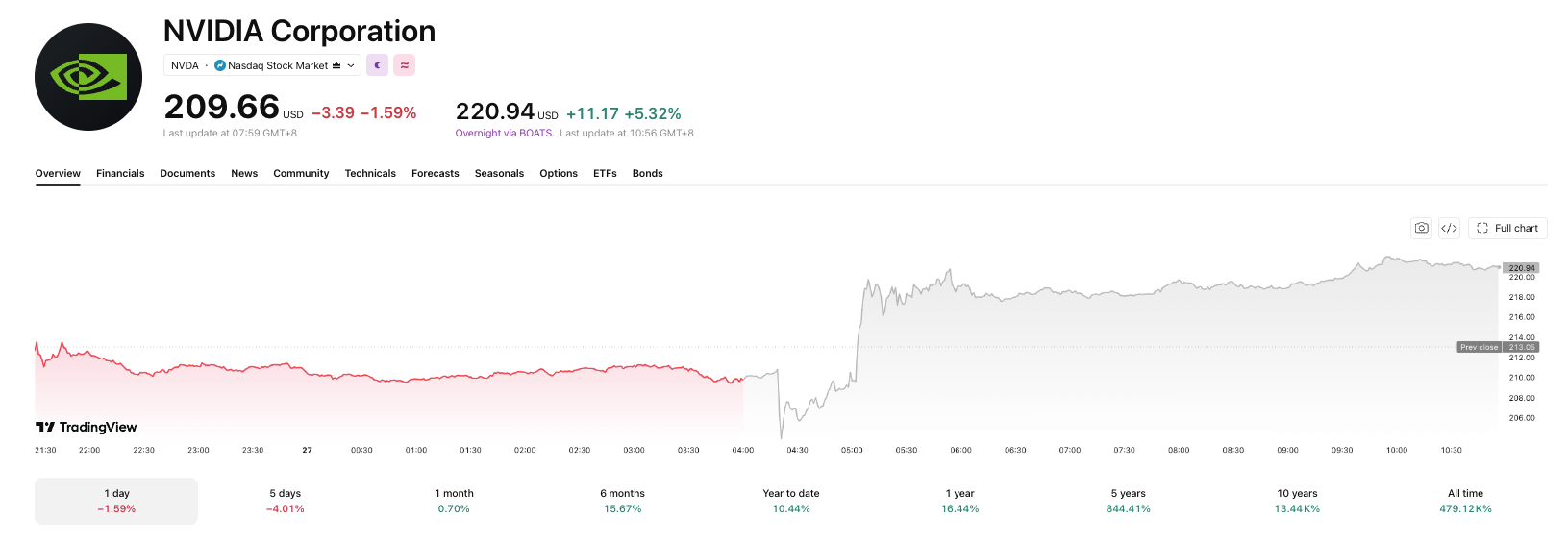
Michael Burry bought December Nvidia (NVDA) call options ahead of the company’s record-breaking earnings, even as he added to his existing short position against the stock. He described the calls as a hedge, not a bet on gains.
The “Big Short” investor disclosed the move on his Substack, where he also revealed fresh shorts against Oracle (ORCL), Palantir (PLTR), Nebius (NBIS), and Caterpillar (CAT). His total short stock position now exceeds 21% of his portfolio, excluding puts.
A Hedge, Not a Reversal
Burry set the call strikes in the mid-to-high $200s and paid a single-digit premium per contract. He said that cost is fully offset by his existing short and put exposure, which represents 3.5% to 4% of his portfolio.
“I am not playing for gains here,” Burry said. He added he would not have made the trade without such a large bearish position already in place. He has used this hedging approach around past earnings reports, though he admitted his track record with it is mixed.
Nvidia’s earnings trap heading into Wednesday’s report had already unsettled traders, with the stock sliding for seven straight sessions beforehand.

Why Burry Still Sees Nvidia as Overvalued
Burry called Nvidia’s low price-to-earnings ratio deceptive for a company he believes commands short-lived monopoly power. He said his own theoretical value for the stock sits well below where it trades today.
He also argued Nvidia will direct more cash toward capital spending than shareholder returns, investing “into and through the top of the bubble” in a way that could later trigger sharp earnings reductions.
The stance echoes Burry’s broader campaign against the AI trade, including his 1987 style crash warning earlier this month.
Burry also expanded long positions in Birkenstock (BIRK) and Freddie Mac (FMCC) this week, calling the Birkenstock stake a full position.
Nvidia stock is up more than 12% year to date, considering its overnight pop. Whether yesterday’s earnings validate Burry’s short or hand him another loss on the hedge remains an open question.
The post Michael Burry Shorts This AI Giant, Then Buys Calls as a Hedge: Why? appeared first on BeInCrypto.
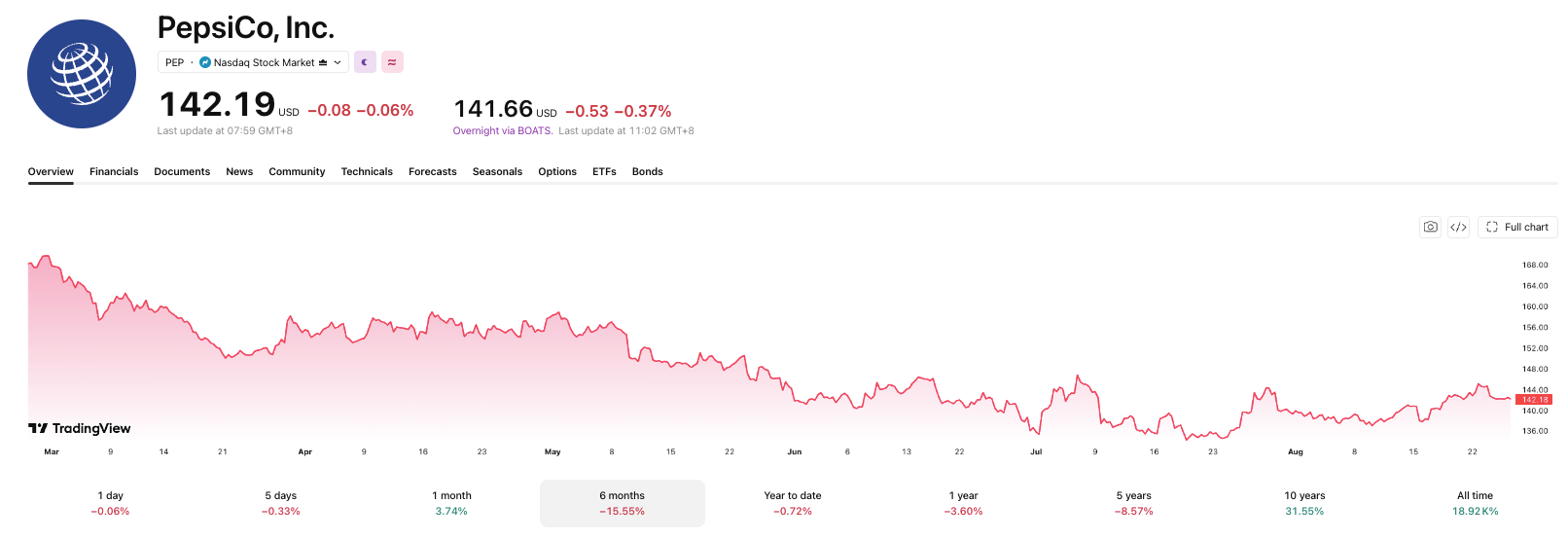
Jim Cramer named PepsiCo (PEP) his next stock idea on Wednesday’s Mad Money. He built the pick on falling oil prices instead of chasing Nvidia or Salesforce.
The CNBC host framed PepsiCo as a value play. He tied it to his broader view that oil is falling and inflation is peaking. Cramer called it a starting point, not yet a position.
A Falling-Oil, Peaking-Inflation Worldview
Cramer’s process starts with a call on rates and inflation before he names any stock. He said the economy looks stable barring a shock out of Iran or Ukraine.
He pointed to easing crude prices as his clearest sign that inflation is topping out. Oil fell nearly 3% this week as Iran and Oman resumed talks on a Strait of Hormuz shipping corridor.
Cramer also downplayed Federal Reserve Chair Kevin Warsh, whose Jackson Hole debut speech lands Friday. He argued a hike is unlikely while the Treasury is already working to hold down long-term borrowing costs.

Why PepsiCo Beat Nvidia and Salesforce to the Pick
Tech was the obvious starting sector, but Cramer said Nvidia and Salesforce had already jumped on strong earnings. Buying either now, he said, would mean chasing a move that already happened. He pointed to Nvidia’s blowout quarter results as an example.
Travel and leisure names failed his test too. He said stocks like Disney and Expedia had already rallied and depend on discretionary spending a soft economy could squeeze.
PepsiCo fit a different screen. Cramer looks for shares trading cheap against their own history with a dividend yield near 4%. PepsiCo has raised its payout for 54 straight years. It now yields roughly 4%, near its highest level in more than a decade.
“I like them low. Some people like them hot. I like them cool.”
Jim Cramer, host of CNBC‘s Mad Money
Cramer said PepsiCo executives repeated on their earnings call that high gas prices have weighed on sales. Falling oil, he argued, could remove that drag on consumer spending.
Cramer stressed the idea remains a screening result, not a formal position. Whether the valuation gap closes may hinge on where oil and rates move after Warsh’s speech Friday.
The post Jim Cramer Says Falling Oil Prices Make PepsiCo His Next Stock Pick appeared first on BeInCrypto.


European Central Bank Executive Board member Piero Cipollone defended the digital euro’s proposed privacy protections in an interview published Aug. 24, saying the Eurosystem would be unable to connect individual users with specific payments.
Summary
- ECB says Eurosystem cannot directly link individuals to online or offline digital euro transactions itself.
- Offline payments would reveal personal transaction details only to the payer and payee involved directly.
- Banks would still identify online users when conducting required anti-money laundering compliance checks on transactions.
- The European Parliament approved negotiations, not the final digital euro regulation, in July 2026 itself.
- A potential 2029 issuance depends on legislation, testing and a later ECB Governing Council decision.
His comments addressed fears that a central bank digital currency could expand government surveillance. However, digital rights organizations argue that the project still relies too heavily on institutional promises instead of independently verifiable technical protections.
ECB says the digital euro would limit user tracking
Cipollone said the digital euro would provide stronger privacy than conventional bank transfers because the Eurosystem would not receive information allowing it to identify individual users.
“The digital euro guarantees the maximum level of privacy that current technology can offer,” Cipollone claimed.
Under the proposed design, online transactions would be processed through banks and other payment service providers. Those companies could identify customers when performing anti-money laundering checks, but the Eurosystem would receive pseudonymized settlement information.
The ECB’s updated guidance says it would not directly connect that information with a particular person. This protection would not make online digital euro transactions anonymous to the customer’s bank.
The digital euro would operate on a centralized settlement platform rather than a public blockchain. The Eurosystem would process and verify holdings and settlements while payment providers handled customer-facing accounts.
Offline digital euro payments would resemble cash
Offline payments would take place directly between devices, such as smartphones or payment cards. The ECB says personal transaction details would remain known only to the payer and recipient.
Anti-money laundering controls would instead apply when users added or withdrew money from an offline wallet. The ECB compares that process with checks performed when customers deposit or withdraw physical cash.
Offline functionality would also allow payments during network disruptions. Users would need to fund their offline balance beforehand, meaning available spending would be limited to the value stored locally on their device.
Cipollone also rejected claims that the digital euro would replace cash. He pointed to the ECB’s work on redesigned banknotes as evidence that physical and digital euros are intended to coexist.
Privacy groups want technical guarantees
Austrian digital rights group epicenter.works and partner organizations remain unconvinced that the current framework provides enough enforceable protection.
The draft’s privacy safeguards “rely too heavily on institutional assurances,” the organization warned.
The group’s statement called for a privacy threshold covering routine payments, public documentation of core mechanisms and open-source code where possible. It also backed zero-knowledge proofs, threshold cryptography and authenticated encryption.
Civil society groups argue that laws and policies can be weakened during implementation or reinterpreted by courts. Technical controls would make it harder for institutions to collect information beyond what the system permits.
The European Parliament’s negotiating position includes privacy-by-design measures and offline payments. As crypto.news reported, lawmakers also proposed zero-knowledge technology for transaction verification.
EU negotiations will determine the final protections
The European Parliament did not give final approval to the digital euro regulation in July. Members instead authorized negotiations with the Council after approving Parliament’s position on July 9.
The Council adopted its negotiating position in December 2025. Both institutions must now agree on a common text before separately approving the regulation.
The ECB says it could be ready for a potential first issuance during 2029 if lawmakers adopt the necessary legislation by the end of 2026. Its Governing Council would make a separate decision on whether issuance should proceed.
Before then, a 12-month pilot is planned for the second half of 2027. In related coverage, the ECB selected 36 payment providers for the pilot, including banks and non-bank companies.
The pilot will test online and offline transfers, merchant payments and the user experience. Its results and the final EU legislation will determine whether the ECB’s privacy promises become enforceable features of the finished system.


Polymarket odds collapsed from 82 percent to 16 percent. The Senate returns September 14 with 14 working days and three unresolved disputes. Meanwhile the SEC, FASB, and OCC are writing rules that do not need a single congressional vote.
Summary
- Polymarket odds on the Clarity Act becoming law in 2026 fell from 82 percent in February to 16 percent by August 7, with Galaxy Digital cutting its estimate to 10 percent in an August 14 note citing the Senate calendar as the primary reason.
- The Senate Banking Committee advanced the bill 15 to 9 on May 14, but three disputes remain unresolved: stablecoin yield provisions affecting $1.35 billion in annual Coinbase USDC rewards revenue, DeFi protocol classification, and ethics requirements targeting presidential crypto income.
- The SEC proposed Regulation Crypto Assets on August 14, creating a framework for digital asset offerings that does not require congressional action, while FASB proposed treating qualifying stablecoins as cash equivalents on August 18 with a November 19 comment deadline.
- The OCC expects to finalize GENIUS Act stablecoin rules by November 2026, four months past the statutory deadline, covering who can issue payment stablecoins and what reserves must back them.
- If the Clarity Act fails, crypto regulation defaults to a patchwork of agency rulemaking: SEC for securities classification, CFTC for commodities, OCC and Treasury for stablecoins, and FASB for accounting treatment, with no unified framework.
The Clarity Act was supposed to be the answer. One bill, one framework, one set of rules covering every digital asset in the United States. The House passed it with 294 votes in July 2025. The Senate Banking Committee advanced it in May 2026. Polymarket bettors priced passage at 82 percent as recently as February. Then the bill ran into three disputes that consumed every working day between May and August, the Senate left for recess without voting, and the odds collapsed to levels that price failure as the base case.
But regulation did not wait for Congress. While legislators argued about stablecoin yield provisions and ethics clauses, three federal agencies moved independently. The SEC proposed its own crypto offering rules. FASB proposed treating certain stablecoins as cash equivalents on corporate balance sheets. The OCC began writing the rules required by the GENIUS Act, which became law in July 2025 but whose implementing regulations missed their own statutory deadline. The question is no longer whether crypto gets regulated. It is whether regulation arrives as a coherent statute or as a collection of agency actions that no single body coordinates.
What the Clarity Act was supposed to do
The Digital Asset Market Clarity Act classifies every digital asset as a security, digital commodity, or stablecoin and assigns regulatory authority accordingly. Securities go to the SEC. Commodities go to the CFTC. Stablecoins fall under joint oversight with prudential regulators. The bill also defines when a token transitions from one classification to another, creates disclosure requirements for token issuers, and sets rules for decentralized protocols that do not have a traditional corporate issuer. The House version passed with 294 votes, including 70 Democrats, making it one of the most bipartisan pieces of financial legislation in the 119th Congress. The breadth of that vote created an expectation that the Senate would follow with amendments and a conference committee would reconcile the two versions by year end. That expectation collapsed in three stages. The Senate Banking Committee vote on May 14 passed 15 to 9, but two of the Democrats who voted yes immediately qualified their support, stating that their committee votes did not guarantee floor votes without progress on outstanding issues. The July 17 hearing exposed the depth of disagreement. And Senate Majority Leader John Thune acknowledged on August 6 that the chamber lacked time for debate, amendments, and a 60 vote cloture threshold before the August 7 recess.
The three disputes that killed the timeline
Each of the three unresolved issues involves real money and real political stakes, which is why none has been resolved through staff level negotiations.
Stablecoin yield. The current Clarity Act text would prohibit offering yield “directly or indirectly” on stablecoin balances and ban anything “economically or functionally equivalent to bank interest.” This provision directly threatens Coinbase’s $1.35 billion in annual revenue from USDC rewards, which the exchange shares with Circle under their commercial agreement. Coinbase has lobbied aggressively against the provision. Banks have lobbied for it, arguing that stablecoin yield without deposit insurance creates an unlevel playing field. Citigroup CEO Jane Fraser backed the Clarity Act publicly but warned that stablecoin rewards could undermine traditional banking deposit bases.
DeFi protocol classification. The bill must define when a decentralized protocol is sufficiently decentralized to avoid SEC registration. The House version created a “decentralization test” based on governance token distribution, code immutability, and the absence of a controlling entity. Senate Democrats have argued the test is too easy to game, pointing to protocols that claim decentralization while a small team controls upgrade keys and treasury wallets. The disagreement is not about whether DeFi should be regulated but about where the line between a decentralized protocol and a company with a token sits.
Ethics requirements. Senate Democrats want state attorneys general to serve as secondary enforcers of the bill’s ban on government officials operating crypto businesses. Republicans and the White House prefer the Justice Department as the sole enforcer. This dispute has become personal because it implicates President Trump’s $1.4 billion in crypto income from World Liberty Financial and the TRUMP memecoin. Neither side has proposed a compromise that addresses both the enforcement mechanism and the political dimension. Galaxy Digital’s August 14 note cited the calendar, not policy disagreements, as the primary reason for cutting passage odds to 10 percent. The Senate returns September 14 and has 14 working days before midterm campaign season dominates the floor schedule. Even if all three disputes were resolved tomorrow, the procedural steps required to bring the bill to a vote, including debate time, amendment votes, and a 60 vote cloture threshold, would consume most of those 14 days. The math does not work.
The SEC moved first
On August 14, the SEC proposed Regulation Crypto Assets, a new framework for digital asset offerings that creates an exemption pathway for qualifying crypto projects to raise capital without triggering full SEC registration. The three member commission, all Republicans appointed by President Trump, opened the proposal for public comment. The timing was deliberate. The SEC announced the proposal one week after the Senate confirmed it would not vote on the Clarity Act before recess. Chairman Paul Atkins framed Regulation Crypto Assets as complementary to legislation, but the effect is substitutive. If the SEC can define how securities laws apply to digital asset offerings through rulemaking, the urgency of passing legislation that does the same thing diminishes. Regulation Crypto Assets builds on the commission’s March 2026 interpretation clarifying how existing securities laws apply to certain crypto assets and transactions. The March document was guidance. The August proposal is rulemaking, which carries the force of law once finalized. The distinction matters because guidance can be reversed by a future commission with a different composition. Rulemaking requires a formal notice and comment process to undo, making it more durable. The proposal also preempts state authority in certain areas, a provision that state regulators have already opposed. If finalized, projects that qualify under Regulation Crypto Assets would face federal rules only, eliminating the 50 state compliance burden that has driven some companies offshore. The scope of Regulation Crypto Assets is narrower than what the Clarity Act covers. The SEC proposal addresses offerings and secondary trading of tokens that qualify under its framework but does not create the comprehensive classification system that the Clarity Act envisions. It does not define digital commodities, does not assign CFTC authority, and does not address DeFi protocol classification. In that sense, it fills one piece of the regulatory puzzle while leaving the rest to other agencies or future legislation. For crypto projects, the immediate practical effect is significant. A company that has delayed token launches because of SEC registration uncertainty now has a potential pathway. The comment period will shape the final rule, and the industry is expected to submit hundreds of responses. The question is whether the SEC finalizes quickly enough to provide certainty before a potential change in commission composition after the 2026 midterms alters the political dynamics.
FASB rewrites the accounting
On August 18, FASB released a proposed Accounting Standards Update that defines when stablecoins qualify as cash equivalents on corporate balance sheets. The three tests are specific: a qualifying stablecoin must carry an on demand contractual redemption right, provide a direct claim on the issuer for a known cash amount (not just secondary market liquidity), and be backed by segregated reserves held at no less than a one to one ratio in short term, highly liquid assets. The board explicitly rejected a looser standard. Secondary market liquidity alone does not qualify. If you cannot walk up to the issuer and demand your cash, the asset fails the test. This means USDC and RLUSD likely qualify. Algorithmic stablecoins and tokens with lock up periods do not. The practical impact is significant. Under current accounting rules, companies holding stablecoins must mark them as intangible assets and take impairment losses when the price dips below cost, even temporarily. Reclassifying qualifying stablecoins as cash equivalents eliminates that friction. Corporate treasurers who avoided stablecoins because of accounting treatment now have a path to hold them without balance sheet distortion. The comment period runs 90 days, closing November 19. If adopted, the standard would apply to fiscal years beginning after December 15, 2027, giving companies roughly a year to prepare. The Clearing House tokenized deposit network, which includes JPMorgan, Bank of America, Citi, and Wells Fargo, is targeting a launch in the first half of 2027, timed to coincide with the new accounting treatment.
The GENIUS Act fills the stablecoin gap
The GENIUS Act became law on July 18, 2025, but its implementing regulations missed the one year statutory deadline on July 18, 2026. The OCC expects to finalize its rules by November 2026, four months late. The Treasury published proposed rules on August 17 and opened a 60 day comment period. The Blockchain Association submitted a letter supporting the proposed framework on August 25. The GENIUS Act defines who can issue payment stablecoins, what reserves must back them, and how holders can redeem them. It requires stablecoins to be fully backed by dollars or similarly liquid assets and mandates annual audits for issuers above $50 billion in market capitalization. The law exists. The rules implementing it are being written. This is happening regardless of whether the Clarity Act passes. The overlap between the GENIUS Act stablecoin provisions and the Clarity Act stablecoin yield provisions creates a potential conflict. If the Clarity Act bans stablecoin yield but the GENIUS Act framework does not explicitly prohibit it, issuers face contradictory guidance. If the Clarity Act fails, the GENIUS Act stands alone as the governing stablecoin law, and the yield question remains open until regulators address it through rulemaking or enforcement. The missed statutory deadline itself carries a signal. Congress set a one year implementation timeline because it expected the rules to be straightforward. They were not. The OCC, Treasury, and FDIC each needed to coordinate on reserve requirements, custodial standards, and the treatment of non bank issuers. The complexity of writing rules for an asset class that did not exist when most banking statutes were written consumed the full year and then some. The Blockchain Association’s August 25 letter supporting the proposed rules is notable because the trade group represents both crypto native companies and traditional financial institutions entering the space. Agreement between those constituencies on reserve requirements and redemption standards suggests the November finalization timeline is realistic. Disagreement on those points would have triggered extension requests and additional comment periods. The absence of major industry opposition to the GENIUS Act implementing rules contrasts sharply with the three blocking disputes that have paralyzed the Clarity Act.
What regulation by rulemaking looks like
If the Clarity Act does not pass in 2026, the regulatory landscape defaults to agency action. The shape is already visible: The SEC defines which tokens are securities and what exemptions apply, through Regulation Crypto Assets and existing enforcement. The CFTC retains authority over digital commodities through its existing Commodity Exchange Act powers, exercised through enforcement rather than bespoke crypto rules. The OCC and Treasury implement the GENIUS Act for stablecoins. FASB determines how crypto assets appear on corporate balance sheets. State regulators retain authority wherever federal rules do not preempt. This patchwork has two advantages and three problems. The advantages: it moves faster than legislation (three agency proposals in one month versus 14 months of congressional inaction), and it can be tailored to specific asset classes without the compromises that a comprehensive bill requires. The problems: no single body coordinates the overall framework, creating gaps and overlaps. Rulemaking is vulnerable to changes in administration, since a future SEC chair with different views could reverse Regulation Crypto Assets through a new rulemaking. And the lack of a legislative foundation means courts, not Congress, become the ultimate arbiters of classification disputes, producing case by case precedent rather than clear rules. The coordination problem is not hypothetical. Consider a token that starts as a security under the SEC’s framework, transitions to a commodity under CFTC oversight as it decentralizes, and is used to collateralize a stablecoin governed by OCC rules. Under the Clarity Act, one statute would define each transition point. Under rulemaking, three agencies must independently agree on where their authority begins and ends. History suggests they will not agree. The SEC and CFTC have disputed jurisdiction over crypto assets since at least 2018, and agency rulemaking does not resolve turf disputes. It formalizes them. The international dimension adds pressure. The European Union’s MiCA framework is fully operational. Singapore, Japan, and the United Kingdom have finalized their own comprehensive regimes. United States companies operating globally must comply with foreign frameworks that assume a single domestic regulator. A patchwork of five federal agencies and 50 state regulators creates compliance costs that a unified statute would eliminate. The longer the Clarity Act stalls, the more entrenched the patchwork becomes, as each agency finalizes rules that create constituencies opposed to being overridden by legislation.
The market has already priced failure
Crypto markets have not waited for legislative certainty. Bitcoin broke $80,000 on August 25 despite the Clarity Act sitting at 16 percent passage odds. XRP ETF inflows hit record levels the same week. Solana staking ETFs crossed $1 billion in cumulative flows. If regulatory clarity were a prerequisite for institutional participation, these flows would not exist. The explanation is that markets have priced in the rulemaking substitute. The SEC’s Regulation Crypto Assets provides enough clarity for ETF issuers to launch products. The GENIUS Act provides enough stablecoin certainty for institutional treasurers. FASB’s cash equivalent proposal provides enough accounting clarity for corporate balance sheets. Each agency action removes one layer of uncertainty that previously required legislation to address. This creates a paradox for the Clarity Act’s proponents. The more effective agency rulemaking becomes at reducing uncertainty, the less urgent legislation feels to the market participants who would benefit from it. And the less urgency the market signals, the less pressure Congress feels to resolve its three disputes. The rulemaking track may not just be a substitute for legislation. It may be the mechanism that prevents legislation from ever being necessary enough to pass. The counterargument is durability. Rulemaking can be reversed. A new administration in 2029 could install an SEC chair who withdraws Regulation Crypto Assets and returns to enforcement by litigation. The GENIUS Act implementing rules could be rewritten. Only legislation provides the permanence that long term institutional allocators need to build multi decade strategies. Whether that permanence matters enough to overcome 14 working days and three intractable disputes is the question the September 15 vote will begin to answer.
What would prove this thesis wrong
Two conditions would invalidate the “regulation by rulemaking” thesis. First, if the Senate returns September 14 and moves immediately to cloture on the Clarity Act, resolving the three disputes in the first week, the bill could pass before midterm politics consume the floor. The probability is low but not zero. Second, if the SEC withdraws or significantly delays Regulation Crypto Assets in deference to congressional action, the rulemaking substitute narrative weakens. The more likely outcome is a hybrid. The Clarity Act passes in a reduced form that addresses classification and DeFi but defers stablecoin provisions to the GENIUS Act framework. This outcome would satisfy the market’s demand for a legislative signal without requiring resolution of the three blocking disputes. But “likely” and “certain” remain separated by 14 working days and a 60 vote threshold.
What to watch
September 15 procedural vote. Senate Majority Leader Thune scheduled this date for a cloture motion. If the vote is postponed or fails to reach 60 votes, the Clarity Act is effectively dead for 2026.
Regulation Crypto Assets comment period. The SEC’s proposed rule will attract hundreds of comments. The volume and content of industry opposition or support will signal whether the SEC feels empowered to finalize without waiting for Congress.
GENIUS Act final rule timeline. The OCC’s November 2026 target for finalizing stablecoin rules will confirm or deny whether the rulemaking track is moving at the pace agencies claim.
FASB comment submissions. If major accounting firms and corporate treasurers submit supportive comments by November 19, adoption becomes more likely, accelerating the accounting pathway for institutional stablecoin use.
Polymarket odds recovery. A sustained move above 30 percent would indicate that new information, likely a bipartisan compromise on one of the three disputes, has changed the legislative calculus.
What is the Clarity Act?
The Digital Asset Market Clarity Act is federal legislation that classifies every digital asset as a security, digital commodity, or stablecoin and assigns regulatory authority to the SEC, CFTC, or joint oversight accordingly. The House passed it with 294 votes in July 2025, and the Senate Banking Committee advanced it 15 to 9 in May 2026.
Why did the Clarity Act not pass before the August recess?
Three unresolved disputes blocked the vote: stablecoin yield provisions affecting Coinbase’s $1.35 billion USDC rewards revenue, DeFi protocol classification rules, and ethics requirements targeting government officials’ crypto income. The Senate calendar also lacked sufficient working days for the debate and amendment process required before a 60 vote cloture threshold.
What is Regulation Crypto Assets?
Regulation Crypto Assets is an SEC proposed rulemaking announced August 14, 2026, that creates a framework for digital asset offerings. It would allow qualifying crypto projects to raise capital without full SEC registration and preempt certain state regulations. It does not require congressional approval.
What are FASB’s three tests for stablecoins as cash equivalents?
A qualifying stablecoin must carry an on demand contractual redemption right, provide a direct claim on the issuer for a known cash amount, and be backed by segregated reserves at no less than a one to one ratio in short term liquid assets. Secondary market liquidity alone does not qualify.
What is the GENIUS Act?
The GENIUS Act became law on July 18, 2025, creating rules for payment stablecoin issuers including reserve requirements, redemption rights, and audit mandates. Its implementing regulations missed the statutory deadline and the OCC expects to finalize them by November 2026.
Can crypto regulation happen without Congress?
Yes. Federal agencies can write rules under existing statutory authority. The SEC, CFTC, OCC, Treasury, and FASB are all currently exercising this power. However, agency rulemaking is more vulnerable to reversal by future administrations and lacks the permanence of legislation.
What happens if the Clarity Act fails entirely?
Crypto regulation defaults to a patchwork of agency rulemaking and enforcement actions. The SEC handles securities classification, the CFTC covers commodities, the OCC implements stablecoin rules under the GENIUS Act, and FASB determines accounting treatment. No single body coordinates the framework.
Will the Clarity Act pass in 2026?
The Senate returns September 14 with 14 working days and a scheduled procedural vote on September 15. Polymarket prices passage at approximately 16 percent. Galaxy Digital cut its estimate to 10 percent. The math requires resolving three disputes and clearing a 60 vote threshold in under two weeks, which most observers consider unlikely. This is educational analysis, not investment advice.
Disclaimer. This article was written on August 26, 2026. All figures reflect data available on that date and may have changed. This is educational analysis and does not constitute investment advice. Legislative timelines and regulatory proposals are subject to change.


The Bank of Korea raised its interest rate by 25 basis points to 3% on Thursday. The move marked a second consecutive increase.
Policymakers had already flagged more tightening in July. Firm core inflation and a renewed jump in Seoul housing prices strengthened the case for another move.
Bank of Korea Hikes Rates to 3%
The hike came as consumer price inflation eased to 2.8% in July. However, core inflation, which strips out volatile food and energy prices, moved the other way. It came in at 2.6% in July, the highest since December 2023.
Korea’s policy turn is recent. The central bank cut its benchmark rate by a full percentage point between October 2024 and May 2025. It then left the rate at 2.5%.
That pause ended last month. The BOK lifted the rate to 2.75% in July, its first increase in three and a half years.
Thursday’s move returns borrowing costs to where they stood before the BOK’s February 2025 cut. It also settles a close call among forecasters. 18 of 35 economists surveyed by Reuters expected the hike.
The board had already flagged its direction at the July meeting.
“Therefore, it is judged that it will be necessary to continue a policy stance consistent with further rate hikes, and the Board will determine the timing and pace of further increases in the Base Rate while assessing the extent of inflationary pressure, the improvement trend in the domestic economy, and financial stability,” the statement read.
Follow us on X to get the latest news as it happens
Housing and Inflation Keep the Pressure On
In July, Korea’s central bank built the case for a rate hike on three pressures: growth, inflation, and financial stability. The BOK said consumer prices would run above the 2% target for “a considerable time.”
The financial stability argument rests on housing. Seoul apartment transaction prices rose 2.50% in June from May, the steepest monthly gain since June 2021. The growth argument rests on chips.
“Korea is benefiting as a key player in the global AI value chain during the process of global AI diffusion. Accordingly, exports and investment are expected to grow strongly, and unprecedented expansion in nominal GDP resulting from the surge in semiconductor prices is likely to support domestic demand through higher corporate profits, increased investment, and gains in wages and tax revenues,” it added.
What Tighter Policy Means for Korean Risk Appetite
Higher rates reach markets already under strain. The KOSPI lost 22% in July, its worst month since 2008, before the won rallied below 1,400 per dollar in August. Leveraged chip funds shed close to $1 billion this month, their first outflow since launch in late May.
Retail capital in South Korea rotates quickly between equities, structured products, and digital assets. Whether a 3% policy rate slows that rotation should become clearer once September flows settle.
Subscribe to our YouTube channel to watch leaders and journalists provide expert insights
The post Bank of Korea Doubles Down With Back-to-Back Hikes as Core Inflation Bites appeared first on BeInCrypto.


Congress gave agencies one year to write stablecoin rules. They missed it by four months and counting. The OCC expects a final rule by November, Tether still lacks a reciprocity determination, and the effective date keeps sliding.
Summary
- The GENIUS Act became law on July 18, 2025, with a one year deadline for implementing regulations that all federal agencies missed on July 18, 2026.
- The OCC expects to finalize its stablecoin rule by November 2026, which would push the effective date to approximately March 2027 under the 120 day implementation window.
- Tether requires a Treasury reciprocity determination to continue serving United States businesses under the foreign issuer pathway, and as of August 2026, that determination has not been issued.
- The proposed rules require every stablecoin issuer serving United States users to be licensed, maintain 100 percent reserves in Treasury bills or insured deposits, report weekly to regulators, and publish monthly disclosures.
- Three parallel rulemaking tracks are active: the OCC for prudential standards, FinCEN and OFAC for anti money laundering and sanctions compliance, and the FDIC and NCUA for institutions under their supervision.
Congress wrote a law. Regulators missed the deadline to implement it. Now they are writing the rules anyway, on their own timeline, with their own interpretations. The GENIUS Act was supposed to create certainty for stablecoin issuers by July 2026. Instead it created a gap: a signed statute without implementing regulations, leaving every issuer in the United States operating under a law whose specific requirements have not been defined.
The delay is not a failure of political will. The agencies agree on the law’s goals. The complexity of writing rules for an asset class that did not exist when most banking statutes were drafted consumed the full year and more. Reserve requirements that sound simple in legislation become complicated when applied to non bank issuers, foreign stablecoins, and tokens that cross multiple regulatory jurisdictions.
What the GENIUS Act requires
The Guiding and Establishing National Innovation for United States Stablecoins Act defines who can issue payment stablecoins, what those tokens must be backed by, and how holders can redeem them. The law applies to any entity issuing a stablecoin to United States users, whether that entity is a national bank, a state chartered institution, or a non bank company seeking federal licensing. Every token in circulation must be backed dollar for dollar by United States dollars, Treasury bills, insured bank deposits, or Treasury repurchase agreements. The law does not permit backing by corporate bonds, money market funds with credit exposure, or other assets that carry default risk. This is stricter than what some issuers currently hold. Circle’s USDC reserves include Treasury bills and money market funds, but the GENIUS Act framework may require Circle to restructure the money market fund component depending on how the OCC defines “qualifying reserves” in the final rule. Issuers above $50 billion in market capitalization must submit to annual audits. All issuers must report weekly to their primary regulator and publish monthly disclosures. The disclosure requirements go beyond what any stablecoin issuer currently provides voluntarily, creating a transparency standard that matches or exceeds what the SEC requires of money market funds. The law takes effect on either January 18, 2027 (18 months after signing), or 120 days after final rules are issued, whichever comes first. Since no agency has finalized its rules, the 120 day clock has not started. If the OCC finalizes in November 2026, the effective date slides to approximately March 2027. If finalization extends into 2027, the entire timeline shifts further.
Why the deadline was missed
Congress set a one year implementation timeline because it expected the rules to be straightforward. They were not. Three agencies needed to coordinate on overlapping requirements, each operating under different statutory authorities and different rulemaking procedures. The OCC handles prudential standards for national banks and federally licensed non bank issuers. Its proposed rule covers reserve backing requirements, risk management frameworks, capital and liquidity standards, custody requirements, and regulatory examination procedures. The draft mirrors obligations placed on traditional depository institutions but adapts them for entities that hold crypto assets and issue tokens on public blockchains. FinCEN and OFAC handle anti money laundering and sanctions compliance under a separate rulemaking coordinated with the Treasury Department. Their proposed rule requires stablecoin issuers to implement Bank Secrecy Act programs, file suspicious activity reports, and screen transactions against OFAC sanctions lists. The complexity here involves applying traditional banking compliance frameworks to blockchain transactions, where pseudonymous addresses and cross chain bridges create monitoring challenges that do not exist in wire transfer systems. The FDIC and NCUA are advancing parallel proposals for state chartered banks and credit unions under their respective supervision. Each agency must align its rules with the OCC framework while accounting for institutional differences in capital requirements and supervisory approaches. The coordination problem explains the delay more than any single technical challenge. Each agency published its proposed rule on a different timeline, accepted comments on different schedules, and is finalizing at different speeds. The OCC leads. The FDIC follows. FinCEN’s AML rules may not finalize until early 2027. The result is a staggered implementation where different requirements take effect at different times, creating compliance uncertainty that the law was designed to eliminate. The staggering creates a specific operational problem. A stablecoin issuer that receives its federal license under the OCC rule may begin operations while the FinCEN AML rule is still in proposed form. That issuer must decide whether to build its compliance program against the proposed AML rule, which may change in the final version, or wait until both rules are final and operate with a compressed implementation window. Neither option is attractive, and both carry risk that a simultaneous finalization would have avoided. The OCC has publicly acknowledged the issue. Acting Comptroller Michael Hsu stated the agency is “very intent on moving quickly and getting a final rule out by November so that we will be able to start processing applications within the new year.” The explicit commitment to processing applications by January 2027 is more operationally meaningful than the November finalization date alone, because it signals that the OCC will not wait for FinCEN to finish before beginning to license issuers. The practical effect is a two track system where prudential licensing proceeds ahead of AML rule finalization.
The Tether problem
Tether presents the most consequential unresolved question in the GENIUS Act implementation. USDT is the largest stablecoin by market capitalization, with roughly $140 billion in circulation as of August 2026. Tether Limited is incorporated in the British Virgin Islands and has never been licensed as a financial institution in the United States. The GENIUS Act creates a foreign issuer pathway that allows non United States companies to serve American businesses, but only if the Treasury Department issues a “reciprocity determination” confirming that the issuer’s home jurisdiction provides comparable regulatory oversight. As of August 2026, that determination has not been issued for any jurisdiction, including the BVI. Without a reciprocity determination, Tether cannot legally offer USDT to United States businesses once the GENIUS Act takes effect. The practical enforcement of that prohibition is complex because USDT trades on global markets accessible to anyone with an internet connection, but the legal prohibition would prevent United States exchanges, custodians, and financial institutions from supporting USDT directly. Tether has responded with two strategies. First, it announced plans to register USDT under the foreign issuer pathway, which requires the reciprocity determination it does not yet have. Second, it launched USAT, a new United States focused stablecoin designed for GENIUS Act compliance from day one, with reserves held in Treasury bills at a United States custodian. The dual strategy hedges against both outcomes: reciprocity granted (USDT stays) or reciprocity denied (USAT replaces it for US markets). The market has noticed. USDT’s share of United States exchange trading volume has declined from 72 percent in January 2026 to approximately 64 percent in August, while USDC’s share has grown from 18 percent to 26 percent over the same period. The shift is gradual but directional, and the GENIUS Act timeline is the primary driver. The timeline matters because digital asset service providers have until July 2028, three years after the law’s signing, before they are prohibited from offering non compliant stablecoins. That grace period gives Tether time but creates a two class market where compliant stablecoins like USDC and RLUSD operate under full regulatory oversight while USDT continues serving United States users under the transitional provision.
Who is already compliant
Circle’s USDC is the closest to full compliance. The company holds reserves primarily in Treasury bills and is regulated as a money transmitter in multiple states. The GENIUS Act framework may require Circle to restructure its reserve portfolio to eliminate any money market fund exposure that does not meet the “qualifying reserves” definition, but the adjustment is incremental rather than structural. Ripple’s RLUSD, which crossed $2 billion in market capitalization during August 2026, is designed for GENIUS Act compliance. Its reserves are held in United States denominated assets with a regulated custodian. RLUSD’s growth on the XRP Ledger has positioned it as the institutional stablecoin for cross border settlement, with nearly $1 billion of supply on XRPL directly. PayPal’s PYUSD, issued through Paxos Trust, operates under New York Department of Financial Services oversight and holds reserves in Treasury bills and cash deposits. The transition to GENIUS Act compliance involves obtaining federal licensing on top of existing state authorization, a process that requires additional capital and compliance infrastructure but no fundamental restructuring. The common thread is that issuers who designed their products with regulatory compliance in mind face incremental adjustments. Issuers who designed for speed and market share face structural changes or market exit. The GENIUS Act is a filter, and the compliance cost is the price of remaining in the United States market.
The institutional pipeline waiting on final rules
The delay in finalization has created a bottleneck for institutional products that depend on regulatory certainty. The Clearing House tokenized deposit network, which includes JPMorgan, Bank of America, Citi, and Wells Fargo, is targeting a launch in the first half of 2027. That timeline assumes GENIUS Act rules are final and the effective date is known. If finalization slips past November, the launch date slips with it. FASB’s August 18 proposal to treat qualifying stablecoins as cash equivalents on corporate balance sheets is directly connected to the GENIUS Act timeline. The accounting treatment requires stablecoins to carry an on demand redemption right and segregated one to one reserves, requirements that overlap almost exactly with the GENIUS Act framework. If both the GENIUS Act rules and the FASB standard finalize on schedule, corporate treasurers will have simultaneous regulatory certainty and accounting clarity for holding stablecoins. If either slips, the institutional adoption timeline extends. The OUSD revenue sharing stablecoin consortium, which includes Visa, Mastercard, Stripe, and BlackRock among its 140 plus partners, has positioned itself to capitalize on this convergence. A stablecoin that qualifies as a cash equivalent under FASB and meets GENIUS Act reserve requirements becomes functionally equivalent to a Treasury bill on a corporate balance sheet, with the added benefit of programmable settlement on blockchain rails. The pipeline is real and the capital is committed. What is missing is the final rule that converts proposed requirements into enforceable standards. Every month of delay is a month of stalled product launches, deferred treasury allocations, and competitive advantage flowing to jurisdictions where the rules are already final.
The dollar defense argument
The GENIUS Act is not primarily about consumer protection, despite the disclosure and reserve requirements that serve consumer interests. The law’s strategic logic is about maintaining the dollar’s dominance in digital payments. Stablecoins denominated in United States dollars represent approximately $170 billion in circulating supply as of August 2026. Every dollar held in stablecoin reserves is a dollar invested in Treasury bills or deposited at insured banks, creating demand for United States government debt. If the stablecoin market grows to $1 trillion, as several projections suggest by 2030, the reserve requirement becomes a meaningful source of Treasury bill demand. Foreign stablecoins denominated in euros, yuan, or other currencies compete directly with this dynamic. The reciprocity determination framework in the GENIUS Act is designed to ensure that foreign issuers serving United States markets operate under comparable rules, preventing regulatory arbitrage that could redirect reserve demand away from United States government debt. This logic explains why the missed deadline has not generated significant political backlash. The law’s strategic objectives are served by the rulemaking process itself, which signals to global markets that the United States is building a comprehensive stablecoin framework. The specific effective date matters less than the trajectory, and the trajectory is clearly toward finalization. The European Union’s MiCA framework, fully operational since January 2026, requires similar reserve backing for euro denominated stablecoins. But MiCA explicitly prohibits yield payments on stablecoin balances, a provision that has driven some DeFi activity offshore. The GENIUS Act’s silence on yield gives the United States a potential competitive advantage: if the OCC permits reserve income sharing, dollar stablecoins become more attractive to holders than euro stablecoins, reinforcing dollar demand. The geopolitical dimension extends beyond Europe. China’s digital yuan operates as a central bank digital currency without the reserve backed stablecoin model. If private dollar stablecoins reach $1 trillion in circulation while operating under a credible regulatory framework, they become a de facto extension of United States monetary influence in digital commerce, operating on rails that the Federal Reserve does not control but that United States regulators oversee. The GENIUS Act, for all its implementation delays, is the legal foundation for that strategic position.
What the final rules will decide
Several questions remain open until the OCC publishes its final rule, expected in November. First, the precise definition of “qualifying reserves.” The law names Treasury bills, insured deposits, and Treasury repos. The question is whether the final rule permits any additional asset classes, such as agency mortgage backed securities or overnight reverse repurchase agreements, that carry negligible credit risk but are not explicitly named in the statute. Second, the capital requirements for non bank issuers. Banks have existing capital frameworks. Non bank stablecoin issuers do not. The proposed rule would require non bank issuers to maintain capital buffers that absorb operational losses without touching reserves, but the size and composition of those buffers remained subject to comment. Third, the examination framework. The OCC proposed regular on site examinations for federally licensed stablecoin issuers, mirroring its bank supervision model. Non bank issuers have never been subject to on site federal examination. The operational burden and cost of preparing for OCC examiners will affect the economics of stablecoin issuance, potentially favoring larger issuers who can amortize compliance costs across a bigger asset base. Fourth, the treatment of stablecoin yield. The GENIUS Act itself does not explicitly prohibit interest payments on stablecoin balances. However, the Clarity Act’s proposed stablecoin yield ban would apply if it passes. If it does not, the GENIUS Act rules govern, and the OCC must decide whether issuers can share reserve income with holders. This question has direct implications for Coinbase’s $1.35 billion annual USDC rewards revenue and for every DeFi protocol that generates yield on stablecoin deposits. The OCC’s final rule on yield could reshape the competitive landscape for stablecoins more than any other single provision. Fifth, the interoperability standard. The proposed rule addresses how stablecoins issued by different licensed entities interact when transferred across blockchains. A USDC token on Ethereum and a USDC token on Solana are technically different assets bridged by Circle’s infrastructure. The final rule must define whether each chain instance requires separate regulatory treatment or whether the issuer’s federal license covers all instances regardless of the underlying blockchain.
What would prove this thesis wrong
Two conditions would change the trajectory. First, if the OCC misses its November target and finalization extends into mid 2027, the staggered implementation problem worsens and market participants may begin operating under their own interpretations of the statute, creating enforcement risk. Second, if Congress passes the Clarity Act with stablecoin provisions that override or modify the GENIUS Act framework, the entire rulemaking track becomes moot and agencies would need to restart the process under new statutory authority. The Blockchain Association’s August 25 letter supporting the proposed rules suggests the industry considers the current rulemaking track acceptable. Major industry opposition would have signaled a risk of extended comment periods and revision cycles. Its absence suggests November finalization is realistic.
What to watch
OCC final rule publication date. November 2026 is the stated target. Any delay past December pushes the effective date into mid 2027 and extends the compliance uncertainty period.
Treasury reciprocity determinations. The first country to receive a reciprocity determination sets the precedent for foreign stablecoin issuers. If the BVI receives one, Tether’s USDT can stay. If it does not, USDT faces a United States market exit by July 2028.
USDC reserve restructuring. If Circle announces changes to its reserve composition in response to the proposed rules, it signals that the final rule definition of “qualifying reserves” is narrower than current industry practice.
USAT adoption rates. Tether’s United States focused stablecoin is a hedge against reciprocity denial. Its adoption rate on exchanges and in DeFi protocols will indicate whether the market is preparing for a post USDT scenario.
FinCEN AML rule timeline. The anti money laundering rulemaking is running behind the OCC prudential rule. A significant gap between the two creates a period where stablecoin issuers must meet prudential standards but lack finalized AML guidance.
What is the GENIUS Act?
The Guiding and Establishing National Innovation for United States Stablecoins Act is a federal law signed on July 18, 2025, that creates a regulatory framework for payment stablecoins. It defines who can issue stablecoins, what reserves must back them, and how holders can redeem them.
Why did regulators miss the GENIUS Act deadline?
Three federal agencies needed to coordinate overlapping rules under different statutory authorities. The OCC handles prudential standards, FinCEN and OFAC handle anti money laundering and sanctions, and the FDIC handles state chartered institutions. The complexity of applying banking compliance frameworks to blockchain based assets consumed more time than the one year timeline allowed.
When will the GENIUS Act rules take effect?
The law takes effect on January 18, 2027, or 120 days after final rules are issued, whichever comes first. If the OCC finalizes in November 2026, the effective date would be approximately March 2027.
What reserves must stablecoin issuers hold?
The GENIUS Act requires 100 percent backing in United States dollars, Treasury bills, insured bank deposits, or Treasury repurchase agreements. No corporate bonds, equities, or higher risk assets are permitted.
Can Tether continue operating in the United States?
Tether requires a Treasury reciprocity determination confirming that its home jurisdiction provides comparable regulatory oversight. That determination has not been issued. Without it, Tether cannot legally offer USDT to United States businesses once the law takes effect. Digital asset service providers have until July 2028 before non compliant stablecoins are prohibited.
Is USDC already GENIUS Act compliant?
Circle’s USDC is close to full compliance given its Treasury bill reserves and state money transmitter licenses, but may need to restructure any money market fund holdings that do not meet the final rule’s qualifying reserves definition.
How does the GENIUS Act affect DeFi stablecoins?
The law applies to any entity issuing stablecoins to United States users. Algorithmic stablecoins that are not backed by qualifying reserves cannot meet the 100 percent backing requirement. Decentralized protocols that issue stablecoins without a licensed entity face classification and enforcement questions that the final rules must address.
What happens if the GENIUS Act rules are never finalized?
The statute itself is law regardless of whether implementing regulations are finalized. Issuers would need to comply with the statutory text directly, which creates uncertainty because many provisions reference regulatory definitions that only exist in final rules. Courts would likely resolve ambiguities through enforcement actions and litigation. This is educational analysis, not investment advice.
Disclaimer. This article was written on August 26, 2026. All figures reflect data available on that date and may have changed. This is educational analysis and does not constitute investment advice. Regulatory timelines and proposed rules are subject to change.
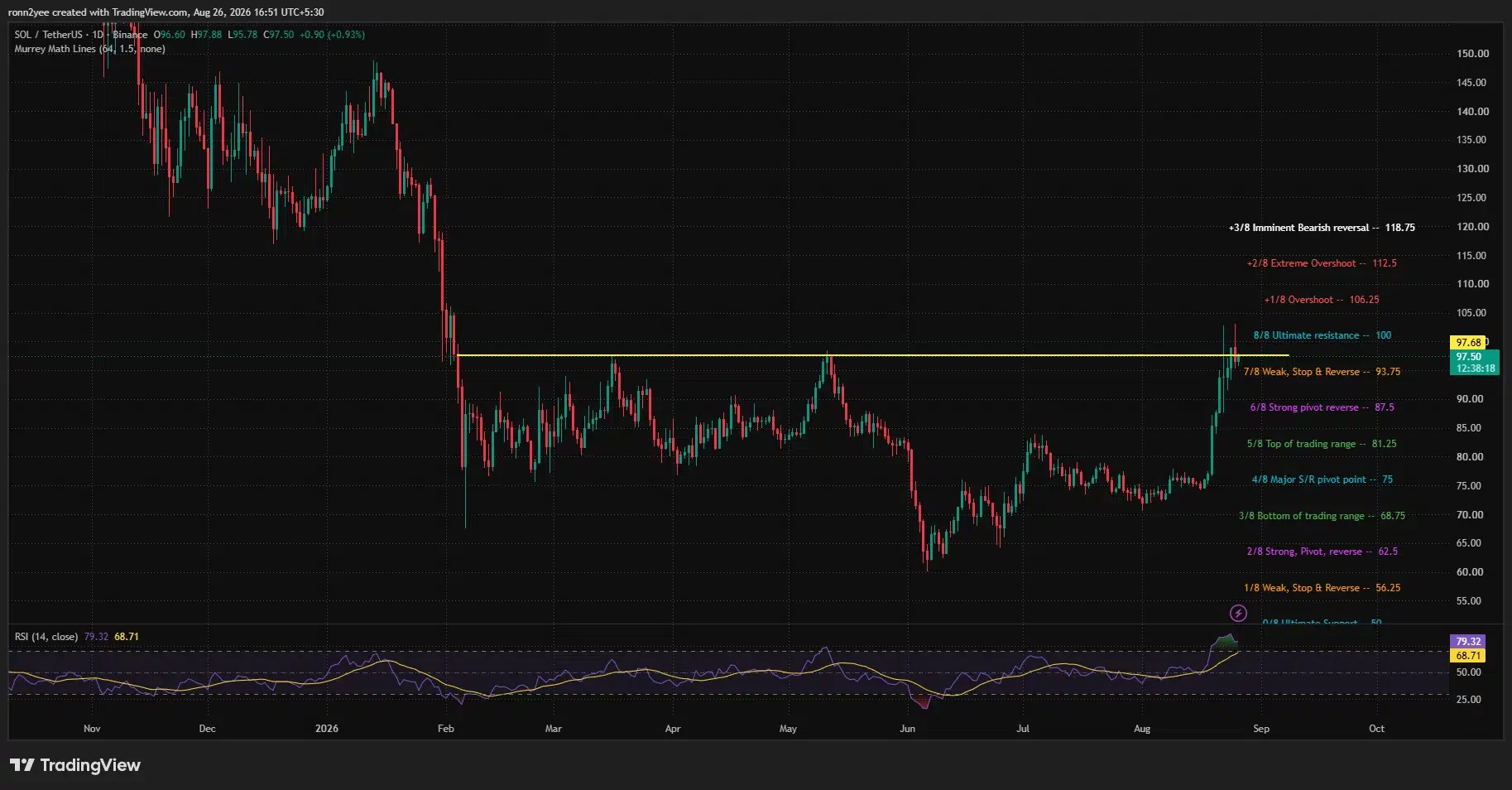
Solana price traded near $97.50 on Aug. 26 after gaining about 14% over seven days, as improving risk appetite, short liquidations, ETF inflows, and network developments pushed SOL above several resistance levels.
Summary
- Solana price climbed from $85.37 on Aug. 20 to a weekly high above $102.
- Price remains below the $100 resistance while the daily RSI stands at an overbought 79.
- 4-hour buying pressure remains positive, with CMF at 0.14.
- Analysts are divided between a rally toward $120 and a correction below $92
Solana price breaks out but stalls below $100
Solana (SOL) price rose from an Aug. 20 opening price of $85.37 to an intraday high above $102.59 on Aug. 25. The move represented an increase of more than 20% at its peak, although profit-taking later pulled SOL back toward $97.50.
SOL was still up about 14% over the seven-day period at the time of writing. The rally allowed the token to break above the $87.50 and $93.75 Murrey Math levels, both of which had previously acted as important resistance zones.
The daily chart shows that the price briefly crossed the $100 “ultimate resistance” level before sellers forced it lower. SOL also tested the $102–$103 area twice, but buyers were unable to secure a daily close above that range.
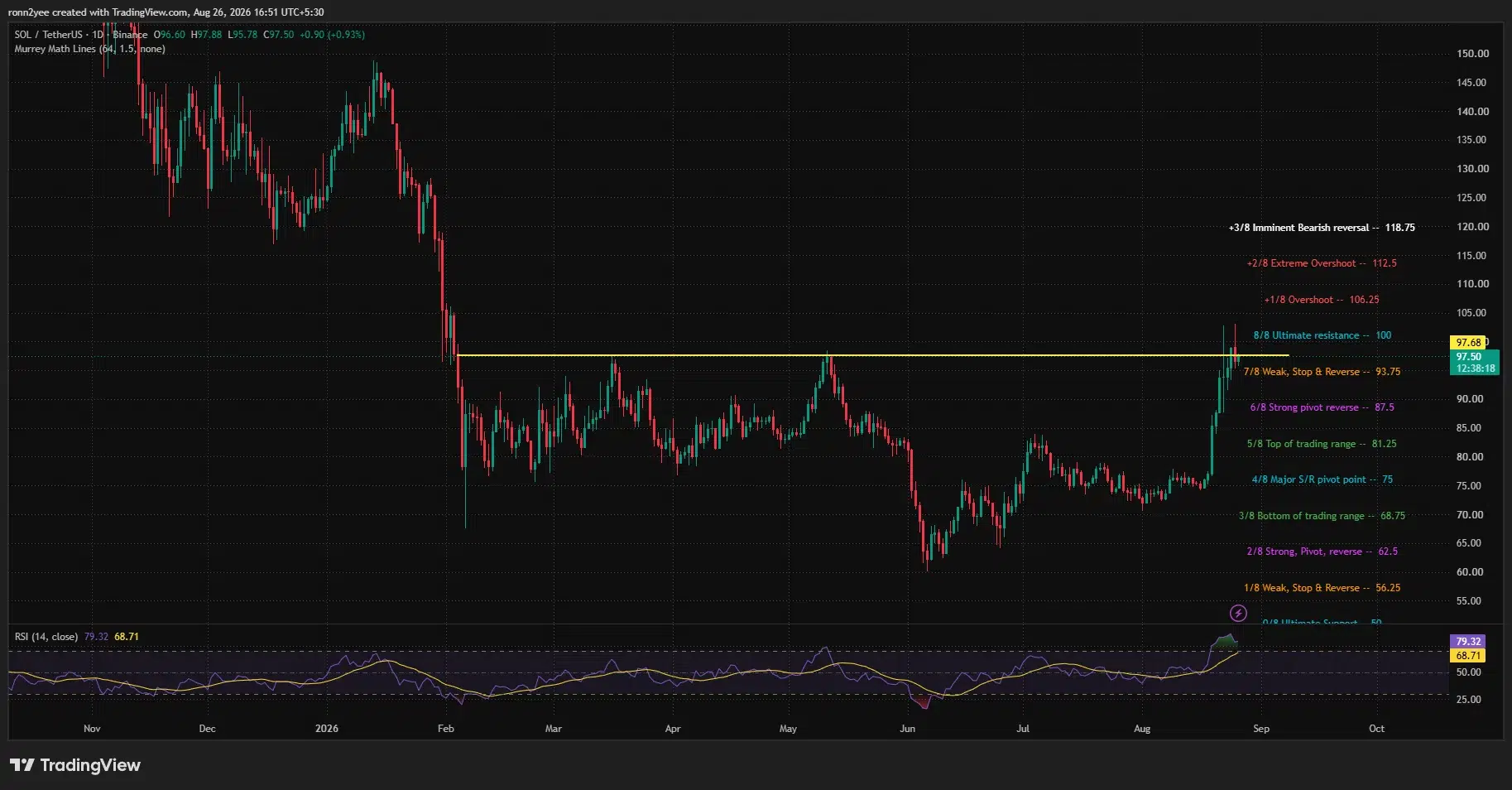
The pullback has not yet reversed the broader breakout. Solana remains above $93.75, while its recent candles show buyers returning whenever the price approaches $95.
However, the daily Relative Strength Index has climbed to 79.32, well above the commonly used overbought threshold of 70. Its moving average stands at 68.71, confirming that momentum accelerated rapidly during the latest rally.
An overbought RSI does not automatically signal an immediate decline, but it shows that SOL may need to consolidate before attempting another sustained move above $100.
Macro shift and short squeeze drive the rally
Solana’s advance occurred alongside a broader crypto market rally after liquidity actions by the U.S. Treasury pushed government bond yields lower and weakened the U.S. dollar.
Lower yields reduced pressure on risk assets and forced traders who had positioned for another market decline to close bearish bets. More than $4 billion in crypto short positions were reportedly liquidated over several days, creating forced buying across major digital assets.
Solana benefited from that market-wide squeeze because of its higher volatility relative to Bitcoin. Once SOL broke through the upper-$80 range, short covering and momentum buying helped carry the token through the psychological $100 barrier.
Improving U.S. regulatory expectations added to the change in sentiment. Investors responded to the Securities and Exchange Commission’s proposed crypto framework and renewed congressional attention on the Digital Asset Market Clarity Act.
Solana-specific developments also supported the move. The network community opened voting on a Resource Fee Proposal that would separate inclusion fees from compute resource fees and burn the latter in full.
Supporters expect the proposal to connect periods of high network use with higher SOL burns, although its final effect on supply would depend on adoption and future activity.
Institutional demand also strengthened during the week. Spot Solana exchange-traded funds recorded approximately $65.74 million in net inflows so far this week, their highest weekly inflows in 2026.
Network activity provided another source of support after Solana overtook Base in daily x402 micropayment transactions. Ramp’s integration of AI-agent wallet support on Solana also expanded the network’s potential role in automated payments.
4-hour chart shows buyers defending $96.67
Solana’s 4-hour Bollinger Bands show the price consolidating after a sharp expansion in volatility. SOL traded at $97.53, above the 20-period middle band at $96.67.
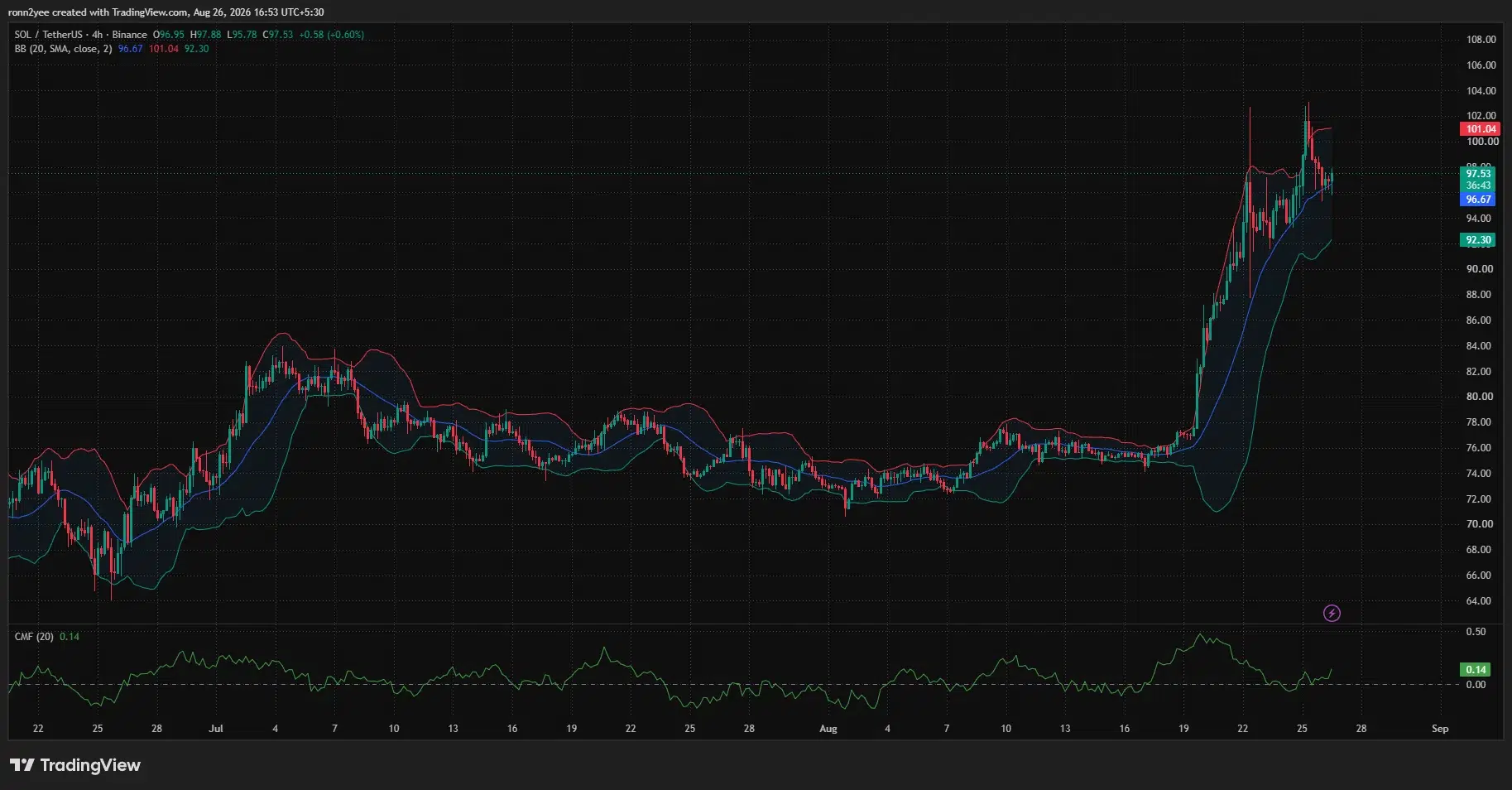
Remaining above the middle band keeps the short-term structure tilted toward buyers. The upper band at $101.04 represents the immediate technical barrier, closely matching the psychological $100 level and the recent rejection zone.
A 4-hour close above $101.04 could strengthen the case for another test of $102.59–$103.08. Clearing that area would leave $106.25, the next Murrey Math overshoot level, as a possible upside target.
The Chaikin Money Flow indicator stood at 0.14 on the 4-hour chart. A reading above zero suggests that buying pressure continues to exceed selling pressure despite SOL’s pullback from its weekly high.
The lower Bollinger Band at $92.30 forms the main short-term downside level. A break below the middle band could initially expose $93.75, followed by $92.30.
The daily chart places the next stronger support at $87.50. Losing that level would weaken the breakout and reopen the possibility of a move toward $81.25, which marked the top of SOL’s previous trading range.
Liquidation heatmap points to liquidity near $99
CoinGlass’ 24-hour liquidation heatmap shows dense leveraged positions immediately above Solana’s current price.
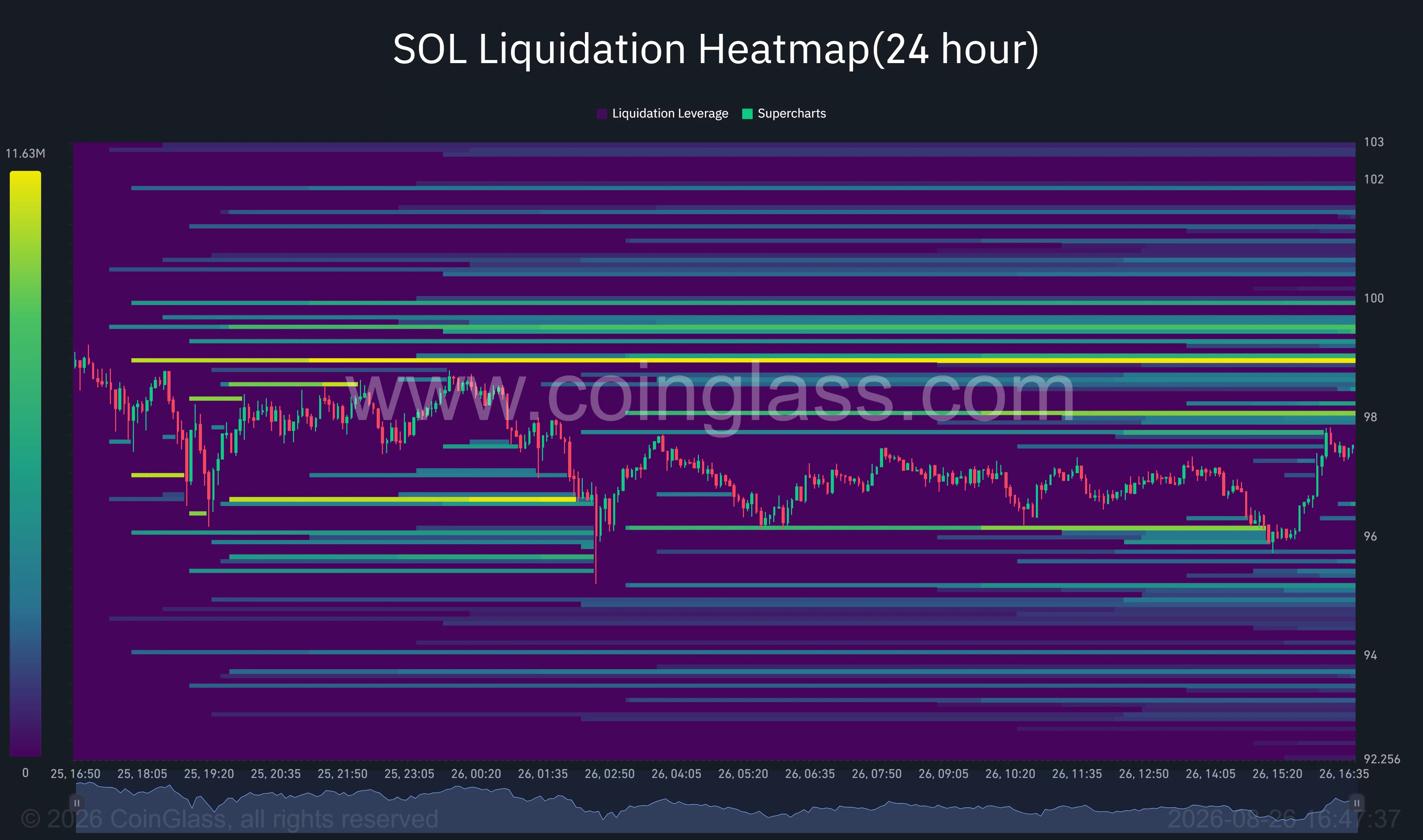
The strongest nearby concentration appears around $98.90–$99.10, with additional liquidity visible near $99.50 and $100. Such clusters can attract price because a move into them forces leveraged short positions to close.
If SOL crosses $99, liquidations could help accelerate another push toward $100–$103. However, the previous rejection above $102 shows that sellers are also active within that range.
Liquidity is visible below the market near $96, $95, and $94. A failure to break through the overhead cluster could therefore send SOL back toward lower-leveraged positions.
The heatmap supports a two-sided short-term setup: a break above $99 could generate another squeeze, while a rejection leaves $96 and $94 exposed.
Analysts split on $120 rally and $88 correction
Pseudonymous trader Altcoin Sherpa expects Solana’s advance to continue if conditions across the wider crypto market remain supportive.
“This goes to $120+ in the coming weeks as long as BTC is still stable/strong. Inflation going down, risk conditions going up, etc.”
A move to $120 from $97.50 would represent an increase of about 23%. Before reaching that target, SOL would need to clear resistance at $100, $103.08, $106.25, and $112.50.
Crypto analyst Haris offered a more cautious assessment, describing the current structure as a possible bull trap because of repeated resistance between $98 and $102.
“Price bounced hard, but $98–$102 is still rejecting. If SOL comes back there and gets rejected again, I will open a short.”
Haris identified $92 as the first downside target. According to the analyst, failure to hold that level could lead to a deeper decline toward $80–$88.
Solana’s immediate direction therefore depends on whether buyers can turn $100–$103 into support. Holding above $96.67 preserves the short-term bullish structure, while a drop through $92.30 would favor a broader retest of the breakout.
Disclosure: This article does not represent investment advice. The content and materials featured on this page are for educational purposes only.


Digital asset infrastructure provider Taurus has connected its tokenization and custody platforms to Swift’s blockchain-based shared ledger, giving financial institutions a route to use bank-issued tokenized deposits for round-the-clock cross-border payments.
Summary
- Taurus has connected its custody and tokenization platforms to Swift’s blockchain ledger.
- The first client integrations are expected within days, followed by initial DLT transactions within weeks.
- Banks can use the connection for cross-border payments involving bank-issued tokenized deposits.
- Swift’s ledger has already processed its first live cross-border transaction between Standard Chartered and HSBC.
Taurus said Wednesday that the integration connects Swift smart contracts with Taurus-CAPITAL and Taurus-PROTECT on clients’ permissioned blockchain infrastructure, with the first client connections expected within days and initial distributed ledger transactions planned within weeks.
Existing Taurus clients can add the connection to infrastructure already running in production, while banks without their own blockchain systems can use managed Hyperledger Besu infrastructure and Ethereum Virtual Machine connectivity supplied by Taurus. The company also supports institutions that already operate Besu or another EVM-compatible system by connecting its tokenization and wallet tools to their existing nodes.
Taurus gives banks a route into Swift’s tokenized deposit ledger
Under the integration, Taurus-PROTECT provides programmable wallet and key-management functions, including governance rules, approval workflows and API-based automation. Taurus-CAPITAL handles the issuance and management of bank-issued tokenized money while allowing deposits to remain on the issuing bank’s balance sheet.
For banks that do not already operate blockchain infrastructure, Taurus said it can deploy and manage the permissioned Hyperledger Besu environment required to connect with Swift’s system. Existing Taurus customers can have their infrastructure extended for ledger connectivity within a matter of days.
The arrangement gives financial institutions another way to access a network that Swift moved into initial deployment in July after about nine months of development. As crypto.news previously reported, 17 banks across six continents were preparing to test tokenized deposit payments when the ledger entered its first controlled rollout on July 9. Participants included HSBC, Citi, BNP Paribas, UBS, ANZ, DBS and Standard Chartered.
More than 40 financial institutions were involved in designing the system, according to Taurus, while Swift’s existing network connects more than 11,500 financial institutions and companies across more than 200 markets.
Taurus co-founder and managing partner Lamine Brahimi said financial institutions need digital asset infrastructure that can work securely with systems they already operate. He said the Swift connectivity allows banks to extend their digital asset capabilities into tokenized deposits and cross-border payments while retaining control over their infrastructure.
Swift’s ledger keeps tokenized deposits on bank balance sheets
Swift’s shared ledger is designed as an orchestration layer between participating institutions, coordinating transfers of tokenized deposits before final settlement takes place through established payment arrangements.
Bank-issued deposits remain on each institution’s own ledger, while Swift coordinates their movement between participants. Payments can operate overnight and on weekends, extending availability beyond the overlapping business hours that can restrict traditional cross-border transfers.
Final settlement still takes place through existing mechanisms, including real-time gross settlement systems, meaning participating banks do not need to replace their current settlement arrangements to use the blockchain-based layer.
A July tokenized deposit explainer detailed how such instruments represent commercial bank deposits on a blockchain while retaining a one-to-one relationship with money held on the issuing bank’s balance sheet. The structure differs from stablecoins because the underlying money remains within the commercial banking system and under the banking regulatory framework.
Swift’s ledger applies that model across multiple institutions. Each participating bank can issue or operate its own tokenized deposits, while the shared infrastructure provides a common layer for coordinating payments between otherwise separate systems.
The model has already moved past its initial development stage. Standard Chartered and HSBC have completed the ledger’s first live cross-border transaction, connecting separate tokenized deposit systems through Swift’s infrastructure.
Taurus expands infrastructure already used by financial institutions
The Swift connection adds another institutional function to Taurus’ digital asset stack, which already combines custody, tokenization, blockchain connectivity and staking services for financial institutions.
During June, Taurus added institutional staking through an integration with P2P.org. The arrangement gave banks using Taurus-PROTECT access to validator infrastructure while allowing them to keep custody and control of their assets within existing workflows.
Ethereum staking was included at launch, while connectivity also covered proof-of-stake networks including Solana, Polkadot, Cosmos, NEAR, Cardano and Tezos. P2P.org reported more than $10 billion in delegated assets across over 50 networks at the time.
Taurus has said its institutional client base includes State Street, Deutsche Bank, Santander and CACEIS. The company also opened a New York office in October 2025 as it expanded its presence in the U.S. market.
Its relationship with Deutsche Bank extends into the German lender’s digital asset plans. Deutsche Bank backed Taurus in a $65 million funding round and has continued working with the Swiss company as part of its institutional crypto custody infrastructure.
Taurus has also built its products across multiple blockchain environments. Taurus-CAPITAL was expanded to Solana in February 2025, allowing banks and financial institutions to issue programmable tokenized assets while Taurus-PROTECT provided custody and staking support.
Banks continue testing tokenized financial infrastructure
Swift’s ledger is entering use as major financial institutions continue experimenting with blockchain-based deposits, securities, and settlement systems.
HSBC completed its first blockchain issuance of a digitally native structured product in July, using tokenized U.S. dollar-denominated notes through a private placement for institutional investors in Hong Kong. The HSBC tokenization pilot used Marketnode to issue the notes on blockchain and manage digital payment flows between the bank and the investor.
Swift’s July rollout placed tokenized deposits specifically at the payment layer. The system was developed to preserve existing compliance, credit, risk, and control standards while making cross-border payments available around the clock, including outside normal banking hours.
Taurus now offers three routes into that infrastructure. Banks without Besu infrastructure can use a managed service operated by Taurus, institutions with their own compatible nodes can connect those systems directly, and existing Taurus-PROTECT customers can extend infrastructure already in production.
The company said Swift smart contracts are integrated with its custody and tokenization products across those configurations, with programmable wallets and compliance controls running above the underlying blockchain infrastructure.
For institutions already using Taurus, connectivity can be established within days. The company expects the first clients to connect shortly, followed by the first DLT transactions using its Swift ledger integration within weeks.

Rates Spark: Why 4.75% Is A Natural Fit For The 10yr Yield

XRP ETF volume hits all time high as flows cross $1.57B

Best Players In The NFL: Is Josh Allen, Patrick Mahomes Or Myles Garrett The Top Star?





-

 Fashion5 days ago
Weekend Open Thread: Madewell – Corporette.com
-

 Crypto World1 day ago
SpaceX stock could rise 75% to $240, JPMorgan says
-

 Business5 days ago
Musk’s Tesla, SpaceX Confirm $16.8 Billion ‘Terafab’ Chip Plant as World’s Largest Building in Texas
-

 Crypto World5 days ago
anatomy of crypto’s biggest liquidation event since 2021
-

 Crypto World2 days ago
A $30 Billion AI Fund Implodes, Now the SEC Is Investigating Wall Street’s Role
-

 Politics5 days ago
6 months on, Irish renters crushed by effects of government housing bill
-

 Crypto World1 day ago
Did Trump Just Move SpaceX Stock With One Truth Social Post?
-
 NewsBeat5 days ago
The ‘Lucky Dip Gang’ causing carnage for clicks: After five thugs were killed speeding in the wrong direction on a motorway, GUY ADAMS investigates a sick new trend… and why police aren’t even allowed to pursue them
-

 Business4 days ago
Mystery AI Model ‘Ox Alpha’ Draws Developers With Free Access as Chinese Lab Origins Remain Debated
-

 News Videos7 days ago
Don’t Leave Your Financial Future To Chance | August 19, 2026
-

 Business6 days ago
Five Below: Kids Discount Retailer Reaps Rich Rewards
-

 Business2 days ago
Moderna CEO warns China is pouring state money into mRNA technology
-

 Business2 days ago
NVIDIA Stock Drops Nearly 2 Percent to $210 on Seventh Losing Day Ahead of Critical AI Earnings
-

 Business6 days ago
UK firms in critical financial distress rise 9% to 53,756
-

 Sports4 days ago
Deshaun Watson fires back at Browns fans after being booed: ‘It’s a disrespectful thing’
-

 Crypto World7 days ago
Optimism-funded team's deciding vote shifts $49 million in OP tokens away from users
-

 Crypto World4 days ago
Google Gemini AI Predicts Ethereum Could Become the Trade Retail Misses in 2026
-

 Tech7 days ago
OpenAI confirms ChatGPT is down as logins and signups fail
-

 Tech5 days ago
Unitree’s New Superman Robot Claims to Outjump and Outrun Every Human, Usain Bolt Included
-
 Crypto World5 days ago
Nvidia Stock Suffers Longest Losing Streak Since 2022: Will Q2 Earnings End It?
You must be logged in to post a comment Login