

Crypto World
Telegram takes back TON: Inside the 2026 takeover



On May 4, 2026, Pavel Durov announced Telegram would replace the TON Foundation as the primary driver of The Open Network and become its largest validator.
Summary
- Telegram’s May 2026 TON takeover reversed the SEC-forced retreat that ended the original project in 2020.
- The MTONGA roadmap combines faster finality, lower fees, validator control, developer tools, and Telegram payments.
- TON’s bullish case now rests on Telegram’s execution, but centralization and Durov’s legal exposure add risk.
- The takeover turns TON into a live test of whether consumer-scale crypto can grow through a messaging app.
The announcement is the third step in a seven-step “Make TON Great Again” (MTONGA) roadmap. Network fees dropped sixfold to roughly $0.0005 per transaction, standardized regardless of congestion. Toncoin surged from $1.30 to $1.80 within 24 hours, then climbed to $2.151 over the week, with $191.83 million in single-day staking inflows. The structural reversal is genuinely significant.
Six years ago, in May 2020, the SEC forced Telegram to return $1.22 billion to Gram token investors and pay $18.5 million in penalties, killing the original Telegram Open Network. The 2026 takeover walks Telegram back into the same blockchain through the front door, this time under a different regulatory environment and with 950 million users sitting in the distribution channel.
This is what actually happened, why it happened now, what the centralization debate misses, and what the takeover means structurally for both TON and the broader question of how consumer-scale crypto adoption might work.
What Durov actually announced
The mechanics of the May 4 announcement matter because they determine what specifically changed and what stayed the same.
Pavel Durov posted on X on May 4, 2026 confirming Telegram would replace the Switzerland-based TON Foundation as the primary steward of The Open Network. Telegram would also operate as the largest validator on the chain, contributing infrastructure and stake at a scale beyond any other single entity. The post framed the move as the third visible step in a seven-step roadmap Durov had been calling MTONGA, short for “Make TON Great Again.”
The announcement followed two earlier MTONGA steps. The first was the Catchain 2.0 protocol upgrade, announced on April 9, 2026, which reduced block times from approximately 2.5 seconds to roughly 400 milliseconds and cut transaction finalization from around 10 seconds to nearly one second. The second was the fee reduction, which standardized transaction costs at 0.00039 TON (roughly $0.0005 per transfer) regardless of network congestion. The validator takeover is the third step. The remaining four steps include new developer tools, a revamped ton.org website, TON Pay 2.0 for in-app payments, and the TON Teleport bridge bringing Bitcoin liquidity into the ecosystem.
The market reaction was immediate. Toncoin opened May 4 at roughly $1.30, hit $1.73 within 24 hours, climbed to $1.80 by May 5, and reached $2.151 over the following week. Over a one-week window, TON gained 61.4 percent. Over a one-month window, it gained 69.4 percent. The rally coincided with $191.83 million in single-day staking inflows, the highest level in nearly four months, and $7.17 million in short liquidations as bearish positions were caught off guard.
The ton.org domain, which had been operated by the TON Foundation, now displays a simple holding page reading “ton.org is now controlled by MTONGA. Expect changes soon.” This is more than a symbolic transition. The TON Foundation, which had served as the primary coordinator since 2021 after Telegram abandoned the original project, is being structurally replaced. Telegram is stepping in as both the operational steward and the largest infrastructure participant.
What the announcement did not do is dissolve the TON Foundation entirely. The Foundation has a pending $400 million Kingsway-led PIPE (private investment in public equity) deal and still holds significant TON tokens and ecosystem resources. The Foundation’s role going forward is unclear, but the practical effect of the Telegram takeover is to make the Foundation a secondary rather than primary entity in TON’s governance and development.
The June 2026 inflation vote, which will determine the long-term token issuance schedule, is the next major governance event. The outcome will signal how the new Telegram-led structure handles community governance decisions versus how the prior Foundation-led structure handled them.
The 2020 SEC defeat and why this is a reversal
To understand why the 2026 takeover matters, you have to understand the specific way the original Telegram Open Network ended in 2020.
Pavel and Nikolai Durov began building TON in 2018. The project raised approximately $1.7 billion in two private token sales for “Gram” tokens, which would have been the native asset of the network. Investors included major US and international funds, with the expectation that Gram tokens would be distributed when the network launched.
The SEC filed suit in October 2019, alleging that Telegram’s Gram token sales constituted unregistered securities offerings. A federal judge in New York issued a preliminary injunction in March 2020 blocking the distribution of Gram tokens worldwide. The injunction was the practical end of the project. With distribution blocked globally, Telegram could not deliver the tokens it had sold to investors. The legal pathway forward was prohibitively expensive and uncertain.
In May 2020, Telegram agreed to a settlement that required returning $1.22 billion to Gram token investors and paying $18.5 million in penalties to the SEC. Durov wrote a blog post announcing the death of TON. The project Telegram had spent two years and $1.7 billion building was officially over.
The aftermath was complicated. The TON blockchain itself had been developed and was technically operational, but Telegram could no longer be associated with it. A community of independent developers took over the codebase, eventually formalizing the project under the Switzerland-based TON Foundation in 2021. The community-led TON ran independently of Telegram for approximately four years, gradually building out infrastructure, tools, and an ecosystem.
Telegram’s relationship with the community-led TON deepened in stages. The TON Foundation positioned the network as Telegram-adjacent rather than Telegram-controlled. Telegram integrated TON Connect for wallet authentication. TON-based Mini Apps became a feature of the Telegram platform. In 2024 and 2025, Telegram established TON as its exclusive blockchain partner, deepening integration further without taking direct control.
The May 2026 takeover ends that arms-length arrangement. Telegram is no longer just supporting TON or partnering with TON. Telegram is running TON. The same regulatory entity the SEC forced out in 2020 is the one now driving the project six years later. The reversal arc is genuinely interesting because it shows how regulatory environment shifts can change the structural composition of crypto in ways the original enforcement actions did not anticipate.
The current SEC under Chair Paul Atkins has taken a substantially different approach to crypto than the Gensler-era enforcement-first posture. Multiple crypto enforcement cases have been dropped or settled. Spot ETFs have been approved for assets previously blocked (XRP, DOGE, SOL). The GENIUS Act established a federal stablecoin framework. The CLARITY Act is working through Congress with broad bipartisan support. The regulatory environment that made TON impossible for Telegram in 2020 has shifted enough that the same kind of project is now operationally viable.
This is the structural significance of the 2026 takeover. It is not just a governance change for one blockchain. It is a demonstration the regulatory pendulum has swung far enough to make consumer-scale corporate crypto integration viable again. If Telegram can run TON publicly without immediate SEC enforcement, other major technology companies can plausibly evaluate similar moves. The takeover is precedent-setting beyond TON itself.
Why Telegram is taking control now
Three specific factors explain the timing of the May 2026 announcement, and understanding them helps separate the takeover from the broader narrative of “Telegram bullish for TON.”
The first is regulatory environment shifts described above. The 2020 SEC defeat happened under a specific enforcement regime that no longer exists. The current SEC, the GENIUS Act framework, the pending CLARITY Act, and the broader Trump administration approach to crypto have created an operating environment where direct corporate involvement in a blockchain is structurally viable. Telegram could not run TON in 2020. Telegram can run TON in 2026. The change is the regulatory environment, not the underlying technology or business case.
The second is the structural limitations of the community-led TON Foundation period. The Foundation did meaningful work between 2021 and 2026, building infrastructure and growing the ecosystem. But the Foundation worked with limited resources, slower iteration cycles, and the typical governance friction of decentralized organizations. TON’s previous network congestion, slow upgrade cycles, and developer experience issues were not catastrophic, but they were inconsistent with the scale of ambitions Telegram has for consumer crypto. The MTONGA roadmap explicitly addresses these issues with faster execution and direct corporate resources.
Durov’s framing in his X post was direct: rather than waiting for the TON Foundation to push things forward, Telegram is taking direct control of the pace. This is corporate-speed development replacing foundation-pace development. The trade-off is centralization of decision-making in exchange for faster execution. Whether that trade-off is net positive depends on what you value in blockchain governance, but the operational logic is straightforward.
The third factor is competitive positioning in consumer crypto. Solana has positioned itself as the high-throughput consumer chain. Sui is positioning itself with USDsui as the payments-focused alternative. Hyperliquid has captured derivatives. The window for a chain to claim the “consumer payments and applications” positioning is still open, but it is narrowing. Telegram’s 950+ million user base is the largest consumer distribution advantage any blockchain has ever had access to. Taking direct control of TON lets Telegram move faster on consumer integration features (TON Pay 2.0, Mini Apps, in-app stablecoin payments) while the competitive window is still open.
The combination of these three factors explains why May 2026 specifically. The regulatory environment had shifted enough to make the takeover viable. The Foundation period had reached its natural limitations. The competitive window for consumer crypto positioning was still open but closing. The MTONGA roadmap had built operational momentum (Catchain 2.0, fee cuts) that made the validator takeover the logical next step.
What this means practically is the takeover is not a sudden corporate decision. It is the culmination of a multi-year reintegration visible in stages. The 2024-2025 establishment of TON as Telegram’s exclusive blockchain partner was the precursor. The April 2026 Catchain 2.0 upgrade and fee cuts were the technical preparation. The May 2026 validator takeover is the formalization of a relationship that has been deepening for years.
The centralization debate that everyone is having
The single loudest critique of the Telegram takeover is the centralization concern, and the debate around it deserves more careful unpacking than most coverage provides.
The bearish framing is straightforward. A single corporate validator controlling block production is a known regulatory target. Centralization creates operational risk (if Telegram’s validator goes offline, the network suffers), regulatory risk (if regulators target Telegram, TON is exposed), and governance risk (if Telegram’s corporate priorities diverge from the network’s, the network has limited recourse). The decentralization narrative that has historically been central to crypto’s value proposition weakens substantially when one corporate entity holds outsized influence.
The bullish counter-framing, which Durov articulated in a follow-up X post, is Telegram becoming the largest validator strengthens decentralization by encouraging other major players to join the validator pool. The logic: if Telegram is publicly committed to TON at this scale, other large entities (exchanges, infrastructure providers, institutional validators) have stronger incentives to take part in validator operations because the network has shown long-term viability. Telegram serves as a counterbalance to potential single-entity dominance from any other source.
Both framings have some validity. The bearish concerns are real. A network where one corporate entity holds the largest validator position is structurally different from a network where validator power is distributed across many independent entities. The regulatory exposure is genuine, particularly given Telegram’s ongoing legal issues in France. The operational risk is real, even if currently manageable.
But the bearish concerns also have to be weighed against the reality the prior TON Foundation period was not perfectly decentralized either. The Foundation held significant influence over protocol development, validator selection, and ecosystem direction. The “decentralized” label applied to the Foundation period was always somewhat aspirational rather than fully realized. The shift to Telegram-led governance is a change in degree rather than a shift from decentralization to centralization.
What is genuinely new is the regulatory exposure question. Telegram operates in a specific legal context that includes Durov’s ongoing French case (formal investigation for complicity in platform-related crimes, with potential penalties of 10 years imprisonment and over $550,000 in fines). The case is unresolved. Durov’s travel ban was lifted in November 2025 after one year of compliance, and the criminal investigation keeps moving forward. If the French case produces a negative outcome, or if other jurisdictions take similar action against Telegram or Durov personally, the impact on TON would be substantial.
This is the specific risk the centralization concern crystallizes. A blockchain governed by an independent foundation is somewhat insulated from the legal issues of any particular individual. A blockchain governed by a corporate entity whose CEO faces multiple ongoing criminal investigations carries direct exposure to those investigations. The legal risk to Durov is now structurally connected to the operational risk of TON in ways it was not before.
For TON holders, the practical implication is the asset’s risk profile now includes Durov’s legal exposure in a way it previously did not. The price benefits of Telegram’s commitment are real, but they come bundled with the legal risks of Telegram’s leadership. The two are now structurally linked in ways they were not under the Foundation-led period.
The honest analysis is the centralization debate misses what is actually at stake. The question is not whether TON is centralized (it is, more so now than before). The question is whether the trade-off between centralization and execution speed is net positive given the specific risks the centralization introduces. Reasonable observers can disagree, but the analysis requires engaging with both sides honestly rather than picking a framing.
What MTONGA actually delivers
The MTONGA roadmap is more substantive than most coverage suggests. The seven steps, as they have been progressively announced, include genuine technical and operational improvements that distinguish the Telegram-led era from the Foundation period.
Catchain 2.0 is the first step and was delivered in April 2026. The upgrade reduced block times from approximately 2.5 seconds to roughly 400 milliseconds. Transaction finalization dropped from around 10 seconds to nearly one second. This puts TON in the performance tier alongside Solana’s pre-Alpenglow throughput, Sui’s Mysticeti consensus, and the fastest current Layer-1 networks. For consumer payment applications, the sub-second finality is genuinely important. Users will not accept multi-second waits for routine in-app transactions.
Fee reduction is the second step and was delivered in early May 2026 alongside the validator takeover announcement. Transaction costs dropped from approximately 0.00234 TON to a standardized 0.00039 TON per transaction, regardless of network congestion. At current TON prices, this works out to roughly $0.0005 per transaction. The standardization matters as much as the absolute reduction. Predictable fees let developers build applications with reliable cost models, which has been a persistent issue on networks with variable congestion-based pricing.
Validator takeover is the third step and was the May 4 announcement. Telegram becomes the largest single validator on TON, contributing operational infrastructure at scale. The exact stake size has not been disclosed in precise terms, but the framing is Telegram is providing validator capacity that exceeds any other single entity on the network.
New developer tools and revamped ton.org are the fourth step, expected in late May or early June 2026. The current ton.org displays only the MTONGA holding page. The new site is expected to include updated developer documentation, improved SDKs, better integration guides for Telegram Mini Apps, and operational tools for builders. The Foundation-era developer experience was widely considered inadequate. The MTONGA-era developer experience is being rebuilt from scratch.
TON Pay 2.0 is the fifth step, scheduled for Q2 2026. This is the layer 2 payments upgrade designed for instant, in-app transactions on Telegram. The product is positioned as a gasless experience where users send and receive payments without needing to hold TON for gas. This is the consumer-facing payment product the takeover ultimately serves. If TON Pay 2.0 ships on schedule and works at scale, it positions TON as the largest consumer payment rail in crypto.
TON Teleport is the sixth step, scheduled for mid-2026. This is a cross-chain bridge that brings Bitcoin liquidity into the TON ecosystem. The integration would let Bitcoin holders use BTC in TON-based DeFi without converting to TON or selling. The economic model assumes Bitcoin holders represent a large pool of capital historically excluded from non-Bitcoin DeFi, and bridging Bitcoin into TON specifically captures a meaningful share of that pool.
The seventh step has not been publicly detailed yet. Durov’s posts have referenced “performance upgrades” and “tech superiority” without specifying the exact deliverable. The likely candidates include further consensus improvements, additional consumer features, or new integration capabilities with Telegram’s broader product suite.
The pace of execution matters. Catchain 2.0 was announced April 9 and delivered shortly after. Fee cuts were delivered in early May. The validator takeover was announced May 4 and is being implemented. Developer tools and ton.org revamp are expected within weeks. TON Pay 2.0 is on track for Q2 2026. This is corporate-speed execution the Foundation period did not produce. Whether the speed keeps up at this pace through TON Pay 2.0 and TON Teleport is the open question that will determine the success of the MTONGA roadmap.
The Durov legal risk that matters
A complete analysis has to engage seriously with Durov’s ongoing French legal situation, because it now functions as a specific risk to TON itself.
Durov was arrested at Paris–Le Bourget Airport on August 24, 2024. The arrest followed a multi-month investigation by the Paris prosecutor’s cybercrime unit, which alleged Telegram’s “near total absence of a response” to French authorities’ requests for cooperation in criminal cases. The 12 charges filed include suspected complicity in running an online platform that allows illicit transactions, images of child sex abuse, drug trafficking and fraud, refusal to communicate information to authorities, money laundering, and providing cryptographic services to criminals. Potential penalties include up to 10 years imprisonment and over $550,000 in fines.
Durov was placed under formal investigation on August 28, 2024, banned from leaving France, and required to check in with police twice per week. The travel ban was relaxed in July 2025 to allow short trips to the United Arab Emirates (where Telegram is based). On November 13, 2025, after one year of compliance with judicial supervision, France fully lifted Durov’s travel ban. The criminal investigation, however, remains ongoing as of mid-2026.
Durov has consistently denied the charges. He has accused French authorities of procedural failures, criticized the case as “legally and logically absurd,” and accused French intelligence of asking him to censor Moldovan and Romanian voices in exchange for help with his case. The case has become a free speech cause célèbre, with the Human Rights Foundation and other organizations defending Durov.
The relevance to TON is direct. Before the May 2026 takeover, Durov’s legal exposure was a Telegram issue with indirect implications for TON. After the takeover, Durov’s legal exposure is structurally connected to TON’s operational risk. If French authorities take action affecting Telegram’s operational capacity, the impact on TON would be material. If similar actions are taken in other jurisdictions, the network faces compounding exposure.
The realistic risk scenarios are not necessarily catastrophic. The French case has been moving slowly. The investigation has not produced charges with imminent trial dates. Durov keeps running Telegram normally from Dubai. The most likely outcome is continued slow legal process without immediate operational impact on Telegram or TON.
But the tail risks matter for a structural analysis. If Durov is convicted on any of the charges and faces actual imprisonment, the impact on Telegram’s leadership and operational continuity would be substantial. If other jurisdictions follow France with similar charges, the legal exposure compounds. If the French case produces an unfavorable precedent for platform liability other jurisdictions adopt, the structural risk to Telegram and therefore to TON raises.
The takeover trades the prior TON Foundation governance (legally insulated from any individual’s exposure) for Telegram-led governance (directly exposed to Durov’s legal situation). The trade is rational from an operational perspective, given the execution benefits the takeover unlocks. But it is a real trade. The legal risk profile of holding TON is structurally different now than it was before May 4, 2026.
For TON holders, the practical implication is monitoring Durov’s French case is now part of the asset’s risk analysis. Major developments in the case (charges, trial schedules, settlement discussions, jurisdictional expansion) should be treated as material to TON’s price and operational status, in ways they were not previously.
The consumer crypto question
The broader strategic significance of the takeover is what it means for the question of whether consumer-scale crypto adoption is actually possible.
The consumer crypto thesis has been pursued by many projects for many years. The thesis: blockchain technology has potential for mainstream consumer adoption, but achieving it requires removing the user-experience friction that has kept crypto a relatively niche product. Most attempts have failed because they tried to build consumer applications on top of infrastructure that was not designed for consumer use cases.
TON, under Telegram’s direct leadership, is positioned to test the consumer thesis at unprecedented scale. The user base is 950+ million people. The application platform (Telegram Mini Apps) is already operational. The payment infrastructure (TON Pay 2.0) is launching imminently. The fee structure (near zero, standardized) removes one of the biggest historical barriers to consumer adoption. The technical infrastructure (Catchain 2.0, sub-second finality) supports consumer-grade performance.
If TON delivers on this thesis, it would represent the first time a major blockchain has achieved consumer-scale adoption through a built-in distribution channel rather than through user acquisition campaigns. The implications would be substantial. Other consumer technology companies would face direct pressure to evaluate similar blockchain integrations. The relative value of “blockchain as consumer payment rails” would rise substantially. The dominant stablecoin payment networks (USDC on Solana, USDT on Tron) would face direct competition from a chain with embedded distribution.
If TON fails to deliver on this thesis, the implications are also substantial. The failure mode would be that even with 950 million users, embedded distribution, near-zero fees, and corporate-speed execution, mainstream consumers still do not adopt crypto for payments at scale. That outcome would suggest the consumer crypto thesis itself is fundamentally flawed rather than just being constrained by previous execution problems.
The probability-weighted assessment is TON will achieve meaningful but not transformative consumer adoption over the next 24 to 36 months. The realistic scenario is some portion of Telegram’s user base (perhaps 5 to 15 percent) becomes regular TON users for specific use cases (in-app payments, remittances, gaming, tokenized stocks via xStocks), while the majority of Telegram users do not engage meaningfully with the crypto features. This would still be transformative in absolute terms (50 to 150 million users is larger than the active user base of any existing crypto application), but it would not represent universal mainstream adoption.
The xStocks launch on TON via Telegram’s Wallet is an early signal of what the consumer integration looks like in practice. Tokenized US equities accessible directly through the Telegram interface, without users needing to interact with traditional brokerage infrastructure. This is the kind of product that could attract meaningful consumer adoption if execution holds, particularly in markets with limited access to US equity markets. Whether xStocks and similar products achieve scale will be visible in transaction volume metrics over the coming months.
What this means for TON holders
For readers holding TON or considering positions, the takeover analysis suggests several practical implications.
The bullish case has substantially strengthened. Telegram’s direct commitment, the corporate-speed execution of MTONGA, the near-zero fees, and the consumer integration roadmap (TON Pay 2.0, xStocks, Mini Apps) all support TON’s price trajectory if execution holds. The asset is no longer just a speculative bet on community-led blockchain development. It is a bet on Telegram’s strategic execution as a major consumer technology company.
The bearish case has also strengthened in specific ways. The centralization concerns are real, the regulatory exposure to Durov’s legal situation is direct, and the operational risk of single-entity dominance is meaningful. The takeover trades governance independence for execution speed, which is rational but introduces new risks.
For long-term holders, the practical implication is TON is now more like a corporate-backed crypto asset (similar to BNB on the BNB Chain or Ronin under Sky Mavis) than a community-led decentralized chain (similar to Ethereum or even Solana). The risk and return profile changes accordingly. Corporate-backed crypto assets can experience faster appreciation when the parent company executes well, but they also carry concentrated risk when the parent company faces issues.
For traders, the technical levels matter. The price moved from $1.30 to a peak above $2.80 in the weeks following the takeover. The $2.00 level has been tested as support multiple times in mid-to-late May. A sustained break below $1.65 would suggest the takeover rally is fading. A clean break above $2.40 with rising volume would suggest the structural rerating is holding up. The $1.30 pre-announcement level is the floor that would represent the takeover rally being entirely retraced.
For institutional investors specifically, the centralization profile of TON is a structural consideration that needs to be weighed against the execution benefits. Some institutional categories will be comfortable with the corporate-backed structure. Others have explicit decentralization requirements the new TON structure may not meet. The institutional adoption pattern over the next year will signal which institutional segments find the new structure acceptable.
The xStocks launch and TON Pay 2.0 rollout are the next major catalysts to watch. Successful execution of either would strengthen the structural thesis. Failure or delays would suggest the corporate-speed execution narrative may be more aspirational than operational.
The bottom line
The Telegram takeover of TON is the most consequential governance change in the network’s history and one of the most significant corporate-crypto integration events to date. The structural shift is real, the price action reflects genuine institutional rerating, and the implications extend beyond TON to the broader question of how consumer-scale crypto adoption might work.
The mechanics of the takeover are straightforward. Telegram replaces the TON Foundation as the primary driver, becomes the largest validator, executes the MTONGA roadmap (Catchain 2.0 throughput improvements, sixfold fee reduction, developer tools, TON Pay 2.0 payments layer, TON Teleport Bitcoin bridge), and positions TON as the blockchain layer for Telegram’s 950+ million users. The pace of execution has been corporate-speed rather than foundation-speed, which is both the operational benefit and the source of the centralization concern.
The historical context matters. Six years ago, the SEC forced Telegram to abandon TON, return $1.22 billion to Gram investors, and pay $18.5 million in penalties. The community-led TON Foundation period (2021-2026) preserved the network but ran under structural limitations the corporate-led era is now addressing. The 2026 takeover is the reversal of the 2020 defeat, made possible by the regulatory environment shifts under the current SEC and the broader policy direction of the Trump administration.
The centralization debate is the loudest critique, and it is partially valid. A single corporate validator controlling block production is structurally different from validator power distributed across many independent entities. The regulatory exposure to Durov’s ongoing French legal case (12 charges, potential 10-year imprisonment, ongoing investigation) is now directly connected to TON’s operational risk. The trade-off is execution speed and consumer integration in exchange for centralization and concentrated risk. Reasonable observers can disagree about whether the trade is net positive.
The consumer crypto thesis is what makes the takeover analytically interesting beyond TON specifically. If Telegram’s direct commitment plus 950 million users plus near-zero fees plus instant in-app payments produces meaningful consumer adoption, the thesis is validated and other major consumer technology companies face pressure to evaluate similar blockchain integrations. If the same combination fails to produce consumer adoption, the thesis itself is challenged in ways that go beyond TON. The next 24 to 36 months will produce the empirical answer.
For TON holders, the practical implication is the asset’s risk and return profile has structurally changed. The bullish case is stronger because Telegram’s direct commitment unlocks faster execution and better consumer integration. The bearish case is also stronger because centralization, regulatory exposure to Durov’s legal situation, and concentrated corporate dependence introduce new risks. The realistic outcome is somewhere between transformative success and structural failure.
For the broader crypto market, the takeover signals two things. First, the regulatory environment has shifted enough to make direct corporate involvement in major blockchains viable in ways it was not for years. Second, the consumer crypto thesis is being tested at unprecedented scale through a chain with embedded distribution to nearly a billion users. The success or failure of this test will shape how the next wave of crypto adoption develops.
The 2020 SEC defeat was the end of the original Telegram Open Network. The 2026 takeover is the beginning of something genuinely new: a blockchain that is openly corporate-led, openly distributed through a consumer messaging platform, and openly testing whether crypto can achieve mainstream consumer adoption through built-in distribution rather than through user acquisition.
Whether the experiment succeeds will depend on factors that go beyond what any single party controls. The regulatory environment could shift again. The French case against Durov could produce unfavorable outcomes. The competitive dynamics in consumer crypto could favor other networks. The user adoption of TON Pay 2.0 and similar products could fall short of expectations.
But the experiment is now visibly underway in ways it was not before May 4, 2026. The result, whatever it is, will define how consumer-scale crypto adoption either does or does not happen for the rest of the decade.
That is the structural significance of the takeover. The price action will keep fluctuating. The execution will play out over months and years. The broader implications for the industry will become visible only gradually. But the question of whether a major messaging platform can directly run a major blockchain is no longer theoretical. It is operational. The answer arrives over the coming year.
This article is for informational purposes and does not constitute financial or investment advice. Corporate strategies and regulatory environments evolve quickly; the figures and milestones described reflect reporting available as of late May 2026. Always do your own research.

Following last week’s market-wide calamity in which the cryptocurrency markets shed over $400 billion and all major assets plummeted to yearly lows, many analysts have started speculating on where the bottom is.
The latest to do so was Ali Martinez, who outlined the lowest targets during this cycle for BTC, ETH, and XRP. Hint: there’s more pain ahead for all, according to his findings.
Bitcoin Bottom
The analyst with over 165,000 followers on X began with the largest cryptocurrency by market cap, indicating that the asset is “approaching a market bottom.” He noted that the MVRV Pricing Bands suggest the ultimate capitulation zone, and that level has historically been around the 0.8 MVRV Band.
If history repeats itself, it would represent another major leg down that will drive BTC toward $43,000. The other, less painful option would be a nosedive to the 1.0 MVRV Band, which is currently at $54,000.
Interestingly, another recent analysis on BTC’s potential bottom suggested that it could arrive during the ongoing World Cup in North America. BIT Research justified their prediction with bitcoin’s A-B-C structure it has been following since the October 2025 rejection and subsequent bear market.
ETH Major Decline
While the leg down for bitcoin could see a more modest 32% drop from the current levels to bottom out, ETH’s projected crash is a lot worse. Basing his analysis on Ethereum’s Delta Price model, which measures the relationship between investor cost basis and miner production costs, Martinez warned that the largest altcoin can plummet to $700.
This level has “consistently flagged generational accumulation floors.” If such a major decline indeed transpired, then ETH will dump by another 60%. Moreover, its crash from last year’s all-time high at almost $5,000 would be north of 85%, which will be ‘shitcoin’ territory.
XRP Bottom Closeby
The landscape for ETH seems the most grim given Martinez’s projections. XRP, on the other hand, might be a lot closer to his targeted bottom. He noted that a dominant rising trendline on the monthly chart has “successfully defined every major cycle bottom for nearly a decade.”
If XRP is to find its bottom again there, it could drop to somewhere between $0.70 and $0.90. The lower target would mean a 40% decline, while the higher one is only 21% away from XRP’s current price tag of around $1.15.
5/5 If these projections fully mature, I will be executing a heavy spot-layering strategy directly inside these deep-value windows:$BTC: $43,200$ETH: $700$XRP: $0.90
Pacing capital at these levels keeps the portfolio aligned with structural-cycle data.
— Ali Charts (@alicharts) June 12, 2026
The post BTC vs. ETH vs. XRP: Which Is Closest to a Major Reversal? Analyst Explains appeared first on CryptoPotato.

TLDR:
- CFTC sues New Mexico over attempts to apply state gaming laws to derivatives markets
- KalshiEX case triggers wider jurisdiction clash between federal and state regulators in US markets
- CFTC cites Commodity Exchange Act as basis for exclusive authority over event contracts nationwide
- Multiple US states now challenge prediction markets, raising regulatory uncertainty across the sector
The Commodity Futures Trading Commission has filed a federal lawsuit against New Mexico over jurisdictional authority on prediction markets. The CFTC argues the state is attempting to apply gaming laws to federally regulated derivatives platforms.
New Mexico previously targeted CFTC-registered KalshiEX, escalating tensions between state and federal oversight. The dispute centers on whether states can regulate event contracts already covered under federal law.
CFTC New Mexico Lawsuit Over Prediction Markets Jurisdiction
The CFTC New Mexico lawsuit was filed in federal court in Washington, marking a direct challenge to state-level enforcement actions. The agency seeks to block New Mexico from applying gaming statutes to CFTC-registered contract markets.
According to the filing, federal law grants the commission exclusive authority over derivatives trading venues. The CFTC also requested declaratory relief and a permanent injunction.
New Mexico had earlier filed its own case in state court against KalshiEX LLC.
The state alleged the firm’s prediction markets function as unlawful online sports betting platforms. It also argued the company was attempting to bypass state gaming regulations. That action triggered the federal response from the CFTC.
At the center of the dispute is the Commodity Exchange Act. The law gives the CFTC exclusive jurisdiction over designated contract markets and event contracts.
The commission argues this framework preempts conflicting state gaming laws. It maintains that only federal regulators can oversee such derivatives activity.
CFTC Chairman Michael Selig defended the agency’s position in a statement tied to the filing. He said the state’s approach conflicts with established legal precedent and federal authority.
The commission reiterated that it will continue defending its jurisdiction over commodity derivatives markets.
KalshiEX and Expanding State Challenges in Prediction Markets
The CFTC New Mexico lawsuit is part of a broader wave of state actions targeting prediction markets.
Similar disputes have emerged in Arizona, Connecticut, Illinois, New York, Minnesota, Rhode Island, and Wisconsin. These cases generally focus on whether event-based trading resembles sports wagering. The CFTC has consistently rejected that framing.
KalshiEX sits at the center of the regulatory friction. The platform offers event contracts that allow users to trade on outcomes of real-world events.
States argue these products resemble gambling instruments. The CFTC classifies them as federally regulated derivatives.
The federal agency is seeking to prevent states from enforcing laws that could restrict CFTC registrants. It argues that fragmented regulation would undermine national market consistency. The lawsuit requests a court ruling affirming federal exclusivity. It also seeks to block state interference moving forward.
Market operators now face growing legal uncertainty as jurisdictional lines tighten.
The outcome of the CFTC New Mexico lawsuit could shape how prediction markets expand in the United States. It may also define how far states can extend gaming laws into federally governed financial instruments.



Crypto search interest is rising again in June, according to Alphractal data, as retail investors appear to be paying closer attention to digital assets after months of weaker activity.
Summary
- Crypto searches rose again in June as retail investors started tracking digital assets more actively.
- Alphractal said search spikes often appear during moments of market euphoria and fear.
- Rising crypto search interest shows attention is returning, but it does not confirm fresh buying.
Crypto searches rise again in June
Alphractal said Google searches for cryptocurrencies are increasing in June. The analytics platform described the move as a sign that retail investors are starting to search more about different crypto assets again.
“Google searches for cryptocurrencies are rising again in June,” Alphractal said.
The move comes after a quieter period for digital asset interest. Search activity often drops when prices move sideways or when retail traders leave the market after heavy volatility.
Alphractal also noted that Google Trends spikes are not always bullish. Search jumps can appear during strong rallies, but they can also happen when traders react to fear, crashes, or uncertainty.
Retail attention returns to crypto
The latest rise suggests that crypto is moving back into retail focus. More users are searching for coins, market direction, and exchange-related terms as the market tries to stabilize.
Search activity is often used as a soft sentiment gauge. It does not show actual buying, but it can show when retail investors start watching the market again.
As previously reported by crypto.news, Bitcoin search interest reached 12-month highs during 2026 volatility. That report noted that fear-driven searches do not always mean new buyers are entering the market.
The same report also said small holders were still selling while whales were accumulating. That means renewed attention must be separated from real capital inflows.
Bitcoin volatility drives interest
Bitcoin’s price action has remained one of the main drivers of crypto searches. The asset traded near the low $60,000 area in June after a deep pullback from its 2025 record high.
Sharp price moves tend to pull retail users back into search engines. Some look for dip-buying chances, while others search because they fear deeper losses.
The recent search rise follows a period when broad crypto attention had dropped sharply. As reported earlier this month, global search interest for “crypto” had fallen to one-year lows earlier in 2026.
That earlier drop showed how much retail attention had weakened even while institutions, ETFs, and treasury buyers played a larger role in the market.
Search data gives mixed signals
The return of search activity can help market watchers track sentiment, but it does not confirm a full retail comeback. Stronger proof would require higher retail trading volume, new exchange deposits, and small-holder accumulation.
For now, the data shows that crypto is gaining attention again. It also shows that traders are reacting to volatility after months of weaker interest.
Search spikes can appear near both tops and bottoms. That makes them useful for tracking emotion, but less reliable as a standalone price signal.
The key question is whether June’s rise turns into sustained participation. If searches keep climbing alongside stronger spot demand, retail activity may become a larger force in the market again.
Michael Saylor defended Strategy’s small Bitcoin sale at BTC Prague, saying the move did not change the company’s long-term Bitcoin position.
Summary
- Strategy sold 32 BTC for $2.5 million to fund preferred stock dividend payments due June.
- Saylor said his never-sell advice targeted individual holders, not corporate treasury management decisions at Prague.
- Strategy later bought 1,550 BTC, lifting current reserves to 845,256 Bitcoin after the sale disclosure.
Michael Saylor addressed Strategy’s 32 BTC sale during an appearance at BTC Prague on June 11. The comments followed criticism from traders who questioned the sale after years of “never sell” messaging around Bitcoin.
Strategy sold 32 BTC between May 26 and May 31 for about $2.5 million. The sale came at an average price of $77,135 per coin and marked the company’s first disclosed Bitcoin sale since December 2022.
“I said to YOU never sell your bitcoin,” said Michael Saylor at BTC Prague.
The remark drew attention because Saylor separated personal investor advice from corporate treasury actions. His response framed the sale as a company-level funding decision, not a change in Bitcoin conviction.
Strategy sold BTC to fund dividends
Strategy’s June 1 filing showed that proceeds from the Bitcoin sale were expected to support preferred stock distributions. The board had declared June 30 cash dividends across its preferred share series.
Those obligations include payments tied to STRF, STRC, STRE, STRK, and STRD. The STRC dividend for June carried an annual rate of 11.50%, according to the company filing.
The sale represented only about 0.0038% of Strategy’s Bitcoin balance at the time. That made the transaction small compared with the company’s overall treasury, but it carried more weight because of Saylor’s public messaging.
As previously reported by crypto.news, Strategy’s 32 BTC sale raised debate because the company had built its identity around long-term Bitcoin accumulation. The report noted that the sale was small in size but large in market attention.
Strategy later resumed Bitcoin buying
Strategy later bought 1,550 BTC between June 1 and June 7 for $101.3 million. The company paid an average price of $65,332 per coin and lifted its total Bitcoin reserve to 845,256 BTC.
The purchase was nearly 50 times larger than the 32 BTC sale. It also came as Strategy increased its U.S. dollar reserve by $100 million to $1 billion.
The new purchase eased some concerns over whether Strategy had moved away from accumulation. The same update showed that the company used proceeds from its at-the-market share program to fund the purchase and rebuild cash reserves.
Strategy’s dashboard now lists 845,256 BTC at an average acquisition price of $75,680. That keeps the company as the largest public corporate Bitcoin holder by a wide margin.
Dividend model remains in focus
The debate now centers on how Strategy funds future obligations. Preferred stock dividends create recurring cash needs, while Bitcoin remains the main asset on the company’s balance sheet.
Saylor’s comments suggest that Strategy may separate personal Bitcoin advice from corporate liquidity management. That approach leaves room for limited sales when the company has dividend or financing needs.
Investors will watch the June 30 dividend date for more clues. The key question is whether Strategy uses cash reserves, capital markets, or small Bitcoin sales to meet future payments.
The company’s latest purchase shows that Strategy remains a net Bitcoin accumulator for now. Still, the 32 BTC sale has changed how some traders read the company’s “never sell” message.
Siren has plunged about 75% to $0.126 after a large holder reportedly sold 17 million tokens across multiple on-chain addresses, triggering one of the steepest declines seen in the market this week.
Summary
- SIREN crashed about 75% to $0.126 after a whale reportedly sold 17 million tokens across multiple wallets.
- Open interest fell nearly 40% to $28 million as traders unwound positions and reduced leverage.
- The sell-off renewed concerns over token concentration, with analyst EmberCN claiming whales control 94% of SIREN’s supply.
According to on-chain analyst EmberCN, a whale sold roughly 17 million SIREN tokens, including 6.75 million siren2-native tokens, across multiple addresses over a two-hour period on June 13. The analyst said the selling pressure pushed the token from around $0.47 to $0.23 before losses deepened further. Market data later showed SIREN extending the decline to a low of $0.126 at the time of writing.
EmberCN also claimed that whale-controlled wallets hold at least 94% of SIREN’s total supply, equivalent to about 680 million tokens. The analyst argued that concentrated ownership has allowed a small group of holders to exert significant influence over the token’s price movements.
Whale activity coincides with sharp derivatives unwind
While spot markets absorbed the sell-off, derivatives traders rapidly reduced exposure as prices continued to fall.
Data from CoinGlass showed open interest dropping nearly 40% to $28 million during the decline. The contraction occurred alongside falling prices, a combination that typically points to long liquidations and traders closing existing positions rather than opening fresh bearish bets.
With leveraged positions unwound across the market, speculative activity cooled considerably. The reduction in open interest suggested many traders stepped away after SIREN failed to maintain its earlier rally, leaving the market searching for a new price level following the rapid sell-off.
In a June 13 X post, EmberCN described SIREN as a token heavily influenced by large holders and claimed similar trading cycles had occurred several times in recent months. The analyst alleged that major holders repeatedly accumulated tokens, benefited from rising prices, and later sold into strength before the cycle restarted.
“Every time they finish feasting on the shorts, they turn around and feast on the longs: pump it up dozens of times, then smash it back down. Scoop up the chips and roll into the next round…From February to now, that’s 4 rounds of harvesting in 4 months.”
Similar token collapses have emerged across crypto markets
Recent market events show that sudden token crashes tied to concentrated ownership, liquidity concerns, or unexplained selling pressure have become increasingly common across the crypto sector.
As previously reported by crypto.news, Sahara AI’s SAHARA token fell about 55% on June 9 after heavy selling pushed the asset close to its record low. Responding to the decline, Sahara AI said there were no security issues affecting its token contracts or products and launched an internal review.
A subsequent statement from the project rejected speculation that insiders contributed to the sell-off. Sahara AI stated that no team or investor tokens had been sold or moved, while adding that it had not identified the source of the market pressure.
As previously reported by crypto.news, EDGE tumbled earlier in June after edgeX flagged what it described as unusual market activity. The token fell from about $1.20 to an intraday low near $0.36 before recovering part of the decline.
Although edgeX said preliminary findings pointed to attempts by an external party to manipulate the market, on-chain investigator ZachXBT challenged that explanation. He argued that a small group controlled much of EDGE’s circulating supply and called on the project to disclose details about counterparties and market-making arrangements linked to the token.

The Core Team behind the controversial project has updated the participation and flow model for the Pi Launchpad in a move to strengthen community ties and engagement.
It has opened the doors for Pioneers to participate in testing a second token called ‘SLICE,’ which will run for two more weeks.
Pi Launchpad Update and SLICE Testing
The latest post from the team on X indicated that Pi Launchpad incorporates data and feedback from the first testnet token that commenced testing on PiDay 2026 (March 14) after the new update. Almost 480,000 Pioneers took part in the Launchpad testing and “generated valuable feedback on the Launchpad mechanism.”
According to the team, the feedback has been incorporated into a simpler participation flow, updated Launchpad mechanics, and an improved user experience. Pi Network has now launched its second such test token called ‘SLICE.’ The testing has now commenced and will remain open until Pi2Day (June 28).
Pioneers who want to participate need to follow these steps:
• Open Pi Launchpad in Pi Browser
• Review the SLICE test token and project
• Choose a commitment amount in Test-Pi
• Confirm participation
• Engage with the Slice of Pi app and provide feedback
The testing will help evaluate if the updates can achieve the major goals and provide Pi Network users with another chance to “learn the new ecosystem token mechanics.” The team asserted that SLICE will never go onto Mainnet, as it will only be a Testnet token.
PI Price Update
Despite some other protocol updates and product launches, the project’s native token has remained highly depressed in its price moves. Recall that the overall market-wide crash harmed it severely in the past few weeks, pushing it to a new all-time low of under $0.12, marked on June 6.
It has managed to recover some ground since then and now sits about 7% higher. Nevertheless, the macro scale remains severely painful, with a 95.7% drop since the all-time high seen in late February 2025.
Some on-chain metrics and the upcoming token unlock schedule, on the other hand, suggest that PI’s worst days might be behind it. The RSI is also deep in oversold territory, which could mean a major reversal is upon it, but there’s no clear breakout attempt yet.
The post Major Pi Network (PI) News: Here’s What All Pioneers Need to Know appeared first on CryptoPotato.
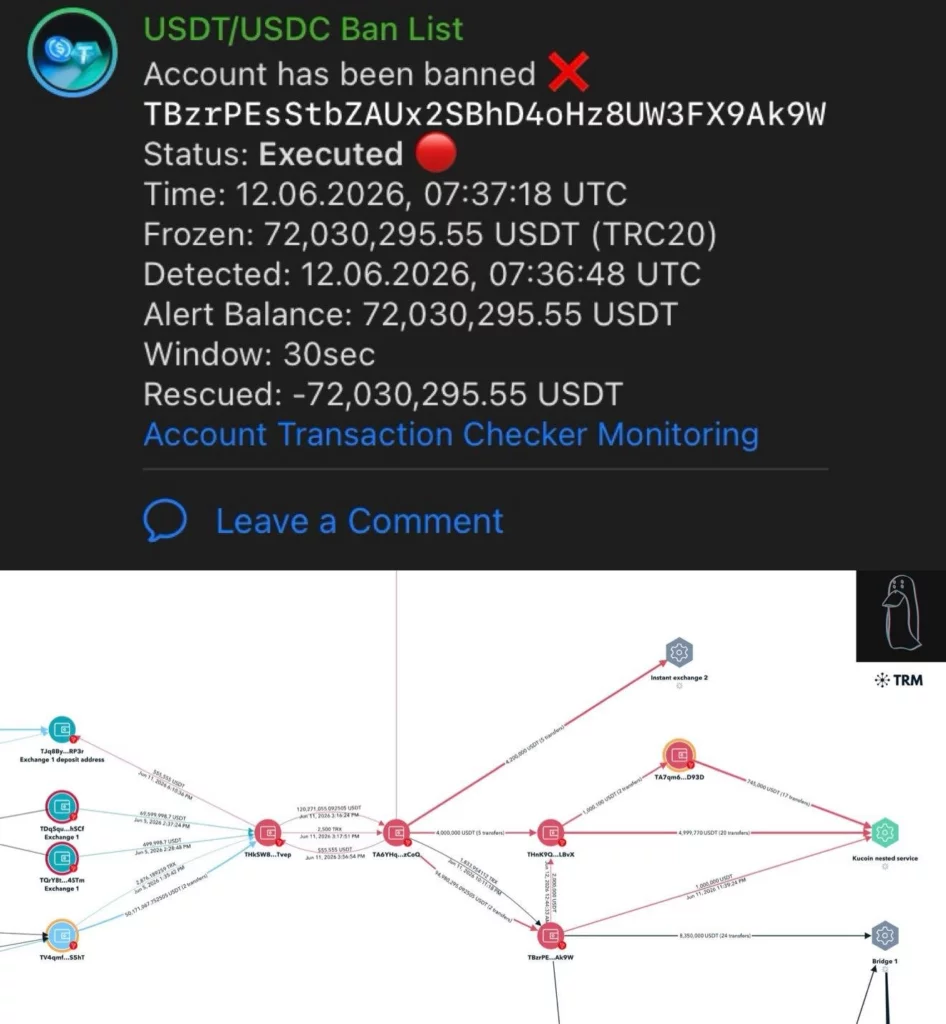
Tether froze more than $72 million in USDT on Tron after ZachXBT linked a large wallet to recent Monero buying and a sharp XMR price spike.
Summary
- ZachXBT traced 120.2 million USDT moving through Tron, KuCoin, instant exchanges, Near Intents wallets.
- Tether froze 72.03 million USDT on Tron after a related address was blacklisted Friday morning.
- XMR traded near $357 after surging toward $438, keeping privacy-coin liquidity in focus today Friday.
ZachXBT traces $120M USDT wallet
On-chain investigator ZachXBT said a Tron address received 120.2 million USDT on June 11 before moving funds across exchanges and cross-chain routes. The address was identified as TA6YHqB2xh5HhfmC7WoLQaWmqq7Vv4zCoQ.
The funds later moved in several directions. ZachXBT said more than $12 million went to KuCoin deposit addresses, while $8 million moved to instant exchanges.
Another $8 million was bridged from Tron to Bitcoin and Ethereum through Near Intents. The activity drew attention because it happened before and during a strong move in Monero.
“Yesterday (June 11) TA6YHqB2xh5HhfmC7WoLQaWmqq7Vv4zCoQ received 120.2M USDT on Tron and began transferring $12M+ to Kucoin deposit addresses and $8M to various instant exchanges,” said ZachXBT.
Monero orders linked to XMR spike
ZachXBT said the same entity created large Monero orders. He linked those orders to a sharp XMR move from $330 to $420.
“The entity created Monero orders which caused the XMR price to spike from $330 -> $420,” said ZachXBT.
Monero later traded near $357.20, according to crypto.news market data. XMR recorded a 24-hour trading range between $345.09 and $438.06, showing how wide the move became.
The token’s 24-hour trading volume stood near $291.3 million, while market capitalization was around $6.7 billion. XMR was still up over 3% on the day and almost 10% over seven days.
The move added fresh attention to Monero’s market depth. Large orders can move XMR quickly because the asset has less exchange access than many top tokens.
Tether freezes related Tron address
ZachXBT said Tether later blacklisted a related Tron address holding about 72 million USDT. Whale Alert data showed 72,030,295 USDT frozen on Tron on June 12.
“A few minutes ago Tether blacklisted an address directly related to Ta6YHq with 72M USDT: TBzrPEsStbZAUx2SBhD4oHz8UW3FX9Ak9W,” said ZachXBT.
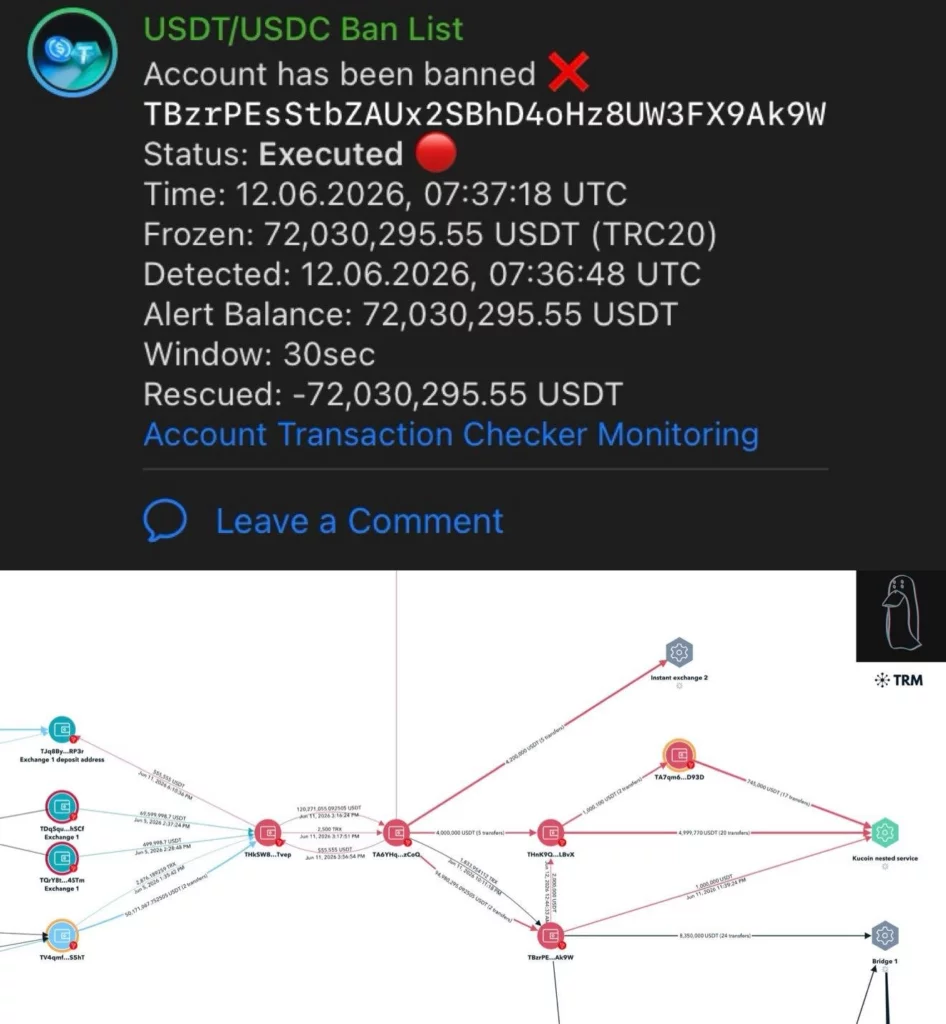
The freeze shows how issuer-controlled stablecoins can be halted at the token contract level. This makes USDT different from assets like Bitcoin or Monero, where issuers do not control transfers.
As previously reported by crypto.news, Tether froze about $515 million in USDT across Ethereum and Tron over a 30-day period in May. Tron accounted for most of those frozen balances.
Monero rally follows earlier demand
The wallet activity came after Monero had already seen stronger market attention. As previously reported, XMR rose above $350 after double-digit daily gains on June 11.
That earlier move was tied to privacy-coin demand, Cake Wallet’s Passport Prime integration, and renewed attention around Monero security audits. The latest ZachXBT report added a separate liquidity-driven angle.
Monero remains one of the largest privacy coins by market value. Its design hides transaction sender, receiver, and amount details by default, which makes it attractive to privacy users and harder for investigators to track.
The latest price action now leaves traders watching whether XMR can hold above the $350 area. A return toward $400 would keep the breakout debate alive, while loss of support could show that the spike was driven mainly by short-term order flow.


TRM Labs has tied four cryptocurrency addresses to live scams targeting 2026 World Cup fans, spanning fake ticket sites and a fixed-match betting scheme as matches play out across North America.
The blockchain intelligence firm says wallets associated with the operations have received less than $1,700 combined so far. However, it warns that scam volume and frequency could ramp up.
How World Cup Demand Fuels Crypto-Based Scams
Major sporting events create concentrated demand spikes for tickets, travel, and merchandise. Scammers build that timing into their planning, seeding fake infrastructure weeks ahead, then promoting it hard near kickoff, TRM research shows.
FIFA-WTO studies estimate that the tournament could draw 6.5 million attendees and add up to $40.9 billion to global GDP. That scale gives fraudsters a deep pool of potential victims.
Watchdogs flagged the risk early. The FBI warned in May about spoofed FIFA websites built to steal personal data and sell fake tickets. The Better Business Bureau echoed the alarm.
Angela Dennis, CEO of the Better Business Bureau of Central Ontario, told reporters why mass demand draws fraud.
“When there is such a mass volume and this high demand, that’s when scammers really get excited because people do fall for the information that they send, whether it’s an email, a phishing email or a text, and having people link to fake sites and providing personal information or payment details to them,” Dennis stated.
Follow us on X to get the latest news as it happens
Inside the On-Chain World Cup Scams
TRM identified several on-chain scam types, led by fake ticketing and fixed-match betting. Fraudulent ticket sites pose as official sellers, list sought-after matches, and demand crypto.
One Polygon (POL) wallet pulled in about $1,562, almost all on April 1. A second operation, tied to a Bitcoin (BTC) address, keeps its phishing page live but has not accepted any payments.
Fixed-match schemes charge an upfront fee for supposed insider results. TRM linked one to a Bitcoin wallet that collected small sums between January and May 2026, then routed them into a custodial account.
A third route runs through tokens. TRM pointed to the $WORLDCUP coin. It trades on LBank as a fan-made commemorative project with no FIFA tie, exposing holders to familiar low-liquidity meme coin losses.
Scammers also lean on bridges to muddy the trail, with TRM counting roughly $1.9 billion in scam funds moved through them over time.
A third scam runs through tokens. A coin called $WORLDCUP trades on the LBank exchange, billed as a fan-made commemorative project with no affiliation with FIFA. Holders face the standard low-liquidity meme coin loss patterns when issuers exit.
“The amounts involved in these cases are modest, but the movement of funds follows patterns commonly seen in consumer crypto fraud,” the report read.
Scammers lean on bridges to move proceeds and complicate tracing. Across all tracked activity, roughly $1.9 billion in scam funds has passed through bridges.
TRM expects to see more typologies as the tournament continues, including gambling pitches, deepfake impersonations of FIFA figures, and fake streaming sites.
Subscribe to our YouTube channel to watch leaders and journalists provide expert insights
The post Crypto Scammers Hit World Cup Fans as Tournament Gets Underway appeared first on BeInCrypto.
TLDR:
- US export control order forced global shutdown of Fable 5 and Mythos 5 models immediately across all users
- Anthropic says restriction stems from alleged jailbreak concern but calls issue narrow and non-systemic in scope
- Other Claude models remain online as company complies with government national security directive requirements
- Firm disputes severity of claims, citing prior red-teaming tests and absence of verified harmful exploits
A US government export control directive has forced Anthropic to suspend global access to Fable 5 and Mythos 5. The order applies to all foreign nationals, including employees outside the United States.
The decision triggered an immediate shutdown of both models across all customer environments. According to internal communication, the directive was issued citing national security concerns tied to potential jailbreak vulnerabilities.
Fable 5 and Mythos 5 Export Control Order Shakes Anthropic AI Access
AnthropicAI confirmed it received the directive at 5:21pm ET from US authorities.
The order required immediate suspension of Fable 5 and Mythos 5 access worldwide. The restriction applies even to foreign national staff working within the company.
The company stated compliance was mandatory under export control rules.
As a result, it disabled both models across its infrastructure. Other Claude models remain fully operational without restriction.
The announcement highlighted that the directive affects users across all regions. Customers outside the United States lost access at the same time as domestic users. The scope of the order reflects broad national security classification.
Anthropic noted the shutdown was abrupt and not pre-planned.
Engineering teams executed global deactivation procedures shortly after receiving the notice. Service disruption affected enterprise users and developers relying on the models.
Fable 5 and Mythos 5 Security Concerns and Jailbreak Claims Explained
The directive reportedly stemmed from concerns about a potential jailbreak method targeting Fable 5.
Authorities believed the technique could expose cybersecurity-related capabilities under certain conditions. The company reviewed the same demonstration internally.
Anthropic stated the identified issue involved narrow vulnerabilities already seen in other models. It added that similar weaknesses could be reproduced using publicly available AI systems. The company did not identify evidence of a universal jailbreak.
Internal assessments showed safeguards were tested extensively before release.
The models underwent thousands of hours of red-teaming with external partners. These included government-linked AI safety institutes and third-party evaluators.
According to Anthropic, no verified harmful deployment resulted from the reported vulnerability. The company said it had not received documentation of a broad exploit affecting model safety systems. It described the issue as limited in scope and non-systemic.
Despite disagreement with the directive’s severity, Anthropic complied with legal requirements.
The firm emphasized ongoing discussions with regulators to restore access. It also reaffirmed that other models remain unaffected and continue operating normally.


Bitget has secured registration in Argentina as a Virtual Asset Service Provider, adding another regulated market to its Latin American footprint as crypto adoption in the country approaches 20% of the population.
Summary
- Bitget has secured Virtual Asset Service Provider registration in Argentina, extending its regulated presence across Latin America.
- Argentina’s crypto market now includes nearly 20% of the population and more than 15,000 businesses that accept digital asset payments.
- The approval comes as Bitget continues expanding tokenized stock and real world asset products across its exchange and wallet ecosystem.
According to a press release shared with crypto.news, Bitget has been added to Argentina’s Virtual Asset Service Provider registry maintained by the National Securities Commission, known locally as the CNV.
The registration allows the exchange to operate within the country’s existing framework for crypto service providers while complying with oversight requirements tied to anti-money laundering and counter-terrorism financing rules.
As part of the registration, Bitget will be subject to reporting and compliance obligations before Argentina’s Financial Information Unit and other relevant authorities. The approval comes as policymakers across Latin America continue building formal rules for digital asset businesses operating in their jurisdictions.
Argentina has emerged as one of the region’s busiest crypto markets, with company data indicating that nearly 20% of the population uses digital assets and more than 15,000 businesses accept crypto payments. Growing participation has turned the country into a key destination for exchanges seeking expansion opportunities across Latin America.
“Regulatory frameworks for digital assets continue developing across Latin America, making compliance and registration increasingly important for platforms operating in the region,” said Gracy Chen, CEO of Bitget.
“Argentina represents an important market within Latin America’s broader digital asset landscape, and Bitget remains focused on supporting sustainable growth by aligning with local regulatory requirements.”
Argentina adds to Bitget’s regional expansion
Coming shortly after regulatory progress in Mexico, the Argentina registration extends Bitget’s presence in markets where crypto adoption and regulatory development are advancing at the same time.
Recent months have also seen the company deepen its focus on products that connect digital assets with traditional finance. Earlier in June, Bitget enabled 15 tokenized stocks and exchange-traded funds, including Apple, Nvidia, Tesla, Microsoft and Amazon-linked assets, to be used as collateral for USDT-margined futures trading through its Unified Trading Account system.
At the time, Chen said users were looking for more ways to put tokenized assets to work across different trading activities as demand for blockchain-based financial products continued to grow.
A separate announcement from Bitget Wallet on June 9 expanded the company’s tokenized asset infrastructure further. The wallet introduced support for direct trading of tokenized real-world assets through its DEX Aggregator API, allowing partner platforms to route trades from cryptocurrencies into tokenized stocks without requiring separate trading systems.
According to Bitget Wallet, the upgrade introduced an RFQ-based routing model designed to secure liquidity before transactions reach the blockchain. Initial integrations included Ondo Finance and xStocks, two of the largest participants in the tokenized asset sector.
Bitget Wallet also reported that its ecosystem now offers access to more than 300 tokenized products spanning equities, commodities, precious metals and other financial instruments. Company figures further show that Bitget’s tokenized equity products have generated more than $30 billion in trading volume since 2025.

Two Star Trek Legends Rip Their Worst Movie Apart

The five emerging interior trends you need to know for the rest of the year

GOF: Lower Your Return Expectations, Not Your Conviction


-

 NewsBeat5 days ago
Alexander Zverev wins the French Open to finally earn a 1st Grand Slam title
-
 Entertainment6 days ago
The Best Mystery Series of All Time Is Surging on Streaming 30 Years After It Ended
-

 Crypto World5 days ago
Anatomy of the June crypto crash: Fed, Iran, Saylor
-

 Crypto World2 days ago
Oppenheimer backs SpaceX as $70 billion retail frenzy builds
-

 Crypto World2 days ago
Markets Rally as SpaceX IPO Looms Amid Iran Tensions and Inflation Surge
-
Crypto World7 days ago
Senator Cynthia Lummis Calls CLARITY Act the Most Consequential Financial Legislation of This Generation
-
 NewsBeat6 days ago
Alexander Zverev conquers demons and outlasts Flavio Cobolli to win French Open for first major title
-

 Tech6 days ago
Microsoft unveils seven homegrown AI models in new bid for ‘long term self-sufficiency’
-

 Tech7 days ago
Hackers now exploit SolarWinds Serv-U flaw to crash servers
-

 Business5 days ago
High Stakes for Wembanyama as New York Pushes for 3-0 Lead
-
 Business6 days ago
The Pain Points Taking a Fragile Tech Rally Down a Notch
-

 Tech5 days ago
Notion restores access to Anthropic after service disruption
-
 Crypto World5 days ago
Eli Lilly (LLY) Stock Surges 4% Following Breakthrough Sleep Apnea Trial Results
-
 Business6 days ago
The investment to transform historic St Helen’s ground in Swansea
-

 Crypto World6 days ago
Trump’s AI Ownership Plan Could Benefit Anthropic at OpenAI’s Expense
-
 Sports4 days ago
Bangladesh beat Australia after 20 years in ODIs, register only their second win over six-time world champions | Cricket News
-

 Business7 days ago
Forensic Expert Floats Handyman Theory in Disappearance of Savannah Guthrie’s Mother
-

 Tech6 hours ago
NanoClaw integrates JFrog registries to secure AI agent downloads
-

 Tech17 hours ago
This Week In Security: Microsoft On Microsoft, Register Your Domains, Linux On ARM, And FreeBSD Joins The File Cache Club
-

 Politics2 days ago
Politics Home | Healey Resignation Is “Colossal Failure Of Government”, Says Former Labour Defence Secretary
You must be logged in to post a comment Login