
Crypto World
Tether Clears First Full Audit as KPMG Issues Unqualified Opinion on 2025 Statements


The entity behind the world’s largest stablecoin has announced that KPMG U.S. issued an unqualified audit opinion on the financial statements of Tether International, S.A. de C.V. for the year ended December 31, 2025. This is the first full financial statement audit in the history of the company behind USDT.
An unqualified opinion carries no reservations, exceptions, or caveats, and is the strongest conclusion an independent auditor can reach. This means KPMG examined the balance sheet, income statement, statement of changes in equity, and cash flow statement under US generally accepted accounting principles, with each area subject to independent substantive testing. The audited statements report reserves exceeding liabilities by $6.81 billion.
KPMG physically counted and inspected every individual gold bar Tether holds, verifying its existence and identifying information. Tether said the procedure went beyond the reports supplied by custodians and counterparties.
The Attestations And The Audit
Tether has provided regular independent attestations of its backing assets for years, but an attestation just checks reserves at a point in time, while the KPMG engagement covered the full financial statements.
Back in 2022, BDO Italia replaced MHA Cayman on the reserves reports, a move Tether called “the next step in the company’s path toward a complete audit.” BDO still prepares the quarterly reports, among them the Q1 2026 attestation showing a record $8.23 billion excess reserve buffer.
Tether had also completed a SOC 2 Type 1 examination covering IT and security controls in 2024, but that examination stopped at the controls and never reached the financial statements.
Moreover, those quarterly figures sit outside KPMG’s opinion. Tether’s most recent attestation covered the second quarter of 2026 and reported $1.5 billion in net operating profit, roughly $184.6 billion of USDT issued, and more than 146 tons of gold.
Tether’s Long History With Regulators
The Commodity Futures Trading Commission fined Tether $41 million in October 2021, finding the company held sufficient fiat reserves to back USDT in circulation for only 27.6% of the days in a 26-month sample from 2016 through 2018.
The order also found Tether had told customers and the market that every token was backed by an equivalent amount of corresponding fiat currency, while its reserves included unsecured receivables and non-fiat assets.
“For years, some detractors said an audit of Tether could not be completed. They said the Company refused to subject itself to the most rigorous scrutiny. We have once again proven them wrong. Completing our financial statement audit sets a new standard for the industry and reflects the leadership we’ve brought to this market from the start,” said Paolo Ardoino, Chief Executive Officer of Tether.
Tether announced signing with a Big Four auditor earlier this year and described the completed engagement as the largest inaugural financial audit in history.
The post Tether Clears First Full Audit as KPMG Issues Unqualified Opinion on 2025 Statements appeared first on CryptoPotato.

Standard Chartered analyst Geoffrey Kendrick says his $100 UNI target for 2030 now looks too low. Six weeks of Robinhood Chain fees changed his math.
BeInCrypto checked his numbers against on-chain data. The core claim holds up. One supporting figure does not.
What Changed in 6 Weeks for the $100 UNI Target
In a June note, Standard Chartered projected a UNI price target of $100, implying a 37x upside fueled by expansion in decentralized finance (DeFi) assets. Analysts were split back then over the Uniswap fee switch debate and whether burns would ever matter.
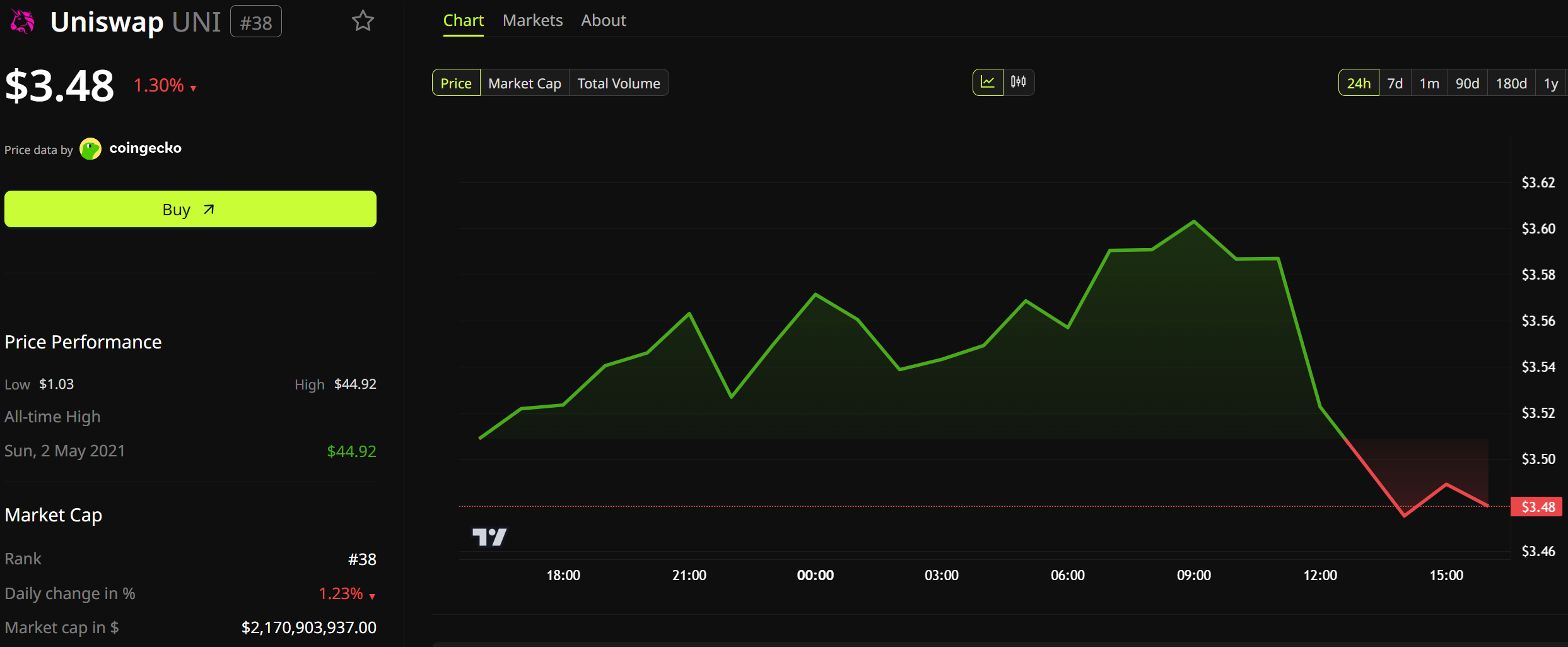
Large wallets have moved since. UNI whale accumulation hit a five-year high this month. UNI was trading near $3.48 on Thursday, down 1.3% in the last 24 hours.

Robinhood Chain went live on July 2. Kendrick wrote to clients exactly 42 days later. Uniswap now handles 76.5% of all trading on the chain, according to DefiLlama data. Its pools moved $409 million in a single day.
That trading throws off fees. Uniswap collected $1.81 million of the chain’s $2.28 million in daily fees, or 78.8%.

Those fees matter because of a change made in December 2025. Uniswap began using part of its revenue to buy and burn UNI, shrinking supply for good.
A second switch covering Robinhood Chain went live on July 27. Burns have doubled since, Kendrick wrote, running at $90 million a year.
That arithmetic holds up. At $3.48 per token, $90 million buys roughly 25.7 million UNI. Circulating supply is 624 million. So the burn rate is 4.1% per year.
The scale shows over time. UNI launched with 1 billion tokens, and about 109 million have been destroyed.
Kendrick called that pace unsustainable. Even at his end-2026 target of $6.50, the burn would still run near 2.2%.
“I fear my 2030 UNI target of USD100 is too low!” Geoffrey Kendrick, Global Head of Digital Assets Research at Standard Chartered, wrote in the latest note.
Follow us on X to get the latest news as it happens
One supporting claim does not check out. Kendrick put Robinhood Chain’s total value locked just under $1 billion.
DefiLlama counts $506.97 million working inside the chain’s apps. A wider measure of everything bridged onto the chain reaches $1.55 billion. His figure sits between the two.
The gap matters less than it looks. Fees come from trading, not from parked money.
Uniswap holds just 16.3% of the chain’s locked value, with lending vaults holding most of the rest. Yet it takes nearly four-fifths of the fees.

The Same 6 Weeks Brought a Fight Over That Volume
Uniswap launched Pools.trade on the same chain on August 5. It lets anyone create a token and send it straight into Uniswap pools.
Creators pick a four-hour bidding window or an instant launch. Uniswap charges no launchpad fee beyond a 0.25% cut for liquidity providers, while rivals typically take close to 1%.
That undercut drew a response. 0xDeployer, a pseudonymous developer, is building a competing launchpad with SushiSwap.
He accused Uniswap of trying to control the whole stack and is issuing a separate token to fund the effort.
However, the challenger starts far behind. SushiSwap handles 0.45% of Robinhood Chain trading, compared to Uniswap’s 76.5%.
Another developer, 0xbeans, disputed the technical complaint. Uniswap’s v4 code is under a license that blocks commercial copies until June 15, 2027, after which it opens fully.
Hooks, the add-on contracts that customize pools, were never restricted.
The pattern is old. SushiSwap itself launched in 2020 by copying Uniswap’s code and paying traders to move their liquidity over.
Early chain volume leans heavily toward meme coins on Robinhood, where launch venues compete hardest.
So six weeks delivered both the fee flow and a challenger for it. Kendrick’s burn math rests on volume Uniswap does not own.
It rents that volume from traders who can leave. Whether $100 proves too low depends on how long they stay.
The post Standard Chartered Rethinks Uniswap Price Target. “$100 is Too Low” appeared first on BeInCrypto.
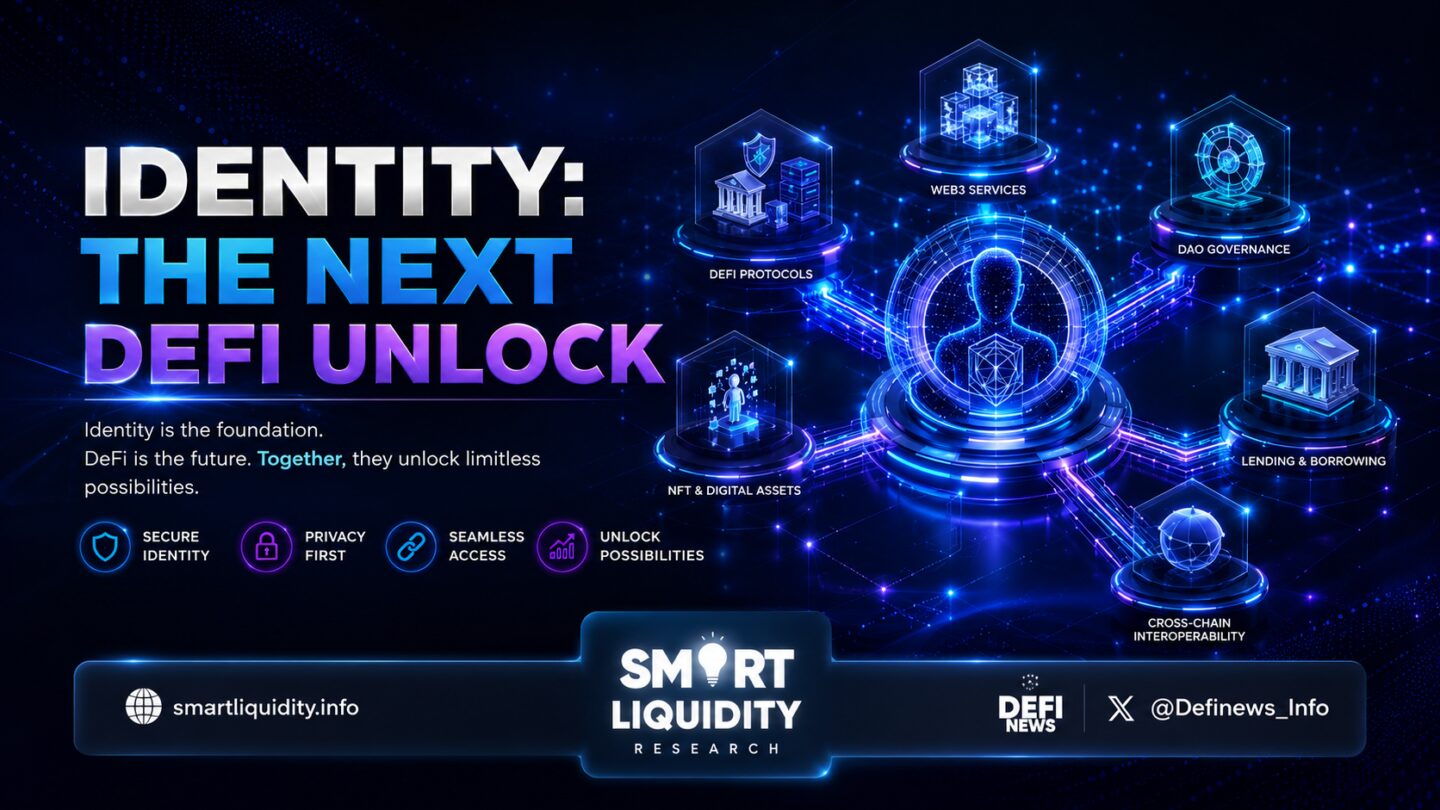
Decentralized finance has transformed how people trade, lend, borrow, and earn without relying on traditional financial intermediaries. Yet one major limitation remains: most DeFi applications know what a wallet owns, but not who or what is behind it. That could change—and identity may become the key to unlocking DeFi’s next major market.
Today, permissionless access is one of DeFi’s greatest strengths. However, it also creates challenges for credit, reputation, compliance, and institutional adoption. Without a reliable way to establish trust, many financial products remain overcollateralized or limited to users willing to operate entirely anonymously.
On-chain identity could introduce a new layer of financial context. Instead of simply evaluating a wallet based on its current assets, protocols could consider verifiable factors such as transaction history, repayment behavior, credentials, business activity, or reputation. Importantly, this does not necessarily mean exposing personal information publicly. Zero-knowledge proofs and privacy-preserving identity systems could allow users to prove specific facts without revealing unnecessary details.
This could create entirely new DeFi markets.
For example, undercollateralized lending could become more practical if borrowers can demonstrate a trustworthy financial history. Businesses could access decentralized credit based on verifiable performance rather than simply depositing large amounts of collateral. Insurance protocols could price risk more intelligently, while institutions could participate in on-chain markets with stronger compliance and identity frameworks.
The opportunity extends beyond lending. Tokenized real-world assets, payroll, decentralized credit scoring, private markets, and cross-border financial services could all benefit from portable digital identity.
The challenge is finding the right balance. DeFi was built around user control, openness, and censorship resistance. An identity layer that becomes invasive or centralized could undermine those principles.
The winning model may therefore be identity without unnecessary exposure: users control their credentials, protocols verify what matters, and sensitive information remains private.
If DeFi can combine permissionless infrastructure with privacy-preserving reputation and identity, the next wave may move beyond simply proving what you own toward proving why you can be trusted. That could dramatically expand the addressable market for decentralized finance.
REQUEST AN ARTICLE
Mad Money host Jim Cramer said the AI data center trade is reclaiming market leadership. He named six stocks leading the rally, and every one of them closed higher on Wednesday.
The group had trailed financials, healthcare, and retail for weeks. Cramer said a run of developments in recent days has restored his confidence in AI infrastructure names.

Why the AI Data Center Trade Stalled
Cramer said the once-hot AI infrastructure names began cooling in late June. The slide then ran through most of July.
“This group has languished while the financials, the healthcares and the retailers rocked,” he said.
Each of the six rallied sharply before the gains reversed, for some in early May and for others in June. All then trended lower through late July. CoreWeave (CRWV) dropped 56% across that span.
Super Micro Computer (SMCI) fell 53%, and Nebius (NBIS) lost 48%. Lumentum (LITE) shed 43%, and Intel (INTC) fell 42%. The Nasdaq 100 declined by just 11%.
The turn arrived with the forced unwind of Situational Awareness. Wednesday’s session is further proof of the regained strength.
Nebius led with a 34.14% gain. CoreWeave added 19.28% and Supermicro 19.02%. Lumentum rose 13.63%, Intel 3.32%, and Nvidia (NVDA) 3.03%.
“I cannot stress enough how important today’s session was,” Cramer added.
Follow us on X to get the latest news as it happens

What Restored Cramer’s Confidence
Cramer noted that prices still sit below their peaks but now “seem primed to go higher.” He pointed to a cluster of recent events that suggested the pressure had passed.
- Intel drew enough investor demand to lift its stock offering to $20 billion from $15 billion.
- He said Supermicro and Lumentum reported better-than-expected results, followed by Nebius. Worth noting that Supermicro missed revenue estimates.
- CoreWeave’s results, he said, offered evidence that older Nvidia GPUs hold value longer than skeptics expected
- Finally, Wednesday’s inflation print eased the rate pressure weighing on growth stocks.
How the 6 AI Data Center Stocks Have Performed in 2026
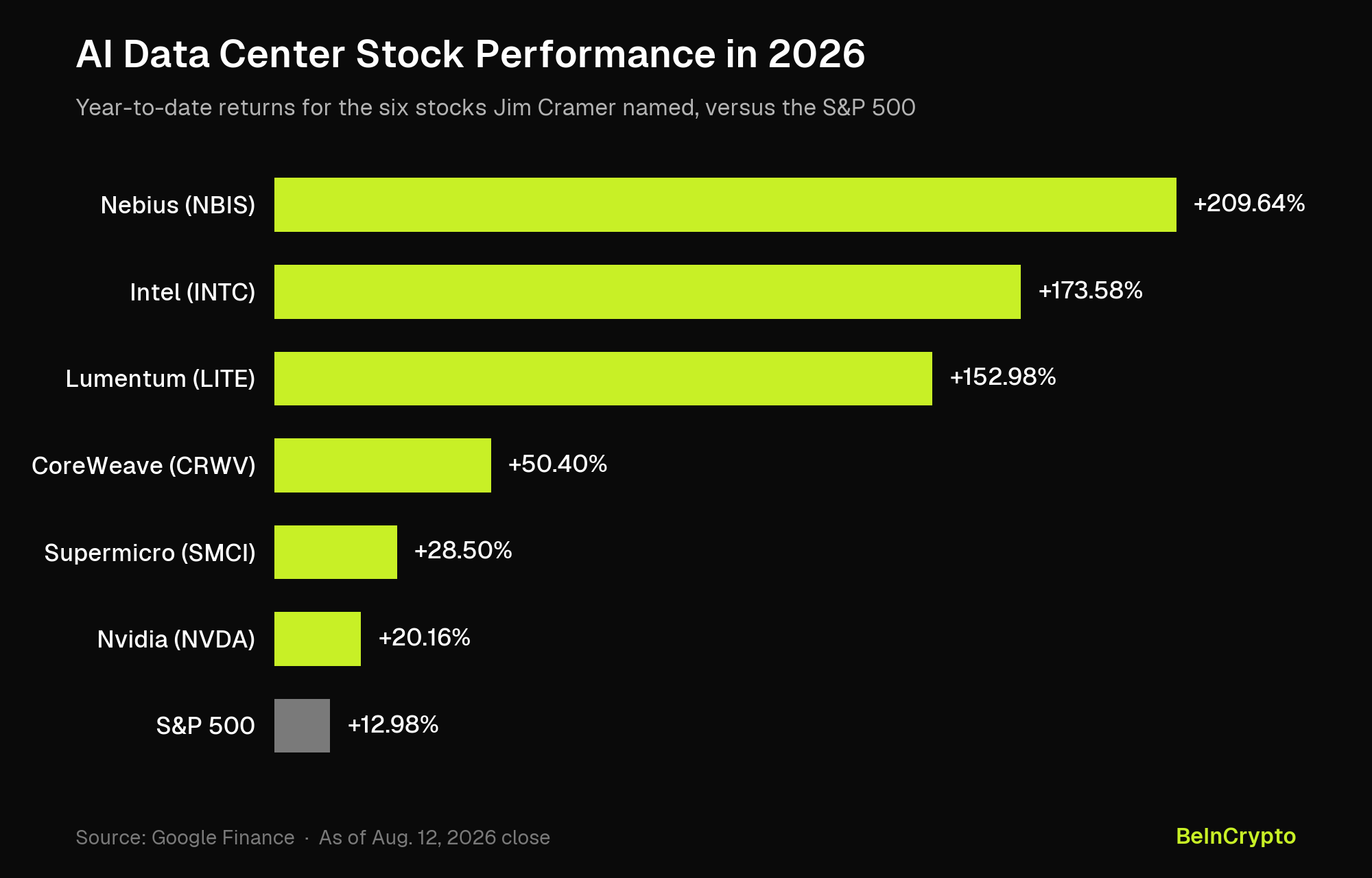
Notably, all six are beating the S&P 500 this year. The index has gained 12.98% year-to-date, according to Google Finance data.
Nebius leads the group at 209.64%, followed by Intel at 173.58% and Lumentum at 152.98%. CoreWeave is up 50.4%, Supermicro is up 28.5%, and Nvidia is up 20.16%.
“This morning, the rockets went off and the fabled six fighting bulls, Supermicro, Nvidia, Intel, Nebius, Lumentum, and CoreWeave, tore out of their pens and proceeded to trample the non-believers who didn’t realize that you’re taking your life in your hands when you bet against these companies,” Cramer said.
The question now is how long the run lasts and whether the six can reclaim their highs.
Subscribe to our YouTube channel to watch leaders and journalists provide expert insights
The post Mad Money’s Jim Cramer Says These 6 AI Stocks are Primed to Surge appeared first on BeInCrypto.

Bitcoin mining stocks have been on a run in 2026, with Riot Platforms, Hut 8, Bitfarms, and Core Scientific posting some of the group’s biggest year-to-date gains, according to a CryptoQuant chart analyst Maartunn shared on X covering trading from January through July.
The move has less to do with mining Bitcoin itself and more to do with miners repositioning as power and data center suppliers for AI companies, reflecting a change in how the market is pricing these stocks.
The Chart Behind the Rally
Maartunn’s chart put Riot’s year-to-date gain at 83% through late July, with Hut 8 up 72%, Bitfarms up 50%, and Core Scientific up 31% over the same stretch.
“It’s a race for power, grid access, and AI-ready infrastructure,” Maartunn wrote, arguing the sector has moved past pure hashrate competition.
That framing lines up with what’s happened since. On August 11, Bloomberg reported that Anthropic agreed to pay Riot $9.1 billion over 20 years for 191 megawatts of computing capacity at its Rockdale, Texas site, enough to power roughly 143,000 homes.
Riot’s shares jumped 24% in after-hours trading on the news, even after closing the regular session down more than 5% and posting a $237 million quarterly loss.
IREN, another miner chasing the same trend, climbed close to 10% this week after landing a $3.4 billion cloud contract with Nvidia, part of its own shift from mining into AI cloud services. Maartunn’s numbers only run through late July, though, while the market data available this week runs through August 12, and the two datasets don’t line up perfectly.
By that more recent close, Riot’s year-to-date gain had settled near 60%, still strong but down from the 83% cited in the July chart, with shares trading around $20. Hut 8 pushed further to a roughly 98% gain, near $91 a share. Core Scientific extended its climb too, up 43% year-to-date and trading near $21.
Others showed more modest upticks, including CleanSpark, which, at the time of writing, was around $12, up 20% this year, and IREN, whose shares were trading near $44, a 16% jump since the start of the year. MARA, the largest publicly traded miner, was about $10, with a much smaller 7% YTD gain.
But not everyone in the sector is celebrating, as data from Yahoo Finance shows Bitdeer, Argo Blockchain, and Canaan are down about 20%, 24%, and 71% in the same period when their counterparts printed green.
Where the Money for This Is Coming From
MARA’s results show why miners are looking elsewhere. In its August 6 shareholder letter, the company reported Q2 revenue of $174.9 million, down 27% year over year, and a $611.3 million net loss. It also sold 2,213 BTC during the quarter while continuing to invest in new infrastructure.
But that does not mean mining is disappearing, with analyst Shanaka Anslem Perera noting on July 6 that the network absorbed a large miner exit after public firms, including MARA, CleanSpark, Riot, Cango, Core Scientific, and Bitdeer, sold more than 32,000 BTC in the first quarter of 2026 and put that money into AI contracts worth an estimated $70 billion industry-wide.
The pivot briefly knocked Bitcoin’s network hash rate down about 4%, the first drop in six years, before difficulty adjustments restored profitability and the network kept producing blocks on schedule.
The post Bitcoin Mining Stocks Rise as Industry Chases AI Infrastructure appeared first on CryptoPotato.
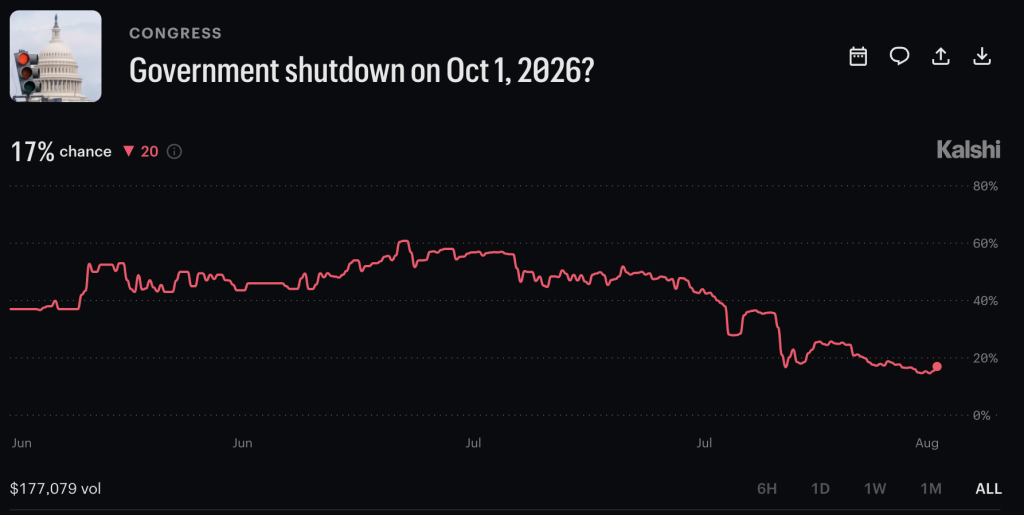
Kalshi’s contract on US government shutdown odds in 2026 priced YES at roughly 17% in early August; by October 1, 2026, it had dropped steeply from about 64% a month earlier.
That repricing arrived as Senate negotiators closed in on a stopgap funding deal. Since then, the Senate has gone further, passing its stopgap funding bill 90-6 on August 8 and extending its proposed funding runway through December 11.
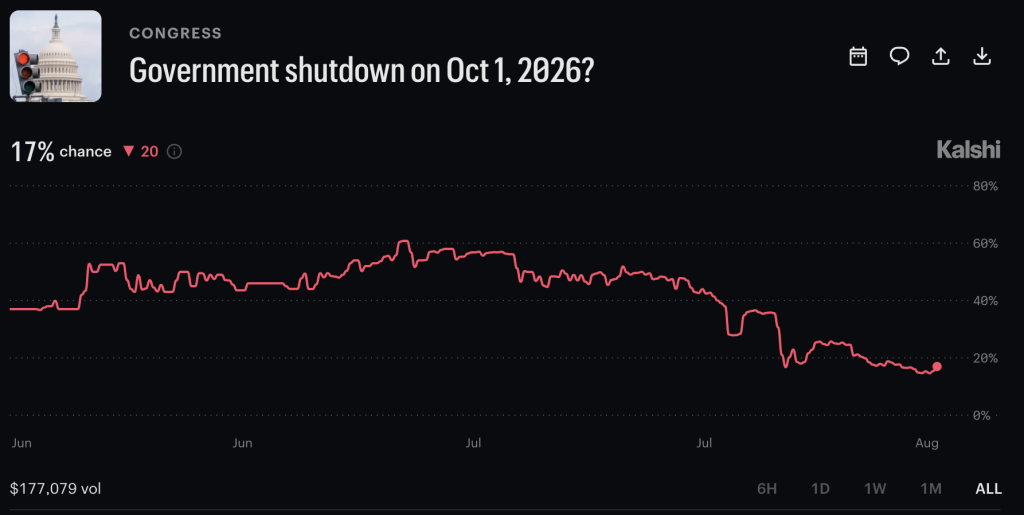
For traders running fiscal risk into crypto positioning, the question isn’t whether the earlier 25% reading was precisely right at any given hour. It’s whether the direction of travel, sharply lower odds of an imminent lapse, actually removes the macro overhang that Bitcoin desks have been pricing into risk-off scenarios, or simply pushes the same fight to a worse date on the calendar.
Discover: Everyone’s Got a Take. Join Kalshi and Get a Free $25 to Actually Trade Yours
US Government Shutdown Odds 2026: What Moved The Market
The catalyst was legislative, not speculative. Senate appropriators initially worked toward a continuing resolution that would fund the government beyond the September 30 deadline, while negotiating limits on a pending Office of Management and Budget rule that would let political appointees block already-approved spending.
Those negotiations have now produced legislation. The Senate approved a continuing resolution 90-6 that would fund federal agencies through December 11 at largely current levels while temporarily blocking the administration from finalizing the proposed OMB grants rule.
The House has already passed its own stopgap measure, but that version runs only through December 4. Because the chambers have approved different bills, the Senate legislation still needs House approval before it can reach President Trump.
Discover: Your Market Calls Are Worth Something. Start With Free $25 on Kalshi
Why The Price Keeps Disagreeing With Itself
The earlier Kalshi pricing reflected genuine uncertainty about how much weight to put on backroom progress versus confirmed legislative action. No passed Senate continuing resolution existed when the contract initially fell toward 17%.
That distinction matters more than the headline percentage. The Senate has now supplied a much stronger signal than negotiations alone: 90 senators voted for a stopgap extending funding beyond the midterms.
But the October shutdown is not formally off the table yet. The House and Senate have passed different versions, and Congress must still agree on a single measure before the September 30 funding deadline.
Fiscal risk of this kind doesn’t move Bitcoin in a straight line. There’s no direct evidence that the shutdown contract alone drove BTC price action in early August – the more accurate framing is that shutdown odds function as one input crypto desks monitor alongside Treasury bill spreads, dollar liquidity, and risk appetite more broadly, a pattern already visible in how traders position around other macro catalysts like CPI prints.
Don’t Miss Out on Our $1,000 USDT Airdrop on ByBit
The post Shutdown Odds Sink, but December Still Hangs Over Bitcoin appeared first on Cryptonews.
Crypto World
Tether (USDT) says it completed long-promised audit from KPMG, down to counting its gold bars


Tether said in March that it had hired a “Big Four” accounting firm to conduct its first full audit. KPMG is one of the Big Four, the group of accounting giants that also includes Deloitte, EY and PwC and audits many of the world’s largest companies.
KPMG examined Tether’s transactions, systems, valuations, counterparties and ownership records, according to the company. Auditors also physically counted and inspected its gold bars.
Tether has repeatedly promised a full audit while relying on reserve attestations, leaving critics asking why a company of its size hadn’t undergone the same level of scrutiny common among large financial firms.
Concerns about the stability and backing of its USDT token, a key piece of infrastructure for crypto trading and markets, have surfaced from time to time as a potential systemic risk for digital assets. The recurring debate became so familiar in crypto circles that it earned its own shorthand as “Tether FUD.”
The stakes have only grown as USDT swelled to over $180 billion in market capitalization, while Tether has become a major buyer of U.S. government debt for reserve assets.
“For years, some detractors said an audit of Tether could not be completed,” CEO Paolo Ardoino said in a statement.
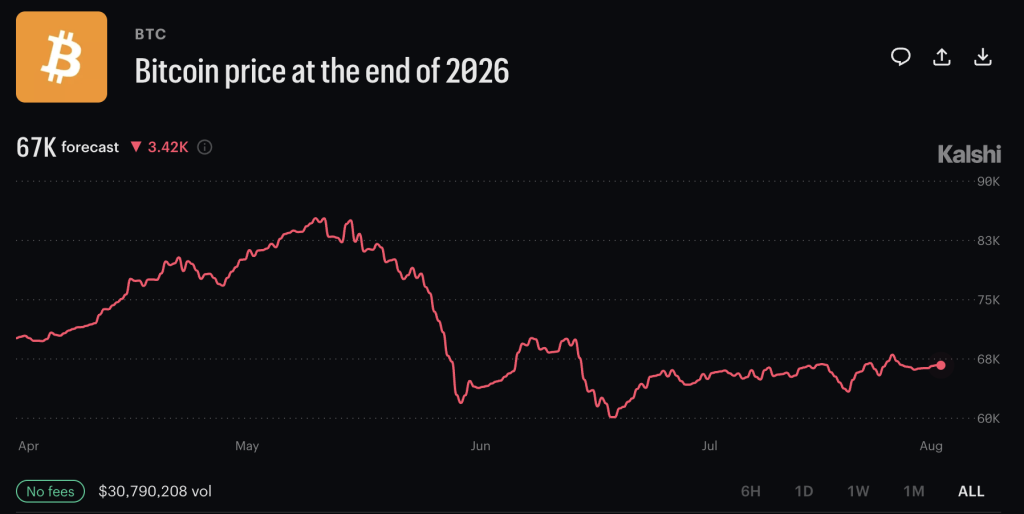
In Bitcoin news today, BTC trades at around $63,500, down -0.6% on the day, sitting in a tight range while the market absorbs a fresh round of corporate treasury noise. Metaplanet CEO Simon Gerovich just killed a rumor that could have spooked holders, and the numbers behind his denial are worth unpacking before assuming this is a non-event.
The Japanese Bitcoin treasury company moved 5,014 BTC (roughly $322M) between custodial addresses over a 24-hour window starting Wednesday, triggering immediate speculation of a sell-off.
Gerovich shut that down directly: “This was a routine custody operation. No bitcoin was sold, and our holdings remain 43,000 BTC.” The entire transfer cost Metaplanet about $8 in network fees, underscoring how cheap it is to move nine-figure sums on-chain when you’re not touching exchange order books.
This clears one overhang, but it doesn’t rewrite Bitcoin’s broader structure. The macro backdrop still matters more than any single treasury’s wallet activity, and traders are right to keep watching whether other public holders face similar scrutiny.
Discover: Your Market Calls Are Worth Something. Start With Free $25 on Kalshi
Bitcoin News: Can BTC USD Hit New Highs This Week?
BTC’s $63,769.56 print with a 0.27% daily gain reflects a market in consolidation rather than a trend. Volume hasn’t shown the kind of spike that typically accompanies a breakout, which suggests traders are waiting on a catalyst rather than forcing direction.
The $63,373 intraday low functions as near-term support; a close below it would open room toward the next demand zone, while reclaiming $64,000 with volume could shift momentum toward retesting recent highs.
Bull case: a clean break above $64,000 on rising volume drags in momentum buyers and squeezes short positioning. Base case: continued range-bound trading between $63,300 and $64,000 as the market digests treasury-company headlines and awaits the next macro print.
Bear case: a breakdown below $63,373 invalidates the near-term structure and reopens downside toward prior support shelves. For deeper technical framing, recent target analysis is worth a look before positioning either direction.
Prediction Market Bettors Give Higher Chance of $40K BTC Over $100K in 2026
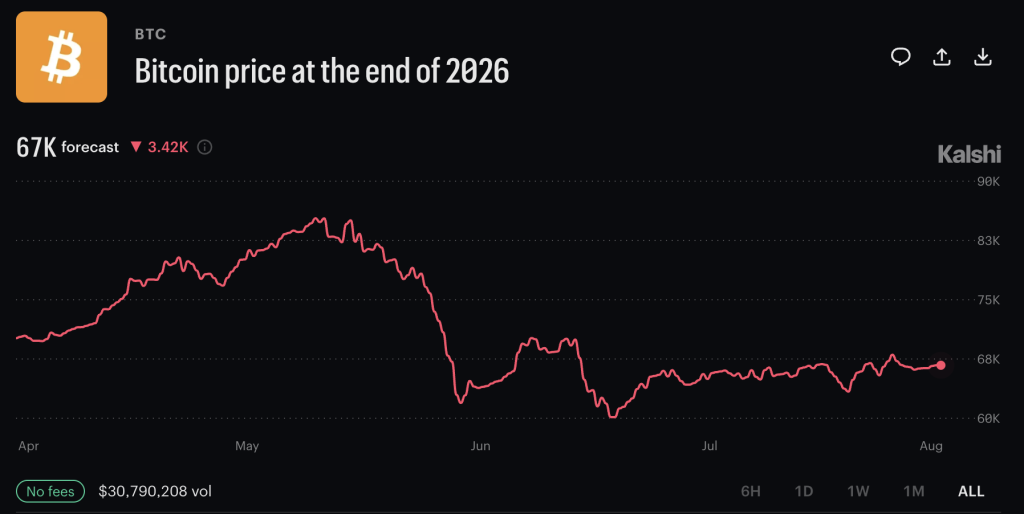
In other Bitcoin news, cryptocurrency bettors are tempering expectations that Bitcoin will reclaim $100,000 in 2026. Kalshi currently assigns only a 1.6% chance of Bitcoin hitting $100,000 and beyond this year, down from a high of 91% in January.
Similarly, chances of BTC reaching $90,000 fell from 71% in early May to 2.5% as of this writing. Interestingly, the odds of Bitcoin moving lower were relatively higher.
Punters have priced in a 20% possibility of Bitcoin declining below $45,000, alongside a 15% chance of a drop below $40,000. Forecasts about Bitcoin’s price action have surged in volume even as the asset struggles through a drawn-out bear market.
Popular market analyst Alessio Rastani predicted Bitcoin would crash to $20,000 by the end of 2027 before making a sharp recovery.
On the other side, Bitwise Chief Investment Officer Matt Hougan said Bitcoin’s refusal to react to bad news, including BTC sales by Strategy and CLARITY Act delays, is one of the clearest signs the cryptocurrency winter is ending.
Discover: Everyone’s Got a Take. Get Free $25 to Actually Trade Yours
This article is not financial advice. Crypto markets are highly volatile. Always conduct independent research before making investment decisions.
The post Bitcoin News: Metaplanet CEO Shuts Down BTC Sale Fears appeared first on Cryptonews.
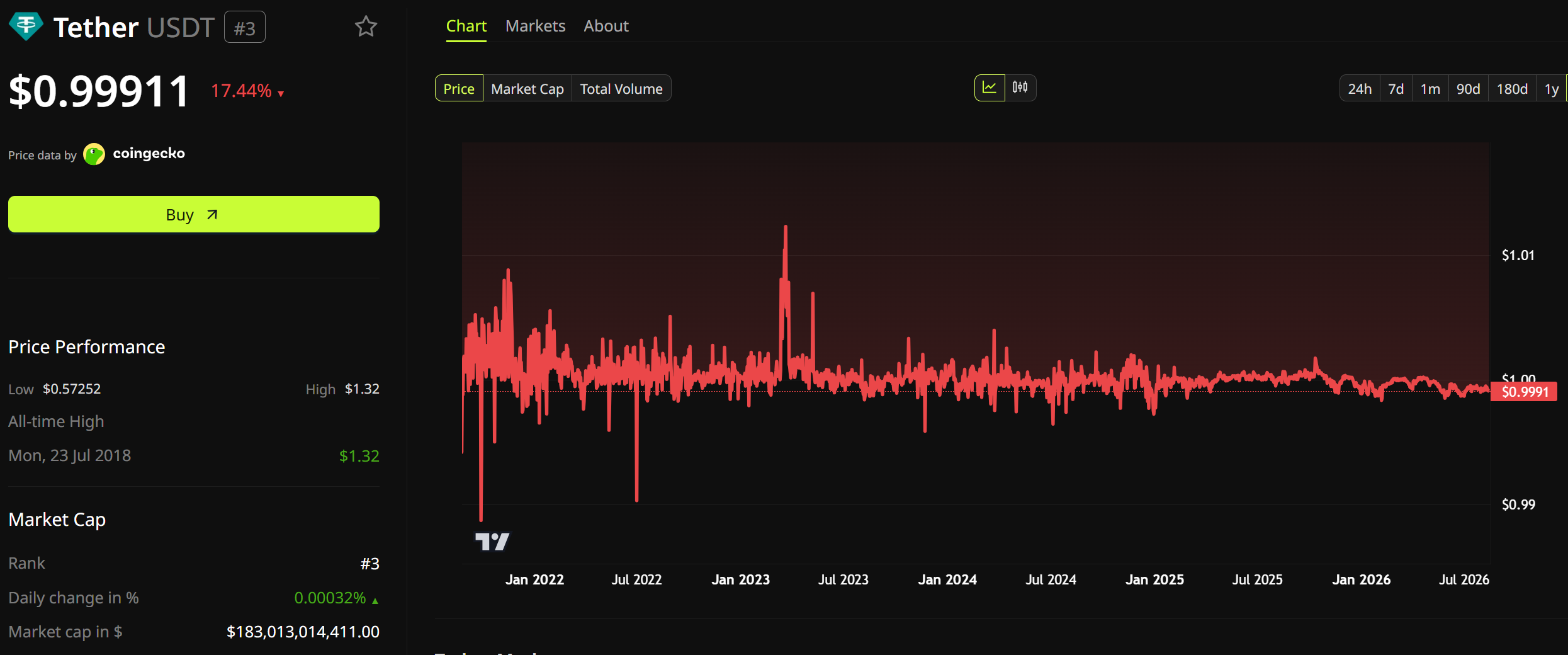
KPMG U.S. has issued an unqualified opinion on Tether’s 2025 financial statements, the first full audit in the stablecoin issuer’s history.
The audited accounts show reserves exceeding liabilities by $6.814 billion as of Dec. 31, 2025. Tether’s own most recent quarterly report puts that buffer at $4.11 billion.
What KPMG Actually Signed Off On
The audit covers Tether International, S.A. de C.V. for the year ended Dec. 31, 2025. An unqualified opinion is the strongest result an auditor can give, meaning no reservations or caveats.
KPMG tested transactions, ownership records, valuations, systems, and counterparties. Its work spanned the full balance sheet, the income statement, changes in equity, and cash flows.
Auditors also counted and inspected every gold bar the company holds, rather than relying on custodian reports.
Tether had spent years defending quarterly attestations from the accounting firm BDO rather than a full audit. It announced the engagement in March, and KPMG was named as its auditor soon after.
“KPMG conducted a full and thorough audit in accordance with AICPA standards – examining the assets, transactions, systems, documentation, and other evidence supporting our financial statements. The result is an unqualified opinion; in other words, it means Tether has a clean audit,” Paolo Ardoino, CEO of Tether, in the company’s statement.
Follow us on X to get the latest news as it happens
The Cushion Has Shrunk Since the Audit Date
An audit opinion is dated, and that date is now almost 20 months old. BDO’s second-quarter report, published July 31, recorded $4.11 billion in excess reserves as of June 30, 2026.
That sits roughly 40% below the figure KPMG verified. The cushion halved in Q2, even as Tether booked about $1.5 billion in net operating profit, suggesting unrealized losses or outflows elsewhere in the reserve.
Bullion is one candidate. Spot gold dropped more than 20% from its January record, and Tether holds gold and Bitcoin alongside Treasury bills. Its tokenized gold token tracks the same metal KPMG counted bar by bar.
What the Clean Opinion Does Not Settle
The audited entity and the attested group are not identical. Tether’s Q4 2025 attestation showed a $6.34 billion surplus for the same balance sheet date, roughly $480 million below the audited figure.
Tether has also not released the statements themselves. Notes, accounting policies, reserve composition, and related-party disclosures would let outside analysts test the numbers instead of accepting a headline.
Nothing in the opinion addresses redemption capacity, liquidity under stress, or counterparty exposure. Those questions carry more weight as the GENIUS Act stablecoin rules, the U.S. framework setting Federal Reserve standards for issuers, take final shape.
Tether’s USDT market capitalization sits near $183 billion, third among all crypto assets.

Tether has cleared the bar, critics said it never would. The harder test arrives with the next attestation, and with whether the company publishes the statements KPMG signed.
The post Tether USDT Gets Largest Audit in History, But One Key Number Has Fallen 40% appeared first on BeInCrypto.
A U.S. crypto industry group is urging the Supreme Court to take up a dispute between Custodia Bank and the Federal Reserve over access to the central bank’s payment system, arguing that federal law limits how broadly the Fed can refuse eligible banks.
In an amicus brief filed Wednesday, the Blockchain Association said the Fed should not have wide discretion to deny payment services to state-chartered banks that meet eligibility requirements. The group also framed Custodia’s case as part of a broader pattern of resistance to crypto banking—referencing regulatory pressure it links to the “Operation Choke Point 2.0” narrative.
Key takeaways
- The Blockchain Association filed an amicus brief supporting Custodia Bank’s petition to the U.S. Supreme Court over Fed master account access.
- The group argues the Federal Reserve should not be able to effectively override eligibility for payment services through broad discretion.
- Custodia’s application for a master account was rejected by the Federal Reserve Bank of Kansas City, and a Tenth Circuit ruling left the Supreme Court as the last option.
- The dispute is unfolding as some crypto firms have obtained federal banking structures and, in limited cases, direct access to Fedwire.
Why Custodia is looking to the Supreme Court
Custodia Bank, a Wyoming-chartered institution focused on digital assets, applied for a Federal Reserve master account in 2020. Such an account is designed to give qualifying banks direct access to payment system services, reducing reliance on intermediary institutions for transfers.
The Federal Reserve Bank of Kansas City denied Custodia’s request in 2023. After that denial, the case moved to the Tenth Circuit Court of Appeals, which ultimately ruled that the regional Fed bank had discretion to reject the application.
Earlier this year, the Tenth Circuit voted 7-3 against rehearing the dispute in March. With the appeals court effectively closing the door, Custodia’s petition to the Supreme Court became its remaining path for review.
The Blockchain Association’s legal argument
The Blockchain Association’s amicus brief argues that the lower court gave the Fed too much leeway in how it interprets its authority. The group contends that federal law requires the Federal Reserve to make its payment services available to eligible nonmember banks.
In the association’s view, the Tenth Circuit’s reasoning risks granting the Fed a de facto veto over state-chartered banks by allowing the central bank to withhold the operational access these institutions would need to function independently.
The filing also connects Custodia’s situation to claims about regulatory discouragement of crypto-related banking activity. Specifically, it links the case to concerns raised under the “Operation Choke Point 2.0” theme, which has been used in parts of the industry to describe alleged pressure that makes it harder for banks to serve digital asset clients.
Notably, the brief’s central emphasis is legal and structural: whether the Fed’s discretion in granting access should be narrowly constrained when a bank meets eligibility requirements.
Access to Fed payment rails is becoming more common—though unevenly
Custodia’s dispute comes at a time when some crypto businesses are making headway into the U.S. banking system through federal licensing, and in certain circumstances, direct links to Federal Reserve infrastructure.
For example, in March, Kraken Financial—an entity tied to the Kraken ecosystem—became the first crypto banking unit to receive a limited-purpose master account from the Federal Reserve Bank of Kansas City. That approval provided direct access to Fedwire. The development stood in contrast to Custodia’s earlier rejection by the same regional Fed bank, highlighting that the legal questions at the heart of Custodia’s case remain highly consequential for other banks pursuing similar access.
Meanwhile, Coinbase has moved through federal chartering pathways tied to custody and trust activities. In April, the company received conditional approval from the Office of the Comptroller of the Currency (OCC) to establish a national trust company, a structure that would bring custody services under federal oversight without allowing retail deposits or operation as a commercial bank. Circle later obtained final OCC approval for a national trust bank in July, and Kraken parent Payward applied for its own national trust company charter the following month.
The OCC has also conditionally approved national trust bank applications for several other crypto-adjacent firms, including Ripple, BitGo, Fidelity Digital Assets, and Paxos in December.
Industry pushback from traditional banking groups
As crypto firms seek federal charters and deeper banking integration, traditional banking associations have argued that these entities can gain benefits associated with bank status without accepting the full set of regulatory obligations applied to conventional retail banks.
In April, the Independent Community Bankers of America opposed Coinbase’s conditional OCC approval for a national trust company, arguing that crypto companies are pursuing the advantages of bank charters while avoiding certain burdens of the traditional banking framework.
This tension underscores a broader theme: even as regulators have created pathways for crypto-related institutions to operate under federal supervision, access to the most central components of the payment system—such as Fed master accounts—still appears to be a contested boundary.
For investors and operators, the Supreme Court decision will matter less as a symbolic victory and more as a potential clarification of how far the Fed can go when determining payment-system access for eligible banks. Until the Court acts, it remains uncertain whether Custodia’s case will reshape the Fed’s discretion or further cement the limits of judicial review over payment rail eligibility decisions.

A security incident at a Trezor shipping provider exposed personal details belonging to 13,689 customers.
The breach affected customers across seven countries, while Trezor confirmed that its wallet systems and devices remain secure.
However, the company warned that exposed details could increase phishing attempts targeting affected users.
Shipping Provider Incident Led to Data Exposure
The incident began after ShipMonk, a shipping provider used by Trezor, suffered unauthorized access to its systems.
As a result, attackers accessed customer information linked to hardware wallet orders processed through the provider.
The exposed information includes names, email addresses, phone numbers, and shipping addresses for some affected customers.
Trezor identified 11,742 customers whose information received full exposure during the incident. Those records included customer names, email addresses, phone numbers, and shipping addresses linked to their orders.
Meanwhile, another 1,947 customers faced partial exposure involving their names, cities, and email addresses.
The affected customers received orders in the United States, the United Kingdom, Sweden, Colombia, Brazil, Italy, or Portugal. Trezor said those orders fell within the 90 days before August 8, 2026, when the incident came to light.
Furthermore, the company contacted affected customers through its official email channel and advised them to remain alert.
Trezor Warns Customers About Phishing Threats
Although the breach exposed personal information, Trezor said attackers did not compromise its internal systems.
The company also confirmed that its hardware wallets remain secure and that customer funds remain protected by wallet security.
Therefore, the incident primarily creates a social engineering risk rather than a direct device security threat.
However, leaked contact and shipping information could help criminals create more convincing phishing messages.
Attackers could combine customer names, addresses, and emails to make fraudulent messages appear linked to Trezor orders. Consequently, affected users could face attempts to obtain wallet credentials, recovery phrases, or other sensitive information.
Trezor customers should therefore avoid links from unexpected messages and verify communications through official channels.
Users should also never provide recovery phrases, because legitimate wallet providers do not require those details.
In addition, customers should treat unexpected calls, emails, and messages as potential attempts to steal wallet access.
Trezor Develops Anonymous Delivery Option
The breach has also pushed Trezor to develop a new Anonymous Delivery option for future customers.
The company plans to introduce the service in the European Union by September and in the United States later.
This approach aims to reduce the personal information connected with hardware wallet purchases and deliveries.
The planned option could allow customers to use nicknames or label identification instead of real names.
It could also support automated parcel lockers, which would reduce the need to provide home delivery addresses.
Furthermore, Trezor plans to offer unbranded packaging with generic sender information for additional privacy.
The move highlights the security challenges that crypto companies face beyond their own technology and wallets.
Shipping partners can hold valuable customer information, which makes third-party data protection important for hardware wallet users.
As Trezor responds to the incident, stronger delivery privacy could help reduce similar exposure in future orders.
The incident also follows a separate Coldcard security incident that raised concerns across the crypto self-custody sector.
Galaxy Research estimated that users lost as much as $116 million in Bitcoin during that incident.
Together, the events highlight how personal data and wallet security can create different risks for crypto users.

Apple TV’s 10-Part Sci-Fi Series Had a Great Premise With One Big Problem

PARKOUR VS MONEY HEIST! 2

High infant formula milk prices are putting babies at risk


-

 Fashion6 days ago
Weekend Open Thread: Mattifying Sunscreen
-

 Fashion6 days ago
Frugal Friday’s Workwear Report: Cap-Sleeve Pointelle Crewneck Sweater
-

 News Videos5 days ago
Can Astrology Help Find Gold and Silver Trends? A Financial Astrology Guide
-

 Tech6 days ago
Rinn Pharma & Biopharma to join NordicPharmaTrain network
-

 Business5 days ago
How to Start a Cleaning Business: A Step-by-Step Guide
-

 Business4 days ago
Datadog: Best Of Breed For Multiple Reasons
-

 Business5 days ago
BDC Weekly Review: Private BDC Q2 Numbers Are Strong
-
 NewsBeat2 days ago
Communication cards help banking customers access services or report scams
-

 Tech7 days ago
Price Hikes May Be Coming for PC Motherboards Next
-

 Business7 days ago
Brightwater secures funding for WA-first dementia projects
-
 Business3 days ago
Oil Price Today (August 11): Crude oil rises to $88 after Trump’s compensation demand dents Hormuz opening. Here’s why
-

 Fashion6 days ago
Weekly News Update, 8.6.26 – Corporette.com
-

 Business7 days ago
Aussie shares lose steam to close record-breaking week
-
 Entertainment7 days ago
Brand New Day’ Characters, Ranked
-

 Fashion7 days ago
The Best Stores Like Ann Taylor
-

 Fashion6 days ago
Irina Shayk Wows in REVOLVE Los Angeles’ Summer Styles
-

 Entertainment7 days ago
Coastal House Media Can Disney Redeem Live Action Dragon Ball?
-

 Fashion6 days ago
Burberry Fall 2026 Takes On Commuter Style
-

 Politics5 days ago
Be quiet, Miriam! – spiked
-

 Fashion4 days ago
Amazon Sundays: Closet Care Before Fall
You must be logged in to post a comment Login