
Crypto World
Tether Made $1.5 Billion in Q2 and Its Reserve Cushion Still Halved

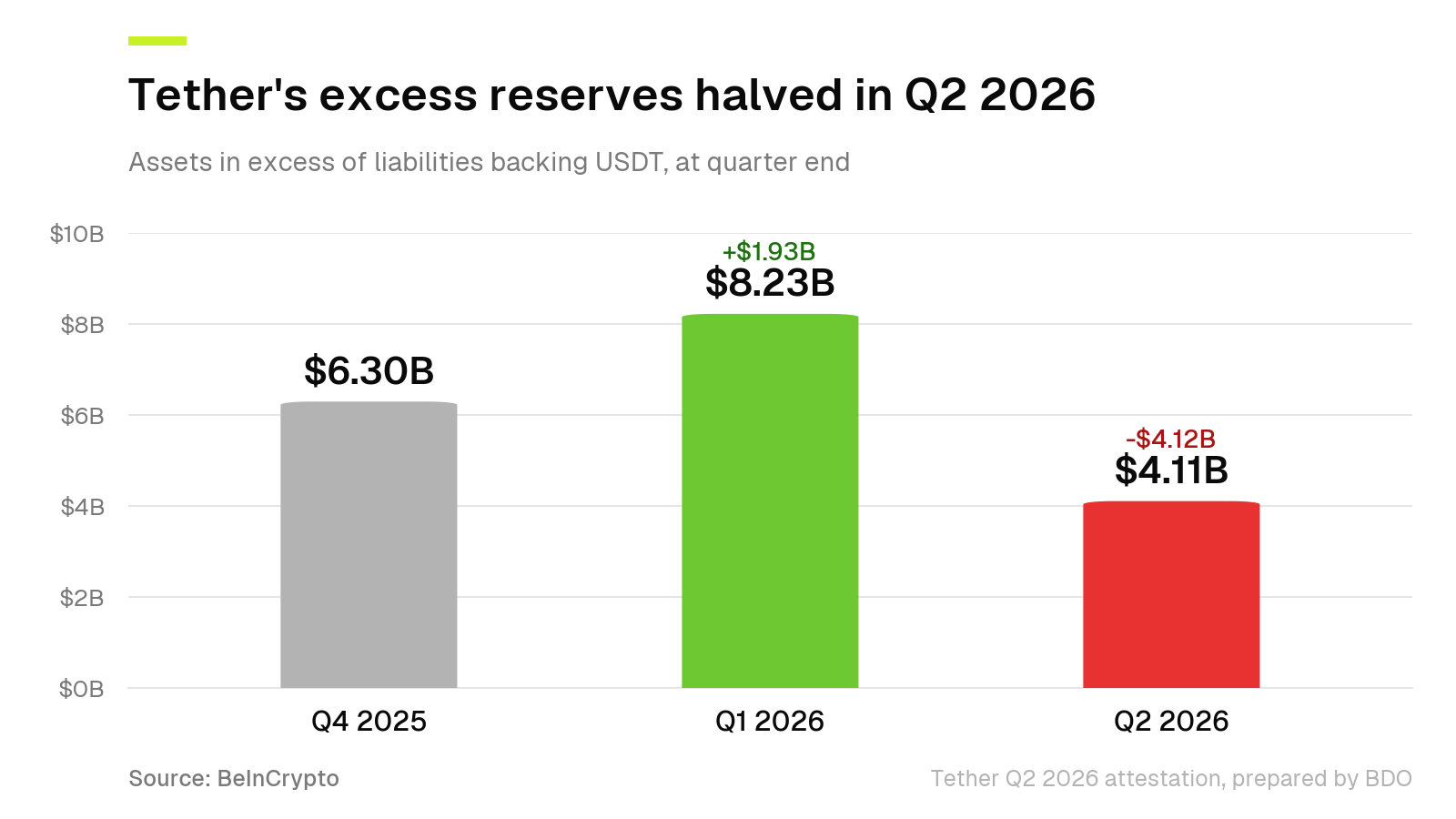
Tether earned roughly $1.5 billion in the second quarter, yet the cushion protecting Tether (USDT) holders shrank by half. Excess reserves closed June at $4.11 billion, down from a record $8.23 billion.
The stablecoin issuer published its Q2 2026 attestation on Friday, prepared by accounting firm BDO. The report confirms USDT stays overcollateralized. It does not explain where more than $5 billion of surplus went.
The Arithmetic the Report Skips
Tether reported total assets of $187.75 billion against liabilities of $183.64 billion on June 30. Three months earlier, assets stood at $191.77 billion.
The asset side therefore fell about $4 billion while token liabilities barely moved. In May, the record Q1 reserve buffer was the company’s headline number.
Add the $1.5 billion earned during the quarter and the gap implies roughly $5.6 billion of unrealized losses or outflows. Tether entered April holding about $20 billion in gold and $7 billion in Bitcoin.
The wording moved as well. The Q1 release reported “net profit.” Friday’s release reports “net operating profit.”
That second measure strips out mark-to-market swings on exactly those assets. Gold and Bitcoin both saw sharp moves during the quarter.
Three Disclosures That Disappeared
Tether’s Q1 report attached a dollar figure to every major asset class. It listed $141 billion in Treasury bills, roughly $20 billion in gold, and about $7 billion in Bitcoin.
Friday’s report attaches none of the three. Gold now appears only as a tonnage count of more than 146 tons.
Meanwhile, Tether’s US Treasury holdings are described as a majority share of reserves. Readers get no figure to compare against the $141 billion disclosed in May.
The company also dropped a boast. In Q1 it noted the buffer alone would rank as the third-largest stablecoin in circulation.
CEO Paolo Ardoino set a different standard in March, when the company hired a Big Four firm.
“Trust is built when institutions are willing to open themselves fully to scrutiny,” the attestation read, citing Paolo Ardoino, CEO of Tether said.
Follow us on X to get the latest news as it happens
The Audit Clock Is Still Running
Tether signed its auditor on March 24. The Financial Times identified KPMG as its auditor three days later. Four months on, Friday’s release says only that the process continued.
That March announcement also stated the group retains earnings instead of paying out profits. If that still holds, distributions cannot explain the decline, which leaves asset values.
Ardoino conceded pressure without sizing it. He said the assets behind part of the reserves came under direct strain during the quarter.
USDT itself never wobbled. The token held its peg near $0.9986 and keeps a third-place market capitalization of $183.5 billion.
Demand held up too, even after Revolut announced a USDT delisting in Europe this month. Tether says it added more than 30 million users during the quarter.
A halved buffer on a $183 billion book is not a solvency event. It is a disclosure question.
At $4.11 billion, the cushion now sits below the $6.3 billion Tether carried at the end of 2025. KPMG will be the first outside party in a position to explain why.

The post Tether Made $1.5 Billion in Q2 and Its Reserve Cushion Still Halved appeared first on BeInCrypto.

Wintermute reported that institutional investors accounted for a record 72% of spot OTC trading volume on its desk in the first half of 2026, up from roughly 61% in the second half of 2024, a structural shift that the firm says makes broad-based altcoin rallies significantly less likely going forward.
The implication is direct: the capital formation mechanism that historically sent profits cascading from Bitcoin into ETH and then down the altcoin long tail is no longer functioning the same way, and retail traders still positioning for an indiscriminate altseason may be running an outdated playbook.
Discover: Everyone’s Got a Take. Get Free $25 to Actually Trade Yours
Wintermute: Capital Is Concentrating, Not Dispersing
Wintermute’s analysis frames the shift as fundamentally about mandate-driven versus speculation-driven capital. Institutional participants operate under defined risk limits and hold positions over longer periods, which means their flow concentrates in assets with demonstrated liquidity, regulatory clarity, and identifiable fundamentals, not in tokens riding narrative momentum.
The report noted that realized volatility has declined from roughly 70% in earlier market cycles to around 45% in the current one, a direct consequence of institutional order flow replacing retail-driven speculation as the marginal price setter.
Lower volatility compresses the explosive upside that defined 2021-style altseasons, but it also reduces the severity of the unwind.
For traders, the operational takeaway is that OTC block flow, executed away from public order books, is increasingly where price direction gets established. Retail participants reacting to exchange order book moves may consistently find themselves a step behind positioning that was set in bilateral institutional trades.
This dynamic is visible in the institutional infrastructure buildout accelerating across major crypto venues.
Discover: Your Market Calls Are Worth Something. Start With Free $25 on Kalshi
RWA Tokenization as the Institutional On-Ramp
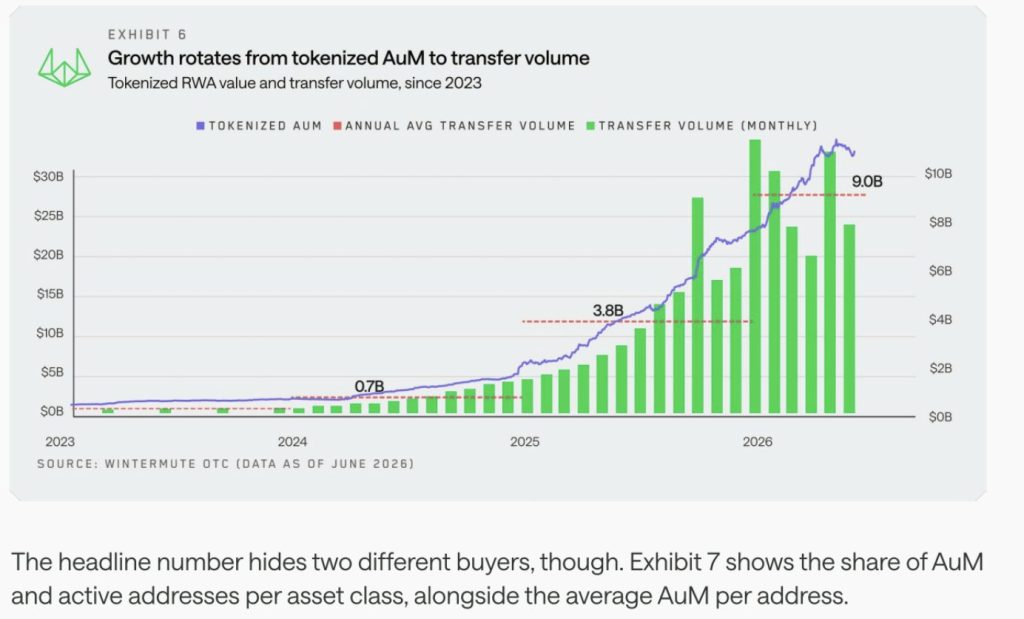
The tokenized real-world asset market reached $31 billion in H1 2026, representing roughly a 50% increase over the prior period, according to Wintermute’s data.
Average monthly transfer volume more than doubled to $9 billion, which signals operational adoption rather than speculative positioning, institutions are moving these assets, not just accumulating them.

The primary instruments attracting institutional capital are U.S. Treasuries, money market funds, and private credit, yield-bearing products where blockchain infrastructure delivers settlement efficiency and programmatic compliance without changing the underlying risk-return profile. This is not institutions chasing crypto-native yield; it is traditional finance running familiar instruments on new rails.
Wintermute also noted that altcoin options notional volume on its OTC desk increased approximately 3.4 times from the second half of 2025 to the first half of 2026, driven by yield-seeking strategies rather than outright directional bets.
Contracts for difference are being deployed across a wider range of tokens for hedging and basket strategies. The derivatives expansion reinforces the same thesis: institutional participants want structured exposure, not raw token speculation. The pattern mirrors broader institutional demand for collateral-grade crypto assets with defined utility.
Discover: Get Paid to Be Right, $25 to Start on Kalshi
The post Wintermute Data Shows Institutional Flow Is Killing Broad Altcoin Rallies appeared first on Cryptonews.
Unlike AI, which has driven a surge in demand for graphics processors to train and run large language models, quantum computing targets a different class of challenges. Researchers say the technology could accelerate molecular simulations, optimize complex logistics networks, advance materials science and improve cryptography.
Krishna said IBM has already demonstrated some of that potential, using quantum computers to uncover properties of materials that conventional computers had been unable to model. Those insights could eventually contribute to longer-lasting batteries, new materials, fusion energy research and drug discovery.
Growing confidence around commercialization has been matched by rising investment. In May, IBM announced plans for a standalone quantum chip foundry backed by a $1 billion commitment from the U.S. Department of Commerce through the CHIPS incentive program, alongside a matching $1 billion investment from the company. Other developers have also expanded manufacturing capacity and research partnerships as they push toward fault-tolerant quantum computers.
The industry’s progress is also drawing attention from the digital asset sector. Several publicly traded bitcoin miners, including MARA Holdings (MARA), Riot Platforms (RIOT) and CleanSpark (CLSP), have diversified into AI and high-performance computing, leveraging their data centers and power infrastructure for new computing workloads.
Quantum computers won’t simply slot into today’s AI data centers. They require entirely different hardware and operating environments, meaning the industry will need new facilities and supply chains as the technology matures.
Bitcoin is still under pressure across the higher time frame despite stabilizing above recent swing lows. While the short-term structure has shifted into consolidation, the broader trend continues to favor sellers unless BTC can reclaim several key resistance levels.
Meanwhile, futures market data shows aggressive market buying beginning to return, potentially laying the groundwork for a relief rally if the price confirms the move.
Bitcoin Price Analysis: The Daily Chart
The daily chart shows BTC trading around $63.3K after its sharp late May breakdown from the $74K region. The selloff pushed the asset well below both the 100-day moving average, currently around $69K, and the 200-day moving average near $71K, leaving the broader market structure bearish.
Since the decline, BTC has entered a sideways consolidation between roughly $60K and $67K. Buyers have repeatedly defended the lower boundary of this range, while the $67K resistance zone continues to cap every recovery attempt.
Beyond the major resistance at $67K, the confluence of the 200-day moving average and the $72K to $74K supply zone is the next potential target, if an upside move materializes. A successful reclaim of those levels would improve the medium-term outlook and could expose the next resistance around $82.5K.
On the downside, immediate support remains around $60K. Losing this level would likely shift attention toward the broader support area around $54K if selling pressure accelerates, which will make the bear market both longer and deeper.
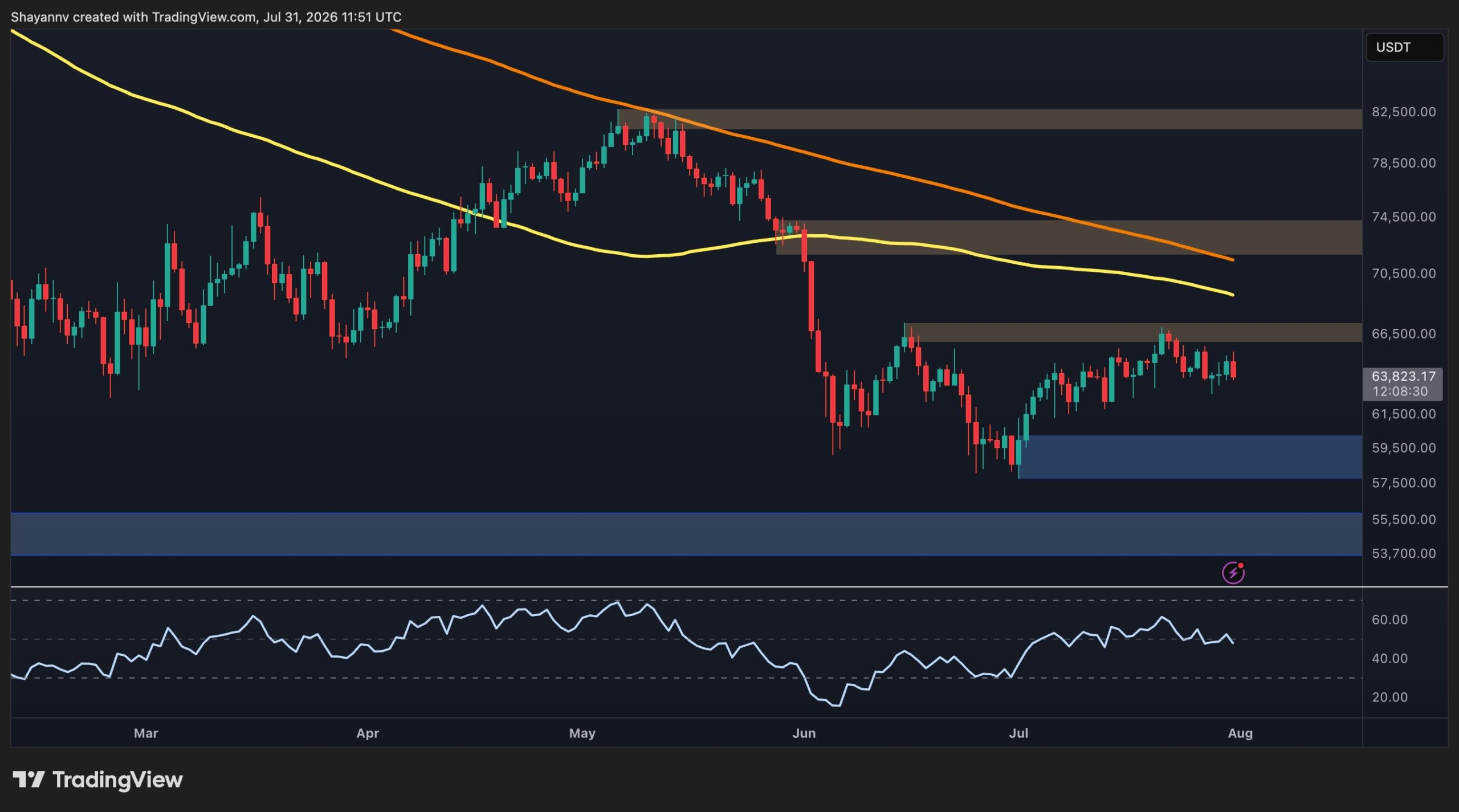
BTC/USDT 4-Hour Chart
The 4-hour timeframe shows Bitcoin consolidating after breaking below a rising channel that had supported the recovery throughout July. The channel breakdown suggests that bullish momentum has weakened and that the recent advance has transitioned into a corrective phase.
The price is currently testing the short-term support around $63K to $63.5K after rejecting the $65K resistance area. As long as this support holds, BTC could continue ranging inside this zone or potentially have another go at the $65K resistance in the coming weeks. On the other hand, a decisive breakdown below $63K would likely increase the probability of another move toward the previous demand zone around $60K.
On the upside, reclaiming the resistance area around $65K to $65.5K would be the first indication that buyers are regaining control, with the broader resistance near $67K remaining the key hurdle for a stronger recovery.

Sentiment Analysis
The Taker Buy Sell Ratio offers insight into whether market participants are executing more aggressive buy orders or sell orders. Values above 1 generally indicate buyers are taking the initiative, while readings below 1 suggest sellers remain dominant.
Although Bitcoin’s price has remained trapped near $64K, the 100-period EMA of the Taker Buy Sell Ratio has climbed above the neutral 1.0 level and continues to hold above the threshold. This divergence indicates that aggressive buying activity has strengthened even as price has failed to respond meaningfully.
Historically, sustained periods where taker buying leads while price consolidates can precede stronger directional moves if spot demand eventually absorbs overhead supply. While this does not guarantee an immediate breakout, it suggests underlying demand is improving beneath the surface.
For now, this bullish futures signal still requires confirmation from price. A break above the $67K resistance zone would align improving order flow with bullish price action, while a loss of the $60K support area would invalidate the near-term constructive outlook despite the positive shift in taker behavior, and potentially lead to another long liquidation cascade.

The post Bitcoin Price Analysis: Is BTC Heading Below $60K After the Latest Rejection? appeared first on CryptoPotato.
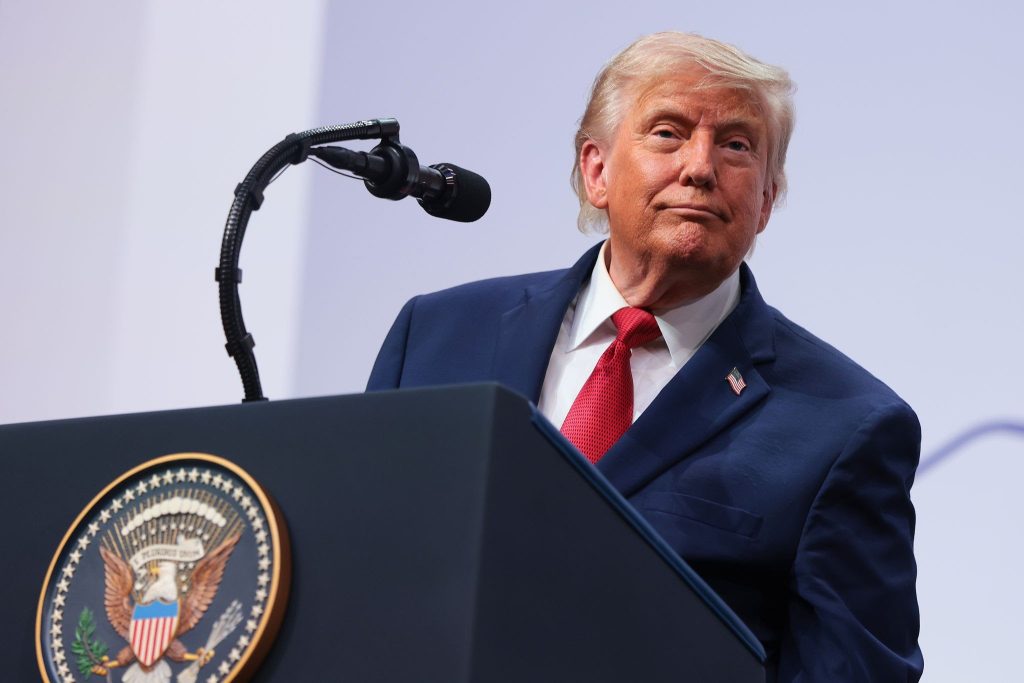
Treasury Secretary Scott Bessent posted a lengthy statement on X on July 30, 2026 demanding the Senate vote immediately on the Clarity Act, closing with Bitcoin creator Satoshi Nakamoto’s dismissal, that he had no time to convince those who don’t understand, in what amounted to the most aggressive public pressure campaign from a sitting Treasury Secretary on crypto legislation in recent memory.
The move followed Bessent’s earlier Wall Street Journal op-ed arguing the U.S. risks forfeiting its role as a global financial leader if Congress fails to act.
Bessent argued that Senate Banking and Agriculture Committee staff had spent thousands of hours negotiating bipartisan revisions since the House passed the Clarity Act over a year ago, and that Republicans now have a floor-ready bill awaiting a vote. His post framed the Democratic holdout not as principled opposition but as political deference to Warren’s bloc, a direct accusation that the delay is manufactured rather than substantive.
The op-ed Bessent published through The Hill made the economic case explicitly: the U.S. risks pushing the digital assets industry offshore through regulatory inaction, ceding ground that cannot easily be reclaimed.
He pointed to the GENIUS Act, signed into law last year and establishing the first federal stablecoin framework, as proof that bipartisan progress is achievable when the political will exists.
“The U.S. didn’t become the world’s financial center by hesitating in moments of technological change. It led by setting standards that others followed. By passing comprehensive digital-asset market-structure legislation, Congress will ensure that the next generation of financial innovation is built on American rails, backed by American institutions, and denominated in American dollars.”
Bessent also pushed back on Democratic claims that the bill lacks consumer protections, arguing that Titles II and III would substantially expand compliance requirements for digital asset intermediaries, moving them closer to the standards applied to traditional financial institutions.
He additionally defended the Blockchain Regulatory Certainty Act provision within the Clarity Act, which protects decentralized software developers from Bank Secrecy Act registration requirements, noting the Fraternal Order of Police, which previously opposed the measure, now supports it.
Discover: Everyone’s Got a Take. Get Free $25 to Actually Trade Yours
Clarity ACT: The Ethics Provisions Deadlock
The substantive obstacle to passage is not consumer protection language, it is the ethics provisions Senate Republicans introduced in May 2026.
Those provisions would bar the president and other federal officials from issuing or sponsoring digital assets while in office, language explicitly aimed at curtailing President Trump’s crypto activity after disclosures showed he generated over $1.2 billion from crypto ventures in 2025 alone.

Democrats have criticized the proposal on three grounds: the restrictions expire in 2029, enforcement rests solely with the Justice Department, and the language does not extend to officials’ children.
That gap between what Republicans offered and what Democrats consider minimally credible enforcement is where negotiations have stalled. Sens. Angela Alsobrooks and Thom Tillis appeared to reach a bipartisan agreement late last month, but whether that deal commands sufficient support from both industries remains unresolved, per The Hill’s reporting.
Meanwhile, the broader crypto market on July 30 was digesting the FOMC decision and ETF flow data, with Bitcoin largely shrugging off the political noise around Senate scheduling, a pattern that held into the following session, where Bitcoin price continued ignoring the political stalemate even as the legislative calendar compressed.
Discover: Get Paid to Be Right, $25 to Start on Kalshi
The post Bessent Invokes Satoshi to Force Senate Vote on Crypto Clarity Act appeared first on Cryptonews.

The team behind the second-largest meme coin introduced an interesting challenge for its community aimed at increasing the token’s global popularity.
Some members said they plan to take advantage of the initiative soon, while others pointed to important reasons to avoid it.
SHIB in the Air
Earlier this week, the major international airline Emirates shook hands with Crypto.com, thus allowing UAE residents to book flights using the digital payment solution on the exchange’s website and application.
Shiba Inu’s official X account shared the update, reminding that SHIB is among the numerous tokens supported by the platform. It also encouraged its community to put the initiative to the test.
Many users applauded the news, and some asserted that they will use the meme coin as a payment method in the coming days. Others said they will never part with their coins, reminding the case of the programmer Laszlo Hanyecs, who bought pizza with Bitcoin (BTC) in 2010.
“Never using my SHIB for paying for anything, I don’t wanna end up being like that guy that bought pizza with his Bitcoin,” CryptoKing stated.
In the crypto world, Hanyecs’s story is considered both legendary and deeply instructive. 16 years ago, he spent 10,000 BTC to buy two pizzas, showing that the cryptocurrency can already be used as a payment method. At that time, the stash was worth around $40, yet at current rates it equals over $630 million.
Alongside promoting the idea of purchasing flight tickets with SHIB, the team has kicked off preparations for its sixth birthday, set for August 1. The community is already speculating whether the celebration will come with a major ecosystem update, but so far there are no signs that this will happen.
SHIB Price Outlook
Last weekend, the self-proclaimed Dogecoin killer posted a sudden and somewhat unexpected daily increase of 35%. Among the potential catalysts that have triggered the pump are a mysterious whale who has resumed accumulating after more than half a year of inactivity, as well as the notable resurgence of the burning mechanism.
In the following days, though, the bears stepped in and erased most of the gains, with SHIB currently trading at around $0.000004702, which is still a 12% jump on a weekly scale. According to Santiment, there were 52 whale transactions amid the rally, suggesting that large holders took profits. At the same time, retail investors joined the party too late and gave whales the necessary liquidity to reduce their exposure.
The analytics platform suggested that the optimal approach with meme coins like SHIB is to exit when retail FOMO surges and return once the crowd turns hostile and labels the token a scam.
The post Shiba Inu Team Sets a New Challenge for the SHIB Army: Who Goes First? appeared first on CryptoPotato.

What is Ceuta?
The city of Ceuta, a peninsular region covering 19.9 sq. km (7.7 sq. mi) on Africa’s northern coast, is one of two Spanish exclaves on the continent, along with Melilla, which is about 220 km (140 mi) southeast. The two Spanish autonomous cities represent the European Union’s only land borders with Africa. Spain has possessed Ceuta, which is separated from mainland Spain by the Strait of Gibraltar, since 1580.
Ceuta has a population of more than 83,000, a mix of Christians and Muslims, including residents and day workers from Morocco and Spain. Ceuta’s population has generally lived harmoniously.
But Morocco, which largely surrounds the two exclaves, still treats them as occupied lands and challenges Spain’s sovereignty, citing history dating back to the Islamic conquests during the 8th century.
Over the years, Rabat, the political seat of the African nation, has triggered diplomatic incidents as part of the dispute. In 2002, Morocco and Spain had a standoff after both sent forces to a small uninhabited island off Ceuta. And in May 2021, amid a deepening diplomatic spat over the disputed Western Sahara region, the Moroccan government loosened its border controls, resulting in nearly 8,000 people from Morocco and sub-Saharan countries pouring into Ceuta in just two days. Some of the migrants eventually returned, but the diplomatic rupture was only repaired when Spain backed Morocco’s autonomy plan for Western Sahara in 2022.
“These Senators have just made my job more difficult, but I will get it done, one way or the other, because I always get it done,” he vowed in late June.
Outside of Congress, public sentiment in America is also showing unease over the conflict and its financial ramifications.
A nationwide AP-NORC poll, conducted between July 23 and July 27, found that 64% of Americans believe the war with Iran has not been worth fighting.
In an earlier poll from Reuters/Ipsos, which surveyed 1,262 American adults across the country over June 18 to 22, just 24% of Americans thought that the war with Iran was worth the costs.
On July 21, Defense Secretary Pete Hegseth was grilled by the Senate Appropriations Committee over the $37.5 billion cost of the Iran war.
The death of 18 American service members during the conflict has also prompted strong reactions, with lawmakers demanding an immediate end to the hostilities. These simmering issues pose a threat to the Republicans ahead of the November midterm elections.
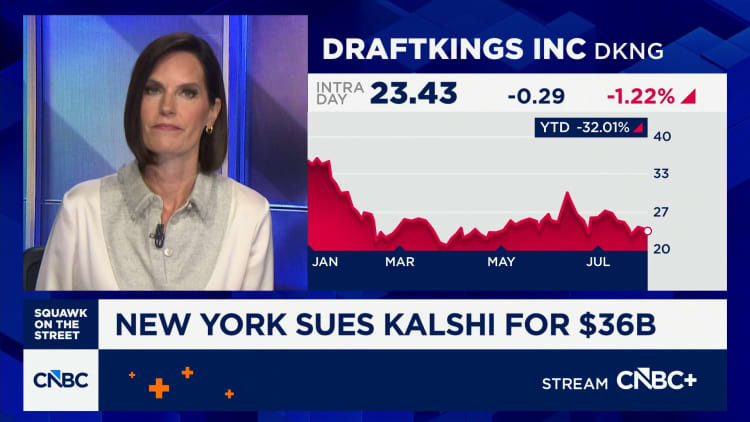

New York state sued prediction market platform Kalshi on Friday, alleging that the company is running an “illegal gambling operation.”
In a case filed in a Manhattan state court, the lawsuit claims that Kalshi accepts wagers as a gambling business in disregard for the state’s constitution and laws by not being registered with the New York State Gaming Commission.
“No matter what they call themselves, prediction markets like Kalshi are gambling platforms, plain and simple,” said New York Attorney General Letitia James in a press release announcing the lawsuit. “By ignoring our laws, Kalshi is running an illegal operation and harming New Yorkers in the process.”
New York Governor Kathy Hochul speaks during the grand opening of the Urban League Empowerment Center by the National Urban League in Harlem in New York City, on Nov. 12, 2025.
Charly Triballeau | AFP | Getty Images
Governor Kathy Hochul in the press release said the state is taking the action to stop what it views as illegal behavior and bring the company into compliance with New York law. The lawsuit is seeking a permanent injunction against Kalshi.
Kalshi, which has its headquarters offices in New York City, expressed disappointment with the decision by the state.
“It’s sad to see this type of political theater from the leadership in our own state,” a Kalshi spokesperson said in a statement. “States can’t just shut down a federally licensed exchange… We love New York, we love New Yorkers, and New Yorkers love our product.”
The suit by the state is also seeking a total restitution to users who have placed trades on the platform, a $100,000 penalty for each attempt to offer sports wagering, and another penalty three times the amount the company has gained while allegedly operating in violation of New York law. The state estimates that could total $36 billion.
Kalshi originally sued New York state in October after the state’s Gaming Commission sent a cease and desist letter to the company. Earlier this month, a judge for the Southern District of New York denied the company’s request for a preliminary injunction and temporary restraining order against the commission.
A supporter checks the gambling site ‘Kalshi” just before State Assembly member, Alex Bores (D-NY) gives a speech to supporters at his watch party at The Freehand Hotel after conceding the congressional race to Micah Lasher who will replace Rep Jerry Nadler (D-NY) in NY’s 12th Congressional District on June 23, 2026 in New York City.
Laura Brett | Getty Images
The same judge denied a request by Kalshi earlier this month for an injunction pending an appeal.
The Commodity Futures Trading Commission, which sees itself as the federal regulator for prediction markets, filed for a temporary restraining order against enforcement actions by New York just before the state’s lawsuit was announced. That comes after the CFTC in April sued the state, requesting a permanent injunction from enforcing its state laws on commission-registered platforms.
“Rather than seek reasoned answers from the courts, Letitia James and New York seek to force an unprecedented sudden shutdown of prediction markets nationwide,” CFTC Chairman Michael Selig wrote in a post on X. “The CFTC has already sued to stop this and will continue to defend its jurisdiction.”
States across the country are locked in battles with the federal government and platforms over prediction markets, which have seen their volumes surge as their sports-related event contracts have become popular with retail traders.
Kalshi — along with other prediction market platforms — and the CFTC believe all event contracts are swaps, and thus are exclusively regulated by the commission. However, states across the country believe the sports offerings are equivalent to sports betting, which is regulated by them.
44 state attorneys General on Monday sent a letter to the CFTC, claiming that the commission has no right to regulate sports-related event contracts, as part of a public comment period for the agency’s first draft of regulations on prediction markets.
While New York cited Kalshi’s sports offering as the reason for its lawsuit, the state also went further. It claims in the lawsuit that the company’s elections, culture and some other event contract offerings also put it in contradiction with the state’s laws.
Disclosure: CNBC and Kalshi have a commercial relationship that includes customer acquisition and a minority investment.

Crypto World
Crypto News, July 31: July Round Up, Kospi Coming Back, Bitcoin Price Ignores Political Noise as Market Splits

The Kospi ended July with a powerful rebound, while the Bitcoin price stayed remarkably steady despite several major headlines. We watched the Kospi recover sharply as the Bitcoin hovered near $64,300, showing little interest in politics, stock market swings, or a major crypto security breach.
July closed with markets moving in different directions. South Korean equities staged an impressive comeback, while crypto traders chased memecoins and tokenized assets instead of pushing Bitcoin higher. Even so, Bitcoin continued trading within a familiar range, reflecting patience.

Discover: The Best Token Presales
Bitcoin Price Stays Calm After Hardware Wallet Exploit
A major security incident became one of Friday’s biggest crypto stories. An attacker exploited a flaw affecting older Coldcard Mk3 hardware wallets, draining 594 BTC from around 500 single-signature wallets in less than 30 minutes.
The vulnerability reportedly traced back to firmware version 4.0.1, where a weakness in random number generation made some wallet seeds predictable. Many affected wallets had remained untouched for years before the coordinated theft unfolded across three blockchain blocks.
Wallet maker Coinkite confirmed the issue and said its early investigation indicates newer Mk4, Q, and Mk5 devices are not affected. Users who protected their wallets with a BIP 39 passphrase also appear to face significantly lower risk. Despite the scale of the exploit, the Bitcoin price barely reacted as it remained close to $64,300 after briefly testing $65,300 during Asian trading before retreating.
Meanwhile, Ethereum hovers around $1,900 while BNB is held near $590, outperforming many large-cap cryptocurrencies. Activity remained concentrated in smaller speculative assets instead of flowing into Bitcoin.

Discover: The Best Crypto to Diversify Your Portfolio
Kospi Recovery Highlights Growing Market Divergence
The Kospi delivered one of Asia’s strongest performances after recovering sharply from its recent correction. Samsung Electronics and SK Hynix helped drive the rally as semiconductor stocks attracted renewed buying following weeks of heavy selling pressure.
Taiwan Semiconductor also posted strong gains, reinforcing optimism across regional technology stocks. However, the Bitcoin price has yet to mirror the equity rebound as closely as it had earlier this month, highlighting a growing disconnect between traditional markets and digital assets.
Instead, speculative capital flowed into selected crypto sectors. Uniswap extended its rally after expanding its fee switch across additional blockchain networks, while several low float tokens recorded triple-digit percentage gains following fresh exchange listings.
South Korean regulators also remained active despite legislative delays. Officials continued discussing interim stablecoin regulations, reflecting the country’s ongoing effort to strengthen oversight while digital asset adoption continues expanding.
The contrast between equities and crypto defined the final trading session of July. While the Kospi recovered with remarkable speed, Bitcoin stayed disciplined and largely ignored both political headlines and market excitement.
That resilience may prove more important than short-term volatility. Security breaches, regulatory developments, and speculative rallies continue to dominate daily headlines, yet Bitcoin has repeatedly shown an ability to absorb negative news without breaking below key support levels.
As August begins, investors will watch whether the Kospi can sustain its recovery and whether the Bitcoin Price finally breaks out of its prolonged trading range. For now, patience remains the dominant theme across both markets.
Trade Crypto on Bybit and Get a Chance to Win Our $1,000 USDT Airdrop
The post Crypto News, July 31: July Round Up, Kospi Coming Back, Bitcoin Price Ignores Political Noise as Market Splits appeared first on Cryptonews.

XRP price prediction is getting bullish as Ripple backed Evernorth amended its SEC registration statement again. The real question is whether the market has already priced it in.
Evernorth’s latest amended Form S-4 formalizes employment agreements for three senior executives. They include chief legal officer Jessica Jonas, chief business officer Sagar Shah, and chief operating officer Meg Nakamura. Jonas would receive an initial equity award worth about $4.5 million. Shah and Nakamura would each receive roughly $2.8 million, pending shareholder approval.
BREAKING: — Xora Finance (@xora_finance) July 30, 2026
 Evernorth updates SEC filing for $1B XRP treasury
Custody move, OTC settlement, or exchange sale? pic.twitter.com/oCFzI6RoBP
The filing also follows previously disclosed compensation for CEO Asheesh Birla and CFO Matt Frymier. Birla’s equity award remains valued at about $44 million. Together, these incentive packages fall under Evernorth’s 2026 Omnibus Incentive Plan. Locking in the executive team with equity suggests the transaction continues moving forward.
At the center of Evernorth’s strategy is its planned Nasdaq listing under the XRPN ticker. The company also aims to build a $1 billion XRP treasury, targeting roughly 473 million XRP, or about 0.8% of the token’s circulating supply. If completed, that allocation would remove a meaningful amount of XRP from the open market, strengthening the long-term supply reduction narrative.
Discover: The Best Token Presales
XRP Price Prediction: Recover Toward $1.65 as Evernorth Filing Advances?
XRP is trading around $1.06, still well below Evernorth’s implied cost basis of about $2.44. That gap cuts both ways. It leaves institutional exposure underwater while supporting the case for continued accumulation. Meanwhile, XRP has traded in a relatively tight range as market sentiment remains cautious.
Technically, the original support levels are no longer relevant after XRP’s recent decline. Immediate support now sits near $1.00, while a break below that could expose the $0.85 to $0.90 area. On the upside, reclaiming $1.10 would improve momentum, with $1.14 to $1.15 acting as the next resistance zone.

The bull case remains unchanged. If XRPN lists on Nasdaq, the SEC clears the S-4 filing, and Evernorth completes its XRP treasury strategy, supply could tighten over time. That would support long term price targets around $2.80, while more aggressive forecasts extend much higher.
The base case assumes filing progress continues but the timeline slips. In that scenario, XRP may consolidate between $1.00 and $1.15 before a stronger catalyst appears. On the bearish side, SEC delays, weaker macro conditions, or a decisive break below $1.00 could open the door to prices under $0.90.
Institutional XRP price targets have been building for months, but the Evernorth catalyst stands apart. It would operate through a regulated U.S. securities vehicle, potentially making it easier for compliant institutional capital to gain exposure if the plan moves ahead.
Trade XRP on Bybit and Get a Chance to Win Our $1,000 USDT Airdrop
LiquidChain Targets Early Mover Upside as XRP Tests Key Levels
XRP’s institutional thesis is compelling, but at current prices, the upside to even the conservative $2.80 target requires patience and tolerance for a -$0.98 invalidation sitting only 9% below spot.
For traders already holding XRP, that’s a known risk. For capital looking to size into a higher-beta opportunity with a structurally different value proposition, the early-stage infrastructure layer is where asymmetry tends to live.
Consider this your invitation.
The age of isolated chains is ending.pic.twitter.com/Iaeuk01uPI
— LiquidChain (@getliquidchain) July 29, 2026
LiquidChain ($LIQUID) is a Layer 3 infrastructure project built around a single thesis: Bitcoin, Ethereum, and Solana liquidity should not require bridging, wrapping, or fragmented execution environments. Its Unified Liquidity Layer fuses all three ecosystems into a single execution environment. So developers deploy once and access all.
The presale is currently priced at $0.01485, with $926K raised to date. Core architecture features include Single-Step Execution, Verifiable Settlement, and a Deploy-Once build model that eliminates multi-chain deployment overhead. The cross-chain fragmentation problem it targets is real and structurally persistent.
Discover: The Best Crypto to Diversify Your Portfolio
The post XRP Price Set for Institutional Boost? Evernorth Files $1B SEC Amendment appeared first on Cryptonews.

Is Tony, A24’s Anthony Bourdain Biopic, Worth Watching?

Wintermute Data Shows Institutional Flow Is Killing Broad Altcoin Rallies

UK Solar Eclipse August 2026: Exact Date, Times, Best Viewing Spots And Safety Advice


-

 Fashion7 days ago
Weekend Open Thread: Brooks Brothers
-
 Sports5 days ago
Commonwealth Games boxing: Jadumani Singh seals dominant 5-0 win over Pakistan’s Sumama Rehman to enter quarter-finals | Commonwealth Games News
-

 Business2 days ago
Why Trees Belong on the Risk Register
-

 Tech5 days ago
Intel is reversing course and bringing hyper-threading back to its server chips
-

 Crypto World6 days ago
Ripple bought a bank in pieces. The $4 billion audit
-

 Politics4 days ago
Luke Littler dismantles Gerwyn Price to retain title in Blackpool
-

 Politics3 days ago
The Part of the Electric Transition Nobody Wants to Discuss
-

 News Videos5 days ago
BITCOIN JUST ENTERED THIS CRITICAL ZONE…
-

 Crypto World5 days ago
XRP Ledger adds $2.6B as RWA inflows rank second
-

 Business2 days ago
Major shareholder moves on Canyon
-

 News Videos1 day ago
Bitcoin Enters the 3rd Stage of the Bear Market
-

 Politics5 days ago
Spain sweeps the board at 2026 World Cup with individual awards
-
 Entertainment3 days ago
‘Stargate’ Creator’s New Sci-Fi Series Returns for Season 3 Tomorrow
-

 Entertainment6 days ago
Sara Gilson Killed By Husband After Viral “Pedophile” TikTok Video
-

 Crypto World3 days ago
Kraken Enables Retail Access to Jersey Mike’s IPO via Tokenized Shares
-

 Tech6 days ago
Anthropic launches Claude Opus 5, a cheaper AI model for coding, agents and enterprise workflows
-

 Tech4 days ago
New macOS Sequoia & Sonoma security updates for older Macs
-

 News Videos3 days ago
Claude: Build Financial Dashboards in Minutes (2026)
-

 Politics1 day ago
Luke Littler’s dominance sparks GOAT debate
-

 Sports16 hours ago
Seema Kaliramna Wins Discus Throw Bronze, Takes India’s CWG Medals Tally To 17
You must be logged in to post a comment Login