
Crypto World
Tether’s new open-source mining kit is a power grab over Bitcoin’s industrial stack



Tether has launched an open-source Mining Development Kit that collapses Bitcoin mining’s fragmented hardware dashboards into a single JavaScript and React-based stack.
Summary
- Tether has launched an open-source Mining Development Kit (MDK) to unify Bitcoin mining infrastructure management.
- MDK gives miners and developers a single JavaScript and React-based layer to automate fleets from home rigs to gigawatt-scale farms.
- The move deepens Tether’s push into mining, following its MiningOS (MOS) release and CEO Paolo Ardoino’s ambition to become the world’s largest Bitcoin miner.
Tether pushes deeper into mining software stack
Stablecoin issuer Tether has launched a new open-source Mining Development Kit (MDK), a full-stack framework designed to give Bitcoin miners unified control over their hardware, power systems and monitoring tools from a single software layer, according to a company announcement.
The MDK rollout on April 27 follows Tether’s earlier decision in February to open-source its MiningOS (MOS) platform, positioning the company as both a major Bitcoin miner and a key software provider for the industry.
Built as a modular framework, MDK lets operators and developers manage everything from small home setups to industrial-scale farms using a JavaScript backend SDK and React-based interface components rather than siloed, proprietary dashboards tied to specific hardware vendors.
MDK targets fragmented mining infrastructure
Tether says MDK is intended to solve what it describes as a fragmentation problem in Bitcoin mining, where fleets often rely on a patchwork of OEM firmware, vendor-specific monitoring suites, legacy GUIs and custom scripts that do not communicate cleanly with each other.
The company’s documentation describes MDK as a “device capabilities + central orchestration” architecture: individual machines, power distribution units, cooling systems and sensors expose standardized capabilities, while a central engine coordinates them through a unified control plane.
MDK is designed to run on Windows, macOS and Linux and is explicitly pitched at both home miners and “gigawatt-scale” industrial operations, reflecting Tether’s claim that the same stack should scale from a handful of ASICs to hundreds of thousands of machines spread across multiple sites.
According to Tether, developers can use the JavaScript SDK to integrate MDK with external services, automation tools or AI-driven agents, while the React component library provides pre-built elements for dashboards, alert panels and configuration views.
In a statement highlighted by industry outlet Techflame, Tether CEO Paolo Ardoino said MDK will offer “infrastructure support for the next generation of Bitcoin mining focused on automation and optimization,” framing the toolkit as a way to standardize and upgrade operational control across the sector.
MDK is also positioned as a companion to MiningOS, which Tether open-sourced in February under an Apache 2.0 license; MOS provides the operating system layer for monitoring and managing mining installations, while MDK offers a programmable development layer on top of that environment.
The launch comes as Tether is already a central player in digital asset markets, with its USDT stablecoin maintaining a market capitalization above $100 billion in recent months, and trading volumes on par with or exceeding those of bitcoin itself on some days, according to market data tracked by sites like CoinGecko.
From stablecoins to industrial control
Tether’s move into open-source mining software is part of a broader strategy to push beyond stablecoin issuance into energy, mining and infrastructure, a shift Ardoino has been signaling publicly since at least 2025.
In a 2025 speech reported by Bitcoin Magazine, Ardoino said Tether had invested more than $2 billion into energy production and Bitcoin mining, and predicted the company could become “the biggest Bitcoin miner in the world, even including all the public companies,” by the end of that year.
He has also framed Bitcoin mining in explicitly energy-centric terms; in a February 2026 post on X, Ardoino described Bitcoin as “energy harvested from the universe,” arguing that mining converts abundant power resources into a scarce digital asset secured by proof-of-work.
Tether’s open-sourcing of MOS and now MDK therefore serves two purposes: reducing its own reliance on proprietary third-party software as it scales out mining operations, and inserting its technology into the wider mining ecosystem as a de facto standard.
Industry publications such as Bitcoin Magazine have noted that MOS uses a self-hosted, peer-to-peer architecture based on Holepunch protocols, allowing miners to manage operations without depending on centralized cloud services or external SaaS platforms.
By pairing MOS with MDK, Tether is effectively trying to occupy both the operating system layer that runs on mining rigs and the orchestration layer that coordinates devices, power, and automation policies across entire fleets.
That combination could make Tether a critical software vendor for miners at the same time as it continues to dominate the stablecoin market through USDT, raising questions about how much influence one company should have over both digital asset liquidity and the physical infrastructure securing Bitcoin.
Automation, AI and centralization concerns
Tether has emphasized that MDK is open-source and extendable, with support for integrating automation and AI-driven optimization agents that can, for example, dynamically adjust hashrate, shift load in response to power prices or schedule maintenance windows using data from sensors and error logs.
According to the company, the framework is designed so that developers do not have to rebuild basic device integrations each time they create new monitoring or control software, potentially shortening development cycles for more advanced energy and strategy management tools.
However, as highlighted by energy and mining analysts quoted in recent coverage of Tether’s push into this space, the creation of a widely adopted, unified orchestration layer for mining infrastructure also concentrates technical risk: a bug, exploit or misconfiguration in MDK-based systems might impact multiple operators at once if they standardize on the same stack.
At the same time, if MDK and MOS gain significant traction, Tether would gain visibility into, and indirect influence over, how large segments of global hash power are monitored and optimized, even if miners run the software on their own infrastructure and retain operational control.
That possibility is especially sensitive given Tether’s scale in the stablecoin market and its growing role in cross-border dollar liquidity, as documented in numerous regulatory and market reports covered by outlets including the Financial Times and Bloomberg.
Ardoino and Tether have argued in previous public comments that their mining and infrastructure investments are driven by a desire to reinforce Bitcoin’s security model and energy footprint rather than simply chase yield, but the MDK launch underscores how tightly the company is now tying its future to the physical underpinnings of the Bitcoin network.
For miners, the calculus will be straightforward and unforgiving: if MDK and MOS deliver more efficient operations, better integration with power markets and a faster path to automation, adoption will likely follow, even as debates over concentration of power and software risk intensify across the Bitcoin ecosystem.

Tether has released an open-source development framework for Bitcoin mining, aimed at giving operators and developers unified control over hardware and software across mining operations.
According to Monday’s announcement, the framework combines a backend SDK and user interface tools to replace fragmented, vendor-specific systems, allowing miners to monitor devices, manage operations and build custom applications across sites from a single control layer.
It uses a modular architecture in which hardware exposes standardized functions and independent modules can be added without altering the core system, enabling integration across different machines, services and locations.
The toolkit supports deployment across Windows, macOS and Linux, and is designed to scale from individual setups to large industrial operations, with features for automation, monitoring and coordinated hardware management, Tether said.
The framework is designed to reduce reliance on proprietary tools and simplify operations across fragmented mining setups, where vendor lock-in and interoperability challenges can increase costs and limit flexibility.
Tether said the release builds on the company’s earlier open-sourcing of its Mining OS, extending its mining software stack with a development layer for building dashboards, workflows and analytics tools on top of existing infrastructure.
The move comes about a week after the company disclosed an 8.2% stake in Antalpha, a Bitcoin-focused lender and equipment financing provider with close ties to mining hardware supplier Bitmain.
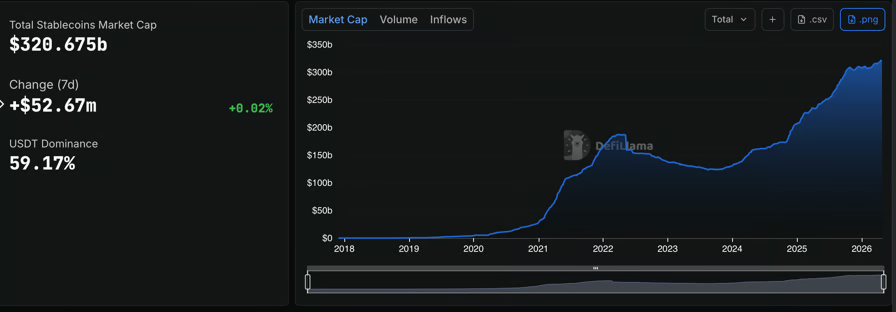
Tether is the issuers of USDT (USDT), the largest stablecoin by market capitalization, accounting for about $190 billion of the roughly $320.7 billion global stablecoin market cap, according to DefiLlama data.
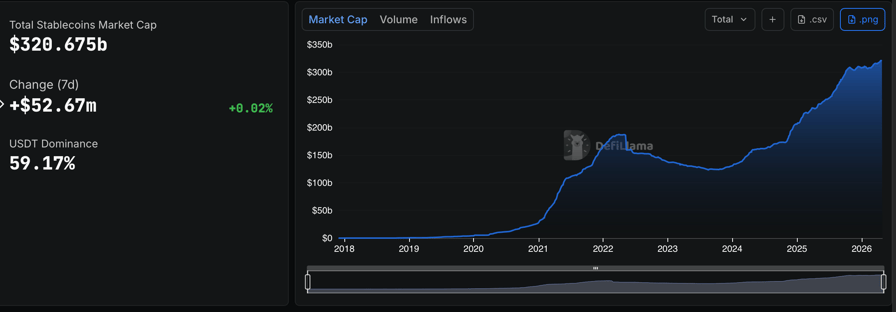
Total stablecoin market cap. Source: DefiLlama
Related: Mining companies move deeper into AI, HPC as MARA may sell Bitcoin
Miners continue to push into AI infrastructure
As Tether moves deeper into Bitcoin mining infrastructure, traditionally pure-play mining operators across the industry are increasingly turning to artificial intelligence and high-performance computing workloads to diversify revenue.
One of the earliest companies to pivot was CoreWeave, originally a crypto mining operation that began shifting toward cloud and high-performance computing in 2019 as demand for AI compute increased.
Since then, a growing number of publicly traded miners, including Riot Platforms, HIVE Digital, MARA Holdings, TeraWulf and Cipher Mining, have pursued similar strategies, redirecting power capacity and infrastructure toward AI and high-performance computing.
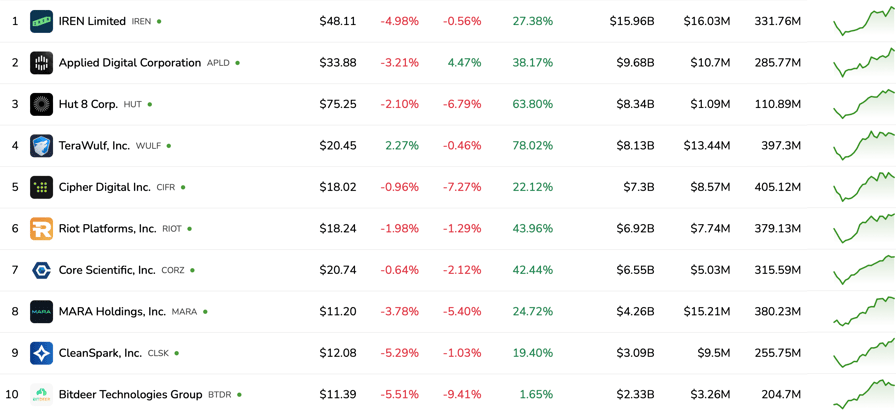
Top 10 publicly traded Bitcoin miners by market cap. Source: Bitcoinminingstock.io
Last week, Core Scientific said it plans to raise $3.3 billion through senior secured notes due in 2031 to fund data center expansion and refinance short-term debt.
On Monday, Hut 8 said in a filing that it is seeking to raise $3.25 billion in senior secured notes to fund a 245-megawatt AI data center in Louisiana, tied to a 15-year, $7 billion lease agreement with Fluidstack, according to The Miner Mag.
Some miners are moving further. Also on Monday, analysts from Bernstein said IREN, the largest publicly traded Bitcoin miner by market capitalization, will likely phase out its mining operations over time as it scales its AI cloud business.
Magazine: 6 weirdest devices people have used to mine Bitcoin and crypto
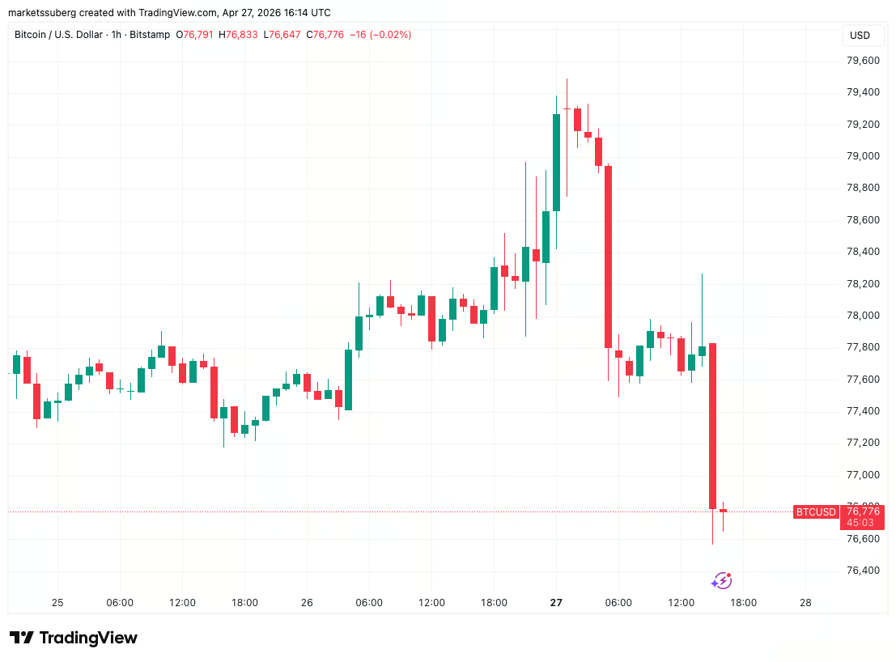
Bitcoin (BTC) fell more than 2% on Monday as US-Iran war nerves again guided macro markets.
Key points:
- Bitcoin gave back early-week gains as its downside extended toward 3% on Monday.
- Two key moving averages hang in the balance amid macro uncertainty over the war in Iran.
- Bulls need to clear the low $80,000 area next, says market analysis.
Crypto exec: Bitcoin needs to clear bull market support band
Data from TradingView showed BTC/USD hitting local lows of $76,567 on Bitstamp, giving back earlier gains.
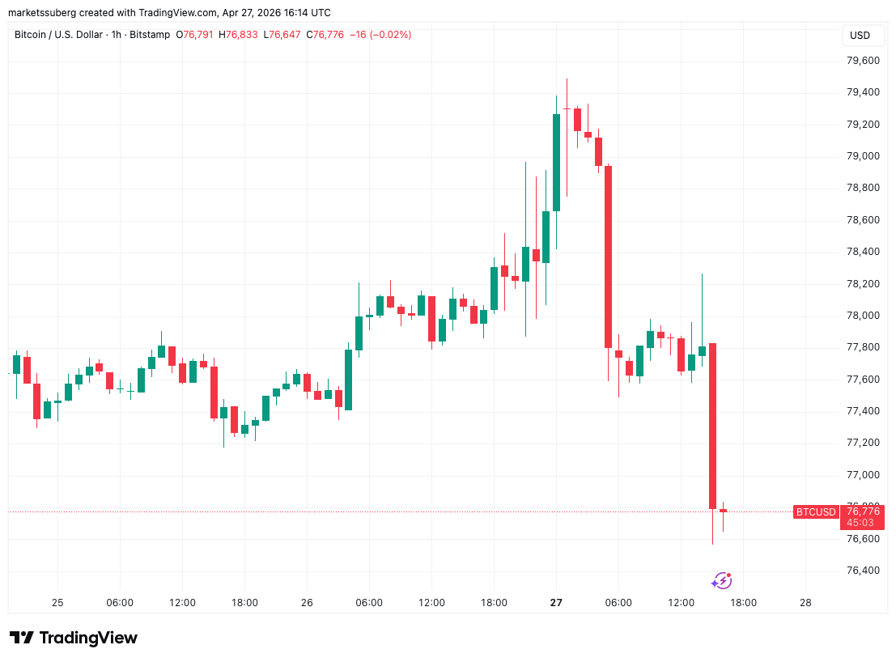
BTC/USD one-hour chart. Source: Cointelegraph/TradingView
The pair had managed a weekly candle close above a key moving average — something that market participants had hoped would allow it to avoid a fresh retracement.
“Bitcoin just reclaimed the 21W EMA for the first time since Oct 2025,” trader Ryan Hogue noted in a post on X.
“$84.5K (200DMA) looks like the next stop this week.”
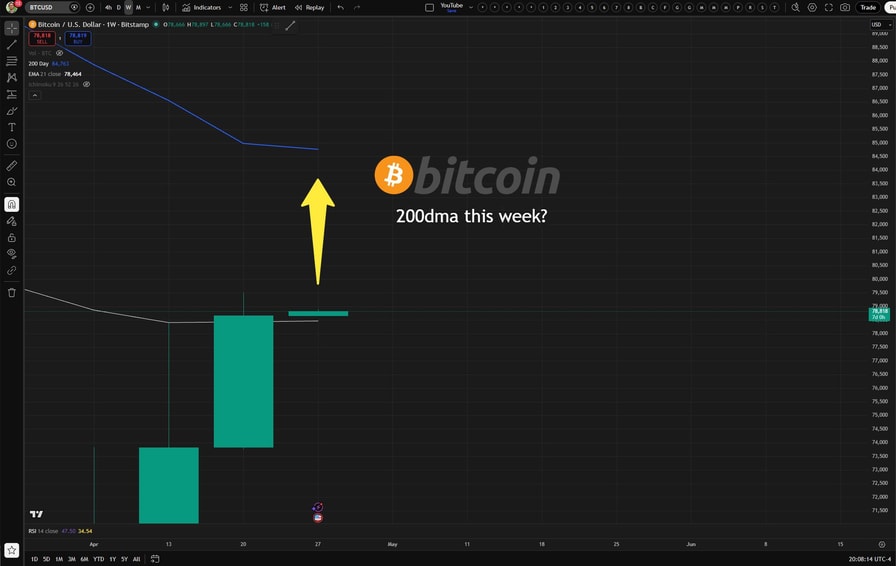
BTC/USD one-week chart. Source: Ryan Hogue/X
Nic Puckrin, CEO and cofounder of crypto education platform Coin Bureau, added that Bitcoin reclaiming its bull market support band — two moving averages of which the 21-week EMA is one — was now key.
“We are right in the middle of the Bull Market Support Band. This has historically served as a key support for bull markets. We broke below the band in October last year,” he told X followers.
“While 80k is acting as a resistance right now, if we flip the band to support, it would point to a major macro-bullish shift.”
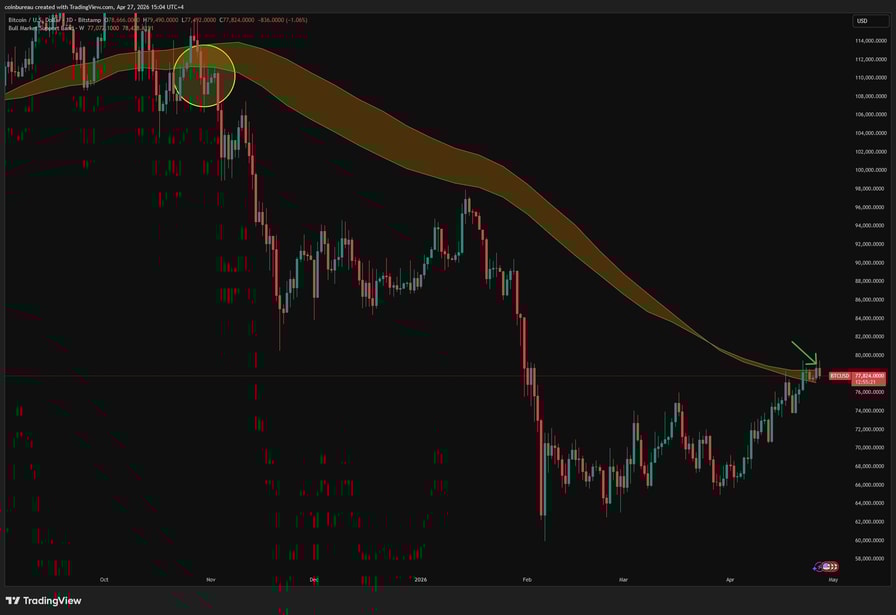
BTC/USD one-day chart with bull market support band. Source: Nic Puckrin/X
Crypto markets “shaping up for more upside”
Uncertainty over progress between the US and Iran on ending the war nonetheless directed Bitcoin lower at the Wall Street open, along with US stocks.
Related: First 21-week trend line reclaim since October 2025: Five things to know in Bitcoin this week
Oil conversely began to gain, with WTI crude reaching $97.50 per barrel to near two-week highs.
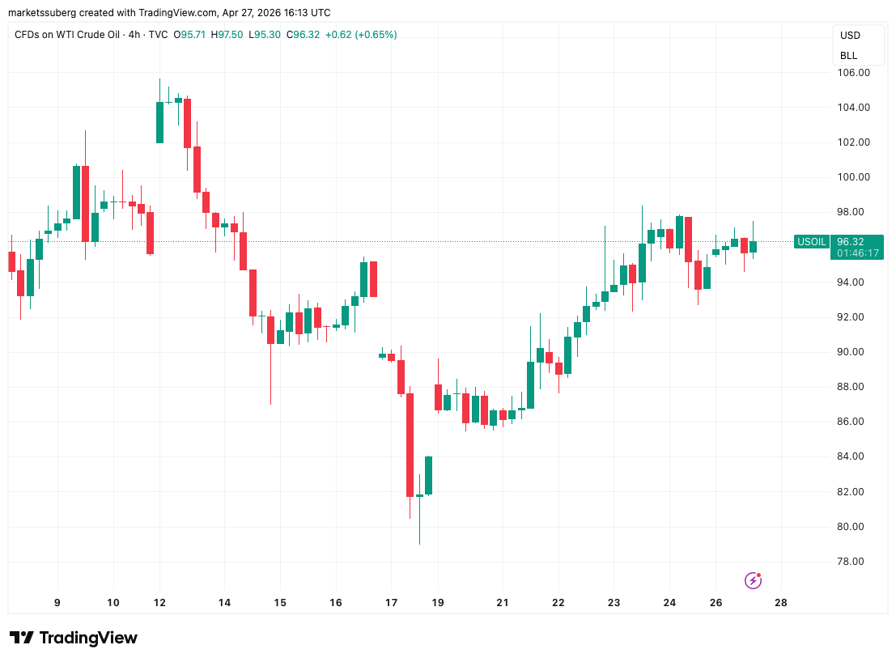
CFDs on US WTI crude oil four-hour chart. Source: Cointelegraph/TradingView
Commenting, trading company QCP Capital suggested that Iran’s foreign minister flying to Russia for talks with President Vladimir Putin was “reviving concerns of broader geopolitical alignment and escalation, and adding to market uncertainty.”
“Whether the next leg higher proves to be another classic bull trap or a more durable recovery will hinge on BTC’s ability to close above 82k,” it wrote in its latest Market Color analysis.
QCP added that corporate earnings represented another source of potential risk-asset volatility for the week ahead.
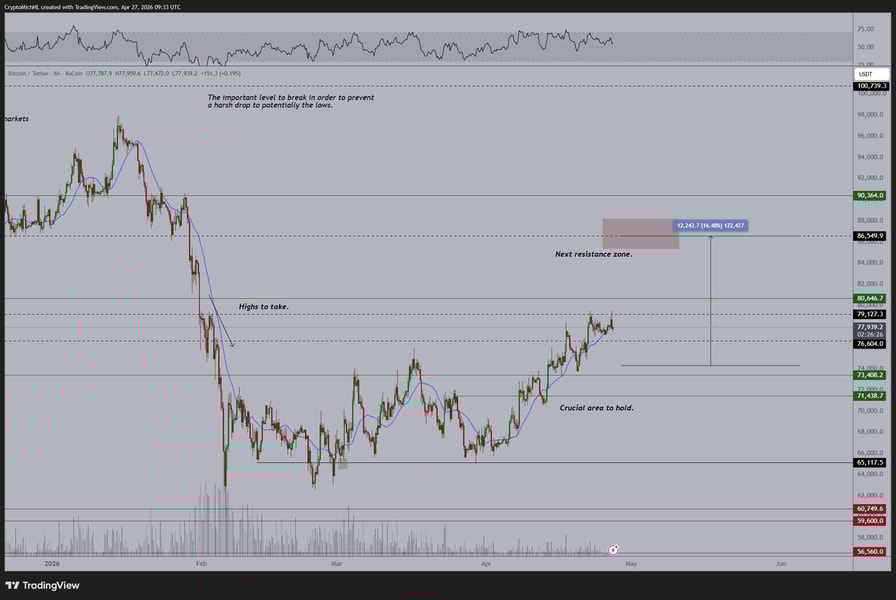
BTC/USDT six-hour chart. Source: Michaël van de Poppe/X
Elsewhere, crypto trader Michaël van de Poppe was confident about a breakout beyond the current multimonth trading range.
“The markets are still shaping up for more upside, and it’s still holding crucial levels,” he wrote on the day.
“I think that we’ll see $85-88K in May and correct/consolidate from there.”


KBank, the South Korean digital-only bank that serves as the exclusive banking partner for crypto exchange Upbit, is set to test onchain cross-border remittances with Ripple, the bank said Monday.
The two companies have completed the first phase of a proof-of-concept using a wallet-based remittance system and are now in phase two, testing the stability of onchain transfers to countries including the United Arab Emirates and Thailand.
KBank is using Palisade, Ripple’s software-as-a-service wallet that was acquired earlier this year as part of Ripple’s $4 billion in crypto-related investments.
Most international bank transfers today route through correspondent banking networks like SWIFT, which can take days to settle and charge fees that compound at each intermediary.
Onchain remittances move funds directly across a blockchain network, settling in minutes with the fee paid only to the network rather than the chain of correspondent banks.
The Ripple partnership tests whether KBank can use that approach to improve speed, cost, and transparency for its remittance customers.
KBank also indicated it is preparing for stablecoin-related regulations in Korea, with plans to continue technical verification of remittance use cases for stablecoins as the legal framework develops.
Korean regulations require all crypto exchange users to link a verified bank account before trading, with each major exchange paired exclusively with one bank. KBank holds that monopoly position with Upbit, the country’s largest crypto exchange. The arrangement helped KBank’s user base grow from roughly 2 million in 2020 to 15 million by the end of 2025.
South Korea lawmakers are currently mulling the Digital Asset Basic Act, a comprehensive crypto regulatory framework that is being finalized. Major Korean financial institutions have been signing infrastructure deals with global blockchain companies in the run-up to the law taking effect.
Korea is one of the most active retail crypto markets in the world, with daily trading volumes on local exchanges regularly outpacing those of mainstream stocks during peak periods. Banks operating in this market are positioning to handle the corporate and cross-border activity expected to follow once the Digital Asset Basic Act formalizes how stablecoins, custody, and tokenized assets are treated under Korean law.


With Genesis Capital fully deployed, the protocol looks to shift from governance-determined capital outflows to rules-bound expenses capped at a fixed percentage of revenue.
Sky, the decentralized finance (DeFi) lending protocol formerly known as MakerDAO, is moving to overhaul how its treasury allocates net revenue now that the founding phase of capital deployment has formally ended.
In a forum post, founder Rune Christensen laid out the rationale for simplifying the Treasury Management Function (TMF), arguing that the recent transfer of Genesis Capital to Grove marks Sky’s permanent exit from the Genesis Capitalization phase. Genesis Capital was the bootstrap funding mechanism Sky used to seed new agents during the expansion of its Sky Agent Network.
The “irregular, governance-determined capital deployments” of the founding period are over, the post said, leaving behind a set of expenses that are rules-bound, predictable, and capped as a fixed percentage of revenue.
The proposal would simplify the TMF from a five-step conditional waterfall into a four-step structure with fixed allocations across Security and Maintenance, Aggregate Backstop Capital, the Smart Burn Engine, and USDS Staking Rewards.
It would also retire several legacy mechanisms, including the Net Revenue Ratio, phase-based distinctions, activity-based staking reward tiers, and Short Term Trading provisions.
The treasury overhaul comes as Sky scales rapidly. USDS supply has climbed to roughly $11.6 billion, making it the third-largest stablecoin, after the Sky community authorized up to $2.5 billion for deployment through stablecoin incubator Obex earlier this year and launched native USDS on Avalanche via the SkyLink bridge in April.
S&P Global Ratings, which last year assigned Sky a “B-“ issuer credit rating, has flagged governance and capital position as the protocol’s key constraints.
Tightening the rules around how revenue is split between security buffers, backstop capital, SKY buybacks, and staking rewards is consistent with the post-Endgame push to make Sky’s expense base more predictable.
This article was written with the assistance of AI workflows. All our stories are curated, edited and fact-checked by a human.

TLDR
- Crypto funds recorded $1.2 billion in inflows, marking four consecutive weeks of positive momentum.
- Bitcoin attracted $933 million in weekly inflows and pushed its year-to-date total to $4.0 billion.
- Total assets under management rose to $155 billion, the highest level since early February.
- Ethereum posted $192 million in inflows, extending its streak to three straight weeks above $190 million.
- Blockchain equity ETFs drew $617 million over the past three weeks as demand increased.
Crypto investment products recorded $1.2 billion in weekly inflows as Bitcoin price climbed to its highest level since early February. CoinShares reported four consecutive weeks of positive flows, which lifted total assets under management to $155 billion. The firm linked the momentum to improving institutional demand and stronger ETF participation.
Crypto Funds Extend Weekly Gains as Bitcoin Leads
Crypto funds posted their fourth straight week of inflows, bringing in $1.2 billion across digital asset products. CoinShares stated that the rise followed Bitcoin’s price move to its highest point since early February. Total assets under management increased to $155 billion, the highest level since February 1.
However, assets under management remain below the $263 billion peak recorded in October 2025. The report titled “Digital Asset Fund Flows Weekly Report” detailed asset-by-asset performance. It showed steady allocation activity across major cryptocurrencies and related equity products.
Bitcoin attracted $933 million in inflows during the reported week. This pushed its year-to-date total to $4.0 billion, according to CoinShares. The firm said the data reflected sustained ETF demand and ongoing accumulation.
Short-Bitcoin products added $16.5 million during the same period. CoinShares said this amount stayed close to the previous month’s average levels. The firm indicated that hedging activity continued but did not increase.
Ethereum, Altcoins Record Fresh Allocations
Ethereum recorded $192 million in inflows over the past week. This marked its third consecutive week with more than $190 million in allocations. CoinShares reported consistent demand across major Ethereum-linked products.
Solana attracted $31.8 million in fresh capital during the week. XRP followed with $25 million in inflows, according to the report. Chainlink also added $6.8 million during the same timeframe.
Litecoin and Sui posted smaller inflows of $0.5 million and $0.4 million, respectively. The data showed broad participation across multiple digital assets. However, Bitcoin and Ethereum accounted for most of the weekly totals.
Blockchain equity ETFs drew $617 million over the past three weeks. The products reached record weekly levels during this period. The report said investors sought exposure to both technology firms and digital asset markets.
The United States led regional inflows with $1.1 billion. Germany followed with $61.7 million, which more than doubled the previous week’s figure. Switzerland reversed prior outflows and posted $35.2 million in new allocations.
Canada added $15 million, reflecting broader regional participation. Australia and Brazil reported inflows of $0.8 million and $0.5 million, respectively. Meanwhile, Hong Kong, France, the Netherlands, Italy, and Sweden recorded modest outflows.
QCP Capital said geopolitical developments influenced short-term price action. “BTC and ETH initially moved higher, but gains were quickly reversed as new geopolitical concerns emerged,” the firm stated. Bitcoin remains up more than 15% this month as ETF demand continues and traders watch the April 28-29 FOMC decision.

TLDR
- Sam Altman apologized for not alerting police about a banned account linked to the Tumbler Ridge shooting suspect.
- OpenAI banned the suspect’s account in June 2025 for activity related to violent behavior.
- The company decided the content did not meet its threshold for an imminent threat.
- The February attack in British Columbia left eight people dead and 25 injured.
- Altman said he spoke with local and provincial leaders before issuing the public apology.
OpenAI CEO Sam Altman apologized to Tumbler Ridge officials for not alerting police about a banned account. The company had removed the account months before a February mass shooting. Altman acknowledged the failure in a public letter released Friday.
Sam Altman Addresses Reporting Failure
Sam Altman sent the letter to leaders in Tumbler Ridge, British Columbia. He admitted the company did not notify authorities after banning the suspect’s account. He wrote, “I am deeply sorry that we did not alert law enforcement.”
He explained that OpenAI banned the account in June 2025. The company cited activity tied to the “furtherance of violent activities.” However, internal reviewers decided the posts did not meet the threshold for imminent harm.
Altman stated that OpenAI considered contacting the Royal Canadian Mounted Police. Yet the company concluded the content lacked a credible and immediate threat. As a result, staff removed the account but did not escalate the case.
He added, “While I know words can never be enough, I believe an apology is necessary.” He recognized the “harm and irreversible loss” suffered by the community. He expressed sympathy for families who lost loved ones.
The February attack unfolded in Tumbler Ridge, British Columbia. Police identified 18-year-old Jesse Van Rootselaar as the suspect. Authorities said she killed her mother and stepbrother before attacking a local school.
At Tumbler Ridge Secondary School, five children and one educator died. Twenty-five others sustained injuries during the shooting. Police confirmed that Van Rootselaar later died by suicide.
Officials Respond to Sam Altman Letter
Altman said he spoke with Mayor Darryl Krakowka and Premier David Eby. He stated they shared the anger and sadness felt across the town. He said they agreed that a public apology was necessary.
He wrote, “No one should ever have to endure a tragedy like this.” He added, “I cannot imagine anything worse in this world than losing a child.” He pledged to work with authorities to prevent similar events.
After the attack, OpenAI disclosed that its systems had flagged the account months earlier. The company said it reviewed the content under its safety policies. It confirmed the account violated usage rules and led to a ban.
The firm stated that it weighed whether to alert police. However, reviewers determined the material did not show imminent danger. Therefore, OpenAI did not contact law enforcement at that time.
Premier David Eby responded publicly on X. He wrote, “The apology is necessary, and yet grossly insufficient.” He added that officials will continue supporting Mayor Krakowka and residents.
The letter emerged as other investigations examine technology platforms and violent incidents. Florida authorities are reviewing whether ChatGPT influenced a 2025 shooting suspect. Separately, a lawsuit claims Google’s Gemini deepened a man’s delusions before his death.
Altman prepares for a civil trial with Elon Musk in federal court this week. The apology letter marks his latest public statement. He reaffirmed his commitment to work with government leaders on safety measures.


OpenAI published five guiding principles on April 26, warning that superintelligence could consolidate power among a small group of companies. The lab pledged to widely disseminate the technology to prevent that outcome.
Sam Altman shared the framework on X. It replaces OpenAI’s 2018 AGI charter and lands as decentralized AI projects compete for the same narrative.
OpenAI Reframes Superintelligence Around Five Principles
The five principles are democratization, empowerment, universal prosperity, resilience, and adaptability. The first commits OpenAI to resisting any concentration of AI control, including within the company itself. It also routes key decisions through democratic processes rather than internal lab choices.
Altman framed it as the lab’s first major principles update since 2018. Empowerment promises broad public access to general AI and the tokens markets that have grown around it.
The remaining three pillars cover economic transition risks, coordination on safety, and a willingness to revise positions. The 2026 charter mentions AGI only twice, signaling a shift toward a wider commitment to AI infrastructure.
Decentralized AI Rivals Push Back
The warning lands as crypto-native AI networks expand. Bittensor (TAO) ran the largest-ever decentralized large-language-model training on its Templar subnet in early April. Grayscale has filed for a TAO-focused ETF, drawing fresh institutional capital to the network.
Critics argue that OpenAI is raising concerns about decentralization only after locking in dominant compute and capital. The company raised more than $110 billion at a $730 billion valuation earlier this year, with Amazon contributing $50 billion of that round.
Validator subnets on Bittensor and similar protocols remain small relative to that capital base. Whether the new principles change how OpenAI deploys its money will determine the document’s weight.
The post OpenAI Warns Superintelligence Could Concentrate Power Without Decentralization appeared first on BeInCrypto.
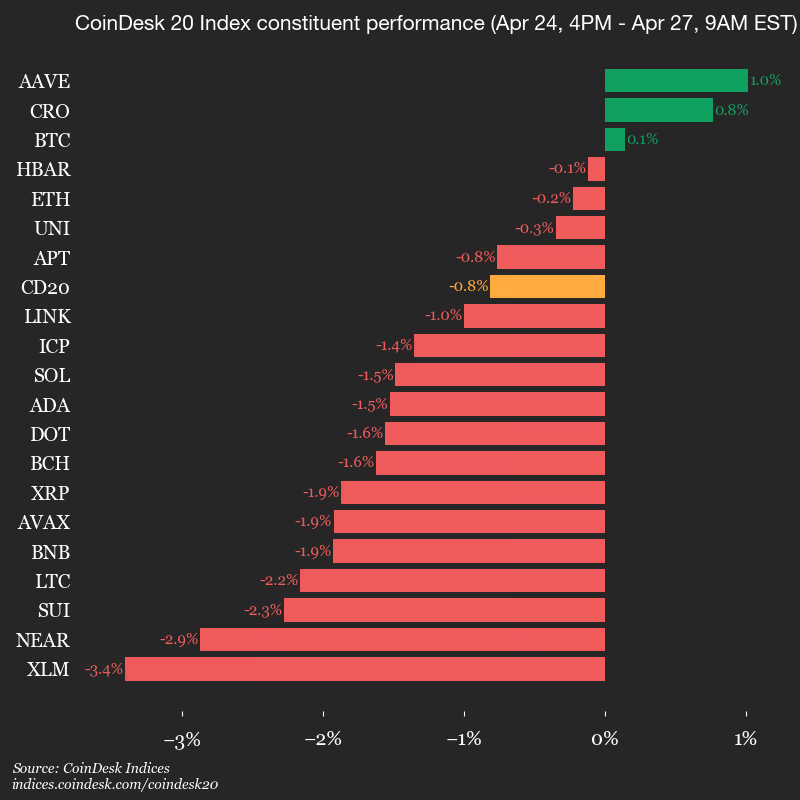
CoinDesk Indices presents its daily market update, highlighting the performance of leaders and laggards in the CoinDesk 20 Index.
The CoinDesk 20 is currently trading at 2106.81, down 0.8% (-17.25) since 4 p.m. ET on Friday.
Three of 20 assets are trading higher.

Leaders: AAVE (+1.0%) and CRO (+0.8%).
Laggards: XLM (-3.4%) and NEAR (-2.9%).
The CoinDesk 20 is a broad-based index traded on multiple platforms in several regions globally.
Canada’s proposed ban on crypto political donations moved a step closer to becoming law on Friday, advancing through Parliament with cross-party support and little opposition.
Bill C-25, the Strong and Free Elections Act, passed second reading in the House of Commons and was referred to committee for further review. In Canada’s system, that vote signals lawmakers broadly agree with a bill’s core principles before it faces detailed scrutiny and possible amendments.
The legislation would prohibit political contributions made in crypto, alongside money orders and prepaid payment products, grouping them as funding methods that are difficult to trace.
The ban would apply across the federal system — registered parties, electoral district associations, candidates, leadership and nomination contestants, and third parties that run election advertising.
Recipients would have 30 days to return illegal crypto contributions or remit them to the Receiver General, Canada’s equivalent of the U.S. Treasury.
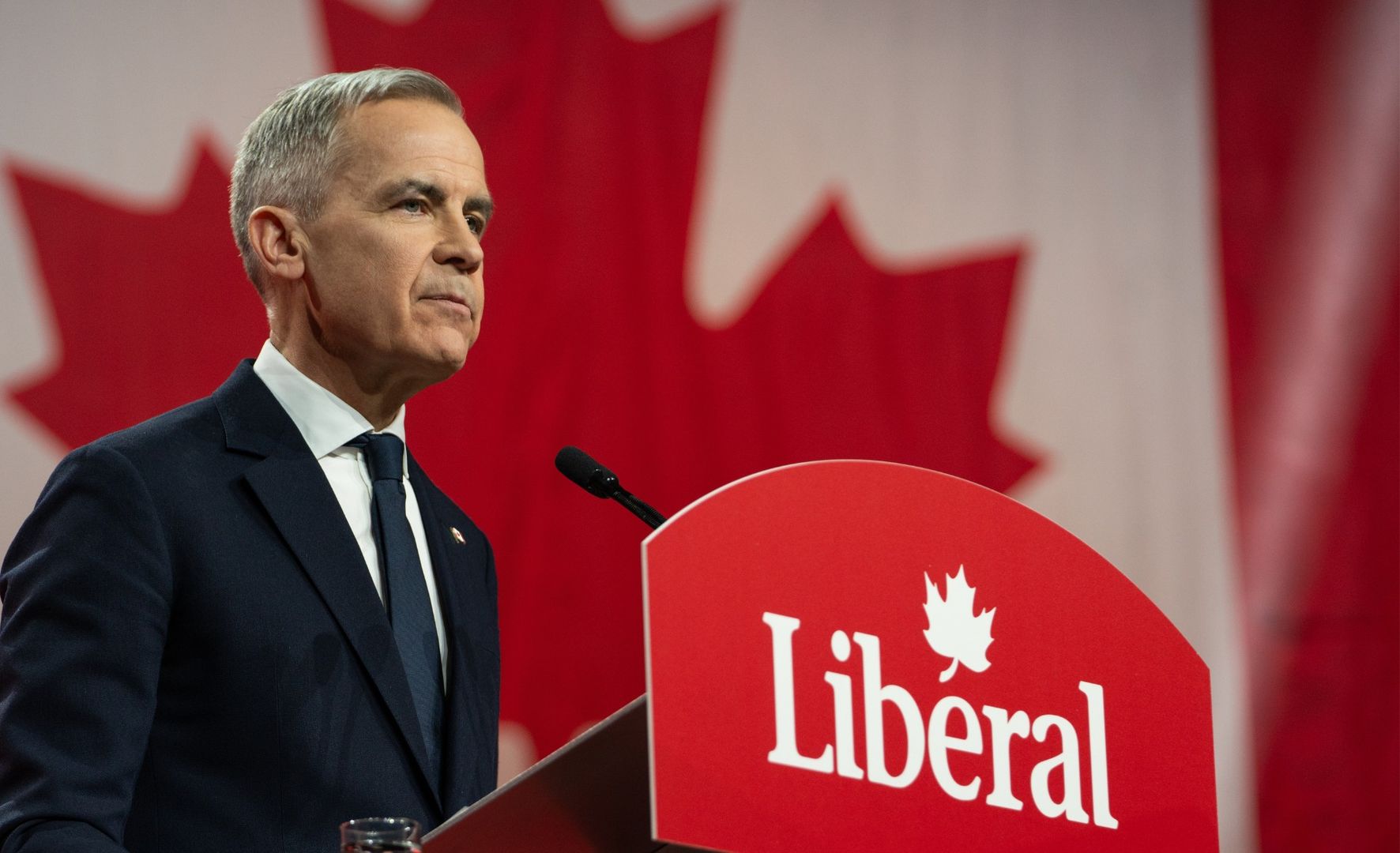
The bill’s lead defender on the floor was Kevin Lamoureux, the Liberal parliamentary secretary to the government’s House leader, a junior official who helps manage the ruling party’s legislative agenda and acts as a floor spokesperson during debate.
His opening speech walked through AI deepfakes, foreign interference, and administrative penalties. Crypto did not come up, according to an official transcript. Asked by a Liberal colleague to pick from three priorities — foreign interference in nominations, political financing transparency or artificial intelligence — Lamoureux picked AI.
Several Conservative Members of Parliament — the party is led by Pierre Poilievre, who marketed himself as crypto-friendly during the last election — raised questions about political financing rules and how new restrictions would be applied.
But the issue never became a central point of contention.
Conservatives backed sending the bill to committee, while other opposition parties raised concerns about different elements of the legislation, but did not center their arguments on crypto.
The limited resistance also reflects how little crypto has been used in Canadian politics.
Canada has technically allowed crypto donations since 2019, when Elections Canada classified them as non-cash, in-kind contributions similar to property. But no major federal party has publicly accepted crypto, and no contributions have been disclosed in recent elections.
C-25 is itself a re-run. Its predecessor, Bill C-65, contained identical crypto language and died when Parliament was prorogued — suspended without dissolving — in January 2025.
Canada’s Chief Electoral Officer recommended tighter regulation of crypto donations in 2022, then, in November 2024, shifted to recommending an outright prohibition, citing pseudo-anonymity and the difficulty of verifying contributors’ identities.
The U.S. is moving in the opposite direction. The Federal Election Commission has permitted crypto donations to American campaigns since 2014.
Earlier this year, the U.K. passed a law banning crypto donations, citing concerns that digital assets could be used to hide the origins of foreign money in British politics.


The digital assets market entered the second quarter in consolidation mode, but Fidelity Digital Assets said underlying data points to early signs of stabilization beneath the surface.
In its Q2 2026 Signals Report published Monday, the crypto trading firm highlighted improving conditions across a number of key metrics, including unrealized profitability, momentum and network usage.
Rather than focusing solely on prices, the report is framed through a broader lens of risk, positioning and cycle dynamics across bitcoin , ether (ETH) and solana (SOL).
Bitcoin, the largest cryptocurrency, continues to serve as the market’s primary source of resilience, with unrealized profit levels and dominance metrics indicating that capital remains concentrated in the most established and liquid asset during the consolidation phase.
“BTC’s dominance continues to gradually increase after declining throughout the latter half of 2025,” wrote analysts led by Daniel Gray.
The digital asset was trading around $77,000 at publication time.
Crypto markets have turned in a choppy performance in recent months, with bitcoin and other major tokens largely range-bound as investors navigate a complex macro backdrop.
Sticky inflation, shifting expectations around central bank rate cuts and periodic volatility in global equities have weighed on risk appetite, while ongoing regulatory scrutiny in the U.S. and abroad has added another layer of uncertainty.
At the same time, conflicts in Eastern Europe and the Middle East and trade frictions between major economies have contributed to bouts of risk-off sentiment, limiting sustained upside across digital assets.
At the same time, the analysts noted that momentum and profitability indicators are consistent with a corrective period, one that may be laying the groundwork for a more stable market structure.
A notable divergence is emerging between price and network activity. The analysts pointed to sustained usage across Ethereum and Solana, suggesting that demand at the protocol level remains intact even as valuations lag.
Taken together, these signals reflect a market still in recovery, but with structural improvements underway that may not yet be fully reflected in prices, the report said.
Read more: Bitcoin faces near-term pressure as liquidity tightens, Hilbert Group CIO says

Blue Jays place starter Max Scherzer on IL with arm tendinitis, ankle inflammation

YouTube TV’s Multiview Feature Just Got A Game-Changing Upgrade

Saylor’s Infinite Money Glitch Explained, DeFi Hack, Pakistan Opens Banks to Crypto

Manchester United reach agreement with Casemiro over contract clause amid transfer speculation

US brings back mandatory military draft registration

Steven Gerrard disagrees with Gary Neville over ‘shock’ Chelsea and Arsenal claim | Football


-

 Politics7 days ago
Gary Stevenson delivers timely reminder to register to vote as deadline TODAY
-

 Fashion3 days ago
Weekend Open Thread – Corporette.com
-
Crypto World2 days ago
Hyperliquid $HYPE Rally Builds Momentum as AI Sector Enters Prove-It Phase
-

 Politics5 days ago
Making troops accountable for war crimes threatens US alliance, ex-SAS colonel warns
-

 Politics5 days ago
Disabled people challenge government SEND proposals over segregation concerns
-

 Tech2 hours ago
Register Renaming | Hackaday
-

 Business5 days ago
Rolls-Royce Voted UK’s Most Iconic Trade Mark as IPO Register Hits 150
-

 Business4 days ago
Patterson-UTI Energy, Inc. (PTEN) Q1 2026 Earnings Call Transcript
-

 Politics5 days ago
Zack Polanski responds to home secretary’s taser threat
-
 Sports1 day ago
IPL 2026: Ruturaj Gaikwad registers slowest fifty of the season, enters all-time unwanted list | Cricket News
-
 Crypto World6 days ago
Five Value Stocks with Recovery Potential in 2026: PayPal (PYPL), Nike (NKE), and More
-

 Politics5 days ago
Starmer handler McSweeney to be dragged from shadows by Foreign Affairs Committee
-
Politics5 days ago
Wings Over Scotland | How To Get Away With Crimes
-

 Crypto World6 days ago
New York sues Coinbase, Gemini over prediction market offerings
-
Entertainment6 days ago
Sydney Sweeney cameo cut from “The Devil Wears Prada 2”, source explains why (exclusive)
-
 Business6 days ago
HCL Tech share price tank over 9% after weak Q4. JPMorgan, HSBC & 3 others cut target price
-

 Politics5 days ago
‘Iran is still a nuclear threat’
-
 Sports5 days ago
Tim Bradley names the current best in the world: “Better than Inoue and Usyk”
-
 Crypto World6 days ago
Crypto’s great hope in Senate’s Clarity Act still has a path to survive tight calendar
-

 NewsBeat1 day ago
LK Bennett closes all stores after entering administration
You must be logged in to post a comment Login