

Crypto World
Thailand broadens crypto futures reach amid licensing overhaul


The Thai Securities and Exchange Commission (SEC) has opened a public consultation on proposed rule changes aimed at letting licensed digital asset businesses apply directly for derivatives licenses. The move would remove the current requirement to establish separate entities for derivatives activities and would extend the use of digital assets as eligible underlying assets for futures contracts. The proposed framework also introduces more stringent measures to manage conflicts of interest and bolster supervisory oversight. Public feedback is welcome through May 20, 2026, and will shape the final rule set.
According to the Thailand SEC, the revisions are designed to broaden access to the country’s derivatives market while safeguarding investors. By enabling existing license-holders to extend into derivatives within their current corporate structures, regulators hope to lower entry barriers for crypto firms seeking to offer hedging tools and other risk-management products. The changes also aim to elevate standards for derivatives exchanges and clearing houses in line with international practice, creating a more coherent and resilient market infrastructure.
Key takeaways
- Thailand proposes direct derivatives licensing for licensed crypto firms, eliminating the need for standalone entities.
- Digital assets would be recognized as eligible underlying assets for futures, expanding the scope of Thailand’s derivatives market.
- New rules emphasize conflict-of-interest controls and stronger regulatory oversight of exchanges and clearing houses.
- Public comment runs through May 20, 2026, with decisions likely to influence regional standards and market access.
Thailand’s plan to streamline crypto derivatives licensing
At the heart of the proposal is a practical shift in how crypto firms can participate in the derivatives segment. Instead of having to spin up a separate corporate vehicle solely to handle derivatives activities, licensed digital asset businesses could apply to offer derivatives services within their existing entities. The SEC frames this as a way to reduce bureaucratic friction while keeping activities under tighter regulatory scrutiny, rather than loosening controls.
The proposed regime would also codify the use of digital assets as underlying assets for futures contracts, a step that regulators argue will modernize the financial toolkit available to Thai investors. By broadening the instrument base, the SEC intends to improve hedging options for portfolios and provide more robust risk-management tools for both retail and institutional participants. Still, the draft rules introduce enhanced safeguards—such as stronger conflict-of-interest provisions and clearer delineation of responsibilities among exchanges, clearing houses, and market participants—to preserve market integrity as activity migrates into the derivatives space.
The Thai move aligns with a broader trend in Asia toward formalizing crypto derivatives under conventional financial-market standards. Regulators in several jurisdictions have pursued a balance between enabling sophisticated products and maintaining guardrails to mitigate systemic risk, particularly given the volatility inherent in digital assets. In Thailand’s case, the next milestone is the public consultation window, which will solicit input from market participants, lawyers, and other stakeholders before a final framework is published.
Global derivatives expansion: what the US could unlock
The Thai proposal arrives as the global derivatives landscape around crypto continues to evolve. In a parallel development, perpetual futures—positions that can be held around the clock—are gaining traction across major platforms as firms prepare for potential regulatory approvals in the United States. Blockchain.com, for example, recently launched perpetual futures trading within its self-custody wallet, enabling users to open leveraged BTC-denominated positions without transferring funds to an exchange. The feature, built on Hyperliquid’s execution layer, provides access to more than 190 markets with up to 40x leverage.
Other major exchanges have pursued similar offerings for non-US clients, expanding 24/7, multi-asset trading access. Kraken and Coinbase each introduced perpetual futures tied to equities for non-US users in earlier waves of product development. While these products remain largely inaccessible to U.S. residents for now, the regulatory outlook in Washington could shift the landscape. In March, comments from CFTC Chair Rostin Behn suggested the agency is actively considering crypto perpetual futures, indicating a potential move to enable such products within the coming months. If realized, the change could unlock a new cadre of venues and liquidity for U.S. traders seeking non-traditional hedges and speculative tools beyond spot markets.
The market has already seen strategic moves that hint at anticipated regulatory alignment. Payward, the parent company of Kraken, agreed to acquire Bitnomial, a U.S.-regulated derivatives venue, a deal framed as expanding access to regulated crypto derivatives for U.S. clients. The consolidation signals a broader industry push to anchor crypto derivatives in compliant, well-governed venues, which could appeal to institutional participants wary of regulatory risk and counterparty risk in less-regulated trading environments.
Taken together, the Thai consultation and the broader push in the United States underscore a shared objective: to mature crypto derivatives into reliable, capital-efficient tools for hedging, risk management, and yield generation. Regulators appear to be calibrating the balance between broad market access and robust oversight, with a clearer emphasis on standardized governance for exchanges and clearing environments worldwide.
Industry implications and what to watch next
For investors and builders, Thailand’s proposed changes could reduce the friction for legitimate crypto firms to offer derivative products within a familiar corporate structure, potentially accelerating the regional adoption of hedging strategies and complex financial products tied to digital assets. If implemented with rigorous oversight, the framework could also reassure institutional players seeking compliant venues and clear risk frameworks, contributing to a more resilient regional market.
From a global angle, the emergence of perpetual futures and regulatory-adjacent activity in major markets raises questions about the pace of U.S. approvals and the boundaries of permissible products. Regulators are balancing the desire to protect investors with the benefits of more transparent, regulated marketplaces that can deliver access to mainstream participants. As the U.S. debate advances, exchanges and liquidity providers will likely continue expanding offerings for non-U.S. customers while preparing for potential U.S. entry points.
Market participants will be keenly watching several milestones: the final shape of Thailand’s derivatives licensing rules after the May 20 consultation; any formal guidance on the treatment of digital assets as underlying assets in Thai futures markets; and the timing and scope of any U.S. regulatory green lights for crypto perpetual futures. Together, these developments could influence where liquidity flows, how risk is managed, and which platforms gain prominence as the global crypto derivatives ecosystem evolves.
For readers tracking regulatory trajectories and product innovation, the Thai process offers a concrete example of how a jurisdiction can ease access to advanced financial instruments while preserving rigorous governance standards. The convergence of regional reform and global product experimentation suggests a maturation phase for the crypto derivatives arena, one that could redefine hedging options and capital efficiency for years to come.
The public consultation in Thailand runs through May 20, 2026. As industry participants prepare feedback, observers should monitor how the final framework handles cross-border activity, conflicts of interest, licensing eligibility, and the interplay with existing securities and futures regimes. The outcome could both unlock new pathways for Thai crypto firms and accelerate the global shift toward regulated, investor-protective derivatives infrastructure.

Crypto World
One in Four Americans Now Use Crypto as Everyday Utility Goes Mainstream, NCA Report Finds
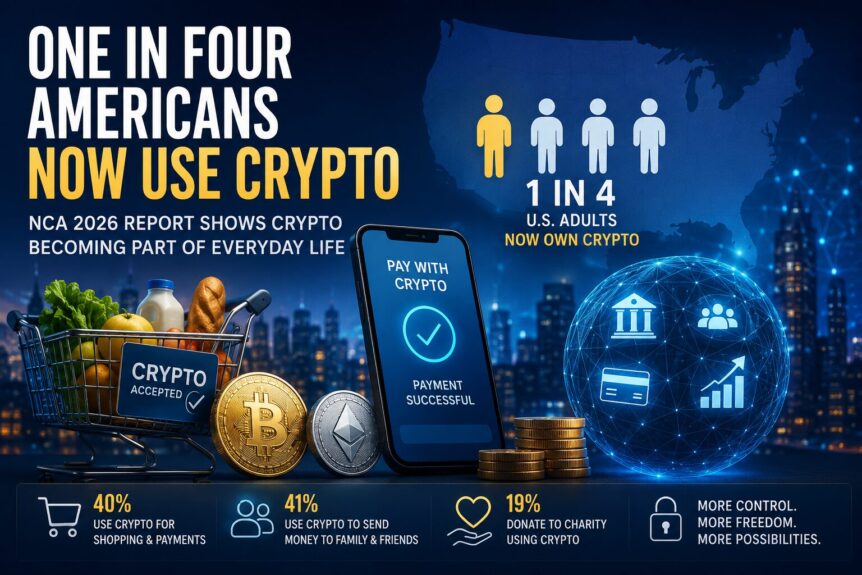
Crypto adoption in the United States is continuing to accelerate, with digital assets increasingly moving beyond speculation and becoming part of everyday financial life, according to the National Cryptocurrency Association’s newly released 2026 State of Crypto Holders Report.
The study, conducted with The Harris Poll among 10,000 U.S. cryptocurrency holders, found that more than 67 million Americans now own crypto, representing roughly one in four U.S. adults. That figure marks an increase of 12 million holders compared to 2025.
Beyond the growing number of holders, the report points to a broader transformation in how Americans are actually using crypto. While investing remains a major driver, usage is rapidly expanding into payments, peer-to-peer transfers, gaming, donations, and business activity.
Speaking with Crypto Breaking, Ali Tager, VP of External Affairs at the National Cryptocurrency Association (NCA), said the industry is entering what she describes as an “everyday utility” phase.
Crypto Usage Is Expanding Beyond Investing
One of the report’s standout findings is that 54% of crypto holders say digital assets have increased their financial independence.
According to Tager, this shift reflects a much deeper evolution in the relationship people have with money and financial systems.
“Crypto usage patterns are diversifying beyond investing and entering a phase of everyday utility,” Tager said.
The report found:
- 40% of holders now use crypto for shopping and payments
- 41% use it to send money to family and friends
- 19% have made charitable donations using crypto
Tager explained that many users are increasingly attracted to crypto because it offers:
- 24/7 access to assets
- faster transactions
- greater financial control
- alternative ways to participate in the economy
“Just like with any other innovation, from AI to smartphones to the internet, these tools become mainstream when we stop focusing on the technology itself and start using it because it solves our everyday problems more efficiently,” she added.
The “Everyday Utility” Era Has Arrived
According to the NCA, crypto’s evolution is no longer theoretical.
Tager shared several examples from the report showing how Americans across different states and professions are using blockchain technology in practical ways:
- ranchers in Wyoming using blockchain to verify humane livestock treatment claims
- artists in California earning royalties directly through blockchain marketplaces
- investors accessing tokenized real estate opportunities
- families using crypto to help manage everyday expenses and medical bills
“Crypto is benefitting people from all walks of life in all kinds of ways,” Tager said.
The report also revealed:
- 54% of holders use crypto in relation to groceries
- 41% connect crypto with travel-related spending
- 39% use it to help cover fuel costs
“When a technology stops feeling novel and starts feeling useful, you don’t notice it crossing over, it just does,” Tager added.
At the same time, she acknowledged that challenges remain, including volatility, trust concerns, and friction around onboarding new users.
Female Participation in Crypto Continues Rising
The report also highlighted a major demographic shift among newer crypto adopters.
Female participation has increased significantly compared to previous years. Among people who entered crypto between 2025 and 2026, women represented 42% of new holders, compared to 34% among earlier adopters.
According to Tager, increasing accessibility and integration with familiar financial systems are helping reduce barriers to entry.
“As crypto becomes integrated into trusted platforms and financial services, it feels more familiar and less complex,” she explained.
The report found that trust tends to rise when crypto becomes connected to mainstream financial brands and platforms such as PayPal, Visa, and traditional banks.
The study also challenges several stereotypes around crypto ownership:
- 90% of holders earn less than $500,000 annually
- 23% earn less than $75,000 per year
- adoption is spreading across construction, manufacturing, retail, technology, and finance sectors
- ownership is growing across Gen Z, Gen X, Boomers, and older generations
Education Remains One of the Industry’s Biggest Challenges
Despite rising adoption, education remains one of crypto’s largest barriers.
According to the report, many Americans still avoid crypto because they simply do not understand how it works or how to use it safely.
Tager said this is one of the core reasons the NCA was created.
“The number one barrier to entry for non-crypto holders in America is that they don’t understand it,” she said.
The organization currently offers:
- free crypto education courses
- interactive beginner lessons
- wallet simulators
- educational podcasts focused on simplifying crypto concepts
Even among existing users, demand for education remains high. Roughly one-third of current crypto holders said they still want more learning resources and practical guidance.
“Accessible resources focused on real-world use cases is what moves the needle,” Tager added.
Regulation, Stablecoins and Payments Could Drive the Next Wave of Adoption
Looking ahead over the next several years, the report suggests mainstream adoption will likely be driven by a combination of:
- payments
- stablecoins
- clearer regulation
- institutional integration
- broader merchant adoption
According to the study:
- 84% of holders expect crypto payments to become common within five years
- 42% believe traditional finance integration would increase trust
- 39% say clearer regulation would strengthen confidence in crypto
Tager believes all of these factors are likely to work together rather than independently.
“Consumers are increasingly looking for practical, everyday ways to use their crypto,” she said.
The report also found that many large retailers in the United States are already accepting crypto payments at checkout.
At the same time, Tager warned that public perception remains heavily influenced by misinformation and sensationalized narratives online.
“When the loudest voices reduce crypto to a caricature, it becomes harder for people to separate fact from fiction,” she said.
“Some may jump in too quickly without understanding it. Others may dismiss the tool entirely without realizing the benefits.”
The National Cryptocurrency Association said it plans to continue expanding educational initiatives and partnerships designed to help Americans better understand how crypto works and how it can be used responsibly in everyday life.

Bitcoin faced a pullback below the $80,000 mark as macro pressures—chiefly elevated oil prices and a heavy-handed liquidity backdrop from the Federal Reserve—added to the fragility of recent upside moves. In the midst of this environment, a Hyperliquid whale opened a roughly $70 million short position across cryptocurrencies and synthetic tokens tied to major technology stocks, stamping a clear bearish tilt on several risk-on assets even as some on-chain traders previously profited from long bets.
Data points and attributions for the move point to a long-running, algorithmically flavored trading approach within the Hyperliquid ecosystem. The new short, traced to the address 0x8def…992dae, is widely reported to be associated with Loracle, an early contributor to Hyperliquid. The development matters not only for price action but for how traders are framing risk in a market still grappling with macro headwinds and a shifting liquidity backdrop.
Key takeaways
- A Hyperliquid whale opened a ~$70 million bearish position across crypto assets and synthetic tokens tied to major tech equities, signaling a technical pivot amid ongoing macro noise.
- The same trader has a track record of profitable bets, including prior long positions in Bitcoin, Zcash, and Toncoin that yielded about $9.2 million over two weeks, underscoring the contrast between short-term tactical bets and longer-running convictions.
- Over the past week, the whale has accumulated a $49 million short on HYPE and expanded into a $12.5 million Bitcoin short plus $8 million in SNDK- and Nasdaq-100-linked synthetic tokens, while maintaining a $1.7 million long in a gold-backed stablecoin—reflecting a nuanced, risk-on/risk-off mix.
- Analysts emphasize the trades appear algorithmic with typical holding periods under a week, suggesting the moves are driven by short-term technical setups rather than a fundamental macro thesis against risk-on assets.
Unpacking the wager and its context
In a market where every macro signal can ripple through crypto prices, the new short position signals more than a single trader’s inclination—it points to a broader debate about timing and resilience. The trader’s blitz of bearish bets across HYPE and Bitcoin, paired with exposure to synthetic tokens tracking major tech names, hints at a liquidity-driven, hedged stance rather than a simple conviction that equities will crash. While Bitcoin has had its own narrative in recent sessions, the position underscores how correlated assets—and their derivatives—can be shuffled in response to short-term price dynamics.
Specifically, the wallet’s activity over the past week included a sizable $49 million short on HYPE, expanding into a $12.5 million short in Bitcoin and an $8 million allocation in synthetic tokens linked to Sandisk and the Nasdaq-100 Index. Yet the same account showed a $1.7 million long in a gold-backed stablecoin, suggesting a measured approach that blends downside bets with hedges against volatility in the broader crypto complex. On the profit side, the trader has historically booked gains from bullish bets as well—the Bitcoin, Zcash, and Toncoin long closed recently yielded a reported $9.2 million over two weeks, and a separate oil-linked synthetic token trade produced about $3 million in profit after a nine-day hold.
What does this mix tell investors? First, the activity illustrates a propensity for rapid, short-cycle moves rather than a long-term directional bet. Analysis from app.trade.xyz depicts an algorithmic trading style with repeated patterning: positions are opened with the expectation of quick reversals or fades, then closed as momentum signals shift. In other words, the liquidity environment—and its microstructures—may be driving capital allocations that look technical more than fundamental.
Macro backdrop: oil, inflation, and the Fed’s balance sheet
The price environment is not helping to calm market nerves. Brent crude has traded above the $100 per barrel threshold as geopolitical frictions—especially in the Middle East—keep supply concerns elevated. Such dynamics feed into inflation expectations, complicating the Federal Reserve’s policy calculus at a moment when liquidity conditions remain a focal point for market participants. In this context, traders are watching for how the Fed will respond to growing inflation pressures and to the broader demand for safe, scarce assets as fixed-income competition intensifies.
Monetary policy signals have grown more complex. The Fed has been actively expanding its balance sheet, purchasing bonds and mortgage-backed securities to ease liquidity strains in the financial system. While this approach can provide near-term relief to counterparties and market infrastructure, it also fuels inflationary pressures and reduces the central bank’s room to maneuver for rate cuts. The persistence of such a balance sheet expansion tends to recalibrate risk appetites across asset classes, potentially altering the relative appeal of fixed income versus scarce, non-yield-bearing stores of value like Bitcoin over the medium term.
From a market structure perspective, a weaker demand for U.S. Treasuries—amid rising inflation expectations and ongoing fiscal pressures—can paradoxically bolster Bitcoin’s macro narrative as a non-sovereign store of value with a fixed supply. If Treasuries become less dominant in global portfolios, capital could rotate into assets perceived as hedges against monetary dilution. That dynamic, however, operates on a longer horizon and depends on how quickly inflation resilience, growth, and policy normalization interact in the coming months.
What this means for traders and builders
For traders, the latest hyper-liquidity move underscores the importance of monitoring the on-chain footprints of large, algorithmically driven players. Even as a single wallet’s bets may not define a trend, they can amplify near-term volatility, particularly when the trades touch instruments tied to equities through synthetic tokens. In that sense, the episode highlights the continuing relevance of cross-asset liquidity, derivatives, and the sensitivity of crypto markets to macro news flow and liquidity shifts.
For developers and investors, the episode reinforces several practical takeaways. First, the interplay between oil prices, inflation expectations, and central-bank balance sheets remains a critical driver of risk appetite. Second, market participants should be mindful of algorithmic strategies that operate on very short timeframes, which can cause abrupt reversals even when longer-term fundamentals seem supportive. Finally, while Bitcoin may benefit from a narrative shift toward scarcity in the face of weaker Treasuries demand, the path to a durable uptrend requires stability in macro conditions and credible progress on inflation and growth trajectories.
Beyond the immediate moves, observers will want to watch two key questions: Will the Fed’s liquidity stance remain accommodative long enough to sustain a broad risk rally, or will inflation pressures force a policy shift that caps risk assets? And will Bitcoin’s role as a macro diversification tool gain traction if Treasuries complexity continues to erode investor confidence? The answers will shape whether the current on-chain activity is a one-off hedging maneuver or a harbinger of a broader regime shift for crypto markets.
In the near term, market watchers should monitor the next set of price actions around Bitcoin and related assets, especially in relation to macro data releases and evolving liquidity conditions. While the Hyperliquid whale’s latest bets are notable, they are one piece of a larger mosaic—one that will unfold as traders balance technical setups against the evolving inflation and policy backdrop.
The biggest meme coin by market capitalization has jumped by double digits over the past 30 days, increasing its dominance in its niche.
However, certain technical indicators suggest the bears may soon regain control.
The Incoming Correction?
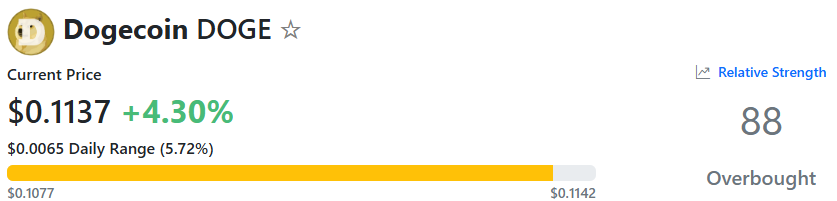
As of press time, DOGE trades at around $0.114 (according to CoinGecko), representing an impressive 8% increase on a two-week basis and a 25% surge for the month. In fact, it has outperformed many leading cryptocurrencies, including Bitcoin (BTC) and Ethereum (ETH), over these time frames.
Nonetheless, the renowned analyst Ali Martinez tempered the excitement in the Dogecoin community after noting that the TD Sequential indicator had flashed a sell signal on the meme coin.
Another short-term warning sign is DOGE’s Relative Strength Index (RSI). The technical analysis tool is often used by traders to spot potential price reversal points and ranges from 0 to 100.
Readings above 70 indicate that the meme coin’s valuation has risen too much, too quickly, and could be due for correction. On the contrary, anything below 30 suggests that the token is oversold and on the verge of a resurgence. As of this writing, DOGE’s RSI stands at roughly 88.
The Bullish Scenario
Despite the aforementioned indicators hinting at a price decline in the near future, multiple market observers remain optimistic that the meme coin has plenty of fuel left to post further gains.
X user Ryker claimed that DOGE’s chart “looks great,” predicting that it “will lead meme trend back together.” For their part, JAVON MARKS argued that the asset has started responding even more positively to a major bullish divergence that has been holding with the MACD.
They envisioned a whopping 500% breakout to the $0.6533 target, which could then open the door to an ascent to a new all-time high of approximately $1.25.
MikybullCrypto followed up with an even more optimistic outlook. They suggested the current levels are “the best area” to hop on the bandwagon before “the massive bullish tide,” forecasting an astronomical explosion to $12.
It is important to note that such a pump seems quite improbable (at least for now), as it would require DOGE’s market cap to exceed $1.8 trillion. In comparison, the current capitalization of BTC stands at around $1.61 trillion, while the total value of the entire crypto sector is less than $2.8 trillion.
The post Dogecoin (DOGE) Soars 25% in a Month, But Key Indicator Flashes a Sell Signal appeared first on CryptoPotato.


Yellow Network chairman Alexis Sirkia says the CLARITY Act is the structural reset U.S. crypto has waited for.
Summary
- Sirkia argues the bill creates the first navigable framework around classification, jurisdiction, and compliance for crypto firms.
- Years of regulatory uncertainty pushed builders to Dubai and Singapore, and the CLARITY Act could reverse that flow if it passes.
- Success, Sirkia says, means founders launching U.S. products without fear of retroactive enforcement years down the line.
The CLARITY Act is moving faster than at any point in its legislative history. The Senate Banking Committee released a new 309-page draft on May 12, with a markup scheduled for May 14, as the White House pushes for Trump to sign the legislation before July 4. For Alexis Sirkia, chairman and co-founder of Yellow Network, the timing is overdue.
“A lot of crypto companies have spent years trying to figure out which regulator they answer to and whether the rules might suddenly change after they launch,” Sirkia said. “That uncertainty affects everything from fundraising to banking relationships to hiring.”
Why builders left and what changes if the bill passes
At Yellow, which builds decentralized clearing infrastructure for digital assets, Sirkia deals daily with the friction that regulatory ambiguity creates across liquidity, settlement, and compliance. His view is that most serious builders are not looking for a free pass from oversight. They are looking for predictability.
“Infrastructure companies cannot scale globally if the rules change every few months or if nobody knows how existing laws apply to decentralized systems,” Sirkia said.
He points to the CLARITY Act’s provisions around disclosure standards, AML requirements, and oversight structures as the foundations that allow companies to make long-term decisions around capital and hiring.
If the bill passes, Sirkia expects founders and engineering talent to remain in the U.S. rather than default to easier regulatory environments. “Right now, a lot of companies choose places like Dubai or Singapore because the regulatory path is simply easier to understand,” he said. “If uncertainty continues, the U.S. risks missing out on a major infrastructure shift happening across finance and digital assets.”
The CLARITY Act passed the House 294 to 134 in July 2025 and cleared the Senate Agriculture Committee in January 2026, but has repeatedly stalled in the Banking Committee over stablecoin yield provisions and unresolved ethics language around government officials’ crypto holdings.
The bar for success and the global race
Senator Bernie Moreno has set a hard end-of-May deadline, warning that missing the window could shelve the legislation for years. Prediction markets currently put the odds of the Act becoming law in 2026 at around 55%.
Sirkia’s definition of success is direct. He wants founders launching products in the U.S. without fear of retroactive enforcement, and banks treating crypto infrastructure as a legitimate counterparty rather than a compliance liability.
“I’d also like to see a healthier relationship between regulators and industry participants overall,” he said. “Crypto will move faster when there’s dialogue and clearer communication.”
On the global picture, Sirkia sees the CLARITY Act as a signal as much as a rulebook. “I see the CLARITY Act as an important signal the U.S. wants to play a serious role in the future of digital finance,” he said. “That matters for everything from stablecoins to tokenized assets to next-generation trading infrastructure.”
Yellow Network, which tapped the XRPL EVM Sidechain to power real-world asset trading, is among the firms watching the May 14 markup closely. If the CLARITY Act advances, Sirkia says expanding compliant decentralized clearing and trading infrastructure inside the U.S. market becomes the immediate priority.

TLDR
- Consensys has delayed its planned U.S. initial public offering until at least the fall.
- The company had aimed to file a confidential draft S-1 with the SEC in late February.
- Weak crypto market conditions led the firm to pause its IPO timeline.
- Consensys engaged JPMorgan and Goldman Sachs to lead the potential offering.
- Bitcoin ETF outflows and falling token prices contributed to market pressure.
Consensys has postponed its planned U.S. initial public offering until at least fall due to weak market conditions. Sources familiar with the matter confirmed the delay and cited recent volatility in crypto markets. The Ethereum software firm had prepared to begin formal filing steps earlier this year.
Consensys Halts IPO Filing Plans
Consensys had targeted a confidential draft S-1 filing with the Securities and Exchange Commission by late February. However, worsening market trends led the company to pause those plans. Two people with direct knowledge confirmed the revised timeline.
The company engaged bankers from JPMorgan and Goldman Sachs last year to manage the offering process. It aimed to move forward while regulatory clarity improved for digital asset companies. Yet market performance shifted sharply at the start of 2026.
Crypto markets declined in February as traders reduced exposure to risk assets. Bitcoin ETFs recorded heavy outflows, and prices across tokens fell. As a result, leveraged liquidations spread across digital assets.
Macroeconomic concerns and tariff discussions also weighed on sentiment. Expectations for interest rate cuts slowed during the same period. Those factors combined to pressure equity and crypto valuations.
A Consensys spokeswoman declined to comment on specific IPO timing. She stated, “As a matter of policy, we don’t comment on market speculation.” The company has not announced a new filing date.
Market Conditions Pressure Crypto Listings
Several crypto firms outlined public listing plans earlier this year after clearer U.S. regulatory guidance. However, weaker market performance forced many companies to reassess their schedules. Large firms such as Kraken and Ledger paused their IPO plans.
BitGo, operating under ticker BTGO, completed the only crypto-native IPO in 2026. The company raised about $213 million in January. It priced shares at $18, which exceeded the marketed range.
Shares rose more than 20% during the company’s debut on the New York Stock Exchange. However, the rally faded in subsequent weeks. The stock now trades about 36% below its IPO price.
The price decline reflected ongoing volatility in digital asset equities. Crypto-linked stocks have tracked broader movements in token prices. Therefore, companies have adjusted capital raising strategies.
Consensys previously secured $450 million in a Series D funding round in early 2022. That round valued the firm at $7 billion. The company has not disclosed updated valuation figures since then.
Joe Lubin leads Consensys and oversees products including the MetaMask wallet. The firm continues to operate its Ethereum development services. For now, it has shifted its IPO consideration to the fall timeframe.

TLDR
- Jupiter has partnered with Bitwise to launch an isolated USDe lending market on Solana.
- Bitwise will curate the dedicated USDe pool within Jupiter Lend for institutional participants.
- The USDe market will operate separately from Jupiter Lend’s main liquidity layer.
- The structure aims to manage risk and support institutional capital participation.
- Fluid protocol will provide collateral and lending infrastructure for the isolated pool.
Jupiter has partnered with Bitwise to launch an isolated USDe lending market on Solana. The firms announced the initiative on Wednesday and confirmed institutional access. The structure separates USDe liquidity and integrates Fluid for lending infrastructure support.
Bitwise and Jupiter Launch Isolated USDe Market on Solana
Jupiter confirmed that Bitwise will curate a dedicated USDe market on Jupiter Lend. The platform will isolate this market from its main liquidity layer to manage risk. The firms said the structure aims to support institutional capital with controlled exposure.
Bitwise will oversee market parameters while Jupiter provides the lending framework. The setup marks the first time an institutional asset manager curates a market on Jupiter Lend. The companies stated that this approach strengthens risk management and capital efficiency.
The isolated pool will function independently from other lending markets on the platform. As a result, liquidity risks from other assets will not affect the USDe market. The partners said this design aligns with institutional compliance standards.
Jonathan Man, Head of DeFi Strategies at Bitwise, addressed the launch. He said, “Jupiter and Fluid have built unique infrastructure for efficient lending markets.” He added that the design provides deep liquidity and risk-mitigating features.
USDe Gains Dedicated Lending Support Through Fluid Integration
The initiative integrates Fluid protocol to supply collateral and lending infrastructure. Fluid will support collateral management and borrowing operations within the isolated pool. The firms confirmed that this integration enhances operational efficiency.
The new market allows users to earn yield on USDe within Jupiter Lend. USDe functions as a synthetic asset that maintains a stable value target. Ethena Labs issues the token and oversees its underlying structure.
Guy Young, CEO of Ethena Labs, commented on the development. He said, “USDe is an institutional-grade savings product, built for scale.” He added that the combined infrastructure creates an efficient USDe market ready for DeFi adoption.
USDe launched in early 2024 and expanded rapidly across crypto markets. By mid-2025, it ranked as the third-largest stablecoin by market capitalization. The asset attracted institutional participation during its early growth phase.
However, USDe later declined in market rankings after volatility pressures. A crypto market crash on Oct. 10 exposed decoupling risks linked to the asset. Market data showed fluctuations in USDe’s price stability during that period.
Jupiter and Bitwise did not disclose specific yield rates for the market. They confirmed that the structure will operate under defined collateral parameters. The companies stated that the market is now live on Solana.
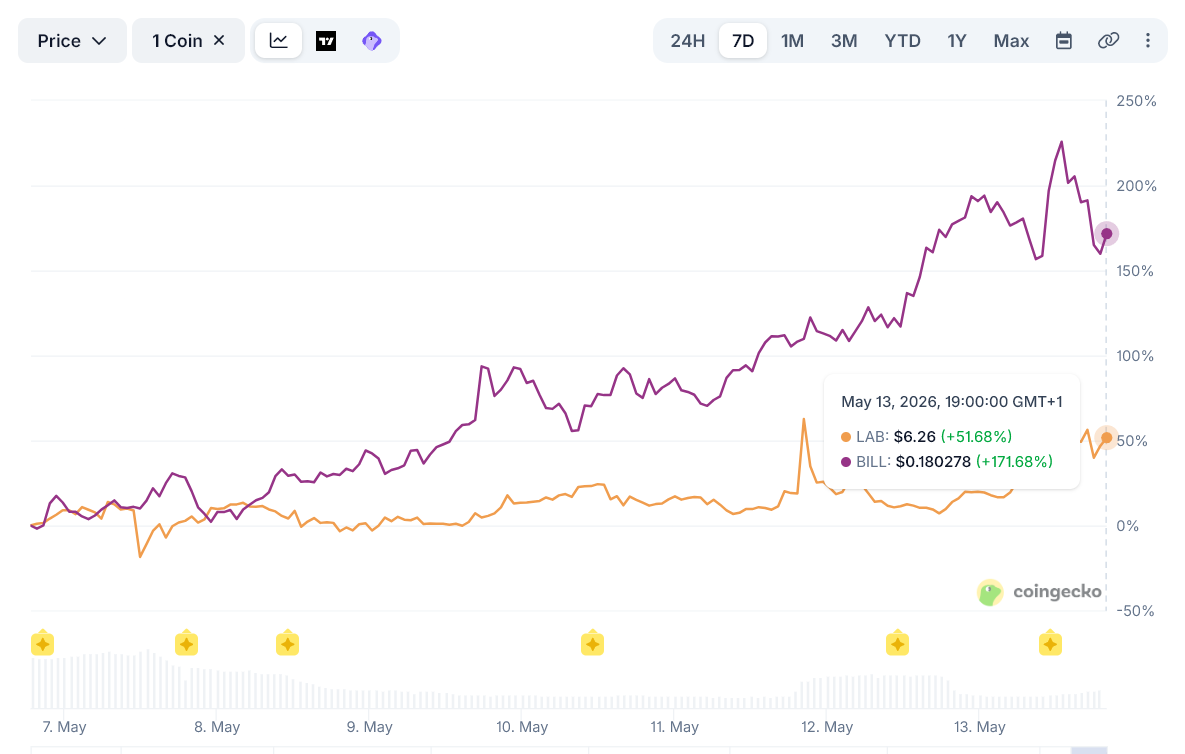
AI tokens are leading the May crypto rally, with LAB and Billions Network (BILL) both posting sharp gains. LAB has attracted traders through its AI-powered trading terminal. BILL has gained attention as a decentralized identity token built for humans and AI agents.
Both charts still point higher if momentum holds. However, the risk profile is different.

What Is LAB Token?
LAB is the native token of a multi-chain trading terminal. The platform lets users trade spot, limit, and perpetual markets across Solana, Ethereum, and BNB Chain from one AI-powered interface.
Its token has a maximum supply of 1 billion, with about 230 million in circulation. LAB holders can stake tokens, vote on governance, and earn a share of transaction fees as platform volume grows.
Why is LAB Token Up 300%?
The main catalyst came on May 3, when LAB launched its mobile app. The move expanded the product beyond browser-extension users and helped trigger a sharp rally.
LAB surged 364% in one day and reached $3.18 before falling 65%. The move liquidated about $12.7 million in leveraged positions within hours.
Since then, LAB has pushed higher again. It recently traded around $6.10 after retesting the 0.786 Fibonacci level near $6.04. The token hit an all-time high of $7.50 on May 11.
LAB Price Outlook
If buyers stay in control, the first upside target sits near $9.35. A stronger breakout could push LAB toward $11.70. That would mean roughly 53% to 92% upside from current levels.
Still, traders should treat LAB as a high-risk momentum trade. On-chain investigator ZachXBT has accused LAB founder Boba Sadikov of coordinating market-making activity across centralized exchanges. The LAB team has not publicly addressed the claims.

Future token unlocks are another risk. Around 282 million LAB tokens remain locked, which could pressure price if supply enters the market during weaker conditions.
What is the Billions Network (BILL) Token?
BILL is the native ERC-20 token of Billions Network. The project focuses on decentralized identity and verification for both humans and AI agents.
Billions uses decentralized identifiers, verifiable credentials, and zero-knowledge proofs. In simple terms, it lets users prove facts about themselves without exposing all their personal data.
Its biggest angle is DeepTrust, a framework designed to verify AI agents through “Know Your Agent” (KYA). That could become more important if AI agents start making more on-chain transactions.
BILL Price Outlook
BILL launched on May 4 across several major exchanges, including KuCoin, Bybit, Binance Alpha, MEXC, OKX, and Kraken. More listings followed shortly after.
Futures listings added more fuel. Bybit listed a BILL perpetual contract on May 6. Binance followed up with BILL/USDT futures on May 7, helping the token jump nearly 50% in a single session.

BILL recently traded near $0.2035 after touching an intraday high of around $0.2268. The first upside target sits near $0.28. A stronger move could take it toward $0.35.
Support sits near $0.15, with a deeper level near $0.10. Momentum remains bullish, but the token is still new, so sharp pullbacks are likely.
For now, LAB offers the more explosive chart. BILL offers a stronger identity and an AI-agent narrative. Traders should watch momentum, exchange flows, and unlock risks before chasing either move.
The post Two AI Tokens Lead May Rally, But Risks Are Rising appeared first on BeInCrypto.
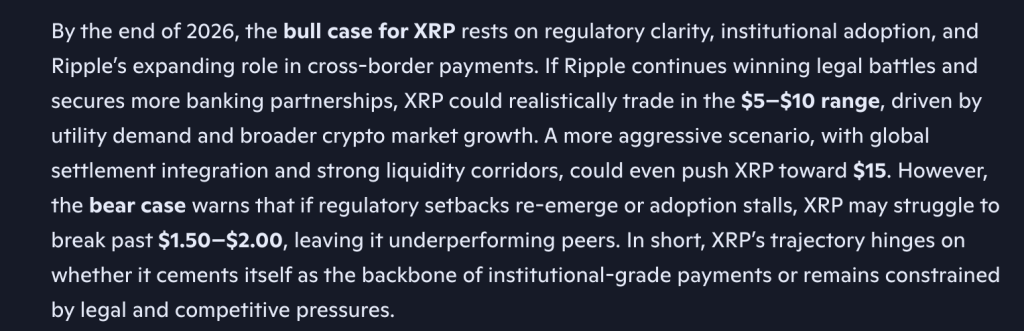
We put a direct structured question to Microsoft Copilot AI about where the XRP price prediction ends up by the end of 2026, and the AI predicts does not dance around it.
The Leading AI frames the entire thesis around a single question: Does XRP become the backbone of institutional-grade payments, or does it stay trapped by legal and competitive noise?
If the answer is yes, Copilot sees a realistic range of $5 to $10.
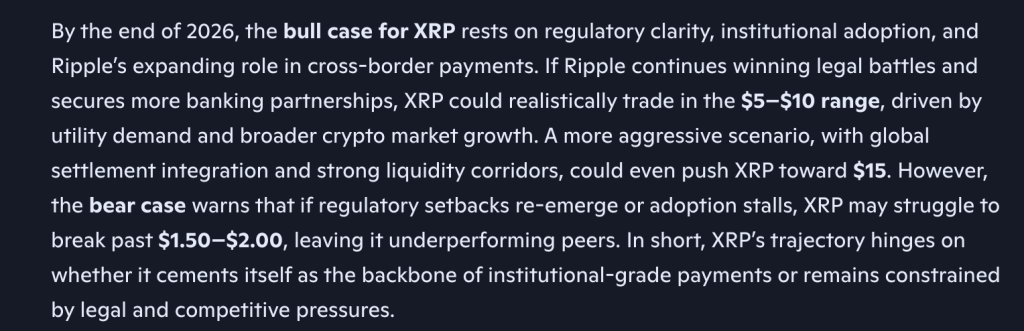
The bull case is built on 3 pillars that are already partially in place. Regulatory clarity following Ripple’s legal wins has removed the overhang that kept institutional money cautious for years.
Banking partnerships are expanding, meaning XRP is no longer just a speculative asset but an active part of real payment infrastructure.
And the broader crypto market recovery provides the macro tailwind that lifts all boats, but historically lifts XRP harder when sentiment is running hot.
Copilot’s more aggressive scenario layers global settlement integration and strong liquidity corridor expansion on top of that foundation and arrives at $15, a number that requires everything to go right simultaneously, but is not built on fantasy, given where Ripple’s enterprise pipeline sits today.

The bear case is blunt. If regulatory setbacks re-emerge or adoption stalls, Copilot says XRP may not even break $1.50 to $2.00, leaving it underperforming peers across the board.
That is the uncomfortable version of this story: all the infrastructure buildout, all the legal wins, and the price still goes nowhere because the utility demand does not translate into actual buying pressure at scale. It has happened before with XRP, and Copilot is not pretending otherwise.
XRP Price Prediction: XPP Has Been Ranging for 3 Months Straight, Is This Why Copilot AI Predicts Aggressive Breakout?
XRP price is trading at $1.4677 on the 4-hour chart, and the chart since February tells a story of stubborn consolidation, finally showing signs of life.
After the February crash from $2.00 down to $1.15, price spent the next 3 months grinding in a wide range between $1.28 and $1.55 with no sustained directional conviction in either direction.
That changed in the last 2 weeks. The current push toward $1.50 is the strongest and most sustained upside move since the March bounce, and it is happening on progressively higher lows, which is a meaningful shift in structure.
Resistance is $1.50 to $1.55, the ceiling that has rejected every serious rally attempt since February. Price is pressing into that zone right now, and how it behaves here defines the next several weeks.
A clean 4-hour close above $1.55 and hold opens the door to $1.65 and then $1.80, where the next major supply sits from the January descent.
Support is $1.35 to $1.38, the mid-range base that has acted as a floor across April and early May. Lose that and $1.28 comes back into play, which is where Copilot’s bear case floor starts to make sense on the chart.
That tight convergence tells you momentum is building steadily without the kind of overextension that typically precedes a sharp reversal. No divergence, no warning signs. Just a quiet grind higher with RSI having room to reach 70 before anything gets stretched.
Copilot’s $5 to $10 call needs a lot of things to go right over 7 months. But the 4-hour chart is at least starting to set up the first step in that direction.
LiquidChain Is Catching the Attention of XRP Holders. Here Is Why
When the market leaders stall, smart money starts looking elsewhere.
BTC, ETH, and XRP are all grinding under resistance right now. The catalysts that unlock the next leg up, macro relief and sustained institutional inflows, have not arrived. Waiting on them means waiting on things you cannot control.
Early-stage infrastructure plays exist in a completely different universe. The upside is not priced in yet. A relatively small amount of capital can move the needle significantly. That asymmetry is the entire point.
LiquidChain is building something the current multi-chain environment desperately needs. Right now, liquidity across Bitcoin, Ethereum, and Solana sits in isolated silos. Moving between them costs money, takes time, and breaks the user experience. LiquidChain collapses all 3 into a single execution layer. Developers deploy once. Users interact across all 3 ecosystems without ever feeling the seams.
The presale is at $0.01454 with just over $700,000 raised. That is not a late entry. That is ground floor.
The risks are real and worth naming. Post-launch adoption, liquidity depth, and execution are all unproven. No early-stage project comes without those question marks. The question is whether the potential justifies the uncertainty.
Established assets offer a smoother ride toward a ceiling that is already visible. LiquidChain offers a much earlier seat at a table that has not been set yet.
Explore the LiquidChain Presale
The post Microsoft Leading Copilot AI Predicts the Shocking Price of XRP by The End of 2026 appeared first on Cryptonews.
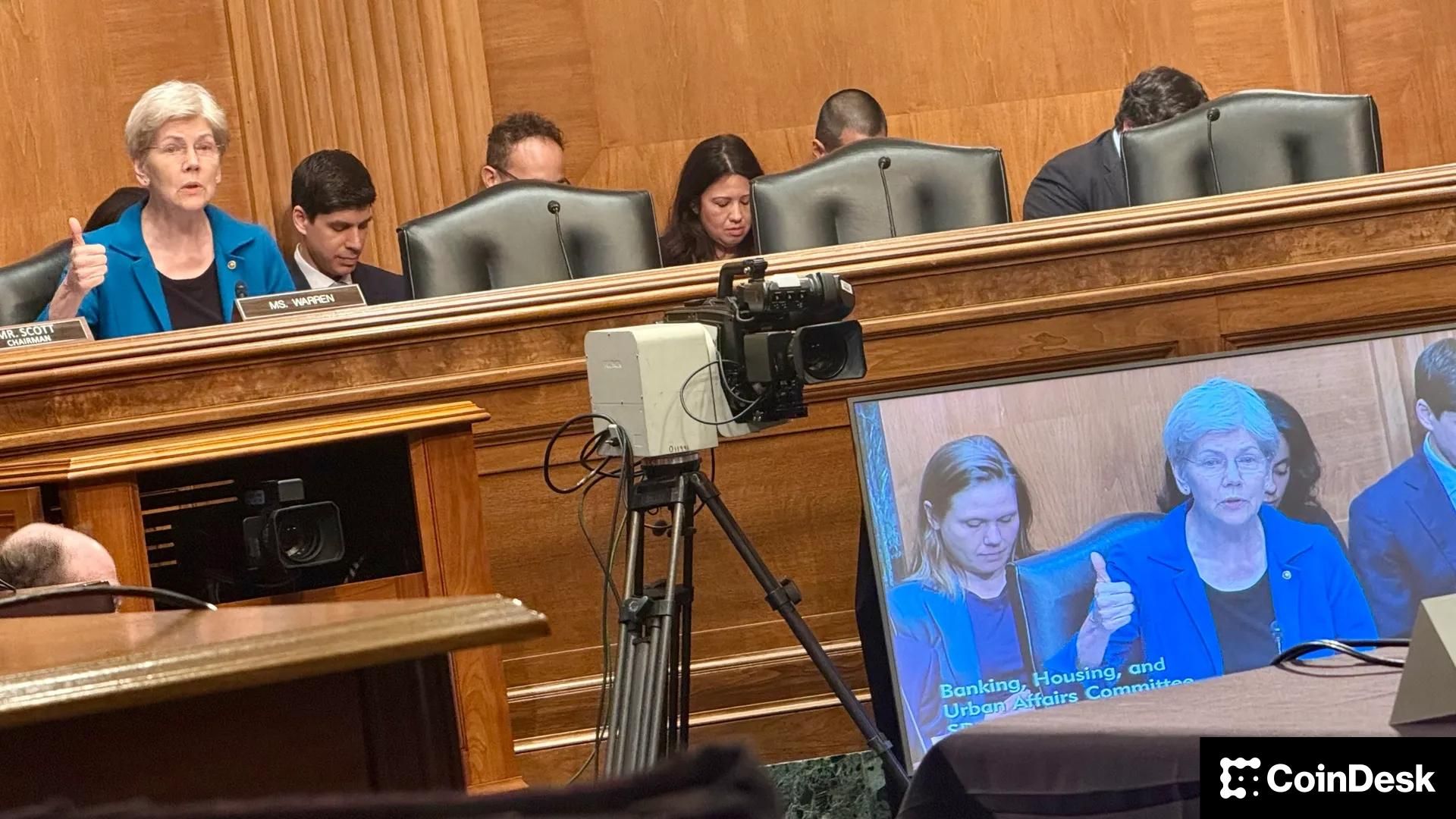
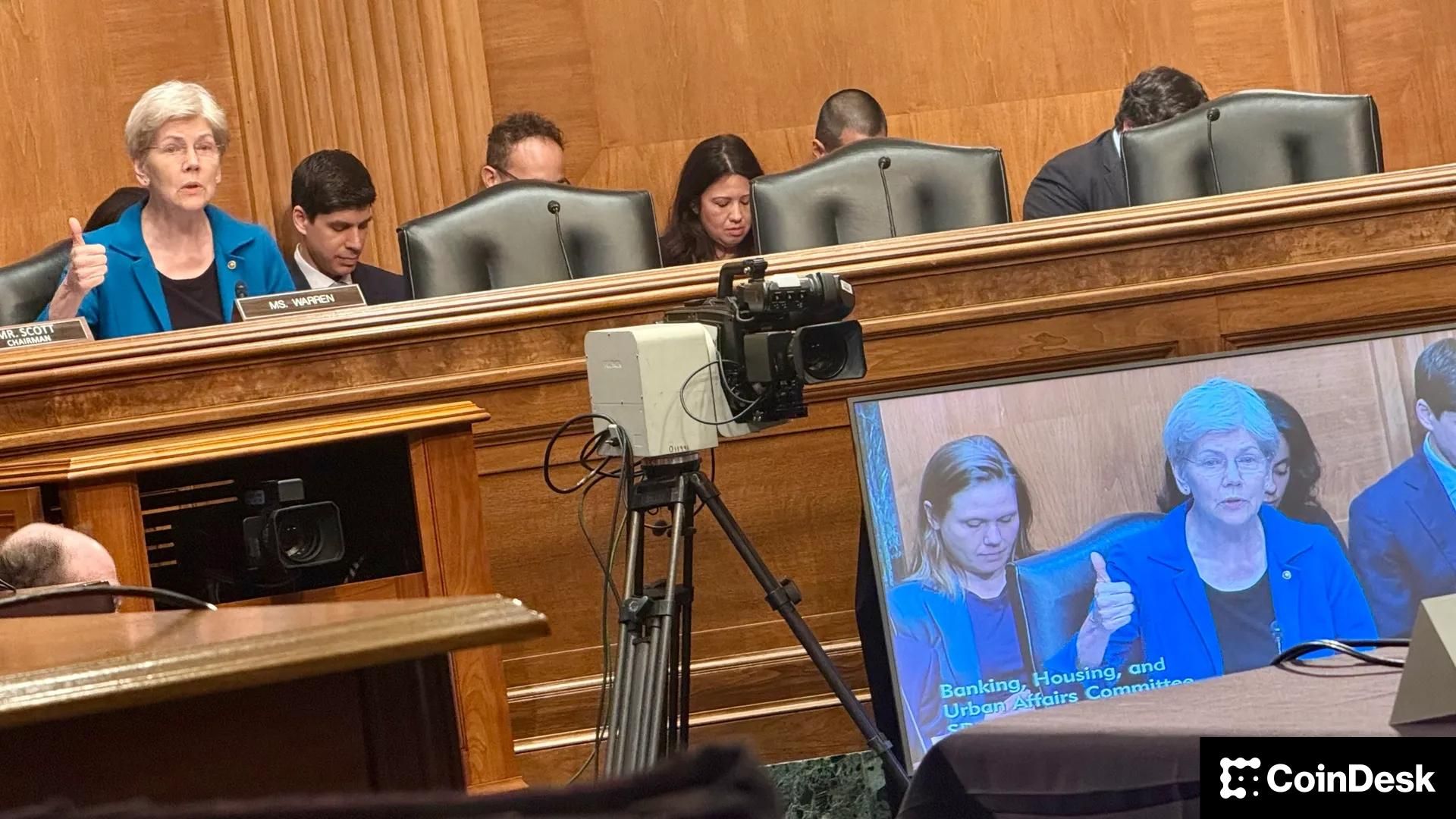
This week’s U.S. Senate Banking Committee hearing to consider edits to the Digital Asset Market Clarity Act has dozens of amendments to weigh, though it’s likely that almost all of them won’t survive the process of Thursday’s event.
Lawmakers have pushed forward a range of proposed changes for the market structure bill as it approaches the hearing known as a “markup,” from amendments that would establish government-ethics rules to others setting safe harbors for developers to one that would cut out a must-have protection for the decentralized finance (DeFi) sector, plus a number of other smaller, technical adjustments.
The list is particularly dominated by a few lawmakers’ names, including Democratic Senators Elizabeth Warren and Jack Reed. Their items are expected to be a rhetorical wish list as other members of the committee — mostly Republicans — seek to advance the bill without significant overhauls.
Each amendment will be discussed during the hearing and will eventually receive a vote, unless they’re withdrawn. A simple majority will be needed to adopt or reject an amendment. Eventually, the Banking Committee will vote to advance the bill itself.
Here are some highlights, according to a list of the proposals circulated ahead of the hearing:
- Senator Reed, a Rhode Island Democrat, wants to adopt some of the requests from bank lobbyists to further restrict stablecoin yields, according to one of his 18 amendments.
- He would also entirely scrap the section known as the Blockchain Regulatory Certainty Act, which shields software developers that don’t control people’s money from being regulated as money transmitters.
- On the same topic, Senator Catherine Cortez-Masto, a Nevada Democrat, wants to “protect software developers by creating a safe harbor from criminal liability for not registering as a money transmitter at the state or federal level.”
- Senator Chris Van Hollen, a Maryland Democrat, is pushing eight amendments, including one that would institute a major Democratic request: banning the president and other senior government officials from “owning, promoting or affiliating with” digital assets businesses.
- Senator Warren would more specifically “prohibit political corruption in banking applications and presidential bank ownership,” seeming to directly target the effort from World Liberty Financial — a company tied to President Donald Trump and his family — to obtain a U.S. banking charter.
- Warren, who is also seeking to cut out whole swaths of the current bill regarding the oversight of digital commodities, went farther afield with some amendments, trying to cap credit card interest rates and calling for bank supervisory records involving “Jeffrey Epstein and his co-conspirators.” (The bill itself does include some non-crypto provisions, including legislation targeted at housing championed by Senator John Kennedy, a Louisiana Republican.)
- Senator Mark Warner, a Virginia Democrat who has been at the center of illicit-finance negotiations involving DeFi, is proposing “a control test to determine when persons operating non-decentralized finance trading protocols are subject to” Bank Secrecy Act anti-money laundering obligations.
- On the Republican side of the committee, Senator Bill Hagerty from Tennessee is seeking a ban of central bank digital currencies (CBDCs) issued by the U.S. Federal Reserve. CBDC bans have already been pushed in various other bills by lawmakers, most recently in the House of Representatives’ bill to reauthorize the Foreign Intelligence Surveillance Act.
Thursday’s session to consider advancing the Clarity Act is likely already well planned for what the Republican majority will allow into the legislation. The last time the Clarity Act was on final approach to a markup in this same committee, it made it to this stage in which some 75 amendments were offered, though that hearing was postponed shortly after.
Previous wrinkles in the negotiation have since been ironed out over four months of talks, clearing a path for committee approval this week. Once that happens, this bill can be merged with the parallel effort that already cleared the Senate Agriculture Committee.
However, some significant changes are still expected after this week, including the effort to resolve the Democrats’ demand for a conflict-of-interest provision on cutting ties between government officials and the crypto sector, most notably seen with the president and his family. A meeting earlier this week on that ethics provision reportedly remained contentious, and Democrats including Senator Kirsten Gillibrand have said the Clarity Act will not get approved in the Senate without it.
Clarity’s advocates need to secure a number of Democratic supporters for the bill if it’s going to clear the 60-vote hurdle that’s standard in the Senate. Then the bill needs to get another approval from the U.S. House, which had already passed a similar bill last year.
In a Wednesday posting on social media site X, Coinbase CEO Brian Armstrong called the bill “strong” and said it “will benefit the American people by making the US financial system faster, cheaper and more accessible.”
“Mark it up,” he said.
Read More: Clarity Act, in the flesh, unveiled by U.S. Senate Banking Committee before hearing

The Senate Banking Committee’s CLARITY Act is heading into Thursday’s markup, buried under opposition.
According to reports, Senator Elizabeth Warren alone filed more than 40 amendments before Tuesday’s 5 p.m. ET deadline, and American Bankers Association members sent over 8,000 letters to Senate offices in less than a week demanding changes to the bill’s stablecoin yield rules.
Over 100 Amendments Filed
The total number of proposed amendments going into Thursday is still being confirmed, but according to a list obtained by Politico, there have been more than 100 proposed. To put things in perspective, a total of 137 revisions were proposed before the markup scheduled for January, which was canceled.
Warren’s batch alone covers a wide range of restrictions. One amendment that stood out would bar the Federal Reserve from issuing master accounts to crypto companies, which would effectively cut such firms off from the core infrastructure of the US banking system.
The lawmaker also attacked the updated bill on X, arguing that it lacked ethics provisions tied to President Donald Trump’s crypto businesses.
“No bill should move through the Banking Committee without real ethics guardrails,” she wrote.
That dispute has become harder for negotiators to avoid. Late last month, analyst Simon Dedic claimed that Trump’s meme coin and his crypto-related dinners were part of the reason the CLARITY Act was going nowhere, with Democrats demanding conflict-of-interest language before backing the legislation.
Another revision, filed by Senator Jack Reed of Rhode Island, would prohibit crypto from being used as legal tender, including for paying taxes. That proposal runs directly counter to a bill Representative Warren Davidson introduced last year that would have allowed Bitcoin to be used for precisely that purpose.
Senators Reed and Tina Smith of Minnesota also filed a joint amendment that would incorporate bank-requested changes to the stablecoin yield language.
According to journalist Brendan Pedersen, the proposal will force senators to choose between crypto and the banks on a single vote, making it an uncomfortable moment for Republicans who tend to side with both.
Bankers Blitz Senators With 8,000 Letters
Elsewhere, members of the American Bankers Association have reportedly sent more than 8,000 letters to Senate offices since last Friday, pushing lawmakers to change the bill’s stablecoin yield compromise.
However, Stand With Crypto, the crypto advocacy group, responded with its own numbers on Tuesday, saying its advocates had called Congress 8,000 times and sent 300,000 emails over recent months to protect stablecoin rewards, and have contacted lawmakers nearly 1.5 million times in support of the CLARITY Act overall.
Those on the side of digital assets are framing the banking industry’s lobbying campaign as an attempt to block competition from yield-bearing stablecoins.
Senator Bernie Moreno accused banks of trying to “kill stablecoins that would let everyday Americans earn real yields on their own money.” He also described the banking industry as a “cartel” protecting low-interest deposit models.
But not everyone inside Washington thinks this fight ends at Thursday’s committee vote. According to reporter Sander Lutz, banking policy leaders are already preparing for another push on the Senate floor if they lose the markup battle over yield restrictions.
Meanwhile, crypto journalist Eleanor Terrett reported that Senate Minority Leader Chuck Schumer privately encouraged Democrats to work toward supporting the bill.
The post CLARITY Act Faces Wave of Amendments Ahead of Markup appeared first on CryptoPotato.

Golden Knights’ McNabb suspended one game for interference on Ducks’ Poehling

Intel-backed ZAM memory could challenge Nvidia’s AI dominance with nine stacked layers and massive bandwidth ambitions soon

Drug counsellor who delivered Matthew Perry ketamine jailed

Manchester United reach agreement with Casemiro over contract clause amid transfer speculation

US brings back mandatory military draft registration

Steven Gerrard disagrees with Gary Neville over ‘shock’ Chelsea and Arsenal claim | Football


-
 Crypto World6 days ago
HarrisX Poll Found 52% of Registered Voters Support the CLARITY Act
-

 Fashion5 days ago
Weekend Open Thread: Marianne Dress
-

 Crypto World7 days ago
Upbit adds B3 Korean won pair as Base token gains Korea access
-
 NewsBeat7 days ago
NCP car park operator enters administration putting 340 UK sites at risk of closure
-

 Fashion2 days ago
Coffee Break: Travel Steam Iron
-

 Tech4 days ago
Auto Enthusiast Carves Functional Two-Stroke Engine from Solid Metal
-

 Fashion3 days ago
What to Know Before Buying a Curling Wand or Curling Iron
-

 Politics2 days ago
What to expect when you’re expecting a budget
-
 Business4 days ago
Ignore market noise, India’s long-term story intact, say D-Street bulls Ramesh Damani and Sunil Singhania
-

 Politics5 days ago
Politics Home Article | Starmer Enters The Danger Zone
-

 Tech3 days ago
GM Agrees To Pay $12.75 Million To Settle California Lawsuit Over Misuse Of Customers’ Driving Data
-

 Politics6 days ago
Simon Cowell Says He Was ‘Horrible’ To Susan Boyle During BGT Audition
-

 Entertainment7 days ago
Sarah Paulson Called Out For Met Gala ‘Hypocrisy’
-

 Entertainment6 days ago
General Hospital: Ric & Ava Bombshell – Ric’s Massive Secret Exposed!
-

 Crypto World7 days ago
Robinhood says Wall Street is building onchain
-

 Sports7 days ago
UEFA Champions League final schedule, teams, venue, live time and streaming | Football News
-

 Entertainment6 days ago
Why David Letterman Called CBS ‘Lying Weasels’
-
 Sports7 days ago
Mike Tyson speaks out on status of Floyd Mayweather fight
-
Entertainment7 days ago
Hayden Panettiere reveals she's estranged from mom, addresses brother Jansen's sudden death: 'I was floored'
-
 Entertainment7 days ago
Paramount+’s ‘Landman’ Season 3 Gets Promising New Update From Returning Director
You must be logged in to post a comment Login