
Crypto World
The 100 Most Influential People in AI 2026


Joseph Gordon-Levitt sees his contribution to the AI conversation as a storyteller, helping people understand what widespread adoption of the technology and the current economic structures around it could mean for them. Companies, he notes, are incentivized to maximize shareholder value. “And that’s not necessarily going to line up with the technology being good for people,” he tells TIME.
As an actor and filmmaker, he’s also concerned about how AI will affect storytelling itself. In December 2025, he founded the Creators Coalition on AI alongside others including Natasha Lyonne and Daniel Kwan. The group aims to become Hollywood’s voice at the table, calling for fair compensation, job protections and deepfake guardrails, among other things. The coalition’s signatories include A-listers like Ben Affleck, Cate Blanchett, Margot Robbie, and Octavia Spencer.
Gordon-Levitt, who co-founded online collaborative media platform HitRecord in the early aughts, isn’t against the development of the technology itself, he says. He sees the potential for AI to empower more people. “But that’s not the path it’s on right now,” he says. “Right now it’s on a path where we take many steps back, where the power is taken away from more and more people and put into the hands of the few. It doesn’t have to be that way.”
In March, he was appointed as the U.N.’s first-ever global advocate for human-centric digital governance, where he would work with the organization’s Internet Governance Forum on promoting an approach that it hopes will be “equitable, innovative, responsible and human-centred.”
“Private companies can’t be the only ones deciding how this technology is going to be developed and deployed,” Gordon-Levitt says. “The people need to get involved. We can’t just be customers, we have to be advocates.”
Ever the storyteller, Gordon-Levitt is looking to distill these themes in his upcoming untitled thriller. “Talking about numbers and issues and policy and technology only takes a conversation so far,” he says. “Making a feature film is one of the best ways to really communicate a human experience—what it feels like as a person to be in this new world that we might be headed for.”


Virtu Financial, M1X Global and Tradeweb have completed an onchain repurchase agreement (repo) that uses a sovereign digital bond as collateral, with the entire transaction settling on the Canton Network. The deal is notable for pairing natively issued sovereign collateral with fully onchain atomic settlement, according to a release referenced in the report.
The collateral in question is USDM1, a US dollar-denominated sovereign bond issued onchain by the Republic of the Marshall Islands. The bond is described as being backed 1:1 by short-term US Treasurys and pays a coupon while it is posted as collateral. It is also structured under New York law as a fully collateralized sovereign obligation.
Key takeaways
- Repo settlement moved fully onchain: the full repo and repurchase cycle completed using atomic settlement on Canton, in under 10 minutes.
- USDM1 is deployed as collateral, not just a tokenized asset: the bond is used to support an institutional financing flow.
- Deal executed between regulated counterparties: the transaction ran through Tradeweb and was completed between established financial firms.
- USDM1 availability ties to institutional rails: Tradeweb provides access, while custody is supported by Anchorage Digital, BitGo and tZERO, per the release.
A repo built around tokenized sovereign debt
Repos are a core part of institutional liquidity management, allowing one party to sell securities and agree to repurchase them later, typically with collateral underpinning the transaction. In this case, the participating firms structured the repo around USDM1—an onchain sovereign bond whose design is meant to keep dollar exposure tied to underlying US Treasurys.
According to the release, the transaction used USDM1 as collateral throughout the lifecycle of the repurchase agreement. This matters because it extends tokenized sovereign debt beyond initial issuance and secondary trading narratives, positioning it for use directly inside financing structures where collateral efficiency and settlement speed are often pivotal.
The companies involved also said the transaction was the first repo to combine natively issued sovereign collateral with fully onchain atomic settlement. While that claim signals a meaningful technical milestone, the report also emphasizes that this remains an early-stage example and does not confirm broad adoption across institutional repo markets.
Canton’s institutional focus shows up in the transaction design
Canton is presented as a blockchain network tailored for institutional finance, with permissioning and privacy features intended to support regulated transactions and tokenized assets. The repo executed this week follows a broader pattern of Canton-related activity in recent months, where major market infrastructure and financial firms have used the network to move tokenized instruments in settlement workflows.
Earlier coverage highlighted that Tradeweb facilitated a July transaction transferring a tokenized US Treasury from Franklin Templeton to Virtu Financial on Canton. That transaction settled against USDCx, illustrating that Canton has been used to connect tokenized assets with stablecoin settlement mechanisms.
In the latest repo, settlement is framed as “fully onchain atomic,” meaning the transaction’s logic and settlement completion happen within the network workflow rather than being partly dependent on traditional post-trade processes. The report states the entire cycle—repo and repurchase—was completed in under 10 minutes between regulated counterparties via Tradeweb.
Momentum on Canton: cross-chain swaps, stablecoins and planned public-benefits pilots
The repo is only one thread in a wider wave of institutional experimentation on Canton. The report notes several developments across August and prior months.
In August, FalconX and Interstice launched a cross-chain swap engine connecting Canton with Ethereum, Solana and Robinhood Chain. The same period also saw World Liberty Financial launch its USD1 stablecoin natively on Canton. Taken together, these moves reflect a push to make Canton interoperable with broader token ecosystems rather than limiting activity to a closed network.
Beyond purely financial market plumbing, the report also references plans announced this month by Digital Asset and the American Idea Foundation—founded by former US House Speaker Paul Ryan—for a 2027 pilot using Canton to distribute state-administered benefits across three US states. While that initiative is different from repo settlement, it signals that developers and institutional backers are looking at Canton as infrastructure for regulated, high-stakes workflows where auditability, access control and privacy matter.
For investors and market participants, this mix of activities raises an important question: whether Canton’s institutional use cases will expand from discrete pilots and isolated transactions into repeatable market processes. Each new transaction type—such as repo collateralization—adds another potential building block, but adoption in core markets depends on operational readiness, counterparties’ comfort with risk controls, and whether tokenized settlement can integrate smoothly with existing institutional infrastructures.
Where USDM1 fits into institutional custody and trading
According to the release cited in the report, USDM1 is available through Tradeweb, while institutional custody is provided by Anchorage Digital, BitGo and tZERO. This structure is relevant because custody and access are often gating factors for tokenized collateral in traditional finance. If collateral remains usable across multiple participants without forcing bespoke custody arrangements, tokenized sovereign debt may be more practical for institutional balance sheets and financing desks.
The reporting also frames USDM1 as a bond that pays a coupon while being used as collateral—an important design point for financing applications. In many collateralized transactions, the issuer of the tokenized asset and the economic rights attached to it can determine whether the collateral is attractive for borrowers and lenders alike.
Still, the report leaves open the extent to which the model will generalize beyond this transaction. Even if the settlement workflow was completed quickly and end-to-end onchain, broader uptake would likely require more counterparties, more standardized collateral handling, and evidence that operational and legal requirements can be met consistently across venues.
Going forward, the key signal for the market will be whether additional repo deals follow using similar collateral structures and whether other institutional networks or trading venues can reproduce the same kind of atomic settlement without requiring significant bespoke setup. Watch for more examples that connect tokenized sovereign assets directly into financing cycles—because that is where adoption could become more than an experimental proof of concept.

A bizarre error that mistakenly credited Bithumb customers with roughly 620,000 BTC is now producing victories for the South Korean exchange in court.
The Seoul Central District Court has ordered one customer to return about $140,400 (194 million won) after they sold BTC mistakenly credited to their account. The court ruled Thursday that the proceeds constituted unjust enrichment.
Specifically, the ruling concerns the cash from those sales, not any Bitcoin the customer may still hold. The exchange filed the claim in March to recover the money linked to the February error.
How the Bitcoin Credit Error Happened
The case is Bithumb’s second court victory in two days after the same court awarded it $3,620 (5 million won) on Wednesday. Two other claims remain pending, involving $10,700 (14.8 million won) and $362,000 (500 million won).
Together, the four claims total about $517,000 (714 million won), with some filings served by public notice. Thursday’s ruling resolves only one part of a broader recovery effort stemming from the February 6 error.
That error occurred during a random-box promotion for small cash prizes. A staff member entered Bitcoin instead of Korean won, causing internal records to show roughly 620,000 BTC across hundreds of accounts.
Notably, the figure was far above Bithumb’s actual holdings of about 40,000 BTC. Trading continued for roughly 40 minutes, with about 1,788 BTC reaching the order book before the exchange halted activity.
Recovery and Regulatory Fallout
The miscredit sent the BTC/KRW pair down about 17%. The exchange reversed most of the false credits that day and said by March 10 that it had recovered 99.7% of the Bitcoin involved in the broader miscredit. It later sought to freeze a few outstanding coins, while some affected traders received 110% compensation.
The incident also drew scrutiny from South Korean regulators, who treated it as a control failure and began an emergency review the next day. Financial regulators examined the case, while lawmakers opened an urgent inquiry.
That review led to wider concerns about how exchanges handle mistaken balances. The Financial Supervisory Service said the balances could qualify as unjust enrichment, supporting Bithumb’s recovery efforts. Authorities later required licensed exchanges to reconcile customer ledgers with actual holdings every five minutes, while the Bank of Korea considered a market circuit breaker.
The post Bithumb Wins Lawsuit After Mistakenly Crediting Users With 620,000 BTC: Report appeared first on CryptoPotato.

Max Tegmark still believes the AI industry isn’t doing enough to protect us from the potential harms of its increasingly powerful models. The MIT professor is the founder of the Future of Life Institute (FLI), a nonprofit aimed at reducing the global catastrophic risks posed by AI.
To the Swedish-American physicist, lagging regulation on the AI industry has built a “race to the bottom,” where firms overlook safety concerns in favor of fast shipments. But a rapid shift in public sentiment towards AI in recent years may change things. An American public increasingly wary about job security, data center construction, and AI use by minors could make AI safety a hot-button issue in the upcoming midterms—and lawmakers are responding with legislation. “I haven’t seen as much shift in U.S. policymaking in the past decade, as I have in the past three months. It’s been amazing,” Tegmark says.
The organization also issues grades on safety and security to the world’s biggest AI companies, hoping to incentivize the relatively unregulated industry to establish some guardrails. And its scores have been unflinching: top scoring Anthropic earned a C+ on the nonprofit’s AI Safety Index released this summer.
Tegmark, who has met with lawmakers and advisers from both sides of the aisle, says, “From left to right, there’s this vast support for AI that cures cancer and complements and helps humans by providing useful tools we’re still in charge of.” At the same time, he says, “There’s this massive opposition to building AI that we don’t know how to control, that’s romancing our kids, that’s teaching terrorists to make bioweapons.”
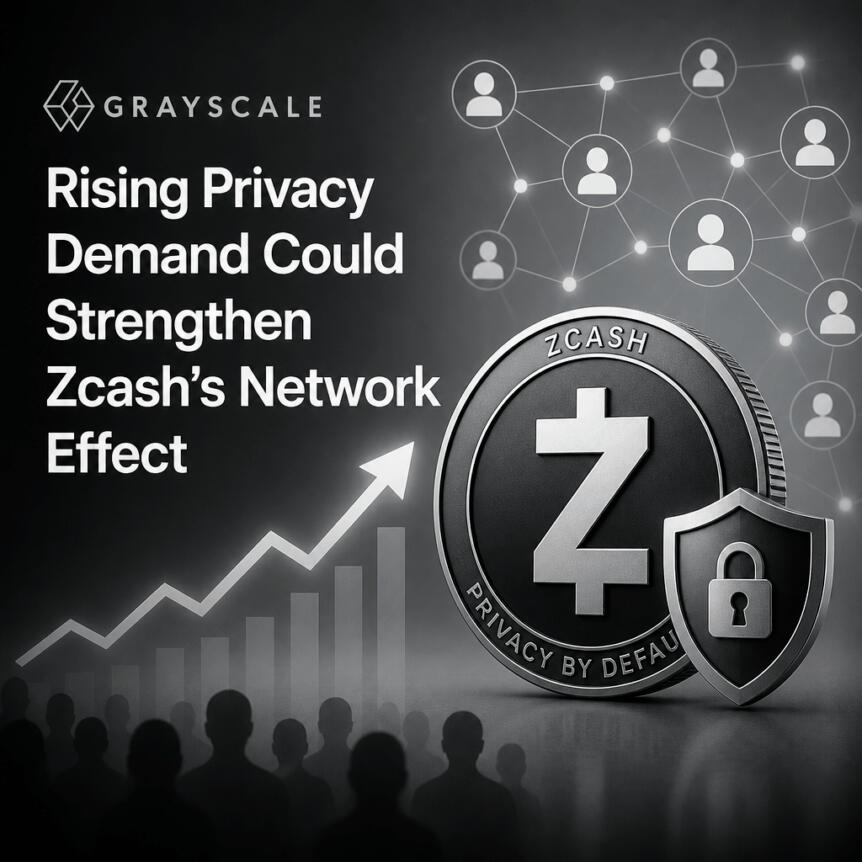
Zcash is being positioned by Grayscale as a potential long-term challenger to Bitcoin’s dominance—less because of day-to-day price action and more due to a structural advantage: transaction privacy. In a new research piece, Grayscale argues that as AI systems become increasingly capable of analyzing large-scale data, the ability to keep financial activity private could grow in importance, potentially translating into renewed demand for privacy-focused networks.
The firm’s thesis centers on what it calls “second mover advantages” for Zcash—an angle Grayscale says prior alternatives such as Litecoin have not managed to capitalize on. At the same time, Grayscale cautions that Bitcoin’s liquidity and entrenched network effects remain formidable barriers, and it characterizes Zcash as a high-risk investment where returns could be volatile.
Key takeaways
- Grayscale’s report frames Zcash’s privacy features as potentially more valuable as AI improves at detecting patterns in financial data.
- The firm argues Zcash may benefit from “second mover advantages” that help it compete against Bitcoin’s network effects—unlike some earlier challengers.
- ZEC has reportedly surged nearly 19-fold over the past year, yet still represents less than 1% of Bitcoin’s market capitalization, implying remaining upside if adoption expands.
- Despite the bullish case, Grayscale stresses Zcash’s returns could be uneven and that Bitcoin’s liquidity remains a major structural advantage.
- Institutional participation in the Zcash ecosystem is also growing, highlighted by Cypherpunk Technologies’ expanded mining operations.
Why Grayscale thinks AI makes privacy more valuable
Grayscale’s research emphasizes that financial privacy isn’t only about ideology or compliance preferences—it could become an operational necessity in a world where AI can extract insights from transaction-related data at scale. According to Grayscale, Zcash’s ability to shield transaction information could help users reduce exposure to surveillance through pattern analysis.
The core of the argument is that improved AI capabilities may raise the cost of openness in financial activity. If AI can better correlate signals across markets, addresses, and counterparties, privacy becomes not merely a feature but a defense against unwanted inference. In that framing, Zcash’s approach to protecting transaction details becomes the differentiator investors may increasingly underwrite.
Network effects and the gap versus Bitcoin
Grayscale also grounds its case in market structure. The report acknowledges that Bitcoin remains difficult to displace, citing both its liquidity and its entrenched network effects. Those advantages, Grayscale suggests, explain why many alternatives struggle to convert technical differentiation into lasting market share.
Still, the firm points to the scale mismatch between Zcash and Bitcoin as a reason to watch the asset. Grayscale cites ZEC’s roughly 19-fold increase over the past year, while noting that Zcash’s market valuation remains under 1% of Bitcoin’s market capitalization. The implication is that even if Zcash captures only a small portion of Bitcoin’s network value, the upside could be substantial—but not without risk.
Grayscale’s own projection (presented in the report’s materials) suggests Zcash could be worth more than $4,000 if its market capitalization reached 5% of Bitcoin’s—an illustrative benchmark rather than a guaranteed outcome. The firm’s stance is that the “defense” provided by Bitcoin’s liquidity could limit Zcash’s speed of adoption, but that the relative valuation gap leaves room for change if narrative and usage converge.
Institutional activity: Cypherpunk expands Zcash mining
The Grayscale thesis is also supported, at least indirectly, by growing institutional interest in Zcash-related infrastructure. Earlier coverage from Cointelegraph reported that Cypherpunk Technologies—an enterprise privacy technology firm listed on Nasdaq—expanded its Zcash exposure by acquiring a mining fleet from Winklevoss Capital in a $33.33 million equity-based transaction.
Cointelegraph reported that the mining operation is already online across US facilities and is producing about 4.2 GSol/s of Equihash hashrate, roughly 18% of the Zcash network’s total computing power. Cypherpunk said the transaction makes its mining arm the network’s largest active fleet.
This matters because mining scale can influence a network’s security profile and operational maturity, both of which institutional participants often weigh when allocating resources. While mining activity does not automatically translate into sustained market share, it can signal increased commitment to the ecosystem and may improve the reliability of network participation during periods of volatility.
What remains uncertain for Zcash
Grayscale’s report contains an important counterweight: Zcash is described as a high-risk investment, and any further upside could be volatile and uneven. Even if AI-driven concerns around surveillance strengthen demand for privacy coins, the path from narrative to lasting market valuation is rarely smooth—especially when competing against Bitcoin’s liquidity advantage.
For readers, the key question is whether privacy demand will translate into consistent usage and broader allocation beyond short-term enthusiasm. The next signals to watch are whether Zcash’s ecosystem continues to attract sustained capital—both from infrastructure providers and market participants—and whether the market continues to assign increasing value to privacy as AI capabilities grow.
Peter Schiff renewed his “death spiral” warning on Strategy (MSTR), even as the stock jumped to $137.40 during a broader Bitcoin (BTC) rally. Michael Saylor answered with an AI-generated video of himself riding a bull in Spain.
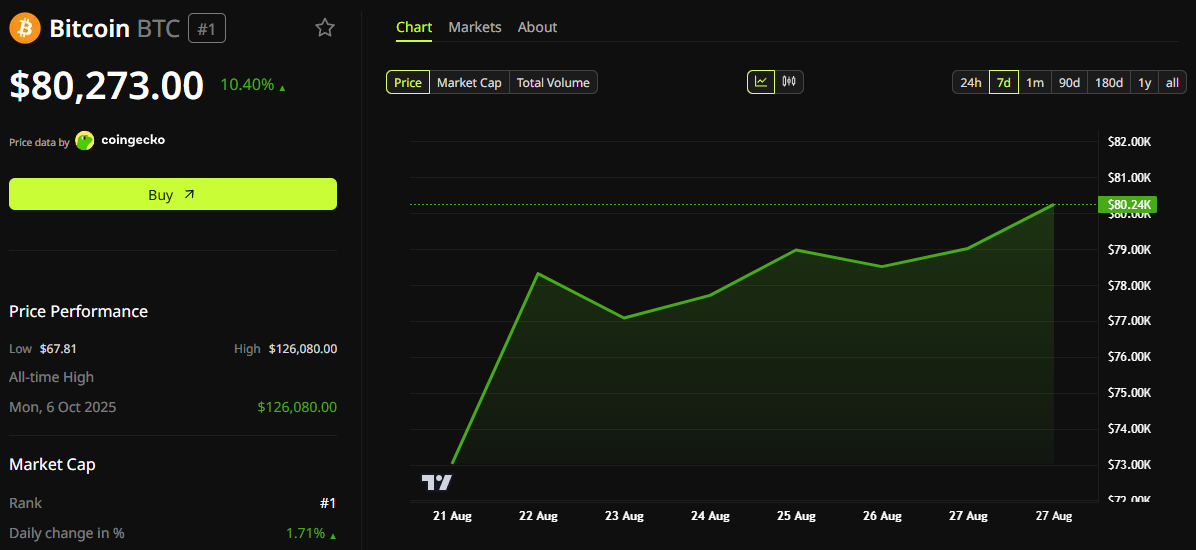
Strategy’s stock has surged since early August, echoing a rebound in Bitcoin that lifted the cryptocurrency back above $80,000 this week. Schiff attributes Thursday’s jump largely to short sellers closing positions rather than genuine buying conviction.
Schiff Won’t Budge on His Bear Case
Schiff, a longtime Bitcoin critic, has spent months arguing that Strategy’s preferred stock dividend obligations leave the company exposed if Bitcoin turns lower again. He linked Thursday’s rally to a short squeeze rather than fresh conviction behind the stock.
Not sure what’s behind today’s sharp $MSTR rally, though I suspect short-covering has a lot to do with it. Nonetheless, I stand by my “death spiral” thesis, even if Strategy’s life expectancy has been extended a bit by the temporary Bitcoin rally.
Schiff has called MSTR a scam before, and he previously warned of a death spiral tied to the same preferred stock structure, which pays a variable dividend that Strategy funds partly by issuing new shares.
Saylor Answers With Bravado
Strategy’s executive chairman posted a short AI-generated clip of himself atop a bull, captioned simply.
Ride the ₿ull.
Michael Saylor shared the clip on X. It landed the same day BeInCrypto covered Strategy’s stock rally, which has coincided with easing fears the company would need to sell Bitcoin to cover its obligations.

The split reaction captures the divide around Strategy’s model. Schiff sees the same balance sheet risk he has flagged for over a year. Saylor, leaning on Bitcoin’s momentum, seems happy to broadcast his confidence publicly.
Whether Schiff’s warning ages any better this time may depend on how long Bitcoin’s rally holds.
The post Schiff Calls MSTR Death Spiral, While Saylor Rides Bulls, MSTR Hits $137 appeared first on BeInCrypto.




Bitcoin’s latest breakout may have started with a shift in U.S. Treasury-market liquidity, but analysts say its staying power will depend on whether ETF inflows and spot demand can replace the initial macro boost.
Summary
- Bitcoin’s recent 22% rally initially carried a macro signature as the Treasury’s expanded long-term bond buybacks pushed yields lower and revived debasement concerns.
- Sygnum CIO Fabian Dori said falling BTC-denominated open interest and contained funding suggest short covering helped fuel the breakout rather than leveraged longs alone.
- U.S. spot Bitcoin ETFs drew $1.92 billion during the breakout week, while continued inflows suggest crypto-native demand is beginning to support the move.
- DWF Labs’ Martin Lee said ETF flows, futures basis and Bitcoin’s pre-breakout range will show whether the rally has a durable structural bid ahead of Sept. 9.
- Both analysts said broader liquidity conditions, rather than the Fed’s policy rate alone, will be crucial as markets assess Warsh’s Jackson Hole message.
Bitcoin surged roughly 22% during its breakout week as long-term Treasury yields fell and the dollar weakened following the U.S. Treasury’s decision to expand buybacks of longer-dated government debt. The move also triggered a major short squeeze, while demand for U.S. spot Bitcoin exchange-traded funds accelerated.
The Treasury said on Aug. 19 that it would at least double the maximum size of liquidity-support buybacks for 10-to-20-year and 20-to-30-year nominal Treasuries, raising them from $2 billion to at least $4 billion per operation. The larger operations are scheduled to begin Sept. 9 and continue through the current refunding quarter.
Fabian Dori, chief investment officer at FINMA-regulated digital asset bank Sygnum, told crypto.news that Bitcoin’s behavior alongside other markets suggests the first stage of the rally had a strong macro component.
“The clearest tell is the combination of cross-asset behavior and crypto-market plumbing.”
Dori said Treasury’s announcement temporarily pushed long-term yields lower while weakening the dollar and lifting both gold and Bitcoin. In his view, those moves were consistent with investors seeking hard assets amid renewed concerns about currency debasement rather than a rally driven exclusively by crypto-specific demand.
Martin Lee, Market Insights Lead at DWF Labs, pointed to a similar divergence across markets. AI and technology assets remained under pressure while gold and Bitcoin ETFs attracted capital as debasement concerns returned, he told crypto.news.
As crypto.news reported earlier, U.S. spot Bitcoin ETFs received about $1.92 billion during the breakout week, their largest weekly inflow in 10 months.
At the same time, the price surge forced traders positioned for further weakness out of the market. Lee said a record $2.7 billion in crypto short positions were liquidated as Bitcoin cleared its previous trading range, meaning part of the apparent spot demand reflected traders buying Bitcoin to cover bearish positions.
Bitcoin rally shows signs of both macro and crypto demand
Derivatives data provides another clue about the nature of the breakout.
Dori noted that Bitcoin-denominated open interest fell during the rally while funding rates remained contained. Bitcoin futures open interest recently declined to roughly 587,584 BTC, its lowest level in nearly five months, from around 645,760 BTC on Aug. 14.
Rather than showing traders aggressively piling into leveraged long positions, Dori said the combination points toward forced short covering playing an important role.
Still, he does not view the entire rally as a macro trade.
“So the right interpretation is probably mixed.”
Dori said the first impulse saw Bitcoin behave more like gold, as lower long-term yields, a weaker dollar, and debasement concerns drove demand. A second, crypto-specific impulse came from ETF inflows alongside regulatory developments in Washington, including the SEC’s Regulation Crypto proposal and renewed White House pressure for progress on the CLARITY Act.
ETF flows provide some evidence that demand has continued beyond the initial Treasury shock. U.S. spot Bitcoin ETFs recorded eight consecutive sessions of inflows through Wednesday, attracting about $2.8 billion over the streak.
The continued inflows matter because the initial reaction in the bond market has already weakened. BNY Markets said the decline in the term premium following the Treasury announcement had largely retraced, with long-term yields returning close to levels seen before the Aug. 19 announcement.
Bitcoin has therefore reached a point where crypto-specific buying may need to carry more of the rally if the original rate impulse continues to fade.
Sept. 9 becomes the next liquidity test
The larger Treasury buybacks do not begin until Sept. 9, raising the question of how much of their expected impact markets have already priced in.
Dori said markets normally react when such policies are announced rather than waiting for the operations themselves to begin. More important than the immediate size of the purchases, in his view, was the signal that the Treasury is willing to intervene when longer-term borrowing costs become excessively high.
Whether that support lasts will depend on what happens after the announcement’s effect fades.
Dori said rising long-end yields would suggest that the buybacks are failing to provide the expected support, while a rebuilding of the Treasury General Account could withdraw liquidity. Rapid increases in funding rates and open interest would also indicate that leverage, rather than underlying demand, had begun driving Bitcoin higher.
Weakening ETF flows or tighter dollar funding conditions would remove another source of marginal demand.
Lee similarly argued that anticipation alone cannot sustain the rally indefinitely.
“A rally on anticipation is only as durable as the flow that follows it.”
He identified ETF flows, futures basis and funding, and Bitcoin’s previous trading range as three key indicators to watch before Sept. 9.
A week of negative ETF creations while Bitcoin holds near current levels could indicate that the anticipation trade is unwinding, Lee said. He added that the three-month futures basis moved back above the 10-year Treasury yield during the rally; a reversal below that level would suggest the cash-and-carry bid had failed to persist.
The more bearish combination would be Bitcoin closing back inside its pre-breakout range while ETF flows turn negative, which Lee said would indicate that leverage drove much of the move without a durable structural bid emerging.
Liquidity increasingly extends beyond Fed rates
Both analysts also argue that investors looking only at the Federal Reserve’s policy rate may miss important forces influencing crypto prices.
Dori said Treasury cash management, particularly changes in the Treasury General Account and the mix of issuance and buybacks, has recently become an important marginal driver of liquidity. The term premium then transmits changes at the long end of the Treasury curve into risk assets.
Other channels include bank balance-sheet capacity, private credit creation, stablecoin growth and global dollar funding conditions, while the Federal Reserve’s balance sheet remains important over a longer horizon.
Lee similarly ranks dollar funding conditions and real yields ahead of the policy rate for short-term crypto market behavior, followed by the term premium. Treasury cash balances and reserve dynamics influence the liquidity underneath those markets, while issuance matters partly through its effect on longer-term yields.
For Lee, Bitcoin’s reaction to the Treasury buyback announcement showed how quickly a change at the long end of the yield curve can affect crypto even without a change in the Fed’s policy-rate outlook.
Warsh faces Bitcoin market focused on more than rates
The liquidity debate now shifts toward Federal Reserve Chair Kevin Warsh’s first Jackson Hole keynote on Friday.
The latest inflation data gives the Fed a complicated backdrop. The Bureau of Economic Analysis reported that headline Personal Consumption Expenditures inflation rose 0.2% in July and 3.7% from a year earlier. Core PCE increased 0.2% for the month and 3.3% annually.
Real consumer spending was nearly unchanged during July, while the personal saving rate stood at 3%.
Dori said Warsh could affect short-term rate expectations by explaining how the Fed views current inflation pressures, including those connected with oil markets. Treasury is attempting to influence the longer end of the curve through its buyback program, while the Fed has more direct control over short-term rates.
“If both were to get aligned, that would be a powerful support for risk assets.”
However, Dori said a simple change in expectations for the September Federal Open Market Committee meeting may not be enough to materially alter institutional crypto positioning.
Instead, investors should watch for any signal that changes the broader liquidity outlook, such as greater tolerance for oil-driven inflation, a different balance between inflation risks and economic growth, or comments capable of repricing the Treasury term premium.
Lee said institutions should remain defensive if inflation, bond yields and the Fed’s policy outlook provide conflicting signals. Bitcoin’s reaction alongside gold could offer another clue about how investors are treating the asset.
If Bitcoin rises with gold while long-duration bonds sell off, Lee said it would strengthen the case that investors are treating BTC as a hedge against fiscal and currency concerns. If Bitcoin instead falls alongside gold, its rate sensitivity would remain dominant, and institutions would have greater reason to reduce exposure.
For both analysts, the next stage of Bitcoin’s rally therefore depends less on any single inflation reading or September rate decision than on whether the liquidity conditions behind the breakout persist. It will also follow whether sustained ETF and spot demand can take over as the initial Treasury-driven impulse fades.


Radosław Piesiewicz, president of the Polish Olympic Committee, has been arrested and charged with two offenses as prosecutors investigate payments and financial ties connected to the collapsed crypto exchange Zondacrypto.
Summary
- Prosecutors charged Piesiewicz with paid influence and favoring certain creditors over others.
- Investigators are examining an alleged €40,000 watch and Piesiewicz’s withdrawal of exchange funds.
- Zondacrypto customers face estimated losses of at least 350 million zlotys, or $94 million.
- Authorities have secured more than 100 million zlotys that could fund compensation claims.
Poland’s Justice Minister and Prosecutor General Waldemar Żurek confirmed the arrest on Aug. 27, saying Piesiewicz had been taken into custody as part of the Zondacrypto investigation.
Following questioning at the Silesian branch of the National Prosecutor’s Office, Żurek said prosecutors charged Piesiewicz under Articles 230 and 302 of Poland’s criminal code. The allegations concern paid influence and satisfying one group of creditors at the expense of others while insolvency was approaching.
Piesiewicz has not been convicted, and prosecutors have yet to publish a full account of the evidence supporting the charges.
Zondacrypto probe examines withdrawals and alleged influence
According to a report on the charges by Wirtualna Polska, citing TVN24, one allegation concerns money Piesiewicz held on Zondacrypto before the platform stopped processing customer withdrawals.
Investigators suspect that Piesiewicz received information allowing him to remove his entire investment from the exchange while other creditors could not access their funds, the report said. Prosecutors are examining whether the payment gave him preferential treatment as Zondacrypto faced possible insolvency.
The second charge concerns alleged paid influence. Prosecutors suspect that Piesiewicz offered to use his contacts to assist Zondacrypto with problems involving Poland’s Office of Competition and Consumer Protection, according to the report.
Piesiewicz rejected the accusations after leaving the prosecutor’s office, describing himself as a victim of the exchange. He also denied receiving preferential treatment when withdrawing his money, according to Polish media reports.
A separate joint investigation by Wirtualna Polska and TVN24 examined his relationship with former Zondacrypto chief Przemysław Kral. Documents and messages reviewed by the outlets allegedly showed that Kral bought a Patek Philippe Calatrava watch for €40,000 in November 2025, nine days before meeting Piesiewicz at a hotel in Monaco.
The invoice carried Kral’s name and private address, according to the investigation. Piesiewicz later sent messages thanking Kral and saying he was shocked, although the messages did not refer directly to the watch.
Piesiewicz has maintained that the watch was not a gift. He said he paid for it in cash and that Kral only arranged the purchase. Żurek previously said the watch was one of the matters prosecutors planned to examine.
Olympic sponsorship placed Zondacrypto close to Piesiewicz
Piesiewicz and Kral met during sponsorship talks in spring 2025, according to Wirtualna Polska and TVN24. By October, Zondacrypto had become the Polish Olympic Committee’s general sponsor under an agreement running from 2026 through 2028.
The sponsorship also resulted in the Olympic Center in Warsaw being renamed the Zondacrypto Olympic Center of the Polish Olympic Committee. Under another part of the arrangement, Polish athletes who performed well at the 2026 Milan-Cortina Winter Olympics were expected to receive crypto rewards.
During the sponsorship period, the joint media investigation alleged that Kral provided Piesiewicz with other benefits, including match tickets, travel for people close to him, and hotel arrangements. Prosecutors have not publicly confirmed each of the reported benefits or said which items form part of the formal charges.
In an Aug. 25 statement, the National Prosecutor’s Office said investigators were verifying whether Zondacrypto had provided a financial benefit to Piesiewicz. The same inquiry is examining financing involving foundations, the conservative political conference CPAC, the broadcaster Telewizja Republika, and other individuals or organizations.
Prosecutors said they could not disclose the evidence collected for each part of the case because releasing it could affect witness interviews, searches, and other legal procedures. Officials have been securing physical and digital records while questioning witnesses and people treated as suspects.
Customer losses exceed 350 million zlotys
The case involving Piesiewicz forms one part of a criminal investigation opened by the Regional Prosecutor’s Office in Katowice on April 17. Authorities are examining suspected fraud against Zondacrypto customers and possible money laundering connected to activity dating from 2022.
Prosecutors said customers may have been misled about their ability to buy and store fiat currencies and crypto through the exchange. The inquiry also covers the receipt, storage, and transfer of funds that may have made it harder to identify assets allegedly connected to fraud.
Estimated customer losses stand at no less than 350 million zlotys, equal to about $94 million. Authorities had received more than 3,600 complaints by June and secured over 100 million zlotys that may later be used to compensate affected customers.
As crypto.news reported in August, Zondacrypto’s website went offline on April 23 after customers reported delayed withdrawals and frozen balances. The exchange-linked ZND token subsequently lost almost all its market value, while available trackers showed no active trading pairs or reported volume.
According to Polish prosecutors, the exchange’s owner said Zondacrypto had lacked access since 2022 to a cold wallet believed to hold about 4,500 Bitcoin. Authorities said customers had not been told about the loss of access.
Kral previously denied that the exchange was insolvent and argued that researchers had examined only its visible hot wallets rather than its offline holdings. No complete wallet list, matching customer liabilities or independently audited proof of reserves was published to verify the claim.
In July, authorities merged the Zondacrypto inquiry with an investigation into the March 2022 disappearance of Sylwester Suszek, who founded BitBay before it was renamed Zondacrypto. Prosecutors said the two cases shared links involving the people and activities under review.
US rules remain separate from Poland’s MiCA dispute
No U.S. agency has announced charges or identified American customer losses in the Zondacrypto case. Any direct exposure for U.S. users, therefore, remains unconfirmed.
For an exchange serving customers in the United States, European registration or authorization does not replace applicable U.S. requirements. FinCEN guidance states that businesses accepting and transmitting convertible virtual currency may need to register as money services businesses and follow anti-money laundering, recordkeeping, and reporting rules, including when the operator is based outside the country.
Zondacrypto’s collapse has also become part of Poland’s dispute over implementing the European Union’s Markets in Crypto-Assets Regulation. President Karol Nawrocki vetoed the crypto bill for a third time in June, arguing that the proposed powers and requirements needed further changes.
The rejected measure would have given Poland’s Financial Supervision Authority licensing, reporting and enforcement powers over crypto service providers. It also included criminal penalties for serious violations involving exchange operations and token issuance.
Poland was among five EU countries with no MiCA licenses recorded as of June 29, while Germany had issued 57 and France 26, according to ESMA register data. ESMA’s central register tracks authorized crypto service providers, crypto-asset white papers and entities identified as noncompliant across the European Union.


Aave V4 deposits have reached a record $806 million after climbing 30% over seven days, while active loans have increased to $206 million.
Summary
- Aave V4 deposits rose above $800 million within six days of crossing $600 million.
- Ethereum Core leads the six listed markets with $378 million in deposits.
- Active EtherFi loans reached $62 million as the market’s utilization rate climbed to 92%.
- Aave V3 remains much larger, holding approximately $31 billion in deposits.
Aave V4 deposits accelerate past $800 million
Aave’s on-chain dashboard shows that V4 deposits reached $806 million on Aug. 27, extending a rapid rise that began earlier in the month. Deposits passed $500 million on Aug. 19 and exceeded $600 million two days later before adding more than $200 million over the following six days.
Within the total, V4 deposits on Ethereum passed $500 million on Aug. 25. The dashboard divides the capital among several markets with separate collateral rules, borrowing limits, and risk settings instead of placing every asset inside one common lending pool.
Ethereum Core is the largest market, holding $378 million, or about 47% of all V4 deposits. EtherFi Cash on Optimism follows with $257 million, giving the two markets a combined $635 million and nearly 79% of the version’s deposits, based on figures from the dashboard.
Among the remaining markets, Ethereum Global Dollar holds $75 million, and Ethereum Prime accounts for $63 million. Avalanche Core has attracted $18 million, while Ethereum Plus holds another $15 million. Combined, the six listed markets account for the full $806 million reported on the dashboard.
The latest figures have placed V4 well above the $400 million level reported in mid-August. Deposits had stood near $350 million at the start of the month, meaning the value supplied to the system has more than doubled in less than four weeks.
Active loans reach $206 million
Borrowing has risen alongside deposits, with active V4 loans reaching $206 million. EtherFi accounts for $62 million of the total as users deposit wrapped EtherFi staked Ether, known as weETH, as collateral to borrow wrapped Ether.
According to the dashboard, the EtherFi market has reached a utilization rate of 92%. Utilization measures the portion of deposited assets currently being borrowed, making the figure important for both lenders and borrowers. High utilization can increase returns for suppliers, but it can also raise borrowing costs and leave less immediately available liquidity for withdrawals.
A recent crypto.news report on Aave’s debt concentration found that Ether staking and restaking tokens, including weETH, rsETH and wstETH, made up about 66.2% of collateral among the protocol’s largest leveraged positions. WeETH alone accounted for roughly 42%, while WETH represented about 73% of the debt held by that group.
The report also found that 9% of positions carried roughly half of Aave’s total debt. Average health factors for the group stood near 1.06, while debt-to-equity ratios were close to 10.7 times, according to the analysis. A health factor below 1 can trigger an automatic liquidation under Aave’s rules.
Such figures cover Aave’s lending system beyond the new V4 markets and therefore should not be treated as a direct measure of V4 risk. Still, they provide context for the 92% utilization recorded in the EtherFi market, where weETH collateral supports borrowing in the closely related WETH asset.
WeETH leads Aave V4’s deposit mix
WeETH is also the largest individual asset supplied to V4, with deposits of $97 million. The Global Dollar stablecoin, or USDG, ranks second at $90 million, followed by WETH and USDC at $81 million each.
Liquid staking and yield-bearing assets account for several other large positions. LiquidETH holds $77 million, while liquidUSD accounts for $58 million. Wrapped Bitcoin deposits have reached $54 million, giving users another crypto asset that can be deployed under V4’s market-specific collateral settings.
The seven named assets together represent $538 million, or about two-thirds of all V4 deposits. Other supported tokens make up the remainder of the $806 million total.
V4’s structure separates its markets into liquidity hubs and specialized spokes. Hubs manage supplied capital and accounting, while spokes set the terms for individual borrowing markets, including which collateral can be used and how much users can borrow.
The design differs from Aave V3, where each market generally operates as its own pool. V3 still holds approximately $31 billion in deposits, nearly 38 times the amount recorded in V4. The comparison shows that most Aave capital remains in the older system even as deposits move into the new version.
During the Aave V4 launch in April, the protocol presented the hub-and-spoke model as a way to create lending markets with tailored risk controls without dividing liquidity across entirely separate pools. Supported uses included fixed-rate loans, tokenized real-world asset collateral, and structured credit.
Aave’s DAO had previously approved $25 million in stablecoin funding and 75,000 AAVE tokens for protocol development. The funding framework established V4 as the system’s long-term technical base while directing revenue from specified Aave Labs products to the DAO treasury.
Avalanche adds a U.S. Treasury lending route
Outside Ethereum and Optimism, Avalanche Core accounts for $18 million of current V4 deposits. Aave launched V4 on Avalanche in July, making the network its first V4 deployment beyond Ethereum.
As reported in July, Aave said the Avalanche rollout would support lending markets backed by tokenized real-world assets. Planned collateral included tokenized U.S. Treasuries, money market funds, private credit and corporate bonds.
The planned Treasury-backed markets provide a direct connection to U.S. financial assets, although on-chain access does not by itself determine whether a product can legally be offered to U.S. investors. Any access rules would depend on the issuer, the structure of the tokenized instrument, and the regulations applying to its distribution.
Avalanche’s deployment also sits alongside an effort to reduce support for markets with little activity. In July, an Aave governance proposal targeted six deployments and dozens of low-use reserves covering about $98.1 million in supplied assets and $15.6 million in debt.
The proposal called for retiring deployments on Sonic, Scroll, zkSync, Metis, Soneium and Aptos while removing 50 low-adoption reserves and 21 matured Pendle principal tokens from other markets. Under the proposed process, Aave would first freeze affected reserves and cut their supply and borrowing caps before gradually reducing the remaining positions.



Days of our Lives LEAK: Sarah and Xander Cross Paths at Father-Daughter Event?

Tour Championship: Min Woo Lee leads with Tommy Fleetwood in contention

Is the Bitcoin Bottom In? The Level That Decides





-

 Fashion6 days ago
Weekend Open Thread: Madewell – Corporette.com
-

 Crypto World2 days ago
SpaceX stock could rise 75% to $240, JPMorgan says
-

 Business5 days ago
Musk’s Tesla, SpaceX Confirm $16.8 Billion ‘Terafab’ Chip Plant as World’s Largest Building in Texas
-

 Crypto World6 days ago
anatomy of crypto’s biggest liquidation event since 2021
-

 Crypto World3 days ago
A $30 Billion AI Fund Implodes, Now the SEC Is Investigating Wall Street’s Role
-

 Politics6 days ago
6 months on, Irish renters crushed by effects of government housing bill
-

 Crypto World2 days ago
Did Trump Just Move SpaceX Stock With One Truth Social Post?
-

 Business5 days ago
Mystery AI Model ‘Ox Alpha’ Draws Developers With Free Access as Chinese Lab Origins Remain Debated
-
 NewsBeat6 days ago
The ‘Lucky Dip Gang’ causing carnage for clicks: After five thugs were killed speeding in the wrong direction on a motorway, GUY ADAMS investigates a sick new trend… and why police aren’t even allowed to pursue them
-
 Crypto World6 days ago
Nvidia Stock Suffers Longest Losing Streak Since 2022: Will Q2 Earnings End It?
-

 Business3 days ago
Moderna CEO warns China is pouring state money into mRNA technology
-

 Business3 days ago
NVIDIA Stock Drops Nearly 2 Percent to $210 on Seventh Losing Day Ahead of Critical AI Earnings
-

 Tech6 days ago
Unitree’s New Superman Robot Claims to Outjump and Outrun Every Human, Usain Bolt Included
-

 Crypto World1 day ago
Warsh Jackson Hole keynote puts financial innovation first
-

 Business6 days ago
UK firms in critical financial distress rise 9% to 53,756
-

 Sports5 days ago
Deshaun Watson fires back at Browns fans after being booed: ‘It’s a disrespectful thing’
-

 Crypto World5 days ago
Google Gemini AI Predicts Ethereum Could Become the Trade Retail Misses in 2026
-

 Tech6 days ago
Faster chip in a familiar form factor
-

 Business6 days ago
Will Tesla Stock Be Higher or Lower a Year From Now? Here’s What Wall Street Analysts Are Saying
-

 Business4 days ago
Tesla Recalls Nearly 3 Million Cars in China Over Hidden Door Handles Linked to Multiple Deaths Amid New Ban
You must be logged in to post a comment Login