
Crypto World
The $292M crypto hack exposed DeFi’s weak spots. Here’s what must change, insiders say

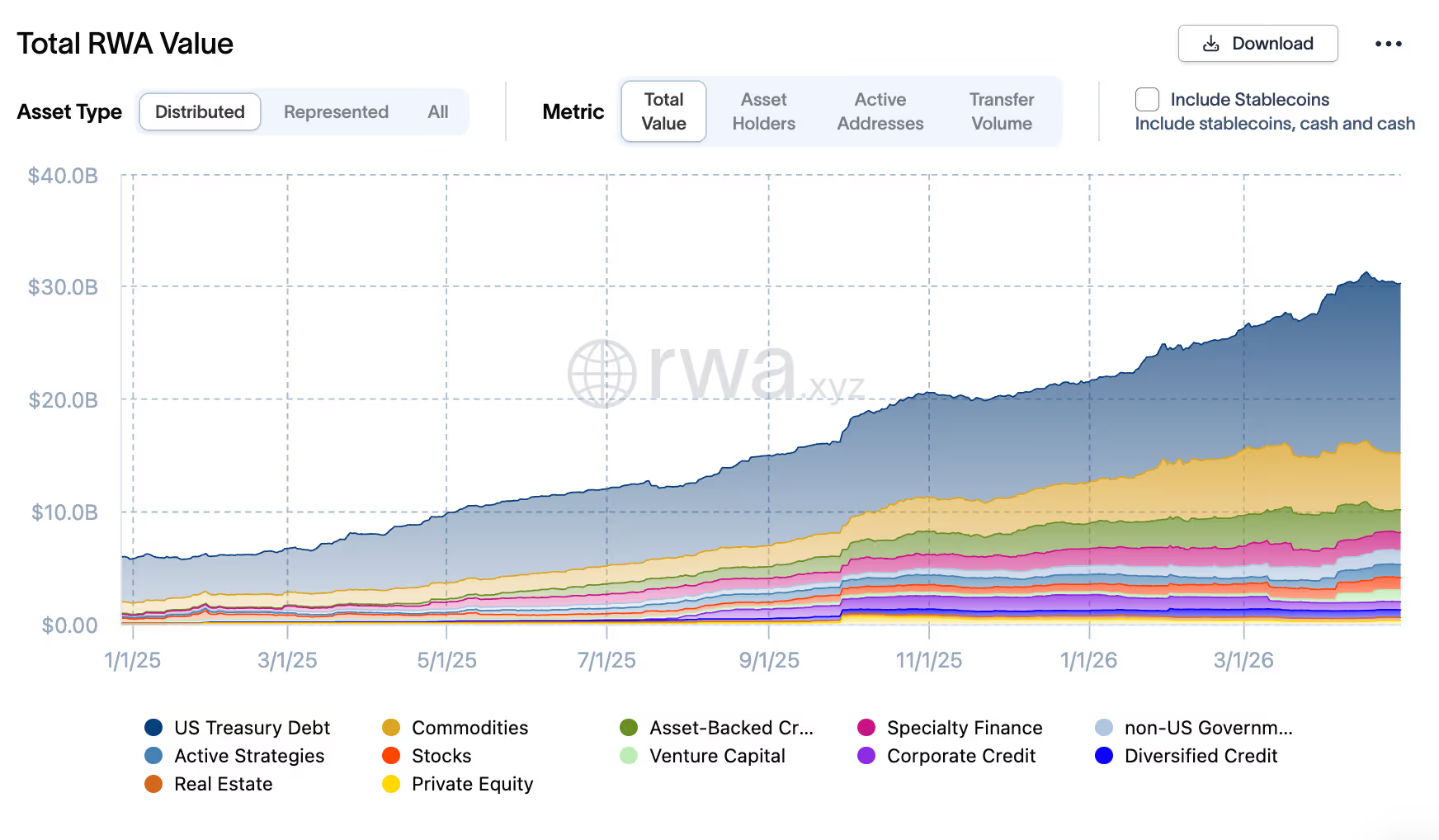
The $292 million exploit of Kelp DAO and the subsequent fallout across crypto lending markets hit decentralized finance (DeFi) at a pivotal moment.
Just as Wall Street firms pushed deeper into onchain markets, the incident has exposed how fragile parts of the system remain and how much work is left before institutions can scale their exposure.
In the weeks leading up to the hack, private credit giant Apollo Global Management (APO), which oversees $900 billion, inked a strategic partnership with Morpho to support lending markets with an option to acquire governance tokens of the protocol, too. Around the same time, the world’s largest asset manager BlackRock (BK) brought its tokenized money market fund onto decentralized exchange Uniswap.
The exploit is unlikely to derail traditional finance (TradFi) pushing deeper into onchain finance, industry insiders argued, but highlighted what DeFi needs to fix before larger pools of capital can move in.
‘Speed bump, not roadblock’
“DeFi platforms are pioneering new ways for investors to utilize their capital more efficiently,” said Nick Cherney, head of innovation at Janus Henderson, an asset manager that oversees about $500 billion in assets. “Pioneers will always face risks.”
Failures like the Kelp DAO exploit can slow momentum, Cherney said, but they also force improvements. Over time, those pressure points tend to produce stronger systems, he argued.
“This is a speed bump for sure, but not a roadblock,” Cherney said.
The longer-term shift, in his view, is already taking shape. Tokenized real-world assets — such as funds, bonds and credit — are starting to anchor DeFi markets, bringing legal frameworks and risk controls that traditional finance has refined over decades.
Episodes like this one could accelerate that transition, Cherney said.

Raising the security floor
For security specialists, the lesson is more direct: the current setup is not enough.
“DeFi and onchain asset management operate in a highly adversarial environment,” said Paul Vijender, head of security at Gauntlet. “Systems are only as secure as their weakest links.”
That reality is pushing the industry toward more comprehensive defenses. Zero-trust architectures — where no part of the system is assumed safe — are becoming harder to avoid, he argued.
In practice, that means layering protections: continuous monitoring, stricter controls, built-in redundancies. Not relying on a single safeguard.
Evgeny Gokhberg, founder of digital asset manager Re7 Capital, said many of the industry’s “best practices” now need to become baseline requirements.
That includes timelocks on key governance actions, stricter multi-signature controls, tighter collateral standards and stronger safeguards around bridges — one of the most common points of failure in DeFi.
“The industry needs to treat them as baseline requirements, not best practice,” he said.
Toward institutional-grade DeFi
Bhaji Illuminati, CEO of Centrifuge Labs, sees the shift as part of a broader compression of financial evolution.
“TradFi has had decades to build up layers of protections,” she said. “DeFi is doing that too, but on a vastly accelerated timeline.”
For institutions to allocate capital at scale, she argued, a few conditions need to be met.
First is clarity: investors need to know exactly what they own, with verifiable collateral and legal structures that map to real-world risk.
Second is reliability: smart contracts, oracles and governance processes must behave in predictable, auditable ways.
Third is liquidity that holds up under pressure, allowing capital to move in and out without distorting markets.
“Being open and secure is not mutually exclusive,” Illuminati said. “The goal is to make trust explicit and verifiable.”
“Going forward, every layer of the DeFi stack needs to make security their number one priority,”she said. “This is becoming increasingly important in the age of artificial intelligence.”
Read more: AI is making crypto’s security problem even worse, Ledger CTO warns



Berkshire Hathaway’s cash hoard climbed to a record $397.4 billion in the first quarter of 2026, the company reported Saturday, even as new chief executive Greg Abel kept the conglomerate’s long-running aversion to Bitcoin (BTC) intact.
The release marks the first quarterly disclosure since Buffett handed the chief executive role to Abel at the start of 2026, and crypto investors hoping for a softer line found none of it.
Cash Stacks, Crypto Stays Out
Operating earnings rose 18% to $11.35 billion in the quarter, lifted by a 28.5% jump in insurance underwriting profit to $1.72 billion, according to Berkshire’s release. Net income more than doubled to $10.1 billion.
The cash and Treasury bill position swelled past the previous $381.6 billion record set in the third quarter of 2025. Berkshire was a net seller of equities again, offloading $24.1 billion in stock against $16 billion in purchases.
Repurchases came in at $235 million, the first material buyback in nearly two years. None of the deployed or undeployed capital touched Bitcoin, spot Bitcoin ETFs, or any digital asset.
Follow us on X to get the latest news as it happens
Abel Holds the Anti-Bitcoin Line
Buffett, who attended the Omaha shareholder meeting alongside Abel, dismissed Bitcoin as ‘rat poison squared’ at the 2018 annual meeting and said in 2022 he would not pay $25 for the entire global supply of the token.
Abel has avoided public comments on crypto, yet his Q1 capital allocation mirrors that view.
Subscribe to our YouTube channel to watch leaders and journalists provide expert insights
Berkshire’s distance is striking against the backdrop of growing institutional adoption. Spot Bitcoin ETFs have absorbed billions in inflows since their 2024 launch, and several public companies have added Bitcoin to corporate treasuries.
With a record T-bill stack and ongoing equity sales, Berkshire is signaling caution on valuations while keeping its distance from the asset class many crypto natives consider an alternative to cash.
The post Berkshire Cash Hits Record $397 Billion as Abel Keeps Buffett’s Anti-Bitcoin Stance appeared first on BeInCrypto.

TLDR:
- Senate Banking Committee targets the week of May 11, 2026, for the Structure Market Bill markup plan
- Polymarket shows 46 percent approval odds for 2026 passage, reflecting cautious market sentiment
- Stablecoin yield rules and ethics restrictions remain key hurdles in Structure Market Bill talks
- Lummis and Scott expect May markup momentum as Senate aligns competing crypto regulation drafts
Structure Market Bill (Clarity Act) enters a decisive phase in May 2026 as Senate lawmakers approach markup discussions while industry experts, prediction markets, and regulatory stakeholders assess timing, political alignment, and legislative momentum shaping potential approval outcomes across the U.S. crypto policy landscape.
Senate Push Builds Around May Markup Window
Momentum around the Structure Market Bill (Clarity Act) has intensified as the Senate Banking Committee targets a May 2026 markup window following extended negotiations across party lines and regulatory agencies involved in digital asset oversight.
Senator Tim Scott described the bill as being in the red zone, signaling readiness for committee-level advancement and structured debate during the scheduled session.
Lawmakers are now aligning schedules ahead of a possible week of May 11, 2026, marking session for the Structure Market Bill (Clarity Act) within the Senate Banking Committee.
Cynthia Lummis stated that the Structure Market Bill (Clarity Act) is expected to move into markup during May, reinforcing legislative urgency among supporters.
Ripple CEO Brad Garlinghouse adjusted expectations from April to May, noting limited time remains for legislative progress on the Structure Market Bill (Clarity Act).
Senator Scott expressed confidence that the bill could reach Senate floor consideration after committee approval, with broader vote discussions expected later in the summer.
Senator Bernie Moreno warned that missing the end-of-May window could significantly delay negotiations due to tighter legislative scheduling constraints.
Market Odds, Stablecoin Rules, and Classification Debates
Prediction markets continue to reflect divided expectations on the Structure Market Bill (Clarity Act), with varying probability estimates across platforms.
Polymarket currently assigns around a forty-six percent chance of full approval in 2026, reflecting moderate optimism among traders.
Kalshi data shows lower short-term approval expectations, with probabilities ranging below forty percent for near-term legislative passage.
Stablecoin yield provisions remain a core negotiation point within the Structure Market Bill (Clarity Act) discussions in Senate committees.
Lawmakers are considering restrictions on passive yield while preserving reward-based mechanisms tied to user activity across crypto platforms.
Separately, proposed ethics measures under the Coin Act have introduced friction due to potential conflicts involving digital asset ownership.
If passed, the bill would establish federal classification of major cryptocurrencies Bitcoin, Ethereum, and XRP as commodities.
Final approval requires committee clearance, Senate floor voting, reconciliation between House and Senate versions, and presidential assent.
Stakeholders continue monitoring legislative coordination as May 2026 remains a decisive period for crypto market structure regulation.
The Structure Market Bill (Clarity Act) requires alignment between Senate Banking and Agriculture Committee versions before floor consideration proceeds.
Negotiators continue resolving differences on regulatory scope and enforcement authority across digital asset market definitions. Committee staff expect continued discussion following the May recess period as procedural drafting intensifies.
Industry participants continue tracking legislative signals as market sentiment adjusts to shifting approval timelines and political negotiation cycles.

TLDR:
- WLFI token sales reportedly moved 5.9B tokens via private allocations after fundraising rounds closed early
- Early investors remain locked out of 80% holdings, while governance terms extend vesting timelines significantly
- Borrowing against WLFI tokens has been used to access liquidity without direct market selling pressure
- Token value has dropped over 90%, with continued downside pressure across related ecosystem assets and liquidity pools
WLFI token sales are drawing fresh attention after reports of large private allocations, treasury movements, and investor lockups tied to the Trump-backed crypto project.
Market participants are closely watching liquidity shifts, governance changes, and ongoing pressure across the token ecosystem.
Treasury Movements and WLFI Token Sales Structure
WLFI token sales have come under scrutiny following disclosures of large private allocations linked to post-fundraising treasury activity.
Reports indicate that 5.9 billion tokens were shifted into private hands after initial rounds concluded, raising questions over distribution transparency.
Data also suggests that founder-linked wallets recorded increases in holdings that were not clearly explained in public governance filings.
World Liberty Financial confirmed private transactions, describing them as white-glove deals directed toward accredited investors in controlled allocations.
Analysts tracking the sales noted inconsistencies between token supply records and disclosed allocation schedules across treasury reports.
These movements suggest layered liquidity management strategies that rely on internal governance approvals rather than open market distribution.
WLFI token sales continue to be assessed by market observers as supply dynamics evolve within the broader ecosystem structure.
Regulatory observers continue monitoring these movements for potential disclosure gaps emerging globally, tracked
Investor Lockups and Borrowing Pressure Across WLFI Token Sales
Investor conditions tied to WLFI token sales include extended lockup periods that restrict access to most early holdings across the ecosystem.
Reports suggest that up to 80 percent of allocated tokens remain inaccessible for many participants under revised governance proposals.
WLFI token sales mechanisms have also been linked to structured borrowing activity, where tokens are used as collateral for stablecoin liquidity.
Approximately five billion tokens were reportedly deposited into decentralized lending protocols to access short-term capital without direct liquidation.
Market observers note that this structure may allow indirect liquidity extraction while formal unlock schedules remain years away for holders.
WLFI token sales performance has weakened significantly, with prices falling more than 90 percent from previous peak levels in trading.
Additional downside pressure has been recorded in the past month as liquidity thinned across trading venues and investor sentiment cooled.
Some ecosystem-linked assets have mirrored token sales weakness, reflecting correlated risk exposure across related digital instruments.
Governance proposals under review could reshape vesting timelines, though approval remains uncertain among token holders voting on changes.
WLFI token sales continue to be evaluated as investors weigh liquidity access against long-term participation requirements and lockup constraints.
Outcomes depend on governance voting results and evolving market liquidity conditions across exchanges globally, tracked by metrics

Key Highlights
- Q1 net profit reached $745 million, climbing from $654 million in the prior-year period
- Quarterly revenue totaled $6.02 billion, falling below analyst projections of $6.35 billion
- Adjusted earnings per share of $2.60 came in under the consensus forecast of $2.98
- March cybersecurity incident linked to Iranian hackers disrupted business operations and affected quarterly performance
- Shares declined approximately 2% to $308.75 in extended trading; company reaffirmed annual guidance
The medical device manufacturer delivered a challenging first-quarter performance, exceeding prior-year profit levels while falling short of analyst expectations for both revenue and earnings. The quarter’s outcome was significantly influenced by a cybersecurity breach that occurred in March.
Shares of SYK retreated roughly 2% in after-market activity to $308.75 after the earnings announcement.
The medical technology firm recorded net earnings of $745 million, translating to $1.93 per share, representing an increase from the year-ago figure of $654 million, or $1.69 per share. However, adjusted earnings reached $2.60 per share, undershooting analyst expectations of $2.98.
Quarterly revenue registered at $6.02 billion for the three-month period ending March 31. While this represented a 2.6% year-over-year advance, it remained below the Street’s consensus projection of $6.35 billion.
Security Breach Creates Operational Challenges
During March, a hacking collective known as Handala, reportedly tied to Iran, took credit for launching a damaging cyberattack against the company. This security breach triggered extensive disruptions across the organization’s Microsoft infrastructure and allegedly postponed certain surgical procedures.
Multiple employees and contracted workers shared on various social platforms that the hacking group’s emblem displayed on their computer login interfaces, though Reuters could not independently confirm these reports.
The company had previously disclosed in April that the cybersecurity incident would negatively impact first-quarter financial results. Management confirmed this expectation during Thursday’s announcement.
According to a Wall Street Journal article from that period, the cybercriminals stated they launched the attack as a response to growing tensions between the United States and Iran.
Division Performance Shows Divergence
Stryker’s MedSurg and Neurotechnology division, representing the company’s primary business unit, generated a 5% revenue increase to $3.21 billion. However, this figure disappointed compared to analyst projections of $3.83 billion.
The Orthopaedics division delivered more encouraging results. Revenue climbed 6.3% to $2.81 billion, surpassing analyst estimates of $2.51 billion.
Weaker customer demand for medical implants and equipment utilized in sophisticated procedures — particularly spinal surgeries and orthopedic interventions — contributed to the overall revenue underperformance.
The company faces direct competition from Zimmer Biomet (ZBH) and Johnson & Johnson (JNJ) throughout the orthopedics marketplace, spanning categories including hip and knee replacement systems, trauma products, and sports medicine devices.
Despite the quarter’s disappointing results, the medical device maker maintained its full-year financial projections. Management confirmed its previous expectations for adjusted annual earnings between $14.90 and $15.10 per share.
This unchanged forecast suggests leadership believes the cybersecurity incident’s financial consequences are limited to the first quarter and will not materially affect full-year performance.
With adjusted EPS of $2.60 for Q1 positioned against full-year guidance of $14.90–$15.10 per share, the company anticipates accelerated earnings growth throughout the remaining nine months.
Management reaffirmed its full-year adjusted earnings per share guidance spanning $14.90 to $15.10 per share.
TLDR:
- Chainlink has enabled over $30 trillion in total value across seven years with zero recorded exploits.
- Institutions including Swift, JP Morgan, and DTCC have independently adopted Chainlink as their infrastructure layer.
- CCIP weekly volume surged 260% to $1.3B while 970,000 LINK was withdrawn from exchanges in one day.
- The SEC and CFTC classified LINK as a digital commodity, strengthening its regulatory standing globally.
Chainlink continues to draw attention from major financial institutions worldwide, even as its native token, LINK, remains priced at $9.
The protocol has now enabled over $30 trillion in total value — a figure that exceeds U.S. GDP. Despite this scale, market pricing has not yet reflected the network’s growing role in global finance.
A closer look at recent data and institutional activity shows a widening gap between on-chain fundamentals and current token valuation.
Institutional Partnerships Signal Growing Confidence in Chainlink
Some of the world’s largest financial institutions have independently chosen Chainlink as their blockchain infrastructure layer. Swift, DTCC, Euroclear, JP Morgan, and Mastercard are among them.
Fidelity International, UBS, the Central Bank of Brazil, and SBI have also adopted the protocol. These organizations collectively clear, settle, and move a large portion of the world’s capital.
Amundi, Europe’s largest asset manager, recently launched a Chainlink-powered tokenized fund. The fund reached $400 million in assets under management within three weeks of launch.
Coinbase has also integrated Chainlink’s DataLink platform to push exchange data on-chain. These moves reflect growing institutional confidence in the protocol’s reliability.
The U.S. Department of Commerce now uses Chainlink oracles for GDP and inflation data feeds. The SEC and CFTC have classified LINK as a digital commodity.
Chainlink’s deputy general counsel holds a seat on the SEC’s Crypto Task Force. This regulatory positioning adds another layer of credibility to the network.
Over seven years of operation, the protocol has recorded zero exploits. This track record has strengthened its position as a trusted infrastructure layer.
As X Finance Bull noted in a post on X: “These aren’t speculative partnerships. These are the institutions that clear, settle, and move the world’s capital.” The consistency of institutional adoption across different sectors reinforces this view.
On-Chain Data Points to Tightening LINK Supply
Recent on-chain activity shows a notable shift in LINK holder behavior. Exchange outflows hit a record high, with 970,000 LINK withdrawn from exchanges in a single day.
Simultaneously, whale wallets holding one million or more LINK grew by 25% over the past year. These trends suggest long-term accumulation rather than short-term trading activity.
CCIP weekly transaction volume surged 260% to reach $1.3 billion. This cross-chain interoperability protocol is central to Chainlink’s role in connecting blockchains with traditional financial systems.
The volume increase aligns with growing institutional use of the network. It also mirrors the broader expansion in tokenized real-world assets.
ETF inflows tied to LINK have surpassed $111 million. This figure reflects growing demand from institutional investors seeking regulated exposure to the asset.
The combination of record outflows and ETF inflows points to a tightening supply environment. Market observers note that this pattern has historically preceded price discovery phases in similar assets.
At present, LINK trades at $9 despite the protocol powering over 65% of all DeFi oracle services. The network connects the world’s largest financial institutions to blockchain infrastructure.
As on-chain fundamentals continue to compound, the gap between protocol utility and token price remains a point of focus for analysts and long-term holders alike.
TLDR:
- Big Tech’s combined 2026 CapEx of $715 billion marks a 98% year-over-year surge from prior levels.
- Amazon leads spending at $200 billion, followed by Microsoft and Alphabet both guiding toward $190 billion.
- Funds are targeting data centers, Nvidia GPUs, custom chips, and power systems to meet AI demand.
- Investor Jim Chanos warns of accounting mismatches and draws comparisons to the dot-com era bust.
Big Tech’s combined capital expenditure is set to reach a record $715 billion in 2026. Amazon, Alphabet, Microsoft, and Meta disclosed the figures during their first-quarter earnings.
The surge nearly doubles last year’s spending levels. Companies are directing funds toward data centers, Nvidia GPUs, custom chips, and power systems. The move comes as AI demand grows rapidly across cloud platforms like AWS and Azure.
Record CapEx Figures Signal a Major Shift in Tech Spending
The $715 billion projection marks a 98% year-over-year increase for the four companies combined. That figure is nearly three times the total spent in 2024 and more than five times 2023 levels. Each company is on pace to spend as much in 2026 as in the prior two years combined.
Amazon leads the group with capital expenditure approaching $200 billion this year. Alphabet and Microsoft are both guiding toward $190 billion each for 2026.
Meta rounded out the group after raising its forecast by $10 billion, now projecting between $125 billion and $145 billion.
The Kobeissi Letter noted the scale on X, stating that Big Tech CapEx has reached unprecedented levels. The post pointed out that the combined spend of $AMZN, $GOOG, $META, and $MSFT is expected to surge 98% year-over-year to a record $715 billion in 2026.
Strong recent revenues are backing these investments across the board. Cloud services, AI tools, and enterprise software have all posted solid growth, giving companies room to commit to large infrastructure buildouts.
AI Infrastructure Drive Draws Both Support and Skepticism
The capital is flowing primarily into data centers and the hardware needed to run large AI models. Nvidia GPUs remain a central purchase, alongside custom silicon developed in-house by each company. Power systems are also a growing part of the budget as energy demands rise.
Supporters of the spending argue it is necessary preparation for the next wave of AI growth. Cloud platforms like AWS, Azure, and Google Cloud are seeing rising demand from enterprise clients and developers building on AI tools.
However, not all observers are convinced the returns will follow. Investor Jim Chanos has raised concerns about accounting mismatches in how these costs are reported. He has drawn comparisons to the capital spending patterns seen during the dot-com era.
Chanos and other skeptics question whether the revenue generated will justify the scale of investment. The debate centers on timing, with critics arguing that the returns on AI infrastructure may take far longer to materialize than the market currently expects. The discussion is ongoing as earnings season continues to reveal more data.


Paul Sztorc’s proposed eCash fork has been framed as a battle over Bitcoin’s principles. But among developers and infrastructure builders, a different interpretation is taking hold.
This isn’t really a Bitcoin fork, they argue. It’s an airdrop — and a potentially hazardous one.
“I’m firmly against Paul’s fork, but not because it represents a ‘hostile Bitcoin hard fork,’ as some claim,” said Sergio Lerner, co-founder of Rootstock Labs, told CoinDesk in an email. “eCash is a new blockchain…It is not directly taking anything away from bitcoin holders.”
That distinction cuts through much of the early backlash. Unlike past splits that attempted to carry the Bitcoin name or compete for hashpower, eCash is structurally closer to a new token being airdropped to existing bitcoin holders.
But for Lerner and others, that framing shifts the concern rather than resolves it.
Airdrops are common across crypto. In Bitcoin, they are rare — and often messy.
Lerner argues that distributing eCash based on Bitcoin’s UTXO set — the collection of “unspent transaction outputs,” essentially the chunks of bitcoin that make up user balances — exposes users to avoidable operational risk, particularly if they try to claim the tokens.
“Airdropping to UTXO owners does not help bitcoiners and instead exposes them to significant risk,” he said, pointing to the need for users to move funds out of cold storage and interact with unfamiliar software.
That risk is compounded by the lack of full replay protection between the two chains. Without a clean separation, transactions intended for Bitcoin could inadvertently affect funds on the eCash network, or vice versa.
Dan Held, a Bitcoin entrepreneur, framed it more bluntly: “Reallocating Satoshi’s coins is shock value marketing, and the no-replay protection makes it quite hazardous to redeem.”
No-replay protection could allows a valid, signed transaction from the hard fork to be maliciously broadcast and accepted on another chain. This causes identical, unwanted transactions on both networks, leading to accidental loss of funds. It occurs when two chains share the same transaction format.
Distribution questions
Beyond security concerns, the distribution itself is being questioned.
Because Bitcoin ownership is often intermediated by exchanges, custodians and institutional platforms, the entity controlling private keys is not always the economic owner of the coins.
“The custodians controlling UTXO keys are often not the rightful economic owners,” Lerner said. “This places users who hold bitcoin through custodians at a disadvantage.”
In practice, that means some users may never receive eCash at all, while others may take on new risks to access it. For systems built on top of Bitcoin — including sidechains, like Rootstock, and federated custody networks — the situation becomes even more complex, potentially requiring coordination or upgrades to safely split coins across chains.
Lerner also criticized the project’s funding model, which allocates a portion of Satoshi-linked coins on the new chain to early investors, calling it “morally objectionable and unnecessary.”
Philosophical fault line
For others, the objection goes beyond mechanics.
Jay Polack, head of strategy at Bitcoin sidechain VerifiedX, sees the proposal as part of a broader category of attempts to reinterpret Bitcoin’s core properties through derivative systems.
“It’s mind boggling to think that anybody would think that’s a really good idea,” Polack said, referring to the combination of forking and reassigning dormant coins.
Polack argues that even indirect changes to how Bitcoin ownership is represented risk undermining the system’s core guarantee.
“You can’t break the native ownership of Bitcoin. It’s totally contradictory to what Bitcoin is,” he said.
In that framing, eCash is less about whether Bitcoin itself changes — it doesn’t — and more about whether the ecosystem should tolerate structures that reinterpret its ledger.
Most Bitcoin forks fail to gain meaningful traction. eCash may follow the same path.
But the reaction to it is already clarifying something else: Bitcoin’s resistance to change is not just about code or consensus rules. It extends to how users are expected to behave, how risk is introduced, and what kinds of experiments are considered acceptable at the edges.
Framed as an airdrop, eCash looks less like a challenge to Bitcoin — and more like a test of how far its social boundaries actually reach.


Crypto trade groups called for a markup of key market structure legislation within hours of U.S. Senators Thom Tillis (R-N.C.) and Angela Alsobrooks (D-Md.) releasing a compromise text Friday on stablecoin yield in the Digital Asset Market Clarity Act, the final major sticking point in the bill.
The text bars crypto firms from paying interest or yield on stablecoin balances in a manner economically or functionally equivalent to a bank deposit.
It carves out rewards programs tied to “bona fide activities or bona fide transactions,” and directs Treasury and the CFTC to write rules within a year of enactment.
Blockchain Association CEO Summer Mersinger called the deal a step in the right direction.
“We commend Senators Tillis and Alsobrooks for their leadership in reaching this agreement,” Mersinger said. “Every day without a clear legal framework is an invitation for top-tier talent, capital, and innovative companies to locate elsewhere.”
The Crypto Council for Innovation endorsed the bill while flagging concerns. Its CEO Ji Hun Kim said the new language extends the prohibition framework well beyond last year’s GENIUS Act, which barred only issuers from paying rewards.
“CCI has been clear that we disagree with assertions about deposit flight concerns from stablecoin adoption,” Kim wrote on X. The text, he said, “goes VERY FAR beyond” the GENIUS Act by applying to all digital asset market participants.
Kim urged the committee to advance the bill anyway. “The north star is to ensure that the U.S. can lead on crypto–this is the future. We respectfully ask Senate Banking to move to mark up. The time is now,” he wrote.
Circle Chief Strategy Officer Dante Disparte, whose firm issues the USDC and EURC stablecoins, endorsed the deal without qualification.
“Today’s compromise on stablecoin yield marks meaningful progress in the CLARITY Act negotiations,” Disparte said. He pointed to USDC’s growth in cross-border payments, capital markets collateral and agentic commerce.
“The United States faces a clear choice in digital assets: lead or be led,” he said. “Today’s progress is an encouraging signal that the U.S. is choosing to lead.”
Coinbase had the most at stake in the negotiations. CEO Brian Armstrong posted “Mark it up” after the text dropped. Chief legal officer Paul Grewal said the language preserves activity-based rewards tied to real participation on crypto platforms, which is what the bank lobby had asked for.
The Senate Banking Committee postponed an earlier CLARITY Act markup in January. Other negotiation points remain unresolved, but the yield language has largely been the greatest obstacle.
Firms will need to restructure rewards programs from a “buy and hold” model to a “buy and use” one to comply with the transaction caveats.


Arbitrum’s Security Council seized 30,766 ETH from the KelpDAO hacker, but a US court order now blocks the DAO from touching the $71 million stash. Lawyers for North Korean kidnapping victims aim to claim the money under a 2015 judgment against Pyongyang.
The legal action stalls Aave and Kelp DAO’s plans to compensate users hit by the April 18 hack. The freeze shows how a centralized governance move pulled assets straight into US courts.
Centralized Action, Centralized Consequences
The Council froze the ETH last month after a bridge exploit drained $290 million from KelpDAO. It coordinated with law enforcement and routed the funds to governance control.
Han Kim and Yong Seok Kim are US nationals whose relative was killed by North Korea. They won more than $300 million in damages from Pyongyang in a 2015 ruling.
Their lawyers obtained an order on May 1 from the Southern District of New York. The order bars Arbitrum from transferring the seized assets.
LayerZero attributed the hack to the Lazarus Group, tying the ETH directly to Pyongyang.
Aave Recovery Hits a Legal Wall
Attorney Gabriel Shapiro reviewed the filing and said the freeze is real, not theoretical. Plaintiffs secured court approval under specific garnishment statutes, leaving the DAO without unilateral authority to redirect the assets.
“Arbitrum DAO is not allowed to do anything with the KelpDAO funds for now, until a divestiture hearing… they are supposed to actually litigate that not just decide on their own what to do with it,” Gabriel Shapiro stated in post on X.
The freeze stalls Aave’s coalition, which pooled ETH from Lido, Mantle, and EtherFi to backstop rsETH holders. Those plans relied on the seized stash flowing back through Arbitrum governance.
According to one of the economics leads at MegaETH, the seizure exposes the DAO to claims it never anticipated.
Identifiable DPRK assets carry legal weight regardless of which protocol holds them.
Once a DAO seizes assets through centralized rails, those assets sit inside the same legal regime as bank accounts.
The divestiture hearing will decide final control. Separate ETH from the heist still moves through laundering channels.
The post Arbitrum’s KelpDAO Freeze Backfires as US Court Blocks $71 Million Recovery appeared first on BeInCrypto.
TLDR:
- Senators Tillis and Alsobrooks finalized a bipartisan deal that unblocks the Crypto Market Structure Bill.
- Crypto platforms are now banned from offering passive stablecoin yield equivalent to bank deposit interest.
- Activity-based rewards like trading and staking remain permitted under the new stablecoin regulatory framework.
- Prediction markets place a 62% chance the Digital Asset Market Clarity Act becomes law in 2026.
The Crypto Market Structure Bill has moved closer to becoming law following a bipartisan Senate agreement. Senators Thom Tillis and Angela Alsobrooks finalized a deal on stablecoin yield this week.
Their agreement resolves the single issue that had blocked the Digital Asset Market Clarity Act for months. The deal also ended the Senate Banking Committee markup collapse from January.
Washington is now ready to give digital assets a comprehensive legal framework for the first time.
Stablecoin Yield Restrictions Draw a Firm Regulatory Line
Under the new agreement, crypto platforms are broadly prohibited from offering passive stablecoin rewards. Paying users a return simply for holding a stablecoin is no longer permitted.
Regulators determined these payments are too similar to interest on a traditional bank deposit. Banks had lobbied firmly against the practice, fearing customers would pull funds from checking accounts.
The deal does not eliminate all reward types, however. Activity-based compensation remains fully permitted under the new framework.
Users can still earn rewards through trading, staking, or using platform services. The regulatory dividing line now sits between passive holding rewards and active participation rewards.
Coinbase had been among the platforms pushing hardest to offer stablecoin yield. The company viewed it as a direct competitor to traditional savings accounts.
That approach is now off the table in the U.S. market. Banks secured this outcome after arguing passive yield would trigger widespread deposit flight.
Bull Theory flagged the outcome on X, noting the deal bars platforms from paying rewards that function like bank deposit interest.
The trade-off is straightforward: crypto platforms lose a key user acquisition tool. Banks retain their edge on passive yield over digital asset providers. Neither outcome was accidental—both sides negotiated with clear objectives.
Regulatory Clarity Opens a New Chapter for Digital Assets
The Crypto Market Structure Bill now has a clear path toward a full Senate vote. Removing the stablecoin yield dispute eliminates the legislation’s single biggest obstacle.
The digital asset industry now has a credible shot at comprehensive federal regulation. Every exchange, stablecoin issuer, and platform in the U.S. has long been waiting for this moment.
Treasury Secretary Scott Bessent has publicly targeted spring 2026 for the bill’s passage. The Senate Banking Committee markup is now expected in May.
Prediction markets currently price the odds of the Clarity Act becoming law in 2026 at 62%. That figure reflects real momentum building in Washington around digital asset legislation.
Bull Theory noted that banks secured their demand on yield while crypto gained the regulatory clarity it had long been seeking.
The deal represents a genuine compromise between two powerful financial interests. Both sides entered negotiations with clear priorities and left with partial wins.
The Crypto Market Structure Bill’s forward movement is the most consequential development for digital assets in years.
A formal legal framework for the industry in America now appears genuinely within reach. Regulatory certainty has long been the most requested outcome from the digital asset sector.

Wigan end losing streak by beating Bradford

Chinese courts rule AI replacement is not legal grounds for firing workers as global tech layoffs hit 78,000

Asake – Gratitude (Official Visualizer)

Manchester United reach agreement with Casemiro over contract clause amid transfer speculation

US brings back mandatory military draft registration

Steven Gerrard disagrees with Gary Neville over ‘shock’ Chelsea and Arsenal claim | Football


-

 Tech5 days ago
Register Renaming | Hackaday
-
Crypto World7 days ago
Hyperliquid $HYPE Rally Builds Momentum as AI Sector Enters Prove-It Phase
-

 Politics5 days ago
Drax board avoid their own AGM, accused of greenwashing & environmental racism
-

 Tech5 days ago
Why Blue Badges Disappeared From Toyota Hybrids
-

 Tech5 days ago
Images of Samsung’s rumored smart glasses have leaked
-
 Sports6 days ago
IPL 2026: Ruturaj Gaikwad registers slowest fifty of the season, enters all-time unwanted list | Cricket News
-
 Tech23 hours ago
Trump’s 25% EU auto tariff breaches Turnberry Agreement that also covers semiconductors and digital trade
-

 NewsBeat6 days ago
LK Bennett closes all stores after entering administration
-

 Fashion4 days ago
Kylie Jenner’s KHY Enters a New Era with ‘Born in LA’
-
 Entertainment7 days ago
Mariah Carey Slams Deposition Claims In Brother’s Lawsuit
-

 Business4 days ago
Most Commercial Energy Audits Miss the Real Losses
-

 Crypto World4 days ago
CFTC’s AI will review U.S. crypto registration applications, chairman tells CoinDesk
-

 Business5 days ago
(VIDEO) Charlize Theron Climbs Times Square Billboard to Promote New Netflix Thriller ‘Apex’
-

 Business3 days ago
Barclay Brothers Avoid Bankruptcy: HSBC Drops High Court Petitions After IVA Deal
-
 Sports22 hours ago
Paul Scholes issues Marcus Rashford reality check as agreement emerges over Man United star
-

 Tech7 days ago
Microsoft to roll out Entra passkeys on Windows in late April
-

 Tech6 days ago
OpenAI’s Sam Altman apologizes for not reporting ChatGPT account of Tumbler Ridge suspect to police
-
 Business3 days ago
Tesla Officially Registers Elon Musk’s Stock: What Investors Need to Know
-

 Tech7 days ago
OpenAI CEO apologizes to Tumbler Ridge community
-

 Tech4 days ago
Get Ready for More Brain-Scanning Consumer Gadgets
You must be logged in to post a comment Login