
Crypto World
The Best Trading Bot for Crypto in 2026: A Complete, Honest Guide


More than 420 million people now hold cryptocurrency worldwide — yet the overwhelming majority still trade manually, emotionally, and inconsistently. The result is predictable: they buy tops, sell bottoms, and hand their edge to the market every single cycle.
The best trading bot for crypto doesn’t just automate button-clicks. Done right, it applies a disciplined, rules-based (or AI-driven) strategy around the clock, without fear, fatigue, or FOMO. But “done right” is the hard part. The market is flooded with bots that are expensive to configure, opaque about performance, and quick to blow up accounts when volatility spikes.
This guide cuts through the noise. We’ll explain exactly how crypto trading bots work, break down the major strategy types, review the top platforms available in 2026, and give you a practical framework for choosing — and safely running — your first automated strategy. Whether you’re a complete beginner, an intermediate trader ready to step up from manual execution, or someone burned by Telegram signal groups, this guide is for you.
Disclaimer: Crypto trading carries significant risk. Past performance of any bot or strategy does not guarantee future results. Always use risk management controls and only allocate capital you can afford to lose.
Table of Contents
- How Crypto Trading Bots Actually Work
- Bot Strategy Types Explained
- AI-Powered vs. Rule-Based Bots: What’s the Real Difference?
- The Best Crypto Trading Bots in 2026 (Reviewed)
- Head-to-Head Comparison: Strategy Type, AI, Pricing, and Best For
- How to Choose the Right Bot for Your Goals
- How to Set Up Your First Crypto Bot Safely (Step-by-Step)
- What Can Go Wrong — and How to Protect Yourself
- Performance Metrics That Actually Matter
- Crypto Trading Strategies: A Plain-Language Primer
- Frequently Asked Questions
How Crypto Trading Bots Actually Work
A crypto trading bot is software that connects to an exchange via API and executes buy and sell orders automatically based on a pre-defined set of rules or an AI model’s output. There is no magic. The bot is only as good as the strategy it runs.
Here is the basic loop:
1. Data ingestion — The bot continuously reads market data: price, volume, order book depth, and (in AI-powered systems) on-chain signals, sentiment feeds, or macroeconomic indicators.
2. Signal generation — A rule fires (“price crossed the 20-period moving average”) or an AI model produces a probability output (“65% probability of upward move in next 4 hours”).
3. Order execution — The bot sends a buy or sell instruction to the exchange. Speed matters: institutional-grade systems execute in milliseconds.
4. Position management — Stop-loss, take-profit, trailing orders, and position sizing rules activate automatically.
5. Logging and reporting — Every trade is recorded for performance analysis.
In practice, what this looks like is a bot running at 3 AM on a Tuesday when Bitcoin drops 8% in 20 minutes. A well-configured bot executes its stop-loss without hesitation. A human trader — asleep, or panicking — does not.
The critical limitation: bots optimise around historical patterns. When the market enters a regime it has never seen before — a black swan, a regulatory shock, a coordinated whale manipulation event — the bot has no special foresight. Human oversight remains essential.
Bot Strategy Types Explained
Understanding the strategy a bot runs is more important than the brand name on the platform. Here are the five major approaches:
Dollar-Cost Averaging (DCA) Bots
DCA bots buy a fixed dollar amount of an asset at regular intervals, regardless of price. This reduces the impact of volatility on entry price and suits long-term holders who believe in an asset’s trajectory.
Best for: Passive investors, beginners, long-term BTC/ETH accumulation. Risk profile: Low to medium. DCA doesn’t prevent capital loss in a prolonged bear market; it only smooths entry points.
Grid Trading Bots
Grid bots place a ladder of buy and sell orders at preset intervals above and below a price. They profit from price oscillation within a range, collecting small margins on each grid level filled.
Best for: Sideways or range-bound markets. Grid bots struggle in strong trending conditions — a market that breaks out of the grid range can cause significant losses. Risk profile: Medium. Grid width, number of levels, and total capital allocation are the key risk variables.
Momentum / Trend-Following Bots
These bots identify directional trends using indicators (RSI, MACD, moving averages, Bollinger Bands) and ride the move. They enter on breakouts and exit when momentum stalls.
Best for: Trending markets (bull runs, post-news breakouts). Risk profile: Medium to high. Momentum strategies suffer in choppy or whipsawing conditions.
Arbitrage Bots
Arbitrage bots exploit price discrepancies between exchanges or between spot and futures markets. They buy where the asset is cheaper and simultaneously sell where it is more expensive.
Best for: Institutional traders with low latency infrastructure. Retail arbitrage margins have compressed significantly as competition has intensified. Risk profile: Low per-trade risk, but execution speed and API reliability are critical.
Quantitative (Quant) Strategy Bots
Quant strategies use statistical models, factor-based analysis, or machine learning to identify repeatable edges in market data. This is the approach used by hedge funds and institutional trading desks — and increasingly, by platforms like SaintQuant, which deploys 18+ live quantitative strategies across crypto markets.
Unlike simple indicator-based rules, quant models analyse multiple data dimensions simultaneously, adapt to changing volatility regimes, and apply rigorous risk controls (position limits, drawdown thresholds, correlation management). SaintQuant makes this institutional-grade approach accessible to everyday traders through its managed strategy tiers — no coding, no configuration required.
Best for: Traders seeking consistent, risk-adjusted returns without having to build or manage strategies themselves. Risk profile: Varies by tier. Plans range from Low (Starter/Basic DCA) to High (Institutional Pro, Hedge Fund, Quant Fund Apex scalping strategies).
AI-Powered vs. Rule-Based Bots: What’s the Real Difference?
The term “AI” is used loosely in crypto bot marketing. Here is an honest breakdown:
| Feature | Rule-Based Bot | AI-Powered Bot |
| How signals are generated | Fixed IF/THEN logic (e.g., RSI crosses 30 → buy) | Machine learning model trained on historical + live data |
| Adaptability | Static — rules don’t change unless you change them | Dynamic — model can re-weight factors as market conditions shift |
| Transparency | High — you can see every rule | Low to medium — “black box” risk for complex models |
| Setup complexity | Moderate — requires user configuration | Lower for managed platforms; high for custom ML model building |
| Performance in regime changes | Degrades unless manually updated | Can adapt, but may also overfit or fail in novel conditions |
| Best used for | Beginners learning automation; specific, well-tested strategies | Experienced traders or managed platform users seeking systematic edge |
The honest answer: Most consumer-facing “AI bots” use relatively simple machine learning (signal classification, basic NLP sentiment) rather than sophisticated deep learning. True AI-driven quant systems require large proprietary datasets, continuous model retraining, and institutional-grade infrastructure. Platforms like SaintQuant operate at this level, deploying models that analyse order flow, volatility regimes, and cross-asset signals simultaneously.
The Best Trading Bot for Crypto in 2026 (Reviewed)
SaintQuant — Best AI-Powered Crypto Trading Bot for Reliable, Risk-Adjusted Returns
Best for: Passive income seekers, complete beginners, and disillusioned signal followers who want professional-grade automation without building strategies from scratch.
What makes it different: SaintQuant is not a bot-builder. It is a fully managed, AI-powered quantitative trading platform. Rather than asking you to configure indicators or pick a grid range, SaintQuant gives you access to a tiered suite of pre-built strategies — each combining machine learning, deep learning, and proven quantitative models — and handles all execution automatically.
The model is simple: sign up, choose a plan that matches your risk profile and capital size, deposit funds, and the platform runs 24/7 across major crypto exchanges on your behalf. At the end of each contract period, your original capital plus earned profit is returned to your account.
In practice, what this looks like: A user signs up in under three minutes, selects a strategy tier (ranging from the $99 free Starter trial to institutional tiers for larger capital), and lets SaintQuant’s AI handle the rest — no indicator-tuning, no grid-width decisions, no overnight monitoring required.
Strategy Tiers (as of April 2026):
| Plan | Capital | Duration | Target Daily ROI | Bot Type | Risk |
| Starter (Free Trial) | $99 | 10 days | ~1.00% | DCA | Low |
| Basic | $150 | 5 days | ~1.35% | DCA | Medium |
| Advanced | $500 | 10 days | ~1.48% | Grid | Medium |
| Pro | $1,000 | 14 days | ~1.55% | Grid | Medium |
| Elite | $2,500 | 20 days | ~1.62% | Grid | Medium |
| Premium | $6,000 | 25 days | ~1.75% | Grid | Medium |
| Institutional | $15,000 | 30 days | ~1.80% | Swing | Medium |
Target ROI figures are based on historical performance. All trading carries risk; past results do not guarantee future returns.
Key Features:
- 10 tiered strategy plans spanning DCA, Grid, Swing, and Scalping bot types
- AI + machine learning + deep learning models that adapt to live market conditions
- Built-in risk management: position controls, drawdown limits, diversified strategy execution
- 24/7 automated trading across major cryptocurrency exchanges
- No subscription fees — a small processing fee applies at withdrawal only
- Free $99 Starter trial to evaluate performance before committing larger capital
- Mobile app available; supports 9 languages for a global user base
Pricing: Plans start at $99 (free 10-day trial). No monthly subscription. Visit saintquant.com/page/strategies for current plan details. Experience Level: Beginner to Institutional
3Commas — Best for Multi-Exchange Active Traders
Best for: Traders who want hands-on control across multiple exchanges with structured entry/exit workflows.
3Commas is one of the most established automation platforms in the market, offering DCA bots, grid bots, and its flagship SmartTrade terminal. SmartTrade lets you set complex conditional orders — take-profit, stop-loss, trailing — from a single interface connected to multiple exchanges simultaneously.
The platform also integrates with TradingView, routing external signals directly into live orders. A basic AI assistant provides configuration suggestions, though these are primarily parameter recommendations rather than autonomous strategy generation.
Key Features: SmartTrade terminal, DCA and grid bots, TradingView signal routing, AI-assisted configuration suggestions, basic backtesting. Pricing: From ~$12.42/month (annual plan). Free tier available with limitations. Supported Exchanges: Binance, Bybit, OKX, Kraken, KuCoin, and others. Experience Level: Intermediate to Advanced
Risk Note: 3Commas requires active monitoring. The platform does not manage your risk for you — stop-loss configuration and position sizing are the user’s responsibility.
Cryptohopper — Best for Strategy Marketplace and Automated Switching
Best for: Traders who want access to pre-built strategies and automated strategy rotation without coding from scratch.
Cryptohopper’s standout feature is its Algorithm Intelligence system, which scores and rotates between strategies based on current market conditions. Rather than locking into one approach, the platform attempts to switch to whichever strategy is performing best in real time — a form of meta-strategy automation.
The Strategy Marketplace allows users to subscribe to third-party strategies, which lowers the barrier to entry but also means performance is dependent on the strategy creator’s skill.
Key Features: Strategy Marketplace, Algorithm Intelligence (strategy rotation), visual Strategy Designer, copy trading, backtesting and paper trading. Pricing: Free Pioneer plan; paid plans from ~$24.16/month. Supported Exchanges: Binance, Bybit, OKX, Coinbase Advanced, Kraken, KuCoin, and others. Experience Level: Beginner to Advanced
Coinrule — Best for Beginners Who Want No-Code Automation
Best for: Complete beginners who want to learn automation without touching a line of code.
Coinrule uses an IF-THEN rule builder with drag-and-drop interface, pre-built templates, and a demo exchange so users can test strategies without risking real funds. The learning curve is genuinely low. The tradeoff is limited strategy depth — the IF-THEN framework is powerful enough for simple momentum or DCA rules, but cannot replicate the sophistication of a quantitative model.
Key Features: No-code rule builder, strategy templates, demo exchange for paper trading, AI-assisted strategy optimisation. Pricing: Free tier; paid plans from $29.99/month. Supported Exchanges: Binance, OKX, Bybit, Bitget, Coinbase Advanced, Kraken, KuCoin, and others. Experience Level: Beginner
Pionex — Best Free Built-In Bots
Best for: Beginners who want free, zero-configuration bots on a built-in exchange.
Pionex is a centralized exchange that includes 10+ built-in trading bots at no extra cost — you only pay the standard trading fee (0.05%). The bots cover grid trading, DCA, and volatility-based strategies. The recent addition of PionexGPT allows users to describe their trading idea in plain English and have the system translate it into a configured bot — a genuinely useful feature for non-technical beginners.
Note: Pionex.com is not available in the US, though Pionex.US operates in 47 states.
Key Features: 10+ free built-in bots, PionexGPT (plain-English bot configuration), demo mode, low trading fees. Pricing: Free (0.05% trading fee). Exchange: Built-in Pionex exchange. Experience Level: Beginner
Bitsgap — Best for Multi-Exchange Unified Terminal
Best for: Active traders who operate across multiple exchanges and want a single dashboard.
Bitsgap aggregates connections to 15+ exchanges into one terminal, offering grid bots, DCA bots, and the COMBO futures bot. Its AI Assistant suggests bot configurations and portfolio allocations based on current market conditions — a useful starting point for configuring parameters, though users should validate suggestions with their own backtesting.
Key Features: Unified multi-exchange terminal, AI Assistant for configuration suggestions, backtesting, demo mode, advanced grid and DCA bots. Pricing: From ~$18/month. Supported Exchanges: Binance, Bybit, OKX, Coinbase Advanced, Kraken, KuCoin, Bitget, and others. Experience Level: Intermediate
HaasOnline — Best for Developers and Advanced Customisation
Best for: Quantitative traders and developers who want full scripting control over strategy logic.
HaasOnline’s differentiator is HaasScript — a proprietary scripting language that gives advanced users complete control over execution logic, including market-making strategies, arbitrage, and custom technical indicator combinations. It is the most powerful platform on this list for users who can leverage it, and the most complex for those who cannot.
Key Features: HaasScript visual and code editor, market-making and arbitrage strategies, built-in backtesting and paper trading. Pricing: From ~$23/month. Experience Level: Advanced / Developer
TradeSanta — Best for Quick Cloud Setup with Templates
Best for: Traders who want to get a simple bot running in under 30 minutes without deep configuration.
TradeSanta is cloud-based, beginner-friendly, and template-driven. Setup is genuinely fast. The trade-off is limited customisation depth — for users who want to go beyond the templates, the platform’s ceiling is lower than 3Commas or HaasOnline. But for the target audience (quick start, low friction), TradeSanta delivers.
Key Features: Strategy templates, long and short bot options, trailing take-profit, 24/7 customer support. Pricing: From ~$18/month. Supported Exchanges: Binance, Kraken, OKX, and 6+ others. Experience Level: Beginner to Intermediate
Head-to-Head Comparison: Strategy Type, AI, Pricing, and Best For
| Platform | Primary Strategy Type | True AI? | Monthly Cost (approx.) | Best For | US Available? |
| SaintQuant | DCA / Grid / Swing / Scalping | Yes (ML + deep learning) | From $99/plan (no subscription) | Fully managed, passive returns | Yes (global) |
| 3Commas | DCA, Grid, SmartTrade | Partial (parameter suggestions) | $12.42+ | Multi-exchange active traders | Yes |
| Cryptohopper | Rule-based + Strategy Rotation | Partial (Algorithm Intelligence) | Free / $24.16+ | Marketplace users | Yes |
| Coinrule | Rule-based (IF-THEN) | Partial (optimisation hints) | Free / $29.99+ | No-code beginners | Yes |
| Pionex | Grid, DCA, GPT-configured | Partial (PionexGPT) | Free (0.05% fee) | Free bot beginners | Pionex.US only |
| Bitsgap | Grid, DCA, COMBO | Partial (AI Assistant) | $18+ | Multi-exchange terminal users | Yes |
| HaasOnline | Custom scripted strategies | No (scripting, not ML) | $23+ | Developers / quant traders | Yes |
| TradeSanta | Template-based | No | $18+ | Quick-start beginners | Yes |
How to Choose the Right Bot for Your Goals
Before you sign up for anything, answer these four questions honestly:
1. How much time do you want to spend managing your trading? If the answer is “as little as possible,” a fully managed platform like SaintQuant is the right fit — you deposit funds, choose a plan, and the system does everything else. If you enjoy chart analysis and active configuration, a tool like 3Commas or Bitsgap gives you that hands-on control.
2. What is your risk tolerance? Grid bots in sideways markets are relatively low-risk. Momentum bots in trending markets are higher-risk. Quant strategies with institutional risk management sit in a measured middle ground, targeting risk-adjusted returns rather than maximum upside.
3. What is your technical level? No-code tools (Coinrule, TradeSanta) are genuinely accessible for beginners. HaasOnline requires coding knowledge. Managed platforms (SaintQuant) require no technical skill at all — the complexity is handled for you.
4. What outcome are you actually trying to achieve? Passive income? Active trading income? Portfolio growth with reduced volatility? The right answer shapes the right tool.
How to Set Up Your First Crypto Bot Safely (Step-by-Step)
There are two distinct setup paths depending on whether you choose a managed platform (like SaintQuant) or a self-directed bot builder (like 3Commas or Bitsgap). Both are covered below.
Path A: Managed Platform (SaintQuant)
Step 1: Register — Create a free account at saintquant.com in under three minutes.
Step 2: Browse Strategies — Review the Strategies page. Each plan shows the bot type (DCA, Grid, Swing, Scalping), duration, target daily ROI, and risk level. Start with the free $99 Starter trial to evaluate real performance before committing larger capital.
Step 3: Deposit — Fund your account with your preferred cryptocurrency. Funds are held in institutional-grade cold storage.
Step 4: Activate Your Strategy — Select your chosen plan and confirm. The AI system takes over immediately — no further configuration required.
Step 5: Monitor (Lightly) — Check your dashboard periodically. At the end of the contract period, your capital plus earned profit is returned automatically.
Path B: Self-Directed Bot Builder (3Commas, Bitsgap, Coinrule, etc.)
Step 1: Choose Your Platform — Match the platform to your goals using the comparison table above.
Step 2: Create API Keys (Correctly) This is where most beginners make dangerous mistakes. When creating API keys on your exchange:
- Enable trade permissions only — never enable withdrawal permissions
- Enable IP allowlisting where available — restrict the key to the bot platform’s IP ranges
- Create a separate key for each bot platform — never reuse keys
- Store keys securely and rotate them every 90 days
Step 3: Start in Paper Trading / Demo Mode Before committing real capital, run your chosen strategy in demo mode for at least 2 weeks across different market conditions. Record performance and drawdown.
Step 4: Start Small with Real Capital Your first live allocation should be a small percentage of your intended total — 10–20%. Observe for 2–4 weeks. Verify that live performance aligns with demo results within a reasonable margin.
Step 5: Monitor, Don’t Abandon Automation does not mean zero oversight. Check your bot’s performance weekly at minimum. Review drawdown against your maximum acceptable threshold. Pause and reassess if the market enters a regime significantly different from backtest conditions.
Step 6: Rebalance and Refine As you gain confidence, expand allocation to strategies performing consistently. Reduce or pause strategies showing deteriorating Sharpe ratios. Diversify across multiple uncorrelated strategies where possible.
What Can Go Wrong — and How to Protect Yourself
Automation is powerful. It is not foolproof. Here are the most common failure modes:
API Key Compromise If your API key is stolen (phishing, data breach, insecure storage), an attacker with trade permissions can liquidate your positions or execute loss-generating trades. Use trade-only keys, IP allowlists, and two-factor authentication on both your exchange and bot platform accounts.
Exchange Outages Exchanges go down. During high-volatility events — exactly when you need execution most — APIs can throttle or fail. Platforms with robust error-handling (SaintQuant’s 24/7 execution infrastructure, for example) manage this more reliably than simple rule-based bots.
Overfitting in Backtests A backtest that shows 300% annual return usually means the strategy was curve-fitted to historical data that will never repeat exactly. Validate with out-of-sample data and paper trading. A realistic backtest on a robust strategy should show modest, consistent returns with manageable drawdown — not spectacular results.
Black Swan Events No bot can predict a Terra/LUNA-style collapse, a major exchange hack, or a sudden regulatory ban. Always maintain a maximum drawdown threshold and a manual override plan.
Strategy Regime Failure A grid bot configured for a $25,000–$35,000 BTC range will lose money if BTC breaks decisively above or below that range. Bots need to be monitored and parameters updated when market structure changes fundamentally.
Performance Metrics That Actually Matter
When evaluating any bot or strategy, look beyond “profit percentage.” These metrics tell a more complete story:
Sharpe Ratio: Measures return relative to risk taken. A Sharpe above 1.0 indicates better-than-average risk-adjusted performance. Above 2.0 is excellent. A strategy showing 200% annual return with a Sharpe of 0.3 is taking far more risk than the headline suggests.
Maximum Drawdown (Max DD): The largest peak-to-trough loss observed. If a strategy’s max drawdown is 60%, ask yourself: can you hold through a 60% paper loss without withdrawing? Most people cannot.
Win Rate vs. Risk/Reward Ratio: A strategy with 40% win rate but 3:1 reward-to-risk can be very profitable. A 90% win rate with 1:10 risk/reward is a disaster waiting to happen. These two metrics must be evaluated together.
Calmar Ratio: Annualised return divided by maximum drawdown. A Calmar above 2.0 is considered good. This is particularly useful for comparing strategies that chase different return/risk profiles.
Recovery Factor: How long does the strategy typically take to recover from its largest drawdown? A strategy with a 3-month recovery time is far more tolerable than one requiring 18 months.
Crypto Trading Strategies: A Plain-Language Primer
What Is Cryptocurrency Trading Automation?
Cryptocurrency trading automation means using software to execute trades based on predefined rules or AI models, removing the human from the execution loop. The goal is not to remove human judgment entirely — strategy design still requires it — but to ensure execution is consistent, fast, and emotionally neutral.
Why Automated Strategies Outperform Manual Trading for Most People
Humans are not wired for financial markets. We anchor on entry prices, hold losers too long, cut winners too early, and trade impulsively on news events. Automation enforces discipline that is extraordinarily difficult to maintain manually, especially through prolonged drawdowns.
Crypto markets also operate 24/7 — a significant structural advantage for bots over human traders who need to sleep.
The Role of Market Analysis in Strategy Design
Even the best automation requires periodic human oversight to validate that market conditions still match strategy assumptions. Tools like TradingView, CoinGecko, and on-chain analytics platforms (Glassnode, Nansen) provide the data layer that informs strategic decisions at the portfolio level — which strategies to run, and when to pause them.
Frequently Asked Questions
Q: What is the most reliable crypto trading bot in 2026? A: Reliability depends on what you’re optimising for. For a fully managed, AI-powered approach with no configuration required, SaintQuant offers a tiered suite of DCA, Grid, Swing, and Scalping strategies — each with defined contract periods, built-in risk management, and capital returned at period end. For self-directed automation, 3Commas and Cryptohopper have well-established track records. “Most reliable” for a beginner is the platform that requires the least manual intervention to avoid costly mistakes.
Q: Can crypto trading bots make money for beginners? A: Yes — but with important caveats. Bots enforce discipline and execute 24/7, which gives beginners structural advantages over manual trading. However, a poorly configured bot can lose money just as fast as a bad manual trader. The safest entry point for beginners is a managed platform like SaintQuant, which offers a $99 free 10-day trial so you can evaluate real performance before committing larger capital. For self-directed platforms, always start in demo/paper trading mode.
Q: What is the best free trading bot for crypto? A: SaintQuant offers a $99 free Starter plan (10-day trial, AI QuickStart DCA strategy) with no subscription commitment — your capital and profit are returned at the end of the period. Pionex also offers 10+ free built-in bots with only a 0.05% trading fee. Coinrule has a free tier for rule-based automation. For serious capital, a paid plan with robust risk management is worth the investment.
Q: How much money do I need to start with a crypto bot? A: SaintQuant’s entry point is $99 for the free Starter trial, with paid plans beginning at $150 (Basic, 5-day DCA strategy). Self-directed platforms like Coinrule and Pionex have no hard minimums but practical minimums of $200–$500 to generate meaningful returns across grid levels. Institutional-tier strategies naturally require larger capital allocations.
Q: Are crypto trading bots legal in the US and Australia? A: Yes. Automated crypto trading is legal in both the US and Australia. You remain responsible for tax obligations on trading profits. In Australia, the ATO treats crypto as property and capital gains tax applies to profits — SaintQuant operates under Australian jurisdiction (SAIN PTY LTD, QLD). In the US, the IRS treats crypto as property. Use crypto tax software to track bot-generated trades accurately.
Q: What is the difference between a trading bot and a copy trading platform? A: A trading bot executes a strategy on your account automatically based on pre-set rules or AI models. Copy trading mirrors another trader’s manual trades in real time. Managed platforms like SaintQuant go further — they deploy proprietary AI strategies entirely on your behalf, with no need to connect your own exchange account via API.
Q: Can I trust AI crypto trading tools? A: AI crypto tools vary enormously in quality. Most consumer “AI bots” use simple signal classification rather than sophisticated machine learning. SaintQuant explicitly uses artificial intelligence, machine learning, and deep learning models — and publishes its strategy types, risk levels, and historical target ROI data openly on its Strategies page. When evaluating any AI trading platform, look for disclosed strategy logic, verifiable performance data, transparent fee structures, and regulatory-grade security practices.
Q: What is cryptocurrency market analysis and do bots do it automatically? A: Market analysis involves evaluating price patterns, volume, on-chain data, macroeconomic factors, and sentiment to make trading decisions. Advanced AI bots like those powering SaintQuant’s strategies scan real-time market data across major exchanges continuously to inform each execution decision. Rule-based bots apply specific indicator logic. Neither replaces the need for periodic human review of whether a strategy still fits current market conditions.
The Bottom Line: Choosing the Best Trading Bot for Crypto
The best trading bot for crypto is the one that matches your goals, your risk tolerance, and your willingness to engage with the platform — not the one with the most features or the most aggressive marketing.
For passive income seekers and beginners who want professional-grade results without the complexity of building strategies from scratch, SaintQuant’s managed AI trading plans are the most accessible entry point in 2026. Start with the free $99 Starter trial — no subscription, capital and profit returned at the end of the 10-day period — and scale up from there. For active traders who want hands-on control, 3Commas and Bitsgap deliver mature, feature-rich platforms. For complete beginners testing the waters at zero cost, Pionex and Coinrule’s free tiers offer genuine on-ramps.
Whatever you choose: start small, verify performance before scaling, and never allocate more than you can afford to lose.
Ready to experience AI-powered crypto trading without the setup headache? Explore SaintQuant’s strategies and start your free trial →
Disclaimer: This is a Press Release provided by a third party who is responsible for the content. Please conduct your own research before taking any action based on the content.



TLDR
- Kalshi launched a new Commodities Hub that expands its 24/7 event contracts platform into agriculture, metals, and energy markets.
- The company added contracts tied to natural gas, coffee, copper, sugar, corn, soybeans, wheat, nickel, diesel, and lithium.
- Kalshi structured the contracts as binary markets based on price direction and threshold outcomes.
- The platform allows users to trade around the clock, including weekends and holidays.
- Kalshi said federal authorities and courts confirmed that its event contracts fall under CFTC oversight.
Kalshi has expanded its platform with a new Commodities Hub that adds agriculture, metals, and energy markets. The company launched the hub on Tuesday to widen access to event contracts tied to raw materials. The move strengthens its 24/7 trading model and targets rising demand for flexible commodity exposure.
Kalshi Expands Commodities Suite with Agriculture, Metals, and Energy Contracts
Kalshi added new markets linked to natural gas, coffee, copper, sugar, corn, soybeans, wheat, nickel, diesel, and lithium. The expansion builds on existing contracts tied to WTI crude, Brent crude, gold, and silver. The company said the hub offers broader commodity coverage through binary event contracts.
The platform structures each contract around price direction and threshold outcomes. Users can trade on whether a commodity will close above or below a set level. Kalshi said this format removes margin requirements, contract rollovers, and complex mechanics tied to futures.
Kalshi stated that geopolitical stress and inflation concerns have fueled higher commodities activity. The company linked the launch to oil market swings tied to Middle East tensions. It said supply chain disruption has also increased trading interest across global markets.
The hub allows continuous trading, including weekends and holidays. Users can express views during off-hours when traditional exchanges remain closed. Kalshi said this access supports faster reactions to macro shocks in energy and agriculture.
The company emphasized that contracts operate under federal financial oversight. It said federal authorities and courts recently affirmed that its event contracts fall under CFTC jurisdiction. This position places the products outside state gaming law.
Regulatory Clarity and Institutional Push Support Kalshi Growth
Kalshi said recent court decisions strengthened its regulatory standing. Federal rulings supported the company’s view that prediction markets qualify as financial products. The firm stated that CFTC oversight governs its commodity event contracts.
The company also confirmed that it received an NFA license for margin trading. This approval allows Kalshi to expand trading features for qualified participants. It said the license supports broader participation across its markets.
Kalshi reported that it has worked with Jump Trading on contract development and liquidity support. The firm said these efforts aim to deepen market efficiency and order flow. It stated that institutional engagement remains a core priority.
The Commodities Hub integrates with Kalshi’s existing event contract interface. Users can access price thresholds and directional markets from a single dashboard. The company said contracts trade around the clock without interruption.
TLDR
- Fellowship PAC raised $11 million and quickly spent $3 million on advertising services.
- The PAC booked its advertising through Nxum Group, a firm co-founded by Tether US CEO Bo Hines.
- Federal Election Commission filings show that Cantor Fitzgerald contributed $10 million to the PAC.
- Anchorage Digital contributed $1 million and described it as part of its bipartisan policy approach.
- The PAC supported Republican candidates in Georgia, Kentucky, and Nebraska with targeted ad spending.
A newly formed crypto political committee has raised $11 million and quickly directed $3 million to advertising services. Fellowship PAC booked those ads through Nxum Group, a firm co-founded by Tether US CEO Bo Hines. Federal Election Commission filings released Wednesday detailed the funding sources and spending activity.
Fellowship PAC funding and early spending
Fellowship PAC collected $10 million from Cantor Fitzgerald and $1 million from Anchorage Digital, according to filings. The committee then committed $3 million for advertising through Nxum Group, which Hines co-founded with his father and a partner.
The PAC supports Republican candidates in congressional and gubernatorial races. It spent $300,000 to support Clay Fuller after he won a Georgia special election. It also directed $850,000 to Nate Morris in Kentucky’s Senate race and $350,000 to Senator Pete Ricketts in Nebraska.
Filings show Nxum Group received the full $3 million in disbursements for advertising services. Before this work, Nxum reported limited campaign activity. The firm previously donated $1 million in billboard advertising to MAGA Inc. in 2024.
Hines served as former President Donald Trump’s crypto adviser before joining Tether last year. He co-founded Nxum before taking his White House role. Nxum’s recent filings now connect it to the PAC’s initial advertising push.
Tether links and corporate contributions
Fellowship PAC has reported ties to Tether since its launch last year. A senior Tether executive serves as the PAC’s chairman. However, most of the current funding came from Cantor Fitzgerald.
Cantor manages reserves for Tether’s stablecoin operations. Howard Lutnick, Cantor’s former chief executive, now serves as Commerce Secretary under Trump. His children now oversee Cantor’s operations.
Fellowship PAC previously announced plans to raise $100 million to support pro-crypto candidates. That pledged total has not appeared in current filings. The PAC has not responded to requests for comment.
Anchorage Digital described its $1 million contribution as part of a broader strategy. The company stated, “Anchorage Digital has made a corporate contribution to the Fellowship PAC as part of our broader, bipartisan approach to advancing regulatory clarity for digital assets in the United States.” Anchorage also posted the statement on its website.
Neither Tether US nor Cantor Fitzgerald responded to media inquiries about their involvement. Filings identify a Cantor executive as the PAC’s treasurer. Current records do not show direct contributions from Tether entities.
U.S. law bars non-U.S. entities from directly participating in federal campaign financing. Tether operates globally, and public records do not clarify whether its U.S. arm contributed funds. The latest Federal Election Commission filings reflect $11 million raised and $3 million disbursed for advertising.
Crypto World
Dogecoin Price Prediction Targets $0.32 While AlphaPepe AI-DEX Demo Goes Live and Presale Nears $1M

The Dogecoin price prediction is shifting. After months pinned below $0.10, multiple analyst models now project DOGE reaching $0.32 by late 2026 if the ascending channel structure holds and broader crypto momentum returns. DigitalCoinPrice and CoinCodex place their conservative band between $0.32 and $0.50, while Binance Square contributors are mapping breakout targets at $0.26, $0.32, and $0.36 if resistance clears. The setup is forming but the timeline stretches across quarters. Meanwhile AlphaPepe just pushed its live AI-DEX demo into public access, crossed $850,000 in presale capital with the $1 million mark now visible, and continues offering a Stage 13 entry at $0.01450 where the distance to analyst targets makes the Dogecoin price prediction look like a rounding error.
What the $0.32 Dogecoin Price Prediction Actually Requires
DOGE trades at $0.093. The 200-day moving average sits at $0.14, more than 50% above the current price. Bollinger Bands remain compressed between $0.087 and $0.101, and every attempt to reclaim $0.10 this year has been rejected. For the Dogecoin price prediction to reach $0.32, the token needs to clear $0.10, flip $0.14 from resistance to support, break through the $0.28 descending trendline that has capped rallies since July 2025, and sustain momentum long enough for the ascending channel to complete.
That is four sequential resistance levels and a minimum of six to eight months under favorable market conditions. From $0.093 to $0.32 is a 244% return. For holders who bought below a penny years ago, that is a recovery story worth watching. For new capital entering at $0.093 today, that is eight months of waiting for a triple that depends entirely on Bitcoin, sentiment, and meme cycle timing all cooperating at once.
AlphaPepe AI-DEX Demo Goes Live as Presale Approaches $1M
The AlphaSwap demo is no longer a claim. It is running. Anyone can access the AlphaPepe cross-chain AI DEX interface and watch it screen contracts for exploit signatures, surface whale wallet movements in real time, and route swaps across chains through an AI execution layer. This is the product that will generate fee revenue the moment public trading opens. It works today, before a single listing candle has printed.
Behind the demo sits a codebase built by an engineer who cut their teeth shipping Shibarium infrastructure across 500 million live transactions. The smart contract carries a 10/10 BlockSAFU audit with zero vulnerabilities flagged. Supply is capped at 1 billion tokens. Every presale purchase delivers tokens to the wallet instantly with no vesting and no lock period.
The presale is approaching $1 million. Over $850,000 has been collected from 7,600 wallets, with roughly 100 new addresses entering every day. Stage 13 is live at $0.01450 but the price climbs every few days and jumps again when the current stage sells through. Stakers are collecting 85% APR while they wait for the Q2 DEX launch. A Tier 1 CEX listing follows directly after.
A $1,000 entry at $0.01450 secures 68,966 tokens. Analysts placing conservative targets at $1.50 would value that at $103,449 when trading begins. The Dogecoin price prediction needs eight months and four resistance flips for a 244% gain. AlphaPepe needs Q2 to arrive for a return measured in multiples of 100. Buyers entering at $5,000 or more can apply code ALPHA100 for a 100% bonus allocation, doubling their token count before the listing math even begins.
One Prediction Needs Permission. The Other Needs a Calendar.
The $0.32 Dogecoin price prediction may arrive. The technical structure supports it if conditions align. But the presale window at $0.01450 with a live AI-DEX demo, a flawless audit, and $1 million in sight does not wait for conditions. Stage 13 is filling and the next stage is approaching at a higher price.
Click To Visit AlphaPepe Official Website To Enter The Presale
FAQs
What is the Dogecoin price prediction for 2026?
Multiple models target $0.32 to $0.50 by late 2026, requiring a breakout above $0.10, $0.14, and $0.28 resistance levels from the current $0.093 price.
What is the AlphaPepe AI-DEX demo?
AlphaSwap is a live cross-chain AI DEX that screens contracts, tracks whale wallets, and routes swaps. The demo is publicly accessible now ahead of the Q2 launch.
How close is AlphaPepe to raising $1M?
Over $850,000 raised across 7,600 wallets with 100 new addresses daily. Stage 13 at $0.01450 is active and the next stage approaches at a higher price.
Disclaimer: This is a Press Release provided by a third party who is responsible for the content. Please conduct your own research before taking any action based on the content.
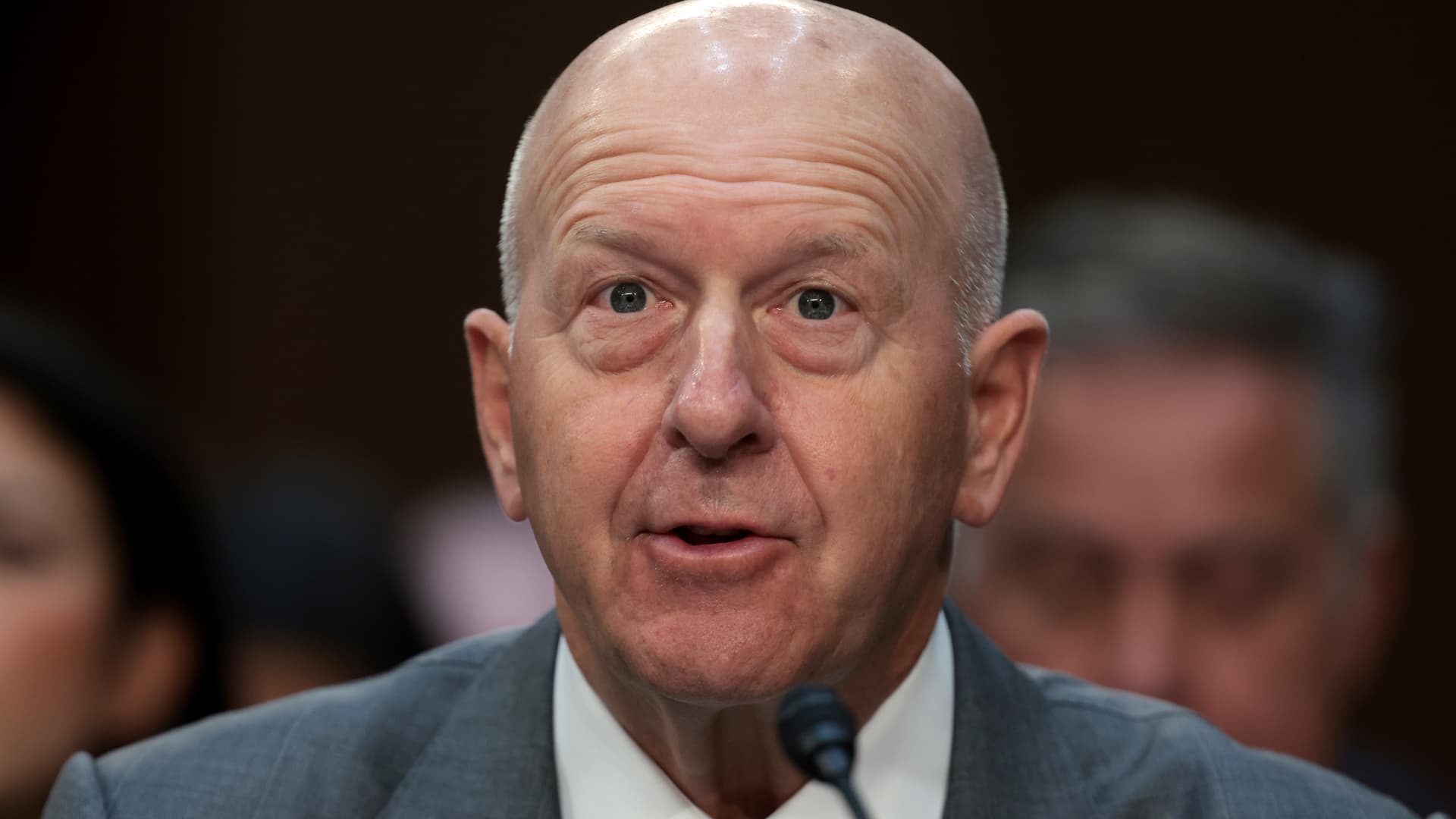
David Solomon, CEO Goldman Sachs, speaking on CNBC’s Squawk Box at the World Economic Forum in Davos, Switzerland on Jan. 22nd, 2026.
Oscar Molina | CNBC
When Goldman Sachs executives were asked about disappointing results in the firm’s fixed income division this week, they made it sound as though the trading environment was simply not in their favor.
Fixed income revenue fell 10% in the first quarter, coming in $910 million below analysts’ expectations, according to StreetAccount data. It was an unusually large miss for one of Goldman’s flagship Wall Street businesses.
“It was basically just a function of the overall environment making markets,” CFO Denis Coleman told an analyst on Monday after the bank’s earning report. “We remain actively engaged with clients, but our performance in rates and mortgages was relatively lower.”
But as nearly all of Goldman’s rivals, including JPMorgan Chase, Morgan Stanley and Citigroup, posted blockbuster results for first-quarter fixed income in the days that followed, one thing became clear to Wall Street: Goldman Sachs’ vaunted fixed income traders had underperformed.
JPMorgan saw fixed income trading revenue jump 21% to $7.1 billion, the bank’s second-biggest haul ever. Morgan Stanley, where fixed income is less a priority than equities, posted a 29% jump in the bond business. Citigroup saw bond trading revenue jump 13% to $5.2 billion.
Since before the 2008 financial crisis, when Lloyd Blankfein led Goldman Sachs, the firm’s fixed income division had been the envy of Wall Street. Goldman was known for its trading prowess, a reputation forged in periods of dislocation when its desks generated outsized gains. The bank’s identity as a trader’s firm — one expected to outperform in turbulent times — has endured in the decade-plus since.
That makes the first-quarter stumble particularly notable.
“It seems that something went wrong at Goldman in fixed income,” said veteran Wells Fargo analyst Mike Mayo, who called the bank’s results “worst-in-class.”
“I’d imagine that at Goldman, a fire is being lit under the traders, managers and risk overseers in FICC after such an underperformance,” Mayo said in an interview with CNBC, using an acronym standing for fixed income, currencies and commodities, the formal name for that business.
The prevailing theory is that Goldman was caught offsides on trades tied to interest rates in the first quarter, according to several market participants who asked for anonymity to speak candidly.
That’s because of the positioning that many Wall Street firms had at the start of this year, when markets were expecting the Federal Reserve to cut interest rates at least twice in 2026, these people said.
But after the price of oil surged with the advent of the Iran war, roiling expectations for inflation, the markets began pricing those cuts out, with some investors even bracing for the possibility of rate hikes this year.
Fixed income was the sole blemish on a quarter in which Goldman Sachs exceeded expectations handily, thanks to the firm’s equities traders and investment bankers. Despite the earnings beat, the firm’s shares dropped as much as about 4% on Monday following the report.
Goldman Sachs didn’t immediately return a call seeking comment. But on Monday, CEO David Solomon sought to put the quarter’s performance into context:
“When I look at the scale and the diversity of the business, it’s performing very, very well,” Solomon said during the company’s conference call. “Some quarters, it’s going to be stronger here, stronger there.”
Crypto World
Wall Street broker Bernstein sees prediction market volumes hitting $1 trillion by 2030 with HOOD, COIN as key players


Wall Street broker Bernstein expects prediction market volumes to reach roughly $1 trillion by 2030, as the sector evolves from niche wagering into broad-based “information markets” spanning sports, crypto, politics and the economy.
Volumes hit $51 billion last year and are on pace to reach about $240 billion in 2026, implying roughly 80% compound annual growth through the end of the decade, the report said. Activity has already accelerated in 2026, with Polymarket and Kalshi recording combined year-to-date volumes of $60 billion.
“Increasing regulatory clarity at the federal level is expanding the addressable market, while blockchain-based tokenization and integration with crypto markets is enabling global liquidity, long-tail event creation and participation from institutions,” wrote analysts led by Gautam Chhugani.
Prediction markets have surged from a niche corner of crypto and academic experimentation into a fast-growing segment of global trading activity in just a few years.
Volumes have spiked alongside major news cycles, most notably the 2024 U.S. election, while platforms like Polymarket and Kalshi have expanded access beyond politics into sports, crypto and macroeconomic events.
The combination of clearer U.S. regulatory footing, improved user experience and the integration of blockchain-based liquidity has accelerated adoption, pushing the sector toward mainstream relevance
The report attributed the growth to improving federal regulatory clarity, which expands access beyond fragmented state-level gaming rules, alongside blockchain-based infrastructure that enables global liquidity and rapid creation of new event contracts.
Sports currently accounts for about 62% of volumes, benefiting from lower effective take rates versus traditional online sportsbooks. But the analysts expect that share to fall to roughly 31% by 2030, as crypto-linked contracts and macro, political and economic events gain traction. Institutional participation is also expected to grow, particularly for hedging event-driven risks.
$10.8 billion in revenue
Bernstein analysts estimate industry revenues could expand from roughly $400 million in 2025 to $2.5 billion in 2026, reaching about $10.8 billion by 2030 at current take rates. Even with significant fee compression, they see potential for a multi-billion-dollar revenue pool.
Distribution is emerging as a key competitive moat. The report pointed to Robinhood (HOOD) and Coinbase (COIN) as early leaders, leveraging their combined tens of millions of users.
Robinhood has already built a $350 million annualized revenue run rate from prediction markets and is moving toward owning exchange infrastructure, while Coinbase entered via Kalshi with nationwide access to more than 1,000 contracts, the report added.
The broker has an outperform rating on both Coinbase and Robinhood.
ETH, SOL, and major altcoins are marginally higher on the day.
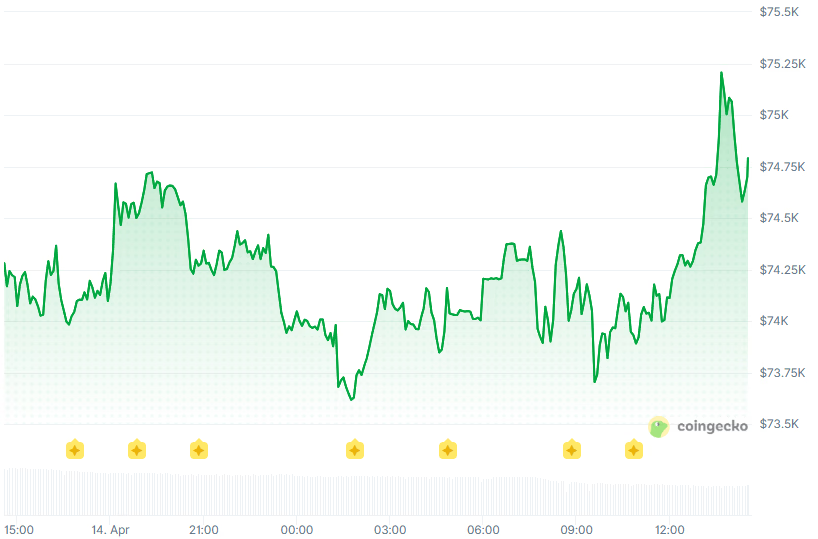
Bitcoin traded around $74,700 on Wednesday, consolidating just below the psychologically significant $75,000 level after retreating from a brief touch above $76,000 earlier this week.
Ethereum changed hands near $2,360, up roughly 2% on the day, while Solana rose to $85 and XRP climbed to $1.39, according to CoinGecko.

Among the Top 100 digital assets, DeFi lending protocols Aave and Morpho are today’s top gainers, up 8% and 7%, respectively.
Meanwhile, RaveDAO is the biggest loser after losing a quarter of its value overnight.
The total crypto market cap stands at $2.61 trillion with 24-hour trading volume near $97 billion. Bitcoin dominance is steady at 57.2%, with Ethereum dominance at 10.9%, per CoinGecko.
ETF Flows Whipsaw
U.S. spot Bitcoin ETFs posted $411.5 million in net inflows on Tuesday, according to SoSoValue data, the second-largest daily inflow day in April and enough to push 2026 year-to-date net flows back into positive territory. Total spot Bitcoin ETF assets under management surged above $96.5 billion.
BlackRock’s IBIT led with approximately $214 million, extending its inflow streak to five consecutive days totaling around $696 million.
The Tuesday inflows marked a sharp reversal from the previous day, when spot Bitcoin ETFs recorded $325.8 million in net outflows, underscoring the tug-of-war between institutional demand and profit-taking in a range-bound market.
Resistance at $75K
Bitcoin has struggled to sustain a break above $75,000, briefly piercing that level yesterday before pulling back to the low $74,000s. Since the onset of the U.S.-Iran conflict, BTC is up roughly 12%, benefiting from its perception as an apolitical store of value, but the rally has stalled at overhead resistance.
The geopolitical backdrop remains the dominant macro variable. Iran’s acceptance of Bitcoin as payment for Strait of Hormuz transit tolls, as confirmed by a spokesperson for Iran’s Oil, Gas and Petrochemical Products Exporters’ Union, continues to ripple through markets.
Bitwise CIO Matt Hougan argued this week that Iran’s use of Bitcoin in sovereign trade positions it to eventually challenge gold’s $34 trillion market cap.
Three near-term catalysts could determine whether Bitcoin breaks higher or retests the $70,000 support zone: the April 15 tax deadline, the Iran ceasefire expiry on April 22, and the FOMC meeting on April 28–29.
Bitwise Asset Management has launched a spot Avalanche exchange-traded product, giving investors exposure to the Avalanche token while staking a portion of its holdings to generate yield.
Bitwise plans to stake roughly 70% of its AVAX holdings through its in-house infrastructure, while maintaining a liquidity reserve of about 30% to meet redemptions and operational needs.
The fund began trading Wednesday on the NYSE under the ticker BAVA, closing up about 1.5%, to $25.50 per share, according to Yahoo Finance. The Avalanche token (AVAX) was last trading at $9.52, up 1.8%, according to CoinMarketCap.
According to Wednesday’s announcement, the product carries a sponsor fee of 0.34%, with a temporary waiver to 0% for the first month on the first $500 million in assets, and is structured to distribute net investment income, including staking rewards, to shareholders periodically.
The fund holds AVAX directly and uses an in-house staking unit, Bitwise Onchain Solutions, to participate in network validation and earn rewards, which are paid in additional tokens. Avalanche staking rewards were about 5.4% as of mid-April, according to the announcement.
Avalanche is a Layer-1 blockchain built for high throughput and low latency. It is used across tokenization and enterprise pilots, including initiatives tied to FIFA, state-level stablecoin efforts in Wyoming, and projects from companies such as Toyota and asset managers including BlackRock.
The new fund is the latest Avalanche fund development in recent weeks. Nasdaq last week filed with the US Securities and Exchange Commission (SEC) to list shares of the VanEck Avalanche Trust, a proposed ETF designed to provide exposure to AVAX under rules governing commodity-based trust shares.
Related: CME Group expands crypto futures with Avalanche and Sui contracts
Bitcoin ETFs and DATs hold an increasing amount of Bitcoin
The launch of Bitwise’s Avalanche ETF comes as exchange-traded crypto products and publicly traded companies continue to accumulate a growing share of Bitcoin’s (BTC) circulating supply.
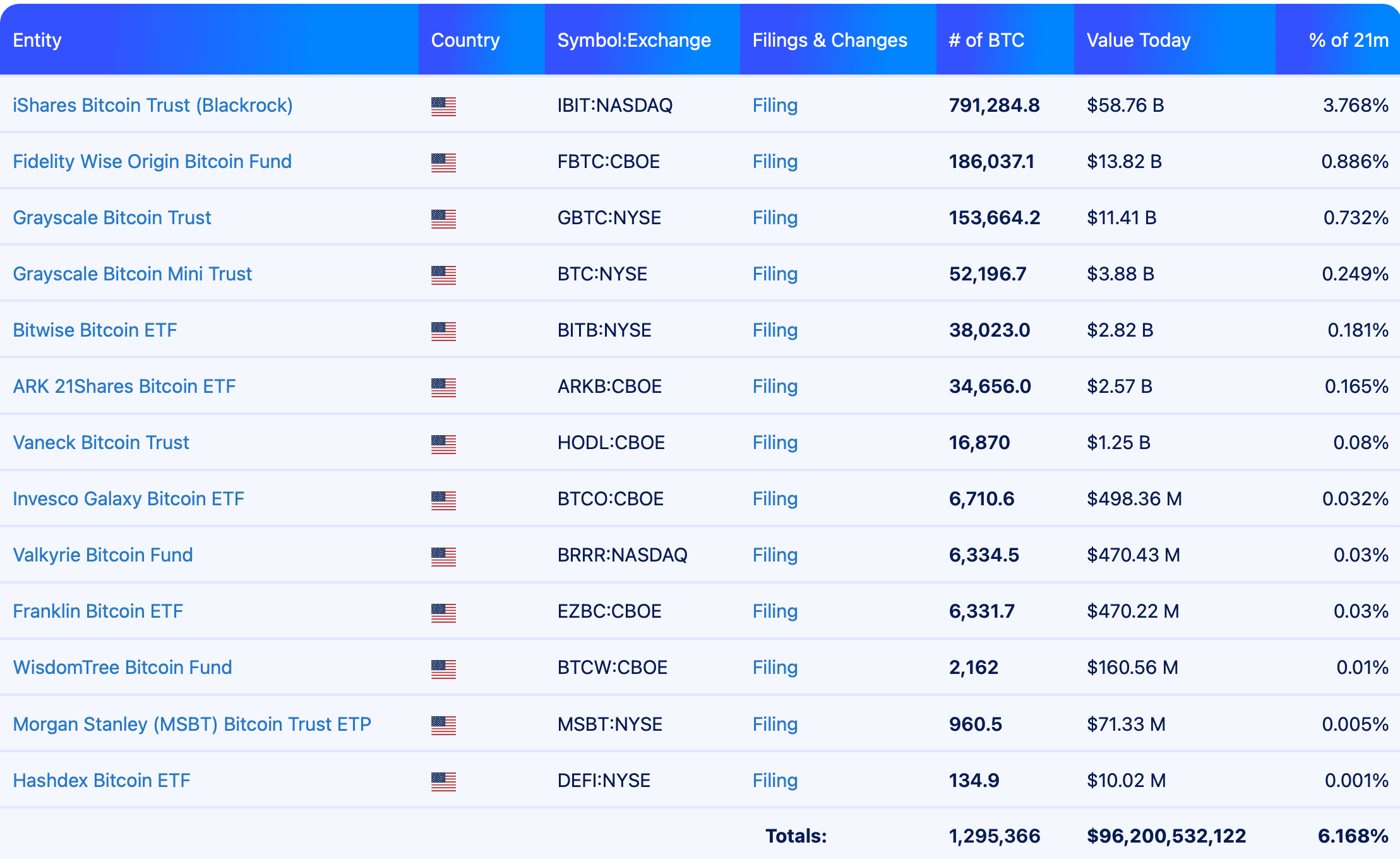
According to data from BitBO.io, Bitcoin ETFs hold more than 1.29 million BTC, or just over 6% of circulating supply. Public companies hold an additional 1.17 million BTC on their balance sheets, based on figures from BitcoinTreasuries.NET. Combined, ETFs and corporate holders now account for around 12% of Bitcoin’s circulating supply.
Among ETFs, accumulation is led by BlackRock’s iShares Bitcoin Trust, which holds about 791,000 BTC, or roughly 3.8% of total supply, followed by Grayscale’s Bitcoin Trust with around 153,600 BTC, or about 0.7%.

Beyond asset managers, banks are also entering the market. Earlier this month, the Morgan Stanley Bitcoin Trust (MSBT), the first spot Bitcoin ETF offered by a US bank, recorded $30.6 million in inflows on its trading debut and generated about $34 million in first-day volume.
On Tuesday, Goldman Sachs filed with the SEC to launch a Bitcoin-linked exchange-traded fund designed to generate income while limiting exposure to the cryptocurrency’s volatility. The proposed fund would invest in Bitcoin ETPs and sell call options to generate income while limiting exposure to price swings.
Among public companies, Strategy, the first Bitcoin treasury company, chaired by Michael Saylor, holds 780,897 Bitcoin, or around 4% of the total supply.
Governments also collectively hold around 3% of circulating Bitcoin, with around 649,870 BTC on their balance sheets. The United States is the largest holder with about 328,000 BTC, followed by China with roughly 190,000 BTC and the United Kingdom with more than 61,000 BTC.
Bitcoin’s price has fallen from its high of around $126,000 in October, and is trading around $75,100, per CoinGecko data.
Magazine: Bitcoin will not hit $1M by 2030, says veteran trader Peter Brandt


Allbirds stock explodes after the struggling shoe brand announces a $50M GPU‑fueled pivot into “NewBird AI,” sells its name for $39M, and rides the AI mania wave.
Summary
- Allbirds shares spike more than 400% after announcing a $50 million AI pivot and “NewBird AI” rebrand.
- The company plans to sell its shoe brand and assets for $39 million and redeploy into GPU‑powered cloud infrastructure.
- The move underscores how investors are rewarding legacy consumer brands that bolt on AI narratives, despite weak fundamentals.
Allbirds shares went vertical on Tuesday after the San Francisco‑based shoe maker said it would pivot into AI compute, rebrand as “NewBird AI” and raise $50 million in convertible financing to buy GPUs, sending the stock from $2.49 to an intraday high of $24.31 before closing at $13.59, up roughly 446% on the day. The move comes just weeks after Allbirds agreed to sell its brand and footwear assets to American Exchange Group for about $39 million, a dramatic turn for a company that once commanded a $4 billion valuation at its 2021 IPO.
According to a press release summarized by outlets like Investing.com, Allbirds has signed a definitive agreement with an unnamed institutional investor for a $50 million convertible financing facility, with proceeds earmarked for “high‑performance GPU assets” and a transition to GPU‑as‑a‑Service and AI‑native cloud solutions under the NewBird AI banner. The facility is expected to close in the second quarter of 2026, subject to shareholder approval at a special meeting scheduled for May 18, 2026, for stockholders of record as of April 13.
Allbirds said it plans to use the initial capital to acquire and deploy dedicated AI compute capacity and to lease that infrastructure to customers who need long‑term access to GPUs, citing “increasing GPU procurement lead times” and “historic low North American data center vacancy rates” as tailwinds for demand. The company also flagged a special dividend for shareholders of record on May 20, 2026, funded from net proceeds of the $39 million asset sale once it closes and after costs, likely in the third quarter.investing+4
On X, the pivot drew a mix of disbelief and fascination as the stock’s parabolic move was screenshotted across FinTwit. “Allbirds, the shoe brand, now says it’s an AI compute company,” Bloomberg reporter Tracy Alloway wrote, posting a chart of the intraday surge. Watcher.Guru told followers that Allbirds’ BIRD ticker had risen “over 420% after announcing shift from shoes to AI,” while The Kobeissi Letter described the move as a “pivoting from shoes to AI” that sent the stock more than 200% higher early in the session.
The asset sale to American Exchange Group, which owns brands such as Aerosoles, was negotiated by a special committee of independent directors and must still be approved by Allbirds’ shareholders, with closing expected in the second quarter of 2026. Filing details show Allbirds had a market capitalization of around $20 million to $26 million before the AI announcement, negative free cash flow of roughly $58 million over the last 12 months and revenue declines of about 22%, underscoring the financial strain behind the dramatic strategy shift.
Market data providers including MarketWatch and Yahoo Finance reported that BIRD shares were up between 300% and 600% at various points during the day as trading volume exploded above 100 million shares, a staggering multiple of the recent daily average. At the same time, analysts and commentators noted that the new AI plan still hinges on shareholder approval for both the $39 million asset sale and the $50 million financing, leaving open questions about execution risk, governance and whether a struggling consumer brand can credibly reinvent itself as a cloud‑infrastructure play in one of the most capital‑intensive corners of the AI boom.
Crypto World
XRP Price Prediction: Boundless Brings Privacy to Ripple, But CZ’s BNB Ready to Overtake Crypto Top Four Spot
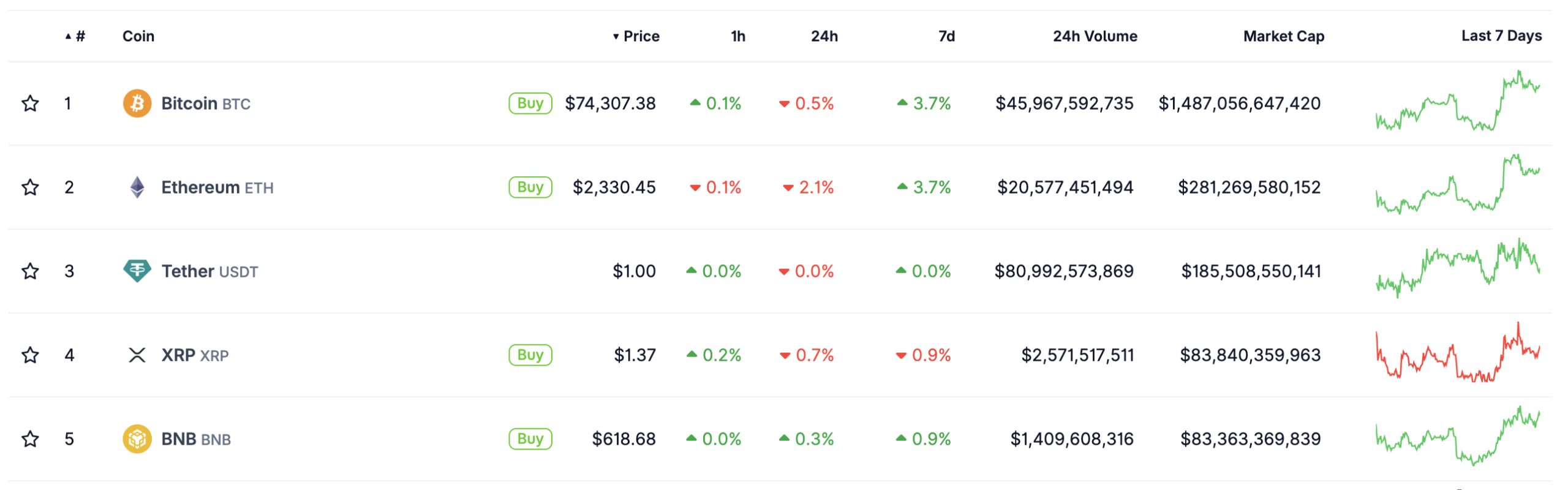
XRP price is trading at above $1.35 as a landmark zero-knowledge proof deployment on XRPL shifts the institutional narrative and prediction. Meanwhile, BNB is circling the top-four market cap rankings with renewed momentum.
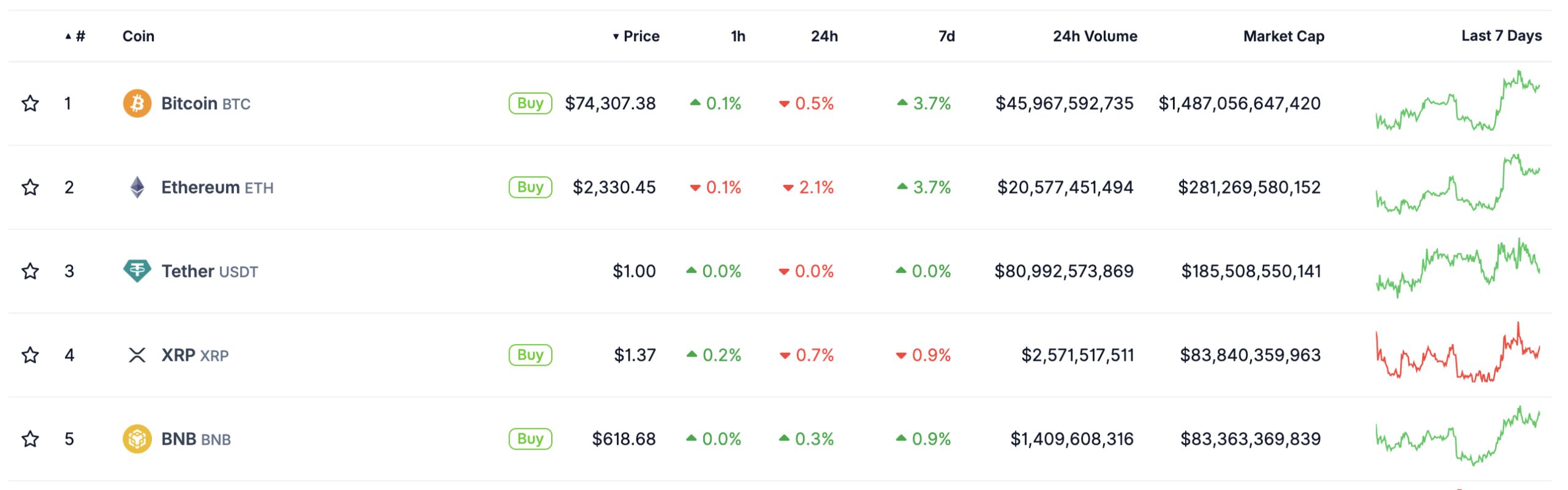
This raises a question the XRP community hasn’t wanted to answer. Is Ripple’s position as secure as its holders believe?
XRPL Commons and Boundless have jointly deployed the first ZK proof verifier natively on XRPL, a RISC-V verifier that makes zero-knowledge proofs a native ledger capability. The rollout happened in three phases: verifier deployment, collaborative design of Smart Escrow transaction types with programmable ZK-gated release conditions, and a live developer toolkit with open-source testnet examples.
— Blockchain Daily News (@blckchaindaily) April 14, 2026
 BREAKING: XRP LEDGER INTEGRATES BOUNDLESS ZERO-KNOWLEDGE PROVING NETWORK, ENABLES FINANCIAL INSTITUTIONS TO TRANSACT PRIVATELY ON PUBLIC BLOCKCHAIN pic.twitter.com/uBYkfO3XYX
Smart Vaults are next, targeting a full private transaction infrastructure in which every settlement is screened against KYC inclusion lists and sanctions lists before funds move, with regulator-accessible disclosure on demand. For institutions that currently treat public ledger transparency as a dealbreaker, this is a material change.
Whether the market prices it in the near term is a separate question entirely. XRP’s technicals are consolidating, and broader regulatory developments continue to shape the Ripple narrative more than any single protocol upgrade.
Discover: The best pre-launch token sales
XRP Price Prediction: $1.50 Too Much to Ask?
XRP is currently caught between $1.29 support and a $1.40 resistance that has capped multiple attempts at continuation. The RSI sits in a wide neutral range of 45–50, indicating consolidation without directional commitment. No volume spike has accompanied the Boundless announcement. At least not yet.
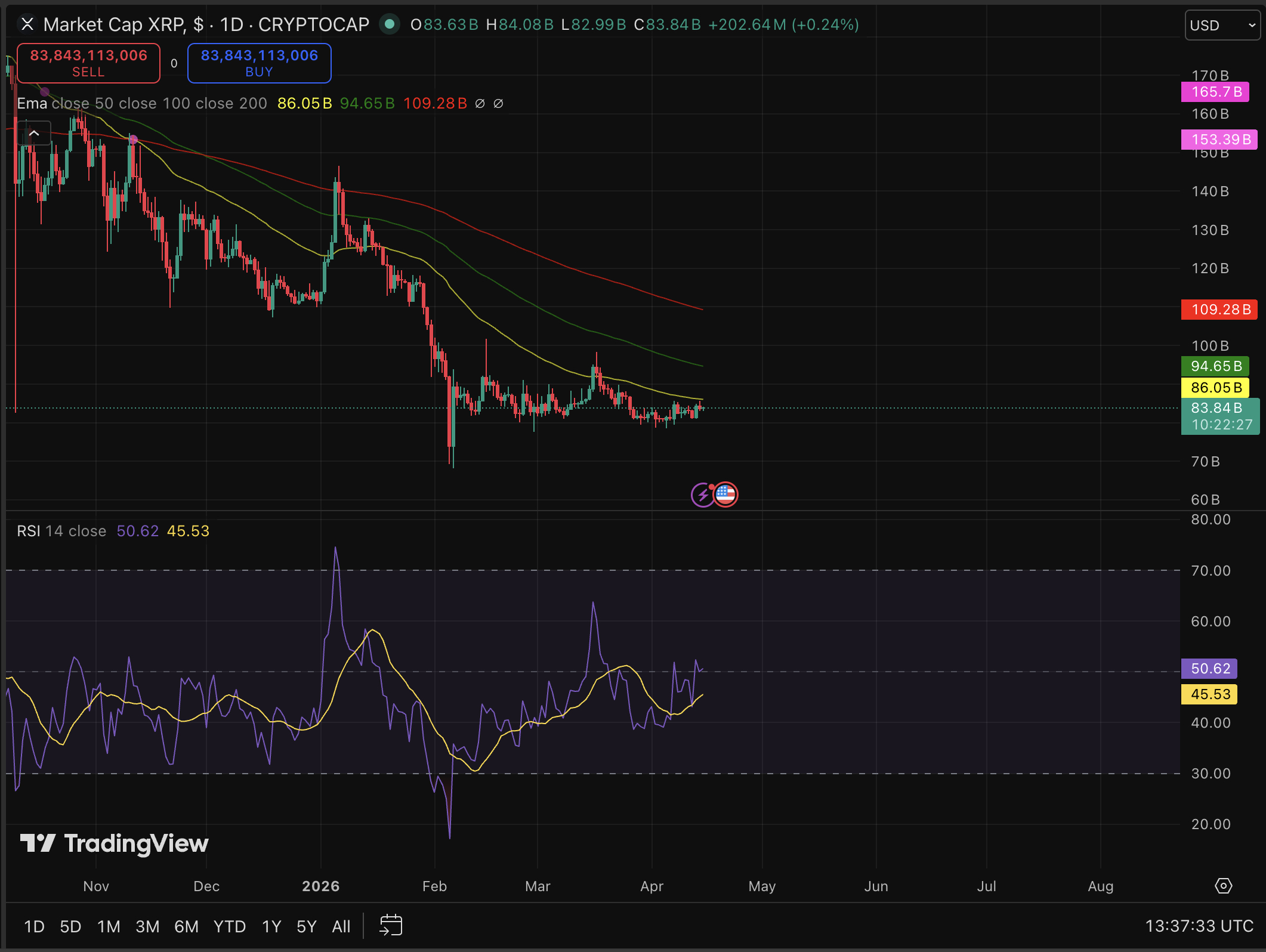
Analyst flagged the setup on April 12: “XRP trades at $1.33… targeting $1.40 by April 2026” amid mixed momentum signals. CoinGecko’s April 6 assessment assigned a 79.5% probability of XRP reaching $1.40 by month-end, a number that sounds bullish until you realize $1.40 is not even $1.50.
MarketBeat’s technical dashboard and longer-horizon analysts like Celal Küçüker, who projects $9 XRP regardless of chart formation, reflect the wide divergence in conviction levels right now.
The ZK development is genuinely significant infrastructure. It just doesn’t resolve a range-bound chart overnight. Rakuten’s XRPL integration covering 44 million users adds to the ecosystem case, but near-term price action remains hostage to broader market sentiment.
Discover: The best crypto to diversify your portfolio with
Bitcoin Hyper Targets Early-Mover Upside as XRP Tests Key Resistance
XRP at $1.37 with a 79.5% shot at $1.40 is a trade, not a transformation. Traders watching consolidation drag on a known asset are increasingly scanning for asymmetric setups, the kind that existed in XRP itself before it became a top-five staple.
Bitcoin Hyper is a Bitcoin Layer 2 project with Solana Virtual Machine (SVM) integration, the first of its kind, delivering sub-second finality and low-cost smart contract execution while anchoring to Bitcoin’s security layer.
The presale has raised $32 million at a current price of $0.0136786, with 36% APY staking available for early participants. The core proposition: bring programmable speed to Bitcoin’s ecosystem without sacrificing the trust layer that makes BTC the reserve asset of crypto.
This is a specific technical gap, and the presale has already crossed $32M in funding as that thesis gains traction.
Research Bitcoin Hyper before the current price stage closes.
The post XRP Price Prediction: Boundless Brings Privacy to Ripple, But CZ’s BNB Ready to Overtake Crypto Top Four Spot appeared first on Cryptonews.
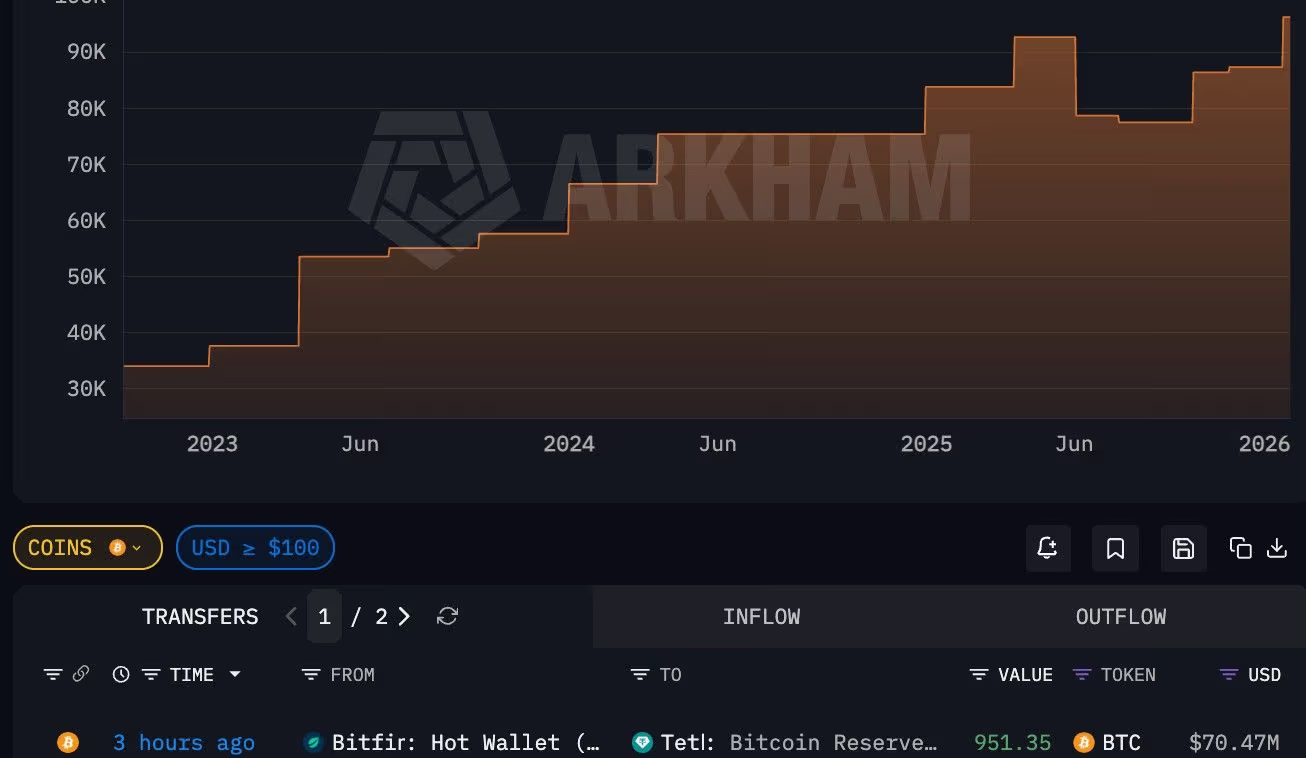
Tether, the company behind the world’s largest stablecoin USDT , added another $70 million worth of bitcoin to its reserves, extending a steady accumulation strategy tied to its stablecoin business.
Blockchain data from Arkham Intelligence shows 951 BTC moved Wednesday from Bitfinex to a wallet labeled “Tether: BTC Reserve.” The address matches one previously confirmed by CEO Paolo Ardoino as the destination for the company’s earlier purchases.

The firm did not respond to a request for comment about the purchase.
The wallet now holds 97,141 BTC, worth about $7.16 billion at current prices, placing Tether among the largest bitcoin holders globally. If Tether was a public company, it would be the second largest BTC holder behind Strategy (MSTR), according to bitcointreasuries.net ranking.
The latest purchase is part of a policy introduced in 2023 to allocate up to 15% of realized operating profits into bitcoin. Unlike digital asset treasuries that raise capital to buy crypto, Tether uses excess earnings generated by its core business.
USDT, Tether’s dollar-pegged token, is the largest stablecoin with a market cap around $185 billion. The company reported more than $10 billion in net profit for 2025, driven by growth in USDT and rising income from U.S. Treasury holdings.
Tether’s reserves are primarily made up of cash-like assets, with up to $141 billion in exposure to U.S. government debt. It also reported $6.3 billion in excess reserves against $186.5 billion in liabilities, offering a buffer above issued tokens.
Alongside U.S. Treasuries, Tether has been building positions in alternative assets. Its latest report also showed $17.4 billion in gold, highlighting a broader diversification strategy.

‘Labour Together’ sabotage outfit now run by former IOF soldier peer

Arsenal star Declan Rice sends message to Man City ahead of ‘title decider’ | Football

Marzetti: Volume Growth Nascent, Clear Underweight

Why Israel is blocking foreign journalists from entering

Bitcoin: We’re Entering The Most Dangerous Phase

Alan Cumming Brands Baftas Ceremony A ‘Triggering S**tshow’

HDB Financial Share q4 result 2026 I HDB Financial SHARE DIVIDEND I HDB Financial DIVIDEND I HDBFS
![Tom Lee: Important Warning To All Ethereum Holders - The Bottom Is Already In [2026 Prediction]](https://wordupnews.com/wp-content/uploads/2026/04/1776284749_maxresdefault-80x80.jpg)
Tom Lee: Important Warning To All Ethereum Holders – The Bottom Is Already In [2026 Prediction]

Ripple XRP: do you see whats coming ?
-

 Politics5 days ago
US brings back mandatory military draft registration
-
 Sports5 days ago
Man United discover Nico Schlotterbeck transfer fee as defender reaches Dortmund agreement
-

 Fashion5 days ago
Weekend Open Thread: Veronica Beard
-

 Politics6 days ago
Malcolm In The Middle OG Turned Down ‘Buckets Of Money’ To Appear In Reboot
-

 Politics3 days ago
World Cup exit makes Italy enter crisis mode
-

 Crypto World6 days ago
Canary Capital Files SEC Registration for PEPE ETF
-

 Business5 days ago
Tesla Model Y Tops China Auto Sales in March 2026 With 39,827 Registrations, Beating Cheaper EVs and Gas Cars
-

 Crypto World2 days ago
The SEC Conditionalises DeFi Platforms to Be Avoided for Broker Registration
-

 Crypto World2 days ago
SEC Signals Exemption for Crypto Interfaces From Broker Registration
-

 News Videos13 hours ago
Secure crypto trading starts with an FIU-registered
-
 NewsBeat3 days ago
Pep Guardiola and Gary Neville agree over Arsenal title problem that benefits Man City
-

 Business5 days ago
OpenAI Halts Stargate UK Data Centre Project Over Energy Costs and Copyright Row
-

 Business4 days ago
Ireland Fuel Protests Enter Day 5 as Blockades Spark Shortages and Government Prepares Support Package
-

 Politics6 days ago
LBC Presenter Mocks Trump Over Iran War Failures
-

 Crypto World5 days ago
Federal judge blocks Arizona from bringing criminal charges against Kalshi
-
 NewsBeat4 days ago
JD Vance announces ‘no agreement’ with Iran over nuclear weapons fear
-

 NewsBeat1 day ago
Trump and Pope Leo: Behind their disagreement over Iran war
-

 Crypto World2 days ago
SEC Proposes Certain Crypto Interfaces Don’t Need to Register as Brokers
-

 Tech6 days ago
A version of Windows 10 released a decade ago is now eligible for additional security patches
-

 Business5 days ago
IMF retains floor for precautionary balances at SDR 20 billion
You must be logged in to post a comment Login