
Crypto World
the biggest rally since the SEC settlement and what is driving it



XRP gained more than 50% in five trading days, its strongest weekly performance in 21 months, as a Treasury buyback expansion, a White House crypto summit, and aggressive whale accumulation converged on the same narrow window.
Summary
- XRP surged from approximately $1.00 on Aug. 18 to a high of $1.6963 on Aug. 22, 2026, a gain of roughly 56% that marks its biggest weekly move since November 2024.
- The U.S. Treasury doubled long-term bond buyback operations from $2 billion to at least $4 billion per session, triggering a rapid drop in benchmark yields and pushing capital into risk assets across crypto markets.
- Ripple CEO Brad Garlinghouse attended a White House crypto policy summit on Aug. 19 alongside SEC Chairman Paul Atkins, advancing the CLARITY Act that would classify XRP as a digital commodity under CFTC oversight.
- Whale addresses holding between 1 million and 10 million XRP accumulated approximately 380 million tokens in one week, pushing tracked holdings from 16.05 billion to 16.36 billion XRP while exchange outflows exceeded 240 million tokens since summer began.
- Spot XRP ETFs attracted $39.78 million in net inflows for the week ending Aug. 22, bringing cumulative inflows since their November 2025 launch to $1.55 billion across seven approved funds.
XRP closed the week of Aug. 18 as the best-performing asset among the top ten cryptocurrencies by market capitalization, beating Bitcoin by more than 40 percentage points and Ethereum by more than 45. The move was not a single-catalyst spike. It was a compressed sequence of macro, regulatory, and on-chain events that landed in the same five-day window, each one reinforcing the next. Understanding why each catalyst mattered, and why their convergence produced a move of this magnitude, requires looking at the specific mechanics of how they interacted.
The rally also marks the first sustained price advance since the SEC settlement that correlates with improving on-chain metrics rather than pure speculation. For seven months before this week, XRP traded between $0.90 and $1.10 while Ripple’s corporate fundamentals strengthened in the background. The disconnect between token price and business development had become one of the most discussed topics in crypto markets. That gap narrowed sharply over five days.
The Treasury buyback that unlocked the rally
The catalyst that set everything in motion arrived on Aug. 19, when Treasury Secretary Scott Bessent announced an expansion of long-term government bond buyback operations. The size of each buyback would double from $2 billion to at least $4 billion per operation, starting Sept. 9. The announcement came after the 30-year Treasury yield spiked to its highest level since 2007, a move that had been pressuring risk assets across every market for weeks.
Buying back bonds pulls supply off the market, pushing bond prices up and yields down. The 30-year yield fell to 5.19% within hours. Traders described the dynamic as informal yield curve control, since the buybacks effectively cap how high long-end yields can climb without the Federal Reserve having to intervene directly.
The effect on crypto was immediate. Bitcoin jumped from $62,000 to $69,000 within 48 hours, its biggest weekly gain in two years. But the impact on XRP was disproportionate. More than $3 billion in crypto short positions were liquidated during the surge, and XRP’s lower market capitalization relative to Bitcoin made it more sensitive to the rotation. Leveraged short sellers who had been betting on a continued grind below $1 were forced to cover, and the resulting squeeze amplified the underlying move.
Lower yields make bonds less attractive relative to riskier assets, which frees capital to rotate into high-beta positions. XRP, with its pending regulatory catalysts and recent technical weakness, became the primary beneficiary of that rotation among large-cap altcoins.
The White House summit and the CLARITY Act
On the same day the Treasury buyback was announced, a separate catalyst emerged from Washington. The White House hosted a crypto policy summit attended by Ripple CEO Brad Garlinghouse, SEC Chairman Paul Atkins, and members of Congress who had co-sponsored the CLARITY Act. President Trump publicly urged Congress to pass the legislation, which would classify XRP and similar tokens as digital commodities under CFTC oversight rather than securities under the SEC.
The CLARITY Act represents the most significant potential shift in U.S. crypto regulation since the Ripple settlement itself. If passed, it would give XRP the same regulatory classification as Bitcoin and Ethereum, removing the last remaining ambiguity about its legal status. The crypto.news analysis of the three conditions for XRP’s recovery identified regulatory clarity as the single most important factor, with 65% of institutional allocators surveyed saying they need this classification before increasing crypto exposure.
The bill faces a Senate procedural vote on Sept. 15. Polymarket prediction contracts currently give it approximately 16% odds of passing, reflecting the difficulty of moving any legislation through Congress in the current political environment. But the market responded to the optics of the summit itself, not the probability of passage. Brad Garlinghouse standing alongside the SEC chairman and the president, discussing a bill that would formalize XRP’s commodity status, sent a signal about the direction of policy that no probability model fully captures.
XRP price jumped roughly 30% in two days following the summit, breaking a year-long downtrend in the process. The move took the token from $1.00 to $1.31 before the additional catalysts pushed it higher.
Whale accumulation and the exchange drain
The on-chain data tells a story that started before the price moved. According to crypto.news reporting on whale accumulation, addresses holding between 1 million and 10 million XRP accumulated approximately 380 million tokens over the week of Aug. 18. Total whale holdings rose from roughly 16.05 billion to 16.36 billion XRP, the highest level since the SEC settlement.
The accumulation was not limited to a single cluster of wallets. Whale transactions on the XRP Ledger surged 280% in 24 hours, with 38 large-value transfers exceeding $1 million recorded in a single trading day. The baseline for large-value XRP transactions in July and early August had averaged roughly 10 to 12 per day, making the spike to 38 a clear departure from normal activity.
More telling than the buying itself was the absence of selling. Whale transfers to Binance fell to their lowest level since 2021 during the same period, suggesting that large holders were accumulating and holding rather than flipping for short-term profit. More than 240 million XRP tokens left exchanges since summer began, reducing the available supply on order books and tightening the market.
The wallets involved in the accumulation include a mix of known institutional custodians and unidentified addresses. Analyst Ali Martinez noted that the accumulation pattern resembles the pre-rally positioning seen before XRP’s January 2026 high of $3.40, when whale addresses added similar quantities before the token rallied from $2.00 to its peak.
Ripple’s own escrow activity adds context. In August 2026, Ripple unlocked 1 billion XRP from escrow, valued at approximately $1.08 billion under its monthly program. Despite this regular supply injection, whale accumulation outpaced the new supply reaching the market, a dynamic that had not occurred since early 2025.
Spot ETF inflows and institutional re-engagement
The seven U.S. spot XRP ETFs approved since November 2025 had a complicated first year. After a strong launch that saw them accumulate $1.3 billion in assets within two months, inflows collapsed through the summer. Weekly ETF inflows fell 93% to just $1.01 million for the week ending Aug. 8, down from $14.86 million the prior week. JPMorgan had predicted up to $8 billion in year-one inflows. The reality was $1.5 billion across eight months.
The week of Aug. 18 reversed that trajectory. Spot XRP ETFs attracted $39.78 million in net inflows, the strongest weekly pace since May. Bitwise Asset Management, Franklin Templeton, and Grayscale Investments led the buying. Cumulative inflows since launch reached $1.55 billion, with the funds now holding approximately 1.50% of total XRP supply.
The crypto.news coverage of ETF inflows crossing $1.55 billion noted that the timing aligned with a shift in macro sentiment following the Treasury buyback announcement. Institutional buyers who had paused allocations during the yield spike returned as soon as yields dropped, suggesting that the problem with XRP ETFs was never demand for the asset itself but the competing returns available in fixed income.
The ETF structure also matters for price mechanics. Unlike over-the-counter XRP purchases, ETF inflows require the fund to buy XRP on the open market or through authorized participants, creating direct buying pressure on the spot price. When $39 million in weekly inflows meets a market where 240 million tokens have already left exchanges, the price impact is amplified beyond what the dollar figure alone would suggest.
How this rally compares to every post-settlement XRP move
XRP has produced four distinct rallies since the SEC settlement was finalized in May 2025. Each one differed in catalyst, duration, peak gain, and retracement depth. Mapping them reveals a pattern that this week’s move both follows and breaks.
Rally one: the settlement itself (May 2025). XRP jumped 42% in three days after the SEC formally withdrew its appeal and Ripple paid the reduced $50 million penalty. The catalyst was purely legal. On-chain accumulation was minimal because the news broke with no advance warning. The retracement was fast: XRP gave back 60% of the gain within two weeks as traders took profit on the news.
Rally two: the ETF approval wave (November 2025). Seven spot XRP ETFs received regulatory clearance, and XRP surged 85% over three weeks. This was the longest sustained move of the cycle, driven by genuine institutional inflows that totaled $483 million in December alone. The retracement was slower but deeper. XRP fell 65% from its January 2026 high of $3.40 to the $1.00 level it occupied before this week’s move.
Rally three: the Ripple Prime announcement (June 2026). Ripple announced conditional approval for a national trust bank charter and raised at a $50 billion valuation. XRP gained 28% in five days. The retracement was almost complete within ten trading sessions, as the market concluded that corporate milestones were not translating into token demand.
Rally four: this week (August 2026). XRP gained 56% in five days, making it the second-largest post-settlement move by magnitude. What distinguishes it from the previous three is the convergence of multiple catalyst types. The settlement rally was legal only. The ETF rally was institutional only. The Ripple Prime rally was corporate only. This week combined macro (Treasury buyback), political (White House summit), on-chain (whale accumulation), and institutional (ETF inflows) catalysts simultaneously.
The convergence matters because it creates feedback loops that single-catalyst rallies cannot sustain. Macro-driven yield drops pull capital into crypto broadly. Political catalysts direct that capital specifically toward XRP. Whale accumulation reduces available supply. ETF inflows create structured buying pressure. Each factor reinforces the others, making the rally more durable than moves driven by a single headline.
Whether this convergence produces a genuinely different outcome from the previous three rallies, all of which eventually retraced, is the central question for XRP holders heading into September.
The overbought signal and what it has meant before
The Relative Strength Index on XRP’s daily chart reached 85.4 on Aug. 22, its most overbought reading since July 2025. The last time the RSI crossed 85, XRP retraced 18% within ten trading days. In three of the four previous instances where XRP’s RSI exceeded 80 since the SEC settlement, the token lost at least 15% of its value within two weeks.
The technical picture is further complicated by the death cross that formed earlier in August. The crypto.news analysis of the death cross erasure explained that while XRP’s daily candle closed above both the 50-day and 200-day exponential moving averages for the first time since the bearish crossover, the 50-day EMA remains below the 200-day line. A confirming golden cross has not yet formed.
The distinction matters because three previous breakouts above both moving averages failed to produce a golden cross, each time resulting in a return below the 200-day EMA within five trading days. The current move needs to hold for at least another week before the moving average crossover would confirm a genuine trend change.
A weekend flash crash on Aug. 22 added to the uncertainty. Approximately $500 million in XRP long positions were liquidated in minutes when the price dropped sharply from $1.69 to $1.43 before recovering to the $1.46 to $1.51 range where it traded into Saturday. The event showed how quickly leveraged positions can unwind even in the middle of a strong rally, and it reduced open interest enough to partially reset the overbought condition.
Ripple’s corporate momentum and the token disconnect
The irony of XRP’s 2026 performance is that Ripple the company has never been stronger. The SEC case ended with XRP retaining full trading rights in the United States. Seven U.S. spot ETFs launched and now hold nearly a billion dollars in XRP. Ripple secured conditional approval for a national trust bank charter. The company raised at a $50 billion valuation. It spent roughly $4 billion on acquisitions. Most recently, Ripple Prime raised $275 million through a private placement of senior unsecured notes with a BBB rating from KBRA, an 8.25% coupon, and a 2031 maturity date.
Yet XRP the token spent the first seven months of 2026 trading between $0.90 and $1.10 while all of this happened. The crypto.news XRP price prediction page noted the base case of $1.80 to $3.20 by 2030, a range that assumed slow and steady appreciation from the $1.00 level. This week’s move has compressed months of expected appreciation into days.
The token’s disconnect from Ripple’s fundamentals is partly structural. XRP’s supply dynamics differ from tokens like Bitcoin or Ethereum. Ripple holds billions of XRP in escrow and releases them monthly, creating a persistent supply overhang that weighs on price even when demand increases. The monthly escrow release of 1 billion XRP in August alone exceeded the total whale accumulation for the entire week. The net effect on circulating supply depends on how much Ripple returns to escrow, a figure the company reports quarterly but not in real time. In previous months, Ripple has returned between 800 million and 900 million tokens to escrow, meaning the net new supply reaching the market each month is typically between 100 million and 200 million tokens. Even at the lower end of that range, the monthly supply addition partially offsets the accumulation pressure from whale buyers.
Ripple Prime’s integration with EDX Markets and Hyperliquid to expand institutional access to spot, perpetual futures, and decentralized liquidity creates new demand channels that did not exist during the first three post-settlement rallies. Whether these channels can absorb enough supply to offset the escrow releases is one of the structural questions that will determine whether this rally holds.
The CLARITY Act as a binary event
The Senate procedural vote on the CLARITY Act scheduled for Sept. 15 creates a binary event risk for XRP that has no parallel in the token’s history. If the bill passes cloture and eventually becomes law, XRP would receive the same commodity classification as Bitcoin and Ethereum, removing the final barrier to full institutional adoption. If it fails, the market would need to reprice the probability of regulatory clarity arriving through legislation versus the current patchwork of court rulings and agency guidance.
The bill’s passage is far from certain. Polymarket gives it approximately 16% odds, and the Senate procedural calendar is crowded. But the White House summit on Aug. 19 moved the conversation from theoretical to operational. The presence of the SEC chairman at a meeting dedicated to advancing the bill suggests coordination between the executive branch and the regulatory agencies that would implement it.
For XRP specifically, the CLARITY Act would resolve the last remaining ambiguity from the Ripple settlement. While courts ruled that XRP traded on secondary markets did not constitute a securities transaction, certain institutional sales remained subject to securities law considerations. The CLARITY Act would eliminate that distinction entirely, making XRP legally identical to Bitcoin for regulatory purposes.
The market appears to be pricing in a higher probability of passage than the prediction markets suggest, or at least pricing in the optionality that the political environment has shifted enough to make some form of regulatory clarity likely within the next 12 months, whether through this specific bill or an alternative path.
https://twitter.com/cryptodotnews/article/2061436021380661610
What to watch
The 200-day EMA retest. A daily close below the 200-day exponential moving average within five trading days would repeat the pattern of three previous failed breakouts and signal that the rally was a short squeeze artifact.
Weekly ETF flow data for the week ending Aug. 29. If inflows sustain or accelerate from the $39.78 million recorded this week, it would confirm that institutional demand is genuine and not a one-week reaction to macro headlines.
The Sept. 15 CLARITY Act cloture vote. The vote itself is binary, but the political dynamics in the weeks leading up to it will shape expectations. Watch for co-sponsor additions or withdrawals as a leading indicator.
Exchange reserve levels. If the drawdown of 240 million tokens from exchanges since summer continues or accelerates, it would tighten supply further and support the price. A reversal, with tokens flowing back to exchanges, would suggest whale profit-taking.
The 30-year Treasury yield. The yield fell to 5.19% after the buyback announcement. If it climbs back above 5.50%, the macro tailwind that triggered the rally would weaken, and the rotation into risk assets could reverse.
Why did XRP surge 50% in one week?
XRP gained approximately 56% between Aug. 18 and Aug. 22, 2026, driven by a convergence of four factors: the U.S. Treasury doubling bond buyback operations, a White House crypto summit advancing the CLARITY Act, whale accumulation of 380 million tokens in a single week, and $39.78 million in spot ETF inflows. The combination created feedback loops that amplified the move beyond what any single catalyst could produce.
What was the Treasury buyback and why did it affect XRP?
Treasury Secretary Scott Bessent announced that long-term bond buyback operations would double from $2 billion to at least $4 billion per session starting Sept. 9. The buybacks pulled supply off the bond market, pushing yields down and freeing capital to rotate into risk assets including crypto. The 30-year yield fell to 5.19% within hours, triggering more than $3 billion in crypto short liquidations.
How much XRP did whales accumulate during the rally?
Addresses holding between 1 million and 10 million XRP accumulated approximately 380 million tokens over the week of Aug. 18, according to on-chain tracking data. Total whale holdings rose from 16.05 billion to 16.36 billion XRP. Additionally, whale transactions exceeding $1 million surged 280% in 24 hours, with 38 large-value transfers recorded in a single trading day.
Is the XRP rally sustainable given the overbought RSI?
The Relative Strength Index reached 85.4 on Aug. 22, the most overbought reading since July 2025. In three of four previous instances where XRP’s RSI exceeded 80 since the SEC settlement, the token retraced at least 15% within two weeks. However, the convergence of multiple catalyst types in this rally makes direct comparison to single-catalyst moves incomplete.
What is the current status of XRP spot ETFs?
Seven U.S. spot XRP ETFs have been trading since November 2025, with issuers including Bitwise, Franklin Templeton, Grayscale, 21Shares, Canary Capital, and Volatility Shares. Cumulative net inflows have reached $1.55 billion, with the funds holding approximately 1.50% of total XRP supply. The week ending Aug. 22 saw $39.78 million in inflows, the strongest weekly pace since May.
What is the CLARITY Act and when is the vote?
The CLARITY Act is proposed legislation that would classify XRP and similar tokens as digital commodities under CFTC oversight. A Senate procedural vote is scheduled for Sept. 15, 2026. Polymarket prediction contracts give it approximately 16% odds of passing. If enacted, it would give XRP the same regulatory classification as Bitcoin and Ethereum.
How does this rally compare to previous XRP moves since the SEC settlement?
This is the second-largest post-settlement rally by magnitude (56%) and the first to combine macro, political, on-chain, and institutional catalysts simultaneously. The settlement rally (May 2025) was legal only, the ETF wave (November 2025) was institutional only, and the Ripple Prime rally (June 2026) was corporate only. Each previous rally eventually retraced between 60% and 100% of its gains.
What is XRP’s current price and market capitalization?
As of Aug. 23, 2026, XRP trades near $1.46 to $1.51, with a total market capitalization of approximately $91.5 billion. It ranks among the top five cryptocurrencies by market cap. The 24-hour trading volume stands at approximately $9.3 billion, reflecting the elevated activity from the weekly surge.
Disclaimer: This article is for informational purposes only and does not constitute investment advice. Cryptocurrency markets are highly volatile, and past performance does not indicate future results. Always conduct your own research before making investment decisions. Published Aug. 23, 2026.



Look closely at a painting, and you might be able to see where an artist changed their mind. Beneath the finished surface, there may be an abandoned line, a figure moved several inches to the left, a color that looked splendid in the morning and became unbearable by night. There may be a smudgy fingerprint at the edge of the canvas. The back may hold a date, a repair, uneven staples, a signature, or the name of a previous owner. These messy marks were once incidental to the artwork. Today they are considered evidence.
AI can produce an image in nano-seconds, then create hundreds of variations before a painter has mixed a color or cleaned a brush. Some of the results are technically bewildering and others inspire disbelief: How is this possible? Yet their abundance is changing our relationship to novelty. When nearly any visual idea can be summoned on demand, newness becomes easier to manufacture but harder to believe in. In an age of effortless images, the mess left behind by making something may become part of what makes it valuable.
So much recent visual culture can appear at once new and strangely familiar. Generative systems learn from immense archives of existing images, then assemble patterns according to statistical relationships. Their output can startle us, though the surprise often arrives cloaked in a recognizable visual fluency: the cinematic light, the dreamlike architecture, the glossy portrait or the eerily composed impossibility. After enough exposure, even the surreal can begin to feel conventional.
A study presented at the 2024 CHI Conference proffers one perspective about how this happens. Participants who used an AI image generator during a visual ideation exercise became more fixed on an initial example and produced fewer ideas, with less variety and originality, than those in the control group. The study involved only 60 people, so its findings should be treated cautiously, though they articulate something many artists and designers have begun to notice: a tool built to accelerate imagination can also narrow it by presenting a polished answer before a more difficult, original idea has had time to form.
Against this flood of frictionless imagery, fine art acquires another kind of presence. A physical artwork occupies time and holds emotion. An artist stood before it, considered it, changed it, ruined it, waited for it, and eventually decided to either finish or abandon it. All artwork contains a sequence of often messy choices that could have gone in any number of directions. The object becomes a record of attention, and attention is becoming one of the scarcest materials we have.
Researchers have already observed a version of this shift. Across six experiments involving 2,965 people, participants consistently valued art labeled “AI-made” less than work labeled “human-made,” even when the images themselves were identical. Awareness of the machine changed the perceived value of the human hand.
This preference extends beyond art. A 2015 study in the Journal of Marketing found that people considered handmade objects more attractive in part because they believed those objects symbolically contained the maker’s love. The participants were projecting on and responding to an imagined human presence embedded in the object, expressed through the perceived time and care required to make it.
Nostalgia is part of the current attraction to the handmade. We remember darkrooms, paste-up boards, paint-stained clothes, and the physical tools that digital technology has made unnecessary or irrelevant, and often forget the expense and tedium the processes demanded. Still, the renewed power of visible erasure or the pleasure of encountering an unrestrained line reaches beyond nostalgia. These marks allow us to envision the intent and the decisions behind them.
AI can attempt to imitate these marks. It can add a false thumbprint, invent pentimenti, reproduce a stray brush bristle, and generate an image that appears to have survived a century in an attic. But mess itself will soon prove very little. Provenance and an intelligible creative process will become more important as appearance ceases to represent authenticity.
In educated hands, AI can still become a profound artistic medium. Photography and digital tools have disrupted ideas about skill and authorship before becoming vehicles for extraordinary art. AI will be shaped by artists whose choices are specific enough to resist its defaults, and those artists may create work we cannot yet imagine. The presence of a tool has never settled the question of artistic value; the depth and consequence of the decisions made with it still matter.
We are entering a period in which polished images and endless variations are available on command. The works we retain or collect may be those that let us encounter another person’s limits: the place where control faltered or the artist had to surrender to something unresolved.
I think our nostalgia for mess is growing from a hunger for evidence that making something still requires time, effort, commitment, and—dare I say it—love.


Germany widened its lead in the number of providers licensed under the European Union’s Markets in Crypto-Assets Regulation (MiCA), with six of its cooperative banks added in the latest register update.
The European Securities and Markets Authority (ESMA) updated its MiCA register on Friday, bringing the number of authorized crypto asset service providers (CASPs) to 331.
Compared with an update from Aug. 12, the six additions were all German cooperative banks: Raiffeisenbank Aidlingen, Ihre Volksbank, VR-Bank Mittelfranken Mitte, Volksbank Euskirchen, VR Bank Ried-Überwald and Volksbank Backnang.
Germany now accounts for 79 CASPs, ahead of France with 35 and the Netherlands with 29. Germany’s total has grown from 57 in late June, when the country already led MiCA authorizations, according to ESMA data previously reviewed by Cointelegraph.
Germany’s Federal Financial Supervisory Authority (BaFin) told Cointelegraph in June that the country’s high number of MiCA authorizations partly reflects its large financial sector and the number of credit institutions eligible to offer crypto services. BaFin also pointed to Germany’s pre-existing national licensing regime, which gave some CASPs access to simplified authorization procedures during the transition to MiCA.
ESMA’s asset-referenced token (ART), electronic money token (EMT) and non-compliant entity datasets were unchanged. The ART register remained empty, the EMT register held 43 entries, and the non-compliant entity list remained at 167.
Related: Bitpanda fined in Austria’s first published MiCA penalty


Abraxas Capital, Fasanara Capital, and Wintermute still hold over $600 million in short positions in Bitcoin (BTC) and Ethereum (ETH).
Blockchain tracker Lookonchain identified the positions as market maker hedging accounts. Their liquidation prices sit far above current market levels.
Liquidation Prices Sit Far Above Spot
The crypto market rally, fueled by policy moves, triggered a wave of short liquidations. BeInCrypto reported that on August 19, short sellers lost $1.3 billion within 60 minutes as Bitcoin climbed 2.5%.
The broader sell-off in bearish positions intensified, with short liquidations reaching $2.74 billion as 172,202 traders were liquidated. Short sellers then lost another $1.06 billion over the following 24 hours.
Lookonchain said the largest remaining on-chain short positions now appear to belong to market makers’ hedging accounts.
“It seems that all the big whales have been liquidated in this price surge! Currently, the largest short positions on the blockchain are held by market makers’ hedging accounts,” Lookonchain posted.
The three firms hold short positions of 138,569 Ethereum (ETH) worth $338 million and 3,425 Bitcoin (BTC) worth $265 million.
Abraxas Capital runs the largest book. Its two ETH shorts liquidate at $4,008 and $3,958, while spot trades near $2,440.
Its BTC shorts liquidate at $128,521 and $140,437 against a $77,381 spot price. Wintermute’s Bitcoin position survives until $251,307.
No position faces liquidation unless Bitcoin climbs 66% or Ethereum climbs 62%. That distance explains why the squeeze passed them by.
Follow us on X to get the latest news as it happens
Wintermute Added Shorts as Losses Mounted
Abraxas Capital carries roughly $58 million in unrealized losses across its four positions. The firm has not closed any of them.
Fasanara Capital sits 18.87% underwater on a $74.81 million ETH short at 15X leverage. Wintermute remains marginally profitable on both assets, according to Lookonchain data.
Separately, Onchain Lens tracked Wintermute raising short exposure on Hyperliquid. That book shows $5.85 million in unrealized losses across various assets.
The latest data suggests the remaining short exposure is less a broad bearish bet and more a reflection of market-making and hedging activity.
With liquidation levels still far above current prices, the positions are unlikely to face immediate pressure unless Bitcoin and Ethereum extend their rally significantly.
Subscribe to our YouTube channel to watch leaders and journalists provide expert insights
The post 3 Trading Firms Still Short Bitcoin and Ethereum Despite Sharp Price Rally appeared first on BeInCrypto.


Tesla has officially ended its Solar Roof project six years after predicting it would be installing 1,000 units per week. The most the company ever installed, at its absolute peak, was 32.
Indeed, it’s only installed 3,000 in total. For context, if the company had achieved Elon Musk’s 1,000 per week goal, it should have installed around 345,000 solar roofs by now.
There was no press release or regulatory filing that accompanied the shutdown. Journalists simply noticed that the webpage, tesla.com/solarroof, now redirects to a separate solar panels webpage.
Solar Roof has also disappeared from the Tesla Energy menu.
One source said Tesla had concluded an internal review that the product was “not financially viable.”
Below is a timeline of the company, from its early days and $2.6 billion acquisition, through an incredible series of government subsidies, litigation, and its final chapter this month.
Read more: Tesla Diner’s struggles accelerate as chef speeds away
Timeline of Tesla Solar Roof (SolarCity)
- June 16, 2014: SolarCity agreed to buy panel maker Silevo for $200 million in stock, plus $150 million in earnouts.
- September 23, 2014: The company scores its first major government subsidy — a lucrative trend that would continue for a decade. New York broke ground at RiverBend, committing $750 million for a plant SolarCity would lease for just $1 a year.
- October 2015: An amended state agreement cut SolarCity’s direct manufacturing commitment in Buffalo from 1,460 jobs to 500.
- July 31, 2016: Tesla signed a stock merger agreement worth roughly $2.6 billion for SolarCity. Musk and two of his cousins were controlling shareholders prior to the deal.
“Musk knew SolarCity was going broke before merger with Tesla,” a shareholder lawsuit alleged. Also at that time, Musk had over $475 million in personal loans backed partially backed by SolarCity stock.
- October 28, 2016: Musk unveiled four tiles at Universal Studios. Omitted from his presentation were certain facts that the tiles generated no electricity, were “conceptual in nature,” and built not for solar power generation but “demonstration of the aesthetics.”
- November 17, 2016: Tesla shareholders approved the SolarCity acquistion.
- November 21, 2016: The merger closed, making SolarCity a Tesla subsidiary and Solar Roof an official Tesla product.
- December 27, 2016: Panasonic finalized an agreement to make photovoltaic cells at its Buffalo, New York plant. In an obvious quid pro quo, Tesla committed to “a long-term purchase commitment from Panasonic.”
- May 10, 2017: Tesla opened orders for SolarCity at $21.85 per square foot of total roof area, promising a lifetime warranty.
- May 25, 2017: Two weeks later, an RBC analyst noted Solar Roof orders as sold out through 2018.
- August 2, 2017: Tesla disclosed that Tesla employees received the first Solar Roof installations.
- January 9, 2018: Tesla told Reuters that its Buffalo, NY facility had begun producing Solar Roof tiles as of December 2017.
- June 12, 2018: In a restructuring that cut about 9% of staff, Musk ended Tesla’s Home Depot partnership for SolarCity sales.
- August 8, 2018: A Reuters investigation found Buffalo producing only one of the four tile styles that Musk demonstrated in 2016.
- September 24, 2018: A CNBC investigation found only 12 Solar Roofs connected in California as of May 2018, far below Musk’s estimate of several hundred.
- October 25, 2019: Tesla launched Solar Roof V3, quoting roughly $33,950 for a 2,000 square foot roof. On the same call, Musk targeted 1,000 installations a week by the end of 2019.
- January 29, 2020: Tesla reported 54 megawatts of solar capacity deployed and claimed hundreds of new hires at its Gigafactory New York.
- February 26, 2020: Panasonic announced it would stop making solar cells in Buffalo by May and cease entirely by September.
- March 16, 2020: Tesla claimed it had built four megawatts of solar tiles in one week, which it claimed was enough for 1,000 homes.
- August 21, 2020: A state audit found Buffalo projected to return 54 cents per subsidy dollar, 98% short of its $30 benchmark.
- September 2020: Panasonic completed its withdrawal from Buffalo, leaving Tesla to run the factory alone.
- January 27, 2021: Tesla reported 205 megawatts of solar deployed across 2020.
- March 2021: Tesla began emailing customers that it had raised Solar Roof prices.
- April 11, 2021: Price hikes reached contracts signed more than a year prior, commonly adding 30% and more than 50% to customers’ costs in some cases.
- April 22, 2021: Musk said Solar Roof and Tesla panels would only be sold bundled with a Powerwall battery.
- April 26, 2021: Musk conceded on a quarterly earnings call that Tesla had “made some significant mistakes in assessing the difficulty of certain roofs.”
- April 30, 2021: Two Pennsylvania customers sued, alleging Tesla raised their contracted price by tens of thousands of dollars after signing.
- May 12, 2021: A California class action put one increase at $71,074.42 to $146,462.22 — more than double the price in the original signed contract. Tesla settled that case.
- July 13, 2021: Musk testified on the stand in Delaware court, defending the SolarCity acquisition.
- April 27, 2022: Delaware’s Court of Chancery came down in favor of Musk, ruling the SolarCity acquisition “entirely fair.”
- September 12, 2022: Tesla reiterated its purchase requirement of at least one Powerwall per every new Solar Roof.
- November 10, 2022: Tesla canceled Solar Roof projects across several states, including permitted ones, and exited some markets entirely.
- June 6, 2023: The Delaware Supreme Court, sitting en banc, affirmed an appeal in favor of Musk, ending nearly seven years of litigation over the SolarCity acquisition.
- July 11, 2023: Tesla settled a California price-hike class action lawsuit for $6.08 million covering about 8,636 customers, admitting no wrongdoing.
- January 24, 2024: Tesla reported 41 megawatts of solar for the quarter, its weakest since 2020. It would never publish another quarterly figure.
- March 7, 2024: A judge approved a settlement that closed Tesla’s final price-hike lawsuit.
- April 16, 2024: Tesla filed a state layoff notice covering 285 Buffalo, NY jobs as it thinned its Solar Roof operations.
- September 25, 2024: Tesla recruited more third-party installers as it wound down its own in-house crews.
- April 19, 2025: Tesla removed online Solar Roof quotes, routing buyers to its third-party installer network.
- July 4, 2025: Donald Trump’s One Big Beautiful Bill repealed Tesla’s residential solar tax credit at the end of 2025.
- January 29, 2026: Tesla unveiled its own conventional solar panel, the product that now replaces the Solar Roof.
- May 14, 2026: Solar Roof projects in Florida are canceled, with field crews reassigned to repairs rather than installations.
- August 20, 2026: Tesla told installers that Solar Roof tiles were no longer orderable.
Got a tip? Send us an email securely via Protos Leaks. For more informed news and investigations, follow us on X, Bluesky, and Google News, or subscribe to our YouTube channel.

Key takeaways
- The Pi Core Team introduced Protocol 27 on the Pi Testnet, enabling preparations for advanced smart contract authentication.
- A mainnet upgrade to Protocol 27 is scheduled for September 15.
- PI faces resistance at $0.1022, with a breakout potentially opening a move toward $0.1204.
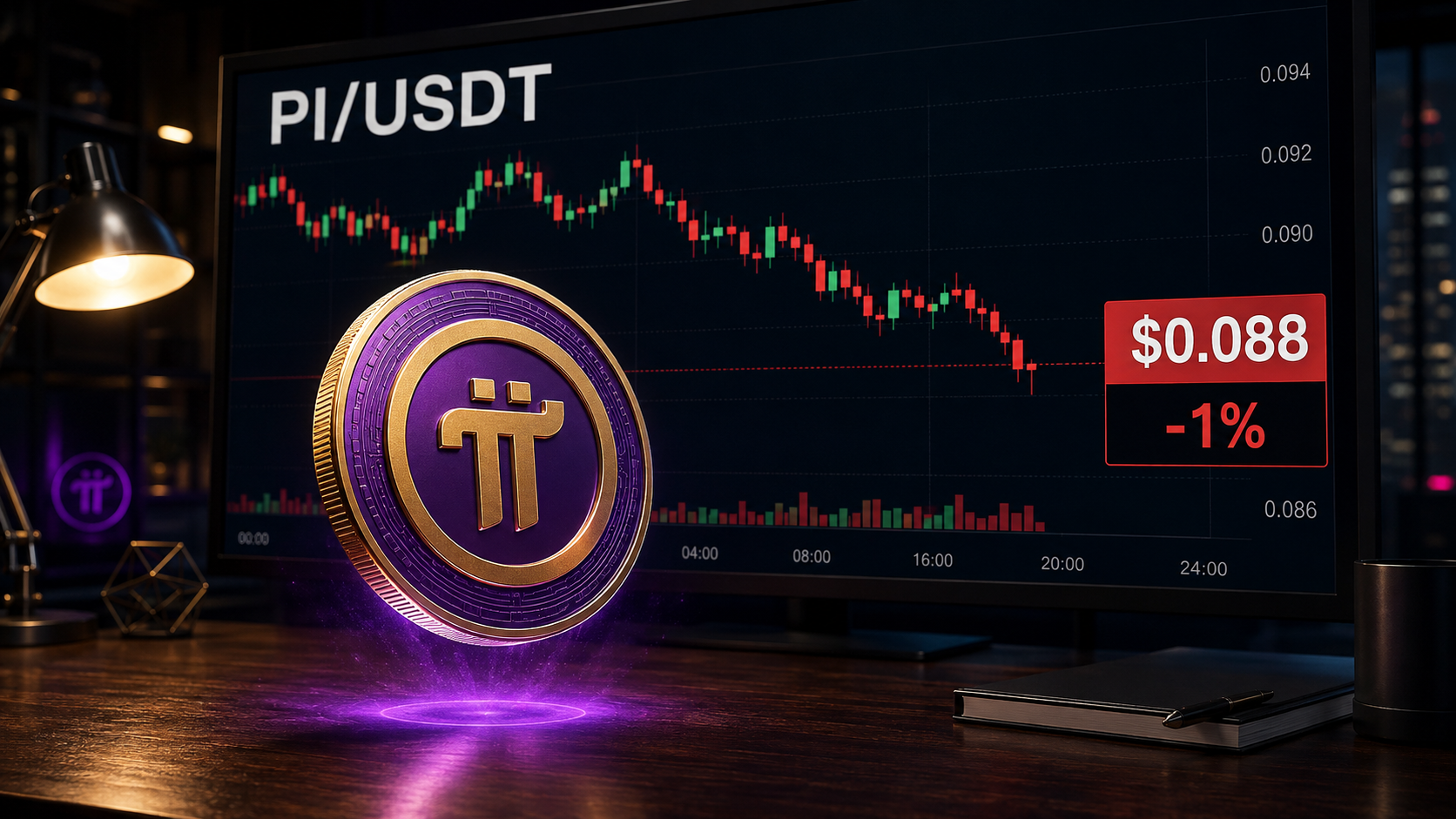
Pi Network is trading lower on Monday following a gain of more than 6% last week, with its price hovering around $0.0880.
The cryptocurrency remains above the $0.0800 level but continues to face resistance below $0.1000.
Despite the recent advance, momentum indicators suggest that PI has not yet developed sufficient buying pressure to sustain a breakout.
The mixed technical outlook comes as developers prepare a network upgrade that could introduce additional authentication capabilities for applications and transactions.
Pi Core team introduces protocol 27 on testnet
The Pi Core Team announced Saturday that it had released Protocol 27 on the Pi Testnet. Pi Network is built on the Stellar Consensus Protocol, and the update incorporates the latest Stellar network protocol into its testing environment.
According to the Pi Core Team’s announcement, Protocol 27 will support new smart contract authentication capabilities.
The upgrade is intended to provide more advanced methods for applications and users to authenticate transactions.
Introducing the protocol on the testnet allows developers to evaluate its functionality before deployment on Pi Network’s mainnet.
The Pi Core Team is targeting September 15 for the mainnet rollout of Protocol 27. Once activated, the upgrade could expand the authentication options available to applications operating on the network.
The update represents a potential technical catalyst for PI, although its immediate effect on the token’s price remains uncertain.
Market participants are likely to monitor progress toward the September deadline alongside broader cryptocurrency market conditions.
PI remains trapped below the $0.1022 resistance
Pi Network is consolidating between technical levels associated with its previous decline from $0.1341 to $0.0703.
Immediate support sits near $0.0853, while the main upside barrier is located at $0.1022.
The $0.1000 psychological level also remains an important threshold for buyers. A confirmed breakout above $0.1022 would signal improving momentum and could open the path toward the next major resistance level at $0.1204.
However, PI remains below these levels, suggesting that buyers have yet to establish control.
The daily Moving Average Convergence Divergence indicator remains slightly positive and above its signal line.
This suggests that some underlying buying demand is still present, although the signal is not strong enough to confirm a sustained rally.
Meanwhile, the Relative Strength Index stands near 48, indicating broadly neutral market conditions.
An RSI reading near 50 typically suggests that neither buyers nor sellers have a clear advantage.
Together, these indicators support the possibility that PI will continue consolidating until a stronger catalyst pushes the price beyond its current range.

The first significant support level for PI is $0.0853. A break below this area could expose the rising trendline near $0.0785.
If selling pressure intensifies, the token could revisit its previous swing low at $0.0703.
For now, PI’s near-term direction depends on whether buyers can defend the $0.0853 support area and build sufficient momentum to challenge resistance near $0.1000 and $0.1022.
Crypto World
Bitcoin steadies near $78,000 as gold rallies, altcoins consolidate after best week in 3 years
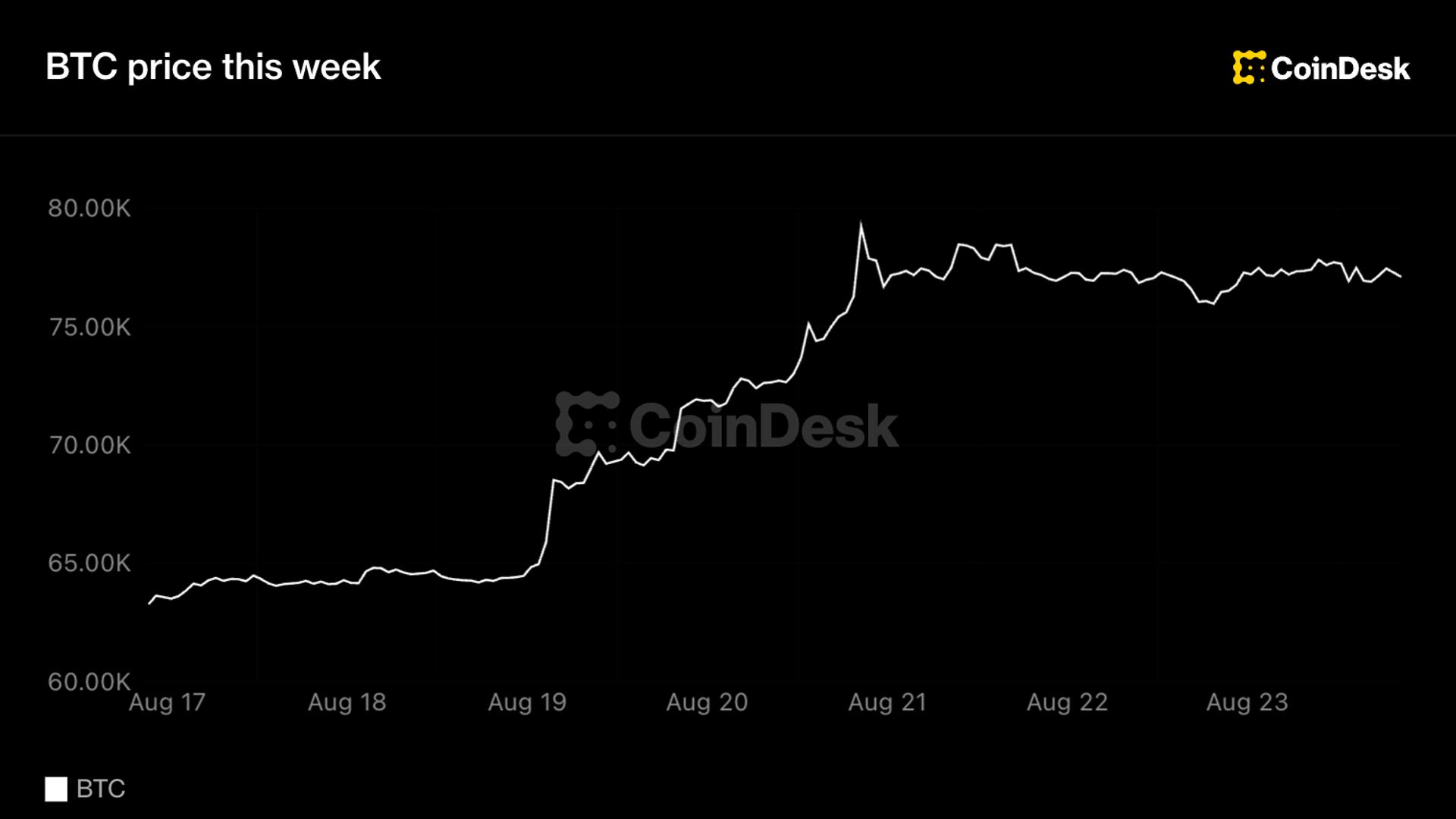
BTC was little changed Monday after last week’s 24% surge triggered by a Treasury buyback announcement that squeezed over $3 billion in shorts.
Bitcoin’s price dip to $75,500 was short-lived, at least for now, and the asset has recovered two grand since then, trading at around $77,500 now.
There are several major gainers from the mid-cap alts, while the larger caps have produced more modest increases, such as ETH’s 2% jump.
BTC Above $77K
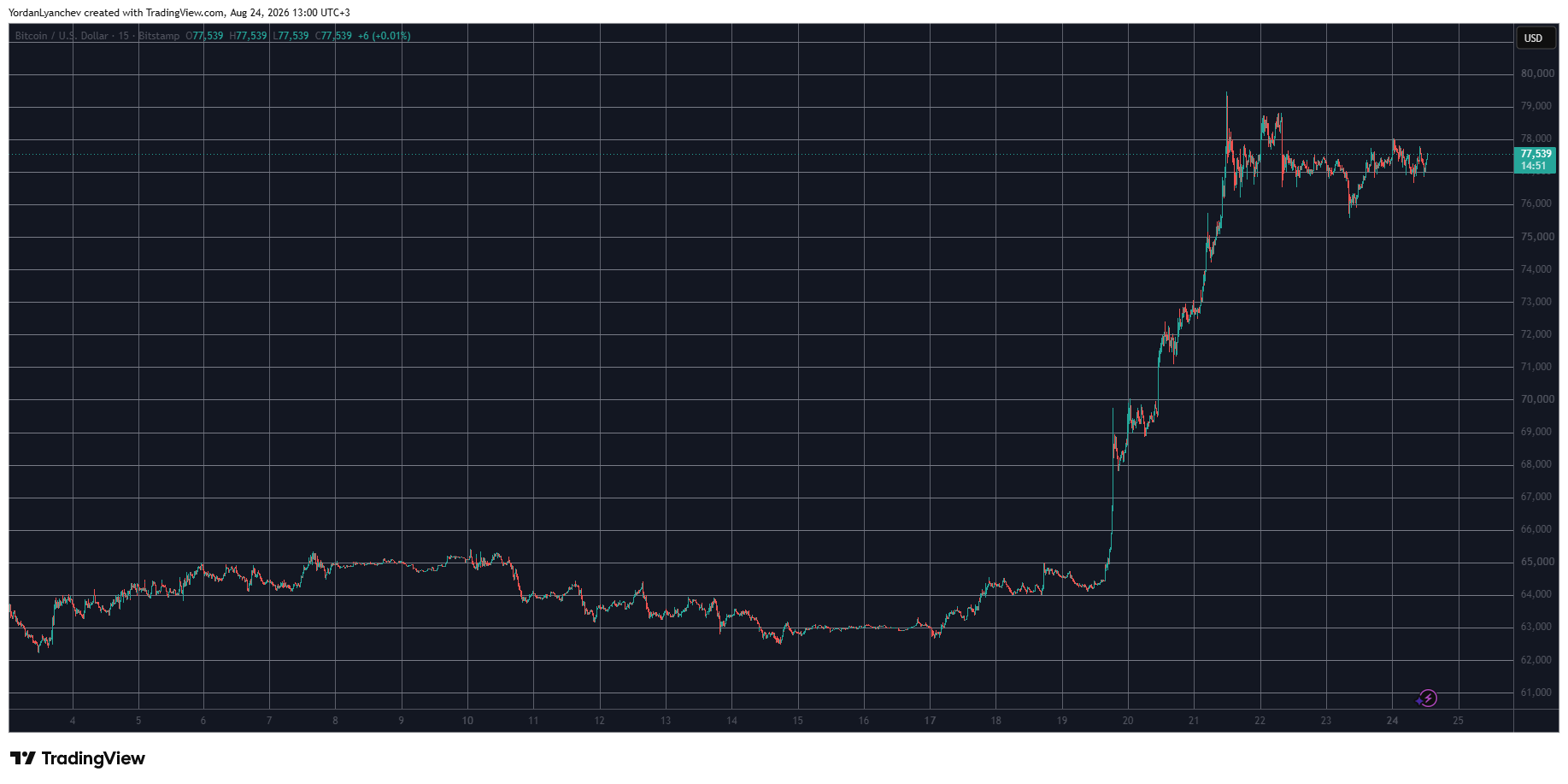
The primary cryptocurrency stood still for weeks and weeks before it finally exploded above the upper boundary at $65,000 last Wednesday. It flew to $70,000 within hours, faced a quick rejection, before it skyrocketed to $72,000 by Thursday morning.
The bulls kept the pressure on and initiated another leg up that culminated on Friday when bitcoin jumped to almost $80,000 for the first time in over three months. After gaining $15,000, the asset was primed for a correction, which took place during the weekend. As reported, it dipped to $75,500 as Wintermute built up a major short position.
However, the trend appears to have changed, and BTC started recovering some ground on Wednesday and Monday. Earlier today, it tapped $78,000 once again before it was stopped. Nevertheless, it still trades above $77,500 as of press time, up by over 21% since this time last Monday.
Its market cap has climbed to $1.555 trillion on CG, while its dominance over the alts has taken a minor hit and is just below 58%.
ZEC Neared $900
Ethereum has risen past $2,450 after a 2% increase in the past 24 hours. XRP is close to $1.50 once again, while BNB has tapped $700 and has climbed one position higher in terms of market cap. ZEC neared $900 yesterday for the first time in nearly a decade, and sits above $830 now.
Even more impressive gains are evident from mid-cap alts like CC, TAO, SKY, CRO, and others. Moreover, AAVE, MNT, and MORPHO have skyrocketed by double digits. PENGU has returned to the top 100 alts by market cap after a 20% daily surge.
In contrast, ENA, PUMP, and XMR have dropped the most since yesterday, with ENA slumping by more than 8%.
The total crypto market cap has added around $30 billion since yesterday and is up to $2.680 trillion on CG.

The post Zcash (ZEC) Explodes Past $800, Bitcoin (BTC) Reclaims $77K: Market Watch appeared first on CryptoPotato.


As a one of global mining pool, ViaBTC has upgraded its Ambassador Program to offer lifetime referral rewards for miners. Approved ambassadors earn a 20% lifetime commission for every new user they refer, while referred users receive a 50% fee-discount coupon valid for 30 days. For those with an established mining community, content audience, or industry network, the program provides a simple way to build a sustainable, long-term income stream.
Turning Community Influence into Tangible Rewards
ViaBTC’s global community includes many veteran miners who are deeply passionate about the industry and highly knowledgeable about mining.
One ambassador operates a small-to-medium-sized mining farm in Southeast Asia and has spent the past two years actively participating in Telegram mining groups. New miners often turn to him for advice on pool configuration, payment methods, and mining-rig operations. After he joined the ViaBTC Ambassador Program, some of the miners he had previously helped signed up through his referral link.
“I used to help people simply because I wanted to. Now the commissions help cover some of my own expenses.”
His day-to-day interactions remained unchanged. The difference was that the expertise and trust he had built over the years began generating additional referral income.
A North American content creator had a similar experience. For two years, he has consistently published mining-rig reviews on YouTube, steadily building a loyal following despite having a relatively modest audience. After becoming a ViaBTC Ambassador, he added his referral link to his video descriptions. Users who sign up through the link receive a 50% fee-discount coupon, while he earns a commission on their mining fees.
“For me, it doesn’t involve any extra work. It simply turns recommendations I was already making for free into something that benefits both sides.”
Neither ambassador needed to build an entirely new business. The miner was already answering questions in his community, while the creator was already producing useful content. The ViaBTC Ambassador Program simply transformed their existing influence into a new source of ongoing referral rewards.
Why a 20% Lifetime Commission Makes Long-Term Referrals Valuable
The 20% lifetime commission is a key benefit of the ViaBTC Ambassador Program. Unlike programs that require participants to reapply or undergo reassessment when an agreement expires, ViaBTC allows ambassadors to continue earning commissions from eligible referred users without renegotiating their contracts or submitting additional applications.
Consider a simple example: If a referred miner generates 0.01 BTC in pool fees during a given month, the ambassador would earn 0.002 BTC at the 20% commission rate. At a BTC price of 70,000 USDT, that commission would be worth approximately 140 USDT.
Actual earnings will vary according to the fees generated by referred users and fluctuations in cryptocurrency prices. However, ambassadors who consistently manage mining communities or content channels can build a growing source of long-term income as their eligible referrals increase from one user to several—or potentially many more.
The program fits naturally into the work of anyone who already has a mining community or content audience. Miners may answer questions daily, while previously published tutorials and reviews can continue attracting new viewers over time. Rather than requiring ambassadors to start from scratch, the program connects the influence they have already built with an ongoing commission structure.
Lowering Barriers and Making Referrals Easier
New users referred by a ViaBTC Ambassador immediately receive a 50% fee-discount coupon valid for 30 days. For those comparing mining pools or taking their first steps into mining, this incentive offers a compelling reason to try ViaBTC. For ambassadors, it helps turn recommendations based on genuine experience into action.
Ambassadors earn a 20% lifetime commission, while referred users benefit from discounted fees—creating clear, tangible value for both sides.
For long-term community managers and content creators, however, commission rates are only part of the equation. A more important consideration is whether the platform remains worth recommending over time.
Founded in 2016, ViaBTC celebrated its tenth anniversary in 2026. Today, it serves more than two million users across over 150 countries and regions. During the past decade, mining hardware has advanced rapidly, mining difficulty and network hashrates have shifted considerably, and the cryptocurrency market has experienced multiple cycles. Throughout these changes, ViaBTC has remained one of the world’s leading mining pools, with its hashrate consistently ranking among the industry’s highest across multiple cryptocurrencies.
For ambassadors, this proven operational track record and sustained market position provide confidence that they are recommending a competitive mining-pool brand that has successfully navigated multiple market cycles.
Veteran or Influencers? A Program for Everyone
The ViaBTC Ambassador Program is not limited to prominent industry figures with large networks or audiences. Veteran and skilled miners, content creators, ASIC miner vendors, and service providers working closely with miners can all be strong candidates. These individuals already possess valuable industry expertise and have earned the trust of their audiences and customers.
If sharing mining knowledge, creating relevant content, or helping customers solve problems is already part of your work or community involvement, the ViaBTC Ambassador Program allows you to earn more from the network you have built. Ambassadors receive a 20% lifetime commission on qualified referrals, while new users receive a 50% fee-discount coupon valid for 30 days, giving them an immediate incentive to join.
ViaBTC also offers additional VIP services and partnership support to leading community influencers and high-hashrate clients, beyond the standard lifetime commission.
The post ViaBTC Extends Lifetime Referral Commissions to Miners Through Its Ambassador Program appeared first on BeInCrypto.

Bitcoin (BTC) broke out of its recent slump last week, reclaiming key levels after getting a substantial boost from the bond market and developments in Washington. Gold benefited from similar conditions, rising above $4,600 on Friday as investor interest returned.
BTC is trading around $77,184, up nearly 22% over the past seven days, while gold rose about 5% in the same period, marking a third consecutive weekly gain, and reaching a three-month high.
Bitcoin And Gold Get Major Lift
Bitcoin (BTC) broke out of its trading range last week, surging nearly 22% as a massive short squeeze, institutional interest in Bitcoin ETFs, and the US Treasury’s announcement that it would double its bond-buy operations from $2 billion to $4 billion. The short squeeze hit traders who bet against BTC, triggering a wave of liquidations that propelled the price higher. Spot Bitcoin ETFs saw renewed momentum and registered their strongest week in 10 months, recording $1.92 billion in net inflows, according to CoinGlass data. The US Treasury’s announcement lowered 30-year bond yields, which hit 5.34% prior to the decision, the highest since 2007. A renewed political push to pass the CLARITY Act has also buoyed investor sentiment.
On the other hand, gold crossed $5,300 in January but fell toward $4,000 by June as investors pivoted to interest-bearing investments thanks to rising interest rates. The bullion is back above $4,600, recording a third consecutive weekly gain, and is currently trading around $4,650, according to Investing.com.
Crypto Gets A Policy Boost
President Trump’s meeting with top crypto industry executives and subsequent calls on Congress to pass the CLARITY Act increased optimism about greater regulatory clarity, helping boost investor sentiment. Commodity Futures Trading Commission (CFTC) Chair Mike Selig added that he would “use every tool available” to advance President Trump’s crypto agenda. The CFTC is meeting on Thursday to explore whether it can use its existing authority to ease crypto rules. The United States Securities and Exchange Commission (SEC) has already announced the implementation of the “Regulation Crypto Assets” framework. The framework introduces tailored exemptions and a provisional safe harbor, preventing specific crypto assets from being classified as securities.
Bitcoin Short Squeeze Another Catalyst
Bitcoin (BTC) registered one of its strongest rallies in recent memory last week, reclaiming key levels after trading in the $62,000 and $67,000 range for nearly two months. Short traders seized the moment, placing bets against a rally. However, the US Treasury’s announcement fueled BTC’s surge past the $70,000 mark, triggering a wave of liquidations as traders closed their short positions. This added more fuel to the rally, with over $4 billion in short positions liquidated by Friday, according to CoinGlass data.
BTC started the previous week in positive territory, rising 2.62% on Monday and closing at $64,484. The price registered a marginal increase on Tuesday before rallying more than 7% on Wednesday and closing at $69,300. Upward momentum persisted on Thursday as BTC crossed $70,000 and settled at $73,011, up 5.36%. Bullish sentiment intensified on Friday as the price rallied more than 7%, reaching an intraday high of $79,500 before settling at $78,325. Despite the overwhelming positive sentiment, BTC could not cross $80,000 and lost momentum over the weekend.
Disclaimer: This article is provided for informational purposes only. It is not offered or intended to be used as legal, tax, investment, financial, or other advice.
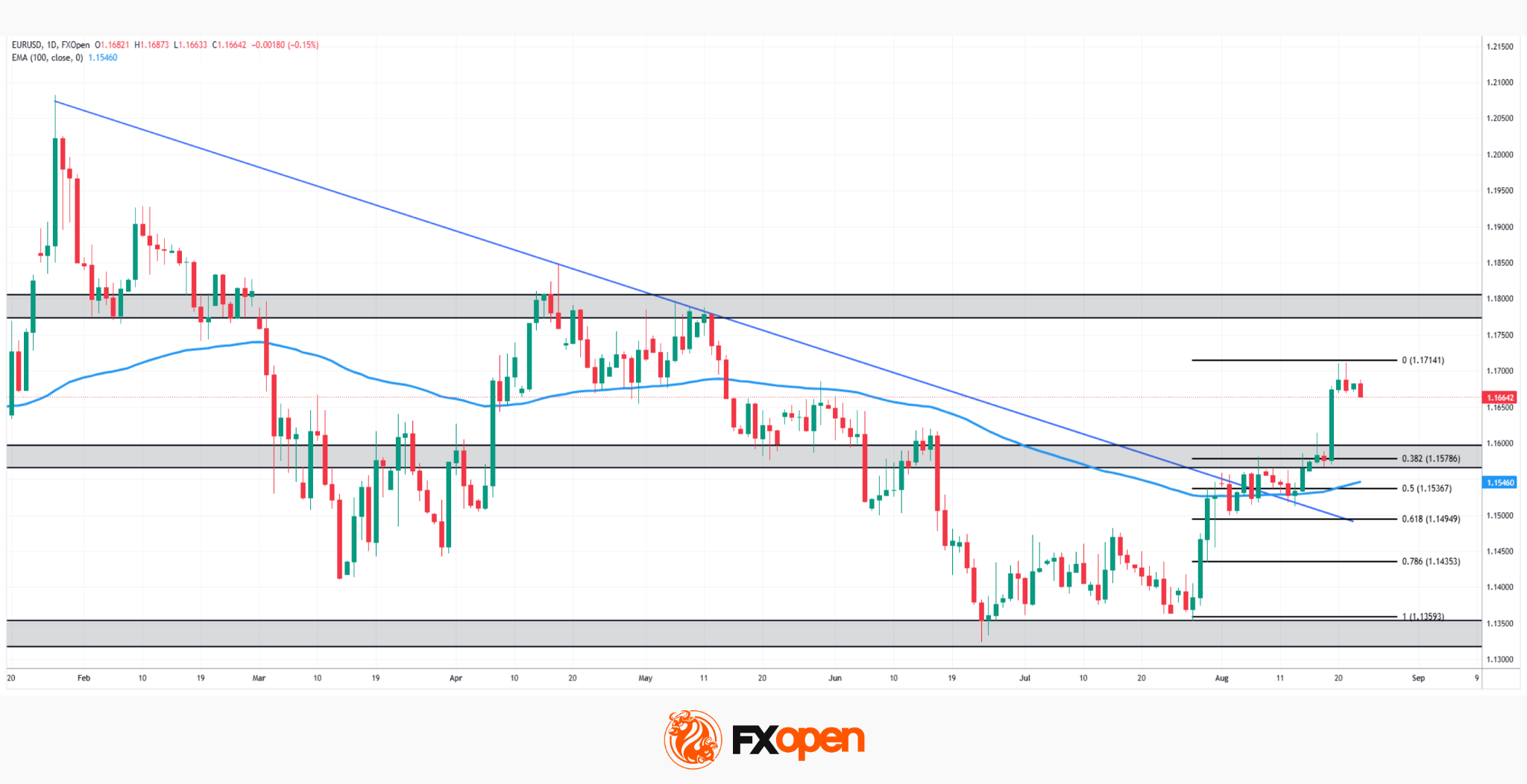
EUR/USD has regained ground in recent sessions, with the pair trading near 1.17 as broad-based weakness in the US dollar continues to dominate the foreign-exchange market. The main driver remains the changing monetary-policy outlook, with investors focused on whether the Federal Reserve can maintain a restrictive stance while the US economy shows signs of slowing.
The dollar faces a key test this week as Fed Chair Kevin Warsh prepares to deliver his first speech at Jackson Hole on Friday. Persistent inflation and rising long-term Treasury yields could encourage a hawkish tone, particularly if Warsh signals that rate cuts in September are far from guaranteed. Conversely, weaker US growth or softer inflation data would reinforce expectations of easier monetary policy and could extend the dollar’s decline.
In Europe, euro-area inflation rose to 2.9% in July, keeping price pressures above the ECB’s 2% target. The ECB has kept interest rates unchanged since June, but higher energy prices and renewed inflation risks could limit the scope for further easing.
With EUR/USD trading near multi-month highs, the Jackson Hole symposium and upcoming US PCE inflation data could determine whether the euro can extend its advance or whether a hawkish Fed response triggers a renewed recovery in the dollar.
Technical Analysis of EUR/USD
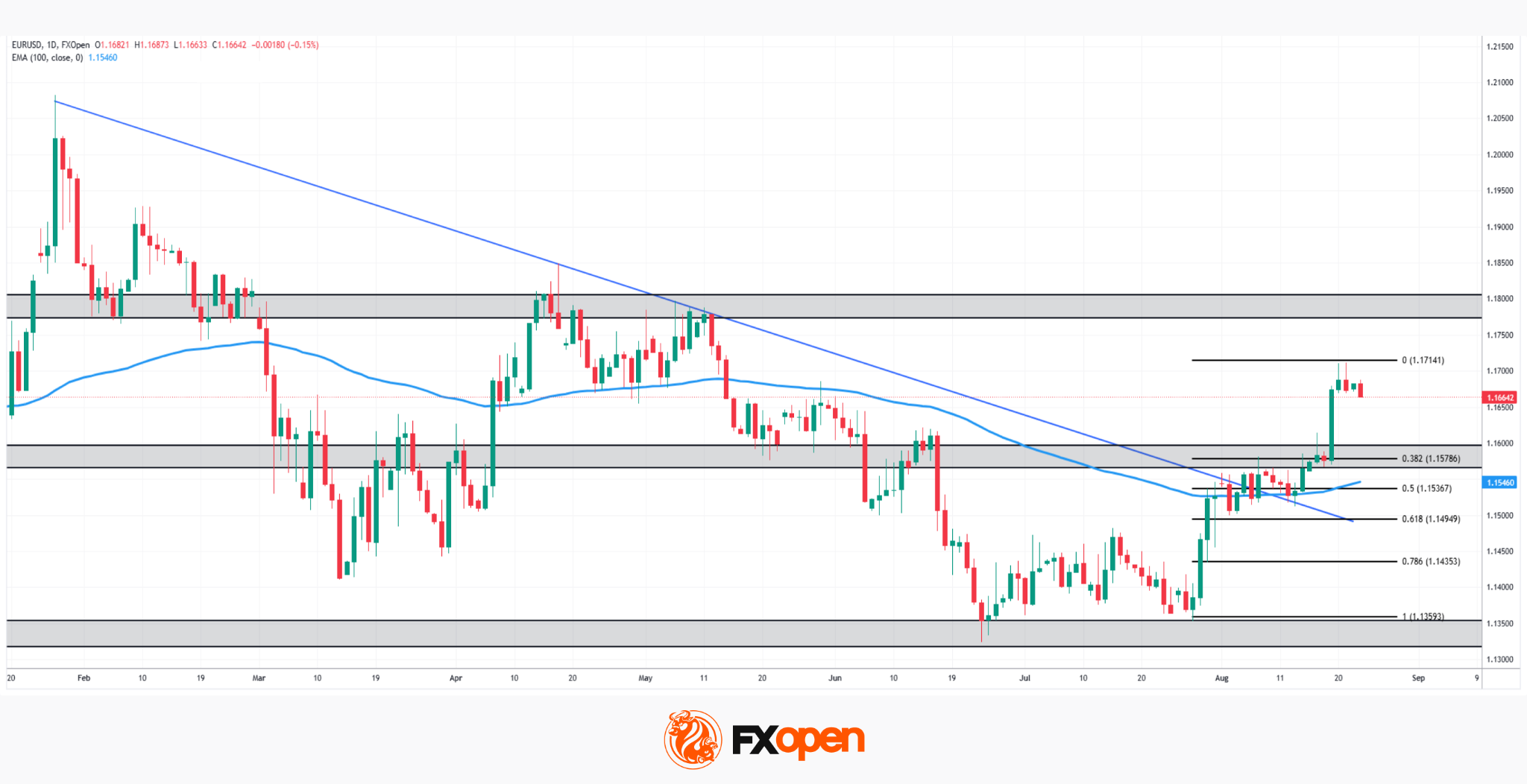
As the daily EUR/USD chart shows, the pair has broken decisively above the descending trendline that had capped price action since the February highs, marking a significant shift in the medium-term structure.
The pair is now trading around 1.1665, comfortably above both the 100-period EMA at 1.1546 and the 0.382 Fibonacci retracement at 1.1579. The breakout has also lifted EUR/USD away from the 1.1537–1.1495 support area, leaving the 1.1714 Fibonacci resistance level as the next major test.
Bullish Scenario
If buyers can maintain control above the 1.1579 Fibonacci level and the 100-period EMA, the bullish structure remains intact.
A break above 1.1714 would open the way towards the 1.1775–1.1800 resistance zone, where previous price action has repeatedly stalled. A sustained move above this area would strengthen the case for a broader recovery and suggest that the longer-term downtrend may have been decisively reversed.
Bearish Scenario
Conversely, a rejection at 1.1714 followed by a break below 1.1579 would weaken the current setup and expose the 100-period EMA around 1.1546, which is closely aligned with the 0.5 Fibonacci level at 1.1537.
A deeper decline through this confluence would bring the 0.618 retracement at 1.1495 into focus, followed by 1.1435 and the 0.786 Fibonacci level as the next downside references.
With EUR/USD testing major Fibonacci resistance after breaking above its descending trendline, the key question is whether buyers can turn the breakout into a sustained advance towards 1.1800, or whether resistance will once again send the pair back towards its key support zone.
Trade over 50 forex markets 24 hours a day with FXOpen. Take advantage of low commissions, deep liquidity, and spreads from 0.0 pips (additional fees may apply). Open your FXOpen account now or learn more about trading forex with FXOpen.
This article represents the opinion of the Companies operating under the FXOpen brand only. It is not to be construed as an offer, solicitation, or recommendation with respect to products and services provided by the Companies operating under the FXOpen brand, nor is it to be considered financial advice.

5 Things to Know About This Leading Melbourne Family Lawyer Handling Complex Cases in 2026

The Art of Mess in the AI Era

8 Near-Perfect Thriller Movie Trilogies, Ranked





-

 Fashion3 days ago
Weekend Open Thread: Madewell – Corporette.com
-

 Business6 days ago
SMA Solar Technology AG (SMTGY) Q2 2026 Earnings Call Transcript
-

 Crypto World2 days ago
anatomy of crypto’s biggest liquidation event since 2021
-

 Business2 days ago
Musk’s Tesla, SpaceX Confirm $16.8 Billion ‘Terafab’ Chip Plant as World’s Largest Building in Texas
-

 Tech6 days ago
Qwen3.8-27B runs frontier-class coding agents and reasoning locally, no cloud API required
-

 Crypto World6 days ago
OCC Greenlights Trump Family Crypto Firm for Trust Charter
-

 Politics2 days ago
6 months on, Irish renters crushed by effects of government housing bill
-
 NewsBeat2 days ago
The ‘Lucky Dip Gang’ causing carnage for clicks: After five thugs were killed speeding in the wrong direction on a motorway, GUY ADAMS investigates a sick new trend… and why police aren’t even allowed to pursue them
-

 Crypto World7 days ago
NAVI Prime launches institutional lending framework on Sui
-

 News Videos4 days ago
Don’t Leave Your Financial Future To Chance | August 19, 2026
-

 Tech5 days ago
GLM-5.3 hits the API at $1.4/$4.4 per million tokens
-
Tech6 days ago
5 Of The Most Reliable Car Brands To Consider If You’re Buying A Used SUV
-
 Crypto World7 days ago
Dow’s 3-Year Winning Run Isn’t a Crash Signal, Still 49% Odds of Double-Digit Gains
-

 Business6 days ago
Stock Market Today: Tech Futures Slide As Treasury Yields Jump; Nvidia, Micron, Sandisk Sell Off
-

 Tech7 days ago
Straight Up the Cliff, Yunnan’s New Fuyao Ladder Turns a Three-Hour Climb Into a 50-Second Ride for Students
-

 Tech6 days ago
Keychron K8 Ultra 8K review: a great value keyboard with comfort issues
-
 Tech7 days ago
Nvidia discloses $21B stake in SpaceX
-
Business6 days ago
Fabrinet (FN) Q4 2026 Earnings Call Transcript
-

 Business4 days ago
Five Below: Kids Discount Retailer Reaps Rich Rewards
-

 Business5 days ago
Marvell Shares Jump 7% as Google Chip Deal Confirms Custom AI Silicon Partnership, Analysts
You must be logged in to post a comment Login