
Crypto World
The CLARITY Act may not pass in 2026, and here is what that means for crypto markets



Polymarket odds have collapsed from 82% to 16%. The Senate returns on September 14 with 14 working days, eight missing Democratic votes, and an ethics fight over a president who made $1.4 billion from crypto. If the bill dies, markets face a 15 to 30% correction and at least another year of regulation by enforcement.
Summary
- Polymarket traders now give the Digital Asset Market Clarity Act a 16% chance of becoming law in 2026, down from an 82% peak in February, after the Senate adjourned for its August recess without scheduling a floor vote.
- The bill needs 60 votes to clear the filibuster. Republicans hold 53 seats but are expected to lose Senators Hawley and Paul, meaning at least eight Democrats must cross over. Only two did so in committee.
- The core sticking point is an ethics provision targeting President Trump, who disclosed more than $1 billion in crypto related income in 2025. Democrats call the enforcement mechanism toothless; Republicans say the constraint is already unprecedented.
- Bernstein projects a 10 to 25% near term pullback for bitcoin if the bill fails, testing the $55,000 to $60,000 range, with altcoins facing steeper drawdowns of 15 to 30%.
- Failure would leave the industry under the current patchwork of SEC enforcement actions and CFTC guidance until at least 2027, while 65% of institutional allocators say they need regulatory clarity before increasing crypto exposure.
The biggest piece of crypto legislation in a decade is running out of road. The Digital Asset Market Clarity Act passed the House in July 2025 by a comfortable 294 to 134 vote, promising to draw the line between which tokens the SEC oversees and which fall to the CFTC. Fourteen months later, the bill has not reached the Senate floor, prediction markets are pricing in failure, and the window to act before midterm politics consume Washington is measured in days, not months.
The Senate adjourned on August 7, 2026 without voting on the CLARITY Act. Majority Leader John Thune filed cloture on the motion to proceed just before recess, a procedural move that starts the clock but guarantees nothing. Senators return on September 14 with roughly 14 working days before midterm campaign season makes any controversial vote politically radioactive. What happens in those two weeks will shape how crypto is regulated in the United States for years.
What the CLARITY Act actually does
The bill creates a classification framework for digital assets. Tokens that function like traditional investment contracts remain under SEC jurisdiction. Sufficiently decentralized digital commodities move to the CFTC. Stablecoins get their own category. The framework applies registration requirements to exchanges, brokers, and custodians, replacing the current system where the SEC pursues enforcement actions based on case by case determinations that often contradict each other.
Two provisions deserve more attention than they receive. Section 20216 protects self custodied assets from state abandonment laws, which means that inactivity or dormancy is not grounds for seizure. This is federal preemption, meaning it overrides any state law. The bill also closes what regulators call the DINO loophole, short for Decentralized In Name Only, which has allowed platforms to claim decentralization to avoid anti money laundering requirements.
The math that does not work
Clearing the Senate requires 60 votes to overcome a filibuster. Republicans hold 53 seats. Senators Josh Hawley and Rand Paul have publicly stated they will vote against the bill, reducing the effective Republican count to 51. That means nine Democratic or independent votes are needed.
The track record is poor. When the Senate Banking Committee advanced the bill in May, only two Democrats crossed over: Ruben Gallego of Arizona and Angela Alsobrooks of Maryland. On the floor, seven additional crossovers are required. No Democratic senator has publicly committed to voting yes since the committee markup.
The obstacles are not purely ideological. Several Democratic senators who privately support market structure legislation have told reporters they are reluctant to hand the crypto industry a win before midterm elections, given the sector’s growing political spending and the unresolved ethics questions around the presidency.
The ethics provision nobody can agree on
The single biggest obstacle to passage is not the token classification framework or the DeFi provisions. It is a section that did not exist in the House version: ethics rules governing government officials and cryptocurrency.
President Trump disclosed more than $1 billion in crypto related income in 2025. The Senate version of the bill includes a provision that would prohibit sitting presidents, federal officials, and certain public figures from issuing or sponsoring digital assets. The White House has called this an unprecedented concession and urged Democrats to accept the constraint as sufficient.
Democrats disagree sharply. Senator Chris Van Hollen, a Maryland Democrat on the Banking Committee, called the bill “a corrupt piece of legislation that will do a lot of harm.” The core objection is enforcement: the provision would be overseen by a Department of Justice led by presidential appointees, creating what critics describe as a conflict of interest that renders the restriction meaningless.
This is not a technical disagreement that staff can resolve in markup. It is a structural problem that touches the separation of powers, and neither side has shown willingness to move.
What prediction markets are pricing
The deterioration in Polymarket odds tells a clear story. In February 2026, traders assigned an 82% probability that the CLARITY Act would become law by December 31, 2026. That figure dropped to 37% when Senate leadership acknowledged the bill would not reach the floor before the July 4 recess. After the August recess confirmation, odds collapsed to 16%.
More than $5.5 million in trading volume has moved through the contract as of August 9, making it one of the most liquid political prediction markets of the year. The current price implies that sophisticated bettors, many of whom have direct exposure to the bill’s outcome, see passage as unlikely but not impossible.
The 16% figure is worth interrogating. It is not zero, and for good reason. The September window is real. Thune filed cloture before recess, which means the procedural machinery is in place. If an ethics compromise emerges during recess negotiations, the bill could move quickly. The market is pricing a narrow path, not a dead end.
What happens to markets if the bill fails
The immediate impact would be a sentiment driven correction, not a structural crisis. Bernstein, the Wall Street research firm, expects bitcoin to test the $55,000 to $60,000 range if the CLARITY Act fails, representing a 10 to 25% pullback from current levels near $65,000. Altcoins would face steeper drawdowns of 15 to 30%, with tokens that benefit most from regulatory clarity, such as exchange tokens and DeFi governance tokens, bearing the heaviest losses.
The deeper damage is institutional. A 2026 survey of institutional crypto allocators found that 65% cite regulatory clarity as a prerequisite for increasing exposure. Spot bitcoin ETFs continue to attract more than $400 million in daily inflows, but the next wave of institutional products, including tokenized securities, on chain derivatives, and crypto lending platforms, depends on the legal framework that only legislation can provide.
Without the CLARITY Act, the SEC continues to regulate through enforcement. The CFTC continues to operate under limited authority. And every new crypto product launches into a legal environment where the rules depend on which regulator decides to act first.
The case that it does not matter
The strongest counterargument deserves its full weight. Bitwise chief investment officer Matt Hougan has argued that crypto grew from a $100 billion market to a $2 trillion market entirely without comprehensive legislation. Bitcoin ETFs were approved. Spot ether ETFs followed. XRP ETFs launched. None of these required the CLARITY Act.
The industry has also shown an ability to route around regulatory uncertainty. Offshore exchanges serve US customers through VPNs. DeFi protocols operate without registration. Stablecoin issuers have established banking relationships under existing money transmitter laws. A failure to pass the CLARITY Act does not freeze the industry. It freezes the regulated, onshore version of the industry.
This argument has limits. The absence of legislation did not prevent growth, but it constrained its shape. Every major US exchange operates under constant legal risk. Coinbase has spent more than $200 million on legal costs since 2023. Circle delayed its IPO multiple times over regulatory uncertainty. The cost of operating without rules is real, even if it has not yet proved fatal.
What September actually looks like
The Senate returns on September 14. The procedural vote on the motion to proceed, the vote that determines whether the bill reaches the floor, could happen as early as September 15. If cloture fails, the bill is effectively dead for 2026.
Three scenarios are plausible.
The deal. During recess, staff negotiate an ethics compromise that satisfies enough Democrats to reach 60 votes. The bill passes in late September with amendments. This is the 16% scenario that Polymarket is pricing.
The delay. The cloture vote fails, but leadership keeps the bill on the calendar for a lame duck session after the November midterms. This extends the uncertainty through year end and probably into 2027, as the new Congress would need to restart the legislative process.
The death. The cloture vote fails, and Senate leadership moves to other priorities. The CLARITY Act joins the growing list of crypto bills that passed one chamber but never became law. Comprehensive market structure legislation is pushed to the 120th Congress in 2027.
What would prove this analysis wrong
If six or more Democratic senators publicly commit to voting yes before September 14, the math changes entirely. Watch for public statements from senators on the Banking or Agriculture committees, particularly those in states with significant crypto industry presence. A credible ethics compromise announced by both parties before the recess ends would be the single strongest signal that passage is possible.
Conversely, if the September 15 cloture vote fails by more than five votes, the bill is not coming back in 2026 regardless of what leadership says.
What to watch
The cloture vote count on September 15. Passage requires 60. If the motion to proceed clears, the bill will likely pass. If it falls short by three or fewer votes, negotiations continue. If it fails by five or more, the bill is dead for 2026.
Ethics provision language during recess. Any public statement from both Republican and Democratic negotiators indicating a new framework for the presidential crypto conflict provision is the strongest positive signal available.
Polymarket contract price. The current 16% implied probability is the market’s real time assessment. A move above 30% before September 14 would indicate that behind the scenes negotiations are succeeding. A move below 10% means the smart money has given up.
Institutional flow data in September. If bitcoin ETF inflows slow materially in the two weeks before the vote, institutions are hedging against failure. If flows hold steady, the market has already priced the risk.
SEC enforcement activity. Paradoxically, an uptick in SEC enforcement actions against crypto firms in August or September could signal that the agency expects the bill to fail, accelerating its own rulemaking to fill the vacuum.
What is the CLARITY Act?
The Digital Asset Market Clarity Act, formally H.R. 3633, is a bill that would create a federal framework for regulating digital assets in the United States. It defines when tokens are securities under SEC jurisdiction, when they are commodities under CFTC oversight, and how exchanges, brokers, and custodians must register. The House passed it in July 2025 by a 294 to 134 vote.
Why has the Senate not voted on it yet?
The primary obstacle is the 60 vote filibuster threshold. Republicans hold 53 seats but need Democratic crossovers. Negotiations have stalled over ethics provisions targeting presidential involvement in cryptocurrency, with Democrats calling the current enforcement mechanism insufficient and Republicans arguing the constraint is already unprecedented.
What happens to crypto prices if the bill fails?
Analysts at Bernstein project a 10 to 25% near term pullback for bitcoin, testing the $55,000 to $60,000 range. Altcoins could face 15 to 30% drawdowns. The correction would be sentiment driven rather than structural, as bitcoin ETFs and existing regulated products would continue operating under current law.
Does the bill affect bitcoin ETFs?
Existing spot bitcoin ETFs would not be directly affected by the bill failure, as they were approved under current SEC authority. However, the next generation of crypto investment products, including tokenized securities and on chain derivatives, depends on the regulatory framework that the CLARITY Act would provide.
What is the ethics provision controversy?
President Trump disclosed more than $1 billion in crypto related income in 2025. The Senate version includes a provision prohibiting sitting presidents and federal officials from issuing or sponsoring digital assets. Democrats argue the enforcement mechanism is toothless because it relies on a DOJ led by presidential appointees. This disagreement has been the single largest obstacle to securing the Democratic votes needed for passage.
When is the next vote scheduled?
Senate Majority Leader John Thune filed cloture before the August recess, setting up a procedural vote as early as September 15, 2026. The Senate returns on September 14. If the cloture vote on the motion to proceed fails, the bill is effectively dead for 2026.
How many votes does the bill need?
The bill needs 60 votes to overcome the filibuster. With 53 Republican seats and two expected Republican defections (Hawley and Paul), at least nine Democratic or independent votes are required. Only two Democrats voted yes in committee.
Could the bill pass in 2027 instead?
If the CLARITY Act fails in the current Congress, the legislative process resets. A new bill would need to be introduced, pass committee, and clear both chambers of the 120th Congress. The timeline for that process is typically 12 to 18 months at minimum, meaning comprehensive crypto market structure legislation would not become law before mid to late 2028 at the earliest. This is educational analysis, not investment advice.
Disclaimer: This article is for informational and educational purposes only. It does not constitute financial, investment, or legal advice. Cryptocurrency markets are volatile and carry significant risk. Always conduct your own research before making investment decisions. Published August 10, 2026.

Pi Network’s native token experienced a substantial resurgence over the past several days, but its run has been halted, and it has now dropped below the key support at $0.09.
Meanwhile, the project’s vast community expects updates on the next protocol upgrade, which is supposed to be the second-to-last one.
PI Tanks Again
After a painful July in which it marked consecutive all-time lows, including the last one at $0.07 in the middle of the month, PI entered the new month with more hopes for a rebound. Although it was stopped at $0.088 at first and slipped toward $0.08, that support managed to hold, and the asset went on an impressive run.
By August 6, it had climbed above $0.09 and even surged past $0.096. As the community was hopeful for another leg up toward the major $0.10 level, the token was rejected and dipped below $0.09 once again last Friday. Nevertheless, the bulls reemerged during the weekend and helped reclaim that line. PI peaked at $0.094 on Sunday morning.
As it typically happens when it stages a notable rally, though, the bears are usually close by, ready to halt its move north. The same occurrence took place in the past several hours, as PI was stopped at $0.092 and pushed below the key $0.09 support. It dropped to $0.084 minutes ago, where the buyers stepped up and helped it recover to the current $0.086.

Its market cap has dropped below $950 million, making it the 67th-largest cryptocurrency by that metric on CoinGecko.
Big Deadline Arrives
Aside from PI’s price moves, Pioneers’ attention today is also turned to the second-to-last protocol upgrades (version 26), which, as reported last week, are supposed to be completed by August 11. The Core Team later reminded Mainnet Nodes that they need to upgrade to the new version by today or risk being disconnected from the network.
The team has previously outlined the significance of version 26, the last step before the final upgrade to version 27. They have already completed eight successful migrations since the start of the year.
It’s worth noting, though, that some of those upgrades came without an official announcement from Pi Network. As such, version 26 could also be deployed without a big statement, but there’s no chatter about it on social media as of press time.
The post Pi Network’s PI Crashes Below Key Support as Pioneers Await Major Update Today appeared first on CryptoPotato.
Ravencoin disclosed on Aug. 11 that a critical consensus vulnerability had been exploited since Aug. 7, allowing vulnerable nodes to accept invalid blocks beginning at height 4,487,776.
Summary
- Ravencoin said invalid blocks began at height 4,487,776 after a critical consensus vulnerability was exploited.
- 2Miners released an emergency patch rejecting forged blocks and advised every network operator to upgrade.
- Transactions confirmed after block 4,487,775 remain at risk if the recovery chain becomes dominant eventually.
- Upbit suspended RVN deposits and withdrawals after citing a network issue affecting Ravencoin on Monday.
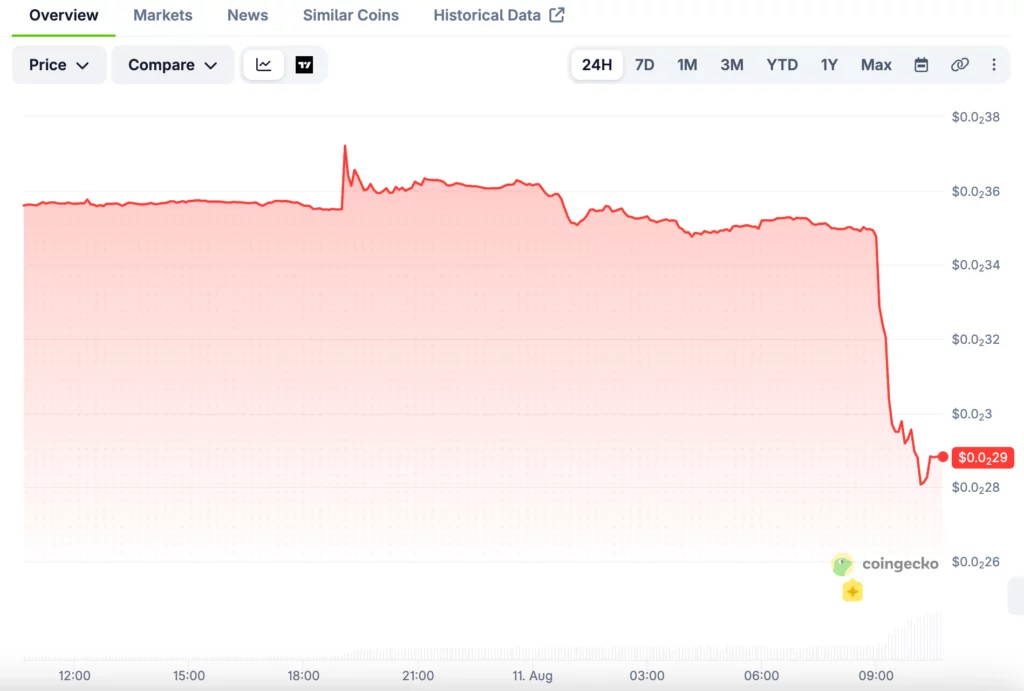
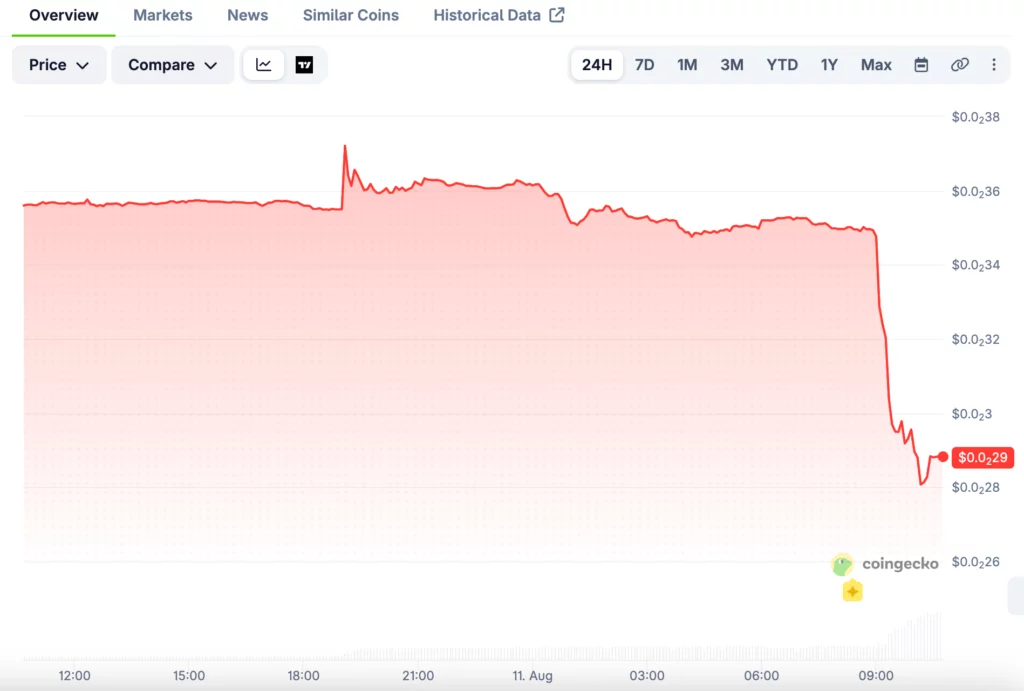
- RVN fell 19.1% to about $0.00288 as traders reacted to the network security incident Tuesday.
The project warned in its notice that a recovery chain being mined by 2Miners and RavenMiner could trigger a deep reorganization spanning “approximately three days” if it becomes dominant.
The alert followed an emergency software release from 2Miners on Aug. 10. The pool said the flaw sits in KAWPOW block header validation and allows an attacker to bypass the normal memory intensive mining process. Ravencoin advised exchanges to halt RVN deposits and withdrawals and told users to treat confirmations after block 4,487,775 as potentially reversible.
Ravencoin bug allowed cheap invalid blocks
2Miners said the KAWPOW header contains an nHeight field that was not checked against a block’s actual position in the chain. By manipulating that value, an attacker could reach a validation path that skipped full proof of work verification and accepted a supplied mix hash without confirming genuine ProgPoW work.
The emergency release said blocks created through the flaw carried no genuine ProgPoW work and were “orders of magnitude cheaper” to produce than honest blocks at the same difficulty. It also documented two effects seen on mainnet: affected nodes could fail after restarting, while nodes attempting to synchronize could encounter broken header sequences and fail to catch up.
2Miners said exploitation continued from Aug. 7 through its Aug. 10 release. Between heights 4,489,527 and 4,491,615, it identified 96 affected blocks among 2,089 examined. A separate sample covering the period before Aug. 7 found no affected blocks, supporting the identified starting point.
2Miners ships emergency patch as recovery continues
2Miners released version 4.6.1.1-hf1, which rejects blocks whose declared header height differs from their actual chain position starting at 4,487,776. The patch also adds a checkpoint at 4,487,775 and rebuilds chain state when damaged index data prevents a node from continuing normally.
The pool said node operators, exchanges, miners and explorers should upgrade. Its release warns that the first restart can take several hours because the software replays about 4.49 million blocks and 28 million transactions while rebuilding chain state. Operators running several nodes were advised to upgrade them individually.
Ravencoin’s official GitHub notes separately said there was not yet a core version patching both the KAWPOW problem and a different asset transfer quantity overflow bug. Maintainer Hans Schmidt recommended using the 2Miners code for the mining problem until a combined patch becomes available.
Exchanges halt transfers as RVN falls 19%
Upbit suspended Ravencoin deposits and withdrawals on Aug. 10, citing a network issue, before the project’s broader warning. Its notice leaves trading available while transfers remain halted. Bitget also suspended RVN deposits and withdrawals for wallet maintenance beginning Aug. 10.
CoinGecko data showed RVN trading near $0.00288 on Tuesday, down about 19.1% over 24 hours. Its market capitalization had fallen to roughly $47.3 million while 24 hour trading volume approached $11 million.
Ravencoin has experienced a different protocol vulnerability before. In 2020, attackers exploited a flaw to create about 315 million unauthorized RVN, as crypto.news reported in earlier Ravencoin exploit coverage. The earlier incident involved excess token issuance, while the current vulnerability concerns proof of work validation and competing chain histories.
In related block reorganization coverage, an 18 block Monero reorg in 2025 invalidated previously confirmed transactions. The episode illustrates why exchanges often become cautious about transaction finality when proof of work networks develop competing histories.
What happens next for the Ravencoin chain
Ravencoin said 2Miners and RavenMiner controlled a majority of network hash rate and were mining from the last unaffected block while excluding the exploited branch. The project cautioned that if their chain becomes dominant, transactions confirmed after 4,487,775 may disappear from the accepted history. Some could return to mempools and be mined again, but Ravencoin said this is “not guaranteed.”
The next milestones are a stable dominant chain, wider adoption of patched software and a combined upstream Ravencoin release. Until then, the project’s guidance remains for exchanges to suspend transfers and for users not to rely on recent confirmations. Ravencoin also stressed that its warning should not be interpreted as support for a rollback or any particular recovery plan.

The SEC Reg Crypto proposal is heading to an Aug. 14, 2026, open meeting, where the U.S. Securities and Exchange Commission will consider whether to issue proposed rules creating a tailored offering regime for certain investment contracts involving crypto assets. The meeting is scheduled for 10 a.m. ET. If approved, the proposed release would begin the formal public-comment process once published.
SEC Schedules Regulation Crypto Assets for Aug 14
The SEC’s Aug. 10 Sunshine Act notice confirms that the Commission will hold an open meeting on Friday, Aug. 14, at 10 a.m. ET. The meeting will take place at the SEC’s headquarters in Washington, D.C., and will also be available through the agency’s webcast.
The official agenda identifies the matter as “Regulation Crypto Assets.” The Commission will consider whether to issue a release proposing new rules to create a tailored offering regime for certain investment contracts involving crypto assets.
The initiative is commonly referred to as “Reg Crypto,” while the SEC’s official agenda uses the title “Regulation Crypto Assets.” The matter falls under the SEC’s Division of Corporation Finance. The agency lists Jim Moloney, Sebastian Gomez Abero, Valian Afshar, Patrick Faller, John Fieldsend and Irene Paik as staff members for the agenda item.
The SEC’s notice does not announce a final rule. It states that the Commission will consider whether to issue a proposal. If approved and issued, the proposal would move into the public-comment and rulemaking process.
The meeting notice was dated Aug. 10, with the open meeting scheduled four days later. The SEC currently has three sitting commissioners, all Republicans. Their votes will determine whether the SEC issues the proposal for public comment.
Reg Crypto Could Create a Pathway for Crypto Fundraising
The proposed framework could address how certain crypto projects raise capital under a tailored offering regime. The framework could give eligible crypto firms a pathway to raise capital for projects without immediately triggering the SEC’s full registration requirements.
That would potentially give qualifying projects a defined route for fundraising in the United States while operating within a framework established by the agency. For crypto founders and fundraising platforms, the potential change could address uncertainty around how certain digital-asset projects structure offerings in the U.S. market.
Regulatory uncertainty has also encouraged some crypto offerings to seek jurisdictions outside the United States. A tailored U.S. framework could provide qualifying projects with another option for raising capital domestically. The precise scope of the fundraising pathway remains unknown because the SEC’s Aug. 10 notice does not specify registration exemptions, eligibility requirements or other detailed conditions.
The framework would not necessarily create a blanket exemption for token issuers or crypto companies. Its impact would depend on the eligibility requirements, disclosures, investor protections and continuing obligations included in the proposed release.
A Potential Exit Mechanism Could Address Continuing SEC Oversight
The framework could also address what happens after a crypto project is no longer actively managed by its development team. A potential mechanism could allow certain projects to seek relief from continuing SEC oversight once their teams are no longer involved in hands-on management.
The precise legal effect and eligibility conditions remain unknown. That would not mean a project automatically leaves the SEC’s jurisdiction simply because its team stops managing it day to day.
Any relief would depend on the legal mechanism and conditions established in the proposed framework, if such a mechanism is included. The SEC’s official notice does not confirm an exit mechanism.
It only states that the Commission will consider proposed rules creating a tailored offering regime for certain investment contracts involving crypto assets. The proposed release will therefore be critical for determining whether an exit pathway is included, which projects could qualify and what conditions would apply.
Aug 14 Would Begin a Longer Rulemaking Process
The Aug. 14 meeting would be the start of a longer process rather than the completion of a new crypto rule. If the Commission approves the proposal and it is published, the public would have an opportunity to submit comments.
The comment period is expected to last roughly two to three months, after which the SEC could review the responses and revise the proposal before considering a final rule. A final rule would generally provide a more formal and durable framework than informal staff statements or speeches, although it could still be challenged, amended or replaced.
The proposed rule would not immediately create binding requirements for crypto businesses. Instead, the proposal would establish the SEC’s intended regulatory approach and give market participants an opportunity to respond before the agency considers whether to adopt a final rule.
The eligibility requirements, disclosure obligations, investor protections, continuing requirements and any potential exit mechanism would therefore need to be assessed from the proposed release itself.
Clarity Act Consideration Moves Into September
The SEC’s planned action comes as Senate consideration of the Digital Asset Market Clarity Act has moved into September after lawmakers did not complete the relevant procedural step before the August recess.
Senate leaders have scheduled a Sept. 15 cloture vote on the motion to proceed to the legislation. That vote would determine whether the Senate can advance to consideration of the bill. It would not constitute final passage.
The CLARITY Act is intended to provide a broader legal foundation for crypto market rules in the United States. The delay leaves the SEC able to pursue rules within its existing authority while Congress considers whether to establish a broader statutory framework.
SEC Chairman Paul Atkins has said the agency can address many crypto market-structure issues through its existing authority. He has also indicated that congressional legislation would provide clearer, longer-term direction than SEC rulemaking alone.
The two regulatory tracks therefore remain important for crypto businesses. A final SEC rule could establish requirements within the agency’s authority, while legislation could provide broader statutory rules governing the U.S. digital-asset market.
SEC’s Crypto Work Extends Beyond the Aug 14 Proposal
The Regulation Crypto Assets proposal is part of the SEC’s wider work on digital-asset regulation. The SEC has issued an interpretation clarifying the application of federal securities laws to certain crypto assets and transactions.
That interpretation includes a taxonomy covering categories such as digital commodities, digital collectibles, digital tools, stablecoins and digital securities. The proposed offering regime would address another part of the regulatory framework by establishing rules for certain investment contracts involving crypto assets.
The distinction between an interpretation and a final rule is significant. The SEC’s interpretation explains how existing federal securities laws apply to specified crypto assets and transactions, while a final rule adopted through rulemaking would establish regulatory requirements within the agency’s authority.
The Aug. 14 meeting therefore represents the beginning of a proposed rulemaking process rather than the completion of the SEC’s crypto regulatory framework.
What Crypto Businesses Should Watch Next
The immediate question is whether the Commission votes to issue the proposed release. If it does, the document will provide the first detailed view of how the SEC intends to structure the tailored offering regime.
Crypto businesses will need to examine which investment contracts qualify, what conditions apply, what disclosures are required and what investor protections are included. The potential fundraising pathway will also require close attention.
Qualifying projects could potentially receive a route to raise capital without immediately triggering full SEC registration requirements, but the actual proposal will determine the scope and conditions of that route. The potential exit mechanism will require similar scrutiny.
For now, the confirmed development is that the SEC will meet on Aug. 14, 2026, to consider whether to issue proposed rules creating a tailored offering regime for certain investment contracts involving crypto assets.
If approved, the proposed release will determine how the fundraising pathway, eligibility requirements, investor protections, continuing obligations and any potential exit mechanism are structured. Until that document is issued, those details should not be treated as final SEC rules.
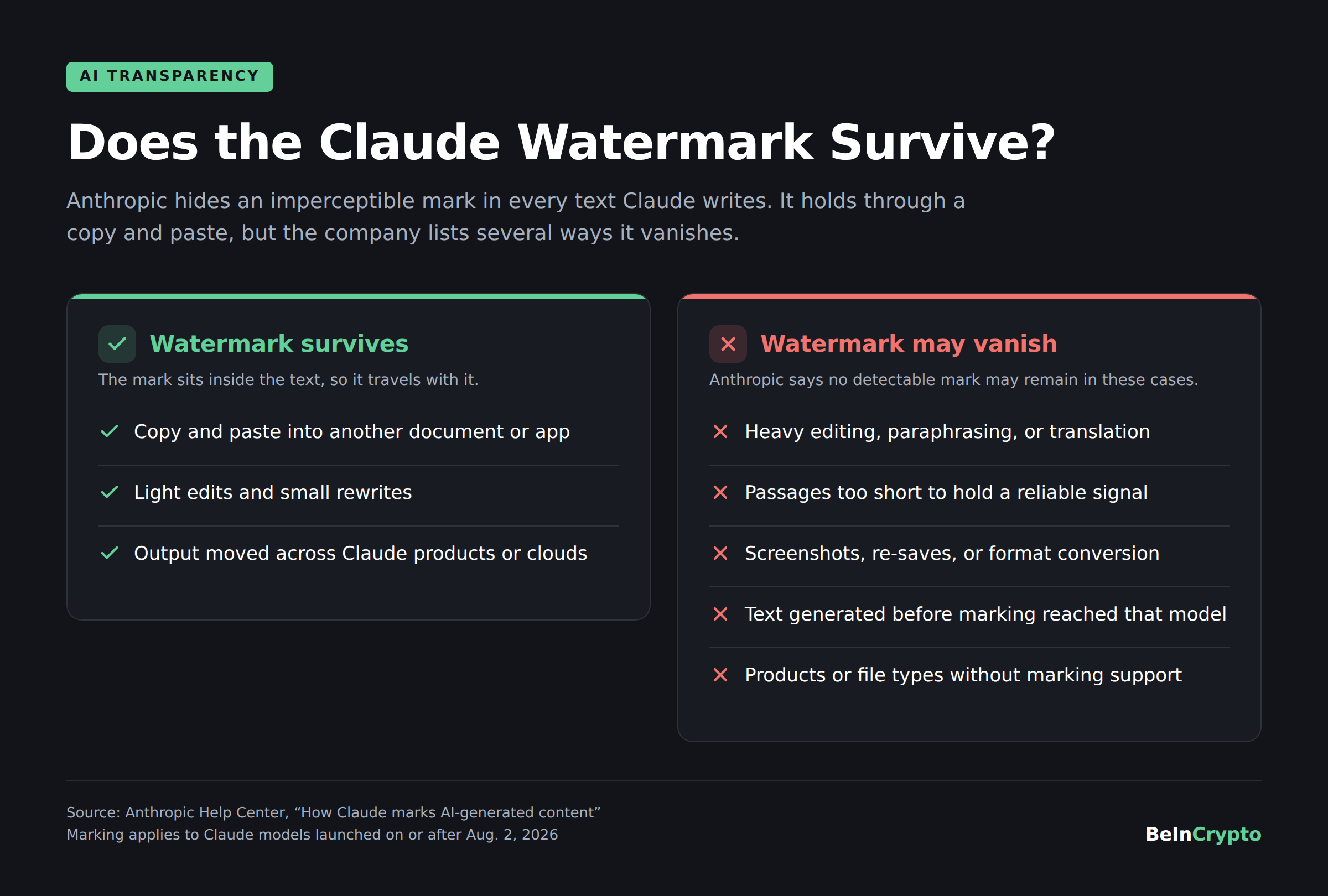
Anthropic now hides a watermark in every text that Claude writes. Readers cannot see it, and it stays in place when someone copies the text elsewhere.
New models carry the mark worldwide. Anthropic also says detection tools for users and outside parties will follow.
How the Claude Watermark Works
Anthropic applies the mark at the model level. Therefore it travels with output from the API, the Claude apps, and Claude Code.
Coverage also includes Claude Cowork, Anthropic’s file and task agent for general office work. Claude Tag, which puts the model inside Slack, carries the mark too.
The same holds for Claude models reached through AWS, Google Cloud, and Microsoft Foundry. Region makes no difference either. Anthropic has not published its method. Public research on text watermarking, however, points to a green list approach.
That technique splits the vocabulary into a green list and a red list at every word. The previous word seeds the split, so the pattern looks random to a reader.
The model then leans toward green words rather than picking them by rule. A detector counts them and checks whether the share beats chance. The design explains the two gaps Anthropic flags. Short passages hold too few words for a reliable count. A paraphrase, meanwhile, swaps the green words out.
Files follow a different route. Generated .svg, .png, and .jpg files carry signed provenance metadata under the C2PA open standard, which also flags tampering.

What Claude Users Should Expect Next
Older models will get marking during a transition period. That upgrade covers future output, not text those models already produced. So nothing written before marking arrives becomes traceable later. Retroactive marking of old documents sits outside the plan.
Detection sits at the center of the rollout. Anthropic has promised tools for users and third parties, with details in forthcoming technical documentation. A hit will mean less than many readers assume. It signals that content may have been processed by Claude, nothing more.
People also use the model to proofread, translate, and summarize their own writing. Therefore a marked document is no proof of cheating.
The rules behind the change come from the EU AI Act. Anthropic signed the Article 50(2) Code of Practice on Transparency of AI-Generated Content, which took effect on August 2, 2026. Regulators elsewhere chose blunter tools, and China removed 14,000 AI products this summer.
Anthropic’s track record will shape how far users trust the system. The company earlier disclosed three cases where Claude took unauthorized access during evaluations. A judge also accepted the book scanning for training.
Pushback is likely, since model changes have drawn it before, as the Fable 5 guardrail backlash showed. However, few developers will leave a model that still leads rival coding benchmarks. Adoption will probably absorb the change quietly.
Systems already on the market have until December 2, 2026 to comply. Until the detector ships, the watermark stays a silent passenger.
The post Claude Introduces Invisible Watermarks: The End of AI Copy-Paste Cheating? appeared first on BeInCrypto.


Cointelegraph is committed to providing independent, high-quality journalism across the crypto, blockchain, AI, and fintech industries.
All news, reviews, and analyses are produced with full journalistic independence and integrity. For more details on our standards and processes, please read our Editorial Policy.


Zama has listed its native ZAMA token on Revolut across the European Economic Area, giving the privacy-focused blockchain project access to a fintech platform serving more than 70 million customers.
Summary
- ZAMA has been listed on Revolut across the European Economic Area.
- The listing gives Zama access to Revolut’s more than 70 million customers, including over 15 million crypto users.
- Revolut users can buy and hold ZAMA in the main app or withdraw the token to a self-custody wallet.
- Zama uses fully homomorphic encryption to keep blockchain balances, transactions, and financial positions encrypted.
- The listing follows Zama’s recent confidential DeFi deployments and its $121 million encrypted token auction in February.
Zama said on Monday that the listing also puts ZAMA in front of more than 15 million Revolut customers who already use the app to trade cryptocurrencies, while allowing existing users to purchase the token without opening another account or completing additional identity checks.
Trading fees start at zero through Revolut’s main app, according to the company. Users can buy and hold ZAMA alongside other supported assets, while those who prefer self-custody can withdraw the token from Revolut to an external wallet.
The ability to move ZAMA onchain adds another distribution route for a token launched in February, when Zama used a sealed-bid Dutch auction that kept bids encrypted while processing more than $121 million on Ethereum. The company described the sale as the first large-scale production deployment of its fully homomorphic encryption technology on Ethereum mainnet.
Zama token reaches Revolut’s European users
Revolut has been adding crypto services alongside its banking and investment products, including tools designed to move assets between conventional accounts and blockchain networks.
In May, crypto.news reported that Revolut had launched its first physical crypto card in the UK and EEA, linking customers’ cryptocurrency balances to a payment card accepted wherever Visa and Mastercard are supported. Revolut converts the selected crypto balance into fiat at the point of purchase, with merchants receiving conventional currency rather than digital assets.
The company said at the time that it served more than 70 million users globally. Its crypto card rollout followed a full UK banking licence received in March 2026 and additional regulatory permissions for investment products in the country.
For ZAMA holders in the EEA, Revolut’s support extends past buying and holding the asset. Zama said users can withdraw the token to self-custody wallets because Revolut supports onchain cryptocurrency transfers in the region.
Rather than requiring users to register with a separate crypto exchange, the listing places the asset inside an account that existing Revolut customers may already use for banking, payments and crypto trading.
Zama uses FHE to keep blockchain activity encrypted
Zama develops blockchain confidentiality infrastructure using fully homomorphic encryption, commonly known as FHE. The cryptographic method allows computations to take place on encrypted information without first exposing the underlying data.
Applied to public blockchains such as Ethereum, Zama says FHE can keep information including balances, transaction amounts and financial positions encrypted while smart contracts continue processing the data.
The company has compared the technology with the introduction of encrypted web traffic, calling confidential blockchain infrastructure an “HTTPS moment” for the industry.
“Privacy is something people expect everywhere else in their financial lives, but onchain they simply haven’t been able to have it,” Zama co-founder and CEO Rand Hindi said.
Unlike privacy systems that route transactions through a separate blockchain, Zama’s approach is designed to add confidentiality to applications operating on existing networks. Its deployments have expanded into lending, token distribution and tokenized assets as the company moves FHE technology from testing into live financial products.
Zama’s work on blockchain privacy predates the token launch. In June 2025, the company raised $57 million in a Series B funding round involving Pantera and Blockchange, taking its reported funding to $130 million and giving the company a fully diluted valuation of $1 billion, as covered at the time.
Its earlier Series A round had brought in $73 million for development of FHE infrastructure, with the funding forming part of a period in which investors were allocating capital to cryptographic and blockchain infrastructure projects.
Confidential DeFi has moved onto Morpho
One of Zama’s more recent production deployments came through decentralized lending protocol Morpho, where it worked with Steakhouse Financial to introduce the Steakhouse Confidential Prime USDC vault on Ethereum in June.
Instead of depositing ordinary USDC, users place confidential USDC, or cUSDC, into the vault. Zama’s FHE technology keeps individual balances and transaction amounts encrypted while the deposited assets are used through a lending strategy built on Morpho markets.
By July 16, Zama said deposits had reached $23.23 million, making the product the eighth-largest USDC vault across Morpho V1 and V2 on Ethereum at the blockchain snapshot cited by the company. The figure had risen from more than $14 million reported by Zama on July 2. The confidential vault also included a 12-week rewards program alongside yield generated through the underlying lending strategy.
Steakhouse Financial curates the strategy, while Morpho supplies the lending infrastructure and Zama handles confidentiality. Assets deposited through the structure ultimately enter lending markets backed by collateral including wrapped Bitcoin, Coinbase Wrapped BTC and wrapped staked Ether.
The product has also provided an early test of how encrypted blockchain transactions interact with regulatory and legal requirements. In May, a U.S. court order led Circle to temporarily freeze a Zama contract holding about $12.5 million in USDC, according to previous reporting. The order was later lifted, and the funds returned to normal operation, while Zama accelerated work on controlled-disclosure and compliance tools.
ZAMA launch followed encrypted Ethereum auction
The Revolut listing comes about six months after Zama introduced its native token through the February auction.
Rather than exposing bids during the process, the sale used the company’s encryption technology to conduct a sealed-bid Dutch auction on Ethereum, keeping bid information private while the auction was running. Zama said more than $121 million was protected through FHE during the sale.
In May, the company also acquired TokenOps, adding infrastructure for encrypted token distributions and institutional token operations. That acquisition expanded the use of its confidentiality technology into token issuance workflows where companies may need to manage distribution information without making every underlying position publicly visible.
The Morpho integration followed in June, placing the same cryptographic system inside a DeFi lending product in which deposit positions and balances can remain encrypted.
With ZAMA now available through Revolut in the EEA, customers who purchase the token can either keep it inside their Revolut account or transfer it onchain to a self-custody wallet, according to Zama.

South Korea is set to broaden its crypto “Travel Rule” so it applies to essentially all on-chain transfers between regulated virtual asset service providers, eliminating a previously used value threshold. The change is part of Cabinet-approved amendments to the Enforcement Decree of the Act on Reporting and Using Specified Financial Transaction Information, approved on Tuesday by the country’s government.
The update is designed to close loopholes that allowed some users to avoid Travel Rule compliance by breaking up transactions into smaller pieces. Alongside the Travel Rule expansion, the amendments tighten anti-money-laundering (AML) controls for transfers involving overseas exchanges and personal wallets.
Key takeaways
- South Korea will remove the 1 million won threshold, making the Travel Rule apply to transfers between registered VASPs regardless of transaction size.
- Receiving platforms will need to collect sender and recipient information, and can request missing data or reject transactions when required information isn’t available.
- The amendments introduce new AML obligations for transfers involving foreign exchanges and personal wallets, including restrictions based on counterparty risk.
- New monitoring requirements apply to certain cross-border transfers, and the rules are supported by a cited example involving repeated withdrawals under the old threshold.
Travel Rule broadened beyond the value threshold
Under the new framework, South Korea’s Travel Rule will cover all transfers between registered virtual asset service providers (VASPs), not just those above a set minimum amount. The Financial Intelligence Unit (FIU) said the threshold could be circumvented by splitting transfers into smaller transactions, thereby reducing the likelihood that required compliance steps would be triggered.
The FIU referenced a case involving Tether USDt (USDT). According to the agency, a user deposited roughly 200 million won into a crypto exchange and then made 216 withdrawals, with each withdrawal valued below 1 million won—illustrating how repeated small transfers could be used to structure activity around the prior limits.
By removing the threshold, the government aims to make the compliance requirement more consistent. In practical terms, the amendments require receiving platforms to obtain sender and recipient information for incoming transfers subject to the rule. If information is missing, the receiving VASP may request the necessary details. Where required data cannot be obtained, it may reject the transaction.
Risk-based AML rules for foreign exchanges and personal wallets
The Cabinet-approved amendments also add AML requirements tied to counterparty risk for transfers involving overseas crypto exchanges and personal wallets.
Registered local VASPs will be expected to decide which foreign transfers to allow based on the risk profile of the counterparty. Transfers to overseas exchanges assessed as low-risk would generally remain permitted. Transactions involving other foreign exchanges and personal wallets would be allowed when the sender and recipient are the same person—reflecting a tighter standard for cross-actor transfers.
Where the counterparty is classified as high risk, the amendments indicate those transactions will be prohibited. The government’s rationale is that suspected money laundering involving overseas exchanges and personal wallets has increased, and that weaknesses in existing AML coverage for those channels have been exploited.
In addition to the risk-based gating, the rules require crypto platforms to build out monitoring capabilities. The decree calls for suspicious transaction monitoring systems for transfers worth at least 10 million won when the transfer involves foreign exchanges or personal wallets.
Broader compliance expectations for registered VASPs
Beyond Travel Rule and transfer screening, the amendments also strengthen the broader regulatory foundation for crypto service providers. The decree strengthens registration requirements by expanding scrutiny of elements including financial soundness, internal controls, staffing, and infrastructure standards. It also broadens oversight of major shareholders, reflecting a more intensive approach to operator accountability.
The government’s intent appears twofold: first, to reduce opportunities to route around compliance through transaction structuring; and second, to bring more systematic AML oversight to cross-border and self-custody-related flows, where authorities have indicated existing rules have been insufficient.
When the changes take effect
The VASP registration provisions will take effect on Aug. 20. However, current providers will receive an additional year to meet certain requirements related to financial, staffing, infrastructure, and internal control obligations.
For the Travel Rule expansion and the related transfer-related AML obligations, the amendments take effect six months after the decree is promulgated. That staggered timeline gives exchanges and other regulated providers time to adjust compliance systems—particularly around sender/recipient data handling and counterparty risk assessments.
With these updates, South Korea is moving toward more comprehensive transmission of transfer information across regulated rails while simultaneously tightening controls for cross-border activity and personal wallet flows. Investors, traders, and users should watch for how exchanges implement sender/recipient data requests, what counterparty risk models they publish internally, and how strictly they will enforce rejections when required information can’t be provided—changes that could affect user experience for transfers just as much as they affect compliance outcomes.


South Korea’s Cabinet approved rules on Aug. 11 that will remove the 1 million won minimum for crypto Travel Rule checks, extending information sharing requirements to every transfer between registered domestic virtual asset service providers.
Summary
- South Korea will apply its crypto Travel Rule to every transfer between registered domestic VASPs.
- Receiving exchanges must obtain sender and recipient information, requesting data or rejecting transfers when necessary.
- Transfers involving overseas exchanges and personal wallets will face risk based restrictions under the amendments.
- Transactions worth at least 10 million won involving foreign platforms or wallets require internal monitoring.
- Travel Rule changes take effect six months after promulgation, unlike registration provisions starting August 20.
The Financial Services Commission said in its official release that the change is designed to stop users from avoiding scrutiny by splitting transfers into smaller amounts.
The decision completes a regulatory process that began earlier this year. The Korea Financial Intelligence Unit had proposed expanding the rule after finding that roughly 60% of transfers between domestic VASPs were below the existing 1 million won threshold.
South Korea crypto Travel Rule will cover every amount
Under the existing regime, the sending VASP must provide originator and beneficiary information when a domestic transfer reaches at least 1 million won. Once the amendments take effect, that minimum disappears and the obligation applies regardless of transaction value.
Receiving platforms will also take on clearer responsibilities. They must secure information supplied by the sender and can request missing information or reject a transfer when required data is unavailable. The FSC cited one suspected evasion case involving about 200 million won used to purchase USDT before 216 withdrawals were made in amounts below 1 million won.
The expansion follows months of regulatory debate. As previously reported in earlier industry coverage, South Korea’s Digital Asset Exchange Alliance had raised concerns about the operational burden created by the wider AML proposal.
Overseas exchanges and personal wallets face new controls
The final rules also create a risk based framework for transfers between registered Korean VASPs and overseas exchanges or personal wallets. Transfers to foreign platforms classified as low risk can proceed, while transactions involving other foreign exchanges or personal wallets will generally require the sender and recipient to be the same person. High risk transactions can be prohibited.
Providers must also build internal suspicious transaction monitoring systems for transfers of at least 10 million won involving overseas VASPs or personal wallets. The requirement reflects regulatory concerns that overseas platforms and private wallets have been used to bypass existing anti money laundering controls.
Notably, the final approach is softer than one element of the March proposal. The earlier draft called for transfers of at least 10 million won involving overseas platforms or wallets to be reported to KoFIU regardless of their risk level. After industry objections, the final Cabinet approved version instead requires providers to operate their own monitoring systems.
Korea moves further than the current U.S. threshold
South Korea’s zero threshold approach will differ from the current U.S. model. FinCEN guidance says the U.S. Travel Rule generally applies to qualifying transmittals of $3,000 or more. South Korea will instead require information sharing for every covered domestic VASP transfer once its new rules become effective.
The change also fits within wider international efforts to increase payment traceability. FATF’s updated standards require virtual asset providers to obtain and retain originator and beneficiary information. In earlier compliance coverage, different thresholds across jurisdictions were identified as a continuing challenge for exchanges operating internationally.
When will the new crypto transfer rules start?
The new transfer requirements do not begin on Aug. 20. The FSC said the VASP registration provisions and rules concerning sanctions on former employees take effect on that date. The Travel Rule expansion and other transfer related AML requirements will instead take effect six months after the decree is formally promulgated.
Existing VASPs also receive a one year grace period for certain new requirements covering debt ratios, staffing, computer infrastructure and internal controls. The broader registration framework will allow regulators to examine financial soundness, senior management qualifications and major shareholders more closely.
The changes add another layer to South Korea’s expanding oversight of cross border crypto activity. In previous cross border coverage, lawmakers had already moved to create registration requirements for businesses handling international virtual asset transfers.
For exchanges and users, the next date to watch is the decree’s formal promulgation because that will start the six month countdown for the new transfer rules. KoFIU also plans continued supervision of VASPs as firms update their systems to handle identity information on transfers that previously fell below the threshold.


Flight tracking company FlightAware has sued Kalshi over flight-cancellation prediction markets that rely on its data, seeking court orders to stop the platform from using its information and brand in connection with the contracts.
Summary
- FlightAware has sued Kalshi over its flight cancellation prediction markets and alleged unauthorized use of its data.
- The company is seeking injunctions to stop Kalshi from using its tracking data and brand for the contracts.
- FlightAware said the markets could create incentives for unsafe attempts to influence flight cancellations.
- The lawsuit adds to Kalshi’s ongoing legal disputes with state regulators over prediction markets.
FlightAware, in a complaint filed Monday, accused Kalshi of using its flight-tracking data without permission to settle prediction markets while giving users the impression that the two companies had a close commercial relationship.
The dispute centers on markets Kalshi introduced last month that allow users to trade on whether individual flights will be canceled. Kalshi tells users that the outcomes of the contracts are “verified from FlightAware,” according to the filing.
FlightAware said it had not agreed to have its data used for that purpose and was not told beforehand that its information would determine whether traders received payouts.
“Kalshi never informed FlightAware that it would rely on FlightAware’s data to determine the outcome of these betting markets,” the company said in its complaint.
The lawsuit accuses Kalshi of breach of contract, trademark infringement and unfair competition. FlightAware is seeking a temporary restraining order as well as preliminary and permanent injunctions that would stop Kalshi from using the flight-tracking company’s services and brand for the disputed markets.
FlightAware says Kalshi created an impression of partnership
FlightAware’s objection extends beyond Kalshi’s use of flight data to determine contract outcomes.
By naming FlightAware in the verification process, Kalshi allegedly gave customers the impression that the tracking company had approved or participated in the markets, according to the complaint.
FlightAware said customers began assuming it had become involved with Kalshi after the cancellation markets went live, creating reputational concerns for a company whose services are used to track commercial and private aviation.
The filing also argues that the markets could expose FlightAware to criticism over the types of events traders are being allowed to speculate on, even though FlightAware itself does not operate or administer the contracts.
For the flight contracts, traders effectively take positions on whether a specified flight will be canceled. Kalshi then relies on the stated verification source to determine the final result and settle the corresponding positions.
FlightAware alleges that Kalshi obtained the benefit of its data and reputation while making that information part of a commercial betting product without securing permission for such use.
Flight cancellation markets raised safety concerns
Beyond the contractual and trademark claims, FlightAware raised concerns about incentives created by allowing traders to profit from flight cancellations.
Kalshi excludes payouts for cancellations caused by malicious acts or security-related disruptions, according to the lawsuit, but FlightAware argued that the contracts still created safety risks connected with attempts to influence aviation operations.
The company said there was “widespread outrage and concern” that the contracts could encourage unsafe efforts to affect whether flights operate as scheduled.
Such conduct could “strand travelers, disrupt airline operations, and threaten safety,” FlightAware said.
The complaint does not allege that a trader has successfully interfered with a flight to win one of the contracts. Instead, FlightAware’s argument focuses on the incentive it says is created when financial payouts depend on whether a real-world flight is canceled.
The concern adds another type of challenge for Kalshi as its event contracts expand beyond traditional financial or political outcomes into sports and other real-world events.
Kalshi operates as a Commodity Futures Trading Commission-regulated prediction market and has argued in several state disputes that its event contracts fall under federal derivatives oversight rather than state gambling laws.
Kalshi faces separate fights over prediction markets
The FlightAware lawsuit comes as Kalshi is already fighting several cases over whether some of its contracts amount to gambling under state law.
On July 31, New York Attorney General Letitia James and Governor Kathy Hochul sued Kalshi, accusing the company of operating an unlicensed gambling business in the state. As crypto.news previously reported, New York is seeking at least $36 billion in damages, penalties and related relief while also asking a court to halt the disputed contracts.
The New York complaint alleges that Kalshi offered event contracts without a state gaming license and allowed users between 18 and 20 to participate even though New York requires customers to be at least 21 for mobile sports betting. State investigators also said they opened accounts and completed transactions on Kalshi as part of their investigation.
Court rulings have not produced a uniform answer on how prediction markets should be treated.
In Washington, a judge on July 21 granted a preliminary injunction restricting Kalshi’s sports event contracts after finding that state gambling laws could apply despite the company’s federal registration. The Washington court ruling rejected Kalshi’s argument at that stage of the case that the Commodity Exchange Act prevented the state from enforcing its gambling rules.
Michigan has produced another setback for prediction-market operators. On Aug. 6, U.S. District Judge Shalina Kumar denied Coinbase Financial Markets’ request for preliminary relief that would have stopped Michigan officials from applying state sports-betting laws to the company’s event contracts, according to a recent Michigan ruling.
Kalshi itself had already become caught between Michigan authorities and the CFTC in July. A Michigan court ordered restrictions on its sports contracts, while the federal regulator later directed the company not to unwind trades in response to the state order. Kalshi said at the time that the conflicting instructions left it trying to comply with competing state and federal requirements.
Minnesota court has favored Kalshi and Polymarket
Minnesota has produced a different result.
A federal judge on July 27 blocked enforcement of Minnesota’s prediction-market ban against CFTC-registered designated contract markets while litigation continues. As previously covered by crypto.news, the Minnesota injunction protected Kalshi, Polymarket US and other federally registered markets from enforcement of the new law at the preliminary stage.
Judge Katherine Menendez found that the plaintiffs were likely to succeed on at least part of their federal preemption argument, although she did not rule that every event contract offered by the platforms qualified for federal protection.
The court specifically questioned whether registration as a designated contract market automatically determines the legal status of every individual contract. The judge noted that different types of event contracts could require separate analysis as the cases move toward final decisions.
At the federal level, the CFTC has taken the position that derivatives traded on registered prediction-market exchanges fall within its jurisdiction under the Commodity Exchange Act. That position has put the regulator in direct conflict with states seeking to apply gambling rules to sports-related contracts.
According to the FlightAware report, the CFTC has pursued complaints involving Wisconsin, Illinois, Arizona, Connecticut, New York, New Mexico, Minnesota and Rhode Island as part of the jurisdiction fight.
FlightAware’s case follows a different legal route because it concerns the use of the company’s data and trademarks rather than whether Kalshi’s contracts violate state gambling laws. The company is asking the court to stop Kalshi from using FlightAware information and branding in connection with its flight-cancellation markets while its breach-of-contract, trademark and unfair-competition claims proceed.


ADI Chain’s job is to turn those deals into blockchain tokens and handle payments using stablecoins (digital tokens pegged 1-to-1 to real currencies like the UAE dirham or the U.S. dollar), so money moves instantly without a traditional bank wire. For now, this is aimed at “qualified institutional participants,” or large, vetted investors, not everyday retail buyers.
Shipfinex CEO Capt. Vikas Pandey said the partnership would let the company “create a regulated digital route into this market, with every instrument tied to a real vessel, its economics and its legal structure.”
No maritime asset tokens have been issued yet and Shipfinex doesn’t yet have a green light to do so. Its regulatory clearance from Dubai’s Virtual Asseets Regulatory Authority is an “In-Principle Approval” — a preliminary thumbs-up confirming it has passed an initial background check, not a finished license to operate.
Nevertheless, Shipfinex has earmarked around 35 vessels worth about $500 million combined as candidates for tokenization, once the regulatory approval and deal structure are finalized. Each ship will eventually sit in its own separate legal entity, so if one ship runs into financial trouble, it doesn’t drag down investors in the others.
Buying a token, once one becomes available, could mean one of a few different things for the institutional investors, depending on how each deal ends up being structured. It could mean a loan backed by the ship (similar to earning interest on a loan), a share of the money the ship earns from shipping contracts, or a broader economic stake in the vessel’s value.

Politics Home Article | From Manchester to the Nation

Peter Fury delivers verdict on Anthony Joshua vs Tyson Fury taking place in the US

Meet Snowflake Volunteer: Tor’s Android app that lets you help people bypass censorship


-

 Fashion4 days ago
Weekend Open Thread: Mattifying Sunscreen
-

 Fashion4 days ago
Frugal Friday’s Workwear Report: Cap-Sleeve Pointelle Crewneck Sweater
-

 Sports5 days ago
Jordan Coyle & Cordiamo take Laya Arena Stakes at RDS
-

 News Videos3 days ago
Can Astrology Help Find Gold and Silver Trends? A Financial Astrology Guide
-
 Business5 days ago
US stocks: Dow closes at record on Mideast optimism; SpaceX, AMD drag Nasdaq
-

 Politics5 days ago
Reform UK And Greens Sink To Lowest Favourability Ratings To Date
-

 Business6 days ago
Nvidia Stock Climbs 2.5% as Chip Sector Rally Builds Ahead of AMD Earnings, Nvidia’s Own Report Looms
-

 Tech6 days ago
OpenAI, Anthropic AI agents targeted real people and systems in cyber tests
-

 Crypto World7 days ago
Polymarket targets $20 billion valuation as competition heats up in prediction market sector
-

 Business5 days ago
Supply chain issues impact Ingredion
-
 Crypto World7 days ago
CLARITY Act Senate Vote Locked In, But 60-Vote Hurdle Looms Large
-

 Tech3 days ago
Rinn Pharma & Biopharma to join NordicPharmaTrain network
-

 Business2 days ago
How to Start a Cleaning Business: A Step-by-Step Guide
-
 Crypto World6 days ago
Dow and S&P 500 Hit Records on AI Earnings: When Will the Bubble Burst?
-

 Business2 days ago
Datadog: Best Of Breed For Multiple Reasons
-

 Business2 days ago
BDC Weekly Review: Private BDC Q2 Numbers Are Strong
-
Crypto World7 days ago
Trump Administration Plans Ban on New Chinese AI Data Center Components: Report
-
 Crypto World6 days ago
Dollar Index Trapped at 100 as Hawkish Fed Meets Official Selling
-

 Business6 days ago
McDonald’s (MCD) Q2 2026 earnings
-

 Fashion6 days ago
The Bright Side of Black and White
You must be logged in to post a comment Login