
Crypto World
The Market Is Terrified, Institutions Aren’t. Analyzing the ‘Extreme Fear’ Floor

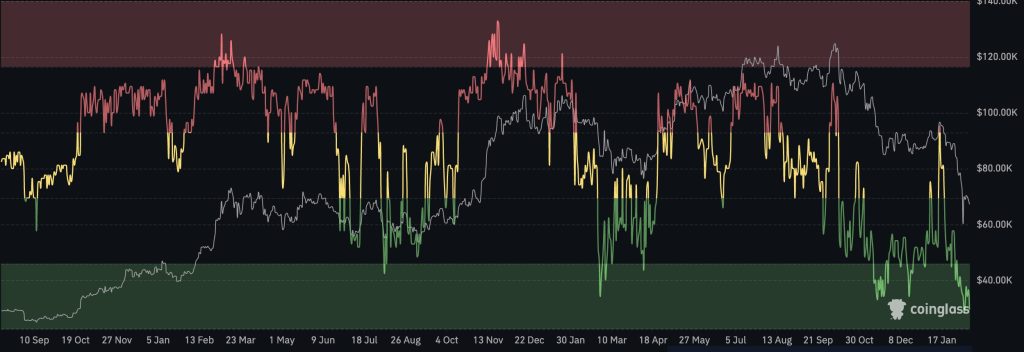
Retail traders are dumping Bitcoin in panic mode right now. Fear is everywhere. The Fear and Greed Index is stuck at 12. That is extreme.
However, perpetual futures volume is actually spiking. That kind of divergence does not show up for no reason.
The market has wiped out nearly $800 billion in a month. Brutal. But the real question is this. Is smart money quietly positioning before the next major move.
Because when fear is loud and volume rises at the same time, something is about to break.
Key Takeaways
- JPMorgan maintains a bullish 2026 outlook despite the total market cap falling from $3.1T to $2.3T.
- The Crypto Fear & Greed Index is pinned at 12 (“Extreme Fear”), levels historically associated with bottom formation.
- Bitcoin is trading at $67,610, significantly below its estimated production cost of $77,000.
- Whale activity in perpetual markets suggests complex institutional hedging is dominant over spot selling.
Is This Institutional Hedging or Strategic Accumulation?
So let’s pause for a second.
Who is buying when the market feels this terrified? Bitcoin price is around $67,610 and Ether near $1,950, both down heavily this month.
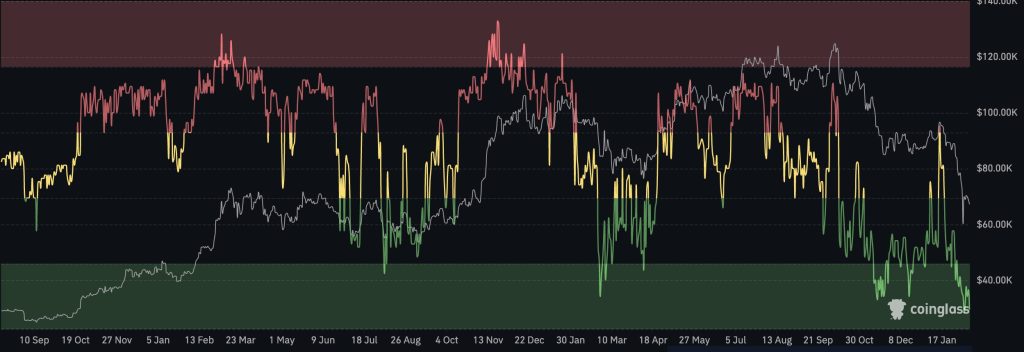
Spot charts look rough and retail is clearly panicking. Yet, Perpetual futures volume is climbing fast, which usually signals sophisticated players stepping in with structured positions, not emotional longs.
This isn’t what speculative euphoria looks like. When retail piles in, funding spikes positive. Instead, BTC funding is nearly flat and ETH funding is negative.
There are only two real explanations here: institutional hedging… or strategic positioning ahead of a larger move.
Will Bitcoin Price $50K Floor Hold?
The charts look terrible right now, no doubt about it. However, fundamentals wise it might leaning bullish good long term.
JPMorgan estimates Bitcoin’s production cost sits around $77,000. BTC is trading well below that.
Historically, when price drops under production cost, it does not stay there long. Miners either shut off machines or pressure builds for a rebound.
Still, the downside risk is not gone. Chief equity strategist John Blank warned Bitcoin could slide to $40,000 within 6 to 8 months.
That would be a full blown capitulation scenario. All Traders are now locked on $60,000 as the key support to watchout for.
The post The Market Is Terrified, Institutions Aren’t. Analyzing the ‘Extreme Fear’ Floor appeared first on Cryptonews.


TLDR
- Bitcoin experienced one of its largest capitulation events in history with $3.2 billion in realized losses on February 5, 2026.
- The massive sell-off led to significant losses for Bitcoin and Ethereum investors, marking one of the worst days in crypto history.
- Ethereum mirrored Bitcoin’s downturn, suffering a sharp price drop as the broader market faced extreme selling pressure.
- On-chain data showed that the market realized an average of $2.3 billion in daily losses over the past week.
- Experts warn that more pain could lie ahead for the crypto market, with predictions of further price declines for both Bitcoin and Ethereum.
The cryptocurrency market experienced one of its most intense capitulation events in history on February 5, 2026. Data from CryptoQuant revealed that investors faced a staggering $3.2 billion in realized losses in just 24 hours. This massive sell-off is among the largest recorded losses, placing the event in the top 3-5 worst loss events ever documented in crypto history.
Bitcoin Suffered a Major Blow
The February 2026 market crash was especially harsh on Bitcoin. According to CryptoQuant, the sell-offs during this period caused Bitcoin investors to lock in a massive loss. The on-chain data shows that Bitcoin holders faced severe financial pain, with billions in unrealized losses turning into realized losses in a single day.
Bitcoin’s price was significantly impacted, dropping to lower levels than many had not expected. The crypto asset saw one of its worst days, as the market faced an extreme level of selling pressure. Investors, many of whom had bought during higher price levels, were forced to sell at a loss.
Ethereum’s Struggles Mirror Bitcoin’s Downturn
Ethereum, too, faced a severe loss in the February 2026 sell-off. The second-largest cryptocurrency after Bitcoin suffered as the broader market crashed. Ethereum’s price dropped dramatically, as investors were forced to realize losses amid widespread capitulation in the market. Ethereum’s price moved in tandem with Bitcoin’s decline, showing similar patterns of pain for holders.
Despite Ethereum’s resilience in previous years, it did not escape the effects of this capitulation event. Like Bitcoin, Ethereum holders faced the harsh reality of the market’s volatility. With the pressure mounting, Ethereum’s losses became a symbol of the widespread distress in the market.
Is More Pain Ahead for Crypto?
Despite the harsh nature of the February 2026 crash, experts warn that more challenges could lie ahead for cryptocurrency holders. Standard Chartered issued a cautionary note, suggesting that the market is still at risk of further correction. Analysts predict Bitcoin could fall as low as $50,000, with Ethereum possibly reaching levels as low as $1,400.
The macroeconomic environment, coupled with potential ETF outflows, could continue to contribute to a downward trend. Cryptocurrency investors are bracing themselves for more uncertainty, as the market remains volatile and unpredictable.


Decibel Foundation is moving to embed an on-chain stablecoin into its Aptos-native derivatives ecosystem. The protocol-native token, USDCBL, issued by Bridge, is set to back on-chain perpetual futures trading as Decibel gears up for its February mainnet launch. The dollar-denominated asset is designed to internalize reserve economics, reducing dependence on third-party stablecoin issuers and giving the protocol more control over collateral dynamics. Decibel, incubated by Aptos Labs, plans to debut in February with a fully on-chain perpetual futures venue that relies on a single cross-margin account. The platform’s December testnet reportedly attracted more than 650,000 unique accounts and exceeded 1 million daily trades, figures that have yet to be independently verified.
Key takeaways
- Decibel will launch a protocol-native stablecoin, USDCBL, issued via Bridge’s Open Issuance platform, ahead of its Aptos-based perpetual futures exchange mainnet.
- USDCBL reserves will be backed by a mix of cash and short-term U.S. Treasuries, with yield retained within the protocol to support on-chain economics.
- Onboarding flow converts deposits of USDC into USDCBL, enabling on-chain collateral for perpetual futures and reducing reliance on external stablecoin issuers.
- The project emphasizes that USDCBL is infrastructure for the exchange rather than a standalone retail token, signaling a broader push toward ecosystem-native stablecoins.
- The announcement situates Decibel within a wider trend toward native stablecoins across crypto and traditional finance, with examples like Hyperliquid’s USDH and institutional tokens from JPMorgan and PayPal.
- Bridge’s Open Issuance ties Decibel to a broader stablecoin issuance framework, underscored by Bridge’s acquisition by Stripe in late 2025.
Sentiment: Neutral
Market context: The emergence of ecosystem-native dollar tokens across crypto platforms and traditional finance mirrors a broader move toward internalized collateral and on-chain settlement. The trend includes initiatives such as Hyperliquid’s native stablecoin USDH, JPMorgan’s tokenized deposits with JPM Coin, and PayPal’s PYUSD, all highlighting a shift toward dollars inside networks rather than relying solely on external issuers. The regulatory environment is also evolving, with proposals for stablecoin licensing and oversight under consideration in the United States.
Why it matters
The Decibel initiative marks a meaningful shift in how on-chain derivatives ecosystems anchor liquidity and risk management. By issuing USDCBL through Bridge’s Open Issuance platform, the project creates a fully collateralized stablecoin designed to live entirely within the protocol’s rails. The approach aims to reduce counterparty risk and minimize dependence on third-party stablecoin issuers, potentially lowering external liquidity constraints for the exchange’s perpetual futures venue.
From a tech perspective, a cross-margin architecture on a fully on-chain perpetuals venue can streamline settlement and collateral management. The onboarding flow—deposit USDC and convert to USDCBL— ties user funds to a native collateral pool that is governed by on-chain rules and reserves that are auditable in real time. The reserve model anchors value in a mix of cash and short-term U.S. Treasuries, with yield returned to the protocol rather than shared with external issuers or custodians. That design could improve capital efficiency and enable more aggressive reinvestment into ecosystem development and product enhancements, provided risk controls remain robust.
Market observers note that the broader push toward ecosystem-native stablecoins is not limited to crypto-native platforms. In parallel, traditional financial players are deploying tokenized dollar instruments within their networks to support real-time settlements and liquidity optimization. The PayPal PYUSD program and JPM Coin’s deployment for institutional settlement illustrate how “inside-network” dollars can reshape flow dynamics across both crypto and conventional finance. In the case of PayPal, for example, a 2025 rewards program tied to PYUSD holdings further integrates the stablecoin into consumer and merchant ecosystems, signaling how stablecoins can extend beyond trading into everyday payments and incentives.
Hyperliquid’s USDH example underscores the potential of native stablecoins to serve as platform-wide collateral. USDH is minted on the platform’s HyperEVM layer and is designed to act as collateral across the exchange, aiming to reduce reliance on off-platform issuers. This demonstrates a broader appetite among developers to align stablecoins with the specific risk profiles and liquidity needs of their ecosystems, rather than “one-size-fits-all” stablecoins that depend on external issuers.
As the ecosystem experiments with native stablecoins, the role of issuance infrastructure becomes another critical variable. Bridge’s Open Issuance framework enables projects to create regulated, fully collateralized stablecoins with integrated on- and off-ramps, linking on-chain finance more tightly to real-world assets. Bridge’s acquisition by Stripe in late 2025 highlights how stablecoin tooling is increasingly intertwined with mainstream fintech infrastructure, potentially accelerating adoption and interoperability across networks.
In short, Decibel’s USDCBL blueprint reflects a broader thesis: native stablecoins embedded within a platform’s governance and risk framework can improve liquidity, reduce external dependencies, and enable more sustainable funding for ecosystem development. Whether such models gain traction will depend on risk controls, regulatory clarity, and the ability of on-chain venues to demonstrate durable, auditable reserve management while delivering reliable user experiences.
What to watch next
- February mainnet launch of the Aptos-based perpetual futures exchange and the onboarding flow for USDCBL.
- Details on reserve composition, collateralization ratios, and on-chain governance updates tied to USDCBL and Bridge’s issuance framework.
- Regulatory developments around stablecoin licensing and compliant issuance pathways, including mentions of licensing proposals in the U.S. context.
- User adoption metrics from the testnet and early mainnet phases, including net deposits into USDCBL and cross-margin activity.
Sources & verification
- Decibel Foundation’s announcement about USDCBL and its use as collateral for on-chain perpetual futures.
- Decibel’s X post detailing reserve backing and income retention within the protocol.
- Bridge’s Open Issuance platform and its role in issuing regulated, fully collateralized stablecoins; Bridge’s 2025 Stripe acquisition.
- December testnet performance metrics (650,000+ unique accounts; 1,000,000+ daily trades).
- Comparative examples of ecosystem-native stablecoins, including Hyperliquid’s USDH, JPM Coin, and PayPal’s PYUSD.
Decibel’s on-chain stablecoin aims to underpin Aptos perpetuals
The Decibel Foundation’s plan centers on USDCBL, a protocol-native stablecoin issued by Bridge, designed to operate as collateral for on-chain perpetual futures on Decibel’s upcoming Aptos-based exchange. Depositors will convert USDC (CRYPTO: USDC) into USDCBL (CRYPTO: USDCBL) as part of the onboarding flow, with USDCBL issued via Bridge’s Open Issuance platform. The intention is to create a fully collateralized, internal reserve mechanism that reduces exposure to external stablecoin issuers while maintaining familiar price stability for traders. Bridge, which had been acquired by Stripe in late 2025, serves as the issuance backbone for USDCBL, aiming to deliver a seamless on-ramp and off-ramp experience for users across the ecosystem.
At launch, the exchange will feature a single cross-margin account for on-chain perpetual futures, simplifying risk management for users who hold USDCBL as collateral. The December testnet reportedly attracted hundreds of thousands of users and a high level of trading activity, underscoring pent-up demand for on-chain derivatives experiences on Aptos. However, as with many new testnet figures, independent verification remains pending, so market participants will be watching the February mainnet rollout closely to assess real-world engagement and liquidity.
USDCBL reserves are described as a mix of cash and short-term U.S. Treasuries, with yield generated by those assets retained within the protocol. This approach could reduce the need to rely on trading fees or token incentives as primary revenue streams, freeing capital to be reinvested into ecosystem development and product enhancements. The foundation emphasized that USDCBL is not merely another stablecoin; rather, it is “core exchange infrastructure” intended to support the mechanics of a fully on-chain venue rather than serve as a broad retail token. This framing reflects a design choice that prioritizes platform integrity and reliability over standalone consumer use cases.
In the broader context, Decibel’s move sits alongside a wave of native-stablecoin experiments across both crypto-native projects and traditional financial institutions. Hyperliquid’s USDH, minted on the platform’s HyperEVM, illustrates how a platform-specific token can function across an exchange’s liquidity and collateral framework. The inclusion of widely discussed developments like JPM Coin (institutional tokenization for settlement) and PYUSD (PayPal’s dollar-backed token integrated into its payments network) further demonstrates the industry’s interest in dollars entrenched within networks rather than external issuers alone. Taken together, these examples depict a landscape where stablecoins are increasingly tailored to the governance and risk profiles of individual ecosystems, rather than deployed as generic, market-wide instruments.


The Ethereum co-founder condemned Russia’s invasion of Ukraine while saying the country could benefit from crypto principles like decentralization.
Vitalik Buterin shared in a long post on X on Feb. 12, originally written in Russian, his views on Russia’s war against Ukraine and what Russia’s future could look like under a “decentralized governance” model.
In the first half of the post, published ahead of the fourth anniversary of Russia’s invasion, the Ethereum co-founder called the war “criminal aggression,” not a “complicated situation” where both sides are equally at fault. He then argued that real, lasting security for Ukraine and Europe will not come from a temporary ceasefire alone, but from change inside Russia itself.
In his view, the strongest guarantee of peace would be for Russia to transform into a different kind of system. To do that, he said, the country would need deeper structural reform based on decentralized governance.
Buterin’s post underscores a broader trend of applying crypto ideas, especially decentralization and transparency, to geopolitics. As crypto adoption grows around the world, its core principles are increasingly being discussed as models for both financial and political systems.
“People often speak about ‘decentralized governance’ and ‘radical democracy’ in very abstract and idealistic terms, but far too rarely do they talk about what concrete problem it can actually solve,” Buterin wrote, via translation.
He listed ideas such as quadratic voting, zero-knowledge (ZK) systems and online discussion platforms like pol.is. These tools, he said, can help large groups find common ground instead of leaving decisions to a small, centralized elite.
“In the crypto industry, some people like to say that we need to move from ‘don’t be evil’ to ‘can’t be evil’. In human society, achieving this goal 100% is completely unrealistic, but achieving 25%? That would already be a very good result,” Buterin wrote in Russian.
He added that this point matters for two reasons: First, when building any new system, people must be clear about the real goal. Second, both ordinary Russians and members of the political elite who would need to “cooperate in order for there to be any success” must understand why these ideas are worth supporting.
In the final part of his essay, Buterin focused on decentralized governance as a process, highlighting digital tools and AI-driven discussion platforms. He argued that the Russian opposition needs new ideas and leaders, and that the best way to find them is to involve more people directly.
Instead of relying on a small group, he suggested using online systems like pol.is, where large numbers of citizens can post views and vote on proposals.
“This makes it possible to find societal compromises — or even consensus — directly, without intermediaries (such as elected representatives), so that officials are left only with the task of turning that compromise/consensus into an official document or law,” Buterin wrote.
He emphasized that “this is all long-term,” and that the Russian people need to think deeply about what happens after Putin. “Having a concrete roadmap — a plan that can convince a broad coalition, both ordinary people and politicians, both inside Russia and in other countries — is an important first step,” he concluded.
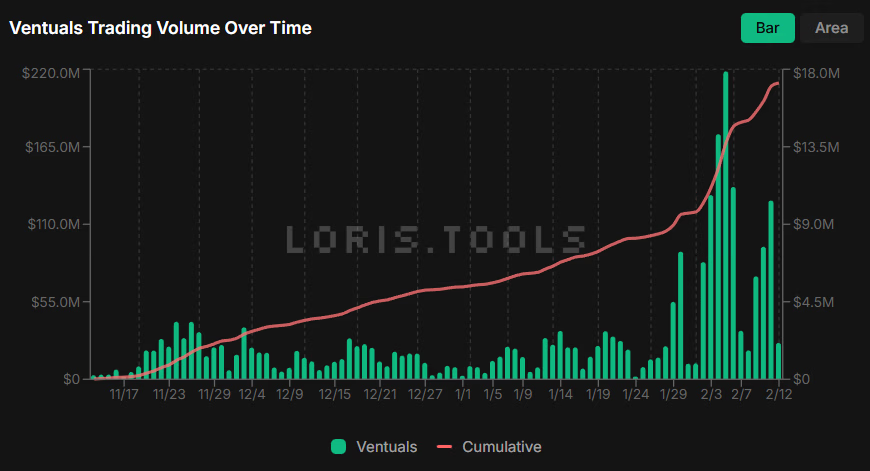
Cumulative trading volume on the tokenized private equity platform reached $200 million about four months after the protocol’s launch.
Ventuals, a protocol that lets users trade tokenized exposure to private and pre-IPO companies, has crossed $200 million in cumulative trading volume less than three months after launch, according to a Feb. 11 X post from the platform’s co-founder, Alvin Hsia.
The milestone was reached just 17 days after cumulative volume first hit $100 million, on Jan. 24, a level that took the platform 73 days to achieve, Hsia noted.

On-chain data from LorisTools, which tracks activity across Hyperliquid’s HIP-3 products, shows cumulative volume on Ventuals has climbed past $215 million by press time. The platform has recorded 5,342 unique traders and generated over $70,000 in fees since going live in October 2025.
Built on the Hyperliquid blockchain, Ventuals allows traders to take synthetic, leveraged positions tied to the valuations of private companies, including firms such as Anthropic and OpenAI.

The most actively traded product so far is MAG7 — a contract tracking the so-called “Magnificent Seven” U.S. tech companies, which includes Amazon, Apple and Microsoft — which has seen over $4 million in trading volume today, Feb. 12, the data shows.
Alongside the surge in activity, Ventuals’ liquid staking token vHYPE, which represents a claim on the underlying HYPE, Hyperliquid’s native token, rose about 20% to $30, according to CoinGecko data.

The Bitcoin price has already crashed by nearly 50% from its all-time high, and a top long-term bull believes there is more downside to come in the near term.
Summary
- Bitcoin price has slumped from the all-time high to $66,000.
- Standard Chartered warned that the coin may drop to $50k.
- Technical analysis suggests that the coin may fall before rebounding.
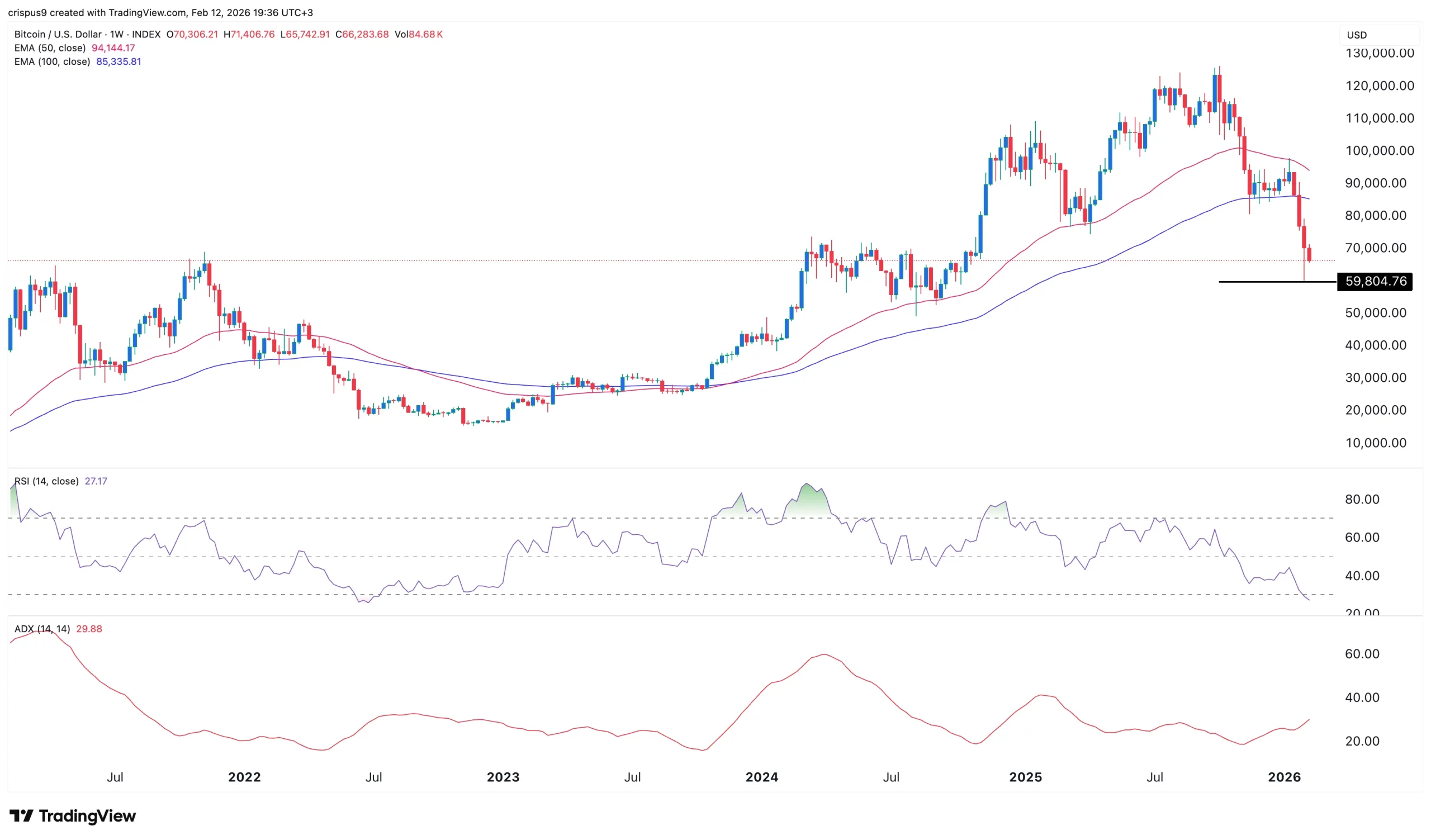
Bitcoin (BTC) retreated to $66,000 on Thursday, a few points above the year-to-date low of $60,000. This decline has persisted as its divergence from American stocks has widened, with leading indices such as the Dow Jones and the Nasdaq 100 hovering near their record highs.
Bitcoin’s price may have further downside in the near term, according to Standard Chartered, which warned that the coin may crash to $50,000.
The bank then lowered its Bitcoin price target for the year to $100,000, down from its previous estimate of $150,000. It was the second major downgrade as the bank had previously set the target price to $300,000.
Geoffrey Kendrick, the bank’s head of digital assets, predicts there will be more capitulation in the coming months. At the same time, he pointed to the ongoing Bitcoin ETF outflows, plunging futures open interest, and lack of a clear narrative.
“I think we are going to see more pain and a final capitulation period for digital asset prices in the next few months. The macro backdrop is unlikely to provide support until we near [Kevin] Warsh taking over at the Fed,” Kendrick told The Block. “On the downside I think this will see BTC to $50,000 or just below, ETH to $1,400.”
SoSoValue data shows that spot Bitcoin ETFs have shed over $282 million in assets this month. They have lost close to $6 billion in the last four months, a sign that investors are capitulating, with some moving their cash to the booming stock market.
Meanwhile, the futures open interest has tumbled to $44 billion from last year’s high of $96 billion. Falling open interest is a sign that investors are reducing their exposure to Bitcoin.
Bitcoin price technical analysis
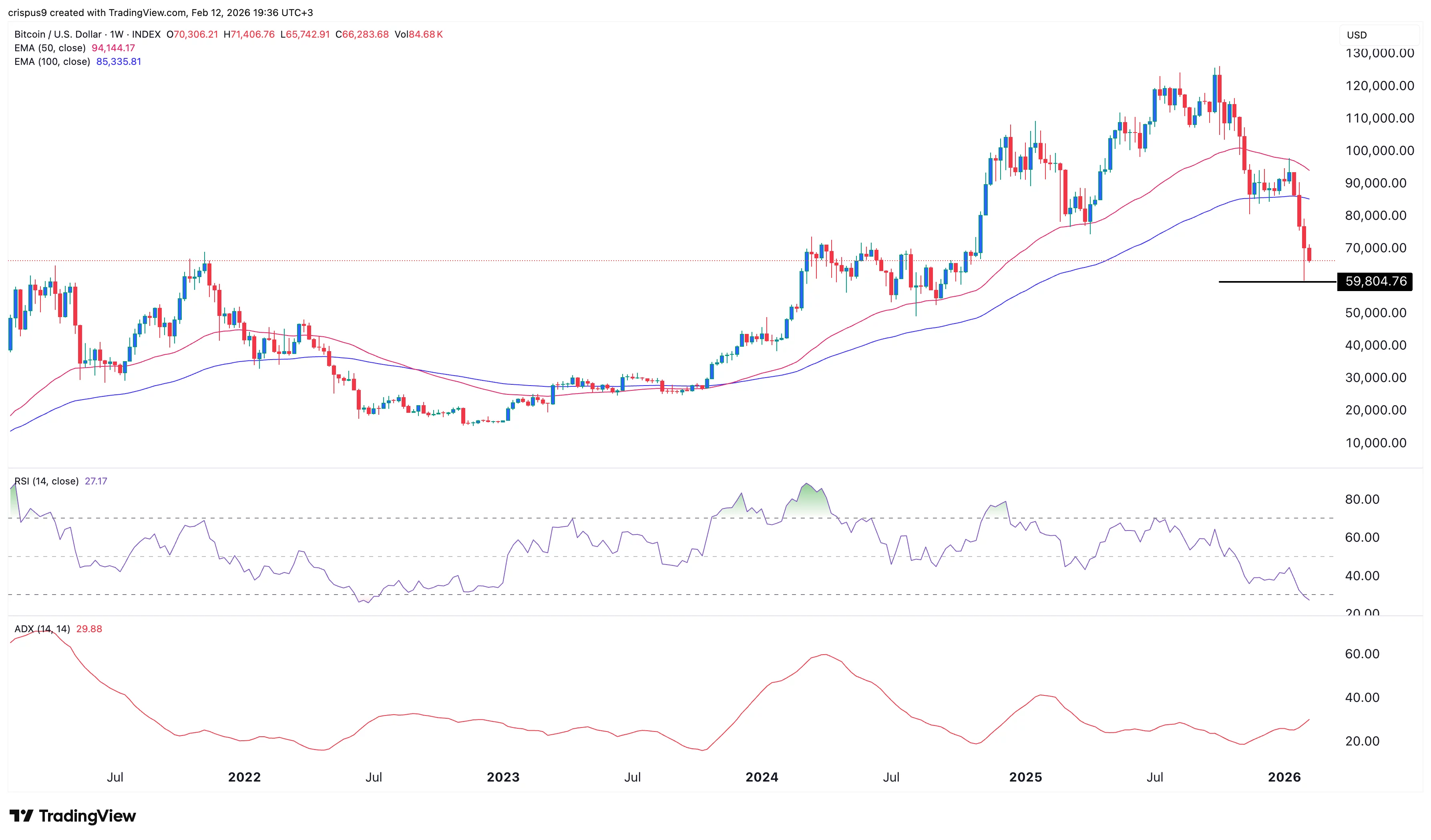
The weekly chart shows that the BTC price has declined over the past few months and is now hovering near its lowest point of the year. It has already dropped below the 50-week and 100-week Exponential Moving Averages. Also, the Average Directional Index has jumped to 30, a sign that the downtrend is strengthening.
Therefore, the most likely outlook is bearish, with the initial target being at $60,000. A drop below that level will signal further downside to $50,000, as Standard Chartered predicts.
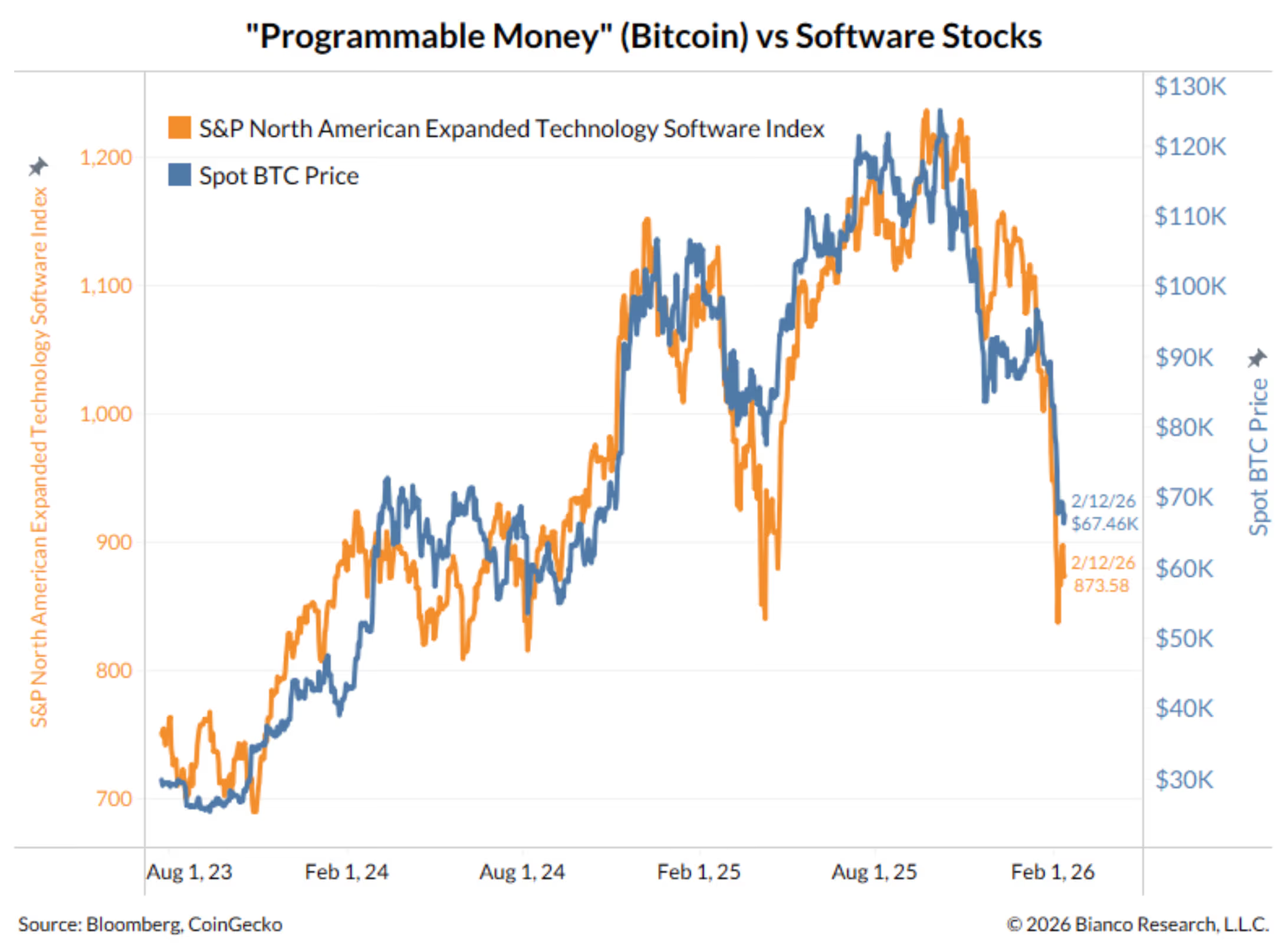
Bitcoin fell back toward last week’s lows, giving up nearly all of its recent gains above $70,000 and resuming its slide alongside weakness in the broader tech sector, as the crypto now trades back around $65,000.
Bitcoin was down 2% over the past 24 hours, with losses in ether and solana roughly tracking.
The decline mirrored broad price action in the Nasdaq, which fell 2% on Wednesday and more particularly in the software sector, where the iShares Expanded Tech-Software Sector ETF (IGV) tumbled 3%. The IGV is now down 21% year to date as investors question the sector’s pricey multiples in a world where the coding abilities of artificial intelligence agents appear to be rising exponentially.
“Software stocks are struggling again today,” wrote macro strategist Jim Bianco. “IGV is essentially back to last week’s panic lows.”
“Don’t forget there’s another type of software, ‘programmable money,’ crypto,” Bianco added. “They are the same thing.”

Precious metals not immune
Cruising along with modest gains through most of the day, gold and silver suffered quick, steep plunges in the mid-afternoon. Late in the session, silver was lower by 10.3% to $75.08 per ounce and gold was down 3.1% to $4,938.


Binance Co-CEO Richard Teng has defended the exchange against claims that it was responsible for the October 10, 2025, “10/10” crypto crash, which saw roughly $19 billion in liquidations.
Speaking at CoinDesk’s Consensus Hong Kong conference on February 12, 2026, Teng argued the sell-off was driven by other factors besides any Binance-specific failures.
Sponsored
Sponsored
Richard Teng Gives Binance’s Side of the Story on October 10 Crash
The Binance co-CEO cited macroeconomic and geopolitical shocks between the US and China. Specifically, he cited:
- Fresh US tariff threats, including potential 100% duties on Chinese imports, and
- China’s imposition of rare-earth export controls.
The combination, he said, flipped global risk sentiment, triggering mass liquidations across all exchanges, centralized and decentralized alike.
“The US equity market plunged $1.5 trillion in value that day,” Teng said. “The US equity market alone saw $150 billion of liquidation. The crypto market is much smaller. It was about $19 billion. And the liquidation on crypto happened across all the exchanges.”
The majority of liquidations (roughly 75%) occurred around 9:00 p.m. ET, coinciding with the release of macro news.
Teng acknowledged minor platform issues during the event, including a stablecoin depegging (USDe) and temporary slowness in asset transfers.
However, he stressed these were unrelated to the broader market collapse. He also emphasized that Binance supported affected users, including by compensating some of them.
Sponsored
Sponsored
“…trading data showed no evidence of a mass withdrawal from the platform,” he added.
Last year, Binance reportedly facilitated $34 trillion in trading volume and served over 300 million users.
It is worth noting that the October 10 crash has been a persistent cause of Binance FUD over the past several months. The exchange has faced criticism from far and wide, with the heaviest attacks coming from rival exchange OKX and its CEO, Star Xu.
Traders Reject Teng’s Macro Shock Explanation Amid $19 Billion 10/10 Liquidation
Despite Teng’s detailed defense, traders on social media have responded swiftly and critically. On X (Twitter), users accused Binance of locking APIs and engineering conditions that forced liquidations, only to deflect responsibility with the “macro shock” explanation.
Sponsored
Sponsored
“Blaming macro shocks is the new ‘it was a glitch.’ $19B liquidated and somehow nobody at Binance is responsible lol,” one user challenged.
Naysayers go further, with some users likening Teng’s claims to colloquial phrases in harsh criticism.
“‘It wasn’t us, it was the macro’ is the crypto exchange version of the dog ate my homework. $19B in liquidations and every platform just points at the guy next to them,” another said.
However, the majority of responses revolved around alleged fake API responses and questioned internal coordination at Binance. The general sentiment is that users feel the exchange is not fully transparent.
The backlash illustrates the ongoing tension between centralized exchanges and leveraged traders during high-volatility events.
While retail demand has cooled compared to previous years, Teng highlighted that institutional and corporate participation in crypto remains strong.
Sponsored
Sponsored
“Institutions are still entering the sector,” he said. “Meaning the smart money is deploying.”
Teng also framed the 10/10 event as part of a broader cyclical pattern in crypto markets. He argued that despite short-term turbulence, the sector’s underlying development continues, with institutional capital driving long-term confidence.
Still, the exchange faces a twofold challenge:
- It must defend its role during unprecedented market stress
- Binance must also restore trust with a skeptical trading community.
While the $19 billion liquidation wiped out positions across the market, the debate over who or what should be held accountable continues to simmer online. This is expected, given the fragility of confidence in high-leverage crypto trading.


Bitcoin’s recent price decline has prompted market analysts to assess whether a price floor is forming, with one prominent on-chain researcher stating the risk-reward profile has shifted following the selloff.
Summary
- “Checkmate” Check suggests Bitcoin has entered “deep value” territory.
- Recent selloff capitulation losses resemble those seen at 2022 cycle lows, indicating a potential market bottom forming with a 60% probability.
- Bitcoin’s price may be forming a bottom, but further declines are possible as market sentiment shifts.
James “Checkmate” Check, a former lead researcher at Glassnode and author of Check On Chain, told What Bitcoin Did host Danny Knowles that Bitcoin entered “deep value” territory across multiple mean-reversion frameworks when it dropped into recent price zones, according to statements made on the podcast. Check noted that capitulation-style losses spiked to levels last seen at the 2022 cycle lows.
Check stated that if Bitcoin is not trending toward zero, the statistical setup appears increasingly asymmetric after the selloff. The analyst said the current environment represents a time for market participants to pay attention rather than lose focus.
The researcher said he was focused on market structure rather than identifying a single forced seller behind the price movement.
Check offered a probabilistic assessment, stating that the odds of a bottom forming have increased significantly. He said the probability that the market has already set a meaningful low stands at more than 50%, likely around 60%, according to his analysis. The analyst assigned low odds to Bitcoin reaching a new all-time high within the year without a major macroeconomic shift or significant market event.
Regarding exchange-traded funds, Check cited billions in outflows during the drawdown, but characterized the situation as positioning unwinds rather than structural failure. He noted that at an earlier peak, approximately 62% of cumulative inflows were underwater, while ETF assets under management declined only in the mid-single digits. Check suggested earlier outflows aligned with CME open interest, consistent with basis-trade adjustments.
The analyst criticized reliance on the four-year halving cycle as a timing tool, calling it an “unnecessary bias.” Check said his approach prioritizes observing investor behavior over calendar-based predictions.
Even if the low has been established, Check said he expects the market to revisit it. He argued that bottoms typically form through multiple “capitulation wicks” followed by extended periods of reduced activity, where sustained uncertainty erodes confidence among late-cycle buyers. Check stated that formulating a bear case at current levels would be premature, framing the current zone as late-stage rather than early-stage in the move, while acknowledging prices could decline further.
The analyst described two failed all-time-high attempts in October followed by a sharp decline that likely resulted in significant losses for market participants. He referenced what he termed a “hodler’s wall” of invested wealth positioned above key levels, including a threshold he called the “bull’s last stand.” Check argued that once price broke below those levels, downside probability increased.
A key reference level cited by Check was the True Market Mean, described as a long-term center-of-gravity price that also overlapped with the ETF cost basis. He said that once that level broke, the psychological regime shifted to an acceptance phase where market participants began to believe a bear market had begun.
Check argued the market was subsequently pulled toward a prior high-volume consolidation zone where a significant portion of this cycle’s trading volume had occurred. He said the selloff likely involved leverage liquidations but framed that as secondary to a broader shift in market sentiment, where participants sell rallies during perceived downtrends.
The most significant bottoming signal emphasized by Check was the scale of realized losses during the recent decline. He said capitulation losses occurred at a very large daily rate, comparable to the 2022 bottom, with sellers concentrated among recent buyers from the late cycle and those who purchased during an earlier consolidation period. Check also noted that SOPR (Spent Output Profit Ratio) printed around minus one standard deviation, a reading that has historically appeared in only two contexts: as an early warning signal and near bottoming phases.
Check reiterated that bottoms form through a process involving multiple capitulation events followed by extended periods of reduced speculative interest, rather than a single definitive price point.
Launchpad buyers are down 30% with a 2-year vesting period ahead of them.
Espresso, a decentralized rollup base layer, launched its native ESP token this morning at a valuation of roughly $275 million following its token airdrop and distribution.
The token debuted at $0.072 before jumping up to $0.083 shortly after its launch and has reported $115 million in trading volume over its first 7 hours across CoinGecko-tracked platforms.
The protocol is designed to support rollups and appchains with everything they need from a base layer to ensure high performance, including finality, data availability, and real-time interoperability.
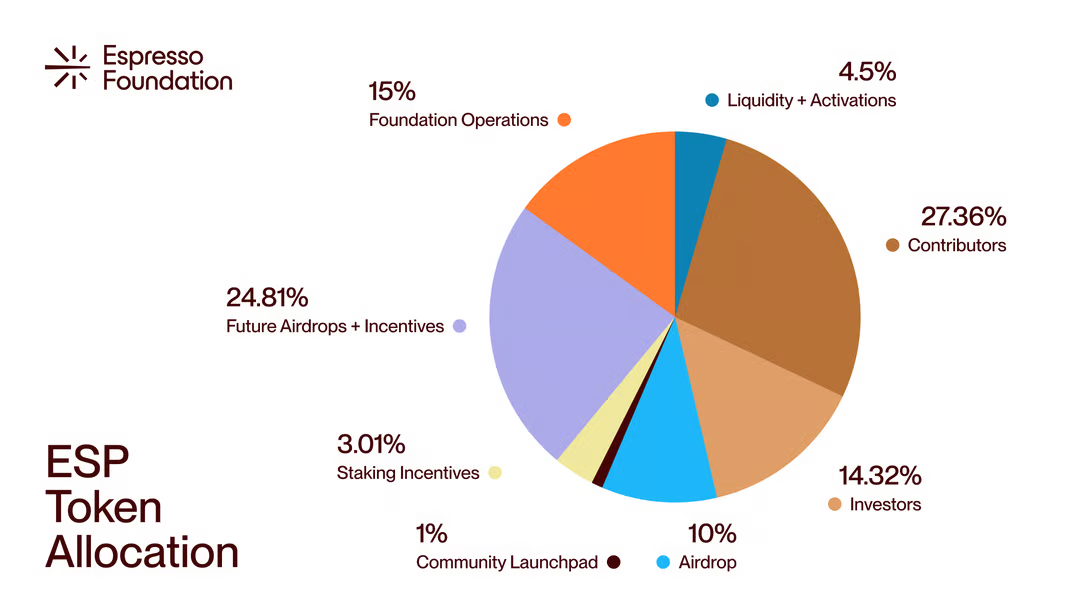
Today’s ESP token launch enables the network to transition to proof-of-stake, and the protocol has distributed 10% of the token supply in an airdrop to more than one million eligible addresses.

There was also a Kaito Launchpad sale in July 2025, which sold 1% of the supply at a $400 million valuation, leaving launchpad investors with a 31% loss at current prices.
The ESP token is the latest in a line of ICOs and token sales that are opening underwater, with Infinex and Aztec being two other recent examples.


Coinbase (COIN) missed fourth-quarter earnings forecasts on Thursday, thanks to weaker trading activity and lower crypto asset prices.
The U.S.-based crypto exchange posted total revenue of $1.78 billion against estimates for $1.83 billion. Adjusted EPS of $0.66 was well lower than the consensus $0.86.
Total transaction revenue of $983 million was below forecasts for $1.02 billion and down from $1.046 billion in the third quarter and $1.556 billion in the fourth quarter one year ago.
Subscription revenue of $727.4 million was down from $746.7 million the previous quarter and up from $641.1 million a year earlier.
Through Feb. 10 of the first quarter, the company saw transaction revenue of about $420 million. It guided to full-quarter subscription revenue of $550-$630 million.
“We continue to be optimistic about the long-term trajectory of the crypto industry,” Coinbase said. “Crypto is cyclical, and experience tells us it’s never as good, or as bad as it seems. While asset prices can be volatile, under the surface an undercurrent of technological change and crypto product adoption continues.”
Shares are modestly higher in after-hours trading, but fell 7.9% during the regular session, extending year-to-date declines to 40%.

Super League: York Knights 19-18 Hull KR – York stun defending champions

US debt to break WWII record by 2030, CBO projects in new budget report
Bitcoin Faces Historic Capitulation Event with $3.2 Billion in Losses

Smart energy pays enters the US market, targeting scalable financial infrastructure

Software stocks enter bear market on AI disruption fear with ServiceNow plunging 10%

Wikipedia volunteers spent years cataloging AI tells. Now there’s a plugin to avoid them.

SHOCKING BlackRock Bitcoin ETF CRASHED! Crypto Bear Market Confirmed ARE WE FXCKED?

All Banking Exam in 2026 | Banking & Financial Awareness | GA Practice Set-93 By Chandan Sir

Miner du Bitcoin sera-t-il toujours rentable ?! #bitcoin #mining
-

 Politics4 days ago
Why Israel is blocking foreign journalists from entering
-
 Sports6 days ago
JD Vance booed as Team USA enters Winter Olympics opening ceremony
-
 Business4 days ago
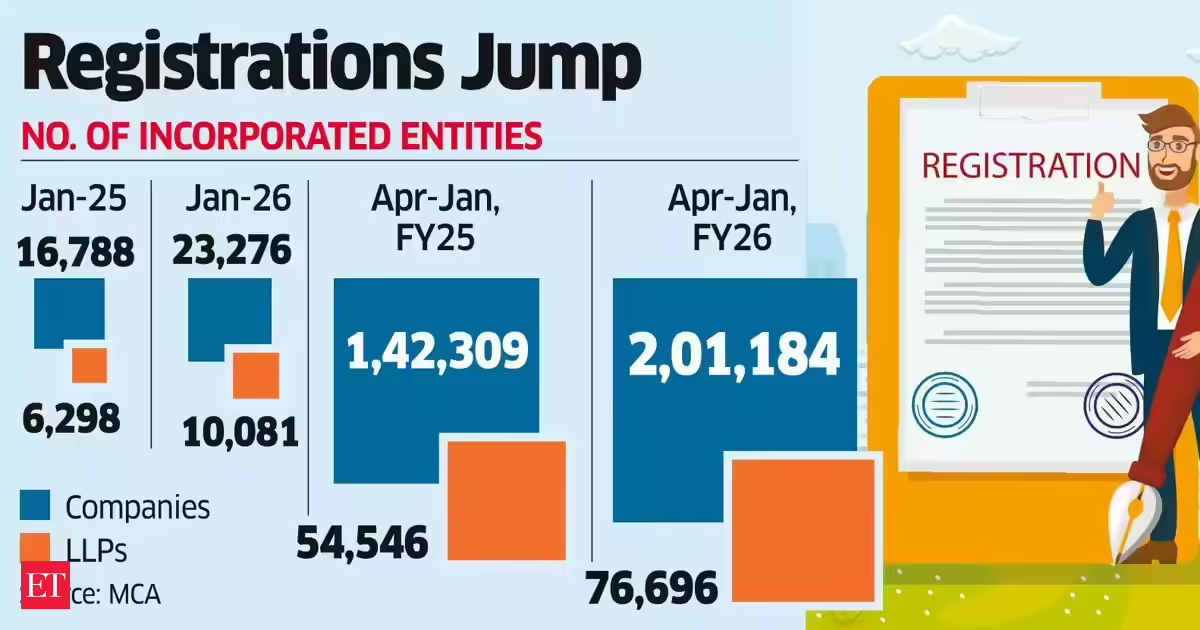
LLP registrations cross 10,000 mark for first time in Jan
-

 NewsBeat3 days ago
Mia Brookes misses out on Winter Olympics medal in snowboard big air
-

 Tech6 days ago
First multi-coronavirus vaccine enters human testing, built on UW Medicine technology
-

 Sports22 hours ago
Big Tech enters cricket ecosystem as ICC partners Google ahead of T20 WC | T20 World Cup 2026
-

 Business4 days ago
Costco introduces fresh batch of new bakery and frozen foods: report
-

 Tech2 days ago
SpaceX’s mighty Starship rocket enters final testing for 12th flight
-

 NewsBeat4 days ago
Winter Olympics 2026: Team GB’s Mia Brookes through to snowboard big air final, and curling pair beat Italy
-

 Sports4 days ago
Benjamin Karl strips clothes celebrating snowboard gold medal at Olympics
-
Sports5 days ago
Former Viking Enters Hall of Fame
-

 Politics4 days ago
The Health Dangers Of Browning Your Food
-
Sports7 days ago
New and Huge Defender Enter Vikings’ Mock Draft Orbit
-

 Business4 days ago
Julius Baer CEO calls for Swiss public register of rogue bankers to protect reputation
-
 NewsBeat6 days ago
Savannah Guthrie’s mother’s blood was found on porch of home, police confirm as search enters sixth day: Live
-
 Crypto World23 hours ago
Pippin (PIPPIN) Enters Crypto’s Top 100 Club After Soaring 30% in a Day: More Room for Growth?
-

 Video19 hours ago
Prepare: We Are Entering Phase 3 Of The Investing Cycle
-

 Crypto World2 days ago
Blockchain.com wins UK registration nearly four years after abandoning FCA process
-
 Crypto World3 days ago
U.S. BTC ETFs register back-to-back inflows for first time in a month
-
 NewsBeat4 days ago
Residents say city high street with ‘boarded up’ shops ‘could be better’