
Crypto World
The New AI-Driven Era of Software Development



In early 2025, the term vibe coding began to circulate widely across the technology community. Coined by AI researcher Andrej Karpathy, it refers to a radically different way of building software. Instead of writing code line by line, the developer simply describes what they want to achieve in natural language, and an artificial intelligence system translates that description into executable code.
This article explores what vibe coding is, how it works, its main advantages and risks, and how it fits within the broader movement of AI-driven software development. It also examines the social and ethical dimensions of this emerging paradigm and what the future might look like if the “vibe” becomes mainstream.
What is Vibe Coding?
Vibe coding is a form of AI-assisted programming in which a developer describes a problem or a desired feature using natural language. A large language model (LLM), such as GPT or Claude, then generates the corresponding source code that implements it. Rather than acting as a mere autocomplete tool, the AI effectively becomes a creative collaborator capable of producing entire systems or applications from conceptual prompts.
The term was first introduced by Andrej Karpathy, former AI director at Tesla and a leading figure in the OpenAI ecosystem. In one of his social media posts, he summarised the concept with the now-famous phrase: “fully give in to the vibes, embrace exponentials, and forget that the code even exists.” He associated vibe coding with a freer, more experimental and iterative form of development. By mid-2025, Merriam-Webster had even listed “vibe coding” as an emerging slang term within technology.
It is important to distinguish vibe coding from traditional AI-assisted programming. Using an AI tool to generate snippets or suggest completions is not quite the same thing. What defines vibe coding is a change in mindset. Instead of controlling every detail of the code, the developer focuses on intention, results, and iterative feedback. Simon Willison, a well-known software engineer, has noted that if you still read and understand every line the AI produces, you are not truly vibe coding — you are simply using a language model as an assistant.
How Vibe Coding Works
Although the idea sounds straightforward, the practice of vibe coding involves a dynamic interplay between human creativity and machine intelligence. It typically begins with a prompt: the developer describes what they want, for example, “create an interactive dashboard using data from environmental sensors.” The AI produces the initial code, and the developer then refines it through follow-up instructions such as “make the colours change with temperature” or “add a live refresh feature.” This loop of experimentation and adjustment lies at the heart of vibe coding.
Developers primarily evaluate code through execution rather than inspection. They run the programme, see whether it behaves as expected, and request corrections when errors arise. Manual debugging still plays a role, but the relationship with code becomes more conversational than mechanical. Over time, trust in the AI fluctuates. Developers learn which tasks can be safely delegated and when to intervene directly. Researchers have described this as a process of “calibrating trust,” in which the human defines how much to rely on the system at each stage of development.
The Benefits of Vibe Coding
One of the greatest strengths of vibe coding is its speed. Ideas can be transformed into functional prototypes in a fraction of the time it would take traditional coding. This speed makes it particularly useful for startups, research teams and creative professionals who need to explore multiple directions quickly.
Another significant benefit is accessibility. People with limited technical training can now create simple applications or automate workflows without learning programming languages in depth. This democratisation of software creation could empower a new generation of makers and entrepreneurs.
By delegating repetitive or boilerplate tasks to the AI, developers can focus on strategic design and high-level logic. The workflow also encourages a sense of creative flow: instead of getting lost in syntax, the human partner can concentrate on goals, functionality and user experience. Many practitioners describe vibe coding as liberating, turning software creation into an expressive process similar to design or storytelling.
Risks and Limitations
Despite its promise, vibe coding carries significant risks. The most obvious one is the loss of understanding. Accepting generated code without reviewing it can lead to serious issues when something goes wrong. Bugs, security vulnerabilities or unexpected behaviours may remain unnoticed until they cause damage. As Andrew Ng has pointed out, vibe coding can sound effortless, but in reality, it remains cognitively demanding and far from trivial.
Quality and maintainability are also major concerns. Code produced by AI models may be inefficient, inconsistent or difficult to update, especially in large-scale projects. Furthermore, compliance and data protection become complex when generated code integrates external libraries or APIs without explicit human oversight. In 2025, a case involving the platform Base44 revealed security flaws in applications created through automated AI workflows, highlighting the importance of robust verification processes.
Culturally, some developers fear that vibe coding could erode traditional craftsmanship in software engineering. The discipline and rigour associated with manual coding is being replaced by superficial experimentation. Others have coined the term “vibe coding hell” to describe an over-reliance on AI, where developers use it for everything, including trivial tasks, eventually losing confidence in their own technical skills.
Vibe Coding and Artificial Intelligence
Vibe coding represents a natural evolution of generative AI. It is not just a new technique but a redefinition of the relationship between humans and machines. Instead of translating ideas into syntax, developers now express intentions through prompts, while the AI interprets and executes them. Researchers have called this shift a “mediation of intent,” where the act of programming becomes probabilistic and collaborative.
In this new model, cognitive work is redistributed. The human becomes a designer of prompts, a tester and a strategist, while the AI handles most of the implementation. Some scholars describe the process as “material disengagement” — the developer orchestrates code indirectly, maintaining creative control without manual manipulation.
Empirical studies show that vibe coders often experience high levels of creative flow and satisfaction when working with AI systems, even though they also face challenges such as latency, debugging uncertainty and fluctuating trust. Early adoption in technology firms like Notion and several AI startups suggests that vibe coding may soon become a standard practice for internal prototyping and innovation.
Responsible Use and Best Practices
To benefit from vibe coding without falling into its traps, developers should adopt specific best practices. Automated testing, static analysis and version control are essential to ensure reliability, even when the code is not fully read. Prompts should be written with transparency and clear objectives to avoid ambiguous or insecure results.
Human oversight must remain a core principle. Developers need to decide when to trust the AI and when to intervene manually, particularly in systems that handle sensitive data or critical operations. Maintaining detailed records of prompts and outputs can improve reproducibility and accountability.
Security audits and compliance checks are equally vital. AI-generated software must respect privacy standards and industry regulations. A hybrid approach, using vibe coding for rapid experimentation and conventional programming for critical components, seems to offer the best balance. Above all, developers should continue strengthening their ability to understand and review code, since comprehension remains the ultimate safeguard against failure.
The Future of Vibe Coding
Vibe coding marks a genuine paradigm shift in how software is created. It is not just about faster coding but about redefining the human role in development, from coder to orchestrator, from writer to conductor of intelligent systems. Academic research increasingly treats it as a socio-technical phenomenon that blends trust, creativity and delegation between humans and machines.
Yet, vibe coding is not a magical solution. Without testing, documentation and ethical oversight, projects built on “vibes” can easily become unreliable or even dangerous. The next few years will likely bring more sophisticated tools, conversational interfaces, and automated audits tailored to AI-generated code. We may also see the emergence of new professional standards focused on safety, transparency and accountability in AI-assisted development.
If used responsibly, vibe coding could democratise software creation, accelerate innovation and make technology more accessible than ever before. But like all powerful tools, it demands critical thinking, human supervision and a commitment to quality. The true promise of vibe coding lies not in abandoning code, but in transforming the act of coding into a more intuitive, creative and collaborative process.



The head of the U.S. Securities and Exchange Commission says prediction markets are drawing serious legal and regulatory attention.
Summary
- U.S. Securities and Exchange Commission Chair Paul Atkins called prediction markets a “huge issue” as the sector faces growing legal and regulatory scrutiny.
- Atkins said some event-based contracts could fall under SEC jurisdiction if they meet the definition of a security.
- The SEC is coordinating with the Commodity Futures Trading Commission as questions mount over oversight, especially for platforms like Polymarket and Kalshi.
At a Senate Banking Committee hearing on February 12, SEC Chair Paul Atkins described rapidly-growing prediction markets as “a huge issue” for federal regulators.
Platforms such as Kalshi and Polymarket have expanded quickly since the 2024 election cycle. These markets let users speculate on outcomes from elections and sports to economic events.
Their growth, now measured in tens of billions of dollars, has pushed them into the spotlight of U.S. regulators.
Who regulates prediction markets?
Atkins said the legal status of prediction markets isn’t always clear. He noted that jurisdiction overlaps between the SEC and the Commodity Futures Trading Commission (CFTC).
“Prediction markets are exactly one thing where there’s overlapping jurisdiction potentially,” Atkins said.
Historically, the CFTC has been seen as the primary federal regulator for these markets. Atkins said the SEC may regulate some markets depending on how they’re structured, especially if contracts resemble securities.
“We have enough authority,” he told lawmakers, adding that a “security is a security regardless how it is and some of the nuance with prediction markets and the products depends on wording.”
SEC officials are reportedly meeting weekly with their counterparts at the CFTC.
CFTC Chair Michael Selig said regulators want a framework that protects market participants without pushing these platforms offshore.
Meanwhile, prediction markets also face state-level litigation, including claims that some offerings are illegal gambling under local laws.
Recent reports have noted insider trading concerns and legislative efforts to limit political event betting.
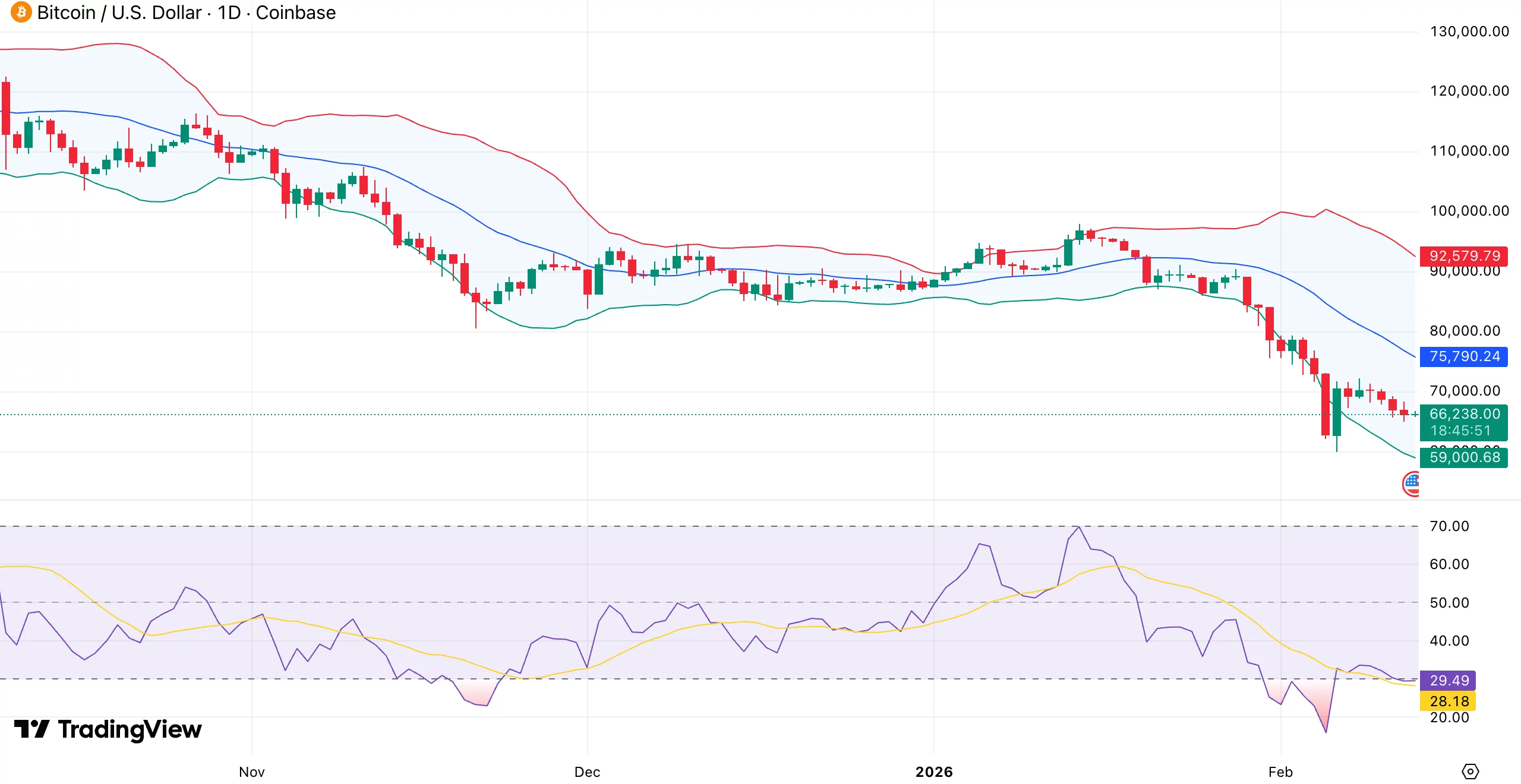
Bitcoin price trades near $68,000 as $2.5 billion in BTC options expire today, placing $74,000 max pain at the center of market focus.
Summary
- Bitcoin has been on a downtrend in February, falling nearly 50% from its all-time high.
- $2.5B in BTC options expire today with a put/call ratio of 0.72 and max pain at $74,000.
- RSI sits near 29 as volume and open interest decline across derivatives markets.
Bitcoin was trading at $68,280 at press time, down 1.1% over the last 24 hours. The asset has moved within a 7-day range of $64,760 to $71,450. Over the past 30 days, BTC is down 30%, and it now sits roughly 50% below its $126,080 all-time high set in October.
Spot activity has cooled. Bitcoin (BTC) logged $47 billion in 24-hour trading volume, a decline of 11% from the previous day. Derivatives markets are also easing.
As per Coinglass data, total futures volume stands at $63 billion, down 18%, while open interest has dipped 1.73% to $44 billion. That combination points to position trimming rather than aggressive new exposure.
$2.5B in options set to expire
According to Deribit data, $2.5 billion worth of Bitcoin options are set to expire at 8:00 a.m. UTC on Feb. 13. The put/call ratio stands at 0.72, indicating more call contracts than puts. The max pain price is $74,000, the level where the largest number of options would expire worthless.
At the same time, $420 million in Ethereum options will also expire, with a put/call ratio of 0.85 and a max pain level of $2,100.
Options expiry refers to the settlement of contracts that give traders the right, but not the obligation, to buy or sell Bitcoin at a specific price before a set date. As expiry approaches, market makers hedge their exposure by buying or selling spot and futures.
This can increase short-term volatility. In many cases, price gravitates toward the max pain level. In others, strong directional momentum overrides expiry-related flows.
With Bitcoin trading nearly $6,000 below $74,000, traders are watching to see whether the price gets pulled higher into settlement or continues lower.
Technical outlook: pressure remains below $74K
The daily structure is clearly bearish. Bitcoin has been printing lower highs and lower lows. It trades below the 50-day moving average near $75,000 and well under the 200-day moving average around $92,500. That alignment keeps momentum tilted to the downside.
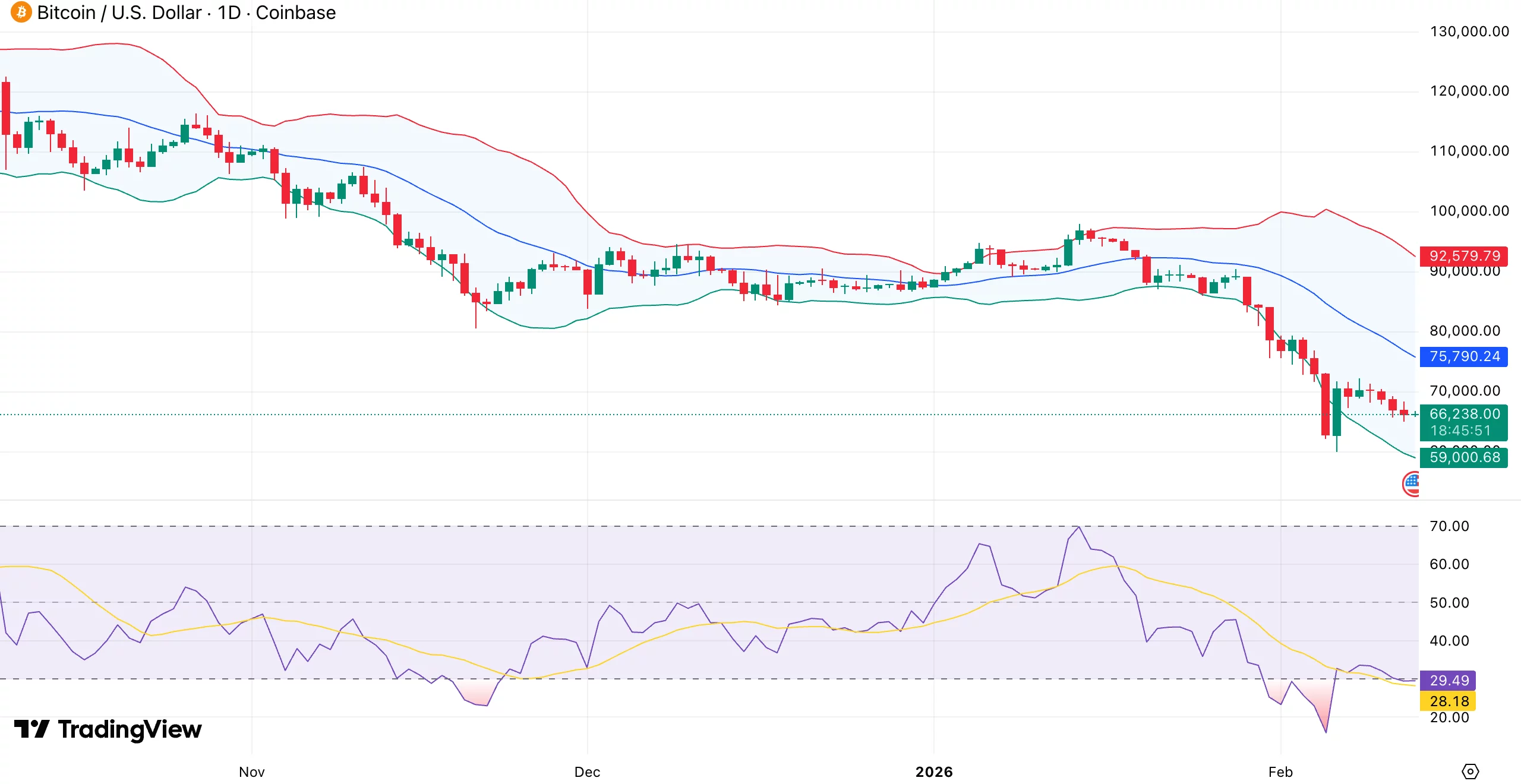
Bollinger Bands are expanding, not compressing. Price recently touched the lower band, which often signals oversold conditions. In strong downtrends, however, assets can stay pinned near the lower band for longer than expected.
The relative strength index is around 29, deep in oversold territory. Yet there is no confirmed bullish divergence. Until RSI forms higher lows while price stabilizes, reversal signals remain limited.
Support sits at $65,000–$66,000, followed by the psychological $60,000 level. On the upside, $74,000–$76,000 is the key reclaim zone. A daily close above that area would ease pressure and open room toward $80,000.
For now, Bitcoin remains technically weak below $74,000. Options expiry may add volatility, but trend reversal requires structure to shift, not just a short-term bounce.
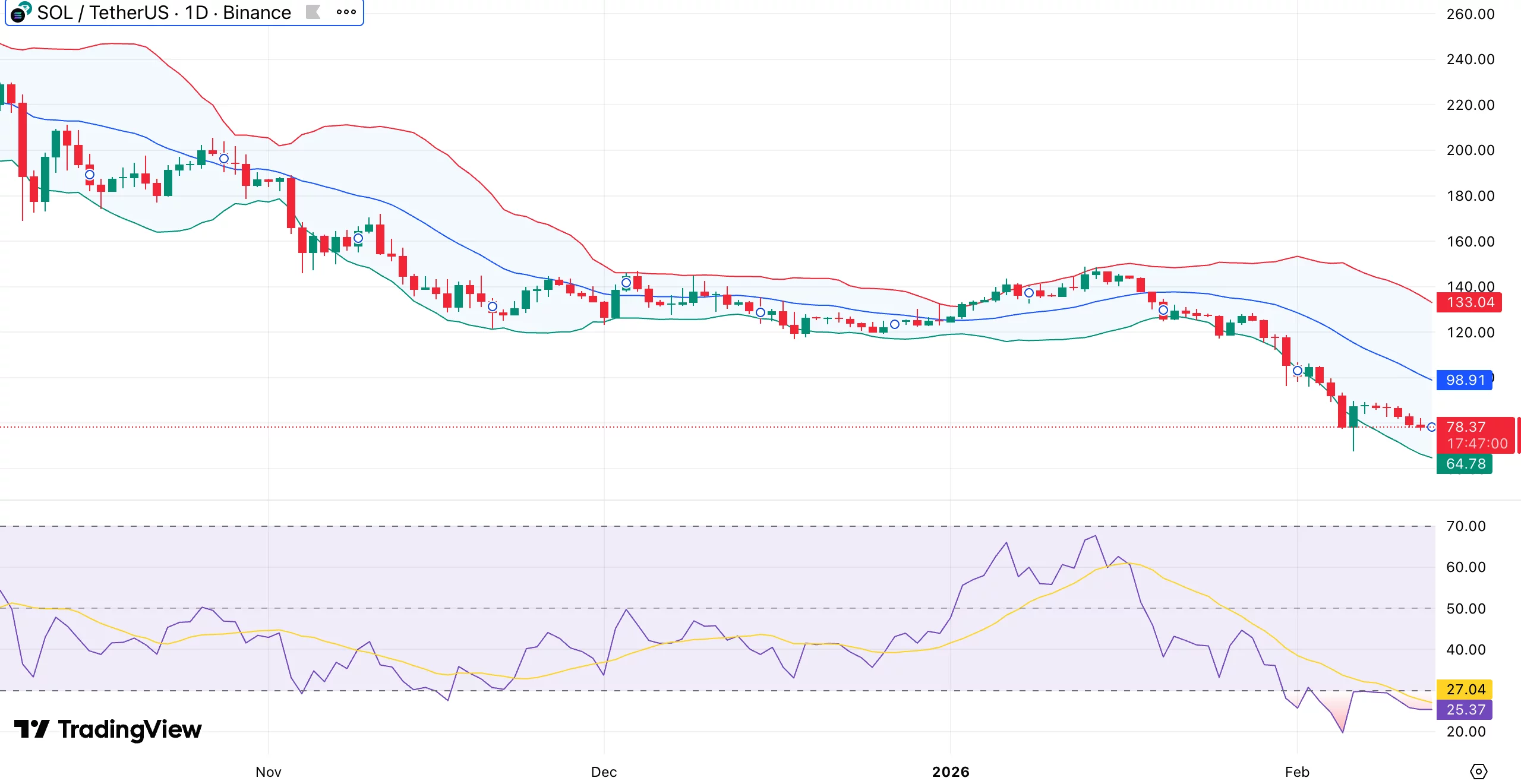
Solana price has slipped beneath a critical support level, with momentum indicators flashing deep oversold conditions as traders re-assess risk.
Summary
- Solana’s breakdown below a key psychological level reinforces its downtrend, with sellers still controlling structure.
- The memecoin-driven surge that fueled the previous rally has cooled.
- RSI has plunged to 25 as price breaks below $80, confirming strong bearish momentum.
Solana was trading at $78.33 at press time, down 2.7% over the past 24 hours. The token has dropped 45% in the last 30 days and is now roughly 73% below its January 2025 all-time high. Over the past week, the price has ranged between $76.81 and $89.28, with sellers maintaining control.
Trading activity has fallen. At $3.83 billion, Solana’s (SOL) 24-hour spot volume was down 15%. On the derivatives side, CoinGlass data shows that open interest dropped 3% to $4.91 billion, while volume dropped 12% to $10.28 billion.
The decline in open interest indicates that traders are closing positions rather than opening new aggressive bets. That kind of unwinding is common during the later stages of a correction. Still, it should not be mistaken for a confirmed bottom.
Why Solana has struggled
Solana’s weakness comes after a sharp pullback from its late 2024 and early 2025 rally. Memecoin activity, including tokens with political themes, attracted a lot of speculative capital to the ecosystem during that run. Leverage accumulated across derivatives markets as liquidity rapidly increased.
When that momentum cooled, the structure weakened. Long positions began to unwind, and stop-losses were triggered in succession.
Selling pressure increased as a result. Solana is a high-beta asset that often amplifies broader market movements. It tends to fall more when sentiment changes, but it can also outperform in high risk-on situations.
In periods of uncertainty, traders often prefer deeper liquidity, and that may favor Bitcoin and Ethereum. Compared to those markets, SOL’s thinner liquidity can amplify volatility during deleveraging.
Declining decentralized exchange volumes have also pressured the token. According to DefiLlama data, Solana’s January DEX volume was $117 billion. That was an improvement over the previous two months, but it was still less than the $155 billion that was recorded in October. Ecosystem-driven demand for SOL has weakened as speculative trading continues fade.
Although long-term projections are largely positive, pointing to the rise in stablecoin usage and micropayments, there haven’t been many short-term catalysts, making the price susceptible to technical pressure.
Solana price technical analysis
The break below $80 is technically significant. The level had acted as psychological support and formed the lower edge of a recent consolidation range. Once it gave way, the broader downtrend that began after the January peak near $150 was reinforced.
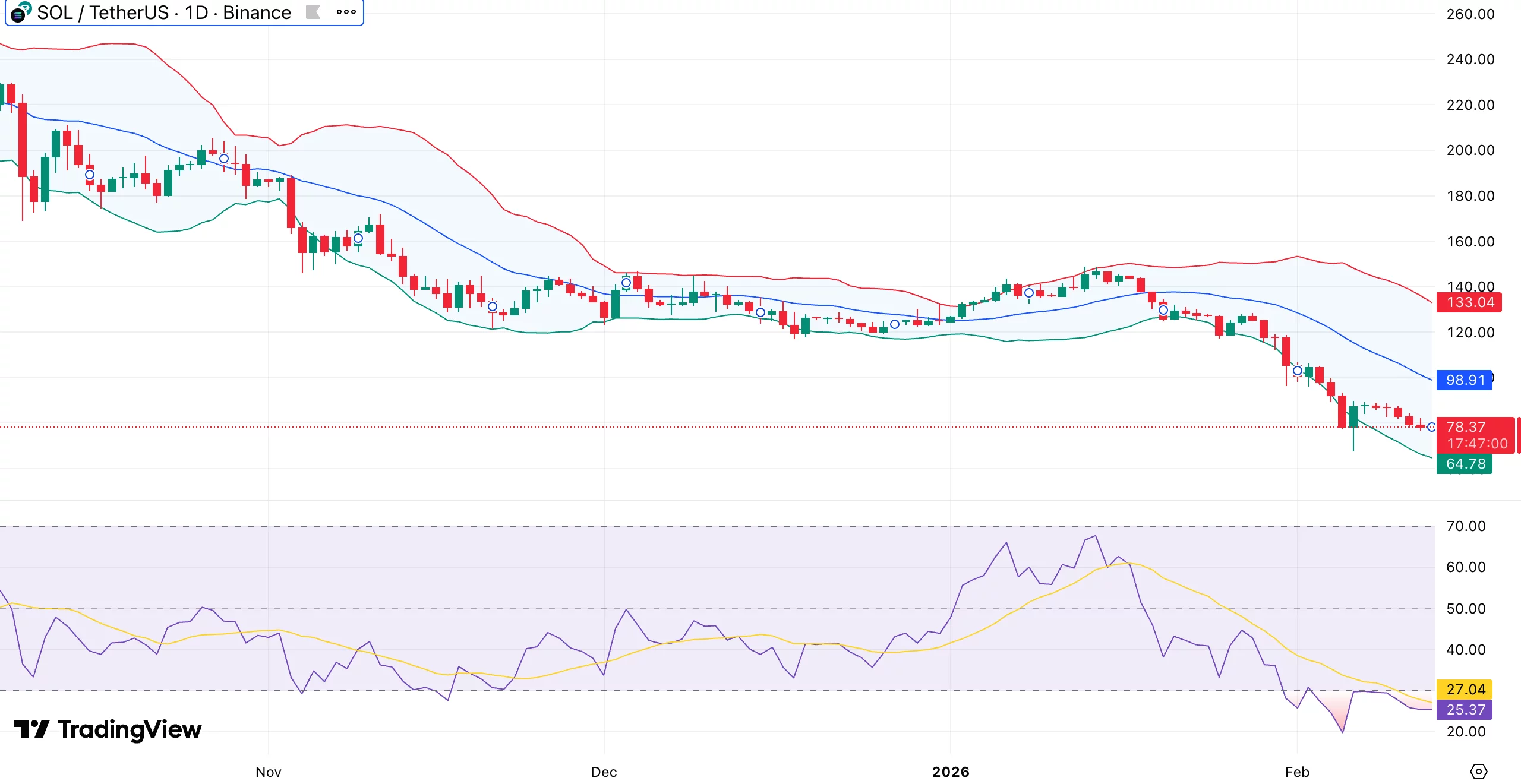
SOL now trades beneath both the 20-day and 50-day moving averages. Price is also positioned below the mid-point of the Bollinger Bands. Meanwhile, the bands themselves are widening, a sign that volatility is expanding.
When price continues to hug the lower band during that expansion phase, it usually reflects trend continuation rather than an immediate reversal.
Momentum indicators align with the weakness. Deep in oversold territory, the relative strength index has dropped to 25. Though no bullish divergence has yet to form, such readings may precede brief relief rallies. RSI remains below its signal average, which suggests sellers still dominate near-term flows.
SOL would need to firmly reclaim $80 with conviction in order for bullish momentum to resume. A sustained move toward $90 would be the next test. Beyond that, the $98–$100 region stands as a major resistance cluster.
On the downside, the $72–$70 area marks the next support zone. If that fails, attention shifts to the $65–$68 range, with stronger psychological support resting near $60.
The current setup reflects a market under pressure. Whether this evolves into capitulation or stabilizes into a base will depend on how the price behaves around the $70 region.


BitGo Holdings, Inc. and 21Shares have expanded their global partnership to support a growing lineup of crypto exchange-traded products (ETPs) and ETFs with enhanced staking and custody services.
Summary
- BitGo Holdings Inc. and 21Shares have expanded their global partnership to strengthen custody and staking support for crypto ETFs and ETPs across the U.S. and Europe.
- BitGo will provide qualified custody, trading, execution and integrated staking services, enabling 21Shares’ products to offer secure asset storage and potential staking yields.
- The move comes amid rising institutional demand for regulated crypto investment vehicles, with 21Shares managing roughly $5.7 billion in assets.
21Shares turns to BitGo for expanded custody
The new agreement covers both the United States and Europe, deepening cooperation between two major players in digital asset infrastructure and investment products.
Under the expanded partnership, BitGo will provide qualified custody, trading, execution and integrated staking services for 21Shares’ U.S.-listed ETFs and international ETP offerings.
These services include secure asset safekeeping, access to deep liquidity across electronic and over-the-counter markets, plus competitive staking rewards, all delivered within BitGo’s regulated and insured custody framework.
21Shares, a leading issuer of crypto investment products managing roughly $5.7 billion in assets, gains from BitGo’s infrastructure as it continues to expand its suite of digital asset offerings. The expanded pact supports both spot crypto products and instruments that enable holders to earn staking yields, a growing demand among institutional and regulated investors.
What this means for the market
The expanded collaboration comes at a time when institutional interest in regulated crypto products is rising globally. By pairing BitGo’s custody and staking capabilities with 21Shares’ broad ETP platform, both firms are positioning themselves to attract professional capital seeking secure, compliant exposure to digital assets.
Adam Sporn, Head of Prime Brokerage and Institutional Sales at BitGo, highlighted the importance of the partnership as 21Shares increases its ETF product range worldwide.
Andres Valencia, Head of Investment Management at 21Shares, noted that BitGo’s track record in security, regulatory compliance and governance made it an ideal partner for expanding staking and custody services.
This development builds on recent milestones for BitGo, including regulatory approvals and its NYSE listing, which enhance its ability to serve institutional clients with robust, compliant infrastructure. Meanwhile, 21Shares continues to grow its global ETF and ETP footprint, leveraging trusted partners like BitGo to scale securely.


The Commodity and Futures Trading Commission expanded its Innovation Advisory Committee to a 35-member panel on Thursday with the addition of executives from leading crypto-facing entities like Coinbase and Ripple, among others.
Summary
- The CFTC has finalized a 35-member Innovation Advisory Committee to help modernize regulatory oversight.
- Executives from Coinbase, Ripple, Uniswap, and other crypto firms make up the majority of the panel.
- Chairman Michael Selig said the group will support the agency’s goal to “future-proof” U.S. financial markets.
An updated list with 23 new appointments, layered over the original 12 charter members that were designated at launch in late 2025, was published by the commission on Feb. 12.
The committee was formed to help guide the derivatives regulator so it can “future-proof its markets and develop clear rules of the road for the Golden Age of American Financial Markets,” Chairman Michael S. Selig explained.
The origins of the committee can be traced back to late 2025 under then‑Acting Chair Caroline Pham, who established the CEO Innovation Council to address the challenges of 24/7 trading, tokenized collateral, and prediction markets, goals that will remain on the agenda of the expanded Innovation Advisory Committee.
After Selig’s appointment as the permanent CFTC Chairman, he restructured and rebranded the council as the Innovation Advisory Committee, to officially replace the long-standing Technology Advisory Committee, and nominated the 12 original participants, such as Tyler Winklevoss from Gemini and Shayne Coplan from Polymarket, as charter members.
The majority of the 35-member committee now hails from digital asset firms. Notably, 20 members are directly involved with the crypto space.
Some of the new additions to the list include Crypto.com CEO Kris Marszalek, a16z crypto Managing Partner Chris Dixon, Ripple CEO Brad Garlinghouse, and Blockchain.com CEO Peter Smith, among others.
Meanwhile, executives at Grayscale, Anchorage Digital, Solana Labs, Paradigm, Kraken, Bullish, Chainlink Labs, Bitnomial, Etherealize, and Framework Ventures were also named to the committee.
At least five members are tied to prediction markets, including Kalshi CEO Tarek Mansour and DraftKings CEO Jason Robins.
Other members include executives at major financial institutions such as Nasdaq, CME Group, Cboe Global Markets, Intercontinental Exchange, and the Depository Trust and Clearing Corporation.
“By bringing together participants from every corner of the marketplace, the IAC will be a major asset for the Commission as we work to modernize our rules and regulations for the innovations of today and tomorrow,” Selig said.

Bitcoin investors are rethinking the asset’s role as inflation cools, according to Bitcoin entrepreneur Anthony Pompliano. He told Fox Business that a softer inflation backdrop raises questions about Bitcoin’s value proposition as a finite-supply asset, especially if central banks continue to pursue accommodative policies. With January’s Consumer Price Index (CPI) cooling to 2.4% from 2.7%, the macro narrative is shifting and traders are weighing how long the inflation narrative can sustain crypto’s narrative as a hedge. The current price action mirrors a cautious mood within the market, as Bitcoin has retreated over the past month while sentiment remains subdued.
Key takeaways
- January CPI came in at 2.4% year over year, down from 2.7% in December, signaling a softer inflation backdrop.
- Bitcoin’s sentiment measure has slipped to multi-year lows, with the Crypto Fear & Greed Index signaling “Extreme Fear” at a recent reading.
- The flagship cryptocurrency is trading around the mid-to-upper $60 thousands, after a roughly 28% decline in the last 30 days.
- The U.S. dollar’s strength has cooled, with the dollar index down about 2.3% over the past month, reflecting shifting macro dynamics.
- Pompliano outlined a “monetary slingshot” thesis: as the dollar devalues and deflationary pressures surface in the near term, Bitcoin could gain longer-term value even if near-term volatility persists.
Tickers mentioned: $BTC
Sentiment: Bearish
Price impact: Negative. Bitcoin’s price has fallen roughly 28% over the past month as macro concerns and sentiment weigh on risk assets.
Market context: In a broader macro context, inflation data and policy expectations continue to shape appetite for risk assets, including crypto. Traders are watching how central banks respond to evolving growth signals, while crypto-specific catalysts compete with traditional macro forces in steering flows and volatility.
Why it matters
The debate over Bitcoin’s role as a hedge against inflation has long hinged on the premise that a fixed supply will preserve value when fiat currencies are debased. Pompliano’s comments underscore the tension between theory and market reality: even as inflation data cools, the path of monetary policy remains uncertain, and investors are wary of premature conclusions about a lasting inflation retreat. In the near term, softer inflation can sap risk premium, potentially slowing the upside impulse for non-fiat stores of value like Bitcoin. Yet the longer-term case for supply-limited assets persists in the eyes of many bulls, particularly if policy makers persist with higher money growth or if inflation surprises to the upside later in the cycle.
The price action around Bitcoin during this period is a reminder that macro-driven volatility remains a defining feature of markets. The asset’s correlation with broader risk sentiment has intensified at times, even as proponents argue that the fixed supply and ever-closer approach to a 21 million cap provide a unique resilience during downturns. The current price backdrop—around $68,850 at publication and a 28% decline over 30 days—illustrates the tug-of-war between inflation awareness and liquidity conditions in crypto markets. The discussion around how monetary policy interacts with digital assets is likely to stay in focus as investors recalibrate what constitutes a hedge in a low-inflation regime that could be reinforced by policy shifts in the months ahead.
Additionally, the commentary around a potential “monetary slingshot” frames Bitcoin as part of a broader debate about how currency debasement and macro policy interact with a new generation of investors. If the dollar softens further in response to renewed expectations for money supply expansion or rate adjustments, Bitcoin could attract fresh inflows as an alternative store of value. That possibility exists alongside the reality that sentiment remains fragile and technicals are unsettled, making immediate directional bets more challenging for casual traders and even some long-term holders.
The impact of macro data on crypto markets is not isolated to Bitcoin. Broader market dynamics—ranging from ETF activity to sentiment gauges—continue to influence the pace and direction of capital into digital assets. Investors are weighing whether the inflation narrative can reassert itself or if structural shifts in the macro environment will redefine how crypto assets behave in risk-off cycles. In parallel, other macro indicators—like the strength or weakness of the U.S. dollar—will help determine whether BTC can sustain any upside or if it remains trapped within a wider risk-off regime.
For readers following the latest data points, the CPI figure and the Fed’s communications are central to the story. While the inflation print itself is a headline, the deeper question is whether the disinflationary trend proves durable or merely a snapshot in a more complex cycle. As Pompliano noted in his remarks, even if inflation cools on the surface, structural changes in policy and global liquidity conditions could continue to shape the narrative around Bitcoin’s long-term value proposition.
In parallel, the market’s mood as reflected by the Crypto Fear & Greed Index and the price movement of Bitcoin underscore a broader caution. The index’s “Extreme Fear” reading suggests that participants are reluctant to push risk assets higher, even when macro data offers a glimmer of relief. Traders will be watching next month’s inflation data, policy statements, and the evolving set of on-chain metrics to gauge whether the current sell-off represents a temporary pause or the onset of a new leg lower.
https://platform.twitter.com/widgets.js


According to local reports, Russia’s central bank is re-examining its long-standing opposition to stablecoins. First Deputy Chairman Vladimir Chistyukhin said the Bank of Russia will conduct a study this year on the feasibility of creating a Russian stablecoin.
Previously, Russia had consistently opposed plans for a centralized stablecoin. However, Chistyukhin said foreign practice now warrants a renewed assessment of risks and prospects.
Sponsored
Sponsored
Moscow Reopens the Stablecoin Debate
The shift signals a strategic rethink rather than an immediate policy change. Still, the timing is notable.
Over the past year, the United States passed the GENIUS Act, establishing a federal framework for payment stablecoins.
The law formalized 1:1 dollar backing and reserve transparency requirements.
As a result, US-backed stablecoins have gained institutional legitimacy and expanded their footprint in cross-border payments and digital asset settlement.
At the same time, the European Union has accelerated work on a digital euro and MiCA-compliant euro stablecoins led by major banks.
Sponsored
Sponsored
European policymakers have framed these efforts as necessary to preserve monetary sovereignty and reduce dependence on foreign digital currencies.
Against that backdrop, Russia risks falling behind in the race to shape digital monetary infrastructure. Stablecoins now function as core liquidity rails in global crypto markets and, increasingly, in trade settlement.
If dollar and euro-backed tokens dominate cross-border flows, Russian entities could face deeper reliance on foreign-regulated instruments.
Sanctions Pressure and the Sovereignty Question
Moreover, sanctions and restrictions on Russia’s access to traditional payment networks add urgency.
A domestically controlled stablecoin could, in theory, provide an alternative settlement mechanism for international partners willing to transact outside Western systems.
Even exploring the concept signals that Moscow recognizes the geopolitical dimension of stablecoin infrastructure.
However, risks remain substantial. A Russian stablecoin would require credible reserves, legal clarity, and trust from counterparties. Without transparency and liquidity, adoption would be limited.
For now, the Bank of Russia is studying the issue, not endorsing it.
Crypto World
Hyperliquid price charts bullish reversal pattern as network earnings spike, rebound coming?
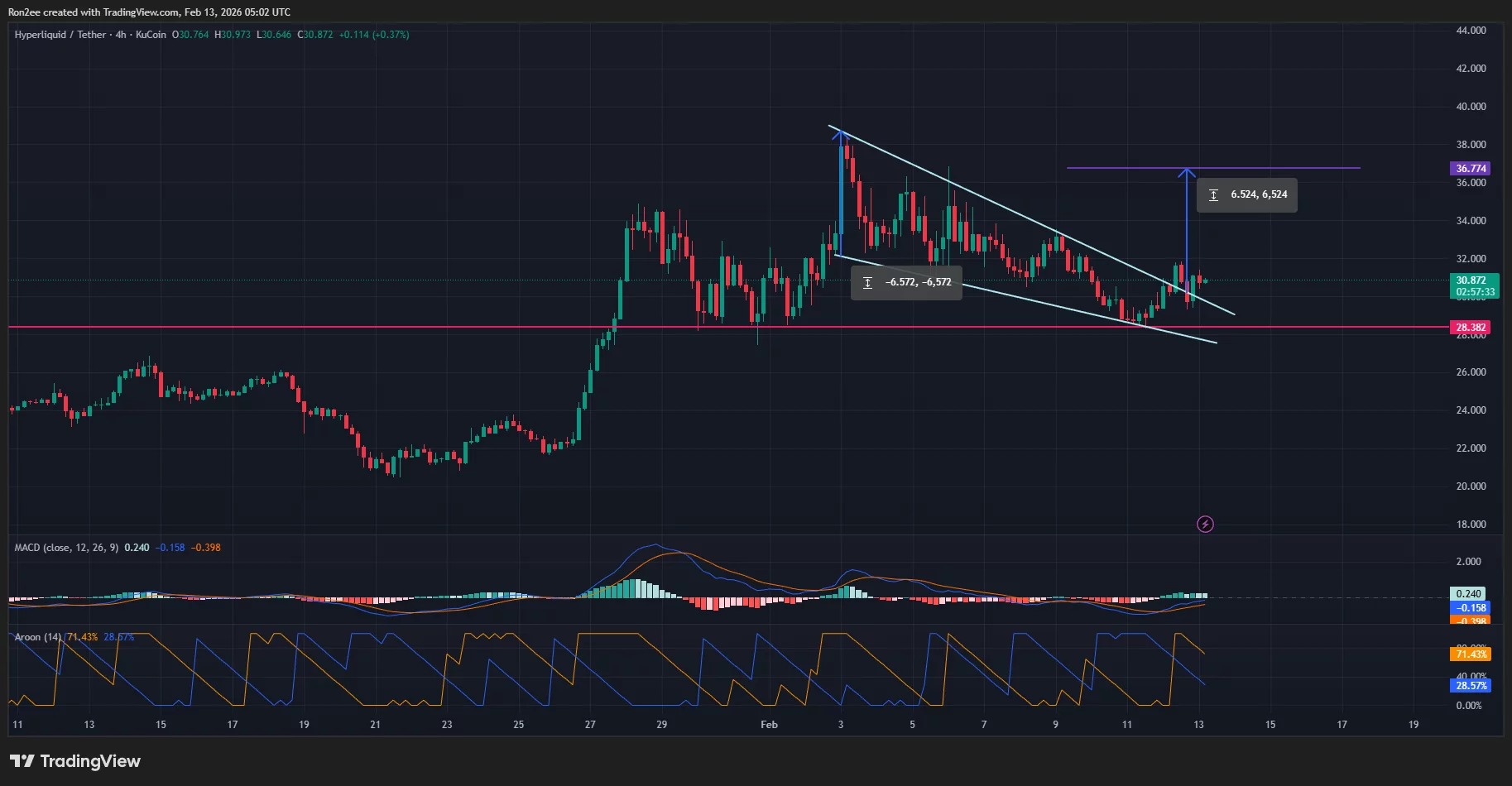
Hyperliquid price action recently confirmed a breakout from a bullish reversal pattern, supported by a notable uptick in network revenue.
Summary
- Hyperliquid price has been in a downtrend for over a week.
- Weekly revenue generated on Hyperliquid has increased nearly 200% since late December.
- A falling wedge pattern confirmed on the 4-hour chart could position the token for further gains.
After rallying to a yearly high of $37.84 on Feb. 3, the Hyperliquid (HYPE) price retraced nearly 18% to $31.06 at the time of writing.
This downtrend coincided with wider weakness across altcoins and majors like Bitcoin (BTC) and Ethereum (ETH), partly driven by a stronger-than-expected U.S. labor market report, which reduced the likelihood of imminent Fed rate cuts. Meanwhile, significant whale selloffs have also hurt its price performance.
Despite the recent price dip, a key network metric suggests that the token could be up for a recovery soon.
Data from DeFiLlama show that the revenue generated by the network over the past week has surged nearly 200% over levels recorded around the end of December. This uptick in revenue follows a spike in commodities futures trading on the platform, especially silver and gold markets.
Increased trading activity directly benefits HYPE holders through its unique buyback and burn mechanism. Notably, the protocol uses 97% of the fees generated by the derivatives trading platform to buy back HYPE from the open market, thereby reducing the available supply, which ultimately helps in supporting the price against volatility. Additionally, if Hyperliquid pairs are used for these trades, the protocol can burn them permanently to further increase scarcity.
There’s also considerable hype around upcoming updates. The Hyperliquid team has teased plans to support outcome trading via the HIP 4 upgrade, a feature that would be useful for the burgeoning prediction markets. A testnet version of HIP 4 is currently live.
On the 4-hour chart, Hyperliquid price has broken out of a falling wedge pattern formed of two descending and converging trendlines. Once confirmed, this pattern has historically been a precursor to staunch rallies.
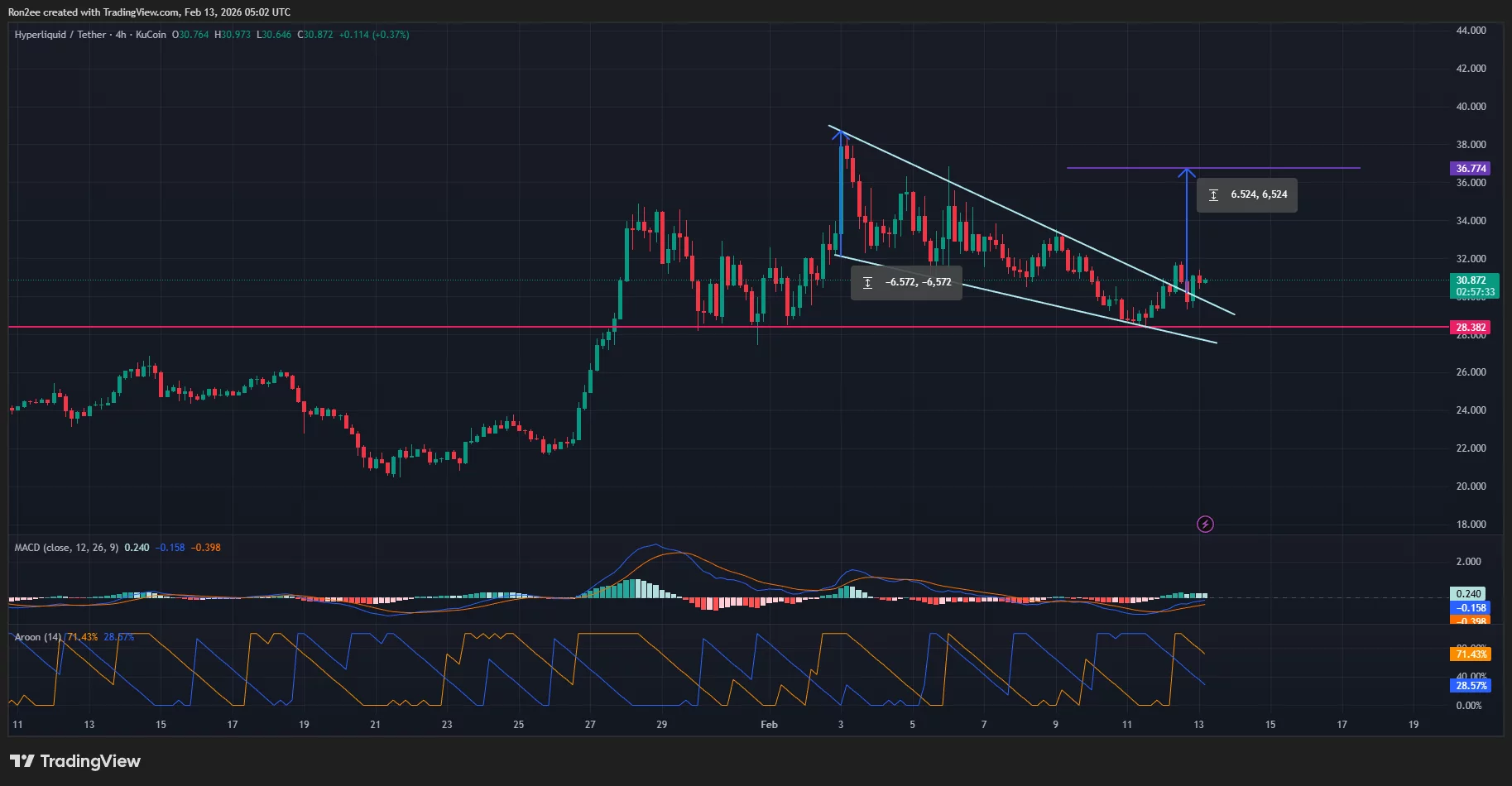
Calculating a target based on this breakout would put HYPE on a path towards $36.70. This is calculated by adding the height of the pattern to the price at which it broke out of the upper trendline. At press time, this level lies roughly 18% above the current market price.
The MACD indicator appeared to favor the bullish prediction, with the MACD lines pointing steadily upward. At the same time, the Aroon Up was at 71.4% while the Aroon Down sat much lower at 28.57%, suggesting that bulls are still dominating the market direction.
However, it should be noted that broader market sentiment is playing a very important role in gauging market direction at the time, especially as BTC and ETH have been trading sideways this week.
A sudden spike in volatility or a sharp correction in the majors, as seen earlier multiple times this year, could easily invalidate the bullish narrative and likely force the token back into a consolidation phase.
Disclosure: This article does not represent investment advice. The content and materials featured on this page are for educational purposes only.
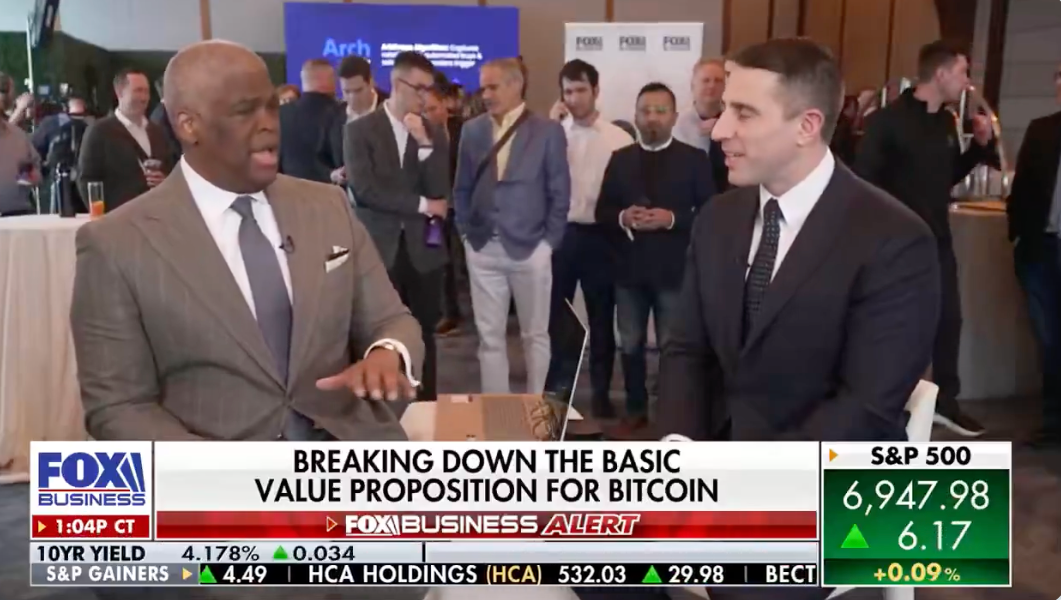
Bitcoin investors are being forced to rethink why they hold the asset as inflation data cools, according to Bitcoin entrepreneur Anthony Pompliano.
“I think the challenge for Bitcoin investors, can you hold an asset when there is not high inflation in your face on a day-to-day basis?” Pompliano said during an interview with Fox Business on Thursday. “Can you still believe in what Bitcoin’s value proposition is, which is that it’s a finite-supply asset. If they print money, Bitcoin is going higher,” he said.
“Bitcoin and gold are great long-term things,” he said. The Consumer Price Index (CPI) fell to 2.4% in January from 2.7% in December, according to the Bureau of Labor Statistics. However, Mark Zandi, Moody’s chief economist, recently told CNBC that inflation “looks better on paper than in reality.”

Bitcoin (BTC) is typically seen as a hedge against inflation because only 21 million coins will ever exist. When central banks increase the money supply and the value of fiat currencies declines, investors often turn to perceived riskier assets, such as Bitcoin, to protect their purchasing power.
Bitcoin sentiment has reached multi-year lows
It comes as sentiment for Bitcoin has reached multi-year lows not seen since June 2022, with the Crypto Fear & Greed Index, which measures overall crypto market sentiment, posting an “Extreme Fear” score of 9 in its Saturday update.

Bitcoin is trading at $68,850 at the time of publication, down 28.62% over the past 30 days, according to CoinMarketCap.
US dollar devaluation will be covered up by “monetary slingshot”
Pompliano said the macro environment could create short-term volatility for Bitcoin before it resumes its upward trajectory.
“We’re going get deflationary-type forces in the short term, people are going to ask to print money and to drop interest rates,” he said.
He explained that this will lead to the devaluation of the US dollar, though the effect won’t be immediately visible.
Related: Bitcoin ETFs bleed $410M as Standard Chartered slashes BTC target
“The currency is going to be devalued at a time where deflation covers up the impact, so I call it a monetary slingshot,” Pompiano said.
Pompliano forecasted that the Federal Reserve will continue to expand the money supply to “deal with inflation,” but as the dollar faces further devaluation, he expects Bitcoin to become “more valuable than ever.”
The US dollar index, which tracks the dollar’s strength against a basket of major currencies, is down 2.32% over the past 30 days and is trading at $96.88, according to TradingView.
Magazine: Bitcoin’s ‘biggest bull catalyst’ would be Saylor’s liquidation: Santiment founder
Crypto World
Can Monero price reclaim January highs as bullish MACD crossover forms after weekly rebound?
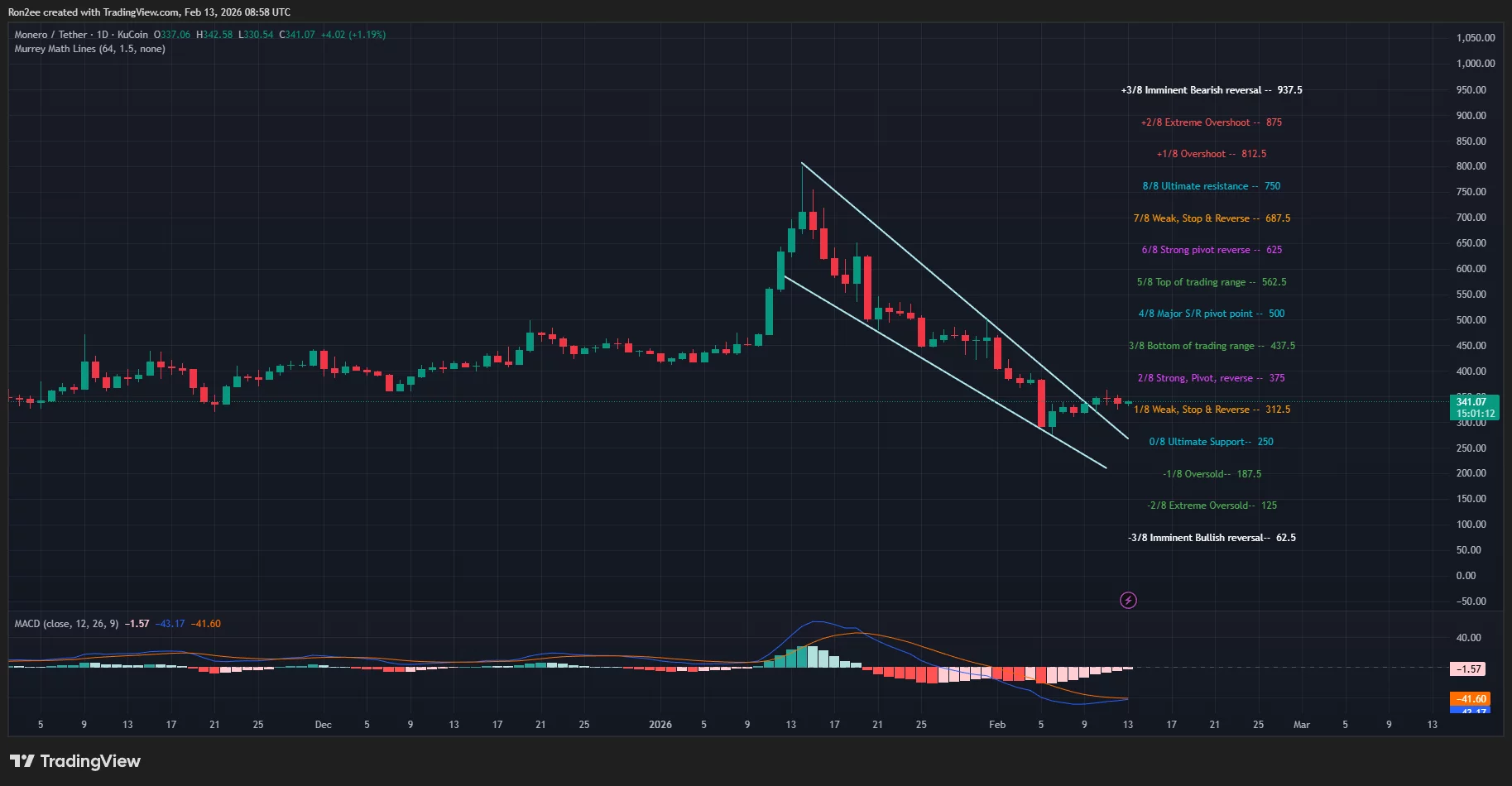
Monero price rebounded nearly 15% over the past week to $350 as investors bought the recent dip to a yearly low. It is close to charting a bullish MACD crossover that could pave the way for more upside in the coming weeks.
Summary
- Monero price is close to confirming a bullish MACD crossover on the daily chart.
- Recent dip buying and demand for privacy tokens have supported XMR price action.
On the daily chart, Monero price is on the brink of confirming a bullish MACD crossover, which occurs when the MACD line crosses over the signal line. Such a crossover typically means that buying pressure has started to outweigh the sellers who had been dominating previously.
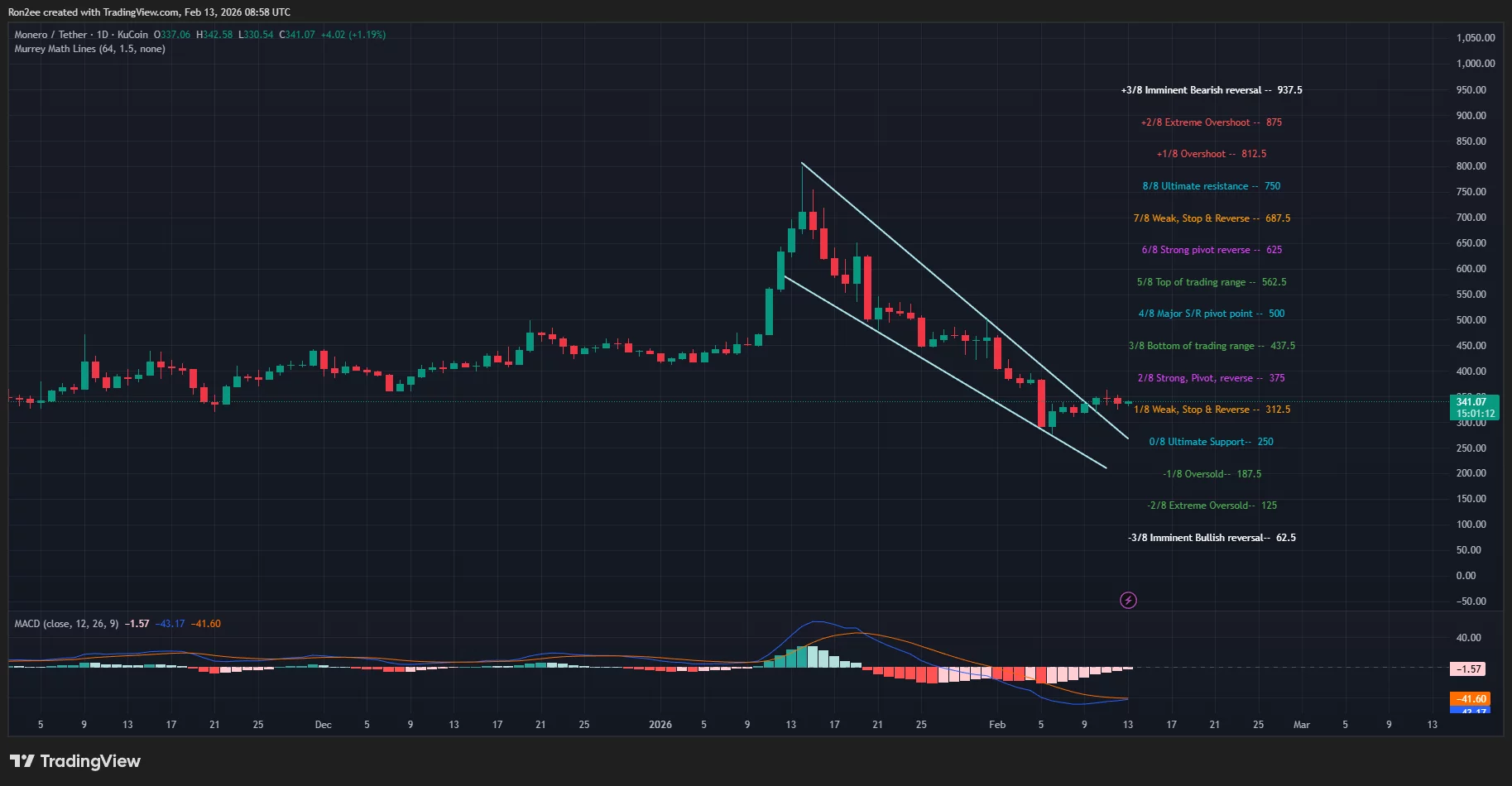
XMR price has also confirmed a breakout from a falling wedge pattern formed when an asset price trades within two converging and descending lines. A falling wedge breakout has historically been one of the most reliable indicators of an impending bullish reversal in trend.
For now, the next key resistance to watch lies at $375, the strong pivot reverse point of the Murray lines. A rally above this could trigger a sharp continuation to as high as $625, where the strong pivot reverse of the upper range lies.
If bulls manage to push past that resistance, the next likely target would be a reclaim of the yearly high at $788.
According to data from crypto.news, Monero (XMR) price rallied to a weekly high of around $350 on Feb. 12, before stabilizing around $334 at press time.
Monero’s rally over the past months has largely been supported by renewed market chatter over privacy as a hedge, fueled by rising global surveillance concerns.
As the European Union prepares to implement stricter bans on anonymous accounts and privacy coins by 2027, and Dubai’s regulators tighten restrictions, users are moving toward XMR.
There’s also demand for the token across illicit marketplaces where bad actors use XMR to circumvent regulatory surveillance. Per a recent report from TRM Labs, nearly 48% of newly launched darknet markets now support XMR exclusively.
Holding a market cap of over $6.1 billion when writing, Monero has navigated a volatile start to the year. After soaring over 75% to a mid-January high of $788.50, the asset suffered a major correction that sent it tumbling to a yearly low of $284 last week.
The crash followed Bitcoin’s drop below the $75,000 psychological support level, an event that spooked the broader market and sparked billions of dollars in liquidations, with privacy coins bearing the brunt of the selloff.
Notably, as of press time, the total market cap of privacy coins was still in pain as it dropped nearly 12% over the past day to $11.4 billion.
However, some of the major players, such as Monero, Zcash (ZEC), and Decred (DCR), have managed to hold gains so far this week as investors capitalized on the recent volatility through dip buying, likely viewing the recent sell-off as a long-term accumulation opportunity.
Disclosure: This article does not represent investment advice. The content and materials featured on this page are for educational purposes only.

Ripple XRP HOLY SNAP!

Dismay as taxpayers might foot the bill for facilities at major new town’s railway station
Pathfinder Bancorp director Gagas buys shares worth $26893


-

 Politics5 days ago
Why Israel is blocking foreign journalists from entering
-
 Business5 days ago
LLP registrations cross 10,000 mark for first time in Jan
-

 NewsBeat4 days ago
Mia Brookes misses out on Winter Olympics medal in snowboard big air
-

 Sports2 days ago
Big Tech enters cricket ecosystem as ICC partners Google ahead of T20 WC | T20 World Cup 2026
-

 Business5 days ago
Costco introduces fresh batch of new bakery and frozen foods: report
-

 Tech3 days ago
SpaceX’s mighty Starship rocket enters final testing for 12th flight
-

 NewsBeat5 days ago
Winter Olympics 2026: Team GB’s Mia Brookes through to snowboard big air final, and curling pair beat Italy
-

 Video17 hours ago
The Final Warning: XRP Is Entering The Chaos Zone
-

 Sports5 days ago
Benjamin Karl strips clothes celebrating snowboard gold medal at Olympics
-
Sports7 days ago
Former Viking Enters Hall of Fame
-

 Politics6 days ago
The Health Dangers Of Browning Your Food
-

 Business6 days ago
Julius Baer CEO calls for Swiss public register of rogue bankers to protect reputation
-
 Crypto World2 days ago
Pippin (PIPPIN) Enters Crypto’s Top 100 Club After Soaring 30% in a Day: More Room for Growth?
-

 Video2 days ago
Prepare: We Are Entering Phase 3 Of The Investing Cycle
-

 Crypto World2 hours ago
Bhutan’s Bitcoin sales enter third straight week with $6.7M BTC offload
-
 Crypto World4 days ago
U.S. BTC ETFs register back-to-back inflows for first time in a month
-

 Crypto World4 days ago
Blockchain.com wins UK registration nearly four years after abandoning FCA process
-
 NewsBeat5 days ago
Residents say city high street with ‘boarded up’ shops ‘could be better’
-
Sports4 days ago
Kirk Cousins Officially Enters the Vikings’ Offseason Puzzle
-
 Crypto World4 days ago
Ethereum Enters Capitulation Zone as MVRV Turns Negative: Bottom Near?