
Crypto World
The New Frontier in Artificial Intelligence and Coding



Artificial intelligence (AI) continues to advance at an incredible pace, revolutionising various industries and transforming the way we work and create. Today, we are witnessing two innovations that are reshaping the AI landscape: Claude 3.5 Sonnet and Claude 3.5 Haiku. Developed by Anthropic, these models redefine efficiency in coding and problem-solving tasks while introducing groundbreaking features, such as enabling AI to interact with computers in a remarkably human-like way.
In this article, we will delve into the exceptional capabilities of these models, their key advancements, comparisons with competitors, and how they can dramatically transform workflows to boost productivity in high-tech environments.
Claude 3.5 Sonnet: Innovation in Coding and Reasoning
The updated version of Claude 3.5 Sonnet is not just an incremental improvement but a qualitative leap in programming and solving complex problems. In specific tasks such as coding, the model demonstrates exceptional performance, achieving a remarkable 93.7% accuracy in coding evaluations like HumanEval. This figure significantly surpasses most models on the market, including renowned competitors like the GPT-4o mini.
The improvement in tool use and coding benchmarks is equally impressive. In evaluations like SWE-bench Verified, Claude 3.5 Sonnet improved from 33.4% in its previous version to 49.0%, making it an ideal tool for developers managing complex processes and performing advanced reasoning tasks.
But it is not just about the numbers. Major tech companies like GitLab have integrated Claude 3.5 Sonnet into their workflows, achieving up to 10% improvements in DevSecOps tasks without sacrificing processing speed. This demonstrates the model’s incredible ability to handle multi-step tasks and seamlessly adapt to demanding environments.
Claude 3.5 Haiku: Speed and Performance at an Affordable Cost
If speed and affordability are your top priorities, Claude 3.5 Haiku is the perfect choice. Designed to deliver an exceptional balance between speed and performance, this model excels in practical tasks requiring quick and accurate responses.
Claude 3.5 Haiku performs impressively in coding tasks, scoring 88.1% in evaluations like HumanEval. Although more compact than Claude 3.5 Sonnet, it excels in specific tasks such as handling large datasets and personalising user experiences. This makes it an ideal choice for businesses looking to maximise efficiency without incurring excessive costs.
Companies like Asana and Canva have already started using Claude 3.5 Haiku to automate repetitive processes, optimise workflows, and generate personalised experiences based on complex data. Early implementations show that even in demanding business environments, Haiku maintains high accuracy and speed without compromising quality.
Claude Learns to Use Computers: A Game-Changing Revolution
One of the most exciting advancements introduced by Claude 3.5 Sonnet is its ability to “use computers” like a human. This means the model can move a cursor, click buttons, type text, and interact with graphical interfaces.
Although this feature is in a beta experimental phase, it is already transforming how businesses tackle complex tasks. For instance, Replit uses this ability to evaluate applications in real-time, while companies like DoorDash and Cognition are exploring how Claude can automate processes that previously required dozens—or even hundreds—of manual steps.
This capability allows the model to perform tasks like filling out forms, navigating web pages, managing spreadsheets, and conducting open-ended research—all through simple instructions translated into computer actions. While this feature still has room for improvement, its potential is undeniable.
Comparisons with Other Models
Claude 3.5 Sonnet and Haiku do not operate in a vacuum—they are designed to compete with other big names in the AI industry. When compared to models like GPT-4o and Gemini 1.5, Claude 3.5 Sonnet shows superior performance in key tasks.
In graduate-level reasoning evaluations, Claude 3.5 Sonnet achieves an impressive 65.0%, outperforming GPT-4o and smaller models like GPT-4o mini. In coding tests, its 93.7% accuracy stands out significantly above its direct competitors.
Meanwhile, Claude 3.5 Haiku offers competitive performance against models in its category, excelling in speed and low latency. This makes it a viable option for tasks where speed is as critical as accuracy.
Practical Applications and Use Cases
Developers and businesses adopting these models will find countless practical applications. Claude 3.5 Sonnet is ideal for complex software development projects, from planning to implementation, while Claude 3.5 Haiku is perfect for data analysis, content creation, and real-time information management.
Additionally, the ability to use computers opens up a new realm of exciting possibilities. Imagine an AI system capable of automating a process in a CRM, conducting online research, or even testing applications under development. This not only saves time but also reduces human error and improves operational efficiency.
A Responsible Approach to Scalability
With significant advancements come great responsibilities, and Anthropic understands this perfectly. To ensure safe use of these new capabilities, the company has developed classifiers that detect potential misuse, such as spam or disinformation. Additionally, rigorous testing has been conducted in collaboration with AI safety institutes in the United States and the United Kingdom, ensuring these models meet high safety standards.
What’s Next for the Future?
Claude 3.5 Sonnet and Haiku represent just the beginning of what promises to be a new era in artificial intelligence. The capabilities they are introducing—from coding advancements to computer usage—are paving the way for more versatile, autonomous, and efficient systems.
As more companies adopt these technologies and provide feedback, we can expect rapid improvements and the emergence of new applications we have not even imagined yet.
Conclusion
Whether you are a developer, entrepreneur, or simply a tech enthusiast, Claude 3.5 Sonnet and Haiku offer innovative tools that can transform the way you work. From more precise coding to the ability to automate complex tasks, these models are redefining what is possible with artificial intelligence.

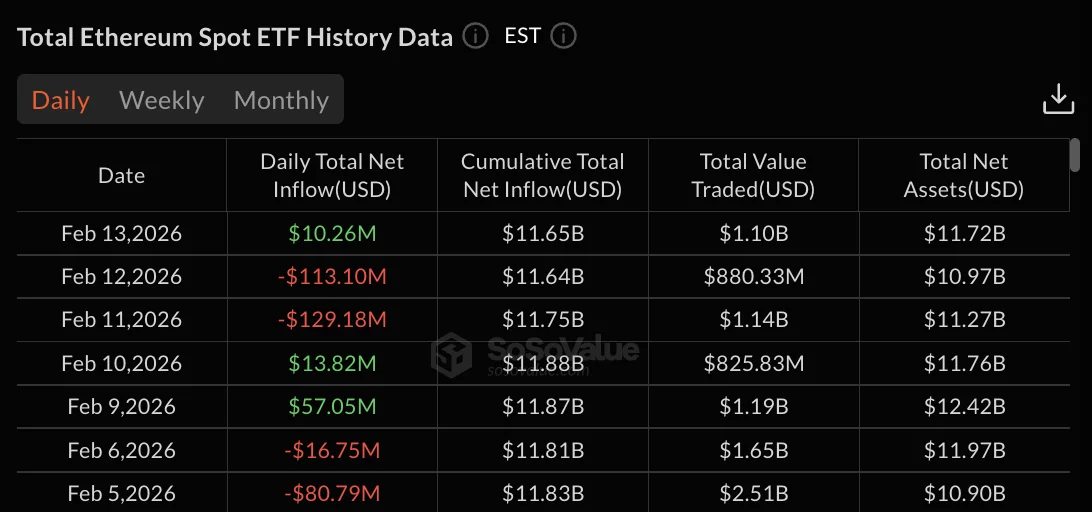
Ethereum spot ETFs recorded $10.26 million in net inflows on February 13, breaking a two-day outflow streak that saw $242.28 million in redemptions.
Summary
- Ethereum ETFs added $10M as ETH price reclaimed $2,000.
- Bitcoin ETFs saw modest $15M inflows after prior outflows.
- Weekly ETH ETF flows remain negative despite rebound.
Grayscale’s mini ETH trust led flows with $14.51 million, followed by VanEck’s ETHV at $3.00 million and Fidelity’s FETH at $2.04 million.
Ethereum (ETH) price gained 5.8% over 24 hours to reclaim the $2,000 level, trading in a range of $1,926.66 to $2,067.44.
The recovery follows sharp declines across longer timeframes: down 1.2% over seven days, 23.7% over 14 days, 37.5% over 30 days, and 24.4% over one year.
Weekly Ethereum outflows persist at $161 million
Ethereum ETFs recorded $161.15 million in weekly net outflows for the period ending February 13 despite the final day’s positive flow.
February 11 posted the week’s largest single-day withdrawal at $129.18 million, followed by February 12’s $113.10 million in redemptions.
February 9-10 briefly interrupted selling with $70.87 million in combined inflows. February 9 saw $57.05 million in positive flows while February 10 added $13.82 million.
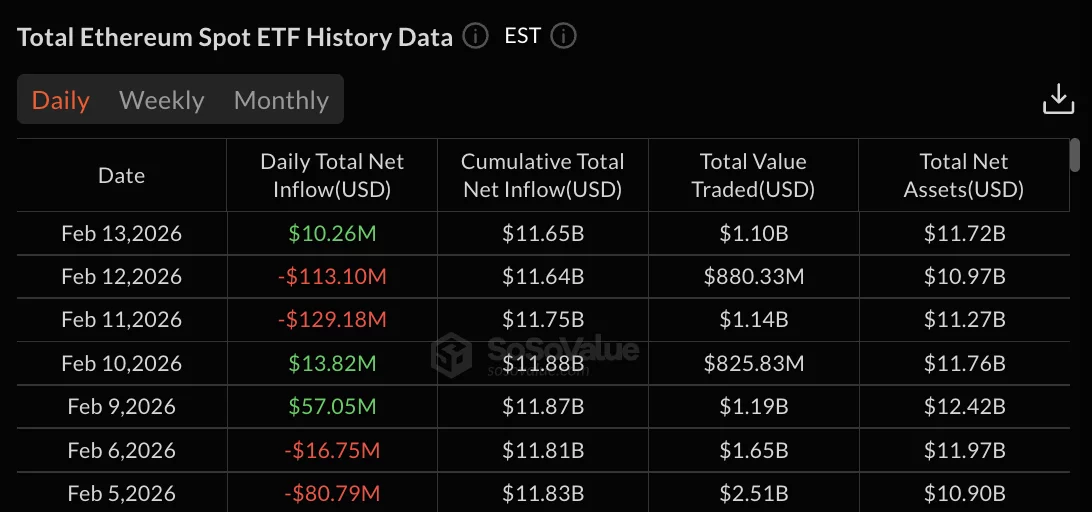
The week ending February 6 posted $165.82 million in outflows, while the week ending January 30 recorded $326.93 million in redemptions.
The week ending January 23 marked the peak with $611.17 million in withdrawals as Ethereum fell from above $3,000 to below $2,000.
Total value traded reached $1.10 billion on February 13, down from $880.33 million the previous day.
Bitcoin posts modest $15 million inflow with mixed fund flows
Bitcoin spot ETFs recorded $15.20 million in net inflows on February 13, led by Fidelity’s FBTC with $11.99 million.
Grayscale’s mini BTC trust added $6.99 million while VanEck’s HODL contributed $1.95 million and WisdomTree’s BTCW posted $3.64 million.
BlackRock’s IBIT recorded $9.36 million in outflows and was its third withdrawal in four trading days.
February 11-12 saw Bitcoin ETFs post $686.67 million in combined outflows before February 13’s reversal.
Ethereum’s 5.8% daily gain allowed it to reclaim the $2,000 level after dipping below $1,930 earlier in the session.
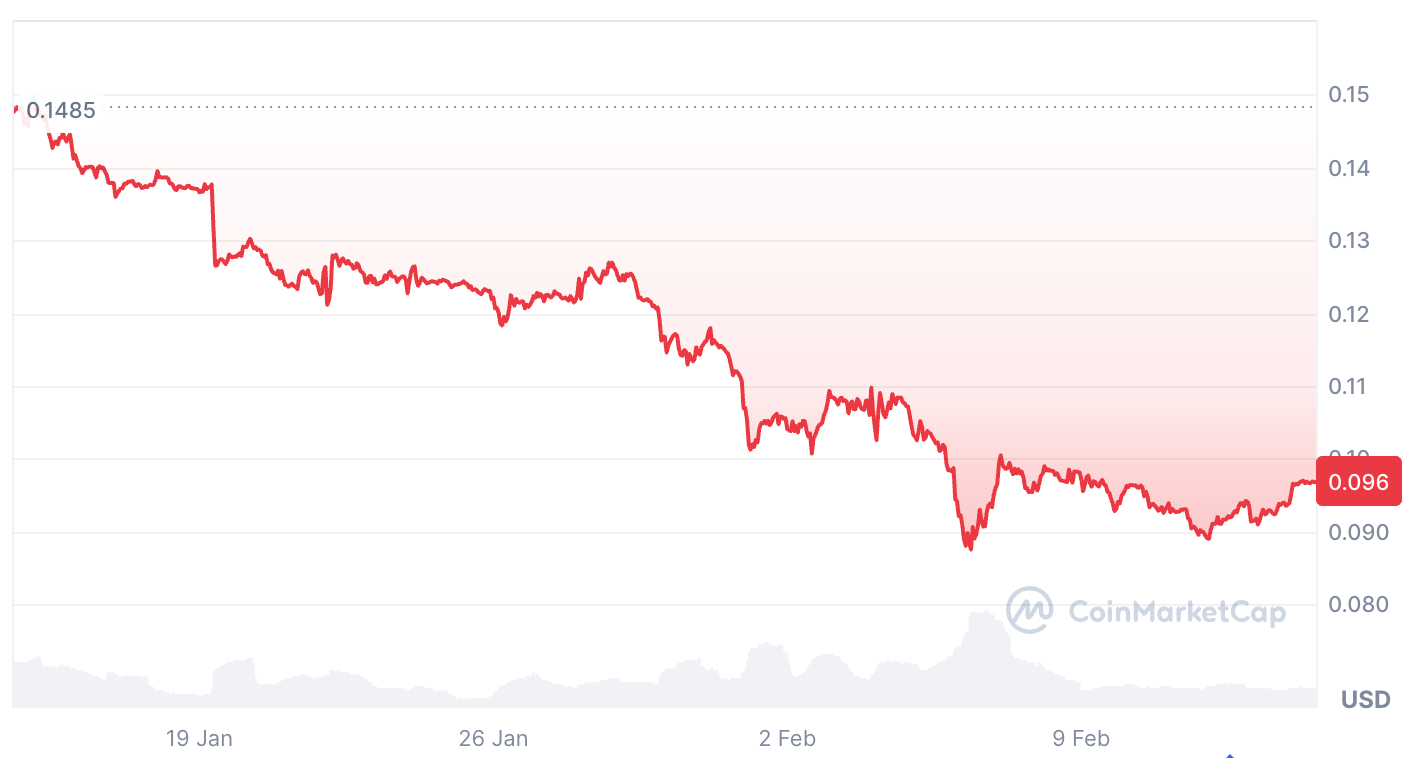
A reversal in memecoins could come sooner than traders expect, even amid choppy conditions across the broader crypto market, if history is any indication, according to crypto sentiment platform Santiment.
“There is a growing narrative of “nostalgia” regarding memecoins, with many traders treating the sector as if it is permanently dead,” Santiment said in a report published on Friday.

“This collective acceptance of the ‘end of the meme era’ is a classic capitulation signal,” Santiment said, explaining that when a sector of the market is completely written off, it is often the “contrarian time” to start paying attention.
“Watch sectors that the crowd has left for dead; max pain often marks the bottom,” Santiment said.
Memecoin market cap falls amid market decline
The total memecoin market capitalization has fallen 34.04% to $31.02 billion over the past 30 days amid a wider crypto market decline that saw Bitcoin (BTC) fall near $60,000 on Feb. 3, the lowest point the asset’s price has been since October 2024, according to CoinMarketCap.
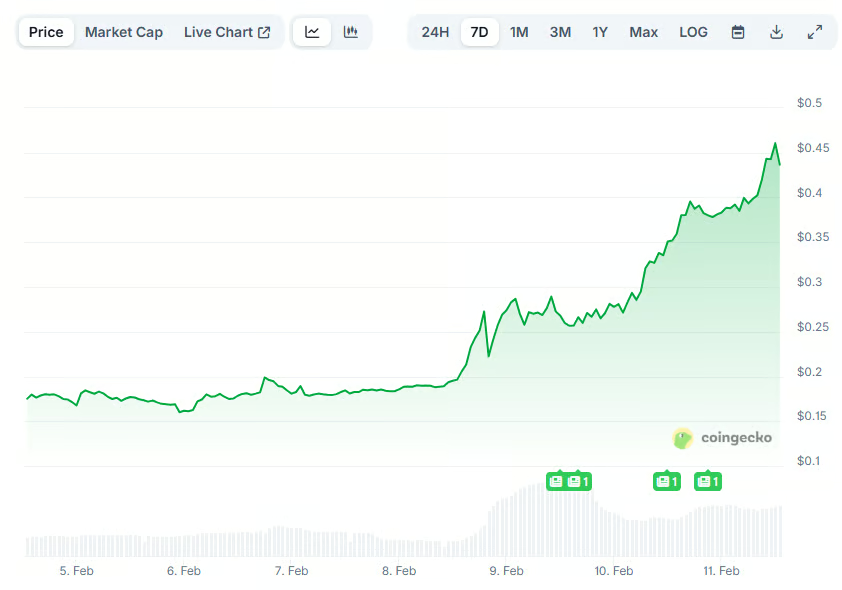
Among the top 100 cryptocurrencies, memecoin gains over the past seven days were mostly modest, except for outlier Pippin (PIPPIN), which surged 243.17%. The next best performers were Official Trump (TRUMP), up 1.37%, and Shiba Inu (SHIB), up 1.11%.
In previous cycles, market participants often expected Bitcoin to reach new all-time highs first, followed by a rotation of capital into Ethereum (ETH) and then into higher-risk altcoins.
However, as Bitcoin matures and institutional interest grows, some analysts are now questioning whether the familiar rotation pattern will play out the same way.
Altcoin season may not be “rising tide raises all ships”
Others have suggested that, unlike previous altcoin seasons where gains were broadly spread across the market, the next altcoin season may be far more selective, with only certain cryptocurrencies seeing upside.
Craig Cobb, the founder of The Grow Me, told Magazine in August 2025 that the next altcoin season will not be “the rising tide raises all ships.”
Related: Bitcoin holders are being tested as inflation eases: Pompliano
Santiment pointed to a growing fear on the crypto market on social media, with significantly more bearish than bullish comments, which may also be a sign that a market rebound is underway.
“Historically, markets move against the crowd’s expectations. This lingering disbelief, even during a price pump, is a healthy sign for a potential sustained recovery,” Santiment said.
Magazine: Bitcoin’s ‘biggest bull catalyst’ would be Saylor’s liquidation: Santiment founder

Bitcoin’s latest price action shows buyers attempting to extend a modest relief, with the benchmark crypto eclipsing the $68,500 mark as they seek to form a higher low around $65,000. On-chain analytics place BTC in a broad consolidation corridor, sandwiched between a true market mean near $79,200 and a realized price around $55,000. Analysts caution that this range-bound dynamic could persist until a tangible catalyst breaks the stalemate, sending prices either toward the upper boundary or back toward support levels. The current landscape reflects a delicate balance between demand at lower levels and selling pressure at nearby resistance, underscoring a market waiting for a clearer directional cue.
Key takeaways
- Bitcoin has moved above 68,500 but faces stiff resistance near 74,508, where a breakout would signal renewed bullish momentum and a potential shift in the range.
- On-chain data from Glassnode places BTC within a broad corridor, with the true market mean around 79,200 and the realized price near 55,000, implying accumulation could intensify only on a decisive breakout.
- Standard Chartered trimmed its BTC price target for 2026 to 100,000 from 150,000 and subsequently projected a dip to 50,000 in the near term before a late-year recovery, highlighting a cautious institutional stance.
- Several market observers still argue that BTC has not yet printed a definitive bottom; a notable forecast puts a bottom in the 40,000–50,000 range between September and November 2026.
- Altcoins show pockets of resilience, with selective recoveries across ETH, BNB, XRP, SOL, DOGE, BCH, HYPE, ADA, and XMR as traders scan for early signs of a broader reversal.
Tickers mentioned: $BTC, $ETH, $BNB, $XRP, $SOL, $DOGE, $BCH, $HYPE, $ADA, $XMR
Market context: The broader market remains in a cautious stance as liquidity shifts and risk sentiment weigh on near-term moves. BTC’s current trajectory sits within a defined range, with analysts awaiting a decisive catalyst to push prices beyond resistance at 74,508 or to test critical supports. Institutional views add a layer of caution: Standard Chartered’s revised targets underscore a more conservative path for BTC in 2026, while analysts like Tony Research have outlined a potential bottoming window that could extend into late 2026. The immediate narrative centers on whether buyers can sustain pressure to invalidate the prevailing consolidation and ignite a broader rally.
Why it matters
The immediate importance of the current price structure lies in its impact on risk appetite and portfolio strategy. A sustained break above the 74,508 resistance level would not only shift the technical landscape for Bitcoin but could also rekindle momentum across the market, potentially drawing fresh capital into the space and facilitating a fuller altcoin recovery. Conversely, a breakdown below significant support could reinforce a risk-off mood, prompting a retracement toward the lower end of the range and testing the resilience of major support zones.
On-chain metrics provide context for traders weighing opportunity versus risk. The gap between the true market mean and the realized price implies participants are mindful of the distance between where BTC traded historically and where it is currently priced on a realized basis. This creates a framework in which bulls must prove durability by pushing beyond key technical thresholds, while bears still cling to the possibility of renewed downside if sellers re-enter with vigor. The evolving dialogue between on-chain signals and price action continues to shape sentiment, particularly as institutions reassess their longer-term exposure given mixed forecasts for the asset class.
For market participants, the current setup also matters for liquidity access and risk management. A confirmed breakout could unlock fresh liquidity pools and spur risk-taking in related sectors, whereas a protracted consolidation may incentivize traders to adopt range-bound strategies, await catalysts, or reallocate to alternative opportunities within and outside the crypto market. The evolving narrative across BTC and the major altcoins sets a backdrop for how exchanges, custodians, and developers approach scaling, risk controls, and product launches in the coming quarters.
What to watch next
- Bitcoin: Monitor a clear move above 74,508 to validate a bullish breakout, or a break below 60,000 to suggest renewed downside pressure and a potential retest of lower supports.
- Ether: A sustained push above 2,111 would signal renewed demand, while a breach of 1,750 could invite a deeper correction toward 1,537 or lower.
- XRP: The pair remains within a descending-channel pattern; a daily close above the 1.55 level and the downtrend line would be a bullish cue, while a drop below 1.11 could accelerate losses toward 1.00.
- Solana: The 95 level stands as a bear fault line; a move above could target the 50-day SMA near 119, whereas a failure near 95 might push toward 77 and test support.
- Dogecoin: Bulls need a breakout above 0.12 to signal progress, with 0.09 acting as a critical support; a break below 0.09 raises the risk of a slide toward 0.08 and beyond.
Sources & verification
- Bitcoin price action around 68,500 with a key resistance near 74,508 and the concept of a higher low near 65,000 to frame the near-term setup.
- Glassnode on-chain metrics showing BTC trading between a true market mean of ~79,200 and a realized price near ~55,000.
- Standard Chartered’s revised BTC targets: 100,000 for 2026 with a potential move down to 50,000 in the near term.
- Analyst commentary placing BTC bottom prospects in the 40,000–50,000 range during Sept–Nov 2026.
- TradingView-based charts and top-10 asset analyses used to illustrate price action across BTC and major altcoins.
Market reaction and key figures shaping the crypto chart landscape
Bitcoin (CRYPTO: BTC) has managed a cautious uptick, clearing the 68,500 mark as buyers push for a higher low near 65,000. The price action sits within a defined corridor: a ceiling at 74,508 and a floor supported by the psychological and technical baselines around 60,000. The trajectory suggests traders are weighing a potential breakout against the risk of renewed downside, a dichotomy that mirrors the broader market’s struggle to find a durable directional impulse.
In the broader market, major alts are attempting to carve out their own narratives. Ether (CRYPTO: ETH) is fighting to sustain a foothold above 2,000, with resistance sketched at 2,111. A decisive breach above that threshold could catalyze a broader recovery, while a retreat could backtest 1,750 and possibly lower. Binance Coin (CRYPTO: BNB) has seen price pressure as well, edging toward a critical support level around 570—an area that could determine whether bulls gain ground to push toward the 669-plateau and the 20-day moving average near 710. XRP (CRYPTO: XRP) continues to navigate within a descending channel; a breakout above the 1.55 level on a sustained basis could deflate the pessimism around the pattern, whereas a failure to hold could accelerate a slide toward 1.11 and beyond.
Solana (CRYPTO: SOL) traders are closely watching $77 as a support pivot, with a failure to hold that level potentially steering the price toward 67–95. Conversely, a break above 95 could open the door to a test of the 50-day moving average around 119, suggesting a bear trap could be in play. Dogecoin (CRYPTO: DOGE) remains sensitive to micro rallies but faces ongoing selling pressure on rallies; a break above 0.12 would be noteworthy, while a drop below 0.09 reinforces the risk of a slide toward 0.08.
Bitcoin Cash (CRYPTO: BCH) has shown weakness below the 497 level, yet bulls are contesting the 20-day EMA around 536. A sustained move above the EMA would indicate demand at lower levels and could target the 50-day moving average near 581, while a failure could leave BCH exposed to a decline toward 443. Across the spectrum, Hyperliquid (CRYPTO: HYPE) has regained footing above the 20-day EMA, signaling buying on dips; a decisive move beyond 35.50 could spur a rally toward 44, while a break below 27.25 risks a drop toward 20.82. Cardano (CRYPTO: ADA) remains locked in a descending channel, with a break above the 20-day EMA at 0.29 needed to extend the range in a more constructive fashion. Monero (CRYPTO: XMR) is testing the 360 barrier, with a potential breakout to challenge the 385 and 460 levels if buying pressure intensifies, though a fall below 309 could invite a push toward 276 as a potential buyer magnet.
Crypto World
CryptoQuant Places Bitcoin Bear Market Bottom at $55,000 as Key Indicators Show Extended Correction Ahead
TLDR:
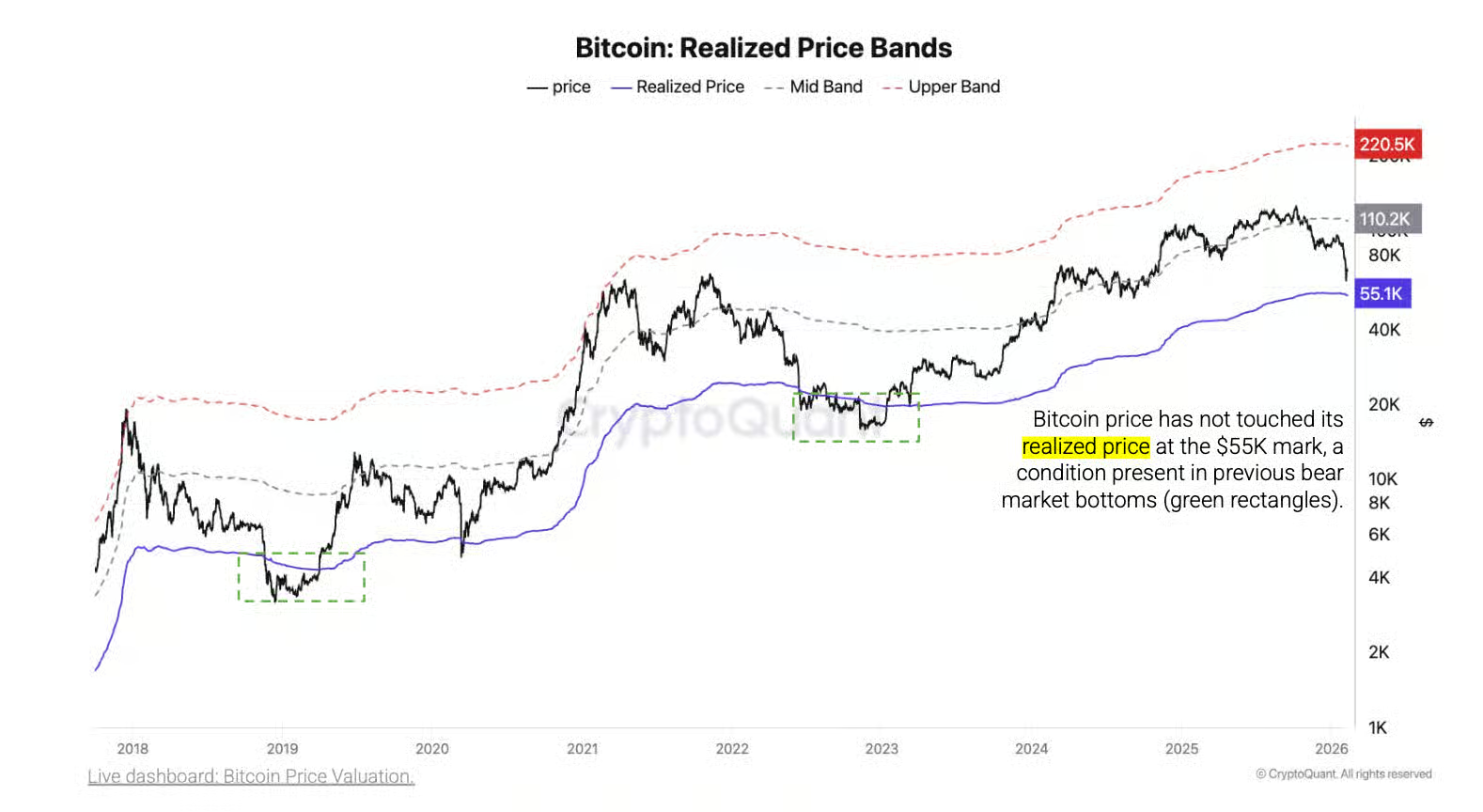
- Bitcoin trades 25% above its realized price of $55,000, which historically marks bear market bottoms
- February 5 sell-off triggered $5.4 billion in daily losses, the largest since March 2023’s $5.8 billion event
- Monthly realized losses at 0.3 million BTC remain far below 2022 bear market bottom of 1.1 million BTC
- Long-term holders selling near breakeven versus 30-40% losses typical at previous bear market cycle lows
Bitcoin’s bear market floor sits around $55,000, according to blockchain analytics platform CryptoQuant. The firm’s latest assessment suggests the cryptocurrency remains more than 25% above this critical support level.
CryptoQuant analysts note that bear market bottoms require several months to establish rather than forming through sudden capitulation events.
This analysis comes as Bitcoin trades significantly higher than key historical support zones that marked previous cycle lows.
Realized Price Indicates Extended Bottoming Process
The realized price metric serves as CryptoQuant’s primary indicator for determining Bitcoin’s potential bottom. This measure calculates the average price at which all coins last moved on the blockchain.
Historical data shows this metric provided strong support during past bear markets. Current trading prices remain elevated compared to this threshold, suggesting additional downside potential exists.
Previous bear cycles demonstrated distinct patterns when Bitcoin approached these levels. During the 2018 downturn, prices dropped 30% below the realized price before stabilizing.
The FTX collapse in 2022 pushed Bitcoin 24% beneath this metric. After reaching these depths, the cryptocurrency spent between four and six months building a foundation before recovery began.
Recent market volatility has not yet pushed Bitcoin into the extreme zones that characterize true bottoms. On February 5, the asset experienced a 14% decline to $62,000, triggering $5.4 billion in realized losses.
This marked the largest single-day loss realization since March 2023, when holders crystallized $5.8 billion in losses. The figure also exceeded the $4.3 billion recorded shortly after the FTX exchange collapsed.
Despite these substantial losses, CryptoQuant maintains that a structural bottom has not materialized. Monthly cumulative realized losses currently stand at 0.3 million BTC, well below the 1.1 million BTC observed at the end of the 2022 bear market. This disparity suggests selling pressure has not reached the intensity associated with cycle lows.
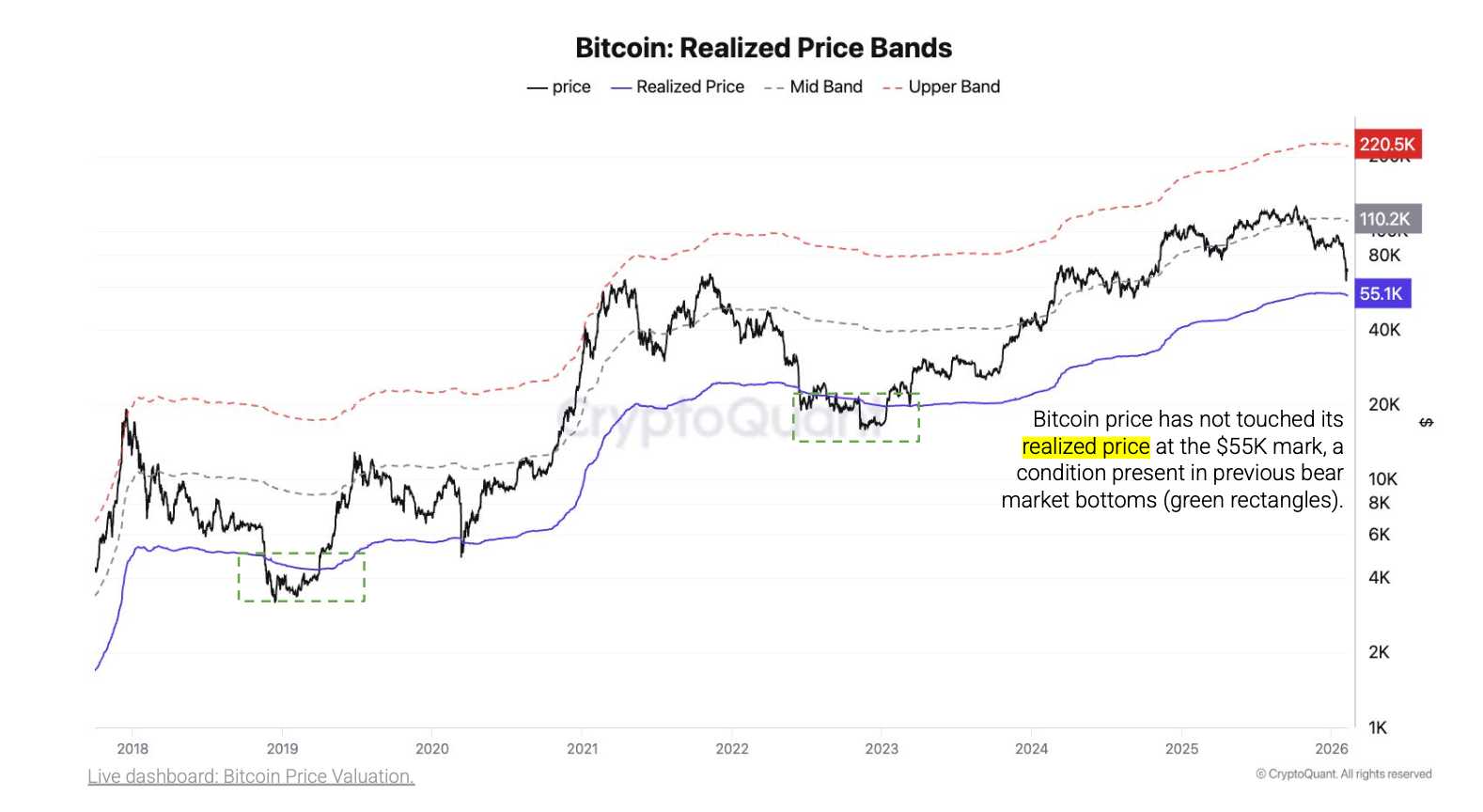
Source: Cryptoquant
Multiple Indicators Show Market Remains Above Capitulation Levels
The MVRV ratio, which compares market value to realized value, has not entered extreme undervaluation territory. This metric historically signals bear market bottoms when reaching deeply depressed levels.
Current readings indicate Bitcoin trades above the ranges that marked previous cycle nadirs. Similarly, the Net Unrealized Profit and Loss metric has not declined to the 20% unrealized loss threshold observed at past bottoms.
Long-term holder behavior provides additional evidence that full capitulation has not occurred. These investors currently sell positions near breakeven prices.
During previous bear market conclusions, long-term holders typically absorbed losses between 30% and 40% before markets reversed. This behavioral difference suggests conviction remains higher than at historical turning points.
Approximately 55% of Bitcoin’s circulating supply remains profitable at current prices. This contrasts with the 45% to 50% range typically observed at cycle lows.
The elevated proportion of profitable holdings indicates many investors entered positions at lower prices and maintain paper gains. Bear market bottoms usually feature a higher percentage of underwater positions across the holder base.
CryptoQuant’s Bull-Bear Market Cycle Indicator remains in the Bear Phase rather than advancing to the Extreme Bear Phase. The latter designation historically marks the beginning of extended bottoming periods.
These extreme phases typically persist for several months, reinforcing the firm’s assessment that bear markets require time to resolve.
Standard Chartered recently adjusted its outlook, projecting Bitcoin could test $50,000 before recovering later this year.

Crypto World
How Espresso’s HotShot Consensus Addresses the Rollup Centralization and Fragmentation Crisis

TLDR:
- Espresso’s decentralized shared sequencer eliminates single points of failure in Rollup transaction ordering.
- HotShot consensus achieves two-second finality on devnet with plans for sub-second confirmation by 2026.
- Presto enables one-click cross-chain transactions without traditional bridging or additional gas fees.
- The network integrates with over 20 chains while preserving Rollup sovereignty through flexible participation.
The rapid proliferation of Layer 2 Rollups has created two fundamental problems that threaten ecosystem cohesion. Fragmentation prevents seamless interaction between chains, while centralized sequencers introduce censorship risks and single points of failure.
Espresso Systems addresses both challenges through a decentralized shared sequencer network powered by HotShot consensus.
The protocol raised $60 million from a16z and Coinbase Ventures to build infrastructure connecting over 20 chains with fast finality and cross-chain composability.
Cross-Chain Composability Addresses Rollup Fragmentation Crisis
The fragmentation dilemma emerged as rollups multiplied without standardized interoperability protocols. Applications and liquidity became isolated across separate Layer 2 ecosystems.
Users faced complex bridging processes and high costs when moving assets between chains. This fragmentation undermined the composability that makes Ethereum’s base layer valuable for developers.
Espresso tackles this problem through its confirmation layer architecture designed to achieve cross-chain composability.
According to the official website, the network provides reliable state views for other chains, bridges, and applications through real-time confirmation.
Smart contracts deployed on different Rollups can directly communicate without traditional bridging infrastructure. This restores the seamless interaction developers expect from integrated blockchain environments.
The Presto solution demonstrates practical fragmentation resolution through one-click cross-chain transactions. The system leverages Espresso’s fast finality to enable direct chain communication.
A partnership with Rarible showcased cross-chain NFT minting at the Devcon developer conference. The demonstration proved users could mint NFTs across chains without bridging or extra gas fees.
Technical performance supports these composability goals with measurable improvements. The current devnet achieves two-second finality with 5 MB/s throughput.
Official updates note this represents three times faster confirmation and five times higher capacity compared to mainnet. The development roadmap projects sub-second finality by 2026 as optimization continues.
Decentralized Sequencing Eliminates Centralization Vulnerabilities
Centralized sequencing represents the second critical vulnerability in current rollup architecture. Most Layer 2 networks rely on single sequencers controlled by project teams.
These operators possess unilateral power to order, delay, or exclude transactions from blocks. The arrangement creates censorship vectors and introduces catastrophic failure risks if operators go offline.
Espresso replaces centralized control with a distributed validator network operating globally. The shared sequencer accepts transaction blocks from connected Rollups for collective confirmation.
HotShot consensus serves as the Byzantine Fault Tolerance protocol ensuring distributed agreement among validator nodes. This architecture eliminates single points of failure while distributing censorship resistance across the entire network.
Protocol-level safeguards enforce decentralization guarantees for settlement on Ethereum’s base layer. The system ensures only blocks confirmed by Espresso validators can finalize on Layer 1.
This restriction prevents Rollup operators from bypassing consensus through direct submission. The mechanism guarantees all transactions undergo distributed validation before achieving finality.
The business model preserves Rollup sovereignty despite shared infrastructure. Official statements emphasize Rollups can freely choose to fully rely on the network, partially participate, or run independent sequencers.
This flexibility allows projects to access decentralization benefits without surrendering operational control. Partnerships with Arbitrum, Optimism, and Polygon demonstrate major ecosystem acceptance of the shared sequencing approach.


U.S. prosecutors have warned of Valentine’s Day romance scams using crypto after cases cost victims millions.
Prosecutors in the U.S. state of Ohio have issued a public warning urging Americans to watch for romance scams tied to cryptocurrency as they celebrate Valentine’s Day.
The alert drew attention to a rise in emotionally driven fraud cases where victims are persuaded to send digital assets after forming online relationships.
Federal Warning Outlines Latest Tactics
The U.S. Attorney’s Office for the Northern District of Ohio said criminals often approach targets through dating apps, social platforms, or text messages, then build trust for weeks or months before requesting money for fabricated emergencies or investments.
According to U.S. Attorney David M. Toepfer, scammers “prey on trust and emotion,” and they “are not looking for love—they are looking for money.” He added that such criminals often focus on older adults and emotionally vulnerable individuals.
His office also cited recent prosecutions and investigations, including a December 2025 case where authorities charged Frederick Kumi, a Ghanaian national accused of helping run a romance fraud network that allegedly took more than $8 million from elderly victims since 2023. Per investigators, the group used AI tools to create false identities and maintain convincing conversations before requesting money. Kumi was arrested in Ghana and is facing charges including wire fraud conspiracy and money laundering conspiracy.
Another case involved an Ohio woman who lost about $663,000 after a stranger contacted her through a “wrong number” text. The fraudster later guided her through opening accounts on Crypto.com and Coinbase, then convinced her to transfer funds to a fake investment platform.
Fortunately, detectives from the FBI traced part of the stolen money to cryptocurrency wallets and seized more than $8.2 million in USDT with help from Tether.
You may also like:
Data Shows Wider Trend in Crypto-Linked Fraud
Recent industry research suggests these crimes fit a broader pattern, as shown in a January 2026 report from blockchain security firm PeckShield, which estimated that crypto scams and hacks cost users more than $4 billion in 2025, with about $1.37 billion tied to scams alone.
The company said losses from scams rose about 64% from the previous year, often involving personalized impersonation tactics aimed at high-value targets.
The Ohio prosecutors have recommended several ways that people can protect themselves from romance tricksters, including reverse image searches on profile photos, skepticism toward anyone who refuses to meet in person, and a hard rule against sending cryptocurrency, gift cards, or wire transfers to people met online.
They also advised victims to preserve all communications and financial records, then file reports with the FBI’s Internet Crime Complaint Center. Additionally, the National Elder Fraud Hotline operates daily to guide older adults through the reporting process.
According to the officials, for those who may have sent crypto, time matters, since law enforcement can freeze stolen assets, but only if wallets are identified before funds move through mixers or overseas exchanges.
SECRET PARTNERSHIP BONUS for CryptoPotato readers: Use this link to register and unlock $1,500 in exclusive BingX Exchange rewards (limited time offer).


The head of the U.S. Securities and Exchange Commission says prediction markets are drawing serious legal and regulatory attention.
Summary
- U.S. Securities and Exchange Commission Chair Paul Atkins called prediction markets a “huge issue” as the sector faces growing legal and regulatory scrutiny.
- Atkins said some event-based contracts could fall under SEC jurisdiction if they meet the definition of a security.
- The SEC is coordinating with the Commodity Futures Trading Commission as questions mount over oversight, especially for platforms like Polymarket and Kalshi.
At a Senate Banking Committee hearing on February 12, SEC Chair Paul Atkins described rapidly-growing prediction markets as “a huge issue” for federal regulators.
Platforms such as Kalshi and Polymarket have expanded quickly since the 2024 election cycle. These markets let users speculate on outcomes from elections and sports to economic events.
Their growth, now measured in tens of billions of dollars, has pushed them into the spotlight of U.S. regulators.
Who regulates prediction markets?
Atkins said the legal status of prediction markets isn’t always clear. He noted that jurisdiction overlaps between the SEC and the Commodity Futures Trading Commission (CFTC).
“Prediction markets are exactly one thing where there’s overlapping jurisdiction potentially,” Atkins said.
Historically, the CFTC has been seen as the primary federal regulator for these markets. Atkins said the SEC may regulate some markets depending on how they’re structured, especially if contracts resemble securities.
“We have enough authority,” he told lawmakers, adding that a “security is a security regardless how it is and some of the nuance with prediction markets and the products depends on wording.”
SEC officials are reportedly meeting weekly with their counterparts at the CFTC.
CFTC Chair Michael Selig said regulators want a framework that protects market participants without pushing these platforms offshore.
Meanwhile, prediction markets also face state-level litigation, including claims that some offerings are illegal gambling under local laws.
Recent reports have noted insider trading concerns and legislative efforts to limit political event betting.
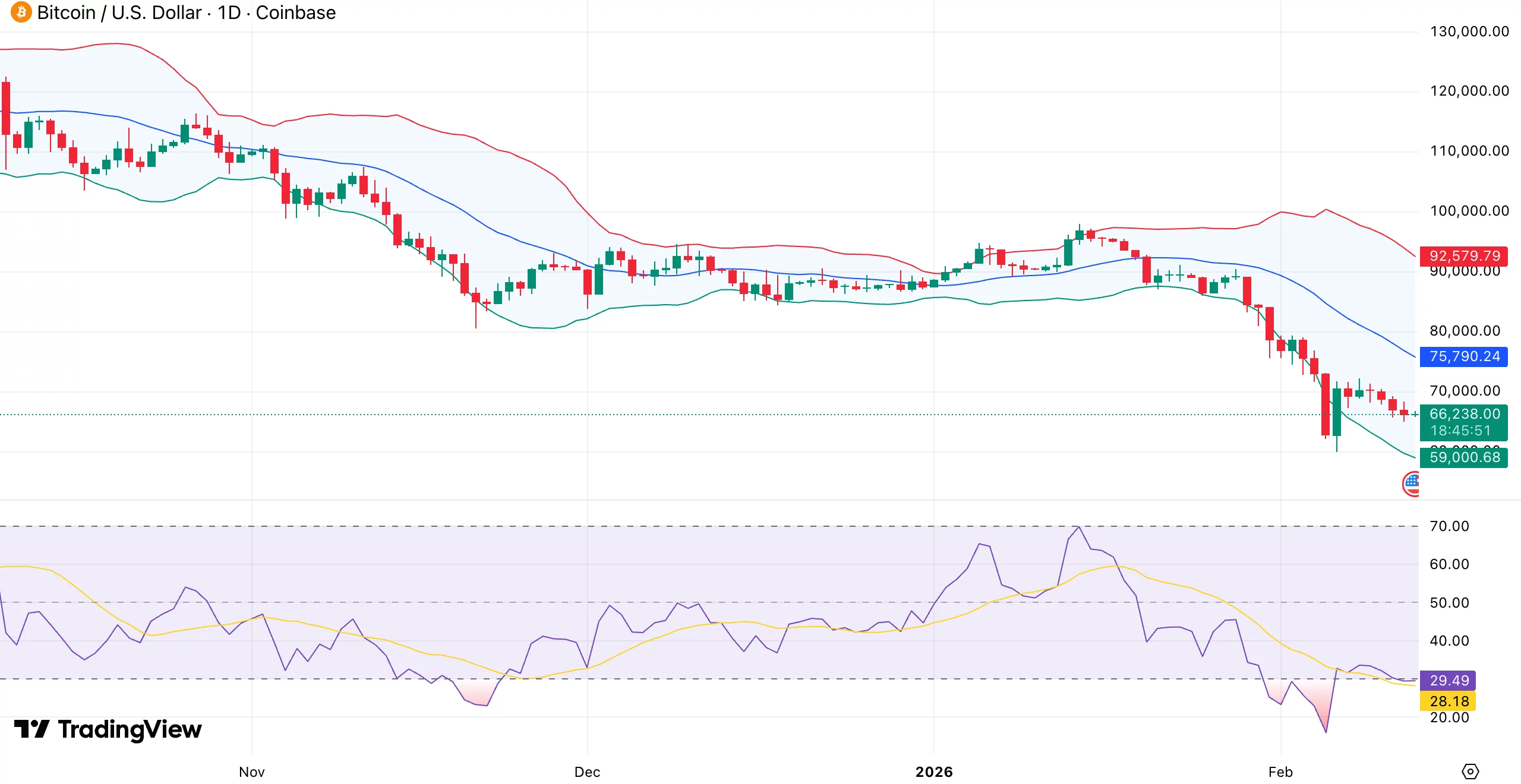
Bitcoin price trades near $68,000 as $2.5 billion in BTC options expire today, placing $74,000 max pain at the center of market focus.
Summary
- Bitcoin has been on a downtrend in February, falling nearly 50% from its all-time high.
- $2.5B in BTC options expire today with a put/call ratio of 0.72 and max pain at $74,000.
- RSI sits near 29 as volume and open interest decline across derivatives markets.
Bitcoin was trading at $68,280 at press time, down 1.1% over the last 24 hours. The asset has moved within a 7-day range of $64,760 to $71,450. Over the past 30 days, BTC is down 30%, and it now sits roughly 50% below its $126,080 all-time high set in October.
Spot activity has cooled. Bitcoin (BTC) logged $47 billion in 24-hour trading volume, a decline of 11% from the previous day. Derivatives markets are also easing.
As per Coinglass data, total futures volume stands at $63 billion, down 18%, while open interest has dipped 1.73% to $44 billion. That combination points to position trimming rather than aggressive new exposure.
$2.5B in options set to expire
According to Deribit data, $2.5 billion worth of Bitcoin options are set to expire at 8:00 a.m. UTC on Feb. 13. The put/call ratio stands at 0.72, indicating more call contracts than puts. The max pain price is $74,000, the level where the largest number of options would expire worthless.
At the same time, $420 million in Ethereum options will also expire, with a put/call ratio of 0.85 and a max pain level of $2,100.
Options expiry refers to the settlement of contracts that give traders the right, but not the obligation, to buy or sell Bitcoin at a specific price before a set date. As expiry approaches, market makers hedge their exposure by buying or selling spot and futures.
This can increase short-term volatility. In many cases, price gravitates toward the max pain level. In others, strong directional momentum overrides expiry-related flows.
With Bitcoin trading nearly $6,000 below $74,000, traders are watching to see whether the price gets pulled higher into settlement or continues lower.
Technical outlook: pressure remains below $74K
The daily structure is clearly bearish. Bitcoin has been printing lower highs and lower lows. It trades below the 50-day moving average near $75,000 and well under the 200-day moving average around $92,500. That alignment keeps momentum tilted to the downside.
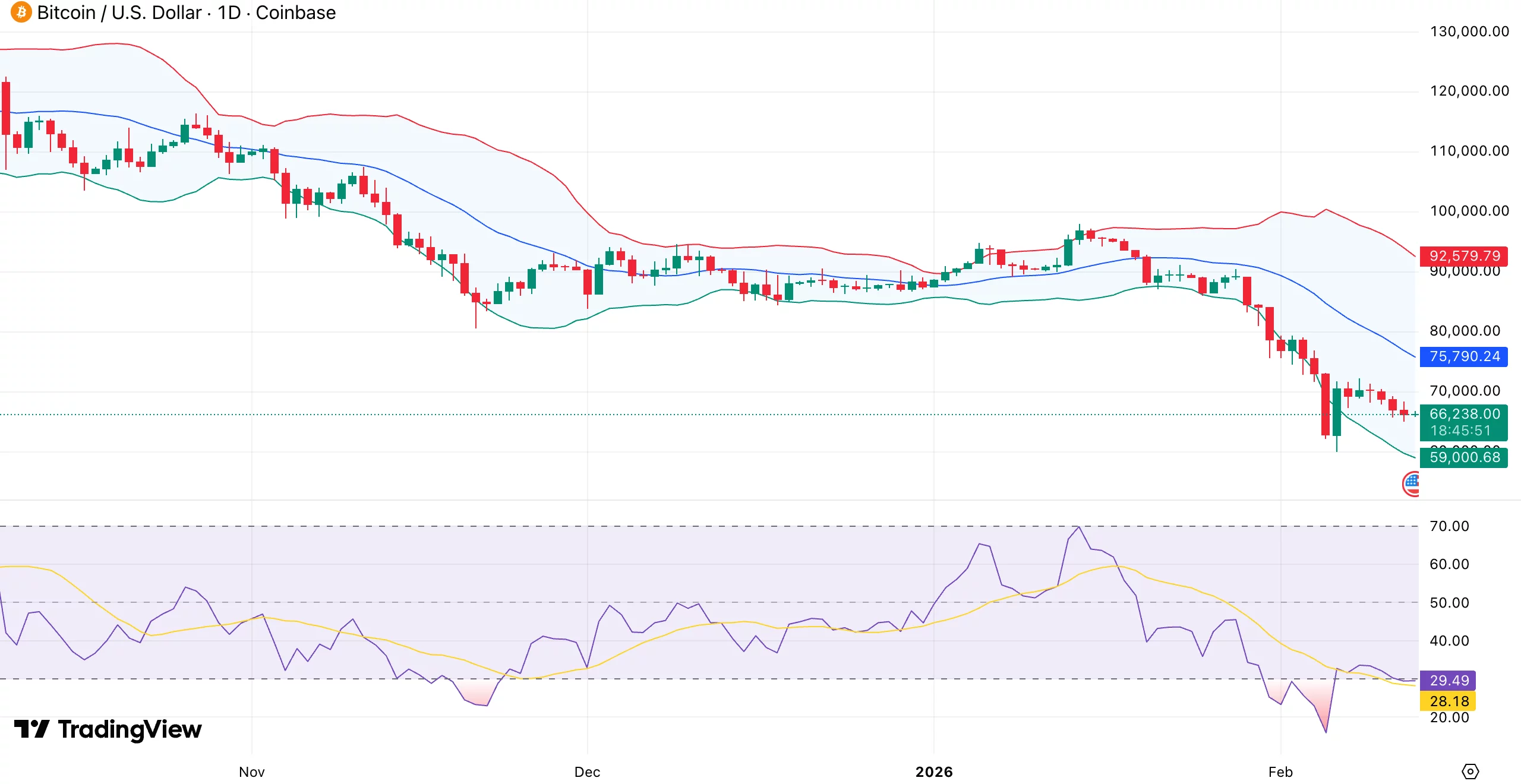
Bollinger Bands are expanding, not compressing. Price recently touched the lower band, which often signals oversold conditions. In strong downtrends, however, assets can stay pinned near the lower band for longer than expected.
The relative strength index is around 29, deep in oversold territory. Yet there is no confirmed bullish divergence. Until RSI forms higher lows while price stabilizes, reversal signals remain limited.
Support sits at $65,000–$66,000, followed by the psychological $60,000 level. On the upside, $74,000–$76,000 is the key reclaim zone. A daily close above that area would ease pressure and open room toward $80,000.
For now, Bitcoin remains technically weak below $74,000. Options expiry may add volatility, but trend reversal requires structure to shift, not just a short-term bounce.
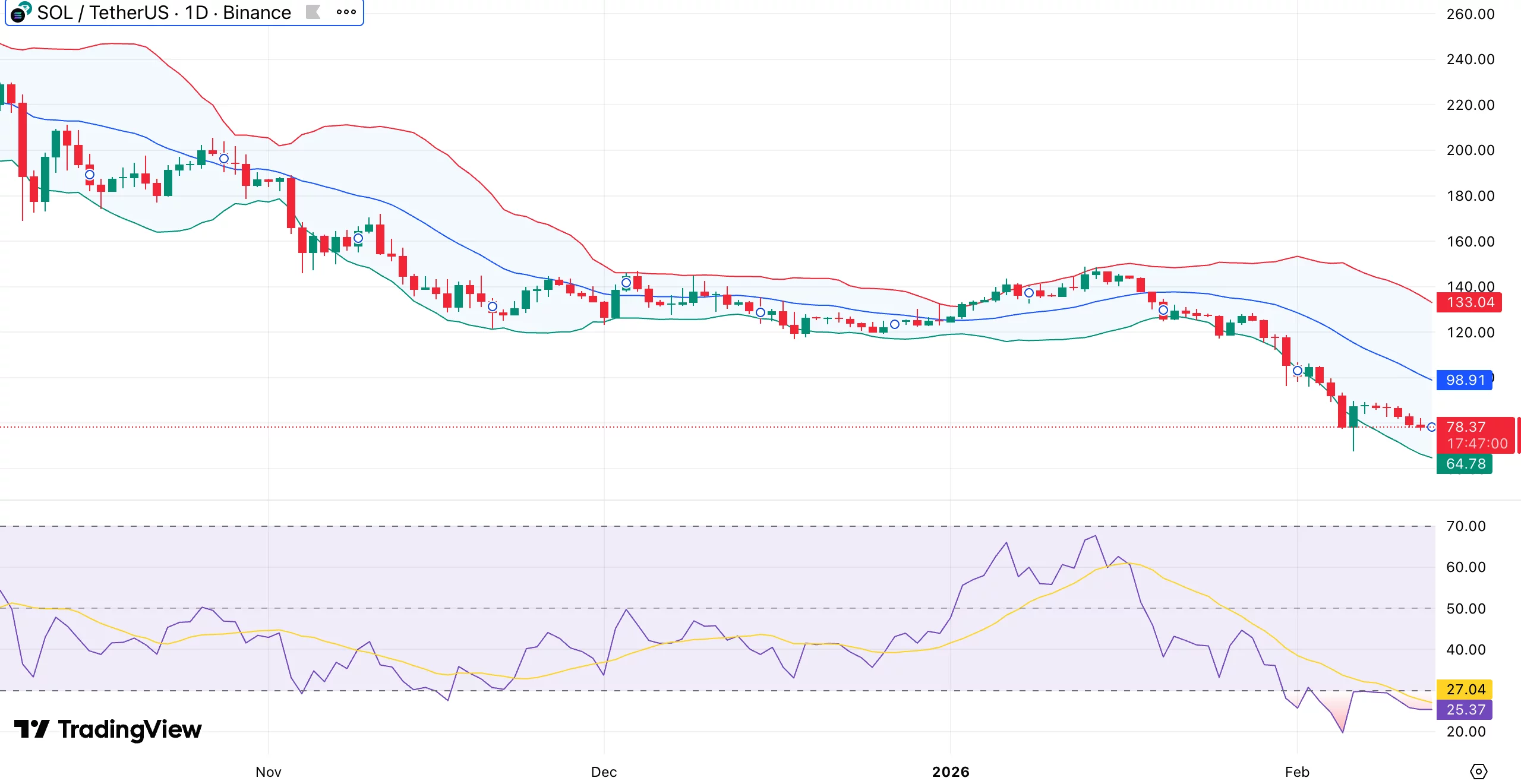
Solana price has slipped beneath a critical support level, with momentum indicators flashing deep oversold conditions as traders re-assess risk.
Summary
- Solana’s breakdown below a key psychological level reinforces its downtrend, with sellers still controlling structure.
- The memecoin-driven surge that fueled the previous rally has cooled.
- RSI has plunged to 25 as price breaks below $80, confirming strong bearish momentum.
Solana was trading at $78.33 at press time, down 2.7% over the past 24 hours. The token has dropped 45% in the last 30 days and is now roughly 73% below its January 2025 all-time high. Over the past week, the price has ranged between $76.81 and $89.28, with sellers maintaining control.
Trading activity has fallen. At $3.83 billion, Solana’s (SOL) 24-hour spot volume was down 15%. On the derivatives side, CoinGlass data shows that open interest dropped 3% to $4.91 billion, while volume dropped 12% to $10.28 billion.
The decline in open interest indicates that traders are closing positions rather than opening new aggressive bets. That kind of unwinding is common during the later stages of a correction. Still, it should not be mistaken for a confirmed bottom.
Why Solana has struggled
Solana’s weakness comes after a sharp pullback from its late 2024 and early 2025 rally. Memecoin activity, including tokens with political themes, attracted a lot of speculative capital to the ecosystem during that run. Leverage accumulated across derivatives markets as liquidity rapidly increased.
When that momentum cooled, the structure weakened. Long positions began to unwind, and stop-losses were triggered in succession.
Selling pressure increased as a result. Solana is a high-beta asset that often amplifies broader market movements. It tends to fall more when sentiment changes, but it can also outperform in high risk-on situations.
In periods of uncertainty, traders often prefer deeper liquidity, and that may favor Bitcoin and Ethereum. Compared to those markets, SOL’s thinner liquidity can amplify volatility during deleveraging.
Declining decentralized exchange volumes have also pressured the token. According to DefiLlama data, Solana’s January DEX volume was $117 billion. That was an improvement over the previous two months, but it was still less than the $155 billion that was recorded in October. Ecosystem-driven demand for SOL has weakened as speculative trading continues fade.
Although long-term projections are largely positive, pointing to the rise in stablecoin usage and micropayments, there haven’t been many short-term catalysts, making the price susceptible to technical pressure.
Solana price technical analysis
The break below $80 is technically significant. The level had acted as psychological support and formed the lower edge of a recent consolidation range. Once it gave way, the broader downtrend that began after the January peak near $150 was reinforced.
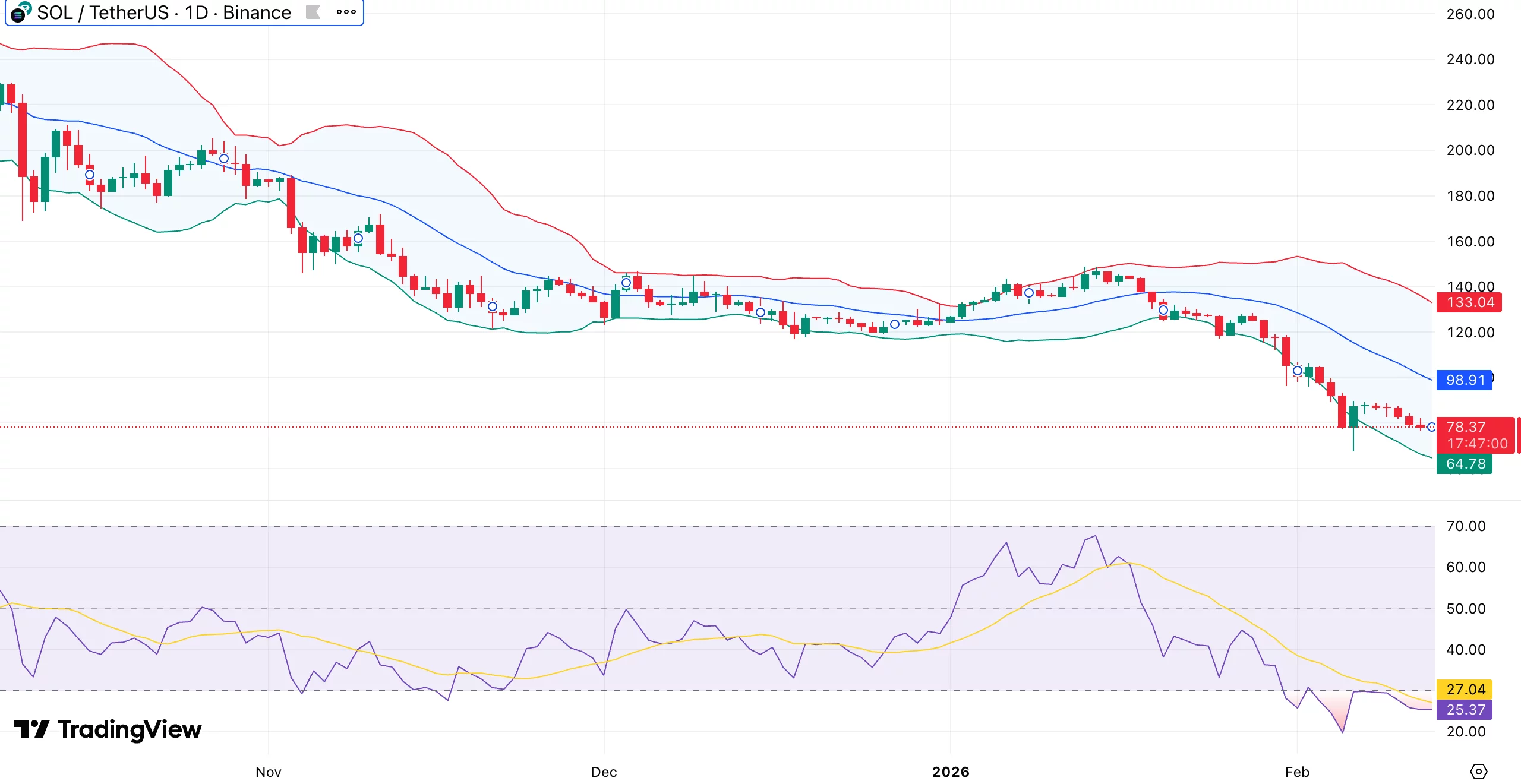
SOL now trades beneath both the 20-day and 50-day moving averages. Price is also positioned below the mid-point of the Bollinger Bands. Meanwhile, the bands themselves are widening, a sign that volatility is expanding.
When price continues to hug the lower band during that expansion phase, it usually reflects trend continuation rather than an immediate reversal.
Momentum indicators align with the weakness. Deep in oversold territory, the relative strength index has dropped to 25. Though no bullish divergence has yet to form, such readings may precede brief relief rallies. RSI remains below its signal average, which suggests sellers still dominate near-term flows.
SOL would need to firmly reclaim $80 with conviction in order for bullish momentum to resume. A sustained move toward $90 would be the next test. Beyond that, the $98–$100 region stands as a major resistance cluster.
On the downside, the $72–$70 area marks the next support zone. If that fails, attention shifts to the $65–$68 range, with stronger psychological support resting near $60.
The current setup reflects a market under pressure. Whether this evolves into capitulation or stabilizes into a base will depend on how the price behaves around the $70 region.


BitGo Holdings, Inc. and 21Shares have expanded their global partnership to support a growing lineup of crypto exchange-traded products (ETPs) and ETFs with enhanced staking and custody services.
Summary
- BitGo Holdings Inc. and 21Shares have expanded their global partnership to strengthen custody and staking support for crypto ETFs and ETPs across the U.S. and Europe.
- BitGo will provide qualified custody, trading, execution and integrated staking services, enabling 21Shares’ products to offer secure asset storage and potential staking yields.
- The move comes amid rising institutional demand for regulated crypto investment vehicles, with 21Shares managing roughly $5.7 billion in assets.
21Shares turns to BitGo for expanded custody
The new agreement covers both the United States and Europe, deepening cooperation between two major players in digital asset infrastructure and investment products.
Under the expanded partnership, BitGo will provide qualified custody, trading, execution and integrated staking services for 21Shares’ U.S.-listed ETFs and international ETP offerings.
These services include secure asset safekeeping, access to deep liquidity across electronic and over-the-counter markets, plus competitive staking rewards, all delivered within BitGo’s regulated and insured custody framework.
21Shares, a leading issuer of crypto investment products managing roughly $5.7 billion in assets, gains from BitGo’s infrastructure as it continues to expand its suite of digital asset offerings. The expanded pact supports both spot crypto products and instruments that enable holders to earn staking yields, a growing demand among institutional and regulated investors.
What this means for the market
The expanded collaboration comes at a time when institutional interest in regulated crypto products is rising globally. By pairing BitGo’s custody and staking capabilities with 21Shares’ broad ETP platform, both firms are positioning themselves to attract professional capital seeking secure, compliant exposure to digital assets.
Adam Sporn, Head of Prime Brokerage and Institutional Sales at BitGo, highlighted the importance of the partnership as 21Shares increases its ETF product range worldwide.
Andres Valencia, Head of Investment Management at 21Shares, noted that BitGo’s track record in security, regulatory compliance and governance made it an ideal partner for expanding staking and custody services.
This development builds on recent milestones for BitGo, including regulatory approvals and its NYSE listing, which enhance its ability to serve institutional clients with robust, compliant infrastructure. Meanwhile, 21Shares continues to grow its global ETF and ETP footprint, leveraging trusted partners like BitGo to scale securely.
Tyler Perry reveals he broke his collarbone in 'terrible' bike accident in Italy: 'It separated in two places'

Claude is leveling up against Gemini and ChatGPT with powerful free tools

Trump says Iran regime change would be the ‘best thing that could happen’ | World News


-

 Politics6 days ago
Why Israel is blocking foreign journalists from entering
-
 Business6 days ago
LLP registrations cross 10,000 mark for first time in Jan
-

 NewsBeat4 days ago
Mia Brookes misses out on Winter Olympics medal in snowboard big air
-

 Sports2 days ago
Big Tech enters cricket ecosystem as ICC partners Google ahead of T20 WC | T20 World Cup 2026
-

 Business5 days ago
Costco introduces fresh batch of new bakery and frozen foods: report
-

 Tech3 days ago
SpaceX’s mighty Starship rocket enters final testing for 12th flight
-

 NewsBeat5 days ago
Winter Olympics 2026: Team GB’s Mia Brookes through to snowboard big air final, and curling pair beat Italy
-

 Video19 hours ago
The Final Warning: XRP Is Entering The Chaos Zone
-

 Sports5 days ago
Benjamin Karl strips clothes celebrating snowboard gold medal at Olympics
-
Sports7 days ago
Former Viking Enters Hall of Fame
-

 Politics6 days ago
The Health Dangers Of Browning Your Food
-

 Business6 days ago
Julius Baer CEO calls for Swiss public register of rogue bankers to protect reputation
-
 Crypto World2 days ago
Pippin (PIPPIN) Enters Crypto’s Top 100 Club After Soaring 30% in a Day: More Room for Growth?
-

 Crypto World4 hours ago
Bhutan’s Bitcoin sales enter third straight week with $6.7M BTC offload
-

 Video2 days ago
Prepare: We Are Entering Phase 3 Of The Investing Cycle
-
 Crypto World4 days ago
U.S. BTC ETFs register back-to-back inflows for first time in a month
-

 Crypto World4 days ago
Blockchain.com wins UK registration nearly four years after abandoning FCA process
-
 NewsBeat5 days ago
Residents say city high street with ‘boarded up’ shops ‘could be better’
-
Sports4 days ago
Kirk Cousins Officially Enters the Vikings’ Offseason Puzzle
-
 Crypto World4 days ago
Ethereum Enters Capitulation Zone as MVRV Turns Negative: Bottom Near?