
Crypto World
The New Race for Cross-Chain Liquidity: Why the Future of DeFi May Depend on Moving Capital Seamlessly


For years, blockchain ecosystems competed largely on one question: Which network can attract the most users, developers, and capital?
Ethereum built a massive DeFi economy. Solana became known for high-speed transactions and low fees. Layer-2 networks expanded Ethereum’s capacity, while newer chains introduced alternative approaches to scalability, interoperability, and application development.
But the competitive landscape is changing.
The next major battle may not be about which blockchain has the most liquidity locked inside its ecosystem. Instead, it may be about which networks, protocols, and infrastructure providers can move liquidity between ecosystems most efficiently, securely, and intelligently.
This is creating a new race for cross-chain liquidity.
As the number of blockchains continues to grow, liquidity becomes increasingly fragmented. Assets that once existed primarily within a single ecosystem can now move across multiple chains, creating new opportunities—but also new technical and security challenges.
The winners of the next phase of DeFi may therefore be the platforms that can make blockchain fragmentation feel invisible to users.
What Is Cross-Chain Liquidity?
Cross-chain liquidity refers to the ability to move, access, or utilize capital across different blockchain networks.
Imagine a user holding USDC on one blockchain who wants to participate in a lending protocol on another network. Without interoperability infrastructure, the user may need to:
- Move assets through a bridge.
- Convert the asset into another token.
- Pay multiple transaction fees.
- Wait for confirmations.
- Navigate different wallets or applications.
- Accept additional smart-contract and bridge risks.
Cross-chain infrastructure attempts to simplify this process.
Instead of treating every blockchain as an isolated financial island, interoperability protocols aim to connect liquidity across ecosystems.
The goal is simple:
Liquidity should be able to follow opportunity.
If lending yields are better on one chain, trading volume is higher on another, or a new application launches somewhere else, capital should ideally be able to move there efficiently.
That concept could become one of the most important foundations of mature DeFi.
Why Liquidity Fragmentation Is Becoming a Bigger Problem
The blockchain industry has evolved from a relatively small number of major networks into a highly fragmented environment.
There are Layer-1 blockchains, Ethereum Layer-2s, appchains, rollups, sidechains, modular networks, and specialized execution environments.
This creates an interesting paradox.
More blockchains create more opportunities.
But:
More blockchains can also create more fragmented liquidity.
A trader may find the best liquidity for one asset on Ethereum, the lowest transaction costs on another network, and the most attractive DeFi opportunity somewhere else.
Capital becomes scattered.
This fragmentation can produce several problems:
- Lower liquidity on individual applications
- Higher slippage
- More complicated user experiences
- Increased transaction costs
- Liquidity trapped inside isolated ecosystems
- Greater reliance on bridges and interoperability infrastructure
- More difficult capital management for DeFi users
For decentralized finance to become a truly interconnected financial system, liquidity cannot remain permanently trapped within individual chains.
The Evolution of Cross-Chain Infrastructure
Cross-chain technology has gone through several generations.
Early blockchain bridges largely focused on one objective:
Move an asset from Chain A to Chain B.
The process often involved locking an asset on one network and creating a corresponding representation on another.
For example:
Native Asset → Lock → Wrapped Asset → Destination Chain
Although this approach enabled interoperability, it also introduced additional points of failure.
The industry has since experimented with more sophisticated architectures.
Modern interoperability systems can involve:
- Cross-chain messaging
- Liquidity networks
- Intent-based systems
- Shared security models
- Decentralized verification
- Relayers
- Validators
- Proof-based verification
- Native asset transfers
- Cross-chain swaps
The broader trend is moving from simple token bridging toward programmable interoperability.
That distinction matters.
The future isn’t necessarily about simply moving tokens.
It is about allowing applications on different blockchains to communicate, coordinate, and execute financial actions across networks.
Cross-Chain Messaging Could Be More Important Than Bridging
One of the most important developments in interoperability is the shift from asset movement toward cross-chain messaging.
A bridge answers:
“How do I move this asset?”
Cross-chain messaging asks:
“How can this application communicate with another blockchain?”
That difference opens up much larger possibilities.
For example, a decentralized application could potentially:
- Trigger transactions on another chain
- Verify information from another blockchain
- Coordinate liquidity between ecosystems
- Manage cross-chain positions
- Execute governance instructions
- Automate treasury strategies
- Synchronize application states
This creates the possibility of cross-chain applications rather than simply cross-chain assets.
In such an environment, blockchains become less like isolated networks and more like interconnected components of a larger financial infrastructure.
The Rise of Intent-Based Liquidity
Another important development is the growing interest in intent-based systems.
Traditional DeFi often requires users to specify every step of a transaction.
For example:
Swap Token A → Bridge → Change network → Swap Token B → Approve transaction.
An intent-based system can instead allow the user to express the desired outcome:
“I want 1,000 USDC on this chain.”
The infrastructure can then determine how to execute the transaction.
Different liquidity providers, solvers, market makers, and routing systems can compete to fulfill that intent.
This introduces a new model for liquidity:
Users specify the destination. Infrastructure determines the route.
If this model scales successfully, cross-chain complexity could increasingly disappear behind the interface.
Users may not even need to know which blockchain is handling the transaction.
Liquidity Is Becoming Programmable
Traditional liquidity is relatively passive.
A pool contains assets, and users interact with that liquidity.
Cross-chain liquidity introduces something more dynamic.
Liquidity can potentially be:
- Routed
- Rebalanced
- Aggregated
- Optimized
- Automated
- Allocated according to demand
- Directed toward higher-value opportunities
This means liquidity itself is becoming increasingly programmable.
Imagine a system monitoring dozens of blockchains simultaneously.
If a particular market suddenly experiences high demand, the system could identify available liquidity elsewhere and route capital toward that opportunity.
The resulting architecture begins to resemble a global liquidity layer rather than a collection of isolated decentralized exchanges.
Why Stablecoins Are Central to the Cross-Chain Race
Stablecoins may become one of the most important assets in cross-chain liquidity.
Unlike highly volatile tokens, stablecoins are primarily used as:
- Trading pairs
- Settlement assets
- DeFi collateral
- Payment instruments
- Treasury assets
- Cross-border transfer mechanisms
This makes them natural candidates for interoperability.
A trader may hold stablecoins on one network but want to use them on another.
A DeFi protocol may accept stablecoins from multiple ecosystems.
A payment application may need to settle transactions across different chains.
As stablecoin usage expands, the ability to move stablecoin liquidity efficiently could become a major competitive advantage for blockchain ecosystems.
The race may therefore increasingly revolve around a simple question:
Which infrastructure can make stablecoin liquidity available wherever users need it?
The Security Problem: Liquidity Creates a Bigger Target
Cross-chain liquidity creates enormous opportunities, but it also creates enormous security risks.
Bridges have historically been among the most attractive targets for attackers because they often control significant amounts of assets or coordinate complicated cross-chain verification mechanisms.
The challenge comes from the fact that a cross-chain system must answer a difficult question:
How can one blockchain securely trust information originating from another blockchain?
If that verification process fails, the consequences can be severe.
Potential vulnerabilities include:
- Smart-contract exploits
- Validator compromise
- Private-key failures
- Malicious relayers
- Incorrect message verification
- Oracle manipulation
- Economic attacks
- Liquidity-provider exploits
- Governance attacks
- Replay attacks
- Poorly designed token representations
This means cross-chain liquidity cannot simply be optimized for speed and capital efficiency.
It must also be optimized for security and trust minimization.
The Liquidity Trilemma
Cross-chain infrastructure faces a difficult balancing act.
Users want:
1. Security
Funds should remain protected.
2. Capital Efficiency
Liquidity should not sit idle unnecessarily.
3. Speed
Transactions should settle quickly.
But improving one dimension can sometimes create trade-offs elsewhere.
For example, highly secure verification mechanisms may introduce additional latency.
Extremely fast systems may rely on additional assumptions.
Capital-efficient systems may require complex liquidity management.
The next generation of interoperability protocols will therefore compete not simply on the number of supported chains, but on how effectively they balance these three objectives.
The Battle for Liquidity Providers
Cross-chain infrastructure also creates a new competitive environment for liquidity providers.
Liquidity providers are the capital behind many decentralized markets.
They can earn fees by supplying assets to:
- Automated market makers
- Cross-chain pools
- Lending markets
- Liquidity networks
- Settlement systems
- Intent-based trading systems
But cross-chain liquidity introduces additional considerations.
A liquidity provider must evaluate:
- Yield
- Trading volume
- Impermanent loss
- Bridge risk
- Smart-contract risk
- Chain-specific risk
- Liquidity utilization
- Withdrawal conditions
- Token volatility
Higher yields may compensate for higher risk—but not always.
This means sophisticated liquidity providers will increasingly evaluate risk-adjusted returns, rather than simply chasing the highest advertised APY.
Cross-Chain DEX Aggregation
Decentralized exchanges are another major battleground.
Instead of searching for liquidity on a single chain, cross-chain aggregators can potentially search across multiple liquidity sources.
Consider a user wanting to exchange Asset A for Asset B.
The optimal route might involve:
Chain A → Liquidity Pool → Cross-Chain Network → Chain B → DEX
The user may not need to manually execute each step.
Routing infrastructure can compare:
- Liquidity depth
- Price impact
- Fees
- Gas costs
- Execution speed
- Available routes
- Bridge costs
The result is potentially better execution for users and more efficient utilization of fragmented liquidity.
Why Developers Care About Cross-Chain Liquidity
Cross-chain liquidity isn’t only a user problem.
It is also a developer problem.
A new DeFi application launching on a smaller blockchain may have excellent technology but insufficient liquidity.
Without enough capital, users experience:
- High slippage
- Low borrowing capacity
- Poor trading execution
- Limited market depth
Cross-chain infrastructure can potentially help applications access liquidity beyond their native ecosystem.
This creates a powerful network effect.
More liquidity attracts users.
More users create more volume.
More volume attracts liquidity providers.
More liquidity attracts more developers.
This cycle can accelerate ecosystem growth.
Cross-Chain Liquidity Could Change Blockchain Competition
For years, blockchain ecosystems competed by trying to retain users inside their own environments.
But interoperability creates a different competitive model.
Instead of asking:
“How do we keep liquidity inside our chain?”
Networks may increasingly ask:
“How do we become an attractive destination within a larger liquidity network?”
This is a significant philosophical shift.
A blockchain does not necessarily need to own all liquidity.
It may simply need to become the best place for liquidity to operate.
For example, a chain could specialize in:
- Derivatives
- Gaming
- Stablecoin payments
- Institutional settlement
- Real-world assets
- Lending
- Trading
- AI applications
Cross-chain infrastructure can then connect that specialized economy to the rest of Web3.
The Institutional Opportunity
Cross-chain liquidity could also become increasingly important as institutional capital enters blockchain markets.
If institutions eventually interact with multiple blockchain ecosystems, they will need infrastructure capable of managing liquidity across networks without requiring manual processes for every chain.
This could create demand for sophisticated cross-chain treasury and liquidity-management systems.
Instead of managing isolated wallets across dozens of networks, institutions could potentially use unified infrastructure to monitor and allocate capital across multiple blockchain environments.
Real-World Assets Add Another Layer
The growth of tokenized real-world assets could make interoperability even more important.
Tokenized:
- Treasury products
- Bonds
- Funds
- Credit instruments
- Commodities
- Real estate
- Other financial assets
may eventually exist across different blockchain environments.
If these assets become fragmented across networks, interoperability becomes essential.
Imagine a tokenized financial asset issued on one blockchain while investors use another network for trading, collateralization, or settlement.
Without efficient interoperability, the market becomes fragmented.
With strong interoperability, these assets could potentially participate in a broader digital financial ecosystem.
The Future May Be Chain-Agnostic
One of the most interesting possibilities is that users eventually stop caring which blockchain they are using.
Today, crypto users often think about:
- Which chain?
- Which wallet?
- Which bridge?
- Which DEX?
- Which gas token?
- Which network fee?
For mainstream adoption, that complexity may need to disappear.
The ideal experience could look more like traditional internet applications.
Users simply choose what they want to accomplish.
The infrastructure handles:
Chain selection → Liquidity discovery → Routing → Execution → Settlement
Behind the scenes, multiple blockchains may be involved.
But from the user’s perspective, there is simply one application.
That is the promise of chain abstraction.
Chain Abstraction: The Next Step
Chain abstraction aims to hide blockchain-specific complexity from users and applications.
Instead of forcing users to understand individual networks, applications can provide a unified experience.
This could involve:
- Unified balances
- Automated gas management
- Cross-chain transactions
- Smart routing
- Intent-based execution
- Unified liquidity
- Account abstraction
- Cross-chain messaging
If successful, chain abstraction could transform how people interact with Web3.
Users would no longer think:
“I need to bridge my assets to another chain.”
They would simply think:
“I want to trade, borrow, pay, invest, or transfer.”
The underlying infrastructure would handle the complexity.
What Will Determine the Winners?
The race for cross-chain liquidity will likely not be won by the project supporting the largest number of chains alone.
Several factors will matter.
Security
A cross-chain system managing billions in liquidity must have robust security assumptions.
Capital Efficiency
Idle liquidity is expensive.
The best systems will find ways to maximize the productive use of capital.
Execution Quality
Users care about the final result: price, fees, speed, and reliability.
Liquidity Depth
Deep liquidity reduces slippage and improves execution.
Developer Experience
Infrastructure needs to be easy for applications to integrate.
Composability
Cross-chain systems should allow applications to interact with other protocols rather than operating as isolated services.
Decentralization
Users and institutions may increasingly demand systems that reduce dependence on centralized intermediaries.
Scalability
As more chains and applications connect, interoperability infrastructure must handle increasing transaction and messaging volumes.
The New Competitive Moat: Liquidity Connectivity
In traditional finance, liquidity is a competitive advantage.
The same principle applies to DeFi.
But in a multi-chain environment, simply possessing liquidity may not be enough.
The more important advantage may be liquidity connectivity.
A protocol with access to multiple liquidity sources can potentially offer:
- Better execution
- More trading pairs
- Greater capital efficiency
- More opportunities
- Lower slippage
- Better user experiences
This creates a new kind of network effect.
The more chains connected to a liquidity network, the more valuable that network can become.
And the more users and applications use it, the more attractive it becomes to liquidity providers.
The emerging cross-chain economy could create a powerful flywheel:
More Chains Connected
↓
More Liquidity Available
↓
Better Execution
↓
More Users
↓
More Transaction Volume
↓
More Fees and Opportunities
↓
More Liquidity Providers
↓
Even Deeper Liquidity
This flywheel could become one of the defining economic mechanisms of the next generation of DeFi infrastructure.
What Could Go Wrong?
Despite the enormous potential, cross-chain liquidity is not guaranteed to become a seamless global system.
Several challenges remain.
Fragmented Standards
Different chains may use different architectures, messaging systems, and security models.
Security Failures
One major exploit could undermine confidence in an interoperability network.
Liquidity Fragmentation
Ironically, adding more interoperability systems could create even more fragmentation.
Economic Attacks
Protocols must defend against attackers exploiting incentives rather than traditional software vulnerabilities.
Regulatory Uncertainty
Cross-border digital asset movement may attract increasing regulatory attention.
Complexity
Even if infrastructure becomes sophisticated, poor user interfaces could keep cross-chain applications difficult to use.
The industry therefore needs to solve not only the technical problem of interoperability, but also the economic, security, governance, and user-experience problems surrounding it.
The Bigger Picture
The race for cross-chain liquidity is ultimately about something bigger than bridges.
It is about whether blockchain networks remain isolated economies or evolve into an interconnected financial system.
If interoperability succeeds, liquidity could become increasingly mobile.
Capital could move toward the applications, markets, and opportunities offering the best combination of risk and return.
Developers could build applications without worrying that their users are trapped on a single chain.
Liquidity providers could access markets across multiple ecosystems.
Institutions could manage blockchain-based assets through unified infrastructure.
And users could interact with Web3 without needing to understand every technical layer underneath the application.
Conclusion: Liquidity Wants to Move
Blockchain ecosystems are no longer competing in isolation.
Ethereum, Layer-2 networks, Solana, and other chains are increasingly becoming pieces of a much larger digital economy.
The next stage of DeFi may therefore be defined not by how much liquidity a chain can attract, but by how efficiently that liquidity can connect to the rest of the ecosystem.
The winners of this race will likely be the networks and infrastructure providers that can combine:
Security + Liquidity + Speed + Capital Efficiency + Interoperability + User Simplicity.
Cross-chain liquidity could ultimately transform blockchain from a collection of separate financial networks into a connected global liquidity layer.
And when that happens, the most valuable blockchain may not be the one that keeps liquidity trapped inside its walls.
It may be the one that makes liquidity flow everywhere.
REQUEST AN ARTICLE


Everpure (P) stock jumped in early trading Tuesday on news that the data storage company has landed its second “design win” with a top-five cloud hyperscaler. The rally is extending a recent break out for Everpure, which has climbed 46% year-to-date. Everpure — recently rebranded from the name Pure Storage — announced the design win and supply agreement in a…
Copyright ©2026 Investor’s Business Daily, LLC. All rights reserved. 87990cbe856818d5eddac44c7b1cdeb8

Bitcoin Knots said on August 11 that it plans to choose a new proof-of-work algorithm for the stalled BIP-110 chain after the minority fork produced only two blocks.
The move sets up another confrontation over Bitcoin’s block policy, while the main network continues producing blocks normally.
Knots Pushes New Algorithm as the Fork Stalls
Knots told users not to downgrade or switch to software that weakens Bitcoin’s consensus rules, warning that doing so could expose them to false confirmations from invalid blocks.
Anyone who had already switched was told to upgrade to the latest Knots client, which the project said would attempt to repair the chain state automatically, and miners restarting nodes were told to add the line maxtipage=2592000 to their configuration file.
It also said a new proof-of-work algorithm would be selected at 14:00 UTC on August 11 through a deterministic random process among proposed candidates. A hash was posted alongside the algorithm announcement as what Knots called a proof of fairness for the random selection process.
The announcement came after the BIP-110 chain stopped at block 961,633, as had been reported by CryptoPotato.
“The Bitcoin network is under attack, and block production has slowed significantly,” wrote the Knots team. “The community is preparing mitigations to resolve the situation.”
However, a community note attached to the post pointed out that the main Bitcoin chain had continued normally. It described the reported “attack” and slowdown as affecting only the minority BIP-110 fork, which split at block 961,632 with roughly 2.5% support.
The episode has also exposed a sharp disagreement over what constitutes Bitcoin consensus. In a Sunday post, Adam Back argued that BIP-110 lacked sufficient consensus and that economic users and the market had effectively ignored the fork.
Luke Dashjr takes the opposite view. He wrote that BIP-110 has community support and argued that a proof-of-work change could remove the miners he considers responsible for attacking the fork. He later said, “There’s only one Bitcoin chain, and it just activated BIP110.”
The developer has also reportedly been removed as an editor of Bitcoin’s formal improvement proposal repository this week over what was described as a conflict of interest in how he handled the proposal.
Miners and Developers Remain Split
The mining pool Roughnecks, which had been producing blocks on the BIP-110 branch, announced early Saturday that it was pausing operations, calling the pause an escalation rather than a retreat. By Sunday, it reversed course, saying it would resume mining “ASAP” on the stalled chain tip using software it referred to as Knots-RDTS, adding, “We’re wildcatting again.”
Trey Sellers, a Bitcoin holder active in the replies, questioned the economics of that decision, noting that block rewards need 100 confirmations to mature and the fork was producing at most one block a day. Roughnecks responded that it doesn’t give financial advice and that participants should expect the possibility of no return at all.
By the time Roughnecks posted its Sunday update, the main Bitcoin chain had already reached block 961,865, and later tracking put the gap even wider, with one monitor showing the standard chain at 961,980 against a BIP-110 branch still stuck at 961,633.
Bitcoin’s price barely reacted to any of the drama and was trading around $64,000 at the time of writing, down just over 1% in 24 hours and about 47% below its level a year ago, after twice failing to hold above $65,400 in recent sessions.
The post Bitcoin Knots Plans New Proof-of-Work Algorithm After BIP-110 Enforcement Fails appeared first on CryptoPotato.
Crypto World
Bitcoin (BTC) price stuck below $65,000 as Iran stalemate, Strategy sale squeeze market
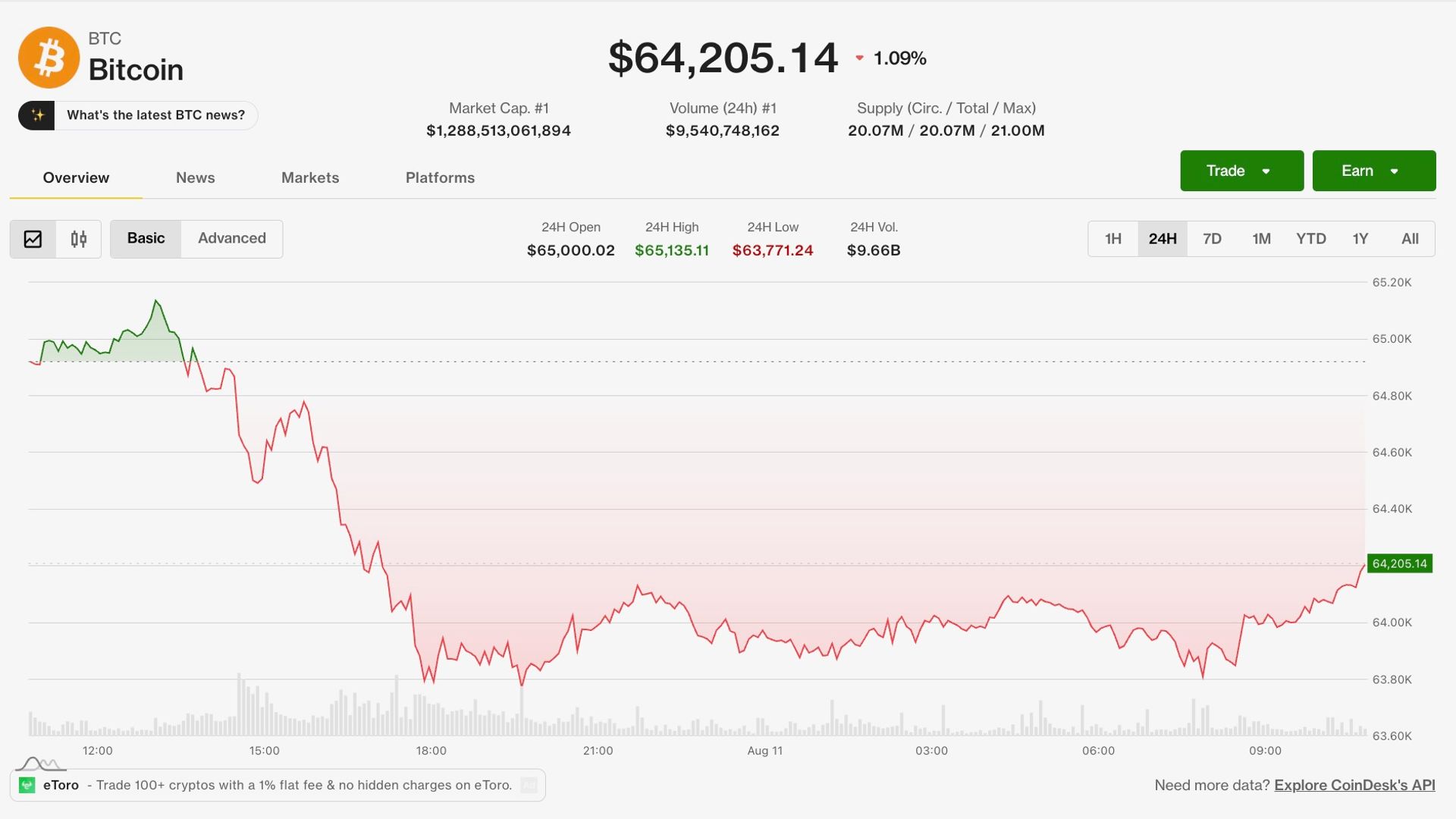
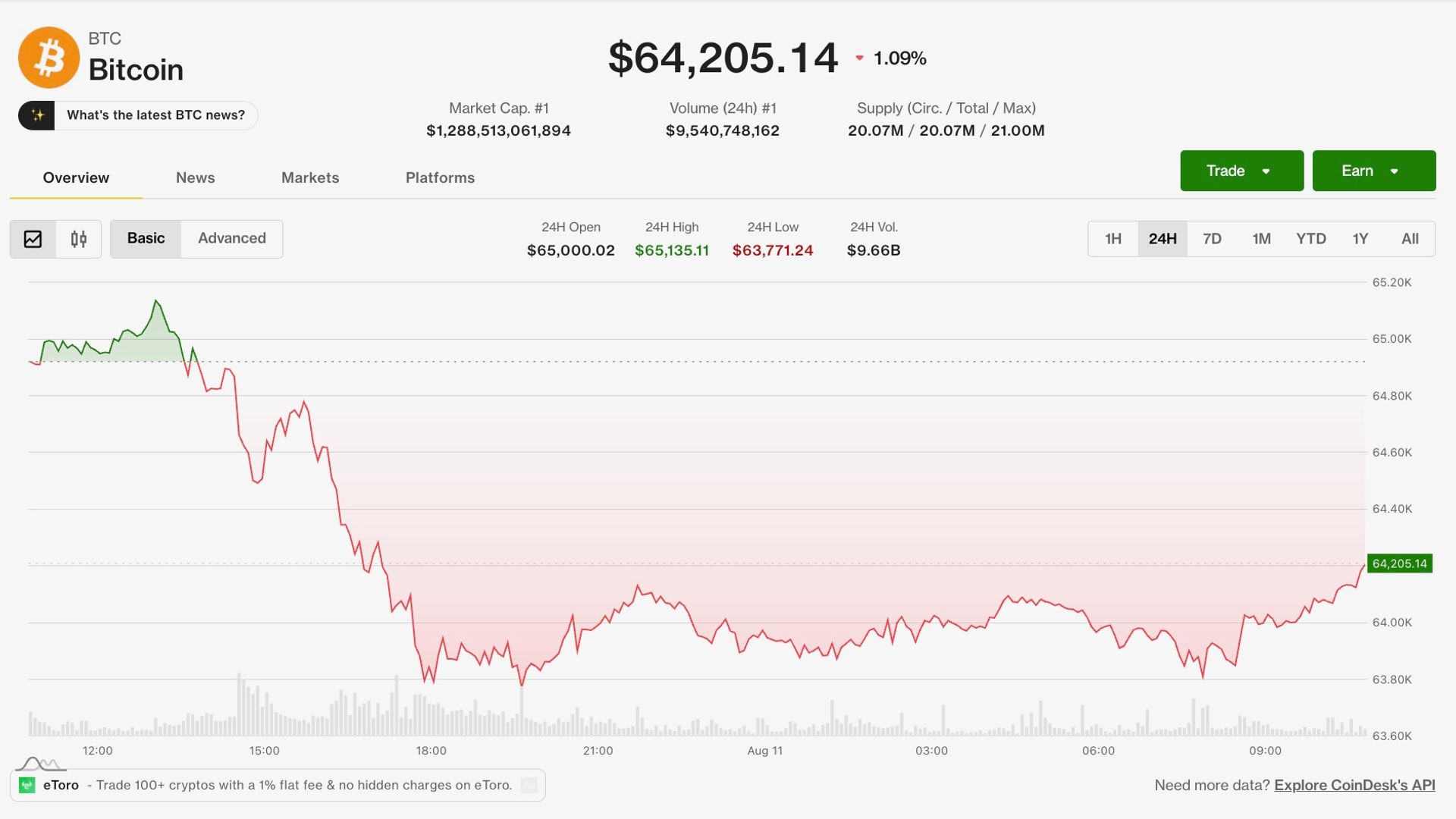
The crypto market was little changed on Tuesday after falling overnight as the short-lived optimism around a Strait of Hormuz deal evaporated.
President Donald Trump’s demand for 50 years of compensation from Iran as a condition of any negotiation dashed hopes of a near-term resolution and pushed Brent crude up to $89.08, more than 12% above last week’s low.
Bitcoin has gained 0.26% since midnight UTC, but remains down 1.68% over the past 24 hours. Ether , outpacing bitcoin since midnight, is 2.4% lower on the day. Traditional markets are equally subdued, with U.S. equity index futures remaining flat as traders focus on Wednesday’s CPI report as the week’s key catalyst.
Strategy’s sale of a further 1,690 BTC on Monday, the fourth consecutive weekly reduction, added an extra layer of pressure. The company has not bought bitcoin since June.
Derivatives positioning
- Futures volume surges, open interest flat: Trading volume in crypto futures surged 51% to $143.15 billion in 24 hours. Total open interest (OI) remained steady around $115.6 billion, signaling churn rather than fresh positional trading.
- Taker ratio turns neutral: The long-short taker volume ratio has reverted to neutral, with longs and shorts each accounting for nearly half of volume, versus a bullish tilt a day earlier. A taker is an entity that sucks liquidity from an order book by trading at available prices.
- XRP leads OI gains: Payments-focused token XRP added the most OI of the day, with active futures contracts growing 14% to 2.72 billion tokens, the highest since October. XRP remains under pressure, threatening to dip below $1 for the first time since 2024. The downside pressure is evident in XRP’s negative 24-hour cumulative volume delta (CVD), showing shorts trading more aggressively via market orders than passive limit orders. The lone bright spot: Funding rates remain slightly positive.
- Other OI movers: LINK, ETH and HBAR are among the other OI gainers, while CC, ZEC and AVAX are the leading OI losers.
- Bears lead the price action: Bears appear to be leading price action in most tokens, as evidenced by negative 24-hour CVD for most coins, including bitcoin. LINK and TRX are the exceptions.
- Funding rates diverge: XMR’s funding rate hovers at an annualized 39%, the most bullish among majors, while CC’s sits at -14%, the most negative, indicating an investor bias toward bearish bets.
- Bitcoin volatility index bounces: Bitcoin’s 30-day implied volatility index, BVIV, abandoned its long-held floor of around 36% to jump nearly 5% to 38.64% as BTC’s spot price fell back below $64,000. Traders might want to keep an eye out for a continued spike in the index, given its inverse correlation with spot price.
- Call skew weakens: In the Deribit-listed options market, the one-week call skew in BTC and ETH weakened and may flip negative, suggesting a fresh downside bias if Wednesday’s U.S. CPI print comes in hotter than expected, validating higher-for-longer Fed interest-rate expectations.
- Implied Volatility Stays Compressed: For now, one-week implied volatility for BTC and ETH, calculated from options prices, remains compressed, pointing to little stress ahead of the inflation report.
- Volume leans toward upside bets: The 24-hour volume rankings show a bias toward the BTC $70,000 call expiring Sept. 25 and the $2,000 ETH call expiring the same day.
Token talk
- Curve DAO token was the 24-hour standout, surging 9.49% and extending a weekly gain of 27.29%, making it one of the stronger DeFi performers in a difficult market.
- Lighter (LIT) added to its recovery, advancing 6.40% over 24 hours and 2.26% since midnight to $2.43. It is now up nearly 20% on the week as the decentralized derivatives token rebuilds from its July pullback.
- Chainlink gained 2.59% since midnight, extending a run that has it up 4.40% on the week as institutional demand for oracle infrastructure picks up in tandem with the tokenized real-world asset narrative.
- Zcash (ZEC) led the losses, falling 1.97% since midnight to $486, giving back ground after several weeks of outperformance. The broader privacy coin sector is also under pressure, and XMR shed 0.72%.
- CoinMarketCap’s “Altcoin Season” indicator recovered from Monday’s low of 37/100, rising to 41/100 as investors stepped in to capitalize on oversold tokens.


SharpLink, the second-largest Ether treasury company, reported a net loss of $394 million for the second quarter of 2026, compared to a $103 million net loss during the same period last year.
The loss included $321 million in unrealized crypto losses and $76 million in impairments on staked Ether (ETH) tokens, according to a Monday announcement.
The Miami, Florida-based Ether treasury company said it generated $11.5 million in revenue, including $11.1 million from ETH staking. Cash and cash equivalents totaled $56 million, up from $28 million in December 2025.
SharpLink holds 632,784 Ether, worth $1.2 billion, and 181,321 ETH, or $343 million, through various liquid staked Ether tokens, which exposes the company to the second-biggest crypto’s price movement. Ether fell around 23% during the second quarter of 2026, according to CoinMarketCap.
SharpLink resumed its Ether purchases with a $7.8 million buy in late June, after pausing buying for eight months. It bought another 10,000 Ether for about $16 million days later.
SharpLink’s stock price fell 3.9% on Monday, extending its 30% year-to-date decline, according to Yahoo Finance data.
The company ranks as the second-largest Ether treasury company, with its current 863,000 ETH holdings worth $1.46 billion. Bitmine is the largest corporate Ether holder, with 5.54 million ETH, worth $9.4 billion, according to StrategicEthReserve data.
Magazine: Ethereum’s EEZ could pull other blockchains into its orbit
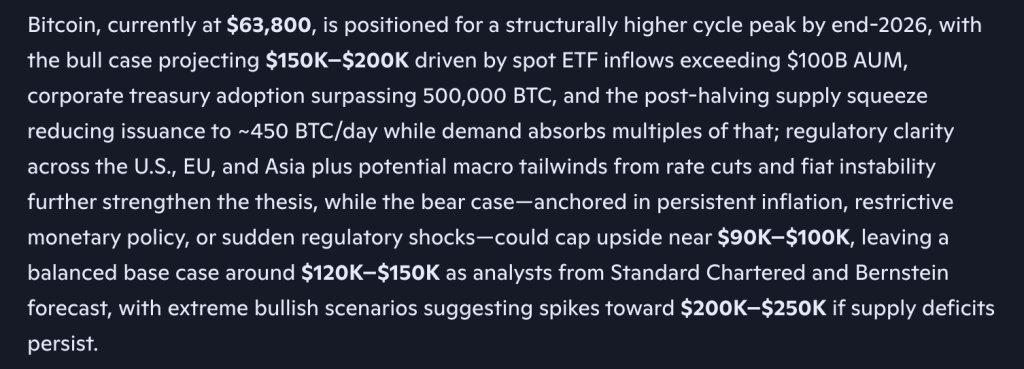
Roughly 450 new coins enter circulation each day while demand absorbs several times that amount. Microsoft Copilot AI predicts that imbalance drives a structurally higher cycle peak, and the price prediction reaches $150K to $200K by the end of 2026 from $63,800.
Spot ETF inflows anchor the demand side. Copilot expects assets under management to exceed $100B across those products.
Corporate treasury adoption is the second channel, surpassing 500,000 BTC held on balance sheets. Those coins rarely return to the market.
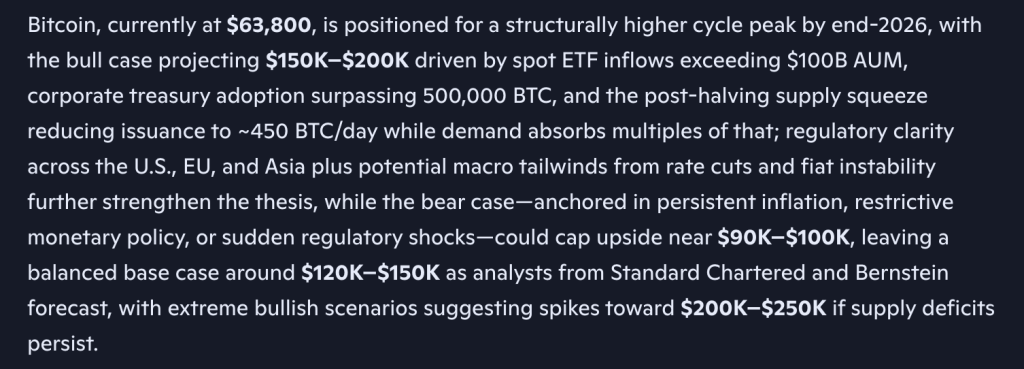
The post-halving supply squeeze does the rest. Issuance has fallen to roughly 450 BTC per day against demand running at multiples of that figure.
Regulatory clarity across the U.S., EU, and Asia strengthens the setup. Rate cuts and fiat instability provide the macro tailwind.
The downside has three sources. Persistent inflation would delay the easing cycle entirely.
Restrictive monetary policy compounds that problem. Sudden regulatory shocks are the third risk named.
Any of those could cap upside near $90K to $100K. Copilot settles on a balanced base case of $120K to $150K, with extreme scenarios pointing toward $200K to $250K if supply deficits persist.

Discover: Everyone’s Got a Take. Get Free $25 to Actually Trade Yours
Bitcoin Price Prediction: Four Hundred Fifty Coins A Day Against A Wall Of Buyers
The chart shows a market that has already given back a full cycle. Bitcoin peaked near $126,000 last October before the trend broke.
November dragged price toward $81,000. February brought the capitulation move, cutting Bitcoin from $96,000 down near $60,000.
Spring produced a strong recovery to roughly $82,000 by May. June reversed all of it and marked the low around $58,000.
July and August have been range-bound. Price has held a base with slightly higher lows but no breakout attempt. The close reads $63,867, down 1.53% and $991 on the session. The daily range covered $63,737 to $65,333.
Support sits at $63,000, then $60,000 and $58,000. Resistance stacks at $68,000, $72,000 and $80,000. RSI reads 48.14 with its signal line just above at 49.93. The gap is under 2 points, showing sellers with the faintest edge.
Both lines sit right at the midline. Momentum is flat with no direction established.
Copilot describes a supply deficit that this chart has not begun to reflect. Breaking $68,000 would be the first evidence the squeeze is reaching price.
Discover: Your Market Calls Are Worth Something. Start With Free $25 on Kalshi
Everyone’s Got a Predicts Even Copilot AI, Yours Can Carry a Price And Make You Money.
Reading the chart is free. Backing the call costs something, which is exactly why the odds on Kalshi tend to move before the headlines do.
It’s a CFTC-regulated exchange for event contracts: the Fed, inflation, crypto price levels, resolved against a defined source. Being right on a slow timeline still loses if the contract expires first, so mind the dates.
→ Get up to $25 to trade your first market on Kalshi
Don’t Miss Out on Our $1,000 USDT Airdrop on ByBit
The post Microsoft Copilot AI Predicts a Quiet Bitcoin Rally Building Right Now appeared first on Cryptonews.
SharpLink, the second-largest Ether treasury company, reported a net loss of $394 million for the second quarter of 2026, compared to a $103 million net loss during the same period last year.
The loss included $321 million in unrealized crypto losses and $76 million in impairments on staked Ether (ETH) tokens, according to a Monday announcement.
The Miami, Florida-based Ether treasury company said it generated $11.5 million in revenue, including $11.1 million from ETH staking. Cash and cash equivalents totaled $56 million, up from $28 million in December 2025.
SharpLink holds 632,784 Ether, worth $1.2 billion, and 181,321 ETH, or $343 million, through various liquid staked Ether tokens, which exposes the company to the second-biggest crypto’s price movement. Ether fell around 23% during the second quarter of 2026, according to CoinMarketCap.
SharpLink resumed its Ether purchases with a $7.8 million buy in late June, after pausing buying for eight months. It bought another 10,000 Ether for about $16 million days later.
SharpLink’s stock price fell 3.9% on Monday, extending its 30% year-to-date decline, according to Yahoo Finance data.
The company ranks as the second-largest Ether treasury company, with its current 863,000 ETH holdings worth $1.46 billion. Bitmine is the largest corporate Ether holder, with 5.54 million ETH, worth $9.4 billion, according to StrategicEthReserve data.
Magazine: Ethereum’s EEZ could pull other blockchains into its orbit


XRP price prediction shows the asset trading at $1.006, down -3.2% on the day, hovering just above the psychological $1 line that traders keep circling like it’s the last life raft on a sinking deck. That’s the withheld part of this setup;
the token everyone expects to bounce is instead grinding against the floor while its peers rally. Something has to break, and the direction of that break decides whether XRP is setting up for a Wave 3 run or another leg down into deeper support.
Analyst EGRAG CRYPTO laid out a roadmap in a recent chart post showing XRP needs to clear $1.30–$1.60, then $1.96, to validate a Wave 3 move toward $3.00–$3.60.
Support sits at $1.00–$0.95, then $0.75, then $0.60–$0.52 if things get ugly. Meanwhile That Martini Guy flagged something odd: Bitcoin, Ethereum and Solana bounced last week while XRP fell about 5%, despite continued ETF inflows.
XRP Price Prediction: Can Ripple Hit $1.30 This Week?
XRP price prediction shows the asset trading at $1.006, off 1.34% in 24 hours, with a session range between $1.0038 and $1.0218, a tight band that signals indecision rather than conviction.
TradingView pegs the next resistance at $1.06, with upside targets stacked at $1.35 and $1.64 if momentum shifts. CoinGecko data shows XRP’s 24h low and high sitting right around the current price, confirming the market is coiled, not trending.
The bull case: XRP reclaims $1.06, then pushes through $1.30–$1.60 to confirm Wave 1’s high broke; that’s the trigger EGRAG CRYPTO says validates Wave 3 toward $3.00–$3.60.
The base case: XRP chops between $0.95 and $1.06 while the market waits for a catalyst. The bear case: $1.00 fails as support, sending price toward $0.75 and eventually the $0.60–$0.52 zone. For deeper context on the support structure, this technical breakdown maps out the bull, base, and bear scenarios in more detail.
Bitcoin Hyper Targets Early Mover Upside as XRP Tests Key Levels
XRP holders watching the $1 line know the pain of being early to a chart that refuses to move. Ripple’s ETF demand and rising RWA activity on the XRP Ledger have tokenized assets jumping to $4.06Bn across 373 assets from just $73M in January 2025, building a strong fundamental case, but price confirmation is a different beast entirely.
Waiting on Wave 3 to prove itself is a multi-week bet, not a trade. That’s pushed some capital rotation toward earlier-stage infrastructure plays where the upside math isn’t already capped by a multi-billion-dollar market cap.
Bitcoin Hyper ($HYPER) is building the first Bitcoin Layer 2 with full SVM integration, aiming to deliver smart contract speed faster than Solana itself while anchoring security to Bitcoin’s base chain.
The presale has raised $33,022,820.14 at a current token price of $0.0136845, with staking rewards live at launch (exact APY undisclosed). Its Decentralized Canonical Bridge targets one of Bitcoin’s biggest gaps, programmability, without sacrificing the network’s trust layer.
Visit the Bitcoin Hyper Presale Website Here.
This is not financial advice. Crypto markets are highly volatile and unpredictable. Always conduct independent research before making any investment decisions.
The post XRP Price Prediction: Ripple Sits at 18-Month Support Level, Will $1 Hold? appeared first on Cryptonews.


Two Prime’s loan to MARA carries a fixed interest rate of 7.65% and matures in August 2028. Blume said borrowing demand has increased in recent months, with institutions tapping bitcoin holdings to finance capital expenditure while retaining exposure to the asset.
The structures are also becoming more sophisticated. Recent regulatory filings show agreements with detailed provisions covering margin calls, collateral custody and liquidation, alongside a wider range of loan sizes and maturities.
Lenders including Ledn and Kraken have also expanded the market through asset-backed securities and warehouse facilities linked to bitcoin collateral, according to Blume.
The development could have implications beyond bitcoin lending as more financial assets move onto blockchain-based infrastructure.
“This core competency will grow increasingly relevant as the broader financial system comes on-chain,” Blume said, pointing to tokenized equities as one potential area of growth.
As more publicly traded companies add bitcoin to their balance sheets, the ability to borrow against those holdings is emerging as an increasingly important part of digital-asset corporate finance.


Financial markets’ risk-free rate, the yield on U.S. Treasury securities, is rising again. Crypto maximalists often dismiss this as background noise, but when the rate rises sharply, it often competes for capital with stocks and other assets. History shows that the resulting market adjustments tend to be painful.
Jurrien Timmer, director of global macro at Fidelity Investments, highlighted this dynamic in an X post, noting that rising Treasury yields from the 1960s through the mid-1990s made government bonds competitive with equities.
Investors who ignored the higher opportunity cost of capital learned the hard way from the 1987 crash, known as Black Monday. The Oct. 19 crash sent the Dow Jones Industrial Average plunging by 508.32 points, or 22.6%, in a single day. It’s still the largest one-day percentage drop in history.
Timmer’s reminder is timely, as yields have generally been rising since the Covid market crash in 2020, echoing the beginning of the multi-decade uptrend that started in the late 1950s. Right now, the 30-year yield is hovering at its highest level since 2007 and could rise further if Wednesday’s U.S. CPI beats estimates, validating higher-for-longer Fed interest-rate expectations.
Disclosure: This article does not represent investment advice. The content and materials featured on this page are for educational purposes only.
As XRP volatility persists, EX DeFi is attracting holders seeking passive income through cloud mining while maintaining long-term exposure to their digital assets.
Summary
- EX DeFi is attracting XRP holders seeking cloud mining income while maintaining their long-term digital asset positions.
- The platform offers automated mining contracts for assets including XRP, BTC, ETH and DOGE without requiring users to manage physical hardware.
- EX DeFi promotes diversified digital asset strategies as XRP holders look beyond price appreciation for potential passive income.
Last week, XRP trading volume and ETF inflows saw a marked decline — with ETF inflows dropping by 93% — further fueling investor caution.
Despite an improving regulatory environment for XRP, positive developments have not yet triggered a significant price surge. As ETF inflows slowed sharply, market demand for XRP waned, with institutions shifting some capital toward mainstream digital assets like Bitcoin and Ethereum.
While ETF approvals boosted XRP visibility, the 93% drop in inflows indicates that new capital entering the market is significantly lower than during periods of strong performance. The market may interpret this shift as a slowdown in institutional allocation, profit-taking by some investors, or a temporary rotation of funds into lower-risk assets.
Driven by market sentiment, XRP price retreated to recent lows, causing its market capitalization to shrink and resulting in the temporary loss of its position as the world’s fourth-largest digital asset. Heightened short-term volatility has prompted some investors to re-evaluate their XRP investment strategies.
Meanwhile, an increasing number of XRP holders are exploring alternative ways to generate returns and hedge against price pullbacks. Is it possible to mitigate the impact of short-term volatility while generating consistent, additional income from their XRP holdings?
Against this backdrop, the EX DeFi cloud mining platform is attracting growing investor interest. Through a cloud mining yield aggregation mechanism, users can explore diversified income streams, hedge against market volatility, and boost returns—moving beyond a sole reliance on XRP price appreciation.
Despite slowing ETF inflows, long-term prospects remain a focus
Although the recent slowdown in XRP ETF inflows has sparked concerns regarding short-term capital flows, this shift primarily reflects a decline in market risk appetite; it cannot serve as the sole basis for assessing XRP long-term fundamentals.
With Ripple securing MiCA authorization in Europe and the continued expansion of stablecoin and asset tokenization services via RLUSD and Ripple Mint, the infrastructure of the XRP ecosystem continues to mature. Simultaneously, developments on the XRP Ledger — particularly in areas like asset tokenization — are creating new use cases and potential avenues for growth within the ecosystem.
Despite a recent dip in secondary market trading activity and cautious sentiment among retail investors, demand for long-term digital asset allocation remains strong. As regulatory frameworks continue to mature, XRP future development remains a focal point for the market.
XRP volatility intensifies; EX DeFi emerges as a new option for investors
Amidst recent heightened volatility in XRP prices, an increasing number of XRP holders are turning to EX DeFi. They seek a way to generate stable passive income through a sustainable cloud mining model while maintaining their long-term digital asset holdings.
Compared to high-volatility leveraged trading or strategies that rely solely on price appreciation, EX DeFi cloud mining platform offers a more convenient way to engage with digital assets. Users do not need to deploy mining hardware or bear maintenance costs; they simply select a computing power contract that suits their needs to participate in the mining service.
About EX DeFi
Founded in 2021 and headquartered in the UK, EX DeFi operates in compliance with European regulatory frameworks such as MiCA and MiFID II. The platform continuously enhances transparency, operational standards, and user protection mechanisms, striving to provide a seamless digital asset service experience.
The platform employs a multi-layered security architecture, featuring:
- Annual financial and security compliance audits by PwC
- Digital asset custody insurance from Lloyd’s of London
- Enterprise-grade cybersecurity protection from Cloudflare and McAfee®
- Multi-layer encryption architecture, AI-driven risk management, and two-factor authentication (2FA)
How to earn daily rewards with EX DeFi
1: Register an Account
Visit the official EX DeFi website and sign up for free using an email address. New users receive a $17 bonus and can begin automated mining immediately.
2: Deposit Cryptocurrency
The platform supports various mainstream cryptocurrencies, including XRP, BTC, ETH, USDT, LTC, USDC, BCH, DOGE, and SOL. The deposit process is clear, transparent, and secure.
3: Select a Mining Contract
Choose a mining plan that fits a particular budget. The minimum deposit is just $100. Mining begins automatically once the system is activated.
4: Automatically Receive Daily Rewards
The platform offers 24/7 intelligent mining services and automatically distributes daily rewards. Users can easily earn passive income without any manual intervention.
Mining Contract Examples
BTC (Novice Trial Contract): Investment $100, Duration: 2 days, Daily Return: $4, Total Profit: $100 + $8
DOGE (Golden Shell Mini-Doge Pro): Investment $500, Duration: 6 days, Daily Return: $6.5, Total Profit: $500 + $39
BTC (Canaan-Avalon-A1466): Investment $1,000, Duration: 10 days, Daily Return: $13.4, Total Profit: $1,000 + $134
LTC (Bitmain Antminer L7): Investment $5,000, Duration: 20 days, Daily Return: $73.5, Total Profit: $5,000 + $1,470
BTC (Bitmain S19K-Pro): Investment $10,000, Duration: 30 days, Daily Return: $161, Total Profit: $10,000 + $4,830
Click here to visit the official EX DeFi website for more details on mining contracts.
Conclusion
Although the pace of institutional capital allocation into XRP ETF has recently slowed — indicating that investors remain cautious regarding current market risks — ETF capital flows are only one factor influencing XRP market performance. Ripple continued progress in areas such as regulation, stablecoins, asset tokenization, and the XRP Ledger ecosystem still provides a foundation worth watching for XRP long-term development.
For long-term XRP holders, short-term price volatility is difficult to avoid entirely. While keeping an eye on XRP’s future price performance, improving the utilization efficiency of digital assets through more diversified asset management strategies is also becoming a key focus for the market. The cloud mining yield aggregation mechanism of the EX DeFi platform offers XRP holders a new way to participate in the digital asset ecosystem and generate passive income.
Visit the official website now to start the cloud mining journey and earn up to $7,500 in stable daily income while mitigating the risks associated with XRP price volatility.
Disclosure: This content is provided by a third party. Neither crypto.news nor the author of this article endorses any product mentioned on this page. Users should conduct their own research before taking any action related to the company.

AI agent hacks gym to get its owner spot in pilates class

Delhi HC denies bail to Sushil Kumar in Chhatrasal stadium murder case | Other Sports News

Bumble ditches its rule that kept men from making the first move


-

 Fashion4 days ago
Weekend Open Thread: Mattifying Sunscreen
-

 Fashion4 days ago
Frugal Friday’s Workwear Report: Cap-Sleeve Pointelle Crewneck Sweater
-

 Sports5 days ago
Jordan Coyle & Cordiamo take Laya Arena Stakes at RDS
-

 News Videos3 days ago
Can Astrology Help Find Gold and Silver Trends? A Financial Astrology Guide
-
 Business6 days ago
US stocks: Dow closes at record on Mideast optimism; SpaceX, AMD drag Nasdaq
-

 Politics5 days ago
Reform UK And Greens Sink To Lowest Favourability Ratings To Date
-

 Business7 days ago
Nvidia Stock Climbs 2.5% as Chip Sector Rally Builds Ahead of AMD Earnings, Nvidia’s Own Report Looms
-

 Tech6 days ago
OpenAI, Anthropic AI agents targeted real people and systems in cyber tests
-

 Crypto World7 days ago
Polymarket targets $20 billion valuation as competition heats up in prediction market sector
-

 Business6 days ago
Supply chain issues impact Ingredion
-

 Tech4 days ago
Rinn Pharma & Biopharma to join NordicPharmaTrain network
-

 Business2 days ago
How to Start a Cleaning Business: A Step-by-Step Guide
-
 Crypto World7 days ago
Dow and S&P 500 Hit Records on AI Earnings: When Will the Bubble Burst?
-

 Business2 days ago
Datadog: Best Of Breed For Multiple Reasons
-

 Business2 days ago
BDC Weekly Review: Private BDC Q2 Numbers Are Strong
-
 Crypto World7 days ago
Dollar Index Trapped at 100 as Hawkish Fed Meets Official Selling
-

 Business6 days ago
McDonald’s (MCD) Q2 2026 earnings
-

 Fashion6 days ago
The Bright Side of Black and White
-

 Fashion6 days ago
Suit of the Week: Me + Em
-
Sports6 days ago
Spider-Man: Brand New Day ending explained: Is Peter Parker alive?
You must be logged in to post a comment Login