
Crypto World
THORChain’s $618,000 Live Swap Puts Blockchain Transparency to the Test


TLDR:
-
- A single $618,000 BTC-to-USDC swap on THORChain exposed every transaction detail to the public in real time.
- GemWallet’s 50 basis point fee was written directly into the transaction memo, visible on-chain to anyone worldwide.
- THORChain allows users to swap assets without creating an account, submitting an ID, or seeking any permission.
- Every swap ever executed on THORChain remains permanently traceable, dating all the way back to its first transaction.
- A single $618,000 BTC-to-USDC swap on THORChain exposed every transaction detail to the public in real time.
THORChain recently showcased blockchain transparency through a live transaction on its network. A user swapped 8.99 BTC, worth roughly $67,393, for 611,637 USDC in under 17 minutes.
The swap totaled approximately $618,000 moving across chains. Every detail of this trade remained publicly visible to anyone with an internet connection.
What the Transaction Revealed About On-Chain Visibility
THORChain shared the transaction publicly, noting that every detail was traceable without any permission required.
The sending wallet address, destination address, exact amounts, fees, and processing time were all recorded permanently on a public blockchain. No compliance department or regulatory body controls access to this data.
The transaction memo also showed that GemWallet processed the swap and charged 50 basis points as a service fee.
That fee was written directly into the transaction instructions, not buried in a terms of service document. Anyone on earth could verify this at the moment it happened.
THORChain posted about the event, stating: “There is no compliance department to call, no freedom of information request to file, no company deciding what data you are allowed to see.”
This reflects a core design principle of public blockchain infrastructure. The data exists on-chain and remains accessible indefinitely.
This level of auditability extends beyond a single transaction. Every swap ever executed on THORChain traces back to the network’s first transaction, all publicly accessible without creating an account or submitting identification documents.
How THORChain Contrasts With Traditional Financial Systems
THORChain draws a direct comparison between its model and traditional finance. In conventional systems, users cannot meaningfully audit the infrastructure they trust with their money.
Access also requires clearing increasingly complex identity verification processes before any transaction can occur.
According to THORChain, opacity and gatekeeping come bundled together in traditional finance. Users are told this is simply how financial infrastructure must function. The protocol presents itself as evidence that this assumption does not hold.
The protocol operates under a model where full transparency and permissionless access coexist by default. A user can make a swap without asking anyone for permission, without creating an account, and without submitting any identification. Both features run simultaneously within the same system.
THORChain noted: “Full transparency and no gatekeepers are not mutually exclusive. They can coexist, and on a public blockchain they do by default.”
This positions the network as a functional alternative to systems where financial data remains controlled and access remains conditional. The transaction itself serves as a working example rather than a theoretical argument.



The U.S. Federal Deposit Insurance Corp. formally proposed its approach to stablecoin issuers as one of the federal financial regulators required to write and oversee rules under last year’s Guiding and Establishing National Innovation for U.S. Stablecoins (GENIUS) Act.
The FDIC’s proposal —meant to align closely with what its sister banking agency, the Office of the Comptroller of the Currency, proposed in February — will be open for a 60-day public comment period on the lengthy list of 144 questions posed Tuesday by the agency.
The FDIC’s job is to police U.S. depository institutions, and under the GENIUS Act, its role is to regulate such institutions issuing stablecoins from their subsidiaries. To that end, it posed capital, liquidity and custody standards for those firms, though the details won’t be set in stone until the rule is finalized — not likely to occur until the agency spends further months reviewing input and writing the final language. This is the second GENIUS Act proposal from the banking agency after its December pitch on the issuer application process.
As expected under the law, stablecoins won’t enjoy the deposit insurance that the banks maintain on traditional banking accounts, according to the proposal.
The OCC’s earlier proposal had a section that caused some initial concern among crypto policy experts wondering how the agency would allow for rewards programs managed by third-party stablecoin relationships, such as exchanges. In the same vein, the FDIC said that issuers wouldn’t be able to represent that their tokens pay interest or yield “simply for holding or using a payment stablecoin,” according to the staff presentation, including via arrangements with third parties. But crypto insiders have grown comfortable that properly tailored rewards programs shouldn’t run afoul of the rules.
The FDIC’s Tuesday proposal also suggested the capital that issuers will need to maintain to manage the risk of the business, plus “an operational backstop, separate from the capital requirement,” based on the previous year’s operating expenses.
The agency also addressed “the applicability of pass-through insurance to deposits held as reserves backing payment stablecoins,” proposing that “tokenized deposits that satisfy the statutory definition of ‘deposit’ would be treated no differently” than other deposits.
While the regulators work to implement GENIUS, some of its details are potentially already being overhauled by the work on the Senate’s Digital Asset Market Clarity Act. A clash between the banking and crypto industries over yield-bearing stablecoin holdings turned into a months-long debate that lawmakers have said they’re close to resolving, though the bill hasn’t yet advanced to a needed hearing. Congress comes back from a break later this week.
The OCC, FDIC and other agencies involved in implementing the rule, including the Treasury Department and the markets regulators, have few impediments in crafting regulations the way the Republican appointees want it. President Donald Trump’s White House has broken with past practice and declined to name any Democrat appointees to the many vacancies across the agencies, so there are no Democrats to raise objections to regulatory language.
But the GENIUS Act itself had drawn significant bipartisan support in both chambers of Congress when it was passed into law.
Read More: U.S. FDIC proposes first U.S. stablecoin rule to emerge from GENIUS Act
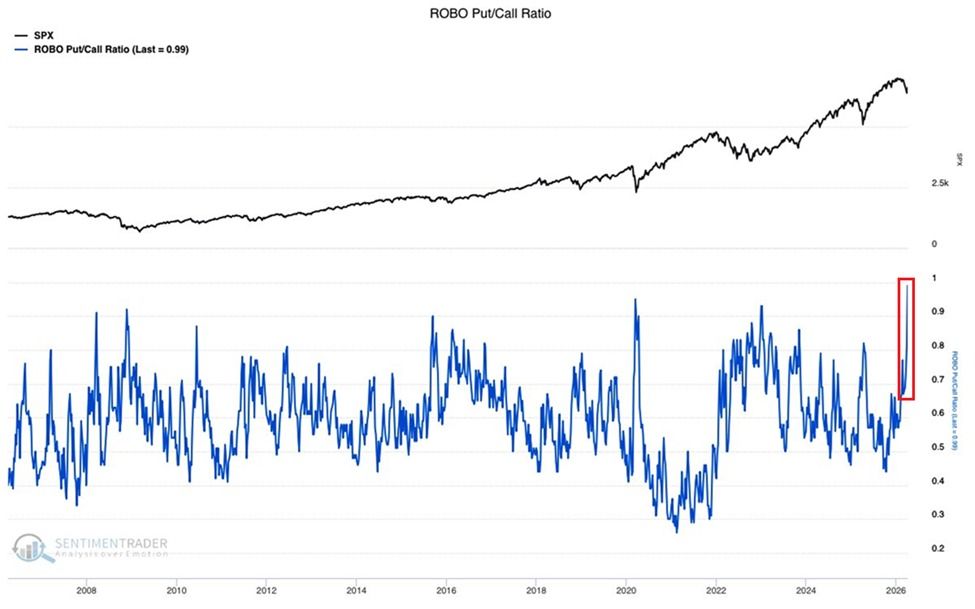
Retail fear across US equity markets has reached levels not seen in over two decades. The ROBO Put/Call Ratio has jumped to 1.0 for the first time in at least 20 years.
The reading exceeds the 0.91 peak during the 2008 Financial Crisis and the 0.95 reached during the 2020 pandemic selloff. The ratio has doubled since December, marking the sharpest rise since the 2022 bear market began.
“This ratio tracks retail opening buy orders in options, with the current reading showing retail traders buying nearly equal amounts of puts and calls…Fear is becoming overdone in this market,” The Kobeissi Letter noted.
Follow us on X to get the latest news as it happens
Market sentiment is also evidenced by the CNN Fear & Greed Index, which has fallen to 23, placing it at the threshold of extreme fear territory.
Bearish Positioning Reaches Rare Extremes
The surge comes amid a broad rise in short interest across all major US indexes. According to data from Global Markets Investor, the median short interest for the S&P 500 now stands at approximately 3.7%, its highest level in 11 years.
The Nasdaq 100 has reached roughly 2.7% short interest, a 6-year high. The Russell 2000 sits near 5.0%, its highest in 15 years.
The last time all three indexes showed such elevated short positioning simultaneously was during the 2010-2011 European debt crisis. That convergence is significant because it suggests bearish conviction extends beyond any single sector or market-cap segment.
“All three indexes have seen short interest rise sharply since mid-2024, accelerating further in 2026,” the post added.
BeInCrypto recently reported that hedge funds shorted global equities at the most aggressive pace in 13 years, with short sales outpacing long purchases by a ratio of 7.6 to 1.
The simultaneous alignment of extreme retail fear, a near-extreme Fear & Greed reading, and elevated institutional short positioning creates a notable asymmetry. Even a modest positive catalyst could trigger forced covering across multiple indexes, triggering a rapid, potentially disorderly rally.
The contrarian case is building, but a catalyst is needed. Sentiment alone doesn’t reverse markets. The critical question is whether current fear reflects genuine, fundamental deterioration or an overshoot driven by peak-fear psychology.
A resolution in the escalating US-Iran tensions could be the kind of macro shock that flips the narrative, but for now, with no signs of de-escalation, the market remains in a holding pattern between peak fear and potential inflection.
Subscribe to our YouTube channel to watch leaders and journalists provide expert insights
The post US Equity Fear Gauge Tops 2008 Crisis Levels as Short Interest Hits Multi-Year Highs appeared first on BeInCrypto.


The US Iran war latest news oil prices today tells a sharply escalating story: American forces struck more than 50 military targets on Kharg Island, the hub through which Iran exports 90% of its crude, sending oil surging more than 3% to nearly $116 per barrel within minutes of the first reports.
Summary
- The US military struck dozens of military targets on Kharg Island early Tuesday, Iran’s semi-official Mehr News Agency was first to report explosions, and Vice President JD Vance confirmed the strikes during a press conference in Budapest
- Oil jumped over 3% to nearly $116 per barrel immediately, while Brent crude crossed $110; Vance said the strikes did not include oil infrastructure and did not represent a change in strategy ahead of Trump’s 8 PM ET deadline
- The IRGC warned it would “deprive the US and its allies of the region’s oil and gas for years” if Trump follows through with threatened strikes on Iran’s civilian power and water infrastructure tonight
The US Iran war latest news oil prices today sent a fresh shock through global energy markets on Tuesday as US forces struck more than 50 military targets on Kharg Island, Iran’s largest oil export hub, hours before President Trump’s 8 PM ET deadline expired. Iran’s semi-official Mehr News Agency reported multiple explosions on the island as early as 1:30 PM local Tehran time, and oil surged immediately, with US crude jumping over 3% to nearly $116 per barrel and Brent crossing $110.
VP JD Vance confirmed the strikes during a press conference with Hungarian Prime Minister Viktor Orbán in Budapest, characterizing them as “re-strikes” on previously targeted sites. “I don’t think the news about Kharg Island changes anything,” Vance said, insisting the attacks did not touch oil infrastructure and did not alter the president’s strategy ahead of the evening deadline.
Kharg Island handles roughly 90% of Iran’s crude oil exports and carries a loading capacity of about 7 million barrels per day, making it the primary financial lifeline of Tehran’s war-era economy. Iran earns an estimated $53 billion in net oil export revenues annually, about 11% of its GDP, almost entirely flowing through the island’s pipelines and terminals.
The US has now struck the island twice since the war began February 28. The first attack in mid-March destroyed naval mine storage facilities, missile bunkers, and air defense systems while preserving oil infrastructure. Tuesday’s strikes hit some of the same sites, according to a US official, again stopping short of targeting the oil terminal itself. Whether that restraint holds after 8 PM is the question driving markets.
What an Oil Infrastructure Strike Would Mean
Analysts have warned that striking Kharg’s oil terminal would have immediate and lasting consequences. “A direct hit on Iran’s export terminal would instantly shut down most of its 1.5 million barrels per day crude exports,” JPMorgan data cited by CNBC showed. “Destruction of its oil infrastructure would take years to rebuild, leaving the country deprived of its most critical source of revenue,” Vandana Hari of Vanda Insights told CNBC.
Iran has already telegraphed its response. The IRGC warned Tuesday that it would “deprive the US and its allies of the region’s oil and gas for years” if the civilian infrastructure strikes go forward. It also signaled that restraint toward Gulf Arab states hosting US military assets is now over, saying “all such considerations have been lifted” — a direct threat to regional energy facilities in Saudi Arabia, Kuwait, and the UAE.
Bitcoin and Crypto Markets Under Fresh Pressure
As crypto.news reported, each round of escalation in this conflict has pushed oil higher and Bitcoin lower, with the Strait of Hormuz closure already keeping crude above $100 for weeks and compressing Federal Reserve flexibility on rate cuts. Crypto.news also noted that major cryptocurrencies have dropped 3 to 5% during prior escalation phases, as higher oil prices feed directly into inflation expectations and reduce appetite for risk assets.
Tonight’s 8 PM deadline, and what follows it, will determine the next major move for both energy and crypto markets.
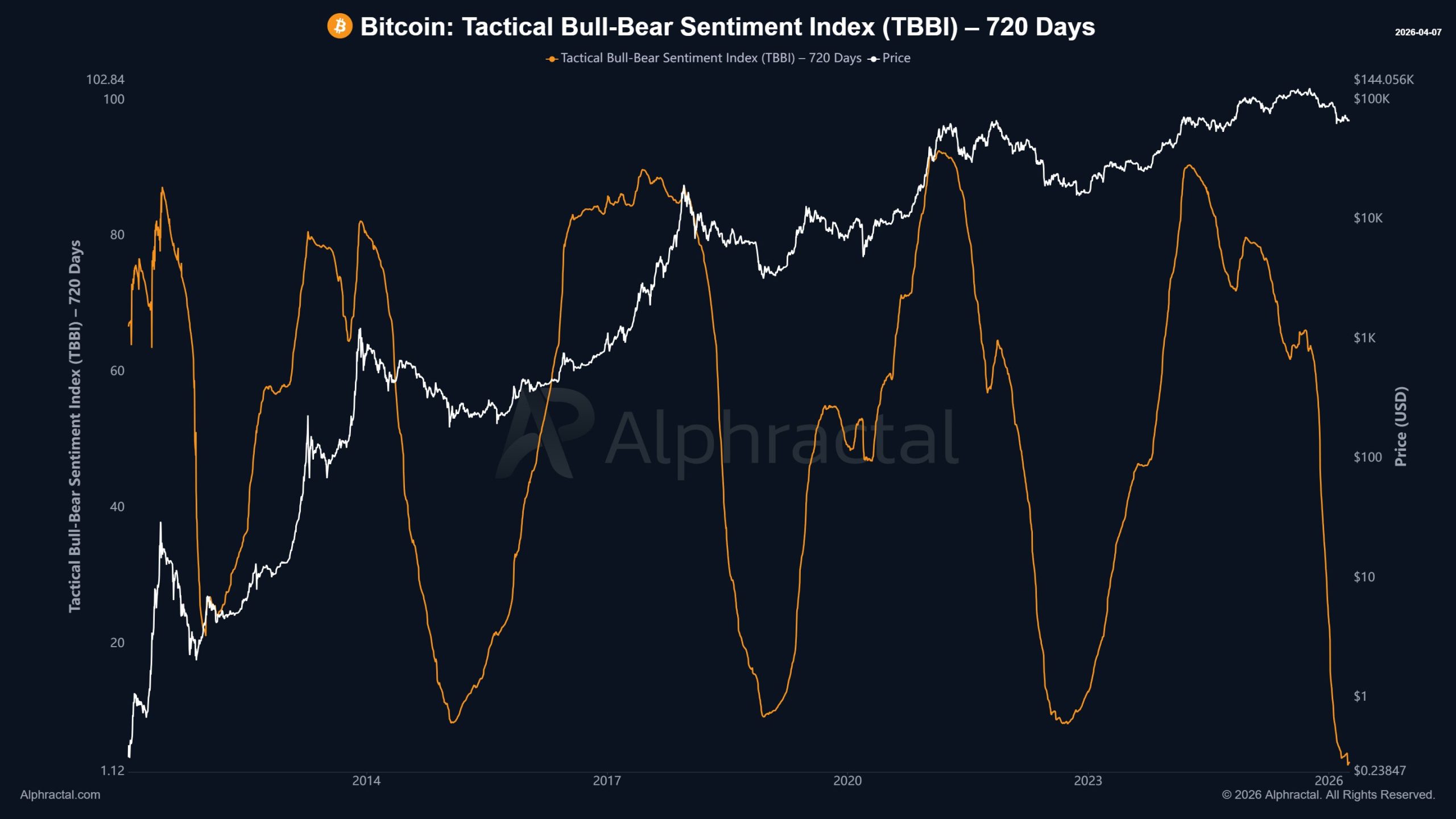
Multiple Bitcoin indicators, including a bull-bear sentiment index and realized price metric, point to a possible final BTC shakeout toward $54,000
Bitcoin (BTC) is showing signs of the bear market’s late stages but could see another leg lower in the coming months, says Joao Wedson, founder and CEO of on-chain analytics platform Alphractal.
Key takeaways:
-
BTC may still see one last big drop before recovering, based on one sentiment indicator.
-
The next likely downside target is near Bitcoin’s realized price at $54,000.
BTC index hints at a drop toward $54,000
In a Tuesday post, Wedson said Bitcoin’s 720-day Tactical Bull-Bear Sentiment Index (TBBI), a long-term indicator that tracks multi-year cycles of fear and greed, had dropped into an extreme bearish zone below 20.
Historically, such readings have reflected “late-stage fear” among traders, a phase that can still produce one final shakeout before Bitcoin begins a more durable recovery.

In 2022, for instance, Bitcoin fell more than 20% after the indicator reached similarly depressed levels.
A comparable setup also appeared before Bitcoin lost around 50% in 2018, prompting Wedson to see a similar possibility in 2026.
Related: Bitcoin RSI ‘nearly perfectly’ copying end of 2022 bear market: Analysis
He warned that Bitcoin could still face “a sharp move like a –$15K shakeout” over the next six months, implying a roughly 20% decline from current levels toward the $54,000 area.
More BTC indicators converge on $50,000–$55,000
The implied target matches earlier BTC downside calls that see Bitcoin falling toward the $50,000–$55,000 area on war-led oil inflation and quantum security risks.
The $54,000 level also nearly coincides with Bitcoin’s realized price (purple) on Glassnode’s MVRV Extreme Deviation Pricing Bands, suggesting any final shakeout could send BTC toward a key on-chain cost-basis support level.

More bearish forecasts have also surfaced, with analysts such as Bloomberg Intelligence’s Mike McGlone warning that Bitcoin could eventually slide to as low as $10,000.
Still, Strategy’s aggressive Bitcoin purchases in recent weeks have helped absorb selling pressure and limit BTC’s downside, raising the possibility that the broader bearish scenario may fail to play out.
As Cointelegraph reported, Bitcoin could reverse sharply and climb back toward $100,000 or higher if the Michael Saylor firm continues its buying spree.
This article is produced in accordance with Cointelegraph’s Editorial Policy and is intended for informational purposes only. It does not constitute investment advice or recommendations. All investments and trades carry risk; readers are encouraged to conduct independent research before making any decisions. Cointelegraph makes no guarantees regarding the accuracy or completeness of the information presented, including forward-looking statements, and will not be liable for any loss or damage arising from reliance on this content.
The US stock market dropped on April 7 as Trump’s warning that “a whole civilization will die tonight” ahead of the Iran Strait of Hormuz deadline injected fresh fear into equities.
WTI crude surged to $115.19, up 13% in a single week, as reports of Israeli strikes on Iran’s Kharg Island petrochemical infrastructure removed the remaining de-escalation hopes that had given stocks a brief lift in recent sessions.
Three forces drove selling on April 7, all tracing back to the same root cause. Oil above $115 is feeding into inflation expectations, keeping the Fed locked, and crushing consumer and growth stocks simultaneously.
1. Trump’s “Civilization” Warning Kills De-Escalation Narrative
Markets had been pricing in partial de-escalation after Iran’s earlier diplomatic exchanges through mediators. Trump’s statement, made ahead of his self-imposed Tuesday deadline for Iran to reopen the Strait of Hormuz, killed that narrative and reignited fears of direct strikes on Iranian energy infrastructure.
The Hormuz closure has already disrupted roughly one-fifth of global oil and LNG supplies. Trump’s demand for immediate reopening, paired with reports of Kharg Island strikes, signals that the conflict is entering a more dangerous phase rather than winding down.
Risk assets sold off as the “war ending soon” trade unwound.
2. WTI at $115 Tightens the Oil-Inflation-Rates Chain
WTI crude at $115.19 is 13% higher in a single week. Oil at these levels functions as a direct tax on consumers and businesses, raising input costs across every sector and feeding into the inflation data the Federal Reserve is watching.
The March CPI report due Friday is expected to show the sharpest monthly increase since 2022, making rate relief even less likely.
3. Apple’s 3.35% Drop Drags the Index
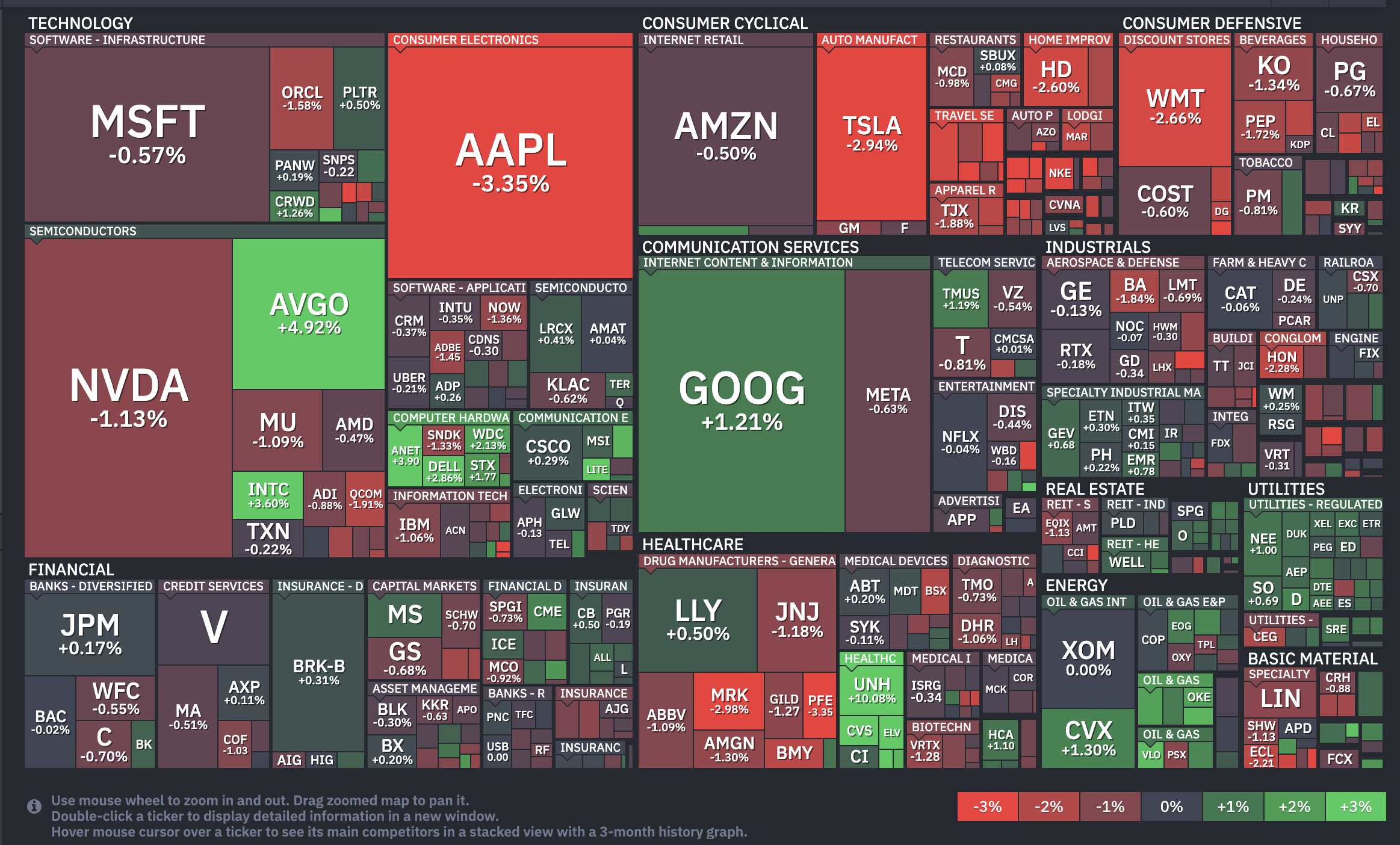
Apple (AAPL) fell 3.35% after Nikkei Asia reported engineering setbacks in the foldable iPhone that could push back production timelines. Apple carries the largest weighting in the S&P 500, so a nearly 4% decline mechanically drags the index regardless of broader conditions.
What Is Happening to Major US Indexes?
At press time, all four major indexes are in the red.
- S&P 500 fell 28.89 points (−0.44%) to 6,582.94. The index dipped over 1% earlier in the session before recovering.
- Dow Jones Industrial Average dropped 244.33 points (−0.52%) to 46,425.60.
- Nasdaq Composite declined 141.40 points (−0.64%) to 21,854.90.
Russell 2000 slipped 0.85 points (−0.34%) to 251.51, confirming that small-cap weakness mirrors the broader index decline.
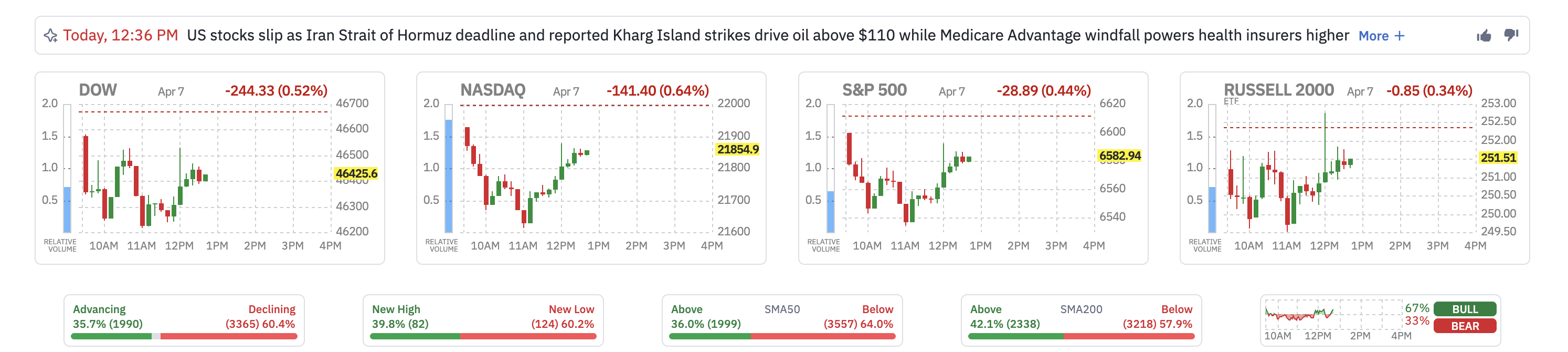
Market breadth is negative, with 3,365 stocks declining (60.4%) versus 1,990 advancing (35.7%).
The S&P 500 trades at 6,580 on the daily chart, grappling with two converging Exponential Moving Averages (EMAs), trend indicators that give greater weight to recent price action.
The 20-day EMA sits at 6,601 and the 200-day EMA at 6,587. When the shortest and longest EMAs compress this tightly, it reflects a market that has lost directional conviction and is waiting for a catalyst to force resolution.
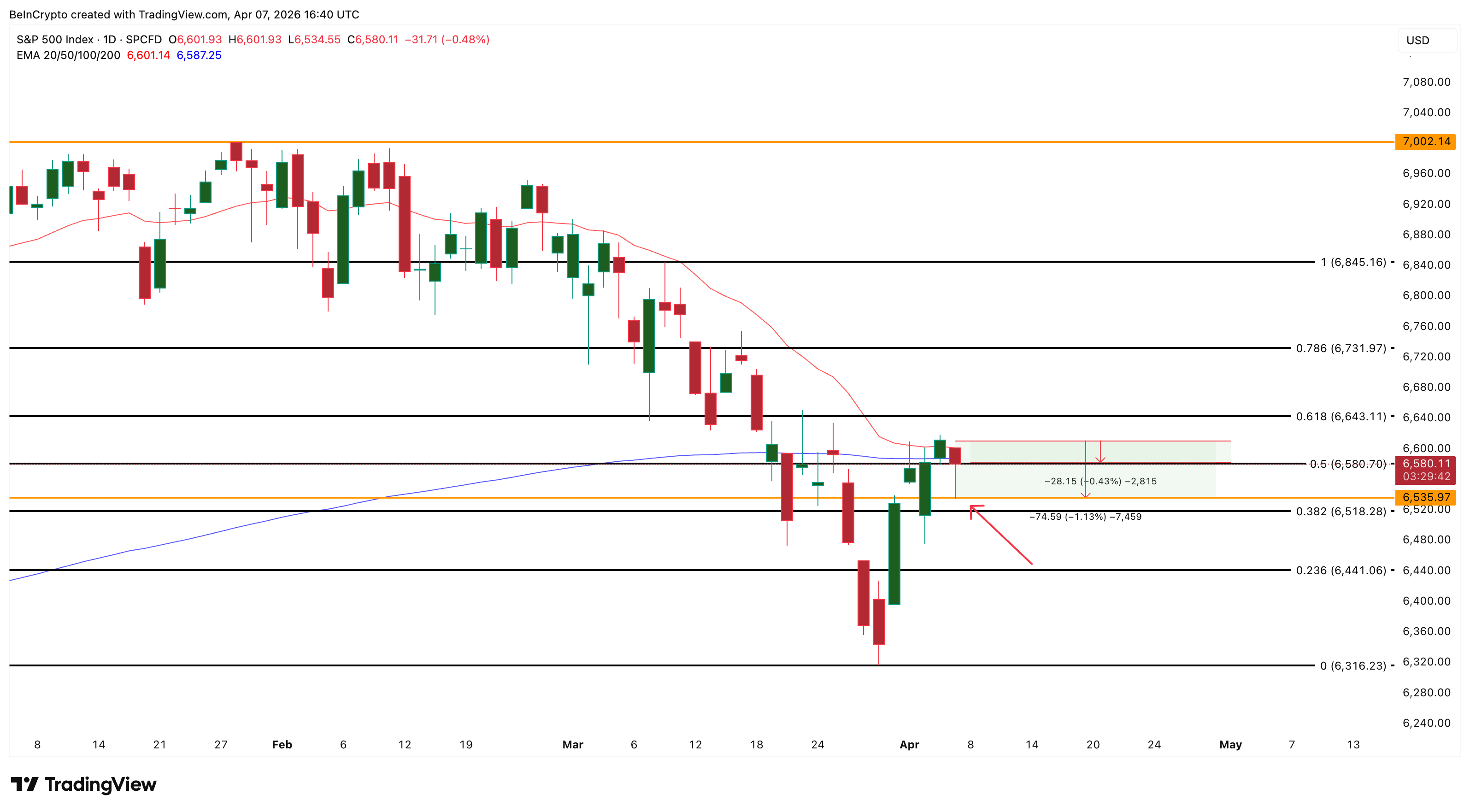
The intraday low of 6,534 found support near 6,518 at the 0.382 technical level. A daily close below 6,518 opens the path toward 6,441 and the previous swing low at 6,316.
On the upside, the US stock market needs a daily close above 6,643 to show recovery strength, with 6,845 as the next target above that.
Which Sectors Are Holding Up?
Energy led with a +0.54% gain as WTI stayed above $115. The sector remains the only group with a structural tailwind from the Iran conflict, as elevated oil prices directly increase producer revenue.
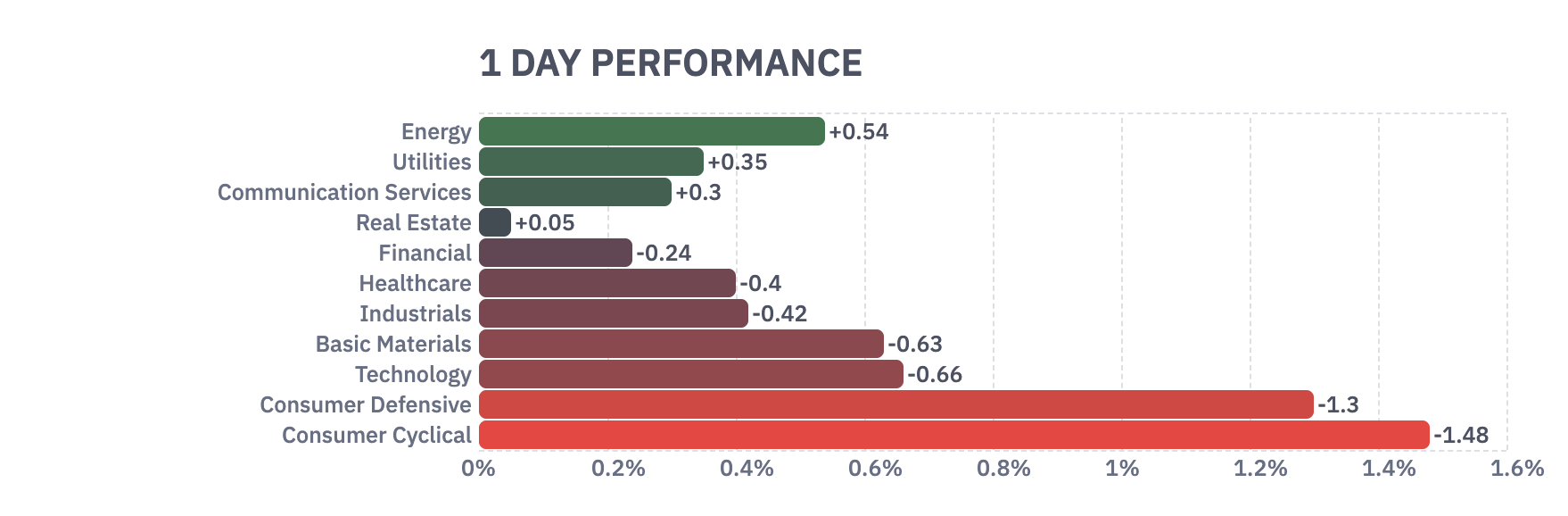
Utilities added +0.35% as defensive positioning continued. Risk aversion is overriding the sector’s traditional rate sensitivity, making yield-paying defensives attractive as a parking spot for nervous capital.
Communication Services gained +0.30%, supported by Google (GOOG) rising 1.21%.
Which Sectors Are Falling?
Consumer Cyclical led losses at −1.48%. Higher oil prices compress discretionary spending power by raising fuel and transportation costs. Tesla (TSLA) fell 2.94%, Home Depot (HD) dropped 2.60%, and Walmart (WMT) lost 2.66%.
Consumer Defensive also fell 1.30%, an unusual decline for a traditionally safe sector that signals selling pressure is broad enough to hit even conservative holdings. Coca-Cola (KO) lost 1.34% and Procter & Gamble (PG) dropped 0.67%.
Basic Materials declined 0.63% despite gold holding above $4,400. The decline reflects that commodity-linked equities are not fully insulated from the broader selling pressure.
Major Stock News Investors Are Watching
Broadcom (AVGO) jumped 4.92% after Anthropic signed an agreement with Google and Broadcom for multiple gigawatts of next-generation TPU capacity starting in 2027.
The deal signals that AI infrastructure demand remains strong enough to override the macro headwinds for companies directly tied to capacity buildout.
UnitedHealth Group (UNH) surged 10.08% on Medicare Advantage windfall news, making it the day’s standout gainer in the S&P 500 and providing a floor for the Healthcare sector that would have otherwise fallen further.
What Are Investors Watching Next?
Trump’s self-imposed Tuesday deadline for Iran to reopen the Strait of Hormuz arrives within hours. If Iran signals compliance or a negotiated pathway, oil could retreat sharply, lifting equities by Wednesday’s open.
If the deadline passes without resolution and strikes on Iranian energy infrastructure begin, WTI could push higher. That scenario would further compress the oil-inflation-rates chain. It would push the 10-year yield toward new highs, and bring the S&P 500’s 6,316 swing low firmly into play.
The March CPI data arrives on Friday. A hot print would reinforce the “higher for longer” narrative, while a softer number could provide relief to growth stocks.
The combination of the Iran deadline and CPI makes this week one of the most event-dense for the US stock market.
The post Why Is the US Stock Market Down Today? appeared first on BeInCrypto.


CME Group is expanding its suite of cryptocurrency futures products, as more traditional finance (TradFi) entities launch regulated crypto trading products.
On Tuesday, CME Group announced plans to launch Avalanche (AVAX) and Sui (SUI) futures contracts on May 4, pending regulatory review.
Market participants will be able to trade both micro-sized and larger-sized contracts, including AVAX futures sized at 5,000 AVAX and Micro AVAX futures sized at 500 AVAX, as well as SUI futures sized at 50,000 SUI and Micro SUI futures sized at 5,000 SUI.
CME expands altcoin futures lineup
The news follows CME Group’s announcement in January of its plans to launch crypto futures contracts tied to Cardano (ADA), Chainlink (LINK) and Stellar (XLM).
The move is the latest sign that traditional financial firms are broadening their regulated crypto product offerings.
CME Group’s continued expansion of its crypto derivatives suite reflects “growing demand for regulated, institutionally-sound products in this asset class,” said Justin Young, CEO and Co-founder of Volatility Shares.
During an earnings call in early February, CME Group CEO Terry Duffy said the exchange is mulling plans to launch its own digital token that could operate on a decentralized network.
CME Group is the largest derivatives exchange by volume, and reported a record average daily trading volume of 28.1 million contracts in 2025, according to a Jan. 7 announcement.
Related: Crypto exchanges gain as tokenized commodity market climbs to $7.7B
CME Group prepares to launch 24/7 trading for crypto products
More TradFi entities are exploring ways to issue tokenized investment products with 24/7 trading. CME said on Feb. 19 that its cryptocurrency futures and options products will begin trading 24/7 on May 29.
Unlike traditional stocks and equities constrained to trading hours, cryptocurrencies are natively tradable 24/7 through cryptocurrency exchanges and decentralized venues.
On March 24, the New York Stock Exchange (NYSE) announced it was partnering with tokenization platform Securitize to mint blockchain-based shares of stocks and exchange-traded funds (ETFs), Cointelegraph reported. The initiative is part of its parent company, Intercontinental Exchange’s (ICE) plan for a tokenized securities venue designed for 24/7 trading and instant onchain settlement.
Meanwhile, crypto exchanges are also venturing into tokenized TradFi products. Coinbase launched 24/7 stock perpetual futures for non-US traders on March 20, offering cash-settled exposure to major US stocks and indices, including Apple and Nvidia.
Crypto exchanges Binance and Kraken have also launched tokenized perpetual futures trading for non-US traders, along with other offshore platforms.
Magazine: Can Robinhood or Kraken’s tokenized stocks ever be truly decentralized?
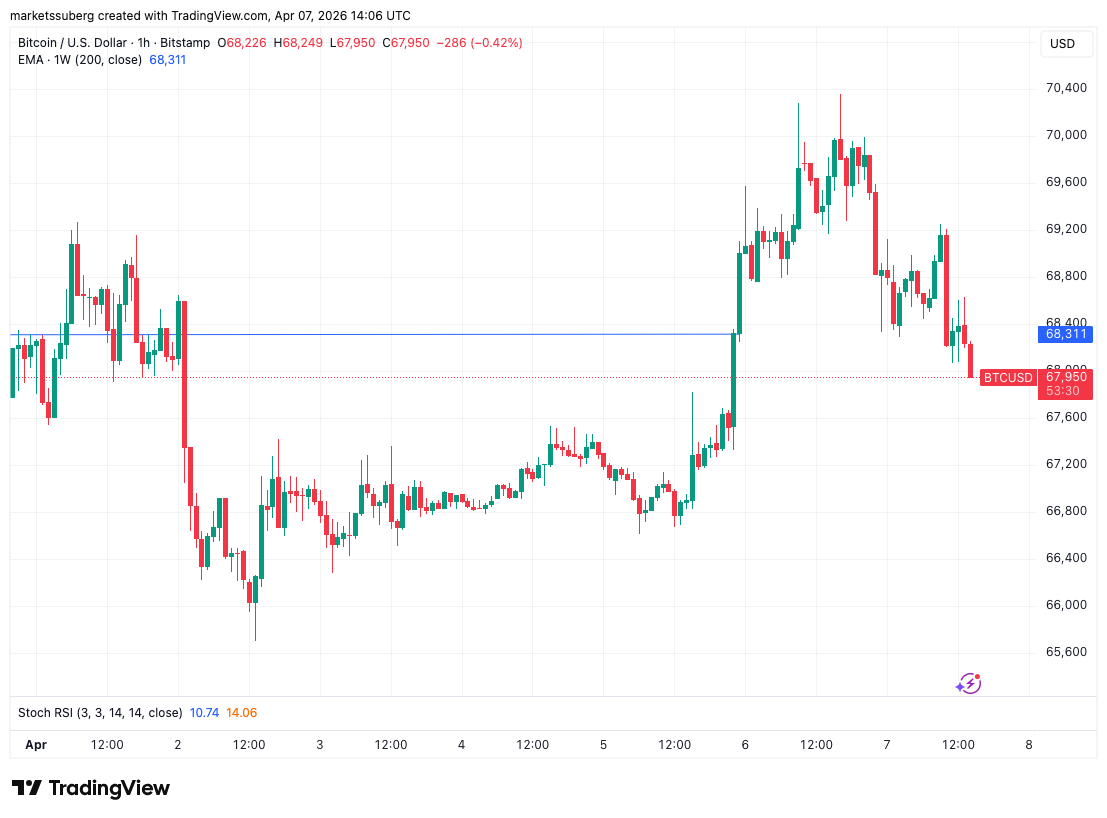
Bitcoin (BTC) stayed near a key long-term trend line at Tuesday’s Wall Street open as markets waited for US-Iran war cues.
Key points:
-
Bitcoin and US stocks attempt to shrug off claims by US President Donald Trump that a “whole civilization will die” after his Iran deadline expires.
-
Oil eyes a rematch with multiyear highs as escalation fears take control.
-
Bitcoin traders see lower levels resulting from current indecision.
Bitcoin attempts to ignore Trump Iran comments
Data from TradingView showed BTC price action focusing on its 200-week exponential moving average (EMA) near $68,300.

Volatility briefly entered prior to the US trading session as President Donald Trump said that “a whole civilization will die tonight,” referring to his 8pm Eastern time deadline for a deal with Iran.
“I don’t want that to happen, but it probably will,” he wrote in a post on Truth Social, while keeping full details sparse.

The post was accompanied by news of strikes on Iranian oil infrastructure on Kharg Island.
Despite this, US stocks managed to avoid major losses on the day, leading commentators to suggest that Iran rhetoric was all but fully priced in.
“Markets have become numb to the headlines,” trading resource The Kobeissi Letter reacted on X.

The day prior, trading company QCP Capital noted that the same geopolitical pattern had been playing out for weeks.
“While the economic and humanitarian consequences of escalation would be severe, particularly via energy market disruption, markets are increasingly discounting the immediacy of this risk,” it wrote in its latest “Market Color” analysis.
QCP described stocks as “broadly stable,” with crypto showing “resilience.”
“After several weeks of weekend escalation rhetoric followed by early-week de-escalation signals, markets are beginning to recognise and fade this pattern,” it continued.
“Despite approaching deadlines and rising rhetoric, crypto markets continue to exhibit resilience rather than panic.”

WTI crude oil nonetheless passed $116 per barrel on the day, coiling below its highest levels in nearly four years.
BTC price surfs liquidity walls
Commenting on Bitcoin and wider market trajectory, crypto trader Michaël Van de Poppe suggested that an inflection point was coming.
Related: Bitcoin RSI ‘nearly perfectly’ copying end of 2022 bear market: Analysis
“Prime question for this is likely whether there will be a ceasefire in the Middle-East or not,” he told X followers.
“From a technical standpoint, it’s more likely that markets are turning downwards as the trend is clearly in that direction and (as I’ve mentioned earlier), sweeping the lows and grabbing that liquidity strengthens a potential reversal on the markets significantly.”

Trader LP flagged overhead resistance making $72,000 a problematic hurdle to clear for bulls.
“Orderbook pressure showed strong buy pressure between 63–66K, which helped drive price toward the 70K region. However, sell pressure is now stepping in around 71–72K, acting as resistance and potentially capping price if it persists,” an X post read.

This article is produced in accordance with Cointelegraph’s Editorial Policy and is intended for informational purposes only. It does not constitute investment advice or recommendations. All investments and trades carry risk; readers are encouraged to conduct independent research before making any decisions. Cointelegraph makes no guarantees regarding the accuracy or completeness of the information presented, including forward-looking statements, and will not be liable for any loss or damage arising from reliance on this content.
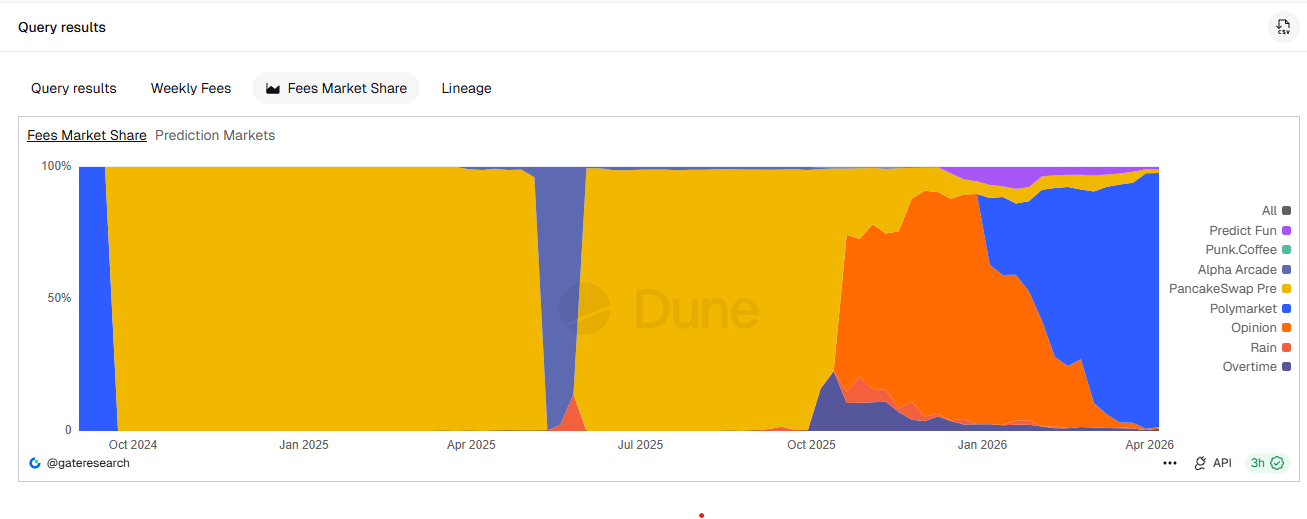
Polymarket has become one of decentralized finance’s most profitable protocols after a pricing overhaul, generating about $7.1 million in fees in the first week of the second quarter, according to new data.
That pace implies an annualized run rate of roughly $365 million if sustained, placing the onchain prediction platform among the industry’s top fee generators and giving it nearly all of the sector’s revenue, at 96.8% of onchain prediction market fees.
The gains follow a March 30 pricing change that pushed daily fees to around $1 million, a level that has largely held as trading activity remains elevated, data from DeFiLlama shows, and make Polymarket the eighth-largest DeFi protocol by fees, along with stablecoin issuers Circle (USDC) and Tether (USDT) and decentralized derivatives exchange Hyperliquid.
Onchain metrics also show Polymarket’s footprint beyond fees. Total value locked on the platform was over $432 million on Tuesday, according to DeFiLlama data, close to its November 2024 US election high of around $510 million, as its share of onchain prediction market revenue rises.

ICE backs Polymarket, but regulation uncertainty remains
Polymarket’s fee engine has started to attract more mainstream partners. Intercontinental Exchange, the owner of the New York Stock Exchange, deepened its bet on Polymarket on March 27, completing a $600 million cash investment as part of a broader $2 billion commitment that will see ICE distribute the platform’s event-driven data to institutional clients.
Related: Iran war bets turn prediction markets into real-time macro radar: Sygnum
At the infrastructure level, Polymarket announced Monday that it is replacing its bridged USDC.e collateral on Polygon with a new 1:1 USDC-backed token called Polymarket USD, which will take over as trading collateral as part of the platform’s April exchange upgrade, as it continues to spin up highly-traded markets on the US-Iran conflict, oil, inflation and equities indices.
Despite its growing revenue, regulation remains a risk. Prediction markets continue to face pushback from some US states and gambling regulators elsewhere, including recent moves by Hungary and Portugal to order local blocking, and Argentina issuing a countrywide block on Polymarket, arguing that the platform operates as an unlicensed gambling site.
Magazine: Bitcoin’s ‘biggest bull catalyst’ would be Saylor’s liquidation — Santiment founder
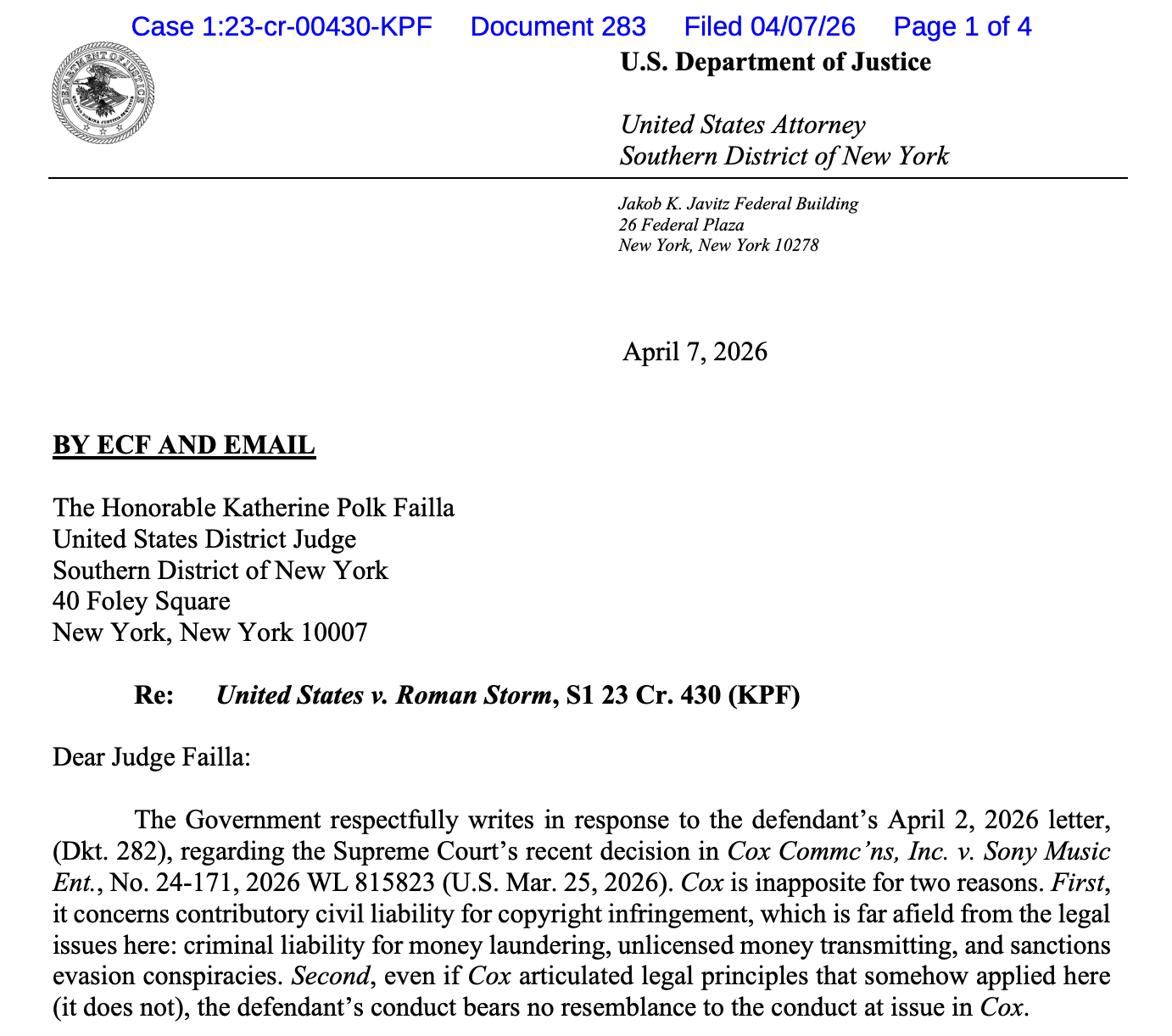
Jay Clayton, the US Attorney for the Southern District of New York (SDNY) and former chair of the Securities and Exchange Commission (SEC), has penned a response to Tornado Cash co-founder Roman Storm’s motion for acquittal, criticizing his alleged criminal behavior.
In a Tuesday filing in the US District Court for the Southern District of New York, Clayton said that Storm’s criminal use of Tornado Cash was “window dressing at best and outright misdirection at worst,” rejecting arguments that he be allowed to use a civil copyright case in his defense.
The US Attorney’s filing followed a Thursday notice from Storm’s lawyers saying they intended to use a 2026 Supreme Court case, Cox Communications, Inc. v. Sony Music Entertainment, as part of an argument about the Tornado Cash co-founder’s intent to participate in the crimes of which he is accused: conspiracy to commit money laundering and conspiracy to violate sanctions.
Clayton said that Storm’s conduct “bears no resemblance” to that in the Cox case, which involved civil liability for copyright infringement. According to the US Attorney, there was no evidence that the Tornado Cash co-founder implemented effective anti-money-laundering measures.
“The defendant’s conduct simply is not comparable to the conduct at issue in Cox,” said Clayton. “In any event, a civil copyright case has no relevance here in the first place.”

Last August, a jury convicted Storm of conspiracy to operate an unlicensed money transmitting business, but deadlocked on conspiracy to commit money laundering and conspiracy to violate sanctions charges, opening the door to a potential retrial. The case has drawn widespread attention from the crypto industry for how developers may be held responsible for their code.
Prosecutors and defense attorneys in the Storm case are scheduled to meet on Thursday.
Related: US lawmakers move to protect blockchain devs from prosecution
Attorney behind memo calling for end to crypto “regulation by prosecution” gets top DOJ job
Last week, US President Donald Trump fired Attorney General Pam Bondi, substituting Deputy AG Todd Blanche as acting head of the Justice Department until the Senate can vote on a replacement. Blanche, who previously acted as Trump’s personal attorney, also penned an April 2025 memo calling for the end of what he called “regulation by prosecution” in the Justice Department.
Although Blanche did not call out Storm by name, he did say that the department will “not pursue actions against the platforms that [criminal] enterprises utilize to conduct their illegal activities” and called for an end to cases inconsistent with that goal.
Storm cited Blanche’s memo in a March X post after prosecutors called to retry the Tornado Cash co-founder on the two deadlocked counts.
”The 2 counts = up to 40 years in federal prison,” said Storm. “For writing open-source code. For a protocol I don’t control. For transactions I never touched. A jury already couldn’t agree this was criminal. But the SDNY prosecutors want to keep trying with the hope of getting a different answer.”
It’s unclear how Blanche may use his new role to direct DOJ policy, or how long he will remain as acting AG. Clayton has asked a federal judge to consider an October retrial for Storm, but as of Tuesday, no date had been set.
Circle minted $1 billion USDC in 24 hours, extending a $4.5b year‑to‑date supply jump and signaling heavy institutional dollar demand across Solana and centralized venues.
Summary
- Circle minted $1 billion in new USDC over the past 24 hours, according to on‑chain data from Lookonchain.
- The pace and size of issuance point to institutional liquidity demand rather than retail activity.
- USDC remains the fastest‑growing major stablecoin in 2026, with net supply up about $4.5 billion year to date.
Circle has minted roughly $1 billion in new USD Coin (USDC) over the past 24 hours, a burst of issuance that signals a sharp, short‑term spike in demand for dollar liquidity across crypto rails, according to on‑chain analytics platform Lookonchain. TechFlow News, citing Lookonchain’s monitoring, reported that Circle executed two large mints totaling $500 million each, bringing 24‑hour issuance to $1 billion and adding to an already heavy minting pace on the Solana network in early 2026.
Lookonchain previously flagged similar surges, including a single‑day window where Circle minted about $1.25 billion USDC on Solana and another period where Circle and Tether together created roughly $17.25 billion in new stablecoins in the weeks following October 2025 market turbulence. OnchainLens data cited by Phemex shows Circle has minted about $3.25 billion in USDC on Solana alone over the past seven days, via repeated $250 million transactions, marking the issuer’s largest weekly stablecoin deployment on the network so far this year.
The cadence and scale of Circle’s latest $1 billion mint make it unlikely to be driven purely by fragmented retail flows. Past episodes where Circle printed $500 million to $1.25 billion in hours have typically coincided with major liquidity provisioning for centralized exchanges, ETF custodians or basis/arbitrage desks, rather than grassroots trading cycles. MEXC and KuCoin coverage of earlier Lookonchain alerts noted that fast, billion‑dollar issuance bursts often precede or accompany deeper order books and wider USDC routing across derivatives venues, lending markets and perpetual futures platforms.
More broadly, data compiled by Artemis and reported by Analytics Insight indicate that USDC has recorded the largest net stablecoin supply increase of 2026 so far, adding about $4.5 billion in circulating supply through March as rivals such as USDT saw net outflows of roughly $2 billion. A separate dashboard from MEXC shows USDC’s market cap near $73 billion, with 24‑hour trading volume around $4.48 billion and over 250 applications using USDC as base collateral or a primary trading pair, underscoring its role as regulated liquidity plumbing for both centralized and decentralized markets.
While Circle does not publicly pre‑announce client‑driven mints, the pattern fits several potential institutional use cases: ETF or centralized‑finance inventory replenishment, on‑chain basis and arbitrage strategies, or large over‑the‑counter (OTC) settlements that require immediate, programmatic dollar liquidity. CoinMarketCap’s research arm recently highlighted “massive USDC minting and inflows to exchanges like Binance,” arguing that such patterns “signal strong capital preparation for trading or deployment rather than speculative retail chasing.”
Coinfomania, covering a prior 750 million USDC mint that kicked off 2026 on Solana, framed these large issuances as “strong liquidity signals” that draw institutional attention to where fresh stablecoin capital is being parked and deployed. Combined with March data showing USDC leading all major stablecoins in net new supply, the latest $1 billion mint suggests that, at least for now, deep‑pocketed players are choosing Circle’s regulated dollar rails as their primary channel for moving size into crypto markets.

Games machine rigged to pay out in Scarborough arcade

Wedding Planner Shuts Down Taylor Swift-Travis Kelce Ocean House Rumors: 'Taylor Is Not My Bride'

Stablecoin issuers get closer to U.S. federal rules with FDIC’s new proposal


-

 NewsBeat5 days ago
Steven Gerrard disagrees with Gary Neville over ‘shock’ Chelsea and Arsenal claim | Football
-

 Business5 days ago
No Jackpot Winner and $194 Million Prize Rolls Over
-

 Fashion4 days ago
Weekend Open Thread: Spanx – Corporette.com
-

 Crypto World6 days ago
Gold Price Prediction: Worst Month in 17 Years fo Save Haven Rock
-

 Business2 days ago
Three Gulf funds agree to back Paramount’s $81 billion takeover of Warner, WSJ reports
-

 Business3 days ago
Expert Picks for Every Need
-

 Sports3 days ago
India men’s 4x400m and mixed 4x100m relay teams register big progress | Other Sports News
-

 Business6 days ago
Login and Checkout Issues Spark Merchant Frustration
-

 Crypto World7 days ago
Bitcoin enters the public bond market as Moody’s gives a first-of-its-kind crypto deal a rating
-
Business2 days ago
No Jackpot Winner, Prize to Climb to $231 Million
-
Crypto World7 days ago
Bitcoin stalls below key resistance as technical signals skew bearish
-

 Tech5 days ago
Commonwealth Fusion Systems leans on magnets for near-term revenue
-

 Politics7 days ago
Starmer’s centre has collapsed, and the left was right all along
-

 Crypto World6 days ago
Ripple rolls out enterprise crypto treasury platform for corporates
-

 Fashion1 day ago
Massimo Dutti Offers Inspiration for Your Summer Mood Board
-

 Crypto World6 days ago
Why It’s Partnering, Not Issuing
-
Crypto World7 days ago
AI Memory Rout Wipes 9% Off Nvidia Stock: Chart Says More Pain Ahead
-
 Sports7 days ago
How to teach yourself the perfect impact position with every club
-

 Tech7 days ago
Solo Leveling: Ranking All Sung Jinwoo Shadows by Power
-

 Tech6 days ago
Drawing Tablet Controls Laser In Real-Time
You must be logged in to post a comment Login