

Crypto World
Tom Lee predicts ETH will hit $250,000 as corporate validators take over network control



The cryptocurrency market is looking at the wrong signals, and a massive shift in how the world’s financial networks operate is happening quietly behind the scenes.
In a keynote address at the Proof of Talk conference in Paris, Tom Lee, head of Research at Fundstrat and Chairman of Bitmine Immersion Technologies (BMNR), told his audience that ether (ETH) is experiencing significant changes that will eventually drive up its price to $250,000. While Lee did not provide a specific timeline for the target, he did map out the infrastructure shifts driving the network toward that value.
Ether on Tuesday was changing hands at $1,906, down 6% over the past 24 hours.
Lee’s Bitmine firm is one of the largest corporate holders of Ethereum. Bitmine ramped up ETH purchases last week, making its most significant since December. It bought 111,942 ether (ETH) worth around $237 million at current prices. That lifted the firm’s holdings to almost 5.4 million ETH, about 4.47% of ether’s circulating supply.
“If a thesis is correct and Ethereum is going to break out of this consolidation, and the consolidation breakout is tokenization and AI, you know, I think that that’s probably 50X or so—significant upside for Ethereum. If Ether realizes, is correct, and Ethereum goes to $250,000, that values Bitmine stock at $5,000. It’s a bargain at $18.”
Multi-trillion-dollar growth
Lee explained that this multi-trillion-dollar growth will be driven by artificial intelligence. As advanced software and automated computing take over the internet, machines will need a way to pay each other instantly without relying on slow, traditional bank wires.
“Robots are already going to dominate most traffic on the internet,” Lee stated. “And this is why Andreessen Horowitz and others have talked about this as being the great unification because if you’ve got robot systems, you’re going to have to control them. And that’s where blockchain is much more effective than traditional rails for controlling what robots do. Whether it’s authentication or identity or payment speed, all of these work better on crypto systems.”
Because of this machine-to-machine economy, Lee believes Ethereum will transform from a speculative digital asset into the primary global currency for paying for automated computer processing power.
Ethereum Foundation death
This systemic growth is completely changing how the underlying blockchain networks are managed. Lee pointed out that the non-profit Ethereum Foundation has spent years shrinking its own footprint, dropping its network holdings down to just 100,000 ETH—accounting for a tiny 0.1% of the total supply.
In its place, massive public companies are stepping in to run the network as corporate validators. Corporate entities like Bitmine and Sharklink now collectively control 7% of the entire circulating Ethereum supply. Instead of relying on foundation grants, these corporate treasuries now generate $500 million in staking rewards each year to fund the ecosystem themselves.
To demonstrate the value of this model, Lee announced a major regulatory milestone for Bitmine, which trades on the New York Stock Exchange under the ticker BMNR.
“Bitmine also meets the eligibility criteria to be added to the Russell 1000,” Lee revealed. “The inclusion date is June 26. Why does that matter? Well, the Russell 1000 is the most widely tracked index in the world… Every fund manager in the world who is benchmarked against the Russell 1000—and that’s over $4 trillion worth—will have to decide if they want to own Bitmine.”
Lee explained, with graphics behind him, that holding an active corporate validator stock significantly outperforms buying spot crypto. Over a baseline six-month stretch, holding regular spot ETH generated a modest 22% return, while Bitmine’s staking architecture returned 500% to its investors.
For Lee, the massive structural growth of corporate staking and AI utility completely overrides any temporary market panic. “If you are bearish today, you are selling at the bottom,” Lee concluded. “And again, I can’t emphasize thinking, if you’re bearish today, you are bearish at the bottom for Bitcoin and Ethereum.”


TLDR
- The EU pushed bidding for its AI gigafactory project from May to July.
- The plan targets five AI data centers, each with one gigawatt of capacity.
- Early interest has dropped from about 70 companies to roughly 10 expected bidders.
- Only two of the five planned centers can receive funding before 2028.
- SoftBank’s France data center plan is larger than the full EU gigafactory program.
Europe’s plan to build large AI data centers has run into delays before bidding begins. The project aims to create five gigafactory sites with major chip capacity across the bloc. However, funding gaps and delayed rules have reduced early interest from potential bidders.
Bidding Delay Shrinks Early Interest in EU AI Sites
According to a report by Bloomberg, the European Union originally planned to open bidding for the AI gigafactory project in May. Officials have now pushed the process to July after repeated delays. The planned facilities would each carry one gigawatt of power capacity. Each site would also use about 100,000 advanced chips for AI workloads.
The European Commission has also delayed the publication of selection criteria several times. That delay has made planning harder for groups preparing bids. The project first attracted interest from about 70 companies across Europe. That field has now narrowed to roughly 10 groups expected to submit proposals.
The plan also limits submissions to a maximum of one bid per country. Several groups now face questions over timing, scale, and available subsidies. Maria Nowicka, a Brussels-based researcher at Interface, pointed to repeated delays. “I think I’ve lost count,” she said, referring to the shifting timeline.
Funding Structure Limits Early Rollout
The EU plan carries a total expected cost of €20 billion. Less than half of that amount would come from public funding. The European Union would provide €4.1 billion in direct subsidies. Host member states would match that amount under the proposed funding model.
Private investors would cover the remaining cost for the five planned centers. However, the funding schedule has created a problem for near-term delivery. Only two of the five centers can receive funding before 2028. The remaining sites depend on the EU’s next budget cycle.
Some partners are reconsidering bids if the project shrinks from its original design. People familiar with the matter said at least two groups may step back. The delayed funding structure places pressure on the program’s launch schedule. It also raises questions about how fast Europe can add AI infrastructure.
Global Data Center Spending Outpaces EU Plan
The EU program faces a large spending gap when compared with private AI infrastructure deals. SoftBank recently announced up to €75 billion for data centers in France. That France’s plan alone exceeds the full EU gigafactory program by more than three times. It also shows the scale of private capital entering AI infrastructure.
Meta is also raising $13 billion for one data center in Texas. That single project stands close to the EU’s total direct subsidy plan. US utilities plan to spend $1.4 trillion on grid infrastructure for AI by 2030. American hyperscalers are also investing hundreds of billions of dollars annually in data centers.
The EU’s €4.1 billion subsidy would spread across five countries. That makes each site dependent on national support and private capital. The Commission has not yet published final bidding criteria for the gigafactory sites. The delayed criteria remain the next factual step before formal bids begin.


Ripple inked strategic deals with three Turkey-based crypto platforms, aiming to boost adoption and usage of its stablecoin RLUSD.
Additionally, the company picked Istanbul Technical University (ITU) as its latest partner in its global University Blockchain Research Initiative (UBRI).
Expansion to Turkey
The company behind the popular cryptocurrency XRP revealed that its USD-pegged stablecoin is now available to institutions in Turkey via partnerships with BiLira, Bitexen, and Bitlo. Jack McDonald (SVP of Stablecoins at Ripple) said the country sits “at the crossroads of traditional financial and digital economy” and has one of the highest rates of crypto adoption globally.
“By providing a stable, USD-backed asset that is both transparent and fully regulated, we are empowering Turkish businesses to access global liquidity,” he added.
Alphan Göğüş, CEO at Bitexen MENA, also spoke on the matter. He described the collaboration as “the first step in a broader rollout” across the Bitexen Global platform.
“Supporting RLUSD aligns with our strategy to provide trusted, USD-denominated instruments within a compliant and scalable framework,” he said.
For his part, Sinan Koç, Co-Founder of BiLira, argued that the stablecoin is “uniquely equipped” to accelerate blockchain adoption in the country. As a matter of fact, Turkey has already emerged as a dominant player in the crypto world, and according to a 2025 Chainalysis report, it facilitates roughly $200 billion in annual transaction volume, outpacing its rivals in the MENA region.
Mustafa Aplay, CEO of Bitlo, said the partnership with Ripple offers the Turkish crypto ecosystem a direct, secure gateway to global financial markets.
“By integrating a regulated, enterprise-grade stablecoin like RLUSD, we’re providing our customers with the highest standard of digital dollars for enterprise needs,” he concluded.
Ripple’s stablecoin officially saw the light of day toward the end of 2024, and since then, it has experienced impressive advancement. Some heavyweights that have so far embraced it include crypto exchanges Binance and OKX, as well as America’s oldest bank, BNY Mellon. Its market capitalization has been rising lately and currently stands at around $1.81 billion, making RLUSD the 48th-largest digital asset.
Another Partnership
In addition to collaborating with BiLira, Bitexen, and Bitlo, Ripple also shook hands with Istanbul Technical University (ITU). The partnership, funded via RLUSD, will support advanced research initiatives and graduate fellowships while establishing an XRP Ledger (XRPL) validator directly on the Istanbul Technical University ITU campus.
“By integrating academic research with hands-on decentralized infrastructure, Ripple and ITU are ensuring the next generation of Turkish researchers and students are at the forefront of blockchain innovation,” the official announcement reads.
The post Major Ripple (XRP) Announcement Affecting Turkish Users: Details appeared first on CryptoPotato.


Mastercard is expanding its settlement network to support regulated stablecoins, a move that could help bring blockchain-based payments deeper into the plumbing of the global financial system.
The company said Wednesday it plans to offer issuers and acquirers additional settlement options, including intraday, weekend and holiday settlement as well as on-chain settlement using regulated stablecoins. The new capabilities will operate alongside existing fiat settlement processes and are designed to give financial institutions more flexibility in managing liquidity.
Mastercard will initially support settlement using Circle’s USDC, Paxos-issued PYUSD, USDG and USDP, Ripple’s RLUSD and SoFiUSD. The stablecoins will be available across blockchain networks including Ethereum (ETH), Solana (SOL), Polygon (POL), Base, Arbitrum (ARB) and XRPL.
While the announcement may appear technical, it reflects a broader shift underway in financial markets. Traditionally, card transactions are authorized instantly, but settlement between banks and payment providers often occurs later in batches and is limited by banking hours. Mastercard’s new framework moves the network closer to an always-on model where value can be transferred and settled around the clock.
“The next phase of stablecoin adoption is about real-world utility, especially in settlement, where timing and liquidity matter most,” Raj Dhamodharan, Mastercard’s executive vice president of blockchain and digital assets, said in a statement.
The significance extends beyond payments. Stablecoins have long been used primarily for crypto trading, but banks, payment firms and asset managers are increasingly viewing them as settlement assets that can move money instantly across borders and outside traditional banking schedules.
The rollout comes as competition intensifies among payment networks and financial institutions seeking to modernize settlement infrastructure. Circle, Ripple, Paxos and other stablecoin issuers have increasingly positioned their products as alternatives to legacy correspondent banking rails for cross-border payments and treasury operations.
Several financial institutions, including Cross River, Lead Bank, CBW Bank, ARQ and Nuvei, are expected to be among the first participants supporting stablecoin settlement in the U.S. and Latin America.
Ethereum remains under pressure after failing to reclaim a major resistance cluster. The price is now hovering around a key long-term support zone. The broader structure suggests sellers still dominate the market, while weakening demand from US investors adds another layer of caution.
Ethereum Price Analysis: The Daily Chart
On the weekly timeframe, ETH has extended its rejection from the major horizontal resistance region around $2.4K. This zone has repeatedly acted as a pivotal level throughout the current cycle and has once again capped upside momentum. The rejection has pushed the asset back toward the ascending trendline that has supported the market since the 2022 bear market bottom.
ETH is currently trading around $2K, just above the trendline and the $1.8K demand zone. This area represents the most important support cluster on the chart, as it combines a horizontal support area with the long-term rising trendline.
As long as ETH remains above this confluence, the long-term market structure will be intact. However, a decisive breakdown below the trendline and the $1.8K support region could trigger a catastrophic correction toward the next major support area near $1,500 and cause more panic, even among long-term investors.
On the upside, the $2.4K zone remains the primary resistance. Reclaiming that area would be the first sign that buyers are regaining control and could open the door for a move toward $4.8K. Yet, with momentum conditions also remaining weak, as shown by the RSI, but not reaching the oversold region on the weekly timeframe, it seems that downside pressure has not fully exhausted itself. As a result, a deeper decline to test the critical support area is likely the scenario in the short-term.

ETH/USDT 4-Hour Chart
The 4-hour chart paints a similarly bearish picture. ETH continues to trade inside a descending channel. The channel is clearly identifiable by consistent lower highs and lower lows since mid-May. Following the rejection from the $2.15K supply zone, the market resumed its downward trajectory and is now returning to the lower boundary of the channel. The price is currently moving inside the $1.95K to $2K support area, which is preventing a sharper decline.
Yet, the bearish channel structure remains the dominant technical feature. As long as ETH stays below the upper boundary of the pattern and beneath the $2.15K resistance zone, short-term momentum favors sellers. A breakdown below the current support region could expose the liquidity pocket around $1.95k and potentially lead to a long liquidation cascade and push the price deeper to test the lower boundary of the channel.
Conversely, a successful defense of the $1.95k area followed by a breakout above the channel’s upper trendline would likely be the first indication of a broader recovery toward $2.15K and potentially the key weekly resistance at $2.4K.

Sentiment Analysis
The Coinbase Premium Index continues to signal weak spot demand from U.S. investors. The metric has remained predominantly in negative territory throughout May and has recently declined toward approximately -0.13. This is one of its lowest readings in the past year.
Historically, sustained positive Coinbase Premium readings tend to accompany periods of strong institutional and U.S.-based buying activity. In contrast, the current negative values indicate that ETH is trading at a discount on Coinbase relative to offshore exchanges, suggesting weaker demand from a key segment of the market.
This weakness aligns with Ethereum’s ongoing downtrend and helps explain the market’s inability to reclaim the $2.4K resistance zone. While deeply negative Premium readings can sometimes precede local bottoms as selling pressure becomes exhausted, the metric currently shows little evidence of aggressive accumulation. So, unless the Coinbase Premium Index begins to recover and move back toward positive territory, supply and demand dynamics continue to support the cautious outlook implied by the technical structure.

The post Ethereum Price Prediction: How Low Can ETH Go If $2K Support Decisively Cracks? appeared first on CryptoPotato.
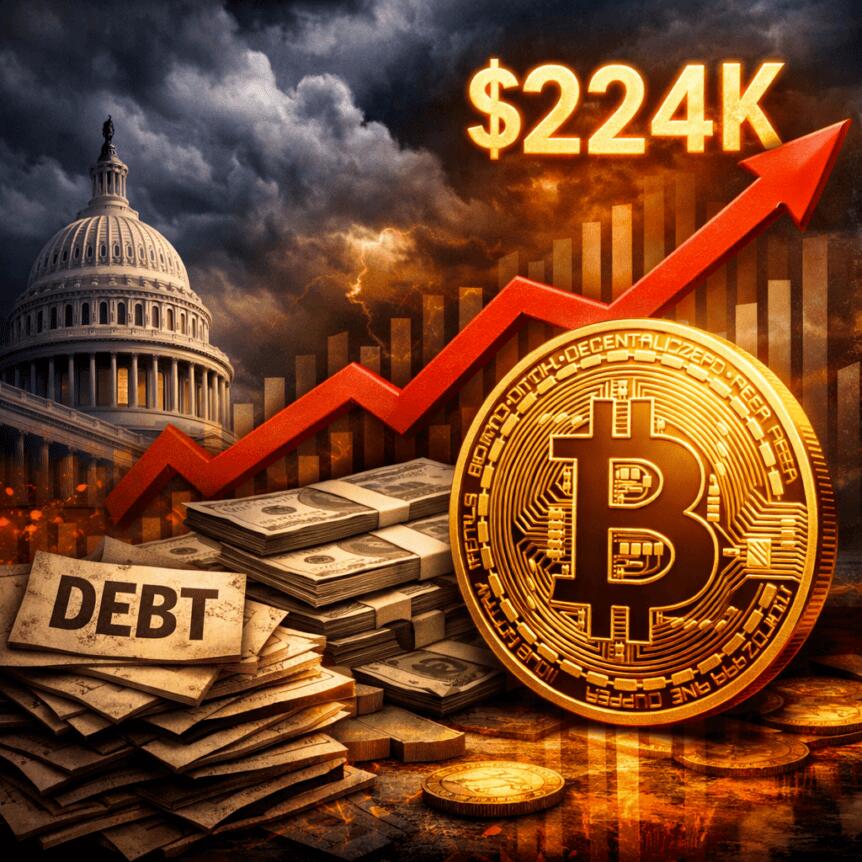
Bitwise’s latest research frames Bitcoin (BTC) as potentially undersized against mounting sovereign-debt concerns. In a scenario where macro stress in global bond markets intensifies, the asset manager argues Bitcoin could fulfill a hedge-like role for investors seeking non-sovereign exposure, with a theoretical fair value around $224,000 per coin if broader adoption as a default-risk buffer materializes. Bitwise emphasizes that this figure reflects a theoretical model, not a price target.
The core impulse behind the thesis is a convergence of debt dynamics and bond-market fragility across major economies. Bitwise points to a brewing strain in the global bond complex, underscored by OECD projections that governments and corporates will need to borrow about $29 trillion in 2026—a 17% uptick versus 2024 and nearly double the borrowing level a decade earlier. A striking 78% of OECD government borrowing is expected to refinance existing debt, highlighting the heavy refinancing burden facing policymakers and markets.
Key takeaways
- Bitwise’s model suggests Bitcoin could be undervalued relative to its macro-hedge potential, with a theoretical fair value of around $224,000 should sovereign-default risk become a dominant driver of capital allocation.
- Global debt issuance and refinancing pressure—especially in major economies like Japan and the United States—could reinforce Bitcoin’s appeal as a shield against traditional macro risks.
- Japan remains a focal point in debt and yield dynamics, with 10-year yields around 2.78% and a 30-year yield at a record high, while public debt sits near 230% of GDP. Domestic yield dynamics may influence cross-border capital flows.
- U.S. and European bond markets show elevated long-end yields and stress indicators, with the U.S. 30-year Treasury yielding about 5.11% on May 11—the highest since 2007—while long-dated swap spreads have climbed to post-crisis peaks.
- Bitcoin’s near-term path may hinge on real yields—the inflation-adjusted rate—where falling real rates historically support BTC, even as the macro environment remains restrictive. A shift where inflation rises while policy rates hold could lower real yields and help BTC’s backdrop.
Macro debt and yield backdrop reshapes Bitcoin narrative
Bitwise’s assessment ties Bitcoin’s macro narrative to the broader stress in debt markets. The OECD’s borrowing projections underscore how financing needs in 2026 are ballooning, with the refinancing of existing debt constituting a substantial portion of new issuance. In this context, the report highlights Japan as a particular pressure point: its 10-year government bond yield hovered near 2.78% while the 30-year yield reached a new high, against a backdrop of public debt approaching 230% of GDP. The bloc of domestic investors holding U.S. Treasuries—reported at roughly $1.2 trillion—faces a balance of higher domestic yields that could tilt allocations back toward Japanese bonds if relative valuations shift. The comparison between Japan’s 10-year yield at about 2.66% and Yen-hedged 10-year U.S. Treasuries at roughly 2.19% illustrates how cross-border capital flow dynamics can influence bond markets and, by extension, alternative hedges like BTC.
Beyond Japan, the U.S. bond market has been sending signals of persistent stress. The 30-year Treasury yield touched about 5.11% on May 11, its highest level in years, while sovereign-risk premia—captured in long-dated swap spreads—have climbed to levels not seen since the European debt-crisis era of 2011–2012. Bitwise argues that such stress could initially weigh on risk assets; however, if central banks respond with liquidity injections to stabilize financial markets, a more pronounced rally in Bitcoin could emerge as a systemic hedge against ongoing macro fragility.
Bitcoin’s fair-value signal and macro hedging case
Central to Bitwise’s narrative is a valuation framework attributed to investor Greg Foss, which estimates Bitcoin’s fair value around $224,000 under a broader adoption scenario tied to hedge-demand against sovereign-default risk. The firm stresses that this is a theoretical construct—not a target price. It serves as a framework for thinking about Bitcoin’s potential role as a macro insurance asset should confidence in traditional debt markets erode.
Despite the longer-term upside the scenario implies, Bitwise notes that Bitcoin could remain range-bound in the near term. Elevated real yields and tighter financial conditions continue to crimp demand, constraining upside momentum even as macro stress scenarios could eventually tilt the risk-reward equation in BTC’s favor.
Real yields, cycles, and what to watch next
The Bitwise report emphasizes real yields—the policy rate minus inflation—as a key driver of Bitcoin’s macro backdrop. Historically, BTC has tended to perform better when real yields decline, since cash and high-quality bonds lose relative appeal in inflation-adjusted terms. The 2021 bull market coincided with falling real yields, while 2022’s drawdown aligned with rising real rates and aggressive monetary tightening. With inflation persistence a live variable, a scenario in which inflation rises but the Fed keeps policy rates intact could pressure real yields lower, potentially creating a more favorable environment for Bitcoin.
Separately, market watchers have spotlighted Bitcoin-price models that place long-run upside into the hundreds of thousands, even as near-term volatility remains elevated. In another framing, a logarithmic price model known as the Bitcoin Decay Channel has pointed to a broad end-2026 range between roughly $90,000 and $255,000, suggesting that BTC could rebound from current support levels while preserving a longer-term bullish thesis if macro and cycle dynamics align.
Analyst outlooks and what investors should monitor
The convergence of debt issuance pressures, central-bank liquidity responses, and evolving real-yield dynamics makes Bitcoin’s macro narrative increasingly relevant for investors seeking diversification and potential hedges. While Bitwise positions the $224,000 figure as a theoretical anchor, the broader implication is clear: a higher-beta asset could gain in importance if sovereign risk intensifies and traditional markets crack under the weight of refinancing needs and rising long-end yields.
As the year unfolds, readers should watch how central banks calibrate liquidity provision in response to bond-market stress, and how sovereign borrowing cycles unfold in major economies. If the stress deepens and liquidity stabilizers enact sizable interventions, Bitcoin could solidify its appeal as a non-sovereign store of value. Conversely, a less turbulent macro environment or a sharper normalization in real yields could keep BTC trading within established ranges.
For deeper context and related discussions, readers may explore Bitwise’s broader commentary, as well as market analyses that connect Bitcoin’s price trajectory to macro indicators and policy shifts. Related perspectives from industry researchers and commentators continue to frame BTC as a potential hedge in a world of swelling debt and diverging yield paths.
Readers should watch next for developments in debt issuance patterns, central-bank policy signals, and any shifts in cross-border capital flows that could reframe Bitcoin’s role in institutional portfolios. The evolving macro backdrop will likely continue to shape BTC’s longer-run narrative as a possible asymmetrical hedge against financial-system stress.
TLDR:
- Ripple opens an expanded D.C. office to deepen engagement with U.S. digital asset policymakers.
- CLO Stu Alderoty says Ripple builds the future of digital assets with regulators, not around them.
- The office will serve as a hub for convening regulators, financial institutions, and industry partners.
- Ripple’s policy focus covers consumer protection, regulatory clarity, and U.S. financial innovation leadership.
Ripple has opened an expanded Washington D.C. office, deepening its commitment to U.S. digital asset policy. The blockchain firm is planting a firmer stake in the nation’s capital at a defining moment for the industry.
Policymakers are actively debating frameworks covering market structure, stablecoins, and payments modernization.
Ripple’s move positions the company at the heart of those conversations. The expansion reflects a long-term bet on constructive engagement over confrontation.
Ripple’s D.C. Expansion Targets the Heart of Digital Asset Policymaking
The new downtown office will anchor Ripple’s policy engagement and stakeholder convening in Washington. It is designed to bring together regulators, financial institutions, policymakers, and industry partners.
Ripple sees the space as more than a physical address and as a platform for shaping financial infrastructure policy. That ambition drives the company’s decision to deepen its Washington footprint now.
The philosophy behind the move is straightforward. Chief Legal Officer Stu Alderoty put it plainly: “Ripple has always believed the future of digital assets should be built with policymakers and regulators, not around them.”
That position separates Ripple from peers who have taken a more adversarial approach to oversight. The company is not waiting for rules to be written and intends to help write them.
Alderoty further tied the expansion to a broader national interest. “Expanding our Washington D.C. presence reflects our long-term commitment to constructive engagement, regulatory clarity, and U.S. leadership in financial innovation,” he said.
Those three pillars define how Ripple approaches every conversation with lawmakers and regulators. They also explain why the company is investing in a permanent, expanded presence rather than periodic visits.
The timing of the expansion carries weight. Congress and federal agencies are currently considering legislation that could reshape how digital assets are classified, traded, and regulated.
Ripple’s expanded presence ensures the company has direct access to those deliberations as they unfold. Early engagement in policy processes tends to produce outcomes more favorable to innovation.
Deepening Commitment Comes as U.S. Digital Asset Policy Reaches an Inflection Point
Ripple’s expanded Washington presence arrives as the broader digital asset industry recalibrates its approach to regulation. Several major firms have grown their policy teams and D.C. footprints over the past year.
Ripple’s move fits that trend but carries particular credibility given its decade-long record of enterprise blockchain deployment. Operational history gives the company a practical voice that newer entrants cannot match.
Alderoty reinforced the consumer-facing dimension of the company’s policy goals. “As blockchain and digital assets become more integrated into the financial system, Ripple is committed to helping shape policy that protects consumers, supports responsible innovation, and keeps America competitive,” he stated.
That framing positions Ripple as an advocate for end users, not just industry interests. It is a deliberate effort to build trust with skeptical regulators and lawmakers.
The expanded office will also serve as a convening space for broader industry and regulatory dialogue. Ripple is positioning itself as a facilitator of conversations, not just a participant in them.
Bringing diverse stakeholders together is a deliberate strategy to build credibility over time. That credibility, sustained through consistent engagement, translates into lasting policy influence.
Ripple’s deepening commitment to Washington reflects a clear-eyed view of where digital asset policy is headed. The company believes the United States has a critical opportunity to lead global financial innovation responsibly.
Sustained engagement, not reactive lobbying, is how Ripple intends to help shape that outcome. The expanded D.C. office is the clearest signal yet of that long-term commitment.
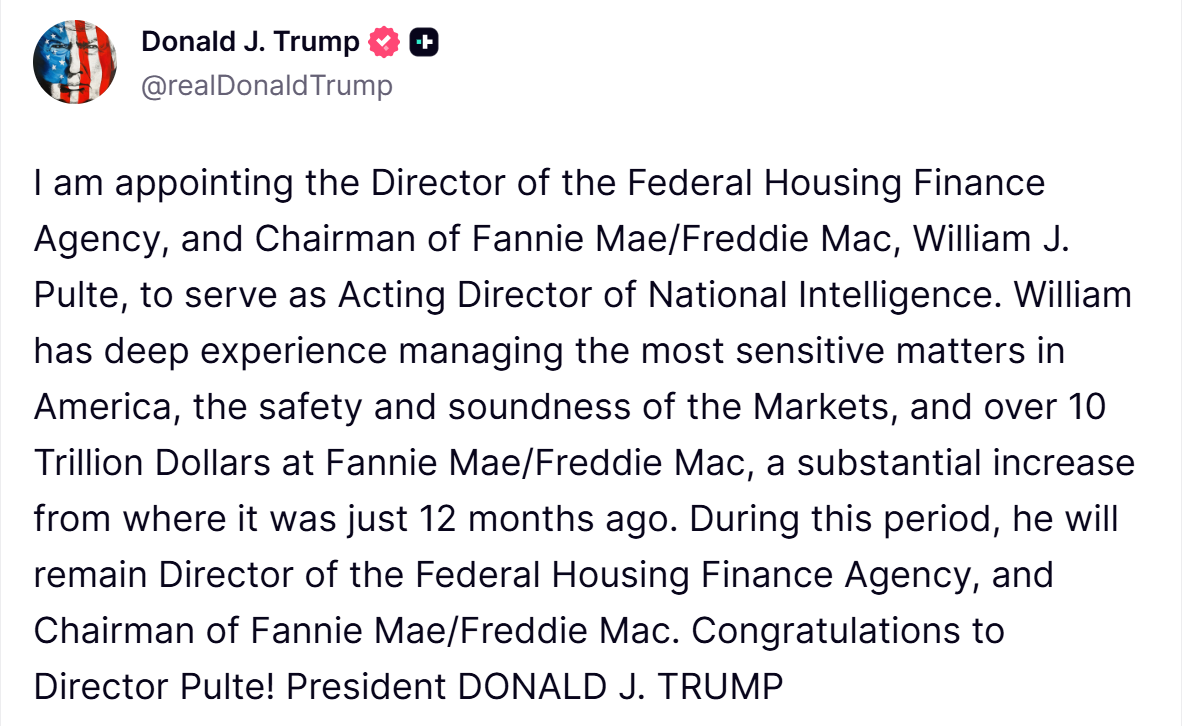
President Donald Trump named Federal Housing Finance Agency Director Bill Pulte as Acting Director of National Intelligence on Tuesday. The pick drew immediate celebration from Bitcoin holders tracking his pro-crypto record.
The 38-year-old will keep his FHFA role and chairmanship of Fannie Mae and Freddie Mac. He will dual-hat the positions until a permanent DNI is nominated and confirmed.

Pulte’s Pro-Crypto Record at FHFA
In June 2025, Pulte ordered Fannie Mae and Freddie Mac to recognize crypto in mortgage assessments. The directive removed any requirement that borrowers liquidate holdings first.
He expanded the policy in March 2026, allowing crypto reserves to back mortgages for the first time.
However, only assets held on U.S.-regulated exchanges qualify under the strict custody restrictions attached to the rule.
Federal disclosures list his personal holdings in Bitcoin (BTC), Solana (SOL), and miner MARA Holdings. Spousal crypto exposure reaches up to $2 million.
A Bitcoiner was just picked for DNI role,” cheered David Bailey.
Follow us on X to get the latest news as it happens
Vice President JD Vance defended the pick in a separate post praising Pulte’s posture toward the intelligence community.
Bill is a great guy who recognizes that the bureaucracy of the intel community must respond to the elected leadership (rather than the other way around),” Vance added.
However, critics highlight Pulte’s lack of intelligence or national security background.
They note federal statute favors such experience, especially as the crypto market structure debate heats up in Congress. The acting role itself does not require Senate confirmation.
“He appears to have been selected precisely because the White House believes he will provide the narrative it wants, not the intelligence we need,” stated Senator Mark Warner.
It will be interesting to see whether Pulte’s Bitcoin-friendly housing playbook extends to his intelligence remit.
The post Why Crypto Markets Cheer Trump’s Pick for Acting DNI Role appeared first on BeInCrypto.

Similar to previous bear markets, bitcoin (BTC) is now on track to experience a slow bleed regime. As analysts explained in the latest Bitfinex Alpha report, this seasonal pattern is further aggravated by weakening demand from spot and institutional avenues.
Even options traders have stopped paying for protection as implied volatility continues to decline and derivatives fall to multi-month lows. This means they are exhibiting a diminishing appetite for paying high premiums for hedging bets.
Market in Slow Bleed Regime
According to the Bitfinex report, volatility sellers are now in control, contributing to the reduction of the likelihood of large price moves in either direction. With open interest gradually declining, the Bitcoin market is facing a slow bleed regime, rather than a sharp deleveraging event.
Proof of the current market condition is bitcoin’s performance for May. The leading digital asset recorded an early-month rally that pushed it above $82,000, but ended the month lower with BTC falling 12.5% from its local top. Bitfinex analysts said the performance highlighted a growing disconnect between broader macroeconomic conditions and the crypto market.
May’s performance also suggested that internal market dynamics were the major driver of weakness, rather than macro conditions. The transition from a phase of expansion at the beginning of the month to a period of sustained distribution highlights a lack of conviction among crypto market participants, not deteriorating external factors.
A clear sign of the lack of conviction is spot Bitcoin exchange-traded funds (ETFs) witnessing $3 billion in cumulative outflows over the past three weeks. Additionally, weakening spot demand, profit-taking from short-term holders, and poor institutional participation erased pillars that supported Bitcoin’s recovery earlier this year. This dynamic made the market more vulnerable to distribution-led selling pressure, according to analysts.
Will June End Negatively Like May?
Furthermore, market experts believe June may end on negative terms just like May if BTC tracks previous bear market patterns.
Seasonal data since 2013 have shown May ending with an average return of 7.36% and a median above 3.5%. While bear seasons in 2018 and 2022 have seen brief recoveries after negative yearly starts, geopolitical tensions have displaced the dynamics over the past two years. Last year was the U.S. tariffs saga, and this year, the Iran conflict. This increases the likelihood of a negative June ending.
However, the prediction for the end of June could be wrong if the market experiences a strong shift in structural inflows from ETFs and institutional products. Aggressive spot accumulation could also change the dynamic and lead to a more positive outcome.
The post Bitcoin Sees Slow Bleed as Distribution-Driven Selling Pressure Intensifies: Bitfinex appeared first on CryptoPotato.
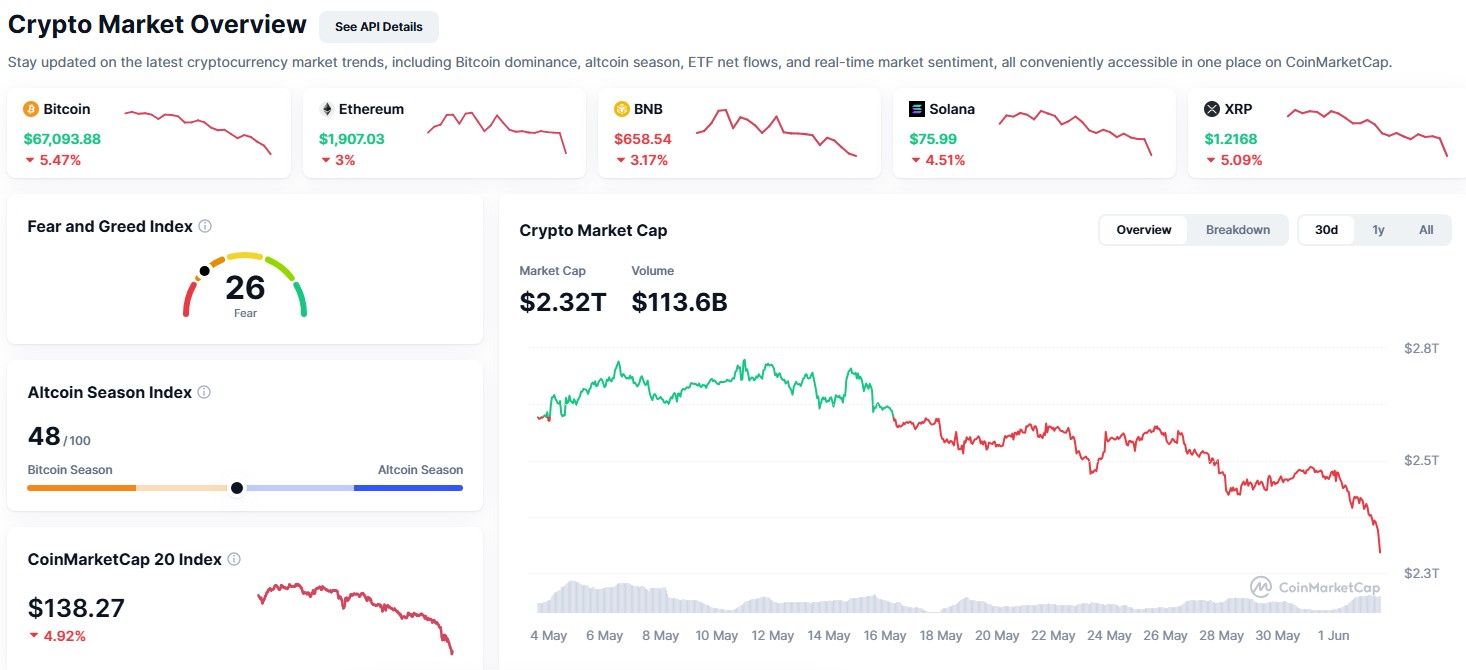
The total crypto market capitalization has fallen sharply to $2.32 trillion. The decline has wiped out roughly 17% of the market value in less than three weeks.
Bitcoin (BTC) trades near $67,400, down 4.5% on the day, with Ethereum (ETH), BNB, Solana (SOL), and XRP also red. Sentiment has flipped to fear as traders question where the bottom may form.

Weekly Chart Shows Rejection at $2.7 Trillion and a Channel Breakdown
The weekly chart for the total crypto market cap confirms a clear bearish structure. Price was rejected at the major resistance zone near $2.7 trillion. That level has flipped between support and resistance multiple times since 2022.
This week’s candle has fallen by 6.61%, dragging the market into the $2.3 trillion support zone. That area acted as a resistance in April 2022.
It then served as a consolidation range between March 2024 and October 2024 before flipping into support in April 2025.
The chart also shows a clear breakdown from the ascending parallel channel that defined the uptrend through 2024 and 2025. The measured target of that pattern points directly at $1.7 trillion. The setup aligns with the bearish read of a recent Bitcoin price prediction.

The Relative Strength Index (RSI) reinforces the bearish read. A descending trendline from March 2024 marked a sustained bearish divergence with price.
A second ascending line then capped the bounce. The RSI top in May 2026 coincided with the $2.7 trillion rejection (blue circle), and momentum has turned lower.
Daily Chart Confirms Bearish Setup as RSI Returns to Oversold
The daily chart adds short-term confirmation to the weekly outlook. Price action has been contained inside a descending parallel channel since October 6, 2026. That date marked the all-time high of $4.27 trillion.
The current daily candle is down 4.42%. The total cap sits at $2.31 trillion right at the edge of the support zone. The drop mirrors broader weakness across altcoins and majors.

The daily RSI has dropped back into oversold territory for the first time since early February 2026. This signals that downside momentum is accelerating rather than fading.
A loss of the $2.3 trillion support could open the path toward $1.7 trillion. That target equals a 27% drop from current levels. The lower boundary of the descending daily channel also converges at that zone.
Crypto Market Bottom Could Form Near $1.7 Trillion in the Coming Weeks
Both timeframes point to the same conclusion. The selloff shows no obvious signs of reversal. The next major support level that could absorb selling pressure sits at $1.7 trillion. The CoinMarketCap dashboard already flags extreme fear at 26 on the index.
A short-term bounce from the $2.3 trillion zone remains possible. However, the structural read across both timeframes suggests that further downside is the higher-probability scenario.
Historical support, the weekly channel target, and the daily channel boundary all converge at $1.7 trillion.
The thesis would be invalidated if the market reclaims $2.7 trillion on a weekly close. The RSI would also need to break back above its descending trendline. Until then, traders may look for a capitulation flush before any sustainable recovery begins.
The timeframe for this move could stretch from weeks to months. Much depends on how quickly the $2.3 trillion support gives way and how broader macro conditions develop.
The post Crypto Crash Wipes Out 7% in 24 Hours: What’s Next? appeared first on BeInCrypto.
TLDR
- UK lawmakers urged regulators to avoid delays in final stablecoin rules.
- The report said a GBP stablecoin market could support faster and cheaper payments.
- The committee backed one-to-one reserve backing for stablecoin issuers.
- Lawmakers questioned proposed holding limits and unremunerated backing asset rules.
- The report urged HM Treasury to review risks tied to private unhosted wallets.
UK lawmakers have urged regulators to avoid delays in final stablecoin rules as global frameworks move ahead. The House of Lords Financial Services Regulation Committee warned that slow action could weaken the UK’s position. Its report calls for rules that support safe innovation while addressing financial stability and consumer risks.
Committee Sees Room for a GBP Stablecoin Market
The committee argued that a sterling stablecoin market could support faster and cheaper payments. It also linked the technology to settlement efficiency and programmable payment services. The report noted that stablecoins could complement existing forms of money. It also stated that new payment options could increase competition across the UK payments sector.
Lawmakers pointed to the UK’s established financial services industry as an advantage. They argued that the country should allow a GBP stablecoin market to form and grow. The committee also noted that a strong market could support wider services around stablecoins. It linked those services to new business opportunities in the wider digital finance sector.
However, the report also identified risks that regulators must address before wider adoption. These include financial stability concerns, banking sector disruption, and consumer protection issues. The committee also raised concerns about illicit activity linked to stablecoins. It described that issue as a global concern for regulators and policymakers.
Lords Back Core Rules but Question Limits
The committee supported much of the Bank of England and FCA stablecoin framework. It backed the proposed requirement for issuers to hold one-to-one backing assets. Lawmakers also welcomed the Bank of England’s proposed backstop lending facility. The report viewed that tool as part of the wider risk management framework.
However, the committee questioned parts of the UK’s planned regime. It noted that some proposals would diverge from rules used in other major markets. The report focused on holding limits, unremunerated backing assets, and commercial bank restrictions. It stated that these measures could shape how the market develops.
The committee recommended that the Bank reconsider the 40% central bank deposit requirement. It argued that unremunerated assets may affect how issuers manage reserves. It also urged regulators not to impose holding limits before risks justify them. The report warned that early limits could restrict GBP stablecoin growth.
Report Calls for Timelines and Flexible Regulation
The committee urged regulators to keep current timelines and avoid further delays. It stated that final rules should give firms certainty and market confidence. The report also recommended a flexible approach to future stablecoin use cases. It argued that regulators should not assume how digital settlement tools will develop.
Lawmakers urged regulators to avoid applying a harsher risk lens to stablecoins. They asked authorities to compare risks with other payment methods fairly. Baroness Noakes, the committee chair, noted that dollar stablecoins dominate the global market. She also stated that the UK has moved more slowly than the US and the EU.
“The UK is lagging behind compared with the US and the EU,” Noakes stated. She added that the UK was now moving in the right direction. The committee also addressed commercial bank involvement in stablecoin issuance. It recommended changes to proposed PRA rules on separate branding and insolvency-remote entities.
The report further urged HM Treasury to review rules for private unhosted wallets. It asked officials to consider legislation if current laws cannot deter illicit activity. Noakes stated that no one knows how a UK stablecoin market may develop. She added that regulation must allow innovation while ensuring risks receive effective controls.
EU AI Data Center Project Faces Delays as Funding Gaps Grow

Chelle Targets Winning Mentality as Super Eagles Prepare for Poland Clash

Audeze MM-520 Headphones Debut at High End Vienna 2026 With Manny Marroquin Tuning and SLAM Technology



-

 NewsBeat7 days ago
Israel says it has killed new Hamas military leader in Gaza City airstrikes
-

 Tech7 days ago
NASA taps Blue Origin to deliver lunar rovers for Moon Base initiative
-

 News Videos5 days ago
This is BROKEN! INSANE 5x MONEY CAR WASH WEEK! The NEW GTA Online UPDATE Today! (GTA5 New Update)
-
 Tech4 days ago
SpaceX just won a second Golden Dome contract. This one is $4.16 billion.
-

 Tech5 days ago
Waymo dominates autonomous vehicle registrations as Tesla trails behind
-

 News Videos4 days ago
SHE IS KILLING XRP!!! WATCH URGENT AND ACT FAST
-
 NewsBeat4 days ago
FIRST NIGHT REVIEW: Take That bring the Circus back to life in spectacular sun-soaked style
-

 Business1 day ago
Jade Biosciences, Inc. (JBIO) Discusses Positive Interim Results From JADE101 Phase I Healthy Volunteer Study and Development Plans Transcript
-

 Tech7 days ago
The Samsung pay deal is the moment Korean unions changed register
-
Crypto World4 days ago
CFTC Has Approved the First Regulated Bitcoin Perpetual Contract in the U.S.
-
Crypto World7 days ago
SpaceX’s $2 Trillion IPO: Why Tech Giants Nvidia (NVDA), Apple (AAPL), and Microsoft (MSFT) May Face Pressure
-
 Entertainment7 days ago
The Most Misunderstood Sci-Fi Horror Movie of the Last 10 Years Just Took Over Netflix
-
 NewsBeat4 days ago
Novak Djokovic v Joao Fonseca LIVE: French Open latest scores and results after Jannik Sinner’s shocking collapse
-
 Crypto World4 days ago
Snowflake (SNOW) Stock Rallies on Strong Q1 Results and AI Product Growth
-
 Entertainment4 days ago
Weak ‘Supergirl’ Box Office Tracking Amid Milly Alcock Backlash
-

 Business4 days ago
Is the Spurs Phenom Already Better Than Prime Diesel?
-

 Business4 days ago
Demand Conditions Improve In Chemicals Sector In April 2026
-
 Crypto World4 days ago
MicroStrategy Moves $30 Million in BTC to Coinbase Prime: Is the Bitcoin Sell-Off Already Here?
-

 Politics4 days ago
The House | Inside Andy Burnham’s Makerfield Campaign: “Nobody Thinks This Is In The Bag”
-
 NewsBeat7 days ago
Energy price cap set for major rise from July as millions face higher bills
You must be logged in to post a comment Login