

Crypto World
Traders watch bitcoin ‘golden cross’ as BTC slides to near $75,000, ZEC dives 9%

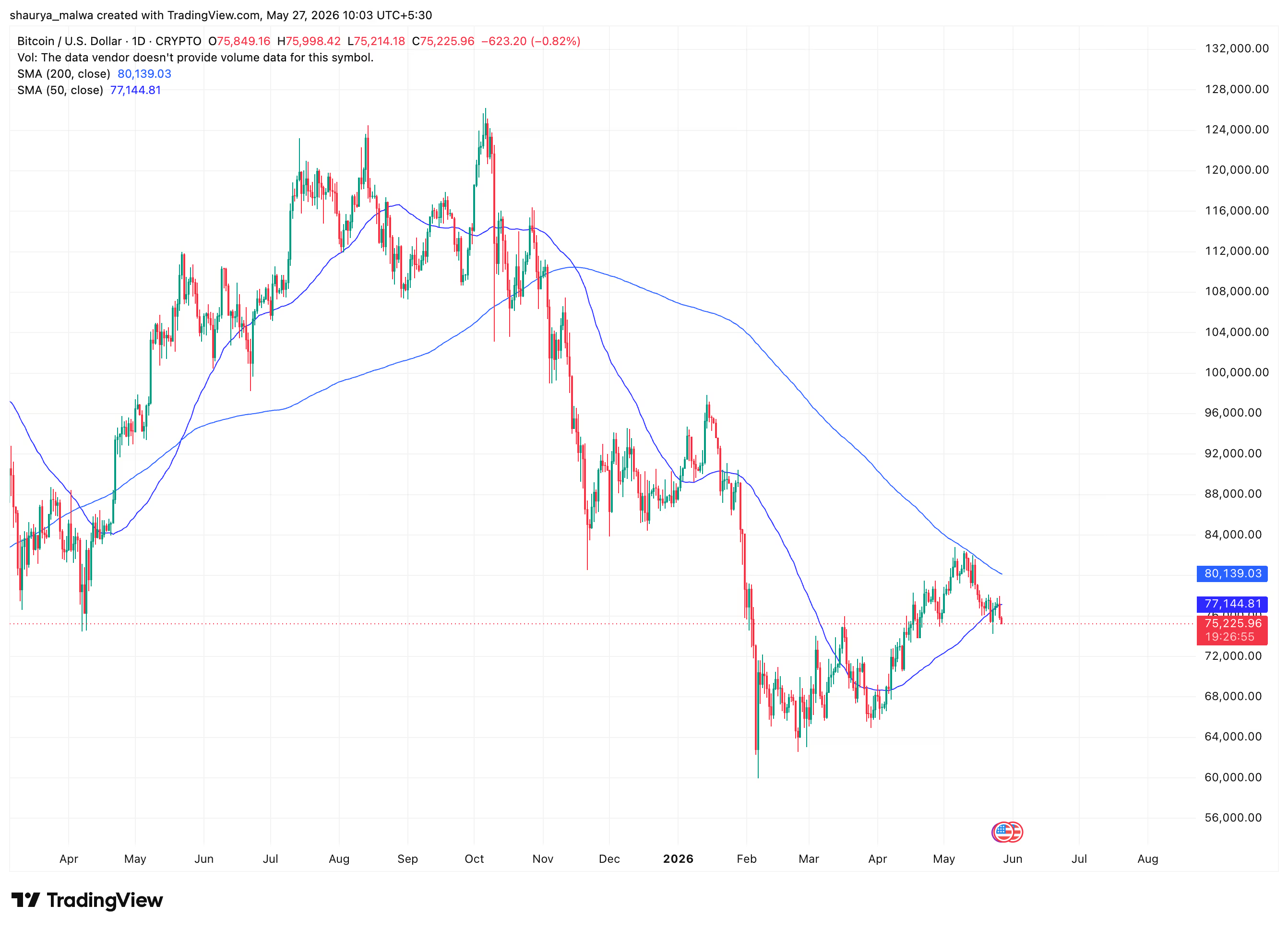
Bitcoin slid to $75,498 in Asian hours Tuesday, leaving crypto markets out of step with the equity rally that pushed global stocks to record highs overnight.
XRP, ether, and Solana were each down as much as 1% in the past day, per CoinDesk data, while Zcash (ZEC) dropped 9% to $564, the biggest single move among the top 15. Hyperliquid (HYPE) bucked the cohort at $59.99, up 1.4% on the day and now sitting just behind Dogecoin on market cap. Tron (TRX) is the quiet performer of the past week, climbing steadily as the rest of the majors held narrow ranges.
What traders are now watching is a setup forming on the bitcoin chart. FXPro analyst Alex Kuptsikevich said in an email the price is finding support near the rising 50-day moving average, while the 200-day moving average briefly acted as resistance earlier in May.
The two lines are on track to cross in the coming weeks, a setup known as a golden cross, which is generally read as a bullish signal. A break of either moving average before the cross could set the direction for crypto markets through the next several weeks, he said.

The flow data has been less encouraging. Spot bitcoin ETFs in the U.S. saw $1.74 billion in withdrawals over the past two weeks, per CryptoOnchain. Retail traders have been adding leverage in the meantime, a combination that has historically preceded sharp liquidation cascades when the market turns against the crowd.
The pattern is showing up at the same time the broader market is asking which asset gives the signal first. Joel Kruger, market strategist at LMAX Group, said ether remains the critical chart to watch, with repeated failures ahead of $2,400 reinforcing the importance of that resistance band.
A decisive daily close above $2,400 would mark a major technical shift and likely bring renewed institutional participation, Kruger said.
The U.S. Securities and Exchange Commission added another piece to the institutional puzzle on Monday, approving the listing of options on a bitcoin index calculated from BTC prices across multiple exchanges. It is the first instrument of its kind, with existing crypto options on U.S. stock exchanges limited to those tied to spot ETF shares.
Equities went the other way overnight, meanwhile.
The MSCI All Country World Index rose for a sixth straight day to a record. South Korea’s Kospi is up about 100% on the year, making it the best-performing major equity gauge globally. Micron Technology jumped 19% in U.S. trading to cross $1 trillion in market value, joining SK Hynix in the chip stocks at that level. Brent crude slipped 1.5% to $98 on signs of progress in U.S.-Iran negotiations. Treasury yields edged lower, with the 10-year at 4.47%.
Bitcoin’s lag behind equities has been one of the cleanest market signals of the past month. Whether that gap closes through a chip-led equity pullback or a bitcoin catch-up depends on which side of the moving average crosses first.

Crypto World
Bermuda Joins Forces With Circle, Coinbase, and Stellar to Create First Fully Blockchain-Based Economy

Key Highlights
- Bermuda has announced a collaboration with Circle, Coinbase, and Stellar to create a completely blockchain-powered national economy
- The island’s monetary authority distributed $100 worth of USDC to citizens in a pilot program testing cryptocurrency for everyday transactions
- Public services will begin accepting digital currency payments, with the motor vehicle department being the first phase
- A national digital currency, the Bermuda Digital Dollar, is under development utilizing Stellar’s blockchain technology
- Legal frameworks governing property rights, contractual agreements, and financial securities are being modernized to accommodate smart contracts and blockchain-based assets
The Caribbean island of Bermuda is advancing an ambitious initiative to transform its economic infrastructure entirely onto blockchain technology. This groundbreaking project involves strategic partnerships with Circle, Coinbase, and Stellar.
In a pioneering trial, the Bermuda Monetary Authority distributed $100 in USDC—Circle’s dollar-pegged stablecoin—to local residents through an airdrop mechanism. Recipients tested the digital currency at a specially organized marketplace where they purchased products, transferred funds peer-to-peer, or exchanged their crypto for traditional cash. Financial service providers including MoneyGram were present to facilitate these conversions.
According to Craig Swan, who leads the Bermuda Monetary Authority, the initiative aimed to simultaneously introduce both merchants and consumers to the digital payment ecosystem. This hands-on trial provided citizens with practical experience using cryptocurrency wallets and conducting blockchain-based transactions in real-world scenarios.
Transition to Digital Government Services
Bermuda’s next phase involves accepting cryptocurrency for government service fees. The Department of Motor Vehicles will serve as the initial testing ground, selected due to its substantial transaction volume since nearly all island residents possess vehicles or driving licenses. Swan indicated that successful implementation will lead to expansion across all government agencies.
Circle has established its Circle Mint platform to support digital treasury operations for government accounts. Meanwhile, Coinbase is contributing technical expertise to facilitate adoption for both institutional entities and individual users.
This strategic vision was initially unveiled at the World Economic Forum gathering in Davos. During that conference, Bermuda officials announced their collaborations with Circle and Coinbase, with the Stellar partnership for the digital currency project being added subsequently.
Introducing the National Digital Currency
Bermuda has formally announced its collaboration with Stellar Development Foundation to create a sovereign digital currency named the Bermuda Digital Dollar. This currency will operate as a stablecoin with full backing from fiat currency reserves maintained in conventional banking institutions.
Premier E. David Burt explained that Bermuda’s continued dependence on outdated payment infrastructure has resulted in excessive transaction fees for residents and hindered economic expansion. The transition to blockchain-based systems is anticipated to significantly lower these costs by eliminating costly intermediary banking processes.
Swan clarified that traditional financial institutions will continue serving essential functions. These banks will maintain the fiat currency reserves backing the digital tokens and provide localized custody solutions.
Legal Framework Modernization
Transitioning an entire national economy to blockchain infrastructure demands comprehensive legal reforms alongside technological implementation. Swan emphasized that contractual law, property ownership regulations, and securities legislation must all be revised to grant legal recognition to smart contracts.
The BMA recently concluded a pilot program where regulatory compliance requirements were encoded directly into smart contract protocols. During this experimental phase, transactions were automatically prevented when collateral reserves fell below required thresholds or when addresses triggered anti-money laundering alerts.
Bermuda is additionally creating an AI-powered payments monitoring system designed to oversee transactions executed by autonomous software agents rather than human operators.
Swan noted that smaller jurisdictions possess inherent advantages in implementing rapid changes. Bermuda’s compact population translates to fewer regulatory hurdles and accelerated deployment schedules compared to larger nations.

Bitcoin’s price tumbled to nearly $75,000 earlier, marking a decline of about 2% for the day. The move was sudden, which raised more than a few eyebrows.
Analysts have started speculating about what caused the cascading red candles, and many are pointing to the involvement of BlackRock’s spot BTC ETF, IBIT.

Largest Dark Pool Block Trade on BlackRock’s IBIT ETF
Multiple analysts noted a massive $1.289 billion IBIT block sale executed by an unknown party through a dark pool at 10:30 AM yesterday.
Popular ETF analyst Eric Balchunas said that the trade involved a whopping 29 million shares, which dwarfs all other trades for the day and perhaps ever.
Confirmed.. 29 million share trade ($1.3b) of $IBIT executed at 1030am this morning. This screen shows all the IBIT trades today by size and you can see one of these is not like the others. Price unchanged today so mkt absorbed it well. https://t.co/Otew0DWa3F pic.twitter.com/jZcoKez74K
— Eric Balchunas (@EricBalchunas) May 26, 2026
Rumors are now circulating that this move could trigger the largest single-day Bitcoin ETF outflow on record. Many traders say the block trade coincided with a sudden downside move in BTC, as seen on the charts.
It also outlines the dangers of concentrated liquidity, especially now that major institutional players have furthered their involvement in the market, as well as large corporate treasuries largely denominated in BTC.
The post The Reason Bitcoin’s Price Plunged to $75K: BlackRock? appeared first on CryptoPotato.


Bankless co-founder David Hoffman said he sold his ETH because he no longer believes Ethereum’s success will fully translate into higher ETH prices.
Hoffman, one of Ethereum’s most visible media advocates, said the “ETH is money” thesis did not collapse. Instead, he argued that it already played out. “The ETH is Money thesis didn’t fail… it played out,” he wrote.
His post lands as ETH trades near a fragile support zone around $2,050 to $2,100. The asset has struggled to regain stronger resistance above $2,300, while ETF flows and on-chain demand remain mixed.
Hoffman Says Ethereum Network Can Win While ETH Lags
Hoffman made a clear split between Ethereum the network and ETH the asset.
“I am massively bullish Ethereum,” he wrote, adding that he expects the network to perform well. But he said only a “marginal amount” of that success may be reflected in ETH.
That is the core of his argument. Ethereum may continue to dominate stablecoins, tokenization, DeFi, and Layer 2 activity. But ETH may no longer capture enough value from that growth to justify a major asset rerating.
The Value Capture Problem
Hoffman argued that Ethereum is structurally designed to give value back to its ecosystem.
He described Ethereum as “a giver, not a taker,” saying it provides secure blockspace to L2s, tokenizes real-world assets, and supports DeFi without taking much economic markup.
That view matches the current market debate. Ethereum usage remains strong across areas such as stablecoins and rollups. But L2s and applications now capture much of the activity that once supported the old fee-burn narrative.
As a result, Ethereum can grow as infrastructure while ETH fails to outperform.
ETH Faces Weak Technical Momentum
The timing also matters. ETH is trading close to a key support range after failing to build strong momentum above $2,200. Analysts have warned that a break below the current zone could weaken the chart further.
At the same time, institutional demand remains uneven. Ethereum ETFs have not delivered the consistent inflows needed to offset weaker market confidence.
A Symbolic Exit From an Ethereum Insider
Hoffman said he is not bearish on ETH. He said he wants to allocate capital elsewhere because he does not expect ETH to be “structurally rerated” higher or lower.
Still, the move carries weight.
For years, Bankless helped popularize ETH as internet money. Hoffman’s exit shows that even some Ethereum believers now question whether ETH remains the best financial expression of Ethereum’s future.
The post Why Bankless Co-Founder Sold His Entire Ethereum Portfolio appeared first on BeInCrypto.
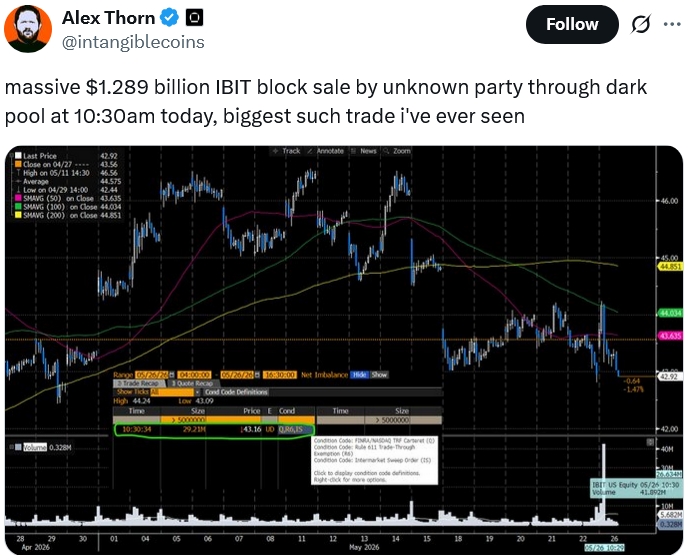
An unknown trader’s $1.3 billion sale of shares in BlackRock’s Bitcoin exchange-traded fund on Tuesday coincided with a steep fall in the price of Bitcoin, according to analysts.
A trader sold 29.2 million shares of BlackRock’s iShares Bitcoin Trust ETF (IBIT) at 2:30 p.m. UTC on a “dark pool,” a private trading platform that institutions often use to discreetly make large trades outside of public markets.
The impact of the $1.3 billion trade was immediately felt in the crypto market, with TradingView data showing that Bitcoin (BTC) fell 1.5% from $77,875 to $76,720 in a short 10-minute window after 2:30 p.m. UTC.
Bitcoin then slid further to a 24-hour bottom of $75,600 about 12 hours later, marking a 2.8% fall for the day.
Bitcoin has historically been viewed as an asset that trades outside of the traditional market, but products such as US-based Bitcoin ETFs have removed barriers for institutional investors to trade Bitcoin, and the cryptocurrency has recently traded in high correlation with US markets.
Alex Thorn, head of firmwide research at crypto investment firm Galaxy Digital, said in a post to X that it was the biggest trade he has seen made through a dark pool.
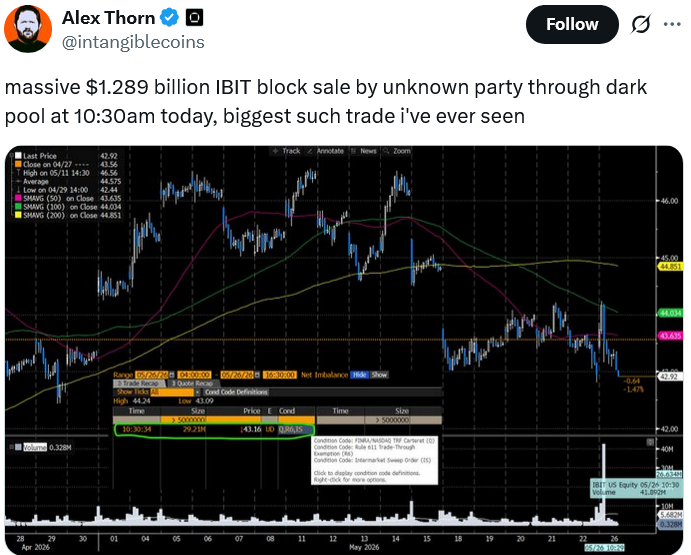
Source: Alex Thorn
Bloomberg ETF analyst Eric Balchunas also shared that the 29.2 million IBIT shares sold at $43.16 and was over 22 times larger than the second-largest IBIT sell order on Tuesday.
Related: Goldman Sachs exits XRP, Solana ETF exposure in Q1 2026
Bitcoin ETF outflow streak continues
US spot Bitcoin ETFs have now recorded eight straight trading days of net outflows, with a $333.6 million outflow on Tuesday, including a $192.4 million outflow from IBIT.
More than $2 billion has now flowed out from the ETFs since May 14, the last recorded net inflow across all the funds, a sign that institutional sentiment toward Bitcoin has weakened, with investors reducing exposure to Bitcoin ETFs at a rate faster than fresh capital flowing into the market.
Institutional market maker Jane Street reduced its Bitcoin ETF holdings by around 70% in the first quarter, while investment bank Goldman Sachs reduced its Bitcoin ETF position by 10%.
Magazine: Bitcoin ETFs bleed $1B, Aave’s $71M ETH unfreeze bid delayed
Key Highlights
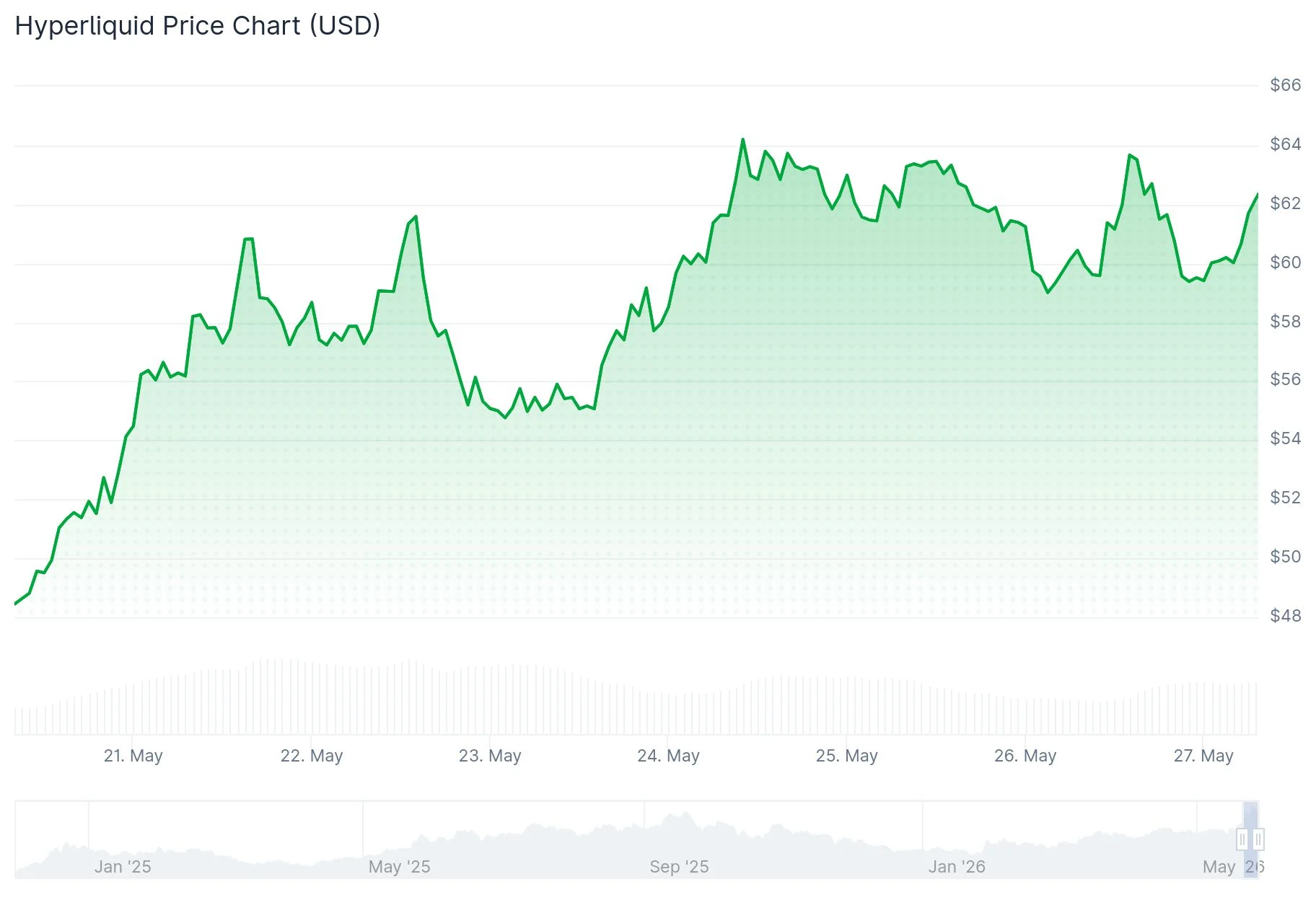
- HYPE reached an unprecedented peak of approximately $65 on May 26, 2026.
- Bitwise’s BHYP exchange-traded fund accumulated $40 million in assets in slightly more than one week.
- Total ETF capital inflows for HYPE touched $89 million across nine days, averaging approximately $9.2 million daily.
- The platform introduced macro-focused prediction markets covering CPI data and Federal Reserve rate decisions.
- Open interest on Hyperliquid surged to $8.5 billion, positioning it as the world’s third-largest derivatives trading platform.
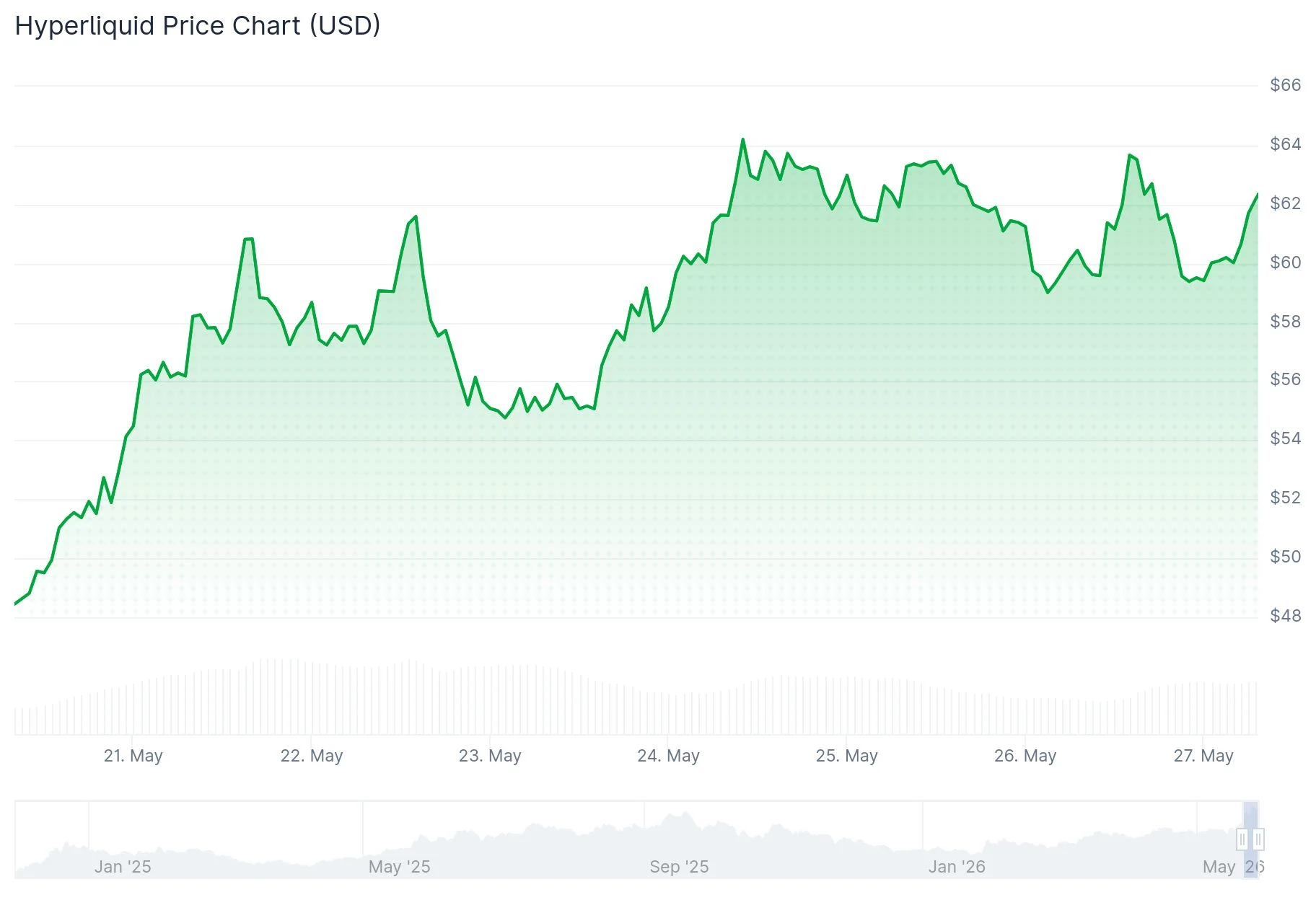
Hyperliquid’s native HYPE token established a fresh record high approaching $65 on May 26, propelled by robust institutional demand through exchange-traded funds and the platform’s debut of prediction market functionality.
Bitwise’s Chief Executive Officer Hunter Horsley revealed that the BHYP ETF processed $12 million in trading activity within the first two hours of market operations on that date. The investment vehicle now manages $40 million in total assets just over a week following its market debut.
An analyst account from Coin Bureau shared insights on X regarding Bitwise’s aggressive accumulation strategy: “Bitwise bought another 162,367 $HYPE, worth about $10.1M, over the past 2 hours. Based on its official website, Bitwise already held 723,361 HYPE, worth around $40.4M, as of May 21, 2026.” The data illustrates the remarkable speed at which institutional capital has entered this digital asset.
Total capital flows into both Bitwise’s BHYP and 21Shares’s THYP products reached $89 million within a nine-day period — representing one of the most rapid ETF accumulation trajectories observed across cryptocurrency investment vehicles.
Grayscale appears to be building a HYPE position as well, presumably in preparation for its own ETF product launch. Market analyst Havoc forecasted that the forthcoming Grayscale GHYP offering might contribute an additional $8 million to $12 million in daily capital flows, potentially purchasing between 8% and 33% of HYPE’s available supply annually.
Institutional Demand Fuels Continued Rally
HYPE has maintained ongoing price discovery mode since ETF products commenced trading. The digital asset advanced from its previous breakout zone around $59.40 and touched $64.50 before continuing its ascent.
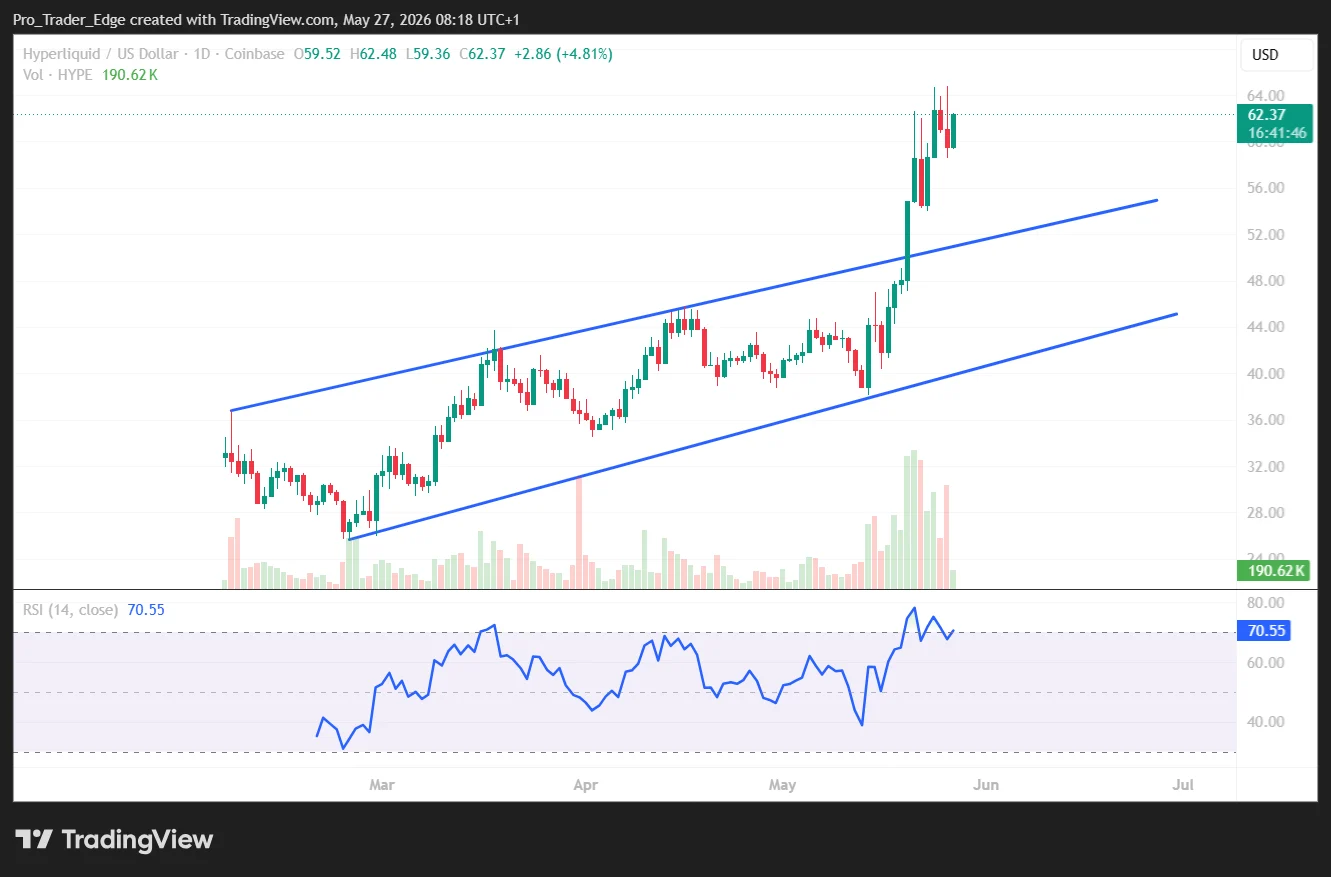
Assuming HYPE maintains support above the $59.40 level, Fibonacci extension analysis suggests potential resistance zones at $76, $89.50, and $101. Derivatives market data revealed combined open interest nearing $2 billion, with funding rates hovering around 0.004%, signaling bullish market positioning.
Cryptocurrency analyst Byzantine General observed that Hyperliquid’s cumulative exchange open interest climbed to $8.5 billion, securing the third position globally after Binance and Bybit. The platform’s market share for open interest achieved 7.2%, establishing a new milestone.
Blockchain data indicated Hyperliquid received more than $1.1 billion in net capital inflows throughout the preceding month.
Platform Debuts Macro Prediction Markets
Coinciding with HYPE’s record price achievement, Hyperliquid unveiled new macroeconomic prediction markets. The initial two offerings concentrate on year-over-year May Consumer Price Index figures and potential Federal Reserve funds rate adjustments at the upcoming June Federal Open Market Committee gathering.
The CPI-focused market registered $8,000 in trading volume with $48,000 in open interest. The Fed rate market recorded $600 in volume alongside $13,200 in open interest. Platform validators additionally greenlit a sports prediction market centered on the Champions League final match.
These new markets complement the previously launched HIP-4 market series, which features a Bitcoin daily price movement market that has generated $578,000 in trading volume and $180,000 in open interest.
The combined assets under management for HYPE ETF products stood at $89 million as of May 26, 2026.
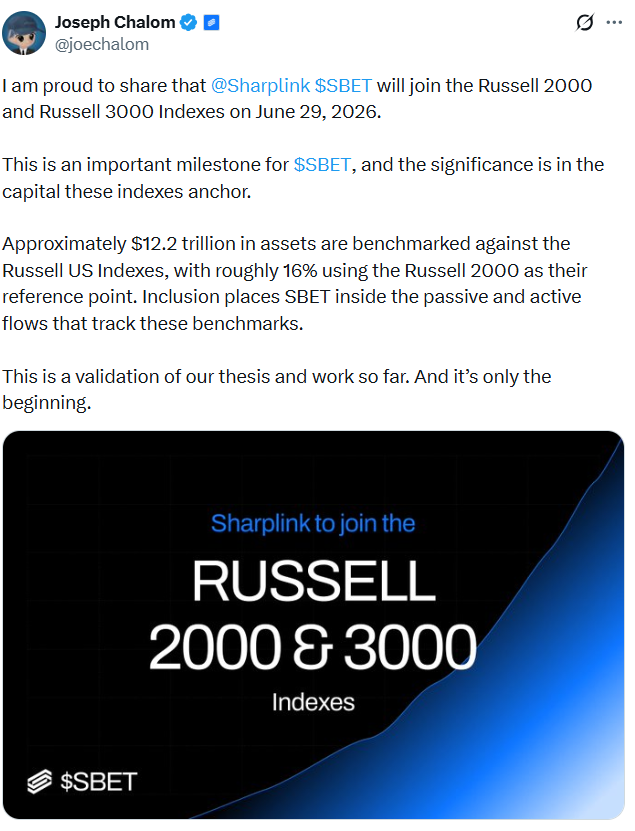
A range of crypto companies have been included in a preliminary list for potential inclusion in the Russell 3000 index, including treasury firms Sharplink and Forward Industries, along with crypto exchange Gemini and crypto services firm Galaxy Digital.
A preliminary index inclusion list for the Russell 3000 was published by the index’s provider, FTSE Russell, on Friday. The index tracks the 3,000 largest companies in the US and requires a market capitalization of at least $146.4 million.
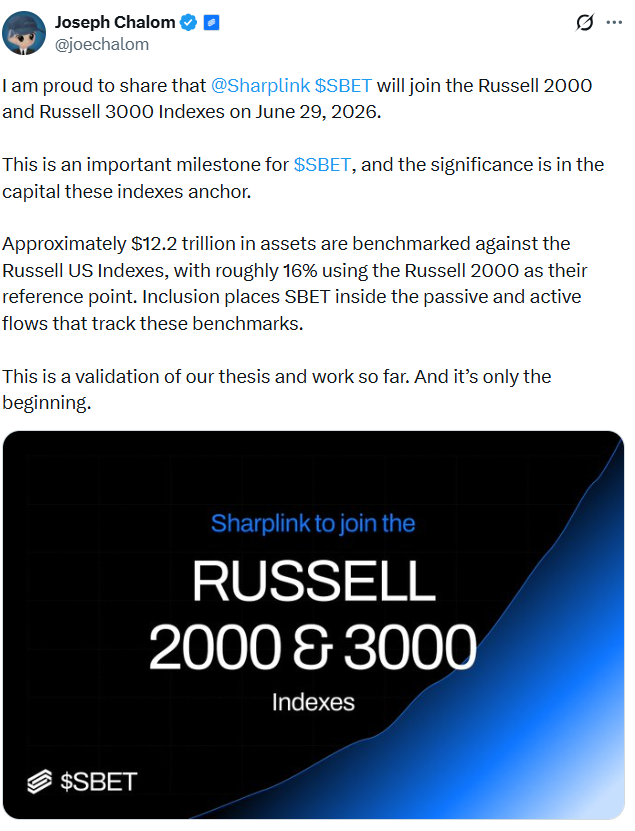
Sharplink has a market cap of $1.2 billion, and the company’s CEO, Joseph Chalom, said in a statement on Tuesday that it means the firm could be included in the Russell 2000, an index that tracks the largest 2,000 publicly traded US companies.
Inclusion in the indexes is widely viewed as a boon for those added, as many active and passive funds, including exchange-traded funds, typically buy stocks included in the index.
Chalom said that joining the Russell indexes would broaden the company’s shareholder base and strengthen its access to capital markets.
Source: Joseph Chalom
Forward Industries’ chief investment officer, Ryan Navi, said the Solana treasury company is also eligible for the Russell 2000 Index, as its market cap sits at about $350 million.
“We believe index inclusion will expand our shareholder base, improve trading liquidity, and increase visibility among long-term institutional investors,” Navi said.
FTSE Russell will provide further list updates on June 5, June 12 and June 18. The newly reconstituted indexes will take effect after the US market closes on June 26.
Related: Bitcoin price lags bullish US tech stocks: Is there a silver lining?
Ether treasury company Bitmine Immersion Technologies was included in a preliminary list for potential inclusion in the Russell 3000 index. Chairman Tom Lee flagged possible inclusion in the Russell 1000, an index tracking the largest 1,000 US companies, due to Bitmine surpassing the index’s minimum market capitalization threshold of $5.7 billion.
Galaxy Digital’s market cap of $11.55 billion also makes it eligible for the Russell 1000, while Gemini’s estimated $571 million makes it eligible for the Russell 2000.
Being added to the Russell 1000 would place Galaxy and Bitmine alongside major US large-cap equities, including tech giants Nvidia, Microsoft, Apple, and Alphabet, the parent of Google.
Magazine: Polymarket seeks Japan entry, Harvard dumps entire ETH position: Hodler’s Digest, May 17 – 23


Kyrgyzstan has launched a state stablecoin backed by physical gold, built its own gold vault, and brought Binance founder Changpeng Zhao into its crypto policy circle.
Zhao, widely known as CZ, now holds a Kyrgyz passport and serves as an adviser to the country’s president, according to Arsen Edilbek uulu, co-founder of KYTLABS and head of fintech consulting in Kyrgyzstan.
Speaking to BeInCrypto Editor-in-Chief Vladimir Arkhireysky, Arsen said Kyrgyzstan is trying to position itself as a regional crypto hub with lighter regulation, banking support, and infrastructure for tokenized real-world assets.
The country’s approach stands out in the region. While Russian regulators continue to move cautiously, Kyrgyzstan is building state-backed crypto products and trying to attract global players.
Kyrgyzstan Launches Two State Stablecoins
According to Arsen, Kyrgyz President Sadyr Japarov is deeply involved in the country’s crypto market strategy and understands the sector well.
The government has worked with major market participants and is trying to create clear mechanisms for crypto companies to operate in the country.
As part of this strategy, authorities decided to develop a state stablecoin.
The Ministry of Finance received a budget of about $100 million to buy physical gold. That gold was placed into reserves and used as backing for a dollar-equivalent token.
The stablecoin is backed by physical gold held in a new Kyrgyz gold vault, which Arsen described as a local version of “Fort Knox.” The token is fully owned by the Ministry of Finance.
A second stablecoin is backed by Kyrgyzstan’s national currency, the som. It was launched in partnership with Binance on BNB Smart Chain.
That project falls under the National Agency for Virtual Assets and the National Council for Virtual Assets. CZ is a member of that council.
New Gold Vault Could Support RWA Projects
Kyrgyzstan has also built a large gold storage facility. Arsen said the vault has enough capacity to hold reserves from neighboring countries.
He estimated that Kyrgyzstan’s own gold and foreign exchange reserves would take up less than 10% of the facility.
The government’s broader goal is to turn the country into a hub for real-world asset projects. These projects could store physical gold in Kyrgyzstan and issue tokens backed by those reserves.
Arsen said the strategy comes as Switzerland is losing some of its appeal as a neutral storage hub. In his view, geopolitical shifts have made Switzerland appear more politically aligned than before.
For Kyrgyzstan, this creates an opening. The country wants to offer gold storage, token issuance, and a friendlier regulatory environment for crypto and RWA companies.
Binance became one of the first major partners in this effort. The initial focus was to use BNB Smart Chain for tokens backed by the national currency.
CZ’s Role in Kyrgyzstan’s Crypto Strategy
CZ now works as an unpaid adviser to the president of Kyrgyzstan, Arsen said.
Under local rules, only citizens of the Kyrgyz Republic can serve as presidential advisers. That means CZ has a Kyrgyz passport.
Arsen said the government’s decision to bring in Binance and CZ was part of a deliberate strategy. The president’s team tracks global crypto trends and looks for organizations that see Central Asia as an important growth region.
Kyrgyzstan is also trying to differentiate itself from Kazakhstan.
Kazakhstan has the Astana International Financial Centre, which operates under a legal structure based on English law. Arsen said that the model creates more complications for the crypto market under current conditions.
Kyrgyzstan chose a softer regulatory approach. The goal is to give companies room to test the region while giving local banks time to prepare for deeper crypto integration.
Banks Prepare for Crypto Custody
Arsen said the cost of maintaining a license for a virtual asset service provider, broker, or securities dealer in Dubai can exceed $1 million per year.
In Kyrgyzstan, he said, the cost is several dozen times lower while offering comparable opportunities.
He also said crypto companies often face banking refusals in Dubai. In Kyrgyzstan, banks are more willing to serve them.
The country is now preparing changes to its banking law. These changes would allow banks to interact with virtual assets and act as custodians.
Arsen expects the reforms to bring larger players into the market. He also said bank apps could soon include Tether-based transfer systems.
Crypto Is Already Entering Banking Apps
Some Kyrgyz banks have already added crypto purchases to their mobile apps. Arsen said about three banks currently offer this function.
Legally, the bank does not sell crypto directly. Instead, it works through a third-party partner.
When a client agrees, the bank transfers the client’s personal and KYC data to the partner. The partner then opens a crypto account for the user.
Through these banking apps, users can buy major assets such as Bitcoin and Ethereum. Stablecoins, including USDT, are also available.
How Ordinary Users Use Crypto
Kyrgyz citizens use crypto for investment and foreign trade, according to Arsen.
Some also use USDT while traveling or making payments in China. Instead of carrying cash, they convert funds into USDT and later exchange it for local currency in the destination country.
Several Kyrgyz banks are also working on crypto cards. These products are being developed under the central bank’s regulatory sandbox.
Meanwhile, Kyrgyzstan’s local payment system, Elkart, is integrating with China’s WeChat. Arsen said this could eventually open access to more than 60 countries in Asia.
For now, Kyrgyzstan’s strategy is clear. The country wants to use crypto regulation, banking access, and gold-backed infrastructure to become a regional digital asset hub.
The post How Kyrgyzstan is Becoming the Switzerland of Crypto appeared first on BeInCrypto.


Crypto-focused political committees are flexing their growing bipartisan political muscle in Texas, spending more than $9 million on races this cycle as Tuesday’s primaries deliver a string of wins for industry-backed candidates across both parties.
Houston Democrat Christian Menefee defeated fellow Democrat Rep. Al Green in the Democratic primary runoff for Texas’s 18th Congressional District, after Republican-led redistricting dismantled Green’s longtime seat and forced the House Financial Services Committee member into a rare incumbent-on-incumbent showdown.
Green had earned an “F” from crypto advocacy group Stand With Crypto after opposing key industry-backed legislation and warning that cryptocurrency could erode U.S. financial leverage abroad.
“Rep. Green’s defeat proves that anti-crypto hostility carries real electoral consequences,” Geoff Vetter, a Fairshake spokesperson, told CoinDesk. “Fairshake was the difference-maker in this race, and we will continue to aggressively back leaders like Rep. Menefee across the country.”
In the Republican Senate primary, Texas Attorney General Ken Paxton toppled longtime Sen. John Cornyn. In other races, Fairshake’s Republican affiliate, Defend American Jobs, and its Democratic counterpart, Protect Progress, backed candidates on opposite sides of the aisle, while the separate crypto-focused Fellowship PAC supported Paxton to the tune of $500,000.
Elsewhere in Texas, Defend American Jobs spent roughly $1.8 million backing four winning Republican candidates: Jon Bonck ($348,433), Tom Sell ($426,279), Carlos De La Cruz ($581,172) and Alex Mealer ($436,278). All four were low-turnout runoffs where the eventual nominee is typically heavily favored in November, making them efficient targets for a well-capitalized political network.
Texas had only one night of primaries, but Tuesday’s results suggest the crypto industry is already positioning aggressively with a well-capitalized war chest for the 2026 midterms, when Democrats are favored — by a slim margin — to sweep both the House and Senate.
David Hoffman, an Ethereum advocate and the co-founder of the media company Bankless, says he sold the remainder of his Ether (ETH) holdings last week as he believes the “ETH is Money” thesis has largely “played out.”
Hoffman said in an X post on Tuesday that “Ethereum got the ETH price it deserves, and I don’t see ETH being rerated as an asset, higher or lower.”
Hoffman said that Ethereum “has done incredibly well, and deserves the market cap that it has,” but the “window of opportunity for ETH to be ‘rerated’ by the market seems to be closing.”
“ETH is, to some degree, money. But not the maximally successful version that we collectively sought out to achieve.”
The “ETH is Money” thesis believes the token is a superior store of value compared to fiat money, as it is decentralized and has introduced mechanisms to try to combat inflation, or the amount of new tokens being created.
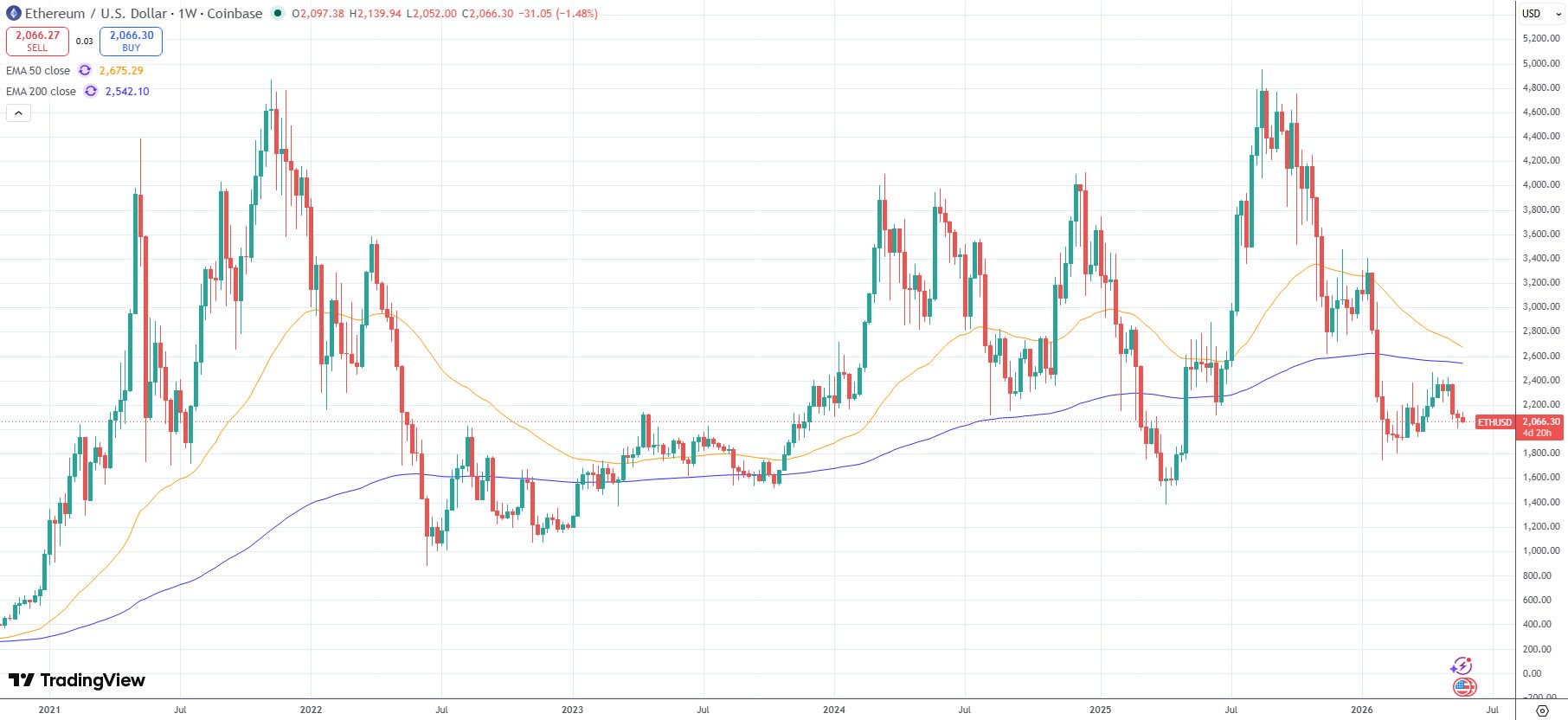
Many Ether backers believed the token could reach the high five-figures, but ETH reached an all-time high of just below $5,000 in August, about equal to its previous bull market peak during the last cycle. It has since dropped by almost 60% from its all-time peak to trade around $2,000.
ETH prices have been largely rangebound for five years. Source: TradingView
Hoffman, a long-time Ethereum bull who has written extensively on investment cases for Ether, announced selling his entire ETH holdings, the value of which he did not disclose, on May 21.
He said that Ethereum is a “giver, not a taker,” providing secure blockspace and tokenization at cost while the blockchain’s layer-2 networks capture most of the fees and benefit.
“Ethereum takes no markup for anything it does. This is the nature of open source software, and this is the power of Ethereum. Ethereum supplies its full set of incredibly important values to the world… at cost.”
Hoffman reiterated that he is “massively bullish” on Ethereum, expecting that the network will do “exceptionally well from here on out,” but only a “marginal amount” of that success will be reflected in its token.
Related: Tom Lee predicts supercycle amid Bitmine’s largest Ethereum buy in 2026
Hoffman’s sale saw mixed reactions from ETH backers, with Bankless co-founder Ryan Sean Adams saying it was the “end of an era.”
Former Ethereum core developer Eric Connor said he didn’t really blame Hoffman because ETH has “grossly underperformed the general crypto market for many years now.”
He attributed the lag mainly to selling pressure from the large number of millionaires created during its explosive early run-up rather than fundamental protocol shortcomings.
“At the end of the day, maximalism to a single coin when it comes to portfolio management is pretty silly,” he said.
Magazine: Polymarket seeks Japan entry, Harvard dumps entire ETH position: Hodler’s Digest

TLDR
- Cryptocurrency mining equities rallied strongly Tuesday, with TeraWulf climbing as much as 17% while Hut 8, IREN, and Riot Platforms each advanced over 5%.
- The rally accompanied the S&P 500’s push past 7,500 to new record territory, driven by a 5.6% jump in the Philadelphia Semiconductor Index, which has surged nearly 77% in 2025.
- Bernstein analysis shows 11 publicly listed Bitcoin mining companies command approximately 27 gigawatts of existing and planned electrical capacity, positioning them as key players for AI data center expansion.
- IREN’s partnership agreement with Microsoft could generate approximately $3.7 billion in annual revenue for its AI cloud services division, according to Bernstein’s estimates.
- Industry observers caution that Bitcoin network security may face heightened concentration risks as major miners transition to AI operations, though hybrid models combining both activities appear most viable.
Cryptocurrency mining equities posted substantial gains Tuesday as a powerful rally in chip and technology stocks boosted investor enthusiasm throughout the industry. Market participants increasingly recognize crypto mining operations as emerging participants in the artificial intelligence infrastructure expansion.
Semiconductor Rally Powers Mining Stock Advances
TeraWulf topped the sector’s performance, surging as much as 17% following its announcement of acquiring a Kentucky-based data center facility. Hut 8, IREN, and Riot Platforms each finished the trading session with gains exceeding 5%.
These advances occurred as the S&P 500 established new all-time highs, breaching the 7,500 threshold for the first time ever. The Philadelphia Semiconductor Index posted a robust 5.6% gain and has now appreciated nearly 77% since the start of the year.
Market enthusiasm for mining companies has intensified as additional firms announce intentions to redirect their electrical infrastructure toward high-performance computing and artificial intelligence applications. These operations are perceived as potentially offering greater stability and profitability compared to cryptocurrency mining as a standalone business.
Bernstein’s analysis identified that 11 publicly traded Bitcoin mining enterprises collectively possess roughly 27 gigawatts of current and anticipated electrical capacity. Industry experts argue that dependable electricity access — rather than chip availability — is emerging as the primary constraint for expanding AI infrastructure.
This situation positions mining companies advantageously to function as strategic collaborators for hyperscale cloud providers and artificial intelligence firms seeking established power and data center capabilities.
IREN exemplifies a mining operation already executing this transformation. The firm recently finalized a partnership with Microsoft that Bernstein projects could generate an annual revenue run rate approaching $3.7 billion for its AI cloud infrastructure operations.
Bitcoin Price Dynamics and Industry Transformation
While the AI transformation has elevated mining stock valuations, Schwab analysts observe it simultaneously introduces questions regarding Bitcoin’s underlying fundamentals.
Mining operations have traditionally established a pricing floor for Bitcoin. When Bitcoin prices approach or fall below production costs for less efficient operators, it has historically indicated downside support levels. Glassnode figures from May 2026 position inefficient miner production expenses at approximately $95,000.
Bitcoin previously reached a peak of $126,000 before declining to roughly $60,000, a threshold that aligned closely with the 200-week moving average and efficient miner production costs during that period.
Schwab’s research team highlights that as prominent mining companies redirect resources toward AI applications, the quantity of active Bitcoin miners supporting the network may decrease. This creates increased concentration among the remaining mining participants, which analysts suggest could theoretically elevate transaction censorship risks or compromise network security over extended timeframes.
Nevertheless, most industry analysts anticipate a hybrid operational model will dominate. Bitcoin mining operates continuously around the clock and can utilize capacity during off-peak periods when AI inference demand diminishes. Inference workloads are forecast to constitute over 50% of worldwide data center demand by 2030, though this demand concentrates during standard business hours.
In operational terms, analysts envision miners employing Bitcoin mining as continuous baseline activity while layering AI inference tasks during high-demand periods — an approach that diversifies revenue streams and mitigates the cyclical volatility that has historically challenged the sector.
Schwab assigns Bitcoin a more favored rating among digital currencies and maintains a neutral stance on Ether, while designating XRP and Solana as less favored alternatives.
Regarding governmental backing, Schwab observes that 28 U.S. states are currently evaluating strategic Bitcoin reserve programs. New Hampshire, Arizona, and Texas have already enacted legislation creating such reserves.

The Telegraph’s Money Advice Editor on the energy price cap increase

Breast Augmentation in Turkey – Top 10 Clinics
Bermuda Joins Forces With Circle, Coinbase, and Stellar to Create First Fully Blockchain-Based Economy


-

 Crypto World6 days ago
Blockchain.com files with SEC for U.S. IPO
-

 Fashion5 days ago
Holiday Weekend Open Thread – Corporette.com
-

 Crypto World5 days ago
Bitcoin Accumulation Weakens as BTC Realized Losses Hit $600M
-

 Business5 days ago
Dell Technologies DELL Stock Surges 15% on AI Server Momentum and Analyst Upgrades in 2026
-

 Crypto World4 days ago
Robinhood crypto COO Tanya Denisova exits
-

 Politics5 days ago
Makerfield: a tale of two social-media histories
-

 Crypto World5 days ago
Space X IPO Is ‘Bad News’ for Tech Stocks: But What About Bitcoin?
-

 Tech2 days ago
Microsoft’s quiet Claude Code retreat and the real cost of enterprise AI
-

 Business3 days ago
NYT Strands Answers May 24 2026 Revealed for Puzzle No. 812 Theme Summer Essentials
-

 Crypto World5 days ago
MicroStrategy’s Saylor Says Miners No Longer Set Bitcoin Price, Another Force Has Taken Over
-

 Tech5 days ago
WhatsApp ads could make Irish debut after discussions with DPC
-

 Crypto World5 days ago
AI infrastructure race heats up as IREN pitches full-stack strategy, WhiteFiber lands $160M deal
-
 Tech5 days ago
A 0.12% parameter add-on gives AI agents the working memory RAG can’t
-

 Tech5 days ago
You Can Now Add ChatGPT To PowerPoint
-
 Crypto World2 days ago
Nvidia (NVDA) CEO Calls on Super Micro to Strengthen Export Controls Amid Smuggling Probe
-
 NewsBeat6 days ago
Charity run by Reform leader Malcolm Offord accused of ‘law breaking’ over Scottish registration
-

 Tech2 days ago
Westone Audio and Etymotic Acquired by Fidelity Collective in Major IEM Market Move
-

 Business5 days ago
Trump Invests $1M-$5M in Kura Sushi USA Chain With 27 California Locations
-

 Sports5 days ago
2026 CJ Cup Byron Nelson leaderboard: Brooks Koepka finds putting stroke in Round 1
-

 Crypto World6 days ago
Exa Labs raises $250 million in funding led by a16z
You must be logged in to post a comment Login