

Crypto World
TRON jumps 26% in 3 months despite doubt, can TRX hold $0.35?

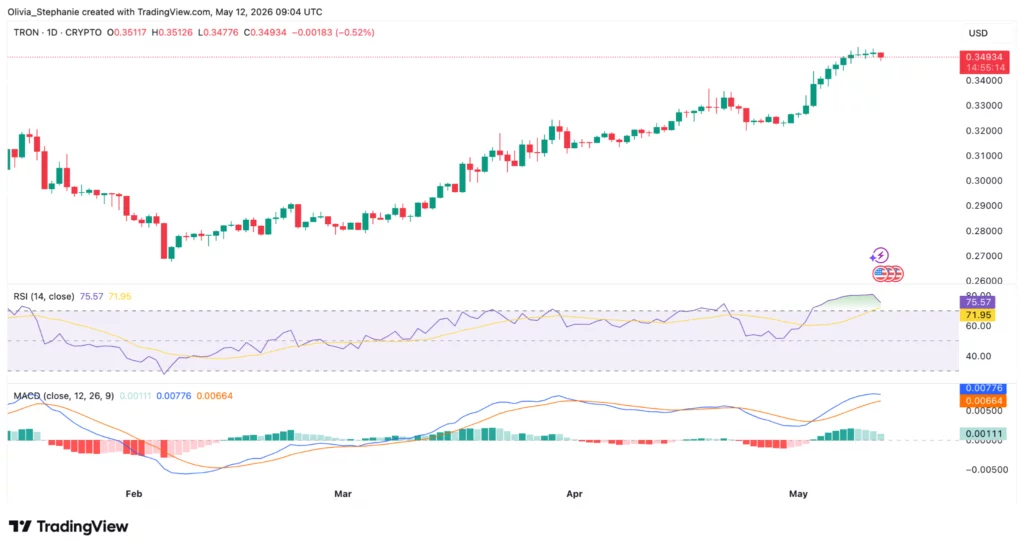
TRON traded near $0.349 after a steady three-month rally, with live market data showing a small intraday decline.
Summary
- TRON traded near $0.349 as RSI moved above 75, showing strong but stretched momentum.
- Santiment said crowd FUD may support TRX as skeptical traders keep doubting the rally.
- TRON’s USDT role remains a major growth driver, but scrutiny over illicit flows persists.
Crypto.news price data also placed TRON (TRX) near $0.351, with a 24-hour range of $0.349241 to $0.352492. The same data showed a market cap above $33 billion and 24-hour volume near $447 million.
Meanwhile, Santiment said TRON has gained about 26% over the past three months, while crowd discussion remains mixed. The analytics firm linked part of the rally to persistent doubt around the project and its founder, Justin Sun.
The firm said many traders still view TRON as “too risky” or “too controversial” compared with newer crypto themes such as AI and DeFi. It also argued that markets often move against crowd expectations when sentiment becomes too one-sided.
TRX chart shows strong momentum
TradingView chart shows TRX in a clear uptrend from early February lows near $0.27 toward the $0.35 area. Price action has formed higher lows and higher highs through March, April, and early May.
The RSI reading sits at near 76, above the 70 level often used to mark overbought conditions. That suggests strong buying pressure, but it also shows the rally may be stretched in the short term.
At the same time, the MACD line sits at 0.00777, above the signal line at 0.00664. That setup still supports bullish momentum, while the histogram remains positive at 0.00112.
However, the latest candles show TRX pausing near the recent high. If buyers keep price above the $0.34 to $0.345 area, the trend may stay supported. A move below that zone would point to a deeper cool-off after the recent climb.
USDT activity remains central to Tron
TRON’s role in stablecoin transfers remains one of its largest market drivers. Earlier crypto.news coverage said TRON had extended its USDT lead over Ethereum, with rising active addresses and record weekly transaction volumes linked to stablecoin use.
That same stablecoin activity has also drawn scrutiny. Crypto.news previously reported that Tether froze USDT across Ethereum and Tron addresses, while a Tether-backed crime unit later froze more than $300 million in illicit assets.
Moreover, TRON has also gained wider market visibility. As crypto.news reported, Moscow Exchange plans to add a TRX index from May 13, using pricing data from Binance, Bybit, OKX, and Bitget for professional investors.
Disclosure: This article does not represent investment advice. The content and materials featured on this page are for educational purposes only.



Amazon has expanded its trucking service to businesses beyond its own logistics network.
Summary
- Amazon expanded its less-than-truckload shipping service to businesses beyond its own logistics network.
- Freight carrier stocks fell after the announcement, including Old Dominion, ArcBest, Saia, XPO and FedEx Freight.
- Amazon is turning more of its logistics network into outside services through Amazon Supply Chain Services.
The move sent shares of several major freight carriers lower on Wednesday. The company will now offer less-than-truckload shipping to businesses across the United States.
Amazon opens LTL service to more businesses
Amazon said it will offer less-than-truckload shipping to all businesses through Amazon Supply Chain Services. The service previously supported companies shipping goods into Amazon warehouses and fulfillment centers.
Less-than-truckload shipping lets carriers move freight from several customers on one trailer. The model differs from full truckload shipping, where one customer fills the trailer. Amazon said the service can deliver freight to any destination in the United States. The company is using its logistics network to reach more business customers.
Jim Ruiz, director of Amazon Freight, said sellers wanted wider access to the service. “The feedback from Amazon selling partners using our LTL service was clear,” Ruiz said. He said customers valued the service’s technology, visibility, and reliability. “Now Amazon LTL can move your freight wherever it needs to go,” Ruiz added.
Freight carrier shares fall after announcement
Freight stocks declined after Amazon announced the expanded trucking service. Old Dominion Freight Line fell 5% after the news. ArcBest shares dropped 4%, while Saia slid 3%. XPO Logistics also fell 5% during the market reaction.
FedEx Freight shares fell about 7% on Wednesday. The company started trading earlier this month after its spinout from FedEx. The share declines came as Amazon moved deeper into a market served by long-standing carriers. The company’s freight offer now targets businesses of different sizes.
Amazon has spent years building a large logistics network for its own retail operations. It now uses more of that network to serve outside companies. The company reduced its reliance on external carriers as it pushed faster delivery speeds. That strategy gave Amazon more control over shipping times and costs.
The logistics network becomes an outside service
Amazon’s logistics system now includes cargo planes, delivery vans, trailers, and containers. The company has 80,000 trailers and 24,000 containers in its freight operation. Its network also includes tens of thousands of delivery vans. Amazon-branded cargo planes support longer-distance movement across its supply chain.
The company has started opening more in-house logistics tools to outside businesses. That approach adds competition for carriers that already serve business shippers. Last month, Amazon introduced an end-to-end supply chain service. The package combines several of its freight and logistics services into one offering.
That announcement pushed shares of UPS and FedEx lower at the time. Wednesday’s LTL expansion added another freight service to Amazon’s outside-business program. Amazon said the LTL service will support destinations nationwide. The company’s latest move extends Amazon Supply Chain Services beyond warehouse-bound shipments.


The Securities and Exchange Commission on Tuesday published its Draft Strategic Plan for fiscal years 2026 through 2030, placing a "firm regulatory foundation for digital assets and distributed ledger technologies" as the first objective of its first goal — the most prominent placement crypto… Read the full story at The Defiant
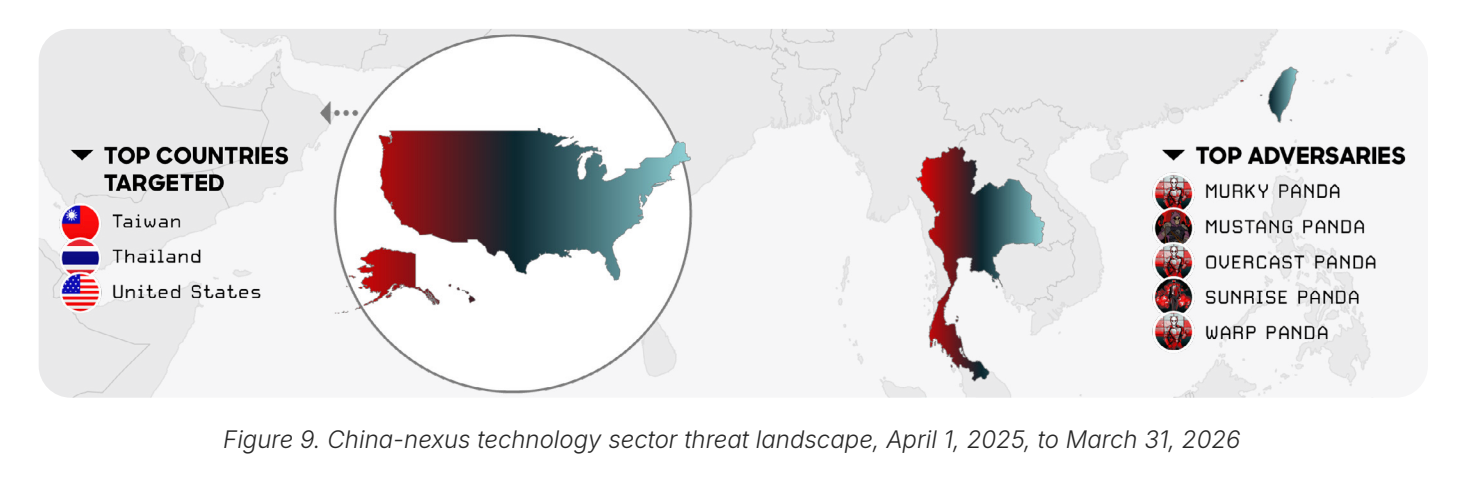
China-nexus adversaries attacked the technology sector more than any other industry over the past year, stealing artificial intelligence (AI) capabilities and intellectual property (IP) that Beijing cannot build fast enough on its own, CrowdStrike said.
The cybersecurity firm tracked activity from April 2025 to March 2026, linking it to Beijing’s drive for technological self-sufficiency and its stated goal of global AI leadership by 2030.
Why China Targets the Technology Sector
Technology firms are where the most valuable AI development now sits. That concentration has pushed the sector to the top of attackers’ target lists. CrowdStrike attributed more than 58% of state-sponsored targeted intrusions against tech to China-nexus groups.
AI capabilities rank as the highest-value intelligence collection target. Beijing can apply those capabilities to military modernization, economic growth, and intelligence gathering.
“Technology entities in general serve as a strategic target for China-nexus adversaries because access to such entities provides high-value intelligence collection as well as access to downstream customer environments that can enable potential supply chain compromises,” the report read.
Several named groups drove the campaigns, including MURKY PANDA, MUSTANG PANDA, OVERCAST PANDA, SUNRISE PANDA, and WARP PANDA. MURKY PANDA’s password-spraying operation alone hit more than 340 US-based entities.
Follow us on X to get the latest news as it happens

The AI Race Driving the Espionage
CrowdStrike frames the espionage as industrial policy aimed at closing China’s AI innovation gap. Adam Meyers, who heads counter-adversary operations at CrowdStrike, explained that each leap in AI capability rewards the developer with an advantage and hands intruders a new way in.
“China runs cyberespionage as an industrial policy to try to close the AI innovation gap, demonstrating that AI capabilities are the prize adversaries are after. Whether you’re building AI or adopting it, security has to be built in from the start,” Meyers said.
The firm expects China to keep prioritizing technology entities for at least 12 months. It cited US-China decoupling, sanctions enforcement, and economic espionage as the main drivers.
The findings sharpen a wider debate over the US lead in AI. Anthropic has argued that Washington could lock in a 12 to 24-month advantage over China through curbs on chip smuggling, offshore data centers, and model distillation.
Therefore, the coming year will test whether export controls and security investments can protect that edge, even as adversaries target the tools used to build AI itself.
Subscribe to our YouTube channel to watch leaders and journalists provide expert insights
The post Technology Becomes Most Targeted Industry as China-Nexus Adversaries Hunt AI appeared first on BeInCrypto.


BlackRock's BUIDL fund, the largest tokenized U.S. Treasury product on-chain, has become the single biggest real-world asset on Avalanche after a multi-hundred-million-dollar allocation that drove the network's distributed RWA total to a record $1.16 billion in late May, with the BUIDL position… Read the full story at The Defiant


Bitwise Chief Investment Officer Matt Hougan said financial advisors are still interested in crypto, but their focus is moving beyond Bitcoin.
Summary
- Matt Hougan said advisors now discuss stablecoins and tokenization more than Bitcoin in recent calls.
- Bitwise survey data already showed advisors ranking stablecoins and tokenization among the top 2026 themes.
- Ethereum, Solana, Chainlink, Avalanche, Circle and Coinbase may benefit if advisor crypto inflows broaden next.
His view came after eight sales calls with teams representing more than 40 advisors in one day.
Hougan wrote in a June 10 memo that advisors asked more about stablecoins and tokenization than Bitcoin. The shift suggests that professional investors are paying closer attention to crypto uses in payments, markets and real-world assets.
Advisors remain active despite the market pullback
Hougan said the main message from the meetings was that advisors have not left crypto during the bear market. He said new crypto cycles have often needed both new products and new investor groups.
“The fact that they remain interested despite the pullback is good news,” Hougan wrote. He said financial advisors and institutions could become the next investor class to support wider crypto adoption.
Bitwise has tracked this interest for months. Its 2026 Bitwise/VettaFi survey found that 56% of advisors owned crypto personally, while 42% could buy crypto in client accounts. Hougan added that advisors manage more than $175 trillion, making their access and product choices important for future crypto flows.
Stablecoins and tokenization lead the discussion
Hougan said Bitcoin has often led crypto recoveries because it is the largest and most established asset. He also said prices around $60,000 looked attractive for long-term investors.
Still, he said advisors showed more curiosity about practical crypto use. “Their eyes are on stablecoins and tokenization more than bitcoin,” Hougan wrote in the memo.
He linked the shift to weaker interest in the fiat debasement trade and stronger public discussion around on-chain finance. Hougan cited comments from SEC Chair Paul Atkins, Goldman Sachs CEO David Solomon and BlackRock CEO Larry Fink on stablecoins and tokenization. The memo did not say advisors have abandoned Bitcoin. It described a change in conversation.
Broader adoption themes
As previously reported by crypto.news, stablecoins have become a larger part of digital payments. Fiat-backed stablecoin supply crossed $319 billion in April 2026, while adjusted transaction volume reached $10.9 trillion in 2025.
Separately, as crypto.news reported, tokenized real-world assets crossed $29 billion by April 2026. Tokenized U.S. Treasuries grew from $380 million in 2023 to $13.4 billion by April 2026.
Hougan said future advisor inflows may first target assets tied to stablecoins and tokenization. He named Ethereum, Solana, Canton, Chainlink and Avalanche as assets raised during the meetings.
He also pointed to Hyperliquid and companies such as Figure, Circle and Coinbase. According to Hougan, advisors now have a broader view of crypto than they had two years ago.
Delaware and New Jersey have advanced bills that would ban crypto ATMs as lawmakers respond to rising scam complaints tied to the machines.
Summary
- Delaware and New Jersey advanced crypto ATM ban bills after lawmakers cited rising fraud complaints.
- FBI data showed 13,460 crypto kiosk complaints and over $388.9m in reported 2025 losses nationwide.
- Regulatory pressure on crypto ATMs is expanding, with Canada considering restrictions and operators facing financial strain.
The moves place both states closer to Indiana, Tennessee and Minnesota, which have already passed total bans.
The push follows new FBI data on crypto kiosks. The agency reported 13,460 complaints in 2025 and more than $388.9m in losses, with people over 50 accounting for more than half of complaints.
Delaware bill would remove crypto ATMs
The Delaware House Economic Committee advanced House Bill 441 on June 9. The bill would ban the ownership, installation and operation of cryptocurrency kiosks across the state.
The proposal would require existing machines to go offline and be physically removed within 90 days after the law takes effect. It also blocks retail point-of-sale or cashier-assisted crypto sales that copy a kiosk.
Representative Cyndie Romer, who sponsored the measure, said crypto ATMs carry high costs and expose residents to fraud. “These kiosks reduce digital currency to a predatory cash grab,” Romer said.
The bill treats violations as unlawful trade practices. Operators could face penalties of up to $10,000, while illegal fees may need to be refunded to users or paid into Delaware’s Consumer Protection Fund.
New Jersey sends ban bill to full Senate
New Jersey’s Senate Commerce Committee advanced Senate Bill 2141 on June 8. The measure would ban businesses from owning, controlling, installing, managing, selling or offering crypto ATMs in the state.
The bill defines crypto ATMs as internet-connected kiosks that let users buy, sell, send or receive digital assets through cash, debit cards or credit cards. Lawmakers linked the proposal to scams involving fake government officials, tech support schemes and bank impersonation.
New Jersey’s measure carries a penalty of up to $10,000 for a first offense. Later violations could bring penalties of up to $20,000, along with other consumer fraud remedies.
The bill would take effect on the first day of the sixth month after enactment. It now awaits action in the full Senate after clearing committee without opposition.
Crypto ATM pressure grows across markets
The bills add to broader pressure on crypto ATM operators in the United States and abroad. Indiana signed the first statewide total ban in March, followed by Tennessee in April and Minnesota in May.
As previously reported by crypto.news, Canada has also moved toward a nationwide crypto ATM ban over fraud concerns. Separate reporting noted that Bitcoin Depot filed for Chapter 11 bankruptcy after facing regulatory pressure, falling revenue and security issues.
Crypto ATM operators have argued that they should not be blamed for crimes carried out by outside scammers. Some operators have added on-screen warnings, identity checks and transaction limits.
Lawmakers in Delaware and New Jersey have taken a different path. Their bills seek to remove the machines rather than regulate them, making crypto ATM bans a growing consumer protection response in 2026.
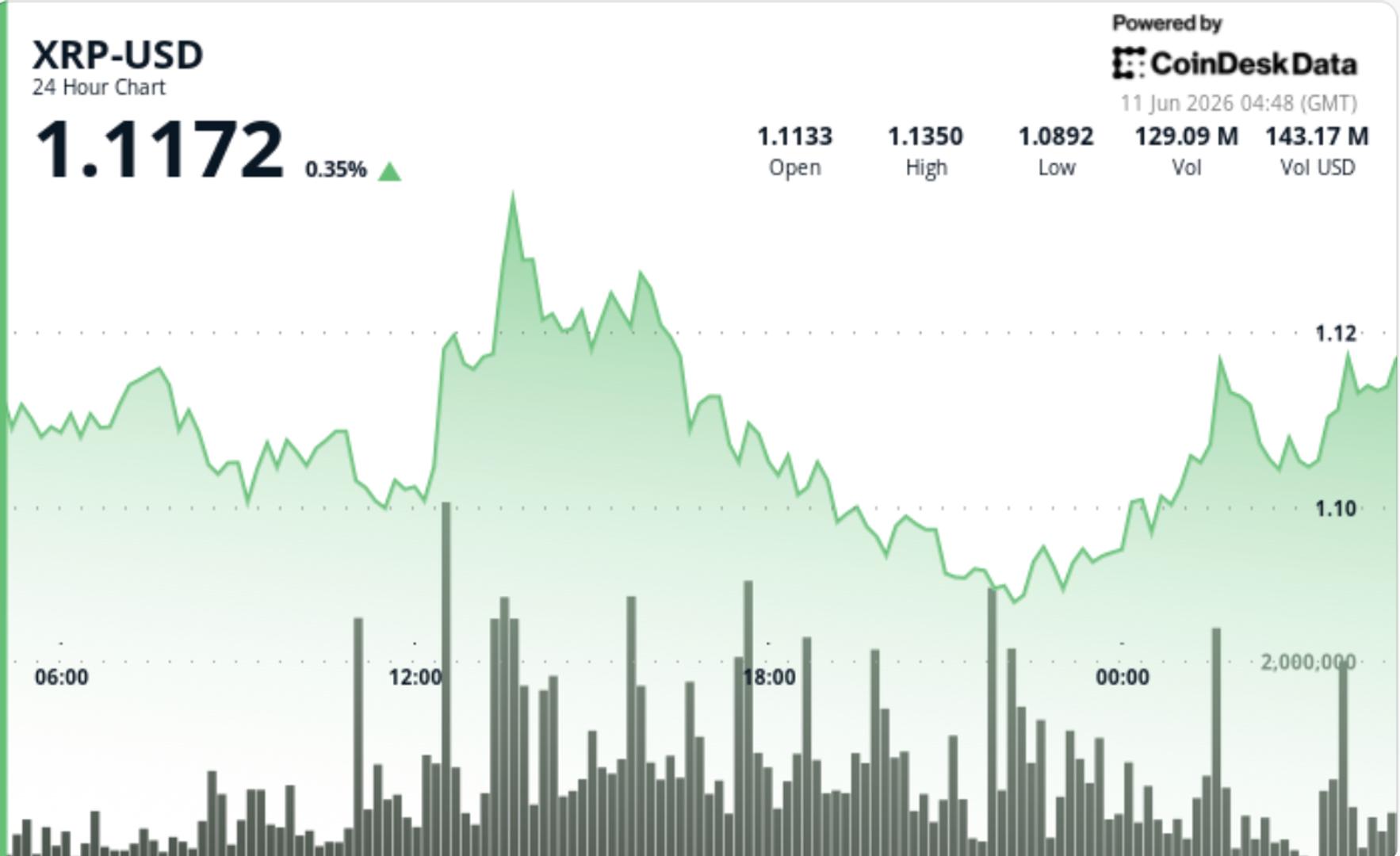
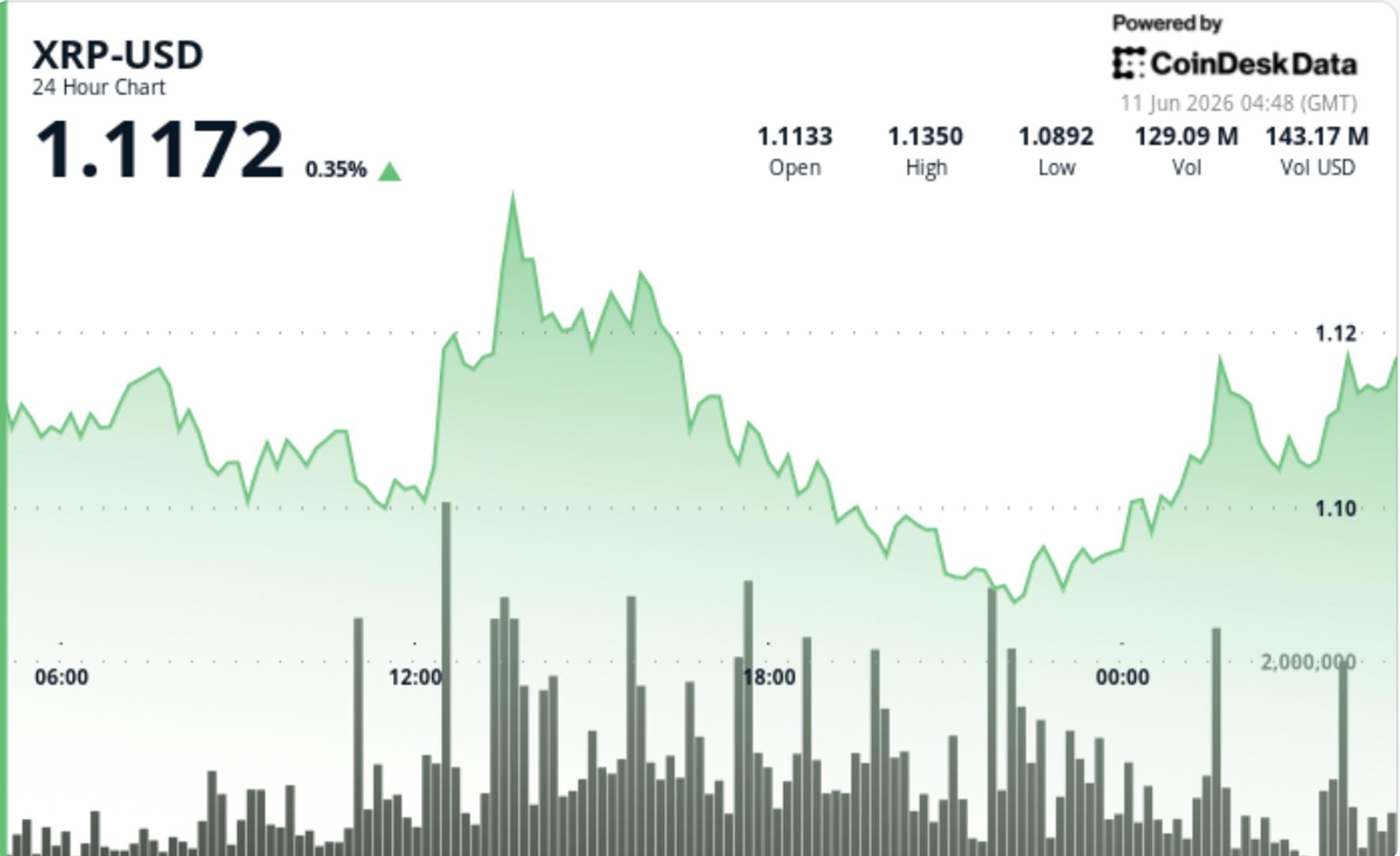
XRP managed to hold the $1.10 area, which matters after last week’s sharp breakdown, but the recovery still looks tentative. Institutional money continues flowing into XRP-linked products and futures activity has picked up sharply, yet price remains pinned near multi-month lows while bitcoin and the broader market recover more aggressively.
News Background
• XRP-linked investment products attracted another $6.75 million in inflows, lifting cumulative ETF inflows to roughly $1.44 billion.
• The XRP Ledger’s version 3.2.0 upgrade is scheduled for June 15 and is expected to reduce server memory requirements by around 40% while rebranding the core software from “rippled” to “xrpld.”
• Futures activity surged to roughly $5 billion during the session, even as open interest remained near cycle lows, suggesting traders are actively repositioning rather than building long-term conviction.
Price Action Summary
• XRP gained about 1% during the 24-hour session, climbing to $1.1141 after recovering from lows near $1.11.
• The strongest move came late in the session when heavy volume pushed price through resistance around $1.1114 and briefly lifted XRP above $1.12.
• Earlier attempts to rally were rejected near $1.1352, leaving that level as the clearest near-term resistance zone.
Technical Analysis
• The most important takeaway is that XRP remains weak relative to the broader market. While the token posted a small gain, it underperformed major crypto benchmarks by nearly two percentage points.
• The late-session breakout above $1.11 was constructive, but it happened within a much larger downtrend that remains intact.
• Futures markets are sending mixed signals. Rising volume points to renewed trader interest, while subdued open interest suggests many participants are still reducing risk rather than aggressively adding exposure.
• XRP remains below its 50-day, 100-day and 200-day moving averages, meaning the broader technical structure continues to favor sellers despite signs of stabilization.
What traders should watch
• $1.10 remains the key support level. Holding above it keeps the recent stabilization attempt intact.
• $1.12-$1.13 is the first resistance zone, followed by $1.1352 where the latest rally stalled.
• A move above $1.26 would begin repairing the chart meaningfully and shift focus back toward the $1.30-$1.40 region.
• If XRP loses $1.05-$1.10 support, traders are likely to start discussing a move toward the psychologically important $1.00 level again.


Bitcoin is trading near a level it has usually reached only late in bear markets, and it has held there even after the hottest U.S. inflation print in three years.
Checkonchain data show BTC fell toward close to its 200-week average, a rough four-year trend line watched by long-term holders. The model puts bitcoin in the bottom 10% of its historical valuation range, a zone that has appeared only during the deepest parts of past bear markets.
Bear market bottoms are a process, not an event.
First, price-sensitive investors capitulate. Then comes the harder phase: months of sideways action that slowly wear down the conviction of those who remain.
In our latest newsletter piece, @_Checkmatey_ examines the evidence… pic.twitter.com/ReSQFfqi5R
— _Checkonchain (@_checkonchain) June 10, 2026
The mood in the market is just as washed out. The Crypto Fear and Greed Index – a measure of sentiment calculated using volatility, social media posts, and market volumes – sits at 9, deep in extreme fear, down from 11 last week and 48 a month ago.
Those readings usually show up when price-sensitive sellers have already done most of their selling. Checkonchain still warns that bottoms are a process where capitulation comes first followed by months of sideways trading that grind down the holders who stayed.
Bitcoin briefly broke below $60,000 this week for the first time since 2024 and changed hands at $62,623 on Thursday, up 1.9% on the day but lower over the week, with a record run of ETF outflows still pulling money out.
The bounce was broad but shallow. Ether rose 1.4% to $1,651, BNB added 1.3% to $595, solana gained 0.9% to $65 and dogecoin 1.1% to $0.085. XRP was the laggard, down 0.3% at $1.12. All of them remain lower over the past seven days, led by ether at 6.5% and XRP at 7.5%. Thursday’s gains dent the weekly slide rather than reverse it.
Inflation is not helping the case for a quick recovery. US consumer prices rose 0.5% in May from April and 4.2% from a year earlier, the fastest annual pace since early 2023, as the Iran war pushed up energy costs, according to Bureau of Labor Statistics data released Wednesday.
The core measure, which strips out food and energy, rose 0.2%, less than economists expected, the one soft spot in an otherwise hot report.
“Hopes for US regulatory clarity have faded again, with Polymarket odds of the Clarity Act passing in 2026 dropping from 62% to 48% this week,” Yves Renno, head of Trading at global crypto payments platform Wirex, told CoinDesk.
“All eyes now turn to the FOMC on June 16th–17th, and Warsh’s tone will be decisive in determining whether Bitcoin bounces toward $68–72K or breaks below $60K entirely.”
Meanwhile, the pressure runs well beyond crypto. Global equities fell to a more than one-month low this week as a technology-led selloff deepened and US forces struck multiple targets in Iran, collapsing the ceasefire that had held since April.
MSCI’s All Country World Index, the broadest measure of global stocks, slipped to its lowest since May 5, and its Asia Pacific gauge fell 0.8% to a three-week low. Brent crude rose 1.8% to about $95 a barrel. The European Central Bank is expected to raise rates later Thursday for the first time since September 2023, with bond traders pricing in higher borrowing costs worldwide.
Crypto World
Solana Price Just Bounced Off $60 With RSI at 28, Is This the Capitulation Bottom or Just a Dead Cat Bounce?

Solana price is trading near $63.61 amid one of the sharpest sentiment contractions in recent memory, the Fear & Greed Index has collapsed to an extreme fear reading of 10.
That bounce off the $60 support zone looks encouraging on the surface. Whether it holds is a different question entirely.
The broader crypto market added just 0.13% in 24 hours while Bitcoin dominance sits firm at 57%, signaling capital remains defensive and rotation into altcoins has not yet materialized in any meaningful way.

The catalyst for the recent selloff was a sector-wide liquidation wave that dragged SOL down to the $60 zone before a partial recovery of over 5%.
CoinMarketCap’s AI market commentary described the move as a “sharp sell-off” followed by a tentative rebound, stopping well short of calling it a trend reversal.
Discover: The Best Crypto to Diversify Your Portfolio
Can Solana Price Reclaim $70 This Week, or Is Another Test of $60 Coming?
SOL is trading at $63.61, sitting 11% below its 20-day EMA and more than 17% below its 50-day EMA. The 200-day EMA at $105 feels academic from current levels.
All major moving averages point downward. This is not a pullback inside a healthy uptrend. It is systematic repricing.
Daily RSI at 28.42 confirms deeply oversold conditions while price hugs just above the lower Bollinger Band floor at $60.52, a zone historically associated with short-term mean reversion pressure. But the daily MACD complicates the setup.
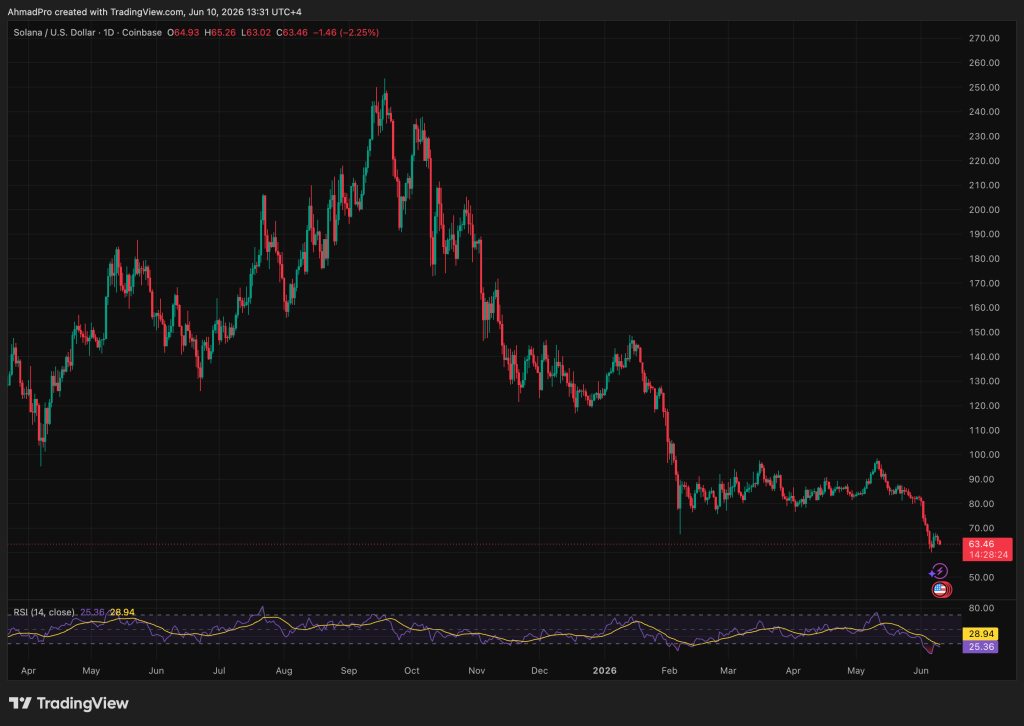
RSI says stretched. MACD says sellers are not done. That tension is the defining technical story right now.
On the hourly chart SOL consolidates tightly between Bollinger Band limits of $65.71 and $68.04 with immediate resistance at $67.62.
The ATR of $4.17 implies daily swings around 6%, meaning stop-out risk at this level is real. Reclaiming the hourly 200 EMA at $69.51 is the minimum technical requirement for any bullish reframe.
Clear $70 to $76 and trend stabilization gets confirmed. Stay rangebound between $63 and $69 and sellers and buyers continue contesting control without resolution. Break below the $60.52 Bollinger floor and local lows come back into view with potentially deeper levels beyond them. ETF fund outflows remain an overhang that tilts the probabilities toward the downside scenario until flows reverse.
LiquidChain Aim to be The “Solana of This Cycle”, Could This Happen?
SOL’s price compression illustrates a structural problem that runs deeper than a single asset’s chart.
Liquidity in crypto remains siloed. Capital rotates between Bitcoin, Ethereum, and Solana but rarely flows efficiently across all 3 simultaneously.
Every rotation absorbs friction in the form of fees, slippage, and fragmented infrastructure that was never designed to function as a connected system. That fragmentation is the problem LiquidChain is building against.
The project is a Layer 3 infrastructure play positioning itself as the cross-chain liquidity layer for the next phase of multi-ecosystem growth.
A Unified Liquidity Layer, Single-Step Execution, Verifiable Settlement, and a Deploy-Once Architecture that lets developers build once and access all 3 ecosystems simultaneously. The presale has raised $832,783 to date with $LIQUID priced at $0.01468.
Early stage infrastructure carries real risk. Token price discovery post-launch is highly unpredictable and execution is unproven at scale.
But the timing against a backdrop of accelerating cross-chain fragmentation is structurally relevant. Capital rotation into presale infrastructure rounds during market compression phases is a documented pattern, not speculation.
Discover: The Best Token Presales
The post Solana Price Just Bounced Off $60 With RSI at 28, Is This the Capitulation Bottom or Just a Dead Cat Bounce? appeared first on Cryptonews.
Crypto World
Bitcoin Enters Distribution Phase as Investors Increasingly Sell Into Strength: Bitfinex Alpha

The bullish impulse of the Bitcoin market has exhausted itself, and bitcoin has now entered a distribution phase. This can be seen in investors increasingly selling into strength rather than increasing their exposure.
According to this week’s Bitfinex Alpha report, both flow data and on-chain dynamics indicate that BTC has transitioned out of the accumulation phase that drove its rally earlier this year. This signals the onset of a period of heavy selling pressure that could see BTC slump to levels last seen in early to mid 2024.
Bitcoin Enters Distribution Regime
Bitcoin already slipped below $60,000 on June 5 amid large outflows from spot exchange-traded funds (ETF) and persistent macroeconomic headwinds. Although the asset has rebounded in the last two days and climbed back above that level, analysts believe the recovery may be hiding a more important shift beneath the surface, which is the transition into a distribution regime.
During the decline last week, BTC fell to a multi-year low of $59,200, a level last seen in October 2024. This price also represented a 53% drawdown from the October 2025 all-time high (ATH), a 28.5% fall from levels recorded in mid-May, and a 20% plunge from the June monthly open. BTC was unable to sustain the $60,000 floor, which has been a price anchor since February.
With BTC having retreated to its Q1 2026 consolidation zone, the asset faces two possible scenarios – the best being a motion range between $60,000 and $72,000. On the other hand, the worst-case scenario is price discovery at levels not seen since the maturation of the spot ETF market.
BTC Faces Worst Case Scenario
Analysts say the worst scenario will play out if BTC breaks through $60,000 for a sustained period of time. Bitcoin’s current moves are already confined within previous range lows, due to catalysts like ETF outflows and Strategy’s BTC sales.
Other factors contributing to bitcoin’s current price trend are rising energy prices, stronger-than-expected labor market data, and tightening financial conditions from the Federal Reserve. However, the most significant factor is the contraction of spot demand as seen in the sharp reversal in Spot Cumulative Volume Delta.
“Spot Cumulative Volume Delta has transitioned into a clear negative regime, touching depths reminiscent of the large liquidations seen in February. The data confirms that aggressive distribution, especially by recent buyers, is currently the dominant force on exchange order books,” analysts explained.
As with previous distribution phases, BTC can only transition back into an accumulation regime when sustained spot demand returns.
The post Bitcoin Enters Distribution Phase as Investors Increasingly Sell Into Strength: Bitfinex Alpha appeared first on CryptoPotato.
FS.COM shares jump over 10% after buyback plan announcement

Amazon trucking push sends freight carrier stocks lower

Taylor Swift Set To Scope Out Her Rumored Wedding Venue



-

 Fashion5 days ago
Weekend Open Thread: Evereve – Corporette.com
-
 Crypto World6 days ago
Jensen Huang Approves Samsung, SK Hynix, and Micron for NVIDIA (NVDA) HBM4 Memory Supply
-

 Crypto World3 days ago
Anatomy of the June crypto crash: Fed, Iran, Saylor
-
 Entertainment4 days ago
The Best Mystery Series of All Time Is Surging on Streaming 30 Years After It Ended
-

 NewsBeat3 days ago
Alexander Zverev wins the French Open to finally earn a 1st Grand Slam title
-

 Tech5 days ago
Suspicious Polyfill login prompts pop up on Toshiba, Muji websites
-
 Crypto World4 days ago
Senator Cynthia Lummis Calls CLARITY Act the Most Consequential Financial Legislation of This Generation
-

 Tech6 days ago
Microsoft launches MXC, an OS-level sandbox for AI agents, with OpenAI and Nvidia already on board
-

 Tech4 days ago
Microsoft unveils seven homegrown AI models in new bid for ‘long term self-sufficiency’
-

 Business6 days ago
(VIDEO) Justin Bieber Delivers Surprise Happy Birthday Serenade to Diners at Los Angeles Mexican Restaurant
-
 Business4 days ago
The Pain Points Taking a Fragile Tech Rally Down a Notch
-
 Crypto World3 days ago
Eli Lilly (LLY) Stock Surges 4% Following Breakthrough Sleep Apnea Trial Results
-
Crypto World6 days ago
LBank Surpasses 25 Million Users Worldwide as AFA Partnership Continues to Drive Global Growth
-

 Tech5 days ago
Von der Leyen’s AI envoy pick draws conflict-of-interest fire
-

 Tech6 days ago
Meta steals a tactic from Tesla and builds data centers in tents
-

 Crypto World4 days ago
Trump’s AI Ownership Plan Could Benefit Anthropic at OpenAI’s Expense
-

 Business3 days ago
High Stakes for Wembanyama as New York Pushes for 3-0 Lead
-
 Sports2 days ago
Bangladesh beat Australia after 20 years in ODIs, register only their second win over six-time world champions | Cricket News
-

 Tech5 days ago
Hackers now exploit SolarWinds Serv-U flaw to crash servers
-
 NewsBeat3 days ago
Alexander Zverev conquers demons and outlasts Flavio Cobolli to win French Open for first major title
You must be logged in to post a comment Login