

Crypto World
Trump Iran Deal Lifts Crypto Markets By $75 Billion

Cryptocurrency markets have recovered around $75 billion in total capitalization following a progress update on Saturday from US President Donald Trump on a peace agreement with Iran.
Trump said a deal has been “largely negotiated” among the United States, Iran, and several Middle Eastern countries, in a post on Truth Social on Saturday.
The countries included in the negotiations were Saudi Arabia, the United Arab Emirates, Qatar, Pakistan, Turkey, Egypt, Jordan and Bahrain.
“An agreement has been largely negotiated, subject to finalization between the United States of America, the Islamic Republic of Iran, and the various other countries, as listed,” he said. His post said:
“Final aspects and details of the deal are currently being discussed and will be announced shortly. In addition to many other elements of the agreement, the Strait of Hormuz will be opened.”
The deal also includes reopening the Strait of Hormuz. The closure of the key waterway has caused global energy prices to spike and has weighed on the cost of living in many nations. It has also hit investments in high-risk assets such as crypto, which have retreated recently.
Three months of war takes its toll
Trump’s announcement comes amid a fragile ceasefire that began in early April with several failed attempts at reaching an agreement between the US and Iran.
US Secretary of State Marco Rubio reiterated Trump’s demands for a peace deal during a visit to India on Saturday. “Iran can never have a nuclear weapon. The straits need to be open without tolls. They need to turn over their enriched uranium,” he said.
Related: Warsh will cut rates, despite consensus view of rate hikes: Analyst
Crypto markets react positively
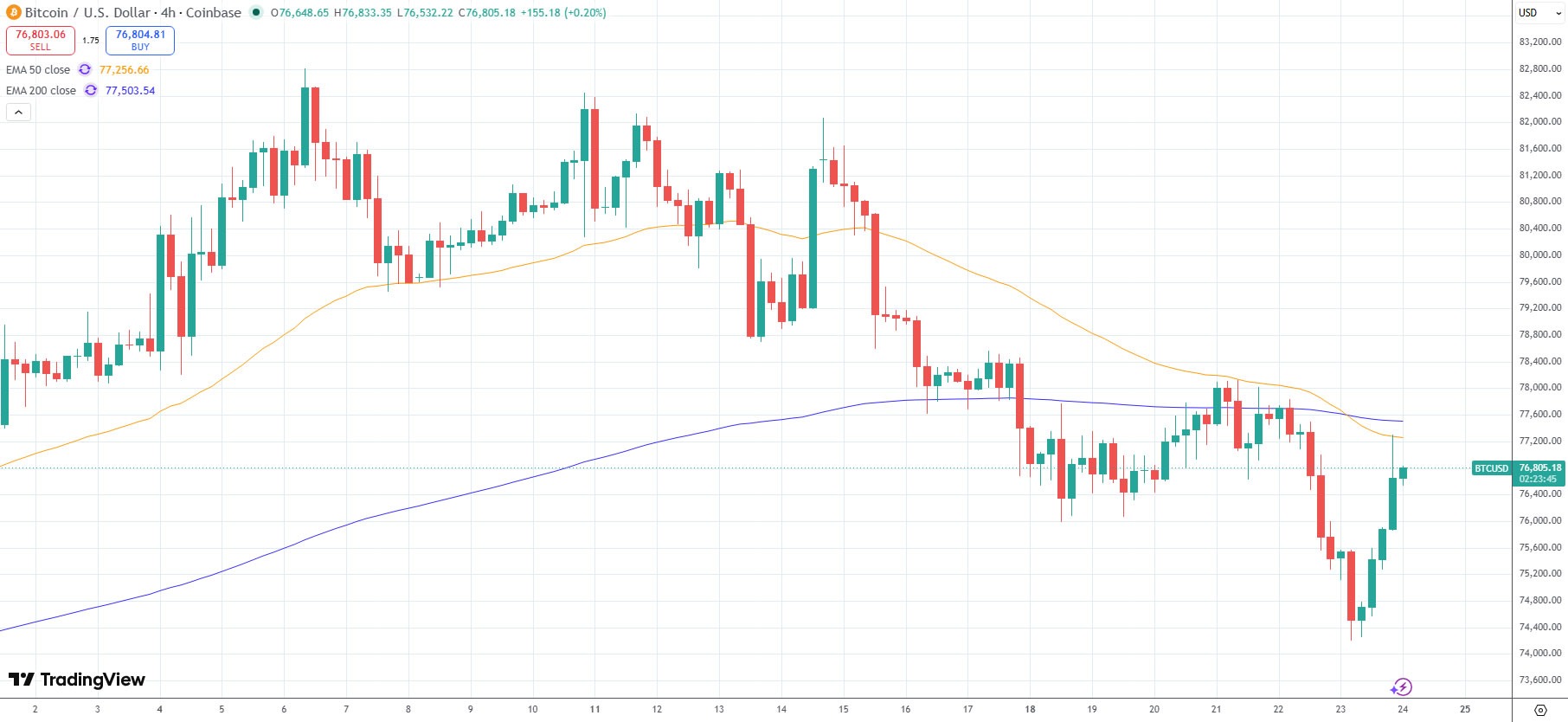
Bitcoin prices fell to a five-week low of $74,250 on Saturday, according to TradingView.
The asset recovered to tap the 50-day exponential moving average at $77,000 in early trading on Sunday before falling back to $76,800 at the time of publication.
BTC has resumed its downtrend after failing to break resistance at $82,000 and remains down 39% from its October peak.
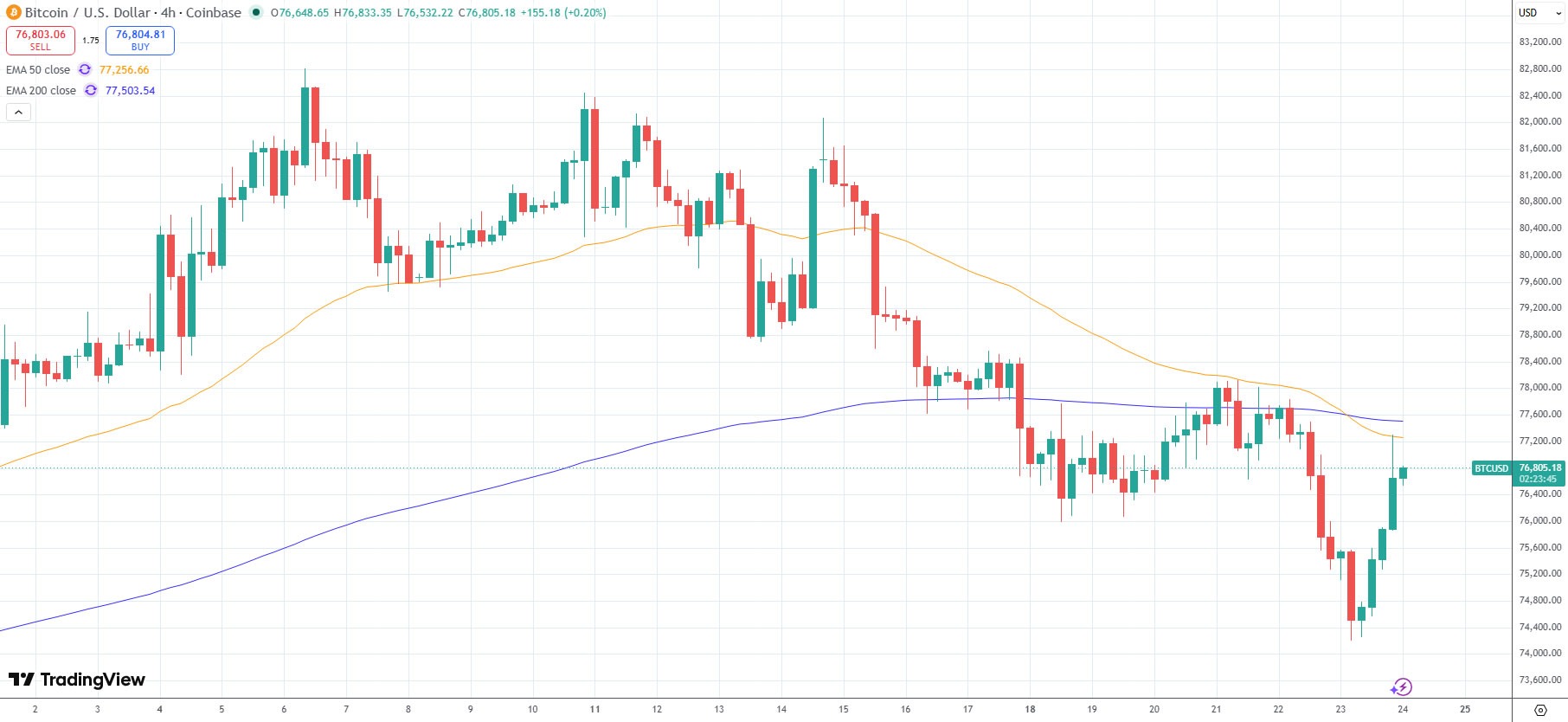
BTC sees minor recovery after Trump’s deal announcement. Source: TradingView
Magazine: Crypto scammers face death, Aussie CGT makes Asian hubs attractive: Asia Express

Crypto World
WhiteBIT EU secures MiCA License in Austria, expanding regulated crypto services across Europe

Disclosure: This article does not represent investment advice. The content and materials featured on this page are for educational purposes only.
WB-Shield Innovations GmbH secures MiCA authorization in Austria, expanding regulated crypto services across the European Economic Area.

Summary
- WhiteBIT EU secured MiCA authorization in Austria, enabling regulated crypto services across the EEA under FMA oversight.
- The approval strengthens WhiteBIT’s European strategy, ensuring compliant, secure, and transparent crypto-asset operations under MiCAR.
- With Austria’s MiCA license, WhiteBIT EU advances its regulated presence, supporting retail and institutional crypto services across Europe.
WB-Shield Innovations GmbH, operating as WhiteBIT EU, announced today that it has obtained authorization under the Markets in Crypto-Assets Regulation (MiCA) in Austria.
The authorization was granted by the Austrian Financial Market Authority (FMA).
The Austrian authorization marks a key step in WhiteBIT’s European growth strategy and underscores WhiteBIT EU’s commitment to operating within a transparent, secure and harmonized regulatory framework. Under MiCAR, WhiteBIT EU will be able to provide regulated crypto-asset services to eligible users across the EEA (excluding Malta).
The authorization marks an important step in WhiteBIT’s broader strategy to build a regulated European presence and contribute to the continued development of the digital asset ecosystem in the EEA.
“WhiteBIT was originally founded as a European exchange, and Europe remains at the core of our long-term vision,” said Volodymyr Nosov, Founder and President of W Group, which WhiteBIT is part of. “With MiCA setting a global benchmark for digital asset regulation, this authorization reinforces our commitment to building a transparent, secure, and compliant crypto ecosystem for users across the region.”
Strengthening WhiteBIT EU’s regulatory position in Europe
MiCAR establishes a harmonized EU framework for crypto-asset service providers, including requirements relating to governance, transparency, client protection and market integrity.
By obtaining authorization in Austria, WhiteBIT EU has completed a substantive regulatory assessment in a jurisdiction recognized for its well-established financial supervisory standards. This strengthens WhiteBIT EU’s regulated European presence and supports the planned provision of crypto-asset services across the EEA within the scope of its MiCAR authorization and in accordance with applicable passporting, onboarding and regulatory requirements.
With the MiCA license in Austria, these efforts are now consolidated under a single regulatory framework, enabling WhiteBIT to serve millions of European retail and institutional clients with compliant, secure, and accessible crypto services.
Launch of WhiteBIT.EU for European users
As part of its transition to the MiCA framework, WhiteBIT is preparing to launch whitebit.eu — a dedicated platform designed specifically for users across the European Economic Area (EEA).
This new platform will serve as WhiteBIT’s regulated hub for the European market, operating under the MiCA framework and offering compliant access to the company’s products and services across the EEA.
New users interested in joining whitebit.eu can already register their interest through a dedicated form on the website and will be among the first to receive updates when the platform becomes available.
About WhiteBIT
WB-Shield Innovations GmbH (WhiteBIT EU) is an entity of WhiteBIT, authorised to provide crypto assets services in the EEA. WhiteBIT was founded in 2018 and is now a part of W Group, which serves more than 35 million customers globally. WhiteBIT collaborates with Visa, FACEIT, Barcelona FC, Juventus and the Ukrainian national football team. The company is dedicated to driving the widespread adoption of blockchain technology worldwide.
Disclosure: This content is provided by a third party. Neither crypto.news nor the author of this article endorses any product mentioned on this page. Users should conduct their own research before taking any action related to the company.
Ali Martinez has cautioned that Strategy’s STRC structure may amplify financial stress in a prolonged Bitcoin bear market, citing similarities to the feedback loop seen in Terra-Luna’s collapse in 2022.
Summary
- Ali Martinez warned that Strategy’s STRC structure could increase financial pressure during a prolonged Bitcoin decline.
- STRC fell as much as 17% below its $100 par value, raising concerns about investor demand.
- Martinez said the stock’s feedback mechanism shares conceptual similarities with Terra-Luna’s collapse dynamics.
In a June 19 X post, Martinez argued that STRC differs from traditional corporate bonds because its dividend rate can be adjusted to help keep the security trading near its $100 par value.
While conventional bond issuers continue paying fixed interest regardless of market fluctuations, he said Strategy may face pressure to raise dividend payouts if demand for STRC weakens during a Bitcoin downturn.
The concern comes as scrutiny of Strategy’s financing model continues to grow following a sharp decline in its latest preferred stock offering.
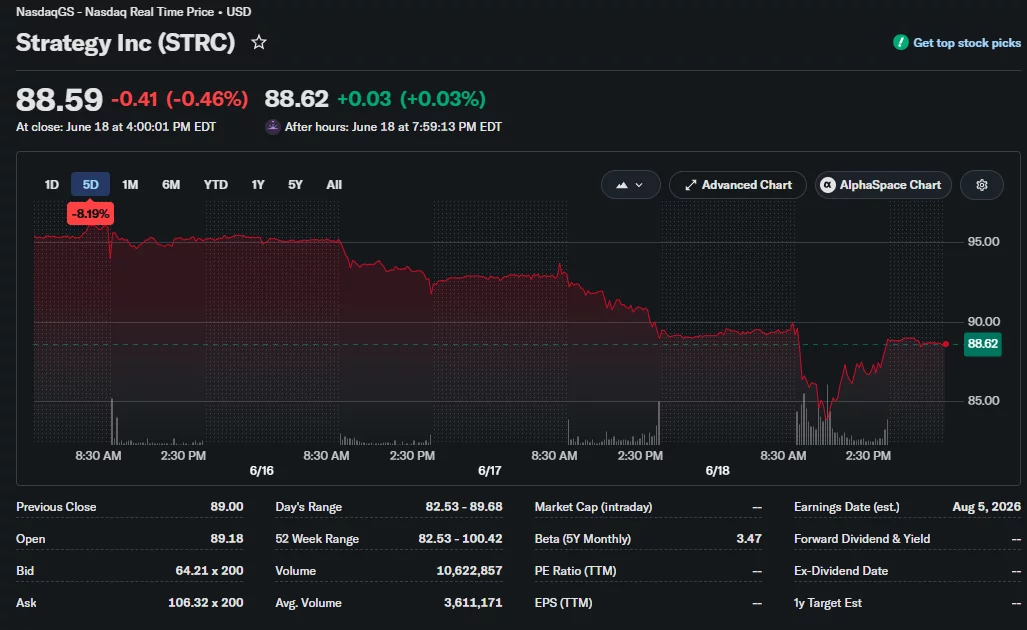
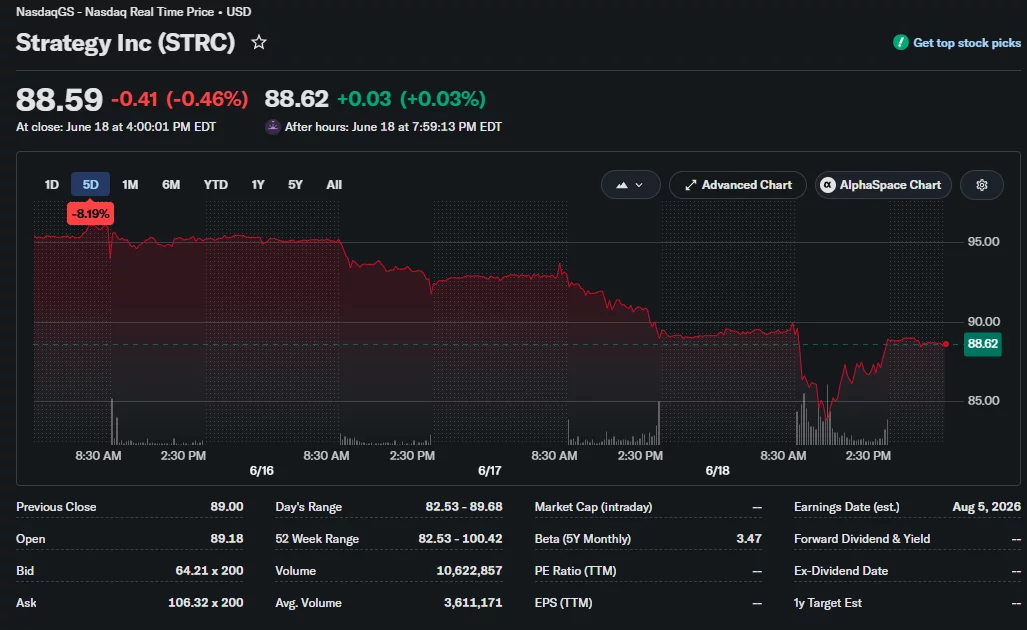
As reported by crypto.news earlier, STRC fell as much as 17% below par value on June 18, reaching a record low of $82.53 before recovering to close at $88.59.
Rising payouts could increase pressure during a Bitcoin decline
Martinez said the structure creates a situation in which Strategy’s financing costs could rise at the same time that the value of its primary treasury asset falls. If Bitcoin remains under pressure and investor demand for STRC declines, the company may need to offer higher dividends to attract buyers and support the stock’s market price.
According to Martinez, additional cash commitments tied to higher payouts could become increasingly burdensome during a prolonged market downturn.
His assessment arrives as investors debate how Strategy should respond to the weakness in STRC. Arca Chief Investment Officer Jeff Dorman recently noted that selling between $3 billion and $4 billion worth of Bitcoin could be one way to relieve pressure on the company’s capital structure.
As reported by crypto.news, Dorman assigned a 25% probability to a large Bitcoin sale and said such a move could provide flexibility while helping restore confidence in STRC. He nevertheless viewed continued sales of MSTR shares as the more likely outcome, assigning that scenario a 70% probability.
Terra comparison focuses on incentives rather than mechanics
While drawing comparisons to Terra-Luna, Martinez emphasized that Strategy is fundamentally different from the failed stablecoin ecosystem. He noted that Strategy does not rely on algorithmic tokens or token minting mechanisms, which played a central role in Terra’s collapse.
Instead, his warning focused on what he described as a similar economic dynamic. Martinez argued that both systems place additional financial burdens on the issuer as conditions deteriorate, rather than reducing pressure during periods of stress.
“It is conceptually similar to the Terra/Luna collapse,” Martinez wrote.
Expanding on that view, he said a sustained Bitcoin decline could force more capital toward supporting STRC around its $100 par value. According to Martinez, this could create a “dangerous loop” where falling asset values coincide with increasing financial obligations.
Additional concerns surrounding Strategy’s liquidity position have also emerged in recent weeks. Earlier, market maker QCP estimated that the company’s available liquidity could cover preferred dividend payments for roughly seven and a half months.
At the same time, longtime Bitcoin critic Peter Schiff has questioned how STRC was marketed to investors, arguing that the stock’s decline could eventually raise Strategy’s future fundraising costs if buyers begin demanding higher yields to hold similar securities.


Zcash has gained renewed attention after discussions around Europe’s planned crypto compliance rules pushed the privacy-focused cryptocurrency back into the spotlight.
Summary
- Mert highlighted Zcash as a leading privacy-focused crypto amid debate over Europe’s upcoming compliance rules.
- Analysts disputed claims that every Bitcoin transaction will require identity verification under the EU framework.
- Technical analysts are watching the $440 support level as ZEC trades near $451 after a sharp correction.
According to recent reports, the European Union is preparing to introduce a €10,000 (about $11,500) limit on cash payments alongside tighter anti-money laundering requirements that are scheduled to take effect in 2027. Early interpretations of the rules sparked claims that every Bitcoin transaction would require identity verification, triggering debate across the crypto market.
Several analysts later argued that those claims overstated the scope of the regulations. Their interpretation suggests the requirements are aimed at regulated crypto service providers rather than direct peer-to-peer Bitcoin transfers. Even so, concerns about financial privacy quickly became a major talking point among traders and market commentators.
Analysts point to Zcash as a privacy alternative
As the discussion intensified, Helius CEO Mert highlighted Zcash as one of the strongest privacy-focused networks available in the crypto market. His comments added to growing attention around privacy coins as investors assessed the potential impact of stricter compliance standards in Europe.
Market commentator WallStreetBets also drew attention to the trend, stating that a new “privacy era” could be emerging. The remarks encouraged traders to take a closer look at privacy-focused assets, with Zcash becoming one of the most frequently mentioned names in those conversations.
Unlike Bitcoin, which records transaction data on a public blockchain, Zcash offers optional shielded transactions that can conceal wallet addresses and transfer details. Supporters of the network have argued that such features could become more attractive if regulators continue expanding reporting and compliance obligations across the digital asset sector.
Traders focus on key support levels
Despite the renewed interest, Zcash has not translated the privacy narrative into immediate price gains. Zcash (ZEC) was trading near $451 at the time of reporting, while daily trading volume fell 29% to about $365 million.
The muted price reaction follows a sharp decline earlier this month. Zcash lost more than 40% in a single day after heavy selling pressure hit the market, with reports linking part of the move to large-holder activity and sales attributed to BitMEX co-founder Arthur Hayes.
While the regulatory debate continues, technical analysts remain focused on whether ZEC can defend critical support zones. Analyst Altcoin Sherpa recently described the current area as a support region and said he remains bullish on the asset over the longer term. According to his analysis, Zcash could continue trading within a broad $350 to $500 range while largely following Bitcoin’s direction.
Another market analyst, Ardi, identified $440 as an important level for the token. According to his assessment, holding above that price and forming a higher low could leave room for another breakout attempt after ZEC previously rallied to around $520 before retreating.
“On the other hand, if it loses $440, it confirms the relief rally set the macro lower high, and we’ve likely seen the November fractal play out. Personally, I’m predicting a little bounce here, then continuation lower.”

TLDR:
- Kaspersky identified dozens of malicious Wallpaper Engine packages with thousands of installs on Steam.
- Lumma and Vidar infostealers were deployed to harvest crypto wallet data and browser credentials.
- Malware was hidden inside password-protected archives or bundled directly within wallpaper downloads.
- The FBI previously investigated Steam-distributed malware across titles including PirateFi and Tokenova.
Wallpaper Engine malware is spreading through Steam Workshop, one of gaming’s most trusted content platforms.
Cybersecurity firm Kaspersky has identified dozens of infected wallpaper packages distributed via the popular live-wallpaper application.
The malicious files steal Steam credentials, hijack active sessions, and deploy infostealers targeting crypto wallet data.
Many packages carried thousands of downloads before discovery, with victims reported across China, Russia, Singapore, Germany, and several other countries.
How Attackers Weaponized a Trusted Platform
Kaspersky’s report, published Monday, revealed that threat actors exploited Steam Workshop to upload malicious Wallpaper Engine packages disguised as animated desktop wallpapers.
Most used anime-style female characters as cover images, lending them a credible, appealing appearance to gamers.
The platform’s trust factor gave the malware a reliable distribution channel with minimal friction for potential victims.
The application’s core feature became the attack vector. Wallpaper Engine allows executable programs to run directly on a Windows machine, which attackers leveraged to deploy malicious payloads under the appearance of legitimate content.
Kaspersky confirmed it had identified dozens of infected wallpaper packages available through Steam Workshop, with many reaching thousands or even tens of thousands of downloads.
Some wallpapers bundled malware directly within the download package. Others concealed payloads inside password-protected archives that unpacked silently after installation.
One documented 2025 case showed a wallpaper launching what appeared to be a functional desktop game while secretly installing the DarkKomet backdoor in the background.
Kaspersky researcher Maxim Starodubov addressed the core vulnerability enabling these attacks. “Trusted platforms can be abused to distribute malware: The attacks rely on users trusting content hosted within legitimate ecosystems,” Starodubov said.
“While many of the malware families involved are well-known, the delivery mechanism enables attackers to reach large numbers of potential victims through seemingly harmless content.”
Infostealers, Crypto Theft, and a Growing Steam Problem
Among the most dangerous payloads identified were Lumma and Vidar infostealers, distributed alongside the RenEngine loader.
These malware families are well-documented tools for harvesting browser credentials, saved passwords, and cryptocurrency wallet information. Kaspersky also noted the activity appeared to involve multiple threat actors rather than a single coordinated group.
Steam credential hijacking was another confirmed outcome. Attackers captured active session tokens, allowing them to access accounts without requiring a password.
Kaspersky explained that “the application-based wallpaper feature allows executable programs to run directly on a user’s Windows computer, allowing attackers to distribute malicious software under the guise of legitimate content.”
The findings follow a documented pattern of Steam-related malware incidents. In July 2025, cybersecurity firm Prodaft reported that the Steam Early Access title Chemia had been compromised to distribute Hijack Loader, Fickle Stealer, and Vidar Stealer.
Earlier, the FBI announced investigations into malware found across several Steam titles, including PirateFi, BlockBlasters, and Tokenova.
Kaspersky advised users to treat Workshop content as potential threat vectors regardless of download counts. High install numbers do not confirm safety, as malicious packages accumulated tens of thousands of downloads before removal.


Quick Summary
- Shopify’s share price has declined approximately 30% in 2026, hovering near $108, even as the company delivers 30%+ revenue expansion for the fourth consecutive quarter
- Traffic generated through AI channels on Shopify’s platform exploded 8x compared to the previous year, with ChatGPT and Copilot pathways producing nearly double the order volume of conventional channels
- Following the Spring 2026 Editions product rollout, Citizens maintained its Market Outperform designation with a $150 target price
- Weekly active merchants using Shopify’s AI-powered assistant Sidekick quadrupled year-over-year during the first quarter
- Thrive Capital deployed $100 million into Shopify, specifically highlighting artificial intelligence’s capacity to transform digital commerce
Shopify (SHOP) shares currently trade near $108, representing a decline of roughly 30% since the beginning of the year and approximately 35% from levels seen six months ago. However, beneath this price weakness lies a company posting some of its most impressive operational results in recent memory.
The e-commerce platform has delivered revenue expansion exceeding 30% for four straight quarters. During Q1, the company’s gross merchandise volume (GMV) exceeded analyst projections by 2%, while earnings before interest and taxes (EBIT) surpassed consensus estimates by 14%. On a constant currency basis, GMV climbed 30% year-over-year.
This widening disconnect between share performance and operational strength has prompted certain Wall Street analysts to identify the current valuation as an attractive entry point.
Citizens reaffirmed its Market Outperform stance with a $150 price objective on June 18, immediately following Shopify’s Spring 2026 Editions announcement — the semi-annual product refresh event. This release featured upgrades to Catalog and Universal Commerce Protocol (UCP), both critical infrastructure components for autonomous shopping experiences.
The investment firm highlighted that Shopify’s development strategy centers on serving customers through any preferred interaction method — from conventional website browsing to AI agents executing purchases on behalf of users.
AI-Generated Traffic Delivers Measurable Business Impact
The company disclosed an 8x year-over-year explosion in artificially intelligent traffic during the most recent quarter. Shopify currently stands as the exclusive e-commerce platform enabling product discovery and purchasing through OpenAI’s ChatGPT, Microsoft Copilot, and Google Gemini interfaces.
These AI-powered channels demonstrate conversion rates approaching twice those of traditional traffic sources. This performance differential represents a meaningful business development rather than marketing rhetoric.
Sidekick, the company’s proprietary AI assistant built on merchant and corporate datasets, experienced a 4x expansion in weekly active merchant accounts year-over-year throughout Q1. This tool helps store owners optimize operations and accelerate business growth.
The underlying business dynamics are compelling: expanding AI traffic generates additional transaction intelligence, which enhances Sidekick’s capabilities, thereby attracting more merchants, subsequently producing more valuable data. This creates a self-reinforcing growth mechanism.
Wall Street Remains Cautiously Optimistic
Consensus opinion hasn’t completely aligned. Cantor Fitzgerald reduced its price objective to $115 while maintaining a Neutral rating, expressing concerns about margin sustainability. UBS similarly holds a Neutral position with a $130 target, identifying Shopify’s Retail POS division as a critical long-term performance driver.
Conversely, Piper Sandler preserved its Overweight recommendation with a $150 price target, emphasizing accelerating adoption of merchant tools. Citizens reinforced this perspective, stating Shopify “consistently delivers more value than it extracts in cost.”
Thrive Capital backed this investment thesis with a $100 million direct stake, specifically tied to the platform’s AI-enabled commerce trajectory.
Citizens acknowledged intensifying competitive pressures, particularly as advanced coding tools democratize merchant software development outside Shopify’s controlled environment.
A tangible risk exists: should OpenAI or Google elect to claim a more substantial portion of transaction value their AI systems facilitate, this could negatively impact Shopify’s merchant services revenue — which currently represents roughly three-quarters of total business income.
Currently, Shopify’s Spring 2026 Editions release strategically positions the platform to serve merchants across all touchpoints — brick-and-mortar, digital storefronts, and AI-mediated channels — leveraging its UCP framework and unified data architecture.
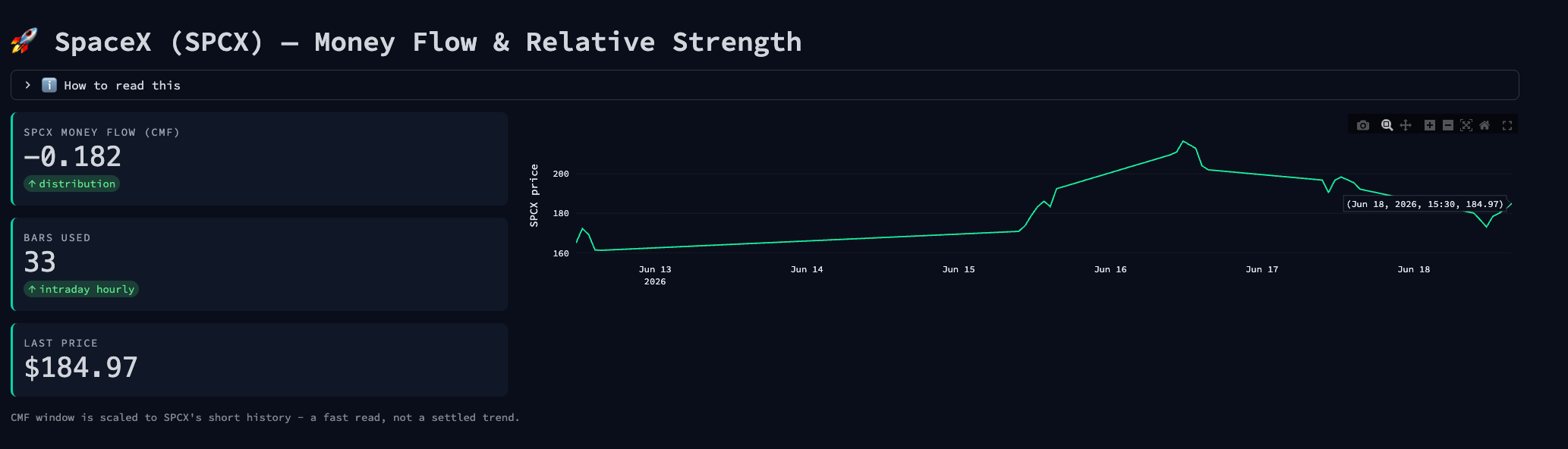
The SpaceX IPO was the biggest in market history, and it ran hot from day one. But the float (available shares) was tiny, so most investors never got an allotment. With the IPO out of reach, money is rotating into other space stocks to watch.
That rotation is selective, lifting only a few names. So rather than chase SpaceX, three of them stand out today.
The Money Is Rotating Within Space, Not Out of It
The SpaceX debut did more than mint one giant stock. It pulled fresh money and attention into the whole space basket. That money is now moving, yet it is not lifting everything.

A few names are drawing it in, while most of the sector leaks it out.

This looks like a real basket-driven move, not a broad market drift. The space names tend to move together, with an average correlation of 0.50. That sits just above their 0.49 link to the Nasdaq 100. So the rotation is partly its own, not a risk-on wave.

Note: There is no real space index. So this is a synthetic basket of the most relevant space names, built as a reference point.
The backdrop, though, stays weak. Only a third of these names trade above their 50-day average, a sign of broad caution. So the money is being selective. Instead of lifting the sector, it flows to a small group of leaders. Three of them stand out.
Spire Global (NYSE: SPIR)
Spire is the cheapest way to ride the rotation, and a fresh catalyst is pulling money in. This space stock to watch has surged 143% in 2026, largely on a European defense pivot.
At June’s ILA Berlin Airshow, Spire signed a deal with Germany’s Diehl Defence. Specifically, the work targets satellite early warning against ballistic and hypersonic missiles. Spire also opened a Munich plant that can build up to 100 satellites a year. Therefore, the inflow tracks real defense demand, not hype.
That demand shows up in the flow. Chaikin Money Flow (CMF), a gauge of institutional money flowing in and out, reads 0.137, the strongest pull in the group. Fundamentally, too, Spire is the steadiest of the three. Already, roughly 76% of 2026 revenue is booked, and breakeven is in sight.

The options confirm the bullish lean. The put-call ratio weighs bearish puts against bullish calls. Spire’s reading sits at 0.42 on open interest, the contracts still held, which is call-heavy. It is also down from 1.25 in March.

Still, one day brought a sharp spike in put volume, pushing the ratio to as high as 4.91. After a 143% year-to-date run, that reads as profit protection, not a real bearish turn.

So if the feared dip never lands, those puts lose value, and late shorts may cover. In turn, that covering would add fuel rather than cap the move. This thesis makes SPIR one of the more interesting space stocks to watch.
Redwire (NYSE: RDW)
One closely followed view calls Redwire the best SpaceX alternative, and its product explains why. It builds the space-grade solar arrays that power satellites and spacecraft in orbit. That hardware is hard to copy, so even SpaceX would likely source it rather than build it. So Redwire grows by supplying the sector, not by competing.
Want more insights like this? Sign up for Editor Harsh Notariya’s Daily Newsletter here.
The flow backs the story. CMF reads a positive 0.133, with more money moving in than out. This is second only to SPIR and shows the money moving out of SPCX might be favoring RDW.
The numbers are strong, yet volatile. The stock ripped 223% to its 2026 peak, then pulled back hard. Still, demand holds up, and RDW is still holding onto over 50% of its year-to-date gains.

First-quarter revenue rose 58%, backlog hit a record $498 million, and 2026 guidance stands at $450 million to $500 million. However, the run drew a Jefferies downgrade and a $500 million share sale, so dilution is a real risk.
The options lean bullish, too. Redwire’s put-call ratio reads 0.44 on volume and 0.48 on open interest, both call-heavy. Notably, the volume figure rose this week, from 0.33, yet open interest barely moved.

Therefore, the fresh put activity looks like light hedging after the run, not bearish conviction.
Voyager Technologies (NYSE: VOYG)
Voyager is the boldest bet, and it is built around a space station. Specifically, its centerpiece is Starlab, a commercial replacement for the aging International Space Station. Voyager leads that project with Airbus, Mitsubishi, and MDA Space.
Notably, Starlab’s payload capacity is already 130% booked, before it even launches. So customers have reserved more space than the station will hold, showing demand is real and revenue largely pre-booked. As a result, the stock is up about 35% in 2026.

The flow agrees, if more softly. CMF holds positive at 0.056, the weakest of the three, but still a net inflow. This hints at slow and cautious capital entry.
Recent wins also stack up fast. Voyager raised 2026 guidance toward $255 million, won a $16.5 million defense contract, and is acquiring lunar firm Astrobotic. Still, the catch is patience, because Starlab earns nothing yet.
The options match the group. By daily volume, Voyager’s put-call ratio reads 0.55.

Yet among contracts held longer, it drops to 0.33, firmly call-heavy. So more puts trade each day, but few stay open. The lasting positions still favor calls. Once again, that reads as short-term caution, not a real bearish turn for this space stock.
The post 3 Space Stocks to Watch if You Missed the SpaceX IPO appeared first on BeInCrypto.

Binance’s attempt to secure a Markets in Crypto-Assets Regulation (MiCA) license in Greece has triggered fresh scrutiny about how much influence the European Central Bank (ECB) could have during the review process—even though MiCA licensing authority is held by national regulators, not EU institutions.
The situation gained momentum after reports claimed the ECB signaled that Binance would be unwelcome in Europe, following indications that Greece’s market regulator was moving toward rejection before MiCA’s July 1 transitional deadline. Legal experts responding to Cointelegraph say MiCA’s framework does not bar the ECB from sharing views with national authorities, raising questions about how political priorities and regulatory review intersect.
Key takeaways
- Under MiCA, crypto-asset service provider (CASP) licenses are issued by national competent authorities (NCAs) such as Greece’s Hellenic Capital Market Commission (HCMC), not directly by the ECB.
- MiCA’s wording permits other EU institutions to communicate with NCAs, according to lawyers speaking to Cointelegraph, even though licensing decisions remain national.
- Reports linked the ECB’s involvement to broader concerns about privately issued stablecoins—an area where the ECB has been especially outspoken.
- Binance has said it believes its application is being advanced through ESMA-level review, but Greece’s regulator has not publicly issued a decision.
- With MiCA’s transitional period ending July 1, timing is critical for firms seeking authorization to continue operating EU-wide under the new rules.
How MiCA licensing is supposed to work
MiCA establishes a licensing pathway for CASPs through national regulators, with the European Securities and Markets Authority (ESMA) playing an oversight and coordination role rather than acting as the licensing authority itself.
In the Binance case, Greece’s Hellenic Capital Market Commission (HCMC) is the body that would determine whether the exchange meets MiCA requirements for approval in Greece. Binance previously stated it had applied for a MiCA license in Greece.
MiCA’s approach is explicitly tied to the NCAs for authorization decisions, a point that matters for readers because the ECB cannot formally issue a CASP license. Still, experts argue that the regulation does not prevent an EU institution from offering input to the relevant national authority during review.
According to David Lesperance, founder at Lesperance & Associates, MiCA does not restrict a third party—such as the ECB—from providing its opinion to a national regulator assessing an application.
What reports claim—and the legal argument around “informal” influence
Cointelegraph reported that the new wave of concern followed two related developments: an earlier Reuters report indicated Greece’s market regulator was expected to reject Binance’s MiCA application, and a subsequent report from The Big Whale claimed ECB President Christine Lagarde had conveyed to Greek Prime Minister Kyriakos Mitsotakis that Binance was not welcome in Europe.
The timing is especially sensitive: the reports emerged less than two weeks before the end of MiCA’s transitional period on July 1, which affects which firms can continue operating across the EU under the licensing regime.
But the key question for market participants is not only what has been said publicly—it’s what is procedurally permissible. Lawyers told Cointelegraph that MiCA’s text does not bar other EU bodies from engaging with national regulators, even if those bodies are not the final decision-makers.
Yuriy Brisov, a lawyer at Digital & Analogue Partners, said nothing in MiCA prevents the ECB from talking to, advising, or raising concerns with an NCA. However, he noted that the ECB’s role is clearly spelled out in other parts of MiCA—particularly rules governing stablecoin issuers—rather than in the exchange licensing chapter that covers CASPs like Binance.
Binance itself, in a blog post published after the Reuters coverage, said it understood HCMC had completed its review for compliance and that the application was also subject to review at the ESMA level. The exchange later told Cointelegraph it believed ESMA intended to move the application forward and authorize it at an upcoming board meeting.
Separately, Brisov said HCMC has not published a decision on Binance’s application. Cointelegraph also noted that ESMA does not authorize CASP licenses under MiCA, reinforcing that the core licensing decision ultimately rests with the national regulator.
Why stablecoins are at the center of the dispute
The broader political context appears to be stablecoins. The ECB has repeatedly argued that privately issued stablecoins should not replace tokenized financial infrastructure anchored by central bank money. According to The Big Whale’s reporting, Lagarde’s intervention—if accurate—was linked to this stablecoin position.
Cointelegraph previously covered the ECB’s stance that Europe should prioritize regulated settlement systems over reliance on private stablecoins. The ECB has also raised concerns that stablecoins could further entrench US dollar dominance in global finance. Executives within the ECB have framed these risks in structural terms, suggesting stablecoins are not only a technical or market issue but also a strategic one.
For Binance, the stablecoin angle is particularly consequential. Market data cited in the report indicates that Binance has been a dominant liquidity hub for stablecoins on centralized exchanges.
According to CryptoQuant data reported in February, Binance held approximately $47.5 billion in stablecoins, representing about 65% of total stablecoin reserves across centralized exchanges. The same dataset indicated the figure was higher than roughly $35.9 billion a year earlier.
This helps explain why investors may view Binance’s licensing outcome as more than a single-company regulatory event. If the ECB’s priorities influence how NCAs approach CASP risk considerations—directly or indirectly—then large stablecoin “rails” may face heightened scrutiny, especially during fast-approaching deadlines.
Binance’s importance to stablecoin liquidity is also reflected in how regulators and analysts track market structure: when a firm serves as a major exchange venue for stablecoin trading and reserves, its compliance pathway can become a proxy battleground for Europe’s broader position on tokenized money and settlement.
What happens next before July 1
With the MiCA transitional period set to end on July 1, the immediate focus for market participants is whether HCMC issues a decision in Binance’s case and, if authorization is denied or delayed, what alternative routes remain for the exchange to operate lawfully across the EU under MiCA.
Cointelegraph also reported that ESMA and HCMC did not provide immediate comment to its inquiries. Meanwhile, the ECB and the French regulator AMF declined to comment in connection with the claims.
There were also claims about possible other regulatory pathways, including France being mentioned as a potential remaining route in coverage by The Big Whale; however, Cointelegraph’s reporting did not indicate that any formal French MiCA application had been filed at the time of publication.
For readers, the practical takeaway is that MiCA’s deadline structure can compress uncertainty into a narrow window. Even if MiCA licensing authority is formally national, the scope and timing of ESMA-level review—and any policy input from EU institutions—could shape outcomes that determine whether large trading venues can keep serving European customers.
Until HCMC publishes a decision and the regulatory process becomes clearer, investors and operators should watch for two signals: whether the Greek authorization timeline moves toward approval or rejection, and how stablecoin-focused concerns translate into CASP-level licensing expectations across EU member states as the July 1 cutoff approaches.
Global asset manager Franklin Templeton has filed for two exchange-traded funds (ETFs) designed to convert dividend income from US stocks into Bitcoin exposure, according to a June 18 filing with the US Securities and Exchange Commission (SEC).
The proposed Franklin US Equity Bitcoin DRIP Index ETF and Franklin US Innovation Bitcoin DRIP Index ETF would track indexes that systematically reinvest stock dividends into a Bitcoin allocation, creating a rules-based Bitcoin exposure alongside traditional equity holdings.
According to the filing, the funds would launch with a 5% allocation to Bitcoin exposure and a 95% allocation to US equities. Under the index methodology, regular and special dividends from the stock holdings would be reinvested into the index’s Bitcoin allocation, while quarterly rebalances would maintain the Bitcoin allocation within predefined limits.
The filing states that the funds may gain Bitcoin exposure through a range of instruments, including Bitcoin exchange-traded products, futures contracts, options and Bitcoin-backed depositary receipts. The funds may also hold certain Bitcoin-related investments through a wholly owned Cayman Islands subsidiary.
While the Equity ETF would track a broad US large-cap stock index, the Innovation ETF would track an index composed of the 100 largest non-financial companies listed on Nasdaq.
Both funds would be structured as passive index ETFs tracking proprietary VettaFi indexes. The filing states that the underlying indexes would be rebalanced quarterly and reconstituted semiannually.
Related: Bitcoin taps $63K on Juneteenth as July Fed rate-hike odds near 40%
ETF issuers experiment with new Bitcoin strategies
Franklin Templeton’s filing comes as asset managers increasingly experiment with Bitcoin investment products that extend beyond traditional spot ETFs.
Much of that innovation has focused on income generation. In January, BlackRock filed for the iShares Bitcoin Premium Income ETF, which would use an options strategy tied to Bitcoin and its spot Bitcoin ETF to generate additional returns.
Goldman Sachs followed in April with plans for a Bitcoin income ETF that would invest in spot Bitcoin exchange-traded products and sell call options against those holdings to generate yield while reducing sensitivity to Bitcoin’s price swings.
The following month, Hamilton ETFs entered the market with a proposed leveraged Bitcoin income fund in Canada built around covered-call strategies and short-term options contracts.
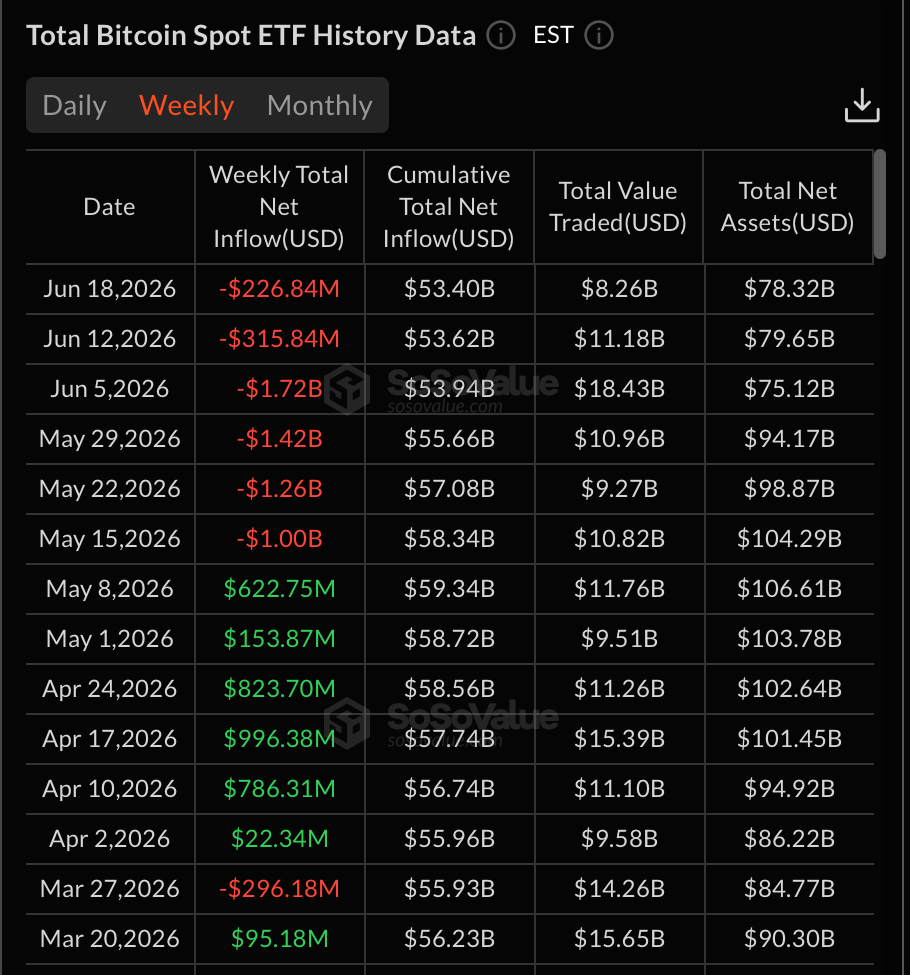
Franklin Templeton’s filings come amid weaker demand for US spot Bitcoin ETFs, which recorded six consecutive weeks of net outflows between May 15 and June 18, according to SoSoValue data.
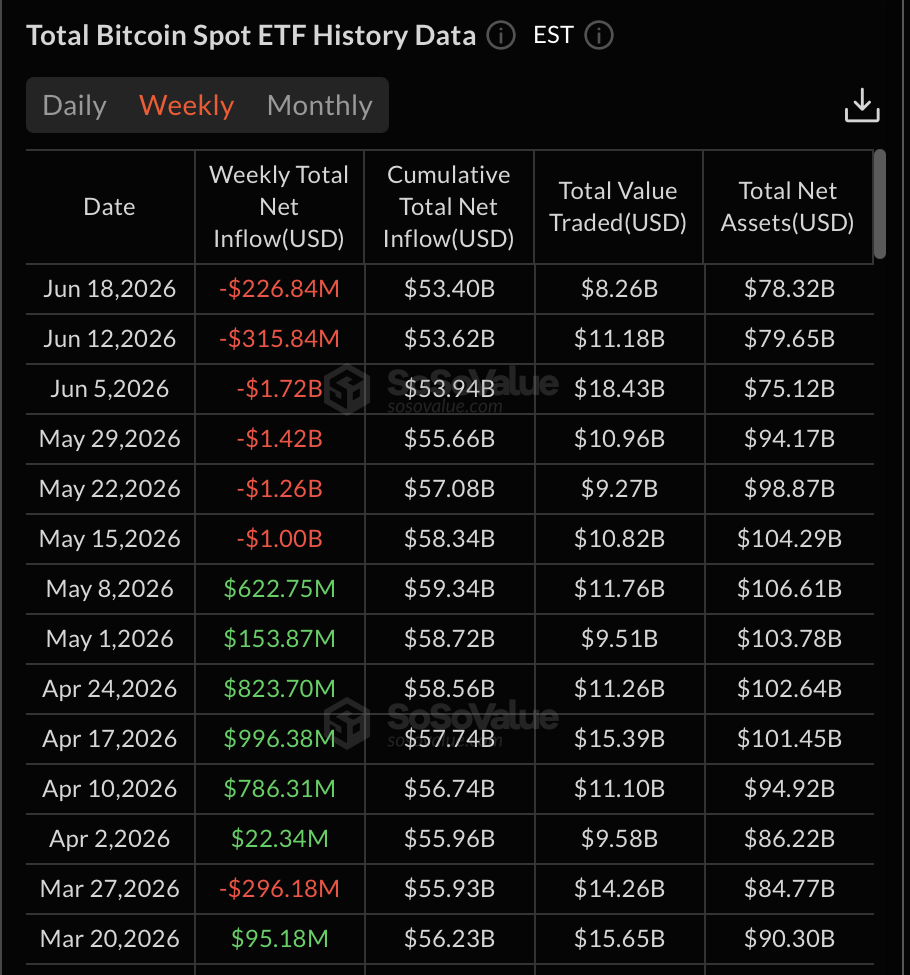
US spot Bitcoin ETF weekly net flows. Source: SoSoValue
Magazine: Bitcoin, the ‘canary in the coal mine,’ XRP transaction demand falls 91.5%: Market Moves


Cardone Capital has purchased another 282 Bitcoin worth about $18 million as the cryptocurrency market has retreated toward recent lows amid rising geopolitical tensions.
Summary
- Cardone Capital bought another 282 BTC worth about $18 million as Bitcoin traded near $62,000.
- The firm uses rental income from multifamily properties to fund ongoing Bitcoin purchases.
- Grant Cardone targets 3,000 BTC by 2026 and 10,000 BTC over the longer term.
In a June 19 X post, Grant Cardone announced that his real estate investment firm added 282 BTC to its treasury. Based on current market prices, the purchase is valued at roughly $18 million and comes as Bitcoin (BTC) trades near the $63,000 level following a broader crypto market decline linked to tensions surrounding the Israel-Lebanon conflict.
The latest purchase follows another acquisition made during a recent market downturn, when Cardone Capital bought 130 BTC valued at approximately $9.7 million. The transaction adds to a growing Bitcoin position that Cardone has continued to expand through a strategy tied directly to income-producing real estate assets.
Cardone continues building Bitcoin position through rental income
Earlier this year, Cardone Capital disclosed that it had accumulated about 1,000 BTC after purchasing $10 million worth of Bitcoin in January. According to the company, those purchases are funded through a dollar-cost-averaging strategy that directs rental income from selected multifamily properties into Bitcoin acquisitions.
Among those assets is a 366-unit apartment complex in Boca Raton. Rather than distributing excess cash flow to investors or using it to acquire additional real estate, the firm channels part of that income toward Bitcoin purchases.
According to comments previously made by Cardone, the company intends to hold 3,000 BTC by the end of 2026 and ultimately accumulate 10,000 BTC across multiple investment vehicles.
Speaking at the Consensus 2026 conference in Miami, Cardone revealed that the company had recently increased its Bitcoin allocation by another $100 million. He said the purchase formed part of a broader transaction that also included roughly $235 million worth of real estate acquisitions.
During the event, Cardone described the firm’s structure as a combination of Bitcoin and real estate held within the same limited liability company. He argued that the model differs from traditional real estate investment trusts, which generally do not hold Bitcoin directly on their balance sheets.
Real estate and Bitcoin strategy expands beyond treasury purchases
Cardone has repeatedly linked the company’s Bitcoin strategy to its real estate portfolio. In earlier remarks, he estimated that combining the two asset classes could generate annual returns ranging between 22% and 32%, while noting that many investors in the firm’s products had no previous Bitcoin exposure.
According to Cardone, roughly 80% of investors in one of the firm’s Bitcoin-linked real estate funds did not own Bitcoin before participating.
The company has also introduced investment products built around the same concept. As reported earlier by crypto.news, Cardone Capital launched the 10X Miami River Bitcoin Fund in May 2025, pairing a 346-unit apartment complex on the Miami River with $15 million in Bitcoin. The fund also directs a portion of rental income toward additional Bitcoin purchases.
Cardone’s involvement with blockchain-based assets extends beyond treasury accumulation. In early 2024, he listed his $42 million Golden Beach property on Propy, a blockchain-powered real estate marketplace that supports transactions in both Bitcoin and U.S. dollars through a decentralized title registry and escrow system.

WhiteBIT has secured authorization under the EU’s Markets in Crypto-Assets Regulation (MiCA) from Austria’s Financial Market Authority, enabling the exchange to provide regulated crypto services across the European Economic Area using a single passported regime. The authorization positions WhiteBIT to operate within the harmonized EU framework as transitional national arrangements near their end.
MiCA’s cross-border “passporting” mechanism is designed to reduce the need for repeated licensing across member states. For institutions and market participants, the development is consequential: it affects how exchanges structure compliance programs, customer communications, and operational continuity in jurisdictions where legacy registrations may no longer be sufficient.
Key takeaways
- WhiteBIT received MiCA authorization from Austria’s Financial Market Authority, supporting regulated service delivery across the EEA.
- MiCA allows authorized firms in one member state to passport services across the EEA, reducing duplicative licensing.
- Austria has not extended grandfathering for virtual asset service providers beyond Dec. 31, 2025, accelerating migration to MiCA.
- EU deadlines are tightening: after July 1, legacy operators may need to hold MiCA authorization or cease EEA client services.
- Regulators and oversight bodies are emphasizing wind-down and client migration planning for firms that remain unauthorized.
Austria authorization and the MiCA passporting framework
WhiteBIT’s authorization under MiCA was granted by Austria’s Financial Market Authority. Under MiCA, a crypto-asset service provider licensed in one EU member state can provide services throughout the EEA without securing separate authorizations in each jurisdiction.
The exchange indicated that the authorization will support the rollout of a dedicated European platform at whitebit.eu. In practice, passporting can streamline geographic expansion while also increasing the importance of centralized compliance controls—such as transaction monitoring, risk management, and supervisory reporting—aligned to MiCA requirements.
WhiteBIT is part of W Group, which the company says serves more than 35 million customers globally. The exchange was founded in 2018.
Why Austria’s MiCA transition matters: grandfathering and regulatory timing
Austria’s approach underscores the timetable confronting many European crypto businesses. Austria did not extend “grandfathering” provisions for virtual asset service providers beyond Dec. 31, 2025, according to information referenced in comments provided to Cointelegraph by the Financial Market Authority. As a result, Austria has become one of the earlier EU jurisdictions to fully shift operating models to MiCA.
MiCA’s transition rules are pivotal for compliance departments because they determine which firms can lawfully continue serving customers and under what conditions. For exchanges and other regulated service providers, the end of grandfathering increases the operational consequences of delayed approvals—especially where customer onboarding, marketing claims, and service delivery are tied to licensing status.
According to the Financial Market Authority’s previously provided comments cited in the coverage, the regulator has licensed nine crypto-asset service providers under MiCA and characterized application volume as “significant.” This suggests a relatively active supervisory pipeline, but it also signals that authorization throughput may vary across regulators and categories of services.
Approaching July 1 deadline and enforcement posture
WhiteBIT’s approval arrives less than two weeks before the EU’s MiCA transition period expires on July 1. After that date, firms operating on legacy national registrations must either obtain MiCA authorization or stop serving clients within the EU/EEA.
The proximity of the deadline has intensified scrutiny on exchanges that have not yet secured authorization. Reuters has reported that Greece’s market regulator was preparing to reject Binance’s MiCA application. Separately, reporting referenced that France may represent a remaining route for certain exchanges seeking authorization before the deadline.
The compliance significance of these developments is not limited to licensing outcomes. Where authorizations are rejected or delayed, firms may face operational constraints affecting custody arrangements, marketing and advertising practices, and customer support processes. For institutional stakeholders, this increases the need to validate counterparties’ regulatory status and to assess the continuity of access to services during wind-down scenarios.
In its reporting shared with Cointelegraph, OKX Europe suggested the transition could affect a meaningful portion of European activity. The company pointed to data indicating that approximately 7.6 million of 18.5 million crypto app downloads in Europe between May 2025 and May 2026 were linked to exchanges not listed on public MiCA authorization registers. While download data is not a direct proxy for user balances or revenue, it can provide a directional sense of where operational risk may concentrate as firms transition away from legacy permissions.
ESMA guidance: wind-down and client migration plans
Beyond national regulators, EU-level oversight has been explicit about what unauthorized firms should do once transitional periods end. The European Securities and Markets Authority (ESMA) has stated that companies remaining unauthorized after July 1 should implement wind-down and client migration plans rather than continue operating while applications are under review.
This guidance is particularly relevant for compliance monitoring because it frames expected conduct after the regulatory line is crossed. Wind-down planning typically requires firms to consider customer asset handling, disclosure obligations, operational timelines, and coordination with service providers responsible for order handling, custody, and payment-related workflows.
For institutions assessing risk exposure to crypto service providers, ESMA’s posture supports a practical checklist: confirm whether the counterparty is on public MiCA authorization registers, understand the scope of authorized activities, and evaluate whether the firm has contingency plans that align with EU expectations for client migration rather than ongoing service delivery.
Closing perspective
WhiteBIT’s MiCA authorization illustrates how passporting under the EU framework is beginning to reshape the competitive and compliance landscape for European exchanges. As July 1 approaches, the key question for market participants is whether remaining applicants can obtain authorization or will shift toward ESMA-aligned wind-down and client migration. The next phase will likely hinge on supervisory capacity across member states and the clarity of operational requirements for firms transitioning under the end-of-transitional timeline.

Copy Gwyneth Paltrow’s Head-Turning White Bikini Look for $25

Bedford train crash update issued after driver tragically dies

Fox Buys Roku in $22bn Streaming Deal: What It Means

Blockchain.com files with SEC for U.S. IPO

No Jackpot Winner as $257 Million Prize Rolls Over to $269 Million Monday Draw

Israel says it has killed new Hamas military leader in Gaza City airstrikes

Lisa – Money (Lyrics) | aesthetic | slowed | lyrics | #money #lisa

Pi 2day 2026 #PiNetwork #picoin #cryptofuture #crypto #Web3 #cryptocurrency #Launchpad #srmtechinfo

“Aadi Lakshmi Namastubhyam” Mahalakshmi stotram(Stuti)to remove financial obstacles,bring prosperity
-
 Business5 days ago
No Jackpot Winner as $257 Million Prize Rolls Over to $269 Million Monday Draw
-
Crypto World5 days ago
Zimbabwe Requires Crypto Businesses to Register Annually Under New FIU Regulations
-

 Crypto World7 days ago
Bitget enters Argentina’s regulated crypto market through PSAV registration
-

 Tech7 days ago
NanoClaw integrates JFrog registries to secure AI agent downloads
-
 Entertainment5 days ago
Matt Damon’s Viral Sci-Fi Thriller Has Taken Over HBO Max
-

 Business5 days ago
Anthropic staff to meet White House officials next week, Axios reports
-

 Tech5 days ago
As AI companies race to go public, who else is along for the ride?
-
 Crypto World5 days ago
Bitcoin could crash to $48,000, if this historical pattern is triggered
-
 NewsBeat5 days ago
Warning of disruption as Cardiff Crossrail works to start
-

 Politics5 days ago
“Israel’s” ban on ICRC visits ruled illegal, but Knesset moves to stop them permanently
-

 News Videos5 days ago
Financial Accounting | Last Day Revision Strategy and Booster | CMA Inter – June 2026
-
 NewsBeat5 days ago
Tributes to former deputy head teacher at Cambridge school among death and funeral notices
-

 Entertainment6 days ago
Deion Sanders Shares Powerful Post After Viral Advice To Deiondra
-
 NewsBeat5 days ago
what doctors are seeing in ebike crashes
-

 Fashion7 hours ago
Weekend Open Thread: Miami – Corporette.com
-
 Entertainment5 days ago
Kate Middleton Glare Goes Viral After Kids Booed At Royal Event
-

 Crypto World5 days ago
XRP ETFs Outperform As Bitcoin And Ethereum Funds Extend Outflow Trend
-
 Crypto World5 days ago
Market Preview: SpaceX (SPCX) IPO Record, Federal Reserve Meeting, and Iran Nuclear Agreement
-

 Tech5 days ago
Over 400 Arch Linux packages compromised to push rootkit, infostealer
-

 Business5 days ago
Invesco Quality Income Fund Q1 2026 Commentary
You must be logged in to post a comment Login