
Crypto World
Trump pushes Congress to move on Clarity Act during White House crypto event

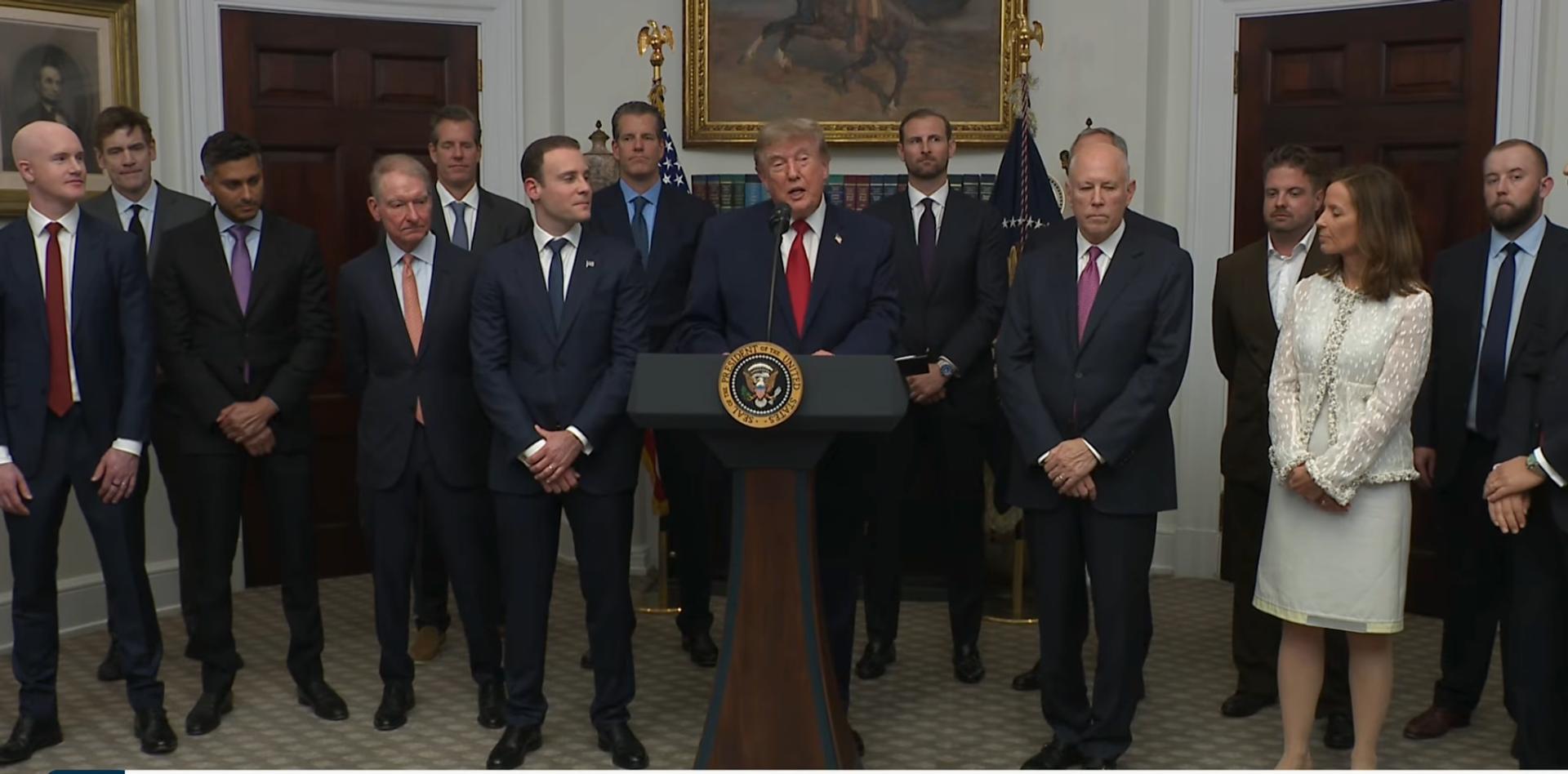
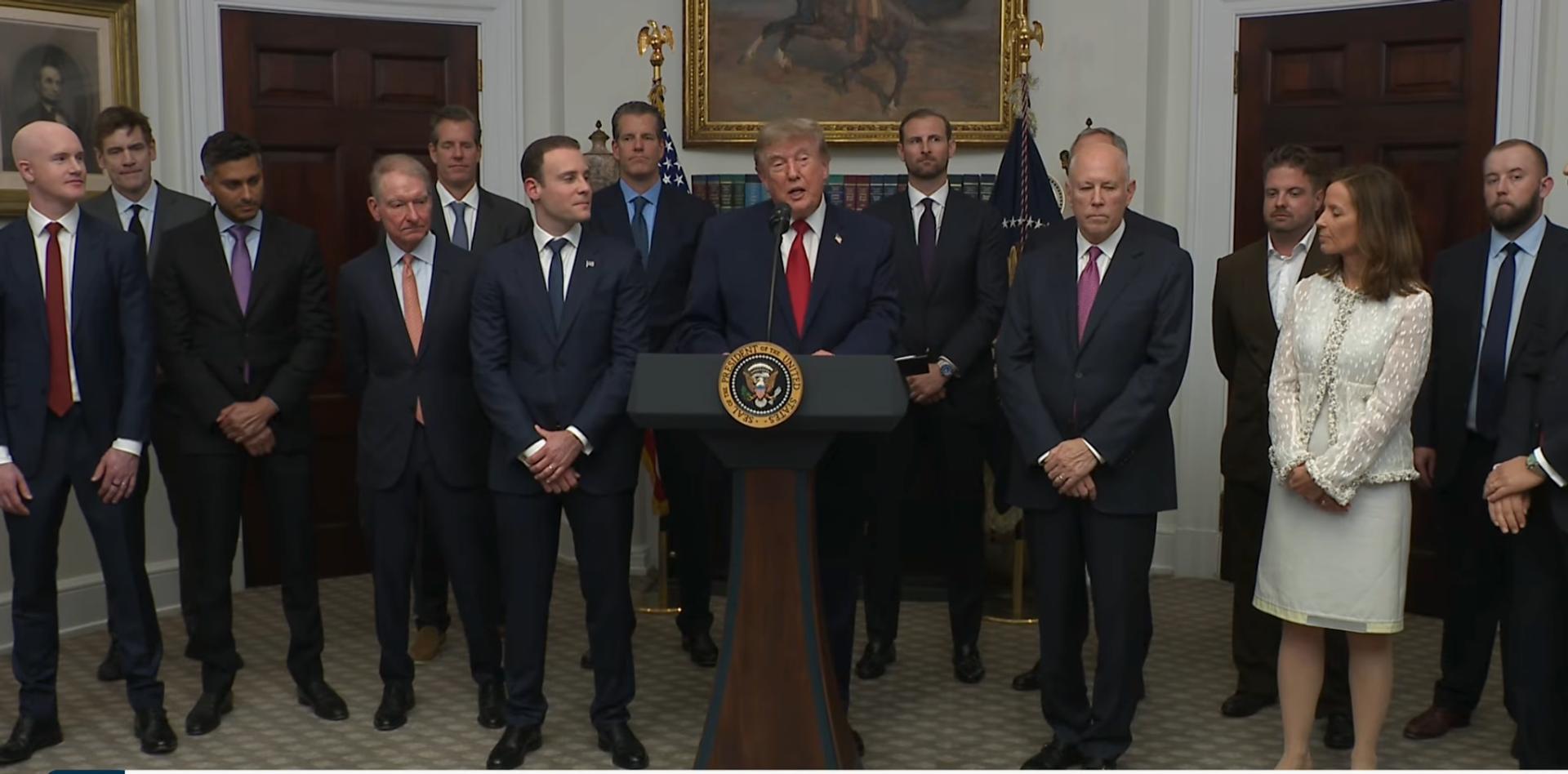
The CEOs from companies across several tech-forward sectors met with the president in advance of this week’s first Innovation Advisory Committee at the CFTC.


U.S. President Donald Trump renewed pressure for passage of the Digital Asset Market Clarity (CLARITY) Act as the Senate remains in recess, urging lawmakers to move quickly on a bill he framed as essential for keeping the United States competitive.
During a Wednesday press conference with prominent crypto executives—including Coinbase CEO Brian Armstrong and Gemini co-founders Cameron and Tyler Winklevoss—Trump said Congress should adopt “a fair version” of CLARITY, arguing the measure would help the U.S. stay “ahead of China.” The bill already cleared the House of Representatives in July 2025, but its momentum in the Senate has stalled for months amid concerns raised by market structure provisions related to tokenized equities, stablecoin-related rewards, and potential conflicts of interest involving the Trump family.
Key takeaways
- Trump pushed for a Senate advance of the CLARITY Act while lawmakers are out of session, emphasizing long-term competitiveness.
- Coinbase CEO Brian Armstrong argued the bill could provide “durable” U.S. crypto policy and suggested it may attract a large Senate coalition.
- Trump referenced former Sen. Lindsey Graham as a key early supporter and urged action in his honor.
- Industry comments came as the CFTC prepared for an Innovation Advisory Committee meeting before Congress returned.
- At the same time, the SEC has proposed a framework aimed at offering certain safe harbors in the absence of CLARITY.
Trump links CLARITY to competitiveness and legislative urgency
Trump’s remarks positioned CLARITY as both a regulatory and economic strategy. He told reporters that members of Congress should pass a version he described as “fair,” asserting it would help the U.S. remain competitive with China.
While the Senate is not currently in session, Trump used the moment to press for momentum. He also characterized support as broad, saying “Lot of Democrats support,” and described CLARITY as “very bipartisan.” The president’s framing suggests the White House is treating the bill as a priority item not only for crypto-focused constituencies, but for the broader political calculus around technology leadership.
Coinbase and Gemini executives emphasize potential durability
Brian Armstrong spoke after Trump and top U.S. regulators at the press event. Armstrong argued that CLARITY would make U.S. crypto policy “durable into the future,” implying that clearer rules could outlast short-term political shifts and help businesses plan beyond election cycles.
Armstrong also floated a potential path to Senate progress. He speculated the bill could garner “more than 60 votes” once the Senate addresses a cloture motion on Sept. 18—an important procedural step that can limit debate and allow a final vote on legislation. Even without claiming certainty, Armstrong’s estimate reflects an industry belief that the bill may be closer to a legislative breakthrough than critics suggest.
Why the Senate delay matters: provisions under scrutiny
CLARITY’s legislative trail provides key context for why the delay has become politically and technically significant. The House approved the bill in July 2025, but the Senate has not taken it up decisively for months. The stall has been tied to debates over specific components, including how tokenized equities would be treated, how stablecoin rewards could operate under the proposed structure, and whether the Trump family’s involvement creates conflicts of interest perceptions within the crypto industry.
These concerns matter for investors and market participants because they affect not just legal interpretation, but also product design and market structure. Rules shaping how digital assets are regulated can influence liquidity, custody practices, exchange operations, and the willingness of traditional finance firms to engage with tokenized markets.
Regulators move in parallel: CFTC planning and SEC proposals
Trump’s push came amid a busy regulatory backdrop. Industry executive remarks arrived one day before the CFTC was scheduled to hold an Innovation Advisory Committee meeting. CFTC Chair Michael Selig said the agency would explore how it can move forward on crypto regulation at the meeting, noting that Congress would not return for another month. The timing highlights a tension investors frequently face during legislative gridlock: while Congress debates market structure, agencies continue attempting to build practical frameworks through their own processes.
That parallel effort extends to the SEC as well. Earlier coverage noted that the Securities and Exchange Commission proposed crypto rules designed to offer companies a safe harbor from tokens being treated as “investment contracts,” along with exemptions related to token issuance. The implication is that, even if CLARITY remains stuck, regulated entities are still being offered potential pathways to compliance—though the approach is necessarily narrower and varies by agency authority.
Taken together, the developments suggest the U.S. regulatory landscape is moving forward on multiple tracks at once: one involving comprehensive legislation through CLARITY, and another involving agency rulemaking or proposed regulatory guidance in the interim.
What to watch next
Attention is likely to center on whether the Senate advances the cloture motion discussed by Armstrong for Sept. 18, and on how the SEC and CFTC continue building workable rules while Congress remains out of session. For market participants, the key question is whether CLARITY ultimately resolves the structural uncertainties that agencies are trying to address piecemeal.
Your day-ahead look for Aug. 19, 2026


The People’s Bank of China (PBOC) added 20 new operators this year across two rounds of expansions, including eight additions this week.


Bitcoin functions as a genuine cheat code for retiring without ever selling, according to analyst and entrepreneur Mark Moss, who laid out that thesis in a recent Coin Stories podcast interview.
His central thesis runs counter to conventional wisdom. The goal should never be to sell Bitcoin to fund a lifestyle, but to stay in the owner column rather than the consumer column.
Bitcoin: The Owner Column vs. the Consumer Column
Under the debt-based monetary system in place since 1971, money enters circulation through credit, and credit requires collateral. Owning even $1 of Bitcoin makes someone an owner who can borrow against it.
Selling, by contrast, triggers tax events, eliminates that collateral, and converts a long-term asset into short-term spending. He also challenges traditional retirement thinking.
The goal should not be freedom from work, he argues, but freedom to work on whatever someone actually chooses.
“…So the retirement path is that that Bitcoin appreciates and hopefully it continues at 30% per year. We already talked about that and so eventually it’s worth $1 million and then it’s worth $5 and $10 million $20 million. But if I sell it to get some of the money, I instantly take myself from the owner column back to the consumer column…,” Moss said.
Follow us on X to get the latest news as it happens.
Moss points to billionaires and creators who stay active into old age, arguing they belong to the builder class rather than consumers dreaming of poolside leisure. He dismisses passive income and the FIRE movement, proposing instead what he calls retiring from assets.
The concrete strategy involves borrowing against Bitcoin with discipline: low loan-to-value ratios, multiple liquidity layers including checking accounts, cash equivalents, and income, with asset sales reserved as a last resort.
Understanding market cycles matters throughout that process, harvesting appreciation without abandoning ownership or triggering unnecessary taxable events.
Why Moss and Schiff Disagree Completely
Moss illustrates the danger of becoming a forced seller through his own history. In 2008, he built a property valued at $12 million, rejected an $11 million offer, then watched the bank sell it for just $4 million after the crash. It is worth roughly $20 million today.
Volatility was never the real problem, he explains. Becoming a forced seller at exactly the wrong moment was:
“…Everybody wants that financial freedom, the ability to live uh without being forced to work off of income, things like that. And so what I like to talk about is how people can have asset freedom. So there are certainly movements like my mentor Robert Kiyosaki talks about building passive income…,” the analyst noted.
Economist and longtime Bitcoin critic Peter Schiff offered a starkly different view. Writing on X, he argued that retiring on Bitcoin only works if someone bought it long ago and sells before a crash.
Moss sees Bitcoin as structural infrastructure for generating liquidity without abandoning ownership, even amid the current 26% yearly decline. Schiff insists that the only realistic path is to sell in time, before volatility erodes accumulated capital.
That leaves a genuine open question for holders. Is Bitcoin an asset to preserve and leverage indefinitely, or one that demands exiting before conditions turn too late?
Subscribe to our YouTube channel to watch leaders and journalists provide expert insights.
The post Bitcoin is a “Cheat Code” to Retire Without Selling, Analyst Explains Why appeared first on BeInCrypto.
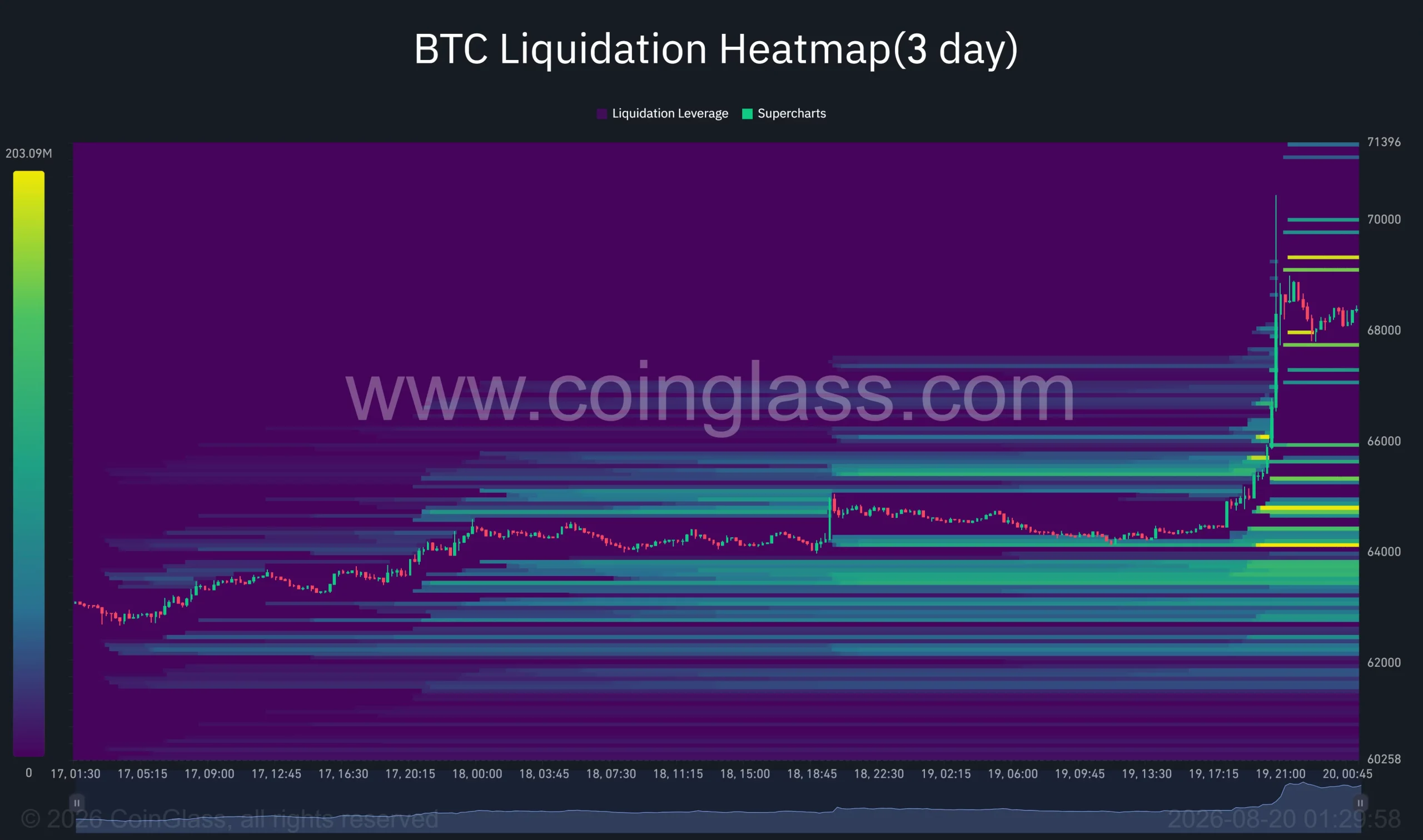
Bitcoin price surged past $68,000 late Wednesday as a break above crowded liquidation levels forced short sellers to buy back positions, turning a gradual recovery into a one-minute price spike of roughly 4%.
Summary
- Bitcoin price jumped from below $65,000 to a high near $69,500 before settling around $68,500.
- More than $1 billion in crypto shorts were reportedly liquidated within one hour.
- The breakout cleared a 4-hour double-bottom neckline near $65,400.
- Bitcoin now faces daily resistance between $69,000 and $70,000 after its RSI entered overbought territory.
Market analyst Daan Crypto Trades said in an Aug. 19 X post that Bitcoin experienced a “massive squeeze” after crossing the $67,000 liquidation cluster. He said the resulting one-minute candle gained about 4%, exceeding the size of any full daily candle recorded in recent weeks.
Bitcoin price clears a two-month trading range
According to data from crypto.news, Bitcoin (BTC) price traded near $68,500 at the time of writing after reaching an intraday high of about $69,500 on Binance. The move represented a gain of nearly 6% from Wednesday’s opening price of around $64,725.
The rally followed several weeks of limited movement between approximately $62,000 and $66,000. Buyers had repeatedly failed to hold above $65,000, encouraging traders to build leveraged short positions around the upper end of that range.
Bitcoin reversed the setup within minutes. Once BTC price crossed $67,000, exchanges began closing positions that no longer had enough collateral, requiring short sellers to buy Bitcoin and adding further upward pressure.
The broader crypto market recorded more than $1 billion in short liquidations within one hour as Bitcoin climbed above $69,000. Total crypto short liquidations later reached $1.79 billion, suggesting that forced buying played a major role in accelerating the rally.
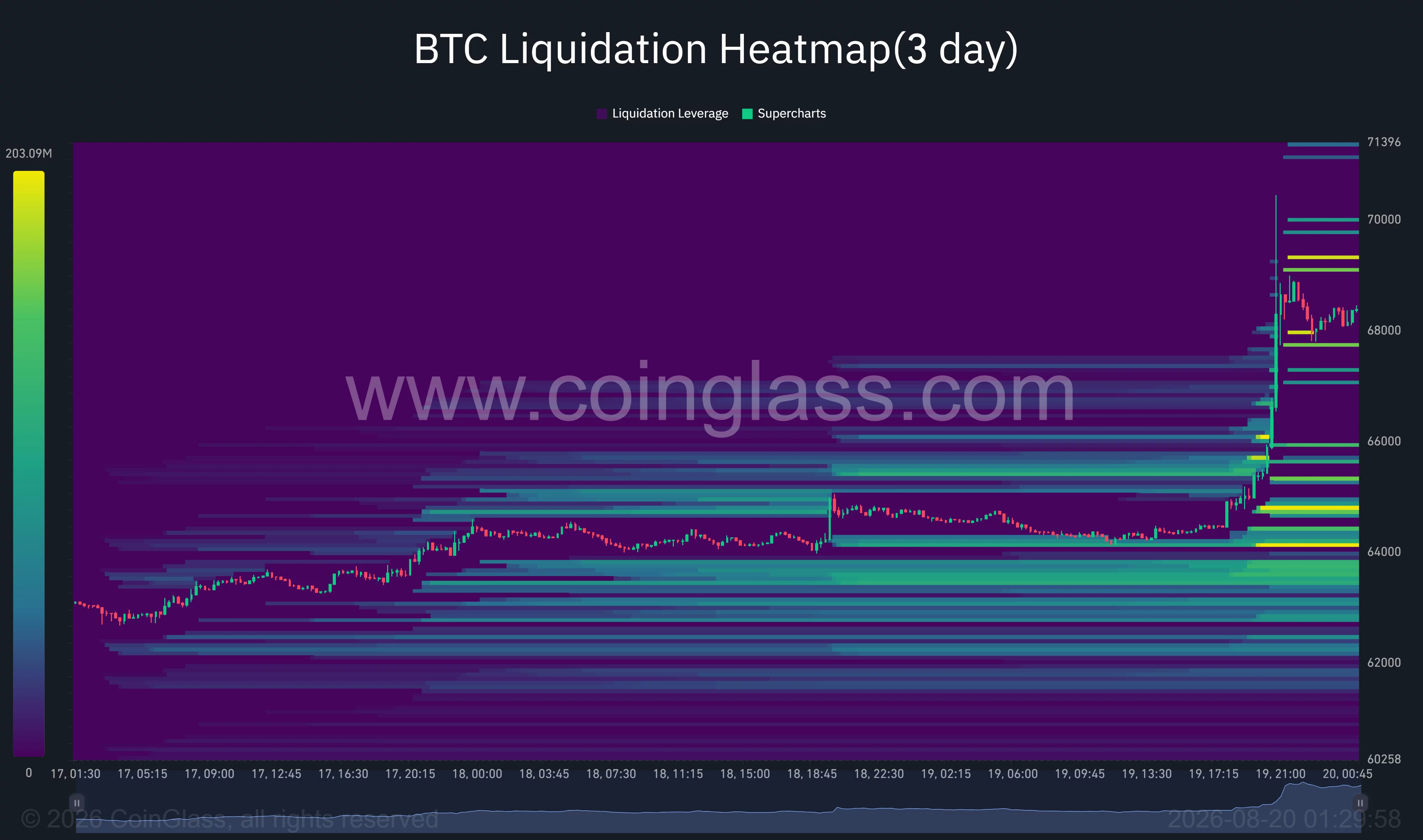
The three-day CoinGlass heatmap shows Bitcoin moving through multiple liquidation bands between $65,000 and $67,500 before reaching the upper cluster near $69,000. Much of the liquidity that had built above the previous trading range was therefore removed during the spike.
Treasury buybacks and SEC proposal support risk appetite
The squeeze followed a U.S. Treasury announcement that it would at least double the maximum size of liquidity-support buybacks for longer-dated government bonds.
Starting Sept. 9, the Treasury plans to raise the maximum purchase size for 10- to 30-year securities from $2 billion to at least $4 billion per operation. Long-term Treasury yields fell after the announcement, while the dollar weakened and US stocks advanced.
Lower bond yields can improve demand for risk assets by reducing the return available from government debt, although the Treasury described its purchases as a way to improve market liquidity rather than a monetary stimulus program.
Bitcoin also benefited from a more favorable US regulatory backdrop after the Securities and Exchange Commission proposed its new “Regulation Crypto Assets” framework on Aug. 18.
According to the SEC proposal, the framework would create tailored registration exemptions for certain crypto-related investment contracts. One exemption would allow eligible startups to raise up to $5 million over four years, while another would permit qualifying issuers to raise as much as $75 million in a 12-month period, subject to disclosures and other requirements.
The proposal has not taken effect and may change following public feedback. Its publication nevertheless added to expectations that US crypto companies could receive clearer fundraising rules.
Bitcoin breakout targets the $69,000 resistance zone
The 4-hour Bitcoin chart shows a double-bottom structure formed between late July and mid-August. Both lows developed near $62,200, while the neckline sat around $65,400.
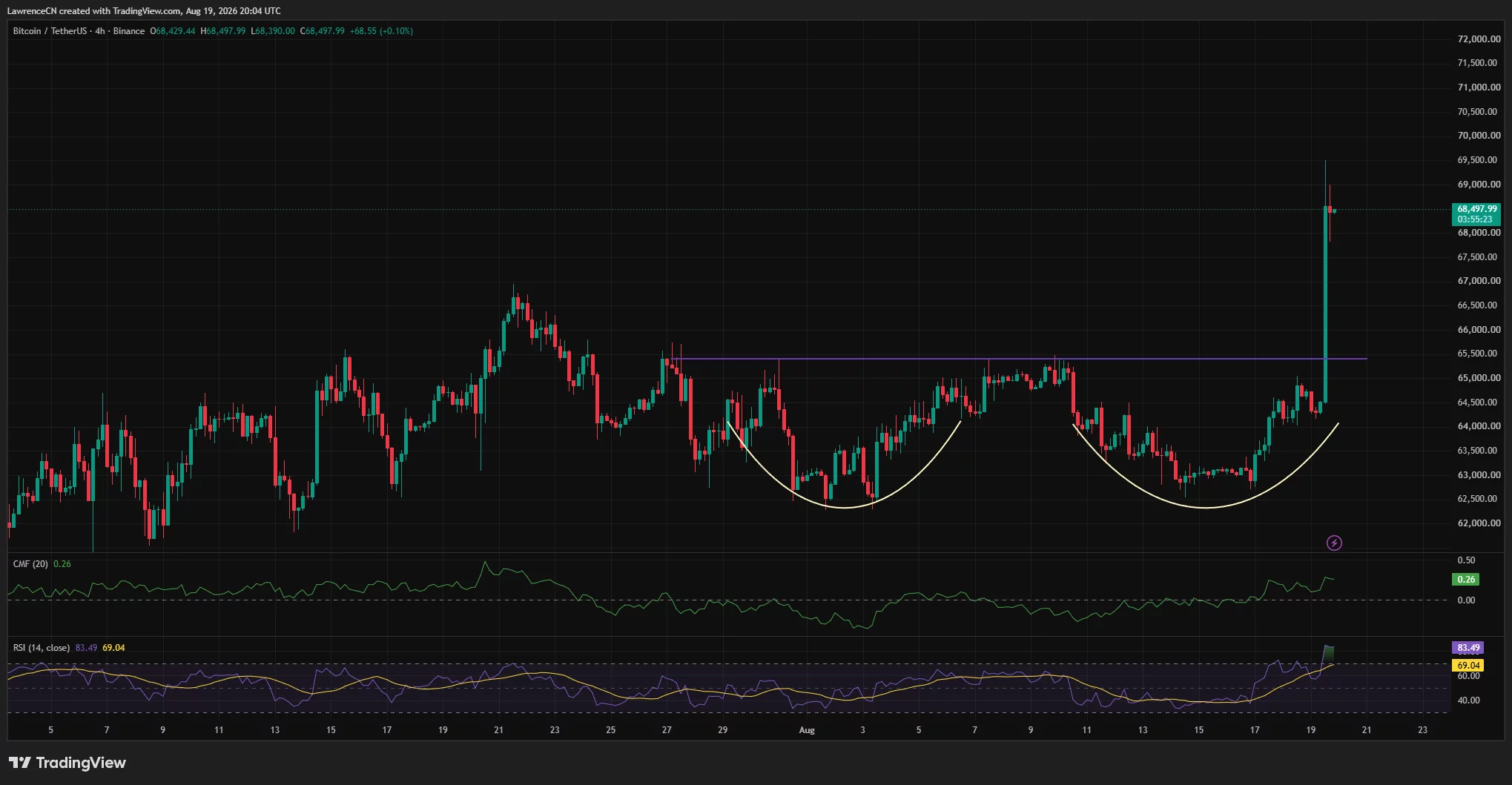
Wednesday’s move broke through that neckline with one large candle, placing Bitcoin roughly $3,000 above the former resistance level. The pattern’s measured move points toward the $68,500–$69,000 region, which Bitcoin reached during the breakout.
Capital flow also strengthened alongside the price. The 4-hour Chaikin Money Flow reading rose to 0.26, indicating that buying pressure outweighed selling pressure during the move.
Short-term conditions have become stretched, however. The 4-hour relative strength index reached 83.49, well above the 70 level commonly associated with an overbought market. The RSI average stood near 69, showing how quickly momentum increased.
An overbought RSI does not require an immediate decline, especially during a short squeeze, but it raises the risk of profit-taking or a retest of the breakout. The long upper wick near $69,500 shows that sellers already responded above $69,000.
On the daily chart, Bitcoin reclaimed its 100-day simple moving average around $66,288. Price remained slightly below the 200-day average near $69,031, making the $69,000–$70,000 area the next test for the recovery.
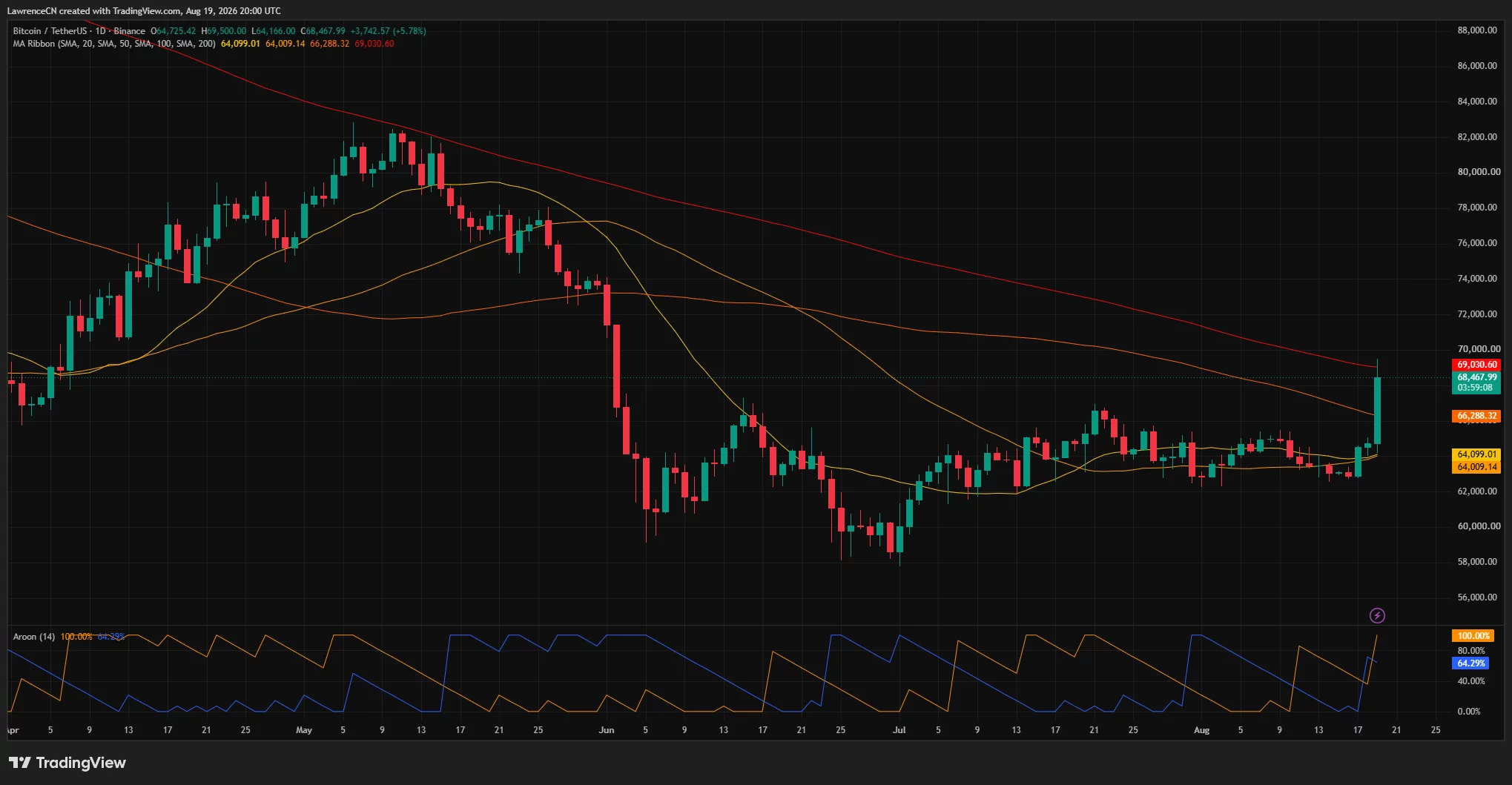
A daily close above that zone would improve the case for a move toward $72,000. Analyst Ted Pillows identified $74,000 as the more important weekly level, arguing that reclaiming it would reduce the likelihood of Bitcoin falling below $55,000.
Failure to hold the breakout could return attention to $67,000, followed by the former neckline around $65,400. The strongest nearby support cluster visible on the liquidation heatmap sits between approximately $64,000 and $65,500.
ETF demand and weaker selling preceded Bitcoin breakout
Before Bitcoin broke above $65,700 on Wednesday evening, the Bitfinex analyst team told crypto.news that fading profit-taking and renewed spot ETF demand had created a more supportive supply setup.
The analysts said Bitcoin had begun rising while US equities fell, marking a break from the cross-asset pattern seen after the Iran-US conflict disrupted correlations in early March. At the time, rising Treasury yields and energy prices continued to pressure traditional markets while Bitcoin remained below $65,000.
On-chain spending also suggested that sellers had less capacity to realize gains. Bitfinex analysts said long-term holders who moved coins were recording small losses, while short-term holders were selling close to their purchase prices.
“Long-term holders are realising losses, albeit minimal, at the deepest ratios since June, short-term holders are transacting at break-even and the aggregate profit ratio of every coin moved on-chain has now closed below par for 10 consecutive sessions.”
The ratio between long-term and short-term holder spent output profit ratios had declined steadily since Bitcoin reached its $126,110 all-time high in October 2025. Short-term-holder distribution still exceeded selling by long-term holders, which Bitfinex described as a signal commonly associated with the later stages of a bear market.
“The supply available to be spent at a profit is increasingly constrained, and the constraint favours bullish price action by mitigating selling interest at the range highs,” the analysts said.
US spot Bitcoin ETFs added to that tightening supply. Bitfinex reported that the funds attracted $297.5 million on Aug. 17, their largest daily inflow of the month, followed by another $189.3 million on Aug. 18. The two sessions produced the first back-to-back net inflows since Aug. 7.
Bitfinex had identified $65,700 as the level Bitcoin needed to clear to extend its recovery. The later breakout carried BTC through that threshold and into the short liquidation clusters above $67,000, where forced buying accelerated the move toward $69,500.
The analysts linked the reduced selling pressure to a longer process of clearing coins held by investors who bought more than two years earlier.
“In December, we expressed that long-term holder sell pressure approaches saturation as the two-year supply overhang clears,” Bitfinex said. “This is what the terminal stage of that process looks like in the tape.”
The breakout supports the analysts’ supply-side assessment, although holding above $65,700 remains important. A return below that level would suggest the move was driven mainly by forced short covering, while continued ETF inflows and firm spot volume would provide stronger evidence of sustained demand.
Zhang’s broader outlook still warns against chasing
Zhang offered a more cautious view of Bitcoin’s longer-term position, arguing that signs of a bottoming process did not yet confirm a durable market bottom.
When Bitget Wallet’s research analyst spoke to crypto.news, Bitcoin price was trading between $64,000 and $64,700 after spending several weeks inside a $62,000–$66,000 range. She cited moderate leverage, compressed volatility, and slower selling by long-term holders as factors that reduced the likelihood of a sharp move in either direction.
“Bitcoin is showing signs of a bottoming process, but not a confirmed bottom,” Zhang said before the rally.
“If $60,000–$62,000 support holds, the setup offers asymmetric upside; confirmation of a durable bottom still requires sustained volume and less fear.”
The subsequent move invalidated the immediate expectation that Bitcoin would remain confined below $66,000, but it did not settle Zhang’s broader question about whether the market has established a durable low. The breakout relied partly on forced short covering, while the 4-hour RSI and rejection near the 200-day average leave room for a pullback.
Zhang expects Bitcoin to trade within a broad $55,000–$80,000 range through year-end. Holding above $65,400 after the initial squeeze would provide stronger evidence that spot buyers, rather than liquidations alone, can support the latest recovery.
Disclosure: This article does not represent investment advice. The content and materials featured on this page are for educational purposes only.


The exchange that lost $1.46 billion to North Korean hackers is the first large centralized firm to put numbers on a claim bitcoin developers have been making all month.


Gnosis Chain is transitioning from a standalone Layer 1 to an Ethereum-settled rollup and retiring its independent validator set, according to an announcement from Gnosis Chain and a proposal published on GnosisDAO's governance forum. For GNO stakers, the approved direction would unlock roughly… Read the full story at The Defiant


US President Donald Trump continued to push for passage of a crypto market structure bill as the Senate remains in recess.
In a Wednesday press conference with crypto company executives including Coinbase CEO Brian Armstrong and Gemini co-founders Cameron and Tyler Winklevoss, Trump said members of Congress should pass “a fair version” of the Digital Asset Market Clarity (CLARITY) Act to keep the US “ahead of China.” The market structure bill, passed by the House of Representatives in July 2025, has been stalled in the Senate for months amid concerns about tokenized equities, stablecoin rewards and the Trump family’s potential conflicts of interest with the crypto industry.
Armstrong, who spoke after Trump and US regulatory heads, said that the bill would make crypto policies in the US “durable into the future, so it could survive for decades and decades to come.” The Coinbase CEO speculated that the bill could have “more than 60 votes” once the Senate addressed a cloture motion on Sept. 15.
“It’s very bipartisan, I would say,” said Trump following Armstrong’s comments. “Lot of Democrats support.”
The president pushed for Congress to pass CLARITY in July following the death of Senator Lindsey Graham. Trump said that Graham had been a “big supporter” of the bill, and lawmakers in the Senate should advance CLARITY in his honor.
Crypto company executives’ remarks to the press came one day before the Commodity Futures Trading Commission (CFTC) was scheduled to hold an Innovation Advisory Committee meeting. CFTC Chair Michael Selig said the agency would explore moving forward on crypto regulations at the meeting, as Congress wouldn’t be returning to session for another month.
The White House meeting happened the same week that the Securities and Exchange Commission proposed crypto rules offering companies a safe harbor from tokens being treated as “investment contracts” and certain exemptions for token issuance.
Related: SEC proposes new crypto rules in absence of CLARITY Act
This is a developing story and will be updated as more information becomes available.


Geo founder Yaniv Tal has identified four weaknesses in online information that he says make AI answers unreliable: lost provenance, flattened authority, hidden disagreement, and repeated model-generated errors.
Summary
- Geo separates claims, sources, and supporting evidence inside community-governed knowledge Spaces.
- Tal says human judgment can help rank credible reasoning without removing competing views.
- A Nature study found that repeated training on synthetic material can cause model collapse.
- NIST recommends tracking training sources and incorporating expert human feedback into AI systems.
Geo founder Yaniv Tal told crypto.news that unreliable AI answers often begin with the material models receive, arguing that the internet was designed to distribute information rather than preserve its authority, origin, or accountability.
“AI doesn’t have a truth problem, the internet does,” Tal said.
According to Tal, information loses critical context as websites scrape and republish it. A claim may pass through several pages before entering a training set, leaving a model with the statement but no clear route back to its original source.
Authority also becomes difficult to measure when a research paper, company announcement, and anonymous forum post enter the same data pipeline as text. Tal said models may then treat material with different standards of evidence as if it carries similar weight.
“Provenance collapses. A claim gets scraped, restated, and re-scraped until the original source is unrecoverable,” he said.
Geo founder identifies four failures behind unreliable AI answers
Disagreement creates another problem because language models often combine competing positions into one response. Tal said such compression can hide genuine disputes among qualified experts, giving users a single confident answer without showing that credible alternatives exist.
The fourth weakness arises when AI-generated material returns to the data supply used by later models. Errors can survive repeated publication, while synthetic articles, posts, and summaries make it harder to locate the human-produced material from which a claim originated.
“Models increasingly train on output from other models, so errors don’t just persist, they amplify,” Tal said.
Independent research has documented a related risk. A 2024 Nature study examined what happens when generative models repeatedly learn from material produced by earlier models. Researchers described “model collapse” as a process in which systems gradually lose information about the original data distribution.
Less common material began disappearing during the early stages of the experiments, according to the paper, while later model generations produced distributions bearing little resemblance to the source data. Researchers said access to original, human-produced information remains important as AI-generated material spreads across the internet.
Tal does not classify the four weaknesses as failures confined to model design. In his account, models reproduce flaws already embedded in their training material, including missing sources and a lack of visible distinctions between evidence, opinion, and promotion.
Human verification would rank claims without removing disagreement
Geo’s proposed answer starts by separating a statement from its author and the evidence supporting it. Relationships between entries can show whether one argument supports another, contradicts it, or responds directly to a disputed point.
Once those links are recorded, Geo can order arguments by their assessed strength while retaining competing material beneath them, Tal said. The structure is intended to keep disagreement available without displaying every contribution as an undifferentiated comment feed.
“Pluralism doesn’t have to mean noise,” Tal said. “We think several well-structured competing perspectives is often the more honest answer.”
Geo organizes information through independent communities called Spaces. Its current website lists initial Spaces covering crypto, health, AI, education, world affairs, and US politics.
Members can contribute and participate in discussions, while people with relevant knowledge can apply to become editors. According to Geo, its curator program asks participants to evaluate sources, connect arguments, and add structured information to an open knowledge graph.
The model was developed from Geo Genesis, which entered early access in January 2025. As previously reported, its default governance structure divided participants into Editors and Members. Editors received voting authority, while Members could contribute information to individual Spaces.
Built on the Aragon OSx governance framework, Geo Genesis followed the release of GRC-20, a standard for representing connected knowledge. The Graph said in June 2025 that GRC-20 could let communities publish structured information onchain and retrieve it through subgraphs and Substreams.
Tal, who co-founded The Graph before starting Geo, said expertise would not be assigned by one central authority under the proposed system. Contributors would build a reputation through their work, and Geo intends for that record to follow a person between Spaces.
“Human judgment is the scarce input now, not the redundant one. Machines generate more content than people can process, and almost none of it has anyone accountable for its truth.”
Community governance still faces an identity problem
A human-run knowledge network must still determine whether contributors are genuine, qualified, and independent. Open governance systems can face Sybil attacks, in which one participant creates multiple identities to gain influence over voting, rankings, or rewards.
A June 2026 explainer examined how biometric checks, social trust networks, and zero-knowledge identity tools attempt to verify unique people. Each method involves trade-offs between privacy, attack resistance, accessibility, and control, while AI can help attackers create convincing personas at low cost.
Tal said Geo would rely on contribution records and domain-specific communities rather than allowing anonymous material to carry the same status as claims attached to people with public histories. Editors would apply through individual Spaces, and members would take part in governing the subjects they follow.
“Skin in the game without financial stakes changes the quality of what people are willing to put their name to,” Tal said.
The approach does not remove the need to decide who selects editors, how communities resolve coordinated manipulation, or whether expertise earned in one subject should carry weight in another. Tal described the gatekeeper issue as real but argued that independent Spaces would prevent one institution from controlling every field.
Human involvement has also gained attention in crypto security, where automated tools may detect malicious activity, but users still authorize transactions. In May 2026, a Ledger security report described manual verification and clear transaction displays as safeguards against AI-assisted phishing, fake interfaces, and automated scams.
Onchain records separate transactions from surrounding claims
Crypto is one of Geo’s first Spaces because blockchain activity offers a direct test of the difference between verifiable records and human interpretation, Tal said.
A blockchain can confirm that a transaction occurred at a recorded address and block. It cannot, without additional evidence, establish who controls the address, why funds moved, whether activity was organic, or what a project plans to do next.
“On-chain data is verifiable by construction. A transaction happened or it didn’t,” Tal said. “Everything wrapped around it is claims.”
Project announcements, partnership descriptions, market forecasts, and explanations of token movements therefore require separate treatment, according to Tal. Geo intends to attach such claims to named contributors and preserve their records, including earlier statements that proved wrong.
Promotional activity makes the distinction especially important in digital-asset markets, where teams may present selected metrics beside verifiable transaction data. Tal said a trustworthy knowledge layer should label the categories rather than presenting both in the same voice.
US guidance also calls for provenance and human review
For US developers and companies deploying generative AI, the National Institute of Standards and Technology has recommended several controls that overlap with parts of Tal’s argument.
NIST’s Generative AI Profile, published in July 2024, advises organizations to document training-data sources, monitor the origin of generated material, and evaluate feedback between provenance systems and human reviewers. The voluntary framework also calls for domain experts and affected communities to take part in certain assessments.
Content provenance standards offer another method for recording where digital material originated. The Coalition for Content Provenance and Authenticity uses cryptographically signed Content Credentials to preserve information about who created or changed an asset and how it was edited.
Under the C2PA specification, however, validated provenance does not determine whether an attached claim is good, bad, or truthful. The standard verifies that assertions are connected to the underlying asset, correctly formed, and free from tampering.
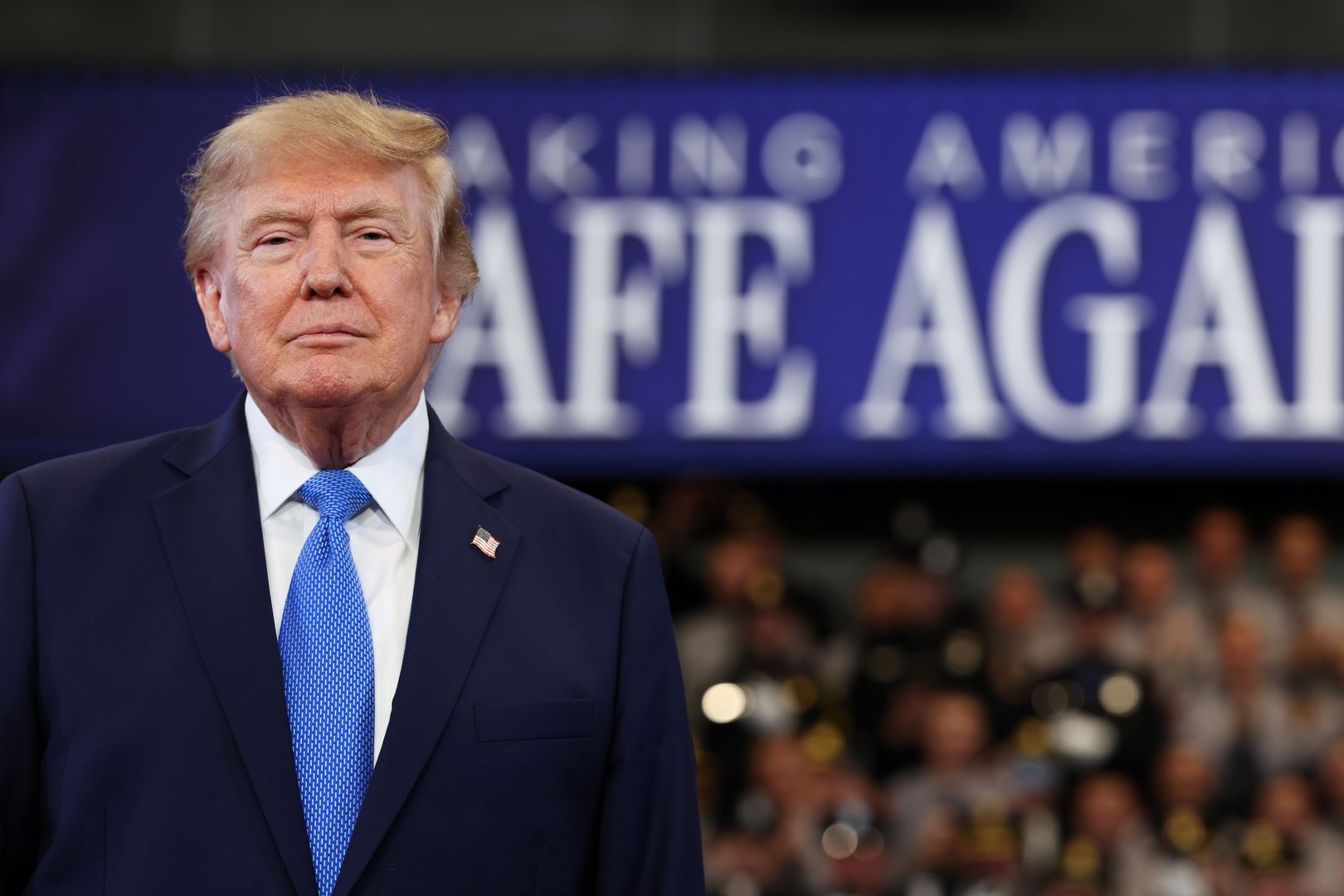
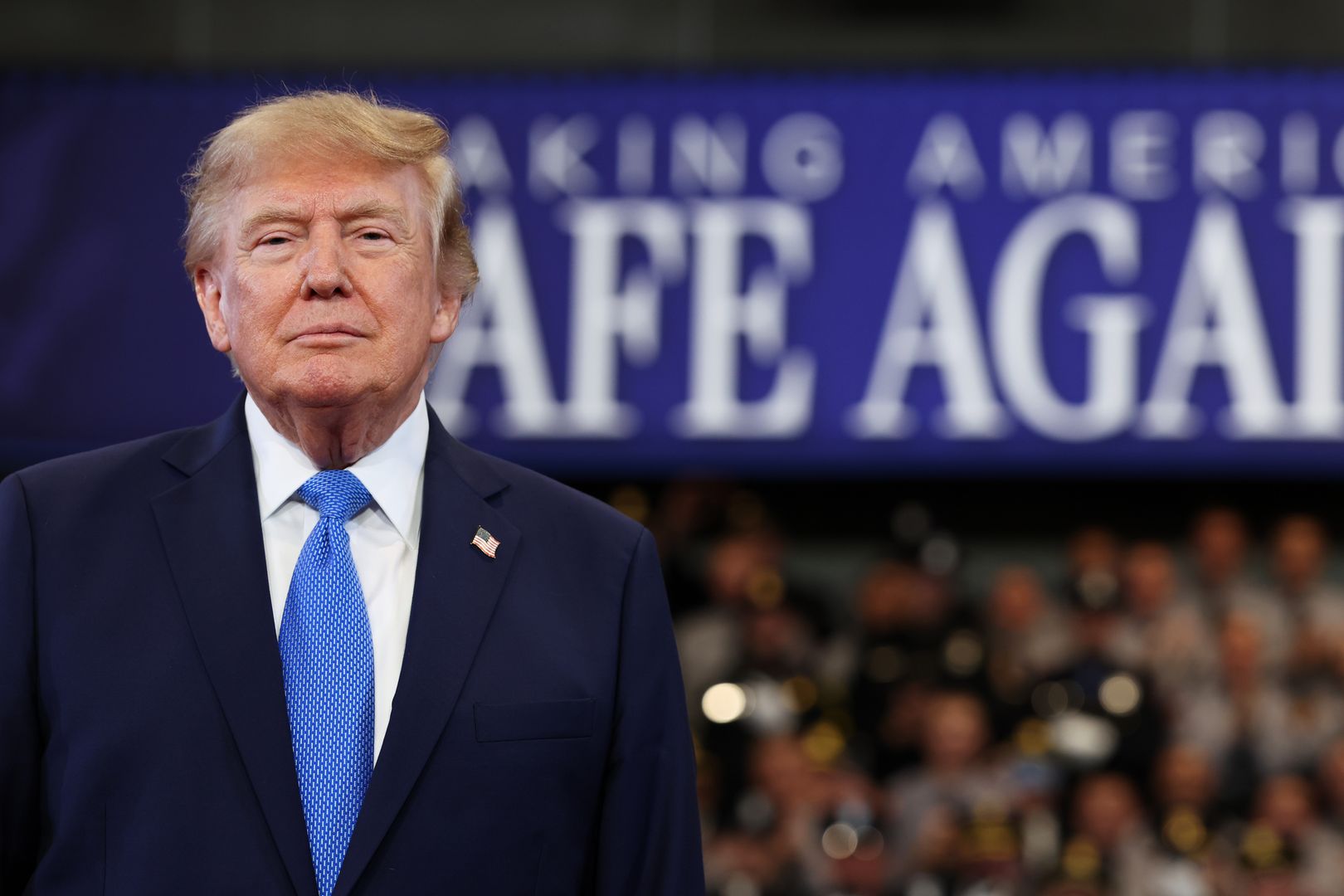
During a White House meeting Wednesday, President Donald Trump said CFTC Chair Mike Selig is working to bring the perpetual futures platform into the U.S. under federal rules.

England vs Pakistan, 1st Test Day 1 Highlights: Ollie Robinson, Josh Tongue Put England On Top

Marion County, Kansas Has Racked Up $4 Million In Settlements Since It Raided A Local Paper’s Office

Prince Harry and Meghan Markle to move back to the UK





-

 Fashion5 days ago
Weekend Open Thread: Ann Taylor
-
 Sports6 days ago
This U.S. Amateur is a glimpse into golf’s future in more ways than you think
-
 Tech5 days ago
11 Ways to Rank Your Videos
-
 NewsBeat5 days ago
Myanmar says over 300,000 Rohingya refugees verified for repatriation as exodus enters ninth year
-

 Sports5 days ago
Birmingham 2026: Day 6 Timetable for Irish Athletes
-

 Politics4 days ago
SEQ Code: The Three Letter Boarding Pass Code That Could Give You The Worst Seat
-

 Tech6 days ago
DeepSeek Harness launches as open source rival to Claude Code, alongside V4-Pro on API with higher prices
-

 Crypto World2 days ago
OCC Greenlights Trump Family Crypto Firm for Trust Charter
-

 Tech2 days ago
Qwen3.8-27B runs frontier-class coding agents and reasoning locally, no cloud API required
-
 Entertainment5 days ago
10 Netflix Shows That Quietly Became Modern Classics
-

 Fashion5 days ago
Weekly News Update, 8.14.26 – Corporette.com
-
 Tech4 days ago
Every fusion startup that has raised over $100M
-
 Entertainment5 days ago
Marvel Studios Reveals New X-Men Cast Including Adam Driver and Sadie Sink
-

 Fashion7 days ago
The Details Do the Dressing
-

 Business5 days ago
Facebook Down Now? Users Report Login And Loading Problems As Outage Trackers Monitor Ongoing Issues
-

 Crypto World6 days ago
Robinhood Chain Approaches $1B TVL as Uniswap Integration Boosts Liquidity
-

 Fashion5 days ago
Cart Confidential Vol. 44 – Julia Berolzheimer
-
 Business4 days ago
Monarch Mutual Fund set to enter MF space with maiden overnight fund; files draft with Sebi
-

 Politics6 days ago
The migrant mega-dinghy – spiked
-

 Tech6 days ago
Troubleshooting Video Delay On The Raspberry Pi
You must be logged in to post a comment Login