

Crypto World
U.S. CFTC files request to erase Gemini settlement that it no longer considers fair



The U.S. Commodity Futures Trading Commission wants to tear up the remnants of an old dispute with crypto exchange Gemini, with the agency insisting that its own staff’s assertions about Gemini making misleading statements weren’t handled properly.
The CFTC filed a request alongside Gemini in federal court to negate a settlement secured at the start of last year, with the current agency essentially disputing the conclusions of the previous agency. After a review of the case, the CFTC “concluded the complaint should not have been filed — and would not have been under current enforcement standards,” it said in a Wednesday statement.
In January of 2025, Gemini agreed to resolve an enforcement action with a $5 million fine and other requirements, settling a matter that began in 2017. In meetings with the CFTC back then, its staff had determined that Gemini allegedly made false statements about the relative difficulty of manipulating bitcoin futures contracts and the regulator pursued an enforcement action in 2022.
If the U.S. District Court for the Southern District of New York grants the request to cancel the settlement and toss the case, the remainder of Gemini’s requirements under the agreement will be nullified — including its injunction preventing the company from making false or misleading statements to the commission in the future.
The CFTC has dramatically reversed its previous relationship with the crypto industry since the arrival of the administration of President Donald Trump just days after the Gemini settlement, and the subsequent appointment of CFTC Chairman Mike Selig, who has embraced digital assets as one of his top policy goals.
Trump has also sought to champion the industry, including specifically welcoming Gemini’s founders, the Winklevoss brothers, to White House events.
The president’s previous nominee to run the CFTC, former Commissioner Brian Quintenz, said last year in posts on X (formerly Twitter) that the Winklevoss brothers had asked him to review the settlement and suggested they were unhappy that he refused to commit to anything further than a review of the case. Trump withdrew his nomination just under three weeks later.
The president’s pro-crypto agenda was on display Wednesday in a posting on his social media platform, Truth Social, where he said, “The new Frontier of Finance is being Built in America, and ‘TRUMP’ will NEVER let Crypto down!”



Polymarket paid mostly college-age creators to stage fake winning bets on copycat versions of its website. A Wall Street Journal investigation found none of the roughly $1.9 million in bets shown across 1,105 videos were real.
The findings run counter to the company’s core pitch. Polymarket settles every real trade on a public blockchain that anyone can audit. Its growth campaign relied on the opposite, staged trades on fake sites that no ledger could verify.
How Polymarket’s Alleged Fake Bets Worked
Real Polymarket trades run on the Polygon blockchain and settle in USDC. Markets resolve through UMA’s permissionless oracle, where anyone can propose or dispute an outcome by posting a $750 bond. Every position is public.
The marketing operation lived entirely off that ledger. The Journal reportedly reviewed 1,105 videos from 10 promoted creators between December and mid-May. Around 70% showed a bet, and none were genuine.
One video showed a creator winning $100,000 after Trump appeared to say the word McDonald’s in January. Trump never said it publicly that month, and the clip was older.
On the real market, public data shows more than 50 accounts made that bet, and all lost.
Many clips were filmed on dummy sites such as poiymarket.com, built to mirror the real platform. Across 118 videos, creators celebrated roughly $900,000 in fabricated wins. The same bets would have lost more than $166,000.
Creators earned about $2,000 to $3,000 a month and were told not to disclose the payments. A hired marketing firm then pushed the clips past 140 million views. The pattern echoes an earlier market resolution dispute that dented user trust.
Scandal Hits During Polymarket’s US Comeback
The timing is awkward. US regulators fined Polymarket $1.4 million in 2022 for running an unregistered market and ordered the winding down of non-compliant trades.
The company later reincorporated in Panama, with its headquarters reportedly a shared law office that also worked with FTX.
Polymarket has since won a regulated US market entry and now wants to bring its exchange onshore.
The fake campaign specifically targeted American users, who can still reach the offshore site through a VPN.
Trust questions are not new. A separate Journal analysis found most users lose money, even as the videos sold easy profit.
Now competing with regulated rival Kalshi, Polymarket said it will audit its promotional content.
That review, which is changing how regulators view its onshore push, may shape the next phase of the prediction market race.
The post Polymarket Accused of Using Fake Winning Bets to Fuel Viral Growth appeared first on BeInCrypto.

Key Takeaways
- Data center operations now represent AMD’s primary revenue catalyst, powered by EPYC server chips and Instinct AI accelerators
- Market share gains don’t require overtaking Nvidia — capturing a significant portion of explosive AI chip demand is sufficient
- Conservative 2031 projection points to approximately $704, while optimistic scenarios exceed $1,500
- Analyst sentiment remains constructive: 30 Buy recommendations, 12 Hold, 1 Sell — overall Moderate Buy rating
- Current trading levels exceed consensus price targets, suggesting near-term valuation concerns following recent gains
Advanced Micro Devices has emerged as a critical player in the artificial intelligence infrastructure expansion.
The firm’s first-quarter 2026 financial report illustrated this strategic shift unmistakably. Revenues climbed substantially, fueled by robust appetite for EPYC data center processors and Instinct GPU accelerators. The data center segment has displaced gaming and consumer processors as the company’s dominant growth driver.
Shares currently change hands near $537. This valuation reflects significant optimism already embedded in the market price.
Advanced Micro Devices, Inc., AMD
The optimistic investment thesis hinges on three critical factors. Cloud hyperscalers increasingly prioritize vendor diversification for AI silicon. AMD has established substantial positioning in server processors following years of systematically capturing territory from Intel. The company’s AI accelerator development timeline positions it as a viable alternative computing platform.
Nvidia maintains commanding leadership in AI acceleration hardware. However, AMD’s success doesn’t require outright victory in this competition. Even a substantial minority position in an explosively expanding market translates to dramatically increased business scale.
Three Potential Trajectories Through 2031
Financial analysts have constructed three distinct scenarios for AMD’s evolution over the next seven years.
Under pessimistic assumptions, AMD expands but struggles to secure adequate AI accelerator adoption. Revenues might approach $70 billion, yet margin compression limits profitability. Applying a 25x earnings multiple yields a stock price near $200.
The middle-ground projection presents more favorable conditions. AMD sustains data center penetration, expands Instinct GPU deployment, and achieves margin improvement. Revenue could reach $120 billion with earnings per share around $22. A 32x valuation multiple supports a price target of approximately $704.
The optimistic scenario envisions transformational success. Should AMD establish itself as the definitive second AI chip platform while simultaneously expanding CPU and enterprise computing presence, revenues might hit $180 billion. With EPS at $40 and a premium valuation, shares could trade beyond $1,500.
Weighting these scenarios by probability generates a blended target near $807 — representing roughly 50% appreciation from current levels, or approximately 8.5% annualized returns.
Current Wall Street Perspective
The analyst community maintains generally favorable views, albeit with important caveats.
AMD presently carries 1 Strong Buy, 30 Buy ratings, 12 Holds, and 1 Sell, per MarketBeat data. The aggregate rating stands at Moderate Buy.
The complication: average analyst price targets fall below AMD’s current market price. This gap suggests analysts appreciate the business fundamentals while believing the stock has outpaced near-term justification following its recent advance.
The Road Ahead for AMD
AMD’s EPYC processor family has systematically captured CPU market share from Intel over consecutive quarters. This provides the company with established data center relationships independent of Instinct GPU revenue contributions.
Executive guidance has previously outlined expectations for sustained multi-year expansion, anchored by data center growth. These projections form the foundation for 2031 valuation models.
For AMD to generate meaningful market outperformance from current levels, execution closer to the bullish scenario appears necessary. The base-case trajectory delivers returns roughly aligned with broader equity market expectations — respectable, but below the outsized gains growth-oriented investors typically seek.
First-quarter 2026 data center revenue established a new company record for quarterly performance.

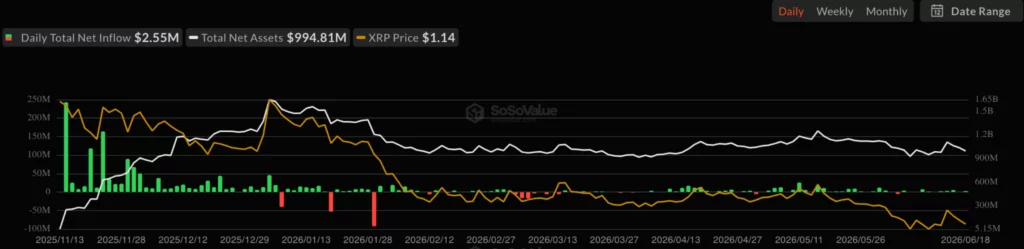
XRP price traded near $1.14 on June 21, with the token still locked in a narrow range after failing to clear $1.20.
Summary
- XRP price traded near $1.14 as buyers defended the key $1.10 support zone after weak volume.
- Ripple adoption keeps growing through RLUSD, MXNB, Mastercard settlement links and AI payment tools.
- ETF inflows and low exchange reserves support the rebound case, but whale selling remains under pressure.
According to crypto.news data, XRP showed a 24-hour move of -0.34%, with price action between $1.13 and $1.15.
The token stayed almost flat over seven days but remained down more than 16% over 30 days. Trading volume stood near $872 million, while market value held around $70.97 billion, keeping XRP in sixth place among crypto assets.
The setup remains simple. Bulls need to protect $1.10, while a close above $1.20 would give the market a reason to revisit $1.25 and $1.30.
XRP price stays locked inside a tight range
Last week’s range view has held. XRP buyers pushed toward $1.20, but they did not secure a breakout with strong volume. Sellers also failed to break the $1.10 floor, keeping the token inside the same band.
That makes $1.10 the first level to watch. A clean move below that area could expose $1.05 and then the $1.00 zone.
The upside path also remains clear. XRP needs volume above $1.20 before bulls can target $1.25 and $1.30. Without that confirmation, the move looks more like consolidation than a new trend.
This range still matters. Long periods of flat trading often build pressure, but direction still depends on who wins the range. A breakout without volume would carry less weight than a close backed by stronger spot demand.
Ripple adoption supports the long-term case
Ripple’s ecosystem news gave bulls a stronger utility argument even as price stayed weak. The company has pushed RLUSD into more payment channels and recently backed Flutterwave’s Series E round to support stablecoin adoption in African payments.
Ripple also worked with Bitso on MXNB, a Mexican peso stablecoin on the XRP Ledger. Ripple is expanding RLUSD through Mastercard’s stablecoin settlement network and MXNB-powered cross-border payment infrastructure.
The XRP Ledger also moved deeper into automated payments. Crypto.news reported that Ripple launched the XRPL AI Starter Kit, allowing AI agents to use XRP and RLUSD for payments through the x402 protocol.
This does not guarantee higher prices. It does show that XRP’s utility story is moving beyond retail trading and into payments, stablecoins, settlement and machine-to-machine transfers.
CLARITY Act and reserves shape the catalyst
Regulation remains a key part of the XRP price analysis. As crypto.news reported, the CLARITY Act has cleared committee and now needs Senate votes, with the 60-vote threshold still ahead.
The bill matters for XRP because it could give institutions clearer rules for digital commodities and tokenized settlement. XRP is already being used in tokenized Treasury settlement pilots, but larger adoption still depends on legal certainty.
Supply data adds another layer. Crypto.news reported that XRP exchange reserves fell to a seven-year low near 1.6 billion tokens, down about 50% from October 2025. Low exchange supply can make price more sensitive when demand arrives.
Fund flows are another support point. According to SoSoValue data, XRP-linked products recorded about $10.66 million in weekly net inflows for the week ending June 18, close to $10.68 million in the prior week. Cumulative net inflows rose to about $1.45 billion, while total net assets moved closer to $1 billion.
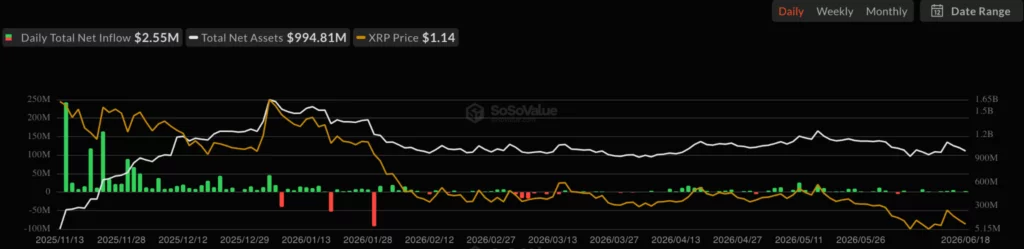
Still, whale activity keeps risk on the table. As previously reported, whales had distributed more than 30 million XRP in five days, while network activity weakened.
Analysts watch $1.10 and $1.20
Technical analysts remain split. EGRAG CRYPTO described the two-month XRP chart as “E is the battlefield,” pointing to a structure that could support a future breakout if buyers defend the current zone.
The analyst listed much higher cycle targets, including $9.50 to $17.23, with $13 as a main focus. Those targets remain speculative while XRP trades near $1.14 and below the $1.20 breakout area.
For now, the market does not need targets to define the next move. XRP needs to hold $1.10, reclaim $1.20 and then show stronger volume. A failure at $1.10 would keep sellers in control.
ETF flows, lower exchange reserves and Ripple adoption support the rebound case. Whale selling, weak activity and a stalled breakout support the cautious case. XRP is still waiting for a clean trigger.
Disclosure: This article does not represent investment advice. The content and materials featured on this page are for educational purposes only.
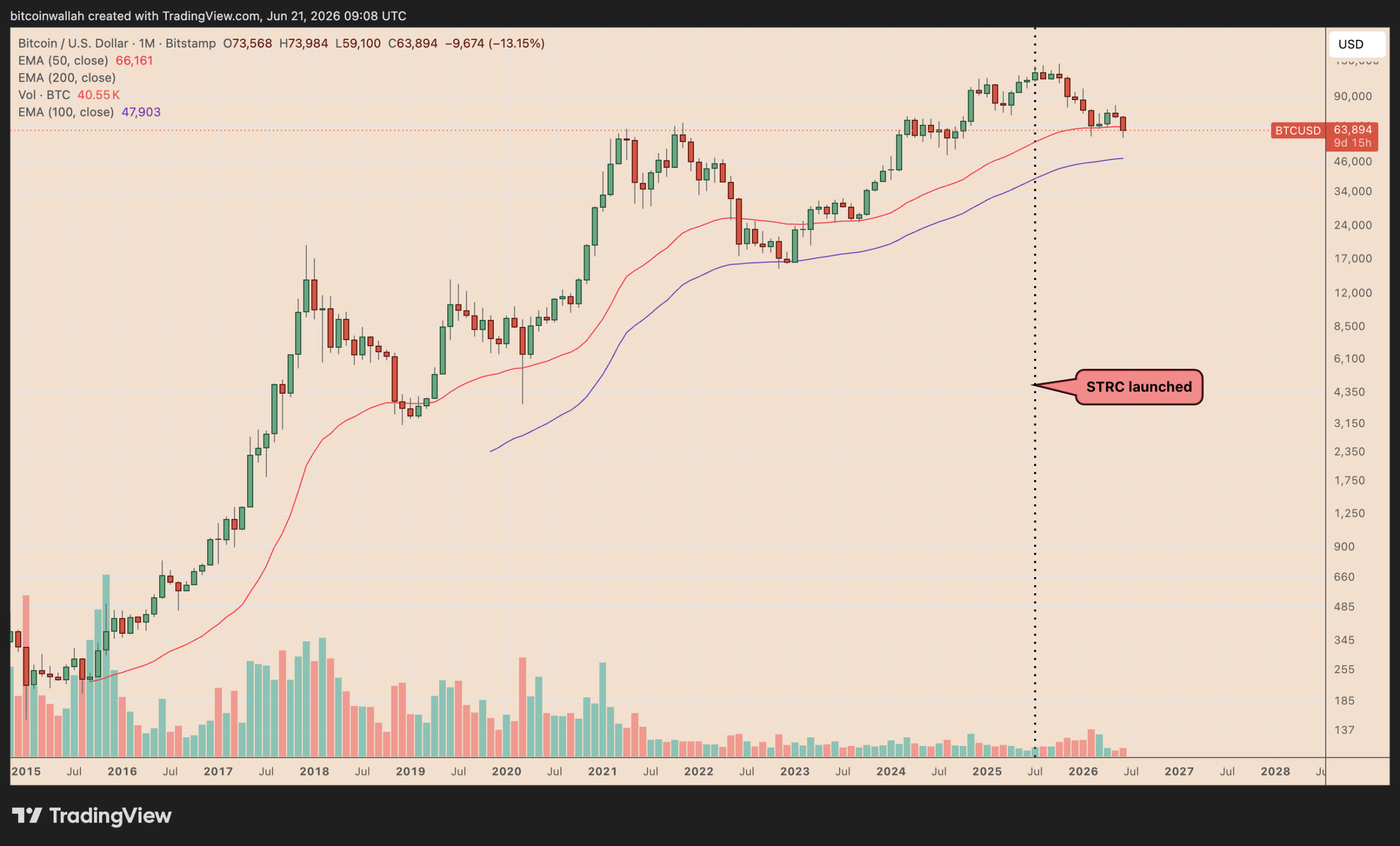
Bitcoin (BTC) has fallen roughly 50% since Michael Saylor’s Strategy launched Stretch (STRC), its flagship Bitcoin-funding vehicle, in late July 2025.
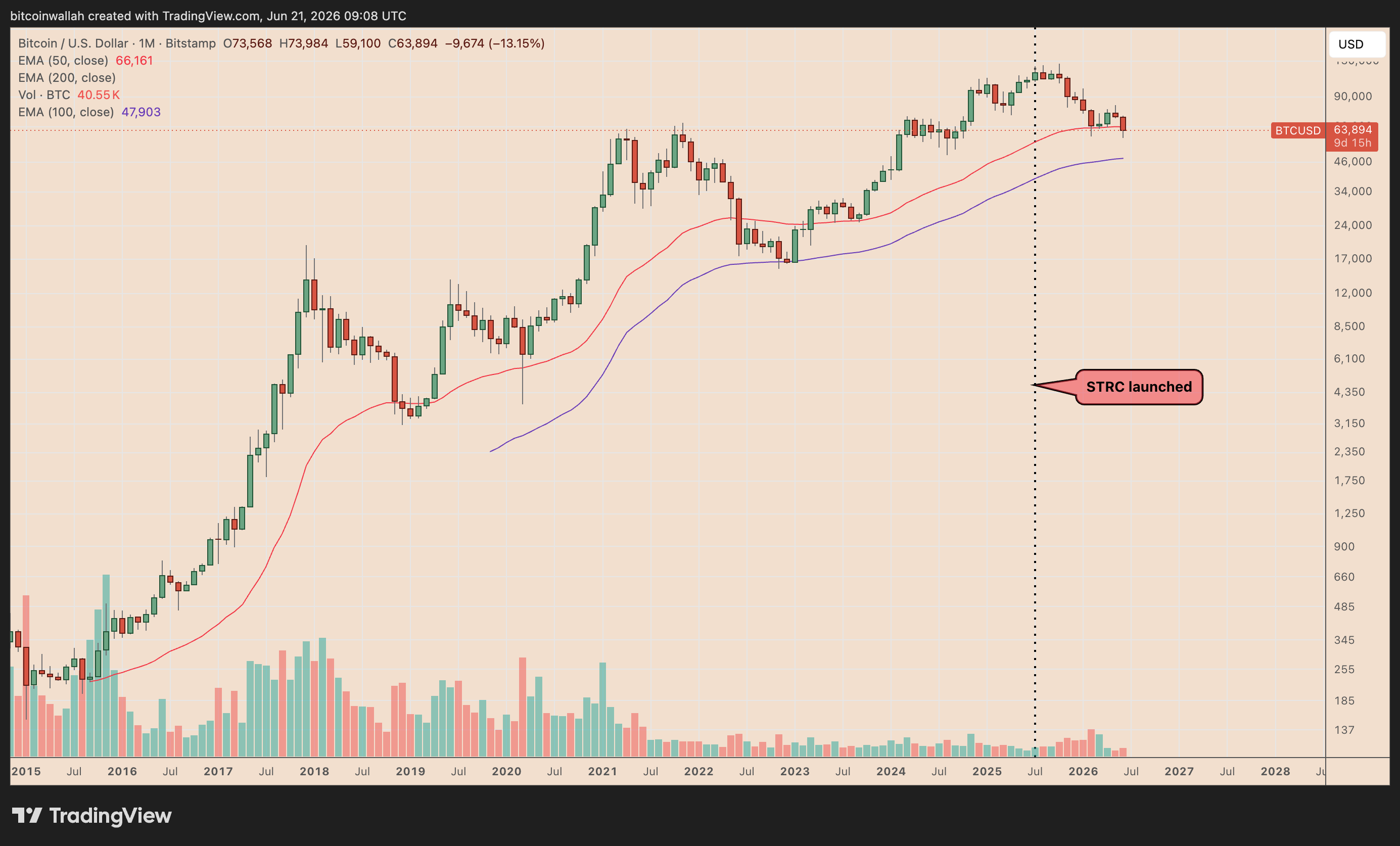
BTC/USD monthly chart. Source: TradingView
Key takeaways:
- STRC is acting like a classic Ponzi scheme, argue Peter Schiff and other critics.
- Other analysts disagree, noting that STRC’s drop below the $100 par is due to a leverage wipeout.
Critics say STRC looks like a “classic centralized Ponzi”
STRC was designed to trade near its $100 par value, enabling Strategy to raise capital to buy more Bitcoin. The instrument is now trading at a deep discount, suggesting that the BTC buying channel is under pressure.
On Thursday, STRC fell to a record low of $82.53 before closing at $88.59, still below the $100 par value.
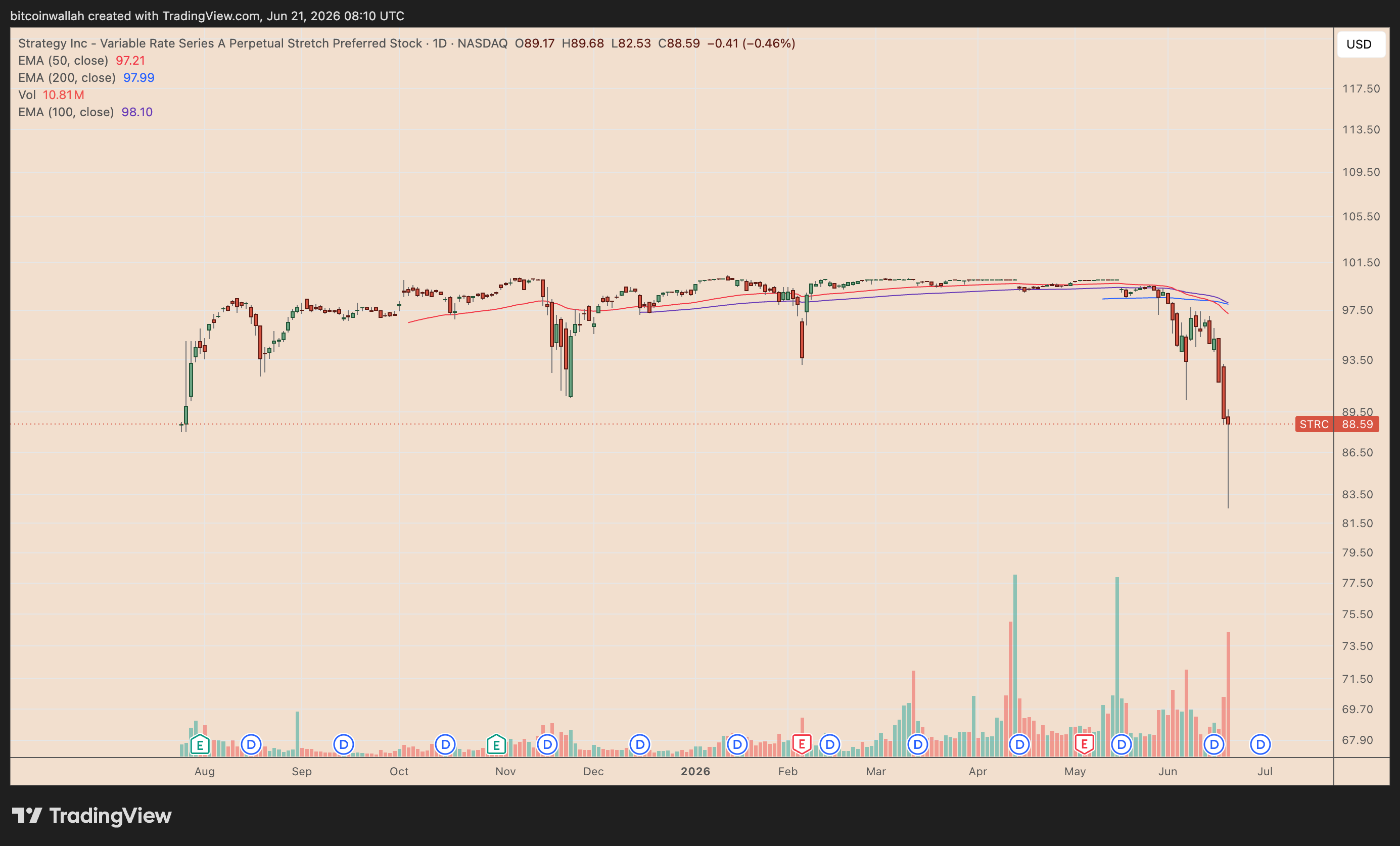
STRC daily chart. Source: TradingView
Launched in July 2025, STRC was designed to trade near par through adjustable dividends, currently 11.5% annualized, with proceeds used primarily to acquire Bitcoin.
The widening discount has pushed STRC’s effective yield above 12.9% and contributed to a pause in at-the-market share issuance. That risks slowing down the capital-raising flywheel behind Strategy’s Bitcoin treasury, which now holds more than 846,000 BTC.
In finance, a “flywheel” is a self-reinforcing business model where growth in one metric directly helps grow another, compounding momentum.
But trading 13% below par has revived criticism of Strategy’s funding model.
Bitcoin critic Peter Schiff has repeatedly described STRC as “a classic centralized Ponzi,” arguing that it depends on Strategy’s ability to raise fresh capital through new share sales or sell Bitcoin to meet obligations.
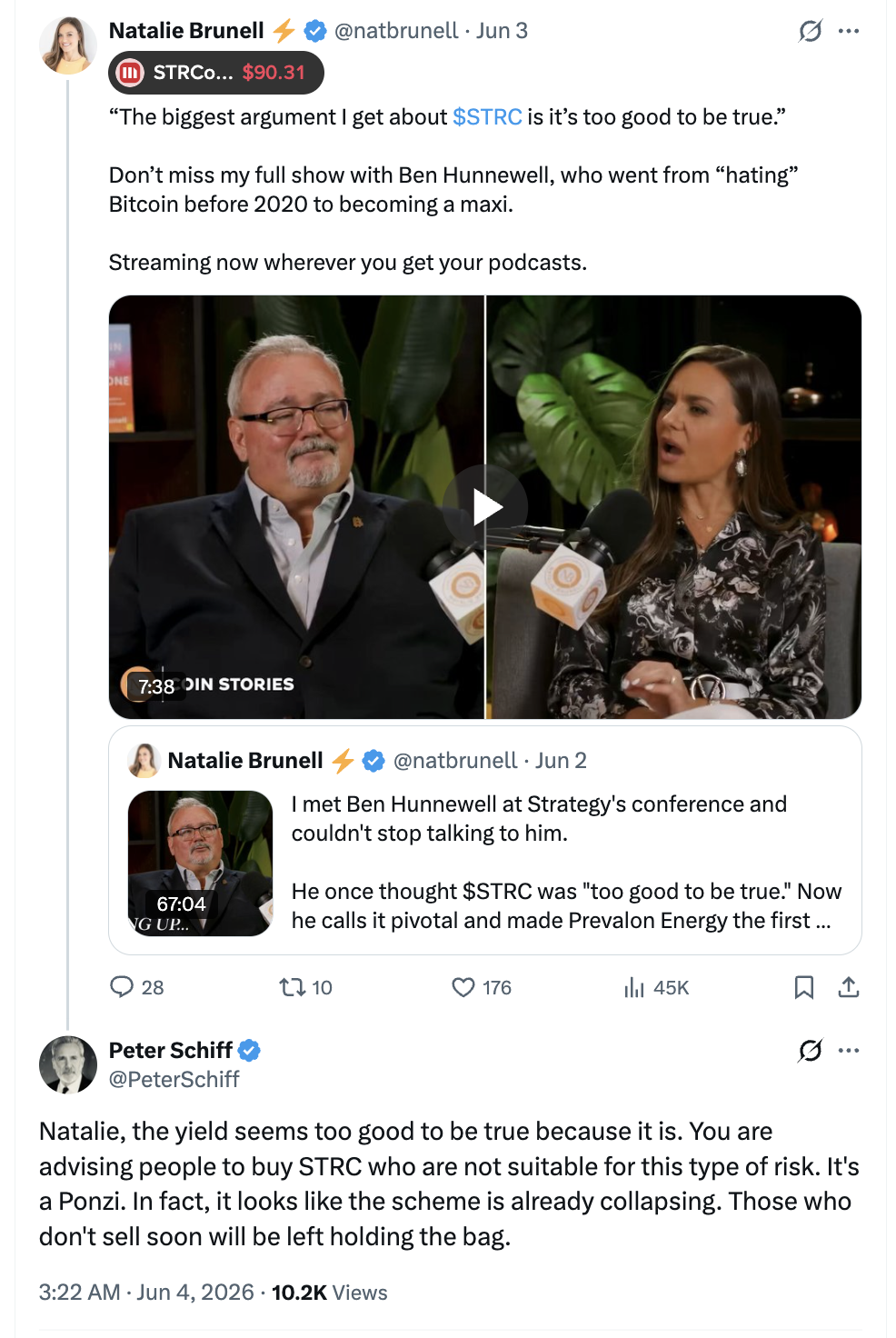
Source: X/Peter Schiff
Crypto trader DonAlt also questioned STRC’s recent price action, asking why the instrument was “trading like a Ponzi” after its sharp move below par.
Strategy has not directly addressed this in recent statements, instead continuing to present STRC as preferred equity supported by its Bitcoin-focused treasury strategy.
However, the company has moved STRC to a semi-monthly dividend schedule, with payouts now designed to occur twice a month rather than monthly.
Strategy’s Bitcoin buying pace slows as STRC slumps
The pace of Strategy’s Bitcoin accumulation has slowed sharply as STRC trades below par value.
The company added 1,550 BTC for $101 million in the week ending June 8 and another 1,587 BTC for $100 million in the week ending June 15, lifting total holdings to 846,842 BTC.
Those were meaningful purchases, but they were far smaller than Strategy’s weekly buys earlier in 2026.
For instance, in April, Strategy bought 34,164 BTC for $2.54 billion in a single week. In May, it added another 24,869 BTC for roughly $2.01 billion. By contrast, June’s weekly additions have been closer to $100 million each.
The slowdown also coincided with a small but notable 32 BTC sale earlier in June, worth about $2.5 million, to help cover dividend obligations.
Related: Bitcoin price sets $64.5K week-to-date low as Strategy selling worries return
The sale was tiny compared with Strategy’s overall Bitcoin treasury, but it showed that cash obligations can still force limited BTC sales when STRC-led funding becomes less efficient.
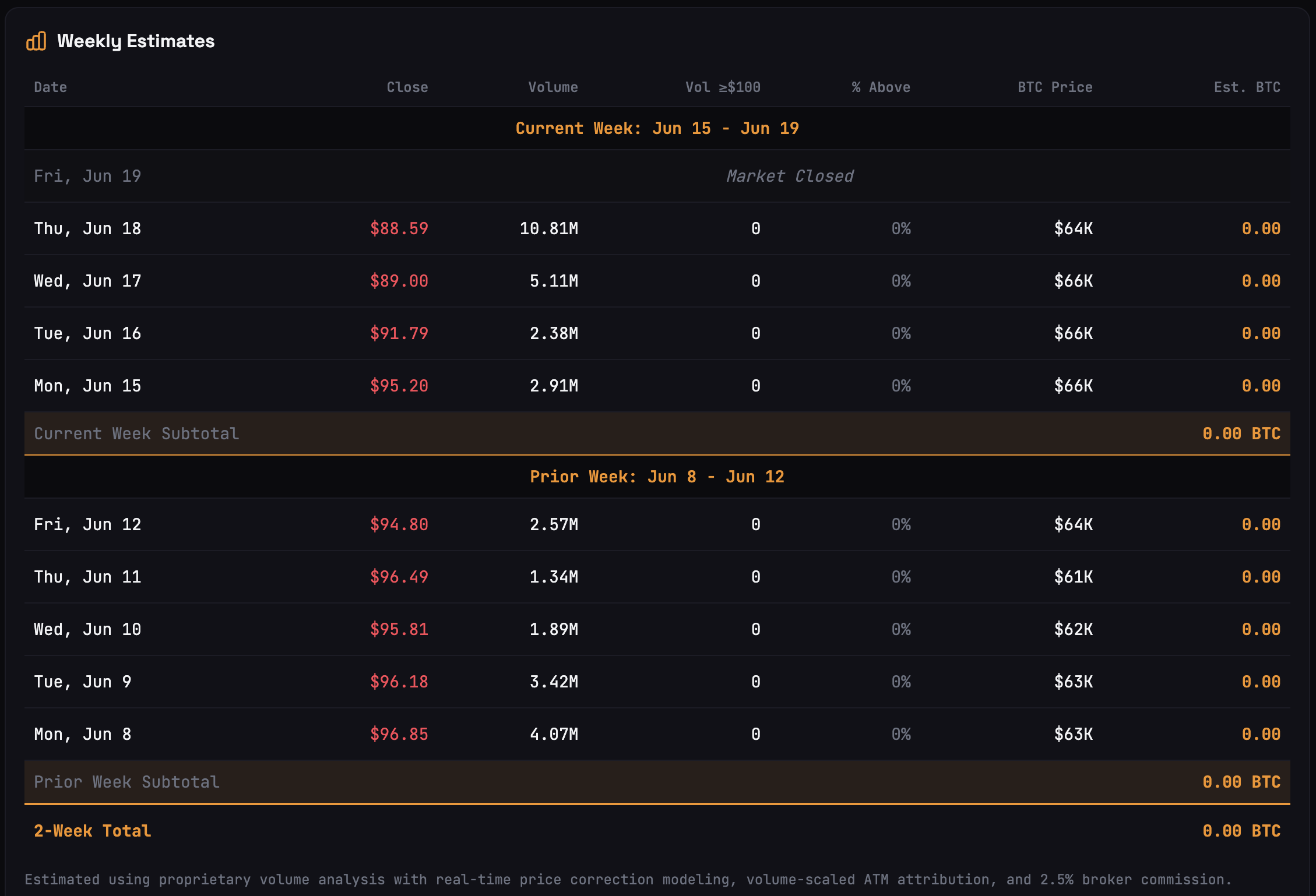
STRC-led weekly BTC buying estimates. Source: STRC.LIVE
Analyst says STRC drop is a leverage wipeout
The STRC sell-off looked more like a leverage wipeout than a deterioration in Strategy’s fundamentals, according to Jesse Myers, head of Bitcoin strategy at The Smarter Web Company.
“Strategy is fine,” he said in a Thursday post, adding that the company could pay STRC dividends for 32 years if conditions remain unchanged, and indefinitely if Bitcoin appreciates at roughly 2% annually.
STRC’s long stretch near $99–$100 encouraged investors to use heavy leverage, with some assuming the instrument would stay above $95. Once the price slipped, margin calls and forced selling accelerated the decline.
The discount may also attract income buyers, according to analyst Scott Melker.
In a Sunday post, he noted that STRC’s dividends are based on the $100 liquidation preference, not the market price. At an 11.5% dividend rate, buyers at $90 earn about 12.8%, while buyers at $85 earn roughly 13.5%.
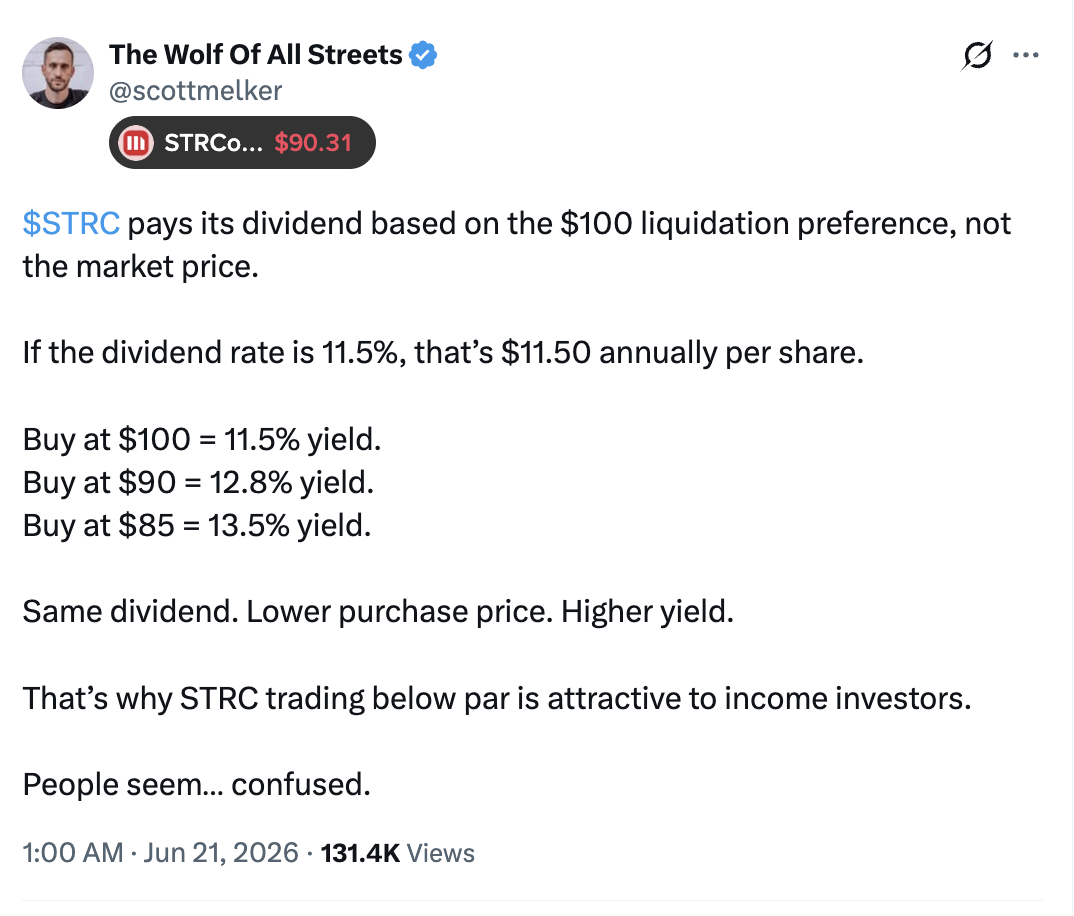
Source: X/Scott Melker
At current prices, STRC offers an effective yield of about 13%. Strategy may announce its next dividend rate on June 30, while retaining other options, including MSTR share issuance and cash reserves, to fund its Bitcoin purchases.

Bitcoin can survive another price crash as it has done so many times in the past, reassured the CEO of CryptoQuant, Ki Young Ju.
However, he envisions another major threat for the asset – boredom, and he linked it to Strategy’s STRC shares, which have raised some eyebrows in the past few weeks.
Boredom, Not a Crash
If you have followed the cryptocurrency industry for a few (or more) years, you are probably aware of its intense volatility at times. Bitcoin has been the object of some mind-blowing fluctuations, up or down. Of course, the skyrocketing liquidations on the way down are usually the ones people read about, and don’t get me wrong, there have been plenty of instances in which the asset has tumbled by double digits daily. However, it has also risen in the opposite direction violently before.
Naturally, the current market state and the past several months, starting with the early October massacre, the February calamity, and the June crash, are examples of bear-dominated trends. Nevertheless, BTC has managed to withstand all of those and has (for now) returned stronger than before.
Consequently, CryptoQuant’s chief exec didn’t seem too bothered about the potential of another crash. However, he believes boredom could pose a more profound threat, especially if Strategy’s controversial Stretch (STRC) fails to operate as intended.
“Strategy’s STRC structure becomes truly dangerous not when Bitcoin simply crashes, but when Bitcoin spends years moving sideways, and the bear market drags on.”
He added that “long stagnation kills the story,” as BTC can survive another crash if the market still believes in the next leg up. However, weak demand due to stagnation leads to compressed MSTR premium and makes “Saylor’s capital-raising machine much harder to sustain.”
A Reason to Believe
Young Ju further explained that the real challenge for Saylor and his company is not just to keep buying bitcoin, but to give the market “a new reason to believe.”
“After nearly a decade in this industry, I’ve realized Bitcoin’s core has not really changed. What changes every cycle is the story around why BTC price should keep going up. But, most of those stories now feel exhausted.”
He warned that BTC failed to serve as digital gold when it was needed, as it traded like a tech stock. It was supposed to be freedom money built by cypherpunks, but many OGs are now shilling other coins. It also faces the rising threat of advanced quantum computing.
Although he remains a firm believer that “the pool of capital that could flow into Bitcoin is massive,” he noted that the “sense of an inevitable catalyst feels much weaker” now compared to 10 years ago.
“It makes me a little sad to see the ideas that originally pulled me in gradually get consumed and diluted: freedom money, energy money, and institutional adoption.”
The post Bitcoin’s Biggest Risk Is Boredom, Not Another Price Crash: CryptoQuant CEO appeared first on CryptoPotato.

TLDR
- The XRP Ledger’s core server software xrpld v3.2.0 launched June 15, targeting 30–40% memory optimization
- Node operators and developers identified several technical issues via GitHub shortly after deployment
- A node operator experienced complete sync failure post-upgrade despite previous version stability
- Reported issues encompass configuration parsing problems, transaction relay defects, and validator data distribution gaps
- Adoption remains at 26% network-wide; no critical network failures documented
Following the June 15 deployment of xrpld version 3.2.0, the XRP Ledger development community has documented numerous technical issues with the network’s updated core server infrastructure.
The software update promised notable enhancements including performance optimization and a projected 30% to 40% decrease in memory consumption. The release also transitioned the server nomenclature from “rippled” to “xrpld” while incorporating enhanced security protocols.
Yet, shortly following the launch, node administrators and software engineers started documenting problems through the official GitHub issue tracker.
Synchronization Problems and Configuration Glitches
A node administrator documented that their infrastructure running v3.2.0 completely failed to retrieve ledger information following the update. The system maintained connection status but synchronization ceased entirely. Notably, identical hardware performed flawlessly under version 3.1.3. This issue, submitted June 18, awaits resolution.
Another documented problem reveals that configuration files containing inline comments trigger server crashes during initialization. The legacy parsing system fails to properly handle comments in specific parameters, generating a “BadLexicalCast” exception.
Project maintainers have validated multiple reports as legitimate defects requiring technical assessment.
Relay and Validator Network Concerns
Engineers identified a defect affecting transaction propagation mechanisms to network peers. A computational error restricts the number of peers receiving transaction broadcasts, potentially causing insufficient network distribution.
The resource fee tracking mechanism also drew scrutiny. The current implementation only preserves the maximum fee value while discarding previous entries, behavior developers classify as erroneous.
Validator list propagation presented another challenge. Currently, validator metadata transmits exclusively to inbound peer connections while excluding outbound links. This asymmetry affects validator information distribution throughout the network infrastructure.
Developers identified potential unsigned integer overflow vulnerabilities during ledger sequence validation processes. Additional reports highlighted inconsistent transaction routing parameters and compromised node identification when utilizing ephemeral cryptographic keys.
A further report outlined a logical deficiency in ledger state tracking that can strand nodes in undefined states without established recovery procedures.
Current Status Assessment
Presently, none of the documented defects have triggered network-wide service disruptions. The XRP Ledger Foundation alongside open-source development contributors continue examining all submitted reports via the project’s GitHub platform.
Network adoption of version 3.2.0 currently stands at 26%. The substantial majority of nodes continue operating on previous software releases.
The XRP Ledger Foundation has not released official communications or remediation patches at publication time. All identified issues remain under ongoing technical evaluation.
Key Takeaways
- Scaramucci anticipates Bitcoin will begin its upward momentum in Q4 2026 through early 2027
- He dismisses concerns about Michael Saylor and Strategy, calling them financially secure
- Strategy maintains approximately $52 billion in Bitcoin holdings plus $1 billion cash reserves
- Declining retail interest and reduced Google search activity represent bullish indicators in his view
- ETF capital flows and institutional accumulation have created a less volatile cycle compared to previous periods
Anthony Scaramucci, founder of SkyBridge Capital, told CNBC that Bitcoin remains aligned with its traditional four-year market cycle. He anticipates an upward price movement commencing in late 2026 and extending into the first quarter of 2027.
According to Scaramucci, the current market cycle has exhibited less volatility than previous iterations. Bitcoin experienced approximately 50% retracement from peak levels, significantly less than the 60–70% corrections observed in earlier cycles. He attributes this moderation to sustained ETF capital inflows and growing institutional participation.
“I think Bitcoin starts to rally late in the fourth quarter of 2026 into early 2027,” he said.
Scaramucci identified diminishing market attention as an encouraging development. Search volume for Bitcoin on Google has declined substantially, and retail investor enthusiasm has waned. He characterized this apathy as a pattern that typically emerges near cycle lows rather than market peaks.
He emphasized that Bitcoin’s market remains comparatively modest in size. Consequently, even limited fresh capital entering the market can generate substantial price appreciation. Scaramucci disclosed that he maintains significant personal Bitcoin exposure.
“I still like it. I own a lot of it,” he said.
Strategy’s Position Draws Support From Scaramucci
Scaramucci dismissed criticisms surrounding Strategy’s substantial Bitcoin position. He highlighted Michael Saylor’s access to robust capital markets and a solid financial foundation.
“You have to really understand the mechanisms of the balance sheet to understand that Bitcoin can go a lot lower, and he’s virtually not in trouble,” he said.
Strategy’s Bitcoin treasury stands at approximately $52 billion in current value. This reserve provides coverage for 31 months of dividend payments and interest commitments. The firm additionally maintains $1 billion in liquid cash reserves.
No significant debt obligations come due before 2028. Saylor has stated publicly that Strategy can continue servicing its preferred stock dividends and enhancing shareholder returns as long as Bitcoin appreciates by a minimum of 1.25% annually.
Scaramucci observed that Strategy’s equity continues trading at a premium relative to its underlying Bitcoin reserves. He suggested this premium provides investors with “necessary arbitrage” opportunities that justify the investment thesis.
“I like him. I think he’s going to be right,” Scaramucci said of Saylor.
He further mentioned that recent geopolitical developments and declining energy costs could suppress inflationary pressures. Should this scenario materialize, the Federal Reserve might implement interest rate reductions, potentially benefiting Bitcoin and broader risk assets.
Drawing on nearly four decades of investment experience, Scaramucci characterized the present market conditions as a late-cycle deceleration rather than the conclusion of Bitcoin’s long-term appreciation trajectory.

Quick Summary
- Total net revenue for 2025 reached $4.5B at Robinhood, representing a 52% annual increase
- First quarter 2026 brought $1.07B in revenue (up 15%), while Gold membership reached 4.3 million users
- Wall Street’s consensus 12-month target averages approximately $112, marginally exceeding today’s ~$108 trading level
- Projections for 2031 suggest a baseline target near $148, with optimistic scenarios approaching ~$293
- Probability-weighted analysis indicates a 2031 price around $156, representing potential gains of ~44% from present values
Robinhood (HOOD) stock currently hovers around the $108 mark, prompting investors to question its trajectory over the coming half-decade.
The trading platform delivered $4.5 billion in consolidated net revenue throughout 2025, marking a substantial 52% year-over-year expansion. Profitability metrics showed strength as well, with net income totaling $1.9 billion while adjusted EBITDA surged 76% to reach $2.5 billion.
Momentum carried into the first quarter of 2026. Robinhood generated $1.07 billion in quarterly revenue, reflecting 15% growth compared to the same period a year earlier. Earnings per share on a diluted basis landed at $0.38, representing a 3% improvement. The premium Gold subscription service expanded its user base by 36%, hitting an all-time high of 4.3 million subscribers.
Operational metrics from May painted an even stronger picture. The platform’s funded customer count climbed to 27.7 million, while aggregate platform assets swelled to $377 billion—a 48% year-over-year jump. During Q1 alone, net deposits totaled $17.7 billion.
The company has evolved significantly beyond its original retail equity trading roots. Today, Robinhood encompasses options trading, cryptocurrency transactions, retirement planning tools, banking services, credit card offerings, prediction market participation, and access to private market opportunities.
Exploring Three Distinct Price Scenarios
Three potential pathways illustrate where HOOD shares might trade by 2031.
Under a bearish scenario, annual revenue reaches approximately $6.5 billion, but compressed margins and subdued trading activity constrain profitability. Applying a 22x price-to-earnings ratio yields a potential stock price around $35.
The baseline projection estimates annual revenue of roughly $10 billion by 2031. Assuming net profit margins stabilize around 35% and earnings per share hit $3.90, a 38x valuation multiple suggests a price target near $148.
An optimistic scenario envisions Robinhood successfully constructing a comprehensive financial ecosystem. Should revenue climb to $14 billion with EPS reaching $6.50, a 45x earnings multiple would support a stock price approaching $293.
Balancing these scenarios through probability weighting produces a 2031 target price around $156—translating to approximately 44% appreciation from current levels, or roughly 7.5% compound annual growth.
Wall Street’s Current Perspective
Analyst sentiment toward Robinhood remains constructive, though enthusiasm appears measured.
MarketBeat data reveals HOOD holds 18 Buy recommendations, 5 Hold ratings, and no Sell opinions. The overall consensus stands at Moderate Buy. However, the mean 12-month price objective sits around $112—only marginally higher than current trading levels.
This modest near-term target despite positive ratings suggests analysts recognize the long-term opportunity while acknowledging limited immediate upside following the stock’s recent appreciation.
Several headwinds warrant consideration. Current valuation multiples appear elevated. Transaction-based revenue streams face cyclical pressures. Cryptocurrency markets exhibit high volatility. The regulatory environment remains uncertain. Established financial institutions pose formidable competitive challenges.
Conversely, Robinhood possesses meaningful competitive strengths—including a substantial, demographically young customer base, expanding subscription-driven revenue from Gold memberships, growing assets under administration, and continuous product portfolio diversification.
Realistic modeling places the 2031 price range between $150 and $160. Achieving the $293 bull case target would require Robinhood to successfully transform into a comprehensive financial super app serving next-generation consumers.


Blockstream CEO Adam Back said concerns over Strategy’s small Bitcoin sale are overblown, framing the move as normal treasury management rather than a warning sign for the company’s Bitcoin plan.
Summary
- Adam Back said Strategy’s small Bitcoin sale showed balance sheet flexibility, not bearish treasury change.
- Strategy sold 32 BTC for about $2.5 million to fund preferred stock dividend payments due.
- Crypto.news later reported Strategy bought 1,550 BTC, keeping its accumulation story active for now again.
Speaking in a Bloomberg interview shared on YouTube, Back addressed questions about Strategy selling 32 BTC to help pay preferred stock dividends. He said the sale showed the firm could meet obligations while keeping Bitcoin at the center of its balance sheet.
Back frames sale as balance sheet use
Back argued that the market should not treat the 32 BTC sale as a bearish signal. In his view, Strategy used a small part of its Bitcoin position to support investor payments and reduce pressure on the capital structure.
He also said the move showed how Bitcoin can function inside a corporate treasury. Rather than showing weak conviction, it showed that a company can hold Bitcoin, raise capital against it and use a limited amount when cash needs arise.
Back’s argument also places the sale inside a larger shift in corporate Bitcoin finance, where companies use BTC alongside preferred shares, debt, common equity, and market tools today.
Strategy’s first sale drew attention
As previously reported by crypto.news, Strategy disclosed on June 1 that it sold 32 Bitcoin between May 26 and May 31 at an average price of $77,135. The sale raised about $2.5 million.
The filing said proceeds were expected to fund distributions on the company’s preferred stock. The sale represented about 0.0038% of Strategy’s Bitcoin holdings at the time, but it drew attention because Michael Saylor had long promoted a “never sell” message around Bitcoin.
Crypto.news later reported that Saylor separated personal investor advice from corporate treasury actions. “I said to YOU never sell your bitcoin,” Saylor said at BTC Prague.
Preferred dividends remain in focus
The debate centers on Strategy’s preferred stock model. Preferred shares can give investors yield, but they also create recurring cash needs that the company must meet through cash reserves, equity issuance or limited Bitcoin sales.
Strategy’s STRC preferred stock has faced pressure after falling below its $100 par value. As crypto.news reported, Saylor defended the company’s Bitcoin-backed strategy and said its Bitcoin and cash reserves still exceeded outstanding debt by about $48 billion.
Some critics argue that dividend obligations could become harder to manage if market conditions weaken. Supporters say the 32 BTC sale showed Strategy has several funding tools and does not need to abandon its long-term accumulation plan.
Strategy remains a net accumulator
The sale did not stop Strategy from buying more Bitcoin. Crypto.news reported that the company later bought 1,550 BTC for $101.3 million, lifting its holdings to 845,256 BTC after the sale disclosure.
That purchase was nearly 50 times larger than the 32 BTC sale. It helped support Back’s view that the transaction was not a broad retreat from Bitcoin.
Saylor has also argued that Bitcoin does not need staking or protocol-based yield. In a separate post covered by crypto.news, he framed Bitcoin as the base layer for credit, money, yield and equity products.
For now, the issue is not whether Strategy still wants Bitcoin. The question is how it funds preferred dividends while keeping investor trust and managing balance sheet risk.

TLDR
- STRC, Strategy’s preferred stock instrument, plunged to an all-time intraday low of $83 on June 18, trading approximately 17% beneath its $100 par value — marking the worst performance since launching in July 2025.
- The company’s $1.5 billion convertible bond repurchase depleted Strategy’s cash reserves, slashing projected dividend coverage from an intended 24-month buffer down to approximately 6 months.
- With bitcoin declining from highs above $80,000 in May to approximately $62,500, Strategy’s BTC portfolio now carries an unrealized deficit of roughly $11.14 billion.
- CEO Michael Saylor maintained the company’s financial strength, noting that combined BTC and USD reserves surpass total debt obligations by approximately $48 billion.
- While skeptics like Peter Schiff have questioned the legality of Strategy’s approach, advocates contend STRC’s framework remains viable provided Bitcoin experiences long-term appreciation.
On June 18, Strategy’s STRC preferred shares collapsed to an unprecedented intraday bottom of $83, ultimately settling at $88.59 — approximately 17% under the $100 par value benchmark. Since its July 2025 introduction, the instrument was engineered to maintain trading levels at or close to par while delivering an 11.5% annualized return.
This sharp decline wasn’t an abrupt event. Rather, it emerged from a sequence of corporate actions and bitcoin’s persistent price deterioration spanning several weeks.
Heading into its monthly ex-dividend date on May 14, STRC maintained its $100 level while bitcoin commanded prices exceeding $80,000. Superficially, the situation appeared stable. However, BTC had already retreated significantly from its October 2024 peak of $126,000.
That identical day, competitor Strive Asset Management unveiled SATA, its own preferred instrument featuring daily distributions at a 13% yield — immediately creating competitive pressure for Strategy.
Convertible Note Repurchase Drains Cash Cushion
The following day, May 15, Strategy disclosed plans to repurchase $1.5 billion worth of its 2029 convertible bonds at an 8% discount. The company financed a portion of this transaction by tapping into cash reserves initially designated for dividend distributions and debt service obligations.
This crucial information wasn’t immediately transparent. When details surfaced on May 26, the reserve balance had contracted to $871 million — dramatically reducing STRC dividend coverage from the advertised 24-month projection to merely 6 months.
STRC slipped to $99.33 that session. Bitcoin was changing hands around $77,000.
Despite this, Strategy persisted with bitcoin accumulation. On May 18, the firm acquired 24,869 BTC while prices descended toward $76,000.
June 1 delivered another unexpected development. Strategy disposed of 32 BTC — representing its first bitcoin divestment since 2022. Though minuscule at just 0.0038% of total holdings, the transaction alarmed market participants. MSTR shares declined 5.9% that day. Bitcoin tumbled to lows near $70,500. STRC settled at $98.07.
Accelerating Bitcoin Weakness Compounds Challenges
By June 5, bitcoin had penetrated below $60,000 for the first time since October 2024. STRC touched lows of $90 before recovering to close at $93.40.
Strategy shareholders authorized a transition to semi-monthly STRC dividend distributions on June 8, an adjustment intended to minimize volatility surrounding ex-dividend periods. The company simultaneously disclosed its dollar reserve had rebounded to $1 billion following the purchase of 1,550 BTC.
On June 15, Strategy added another 1,587 BTC to its portfolio. Reserve balances reached $1.1 billion.
Then June 18 arrived. STRC plummeted to $83 during trading hours before finishing at $88.59 as bitcoin declined 2.4% to $62,880. Strive CEO Matt Coles, whose SATA instrument also suffered losses, attributed the downturn to forced liquidations from leveraged positions rather than fundamental credit deterioration.
Strategy currently maintains 846,842 BTC, accumulated at an average acquisition cost of $75,656 per unit. With bitcoin hovering around $62,500, the corporation faces an unrealized portfolio loss approaching $11.14 billion.
MSTR common equity trades near $112, representing roughly an 80% decline from its November 2024 record high.
Michael Saylor countered critics this week, declaring via X that combined BTC and USD reserves now surpass the company’s total debt burden by approximately $48 billion. He drew comparisons to 2022, when debt temporarily exceeded reserves by $300 million while BTC traded near $20,000.
Peter Schiff has advocated for shareholder litigation and suggested Saylor potentially breached SEC promotional regulations while marketing STRC. Conversely, Bitcoin proponent Samson Mow characterized STRC as a “brilliant instrument,” maintaining there are no inherent structural deficiencies unless one assumes bitcoin won’t appreciate over extended timeframes.

Jeremy Clarkson confirms future of Clarkson’s Farm after cancer diagnosis

Moschino names Loris Messina and Simone Rizzo as creative directors

Polymarket Accused of Using Fake Winning Bets to Fuel Viral Growth


-

 Business7 days ago
No Jackpot Winner as $257 Million Prize Rolls Over to $269 Million Monday Draw
-

 Fashion2 days ago
Weekend Open Thread: Miami – Corporette.com
-
Crypto World6 days ago
Zimbabwe Requires Crypto Businesses to Register Annually Under New FIU Regulations
-
 Business1 day ago
Wall Street Week Ahead: Investors see Micron earnings as pulse check of AI rally momentum
-
 Entertainment7 days ago
Matt Damon’s Viral Sci-Fi Thriller Has Taken Over HBO Max
-

 Tech7 days ago
As AI companies race to go public, who else is along for the ride?
-

 Business7 days ago
Anthropic staff to meet White House officials next week, Axios reports
-

 Crypto World1 day ago
HIVE shares jump as $220M AI deal speeds Bitcoin mining pivot
-
 Crypto World7 days ago
Bitcoin could crash to $48,000, if this historical pattern is triggered
-
 NewsBeat7 days ago
what doctors are seeing in ebike crashes
-
 NewsBeat7 days ago
Warning of disruption as Cardiff Crossrail works to start
-
 NewsBeat7 days ago
Tributes to former deputy head teacher at Cambridge school among death and funeral notices
-
 Entertainment7 days ago
Kate Middleton Glare Goes Viral After Kids Booed At Royal Event
-

 Politics7 days ago
“Israel’s” ban on ICRC visits ruled illegal, but Knesset moves to stop them permanently
-

 News Videos7 days ago
Financial Accounting | Last Day Revision Strategy and Booster | CMA Inter – June 2026
-

 Crypto World7 days ago
XRP ETFs Outperform As Bitcoin And Ethereum Funds Extend Outflow Trend
-

 Tech6 days ago
Over 400 Arch Linux packages compromised to push rootkit, infostealer
-

 Business7 days ago
Invesco Quality Income Fund Q1 2026 Commentary
-

 NewsBeat7 days ago
Singer Oliver Tree dies aged 32 in helicopter crash in Brazil
-
 Crypto World7 days ago
Market Preview: SpaceX (SPCX) IPO Record, Federal Reserve Meeting, and Iran Nuclear Agreement
You must be logged in to post a comment Login