

Crypto World
U.S. Clarity Act markup leaves BTC price unstirred: Crypto Daily

This is an excerpt from CoinDesk newsletter ‘Daybook.’ Sign up here, if you haven’t already.
The week’s main event for digital assets, the U.S. Clarity Act markup, is due later today. The crypto market, led by bitcoin, seems to be treating it as a non-event.
The proposed bill aims to establish a comprehensive regulatory framework for digital assets. The latest draft, released on May 11, includes several key provisions, including a ban on interest on stablecoin balances and a $5 million penalty for violations. It also adds the Treasury as a rule-making authority alongside the SEC and CFTC.
There is still no ethics language preventing government officials from issuing tokens, though observers expect it may be introduced during markup, when a Congressional committee will review, debate and amend the wording line by line.
“As the framework moves toward passage, BTC’s case as a strategic allocation with unique diversification benefits in a balanced portfolio only strengthens,” said Can-Luca Köymen, an investment strategist at Sygnum Bank.
Not everyone is happy with the current wording.
Over 100 Substack amendments were submitted ahead of a Wednesday deadline, including one proposing a ban on Federal Reserve master accounts for crypto companies.
“That could be problematic,” said Noelle Acheson, author of Crypto is Macro Now, in her latest note. She added that while progress is positive, “there is still much that could go wrong tomorrow.”
She noted that to secure passage in the Senate, the committee will need bipartisan support. Without it, she warned, the chance of the bill passing this year, about 60% on Polymarket, could fall sharply.
Despite the high stakes, BTC implied, or expected, volatility metrics remain subdued, pointing to steadier market conditions.
“Volatility expectations [in BTC] are compressed at all forward horizons, with short-dated options trading close to their year-to-date lows (with implied volatility at a historical low of 30%),” said Andrew Melville and Thahbib Rahman of Block Scholes. “There’s also no obvious event risk priced-in by either BTC or altcoin options ahead of the Senate CLARITY Act markup.”
There are, however, signs of stress in markets tied to Coinbase (COIN). “[There] we do see an embedded implied vol premium in the May-15 contract which covers the debate date, suggesting traders are clearly pricing for the bill to act as a catalyst for companies that stand to benefit from regulatory clarity, but not for BTC,” they said. Stay alert!
Read more: For analysis of today’s activity in altcoins and derivatives, see Crypto Markets Today . For a comprehensive list of events this week, see CoinDesk’s “Crypto Week Ahead.”
What’s trending
Today’s signal

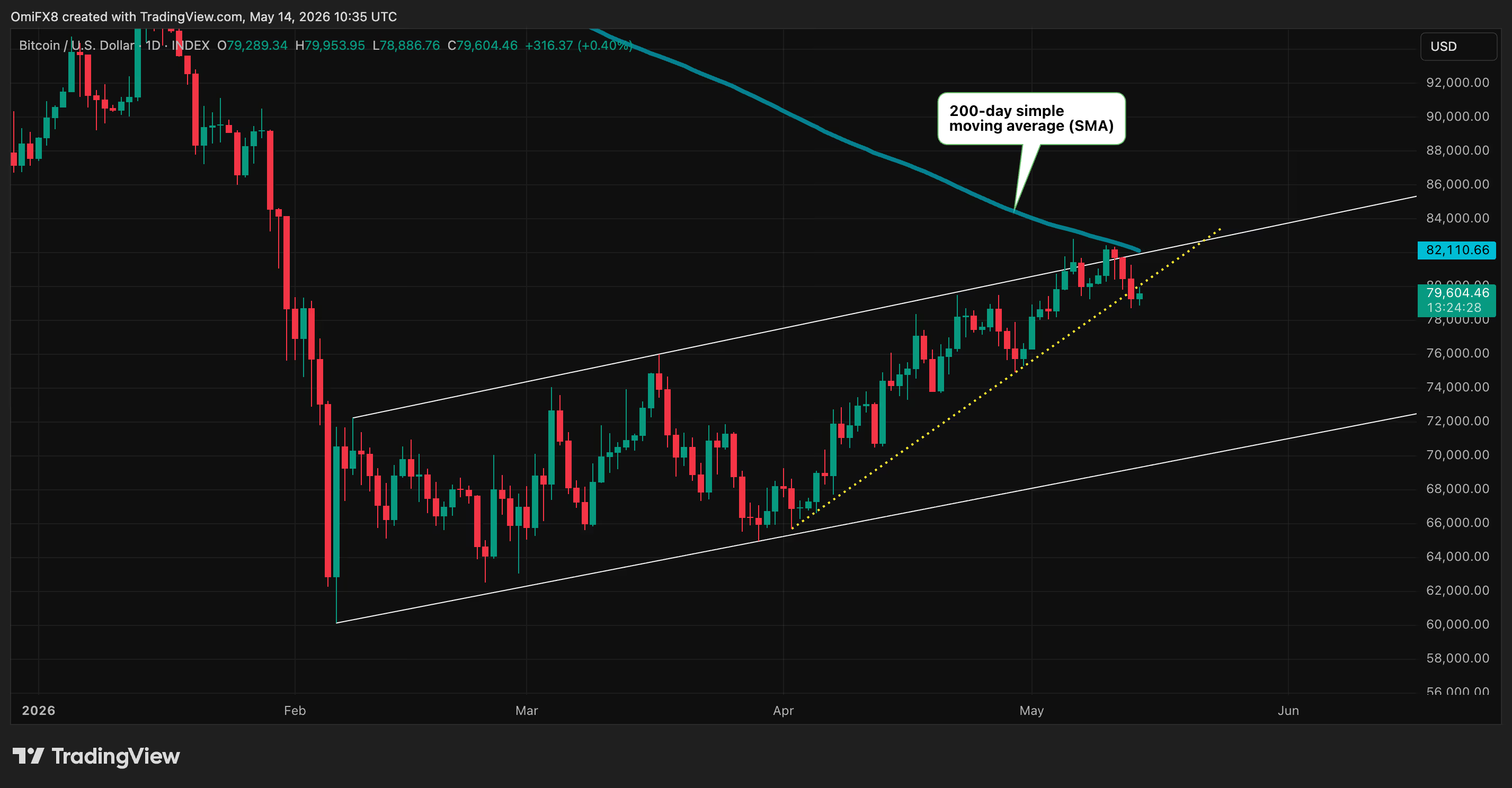
Bitcoin backed away from the confluence of the 200-day simple moving average and the upper boundary of the rising channel that has defined the recovery from February lows.
It’s not just a routine pullback from resistance.
The decline has now also pierced the short-term upward (dotted) trendline drawn from April’s lows, suggesting that the latest leg of the recovery has ended.
Taken together, these signals increase the risk of momentum-driven selling entering the market, potentially driving prices down to $75,000 or lower. On the higher side, the 200-day average placed just above $82,000 is the level to beat to revive the bullish outlook.


The U.S. Securities and Exchange Commission proposed removing two key Regulation NMS rules, opening a new debate over tokenized U.S. stocks and DeFi trading.
Summary
- SEC proposed removing Rules 611 and 610(e), changing long-standing trade protections for U.S. equities markets.
- Analysts say the move could help DeFi market makers support tokenized U.S. stock trading.
- Tokenized equities still face registration, settlement, clearing, and investor-rights questions under U.S. securities rules.
The SEC said on June 11 that it proposed rescinding Rules 611 and 610(e) of Regulation National Market System. The rules have shaped U.S. equity trading since 2005.
Rule 611 blocks trade-throughs in national market system stocks. In simple terms, a trading venue cannot execute a stock trade at a worse price when a better protected quote is available on another venue.
Rule 610(e) deals with locked and crossed quotations. These rules require trading centers to avoid quotes that equal or cross the national best bid and offer in U.S. stocks.
The SEC said the proposal would also remove related definitions from Rule 600 and make other matching changes. The public comment period will stay open for 60 days after the proposal appears in the Federal Register.
SEC Chairman Atkins says rule change could cut costs
SEC Chairman Paul Atkins said the plan aims to simplify equity market structure after two decades of Rule 611. He said the rule may have created problems that limited market growth.
“After two decades of Rule 611, it is high time that the Commission review its unintended consequences that have hindered — rather than enhanced — the long-term growth of our markets,” said SEC Chairman Paul S. Atkins.
“This proposal is intended to simplify market structure and reduce costs for market participants while allowing competition, innovation, and other market forces to shape the continuing evolution of our equity markets,” Atkins added.
The proposal does not approve tokenized stock trading by itself. It starts a rulemaking process and gives market participants a chance to comment before the agency decides whether to finalize the rescission.
Analysts point to tokenized stocks
Galaxy Digital’s Alex Thorn said the proposal could remove a major barrier for tokenized U.S. equities in DeFi. He argued that automated market makers cannot easily follow Rule 611 because they execute trades through liquidity pools and bonding curves.
“An AMM cannot comply with 611 by construction. It executes against a bonding curve at whatever the pool price is, with slippage, at block-time granularity,” Thorn wrote.
The issue is that DeFi pools cannot check every stock exchange quote in real time before each swap. They also cannot route orders across markets in the same way as traditional trading systems.
Thorn also said Rule 610(e) creates similar issues. AMM prices move with trading flow, which means tokenized equity pools could often lock or cross displayed quotes in the traditional market.
Tokenized equities still face other rules
If the SEC removes the rules, analysts say broker-level best execution duties may play a larger role. FINRA Rule 5310 requires brokers to seek the best available terms for customer orders.
That framework may fit tokenized markets better than trade-by-trade price protection rules. Still, tokenized stocks face other hurdles, including exchange registration, ATS rules, clearing, settlement, and investor rights.
As previously reported, the SEC has been studying an innovation exemption that could allow tokenized public stocks to trade on blockchain platforms. The plan may require tokenized shares to carry the same rights as normal shares, including dividends and voting rights.
Moreover, as reported by crypto.news, Commissioner Hester Peirce has also said any exemption may stay limited in scope. She said it would likely apply to digital versions of existing public equities, not synthetic stock tokens without shareholder rights.
The SEC proposal adds a new step to that wider policy shift. It could reduce one market structure barrier, but the final rules will depend on the comment process and further agency action.


Michael Saylor addressed Strategy’s sale of 32 BTC on stage at BTC Prague on Thursday. He told the audience the transaction does not change the company’s long-term Bitcoin (BTC) thesis.
The executive chairman faced questions because he has urged investors for years to never sell their bitcoin. A small treasury transaction turned that slogan against him this week.
Why Strategy Sold 32 BTC for the First Time Since 2022
Strategy sold 32 BTC between May 26 and May 31 for roughly $2.5 million. That works out to an average of $77,135 per coin, slightly above its $75,699 cost basis.
A June 1 filing with the SEC disclosed the transaction. MSTR shares fell about 6% afterward, and the company’s first bitcoin sale since December 2022 dominated the conversation. The disclosure even triggered a $15 million dispute on Polymarket over contract settlement.
The proceeds will fund distributions on Strategy’s preferred stock. The board declared June 30 cash dividends across all five preferred series, a recurring obligation tied to the firm’s capital structure.
The sale covered about 0.004% of Strategy’s 843,706 BTC, a stack worth roughly $62 billion. Still, the company had already slowed accumulation. It paused buying before earnings in the spring and recently skipped its weekly purchase altogether.
Saylor Speaks Out on His Never Sell Bitcoin Advice
Speaking in Prague on June 11, Saylor confronted the apparent contradiction head-on.
“I said to you never sell your bitcoin.”
Saylor said at BTC Prague, in a video shared by Alex Bragin.
Here is the answer on stage of @BTCPrague why Michael @saylor sold 32 BTC pic.twitter.com/5vGM0P9Rwh
— Alex Bragin (@BraginRights) June 11, 2026
He explained that the advice targeted individual investors, while the corporate sale served a specific financial obligation. In his framing, the company practiced normal treasury management rather than an exit from bitcoin.
He also brushed off the online trolls mocking the sale. In his view, it would be dumb for a company to rule out selling regardless of its obligations.
He stressed that liquidity needs drove the decision, not a bearish view on bitcoin’s future. The sale’s size supports that reading, since $2.5 million barely registers against a $62 billion position.
Saylor once urged followers to sell a kidney before parting with their bitcoin. Those earlier absolutist posts sharpened criticism once the filing appeared.
Skeptics remain unconvinced. Some analysts argue the episode adds to mounting pressure on MSTR as the stock trades below recent highs. Meanwhile, bitcoin traded near $63,400 on Friday, up 1.4% over 24 hours.
The next test arrives on June 30, when the preferred dividends fall due. Investors will watch whether Strategy funds future distributions from new capital or reaches into its bitcoin reserve again.
The post ‘I Said to YOU Never Sell Your Bitcoin’: Saylor Speaks Out on 32 BTC Sale appeared first on BeInCrypto.
The Avalanche Treasury Company saw a rocky start as it debuted on Nasdaq under the ticker AVAT on Thursday, with shares dropping 16% by the end of the day.
The new company gained access to the Nasdaq after merging with special-purpose acquisition company (SPAC) Mountain Lake Acquisition in a $675 million deal first announced in October.
The company, with support from institutional backers including Dragonfly, Pantera, ParaFi Capital, VanEck, Galaxy Digital and Kraken, aims to give investors exposure to the Avalanche blockchain ecosystem without holding the cryptocurrency.
Bart Smith, Avalanche Treasury CEO and former Susquehanna executive, said Thursday that it wasn’t a bet on price, but an investment that “represents meaningful potential for the repositioning of institutional finance.”
Avalanche launched in 2020 with proof-of-stake consensus, high throughput and a multi-chain architecture. Today, more than 550 projects are building in the ecosystem, with more than $1 billion in institutional funds deployed and more than $1.65 billion in real-world assets tokenized on the network.
Tough first day trading for AVAT
AVAT shares fell 16% from their open at $2.20, ending the day at $1.85, according to Google Finance. This has been a typical pattern for crypto company initial public offerings, especially in a bear market.
Related: SpaceX IPO nears 4 times oversubscribed, squeezing crypto and tech
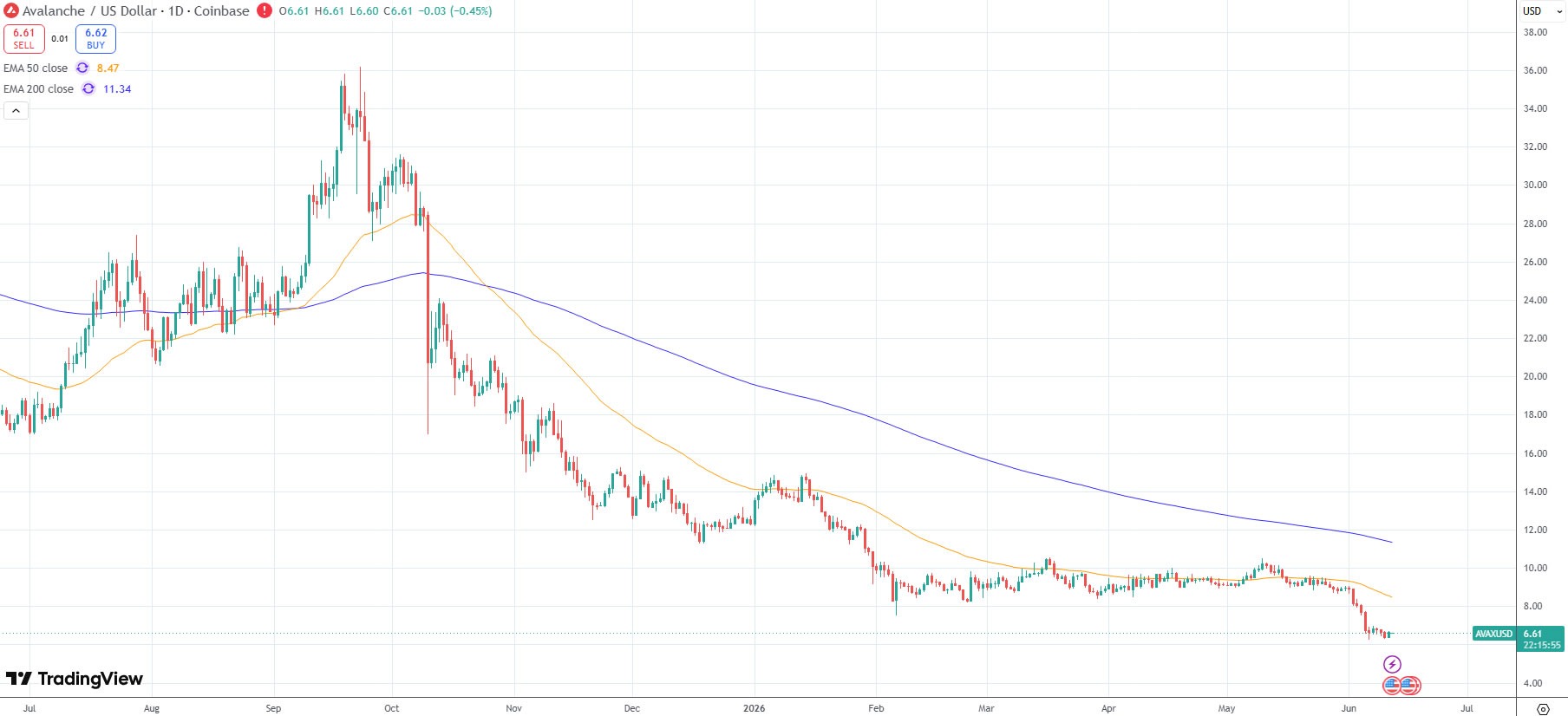
AVAX saw a small 3.4% gain on the day, but the asset has lost 33% over the past 30 days and remains down 95% from its November 2021 all-time high. It is currently trading at its lowest level since early 2021, at $6.61, according to TradingView.
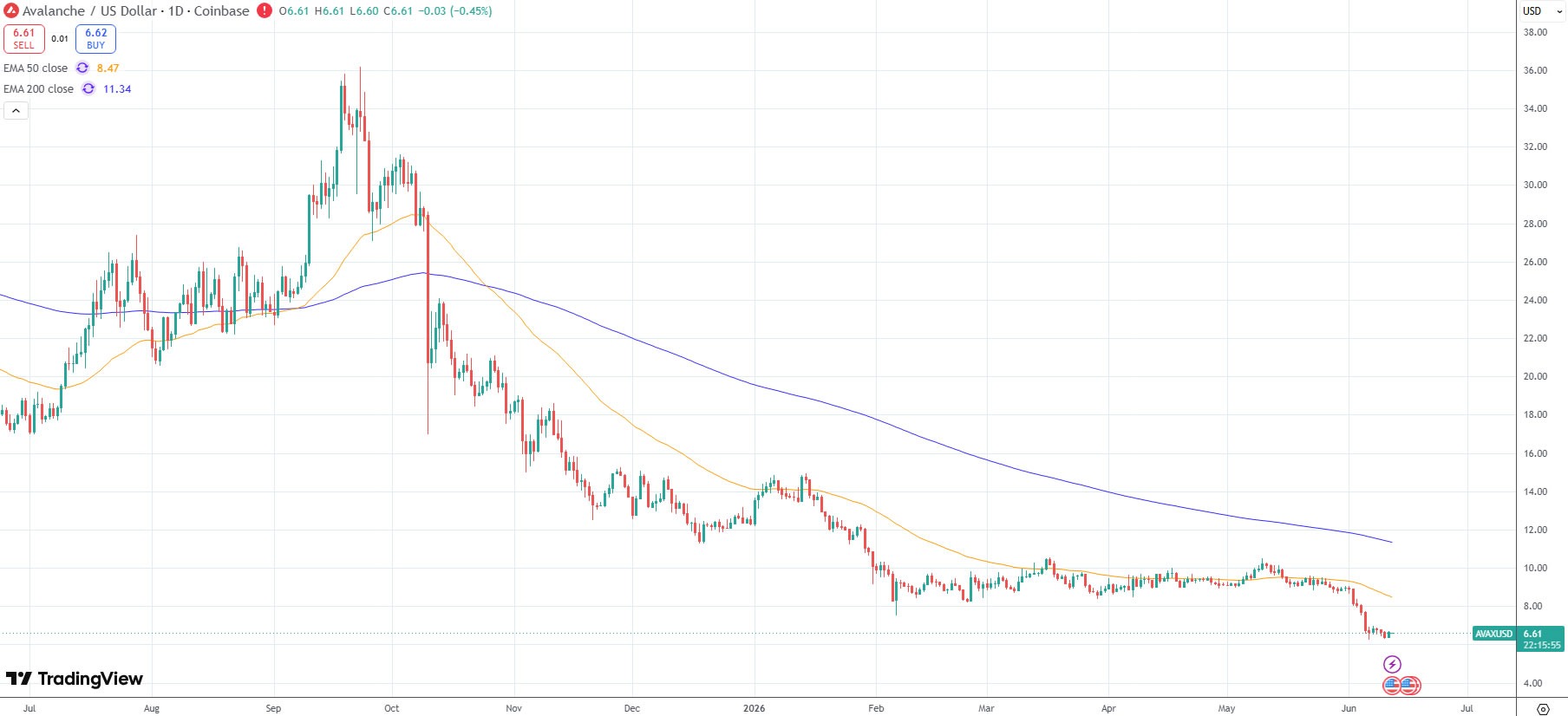
Altcoins have been crushed in 2026, and AVAX is at a five-year low. Source: TradingView
DATs are having a rough ride
Avalanche is the latest crypto ecosystem to launch a publicly listed company, but it comes amid a difficult time for crypto treasury firms.
The weekly net flow of BTC into digital asset treasuries has declined to around $266 million this week, following weekly highs of over $2 billion in April and May, according to Coinglass.
The world’s largest BTC treasury, Strategy, has seen its stock value tumble 69% over the past 12 months as the Bitcoin bear market deepens.
Bitmine Immersion Technologies pivoted from BTC mining to an Ethereum treasury in mid-2025. Its shares (BMNR) saw explosive growth, reaching an all-time high of $135 in July that year, but have since tanked by 88% to $16.50 a year later.
SOL Strategies Inc., a Solana-focused DAT, began trading in September 2025 under STKE, but share prices have also collapsed by 92% over the past 12 months.
Magazine: Does ‘Paper Bitcoin’ mean there’s an unlimited supply of BTC?
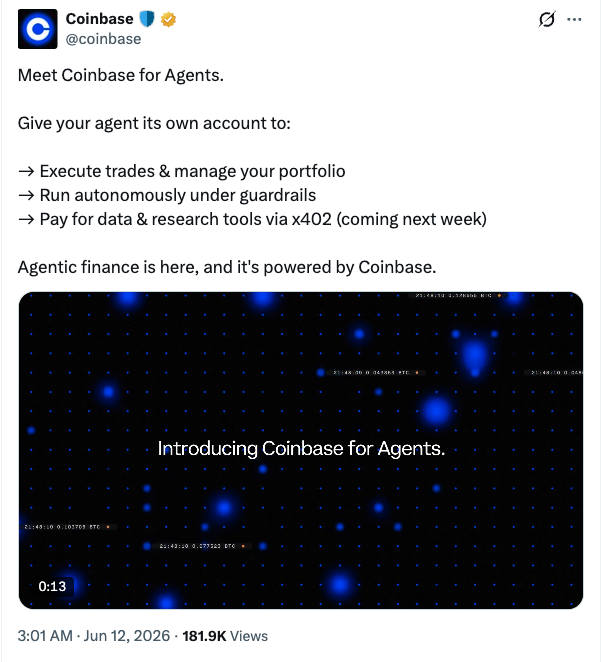
Crypto exchange Coinbase has launched a tool that allows artificial intelligence agents to make payments and trade crypto on behalf of users, as crypto companies look to ride a wave of interest in AI.
Coinbase said Thursday that it is launching Coinbase for Agents, which will allow AI models like ChatGPT and Claude to connect with a user’s exchange account and be prompted to make trades or execute strategies.
AI agents can also make payments using Coinbase’s AI payments protocol x402, allowing the bots to pay for data services to gather information for carrying out trading strategies without human intervention.
Crypto companies have been positioning the technology as a means to support the high-frequency microtransactions that agents typically carry out. AI agents have grown in popularity with the release of better models, with more traders trusting them to autonomously execute trading strategies.
Coinbase said the tool is available via both a model context protocol (MCP), allowing AI models to connect with a user account, and a command-line interface for developers.
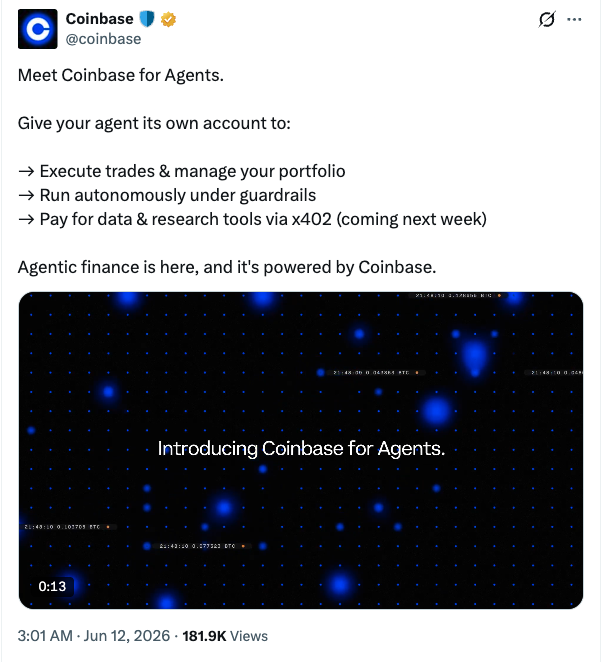
Source: Coinbase
The company said it also introduced Coinbase Advisor, an AI agent integrated into its app that it says is a US Securities and Exchange Commission and Commodity Futures Trading Commission-registered financial adviser that can give guidance on trades.
Coinbase said the tool could help users manage their crypto “without the constant manual oversight” and can undertake tasks like allocating funds to reward programs or making recurring buys.
“Imagine you want to dollar-cost average into ETH at the optimal time of day. Just tell your agent your target and timeframe. It can pull 30 days of hourly price data to identify when ETH historically trades lowest, set a recurring $20 market buy at that time, and schedule it to run daily for the next two weeks,” the company explained.
While many companies are pitching for investors to start using AI, a study published last month found that users of AI agents are losing money, and the agents themselves may not really be working alone.
Researchers at Pantera Capital, Stanford University, Ava Labs and the Initiative for Cryptocurrencies and Contracts studied over 925,000 token holders and found that agent treasuries made gains of $30 million on paper, while their token holders collectively lost $191.7 million.
It also found that many of the projects it studied “do not yet provide clear evidence of autonomous trade execution” with a “substantial share” of projects being “basic API integrations.”
Related: AI agents with crypto could escape and become ‘unstoppable,’ experts warn
Coinbase is the latest to bet that AI agents will interact with and transact across multiple services.
Stablecoin issuer Circle last month launched tools letting AI agents use wallets, discover services and make programmable payments with its token. Circle CEO Jeremy Allaire has predicted that billions of AI agents will use stablecoins within five years.
Earlier this month, the stablecoin and wallet infrastructure provider Crossmint launched a service that enabled AI agents to make payments using eligible Visa credit and debit cards.
Crypto investment firm Keyrock said in a report in May that AI agents had quickly created a “developed ecosystem,” and had settled $73 million across 176 million transactions between May 2025 and April 2026.
AI Eye: How AI just dramatically sped up the quantum risk for Bitcoin

South Korean tech giant LG Electronics is working with the Ethereum layer-2 network Arbitrum to build a blockchain-based advertising network aimed at serving the digital ad industry.
Arbitrum would give advertisers and publishers a shared database of ad inventory and track how customers interact with advertisements, with the company exploring how to bring the service to market this year, Fortune reported on Thursday.
“We are evaluating whether this approach can deliver meaningful value to advertisers, publishers and audiences,” said Samuel Byungsun Park, the head of LG Electronics’ blockchain research lab.

LG Group’s headquarters is in Seoul, South Korea. Source: Seoul Institute
Digital ad spend is estimated to have reached $679 billion in 2025, making up 68% of worldwide ad spend, according to global advertising giant Dentsu.
Traditional ad networks require costly intermediaries to automate and manage the buying and selling of ad space between advertisers and publishers.
A blockchain-based ad network would cut out intermediaries, aiming to make ad buys more efficient and provide transparency to advertisers about who their ads have reached.
“It means that you can basically run the market in an automated way in software,” Arbitrum co-founder Steven Goldfeder told Fortune. “You don’t need manual intervention.”
The price of Arbitrum (ARB) gained 5.44% on Thursday on news of the new layer-2 blockchain, which Arbitrum confirmed on X.
Cointelegraph contacted Arbitrum and LG Electronics for comment.
Related: Citi launches blockchain marketplace for private companies’ shares: Report
LG has been exploring opportunities in crypto for nearly a decade.
In 2018, LG CNS, a subsidiary of the LG Corporation, launched an in-house blockchain called “Monachain” aimed at businesses that could be used for digital authentication, payments and supply chain management.
LG Electronics developed a decentralized crypto wallet called Wallypto using the Hedera Hashgraph network at the height of the 2022 NFT boom. It served as a companion wallet for the LG Art Lab, an NFT platform that allowed users to display digital artwork on their TVs.
The NFT platform was shut down in June 2025, adding to a wave of NFT marketplace closures that year, while LG Electronics terminated Wallypto a few months later in September.
Magazine: Does ‘Paper Bitcoin’ mean there’s an unlimited supply of BTC?

TLDR
- Avalanche Treasury debuted on Nasdaq under ticker AVAT.
- AVAT closed down 38.1% at $1.85.
- The listing followed a $675 million SPAC merger.
- AVAX rose 1.27% to trade at $6.66.
- The firm plans to acquire over $1 billion in AVAX.
Avalanche Treasury Co. dropped sharply on its first day as a public company after completing a $675 million SPAC merger. The AVAX-focused treasury firm closed down 38.1% at $1.85 after debuting on Nasdaq under the ticker AVAT. Despite the decline, the stock gained 2.7% in after-hours trading as the company outlined plans to expand its presence across the Avalanche ecosystem.
Shares Slide Despite Avalanche Growth Strategy
According to the company, Avalanche Treasury intends to support long-term development across the Avalanche network. The firm said it will deploy capital into ecosystem investments, validator infrastructure, and enterprise partnerships. Executives described the strategy as a way to increase participation in blockchain infrastructure. The company also said the listing offers investors exposure to Avalanche-related growth opportunities. Nasdaq trading began on Thursday following completion of the merger transaction.
Chief executive Bart Smith outlined the company’s investment approach in a public statement. “AVAT intends to deploy capital deliberately to compound Avalanche’s ecosystem value over time,” Smith said. He added that the strategy resembles a corporate treasury model focused on ecosystem expansion. Smith said the company views Avalanche as a platform for institutional finance development. The firm plans to allocate capital across several areas of the network.
While AVAT shares declined, the underlying Avalanche token recorded modest gains. AVAX rose 1.27% during the past 24 hours and traded at $6.66. However, the token remained down 33.7% over the previous month. The stock and token moved in different directions during the company’s first session. Market activity followed the completion of the public listing.
Merger Created Large AVAX Acquisition Platform
As it was reported by Blockonomi earlier, Avalanche Treasury first announced its merger agreement with Mountain Lake Acquisition Corp. in October 2025. The transaction included projected treasury funding of $460 million. It also provided an initial discounted AVAX allocation worth $200 million through the Avalanche Foundation. Company executives said the structure supports future capital deployment plans. The merger officially closed before trading began this week.
The company previously stated its intention to acquire more than $1 billion worth of AVAX. Beyond token accumulation, management plans to support ecosystem infrastructure projects. Future investments may include enterprise integrations and protocol-level initiatives. The firm said these efforts are intended to strengthen Avalanche adoption. Capital allocation decisions will focus on opportunities within the network.
According to company data, Avalanche has attracted more than $1.02 billion in institutional funds. The network has also facilitated over $1.65 billion in tokenized real-world assets. Avalanche Treasury said more than 550 projects currently operate across the ecosystem. Those figures formed part of the company’s public market pitch. Management cited them when discussing future growth opportunities.
Wall Street And Crypto Veterans Back The Firm
Avalanche Treasury’s leadership team combines experience from traditional finance and digital assets. Smith spent more than two decades at Susquehanna and AllianceBernstein before joining the company. Chief operating officer Laine Litman previously helped scale Hidden Road Partners. Hidden Road later became part of Ripple through an acquisition. The company said those backgrounds support its institutional strategy.
The firm’s advisory and board network includes several blockchain industry figures. Ava Labs founder Emin Gün Sirer participates alongside Dragonfly partner Rob Hadick. Other advisors include Blockworks chief executive Jason Yanowitz and Aave founder Stani Kulechov. The company said these individuals contribute industry expertise and strategic guidance. Their involvement spans both blockchain and traditional finance sectors.
Avalanche Treasury has also secured backing from multiple financial and crypto firms. Supporters include Dragonfly, ParaFi Capital, VanEck, FalconX, Galaxy Digital, Pantera Capital, and Kraken. Hadick said Avalanche has become a preferred blockchain platform for enterprise use cases. He added that a public treasury vehicle could provide institutions with a new entry point. Avalanche Treasury joins other AVAX-focused treasury firms, including AVAX One Technology Ltd.

Binance Wallet’s SpaceX IPO campaign attracted about $557 million in subscription funds, showing strong onchain demand for tokenized exposure to the planned listing.
Summary
- Binance Wallet’s SpaceX IPO campaign drew about $557 million from 27,689 onchain addresses, Dune data showed.
- Smaller subscriptions dominated address count, but larger wallets provided most funds committed to the campaign.
- The campaign offers tokenized SpaceX exposure through SPCXx, but final allocations are not guaranteed.
Binance Wallet campaign draws $557M
Dune data showed that Binance Wallet’s SpaceX IPO subscription campaign attracted about $557 million from 27,689 addresses. The figures show strong demand for SPCXx, a tokenized security product tied to SpaceX’s potential IPO.
The campaign allows eligible users to submit subscription applications through Binance Wallet. The product is linked to xStocks and gives users a chance to receive SpaceX tokenized securities after issuance.
Binance listed 135 USDC as the indicative price per token, excluding fees. The campaign also carries a 5% underwriting fee and uses USDC as the supported subscription token.
The campaign does not promise final allocation. “Submitting a subscription application only represents an expression of subscription interest and does not guarantee that the application will receive an allocation of SPCXx,” Binance said.
Large wallets supply most funds
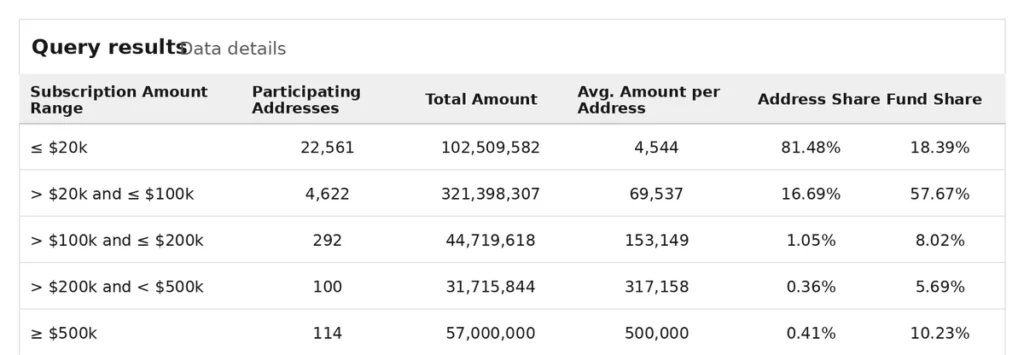
The Dune data showed that addresses contributing $20,000 or less made up 81.48% of participants. However, those smaller wallets accounted for only 18.39% of total subscription funds.
Addresses contributing more than $20,000 and up to $100,000 made up 16.69% of participants. This group supplied 57.67% of total funds, making it the largest source of capital in the campaign.
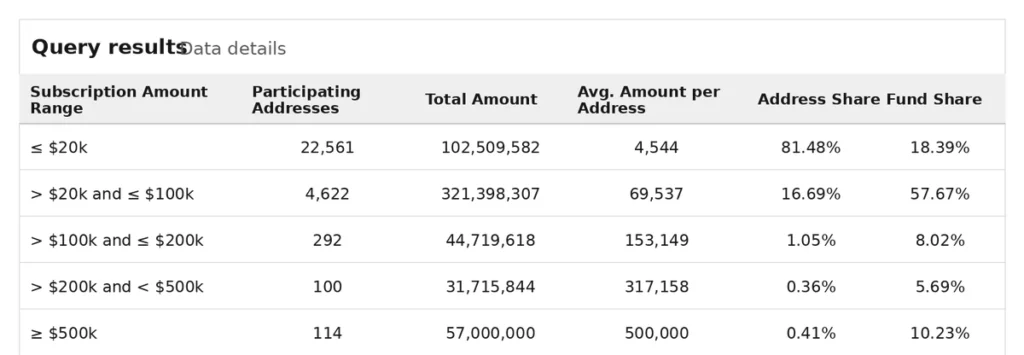
A smaller number of larger wallets also played a clear role. A total of 114 addresses contributed $500,000 or more, representing 10.23% of total funds.
The split shows broad address participation, but capital remained concentrated among bigger subscribers. That pattern is common in high-demand tokenized offerings, where smaller users raise participation numbers while larger wallets drive funding totals.
Tokenized SpaceX demand keeps rising
Binance said SPCXx is the first project under its Wallet IPO Campaign. The company said the campaign aims to connect traditional capital markets with onchain financial markets.
Users who receive final allocations will get SPCXx tokens after issuance is completed. Binance said the token is designed to offer exposure to price performance related to the SpaceX IPO.
The product does not represent direct ownership of SpaceX shares. Binance said holders do not receive voting rights, dividend rights, or other shareholder rights tied to normal equity ownership.
As previously reported by crypto.news, Binance recently expanded its tokenized stock lineup while teasing a future SpaceX-linked product. The exchange added tokenized products tied to Circle, Nvidia, Tesla, Micron, and Sandisk as demand for onchain stock exposure increased.
SpaceX IPO draws crypto market attention
SpaceX’s planned listing has become a major focus across crypto markets. Traders have also used pre-IPO perpetual contracts and other tokenized products to gain price exposure before a public listing.
SpaceX’s planned IPO has drawn heavy investor demand, raising questions about whether the listing could pull capital from digital assets, as previously reported. The offering has also driven activity across crypto exchanges offering SpaceX-linked products.
The Binance Wallet subscription data adds another measure of that demand. It shows that tokenized IPO products are drawing both small wallet participation and large capital commitments.
The next focus will be final allocation, token distribution, and how much committed USDC converts into SPCXx tokens. Binance has said the final offering price will be determined after the subscription period ends.


Blockchain is no longer just a story of Wall Street banks and brokers leveraging the technology to optimize finance. Now, corporates are embracing distributed ledger to streamline business operations.
LG Electronics, the South Korean consumer electronics giant spanning TVs, laptops, and home appliances, with annual global revenue of over $60 billion, is building a blockchain-based advertising network and has chosen Arbitrum to help build it out.
LG told Fortune it has developed its own layer-2 blockchain network in collaboration with Arbitrum, a layer 2 protocol that enables low-cost, high-speed transactions on Ethereum.
LG’s move is part of a broader trend of corporations seeing operational potential in blockchain technology. Walmart has used the technology to transform food safety and reduce the time needed to trace a product through its supply chain to just 2.2 seconds, down from over six days. IBM has built blockchain-based supply chain solutions, while Microsoft has integrated blockchain into its Azure cloud platform for enterprise applications.
HashKey Holdings Limited approved a share repurchase plan of up to HK$100 million as its Hong Kong-listed stock rebounded after recent pressure.
Summary
- HashKey approved a HK$100 million buyback using company funds, excluding global offering proceeds from repurchases.
- The buyback runs until the next AGM, with timing and price left to board discretion.
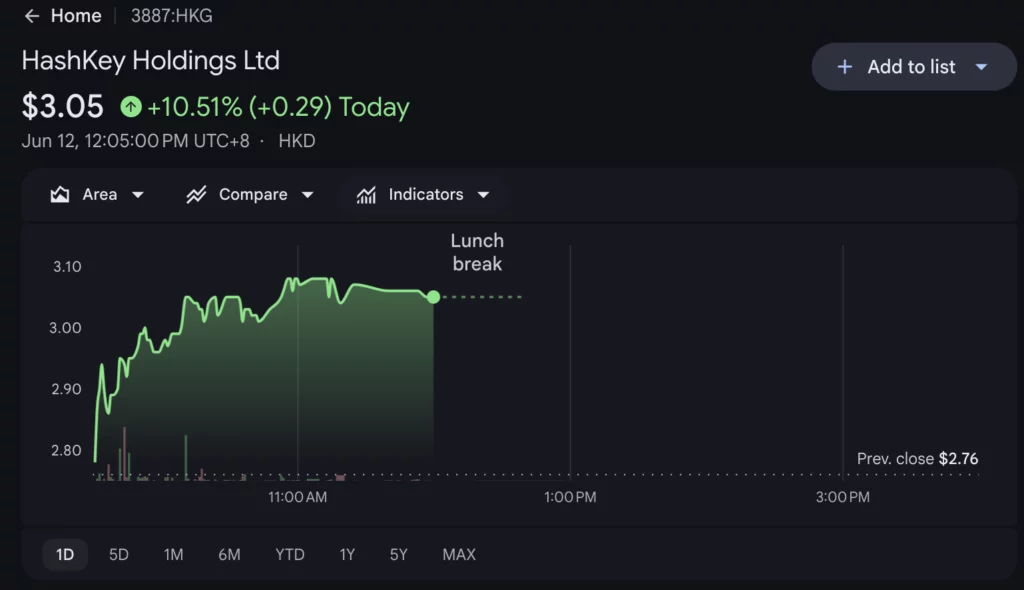
- HashKey shares rose 10.51% to HK$3.05 after trading near their 52-week low recently.
HashKey clears HK$100M buyback plan
HashKey Holdings Limited, listed under stock code 3887, said its board approved an on-market share repurchase plan after the mandate passed at its annual general meeting on June 11, 2026. The company plans to use up to HK$100 million of its own funds for the buyback.
The company said the funds will not include proceeds from its global offering. The repurchase period will run from the approval date until the end of the next annual general meeting.
HashKey said the buyback will follow Hong Kong Stock Exchange listing rules, the Takeovers Code, share buyback rules, Cayman Islands company law, and other rules that apply to the company. The board will decide the timing, size, and price of any repurchases based on market conditions.
The company also warned that the plan does not guarantee that shares will be bought back. It said the board will keep discretion over whether to carry out any repurchases.
Shares rebound after recent pressure
HashKey shares rose 10.51% to HK$3.05 in the latest trading data. The stock had recently traded near its 52-week low, adding attention to the company’s decision to approve a repurchase plan.
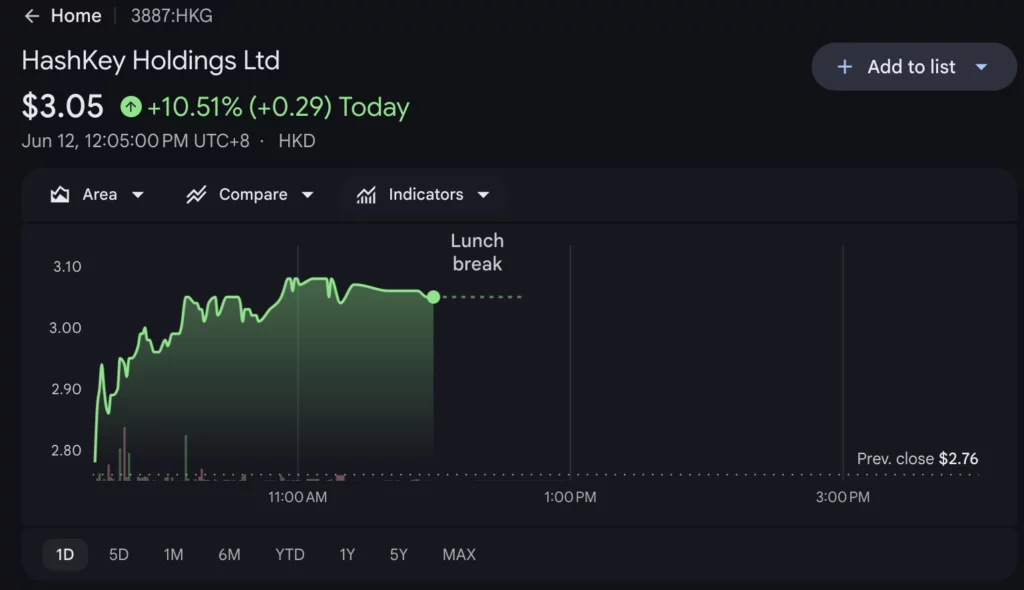
The stock’s latest move followed a weak period for the shares. Recent market data showed HashKey had declined sharply year-to-date before the rebound, while the stock also fell over the past week.
The buyback comes as the company tries to show confidence in its listed shares. “We believe that the current value of the Company’s shares does not fully reflect the Group’s strategic positioning and growth potential in the Web3 digital financial infrastructure space,” said Chairman and Chief Executive Officer Dr. Xiao Feng.
The company said it will fund the buyback from internal resources. That detail is important because it separates the repurchase plan from proceeds raised through the global offering.
Web3 expansion adds context
HashKey is one of Asia’s listed digital asset companies. Its business covers digital asset trading, technology services, investment management, on-chain services, and financial infrastructure.
As previously reported by crypto.news, HashKey launched its Hong Kong IPO with a targeted raise of up to $215 million. The company’s listing came as Hong Kong continued to expand its regulated digital asset market.
HashKey has also remained active after listing. Its asset management arm led a $40 million investment in SignalPlus, a crypto derivatives trading platform, with HashKey Group contributing $20 million in cash.
The group also signed a memorandum of understanding with Oceanus Group to develop stablecoin settlement infrastructure for global trade finance. The partnership targets digital settlement tools for cross-border commerce and trade finance.
Buyback follows Hong Kong crypto push
HashKey’s buyback comes during a wider shift in Hong Kong’s digital asset market. Local regulators have continued to expand rules for licensed crypto platforms, tokenized assets, and stablecoin activity.
As previously reported by crypto.news, Hong Kong has moved to widen crypto licensing and stablecoin rules as part of its 2026-27 financial policy agenda. The city has also supported work around tokenized bonds and regulated digital asset infrastructure.
For HashKey, the buyback places focus on both share performance and capital use. The company must now decide whether market conditions support actual repurchases under the approved mandate.
The plan gives the board room to act while keeping control over timing and price. Investors will watch whether HashKey uses the mandate, and how the stock reacts after its latest rebound.
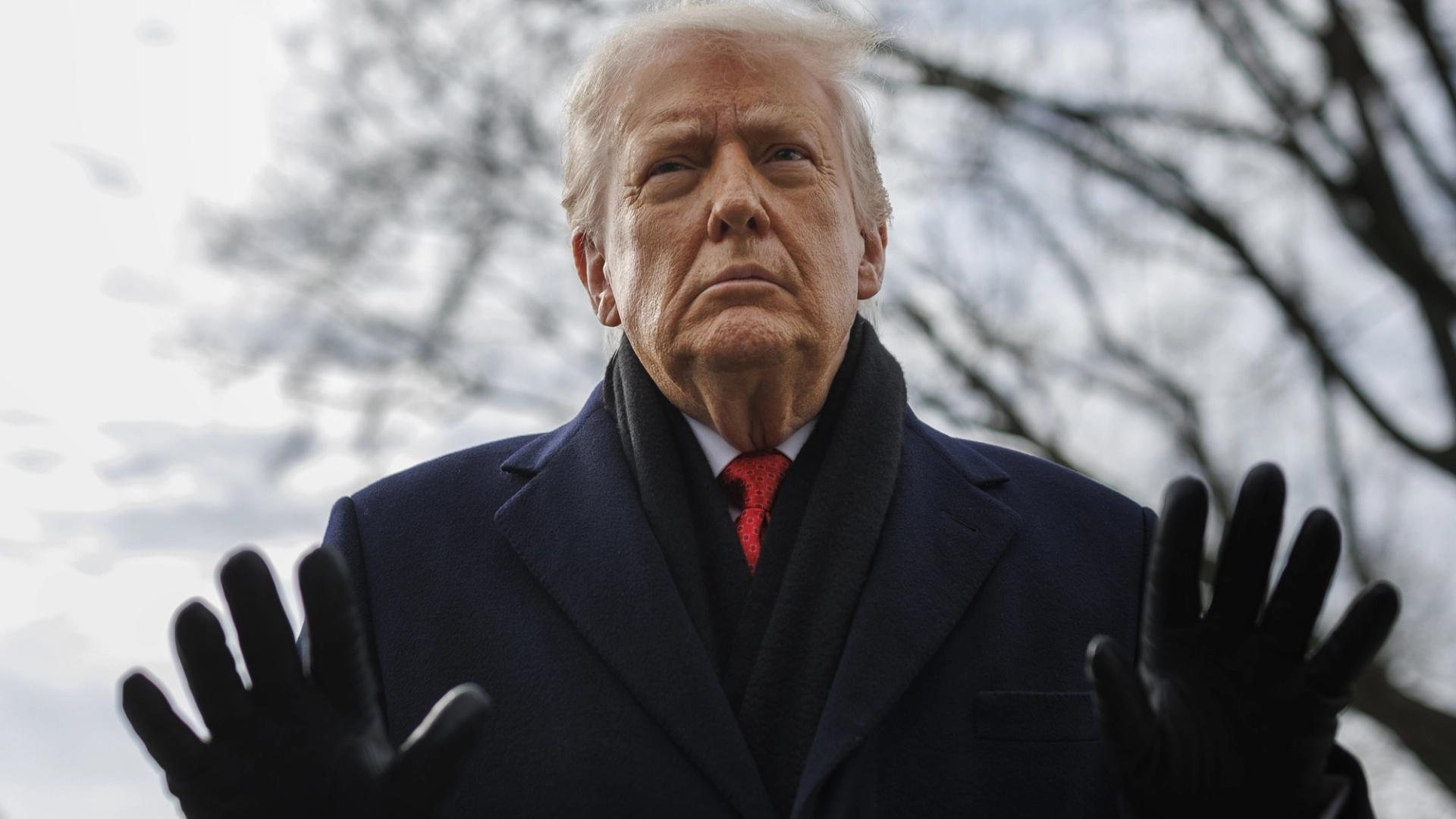
The risk-off mood that hammered crypto all week is reversing. Bitcoin is back in the green, and the trigger was a sudden de-escalation in the Iran war.
Bitcoin traded at $63,550 on Friday, up 1.6% on the day and 1.4% over the week, per CoinDesk data. Days earlier it had fallen to levels last seen in 2024 – below $60,000 – but has recovered and climbed back to a weekly gain.
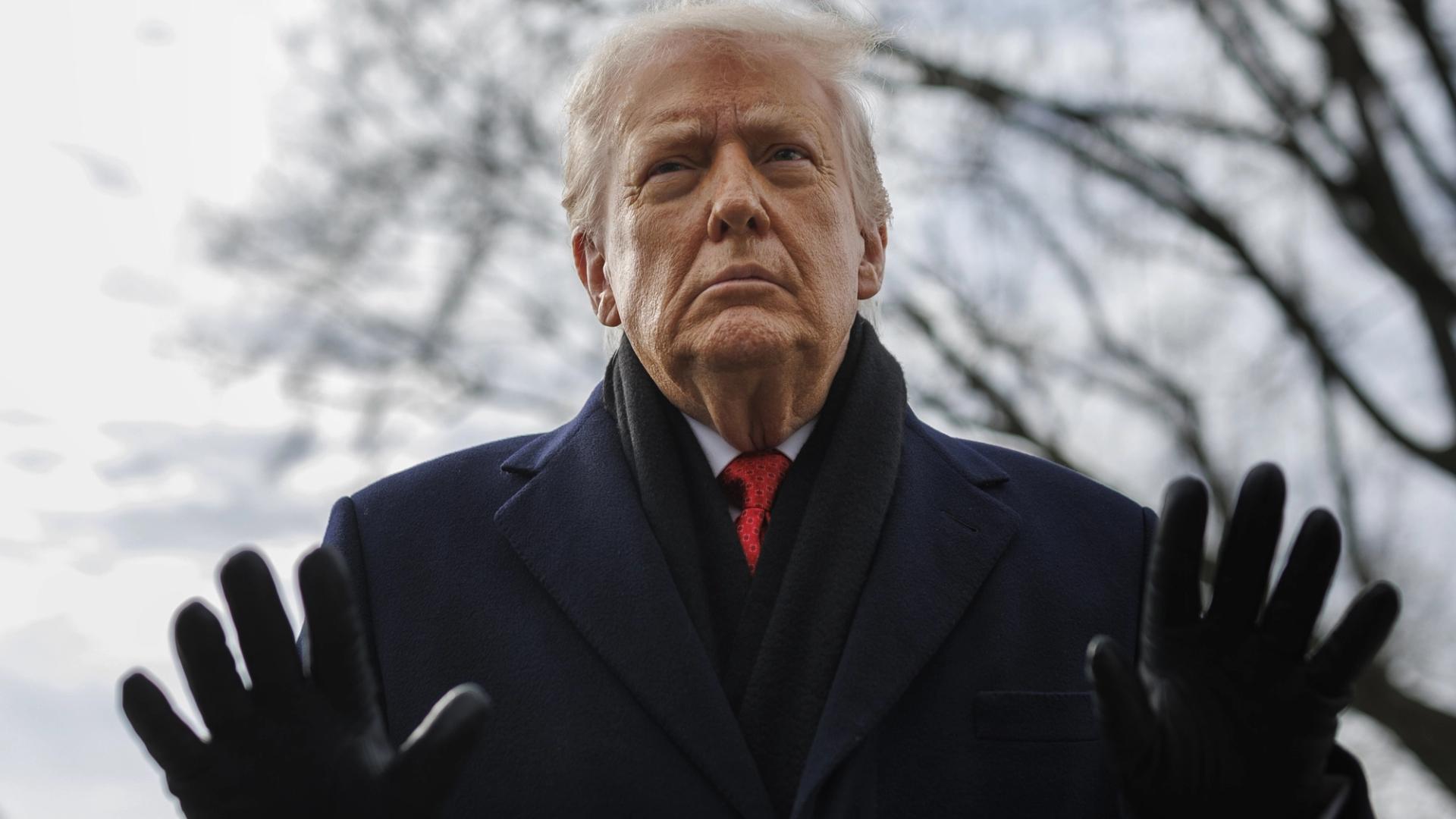
A key catalyst came as President Donald Trump said the US was close to a deal with Iran and that he had “ended the war with Iran today.” Markets read it as the end of a conflict that has whipsawed prices for more than 100 days. Brent crude dropped 2% to about $88.50 a barrel, while gold and silver prices surged.
The move extended to stocks. South Korea’s Kospi, a gauge for AI stocks, rose 8.4%. MSCI’s Asia Pacific index gained 3.5%, its biggest rise in two months. US stock futures pointed higher and European shares were set to open up 1.8%.

SEC rule rollback could unlock tokenized U.S. stock trading in DeFi
Ana Navarro unleashes explosive tirade on ex-Trump aide, Disney Channel star in epic on-air fight: 'Have you no shame?'

Woodside blocks Inpex with $567m Browse buy



-

 Fashion7 days ago
Weekend Open Thread: Evereve – Corporette.com
-
 Crypto World7 days ago
Jensen Huang Approves Samsung, SK Hynix, and Micron for NVIDIA (NVDA) HBM4 Memory Supply
-

 NewsBeat4 days ago
Alexander Zverev wins the French Open to finally earn a 1st Grand Slam title
-
 Entertainment5 days ago
The Best Mystery Series of All Time Is Surging on Streaming 30 Years After It Ended
-

 Crypto World4 days ago
Anatomy of the June crypto crash: Fed, Iran, Saylor
-

 Tech6 days ago
Suspicious Polyfill login prompts pop up on Toshiba, Muji websites
-
Crypto World5 days ago
Senator Cynthia Lummis Calls CLARITY Act the Most Consequential Financial Legislation of This Generation
-

 Tech7 days ago
Microsoft launches MXC, an OS-level sandbox for AI agents, with OpenAI and Nvidia already on board
-

 Tech5 days ago
Microsoft unveils seven homegrown AI models in new bid for ‘long term self-sufficiency’
-

 Business7 days ago
(VIDEO) Justin Bieber Delivers Surprise Happy Birthday Serenade to Diners at Los Angeles Mexican Restaurant
-
 NewsBeat5 days ago
Alexander Zverev conquers demons and outlasts Flavio Cobolli to win French Open for first major title
-

 Tech6 days ago
Von der Leyen’s AI envoy pick draws conflict-of-interest fire
-

 Business4 days ago
High Stakes for Wembanyama as New York Pushes for 3-0 Lead
-
 Business5 days ago
The Pain Points Taking a Fragile Tech Rally Down a Notch
-
 Crypto World4 days ago
Eli Lilly (LLY) Stock Surges 4% Following Breakthrough Sleep Apnea Trial Results
-

 Tech7 days ago
Meta steals a tactic from Tesla and builds data centers in tents
-

 Tech6 days ago
Hackers now exploit SolarWinds Serv-U flaw to crash servers
-
Crypto World7 days ago
LBank Surpasses 25 Million Users Worldwide as AFA Partnership Continues to Drive Global Growth
-

 Crypto World5 days ago
Trump’s AI Ownership Plan Could Benefit Anthropic at OpenAI’s Expense
-

 Tech4 days ago
Notion restores access to Anthropic after service disruption
You must be logged in to post a comment Login